
Aug 13, 2026
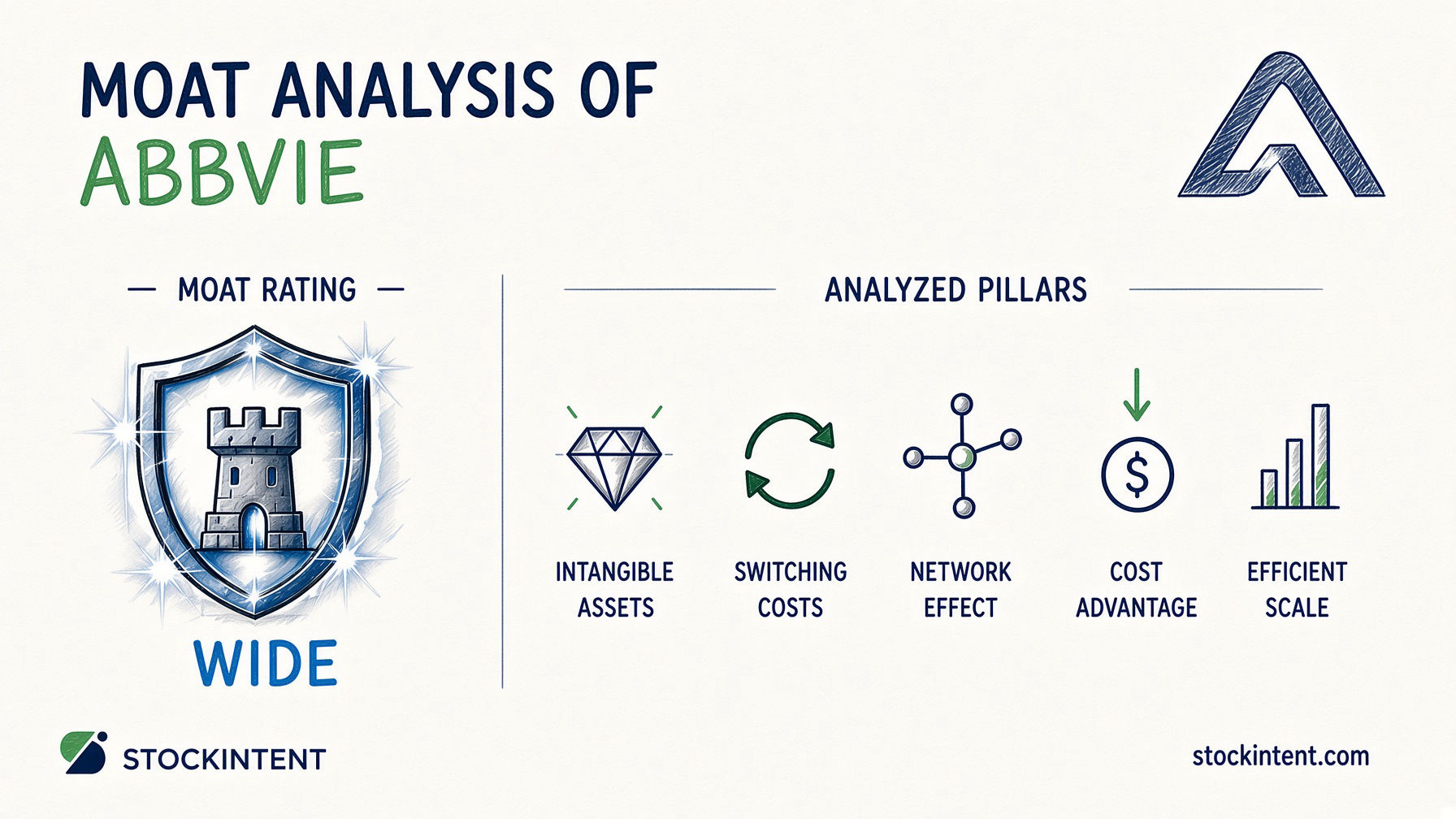
AbbVie carries a Wide economic moat with a Stable trend and Medium uncertainty. That verdict reflects a company that has largely rebuilt its competitive position after the Humira patent cliff, though the durability of that moat still depends on factors investors must continue to monitor.
Here's what matters most at a glance:
The moat matters because pharmaceutical competitive advantages are time-bound by definition. AbbVie reported Q1 2026 net revenue of $15.0 billion, up 12.4% on a reported basis, with adjusted EPS of $2.65 and full-year guidance raised to $14.08–$14.28. These numbers show the moat is currently translating into financial performance.
The question for long-term investors is whether that translation remains durable as the patent calendar advances.
Pharmaceutical moats work differently than tech platform moats. AbbVie's competitive advantages come from legal protection and clinical adoption, not from user networks or structural cost leadership. Understanding which pillars actually matter helps investors focus on what to monitor.
Intangible assets: strong
This is AbbVie's core moat. Patent protection and regulatory exclusivity around Skyrizi and Rinvoq extend well into the 2030s. Morningstar's 2026 upgrade to Wide moat cited this exact factor, noting AbbVie successfully navigated Humira losses and rebuilt around a diversified portfolio of protected assets. Find My Moat analysis points to Rinvoq's U.S. generic entry being delayed to April 2037, assuming pediatric exclusivity holds. That runway gives AbbVie more than a decade of protected pricing power for its key immunology franchise.
Pro Insight: In our experience analyzing pharmaceutical competitive positions, investors often overestimate network effects and underestimate patent duration. AbbVie's moat is almost entirely legal and clinical, long-dated exclusivity and physician habit, rather than platform effects. This means the moat is quantifiable through patent cliffs.
Switching costs: moderate to strong
Pharma switching costs aren't like software lock-in. They're more about clinical and commercial inertia. Physicians who achieve good patient outcomes with Skyrizi or Rinvoq face real friction changing therapies. Morningstar specifically highlights physician entrenchment in aesthetics and leading efficacy in large immunology indications. Beanvest's moat analysis adds that Botox's long product cycles and established patient relationships create additional stickiness. Payer formulary placement reinforces this, once a drug is preferred, switching requires documented failure or new clinical evidence.
Efficient scale: weak to moderate
AbbVie holds market-leading positions in immunology, which supports R&D and commercialization efficiency. But this isn't a true efficient-scale moat in the classic sense. The market can support multiple large competitors, and AbbVie's dominance comes from product quality and patent protection rather than structural cost advantages from market size. It's a supporting factor, not a standalone pillar.
Network effects: not material
None of the sources we reviewed identified meaningful network effects for AbbVie. One prescriber choosing Skyrizi doesn't directly make the drug more valuable for another prescriber. Evidence diffusion and payer discussions create some indirect benefits, but these don't meet the threshold of true network effects where user adoption directly increases value for all users.
Cost advantage: weak
AbbVie's profitability stems from premium pricing on protected drugs, not from lower manufacturing or operating costs versus peers. High margins and returns on capital are outcomes of the patent moat, not evidence of unique cost structure. When those patents expire, as Humira demonstrated, margins compress quickly regardless of operational efficiency.
The bottom line on pillars: AbbVie's moat is primarily intangible assets reinforced by clinical switching costs. The key dispute among analysts isn't whether these advantages exist, it's how durable they remain after the 2030s patent runway and how much policy pressure, biosimilar competition, and pipeline execution risk will erode them over time.
AbbVie's competitive advantages are translating into financial results you can see. In Q1 2026, the company reported $15.0 billion in net revenue, up 12.4% on a reported basis and 10.3% operationally. Adjusted EPS came in at $2.65, and management raised full-year guidance to $14.08–$14.28. These aren't just good numbers. They're evidence that the patent-protected franchise is converting clinical demand into cash flow right now.
The moat shows up most clearly in margins. Management forecasts 2026 gross margin above 84% and adjusted operating margin around 48.5% to 50%. That level of profitability reflects genuine pricing power from specialty drugs with limited substitutes, not operational efficiency alone. When a business can sustain economics like these, it's usually because competitors face real barriers to entry.
Growth tells the same story. Skyrizi and Rinvoq are projected to exceed $31 billion in combined sales by 2027, successfully replacing the Humira revenue base. In our view, this transition is the single most important proof point for AbbVie's moat. Rebuilding a blockbuster franchise after losing patent protection on the previous one is genuinely difficult. Most pharmaceutical companies fail at this. AbbVie appears to be pulling it off.
But the moat's benefits are not uniform across the business. Neuroscience is growing, yet it lacks the same depth of clinical evidence and physician adoption that immunology enjoys. And Humira's ongoing decline, which Reuters notes is being offset by newer products, is a live demonstration of what happens when patent protection expires. The moat works until it doesn't. That asymmetry is why we rate uncertainty as Medium despite the strong current numbers.
One more thing worth watching: AbbVie's own filings explicitly warn that patent expiration is typically followed by substitutes that can significantly reduce sales in a short amount of time. The company said this about its own business model. It confirms that even management views the moat as conditional and time-bound, not permanent.
AbbVie's moat trend is stable to widening. The company is not coasting on legacy advantages, and it's not backsliding into the Humira hole. Instead, it's actively rebuilding its competitive position around newer, better-protected franchises.
The widening case rests on two developments. First, Morningstar upgraded AbbVie to Wide moat in 2026, explicitly citing the successful post-Humira transition and a more diversified portfolio of long-dated assets. That's not a small call. Analysts had been skeptical AbbVie could replace a $20 billion franchise. Second, Skyrizi and Rinvoq are projected to exceed $31 billion in combined sales by 2027, which would make them larger than Humira ever was. When your replacement products outgrow the original, that's genuine moat expansion.
Stability is visible in the operating numbers. Q1 2026 revenue grew 12.4% and management raised full-year EPS guidance. The business is generating cash while rebalancing, not burning capital during transition.
Still, counterpressures exist. Humira continues to erode. AbbVie also remains exposed to payer pricing pressure and policy risk, including IRA-related negotiations that could compress net pricing on key assets. The moat isn't getting weaker today, but its long-term durability depends on how well AbbVie manages these headwinds.
Here's what we think investors should monitor:
Investors tracking these four indicators can organize these indicators into a watchlist with custom metrics views to monitor whether AbbVie's moat trend is improving or weakening over time.
We rate AbbVie's uncertainty as Medium.
The near term looks reasonably visible. Management raised full-year 2026 adjusted EPS guidance to $14.08–$14.28 after a strong Q1, and Skyrizi plus Rinvoq are projected to exceed $31 billion by 2027. Those are company-reported figures, not our estimates, and they anchor the center of the outcome range. For the next two to three years, AbbVie's revenue path is more forecastable than most large pharma companies because it has major products with demonstrated demand and explicit guidance.
But the tails widen quickly. AbbVie's own filings explicitly warn that patent expiration is typically followed by substitutes that can significantly reduce sales in a short amount of time. Our interpretation is that this will eventually apply to Skyrizi and Rinvoq, though the exact timing depends on litigation outcomes and regulatory decisions that remain unresolved.
There's also earnings volatility hiding beneath the headline numbers. In its Q1 2026 release, AbbVie explicitly stated that acquired IPR&D and milestone expenses cannot be reliably forecasted beyond Q1. That means even when top-line trends remain stable, the bottom line can swing. Investors who focus only on revenue growth may be surprised by margin compression from business development activity.
Product concentration amplifies everything. Skyrizi and Rinvoq are carrying the growth narrative. Any slowdown in uptake, pricing pressure from Medicare or IRA negotiations, or competitive clinical data would have an outsized effect. The 2037 Rinvoq patent date, based on pediatric exclusivity assumptions, is not guaranteed. Earlier generic entry would materially shorten the moat runway.
So the practical picture is this: the center of AbbVie's outcome range is moderately narrow for 2026–2028, but the tails are wide enough to matter. The moat is real today. Its durability depends on factors, patent litigation, pipeline execution, and policy risk, that are genuinely uncertain. That's exactly what a Medium uncertainty rating should capture.
AbbVie carries a Wide economic moat with a Stable to Widening trend and Medium uncertainty. That verdict reflects a company that has largely rebuilt its competitive position after the Humira patent cliff, though the durability of that moat still depends on factors investors should track continuously.
The two issues that matter most are straightforward. First, can Skyrizi and Rinvoq sustain their growth trajectory and defend their market share through the 2030s? The patent runway is long, but not infinite. Second, will AbbVie's pipeline and business development activity generate enough new assets to offset the next wave of exclusivity losses when they eventually arrive? Humira's sharp decline proved that even blockbuster franchises can erode quickly once substitutes enter the market.
What could change our view? Adverse patent litigation outcomes that shorten Rinvoq's protection, slower-than-expected immunology share gains, or sustained net pricing pressure from IRA negotiations or payer consolidation would all weaken the moat. Conversely, successful pipeline launches, additional indication expansions for Skyrizi or Rinvoq, or durable pricing power in aesthetics would support further widening.
For investors, the practical implication is clear. AbbVie is a quality compounder with genuine competitive advantages today, but it is not a passive holding. The moat requires active monitoring of patent calendars, clinical data readouts, and formulary positioning. The economics are excellent while they last, and the current runway is long enough to matter. The question is whether management can extend that runway faster than the clock runs down.
This content is for informational and educational purposes only and is not investment advice.
AbbVie carries a Wide economic moat with a Stable trend and Medium uncertainty. That verdict reflects a company that has largely rebuilt its competitive position after the Humira patent cliff, though the durability of that moat still depends on factors investors must continue to monitor.
Here's what matters most at a glance:
The moat matters because pharmaceutical competitive advantages are time-bound by definition. AbbVie reported Q1 2026 net revenue of $15.0 billion, up 12.4% on a reported basis, with adjusted EPS of $2.65 and full-year guidance raised to $14.08–$14.28. These numbers show the moat is currently translating into financial performance.
The question for long-term investors is whether that translation remains durable as the patent calendar advances.
Pharmaceutical moats work differently than tech platform moats. AbbVie's competitive advantages come from legal protection and clinical adoption, not from user networks or structural cost leadership. Understanding which pillars actually matter helps investors focus on what to monitor.
Intangible assets: strong
This is AbbVie's core moat. Patent protection and regulatory exclusivity around Skyrizi and Rinvoq extend well into the 2030s. Morningstar's 2026 upgrade to Wide moat cited this exact factor, noting AbbVie successfully navigated Humira losses and rebuilt around a diversified portfolio of protected assets. Find My Moat analysis points to Rinvoq's U.S. generic entry being delayed to April 2037, assuming pediatric exclusivity holds. That runway gives AbbVie more than a decade of protected pricing power for its key immunology franchise.
Pro Insight: In our experience analyzing pharmaceutical competitive positions, investors often overestimate network effects and underestimate patent duration. AbbVie's moat is almost entirely legal and clinical, long-dated exclusivity and physician habit, rather than platform effects. This means the moat is quantifiable through patent cliffs.
Switching costs: moderate to strong
Pharma switching costs aren't like software lock-in. They're more about clinical and commercial inertia. Physicians who achieve good patient outcomes with Skyrizi or Rinvoq face real friction changing therapies. Morningstar specifically highlights physician entrenchment in aesthetics and leading efficacy in large immunology indications. Beanvest's moat analysis adds that Botox's long product cycles and established patient relationships create additional stickiness. Payer formulary placement reinforces this, once a drug is preferred, switching requires documented failure or new clinical evidence.
Efficient scale: weak to moderate
AbbVie holds market-leading positions in immunology, which supports R&D and commercialization efficiency. But this isn't a true efficient-scale moat in the classic sense. The market can support multiple large competitors, and AbbVie's dominance comes from product quality and patent protection rather than structural cost advantages from market size. It's a supporting factor, not a standalone pillar.
Network effects: not material
None of the sources we reviewed identified meaningful network effects for AbbVie. One prescriber choosing Skyrizi doesn't directly make the drug more valuable for another prescriber. Evidence diffusion and payer discussions create some indirect benefits, but these don't meet the threshold of true network effects where user adoption directly increases value for all users.
Cost advantage: weak
AbbVie's profitability stems from premium pricing on protected drugs, not from lower manufacturing or operating costs versus peers. High margins and returns on capital are outcomes of the patent moat, not evidence of unique cost structure. When those patents expire, as Humira demonstrated, margins compress quickly regardless of operational efficiency.
The bottom line on pillars: AbbVie's moat is primarily intangible assets reinforced by clinical switching costs. The key dispute among analysts isn't whether these advantages exist, it's how durable they remain after the 2030s patent runway and how much policy pressure, biosimilar competition, and pipeline execution risk will erode them over time.
AbbVie's competitive advantages are translating into financial results you can see. In Q1 2026, the company reported $15.0 billion in net revenue, up 12.4% on a reported basis and 10.3% operationally. Adjusted EPS came in at $2.65, and management raised full-year guidance to $14.08–$14.28. These aren't just good numbers. They're evidence that the patent-protected franchise is converting clinical demand into cash flow right now.
The moat shows up most clearly in margins. Management forecasts 2026 gross margin above 84% and adjusted operating margin around 48.5% to 50%. That level of profitability reflects genuine pricing power from specialty drugs with limited substitutes, not operational efficiency alone. When a business can sustain economics like these, it's usually because competitors face real barriers to entry.
Growth tells the same story. Skyrizi and Rinvoq are projected to exceed $31 billion in combined sales by 2027, successfully replacing the Humira revenue base. In our view, this transition is the single most important proof point for AbbVie's moat. Rebuilding a blockbuster franchise after losing patent protection on the previous one is genuinely difficult. Most pharmaceutical companies fail at this. AbbVie appears to be pulling it off.
But the moat's benefits are not uniform across the business. Neuroscience is growing, yet it lacks the same depth of clinical evidence and physician adoption that immunology enjoys. And Humira's ongoing decline, which Reuters notes is being offset by newer products, is a live demonstration of what happens when patent protection expires. The moat works until it doesn't. That asymmetry is why we rate uncertainty as Medium despite the strong current numbers.
One more thing worth watching: AbbVie's own filings explicitly warn that patent expiration is typically followed by substitutes that can significantly reduce sales in a short amount of time. The company said this about its own business model. It confirms that even management views the moat as conditional and time-bound, not permanent.
AbbVie's moat trend is stable to widening. The company is not coasting on legacy advantages, and it's not backsliding into the Humira hole. Instead, it's actively rebuilding its competitive position around newer, better-protected franchises.
The widening case rests on two developments. First, Morningstar upgraded AbbVie to Wide moat in 2026, explicitly citing the successful post-Humira transition and a more diversified portfolio of long-dated assets. That's not a small call. Analysts had been skeptical AbbVie could replace a $20 billion franchise. Second, Skyrizi and Rinvoq are projected to exceed $31 billion in combined sales by 2027, which would make them larger than Humira ever was. When your replacement products outgrow the original, that's genuine moat expansion.
Stability is visible in the operating numbers. Q1 2026 revenue grew 12.4% and management raised full-year EPS guidance. The business is generating cash while rebalancing, not burning capital during transition.
Still, counterpressures exist. Humira continues to erode. AbbVie also remains exposed to payer pricing pressure and policy risk, including IRA-related negotiations that could compress net pricing on key assets. The moat isn't getting weaker today, but its long-term durability depends on how well AbbVie manages these headwinds.
Here's what we think investors should monitor:
Investors tracking these four indicators can organize these indicators into a watchlist with custom metrics views to monitor whether AbbVie's moat trend is improving or weakening over time.
We rate AbbVie's uncertainty as Medium.
The near term looks reasonably visible. Management raised full-year 2026 adjusted EPS guidance to $14.08–$14.28 after a strong Q1, and Skyrizi plus Rinvoq are projected to exceed $31 billion by 2027. Those are company-reported figures, not our estimates, and they anchor the center of the outcome range. For the next two to three years, AbbVie's revenue path is more forecastable than most large pharma companies because it has major products with demonstrated demand and explicit guidance.
But the tails widen quickly. AbbVie's own filings explicitly warn that patent expiration is typically followed by substitutes that can significantly reduce sales in a short amount of time. Our interpretation is that this will eventually apply to Skyrizi and Rinvoq, though the exact timing depends on litigation outcomes and regulatory decisions that remain unresolved.
There's also earnings volatility hiding beneath the headline numbers. In its Q1 2026 release, AbbVie explicitly stated that acquired IPR&D and milestone expenses cannot be reliably forecasted beyond Q1. That means even when top-line trends remain stable, the bottom line can swing. Investors who focus only on revenue growth may be surprised by margin compression from business development activity.
Product concentration amplifies everything. Skyrizi and Rinvoq are carrying the growth narrative. Any slowdown in uptake, pricing pressure from Medicare or IRA negotiations, or competitive clinical data would have an outsized effect. The 2037 Rinvoq patent date, based on pediatric exclusivity assumptions, is not guaranteed. Earlier generic entry would materially shorten the moat runway.
So the practical picture is this: the center of AbbVie's outcome range is moderately narrow for 2026–2028, but the tails are wide enough to matter. The moat is real today. Its durability depends on factors, patent litigation, pipeline execution, and policy risk, that are genuinely uncertain. That's exactly what a Medium uncertainty rating should capture.
AbbVie carries a Wide economic moat with a Stable to Widening trend and Medium uncertainty. That verdict reflects a company that has largely rebuilt its competitive position after the Humira patent cliff, though the durability of that moat still depends on factors investors should track continuously.
The two issues that matter most are straightforward. First, can Skyrizi and Rinvoq sustain their growth trajectory and defend their market share through the 2030s? The patent runway is long, but not infinite. Second, will AbbVie's pipeline and business development activity generate enough new assets to offset the next wave of exclusivity losses when they eventually arrive? Humira's sharp decline proved that even blockbuster franchises can erode quickly once substitutes enter the market.
What could change our view? Adverse patent litigation outcomes that shorten Rinvoq's protection, slower-than-expected immunology share gains, or sustained net pricing pressure from IRA negotiations or payer consolidation would all weaken the moat. Conversely, successful pipeline launches, additional indication expansions for Skyrizi or Rinvoq, or durable pricing power in aesthetics would support further widening.
For investors, the practical implication is clear. AbbVie is a quality compounder with genuine competitive advantages today, but it is not a passive holding. The moat requires active monitoring of patent calendars, clinical data readouts, and formulary positioning. The economics are excellent while they last, and the current runway is long enough to matter. The question is whether management can extend that runway faster than the clock runs down.
This content is for informational and educational purposes only and is not investment advice.