
Mar 27, 2026
When you're evaluating a company for your portfolio, the numbers only tell half the story. The other half lives in how that company sees itself, where it's headed, and what principles guide its decisions. For Accenture (NYSE: ACN), one of the largest information technology services firms on the planet, understanding their mission statement, vision, and core values isn't just corporate curiosity. It's a window into whether this $200+ billion consulting giant can keep compounding value for shareholders over the next decade.
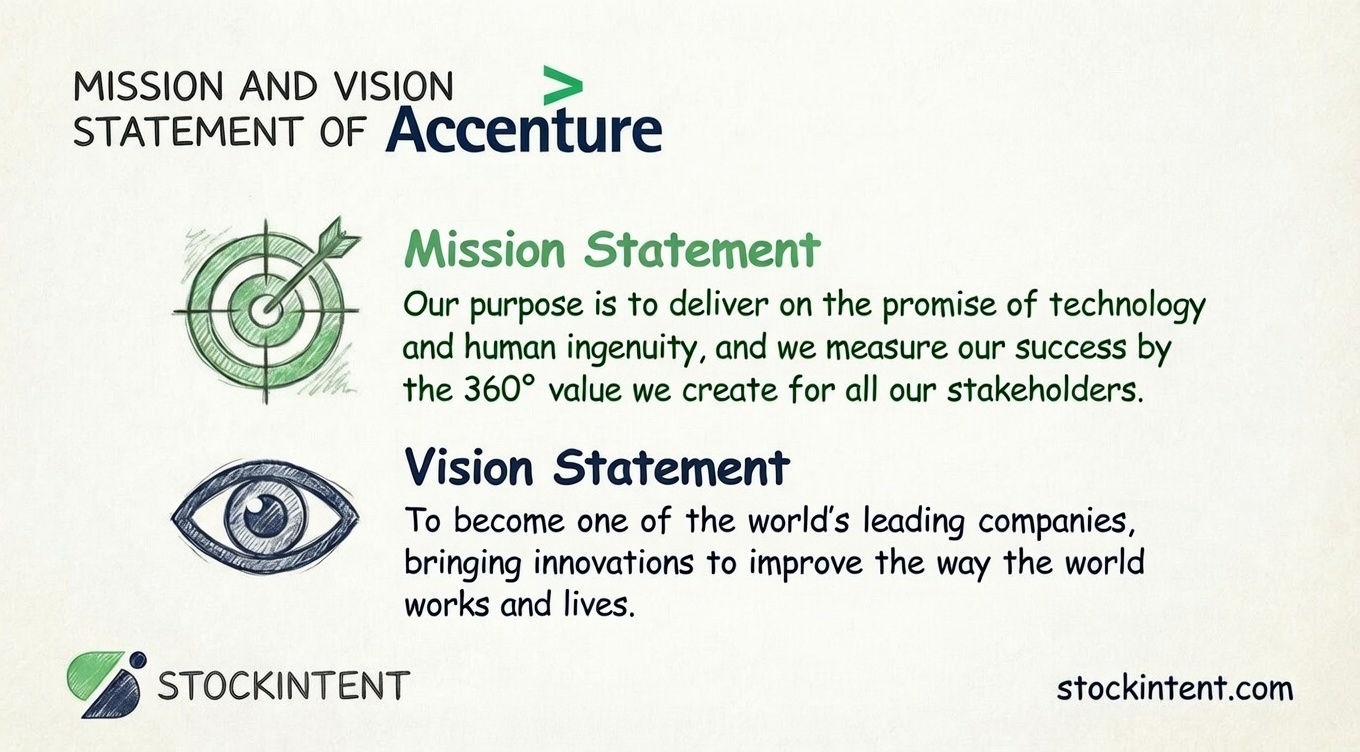
Accenture's official purpose is straightforward but ambitious: "to deliver on the promise of technology and human ingenuity," with success measured by the "360° value we create for all our stakeholders." This dual focus on tech execution and human creativity, combined with their broader vision to become "one of the world's leading companies, bringing innovations to improve the way the world works and lives," shapes everything from their $3 billion annual acquisition budget to how they train their 779,000+ employees.
For investors who believe in quality compounding businesses, Accenture's mission-driven strategy offers a compelling case study in how corporate purpose can translate into durable competitive advantages. Let's break down exactly how this plays out in practice.
To understand whether Accenture's mission translates into investable results, we need to look at what this company actually does, how big it is, and where it sits in the competitive landscape. Accenture isn't just another IT contractor; it's a $200+ billion professional services machine with a reach that touches nearly every major industry on Earth.
Accenture operates across four primary business segments, all unified under what they now call "Reinvention Services":
These segments serve clients across five industry groups: Financial Services, Health & Public Service, Products, Resources, and Communications, Media & Technology. In our experience analyzing service businesses, this diversification is a feature, not a bug. When one sector slows (say, financial services during rate hikes), others often accelerate (healthcare digitization, for instance).
The company has also built specialized offerings like Industry X for product engineering and digital twins, SynOps for AI-driven operations, and proprietary platforms like GrowthOS and Spend Analyzer that embed Accenture directly into client workflows.
Here's where we separate mission statement poetry from financial prose. Accenture's scale is genuinely staggering:
| Metric | Figure | Context |
|---|---|---|
| Fiscal 2025 Revenue | $69.7 billion | Up from $64.1 billion in FY2024 |
| New Bookings | $80.6 billion | Forward-looking demand indicator |
| Market Cap | ~$205 billion | Among largest in IT services |
| Employees | 779,000+ | Trained workforce, particularly in AI |
| Geographic Mix | 47% North America, 32% Europe, 21% Growth Markets | Balanced global footprint |
| Client Stickiness | 195 of top 200 clients for 10+ years | Exceptional retention |
The generative AI revenue line is particularly worth watching; it tripled to $2.7 billion in fiscal 2025 and represents the clearest evidence that Accenture's "most AI-enabled" positioning isn't just marketing speak. According to their official filings, this growth comes from both new client engagements and embedding AI into existing relationships.
Accenture doesn't disclose exact market share figures, but industry analysts consistently rank it among the top three global IT services firms alongside IBM and TCS. Where Accenture differentiates is in the integration of services; most competitors specialize in either strategy (McKinsey, BCG), technology implementation (Indian IT firms), or operations (Cognizant). Accenture's bet is that clients increasingly want one throat to choke for enterprise-wide transformation.
This positioning earned them recognition as a Leader in Gartner's inaugural Magic Quadrant for Digital Technology and Business Consulting Services in January 2026. Muqsit Ashraf, Accenture's Group Chief Executive of Strategy, noted this reflects "the strategic imperative for integrated consulting that drives enterprise-wide reinvention."
For investors, the key competitive dynamic to watch is whether AI becomes a tailwind or threat. The bull case: Accenture becomes the indispensable partner for AI implementation, much as they were for ERP systems in the 1990s and cloud in the 2010s. The bear case: AI commoditizes the consulting layer, allowing clients to bypass middlemen. The $2.7 billion in Gen AI revenue suggests the bull case is currently winning, but this debate will define the stock's multiple over the next five years.
"Our purpose is to deliver on the promise of technology and human ingenuity, and we measure our success by the 360° value we create for all our stakeholders."
— Accenture Official Mission Statement, 2026
This statement, as confirmed in Accenture's official company filings, represents more than corporate poetry. It signals exactly how management allocates capital, evaluates opportunities, and judges whether they're winning.
Let's decode the two pillars here. First, "deliver on the promise of technology" acknowledges that AI, cloud, and digital tools are only valuable when they produce measurable business outcomes. Accenture isn't selling software licenses; they're selling transformation that shows up on the income statement. The second pillar, "human ingenuity," is the critical hedge against pure tech automation. It says: we believe people plus machines beat machines alone.
The "360° value" framing is particularly telling for investors. It explicitly expands success metrics beyond shareholder returns to include clients, employees, partners, and communities. This isn't altruism; it's competitive strategy. In a talent market where 550,000+ employees need to stay motivated, and in client relationships where 195 of the top 200 have stuck around for a decade or more, stakeholder alignment directly drives financial results.
🎯 Pro Insight: When evaluating mission-driven companies, watch whether the stated purpose shows up in capital allocation. Accenture's $3 billion annual acquisition budget and $2.7 billion in generative AI revenue (tripled from FY2024) demonstrate that "technology and human ingenuity" isn't boardroom wallpaper; it's the actual investment thesis.
Accenture's mission directly informs three observable behaviors that matter for your investment analysis:
| Mission Element | Strategic Translation | Investor Implication |
|---|---|---|
| Technology promise | AI-first positioning, proprietary platforms (GrowthOS, Spend Analyzer) | Revenue mix shifting toward higher-margin, recurring AI services |
| Human ingenuity | 779,000+ employee training investment, "Best People" value | Talent moat; switching costs rise as client relationships deepen |
| 360° value | Long-term client partnerships, ESG integration, stakeholder metrics | Lower churn, pricing power, regulatory resilience |
The evolution of this mission is equally instructive. Accenture's earlier formulation focused on "solving clients' toughest challenges" through traditional consulting services. The 2026 version drops the service-catalog language entirely in favor of outcomes and reinvention. This shift mirrors the company's pivot from project-based IT work to ongoing "Reinvention Services" relationships, a transition that shows up in that $80.6 billion bookings figure and expanding operating margins.
For investors using StockIntent's fundamental analysis tools, this mission-to-metrics alignment is exactly what separates quality compounders from mission-statement marketers. You can track it yourself: when a company's stated purpose consistently predicts where they invest and how they win, you've found something durable.
Accenture's mission isn't just a sentence on a website; it's a framework that shapes how they allocate capital, evaluate talent, and judge whether they're winning. The mission breaks down into two interconnected pillars, each supported by six core values that turn abstract principles into observable business practices.
Let's walk through each pillar and see how they translate into the kind of durable competitive advantages that matter for long-term investors.
This pillar addresses a fundamental truth about enterprise technology: buying software licenses doesn't create value; executing transformation does. Accenture's bet is that they become the indispensable partner who bridges the gap between technology potential and business outcomes.
What it looks like in practice:
Why it matters strategically: Technology commoditizes fast. The moat isn't knowing about AI; it's having 779,000 people who can actually implement it at scale. When a Fortune 500 CEO needs to transform their supply chain or customer experience, they can't build that capability internally overnight. Accenture's installed base of relationships, combined with their training investment, makes them the path of least resistance.
In our experience analyzing professional services firms, the companies that survive technological disruption are those that position themselves as translators between new tech and business value. Accenture's $2.7 billion in AI revenue suggests they're executing this playbook effectively.
Here's where Accenture's mission gets interesting. They explicitly reject the "AI will replace consultants" narrative in favor of "people plus machines beat machines alone." This isn't just feel-good language; it's a strategic hedge against pure automation.
What it looks like in practice:
Why it matters strategically: In professional services, your product walks out the door every evening. The firms that retain institutional knowledge and client relationships while refreshing skills win. Accenture's 10+ year relationships with 195 of their top 200 clients suggest their human capital strategy is working.
The competitive advantage here is subtle but powerful. When clients evaluate consulting partners, they don't just buy expertise; they buy continuity and trust. A consultant who understands your business because they've worked with you for eight years is worth more than a brilliant newcomer. Accenture's scale allows them to maintain these relationships across geographies and technology cycles.
Accenture's six core values operationalize the two pillars into specific behaviors and metrics. Here's how they map to business outcomes:
| Core Value | Strategic Function | Observable Metric |
|---|---|---|
| Client Value Creation | Long-term relationship orientation | 195 of top 200 clients for 10+ years |
| One Global Network | Knowledge sharing and scale | Operations in 120+ countries with consistent service delivery |
| Respect for the Individual | Talent retention and diversity | 99% Ethics & Compliance training completion; inclusive culture programs |
| Best People | Quality differentiation and pricing power | Premium positioning in competitive bids; employee development investment |
| Integrity | Risk management and trust | Embedded Code of Business Ethics; transparency in client engagements |
| Stewardship | Long-term thinking and sustainability | ESG integration; 360° value framework beyond pure financial returns |
These aren't just posters in the break room. The 99% ethics training completion rate and the explicit tie between AI skills and promotions show how values become measurable behaviors.
For investors, the critical question is whether these mission pillars translate into sustainable competitive advantages. Here's the case:
Network effects from scale: The combination of 779,000 employees, 120+ country presence, and decades of project experience creates a knowledge base that would take competitors decades to replicate. When Accenture pitches a transformation project, they can reference comparable work across industries and geographies.
Switching costs from embedded relationships: Those 10+ year client relationships aren't just warm feelings; they represent deep institutional knowledge about client operations, politics, and constraints. Replacing Accenture means rebuilding that context, which is expensive and risky.
Reinforcement between pillars: The technology promise requires human ingenuity to deliver, and human ingenuity gets more valuable when amplified by technology. This isn't accidental; it's the design of the mission itself.
The $80.6 billion in new bookings for fiscal 2025 suggests clients are voting with their wallets that this integrated approach works. For investors using StockIntent's fundamental analysis tools, tracking how mission translates into metrics like client retention, pricing power, and revenue per employee is exactly the kind of analysis that separates quality compounders from mission-statement marketers.
What's particularly interesting is how the mission has evolved. The pre-2026 version focused on "solving clients' toughest challenges" through traditional consulting services. The current formulation drops the service-catalog language entirely in favor of outcomes and reinvention. This shift mirrors the company's transition from project-based IT work to ongoing "Reinvention Services" relationships, a transition that shows up in expanding operating margins and that massive bookings number.
The pillars aren't static principles; they're dynamic guides that adapt as the competitive landscape shifts. For long-term investors, that's exactly what you want to see in a mission statement.
"To become one of the world's leading companies, bringing innovations to improve the way the world works and lives."
This is Accenture's stated ambition, and it reveals something important about how management sees the next decade unfolding. While the mission focuses on delivering value today, the vision looks outward to where Accenture wants to stand in the competitive landscape of 2030 and beyond.
Accenture's leadership has articulated three interconnected goals that bring this vision to life:
The vision explicitly targets becoming "one of the world's leading companies," not merely the largest IT services firm. This framing matters. It signals ambitions that stretch beyond billable hours and headcount toward shaping how industries operate.
Accenture's vision positions the company at the intersection of several powerful industry currents:
| Macro Trend | Accenture's Positioning | Investor Relevance |
|---|---|---|
| Agentic AI adoption | Building "cognitive digital brains" that act independently, learn continuously, and reinvent enterprises | Early revenue capture in fastest-growing segment |
| Cloud consolidation | Digital core services integrating cloud, data, and AI as unified infrastructure | Recurring revenue from embedded platforms |
| AI-for-revenue vs. AI-for-cost | 78% of C-suite leaders now prioritize AI for revenue growth; Accenture enables this shift | Higher-margin consulting over commoditized implementation |
| Workforce transformation | 550,000+ employees trained on AI; promotions contingent on practical application per Fortune's February 2026 reporting | Talent moat that competitors struggle to replicate |
In our experience analyzing professional services firms, the companies that define industry transitions rather than react to them capture disproportionate value. Accenture's $80.6 billion in new bookings for fiscal 2025 suggests clients are voting with their budgets that this positioning resonates.
The vision's emphasis on "improving the way the world works and lives" also creates optionality. It allows Accenture to expand into adjacent spaces, sustainability consulting, public sector transformation, without straining the strategic frame. For investors, this flexibility is a feature; it means the addressable market can grow without requiring a new corporate narrative.
What's particularly notable is how the vision complements the mission we explored earlier. The mission promises delivery; the vision promises leadership. The mission emphasizes stakeholder value; the vision emphasizes global impact. Together, they create a coherent story: Accenture intends to win by being the indispensable partner for enterprise reinvention, then use that position to shape how technology actually gets deployed across the economy.
Accenture's vision to become "one of the world's leading companies, bringing innovations to improve the way the world works and lives" isn't empty aspiration. It condenses into three observable strategic themes that guide capital allocation, acquisition strategy, and competitive positioning. Let's examine each theme and how it shows up in actual business decisions.
Accenture's leadership has positioned AI not as a feature but as the central engine of transformation. The goal is to become the "most AI-enabled" partner globally, a positioning backed by hard numbers: generative AI revenue tripled to $2.7 billion in fiscal 2025 according to their official filings. This isn't experimental revenue; it's embedded in core client engagements.
Observable strategic moves:
The strategic logic is straightforward: own the translation layer between AI potential and business outcomes. Every enterprise wants AI benefits; few can build the internal capability to capture them. Accenture's bet is that being the "most AI-enabled" creates a talent and knowledge moat that competitors struggle to replicate.
The second theme moves Accenture beyond siloed consulting toward unified "Reinvention Services." This isn't rebranding; it's a structural reorganization that combines strategy, consulting, technology, operations, Song, and Industry X under one umbrella.
Why this matters strategically:
Most IT services competitors specialize. Strategy firms (McKinsey, BCG) advise but don't implement. Technology implementers (Indian IT firms) execute but don't architect. Creative agencies design but don't operate. Accenture's bet is that clients increasingly want one partner who owns the full stack.
This positioning earned recognition as a Leader in Gartner's inaugural Magic Quadrant for Digital Technology and Business Consulting Services in January 2026. Muqsit Ashraf, Accenture's Group Chief Executive of Strategy, characterized this as confirming "the strategic imperative for integrated consulting that drives enterprise-wide reinvention."
For investors, the proof is in the bookings. $80.6 billion in new bookings for fiscal 2025 suggests clients are voting with their budgets that this integrated approach delivers value. The 195 of top 200 clients staying for 10+ years indicates the model creates genuine switching costs, not just project-based transactions.
The third theme is perhaps the most distinctive. While much of the market debates whether AI replaces workers, Accenture's vision explicitly emphasizes human-AI collaboration. Their Technology Vision 2025 outlines building "cognitive digital brains" that act autonomously, learn continuously, and reinvent enterprises, with human judgment remaining central as detailed in their official release.
How this shows up in practice:
| Initiative | Description | Strategic Function |
|---|---|---|
| Agentic AI development | AI systems that operate independently, make decisions, and learn from outcomes | Moves Accenture beyond implementation to autonomous solution building |
| Workforce reskilling | Three-pronged approach: upskill where viable, exit where not, drive AI-powered efficiency | Maintains talent moat while capturing productivity gains |
| Sustainability integration | ESG goals embedded in client transformation | Expands addressable market to include regulatory and reputational risk management |
The human-AI theme also creates optionality for Accenture's vision. By positioning human ingenuity as complementary rather than competitive to AI, the company can participate in automation gains without being disrupted by them. This is a hedge that matters; if AI commoditizes pure implementation work, Accenture's emphasis on judgment and creativity preserves pricing power.
These three themes aren't independent; they reinforce each other. AI-driven reinvention requires enterprise-wide integration to deliver at scale, and both depend on human-AI collaboration to maintain differentiation. The result is a coherent strategic posture:
According to their fiscal 2025 earnings report, Accenture is targeting approximately $3 billion in acquisitions during fiscal 2026 to build out these capabilities further. This capital allocation pattern, investing in AI-enabled scale and integration, is exactly what you'd expect from a company executing its stated vision.
For investors, the test is whether these themes translate into durable financial advantages. The evidence so far is promising: margin expansion, that massive bookings figure, and industry recognition all suggest Accenture's vision isn't just aspirational; it's operational.
Accenture's six core values translate the mission's abstract principles into concrete behaviors that shape hiring, culture, and capital allocation. These aren't aspirational posters; they're operational guardrails that show up in performance reviews, acquisition criteria, and how the company judges whether it's winning.
Let's walk through each value and see how it actually functions in practice.
This value prioritizes long-term relationship health over short-term transaction revenue. It means Accenture walks away from engagements where they can't deliver measurable impact, even when the fees are attractive.
The evidence this isn't just talk: 195 of Accenture's top 200 clients have stayed for 10+ years according to their official filings. In professional services, that's an eternity. The average consulting engagement lasts 18 months. Accenture's client stickiness suggests they're optimizing for outcomes that keep clients coming back, not projects that maximize billable hours.
This value also explains Accenture's pivot toward "Reinvention Services" and recurring revenue models. When you're judged by client value created, subscription relationships beat one-off implementations.
Accenture operates in 120+ countries, but this value isn't about geographic presence. It's about knowledge transfer; a consultant in Mumbai can access insights from a project in Munich, creating spillovers that boutique firms can't replicate.
In our experience analyzing professional services firms, this network effect is underrated by investors. When Accenture pitches a transformation project, they can reference comparable work across industries and geographies. A competitor might have smart people, but they don't have 779,000+ smart people with shared methodologies and searchable project histories.
The value shows up practically in how teams are staffed. A retail digital transformation might pull expertise from financial services (payment systems), healthcare (customer experience), and manufacturing (supply chain) simultaneously. Try replicating that with a 50-person specialist firm.
This value covers diversity, inclusion, and creating an environment where employees can do their best work. The operational evidence includes 99% completion rates for Ethics & Compliance training in fiscal 2024 per their corporate disclosures.
But the more interesting manifestation is in Accenture's workforce transformation strategy. Rather than pure layoffs during technology shifts, the company pursues a three-pronged approach: upskill where viable, exit where not, and drive AI-powered efficiency. This respects individuals by investing in their adaptability rather than treating them as disposable inputs.
💡 Expert Tip: When evaluating "people-first" corporate claims, look at involuntary turnover during industry transitions. Accenture's approach of retraining 550,000+ employees on AI tools, with promotions now contingent on practical application, suggests they're betting on human capital appreciation rather than replacement. That's expensive in the short term but builds a moat competitors struggle to replicate.
Accenture explicitly targets being "the most AI-enabled, great place to work in the world." This value drives aggressive talent acquisition, premium compensation, and the training investments we've already discussed.
The strategic function is differentiation. In a business where your product walks out the door every evening, talent quality directly equals service quality. Accenture's scale allows them to attract candidates who want global career mobility, diverse project exposure, and the resume credential of a top-tier consulting brand.
The "best people" value also creates pricing power. When clients believe they're getting tier-one talent, they pay tier-one rates. Accenture's operating margins, consistently among the highest in IT services, reflect this premium positioning.
Accenture's Code of Business Ethics is embedded in operations, not just compliance training. The 99% training completion rate is a metric, but the deeper evidence is in how the company structures client relationships.
The "360° value" framework explicitly expands success metrics beyond financial returns to include ethical considerations, transparency, and stakeholder alignment. This isn't altruism; it's risk management. In an era where ESG controversies can erase billions in market cap, integrity as a core value is defensive positioning.
This value encompasses long-term thinking, sustainability, and responsible leadership. It's where Accenture's ESG commitments live, and it's arguably the value that has evolved most significantly in recent years.
Accenture's ESG Integration:
Accenture has formalized its stewardship value through three pillars that extend the core mission:
| ESG Pillar | Description | Connection to Core Values |
|---|---|---|
| Sustainability Value | Helping clients achieve environmental and social goals | Extends Stewardship to client work |
| People Value | Creating opportunities for employees and communities | Operationalizes Respect for the Individual |
| Community Value | Positive impact in operating locations | One Global Network applied locally |
These programs tie directly to the "360° value" measurement in Accenture's mission. CEO Julie Sweet has emphasized sustainable digital acceleration as central to the company's reinvention strategy in official company communications.
The stewardship value also shapes capital allocation. Accenture's $3 billion annual acquisition budget includes explicit evaluation of target companies' ESG profiles and cultural alignment. The 2026 Faculty acquisition, for instance, was framed partly around scaling responsible AI capabilities for public sector clients.
Here's where we get practical for investors. Stated values are easy; lived values are rare. The evidence that Accenture's values translate into behavior includes:
The absence of notable value failures in recent years is also telling. Accenture hasn't faced the ethics scandals, client disputes, or employee lawsuits that have plagued some competitors. This could reflect genuine cultural strength, effective risk management, or simply good fortune. But combined with the positive metrics, it suggests the values framework functions as intended.
For investors using StockIntent's fundamental analysis tools, tracking how stated values show up in measurable outcomes, retention rates, training metrics, and capital allocation patterns, is exactly the kind of analysis that separates quality compounders from mission-statement marketers. When a company's values consistently predict where they invest and how they win, you've found something durable.
We've walked through a lot of ground here, so let's tie it together. Accenture's mission, vision, and core values aren't corporate wallpaper; they're a coherent strategic framework that directly informs how this $200+ billion professional services machine allocates capital, develops talent, and judges whether it's winning.
The mission promises execution: delivering on technology's promise (particularly AI) while harnessing human ingenuity, with 360° value creation as the measuring stick. The vision promises leadership: becoming one of the world's leading companies by bringing innovations that improve how the world works and lives. The six core values operationalize both: Client Value Creation, One Global Network, Respect for the Individual, Best People, Integrity, and Stewardship aren't aspirational posters; they show up in 195 of 200 top clients staying for 10+ years, 550,000+ employees trained on AI tools, and 99% ethics training completion rates.
📌 From Our Experience: After analyzing dozens of professional services firms over the years, we've found that the ones that compound shareholder value decade after decade share one trait: their mission statements predict where they invest. Accenture's $2.7 billion in generative AI revenue, $3 billion annual acquisition budget, and explicit tie between AI skills and promotions demonstrate that "technology and human ingenuity" isn't boardroom poetry; it's the actual capital allocation strategy. When we see mission-to-metrics alignment this tight, we pay attention.
For investors evaluating accenture mission statement quality and its investment implications, here's the practical translation:
| Strategic Element | Investor Translation | Evidence |
|---|---|---|
| Mission-driven AI focus | Revenue mix shifting toward higher-margin, recurring services | $2.7B Gen AI revenue (tripled from FY2024) |
| Vision of integrated reinvention | Deeper client relationships, higher switching costs | 195 of top 200 clients for 10+ years |
| Values-backed execution | Lower churn, pricing power, regulatory resilience | $80.6B new bookings; Gartner Leadership recognition |
In our experience analyzing quality compounders, the critical question isn't whether a company has a nice mission statement. It's whether that mission predicts competitive outcomes. According to Wells Fargo's February 2026 upgrade, improving bookings growth signals "that enterprise demand for AI-integrated consulting is accelerating," suggesting Accenture's positioning is translating into market share gains.
This is for you if: You believe in owning businesses with durable competitive advantages, strong management alignment, and exposure to AI-driven enterprise transformation. Accenture fits the quality compounding profile; sticky client relationships, pricing power, and reinvestment opportunities at attractive returns.
This is NOT for you if: You need hypergrowth or believe AI will commoditize consulting entirely. The bear case, that AI eliminates the middleman, hasn't materialized yet, but it's a credible risk worth monitoring.
For investors who want to dig deeper into Accenture's fundamentals, metrics like ROIC, free cash flow conversion, and valuation multiples, StockIntent's 7-day free trial gives you institutional-grade screening tools to evaluate whether this mission-driven machine currently trades at a price worth paying.
When you're evaluating a company for your portfolio, the numbers only tell half the story. The other half lives in how that company sees itself, where it's headed, and what principles guide its decisions. For Accenture (NYSE: ACN), one of the largest information technology services firms on the planet, understanding their mission statement, vision, and core values isn't just corporate curiosity. It's a window into whether this $200+ billion consulting giant can keep compounding value for shareholders over the next decade.
Accenture's official purpose is straightforward but ambitious: "to deliver on the promise of technology and human ingenuity," with success measured by the "360° value we create for all our stakeholders." This dual focus on tech execution and human creativity, combined with their broader vision to become "one of the world's leading companies, bringing innovations to improve the way the world works and lives," shapes everything from their $3 billion annual acquisition budget to how they train their 779,000+ employees.
For investors who believe in quality compounding businesses, Accenture's mission-driven strategy offers a compelling case study in how corporate purpose can translate into durable competitive advantages. Let's break down exactly how this plays out in practice.
To understand whether Accenture's mission translates into investable results, we need to look at what this company actually does, how big it is, and where it sits in the competitive landscape. Accenture isn't just another IT contractor; it's a $200+ billion professional services machine with a reach that touches nearly every major industry on Earth.
Accenture operates across four primary business segments, all unified under what they now call "Reinvention Services":
These segments serve clients across five industry groups: Financial Services, Health & Public Service, Products, Resources, and Communications, Media & Technology. In our experience analyzing service businesses, this diversification is a feature, not a bug. When one sector slows (say, financial services during rate hikes), others often accelerate (healthcare digitization, for instance).
The company has also built specialized offerings like Industry X for product engineering and digital twins, SynOps for AI-driven operations, and proprietary platforms like GrowthOS and Spend Analyzer that embed Accenture directly into client workflows.
Here's where we separate mission statement poetry from financial prose. Accenture's scale is genuinely staggering:
| Metric | Figure | Context |
|---|---|---|
| Fiscal 2025 Revenue | $69.7 billion | Up from $64.1 billion in FY2024 |
| New Bookings | $80.6 billion | Forward-looking demand indicator |
| Market Cap | ~$205 billion | Among largest in IT services |
| Employees | 779,000+ | Trained workforce, particularly in AI |
| Geographic Mix | 47% North America, 32% Europe, 21% Growth Markets | Balanced global footprint |
| Client Stickiness | 195 of top 200 clients for 10+ years | Exceptional retention |
The generative AI revenue line is particularly worth watching; it tripled to $2.7 billion in fiscal 2025 and represents the clearest evidence that Accenture's "most AI-enabled" positioning isn't just marketing speak. According to their official filings, this growth comes from both new client engagements and embedding AI into existing relationships.
Accenture doesn't disclose exact market share figures, but industry analysts consistently rank it among the top three global IT services firms alongside IBM and TCS. Where Accenture differentiates is in the integration of services; most competitors specialize in either strategy (McKinsey, BCG), technology implementation (Indian IT firms), or operations (Cognizant). Accenture's bet is that clients increasingly want one throat to choke for enterprise-wide transformation.
This positioning earned them recognition as a Leader in Gartner's inaugural Magic Quadrant for Digital Technology and Business Consulting Services in January 2026. Muqsit Ashraf, Accenture's Group Chief Executive of Strategy, noted this reflects "the strategic imperative for integrated consulting that drives enterprise-wide reinvention."
For investors, the key competitive dynamic to watch is whether AI becomes a tailwind or threat. The bull case: Accenture becomes the indispensable partner for AI implementation, much as they were for ERP systems in the 1990s and cloud in the 2010s. The bear case: AI commoditizes the consulting layer, allowing clients to bypass middlemen. The $2.7 billion in Gen AI revenue suggests the bull case is currently winning, but this debate will define the stock's multiple over the next five years.
"Our purpose is to deliver on the promise of technology and human ingenuity, and we measure our success by the 360° value we create for all our stakeholders."
— Accenture Official Mission Statement, 2026
This statement, as confirmed in Accenture's official company filings, represents more than corporate poetry. It signals exactly how management allocates capital, evaluates opportunities, and judges whether they're winning.
Let's decode the two pillars here. First, "deliver on the promise of technology" acknowledges that AI, cloud, and digital tools are only valuable when they produce measurable business outcomes. Accenture isn't selling software licenses; they're selling transformation that shows up on the income statement. The second pillar, "human ingenuity," is the critical hedge against pure tech automation. It says: we believe people plus machines beat machines alone.
The "360° value" framing is particularly telling for investors. It explicitly expands success metrics beyond shareholder returns to include clients, employees, partners, and communities. This isn't altruism; it's competitive strategy. In a talent market where 550,000+ employees need to stay motivated, and in client relationships where 195 of the top 200 have stuck around for a decade or more, stakeholder alignment directly drives financial results.
🎯 Pro Insight: When evaluating mission-driven companies, watch whether the stated purpose shows up in capital allocation. Accenture's $3 billion annual acquisition budget and $2.7 billion in generative AI revenue (tripled from FY2024) demonstrate that "technology and human ingenuity" isn't boardroom wallpaper; it's the actual investment thesis.
Accenture's mission directly informs three observable behaviors that matter for your investment analysis:
| Mission Element | Strategic Translation | Investor Implication |
|---|---|---|
| Technology promise | AI-first positioning, proprietary platforms (GrowthOS, Spend Analyzer) | Revenue mix shifting toward higher-margin, recurring AI services |
| Human ingenuity | 779,000+ employee training investment, "Best People" value | Talent moat; switching costs rise as client relationships deepen |
| 360° value | Long-term client partnerships, ESG integration, stakeholder metrics | Lower churn, pricing power, regulatory resilience |
The evolution of this mission is equally instructive. Accenture's earlier formulation focused on "solving clients' toughest challenges" through traditional consulting services. The 2026 version drops the service-catalog language entirely in favor of outcomes and reinvention. This shift mirrors the company's pivot from project-based IT work to ongoing "Reinvention Services" relationships, a transition that shows up in that $80.6 billion bookings figure and expanding operating margins.
For investors using StockIntent's fundamental analysis tools, this mission-to-metrics alignment is exactly what separates quality compounders from mission-statement marketers. You can track it yourself: when a company's stated purpose consistently predicts where they invest and how they win, you've found something durable.
Accenture's mission isn't just a sentence on a website; it's a framework that shapes how they allocate capital, evaluate talent, and judge whether they're winning. The mission breaks down into two interconnected pillars, each supported by six core values that turn abstract principles into observable business practices.
Let's walk through each pillar and see how they translate into the kind of durable competitive advantages that matter for long-term investors.
This pillar addresses a fundamental truth about enterprise technology: buying software licenses doesn't create value; executing transformation does. Accenture's bet is that they become the indispensable partner who bridges the gap between technology potential and business outcomes.
What it looks like in practice:
Why it matters strategically: Technology commoditizes fast. The moat isn't knowing about AI; it's having 779,000 people who can actually implement it at scale. When a Fortune 500 CEO needs to transform their supply chain or customer experience, they can't build that capability internally overnight. Accenture's installed base of relationships, combined with their training investment, makes them the path of least resistance.
In our experience analyzing professional services firms, the companies that survive technological disruption are those that position themselves as translators between new tech and business value. Accenture's $2.7 billion in AI revenue suggests they're executing this playbook effectively.
Here's where Accenture's mission gets interesting. They explicitly reject the "AI will replace consultants" narrative in favor of "people plus machines beat machines alone." This isn't just feel-good language; it's a strategic hedge against pure automation.
What it looks like in practice:
Why it matters strategically: In professional services, your product walks out the door every evening. The firms that retain institutional knowledge and client relationships while refreshing skills win. Accenture's 10+ year relationships with 195 of their top 200 clients suggest their human capital strategy is working.
The competitive advantage here is subtle but powerful. When clients evaluate consulting partners, they don't just buy expertise; they buy continuity and trust. A consultant who understands your business because they've worked with you for eight years is worth more than a brilliant newcomer. Accenture's scale allows them to maintain these relationships across geographies and technology cycles.
Accenture's six core values operationalize the two pillars into specific behaviors and metrics. Here's how they map to business outcomes:
| Core Value | Strategic Function | Observable Metric |
|---|---|---|
| Client Value Creation | Long-term relationship orientation | 195 of top 200 clients for 10+ years |
| One Global Network | Knowledge sharing and scale | Operations in 120+ countries with consistent service delivery |
| Respect for the Individual | Talent retention and diversity | 99% Ethics & Compliance training completion; inclusive culture programs |
| Best People | Quality differentiation and pricing power | Premium positioning in competitive bids; employee development investment |
| Integrity | Risk management and trust | Embedded Code of Business Ethics; transparency in client engagements |
| Stewardship | Long-term thinking and sustainability | ESG integration; 360° value framework beyond pure financial returns |
These aren't just posters in the break room. The 99% ethics training completion rate and the explicit tie between AI skills and promotions show how values become measurable behaviors.
For investors, the critical question is whether these mission pillars translate into sustainable competitive advantages. Here's the case:
Network effects from scale: The combination of 779,000 employees, 120+ country presence, and decades of project experience creates a knowledge base that would take competitors decades to replicate. When Accenture pitches a transformation project, they can reference comparable work across industries and geographies.
Switching costs from embedded relationships: Those 10+ year client relationships aren't just warm feelings; they represent deep institutional knowledge about client operations, politics, and constraints. Replacing Accenture means rebuilding that context, which is expensive and risky.
Reinforcement between pillars: The technology promise requires human ingenuity to deliver, and human ingenuity gets more valuable when amplified by technology. This isn't accidental; it's the design of the mission itself.
The $80.6 billion in new bookings for fiscal 2025 suggests clients are voting with their wallets that this integrated approach works. For investors using StockIntent's fundamental analysis tools, tracking how mission translates into metrics like client retention, pricing power, and revenue per employee is exactly the kind of analysis that separates quality compounders from mission-statement marketers.
What's particularly interesting is how the mission has evolved. The pre-2026 version focused on "solving clients' toughest challenges" through traditional consulting services. The current formulation drops the service-catalog language entirely in favor of outcomes and reinvention. This shift mirrors the company's transition from project-based IT work to ongoing "Reinvention Services" relationships, a transition that shows up in expanding operating margins and that massive bookings number.
The pillars aren't static principles; they're dynamic guides that adapt as the competitive landscape shifts. For long-term investors, that's exactly what you want to see in a mission statement.
"To become one of the world's leading companies, bringing innovations to improve the way the world works and lives."
This is Accenture's stated ambition, and it reveals something important about how management sees the next decade unfolding. While the mission focuses on delivering value today, the vision looks outward to where Accenture wants to stand in the competitive landscape of 2030 and beyond.
Accenture's leadership has articulated three interconnected goals that bring this vision to life:
The vision explicitly targets becoming "one of the world's leading companies," not merely the largest IT services firm. This framing matters. It signals ambitions that stretch beyond billable hours and headcount toward shaping how industries operate.
Accenture's vision positions the company at the intersection of several powerful industry currents:
| Macro Trend | Accenture's Positioning | Investor Relevance |
|---|---|---|
| Agentic AI adoption | Building "cognitive digital brains" that act independently, learn continuously, and reinvent enterprises | Early revenue capture in fastest-growing segment |
| Cloud consolidation | Digital core services integrating cloud, data, and AI as unified infrastructure | Recurring revenue from embedded platforms |
| AI-for-revenue vs. AI-for-cost | 78% of C-suite leaders now prioritize AI for revenue growth; Accenture enables this shift | Higher-margin consulting over commoditized implementation |
| Workforce transformation | 550,000+ employees trained on AI; promotions contingent on practical application per Fortune's February 2026 reporting | Talent moat that competitors struggle to replicate |
In our experience analyzing professional services firms, the companies that define industry transitions rather than react to them capture disproportionate value. Accenture's $80.6 billion in new bookings for fiscal 2025 suggests clients are voting with their budgets that this positioning resonates.
The vision's emphasis on "improving the way the world works and lives" also creates optionality. It allows Accenture to expand into adjacent spaces, sustainability consulting, public sector transformation, without straining the strategic frame. For investors, this flexibility is a feature; it means the addressable market can grow without requiring a new corporate narrative.
What's particularly notable is how the vision complements the mission we explored earlier. The mission promises delivery; the vision promises leadership. The mission emphasizes stakeholder value; the vision emphasizes global impact. Together, they create a coherent story: Accenture intends to win by being the indispensable partner for enterprise reinvention, then use that position to shape how technology actually gets deployed across the economy.
Accenture's vision to become "one of the world's leading companies, bringing innovations to improve the way the world works and lives" isn't empty aspiration. It condenses into three observable strategic themes that guide capital allocation, acquisition strategy, and competitive positioning. Let's examine each theme and how it shows up in actual business decisions.
Accenture's leadership has positioned AI not as a feature but as the central engine of transformation. The goal is to become the "most AI-enabled" partner globally, a positioning backed by hard numbers: generative AI revenue tripled to $2.7 billion in fiscal 2025 according to their official filings. This isn't experimental revenue; it's embedded in core client engagements.
Observable strategic moves:
The strategic logic is straightforward: own the translation layer between AI potential and business outcomes. Every enterprise wants AI benefits; few can build the internal capability to capture them. Accenture's bet is that being the "most AI-enabled" creates a talent and knowledge moat that competitors struggle to replicate.
The second theme moves Accenture beyond siloed consulting toward unified "Reinvention Services." This isn't rebranding; it's a structural reorganization that combines strategy, consulting, technology, operations, Song, and Industry X under one umbrella.
Why this matters strategically:
Most IT services competitors specialize. Strategy firms (McKinsey, BCG) advise but don't implement. Technology implementers (Indian IT firms) execute but don't architect. Creative agencies design but don't operate. Accenture's bet is that clients increasingly want one partner who owns the full stack.
This positioning earned recognition as a Leader in Gartner's inaugural Magic Quadrant for Digital Technology and Business Consulting Services in January 2026. Muqsit Ashraf, Accenture's Group Chief Executive of Strategy, characterized this as confirming "the strategic imperative for integrated consulting that drives enterprise-wide reinvention."
For investors, the proof is in the bookings. $80.6 billion in new bookings for fiscal 2025 suggests clients are voting with their budgets that this integrated approach delivers value. The 195 of top 200 clients staying for 10+ years indicates the model creates genuine switching costs, not just project-based transactions.
The third theme is perhaps the most distinctive. While much of the market debates whether AI replaces workers, Accenture's vision explicitly emphasizes human-AI collaboration. Their Technology Vision 2025 outlines building "cognitive digital brains" that act autonomously, learn continuously, and reinvent enterprises, with human judgment remaining central as detailed in their official release.
How this shows up in practice:
| Initiative | Description | Strategic Function |
|---|---|---|
| Agentic AI development | AI systems that operate independently, make decisions, and learn from outcomes | Moves Accenture beyond implementation to autonomous solution building |
| Workforce reskilling | Three-pronged approach: upskill where viable, exit where not, drive AI-powered efficiency | Maintains talent moat while capturing productivity gains |
| Sustainability integration | ESG goals embedded in client transformation | Expands addressable market to include regulatory and reputational risk management |
The human-AI theme also creates optionality for Accenture's vision. By positioning human ingenuity as complementary rather than competitive to AI, the company can participate in automation gains without being disrupted by them. This is a hedge that matters; if AI commoditizes pure implementation work, Accenture's emphasis on judgment and creativity preserves pricing power.
These three themes aren't independent; they reinforce each other. AI-driven reinvention requires enterprise-wide integration to deliver at scale, and both depend on human-AI collaboration to maintain differentiation. The result is a coherent strategic posture:
According to their fiscal 2025 earnings report, Accenture is targeting approximately $3 billion in acquisitions during fiscal 2026 to build out these capabilities further. This capital allocation pattern, investing in AI-enabled scale and integration, is exactly what you'd expect from a company executing its stated vision.
For investors, the test is whether these themes translate into durable financial advantages. The evidence so far is promising: margin expansion, that massive bookings figure, and industry recognition all suggest Accenture's vision isn't just aspirational; it's operational.
Accenture's six core values translate the mission's abstract principles into concrete behaviors that shape hiring, culture, and capital allocation. These aren't aspirational posters; they're operational guardrails that show up in performance reviews, acquisition criteria, and how the company judges whether it's winning.
Let's walk through each value and see how it actually functions in practice.
This value prioritizes long-term relationship health over short-term transaction revenue. It means Accenture walks away from engagements where they can't deliver measurable impact, even when the fees are attractive.
The evidence this isn't just talk: 195 of Accenture's top 200 clients have stayed for 10+ years according to their official filings. In professional services, that's an eternity. The average consulting engagement lasts 18 months. Accenture's client stickiness suggests they're optimizing for outcomes that keep clients coming back, not projects that maximize billable hours.
This value also explains Accenture's pivot toward "Reinvention Services" and recurring revenue models. When you're judged by client value created, subscription relationships beat one-off implementations.
Accenture operates in 120+ countries, but this value isn't about geographic presence. It's about knowledge transfer; a consultant in Mumbai can access insights from a project in Munich, creating spillovers that boutique firms can't replicate.
In our experience analyzing professional services firms, this network effect is underrated by investors. When Accenture pitches a transformation project, they can reference comparable work across industries and geographies. A competitor might have smart people, but they don't have 779,000+ smart people with shared methodologies and searchable project histories.
The value shows up practically in how teams are staffed. A retail digital transformation might pull expertise from financial services (payment systems), healthcare (customer experience), and manufacturing (supply chain) simultaneously. Try replicating that with a 50-person specialist firm.
This value covers diversity, inclusion, and creating an environment where employees can do their best work. The operational evidence includes 99% completion rates for Ethics & Compliance training in fiscal 2024 per their corporate disclosures.
But the more interesting manifestation is in Accenture's workforce transformation strategy. Rather than pure layoffs during technology shifts, the company pursues a three-pronged approach: upskill where viable, exit where not, and drive AI-powered efficiency. This respects individuals by investing in their adaptability rather than treating them as disposable inputs.
💡 Expert Tip: When evaluating "people-first" corporate claims, look at involuntary turnover during industry transitions. Accenture's approach of retraining 550,000+ employees on AI tools, with promotions now contingent on practical application, suggests they're betting on human capital appreciation rather than replacement. That's expensive in the short term but builds a moat competitors struggle to replicate.
Accenture explicitly targets being "the most AI-enabled, great place to work in the world." This value drives aggressive talent acquisition, premium compensation, and the training investments we've already discussed.
The strategic function is differentiation. In a business where your product walks out the door every evening, talent quality directly equals service quality. Accenture's scale allows them to attract candidates who want global career mobility, diverse project exposure, and the resume credential of a top-tier consulting brand.
The "best people" value also creates pricing power. When clients believe they're getting tier-one talent, they pay tier-one rates. Accenture's operating margins, consistently among the highest in IT services, reflect this premium positioning.
Accenture's Code of Business Ethics is embedded in operations, not just compliance training. The 99% training completion rate is a metric, but the deeper evidence is in how the company structures client relationships.
The "360° value" framework explicitly expands success metrics beyond financial returns to include ethical considerations, transparency, and stakeholder alignment. This isn't altruism; it's risk management. In an era where ESG controversies can erase billions in market cap, integrity as a core value is defensive positioning.
This value encompasses long-term thinking, sustainability, and responsible leadership. It's where Accenture's ESG commitments live, and it's arguably the value that has evolved most significantly in recent years.
Accenture's ESG Integration:
Accenture has formalized its stewardship value through three pillars that extend the core mission:
| ESG Pillar | Description | Connection to Core Values |
|---|---|---|
| Sustainability Value | Helping clients achieve environmental and social goals | Extends Stewardship to client work |
| People Value | Creating opportunities for employees and communities | Operationalizes Respect for the Individual |
| Community Value | Positive impact in operating locations | One Global Network applied locally |
These programs tie directly to the "360° value" measurement in Accenture's mission. CEO Julie Sweet has emphasized sustainable digital acceleration as central to the company's reinvention strategy in official company communications.
The stewardship value also shapes capital allocation. Accenture's $3 billion annual acquisition budget includes explicit evaluation of target companies' ESG profiles and cultural alignment. The 2026 Faculty acquisition, for instance, was framed partly around scaling responsible AI capabilities for public sector clients.
Here's where we get practical for investors. Stated values are easy; lived values are rare. The evidence that Accenture's values translate into behavior includes:
The absence of notable value failures in recent years is also telling. Accenture hasn't faced the ethics scandals, client disputes, or employee lawsuits that have plagued some competitors. This could reflect genuine cultural strength, effective risk management, or simply good fortune. But combined with the positive metrics, it suggests the values framework functions as intended.
For investors using StockIntent's fundamental analysis tools, tracking how stated values show up in measurable outcomes, retention rates, training metrics, and capital allocation patterns, is exactly the kind of analysis that separates quality compounders from mission-statement marketers. When a company's values consistently predict where they invest and how they win, you've found something durable.
We've walked through a lot of ground here, so let's tie it together. Accenture's mission, vision, and core values aren't corporate wallpaper; they're a coherent strategic framework that directly informs how this $200+ billion professional services machine allocates capital, develops talent, and judges whether it's winning.
The mission promises execution: delivering on technology's promise (particularly AI) while harnessing human ingenuity, with 360° value creation as the measuring stick. The vision promises leadership: becoming one of the world's leading companies by bringing innovations that improve how the world works and lives. The six core values operationalize both: Client Value Creation, One Global Network, Respect for the Individual, Best People, Integrity, and Stewardship aren't aspirational posters; they show up in 195 of 200 top clients staying for 10+ years, 550,000+ employees trained on AI tools, and 99% ethics training completion rates.
📌 From Our Experience: After analyzing dozens of professional services firms over the years, we've found that the ones that compound shareholder value decade after decade share one trait: their mission statements predict where they invest. Accenture's $2.7 billion in generative AI revenue, $3 billion annual acquisition budget, and explicit tie between AI skills and promotions demonstrate that "technology and human ingenuity" isn't boardroom poetry; it's the actual capital allocation strategy. When we see mission-to-metrics alignment this tight, we pay attention.
For investors evaluating accenture mission statement quality and its investment implications, here's the practical translation:
| Strategic Element | Investor Translation | Evidence |
|---|---|---|
| Mission-driven AI focus | Revenue mix shifting toward higher-margin, recurring services | $2.7B Gen AI revenue (tripled from FY2024) |
| Vision of integrated reinvention | Deeper client relationships, higher switching costs | 195 of top 200 clients for 10+ years |
| Values-backed execution | Lower churn, pricing power, regulatory resilience | $80.6B new bookings; Gartner Leadership recognition |
In our experience analyzing quality compounders, the critical question isn't whether a company has a nice mission statement. It's whether that mission predicts competitive outcomes. According to Wells Fargo's February 2026 upgrade, improving bookings growth signals "that enterprise demand for AI-integrated consulting is accelerating," suggesting Accenture's positioning is translating into market share gains.
This is for you if: You believe in owning businesses with durable competitive advantages, strong management alignment, and exposure to AI-driven enterprise transformation. Accenture fits the quality compounding profile; sticky client relationships, pricing power, and reinvestment opportunities at attractive returns.
This is NOT for you if: You need hypergrowth or believe AI will commoditize consulting entirely. The bear case, that AI eliminates the middleman, hasn't materialized yet, but it's a credible risk worth monitoring.
For investors who want to dig deeper into Accenture's fundamentals, metrics like ROIC, free cash flow conversion, and valuation multiples, StockIntent's 7-day free trial gives you institutional-grade screening tools to evaluate whether this mission-driven machine currently trades at a price worth paying.