
Sep 16, 2026
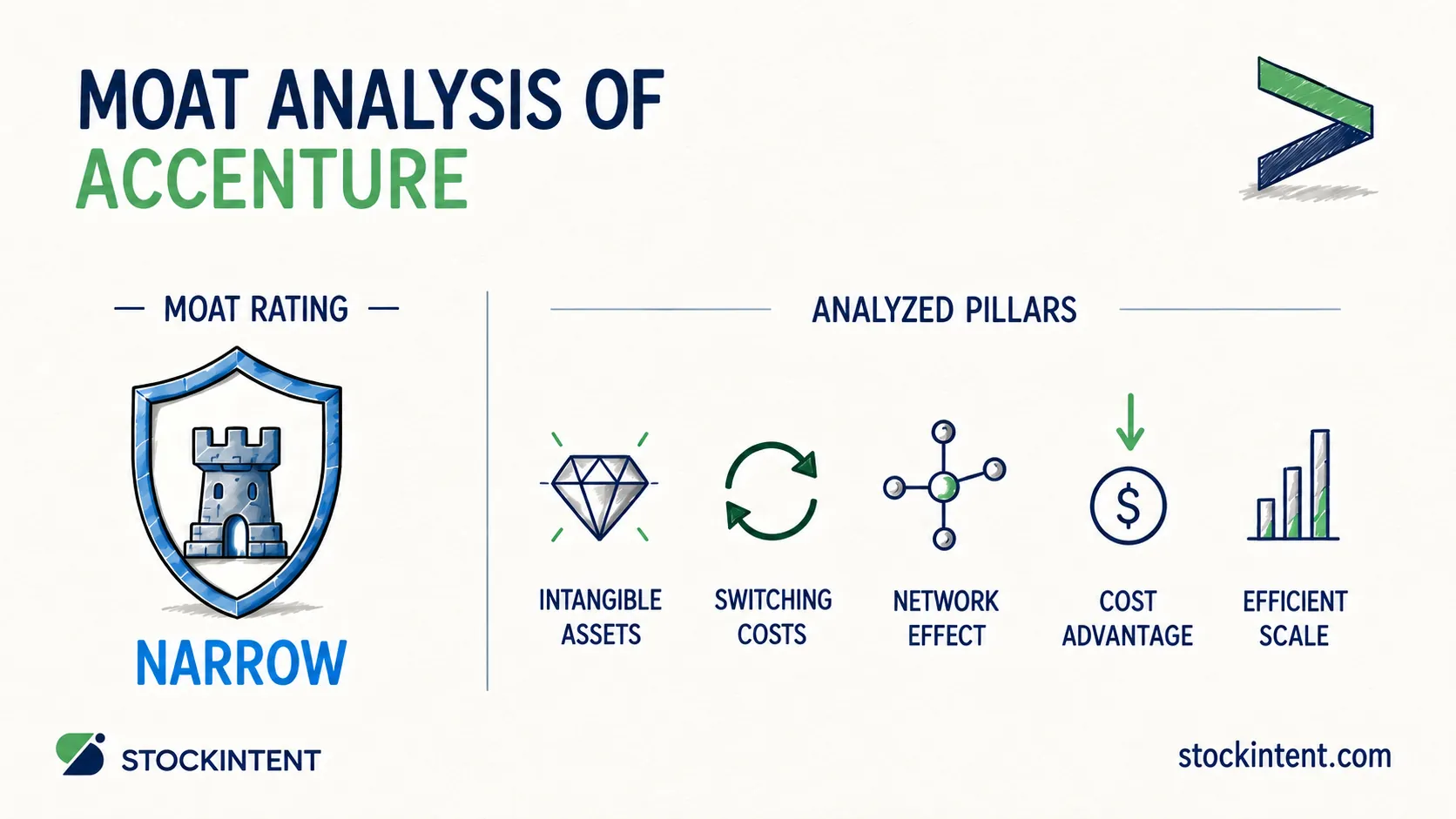
Accenture has a Narrow economic moat with a Stable trend and Medium uncertainty, based on our reading of its fiscal 2026 results. In Q3 FY26 (May 2026), the company reported revenue of $18.7 billion, up 6% in U.S. dollars, a 17.0% operating margin, and a trailing-twelve-month return on invested capital of 21%.
That's franchise-quality profitability. New bookings of $19.3 billion, though, fell 2% year over year, which is why we stop short of a wide-moat call.
Here's the short version of what matters:
This analysis is about business quality, not valuation. A wonderful company bought at a fair price beats a cheap stock with no moat, and the question we answer below is whether Accenture's advantages will keep protecting its economics for years.
Two pillars carry Accenture's moat, and the other three mostly don't show up. That's the honest picture after weighing the evidence, and it matters because investors often credit Accenture with advantages it doesn't actually have.
Morningstar's 2026 company report reaches the same conclusion we do: the moat rests on switching costs and intangible assets, which together support a narrow-moat rating.
Here's each pillar, ranked from strongest to weakest:
Switching costs (strong). Accenture embeds itself in multi-year digital transformations, managed services, and systems integration. Ripping out a partner mid-redesign costs time, money, and organizational pain, so clients rarely do it. This is the least disputed pillar in the analysis, and it's what keeps revenue predictable between deal cycles.
Intangible assets (moderate to strong). Brand trust with enterprise clients, delivery playbooks built over decades, deep industry expertise, and partnerships with the major hyperscalers and software vendors all support win rates and repeat mandates. These aren't hard assets like patents, but in professional services they're what clients are actually buying.
Cost advantage (moderate). Global delivery scale and labor arbitrage help Accenture run leaner than smaller rivals. But consulting remains a people business, so wage inflation and talent costs cap how much structural margin superiority it can build.
Network effects (weak). This is the common misconception. Accenture is huge, but its clients don't become more valuable to each other by joining its ecosystem, so there's no classic network effect.
Efficient scale (weak or not material). Scale benefits exist, but the IT services market doesn't have a structure where size alone locks out competition.
Pro Insight: Network effects get mistakenly attributed to professional services firms all the time. Accenture's moat is about switching costs and intangible assets, not platform dynamics. Clients can and do use multiple consultancies at once, which undermines true network effects despite the ecosystem language in marketing materials.
If you want to work through these characteristics yourself, StockIntent's company reports let you dig into the financial statements, rankings, and historical performance data behind a moat assessment like this.
The takeaway: Accenture has a real but not impenetrable franchise. Its durable advantages come from embedded client relationships and accumulated intellectual capital, which is exactly the kind of excess-return source we look for in a long-term business owner's framing.
What the pillars don't tell you is how the moat shows up in actual results, and that's where the numbers get interesting.
A moat only counts if it shows up in the numbers, so here's where Accenture's advantages are actually visible in fiscal 2026.
The clearest evidence is client stickiness. In Q3 FY26, Accenture reported 104 clients year-to-date with quarterly bookings above $100 million, up 13% year over year. That's the switching-cost pillar doing real work: large enterprises keep handing over bigger mandates, and that pattern looks more like a strategic partner than a replaceable vendor.
Scale efficiency shows up next. Q3 free cash flow reached $3.6 billion, and margins expanded even as revenue growth stayed uneven. A commoditized services business can't do both at once; Accenture's delivery scale and mix of higher-value consulting work can.
Now the limitation: demand softened in the quarter, with total bookings down 2% and a book-to-bill of just 1.0. If Accenture had genuine, broad-based pricing power, we'd expect the franchise to push through price increases and keep bookings climbing. It didn't, which keeps our rating at narrow rather than wide.
Compared with pure-play advisory peers, Accenture's combination of consulting plus managed services and repeated $100M-plus client wins signals a stronger franchise. But competition from lower-cost IT services firms and hyperscalers remains intense, and that caps how far the moat extends.
Our trend call: stable to modestly widening. AI-led demand and deepening enterprise relationships are building the franchise, but softer managed services and reduced disclosure keep the trend from being a clean widening story.
Start with what's widening. Advanced AI demand is real. In Q1 FY26, Accenture reported $2.2 billion in Advanced AI new bookings, more than 1,400 Advanced AI clients, and over 85,000 AI and data professionals. Then came the peak: record total bookings of $22.11 billion in Q2 FY26, per Accenture's Q2 SEC filing, with consulting bookings alone at $11.33 billion. That's the moat's core working at scale.
Now the pressure points. Q3 bookings fell 2%, and S&P Global Market Intelligence notes managed services bookings dropped 15% in the quarter. Customers are buying in a more selective, project-driven way, prioritizing urgent transformation work while delaying big operational contracts. The managed services side, where switching costs are most embedded, is exactly where the softness sits. That's worth taking seriously.
There's also a transparency problem. In 2026, Accenture stopped separately disclosing AI bookings, removing the very metric investors used to track its most important growth engine.
From Our Experience: When a company obscures the exact growth engine investors were tracking, it often signals either competitive pressure or volatility in that segment. We'd rather see a bumpy disclosed number than a smooth undisclosed one, because the disclosed version lets us judge durability ourselves.
So what should you watch over the next 3-5 years? Four indicators:
To keep these metrics organized, StockIntent's watchlist feature lets you set up custom views so the moat's trajectory proactively shows up in your own dashboards rather than in headlines.
The bottom line for the trend: the moat widens if AI advisory work converts into recurring managed services. If it stays episodic project work while outsourcing softens, the trend flips toward weakening.
We rate the uncertainty around this moat assessment as Medium. The franchise looks solid, but the range of plausible outcomes over the next 3-5 years is moderately wide, and that's what Medium is meant to signal.
Four drivers shape the rating:
Federal exposure. Management's FY2026 guidance of 3-4% local-currency growth includes an estimated 1% drag from federal business, per the Q3 FY26 earnings call. Government spending shifts can move reported growth fast.
AI execution risk. We still don't know how quickly AI demand monetizes, and the reduced disclosure makes that harder to judge from the outside.
Macro cyclicality. Clients can delay discretionary transformation projects when budgets tighten, and bookings already showed that sensitivity in Q3.
Geopolitical and currency effects. A globally distributed delivery model and a multinational client base expose both growth and margins to forces Accenture doesn't control.
Put together, the scenarios span a wide band. The base case keeps Accenture a top-tier services franchise. The upside case converts AI demand into durable market share; the downside sees AI services commoditize while federal demand softens. Against that, financial cushion helps: the 21% trailing ROIC, a committed $9.5 billion capital return for FY26, and a raised $9 billion acquisition budget all reflect cash-generative stability, even though none of it removes the business uncertainty.
This content is for informational purposes only and is not investment advice.
Accenture earns a Narrow moat, a stable to modestly widening trend, and Medium uncertainty. The strongest evidence is switching costs keep deepening, as shown by the growing count of $100M-plus clients, and 17% operating margins plus $3.6 billion in quarterly free cash flow confirm a franchise that converts scale into cash.
One question matters most from here: does AI demand become durable, recurring revenue, or does it stay volatile project work? The managed services softness and the reduced disclosure around AI bookings make that harder to answer than it should be, and that opacity is exactly why our uncertainty rating sits at Medium rather than Low.
If the moat widens, it will show up in bookings mix and margin trend. Watch those over time, and the answer will reveal itself.
Accenture has a Narrow economic moat with a Stable trend and Medium uncertainty, based on our reading of its fiscal 2026 results. In Q3 FY26 (May 2026), the company reported revenue of $18.7 billion, up 6% in U.S. dollars, a 17.0% operating margin, and a trailing-twelve-month return on invested capital of 21%.
That's franchise-quality profitability. New bookings of $19.3 billion, though, fell 2% year over year, which is why we stop short of a wide-moat call.
Here's the short version of what matters:
This analysis is about business quality, not valuation. A wonderful company bought at a fair price beats a cheap stock with no moat, and the question we answer below is whether Accenture's advantages will keep protecting its economics for years.
Two pillars carry Accenture's moat, and the other three mostly don't show up. That's the honest picture after weighing the evidence, and it matters because investors often credit Accenture with advantages it doesn't actually have.
Morningstar's 2026 company report reaches the same conclusion we do: the moat rests on switching costs and intangible assets, which together support a narrow-moat rating.
Here's each pillar, ranked from strongest to weakest:
Switching costs (strong). Accenture embeds itself in multi-year digital transformations, managed services, and systems integration. Ripping out a partner mid-redesign costs time, money, and organizational pain, so clients rarely do it. This is the least disputed pillar in the analysis, and it's what keeps revenue predictable between deal cycles.
Intangible assets (moderate to strong). Brand trust with enterprise clients, delivery playbooks built over decades, deep industry expertise, and partnerships with the major hyperscalers and software vendors all support win rates and repeat mandates. These aren't hard assets like patents, but in professional services they're what clients are actually buying.
Cost advantage (moderate). Global delivery scale and labor arbitrage help Accenture run leaner than smaller rivals. But consulting remains a people business, so wage inflation and talent costs cap how much structural margin superiority it can build.
Network effects (weak). This is the common misconception. Accenture is huge, but its clients don't become more valuable to each other by joining its ecosystem, so there's no classic network effect.
Efficient scale (weak or not material). Scale benefits exist, but the IT services market doesn't have a structure where size alone locks out competition.
Pro Insight: Network effects get mistakenly attributed to professional services firms all the time. Accenture's moat is about switching costs and intangible assets, not platform dynamics. Clients can and do use multiple consultancies at once, which undermines true network effects despite the ecosystem language in marketing materials.
If you want to work through these characteristics yourself, StockIntent's company reports let you dig into the financial statements, rankings, and historical performance data behind a moat assessment like this.
The takeaway: Accenture has a real but not impenetrable franchise. Its durable advantages come from embedded client relationships and accumulated intellectual capital, which is exactly the kind of excess-return source we look for in a long-term business owner's framing.
What the pillars don't tell you is how the moat shows up in actual results, and that's where the numbers get interesting.
A moat only counts if it shows up in the numbers, so here's where Accenture's advantages are actually visible in fiscal 2026.
The clearest evidence is client stickiness. In Q3 FY26, Accenture reported 104 clients year-to-date with quarterly bookings above $100 million, up 13% year over year. That's the switching-cost pillar doing real work: large enterprises keep handing over bigger mandates, and that pattern looks more like a strategic partner than a replaceable vendor.
Scale efficiency shows up next. Q3 free cash flow reached $3.6 billion, and margins expanded even as revenue growth stayed uneven. A commoditized services business can't do both at once; Accenture's delivery scale and mix of higher-value consulting work can.
Now the limitation: demand softened in the quarter, with total bookings down 2% and a book-to-bill of just 1.0. If Accenture had genuine, broad-based pricing power, we'd expect the franchise to push through price increases and keep bookings climbing. It didn't, which keeps our rating at narrow rather than wide.
Compared with pure-play advisory peers, Accenture's combination of consulting plus managed services and repeated $100M-plus client wins signals a stronger franchise. But competition from lower-cost IT services firms and hyperscalers remains intense, and that caps how far the moat extends.
Our trend call: stable to modestly widening. AI-led demand and deepening enterprise relationships are building the franchise, but softer managed services and reduced disclosure keep the trend from being a clean widening story.
Start with what's widening. Advanced AI demand is real. In Q1 FY26, Accenture reported $2.2 billion in Advanced AI new bookings, more than 1,400 Advanced AI clients, and over 85,000 AI and data professionals. Then came the peak: record total bookings of $22.11 billion in Q2 FY26, per Accenture's Q2 SEC filing, with consulting bookings alone at $11.33 billion. That's the moat's core working at scale.
Now the pressure points. Q3 bookings fell 2%, and S&P Global Market Intelligence notes managed services bookings dropped 15% in the quarter. Customers are buying in a more selective, project-driven way, prioritizing urgent transformation work while delaying big operational contracts. The managed services side, where switching costs are most embedded, is exactly where the softness sits. That's worth taking seriously.
There's also a transparency problem. In 2026, Accenture stopped separately disclosing AI bookings, removing the very metric investors used to track its most important growth engine.
From Our Experience: When a company obscures the exact growth engine investors were tracking, it often signals either competitive pressure or volatility in that segment. We'd rather see a bumpy disclosed number than a smooth undisclosed one, because the disclosed version lets us judge durability ourselves.
So what should you watch over the next 3-5 years? Four indicators:
To keep these metrics organized, StockIntent's watchlist feature lets you set up custom views so the moat's trajectory proactively shows up in your own dashboards rather than in headlines.
The bottom line for the trend: the moat widens if AI advisory work converts into recurring managed services. If it stays episodic project work while outsourcing softens, the trend flips toward weakening.
We rate the uncertainty around this moat assessment as Medium. The franchise looks solid, but the range of plausible outcomes over the next 3-5 years is moderately wide, and that's what Medium is meant to signal.
Four drivers shape the rating:
Federal exposure. Management's FY2026 guidance of 3-4% local-currency growth includes an estimated 1% drag from federal business, per the Q3 FY26 earnings call. Government spending shifts can move reported growth fast.
AI execution risk. We still don't know how quickly AI demand monetizes, and the reduced disclosure makes that harder to judge from the outside.
Macro cyclicality. Clients can delay discretionary transformation projects when budgets tighten, and bookings already showed that sensitivity in Q3.
Geopolitical and currency effects. A globally distributed delivery model and a multinational client base expose both growth and margins to forces Accenture doesn't control.
Put together, the scenarios span a wide band. The base case keeps Accenture a top-tier services franchise. The upside case converts AI demand into durable market share; the downside sees AI services commoditize while federal demand softens. Against that, financial cushion helps: the 21% trailing ROIC, a committed $9.5 billion capital return for FY26, and a raised $9 billion acquisition budget all reflect cash-generative stability, even though none of it removes the business uncertainty.
This content is for informational purposes only and is not investment advice.
Accenture earns a Narrow moat, a stable to modestly widening trend, and Medium uncertainty. The strongest evidence is switching costs keep deepening, as shown by the growing count of $100M-plus clients, and 17% operating margins plus $3.6 billion in quarterly free cash flow confirm a franchise that converts scale into cash.
One question matters most from here: does AI demand become durable, recurring revenue, or does it stay volatile project work? The managed services softness and the reduced disclosure around AI bookings make that harder to answer than it should be, and that opacity is exactly why our uncertainty rating sits at Medium rather than Low.
If the moat widens, it will show up in bookings mix and margin trend. Watch those over time, and the answer will reveal itself.