
Jul 28, 2026
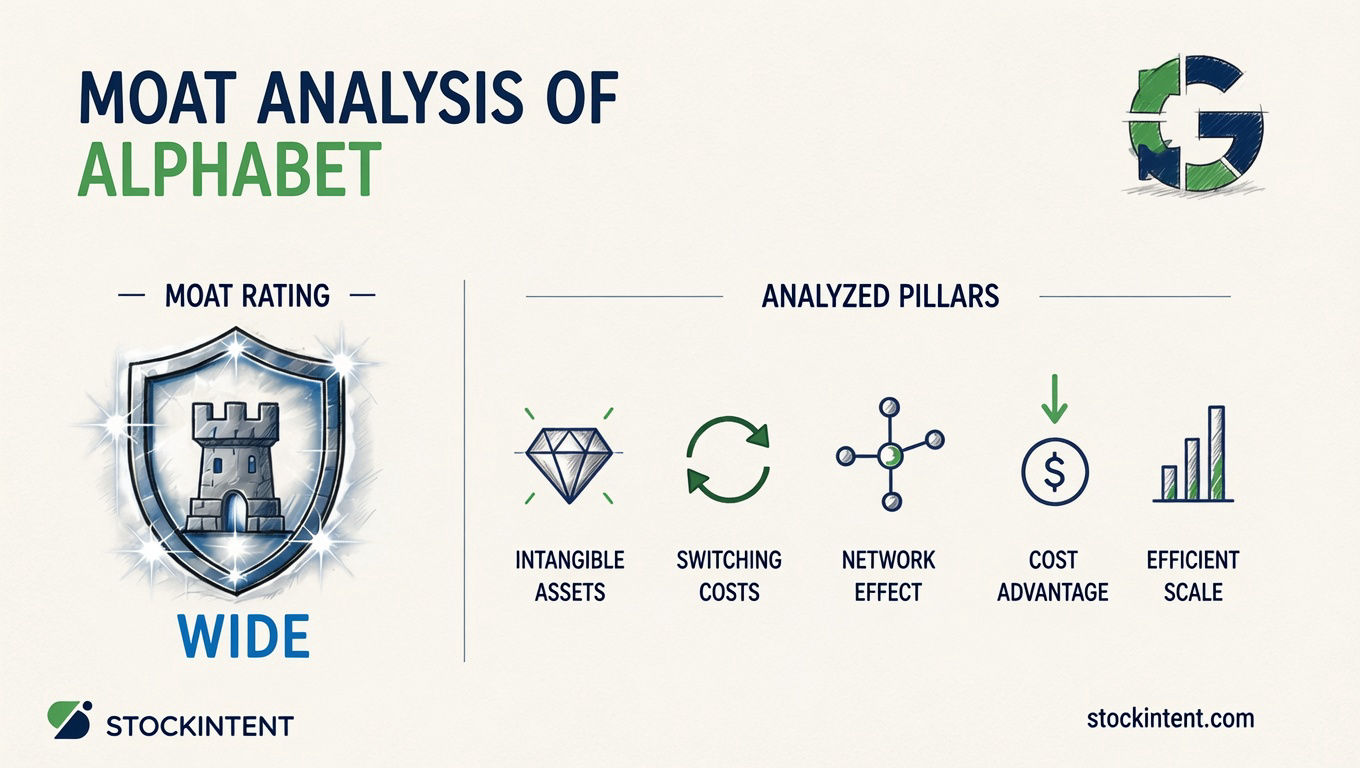
Alphabet earns a Wide moat with a Stable trend and Medium uncertainty as of mid-2026. That verdict reflects real competitive strengths in search, video, and mobile distribution, but also acknowledges that AI-driven disruption and regulatory pressure are now genuine variables rather than distant risks.
Here's what matters most for investors assessing business quality:
In Q1 2026, Alphabet reported $109.9 billion in revenue, up 21.8% year over year, with operating margin expanding to 36.1%. Those are quality-company numbers. The question for long-term investors is whether those economics can endure as the business model evolves.
The sections that follow break down the five moat pillars in detail, show how they appear in financial performance, and identify the specific forward indicators that will tell us whether this wide moat is stable or beginning to narrow.
We look at moats through five pillars: network effects, switching costs, intangible assets, cost advantage, and efficient scale. Not every pillar matters equally for every company. Here's how they stack up for Alphabet in 2026.
| Moat Pillar | Strength Rating | Core Evidence |
|---|---|---|
| Network Effects | Strong | 90% search share, query feedback loops, 2.5B YouTube users |
| Intangible Assets | Strong | "Google it" brand habit, TPUs, Gemini integration |
| Switching Costs | Moderate | Advertiser auction tooling, cross-product ecosystem friction |
| Cost Advantage | Moderate | $180-190B capex scale, infrastructure efficiency |
| Efficient Scale | Weak / Disputed | Digital ads lack local natural monopoly characteristics |
Network effects are Alphabet's strongest pillar. The mechanism is straightforward: more queries generate more click and dwell-time signals, which improve ranking quality, which attracts more users and advertisers, which generates more queries. Per Money365's 2026 analysis, this virtuous cycle is why competitors with similar base technology still struggle to match Google's search quality. YouTube adds a second network layer, creator-viewer dynamics that reinforce engagement and monetization. DeepResearchGlobal estimates roughly 2.5 billion YouTube users and 3 billion Android devices as of 2026.
Intangible assets run a close second. The "Google it" habit reflects durable consumer mindshare that competitors cannot buy overnight. Proprietary AI infrastructure, including TPUs and Gemini integration across Search, Cloud, and Workspace, adds technical assets that are hard to replicate. Several 2026 sources emphasize that Alphabet's data, models, and product integration create intangible advantages that compound over time. This is where brand meets technology behind the scenes.
Switching costs are real but concentrated. For large advertisers, auction tooling and conversion measurement systems create real friction in shifting budgets. If you've spent years optimizing Google Ads campaigns, moving to Microsoft or Meta isn't just a budget reallocation, it's a performance reset. For ordinary consumers, though, switching costs are softer. Habit and default behavior matter more than hard lock-in. Find My Moat's 2026 assessment notes that ecosystem stickiness across Search, Android, Chrome, Gmail, Maps, and YouTube raises user friction, but doesn't trap users the way enterprise software contracts might.
Cost advantage is credible in infrastructure-heavy segments. Alphabet's 2026 investor presentation highlights the combined reach of its product ecosystem, and the company's $180-190 billion capital expenditure guidance acts as a scale barrier that raises rivals' required investment to compete. This matters most in Google Cloud and Search operations, where global data center networks and AI infrastructure create unit cost advantages. The catch is that this advantage is being tested by the very scale of AI spending required to maintain it.
Efficient scale is the weakest pillar. Search and digital advertising simply aren't classic local natural monopolies where one provider serves the market at uniquely efficient scale. The relevant mechanism is scale-driven data and distribution, not efficient scale in the strict sense. Money365's analysis flags this as the most disputed pillar, especially as AI answer engines and potential antitrust remedies could erode distribution advantages that efficient scale would normally protect.
For investors who want to dig deeper into how these claims show up in actual financial statements, reviewing detailed company reports through a consolidated research workflow helps separate moat storytelling from empirical evidence. StockIntent's company reports pull together the performance metrics, segment breakdowns, and historical trends that let you test whether a wide moat rating is backed by returns, margins, and balance sheet strength or just narrative momentum.
Alphabet's network effects and intangible assets don't just sound good on paper. They're visible in the numbers the company reported for Q1 2026. Google Cloud revenue surged 63% year over year, while Search and Other grew 19% and YouTube ads climbed 11%. Operating margin hit 36.1%, and operating income rose 30%. Those aren't growth-stock margins scraped together with heavy spending. They're the signature of a business that can monetize scale efficiently.
The returns above cost of capital tell a similar story. Artificall's 2026 analysis estimates Alphabet's return on invested capital at 13%, which sits above its weighted average cost of capital. In plain terms, the company is creating value rather than simply回收ing its funding costs. That's what you want to see from a wide-moat business.
But here's where the picture gets more complicated. Morningstar warns that the 2026 capital expenditure guidance of $180-190 billion represents the main overinvestment risk. The fort is being defended with real treasure, and the returns on that treasure aren't fully visible yet. Cloud is growing fast, but S&P Global's cloud margin estimates for FY2026 show a wide range, suggesting analysts don't yet agree on how profitably that growth will convert. Free cash flow is under pressure even as operating performance looks strong.
So the moat shows up most clearly where it's already mature: Search, YouTube, and the ad infrastructure that converts attention into dollars. It's emerging in Cloud but hasn't fully proven durable returns. And it's least visible in the heaviest AI investments, where capability is ahead of monetization. The business quality is real, but increasingly, it requires continued execution to maintain.
The trend is Stable, but contested. Alphabet's moat isn't collapsing, and it isn't dramatically widening either. What we're seeing in 2026 is a wide moat under genuine pressure from two directions: AI-driven shifts in how users find information, and heavier capital requirements to defend the ground already held.
What's widening the moat: Google Cloud is the clearest bright spot. Revenue growth of 63% year over year in Q1 2026 suggests Alphabet is translating its AI infrastructure and enterprise credibility into durable market share gains. Management's raised capex guidance, now $180–190 billion for 2026 with signals of further increases in 2027, is being directed toward TPU capacity and cloud scale rather than generic expansion. If that investment builds switching costs among enterprise customers, Alphabet could establish a second major moat pillar beyond advertising.
What's pressuring it: The core search economics face a real test. Matrix BCG's 2026 analysis flags that AI answer engines from Microsoft, OpenAI, and others could reduce traditional search click volume. That's a structural threat, not a cyclical one, because it changes how users interact with information and where ads can appear. Meanwhile, regulatory scrutiny poses contingent risks that the next twelve months could force structural changes to Alphabet's distribution or ad-tech control, impairing the cross-product integration that currently reinforces user retention.
Pro Insight: In our experience following platform transitions, AI search disruption is often overestimated in the near term but underappreciated in its long-term structural impact. Alphabet's moat isn't disappearing in 2026, but the burden of proof is shifting from defending market share to monetizing new interfaces—a materially different economic question that changes how investors should evaluate durability.
The four indicators to watch:
Monetization per query. Are AI Overviews and Gemini preserving or improving revenue per search interaction? This is the cleanest signal of whether AI is extending or compressing the search moat.
Gemini Enterprise paid-user growth. Tikr's 2026 research flags this as a key gauge of whether Alphabet's AI thesis is accelerating or decelerating among commercial buyers.
Google Cloud backlog and large-deal conversion. Rapid customer growth only deepens the moat if it converts into sticky, multi-year commitments with profitable economics.
Post-capex ROIC and free cash flow. With $180–190 billion in planned 2026 spending, the critical question is whether returns on incremental capital hold above the cost of capital or compress under investment intensity.
The bottom line: Alphabet's moat remains wide, but the competitive terrain is shifting from "can anyone catch them?" to "can they monetize the next interface before the current one decays?" That's a harder question, and one that makes the stable trend assessment feel appropriately cautious rather than complacent.
We rate Alphabet's moat uncertainty as Medium.
The core advertising business still delivers highly predictable revenue. In Q1 2026, Alphabet generated $109.9 billion, up 21.8% year over year, with operating margin expanding to 36.1%. Those figures suggest a business with mature demand drivers and real pricing power.
But the range of plausible outcomes is widening, not narrowing. Here's why.
Revenue mix is becoming harder to forecast. Cloud is growing faster than ads, yet S&P Global's FY2026 Cloud margin estimate of 29.4% comes with a wide dispersion of analyst views. Directionally, Cloud is clearly expanding. Exactly how profitably? That's still open.
Capital intensity is the biggest operational variable. Alphabet raised 2026 capex guidance to $180–190 billion, with management signaling further increases in 2027. That spending is defensible if it builds durable infrastructure advantages. But if monetization lags, the same scale becomes a returns drag. Net income of $34.6 billion in Q1 shows the balance sheet can absorb this. Whether it should, at this pace, is the harder call.
Regulatory and AI risks are contingent but material. DOJ remedy proceedings could force structural changes to Alphabet's distribution or ad-tech control within the next twelve months. Separately, AI answer engines could either extend search engagement or compress traditional query economics. The direction matters enormously for whether the moat widens or narrows.
What makes this medium rather than high uncertainty? Alphabet's scale, cash generation, and product breadth make a competitive collapse unlikely over a 3–5 year horizon. The plausible range isn't "dominant or dead." It's closer to "dominant and highly profitable" versus "still leading, but more constrained and capital-intensive." That's a meaningful spread for investors weighing business quality, and it's why we don't treat this wide moat as a sure thing.
This content is for informational purposes only and is not investment advice.
Alphabet holds a Wide moat with a Stable trend and Medium uncertainty. That verdict rests on network effects and intangible assets that still produce premium margins and returns above cost of capital, but the ground is shifting beneath them.
Two questions matter most from here. First, can AI monetization preserve or improve search economics per query as users migrate toward AI Overviews and conversational interfaces? Second, will Google Cloud convert its 63% growth into durable, profitable returns that diversify Alphabet beyond advertising-dependent economics?
The moat isn't broken. But the burden of proof has moved from defending share to monetizing new formats before the old ones decay. Investors should watch the four indicators we flagged: revenue per query, Gemini Enterprise adoption, Cloud backlog conversion, and post-capex returns on capital. These metrics will tell you whether Alphabet's wide moat is stabilizing or slowly narrowing under competitive and technological pressure.
This content is for informational purposes only and is not investment advice.
Alphabet earns a Wide moat with a Stable trend and Medium uncertainty as of mid-2026. That verdict reflects real competitive strengths in search, video, and mobile distribution, but also acknowledges that AI-driven disruption and regulatory pressure are now genuine variables rather than distant risks.
Here's what matters most for investors assessing business quality:
In Q1 2026, Alphabet reported $109.9 billion in revenue, up 21.8% year over year, with operating margin expanding to 36.1%. Those are quality-company numbers. The question for long-term investors is whether those economics can endure as the business model evolves.
The sections that follow break down the five moat pillars in detail, show how they appear in financial performance, and identify the specific forward indicators that will tell us whether this wide moat is stable or beginning to narrow.
We look at moats through five pillars: network effects, switching costs, intangible assets, cost advantage, and efficient scale. Not every pillar matters equally for every company. Here's how they stack up for Alphabet in 2026.
| Moat Pillar | Strength Rating | Core Evidence |
|---|---|---|
| Network Effects | Strong | 90% search share, query feedback loops, 2.5B YouTube users |
| Intangible Assets | Strong | "Google it" brand habit, TPUs, Gemini integration |
| Switching Costs | Moderate | Advertiser auction tooling, cross-product ecosystem friction |
| Cost Advantage | Moderate | $180-190B capex scale, infrastructure efficiency |
| Efficient Scale | Weak / Disputed | Digital ads lack local natural monopoly characteristics |
Network effects are Alphabet's strongest pillar. The mechanism is straightforward: more queries generate more click and dwell-time signals, which improve ranking quality, which attracts more users and advertisers, which generates more queries. Per Money365's 2026 analysis, this virtuous cycle is why competitors with similar base technology still struggle to match Google's search quality. YouTube adds a second network layer, creator-viewer dynamics that reinforce engagement and monetization. DeepResearchGlobal estimates roughly 2.5 billion YouTube users and 3 billion Android devices as of 2026.
Intangible assets run a close second. The "Google it" habit reflects durable consumer mindshare that competitors cannot buy overnight. Proprietary AI infrastructure, including TPUs and Gemini integration across Search, Cloud, and Workspace, adds technical assets that are hard to replicate. Several 2026 sources emphasize that Alphabet's data, models, and product integration create intangible advantages that compound over time. This is where brand meets technology behind the scenes.
Switching costs are real but concentrated. For large advertisers, auction tooling and conversion measurement systems create real friction in shifting budgets. If you've spent years optimizing Google Ads campaigns, moving to Microsoft or Meta isn't just a budget reallocation, it's a performance reset. For ordinary consumers, though, switching costs are softer. Habit and default behavior matter more than hard lock-in. Find My Moat's 2026 assessment notes that ecosystem stickiness across Search, Android, Chrome, Gmail, Maps, and YouTube raises user friction, but doesn't trap users the way enterprise software contracts might.
Cost advantage is credible in infrastructure-heavy segments. Alphabet's 2026 investor presentation highlights the combined reach of its product ecosystem, and the company's $180-190 billion capital expenditure guidance acts as a scale barrier that raises rivals' required investment to compete. This matters most in Google Cloud and Search operations, where global data center networks and AI infrastructure create unit cost advantages. The catch is that this advantage is being tested by the very scale of AI spending required to maintain it.
Efficient scale is the weakest pillar. Search and digital advertising simply aren't classic local natural monopolies where one provider serves the market at uniquely efficient scale. The relevant mechanism is scale-driven data and distribution, not efficient scale in the strict sense. Money365's analysis flags this as the most disputed pillar, especially as AI answer engines and potential antitrust remedies could erode distribution advantages that efficient scale would normally protect.
For investors who want to dig deeper into how these claims show up in actual financial statements, reviewing detailed company reports through a consolidated research workflow helps separate moat storytelling from empirical evidence. StockIntent's company reports pull together the performance metrics, segment breakdowns, and historical trends that let you test whether a wide moat rating is backed by returns, margins, and balance sheet strength or just narrative momentum.
Alphabet's network effects and intangible assets don't just sound good on paper. They're visible in the numbers the company reported for Q1 2026. Google Cloud revenue surged 63% year over year, while Search and Other grew 19% and YouTube ads climbed 11%. Operating margin hit 36.1%, and operating income rose 30%. Those aren't growth-stock margins scraped together with heavy spending. They're the signature of a business that can monetize scale efficiently.
The returns above cost of capital tell a similar story. Artificall's 2026 analysis estimates Alphabet's return on invested capital at 13%, which sits above its weighted average cost of capital. In plain terms, the company is creating value rather than simply回收ing its funding costs. That's what you want to see from a wide-moat business.
But here's where the picture gets more complicated. Morningstar warns that the 2026 capital expenditure guidance of $180-190 billion represents the main overinvestment risk. The fort is being defended with real treasure, and the returns on that treasure aren't fully visible yet. Cloud is growing fast, but S&P Global's cloud margin estimates for FY2026 show a wide range, suggesting analysts don't yet agree on how profitably that growth will convert. Free cash flow is under pressure even as operating performance looks strong.
So the moat shows up most clearly where it's already mature: Search, YouTube, and the ad infrastructure that converts attention into dollars. It's emerging in Cloud but hasn't fully proven durable returns. And it's least visible in the heaviest AI investments, where capability is ahead of monetization. The business quality is real, but increasingly, it requires continued execution to maintain.
The trend is Stable, but contested. Alphabet's moat isn't collapsing, and it isn't dramatically widening either. What we're seeing in 2026 is a wide moat under genuine pressure from two directions: AI-driven shifts in how users find information, and heavier capital requirements to defend the ground already held.
What's widening the moat: Google Cloud is the clearest bright spot. Revenue growth of 63% year over year in Q1 2026 suggests Alphabet is translating its AI infrastructure and enterprise credibility into durable market share gains. Management's raised capex guidance, now $180–190 billion for 2026 with signals of further increases in 2027, is being directed toward TPU capacity and cloud scale rather than generic expansion. If that investment builds switching costs among enterprise customers, Alphabet could establish a second major moat pillar beyond advertising.
What's pressuring it: The core search economics face a real test. Matrix BCG's 2026 analysis flags that AI answer engines from Microsoft, OpenAI, and others could reduce traditional search click volume. That's a structural threat, not a cyclical one, because it changes how users interact with information and where ads can appear. Meanwhile, regulatory scrutiny poses contingent risks that the next twelve months could force structural changes to Alphabet's distribution or ad-tech control, impairing the cross-product integration that currently reinforces user retention.
Pro Insight: In our experience following platform transitions, AI search disruption is often overestimated in the near term but underappreciated in its long-term structural impact. Alphabet's moat isn't disappearing in 2026, but the burden of proof is shifting from defending market share to monetizing new interfaces—a materially different economic question that changes how investors should evaluate durability.
The four indicators to watch:
Monetization per query. Are AI Overviews and Gemini preserving or improving revenue per search interaction? This is the cleanest signal of whether AI is extending or compressing the search moat.
Gemini Enterprise paid-user growth. Tikr's 2026 research flags this as a key gauge of whether Alphabet's AI thesis is accelerating or decelerating among commercial buyers.
Google Cloud backlog and large-deal conversion. Rapid customer growth only deepens the moat if it converts into sticky, multi-year commitments with profitable economics.
Post-capex ROIC and free cash flow. With $180–190 billion in planned 2026 spending, the critical question is whether returns on incremental capital hold above the cost of capital or compress under investment intensity.
The bottom line: Alphabet's moat remains wide, but the competitive terrain is shifting from "can anyone catch them?" to "can they monetize the next interface before the current one decays?" That's a harder question, and one that makes the stable trend assessment feel appropriately cautious rather than complacent.
We rate Alphabet's moat uncertainty as Medium.
The core advertising business still delivers highly predictable revenue. In Q1 2026, Alphabet generated $109.9 billion, up 21.8% year over year, with operating margin expanding to 36.1%. Those figures suggest a business with mature demand drivers and real pricing power.
But the range of plausible outcomes is widening, not narrowing. Here's why.
Revenue mix is becoming harder to forecast. Cloud is growing faster than ads, yet S&P Global's FY2026 Cloud margin estimate of 29.4% comes with a wide dispersion of analyst views. Directionally, Cloud is clearly expanding. Exactly how profitably? That's still open.
Capital intensity is the biggest operational variable. Alphabet raised 2026 capex guidance to $180–190 billion, with management signaling further increases in 2027. That spending is defensible if it builds durable infrastructure advantages. But if monetization lags, the same scale becomes a returns drag. Net income of $34.6 billion in Q1 shows the balance sheet can absorb this. Whether it should, at this pace, is the harder call.
Regulatory and AI risks are contingent but material. DOJ remedy proceedings could force structural changes to Alphabet's distribution or ad-tech control within the next twelve months. Separately, AI answer engines could either extend search engagement or compress traditional query economics. The direction matters enormously for whether the moat widens or narrows.
What makes this medium rather than high uncertainty? Alphabet's scale, cash generation, and product breadth make a competitive collapse unlikely over a 3–5 year horizon. The plausible range isn't "dominant or dead." It's closer to "dominant and highly profitable" versus "still leading, but more constrained and capital-intensive." That's a meaningful spread for investors weighing business quality, and it's why we don't treat this wide moat as a sure thing.
This content is for informational purposes only and is not investment advice.
Alphabet holds a Wide moat with a Stable trend and Medium uncertainty. That verdict rests on network effects and intangible assets that still produce premium margins and returns above cost of capital, but the ground is shifting beneath them.
Two questions matter most from here. First, can AI monetization preserve or improve search economics per query as users migrate toward AI Overviews and conversational interfaces? Second, will Google Cloud convert its 63% growth into durable, profitable returns that diversify Alphabet beyond advertising-dependent economics?
The moat isn't broken. But the burden of proof has moved from defending share to monetizing new formats before the old ones decay. Investors should watch the four indicators we flagged: revenue per query, Gemini Enterprise adoption, Cloud backlog conversion, and post-capex returns on capital. These metrics will tell you whether Alphabet's wide moat is stabilizing or slowly narrowing under competitive and technological pressure.
This content is for informational purposes only and is not investment advice.