Amazon Economic Moat Analysis: Rating, Trend & Competitive Advantages

Amazon Economic Moat Analysis: Rating, Trend & Competitive Advantages

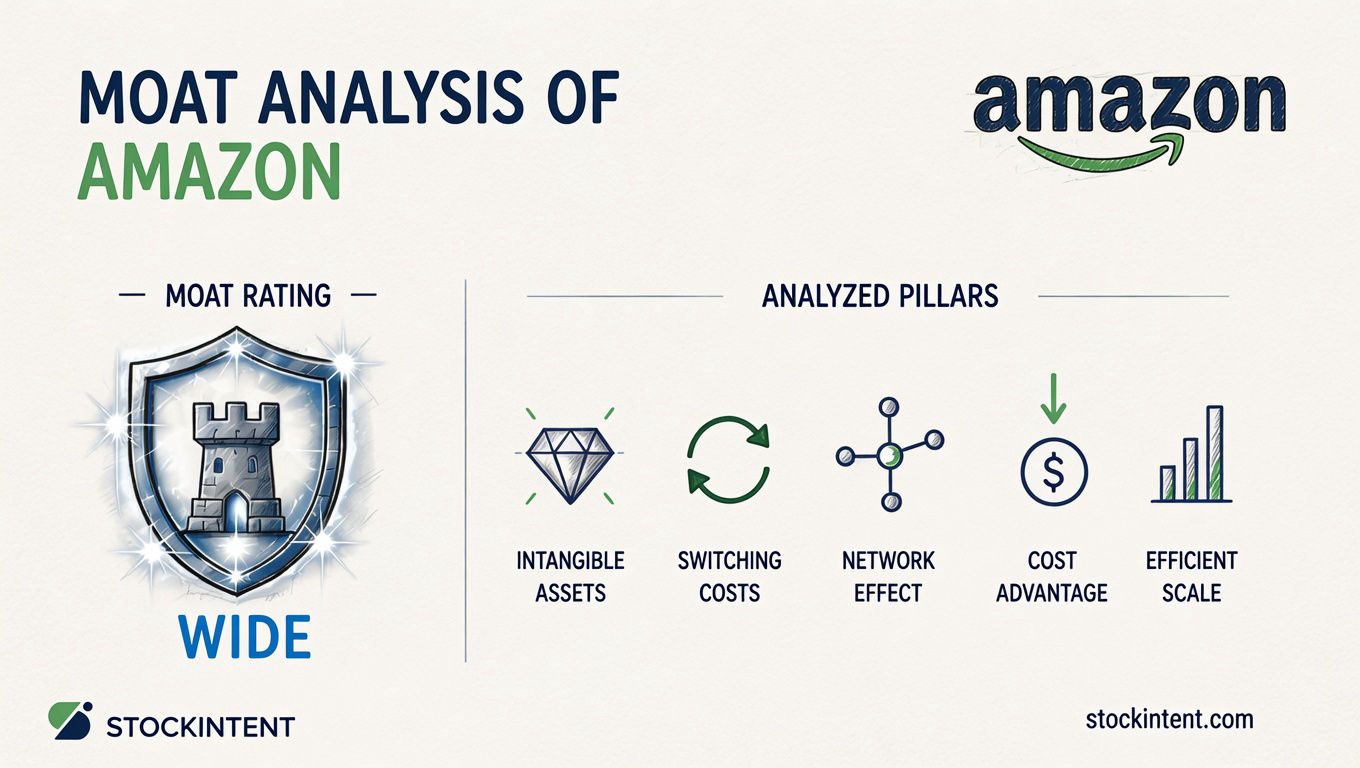
Here's our take: Amazon carries a Wide moat, a Stable trend, and Medium uncertainty. That verdict rests on what the business delivered in Q1 2026.

Net sales hit $181.5 billion, up 17% year over year. Operating income reached $23.9 billion, up 30% year over year. Those numbers show a company where scale is still expanding margins and cash returns.

  • AWS and advertising are the backbone. The strongest moat sources come from AWS's high-margin switching costs and the powerful network effects powering logistics and advertising. Customers and sellers both become more embedded as the ecosystem grows and matures.
  • Efficient scale is the weak link. Rivals like Microsoft Azure and Google Cloud aren't standing still, so protected scale is largely absent for Amazon today.
  • Moat trend: stable to widening. Custom AI chips and accelerating AWS growth could deepen the moat. Still, the $200 billion capital expenditure plan needed to get there creates real offsetting near-term pressure.
  • Uncertainty: medium. Wide dispersion in analyst margin estimates and looming regulatory scrutiny leave the range of future outcomes fairly broad. Even so, current competitive positioning stays strong.

Amazon's Competitive Advantages

Amazon's economic moat rests on five pillars: network effects, intangible assets, cost advantages, switching costs, and efficient scale. Their strength varies by business line, so it pays to examine each one rather than treating the company as a single monolith. Here is how we size up each pillar today.

When we evaluate these kinds of competitive advantages in practice, we turn to detailed company reports to check whether the narrative matches the numbers. StockIntent's fundamental analysis platform lets you test whether AWS margins and logistics efficiency actually support the claimed advantages over time. You can use peer comparisons and historical rankings to ground the story in data.

Network effects: Strong. Amazon's marketplace creates a classic two-sided network. More buyers attract more sellers, which improves selection and draws in even more buyers. The same flywheel powers advertising: more shopping data means better targeting, which attracts more ad spending and further subsidizes low prices. FindMyMoat analysis describes this as one of Amazon's most durable advantages because the loop tightens as traffic grows.

Pro Insight: Investors often miscast Amazon's moat as a retail story. In practice, durable economics are increasingly concentrated in AWS and advertising: infrastructure and platforms where scale compounds differently than in merchandise logistics. The retail operation provides the traffic, but the moat lies in what that traffic enables.

Intangible assets: Strong. AWS's service breadth, proprietary logistics algorithms, and the Amazon brand itself are genuinely hard to replicate. These aren't just goodwill entries on a balance sheet; they represent years of accumulated technology and operational know-how that competitors would need to rebuild from scratch. AlphaSpread's moat analysis groups these assets as a core pillar supporting durable pricing power.

Cost advantage: Strong. Dense fulfillment centers and hyperscale AWS data centers lower unit costs in ways smaller rivals simply cannot match. The same infrastructure that delivers same-day retail goods also runs cloud workloads at a fraction of the cost of building from zero. AlphaSpread points to this density as a meaningful barrier that improves with every new facility and data center Amazon brings online.

Switching costs: Moderate to strong. In AWS, switching is genuinely painful. Once teams embed enterprise workloads, data pipelines, and security tooling, migration becomes operationally complex and expensive. In retail, the lock-in is softer. Prime membership and saved payment info create friction, but shoppers can still jump to Walmart or Temu on price. AInvest notes that this split matters: cloud lock-in is structural, while retail retention is largely habitual and convenience-driven.

Efficient scale: Weak. Amazon is massive, but its core markets are not small niches that naturally limit competition. AWS battles Microsoft Azure and Google Cloud daily, while retail faces Walmart, Temu, and Shein. Money365's 2026 deep dive makes the point directly: most peers lack Amazon's fulfillment scale, yet the market is large enough to support several winners. That makes scale an operating advantage, not a protective barrier that blocks entrants.

Why the Moat Matters: How It Shows Up in Business Performance

We see Amazon's competitive advantages most clearly in its high-margin segments. In Q1 2026, analyst estimates put AWS operating margins between 30.9% and 40.0%, a spread that reflects genuine pricing power and deep customer lock-in. Advertising delivers similar dynamics; Deep Research Global describes it as a rapidly expanding, high-margin business that monetizes first-party shopping intent from Amazon's owned ecosystem.

The contrast with retail is stark. North America operating margin estimates for the same quarter ranged from just 0.9% to 7.8%. Scale keeps the business viable and supports the ecosystem, but it doesn't yet produce the durable profitability we see in AWS.

The moat's weak spot shows up clearly in cash generation. Trailing-twelve-month free cash flow fell to approximately $1.2 billion, squeezed by heavy AI infrastructure investment. Strong cloud economics are real, but they're being redeployed into the business before they accumulate as excess cash for shareholders.

For investors focused on business quality rather than a low valuation alone, this segment split is the critical insight. We view AWS and advertising as compounding, moat-protected businesses with pricing power that converts directly into returns. Retail remains large and necessary, but its contested economics mean overall company quality is only as strong as those high-margin segments allow. Until capital intensity moderates, Amazon's moat will show up more clearly in segment margins than in total free cash flow.

Moat Trend: What Could Strengthen or Weaken the Moat?

We rate Amazon's moat trend as stable to widening. The company is gaining ground in its most profitable segments. Still, record capital spending and an aggressive regulatory backdrop are testing the pace of that expansion.

On the widening side, AWS growth re-accelerated to 28% year over year in Q1 2026, its fastest pace in fifteen quarters, Capital.com reports. That momentum suggests the cloud platform is still pulling ahead of rivals rather than merely holding share.

Custom silicon is adding another defensive layer. Amazon's Trainium and Graviton chips reduce reliance on outside suppliers and could lower AWS costs over time. Yahoo Finance describes this shift as "quietly redefining" the moat. Advertising continues to grow as a high-margin monetization engine that turns existing traffic into profit.

Still, there are real headwinds. The roughly $200 billion capital expenditure plan for 2026 is enormous. While it funds AI infrastructure, analysts estimate that trailing-twelve-month free cash flow has fallen to roughly $1.2 billion and may limit near-term returns.

Deep Research Global flags FTC antitrust risk as a live concern into 2027, since forced changes to marketplace practices could erode structural advantages. Meanwhile, Microsoft Azure and Google Cloud are not easing their competitive pressure.

Investors should monitor four indicators to judge whether the trend is shifting:

  • AWS revenue growth and operating margin each quarter
  • Free cash flow recovery versus capital spending through 2027–2028
  • Advertising revenue growth rate
  • Regulatory outcomes, especially FTC rulings

Tracking these metrics quarter by quarter is easier with a structured watchlist. Set up a watchlist to track these four indicators quarterly. StockIntent's watchlist and market dashboard let you build custom views for exactly these fundamentals. You can then flag changes as they appear rather than after the fact.

Next, we need to ask how confident we can be in this assessment given the range of possible outcomes.

Uncertainty Rating: How Confident Are We in This Moat Assessment?

We rate Amazon's uncertainty as Medium. In plain terms, the company sits on real strengths, but the range of potential outcomes is still too wide to call the future predictable.

Amazon's Q1 2026 report gave solid near-term revenue guidance of $194.0–$199.0 billion for Q2, yet those same filings caution that results remain sensitive to customer demand, inflation, interest rates, tariffs, and geopolitical conditions. That makes the top line look stable at a glance but leaves the revenue mix less predictable.

Operating stability is even harder to pin down. S&P Global's pre-earnings preview showed North America margin estimates ranging from 0.9% to 7.8%, while AWS estimates stretched from 30.9% to 40.0%. That wide dispersion is a direct signal that professionals disagree on how AI spending, price competition, and logistics costs will settle.

Idiosyncratic risks widen the range further. A roughly $200 billion capital expenditure plan for AI could reshape margins, but only if monetization keeps pace. Antitrust scrutiny and trade policy add regulatory variance that pure economics can't capture. The moat is durable, yet its payoff depends heavily on execution and regulatory navigation over the next few years.

This analysis is for informational purposes only and is not investment advice. Amazon's stock may perform differently than its business moat quality would suggest depending on valuation, macro conditions, and execution risks.

Bottom Line

Amazon's moat assessment comes down to three words: Wide, Stable, and Medium uncertainty. In our view, these ratings reflect a business with genuinely durable competitive advantages in its best segments, paired with more contested economics in retail.

The bull case rests on AWS's re-acceleration to 28% year-over-year growth and advertising's high-margin expansion, both of which deepen switching costs and network effects. The bear case is equally real: roughly $200 billion in planned capital spending along with regulatory pressure could compress cash returns for years. Which force wins depends on management execution, customer adoption, and the regulatory climate over the next three to five years.

We view AWS as fortress-like and retail as persistently contested, so overall moat quality is only as strong as its highest-margin platforms allow. Patience is an edge here, but only if it is paired with vigilance. Long-term holders should validate the story each quarter through the watchlist indicators rather than assuming Amazon's advantages are permanently locked in.

Here's our take: Amazon carries a Wide moat, a Stable trend, and Medium uncertainty. That verdict rests on what the business delivered in Q1 2026.

Net sales hit $181.5 billion, up 17% year over year. Operating income reached $23.9 billion, up 30% year over year. Those numbers show a company where scale is still expanding margins and cash returns.

  • AWS and advertising are the backbone. The strongest moat sources come from AWS's high-margin switching costs and the powerful network effects powering logistics and advertising. Customers and sellers both become more embedded as the ecosystem grows and matures.
  • Efficient scale is the weak link. Rivals like Microsoft Azure and Google Cloud aren't standing still, so protected scale is largely absent for Amazon today.
  • Moat trend: stable to widening. Custom AI chips and accelerating AWS growth could deepen the moat. Still, the $200 billion capital expenditure plan needed to get there creates real offsetting near-term pressure.
  • Uncertainty: medium. Wide dispersion in analyst margin estimates and looming regulatory scrutiny leave the range of future outcomes fairly broad. Even so, current competitive positioning stays strong.

Amazon's Competitive Advantages

Amazon's economic moat rests on five pillars: network effects, intangible assets, cost advantages, switching costs, and efficient scale. Their strength varies by business line, so it pays to examine each one rather than treating the company as a single monolith. Here is how we size up each pillar today.

When we evaluate these kinds of competitive advantages in practice, we turn to detailed company reports to check whether the narrative matches the numbers. StockIntent's fundamental analysis platform lets you test whether AWS margins and logistics efficiency actually support the claimed advantages over time. You can use peer comparisons and historical rankings to ground the story in data.

Network effects: Strong. Amazon's marketplace creates a classic two-sided network. More buyers attract more sellers, which improves selection and draws in even more buyers. The same flywheel powers advertising: more shopping data means better targeting, which attracts more ad spending and further subsidizes low prices. FindMyMoat analysis describes this as one of Amazon's most durable advantages because the loop tightens as traffic grows.

Pro Insight: Investors often miscast Amazon's moat as a retail story. In practice, durable economics are increasingly concentrated in AWS and advertising: infrastructure and platforms where scale compounds differently than in merchandise logistics. The retail operation provides the traffic, but the moat lies in what that traffic enables.

Intangible assets: Strong. AWS's service breadth, proprietary logistics algorithms, and the Amazon brand itself are genuinely hard to replicate. These aren't just goodwill entries on a balance sheet; they represent years of accumulated technology and operational know-how that competitors would need to rebuild from scratch. AlphaSpread's moat analysis groups these assets as a core pillar supporting durable pricing power.

Cost advantage: Strong. Dense fulfillment centers and hyperscale AWS data centers lower unit costs in ways smaller rivals simply cannot match. The same infrastructure that delivers same-day retail goods also runs cloud workloads at a fraction of the cost of building from zero. AlphaSpread points to this density as a meaningful barrier that improves with every new facility and data center Amazon brings online.

Switching costs: Moderate to strong. In AWS, switching is genuinely painful. Once teams embed enterprise workloads, data pipelines, and security tooling, migration becomes operationally complex and expensive. In retail, the lock-in is softer. Prime membership and saved payment info create friction, but shoppers can still jump to Walmart or Temu on price. AInvest notes that this split matters: cloud lock-in is structural, while retail retention is largely habitual and convenience-driven.

Efficient scale: Weak. Amazon is massive, but its core markets are not small niches that naturally limit competition. AWS battles Microsoft Azure and Google Cloud daily, while retail faces Walmart, Temu, and Shein. Money365's 2026 deep dive makes the point directly: most peers lack Amazon's fulfillment scale, yet the market is large enough to support several winners. That makes scale an operating advantage, not a protective barrier that blocks entrants.

Why the Moat Matters: How It Shows Up in Business Performance

We see Amazon's competitive advantages most clearly in its high-margin segments. In Q1 2026, analyst estimates put AWS operating margins between 30.9% and 40.0%, a spread that reflects genuine pricing power and deep customer lock-in. Advertising delivers similar dynamics; Deep Research Global describes it as a rapidly expanding, high-margin business that monetizes first-party shopping intent from Amazon's owned ecosystem.

The contrast with retail is stark. North America operating margin estimates for the same quarter ranged from just 0.9% to 7.8%. Scale keeps the business viable and supports the ecosystem, but it doesn't yet produce the durable profitability we see in AWS.

The moat's weak spot shows up clearly in cash generation. Trailing-twelve-month free cash flow fell to approximately $1.2 billion, squeezed by heavy AI infrastructure investment. Strong cloud economics are real, but they're being redeployed into the business before they accumulate as excess cash for shareholders.

For investors focused on business quality rather than a low valuation alone, this segment split is the critical insight. We view AWS and advertising as compounding, moat-protected businesses with pricing power that converts directly into returns. Retail remains large and necessary, but its contested economics mean overall company quality is only as strong as those high-margin segments allow. Until capital intensity moderates, Amazon's moat will show up more clearly in segment margins than in total free cash flow.

Moat Trend: What Could Strengthen or Weaken the Moat?

We rate Amazon's moat trend as stable to widening. The company is gaining ground in its most profitable segments. Still, record capital spending and an aggressive regulatory backdrop are testing the pace of that expansion.

On the widening side, AWS growth re-accelerated to 28% year over year in Q1 2026, its fastest pace in fifteen quarters, Capital.com reports. That momentum suggests the cloud platform is still pulling ahead of rivals rather than merely holding share.

Custom silicon is adding another defensive layer. Amazon's Trainium and Graviton chips reduce reliance on outside suppliers and could lower AWS costs over time. Yahoo Finance describes this shift as "quietly redefining" the moat. Advertising continues to grow as a high-margin monetization engine that turns existing traffic into profit.

Still, there are real headwinds. The roughly $200 billion capital expenditure plan for 2026 is enormous. While it funds AI infrastructure, analysts estimate that trailing-twelve-month free cash flow has fallen to roughly $1.2 billion and may limit near-term returns.

Deep Research Global flags FTC antitrust risk as a live concern into 2027, since forced changes to marketplace practices could erode structural advantages. Meanwhile, Microsoft Azure and Google Cloud are not easing their competitive pressure.

Investors should monitor four indicators to judge whether the trend is shifting:

  • AWS revenue growth and operating margin each quarter
  • Free cash flow recovery versus capital spending through 2027–2028
  • Advertising revenue growth rate
  • Regulatory outcomes, especially FTC rulings

Tracking these metrics quarter by quarter is easier with a structured watchlist. Set up a watchlist to track these four indicators quarterly. StockIntent's watchlist and market dashboard let you build custom views for exactly these fundamentals. You can then flag changes as they appear rather than after the fact.

Next, we need to ask how confident we can be in this assessment given the range of possible outcomes.

Uncertainty Rating: How Confident Are We in This Moat Assessment?

We rate Amazon's uncertainty as Medium. In plain terms, the company sits on real strengths, but the range of potential outcomes is still too wide to call the future predictable.

Amazon's Q1 2026 report gave solid near-term revenue guidance of $194.0–$199.0 billion for Q2, yet those same filings caution that results remain sensitive to customer demand, inflation, interest rates, tariffs, and geopolitical conditions. That makes the top line look stable at a glance but leaves the revenue mix less predictable.

Operating stability is even harder to pin down. S&P Global's pre-earnings preview showed North America margin estimates ranging from 0.9% to 7.8%, while AWS estimates stretched from 30.9% to 40.0%. That wide dispersion is a direct signal that professionals disagree on how AI spending, price competition, and logistics costs will settle.

Idiosyncratic risks widen the range further. A roughly $200 billion capital expenditure plan for AI could reshape margins, but only if monetization keeps pace. Antitrust scrutiny and trade policy add regulatory variance that pure economics can't capture. The moat is durable, yet its payoff depends heavily on execution and regulatory navigation over the next few years.

This analysis is for informational purposes only and is not investment advice. Amazon's stock may perform differently than its business moat quality would suggest depending on valuation, macro conditions, and execution risks.

Bottom Line

Amazon's moat assessment comes down to three words: Wide, Stable, and Medium uncertainty. In our view, these ratings reflect a business with genuinely durable competitive advantages in its best segments, paired with more contested economics in retail.

The bull case rests on AWS's re-acceleration to 28% year-over-year growth and advertising's high-margin expansion, both of which deepen switching costs and network effects. The bear case is equally real: roughly $200 billion in planned capital spending along with regulatory pressure could compress cash returns for years. Which force wins depends on management execution, customer adoption, and the regulatory climate over the next three to five years.

We view AWS as fortress-like and retail as persistently contested, so overall moat quality is only as strong as its highest-margin platforms allow. Patience is an edge here, but only if it is paired with vigilance. Long-term holders should validate the story each quarter through the watchlist indicators rather than assuming Amazon's advantages are permanently locked in.