
Aug 13, 2026
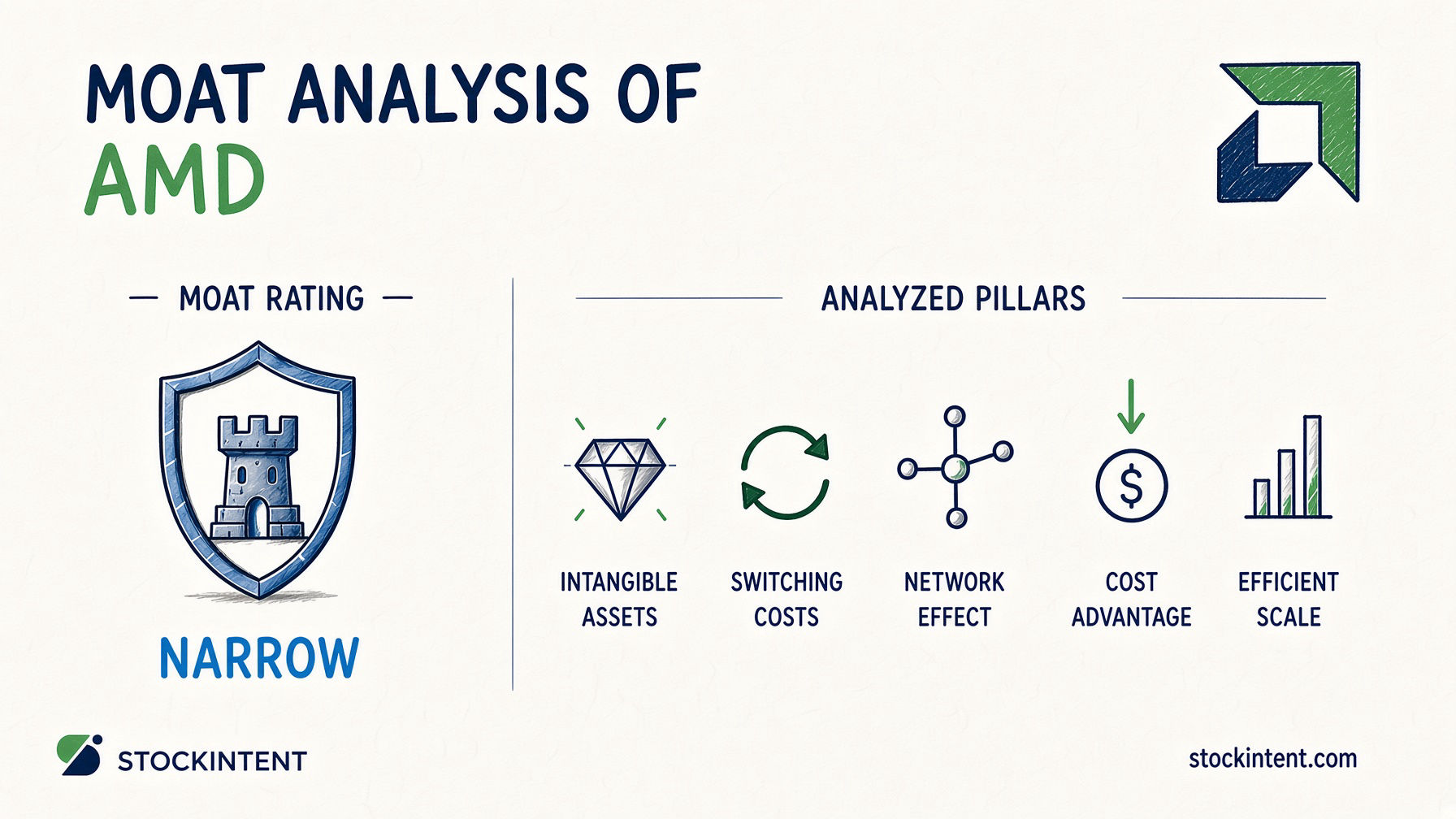
AMD carries a Narrow economic moat today. The trend is Widening, but the uncertainty is Medium-to-High. That verdict matters because moat durability determines whether AMD can compound returns over years or merely ride a product cycle.
Here's what we see after reviewing the company's 2025 strategy release, Q1 2026 filings, and multiple analyst assessments:
The moat is real but conditional. AMD's Data Center revenue hit $5.8 billion in Q1 2026, growing 57% year over year. That is tangible evidence of competitive traction. Still, with roughly 5-7% of the AI accelerator market against NVIDIA's approximately 80%, AMD remains an emerging challenger rather than an entrenched leader.
The question for investors is whether the widening trend can close that gap before cyclical headwinds or competitive pressure stall the momentum.
AMD's moat rests most securely on intangible assets and moderate switching costs. The other three pillars range from disputed to weak. Here's how each one holds up under scrutiny.
Intangible Assets: Moderate to Strong
AMD has built recognizable product brands and technical assets across Ryzen, EPYC, Radeon, and Xilinx. Its software tooling, including ROCm and GPUOpen, adds another layer of intellectual property that customers increasingly factor into procurement decisions. AMD's 2025 strategy release targets greater than 50% server CPU revenue market share and 40% client revenue market share, which signals management's confidence that brand recognition and technical credibility are translating into durable design wins. The company's Gartner positioning in enterprise AI reinforces this pillar.
Switching Costs: Moderate
Once hyperscalers integrate AMD into their server fleets and software stacks, changing vendors creates real friction. Qualification cycles, firmware customization, and workload optimization represent sunk costs that customers prefer not to repeat. AMD's open software approach lowers initial adoption barriers, but the same openness means the stickiness is weaker than NVIDIA's CUDA lock-in. That said, the switching costs are still material in our opinion.
Cost Advantage: Weak to Moderate
AMD's fabless model lowers capital intensity relative to owning fabs, and some analyses note that AMD hardware can run 30-50% cheaper than comparable NVIDIA systems on a performance-per-dollar basis. Still, this reflects competitive pricing and chiplet architecture rather than structural cost leadership. When TSMC raises wafer prices or capacity tightens, AMD feels it like everyone else.
Network Effects: Disputed and Weak
This is where the assessments diverge most sharply. One industry analysis rates AMD's network effects at just 4.5 out of 10, arguing the company is not a classic network-effects business. Another investor assessment claims ROCm adoption creates meaningful ecosystem reinforcement as more developers and hyperscalers standardize on the platform. AMD itself promotes an open ecosystem philosophy that explicitly rejects proprietary lock-in, which helps adoption but undermines the self-reinforcing dynamic that defines strong network effects.
Our interpretation: ROCm lowers switching barriers for entry but does not yet create NVIDIA-like CUDA lock-in. The moat here is conditional on execution and open-ecosystem choice, not self-reinforcing dominance that widens automatically with scale.
Efficient Scale: Weak to Moderate
AMD competes in duopoly and oligopoly structures against Intel and NVIDIA, but these markets require constant innovation and heavy R&D spending rather than rewarding stable incumbency. There is no natural monopoly here. Customers retain alternatives, and market concentration does not translate into scarcity-driven pricing power or protected returns as you might expect in such structures.
Taken together, AMD's competitive advantages are genuine but concentrated. Intangible assets and switching costs do the heavy lifting. Network effects remain aspirational, cost advantage is situational, and efficient scale only marginally registers.
AMD's strongest moat sources, intangible assets and switching costs, are already visible in the company's financial results. In Q1 2026, AMD reported $10.3 billion in total revenue, with Data Center revenue reaching $5.8 billion and growing 57% year over year. That concentration matters. When more than half your revenue comes from the segment where your competitive advantages are strongest, the moat is doing real work.
The margin story reinforces this. GAAP gross margin hit 53% in Q1 2026, with non-GAAP gross margin at 55% and Q2 guidance pointing to approximately 56%. GAAP operating income was $1.5 billion. These figures, reported directly by AMD, show the company converting design-win momentum into actual profitability. Our interpretation is that EPYC and Instinct adoption at hyperscalers is creating both revenue scale and pricing power in AMD's strongest products.
Still, the moat's benefits are uneven. Software and platform lock-in remain weaker than what NVIDIA commands through CUDA. AMD's open-ecosystem approach helps win initial customers but does not yet create the retention dynamics of a deeply entrenched software stack. The balance sheet offers cushion, with $5.5 billion in cash against $874 million in short-term debt, giving AMD financial capacity to keep investing in the ecosystem gap. But for now, the moat shows up most clearly in hardware adoption and cost competitiveness, not in the kind of ecosystem retention that would make customer departure genuinely painful.
The moat trend is widening, but it is not widening automatically. AMD is actively building it through product execution, customer commitments, and a shift in how data center infrastructure is bought and sold. Whether that construction continues depends on a handful of specific, measurable developments.
The most important structural change is the move from single-chip procurement toward rack-scale and platform-level buying. AMD's Helios systems reflect this shift. When customers buy complete platforms rather than individual GPUs, vendors that can integrate hardware, software, and deployment support gain leverage that pure chip suppliers cannot match. AMD's push into full-system deployments is a direct response. If execution succeeds, this deepens switching costs and raises the bar for competitors. If it falters, AMD risks remaining a component vendor in a market that rewards completeness.
On the strengthening side, AMD's management has laid out aggressive targets that imply confidence in competitive momentum: greater than 60% Data Center revenue CAGR, greater than 80% AI Data Center revenue CAGR, and greater than 35% non-GAAP operating margin. The 2025 strategy release anchors these figures. More concretely, AMD has secured multigeneration commitments from OpenAI's 6-gigawatt buildout and Meta, suggesting customers are willing to standardize on AMD hardware across multiple product cycles. That kind of repeat purchase behavior hints at moat reinforcement.
But the counter-pressures are real and specific. NVIDIA still holds approximately 80% of the AI accelerator market versus AMD's roughly 5-7%. One analyst observation cuts through the optimism: while AMD is gaining share, the absolute revenue gap with NVIDIA is widening. That is a warning sign. It means AMD's growth may not be keeping pace with overall market expansion, which would make its position relatively weaker even as absolute revenue rises. Hyperscalers are also developing custom silicon, from Google's TPUs to Amazon's Trainium, which could cap the addressable market for general-purpose vendors like AMD. And US export controls on China-bound MI-series chips add a regulatory constraint that could materially limit demand visibility.
So what should investors actually watch? We track four indicators that will tell us whether the widening trend is holding or stalling:
These four indicators fit neatly into a StockIntent watchlist for tracking quarterly progress. The bull case for AMD's moat trend rests on execution across all four. The bear case rests on any one of them stalling while NVIDIA extends its lead or hyperscalers accelerate their own silicon efforts.
We rate AMD's uncertainty as Medium to High. The company is executing well today, but the range of plausible outcomes over the next three to five years remains uncomfortably wide for investors who prize predictable compounding.
Near-term visibility is actually quite good. AMD guided Q2 2026 revenue to approximately $11.2 billion, plus or minus $300 million, after delivering $10.3 billion in Q1. That narrow band suggests management has solid demand visibility for the coming quarter. The balance sheet offers additional comfort, with $5.5 billion in cash against just $874 million in short-term debt. These are real strengths.
Still, the medium-term picture carries meaningful risks that widen the outcome range. Product execution tops the list. AMD is pursuing annual AI accelerator releases, 2nm CPU transitions, and rack-scale Helios deployments simultaneously. Any slip in the MI450 ramp or yield issues at TSMC would ripple directly into revenue and margin guidance. Reuters reporting on the Q2 outlook explicitly tied the beat to data-center processor demand, but also flagged memory shortages and rising competitive pressure from Intel as factors that could pressure consumer segments.
Regulatory and competitive risks compound the uncertainty. US export controls on China-bound MI-series chips represent a recurring headwind that could constrain addressable market growth without warning. Meanwhile, NVIDIA's approximately 80% AI accelerator share and CUDA ecosystem dominance mean AMD is fighting uphill for every point of share, even as hyperscalers like Google and Amazon invest in their own custom silicon alternatives.
The core issue is this: AMD's moat is still building, not entrenched. A truly wide-moat business generates returns that are resilient across scenarios. AMD's trajectory, while promising, depends heavily on execution timing, customer commitment durability, and competitor responses that remain partly outside management's control.
For investors seeking the uninterrupted compounding characteristic of the highest-quality businesses, that gap between current performance and durable predictability is what keeps the uncertainty rating elevated.
AMD earns a Narrow economic moat, a Widening trend, and a Medium-to-High uncertainty rating. The moat is real but still under construction. Two issues will determine whether it hardens into something durable or stalls as a product-cycle advantage.
First, can MI450 and Helios execution sustain Data Center momentum? AMD's $5.8 billion in Data Center revenue and OpenAI's 6-gigawatt buildout commitment are genuine wins, but the absolute revenue gap with NVIDIA is still widening. That gap needs to start closing for the moat to strengthen structurally.
Second, can ROCm adoption narrow the software gap enough to create real switching costs? AMD's open approach wins initial customers, but NVIDIA's CUDA ecosystem still commands roughly 80% of the AI accelerator market. Without deeper platform lock-in, hyperscalers can diversify away from AMD more easily than AMD can diversify away from them.
Valuation is secondary here. What matters is business quality and durability. AMD is becoming a higher-quality company, but it is not yet a wide-moat compounder. Execution over the next three to five years will determine whether the widening trend continues or whether competitive pressure and cyclical headwinds stall the momentum.
This content is for informational and educational purposes only and is not investment advice.
AMD carries a Narrow economic moat today. The trend is Widening, but the uncertainty is Medium-to-High. That verdict matters because moat durability determines whether AMD can compound returns over years or merely ride a product cycle.
Here's what we see after reviewing the company's 2025 strategy release, Q1 2026 filings, and multiple analyst assessments:
The moat is real but conditional. AMD's Data Center revenue hit $5.8 billion in Q1 2026, growing 57% year over year. That is tangible evidence of competitive traction. Still, with roughly 5-7% of the AI accelerator market against NVIDIA's approximately 80%, AMD remains an emerging challenger rather than an entrenched leader.
The question for investors is whether the widening trend can close that gap before cyclical headwinds or competitive pressure stall the momentum.
AMD's moat rests most securely on intangible assets and moderate switching costs. The other three pillars range from disputed to weak. Here's how each one holds up under scrutiny.
Intangible Assets: Moderate to Strong
AMD has built recognizable product brands and technical assets across Ryzen, EPYC, Radeon, and Xilinx. Its software tooling, including ROCm and GPUOpen, adds another layer of intellectual property that customers increasingly factor into procurement decisions. AMD's 2025 strategy release targets greater than 50% server CPU revenue market share and 40% client revenue market share, which signals management's confidence that brand recognition and technical credibility are translating into durable design wins. The company's Gartner positioning in enterprise AI reinforces this pillar.
Switching Costs: Moderate
Once hyperscalers integrate AMD into their server fleets and software stacks, changing vendors creates real friction. Qualification cycles, firmware customization, and workload optimization represent sunk costs that customers prefer not to repeat. AMD's open software approach lowers initial adoption barriers, but the same openness means the stickiness is weaker than NVIDIA's CUDA lock-in. That said, the switching costs are still material in our opinion.
Cost Advantage: Weak to Moderate
AMD's fabless model lowers capital intensity relative to owning fabs, and some analyses note that AMD hardware can run 30-50% cheaper than comparable NVIDIA systems on a performance-per-dollar basis. Still, this reflects competitive pricing and chiplet architecture rather than structural cost leadership. When TSMC raises wafer prices or capacity tightens, AMD feels it like everyone else.
Network Effects: Disputed and Weak
This is where the assessments diverge most sharply. One industry analysis rates AMD's network effects at just 4.5 out of 10, arguing the company is not a classic network-effects business. Another investor assessment claims ROCm adoption creates meaningful ecosystem reinforcement as more developers and hyperscalers standardize on the platform. AMD itself promotes an open ecosystem philosophy that explicitly rejects proprietary lock-in, which helps adoption but undermines the self-reinforcing dynamic that defines strong network effects.
Our interpretation: ROCm lowers switching barriers for entry but does not yet create NVIDIA-like CUDA lock-in. The moat here is conditional on execution and open-ecosystem choice, not self-reinforcing dominance that widens automatically with scale.
Efficient Scale: Weak to Moderate
AMD competes in duopoly and oligopoly structures against Intel and NVIDIA, but these markets require constant innovation and heavy R&D spending rather than rewarding stable incumbency. There is no natural monopoly here. Customers retain alternatives, and market concentration does not translate into scarcity-driven pricing power or protected returns as you might expect in such structures.
Taken together, AMD's competitive advantages are genuine but concentrated. Intangible assets and switching costs do the heavy lifting. Network effects remain aspirational, cost advantage is situational, and efficient scale only marginally registers.
AMD's strongest moat sources, intangible assets and switching costs, are already visible in the company's financial results. In Q1 2026, AMD reported $10.3 billion in total revenue, with Data Center revenue reaching $5.8 billion and growing 57% year over year. That concentration matters. When more than half your revenue comes from the segment where your competitive advantages are strongest, the moat is doing real work.
The margin story reinforces this. GAAP gross margin hit 53% in Q1 2026, with non-GAAP gross margin at 55% and Q2 guidance pointing to approximately 56%. GAAP operating income was $1.5 billion. These figures, reported directly by AMD, show the company converting design-win momentum into actual profitability. Our interpretation is that EPYC and Instinct adoption at hyperscalers is creating both revenue scale and pricing power in AMD's strongest products.
Still, the moat's benefits are uneven. Software and platform lock-in remain weaker than what NVIDIA commands through CUDA. AMD's open-ecosystem approach helps win initial customers but does not yet create the retention dynamics of a deeply entrenched software stack. The balance sheet offers cushion, with $5.5 billion in cash against $874 million in short-term debt, giving AMD financial capacity to keep investing in the ecosystem gap. But for now, the moat shows up most clearly in hardware adoption and cost competitiveness, not in the kind of ecosystem retention that would make customer departure genuinely painful.
The moat trend is widening, but it is not widening automatically. AMD is actively building it through product execution, customer commitments, and a shift in how data center infrastructure is bought and sold. Whether that construction continues depends on a handful of specific, measurable developments.
The most important structural change is the move from single-chip procurement toward rack-scale and platform-level buying. AMD's Helios systems reflect this shift. When customers buy complete platforms rather than individual GPUs, vendors that can integrate hardware, software, and deployment support gain leverage that pure chip suppliers cannot match. AMD's push into full-system deployments is a direct response. If execution succeeds, this deepens switching costs and raises the bar for competitors. If it falters, AMD risks remaining a component vendor in a market that rewards completeness.
On the strengthening side, AMD's management has laid out aggressive targets that imply confidence in competitive momentum: greater than 60% Data Center revenue CAGR, greater than 80% AI Data Center revenue CAGR, and greater than 35% non-GAAP operating margin. The 2025 strategy release anchors these figures. More concretely, AMD has secured multigeneration commitments from OpenAI's 6-gigawatt buildout and Meta, suggesting customers are willing to standardize on AMD hardware across multiple product cycles. That kind of repeat purchase behavior hints at moat reinforcement.
But the counter-pressures are real and specific. NVIDIA still holds approximately 80% of the AI accelerator market versus AMD's roughly 5-7%. One analyst observation cuts through the optimism: while AMD is gaining share, the absolute revenue gap with NVIDIA is widening. That is a warning sign. It means AMD's growth may not be keeping pace with overall market expansion, which would make its position relatively weaker even as absolute revenue rises. Hyperscalers are also developing custom silicon, from Google's TPUs to Amazon's Trainium, which could cap the addressable market for general-purpose vendors like AMD. And US export controls on China-bound MI-series chips add a regulatory constraint that could materially limit demand visibility.
So what should investors actually watch? We track four indicators that will tell us whether the widening trend is holding or stalling:
These four indicators fit neatly into a StockIntent watchlist for tracking quarterly progress. The bull case for AMD's moat trend rests on execution across all four. The bear case rests on any one of them stalling while NVIDIA extends its lead or hyperscalers accelerate their own silicon efforts.
We rate AMD's uncertainty as Medium to High. The company is executing well today, but the range of plausible outcomes over the next three to five years remains uncomfortably wide for investors who prize predictable compounding.
Near-term visibility is actually quite good. AMD guided Q2 2026 revenue to approximately $11.2 billion, plus or minus $300 million, after delivering $10.3 billion in Q1. That narrow band suggests management has solid demand visibility for the coming quarter. The balance sheet offers additional comfort, with $5.5 billion in cash against just $874 million in short-term debt. These are real strengths.
Still, the medium-term picture carries meaningful risks that widen the outcome range. Product execution tops the list. AMD is pursuing annual AI accelerator releases, 2nm CPU transitions, and rack-scale Helios deployments simultaneously. Any slip in the MI450 ramp or yield issues at TSMC would ripple directly into revenue and margin guidance. Reuters reporting on the Q2 outlook explicitly tied the beat to data-center processor demand, but also flagged memory shortages and rising competitive pressure from Intel as factors that could pressure consumer segments.
Regulatory and competitive risks compound the uncertainty. US export controls on China-bound MI-series chips represent a recurring headwind that could constrain addressable market growth without warning. Meanwhile, NVIDIA's approximately 80% AI accelerator share and CUDA ecosystem dominance mean AMD is fighting uphill for every point of share, even as hyperscalers like Google and Amazon invest in their own custom silicon alternatives.
The core issue is this: AMD's moat is still building, not entrenched. A truly wide-moat business generates returns that are resilient across scenarios. AMD's trajectory, while promising, depends heavily on execution timing, customer commitment durability, and competitor responses that remain partly outside management's control.
For investors seeking the uninterrupted compounding characteristic of the highest-quality businesses, that gap between current performance and durable predictability is what keeps the uncertainty rating elevated.
AMD earns a Narrow economic moat, a Widening trend, and a Medium-to-High uncertainty rating. The moat is real but still under construction. Two issues will determine whether it hardens into something durable or stalls as a product-cycle advantage.
First, can MI450 and Helios execution sustain Data Center momentum? AMD's $5.8 billion in Data Center revenue and OpenAI's 6-gigawatt buildout commitment are genuine wins, but the absolute revenue gap with NVIDIA is still widening. That gap needs to start closing for the moat to strengthen structurally.
Second, can ROCm adoption narrow the software gap enough to create real switching costs? AMD's open approach wins initial customers, but NVIDIA's CUDA ecosystem still commands roughly 80% of the AI accelerator market. Without deeper platform lock-in, hyperscalers can diversify away from AMD more easily than AMD can diversify away from them.
Valuation is secondary here. What matters is business quality and durability. AMD is becoming a higher-quality company, but it is not yet a wide-moat compounder. Execution over the next three to five years will determine whether the widening trend continues or whether competitive pressure and cyclical headwinds stall the momentum.
This content is for informational and educational purposes only and is not investment advice.