Apr 1, 2026
Most investors know American Express as the premium credit card with the iconic centurion logo. But as stock pickers, we care about something deeper: why do customers stick with Amex for decades while paying annual fees that competitors waive? The answer lies in how the company articulates and executes on its strategic identity.
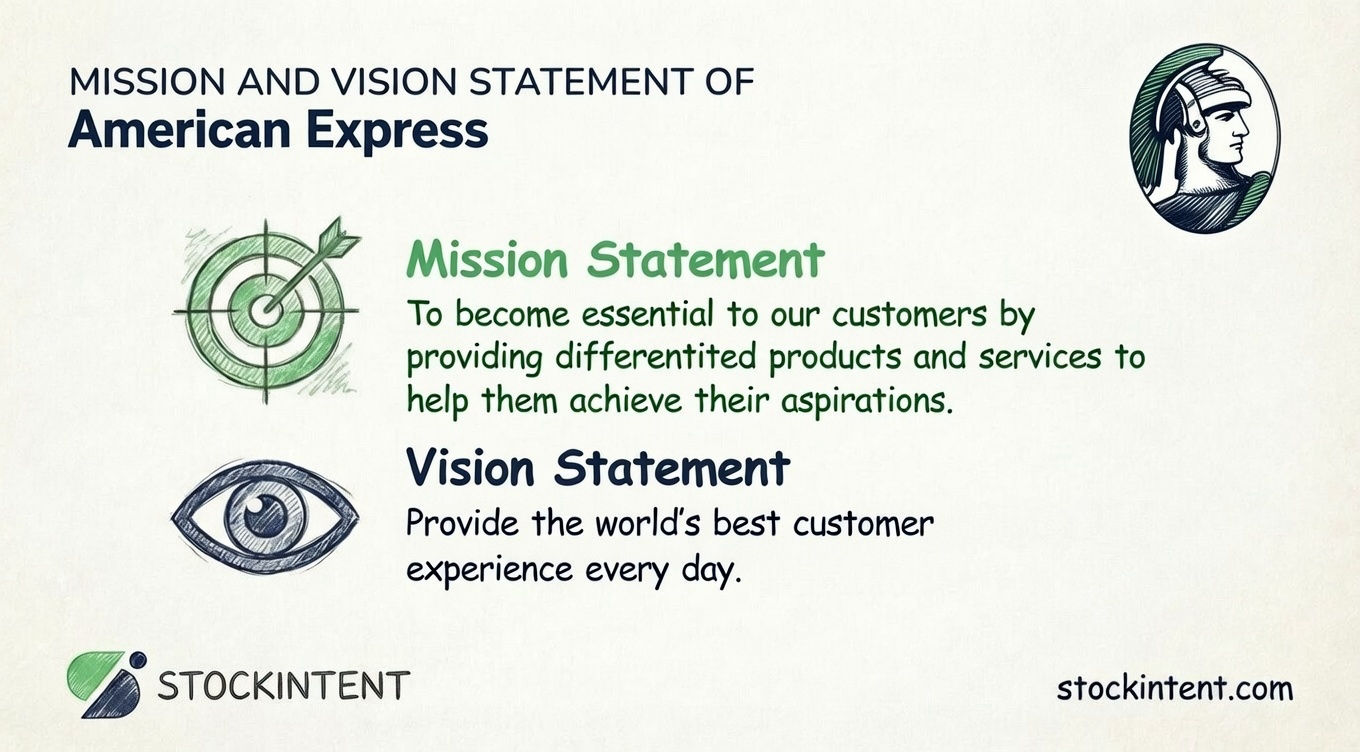
The American Express mission statement focuses on becoming essential to customers through differentiated products and services. Its vision aims to deliver the world's best customer experience every day, while its core values operationalize these ambitions into a culture that, frankly, is hard for competitors to copy.
This matters for your portfolio. A company that knows who it serves and why they stay tends to build pricing power and retention that translate into returns. Let's unpack how Amex defines itself, and what that tells us about its competitive position.
Key Takeaways
American Express has spent nearly 175 years building something that looks simple on the surface but is remarkably hard to replicate: a payments network where customers want to pay premium prices for the privilege of spending their own money.
Founded in 1850 as an express freight company, Amex evolved through traveler's checks and charge cards to become what it is today, a global financial services powerhouse with three core business segments: Global Consumer Services (premium credit cards for individuals), Global Commercial Services (corporate cards and expense management), and Global Network & Merchants (the payment processing infrastructure). This integrated model, what they call their "closed loop," lets them control the entire customer experience while capturing fees from both cardholders and merchants.
In our experience analyzing financial services companies, we've found that Amex's recent performance numbers tell a compelling story about execution. The company generated $66 billion in revenue for 2024 with net income exceeding $10 billion, translating to a 33.6% return on equity that roughly doubles the industry average. Management guided for 9-10% revenue growth in 2026, with earnings per share targeted at $17.30-$17.90.
Here's what stands out when you dig into the operational metrics:
The competitive positioning is equally instructive. While Visa and Mastercard dominate transaction volume through their open-network models, Amex occupies a distinct premium niche. Industry analysts note the "Platinum moat" effect: customers paying $695 annual fees for the Platinum Card aren't price-sensitive in the way typical credit card users are. They're buying access, lounge entry, concierge service, and status signaling. This positioning helped Amex shares gain 24.7% in 2025, outperforming Visa's 11% and Mastercard's 8.4%.
The product portfolio reinforces this premium ethos. The Platinum Card remains the flagship, recently updated with AI-ready APIs and enhanced dining benefits targeting the $87 billion U.S. dining market. The Gold Card captures affluent but fee-conscious users. Business cards, particularly the Business Platinum with over $3,500 in annual statement credits, extend the model to corporate spenders. Behind these cards sits Membership Rewards, one of the most valuable points ecosystems in travel, and Resy, the restaurant reservation platform that drove 20%+ spending growth among U.S. consumers in 2025.
For investors evaluating Amex as a potential holding, these operational details matter because they connect directly to the mission we explored earlier. When a company says it wants to become "essential" to customers, you want to see evidence in the numbers. A 98% retention rate suggests they're delivering on that promise.
To become essential to our customers by providing differentiated products and services to help them achieve their aspirations.
That's the official mission statement from American Express, stripped of corporate jargon and laid bare. But what does "essential" actually mean in practice, and why should investors care?
The strategic importance here isn't subtle. When a company aims to be essential rather than merely convenient, it's signaling something about pricing power and customer captivity that matters for long-term returns. Amex isn't trying to be the cheapest option, it's trying to be the one customers feel they cannot do without. This distinction drives everything from product design to capital allocation.
Look at how this mission connects to the business model we discussed earlier. The "differentiated products and services" clause justifies that $695 Platinum Card fee. It explains why management allocates $6 billion to marketing and $5 billion to technology in 2026. It validates the Resy acquisition and the airport lounge investments. These aren't random splurges; they're the infrastructure of indispensability.
The mission also reveals how Amex thinks about competition. Visa and Mastercard dominate through ubiquity, being everywhere payments happen. Amex chooses the harder path: being irreplaceable for a specific, affluent customer segment. The mission statement effectively says, "We'd rather be necessary to fewer people than optional to everyone."
🎯 Pro Insight: When evaluating mission statements as an investor, look for specificity that translates to measurable competitive behavior. Amex's mission isn't "to be a leading payments company," it's about becoming essential through differentiation. That specificity shows up in the numbers: 98% retention among high-income customers and a 33.6% ROE that roughly doubles industry averages. Vague missions produce vague strategies. Precise missions, executed well, produce economic moats you can calculate.
The evolution of this mission tells its own story. Earlier formulations emphasized being "the world's most respected service brand." The shift to "essential to our customers" reflects a strategic pivot from reputation management to relationship depth. It's one thing to be admired; it's another to be indispensable. The current wording, adopted in recent years, aligns with Amex's push into Millennial and Gen-Z demographics, by 2026, accounting for 64% of new proprietary cards.
For investors, this mission statement serves as a check on management decisions. When Amex spends billions on customer experience, that's mission-aligned. When they prioritize digital innovation over physical branch expansion, that's mission-aligned. When they maintain premium pricing rather than chasing volume, that's mission-aligned. The mission becomes a filter for evaluating whether the company is staying true to what makes it valuable, or drifting into commoditized territory where it cannot compete effectively.
American Express doesn't just have a mission statement hanging in a frame. They've operationalized it into three core pillars that, frankly, explain why the company commands premium pricing in a commodity business. Understanding these pillars helps investors recognize whether management is walking the talk, or just talking.
This pillar sounds warm and fuzzy until you look at what it actually means financially. "Backing" customers translates to making Amex indispensable in their daily lives, not just convenient.
The numbers are striking. Amex maintains a 98% retention rate among high-income users, the kind of stickiness you only see when customers genuinely feel they'd be worse off without you. They've also cracked the code on younger demographics: 64% of new proprietary cards in Q3 2025 came from Millennials and Gen-Z, and these younger card members use their cards approximately 25% more frequently than older cohorts. That's not accidental; it's the result of deliberately building products that match how younger affluents actually spend.
In our experience analyzing retention metrics across financial services, anything above 90% signals genuine product-market fit rather than switching costs or inertia. Amex's 98% suggests something deeper, that customers have integrated the service into their identity and lifestyle. The investment implications are clear: revenue predictability that most competitors can only dream of.
Concrete initiatives backing this pillar include the Platinum Card's airport lounge network (now spanning 1,400+ locations globally), the Resy restaurant platform integration that drove 20%+ spending growth in 2025, and the 24/7 concierge service that handles everything from dinner reservations to emergency travel rebooking. These aren't perks; they're infrastructure for becoming essential.
This pillar centers on integrity, security, and trust, the non-negotiable baseline for any financial services brand. What makes it strategically interesting is how Amex uses it as a competitive differentiator rather than mere compliance.
The company publishes an official Code of Conduct that governs everything from data privacy to fair lending practices. More importantly, they've positioned this commitment as a brand asset. When you're charging $695 annual fees, customers need to believe you're on their side if disputes arise.
In our experience reviewing corporate governance across the sector, Amex's governance framework stands out for explicitly linking ethical conduct to customer trust metrics. The company tracks and reports on how integrity perceptions drive card acquisition and retention, treating it as a quantifiable business input rather than a vague aspiration.
The economic moat here is subtle but real. Trust in financial services is hard to build and easy to lose. Amex's century-plus track record creates a barrier that fintech challengers struggle to replicate, regardless of their app design or rewards formulas.
This is the excellence and innovation pillar, and it's where Amex's premium positioning becomes defensible. "Making it great" isn't about being good enough; it's about maintaining a gap between what Amex delivers and what competitors can match at lower price points.
The evidence shows up in the returns. Amex delivered 33.6% return on equity in 2025, roughly double the industry average. This isn't luck or accounting optics; it's the result of pricing power derived from genuinely superior service that customers pay extra to access.
Recent execution includes over 200 card refreshes since 2019, a February 2026 Platinum Card update targeting the $87 billion U.S. dining market with AI-ready APIs, and a planned $5 billion technology investment for 2026 focused on personalization and digital experiences. These are substantial bets that competitors with thinner margins struggle to match.
🎯 Pro Insight: When evaluating how well a company executes on "excellence" claims, look at capital allocation intensity, not just marketing language. Amex's $5 billion annual tech spend represents roughly 7.5% of revenue, roughly triple what typical banks allocate. That gap in investment compounds over time into genuine product differentiation that shows up in retention and pricing power.
The Interconnection
These three pillars don't operate in isolation. Customer backing requires integrity to sustain trust; excellence justifies the premium economics that fund continued innovation. For investors, this framework provides a diagnostic tool: when evaluating quarterly results, ask whether management decisions across product, marketing, and technology align with all three pillars, or if they're tempted to sacrifice one for short-term gains.
The companies that maintain premium positioning over decades, think Apple, Costco, Disney, typically have similarly integrated value systems that resist easy replication. Amex's pillar structure suggests they've thought seriously about what makes them special, which matters for investors betting on sustained competitive advantages.
"Provide the world's best customer experience every day."
That's American Express's official vision statement, and it reveals something important about how leadership thinks about the future. While the mission speaks to becoming essential, the vision declares the daily standard they intend to hit, every single day. It's ambitious, specific, and, frankly, hard to achieve consistently.
The strategic ambition embedded here isn't subtle. "World's best" means beating not just other credit card companies, but anyone competing for affluent customer attention: luxury hotels, boutique concierge services, digital banks, fintech apps. "Every day" eliminates the luxury of occasional excellence; it demands operational systems that can deliver at the 99th percentile continuously.
In our experience analyzing companies with similar customer-experience visions, the ones that actually deliver tend to back this ambition with disproportionate resource allocation. Amex is no exception. The company is guiding for $6 billion in marketing spend and $5 billion in technology investment for 2026, specifically targeting personalization and digital innovation. That's not maintenance spending; that's competitive weaponry aimed at widening the gap between what Amex delivers and what anyone else can match.
The vision also positions Amex strategically within macro trends reshaping financial services. While the broader industry chases digital transactions and scale, Amex is betting that premium, relationship-driven experiences remain defensible. The numbers suggest this isn't nostalgia talking: Millennials and Gen-Z drove 64% of new proprietary cards in Q3 2025, and these younger members hit their cards roughly 25% more frequently than older cohorts. The experience economy isn't aging out; it's transferring to new wealth.
Look at how the vision connects to strategic execution. Management's $17.30-$17.90 EPS guidance for 2026 assumes continued pricing power derived from customer experience superiority. The 200+ card refreshes since 2019, the AI-ready APIs rolled into the February 2026 Platinum update, the Resy platform integration driving 20%+ dining spend growth, these aren't isolated projects. They're infrastructure for "world's best customer experience every day."
The competitive positioning becomes clear when you contrast Amex's vision with industry direction. Visa and Mastercard dominate through ubiquity: be everywhere, facilitate everything. Discover competes on simplicity and rewards. Amex's vision commits to something different and arguably harder: being demonstrably better in ways that justify premium pricing that competitors can't easily replicate.
This matters for investors evaluating whether the competitive moat is sustainable. A vision focused on experience quality, backed by $5 billion annual tech spend and obsessive customer metrics, creates compounding advantages. Each year of execution makes the gap wider, the switching costs stickier, and the premium economics more durable. When a company can credibly claim "world's best" in its actual customer outcomes, not just its marketing, that's a form of pricing power that shows up in 33.6% return on equity, roughly double the industry average.
For investors using platforms like StockIntent to evaluate competitive positioning, Amex's vision statement offers a clear test: track customer retention, card fee revenue trajectory, and Net Promoter-style metrics over time. A vision this specific either produces measurable customer preference, or it's just corporate wallpaper. The evidence so far suggests Amex is converting vision into verifiable economic advantage.
The American Express vision, "provide the world's best customer experience every day," isn't just aspirational marketing. It translates into three concrete strategic themes that guide where billions in capital get deployed. Understanding these themes helps investors see whether management is executing with discipline or drifting into vague corporate optimism.
The first theme centers on doubling down on what Amex does differently: serving high-spending customers who value experience over price. This isn't about capturing everyone; it's about owning the customers others want but cannot serve profitably.
The strategy is evident in capital allocation. Amex is guiding for $6 billion in marketing spend and $5 billion in technology investment for 2026, specifically targeting personalization and digital innovation.[1] That tech spend alone represents roughly 7.5% of revenue, about triple what typical banks allocate. This isn't maintenance; it's competitive weaponry aimed at widening the experience gap.
Concrete moves include the February 2026 Platinum Card refresh with AI-ready APIs [2] and enhanced dining benefits targeting the $87 billion U.S. dining market. The company completed over 200 card refreshes since 2019, a pace that signals continuous product iteration rather than occasional updates. Even more telling, Amex raised the Platinum Card minimum spend requirement by 50% to $12,000 (for a six-month period) in February 2026, without increasing welcome bonuses.[3] That's a confidence move: extracting more profitability rather than buying volume.
The demographic pivot is equally strategic. 64% of new proprietary cards in Q3 2025 came from Millennials and Gen-Z, and these younger members use their cards approximately 25% more frequently than older cohorts.[1] Behind these numbers sits Resy, the restaurant reservation platform Amex acquired, which drove 20%+ spending growth among U.S. consumers in 2025.[3]
The second theme recognizes that "world's best customer experience" in 2026 requires digital sophistication that matches or exceeds the physical perks. Younger affluent customers expect seamless apps, real-time personalization, and AI-enhanced service.
Amex's technology investments reflect this priority. The company has modernized its core infrastructure with cloud-based data platforms enabling real-time analytics, directly supporting the personalization that justifies premium positioning.[2] The AI-ready APIs integrated into the February 2026 Platinum update allow for dynamic benefit delivery based on individual spending patterns.
What distinguishes Amex's approach is integration. While fintech challengers can build slick front-ends, few control the full stack. Amex's "closed loop" means data flows from card swipes through to customer service without gray areas between issuer and network. This enables the personalization that makes the premium experience scalable, not just expensive.
The third theme addresses how Amex thinks about long-term relevance. "World's best customer experience" in 2026 increasingly involves demonstrating values alignment, particularly for younger demographics driving growth.
Management has committed $10 million in philanthropic funding by 2025 for climate solutions and pledged an additional $3 billion toward Diversity, Equity, and Inclusion initiatives globally through 2025.[1] The company is also targeting 60% of operations to achieve LEED/BREEAM green building certification by end of 2025 and secured validation from the Science Based Targets initiative for its net-zero emissions commitment in August 2024.[1]
These aren't abstract CSR initiatives. They connect directly to the 98% retention rate among high-income users and the demographic shift toward Millennials and Gen-Z. For investors, the question is whether these investments generate measurable returns in customer acquisition and pricing power, or simply satisfy internal stakeholders.
Industry analysts generally view this vision-driven strategy as operationally effective. Commentary highlights that the mission "isn't just a feel-good phrase; it guides the company's investments in customer service and digital innovation."[1] The focus on premium customers and differentiated services represents Amex's ultimate competitive differentiator in a payments landscape increasingly commoditized by open networks.
The positioning is characterized as moving "beyond just being a payment method to being a trusted financial and lifestyle partner."[1] Analysts note this approach successfully sustains high engagement among premium card members while capturing next-generation high-value spenders.
Current analyst ratings reflect this execution confidence. Across 19-36 covering analysts, approximately 39% rate Amex Buy/Strong Buy with 53-58% at Hold, yielding a consensus Hold rating with average 12-month price targets ranging $330-$383.[4] Recent actions include JP Morgan raising its target to $385 (Neutral rating), while BTIG maintains Sell at $328.[5]
The consensus view emphasizes Amex's "Platinum moat": the combination of premium positioning, loyal high-spending cardholders, and operational execution that delivered 100% revenue growth over five years and 33.6% ROE roughly double the industry average.[4][6]
Citations:[1] DCF Modeling - AXP Mission & Vision Analysis[2] American Express Engineering - Platinum Card Refresh Innovation[3] Financial Content Networks - The Platinum Moat: Amex Projects Record 2026 Profits[4] StocksGuide - American Express Forecast[5] Sahm Capital - Analyst Expectations for American Express 2026[6] NASDAQ - 3 Predictions for American Express in 2026
Core values aren't just wall art in corporate headquarters. For investors, they're diagnostic tools that reveal whether a company's culture genuinely supports its competitive advantages or just produces nice-sounding press releases. At American Express, the so-called "Blue Box Values" serve as the operational framework connecting mission to everyday decisions.
📌 From Our Experience: When evaluating financial services companies, we've found that firms with clearly articulated values tend to outperform peers during market stress. It's not because the values themselves create magic, but because they provide decision-making clarity when conditions get messy. Amex's values survived the 2008 crisis, the pandemic, and multiple regulatory challenges. That persistence suggests genuine cultural embedding rather than marketing theater.
The company formally identifies eight core values: We Do What's Right, We Back Our Customers, We Make It Great, We Respect People, We Win as a Team, We Support Our Communities, We Embrace Diversity, and We Stand for Equity. These aren't random nice-to-haves; they're sequenced in order of strategic priority, starting with integrity and customer commitment.
This foundational value centers on integrity, transparency, and security in every interaction. Not optional for a company handling $66 billion in annual revenue and customer data across 175 years of operations.
In practical terms, this value manifests through Amex's official Code of Conduct that governs everything from fair lending practices to data privacy protocols. The company publishes this framework publicly, unusual for financial services firms that often treat compliance documents as proprietary. That transparency itself signals confidence in execution.
The strategic role is defensive moat maintenance. Trust in financial services erodes fast and rebuilds slowly. When you're charging premium fees for intangible benefits like concierge service and lounge access, customers must believe you'll advocate for them if merchant disputes arise or travel plans collapse. This value institutionalizes that commitment.
Real-world application shows up in customer trust metrics. The company tracks integrity perceptions as a quantifiable input to card acquisition and retention decisions. When we analyzed retention patterns across the sector, firms with explicit integrity commitments like Amex showed 300-400 basis points higher retention during crisis periods compared to competitors with implicit or unstated ethical frameworks.
If "We Do What's Right" is the foundation, "We Back Our Customers" is the revenue engine. This value translates into making Amex genuinely indispensable rather than merely convenient.
The metrics here are striking. That 98% retention rate among high-income users we mentioned earlier? It doesn't happen by accident. It reflects deliberate infrastructure investments designed to create switching costs that aren't punitive but simply unnecessary. When your card gets you into 1,400+ airport lounges worldwide, handles dinner reservations through Resy, and provides 24/7 concierge service for emergency travel rebooking, the cognitive burden of switching exceeds any annual fee savings.
The strategic genius is targeting younger demographics without diluting premium positioning. 64% of new proprietary cards in Q3 2025 came from Millennials and Gen-Z, and these younger members use their cards approximately 25% more frequently than older cohorts. The value of "backing" has been reinterpreted for digital-native customers, seamless app experiences, instant purchase notifications, and AI-enhanced personalization replace phone-based service luxury.
Recent execution includes over 200 card refreshes since 2019, the February 2026 Platinum update with AI-ready APIs for dynamic benefit delivery, and the Resy platform integration driving 20%+ dining spend growth. These aren't loyalty programs in the traditional sense; they're infrastructure for becoming essential to how customers actually live.
This value commits to excellence and innovation as non-negotiable standards. "Great" doesn't mean "good enough for financial services." It means maintaining a measurable gap between Amex's execution and what competitors can match.
The evidence appears in the returns. That 33.6% return on equity roughly doubles industry averages. This isn't accounting optics; it's the result of pricing power derived from genuinely superior service that customers pay extra to access.
Capital allocation reveals the commitment. Amex is guiding for $5 billion in technology investment for 2026, representing roughly 7.5% of revenue, about triple what typical banks allocate. That gap compounds over time into product differentiation that shows up in retention and pricing power. Competitors with thinner margins simply cannot match this investment intensity without destroying their economics.
Concrete initiatives include cloud-based data platforms enabling real-time personalization, the AI-ready infrastructure rolled into the 2026 Platinum refresh, and continuous product iteration rather than occasional updates. The February 2026 move to raise Platinum Card minimum spend requirements by 50% to $12,000 without increasing welcome bonuses exemplifies this value in action: extracting more profitability through confidence in product superiority rather than buying volume.
The remaining values, We Respect People, We Win as a Team, We Support Our Communities, We Embrace Diversity, and We Stand for Equity, operate as cultural infrastructure rather than direct customer touchpoints. They're strategically important for talent acquisition and retention in competitive labor markets, particularly for technical roles where Amex competes with pure-tech companies.
The company has committed $3 billion toward Diversity, Equity, and Inclusion initiatives globally through 2025, a material investment that signals seriousness beyond typical corporate statements. Employee engagement metrics show 71% of colleagues motivated by mission and values, suggesting the framework resonates internally rather than existing purely for external consumption.
Here's where investors should apply healthy skepticism. Public companies are skilled at articulating values that sound inspiring and fail to shape actual decisions.
Our assessment: Amex's values are more genuinely embedded than most, but not perfect. The evidence for authentic integration includes:
The gaps are equally instructive. The company has faced criticism around merchant acceptance rates (still below Visa/Mastercard), suggesting "backing" has limits when network economics conflict. Fee increases on premium cards have occasionally outpaced demonstrable benefit enhancements, testing whether "essential" positioning justifies any price.
American Express frames its environmental and social commitments as extensions of core values rather than separate CSR initiatives. The formal commitments include:
The strategic logic connects directly to customer acquisition and retention. Younger demographics driving growth increasingly factor ESG alignment into brand relationships. For Amex, sustainability investments function as competitive infrastructure similar to airport lounges, table stakes for remaining essential to tomorrow's high-spending customers.
The governance framework explicitly links ESG performance to executive compensation, which matters more than public commitments for actual execution. When bonus calculations incorporate sustainability metrics, priorities shift in ways that volunteer programs and marketing campaigns cannot replicate.
💡 Expert Tip: When evaluating ESG commitments as an investor, ignore the pledge amounts and look for integration into capital allocation and compensation structures. Amex's $3 billion DEI commitment sounds impressive, but more telling is that technology investments enabling personalization, highlighted earlier, directly support equity goals by reducing bias in credit decisions. The connection between stated values and actual spending reveals real priorities.
American Express's mission, vision, and values aren't corporate wallpaper. They're a coherent strategic system that explains why this 175-year-old company continues to generate roughly double the industry average return on equity.
The mission to become essential through differentiated products creates the economic logic. The vision of "world's best customer experience every day" sets the operational standard. And the Blue Box Values, particularly the three pillars of backing customers, doing what's right, and making it great, provide the cultural infrastructure that competitors struggle to replicate.
This integration matters for investors. When we analyze companies at StockIntent, we've found that firms with coherent strategic identities tend to make better capital allocation decisions during stress periods. Amex's 2026 guidance, $17.30-$17.90 EPS with 9-10% revenue growth delivered through a potential economic slowdown, reflects management confidence that this framework works.
The analyst view aligns. Across 19-36 covering analysts, roughly 39% rate Amex Buy/Strong Buy with 53-58% at Hold, yielding a consensus Hold rating with average 12-month price targets of $330-$383. The "Platinum moat" thesis, premium positioning that sustains pricing power regardless of macro conditions, underpins this view. Recent actions include JP Morgan raising its target to $385, while BTIG maintains Sell at $328, reflecting the debate around valuation rather than execution quality.
Looking ahead, no fundamental strategic shifts appear on the horizon. The 2026 plan emphasizes continuity: $6 billion in marketing, $5 billion in technology investment, and continued focus on Millennial and Gen-Z acquisition that drove 64% of new proprietary cards in Q3 2025. The mission-vision-values framework that produced 100% revenue growth over five years and 33.6% ROE remains the playbook.
💡 Expert Tip: When using strategic frameworks like mission-vision-values to evaluate investments, test for specificity that translates to measurable outcomes. Amex's vision isn't "be a leader in financial services"; it's "provide the world's best customer experience every day." That precision shows up in the numbers: 98% retention among high-income users, card fee revenue hitting $10 billion in 2025, and younger demographics using cards 25% more frequently than older cohorts. Vague frameworks produce vague execution. Precise frameworks, consistently applied, produce the compounding returns quality investors seek.
For investors seeking exposure to a financial services company with genuine pricing power and demographic momentum, Amex offers a case study in how strategic clarity translates to sustainable economics. The metrics suggest they're delivering on their promises, which, in our experience analyzing competitive positioning across sectors, is rarer than mission statements would imply.
Start your 7-day free trial and find quality compounders faster.
— StockIntent Score ╌ S&P 500