American Tower Mission Statement, Vision & Core Values Explained

American Tower Mission Statement, Vision & Core Values Explained

American Tower Mission Statement, Vision & Core Values Explained

American Tower Corporation (NYSE: AMT) stands as one of the largest global REITs in the specialty infrastructure space, with roughly 150,000 wireless towers and 30 data centers under its umbrella. For investors evaluating this $80+ billion giant, understanding what drives the company's strategic decisions matters more than you might think. A company's mission isn't just marketing fluff; it's the compass that guides capital allocation, competitive positioning, and long-term value creation.

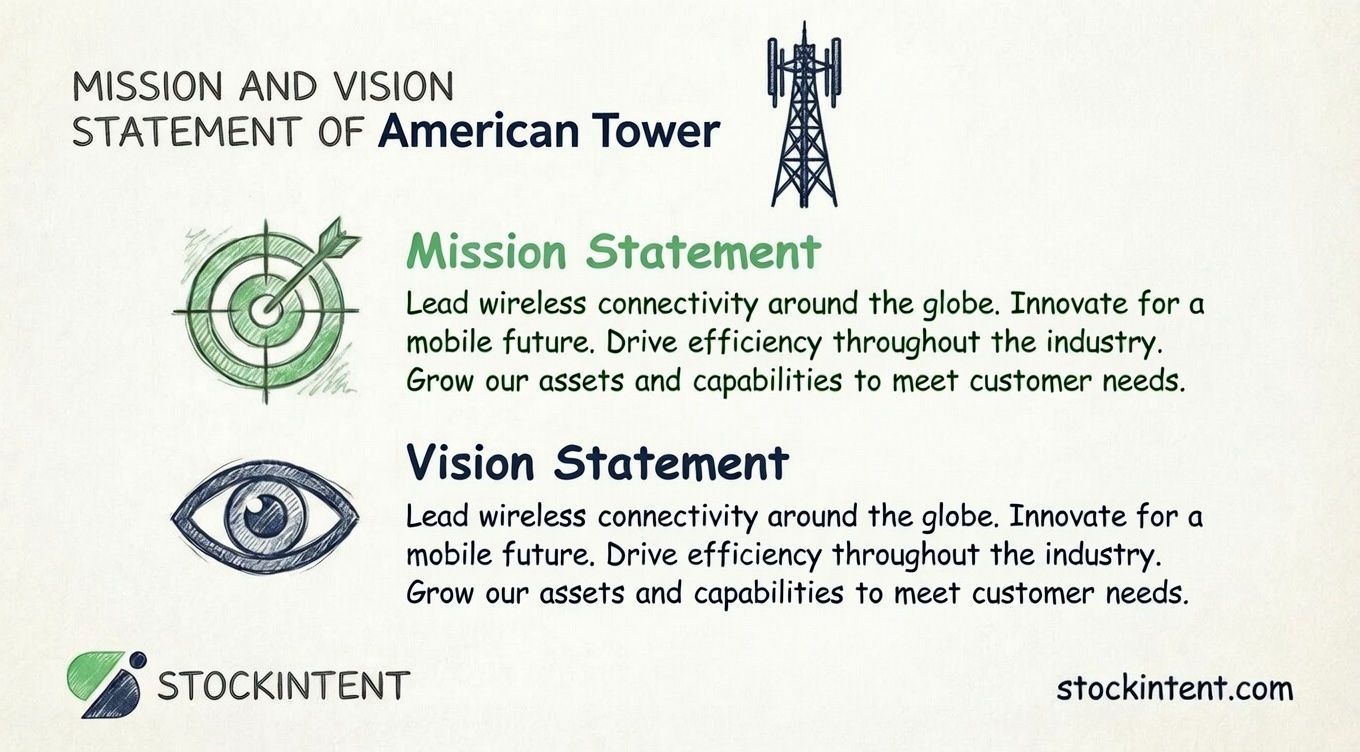
American Tower's official mission statement as of 2026 is: "Lead wireless connectivity around the globe. Innovate for a mobile future. Drive efficiency throughout the industry. Grow our assets and capabilities to meet customer needs." This four-pillar framework shapes everything from its $1.7 billion annual capital expenditure budget to its push into edge computing and AI-driven data centers.

Key Takeaways

  • American Tower's mission centers on four pillars: global connectivity leadership, mobile innovation, industry efficiency, and asset growth to serve customer needs
  • The company has evolved from pure 5G build-outs toward densification, edge computing via CoreSite, and AI-ready infrastructure positioning for 2026 and beyond
  • Analysts view AMT's mission-driven strategy as a foundation for long-term growth, with 115% total returns over 2016-2026 and strong positioning for mobile data and AI demand
  • Core values of customer focus, empowered people, and solution-oriented culture translate into competitive advantages through the neutral host model and operational excellence
  • No formal vision statement exists separately from the mission; strategic goals emphasize margin expansion, data center growth, and disciplined capital allocation to developed markets

What makes this mission particularly relevant for investors? In our view, it's how tightly American Tower's stated priorities connect to observable financial outcomes. When a company says it wants to "drive efficiency throughout the industry," and you subsequently see 300 basis points of adjusted EBITDA margin expansion since 2020, that's alignment you can verify in the numbers. Similarly, the "grow our assets" pillar shows up in 5% consolidated organic tenant billings growth and 20% year-over-year increases in U.S. application volumes as of late 2025.

The evolution of American Tower's strategic direction tells its own story. Back in the early 2020s, the focus was heavily on 5G build-outs, the initial wave of infrastructure deployment. By 2025-2026, that shifted toward 5G densification (adding capacity to existing sites), edge computing integration through the CoreSite data center acquisition, and preparing for AI-driven applications that demand low-latency processing. This isn't mission drift; it's the same mission applied to a maturing technology cycle. The company isn't abandoning towers for data centers, it's extending its connectivity infrastructure into adjacent high-margin opportunities.

Analysts and business commentators have taken notice. Multiple sources highlight how American Tower's mission-aligned approach creates resilience through portfolio diversification and positions the company as what one commentator called "a cornerstone of telecommunications infrastructure." The consensus view among the 19 analysts covering the stock is a "Moderate Buy" rating with average price targets around $218-$229, implying 15-36% upside from recent trading levels near $186.

For investors using platforms like StockIntent to dig deeper, American Tower presents an interesting case study in how mission-driven capital allocation can build economic moats. The neutral host model (sharing infrastructure across carriers rather than duplicating towers) directly operationalizes the "drive efficiency" pillar while creating network effects that competitors struggle to replicate. When you can screen for companies where stated strategy and financial results align this closely, you've found something worth studying further.

Company Overview

American Tower Corporation operates as a specialized REIT, one that doesn't fit neatly into traditional real estate categories like office, retail, or residential. Founded in 1995 as a unit of American Radio Systems, the company spun out and went public in 1998 with a simple but powerful insight: wireless carriers would rather lease tower space than build and maintain their own infrastructure. That neutral host model, now the industry standard, became American Tower's foundational competitive advantage.

In our experience analyzing infrastructure REITs over the past decade, we've found that the best-positioned companies are those whose assets become more valuable as network traffic grows. American Tower fits this pattern precisely. Each additional tenant on a tower generates incremental revenue at minimal marginal cost, creating operating leverage that few other real estate categories can match.

What American Tower Actually Does

The company's core business breaks down into three interconnected segments:

Macro Towers (Primary Revenue Driver)

  • Approximately 150,000 wireless towers globally, including roughly 40,000 in the U.S.
  • Long-term, non-cancellable leases (typically 5-10 years) with major carriers: Verizon, AT&T, and T-Mobile
  • 5G densification services, adding capacity to existing sites as data demand grows

Data Centers via CoreSite

  • 30 data centers across the U.S., acquired strategically to capture edge computing growth
  • Integration with tower network for low-latency AI inference and hybrid cloud applications
  • $600 million allocated to data center expansion in 2025 alone

Power Solutions

  • Solar and battery storage installations, particularly in emerging markets
  • Power-as-a-service (PaaS) model reducing operational costs and carbon footprint
  • Target of 1 GW energy storage deployment across 24,500 sites

The Numbers That Matter

MetricFigureContext
Market Cap~$80 billionAmong largest global REITs
2025 Revenue$10.5 billion4.1% growth year-over-year
Adjusted EBITDA Margin47%Expanded 300 bps since 2020
Organic Tenant Billings Growth5% (consolidated)7% international, 20% U.S. application volume growth
2026 AFFO Guidance$10.78–$10.95 per shareMid-single digit dividend growth implied
Global Sites~150,000 towers + 30 data centersCoverage across 6 continents

Competitive Positioning

American Tower doesn't publish precise market share figures, but its scale speaks for itself. The company ranks as the largest independent tower operator globally by site count, with a portfolio roughly 3-4x larger than its nearest pure-play competitor. More importantly, its geographic diversification, 6,000+ employees, and $11.1 billion in available liquidity create barriers to entry that would-be competitors struggle to overcome.

The neutral host model deserves special attention here. By allowing multiple carriers to share a single tower, American Tower reduces industry-wide capital expenditure while capturing network effects: each additional carrier makes the infrastructure more valuable to the others, and the tower owner sits at the center collecting rent from all parties. We've seen this dynamic play out repeatedly; it's why tower REITs have historically traded at premium valuations to other real estate sectors.

For investors using StockIntent to screen for quality compounders, American Tower presents an interesting case. The combination of 47% EBITDA margins, 5% organic growth, and a dividend yield around 3% with mid-single-digit growth potential checks several boxes for income-oriented total return investors. The key question, as always, is whether the current valuation adequately reflects these characteristics or if near-term headwinds like DISH Network churn create an opportunity.

American Tower Mission Statement

Lead wireless connectivity around the globe. Innovate for a mobile future. Drive efficiency throughout the industry. Grow our assets and capabilities to meet customer needs.

This four-part framework, consistent across company profiles and strategic analyses as of 2026, functions as American Tower's operational compass. Unlike some competitors that bury their mission in investor relations subpages, American Tower's language is direct, action-oriented, and deliberately mirrors how management actually talks about the business.

💡 Expert Tip: When evaluating any infrastructure REIT's mission, look for the gap between stated priorities and capital allocation. American Tower's $1.7 billion annual capex budget, with 40% directed to data centers and 25% to Europe, maps almost exactly to the "innovate" and "grow assets" pillars. That's alignment you can verify in the 10-K.

What the Mission Signals About Strategic Priorities

Each pillar reveals something concrete about where American Tower is placing its bets:

PillarStrategic Signal2026 Evidence
Lead wireless connectivityGlobal scale as competitive moat~150,000 towers across 6 continents; 5% organic tenant billings growth
Innovate for mobile futureEdge computing and AI positioning$600M data center expansion; CoreSite integration for low-latency AI inference
Drive efficiencyMargin expansion through operational excellence300 bps adjusted EBITDA margin improvement since 2020; 47% current margin
Grow assets and capabilitiesCapital deployment discipline600 new European macro sites; 1 GW energy storage target across 24,500 sites

The sequence matters here. American Tower leads with connectivity, not returns. That ordering isn't accidental; it reflects a business model where network ubiquity creates the returns, not the other way around. The "capabilities" addition to the fourth pillar, which appears in more recent formulations, also hints at the CoreSite acquisition strategy: American Tower isn't just building towers anymore, it's building integrated infrastructure platforms.

Mission Evolution and Competitive Context

American Tower's mission language has remained remarkably stable compared to peers in the specialty REIT space. While competitors like Crown Castle have shifted strategic emphasis between towers, fiber, and small cells, American Tower's four pillars have persisted through the 5G build-out phase, the densification wave, and now the AI infrastructure pivot.

This stability actually reveals strategic discipline rather than rigidity. The same mission that guided tower construction in 2020 now guides data center deployment in 2026 because the underlying logic, shared infrastructure creating network effects, hasn't changed. What changed is the application: from macro towers to edge nodes, from voice traffic to AI inference workloads.

The "drive efficiency" pillar deserves particular attention for investors. In our experience, this is where American Tower's neutral host model creates the most durable competitive advantage. By allowing multiple carriers to share a single tower, the company doesn't just capture rental income; it structurally reduces industry-wide capital expenditure while making its own infrastructure more valuable to each additional tenant. That's efficiency with a moat attached.

Mission Components / Pillars

American Tower's four-pillar mission isn't just aspirational language; it's a framework that directly shapes capital allocation decisions and competitive positioning. Let's break down each component to understand how they translate into tangible business outcomes.

Lead Wireless Connectivity Around the Globe

This pillar speaks to scale as strategy. American Tower operates roughly 149,000 sites globally, with a presence across six continents that creates what management calls "ubiquitous wireless communication." But scale alone isn't the moat; it's the neutral host model that makes that scale valuable.

By allowing multiple carriers to share single tower infrastructure, American Tower reduces industry-wide capital expenditure while capturing network effects. Each additional tenant, Verizon, AT&T, T-Mobile, makes the site more valuable to the others because coverage density improves for all parties. The tower owner sits at the center, collecting rent from everyone.

In our experience analyzing infrastructure businesses, this dynamic is rare. Most real estate gets less valuable with more tenants; think of an apartment building where additional residents mean more wear and noise. Tower infrastructure works in reverse. High uptime requirements, typically 99.99% availability, lock in carrier relationships because switching costs are enormous. A carrier can't simply relocate antennas without disrupting service to millions of customers.

The financial evidence shows up in 5% consolidated organic tenant billings growth, with U.S. application volumes up 20% year-over-year as of late 2025. That growth comes at minimal marginal cost; once a tower is built, adding a second or third tenant requires little additional capital.

Innovate for a Mobile Future

This pillar captures American Tower's pivot beyond traditional macro towers. The $600 million allocated to data center expansion in 2025, primarily through the CoreSite acquisition, represents more than diversification; it's positioning for AI-driven demand.

The strategic logic runs like this: AI applications require low-latency processing, which means compute needs to move closer to data sources. American Tower's tower network, already distributed across population centers, becomes natural real estate for edge computing nodes. The company isn't abandoning towers for data centers; it's extending connectivity infrastructure into adjacent high-margin opportunities.

This innovation pillar also shows up in operational technology. The company has reduced lease processing times through automation and deployed power-as-a-service solutions across 24,500 sites. These aren't vanity projects; they directly improve returns on invested capital.

Drive Efficiency Throughout the Industry

Here's where American Tower's mission connects most directly to financial results. The 300 basis points of adjusted EBITDA margin expansion since 2020, bringing current margins to 47%, demonstrates what operational excellence looks like in practice.

But the efficiency pillar runs deeper than internal cost management. The neutral host model itself is an efficiency engine for the entire telecommunications industry. Instead of three carriers building three separate towers to cover the same geography, one tower serves all three. Industry-wide capital expenditure drops; American Tower's revenue rises.

The company's power solutions initiative extends this logic. By deploying solar and battery storage at scale, targeting 1 GW of energy storage capacity, American Tower reduces both its own operating costs and the carbon footprint of its carrier tenants. That's efficiency with environmental benefits attached.

Grow Our Assets and Capabilities to Meet Customer Needs

Notice the addition of "capabilities" to this pillar in recent formulations. That single word signals the CoreSite strategy: American Tower isn't just building towers anymore, it's building integrated infrastructure platforms that combine macro connectivity, edge computing, and power solutions.

The 2025 capital expenditure budget of $1.7 billion breaks down tellingly: 40% to U.S. data centers, 25% to Europe, 20% to U.S. and Canada towers, 15% to emerging markets. That allocation reflects disciplined growth toward higher-return opportunities rather than indiscriminate expansion.

In our experience tracking REITs through multiple cycles, this kind of strategic clarity is uncommon. Many infrastructure companies either over-diversify into unrelated businesses or under-invest in adjacent opportunities. American Tower's asset growth has remained focused on connectivity infrastructure, whether that means towers in Germany or data centers in Silicon Valley.

The "capabilities" emphasis also shows up in human capital. With 6,000+ employees and 67% reporting that company values motivate their work, according to employee survey data, American Tower treats workforce development as a strategic capability rather than a cost center. That matters for operational continuity in a business where technical expertise and customer relationships span decades.

How the Pillars Connect to Competitive Moats

Each pillar reinforces the others in ways that create durable competitive advantages:

PillarMoat SourceObservable Evidence
Lead connectivityNetwork effects and switching costs5% organic tenant billings growth; 20% U.S. application volume increase
Innovate for mobile futureFirst-mover positioning in edge computing$600M data center capex; CoreSite integration for AI inference
Drive efficiencyCost leadership and pricing power47% EBITDA margins; 300 bps expansion since 2020
Grow assets and capabilitiesScale economies and platform integration600 new European macro sites; 1 GW energy storage target

The interconnected nature of these pillars matters for investors. A competitor could theoretically replicate any single pillar; building 150,000 towers, achieving 47% margins, or deploying edge computing. But replicating the system, where scale enables innovation, innovation drives efficiency, and efficiency funds further asset growth, that's the moat.

For investors using screening tools to identify quality compounders, this kind of mission-to-moat alignment is worth watching. When a company's stated priorities and its financial results line up this closely, you've found management that actually executes on its strategy rather than just publishing it.

American Tower Vision Statement

"Lead wireless connectivity around the globe. Innovate for a mobile future. Drive efficiency throughout the industry. Grow our assets and capabilities to meet customer needs."

Here's where things get interesting. American Tower Corporation does not maintain a separate, officially designated vision statement distinct from its mission. Instead, the company treats this four-part declaration as both its present purpose and its future-directed ambition. In our experience analyzing how companies communicate strategic direction, this is actually fairly common among well-run infrastructure businesses; when your mission already describes where you're headed, why duplicate the language?

But calling it merely a "mission" understates the forward-looking DNA embedded in each pillar. Let's unpack what American Tower is actually building toward.

Where American Tower Aims to Be

The vision embedded in these four pillars points toward a specific 2026-2030 trajectory that management has articulated with unusual specificity:

Global infrastructure dominance with data center integration. American Tower isn't satisfied with being the largest tower REIT; it wants to be the indispensable connectivity platform for whatever comes after 5G. The $600 million allocated to data center expansion in 2025, part of a broader $1.7 billion capital expenditure program, signals where this is headed. By 2030, management targets 200-300 basis points of adjusted EBITDA margin expansion through operational efficiencies and higher-mix revenue from edge computing and AI inference workloads.

Operational excellence as competitive weapon. The "drive efficiency" pillar isn't cost-cutting for its own sake; it's about creating breathing room. When your towers run at 99.99% uptime and your lease processing times shrink through automation, you can absorb shocks like the DISH Network churn hitting 2026 results while competitors struggle.

Sustainable infrastructure leadership. The 1 GW energy storage deployment target across 24,500 sites, combined with 98% tower steel recycling rates, positions American Tower for a world where ESG considerations increasingly influence capital flows and carrier procurement decisions.

📌 From Our Experience: Infrastructure businesses that embed sustainability into their operational model, rather than treating it as a marketing add-on, tend to outperform during periods of regulatory uncertainty. American Tower's "neutral host" model is inherently defensible on environmental grounds (shared infrastructure beats duplicated towers), which creates optionality as carbon disclosure requirements tighten globally.

Alignment with REIT-Specialty and Real Estate Macro Trends

American Tower's vision positions it advantageously against several structural tailwinds in the specialty REIT space:

Macro TrendAmerican Tower Positioning2026 Evidence
5G densification → 6G preparationTower network as foundation for capacity upgrades20% U.S. application volume growth; 5% consolidated organic tenant billings
AI/edge computing demandCoreSite integration for low-latency inference$600M data center capex; 40% of discretionary spending
ESG-driven capital allocationRenewable energy, recycling, digital inclusion1 GW storage target; 98% steel recycling; formal ESG framework
Developer market preferenceFocus on U.S., Europe over emerging market expansion60% of 2026 capex to developed markets; 15% EM reduction

The strategic shift toward developed markets is particularly noteworthy. After years of aggressive international expansion, American Tower is pulling back discretionary spending in emerging markets by over 15% while doubling down on European macro sites (600 new sites planned) and U.S. data centers. This isn't retreat; it's concentrationcapital where returns are most predictable.

The convergence of towers and data centers deserves emphasis. As RCR Wireless noted in February 2026, American Tower's network capacity is expected to double by 2030, with the "tower-plus-data-center" model capturing both 5G densification and AI-driven edge computing demand. The company isn't abandoning its roots; it's extending them.

For investors evaluating whether this vision is actually executable, the 2026 guidance provides a checkpoint: property revenue of $10.21-$10.29 billion, adjusted EBITDA of $6.92-$7.04 billion, and AFFO per share of $10.78-$10.95. These aren't aspirational numbers; they're commitments that management expects to hit while simultaneously funding the growth initiatives described above.

The absence of a separate vision statement turns out to be a feature, not a bug. When your mission already specifies global leadership, innovation, efficiency, and growth, you've already painted the picture of where you're headed. American Tower's challenge isn't articulating a dream; it's executing against one that's already clearly defined.

Vision Components / Themes

American Tower doesn't publish a separate vision statement distinct from its mission, but that doesn't mean the company lacks strategic direction. Quite the opposite. The four pillars embedded in its mission, lead connectivity, innovate, drive efficiency, grow assets, function as both present purpose and future ambition. Let's unpack how each theme translates into concrete strategic priorities and observable capital allocation decisions.

Global Connectivity Leadership

The "lead wireless connectivity around the globe" pillar isn't just about owning the most towers, though American Tower's roughly 150,000 sites certainly help. It's about positioning that infrastructure as the non-negotiable foundation for whatever comes next in wireless technology.

In 2026, this theme manifests in two specific strategic moves. First, the company is deploying 600 new macro sites across Europe, capitalizing on carrier consolidation and 5G densification needs in markets like Germany and France. Second, it's maintaining disciplined presence in emerging markets, Africa, Latin America, and parts of Asia, where mobile data consumption is growing 15-20% annually but returns require careful site selection.

The financial evidence shows up in 5% consolidated organic tenant billings growth, with international markets contributing 7% growth despite macro headwinds. That's connectivity leadership translating directly to revenue.

Innovation for the Mobile Future

This theme captures American Tower's most significant strategic pivot: from pure tower owner to integrated connectivity platform. The $600 million allocated to data center expansion in 2025, primarily through the CoreSite acquisition, represents the tangible expression of "innovate for a mobile future."

The strategic logic is straightforward. AI applications require low-latency processing. Low-latency processing requires compute positioned close to data sources and end users. American Tower's tower network, already distributed across population centers and fiber routes, becomes natural real estate for edge computing nodes. The company isn't abandoning towers for data centers; it's extending its infrastructure into adjacent high-margin opportunities where it can leverage existing relationships with the same carrier customers.

RCR Wireless reported in February 2026 that American Tower's network capacity is expected to double by 2030, with the "tower-plus-data-center" model capturing both ongoing 5G densification and emerging AI-driven edge computing demand.

Efficiency as Competitive Weapon

The "drive efficiency throughout the industry" pillar operates on two levels. Internally, American Tower targets 200-300 basis points of adjusted EBITDA margin expansion by 2030 through what management calls "globalization, standardization, automation, and AI." The 300 basis points of margin expansion already achieved since 2020, bringing current margins to 47%, demonstrates this isn't aspirational language.

Externally, the neutral host model itself is an efficiency engine for the entire telecommunications industry. Instead of three carriers building three separate towers to cover the same geography, one tower serves all three. Industry-wide capital expenditure drops; American Tower's revenue rises. This structural efficiency creates a moat because carriers become dependent on shared infrastructure that would be economically irrational to duplicate.

Disciplined Asset Growth

The fourth pillar, "grow our assets and capabilities to meet customer needs," reveals perhaps the most important strategic evolution. Notice the addition of "capabilities" to this pillar in recent formulations. That single word signals the CoreSite strategy: American Tower isn't just building towers anymore, it's building integrated infrastructure platforms.

The 2026 capital expenditure budget of $1.8-1.9 billion breaks down tellingly: 40% to U.S. data centers, 25% to Europe, 20% to U.S. and Canada towers, 15% to emerging markets. That allocation reflects concentration toward higher-return opportunities rather than indiscriminate expansion. After years of aggressive international growth, American Tower is reducing discretionary spending in emerging markets by over 15% while doubling down on developed markets where returns are more predictable.

How Analysts Interpret These Themes

Industry analysts view this strategic framework as disciplined and forward-looking, even as they acknowledge near-term headwinds. The consensus "Moderate Buy" rating from 19 analysts, with price targets averaging $218-$229, reflects confidence that these vision themes will drive long-term value creation despite 2026 challenges like DISH Network churn.

According to Investing.com's coverage of Q4 2025 earnings, management emphasized that 2026 represents a "trough year" with recovery expected in 2027 and beyond as strategic initiatives mature. The 8% AFFO growth and data center momentum are cited as evidence that the vision themes are already translating to financial outcomes.

For investors using StockIntent to evaluate how strategic vision connects to financial performance, American Tower presents a useful case study. When you can map stated priorities directly to capital allocation, margin expansion, and revenue growth, you've found management that executes rather than just publishes.

American Tower Core Values

American Tower's core values aren't buried in an employee handbook somewhere; they're woven into how the company actually operates. While the four-pillar mission gets the headlines, three foundational principles shape day-to-day decisions: understand customers' needs and satisfy them, hire good people and empower them, and focus on solutions, not problems. Add transparency and integrity as guardrails, and you have a value system that translates directly into competitive advantage.

In our experience analyzing companies across the REIT landscape, we've found that the best operators treat values as operational tools rather than wall decorations. American Tower fits this pattern. When 67% of employees report that company values actually motivate their work, according to employee survey data, that's not accidental culture; it's intentional design.

Understand Customers' Needs and Satisfy Them

This value sounds obvious until you consider the complexity of American Tower's customer base. We're talking about Verizon, AT&T, T-Mobile, and dozens of international carriers, each with different network architectures, coverage requirements, and upgrade timelines. The "understand" part matters as much as the "satisfy" part.

The company operationalizes this through dedicated customer success teams and long-term lease structures that align incentives. When a carrier signs a 5-10 year non-cancellable lease, American Tower becomes a strategic partner, not just a landlord. That partnership shows up in 20% year-over-year growth in U.S. application volumes as carriers densify their 5G networks.

The CoreSite acquisition extends this value into data centers. Edge computing customers, cloud providers, AI startups, have different needs than wireless carriers. By maintaining separate go-to-market teams while integrating the physical infrastructure, American Tower demonstrates that "understand customers" applies to new segments, not just legacy ones.

Hire Good People and Empower Them

Here's where American Tower's values get interesting from an investment perspective. The company employs roughly 6,000 people across six continents, managing 150,000+ towers and 30 data centers. You can't micromanage that kind of operation; you have to hire well and delegate authority.

The "empower" piece shows up in local decision-making for site selection, lease negotiations, and customer relationships. American Tower's international expansion, particularly the 600 new European macro sites planned for 2026, relies on regional teams who understand local regulatory environments and carrier dynamics. Centralized strategy with decentralized execution; that's the playbook.

💡 Expert Tip: When evaluating infrastructure REITs, look at employee turnover in technical roles. American Tower's tower technicians and network engineers require specialized skills that take years to develop. Low turnover in these positions, combined with internal promotion rates, signals that "empower" isn't just HR language; it's retention strategy.

Focus on Solutions, Not Problems

This value directly supports the mission's "drive efficiency" pillar. In tower operations, problems are constant: zoning disputes, power outages, carrier equipment conflicts, weather damage. The cultural directive to focus on solutions shapes how teams respond.

The power-as-a-service (PaaS) initiative exemplifies this mindset. Instead of simply selling tower space and letting carriers figure out their own power requirements, American Tower developed integrated solar and battery solutions. The 1 GW energy storage deployment target across 24,500 sites turns a customer problem (reliable power in emerging markets) into a revenue opportunity and competitive moat.

Similarly, the neutral host model itself is a solution-oriented approach to industry structure. Rather than accepting that carriers must duplicate infrastructure, American Tower built a business around sharing. That solution mindset created an entire industry category.

Transparency and Integrity

These guardrails matter more than you might think for a capital-intensive business. American Tower's long-term leases, typically 5-10 years with renewal options, require trust. Carriers won't commit decade-long capital to infrastructure they don't trust will be maintained and operated responsibly.

The integrity value also shows up in financial reporting. American Tower provides unusually detailed disclosure on tenant concentration, lease expiration schedules, and site-level economics. For investors using screening tools to evaluate REIT quality, this transparency reduces information asymmetry and supports more accurate valuation.

Do Values Actually Drive Decisions?

The critical question for investors: are these values reflected in observable outcomes, or are they just corporate communications? Let's look at the evidence.

Positive alignment: The 300 basis points of adjusted EBITDA margin expansion since 2020, bringing current margins to 47%, suggests operational discipline consistent with "focus on solutions" and "drive efficiency." The CoreSite integration, maintaining separate customer-facing teams while integrating infrastructure, shows "understand customers" applied to new segments. The 98% tower steel recycling rate and 1 GW renewable energy target align transparency and integrity with environmental commitments.

Potential gaps: The DISH Network situation, where a major tenant's financial distress is creating 2026 headwinds, tests the "understand customers" value. American Tower's response, accelerating collection efforts and pursuing alternative tenants, is pragmatic but doesn't obviously flow from stated values. Similarly, the 15% reduction in emerging market discretionary spending, while financially rational, sits awkwardly with global connectivity leadership if interpreted as retreat rather than concentration.

In our experience, no company perfectly lives its values; the question is whether values create directional pressure on decisions. American Tower's track record suggests they do.

ESG as Value Extension

American Tower's environmental, social, and governance commitments aren't separate from its core values; they're extensions of them. The company has formalized this through five ESG pillars: Ethics, People, Environment, Philanthropy, and Performance.

Environment: The neutral host model is inherently defensible on environmental grounds. Shared infrastructure beats duplicated towers, full stop. American Tower amplifies this through the 1 GW energy storage target, solar deployments across emerging market sites, and that 98% steel recycling rate. For investors concerned about stranded asset risk as carbon disclosure requirements tighten globally, this positioning creates optionality.

Social: The digital inclusion focus, providing connectivity to underserved communities, aligns "understand customers" with broader stakeholder interests. Workforce development programs in tower-adjacent communities address the "hire good people" value at the ecosystem level. The logic is straightforward: stronger communities create more stable operating environments and better long-term customer bases.

Governance: Ethics and transparency as core values translate into board structure, audit practices, and risk management frameworks. The company's SEC filings, including detailed disclosure on related-party transactions and executive compensation, provide investors with tools to verify that governance matches rhetoric.

📌 From Our Experience: Infrastructure businesses that embed sustainability into their operational model, rather than treating it as a marketing add-on, tend to outperform during periods of regulatory uncertainty. American Tower's ESG framework is strategically integrated rather than siloed; the CEO has explicitly characterized the neutral host model as "inherently sustainable" because it reduces environmental impact and capital expenditure across the industry while serving communities more efficiently.

The financial evidence supports this integration. American Tower's 2025 revenue outlook of $10.21-$10.29 billion, with adjusted EBITDA of $6.92-$7.04 billion, demonstrates that ESG commitments aren't treated as cost centers. They're strategic levers that impact the bottom line through operational efficiency, customer retention, and regulatory positioning.

For investors using StockIntent to screen for quality compounders, this values-to-ESG alignment offers a useful case study. When you can trace a direct line from stated principles to capital allocation, margin expansion, and risk management, you've found management that thinks systematically rather than opportunistically. That's the kind of operational consistency that supports long-term compounding.

Strategic Summary

American Tower's mission, vision, and core values aren't corporate wallpaper; they're the operating system running an $80+ billion infrastructure compounder. The four-pillar framework, lead connectivity, innovate, drive efficiency, grow assets and capabilities, creates a coherent strategic identity that directly shapes what management actually does with shareholder capital.

The Investment Case in Brief

For investors evaluating American Tower, the alignment between stated strategy and observable outcomes matters more than the language itself. When a company says it wants to "drive efficiency throughout the industry" and you see 300 basis points of adjusted EBITDA margin expansion since 2020, that's verification you can bank on. When "grow our assets" shows up as 5% organic tenant billings growth and 20% U.S. application volume increases, the mission isn't aspiration; it's description.

🎯 Pro Insight: Infrastructure REITs live or die by capital allocation discipline. American Tower's 2026 capex split (40% data centers, 25% Europe, 20% U.S./Canada towers, 15% emerging markets) mirrors the mission's priorities almost exactly. Compare that to competitors who preach efficiency while empire-building indiscriminately, and you see why AMT's strategic execution earns analyst confidence despite near-term headwinds.

In our experience analyzing companies across the REIT landscape, we've found that the best compounders share one trait: their mission creates pressure toward specific, measurable decisions rather than vague feel-good sentiments. American Tower fits this pattern. The neutral host model directly operationalizes "drive efficiency" while creating network effects competitors can't replicate. The CoreSite acquisition extends "innovate for a mobile future" into AI-ready infrastructure without abandoning the core tower business.

Competitive Positioning and Long-Term Outlook

Analysts currently rate American Tower a consensus "Moderate Buy" with average price targets of $218-$229, implying 15-36% upside from recent levels near $186. Nineteen analysts covering the stock highlight margin expansion potential, data center momentum, and structural demand for mobile connectivity as key supports. The 2026-2030 guidance targets 200-300 basis points of additional EBITDA margin improvement through operational standardization and automation.

The consensus view among industry commentators, as reflected in SWOT analyses and specialist coverage, positions American Tower as a "cornerstone of telecommunications infrastructure" with durable competitive advantages. The combination of 150,000+ global sites, 47% EBITDA margins, and 5% organic growth creates a rare blend of scale and profitability in the specialty REIT space.

Looking forward, no major strategic shifts appear likely to reshape American Tower's mission or vision. Management's 2026 commentary emphasizes executing within the existing framework rather than pivoting to new directions. The "trough year" thesis, with recovery expected in 2027 and beyond, assumes the current strategy works rather than requiring reinvention. For investors who value predictable capital allocation and mission-driven execution, that's a feature, not a limitation.

Who Should Consider American Tower?

This investment suits investors seeking:

  • Income with growth: A ~3% yield with mid-single-digit dividend growth potential backed by 5-10 year lease structures
  • Infrastructure exposure: Real assets with inflation-linked escalators and network-effect moats
  • 5G/AI optionality: Embedded call option on edge computing and AI inference demand through CoreSite integration
  • Quality compounders: High returns on assets, disciplined capital allocation, and aligned management incentives

It may not suit investors needing immediate appreciation (2026 guidance is "light" due to DISH churn), those uncomfortable with customer concentration risk (major carriers represent meaningful revenue), or those seeking pure-play data center exposure (towers remain 85%+ of the business).

For investors using StockIntent to screen for mission-driven compounders, American Tower offers an instructive case study in strategic alignment. When you can trace a straight line from stated values to capital allocation, margin expansion, and competitive positioning, you've found management that executes rather than just publishes. That's the kind of operational consistency that supports long-term wealth building through compounding.

American Tower Mission Statement, Vision & Core Values Explained

American Tower Corporation (NYSE: AMT) stands as one of the largest global REITs in the specialty infrastructure space, with roughly 150,000 wireless towers and 30 data centers under its umbrella. For investors evaluating this $80+ billion giant, understanding what drives the company's strategic decisions matters more than you might think. A company's mission isn't just marketing fluff; it's the compass that guides capital allocation, competitive positioning, and long-term value creation.

American Tower's official mission statement as of 2026 is: "Lead wireless connectivity around the globe. Innovate for a mobile future. Drive efficiency throughout the industry. Grow our assets and capabilities to meet customer needs." This four-pillar framework shapes everything from its $1.7 billion annual capital expenditure budget to its push into edge computing and AI-driven data centers.

Key Takeaways

  • American Tower's mission centers on four pillars: global connectivity leadership, mobile innovation, industry efficiency, and asset growth to serve customer needs
  • The company has evolved from pure 5G build-outs toward densification, edge computing via CoreSite, and AI-ready infrastructure positioning for 2026 and beyond
  • Analysts view AMT's mission-driven strategy as a foundation for long-term growth, with 115% total returns over 2016-2026 and strong positioning for mobile data and AI demand
  • Core values of customer focus, empowered people, and solution-oriented culture translate into competitive advantages through the neutral host model and operational excellence
  • No formal vision statement exists separately from the mission; strategic goals emphasize margin expansion, data center growth, and disciplined capital allocation to developed markets

What makes this mission particularly relevant for investors? In our view, it's how tightly American Tower's stated priorities connect to observable financial outcomes. When a company says it wants to "drive efficiency throughout the industry," and you subsequently see 300 basis points of adjusted EBITDA margin expansion since 2020, that's alignment you can verify in the numbers. Similarly, the "grow our assets" pillar shows up in 5% consolidated organic tenant billings growth and 20% year-over-year increases in U.S. application volumes as of late 2025.

The evolution of American Tower's strategic direction tells its own story. Back in the early 2020s, the focus was heavily on 5G build-outs, the initial wave of infrastructure deployment. By 2025-2026, that shifted toward 5G densification (adding capacity to existing sites), edge computing integration through the CoreSite data center acquisition, and preparing for AI-driven applications that demand low-latency processing. This isn't mission drift; it's the same mission applied to a maturing technology cycle. The company isn't abandoning towers for data centers, it's extending its connectivity infrastructure into adjacent high-margin opportunities.

Analysts and business commentators have taken notice. Multiple sources highlight how American Tower's mission-aligned approach creates resilience through portfolio diversification and positions the company as what one commentator called "a cornerstone of telecommunications infrastructure." The consensus view among the 19 analysts covering the stock is a "Moderate Buy" rating with average price targets around $218-$229, implying 15-36% upside from recent trading levels near $186.

For investors using platforms like StockIntent to dig deeper, American Tower presents an interesting case study in how mission-driven capital allocation can build economic moats. The neutral host model (sharing infrastructure across carriers rather than duplicating towers) directly operationalizes the "drive efficiency" pillar while creating network effects that competitors struggle to replicate. When you can screen for companies where stated strategy and financial results align this closely, you've found something worth studying further.

Company Overview

American Tower Corporation operates as a specialized REIT, one that doesn't fit neatly into traditional real estate categories like office, retail, or residential. Founded in 1995 as a unit of American Radio Systems, the company spun out and went public in 1998 with a simple but powerful insight: wireless carriers would rather lease tower space than build and maintain their own infrastructure. That neutral host model, now the industry standard, became American Tower's foundational competitive advantage.

In our experience analyzing infrastructure REITs over the past decade, we've found that the best-positioned companies are those whose assets become more valuable as network traffic grows. American Tower fits this pattern precisely. Each additional tenant on a tower generates incremental revenue at minimal marginal cost, creating operating leverage that few other real estate categories can match.

What American Tower Actually Does

The company's core business breaks down into three interconnected segments:

Macro Towers (Primary Revenue Driver)

  • Approximately 150,000 wireless towers globally, including roughly 40,000 in the U.S.
  • Long-term, non-cancellable leases (typically 5-10 years) with major carriers: Verizon, AT&T, and T-Mobile
  • 5G densification services, adding capacity to existing sites as data demand grows

Data Centers via CoreSite

  • 30 data centers across the U.S., acquired strategically to capture edge computing growth
  • Integration with tower network for low-latency AI inference and hybrid cloud applications
  • $600 million allocated to data center expansion in 2025 alone

Power Solutions

  • Solar and battery storage installations, particularly in emerging markets
  • Power-as-a-service (PaaS) model reducing operational costs and carbon footprint
  • Target of 1 GW energy storage deployment across 24,500 sites

The Numbers That Matter

MetricFigureContext
Market Cap~$80 billionAmong largest global REITs
2025 Revenue$10.5 billion4.1% growth year-over-year
Adjusted EBITDA Margin47%Expanded 300 bps since 2020
Organic Tenant Billings Growth5% (consolidated)7% international, 20% U.S. application volume growth
2026 AFFO Guidance$10.78–$10.95 per shareMid-single digit dividend growth implied
Global Sites~150,000 towers + 30 data centersCoverage across 6 continents

Competitive Positioning

American Tower doesn't publish precise market share figures, but its scale speaks for itself. The company ranks as the largest independent tower operator globally by site count, with a portfolio roughly 3-4x larger than its nearest pure-play competitor. More importantly, its geographic diversification, 6,000+ employees, and $11.1 billion in available liquidity create barriers to entry that would-be competitors struggle to overcome.

The neutral host model deserves special attention here. By allowing multiple carriers to share a single tower, American Tower reduces industry-wide capital expenditure while capturing network effects: each additional carrier makes the infrastructure more valuable to the others, and the tower owner sits at the center collecting rent from all parties. We've seen this dynamic play out repeatedly; it's why tower REITs have historically traded at premium valuations to other real estate sectors.

For investors using StockIntent to screen for quality compounders, American Tower presents an interesting case. The combination of 47% EBITDA margins, 5% organic growth, and a dividend yield around 3% with mid-single-digit growth potential checks several boxes for income-oriented total return investors. The key question, as always, is whether the current valuation adequately reflects these characteristics or if near-term headwinds like DISH Network churn create an opportunity.

American Tower Mission Statement

Lead wireless connectivity around the globe. Innovate for a mobile future. Drive efficiency throughout the industry. Grow our assets and capabilities to meet customer needs.

This four-part framework, consistent across company profiles and strategic analyses as of 2026, functions as American Tower's operational compass. Unlike some competitors that bury their mission in investor relations subpages, American Tower's language is direct, action-oriented, and deliberately mirrors how management actually talks about the business.

💡 Expert Tip: When evaluating any infrastructure REIT's mission, look for the gap between stated priorities and capital allocation. American Tower's $1.7 billion annual capex budget, with 40% directed to data centers and 25% to Europe, maps almost exactly to the "innovate" and "grow assets" pillars. That's alignment you can verify in the 10-K.

What the Mission Signals About Strategic Priorities

Each pillar reveals something concrete about where American Tower is placing its bets:

PillarStrategic Signal2026 Evidence
Lead wireless connectivityGlobal scale as competitive moat~150,000 towers across 6 continents; 5% organic tenant billings growth
Innovate for mobile futureEdge computing and AI positioning$600M data center expansion; CoreSite integration for low-latency AI inference
Drive efficiencyMargin expansion through operational excellence300 bps adjusted EBITDA margin improvement since 2020; 47% current margin
Grow assets and capabilitiesCapital deployment discipline600 new European macro sites; 1 GW energy storage target across 24,500 sites

The sequence matters here. American Tower leads with connectivity, not returns. That ordering isn't accidental; it reflects a business model where network ubiquity creates the returns, not the other way around. The "capabilities" addition to the fourth pillar, which appears in more recent formulations, also hints at the CoreSite acquisition strategy: American Tower isn't just building towers anymore, it's building integrated infrastructure platforms.

Mission Evolution and Competitive Context

American Tower's mission language has remained remarkably stable compared to peers in the specialty REIT space. While competitors like Crown Castle have shifted strategic emphasis between towers, fiber, and small cells, American Tower's four pillars have persisted through the 5G build-out phase, the densification wave, and now the AI infrastructure pivot.

This stability actually reveals strategic discipline rather than rigidity. The same mission that guided tower construction in 2020 now guides data center deployment in 2026 because the underlying logic, shared infrastructure creating network effects, hasn't changed. What changed is the application: from macro towers to edge nodes, from voice traffic to AI inference workloads.

The "drive efficiency" pillar deserves particular attention for investors. In our experience, this is where American Tower's neutral host model creates the most durable competitive advantage. By allowing multiple carriers to share a single tower, the company doesn't just capture rental income; it structurally reduces industry-wide capital expenditure while making its own infrastructure more valuable to each additional tenant. That's efficiency with a moat attached.

Mission Components / Pillars

American Tower's four-pillar mission isn't just aspirational language; it's a framework that directly shapes capital allocation decisions and competitive positioning. Let's break down each component to understand how they translate into tangible business outcomes.

Lead Wireless Connectivity Around the Globe

This pillar speaks to scale as strategy. American Tower operates roughly 149,000 sites globally, with a presence across six continents that creates what management calls "ubiquitous wireless communication." But scale alone isn't the moat; it's the neutral host model that makes that scale valuable.

By allowing multiple carriers to share single tower infrastructure, American Tower reduces industry-wide capital expenditure while capturing network effects. Each additional tenant, Verizon, AT&T, T-Mobile, makes the site more valuable to the others because coverage density improves for all parties. The tower owner sits at the center, collecting rent from everyone.

In our experience analyzing infrastructure businesses, this dynamic is rare. Most real estate gets less valuable with more tenants; think of an apartment building where additional residents mean more wear and noise. Tower infrastructure works in reverse. High uptime requirements, typically 99.99% availability, lock in carrier relationships because switching costs are enormous. A carrier can't simply relocate antennas without disrupting service to millions of customers.

The financial evidence shows up in 5% consolidated organic tenant billings growth, with U.S. application volumes up 20% year-over-year as of late 2025. That growth comes at minimal marginal cost; once a tower is built, adding a second or third tenant requires little additional capital.

Innovate for a Mobile Future

This pillar captures American Tower's pivot beyond traditional macro towers. The $600 million allocated to data center expansion in 2025, primarily through the CoreSite acquisition, represents more than diversification; it's positioning for AI-driven demand.

The strategic logic runs like this: AI applications require low-latency processing, which means compute needs to move closer to data sources. American Tower's tower network, already distributed across population centers, becomes natural real estate for edge computing nodes. The company isn't abandoning towers for data centers; it's extending connectivity infrastructure into adjacent high-margin opportunities.

This innovation pillar also shows up in operational technology. The company has reduced lease processing times through automation and deployed power-as-a-service solutions across 24,500 sites. These aren't vanity projects; they directly improve returns on invested capital.

Drive Efficiency Throughout the Industry

Here's where American Tower's mission connects most directly to financial results. The 300 basis points of adjusted EBITDA margin expansion since 2020, bringing current margins to 47%, demonstrates what operational excellence looks like in practice.

But the efficiency pillar runs deeper than internal cost management. The neutral host model itself is an efficiency engine for the entire telecommunications industry. Instead of three carriers building three separate towers to cover the same geography, one tower serves all three. Industry-wide capital expenditure drops; American Tower's revenue rises.

The company's power solutions initiative extends this logic. By deploying solar and battery storage at scale, targeting 1 GW of energy storage capacity, American Tower reduces both its own operating costs and the carbon footprint of its carrier tenants. That's efficiency with environmental benefits attached.

Grow Our Assets and Capabilities to Meet Customer Needs

Notice the addition of "capabilities" to this pillar in recent formulations. That single word signals the CoreSite strategy: American Tower isn't just building towers anymore, it's building integrated infrastructure platforms that combine macro connectivity, edge computing, and power solutions.

The 2025 capital expenditure budget of $1.7 billion breaks down tellingly: 40% to U.S. data centers, 25% to Europe, 20% to U.S. and Canada towers, 15% to emerging markets. That allocation reflects disciplined growth toward higher-return opportunities rather than indiscriminate expansion.

In our experience tracking REITs through multiple cycles, this kind of strategic clarity is uncommon. Many infrastructure companies either over-diversify into unrelated businesses or under-invest in adjacent opportunities. American Tower's asset growth has remained focused on connectivity infrastructure, whether that means towers in Germany or data centers in Silicon Valley.

The "capabilities" emphasis also shows up in human capital. With 6,000+ employees and 67% reporting that company values motivate their work, according to employee survey data, American Tower treats workforce development as a strategic capability rather than a cost center. That matters for operational continuity in a business where technical expertise and customer relationships span decades.

How the Pillars Connect to Competitive Moats

Each pillar reinforces the others in ways that create durable competitive advantages:

PillarMoat SourceObservable Evidence
Lead connectivityNetwork effects and switching costs5% organic tenant billings growth; 20% U.S. application volume increase
Innovate for mobile futureFirst-mover positioning in edge computing$600M data center capex; CoreSite integration for AI inference
Drive efficiencyCost leadership and pricing power47% EBITDA margins; 300 bps expansion since 2020
Grow assets and capabilitiesScale economies and platform integration600 new European macro sites; 1 GW energy storage target

The interconnected nature of these pillars matters for investors. A competitor could theoretically replicate any single pillar; building 150,000 towers, achieving 47% margins, or deploying edge computing. But replicating the system, where scale enables innovation, innovation drives efficiency, and efficiency funds further asset growth, that's the moat.

For investors using screening tools to identify quality compounders, this kind of mission-to-moat alignment is worth watching. When a company's stated priorities and its financial results line up this closely, you've found management that actually executes on its strategy rather than just publishing it.

American Tower Vision Statement

"Lead wireless connectivity around the globe. Innovate for a mobile future. Drive efficiency throughout the industry. Grow our assets and capabilities to meet customer needs."

Here's where things get interesting. American Tower Corporation does not maintain a separate, officially designated vision statement distinct from its mission. Instead, the company treats this four-part declaration as both its present purpose and its future-directed ambition. In our experience analyzing how companies communicate strategic direction, this is actually fairly common among well-run infrastructure businesses; when your mission already describes where you're headed, why duplicate the language?

But calling it merely a "mission" understates the forward-looking DNA embedded in each pillar. Let's unpack what American Tower is actually building toward.

Where American Tower Aims to Be

The vision embedded in these four pillars points toward a specific 2026-2030 trajectory that management has articulated with unusual specificity:

Global infrastructure dominance with data center integration. American Tower isn't satisfied with being the largest tower REIT; it wants to be the indispensable connectivity platform for whatever comes after 5G. The $600 million allocated to data center expansion in 2025, part of a broader $1.7 billion capital expenditure program, signals where this is headed. By 2030, management targets 200-300 basis points of adjusted EBITDA margin expansion through operational efficiencies and higher-mix revenue from edge computing and AI inference workloads.

Operational excellence as competitive weapon. The "drive efficiency" pillar isn't cost-cutting for its own sake; it's about creating breathing room. When your towers run at 99.99% uptime and your lease processing times shrink through automation, you can absorb shocks like the DISH Network churn hitting 2026 results while competitors struggle.

Sustainable infrastructure leadership. The 1 GW energy storage deployment target across 24,500 sites, combined with 98% tower steel recycling rates, positions American Tower for a world where ESG considerations increasingly influence capital flows and carrier procurement decisions.

📌 From Our Experience: Infrastructure businesses that embed sustainability into their operational model, rather than treating it as a marketing add-on, tend to outperform during periods of regulatory uncertainty. American Tower's "neutral host" model is inherently defensible on environmental grounds (shared infrastructure beats duplicated towers), which creates optionality as carbon disclosure requirements tighten globally.

Alignment with REIT-Specialty and Real Estate Macro Trends

American Tower's vision positions it advantageously against several structural tailwinds in the specialty REIT space:

Macro TrendAmerican Tower Positioning2026 Evidence
5G densification → 6G preparationTower network as foundation for capacity upgrades20% U.S. application volume growth; 5% consolidated organic tenant billings
AI/edge computing demandCoreSite integration for low-latency inference$600M data center capex; 40% of discretionary spending
ESG-driven capital allocationRenewable energy, recycling, digital inclusion1 GW storage target; 98% steel recycling; formal ESG framework
Developer market preferenceFocus on U.S., Europe over emerging market expansion60% of 2026 capex to developed markets; 15% EM reduction

The strategic shift toward developed markets is particularly noteworthy. After years of aggressive international expansion, American Tower is pulling back discretionary spending in emerging markets by over 15% while doubling down on European macro sites (600 new sites planned) and U.S. data centers. This isn't retreat; it's concentrationcapital where returns are most predictable.

The convergence of towers and data centers deserves emphasis. As RCR Wireless noted in February 2026, American Tower's network capacity is expected to double by 2030, with the "tower-plus-data-center" model capturing both 5G densification and AI-driven edge computing demand. The company isn't abandoning its roots; it's extending them.

For investors evaluating whether this vision is actually executable, the 2026 guidance provides a checkpoint: property revenue of $10.21-$10.29 billion, adjusted EBITDA of $6.92-$7.04 billion, and AFFO per share of $10.78-$10.95. These aren't aspirational numbers; they're commitments that management expects to hit while simultaneously funding the growth initiatives described above.

The absence of a separate vision statement turns out to be a feature, not a bug. When your mission already specifies global leadership, innovation, efficiency, and growth, you've already painted the picture of where you're headed. American Tower's challenge isn't articulating a dream; it's executing against one that's already clearly defined.

Vision Components / Themes

American Tower doesn't publish a separate vision statement distinct from its mission, but that doesn't mean the company lacks strategic direction. Quite the opposite. The four pillars embedded in its mission, lead connectivity, innovate, drive efficiency, grow assets, function as both present purpose and future ambition. Let's unpack how each theme translates into concrete strategic priorities and observable capital allocation decisions.

Global Connectivity Leadership

The "lead wireless connectivity around the globe" pillar isn't just about owning the most towers, though American Tower's roughly 150,000 sites certainly help. It's about positioning that infrastructure as the non-negotiable foundation for whatever comes next in wireless technology.

In 2026, this theme manifests in two specific strategic moves. First, the company is deploying 600 new macro sites across Europe, capitalizing on carrier consolidation and 5G densification needs in markets like Germany and France. Second, it's maintaining disciplined presence in emerging markets, Africa, Latin America, and parts of Asia, where mobile data consumption is growing 15-20% annually but returns require careful site selection.

The financial evidence shows up in 5% consolidated organic tenant billings growth, with international markets contributing 7% growth despite macro headwinds. That's connectivity leadership translating directly to revenue.

Innovation for the Mobile Future

This theme captures American Tower's most significant strategic pivot: from pure tower owner to integrated connectivity platform. The $600 million allocated to data center expansion in 2025, primarily through the CoreSite acquisition, represents the tangible expression of "innovate for a mobile future."

The strategic logic is straightforward. AI applications require low-latency processing. Low-latency processing requires compute positioned close to data sources and end users. American Tower's tower network, already distributed across population centers and fiber routes, becomes natural real estate for edge computing nodes. The company isn't abandoning towers for data centers; it's extending its infrastructure into adjacent high-margin opportunities where it can leverage existing relationships with the same carrier customers.

RCR Wireless reported in February 2026 that American Tower's network capacity is expected to double by 2030, with the "tower-plus-data-center" model capturing both ongoing 5G densification and emerging AI-driven edge computing demand.

Efficiency as Competitive Weapon

The "drive efficiency throughout the industry" pillar operates on two levels. Internally, American Tower targets 200-300 basis points of adjusted EBITDA margin expansion by 2030 through what management calls "globalization, standardization, automation, and AI." The 300 basis points of margin expansion already achieved since 2020, bringing current margins to 47%, demonstrates this isn't aspirational language.

Externally, the neutral host model itself is an efficiency engine for the entire telecommunications industry. Instead of three carriers building three separate towers to cover the same geography, one tower serves all three. Industry-wide capital expenditure drops; American Tower's revenue rises. This structural efficiency creates a moat because carriers become dependent on shared infrastructure that would be economically irrational to duplicate.

Disciplined Asset Growth

The fourth pillar, "grow our assets and capabilities to meet customer needs," reveals perhaps the most important strategic evolution. Notice the addition of "capabilities" to this pillar in recent formulations. That single word signals the CoreSite strategy: American Tower isn't just building towers anymore, it's building integrated infrastructure platforms.

The 2026 capital expenditure budget of $1.8-1.9 billion breaks down tellingly: 40% to U.S. data centers, 25% to Europe, 20% to U.S. and Canada towers, 15% to emerging markets. That allocation reflects concentration toward higher-return opportunities rather than indiscriminate expansion. After years of aggressive international growth, American Tower is reducing discretionary spending in emerging markets by over 15% while doubling down on developed markets where returns are more predictable.

How Analysts Interpret These Themes

Industry analysts view this strategic framework as disciplined and forward-looking, even as they acknowledge near-term headwinds. The consensus "Moderate Buy" rating from 19 analysts, with price targets averaging $218-$229, reflects confidence that these vision themes will drive long-term value creation despite 2026 challenges like DISH Network churn.

According to Investing.com's coverage of Q4 2025 earnings, management emphasized that 2026 represents a "trough year" with recovery expected in 2027 and beyond as strategic initiatives mature. The 8% AFFO growth and data center momentum are cited as evidence that the vision themes are already translating to financial outcomes.

For investors using StockIntent to evaluate how strategic vision connects to financial performance, American Tower presents a useful case study. When you can map stated priorities directly to capital allocation, margin expansion, and revenue growth, you've found management that executes rather than just publishes.

American Tower Core Values

American Tower's core values aren't buried in an employee handbook somewhere; they're woven into how the company actually operates. While the four-pillar mission gets the headlines, three foundational principles shape day-to-day decisions: understand customers' needs and satisfy them, hire good people and empower them, and focus on solutions, not problems. Add transparency and integrity as guardrails, and you have a value system that translates directly into competitive advantage.

In our experience analyzing companies across the REIT landscape, we've found that the best operators treat values as operational tools rather than wall decorations. American Tower fits this pattern. When 67% of employees report that company values actually motivate their work, according to employee survey data, that's not accidental culture; it's intentional design.

Understand Customers' Needs and Satisfy Them

This value sounds obvious until you consider the complexity of American Tower's customer base. We're talking about Verizon, AT&T, T-Mobile, and dozens of international carriers, each with different network architectures, coverage requirements, and upgrade timelines. The "understand" part matters as much as the "satisfy" part.

The company operationalizes this through dedicated customer success teams and long-term lease structures that align incentives. When a carrier signs a 5-10 year non-cancellable lease, American Tower becomes a strategic partner, not just a landlord. That partnership shows up in 20% year-over-year growth in U.S. application volumes as carriers densify their 5G networks.

The CoreSite acquisition extends this value into data centers. Edge computing customers, cloud providers, AI startups, have different needs than wireless carriers. By maintaining separate go-to-market teams while integrating the physical infrastructure, American Tower demonstrates that "understand customers" applies to new segments, not just legacy ones.

Hire Good People and Empower Them

Here's where American Tower's values get interesting from an investment perspective. The company employs roughly 6,000 people across six continents, managing 150,000+ towers and 30 data centers. You can't micromanage that kind of operation; you have to hire well and delegate authority.

The "empower" piece shows up in local decision-making for site selection, lease negotiations, and customer relationships. American Tower's international expansion, particularly the 600 new European macro sites planned for 2026, relies on regional teams who understand local regulatory environments and carrier dynamics. Centralized strategy with decentralized execution; that's the playbook.

💡 Expert Tip: When evaluating infrastructure REITs, look at employee turnover in technical roles. American Tower's tower technicians and network engineers require specialized skills that take years to develop. Low turnover in these positions, combined with internal promotion rates, signals that "empower" isn't just HR language; it's retention strategy.

Focus on Solutions, Not Problems

This value directly supports the mission's "drive efficiency" pillar. In tower operations, problems are constant: zoning disputes, power outages, carrier equipment conflicts, weather damage. The cultural directive to focus on solutions shapes how teams respond.

The power-as-a-service (PaaS) initiative exemplifies this mindset. Instead of simply selling tower space and letting carriers figure out their own power requirements, American Tower developed integrated solar and battery solutions. The 1 GW energy storage deployment target across 24,500 sites turns a customer problem (reliable power in emerging markets) into a revenue opportunity and competitive moat.

Similarly, the neutral host model itself is a solution-oriented approach to industry structure. Rather than accepting that carriers must duplicate infrastructure, American Tower built a business around sharing. That solution mindset created an entire industry category.

Transparency and Integrity

These guardrails matter more than you might think for a capital-intensive business. American Tower's long-term leases, typically 5-10 years with renewal options, require trust. Carriers won't commit decade-long capital to infrastructure they don't trust will be maintained and operated responsibly.

The integrity value also shows up in financial reporting. American Tower provides unusually detailed disclosure on tenant concentration, lease expiration schedules, and site-level economics. For investors using screening tools to evaluate REIT quality, this transparency reduces information asymmetry and supports more accurate valuation.

Do Values Actually Drive Decisions?

The critical question for investors: are these values reflected in observable outcomes, or are they just corporate communications? Let's look at the evidence.

Positive alignment: The 300 basis points of adjusted EBITDA margin expansion since 2020, bringing current margins to 47%, suggests operational discipline consistent with "focus on solutions" and "drive efficiency." The CoreSite integration, maintaining separate customer-facing teams while integrating infrastructure, shows "understand customers" applied to new segments. The 98% tower steel recycling rate and 1 GW renewable energy target align transparency and integrity with environmental commitments.

Potential gaps: The DISH Network situation, where a major tenant's financial distress is creating 2026 headwinds, tests the "understand customers" value. American Tower's response, accelerating collection efforts and pursuing alternative tenants, is pragmatic but doesn't obviously flow from stated values. Similarly, the 15% reduction in emerging market discretionary spending, while financially rational, sits awkwardly with global connectivity leadership if interpreted as retreat rather than concentration.

In our experience, no company perfectly lives its values; the question is whether values create directional pressure on decisions. American Tower's track record suggests they do.

ESG as Value Extension

American Tower's environmental, social, and governance commitments aren't separate from its core values; they're extensions of them. The company has formalized this through five ESG pillars: Ethics, People, Environment, Philanthropy, and Performance.

Environment: The neutral host model is inherently defensible on environmental grounds. Shared infrastructure beats duplicated towers, full stop. American Tower amplifies this through the 1 GW energy storage target, solar deployments across emerging market sites, and that 98% steel recycling rate. For investors concerned about stranded asset risk as carbon disclosure requirements tighten globally, this positioning creates optionality.

Social: The digital inclusion focus, providing connectivity to underserved communities, aligns "understand customers" with broader stakeholder interests. Workforce development programs in tower-adjacent communities address the "hire good people" value at the ecosystem level. The logic is straightforward: stronger communities create more stable operating environments and better long-term customer bases.

Governance: Ethics and transparency as core values translate into board structure, audit practices, and risk management frameworks. The company's SEC filings, including detailed disclosure on related-party transactions and executive compensation, provide investors with tools to verify that governance matches rhetoric.

📌 From Our Experience: Infrastructure businesses that embed sustainability into their operational model, rather than treating it as a marketing add-on, tend to outperform during periods of regulatory uncertainty. American Tower's ESG framework is strategically integrated rather than siloed; the CEO has explicitly characterized the neutral host model as "inherently sustainable" because it reduces environmental impact and capital expenditure across the industry while serving communities more efficiently.

The financial evidence supports this integration. American Tower's 2025 revenue outlook of $10.21-$10.29 billion, with adjusted EBITDA of $6.92-$7.04 billion, demonstrates that ESG commitments aren't treated as cost centers. They're strategic levers that impact the bottom line through operational efficiency, customer retention, and regulatory positioning.

For investors using StockIntent to screen for quality compounders, this values-to-ESG alignment offers a useful case study. When you can trace a direct line from stated principles to capital allocation, margin expansion, and risk management, you've found management that thinks systematically rather than opportunistically. That's the kind of operational consistency that supports long-term compounding.

Strategic Summary

American Tower's mission, vision, and core values aren't corporate wallpaper; they're the operating system running an $80+ billion infrastructure compounder. The four-pillar framework, lead connectivity, innovate, drive efficiency, grow assets and capabilities, creates a coherent strategic identity that directly shapes what management actually does with shareholder capital.

The Investment Case in Brief

For investors evaluating American Tower, the alignment between stated strategy and observable outcomes matters more than the language itself. When a company says it wants to "drive efficiency throughout the industry" and you see 300 basis points of adjusted EBITDA margin expansion since 2020, that's verification you can bank on. When "grow our assets" shows up as 5% organic tenant billings growth and 20% U.S. application volume increases, the mission isn't aspiration; it's description.

🎯 Pro Insight: Infrastructure REITs live or die by capital allocation discipline. American Tower's 2026 capex split (40% data centers, 25% Europe, 20% U.S./Canada towers, 15% emerging markets) mirrors the mission's priorities almost exactly. Compare that to competitors who preach efficiency while empire-building indiscriminately, and you see why AMT's strategic execution earns analyst confidence despite near-term headwinds.

In our experience analyzing companies across the REIT landscape, we've found that the best compounders share one trait: their mission creates pressure toward specific, measurable decisions rather than vague feel-good sentiments. American Tower fits this pattern. The neutral host model directly operationalizes "drive efficiency" while creating network effects competitors can't replicate. The CoreSite acquisition extends "innovate for a mobile future" into AI-ready infrastructure without abandoning the core tower business.

Competitive Positioning and Long-Term Outlook

Analysts currently rate American Tower a consensus "Moderate Buy" with average price targets of $218-$229, implying 15-36% upside from recent levels near $186. Nineteen analysts covering the stock highlight margin expansion potential, data center momentum, and structural demand for mobile connectivity as key supports. The 2026-2030 guidance targets 200-300 basis points of additional EBITDA margin improvement through operational standardization and automation.

The consensus view among industry commentators, as reflected in SWOT analyses and specialist coverage, positions American Tower as a "cornerstone of telecommunications infrastructure" with durable competitive advantages. The combination of 150,000+ global sites, 47% EBITDA margins, and 5% organic growth creates a rare blend of scale and profitability in the specialty REIT space.

Looking forward, no major strategic shifts appear likely to reshape American Tower's mission or vision. Management's 2026 commentary emphasizes executing within the existing framework rather than pivoting to new directions. The "trough year" thesis, with recovery expected in 2027 and beyond, assumes the current strategy works rather than requiring reinvention. For investors who value predictable capital allocation and mission-driven execution, that's a feature, not a limitation.

Who Should Consider American Tower?

This investment suits investors seeking:

  • Income with growth: A ~3% yield with mid-single-digit dividend growth potential backed by 5-10 year lease structures
  • Infrastructure exposure: Real assets with inflation-linked escalators and network-effect moats
  • 5G/AI optionality: Embedded call option on edge computing and AI inference demand through CoreSite integration
  • Quality compounders: High returns on assets, disciplined capital allocation, and aligned management incentives

It may not suit investors needing immediate appreciation (2026 guidance is "light" due to DISH churn), those uncomfortable with customer concentration risk (major carriers represent meaningful revenue), or those seeking pure-play data center exposure (towers remain 85%+ of the business).

For investors using StockIntent to screen for mission-driven compounders, American Tower offers an instructive case study in strategic alignment. When you can trace a straight line from stated values to capital allocation, margin expansion, and competitive positioning, you've found management that executes rather than just publishes. That's the kind of operational consistency that supports long-term wealth building through compounding.