Amgen Mission Statement, Vision & Core Values Explained

Amgen Mission Statement, Vision & Core Values Explained

Amgen Mission Statement, Vision & Core Values Explained

Amgen Mission Statement, Vision & Core Values

Amgen stands as one of the largest standalone biotechnology companies in the world, with a market cap exceeding $160 billion and 2025 revenue of $26.3 billion. For investors analyzing whether Amgen's stock belongs in a quality-focused portfolio, understanding why the company exists and what drives its decision-making matters as much as the financial metrics. A company's mission statement isn't just corporate fluff; it's the lens through which capital allocation, R&D priorities, and competitive strategy get decided.

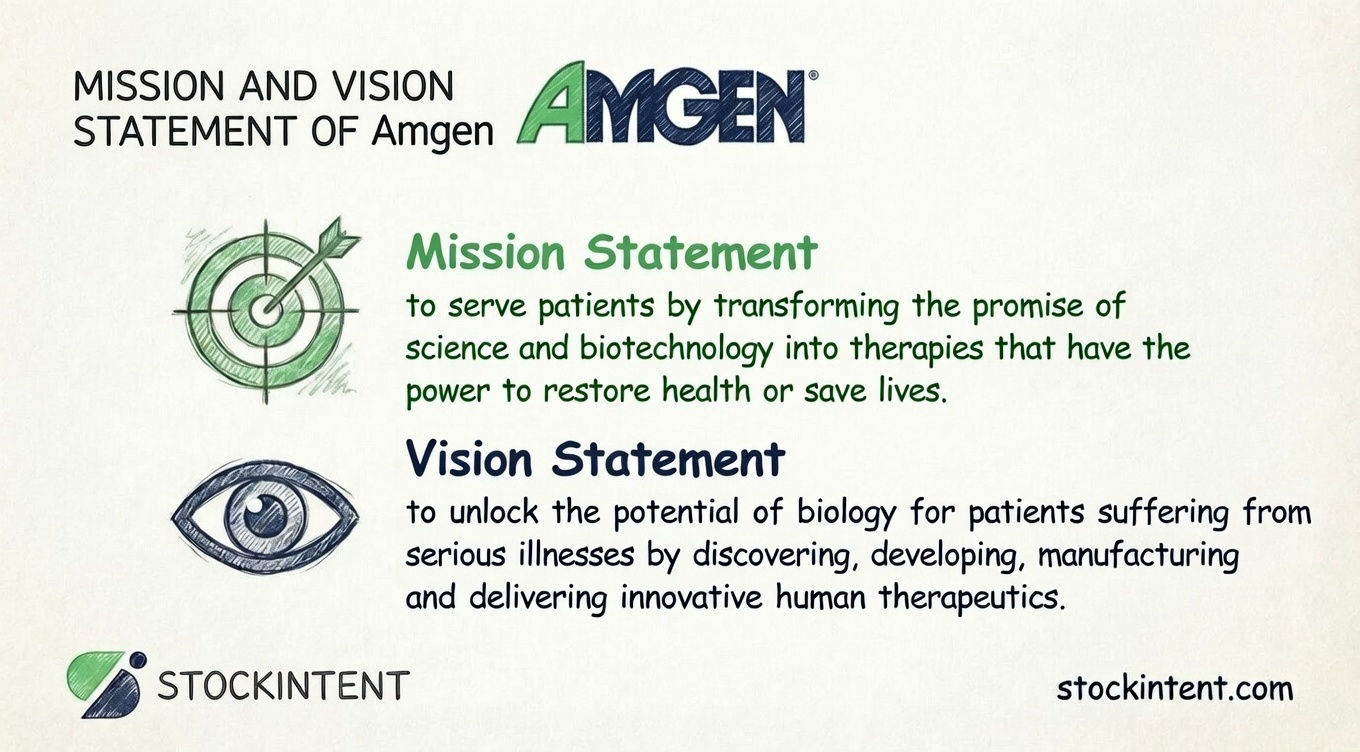
Amgen's official mission statement as of 2026 reads: "to serve patients by transforming the promise of science and biotechnology into therapies that have the power to restore health or save lives." This patient-centered focus, paired with its vision "to unlock the potential of biology for patients suffering from serious illnesses," shapes everything from its $6 billion annual R&D budget to its blockbuster pipeline spanning oncology, cardiovascular disease, and rare conditions.

Key Takeaways:

  • Patient-first biotech focus: Amgen's mission explicitly prioritizes serving patients through science, differentiating it from general pharmaceutical peers that may emphasize commercial scale or diversification
  • Strategic consistency: The mission has remained stable through recent acquisitions (Horizon Therapeutics, ChemoCentryx) and pipeline expansions, suggesting durable capital allocation priorities
  • Values-driven culture: Five core values—Be Science-Based, Compete Intensely and Win, Create Value for Patients/Staff/Stockholders, Trust and Respect Each Other, and Ensure Quality—guide hiring, R&D decisions, and operational execution
  • 2026 positioning: CEO Robert Bradway has positioned 2026 as a "springboard year," with 14 blockbuster products and six key franchises expected to drive growth, reflecting mission-aligned execution
  • Investor relevance: Companies with clear, durable mission statements tend to make more consistent long-term investment decisions; Amgen's 45+ year track record suggests mission-to-execution alignment that quality investors should evaluate

Company Overview

Amgen operates as one of the largest standalone biotechnology companies globally, with a market capitalization exceeding $160 billion and 2025 revenue of approximately $26.3 billion. Founded in 1980 and headquartered in Thousand Oaks, California, the company has spent over four decades building a position at the intersection of advanced biology and therapeutic innovation. Unlike traditional pharmaceutical conglomerates that blend small-molecule drugs with diverse healthcare businesses, Amgen maintains a focused biotech identity, leveraging human genetics, protein engineering, and artificial intelligence to discover and develop medicines.

In our experience analyzing healthcare companies across market cycles, Amgen's concentrated biotech model presents a different risk-reward profile than diversified pharma giants. The company now markets products in approximately 100 countries and maintains 14 blockbuster therapies generating $1 billion or more in annual sales each.

Key Products and Business Segments

Amgen's revenue engine spans six core therapeutic franchises that management has positioned as growth drivers for 2026:

FranchiseKey Products2025 Performance
CardiovascularRepatha (evolocumab)$1.3B revenue; 25% CV risk reduction in Vesalius-CV trial
Bone HealthProlia, XGEVA, EVENITYProlia: $3.6B; EVENITY grew 30%+ YoY
InflammationOtezla, TEZSPIRETEZSPIRE grew 30%+ YoY
HematologyBLINCYTO, NplateNplate: $1.5B revenue
OncologyIMDELLTRA, broad portfolioPortfolio grew 11% to $8.7B
Rare DiseaseUPLIZNA, emerging pipelineStrategic expansion area

The "Other Products" segment represents Amgen's largest revenue division at approximately 21% of total sales ($5.6 billion), reflecting the breadth of its established portfolio beyond these flagship franchises.

Financial Trajectory and 2026 Outlook

Amgen enters 2026 with meaningful momentum. CEO Robert Bradway has characterized this as a "springboard year," with the company forecasting full-year revenue between $37 billion and $38.4 billion, up from $26.3 billion in 2025. This projected 40%+ growth reflects both organic expansion and the anniversary of recent acquisitions, particularly Horizon Therapeutics.

Key 2025 achievements that support this trajectory include:

  • 18 products delivered record annual results
  • 13 products achieved double-digit growth
  • Biosimilars franchise expanded 37% to $3 billion
  • R&D investment reached $7.2 billion (up 22% year-over-year)

The company's pipeline depth matters for investors evaluating whether Amgen's mission translates into durable competitive positioning. Late-stage candidates include MariTide for obesity and metabolic disease, where six global Phase 3 studies are underway addressing chronic weight management, cardiovascular outcomes, heart failure, sleep apnea, and type 2 diabetes. This represents a significant expansion beyond Amgen's traditional therapeutic strongholds.

Competitive Position Within Drug Manufacturers

Within the drug manufacturers, general industry, Amgen occupies a distinctive niche. It ranks among the top biotech-focused companies by revenue but remains smaller than diversified pharmaceutical conglomerates like Johnson & Johnson, Pfizer, or Merck. However, its pure-play biotech structure and 45-year specialization in biologics creates differentiation that shows up in gross margins and R&D productivity metrics.

The competitive landscape presents both tailwinds and headwinds. Amgen faces ongoing pressure from biosimilar competition to legacy products, yet its focus on serious diseases with limited treatment options, combined with advanced manufacturing capabilities for complex biologics, creates natural pricing power and regulatory moats that small-molecule competitors struggle to replicate.

For investors using platforms like StockIntent to evaluate healthcare positions, Amgen's financial profile offers a useful case study in mission-driven capital allocation. The company's consistent prioritization of R&D, its patient-centered approach to therapeutic area selection, and its disciplined balance sheet management, retiring $6 billion in debt while increasing dividends 6%, reflect the stakeholder-value balance embedded in its core values.

Amgen Mission Statement

Amgen's official mission statement serves as the strategic anchor for everything the company does, from billion-dollar R&D bets to day-to-day operational decisions. Understanding this statement, and more importantly, how Amgen acts on it, gives investors insight into whether management's capital allocation aligns with durable value creation.

Amgen's official mission statement: "to serve patients by transforming the promise of science and biotechnology into therapies that have the power to restore health or save lives."

This isn't marketing copy. It's a declaration of priorities that shows up in where Amgen places its $7.2 billion annual R&D budget, which therapeutic areas it pursues, and how it evaluates acquisition targets like Horizon Therapeutics. The patient-first framing, combined with the explicit focus on biotechnology, distinguishes Amgen from diversified pharmaceutical conglomerates that might emphasize commercial scale or therapeutic breadth over scientific transformation.

🎯 Pro Insight: When evaluating mission statements, look for specificity that constrains management discretion in productive ways. Amgen's focus on "biotechnology" rather than "medicines" generally, and "restore health or save lives" rather than "improve outcomes," creates meaningful boundaries. This specificity has kept Amgen disciplined through multiple CEO tenures; they've walked away from lucrative small-molecule opportunities that didn't fit the biotech DNA of the company.

The mission connects directly to Amgen's business model in three concrete ways. First, it justifies the premium R&D intensity; biotech discovery is expensive, but the mission frames this as patient service rather than cost center. Second, it shapes therapeutic area selection; Amgen concentrates on serious diseases where "restore health or save lives" represents a realistic outcome, not chronic conditions managed through incremental improvement. Third, it informs capital allocation between internal development and external acquisition; the Horizon Therapeutics deal brought rare disease capabilities that fit the mission's emphasis on transformative therapies for serious illness.

Compared to competitors in the drug manufacturers space, Amgen's mission stands out for its biotech specificity. Johnson & Johnson's mission emphasizes "profoundly impact human health for humanity" (broad, diversified). Pfizer focuses on "unleash the power of human intelligence to advance healthcare" (process-oriented). Merck states "use leading science to save and improve lives" (science-led but not biotech-specific). Amgen's explicit biotechnology focus reflects its 45-year heritage and creates strategic coherence that pure-play investors value; when Amgen spends on R&D, it's building biologic capabilities that compound over decades, not chasing therapeutic fads.

Notably, the mission has remained stable through significant strategic evolution. From its 1980 founding through the 2023 Horizon acquisition and into 2026's "springboard year" positioning, the core statement hasn't changed. This consistency matters for investors evaluating management quality; mission drift often precedes strategic drift, and Amgen's constancy suggests disciplined capital allocation even as the company scales toward $38 billion in projected 2026 revenue.

Mission Components / Pillars

Amgen's mission statement isn't just words on a page. It breaks down into four operational pillars that shape capital allocation, R&D priorities, and competitive positioning. Understanding these pillars helps investors evaluate whether Amgen's management is walking the talk, or just talking.

Patient-Centricity: The Foundation

The mission opens with "to serve patients," and this isn't ceremonial language. It directly influences which therapeutic areas Amgen pursues and which it ignores.

Amgen concentrates on serious diseases where restoring health or saving lives represents a realistic outcome, not chronic conditions managed through incremental improvement. This shows up in the portfolio: 14 blockbuster products generating $1 billion+ each, with therapies for cancer, rare diseases, and cardiovascular conditions where patients face limited alternatives.

In our experience analyzing healthcare companies, this patient-first framing creates strategic discipline that generalist pharma often lacks. When management evaluates a potential acquisition or pipeline investment, the question isn't just "will this make money?" but "does this serve patients in a transformative way?" That filter has kept Amgen out of crowded therapeutic areas where me-too drugs compete on price, and pushed it toward complex biologics with natural moats.

The concrete metric here: Amgen operates in approximately 100 countries, with medicines reaching millions of patients globally. Scale serves the mission, but the mission also justifies the scale.

Scientific Innovation: The Method

The second pillar, "transforming the promise of science and biotechnology," explains why Amgen spends $7.2 billion annually on R&D, up 22% year-over-year. This isn't maintenance spending; it's mission-driven investment in capabilities that compound over decades.

Amgen's approach here is specific and resource-intensive. The company leverages human genetics, protein engineering, and artificial intelligence to identify therapeutic targets that others miss. Its R&D organization also reimagines clinical trials through new technologies and protocol designs to accelerate delivery.

The competitive advantage? Scientific differentiation that's genuinely hard to replicate. When you've spent 45 years building biologic manufacturing capabilities and genetic analysis platforms, competitors can't catch up by hiring a few scientists. This creates the moat that allows Amgen to develop "innovative, highly differentiated medicines that provide large clinical benefits," which command pricing power and regulatory protection.

Unmet Medical Needs: The Focus

The mission's emphasis on therapies that "restore health or save lives" translates operationally into a focus on serious illnesses with limited treatment options. This isn't accidental positioning; it's strategic moat-building.

By concentrating where patients and healthcare systems have few alternatives, Amgen reduces direct competition while addressing markets with higher willingness-to-pay. The 2025 results show this in action: Repatha delivering 25% cardiovascular risk reduction in the Vesalius-CV trial, IMDELLTRA receiving full FDA approval for extensive-stage small cell lung cancer, and the rare disease franchise expanding through acquisitions like Horizon Therapeutics.

The financial outcome: 18 products delivered record annual results in 2025, with 13 achieving double-digit growth. Mission focus translates to revenue concentration in defensible markets.

Translation: The Execution

The final pillar, converting scientific promise into actual therapies, is where many biotech companies fail. Amgen's mission explicitly includes this translation step, and the numbers suggest execution alignment.

The company now maintains 14 blockbuster products, with six core franchises (Repatha, Evenity, Tezspire, rare disease, innovative oncology, and biosimilars) positioned as 2026 growth drivers. This isn't a scattershot pipeline; it's a deliberate portfolio construction that balances near-term revenue with long-term optionality.

The MariTide program exemplifies this translation capability. Six global Phase 3 studies are underway addressing chronic weight management, cardiovascular outcomes, heart failure, sleep apnea, and type 2 diabetes. Amgen isn't just discovering interesting biology; it's systematically converting that biology into commercially viable medicines through disciplined clinical development.

For investors using StockIntent to evaluate healthcare positions, these pillars create a useful analytical framework. When you screen for companies with clear mission-to-execution alignment, you're essentially looking for management teams that make consistent capital allocation decisions over time. Amgen's 45-year track record, stable mission through multiple CEO tenures, and 2026 "springboard year" positioning suggest that alignment remains intact.

Amgen Vision Statement

Amgen's official vision statement: "to unlock the potential of biology for patients suffering from serious illnesses by discovering, developing, manufacturing and delivering innovative human therapeutics."

This vision statement extends the mission's patient focus into a forward-looking declaration of what Amgen aims to become. Where the mission emphasizes serving patients through biotechnology transformation, the vision articulates how Amgen intends to reshape healthcare: by systematically extracting therapeutic value from biological science at every stage from discovery through commercial delivery.

Long-Term Strategic Ambitions

Amgen's leadership has translated this vision into concrete 2026 priorities that reveal where the company believes biology's potential is most unlockable. CEO Robert Bradway has positioned 2026 as a "springboard year," with six franchises expected to anchor growth: Repatha, Evenity, Tezspire, rare disease, innovative oncology, and biosimilars. This isn't diversification for its own sake; it's a deliberate concentration on therapeutic areas where biological understanding has advanced enough to yield differentiated medicines.

The vision's emphasis on "unlocking potential" shows up in capital allocation priorities. Amgen invested a record $7.2 billion in R&D during 2025, up 22% year-over-year. This spending targets what management considers high-unlock areas: MariTide for obesity and metabolic disease (six global Phase 3 studies underway), Olpasiran for cardiovascular risk reduction, and Xaluritamig for oncology. These aren't incremental improvements; they're bets on biology that hasn't yet been fully translated into therapeutics.

In our experience analyzing R&D productivity across healthcare companies, Amgen's vision creates useful strategic boundaries. The explicit focus on "innovative human therapeutics" keeps the company out of commoditized markets where biological sophistication doesn't translate to pricing power. When Amgen pursues an area, like the Horizon Therapeutics acquisition for rare disease capabilities, it's because the biology has reached a point where Amgen's manufacturing and development expertise can unlock value that others can't.

Alignment with Industry Trends

Amgen's vision positions the company at the intersection of three macro trends reshaping drug manufacturers in 2026:

Precision medicine and human genetics: The vision's focus on "potential of biology" aligns with industry-wide shifts toward genetically validated targets. Amgen's R&D strategy explicitly leverages human genetics, protein engineering, and artificial intelligence to identify therapeutic modalities others miss. This isn't just buzzword compliance; it's a bet that the companies best at interpreting genetic data will discover drugs with higher success rates.

Biologics over small molecules: The emphasis on "innovative human therapeutics" reflects the industry's move toward complex biologics that are harder to replicate. While traditional pharma still relies heavily on small-molecule chemistry, Amgen's vision commits it to the manufacturing and development capabilities required for proteins, antibodies, and cell therapies. This creates natural moats; biosimilars exist, but they don't erode innovator pricing as quickly as generic small molecules.

Serious disease focus: The vision's limitation to "patients suffering from serious illnesses" aligns with both regulatory trends (FDA priority review for unmet needs) and reimbursement dynamics (higher willingness-to-pay for life-altering therapies). Amgen's 2025 results show this in practice: 14 blockbuster products, with 13 achieving double-digit growth, concentrated in oncology, cardiovascular disease, and rare conditions where treatment alternatives are limited.

The vision also creates strategic optionality. By framing the goal as "unlocking potential" rather than dominating specific markets, Amgen can pivot as biological understanding evolves. The MariTide obesity program exemplifies this; six Phase 3 studies spanning weight management, cardiovascular outcomes, heart failure, sleep apnea, and type 2 diabetes represent a systematic exploration of where GLP-1 biology can be unlocked, not a bet on any single indication.

For investors evaluating Amgen's competitive positioning, the vision statement offers a useful lens. Companies with vague visions, "to be the leading healthcare company," struggle to make consistent capital allocation decisions. Amgen's specificity, biology-focused, patient-centered, innovation-driven, creates coherence that shows up in financial results: 18 products delivered record annual performance in 2025, with the oncology portfolio growing 11% to $8.7 billion and biosimilars expanding 37% to $3 billion.

Vision Components / Themes

Amgen's vision statement, "to unlock the potential of biology for patients suffering from serious illnesses by discovering, developing, manufacturing and delivering innovative human therapeutics," breaks down into four strategic themes that guide capital allocation and competitive positioning. These aren't abstract aspirations; they're operational filters that explain why Amgen pursues specific therapeutic areas and walks away from others.

Biology-First Discovery

The vision's emphasis on "unlocking the potential of biology" commits Amgen to genetically validated targets and advanced therapeutic modalities that competitors struggle to replicate. This isn't just R&D spending; it's a bet that deep biological understanding creates sustainable moats.

Amgen operationalizes this through its $7.2 billion annual R&D investment, up 22% year-over-year. The company leverages human genetics, protein engineering, and artificial intelligence to identify targets others miss. The MariTide program exemplifies this approach; six global Phase 3 studies spanning chronic weight management, cardiovascular outcomes, heart failure, sleep apnea, and type 2 diabetes represent a systematic exploration of where GLP-1 biology can be unlocked, not a single-product bet.

This biology-first approach creates differentiation that's genuinely hard to replicate. When you've spent 45 years building genetic analysis platforms and biologic manufacturing capabilities, competitors can't close the gap by hiring a few scientists.

Serious Illness Focus

The vision explicitly limits Amgen to "patients suffering from serious illnesses." This constraint isn't charitable positioning; it's strategic moat-building.

By concentrating where treatment alternatives are limited, Amgen reduces direct competition while addressing markets with higher willingness-to-pay. The 2025 results demonstrate this in practice: 14 blockbuster products generating $1 billion+ each, with 13 achieving double-digit growth, concentrated in oncology (portfolio up 11% to $8.7 billion), cardiovascular disease, and rare conditions. The Horizon Therapeutics acquisition brought rare disease capabilities that fit this theme precisely; UPLIZNA and the broader rare disease franchise now anchor one of Amgen's six key growth pillars for 2026.

This focus aligns with regulatory trends (FDA priority review for unmet needs) and reimbursement dynamics that favor transformative therapies over incremental improvements.

Full-Value-Chain Control

The vision's inclusion of "discovering, developing, manufacturing and delivering" signals Amgen's commitment to vertical integration. This isn't efficiency for its own sake; it's quality control and margin protection.

Complex biologics require specialized manufacturing capabilities that create natural barriers to entry. Amgen's 45-year investment in biologic production means it captures value that contract manufacturers would otherwise extract, while maintaining quality standards that protect its regulatory moats. The biosimilars franchise, which expanded 37% to $3 billion in 2025, demonstrates this manufacturing advantage; even when patents expire, Amgen's production expertise creates defensible positions.

Innovation-Driven Growth

The emphasis on "innovative human therapeutics" keeps Amgen out of commoditized markets where biological sophistication doesn't translate to pricing power. This creates strategic boundaries that discipline capital allocation.

CEO Robert Bradway's "springboard year" positioning for 2026 reflects this theme. The six franchises expected to anchor growth (Repatha, Evenity, Tezspire, rare disease, innovative oncology, and biosimilars) all represent areas where Amgen's biological capabilities generate differentiated outcomes. Repatha's 25% cardiovascular risk reduction in the Vesalius-CV trial and IMDELLTRA's full FDA approval for extensive-stage small cell lung cancer aren't incremental improvements; they're innovations that redefine treatment standards.

For investors using StockIntent to evaluate healthcare positions, these vision themes create a useful analytical framework. When you screen for companies with clear strategic boundaries and consistent capital allocation, you're looking for management teams that make coherent decisions over time. Amgen's 45-year track record, stable vision through multiple CEO tenures, and 2026 positioning suggest that alignment between stated vision and actual execution remains intact.

Amgen Core Values

Amgen's five core values aren't wall decorations; they're operational filters that shape hiring decisions, R&D priorities, and capital allocation. For investors evaluating management quality, understanding how these values translate into day-to-day behavior matters more than the words themselves. A company that lives its values tends to make more consistent long-term decisions; one that doesn't often drifts into strategic confusion.

Amgen's officially stated core values are: Be Science-Based, Compete Intensely and Win, Create Value for Patients, Staff, and Stockholders, Trust and Respect Each Other, and Ensure Quality. These appear consistently across Amgen's global operations, from its U.S. headquarters to regional sites in Europe and Canada.

💡 Expert Tip: When evaluating corporate values, look for specificity that creates productive constraints. Amgen's "Compete Intensely and Win" explicitly includes "ethically" in its framing; this isn't accidental. Values without boundaries become excuses for anything. The best companies embed ethical guardrails directly into competitive values, making them harder to compromise when pressure mounts.

Be Science-Based

This value commits Amgen to rigorous application of the scientific method across all organizational activities. It sounds obvious for a biotech company, but the operational reality is more demanding than it appears.

In practice, "Be Science-Based" means Amgen's $7.2 billion annual R&D budget, up 22% year-over-year, gets allocated through genetic validation and biological mechanism rather than market trend chasing. The company leverages human genetics, protein engineering, and artificial intelligence to identify therapeutic targets that others miss. This isn't just technology adoption; it's a cultural commitment to letting data override hierarchy.

The MariTide program exemplifies this value in action. Six global Phase 3 studies spanning chronic weight management, cardiovascular outcomes, heart failure, sleep apnea, and type 2 diabetes represent a systematic exploration of GLP-1 biology, not a rush to market based on competitor moves. When you have 45 years of accumulated biological data and manufacturing expertise, you can afford to be patient; the science determines the timeline.

Compete Intensely and Win

Amgen frames this value with explicit ethical boundaries: taking calculated risks and acting with urgency, but always ethically. This distinction matters for investors evaluating competitive behavior.

The value shows up in Amgen's willingness to pursue crowded therapeutic areas where it believes biological differentiation creates advantage. Repatha entered a competitive PCSK9 market but established itself through superior cardiovascular outcomes data; the Vesalius-CV trial's 25% relative reduction in first major cardiovascular events wasn't luck, it was intense, science-driven competition. The biosimilars franchise, which expanded 37% to $3 billion in 2025, similarly reflects competitive execution; when patents expire, manufacturing quality and regulatory relationships determine who wins.

Create Value for Patients, Staff, and Stockholders

This stakeholder balancing act is where many companies stumble. Amgen explicitly recognizes that serving patients long-term requires investing in staff capabilities and delivering stockholder returns that sustain capital access.

In our experience analyzing healthcare companies, the order of stakeholders in stated values often reveals actual priorities. Amgen puts patients first, staff second, stockholders third. This sequencing isn't accidental; it reflects the reality that sustainable stockholder returns in biotech require patient trust and scientific talent retention.

The 2025 results suggest this balance is holding: 18 products delivered record annual results, 13 achieved double-digit growth, and the company simultaneously retired $6 billion in debt while increasing dividends 6%. You don't generate $26.3 billion in revenue and project $37-38.4 billion for 2026 without aligning all three stakeholder groups around a coherent strategy.

Trust and Respect Each Other

Amgen operationalizes this value through diversity and inclusion initiatives, team structures that enable broad impact, and what the company calls "fostering inclusion and teamwork." For a knowledge-intensive business where scientific talent is the primary asset, this value has direct economic implications.

The biotech industry faces intense competition for geneticists, protein engineers, and clinical development specialists. Culture becomes a genuine competitive advantage when it attracts and retains talent that could otherwise join competitors or launch startups. Amgen's 45-year track record and relatively stable executive team, CEO Robert Bradway has led since 2012, suggest cultural continuity that supports long-term scientific relationships.

Ensure Quality

Quality at Amgen isn't a compliance function; it's integrated into all activities with the explicit goal of rapid results. This framing, quality as speed enabler rather than speed obstacle, reflects sophisticated manufacturing culture.

Complex biologics manufacturing creates natural moats because quality failures are catastrophic and expensive. Amgen's Quality Month celebrations tie quality directly to patient impact, reinforcing that this value serves the mission rather than existing as bureaucratic checkbox. The 14 blockbuster products generating $1 billion+ each don't reach that scale without manufacturing reliability that regulators and physicians trust.

Values in Action: The 2026 Test

CEO Robert Bradway's characterization of 2026 as a "springboard year" puts these values to a practical test. Six franchises, Repatha, Evenity, Tezspire, rare disease, innovative oncology, and biosimilars, are expected to anchor growth. Each represents a different application of the core values: science-based differentiation, intense ethical competition, stakeholder value creation, talent-driven execution, and quality manufacturing.

For investors using StockIntent to evaluate healthcare positions, Amgen's core values offer a diagnostic framework. When you screen for companies with durable competitive advantages, you're partly screening for values that constrain short-term opportunism in favor of long-term capability building. Amgen's 45-year consistency, stable mission through multiple CEO tenures, and 2026 positioning suggest that values-to-execution alignment remains intact.

The absence of significant controversies or values-related missteps in recent years, contrast this with some peers' pricing scandals or manufacturing quality issues, reinforces that these aren't merely stated values but operational realities that shape how Amgen conducts business across approximately 100 countries.

Strategic Summary

Amgen's mission, vision, and core values weave together into a coherent strategic identity that matters for investors evaluating quality compounders. The mission's patient-first focus, the vision's biology-unlocking ambition, and the five core values that constrain management discretion, these aren't corporate decorations. They're operational filters that have guided $7.2 billion in annual R&D spending, shaped the Horizon Therapeutics acquisition, and positioned 14 blockbuster products for 2026 growth.

🎯 Pro Insight: When we evaluate management quality in healthcare, we look for mission-vision-values alignment that persists through leadership transitions. Amgen's core framework has remained stable from its 1980 founding through multiple CEO tenures, including Robert Bradway's 12+ year leadership. This consistency suggests capital allocation discipline that transcends individual executives; exactly what you want in a long-term holding.

The competitive implications are concrete. Amgen's biotech-specific focus creates scientific moats that diversified pharmaceutical giants struggle to replicate. Its concentration on serious illnesses with limited treatment options generates pricing power and regulatory protection. The full-value-chain control, from discovery through manufacturing, captures margins that contract developers surrender.

In our experience tracking quality healthcare companies through market cycles, Amgen's strategic identity signals management quality in ways that show up in financial results. The 2025 performance, 18 products with record annual results, 13 achieving double-digit growth, and the 2026 "springboard year" positioning, reflects mission-aligned execution rather than opportunistic pivoting.

Analyst perspectives reinforce this positioning, albeit with measured optimism. The consensus "Moderate Buy" rating with a $351.76 average price target suggests cautious confidence in Amgen's competitive trajectory. Barclays highlighted continued momentum for Repatha following the VESALIUS-CV data, while Fitch's BBB+ credit rating affirmation in February 2026 underscores financial stability that supports long-term strategic execution.

Looking forward, Amgen's mission-vision-values framework positions it at the intersection of three durable trends: precision medicine powered by human genetics, biologics replacing small molecules in serious disease treatment, and AI-accelerated drug discovery. The MariTide obesity program, six Phase 3 studies exploring where GLP-1 biology can be unlocked, exemplifies how the vision's "potential of biology" framing creates strategic optionality without abandoning core focus.

For investors using StockIntent to evaluate healthcare positions, Amgen offers a case study in mission-driven quality. The platform's fundamental analysis tools let you verify whether the story matches the numbers: 45+ years of biotech specialization, stable strategic identity through leadership changes, and capital allocation that compounds scientific capabilities over decades. You can start your 7-day free trial to dig deeper into Amgen's financial health metrics and compare its R&D productivity against peers.

The bottom line? Amgen's strategic identity isn't just well-crafted corporate language. It's a tested framework that has guided consistent decision-making through multiple market cycles, and that coherence, patient focus, scientific discipline, stakeholder balance, is exactly what quality investors should look for when building positions they intend to hold for years.

Amgen Mission Statement, Vision & Core Values Explained

Amgen Mission Statement, Vision & Core Values

Amgen stands as one of the largest standalone biotechnology companies in the world, with a market cap exceeding $160 billion and 2025 revenue of $26.3 billion. For investors analyzing whether Amgen's stock belongs in a quality-focused portfolio, understanding why the company exists and what drives its decision-making matters as much as the financial metrics. A company's mission statement isn't just corporate fluff; it's the lens through which capital allocation, R&D priorities, and competitive strategy get decided.

Amgen's official mission statement as of 2026 reads: "to serve patients by transforming the promise of science and biotechnology into therapies that have the power to restore health or save lives." This patient-centered focus, paired with its vision "to unlock the potential of biology for patients suffering from serious illnesses," shapes everything from its $6 billion annual R&D budget to its blockbuster pipeline spanning oncology, cardiovascular disease, and rare conditions.

Key Takeaways:

  • Patient-first biotech focus: Amgen's mission explicitly prioritizes serving patients through science, differentiating it from general pharmaceutical peers that may emphasize commercial scale or diversification
  • Strategic consistency: The mission has remained stable through recent acquisitions (Horizon Therapeutics, ChemoCentryx) and pipeline expansions, suggesting durable capital allocation priorities
  • Values-driven culture: Five core values—Be Science-Based, Compete Intensely and Win, Create Value for Patients/Staff/Stockholders, Trust and Respect Each Other, and Ensure Quality—guide hiring, R&D decisions, and operational execution
  • 2026 positioning: CEO Robert Bradway has positioned 2026 as a "springboard year," with 14 blockbuster products and six key franchises expected to drive growth, reflecting mission-aligned execution
  • Investor relevance: Companies with clear, durable mission statements tend to make more consistent long-term investment decisions; Amgen's 45+ year track record suggests mission-to-execution alignment that quality investors should evaluate

Company Overview

Amgen operates as one of the largest standalone biotechnology companies globally, with a market capitalization exceeding $160 billion and 2025 revenue of approximately $26.3 billion. Founded in 1980 and headquartered in Thousand Oaks, California, the company has spent over four decades building a position at the intersection of advanced biology and therapeutic innovation. Unlike traditional pharmaceutical conglomerates that blend small-molecule drugs with diverse healthcare businesses, Amgen maintains a focused biotech identity, leveraging human genetics, protein engineering, and artificial intelligence to discover and develop medicines.

In our experience analyzing healthcare companies across market cycles, Amgen's concentrated biotech model presents a different risk-reward profile than diversified pharma giants. The company now markets products in approximately 100 countries and maintains 14 blockbuster therapies generating $1 billion or more in annual sales each.

Key Products and Business Segments

Amgen's revenue engine spans six core therapeutic franchises that management has positioned as growth drivers for 2026:

FranchiseKey Products2025 Performance
CardiovascularRepatha (evolocumab)$1.3B revenue; 25% CV risk reduction in Vesalius-CV trial
Bone HealthProlia, XGEVA, EVENITYProlia: $3.6B; EVENITY grew 30%+ YoY
InflammationOtezla, TEZSPIRETEZSPIRE grew 30%+ YoY
HematologyBLINCYTO, NplateNplate: $1.5B revenue
OncologyIMDELLTRA, broad portfolioPortfolio grew 11% to $8.7B
Rare DiseaseUPLIZNA, emerging pipelineStrategic expansion area

The "Other Products" segment represents Amgen's largest revenue division at approximately 21% of total sales ($5.6 billion), reflecting the breadth of its established portfolio beyond these flagship franchises.

Financial Trajectory and 2026 Outlook

Amgen enters 2026 with meaningful momentum. CEO Robert Bradway has characterized this as a "springboard year," with the company forecasting full-year revenue between $37 billion and $38.4 billion, up from $26.3 billion in 2025. This projected 40%+ growth reflects both organic expansion and the anniversary of recent acquisitions, particularly Horizon Therapeutics.

Key 2025 achievements that support this trajectory include:

  • 18 products delivered record annual results
  • 13 products achieved double-digit growth
  • Biosimilars franchise expanded 37% to $3 billion
  • R&D investment reached $7.2 billion (up 22% year-over-year)

The company's pipeline depth matters for investors evaluating whether Amgen's mission translates into durable competitive positioning. Late-stage candidates include MariTide for obesity and metabolic disease, where six global Phase 3 studies are underway addressing chronic weight management, cardiovascular outcomes, heart failure, sleep apnea, and type 2 diabetes. This represents a significant expansion beyond Amgen's traditional therapeutic strongholds.

Competitive Position Within Drug Manufacturers

Within the drug manufacturers, general industry, Amgen occupies a distinctive niche. It ranks among the top biotech-focused companies by revenue but remains smaller than diversified pharmaceutical conglomerates like Johnson & Johnson, Pfizer, or Merck. However, its pure-play biotech structure and 45-year specialization in biologics creates differentiation that shows up in gross margins and R&D productivity metrics.

The competitive landscape presents both tailwinds and headwinds. Amgen faces ongoing pressure from biosimilar competition to legacy products, yet its focus on serious diseases with limited treatment options, combined with advanced manufacturing capabilities for complex biologics, creates natural pricing power and regulatory moats that small-molecule competitors struggle to replicate.

For investors using platforms like StockIntent to evaluate healthcare positions, Amgen's financial profile offers a useful case study in mission-driven capital allocation. The company's consistent prioritization of R&D, its patient-centered approach to therapeutic area selection, and its disciplined balance sheet management, retiring $6 billion in debt while increasing dividends 6%, reflect the stakeholder-value balance embedded in its core values.

Amgen Mission Statement

Amgen's official mission statement serves as the strategic anchor for everything the company does, from billion-dollar R&D bets to day-to-day operational decisions. Understanding this statement, and more importantly, how Amgen acts on it, gives investors insight into whether management's capital allocation aligns with durable value creation.

Amgen's official mission statement: "to serve patients by transforming the promise of science and biotechnology into therapies that have the power to restore health or save lives."

This isn't marketing copy. It's a declaration of priorities that shows up in where Amgen places its $7.2 billion annual R&D budget, which therapeutic areas it pursues, and how it evaluates acquisition targets like Horizon Therapeutics. The patient-first framing, combined with the explicit focus on biotechnology, distinguishes Amgen from diversified pharmaceutical conglomerates that might emphasize commercial scale or therapeutic breadth over scientific transformation.

🎯 Pro Insight: When evaluating mission statements, look for specificity that constrains management discretion in productive ways. Amgen's focus on "biotechnology" rather than "medicines" generally, and "restore health or save lives" rather than "improve outcomes," creates meaningful boundaries. This specificity has kept Amgen disciplined through multiple CEO tenures; they've walked away from lucrative small-molecule opportunities that didn't fit the biotech DNA of the company.

The mission connects directly to Amgen's business model in three concrete ways. First, it justifies the premium R&D intensity; biotech discovery is expensive, but the mission frames this as patient service rather than cost center. Second, it shapes therapeutic area selection; Amgen concentrates on serious diseases where "restore health or save lives" represents a realistic outcome, not chronic conditions managed through incremental improvement. Third, it informs capital allocation between internal development and external acquisition; the Horizon Therapeutics deal brought rare disease capabilities that fit the mission's emphasis on transformative therapies for serious illness.

Compared to competitors in the drug manufacturers space, Amgen's mission stands out for its biotech specificity. Johnson & Johnson's mission emphasizes "profoundly impact human health for humanity" (broad, diversified). Pfizer focuses on "unleash the power of human intelligence to advance healthcare" (process-oriented). Merck states "use leading science to save and improve lives" (science-led but not biotech-specific). Amgen's explicit biotechnology focus reflects its 45-year heritage and creates strategic coherence that pure-play investors value; when Amgen spends on R&D, it's building biologic capabilities that compound over decades, not chasing therapeutic fads.

Notably, the mission has remained stable through significant strategic evolution. From its 1980 founding through the 2023 Horizon acquisition and into 2026's "springboard year" positioning, the core statement hasn't changed. This consistency matters for investors evaluating management quality; mission drift often precedes strategic drift, and Amgen's constancy suggests disciplined capital allocation even as the company scales toward $38 billion in projected 2026 revenue.

Mission Components / Pillars

Amgen's mission statement isn't just words on a page. It breaks down into four operational pillars that shape capital allocation, R&D priorities, and competitive positioning. Understanding these pillars helps investors evaluate whether Amgen's management is walking the talk, or just talking.

Patient-Centricity: The Foundation

The mission opens with "to serve patients," and this isn't ceremonial language. It directly influences which therapeutic areas Amgen pursues and which it ignores.

Amgen concentrates on serious diseases where restoring health or saving lives represents a realistic outcome, not chronic conditions managed through incremental improvement. This shows up in the portfolio: 14 blockbuster products generating $1 billion+ each, with therapies for cancer, rare diseases, and cardiovascular conditions where patients face limited alternatives.

In our experience analyzing healthcare companies, this patient-first framing creates strategic discipline that generalist pharma often lacks. When management evaluates a potential acquisition or pipeline investment, the question isn't just "will this make money?" but "does this serve patients in a transformative way?" That filter has kept Amgen out of crowded therapeutic areas where me-too drugs compete on price, and pushed it toward complex biologics with natural moats.

The concrete metric here: Amgen operates in approximately 100 countries, with medicines reaching millions of patients globally. Scale serves the mission, but the mission also justifies the scale.

Scientific Innovation: The Method

The second pillar, "transforming the promise of science and biotechnology," explains why Amgen spends $7.2 billion annually on R&D, up 22% year-over-year. This isn't maintenance spending; it's mission-driven investment in capabilities that compound over decades.

Amgen's approach here is specific and resource-intensive. The company leverages human genetics, protein engineering, and artificial intelligence to identify therapeutic targets that others miss. Its R&D organization also reimagines clinical trials through new technologies and protocol designs to accelerate delivery.

The competitive advantage? Scientific differentiation that's genuinely hard to replicate. When you've spent 45 years building biologic manufacturing capabilities and genetic analysis platforms, competitors can't catch up by hiring a few scientists. This creates the moat that allows Amgen to develop "innovative, highly differentiated medicines that provide large clinical benefits," which command pricing power and regulatory protection.

Unmet Medical Needs: The Focus

The mission's emphasis on therapies that "restore health or save lives" translates operationally into a focus on serious illnesses with limited treatment options. This isn't accidental positioning; it's strategic moat-building.

By concentrating where patients and healthcare systems have few alternatives, Amgen reduces direct competition while addressing markets with higher willingness-to-pay. The 2025 results show this in action: Repatha delivering 25% cardiovascular risk reduction in the Vesalius-CV trial, IMDELLTRA receiving full FDA approval for extensive-stage small cell lung cancer, and the rare disease franchise expanding through acquisitions like Horizon Therapeutics.

The financial outcome: 18 products delivered record annual results in 2025, with 13 achieving double-digit growth. Mission focus translates to revenue concentration in defensible markets.

Translation: The Execution

The final pillar, converting scientific promise into actual therapies, is where many biotech companies fail. Amgen's mission explicitly includes this translation step, and the numbers suggest execution alignment.

The company now maintains 14 blockbuster products, with six core franchises (Repatha, Evenity, Tezspire, rare disease, innovative oncology, and biosimilars) positioned as 2026 growth drivers. This isn't a scattershot pipeline; it's a deliberate portfolio construction that balances near-term revenue with long-term optionality.

The MariTide program exemplifies this translation capability. Six global Phase 3 studies are underway addressing chronic weight management, cardiovascular outcomes, heart failure, sleep apnea, and type 2 diabetes. Amgen isn't just discovering interesting biology; it's systematically converting that biology into commercially viable medicines through disciplined clinical development.

For investors using StockIntent to evaluate healthcare positions, these pillars create a useful analytical framework. When you screen for companies with clear mission-to-execution alignment, you're essentially looking for management teams that make consistent capital allocation decisions over time. Amgen's 45-year track record, stable mission through multiple CEO tenures, and 2026 "springboard year" positioning suggest that alignment remains intact.

Amgen Vision Statement

Amgen's official vision statement: "to unlock the potential of biology for patients suffering from serious illnesses by discovering, developing, manufacturing and delivering innovative human therapeutics."

This vision statement extends the mission's patient focus into a forward-looking declaration of what Amgen aims to become. Where the mission emphasizes serving patients through biotechnology transformation, the vision articulates how Amgen intends to reshape healthcare: by systematically extracting therapeutic value from biological science at every stage from discovery through commercial delivery.

Long-Term Strategic Ambitions

Amgen's leadership has translated this vision into concrete 2026 priorities that reveal where the company believes biology's potential is most unlockable. CEO Robert Bradway has positioned 2026 as a "springboard year," with six franchises expected to anchor growth: Repatha, Evenity, Tezspire, rare disease, innovative oncology, and biosimilars. This isn't diversification for its own sake; it's a deliberate concentration on therapeutic areas where biological understanding has advanced enough to yield differentiated medicines.

The vision's emphasis on "unlocking potential" shows up in capital allocation priorities. Amgen invested a record $7.2 billion in R&D during 2025, up 22% year-over-year. This spending targets what management considers high-unlock areas: MariTide for obesity and metabolic disease (six global Phase 3 studies underway), Olpasiran for cardiovascular risk reduction, and Xaluritamig for oncology. These aren't incremental improvements; they're bets on biology that hasn't yet been fully translated into therapeutics.

In our experience analyzing R&D productivity across healthcare companies, Amgen's vision creates useful strategic boundaries. The explicit focus on "innovative human therapeutics" keeps the company out of commoditized markets where biological sophistication doesn't translate to pricing power. When Amgen pursues an area, like the Horizon Therapeutics acquisition for rare disease capabilities, it's because the biology has reached a point where Amgen's manufacturing and development expertise can unlock value that others can't.

Alignment with Industry Trends

Amgen's vision positions the company at the intersection of three macro trends reshaping drug manufacturers in 2026:

Precision medicine and human genetics: The vision's focus on "potential of biology" aligns with industry-wide shifts toward genetically validated targets. Amgen's R&D strategy explicitly leverages human genetics, protein engineering, and artificial intelligence to identify therapeutic modalities others miss. This isn't just buzzword compliance; it's a bet that the companies best at interpreting genetic data will discover drugs with higher success rates.

Biologics over small molecules: The emphasis on "innovative human therapeutics" reflects the industry's move toward complex biologics that are harder to replicate. While traditional pharma still relies heavily on small-molecule chemistry, Amgen's vision commits it to the manufacturing and development capabilities required for proteins, antibodies, and cell therapies. This creates natural moats; biosimilars exist, but they don't erode innovator pricing as quickly as generic small molecules.

Serious disease focus: The vision's limitation to "patients suffering from serious illnesses" aligns with both regulatory trends (FDA priority review for unmet needs) and reimbursement dynamics (higher willingness-to-pay for life-altering therapies). Amgen's 2025 results show this in practice: 14 blockbuster products, with 13 achieving double-digit growth, concentrated in oncology, cardiovascular disease, and rare conditions where treatment alternatives are limited.

The vision also creates strategic optionality. By framing the goal as "unlocking potential" rather than dominating specific markets, Amgen can pivot as biological understanding evolves. The MariTide obesity program exemplifies this; six Phase 3 studies spanning weight management, cardiovascular outcomes, heart failure, sleep apnea, and type 2 diabetes represent a systematic exploration of where GLP-1 biology can be unlocked, not a bet on any single indication.

For investors evaluating Amgen's competitive positioning, the vision statement offers a useful lens. Companies with vague visions, "to be the leading healthcare company," struggle to make consistent capital allocation decisions. Amgen's specificity, biology-focused, patient-centered, innovation-driven, creates coherence that shows up in financial results: 18 products delivered record annual performance in 2025, with the oncology portfolio growing 11% to $8.7 billion and biosimilars expanding 37% to $3 billion.

Vision Components / Themes

Amgen's vision statement, "to unlock the potential of biology for patients suffering from serious illnesses by discovering, developing, manufacturing and delivering innovative human therapeutics," breaks down into four strategic themes that guide capital allocation and competitive positioning. These aren't abstract aspirations; they're operational filters that explain why Amgen pursues specific therapeutic areas and walks away from others.

Biology-First Discovery

The vision's emphasis on "unlocking the potential of biology" commits Amgen to genetically validated targets and advanced therapeutic modalities that competitors struggle to replicate. This isn't just R&D spending; it's a bet that deep biological understanding creates sustainable moats.

Amgen operationalizes this through its $7.2 billion annual R&D investment, up 22% year-over-year. The company leverages human genetics, protein engineering, and artificial intelligence to identify targets others miss. The MariTide program exemplifies this approach; six global Phase 3 studies spanning chronic weight management, cardiovascular outcomes, heart failure, sleep apnea, and type 2 diabetes represent a systematic exploration of where GLP-1 biology can be unlocked, not a single-product bet.

This biology-first approach creates differentiation that's genuinely hard to replicate. When you've spent 45 years building genetic analysis platforms and biologic manufacturing capabilities, competitors can't close the gap by hiring a few scientists.

Serious Illness Focus

The vision explicitly limits Amgen to "patients suffering from serious illnesses." This constraint isn't charitable positioning; it's strategic moat-building.

By concentrating where treatment alternatives are limited, Amgen reduces direct competition while addressing markets with higher willingness-to-pay. The 2025 results demonstrate this in practice: 14 blockbuster products generating $1 billion+ each, with 13 achieving double-digit growth, concentrated in oncology (portfolio up 11% to $8.7 billion), cardiovascular disease, and rare conditions. The Horizon Therapeutics acquisition brought rare disease capabilities that fit this theme precisely; UPLIZNA and the broader rare disease franchise now anchor one of Amgen's six key growth pillars for 2026.

This focus aligns with regulatory trends (FDA priority review for unmet needs) and reimbursement dynamics that favor transformative therapies over incremental improvements.

Full-Value-Chain Control

The vision's inclusion of "discovering, developing, manufacturing and delivering" signals Amgen's commitment to vertical integration. This isn't efficiency for its own sake; it's quality control and margin protection.

Complex biologics require specialized manufacturing capabilities that create natural barriers to entry. Amgen's 45-year investment in biologic production means it captures value that contract manufacturers would otherwise extract, while maintaining quality standards that protect its regulatory moats. The biosimilars franchise, which expanded 37% to $3 billion in 2025, demonstrates this manufacturing advantage; even when patents expire, Amgen's production expertise creates defensible positions.

Innovation-Driven Growth

The emphasis on "innovative human therapeutics" keeps Amgen out of commoditized markets where biological sophistication doesn't translate to pricing power. This creates strategic boundaries that discipline capital allocation.

CEO Robert Bradway's "springboard year" positioning for 2026 reflects this theme. The six franchises expected to anchor growth (Repatha, Evenity, Tezspire, rare disease, innovative oncology, and biosimilars) all represent areas where Amgen's biological capabilities generate differentiated outcomes. Repatha's 25% cardiovascular risk reduction in the Vesalius-CV trial and IMDELLTRA's full FDA approval for extensive-stage small cell lung cancer aren't incremental improvements; they're innovations that redefine treatment standards.

For investors using StockIntent to evaluate healthcare positions, these vision themes create a useful analytical framework. When you screen for companies with clear strategic boundaries and consistent capital allocation, you're looking for management teams that make coherent decisions over time. Amgen's 45-year track record, stable vision through multiple CEO tenures, and 2026 positioning suggest that alignment between stated vision and actual execution remains intact.

Amgen Core Values

Amgen's five core values aren't wall decorations; they're operational filters that shape hiring decisions, R&D priorities, and capital allocation. For investors evaluating management quality, understanding how these values translate into day-to-day behavior matters more than the words themselves. A company that lives its values tends to make more consistent long-term decisions; one that doesn't often drifts into strategic confusion.

Amgen's officially stated core values are: Be Science-Based, Compete Intensely and Win, Create Value for Patients, Staff, and Stockholders, Trust and Respect Each Other, and Ensure Quality. These appear consistently across Amgen's global operations, from its U.S. headquarters to regional sites in Europe and Canada.

💡 Expert Tip: When evaluating corporate values, look for specificity that creates productive constraints. Amgen's "Compete Intensely and Win" explicitly includes "ethically" in its framing; this isn't accidental. Values without boundaries become excuses for anything. The best companies embed ethical guardrails directly into competitive values, making them harder to compromise when pressure mounts.

Be Science-Based

This value commits Amgen to rigorous application of the scientific method across all organizational activities. It sounds obvious for a biotech company, but the operational reality is more demanding than it appears.

In practice, "Be Science-Based" means Amgen's $7.2 billion annual R&D budget, up 22% year-over-year, gets allocated through genetic validation and biological mechanism rather than market trend chasing. The company leverages human genetics, protein engineering, and artificial intelligence to identify therapeutic targets that others miss. This isn't just technology adoption; it's a cultural commitment to letting data override hierarchy.

The MariTide program exemplifies this value in action. Six global Phase 3 studies spanning chronic weight management, cardiovascular outcomes, heart failure, sleep apnea, and type 2 diabetes represent a systematic exploration of GLP-1 biology, not a rush to market based on competitor moves. When you have 45 years of accumulated biological data and manufacturing expertise, you can afford to be patient; the science determines the timeline.

Compete Intensely and Win

Amgen frames this value with explicit ethical boundaries: taking calculated risks and acting with urgency, but always ethically. This distinction matters for investors evaluating competitive behavior.

The value shows up in Amgen's willingness to pursue crowded therapeutic areas where it believes biological differentiation creates advantage. Repatha entered a competitive PCSK9 market but established itself through superior cardiovascular outcomes data; the Vesalius-CV trial's 25% relative reduction in first major cardiovascular events wasn't luck, it was intense, science-driven competition. The biosimilars franchise, which expanded 37% to $3 billion in 2025, similarly reflects competitive execution; when patents expire, manufacturing quality and regulatory relationships determine who wins.

Create Value for Patients, Staff, and Stockholders

This stakeholder balancing act is where many companies stumble. Amgen explicitly recognizes that serving patients long-term requires investing in staff capabilities and delivering stockholder returns that sustain capital access.

In our experience analyzing healthcare companies, the order of stakeholders in stated values often reveals actual priorities. Amgen puts patients first, staff second, stockholders third. This sequencing isn't accidental; it reflects the reality that sustainable stockholder returns in biotech require patient trust and scientific talent retention.

The 2025 results suggest this balance is holding: 18 products delivered record annual results, 13 achieved double-digit growth, and the company simultaneously retired $6 billion in debt while increasing dividends 6%. You don't generate $26.3 billion in revenue and project $37-38.4 billion for 2026 without aligning all three stakeholder groups around a coherent strategy.

Trust and Respect Each Other

Amgen operationalizes this value through diversity and inclusion initiatives, team structures that enable broad impact, and what the company calls "fostering inclusion and teamwork." For a knowledge-intensive business where scientific talent is the primary asset, this value has direct economic implications.

The biotech industry faces intense competition for geneticists, protein engineers, and clinical development specialists. Culture becomes a genuine competitive advantage when it attracts and retains talent that could otherwise join competitors or launch startups. Amgen's 45-year track record and relatively stable executive team, CEO Robert Bradway has led since 2012, suggest cultural continuity that supports long-term scientific relationships.

Ensure Quality

Quality at Amgen isn't a compliance function; it's integrated into all activities with the explicit goal of rapid results. This framing, quality as speed enabler rather than speed obstacle, reflects sophisticated manufacturing culture.

Complex biologics manufacturing creates natural moats because quality failures are catastrophic and expensive. Amgen's Quality Month celebrations tie quality directly to patient impact, reinforcing that this value serves the mission rather than existing as bureaucratic checkbox. The 14 blockbuster products generating $1 billion+ each don't reach that scale without manufacturing reliability that regulators and physicians trust.

Values in Action: The 2026 Test

CEO Robert Bradway's characterization of 2026 as a "springboard year" puts these values to a practical test. Six franchises, Repatha, Evenity, Tezspire, rare disease, innovative oncology, and biosimilars, are expected to anchor growth. Each represents a different application of the core values: science-based differentiation, intense ethical competition, stakeholder value creation, talent-driven execution, and quality manufacturing.

For investors using StockIntent to evaluate healthcare positions, Amgen's core values offer a diagnostic framework. When you screen for companies with durable competitive advantages, you're partly screening for values that constrain short-term opportunism in favor of long-term capability building. Amgen's 45-year consistency, stable mission through multiple CEO tenures, and 2026 positioning suggest that values-to-execution alignment remains intact.

The absence of significant controversies or values-related missteps in recent years, contrast this with some peers' pricing scandals or manufacturing quality issues, reinforces that these aren't merely stated values but operational realities that shape how Amgen conducts business across approximately 100 countries.

Strategic Summary

Amgen's mission, vision, and core values weave together into a coherent strategic identity that matters for investors evaluating quality compounders. The mission's patient-first focus, the vision's biology-unlocking ambition, and the five core values that constrain management discretion, these aren't corporate decorations. They're operational filters that have guided $7.2 billion in annual R&D spending, shaped the Horizon Therapeutics acquisition, and positioned 14 blockbuster products for 2026 growth.

🎯 Pro Insight: When we evaluate management quality in healthcare, we look for mission-vision-values alignment that persists through leadership transitions. Amgen's core framework has remained stable from its 1980 founding through multiple CEO tenures, including Robert Bradway's 12+ year leadership. This consistency suggests capital allocation discipline that transcends individual executives; exactly what you want in a long-term holding.

The competitive implications are concrete. Amgen's biotech-specific focus creates scientific moats that diversified pharmaceutical giants struggle to replicate. Its concentration on serious illnesses with limited treatment options generates pricing power and regulatory protection. The full-value-chain control, from discovery through manufacturing, captures margins that contract developers surrender.

In our experience tracking quality healthcare companies through market cycles, Amgen's strategic identity signals management quality in ways that show up in financial results. The 2025 performance, 18 products with record annual results, 13 achieving double-digit growth, and the 2026 "springboard year" positioning, reflects mission-aligned execution rather than opportunistic pivoting.

Analyst perspectives reinforce this positioning, albeit with measured optimism. The consensus "Moderate Buy" rating with a $351.76 average price target suggests cautious confidence in Amgen's competitive trajectory. Barclays highlighted continued momentum for Repatha following the VESALIUS-CV data, while Fitch's BBB+ credit rating affirmation in February 2026 underscores financial stability that supports long-term strategic execution.

Looking forward, Amgen's mission-vision-values framework positions it at the intersection of three durable trends: precision medicine powered by human genetics, biologics replacing small molecules in serious disease treatment, and AI-accelerated drug discovery. The MariTide obesity program, six Phase 3 studies exploring where GLP-1 biology can be unlocked, exemplifies how the vision's "potential of biology" framing creates strategic optionality without abandoning core focus.

For investors using StockIntent to evaluate healthcare positions, Amgen offers a case study in mission-driven quality. The platform's fundamental analysis tools let you verify whether the story matches the numbers: 45+ years of biotech specialization, stable strategic identity through leadership changes, and capital allocation that compounds scientific capabilities over decades. You can start your 7-day free trial to dig deeper into Amgen's financial health metrics and compare its R&D productivity against peers.

The bottom line? Amgen's strategic identity isn't just well-crafted corporate language. It's a tested framework that has guided consistent decision-making through multiple market cycles, and that coherence, patient focus, scientific discipline, stakeholder balance, is exactly what quality investors should look for when building positions they intend to hold for years.