
Sep 19, 2026
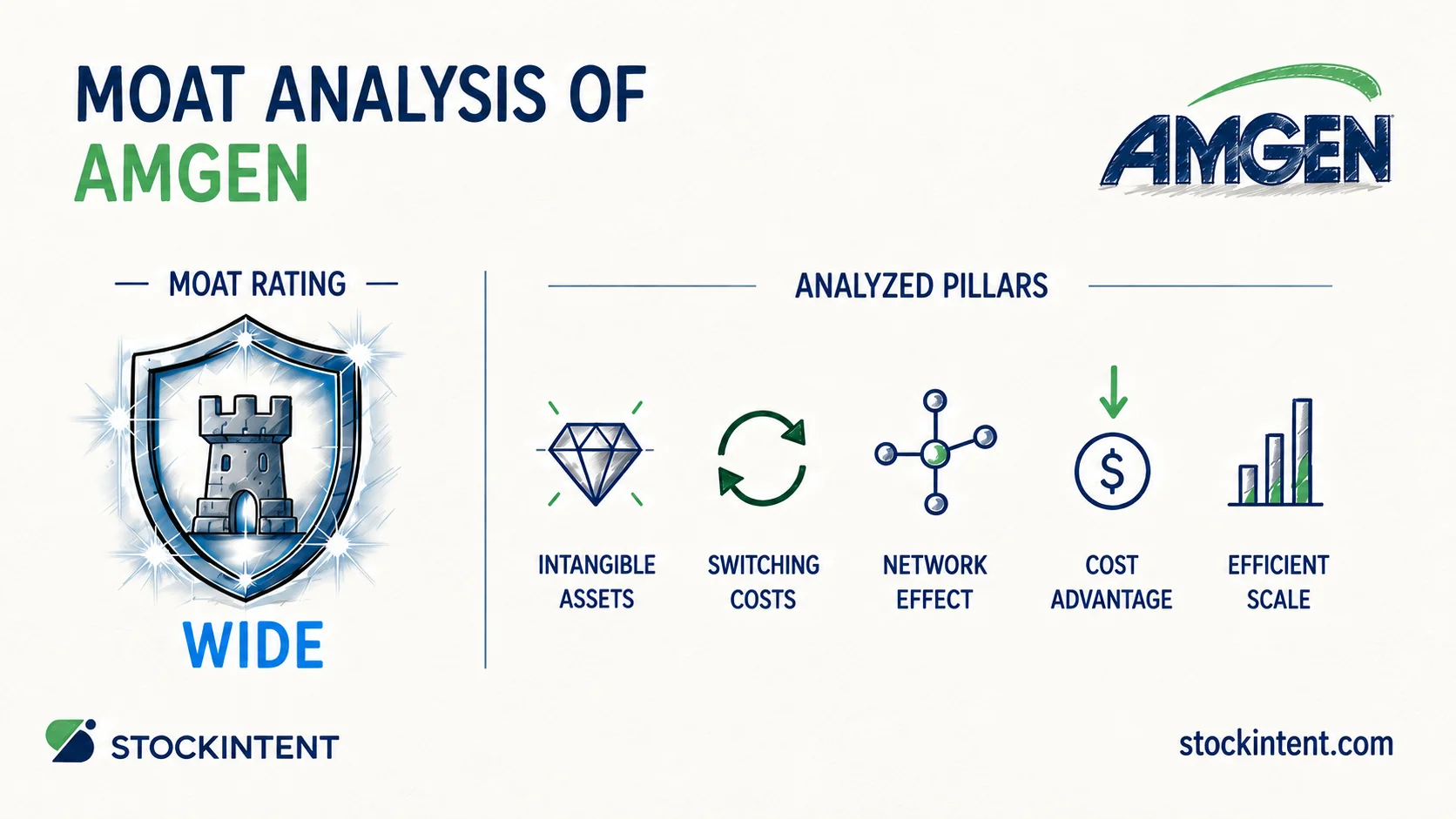
Amgen possesses a Wide Economic Moat with a Stable-to-Widening trend and Medium Uncertainty. In its Q2 2026 financial results, the company demonstrated resilient operational momentum as revenue topped $10 billion with 10% year-over-year growth. Following these quarterly numbers, management raised full-year 2026 revenue guidance to between $38.2 billion and $39.4 billion and lifted non-GAAP EPS expectations to $22.30 to $23.50.
Here is our assessment of Amgen's moat profile:
Evaluating Amgen's moat is about gauging durable business quality rather than timing a short-term trade. Let's look closely at how the five competitive advantage pillars shape Amgen's long-term economics.
Amgen defends its business economics through two primary pillars: formidable intangible assets and clinical switching costs. Other competitive dynamics, such as cost advantage and efficient scale, play supporting roles, while network effects do not apply to pharmaceutical operations.
Intellectual property remains Amgen's core moat foundation. The company protects its therapies through complex patent webs, regulatory exclusivities, and proprietary biologics manufacturing know-how outlined in its 2025 Annual Report. For acquired assets, valuable commercial rights are reflected directly on the balance sheet. In Amgen's Form 10-Q filed in August 2026, TAVNEOS alone carried $2.4 billion in finite-lived intangible asset value as of June 30, 2026. These legal monopolies grant Amgen significant pricing flexibility and shield blockbuster cash flows until patent expiration.
Switching costs in biologic therapies stem from physician habits, patient clinical stability, and formulary positioning. Doctors hesitate to transition stabilized patients away from proven treatments. However, this advantage has clear limits. In 2026, sales for legacy blockbusters Prolia and XGEVA showed accelerated declines under targeted pressure from newly launched biosimilars. While switching friction slows market-share losses compared to traditional small-molecule generics, it cannot prevent eventual revenue erosion once biosimilar alternatives secure preferred payer coverage.
Investors hunting for durable compounding machines often start by identifying companies with strong IP portfolios and customer retention. You can screen for companies with strong intangible assets to uncover businesses that pair high gross margins with defensible pricing barriers.
Amgen benefits from global distribution reach and high-volume bioreactor capacity. Management anticipates this operating leverage will produce full-year 2026 non-GAAP operating margins between 45% and 46%, having already delivered a 48% non-GAAP operating margin in Q2 2026. While these figures confirm excellent internal efficiencies, Amgen does not hold a structural low-cost manufacturing moat over well-funded peers or dedicated contract biologics producers.
Developing complex biologic medicines requires specialized regulatory expertise and substantial capital expenditure, naturally restricting the field of credible entrants. Yet Amgen competes in massive, globally contested therapeutic indications like cardiovascular disease and oncology. Because multiple competitors can profitably serve these expansive markets, Amgen does not enjoy a natural geographic or regulatory monopoly.
Drug demand depends on clinical trial efficacy, physician prescription decisions, and commercial insurance coverage. A patient taking Repatha creates no added utility for another patient starting the therapy.
Pro Insight: Network effects are frequently assumed in platform businesses but are largely absent in pharmaceuticals. Amgen's competitive position rests on intellectual property portfolios and clinical switching friction, not on user-to-user feedback loops. Investors interested in this sector should focus on patent durability and formulary stickiness.
A company's economic moat becomes real when it shows up in sustained margins and durable volume growth across product cycles. For Amgen, competitive advantages translate directly into pricing power and strong cash generation. In Q2 2026, the company generated a 36.8% GAAP operating margin as a percentage of product sales and a 48% non-GAAP operating margin. These numbers reflect strong commercial discipline and fixed-cost leverage.
Moat strength also shows up in portfolio breadth. In Q2 2026, 22 Amgen products posted double-digit sales growth. Amgen's six key growth drivers (Repatha, EVENITY, TEZSPIRE, rare disease, innovative oncology, and biosimilars) expanded 26% year over year. Together, they generated nearly 70% of total product sales. This expansion proves that Amgen can scale newer therapies quickly enough to carry the business forward.
Yet the moat does not provide uniform armor across the balance sheet. Rapid biosimilar inroads into mature franchises like Prolia and XGEVA demonstrate that patent expirations eventually pierce the shield. Even high switching costs cannot protect older assets once payers favor biosimilar alternatives. Unlike single-blockbuster peers that face sharp fiscal cliffs, Amgen relies on broad commercial execution to offset legacy drag.
Investors tracking business quality should check whether high returns on capital come from one drug or a repeatable commercial engine. You can use StockIntent's company reports to evaluate financial performance in depth, tracking segment margins and volume stability as portfolio transitions unfold.
Amgen's economic moat trend is stable to widening in 2026. The biopharma industry structure continues to shift under the Inflation Reduction Act (IRA) and rigorous payer scrutiny. These pressures accelerate price declines on mature therapies while rewarding high-barrier specialty medicines. Amgen is navigating this landscape by steering capital into harder-to-replicate biologics, biosimilars, and differentiated late-stage assets.
Several clear catalysts are widening the company's competitive position. Its six primary growth drivers expanded 26% year over year in Q2 2026, capturing market share and steadily growing their 70% revenue foundation. In its Q2 2026 earnings call, management detailed a capital expenditure plan of approximately $2.6 billion for 2026 to expand manufacturing capacity ahead of expected commercial launches. The most notable upside driver is MariTide, an obesity candidate offering differentiated monthly dosing or potentially quarterly administration. If late-stage trials succeed, MariTide could open an expansive commercial franchise.
Still, countervailing pressures keep the moat trend from widening without friction. CMS-set Medicare Part D price cuts on legacy blockbusters like Enbrel and Otezla highlight regulatory margin compression on mature franchises. Competitive intensity is also mounting in core growth categories. For example, Bernstein downgraded Amgen in 2026, citing competitive threats to Repatha from Merck's enlicitide along with clinical uncertainty around lipoprotein(a) therapies.
To gauge whether Amgen's moat continues to strengthen, investors should track four concrete indicators:
We assign Amgen a Medium uncertainty rating. Uncertainty here does not reflect stock price volatility. Instead, it gauges the plausible range of fundamental business outcomes over the next three to five years.
Four distinct operational and legal drivers define Amgen's outcome range:
In our experience assessing pharmaceutical uncertainty, a Medium rating reflects not just binary clinical risks but the interplay between patent cliffs and replacement velocity. Amgen's 2026 guidance raises suggest management confidence in the transition, yet the IRS dispute and biosimilar acceleration remind us that even wide-moat pharma companies face discrete events that can alter cash flow trajectories
The uncertainty is manageable but requires monitoring the specific watchlist indicators rather than relying on historical moat stability alone.
Amgen merits a Wide Moat rating with a Stable-to-Widening trend and Medium Uncertainty. The business continues to demonstrate remarkable underlying quality, supported by 48% non-GAAP operating margins and six commercial growth drivers that now generate nearly 70% of total product sales. By scaling newer biologics, Amgen has successfully shielded its consolidated cash flows from severe patent expirations.
From here, long-term investors should track two primary dynamics. The first is clinical execution for pipeline candidates like MariTide, which will determine whether Amgen can build an enduring presence in cardiometabolic care. The second is the ongoing pace of biosimilar erosion against legacy blockbusters like Prolia and XGEVA, alongside regulatory pricing pressure on older treatments.
Watching Amgen's transition from aging blockbusters to next-generation specialty platforms provides a clear window into how durable competitive advantages evolve. Keeping an eye on these operational milestones matters far more than obsessing over near-term market sentiment.
This content is for informational and educational purposes only and is not investment advice.
Amgen possesses a Wide Economic Moat with a Stable-to-Widening trend and Medium Uncertainty. In its Q2 2026 financial results, the company demonstrated resilient operational momentum as revenue topped $10 billion with 10% year-over-year growth. Following these quarterly numbers, management raised full-year 2026 revenue guidance to between $38.2 billion and $39.4 billion and lifted non-GAAP EPS expectations to $22.30 to $23.50.
Here is our assessment of Amgen's moat profile:
Evaluating Amgen's moat is about gauging durable business quality rather than timing a short-term trade. Let's look closely at how the five competitive advantage pillars shape Amgen's long-term economics.
Amgen defends its business economics through two primary pillars: formidable intangible assets and clinical switching costs. Other competitive dynamics, such as cost advantage and efficient scale, play supporting roles, while network effects do not apply to pharmaceutical operations.
Intellectual property remains Amgen's core moat foundation. The company protects its therapies through complex patent webs, regulatory exclusivities, and proprietary biologics manufacturing know-how outlined in its 2025 Annual Report. For acquired assets, valuable commercial rights are reflected directly on the balance sheet. In Amgen's Form 10-Q filed in August 2026, TAVNEOS alone carried $2.4 billion in finite-lived intangible asset value as of June 30, 2026. These legal monopolies grant Amgen significant pricing flexibility and shield blockbuster cash flows until patent expiration.
Switching costs in biologic therapies stem from physician habits, patient clinical stability, and formulary positioning. Doctors hesitate to transition stabilized patients away from proven treatments. However, this advantage has clear limits. In 2026, sales for legacy blockbusters Prolia and XGEVA showed accelerated declines under targeted pressure from newly launched biosimilars. While switching friction slows market-share losses compared to traditional small-molecule generics, it cannot prevent eventual revenue erosion once biosimilar alternatives secure preferred payer coverage.
Investors hunting for durable compounding machines often start by identifying companies with strong IP portfolios and customer retention. You can screen for companies with strong intangible assets to uncover businesses that pair high gross margins with defensible pricing barriers.
Amgen benefits from global distribution reach and high-volume bioreactor capacity. Management anticipates this operating leverage will produce full-year 2026 non-GAAP operating margins between 45% and 46%, having already delivered a 48% non-GAAP operating margin in Q2 2026. While these figures confirm excellent internal efficiencies, Amgen does not hold a structural low-cost manufacturing moat over well-funded peers or dedicated contract biologics producers.
Developing complex biologic medicines requires specialized regulatory expertise and substantial capital expenditure, naturally restricting the field of credible entrants. Yet Amgen competes in massive, globally contested therapeutic indications like cardiovascular disease and oncology. Because multiple competitors can profitably serve these expansive markets, Amgen does not enjoy a natural geographic or regulatory monopoly.
Drug demand depends on clinical trial efficacy, physician prescription decisions, and commercial insurance coverage. A patient taking Repatha creates no added utility for another patient starting the therapy.
Pro Insight: Network effects are frequently assumed in platform businesses but are largely absent in pharmaceuticals. Amgen's competitive position rests on intellectual property portfolios and clinical switching friction, not on user-to-user feedback loops. Investors interested in this sector should focus on patent durability and formulary stickiness.
A company's economic moat becomes real when it shows up in sustained margins and durable volume growth across product cycles. For Amgen, competitive advantages translate directly into pricing power and strong cash generation. In Q2 2026, the company generated a 36.8% GAAP operating margin as a percentage of product sales and a 48% non-GAAP operating margin. These numbers reflect strong commercial discipline and fixed-cost leverage.
Moat strength also shows up in portfolio breadth. In Q2 2026, 22 Amgen products posted double-digit sales growth. Amgen's six key growth drivers (Repatha, EVENITY, TEZSPIRE, rare disease, innovative oncology, and biosimilars) expanded 26% year over year. Together, they generated nearly 70% of total product sales. This expansion proves that Amgen can scale newer therapies quickly enough to carry the business forward.
Yet the moat does not provide uniform armor across the balance sheet. Rapid biosimilar inroads into mature franchises like Prolia and XGEVA demonstrate that patent expirations eventually pierce the shield. Even high switching costs cannot protect older assets once payers favor biosimilar alternatives. Unlike single-blockbuster peers that face sharp fiscal cliffs, Amgen relies on broad commercial execution to offset legacy drag.
Investors tracking business quality should check whether high returns on capital come from one drug or a repeatable commercial engine. You can use StockIntent's company reports to evaluate financial performance in depth, tracking segment margins and volume stability as portfolio transitions unfold.
Amgen's economic moat trend is stable to widening in 2026. The biopharma industry structure continues to shift under the Inflation Reduction Act (IRA) and rigorous payer scrutiny. These pressures accelerate price declines on mature therapies while rewarding high-barrier specialty medicines. Amgen is navigating this landscape by steering capital into harder-to-replicate biologics, biosimilars, and differentiated late-stage assets.
Several clear catalysts are widening the company's competitive position. Its six primary growth drivers expanded 26% year over year in Q2 2026, capturing market share and steadily growing their 70% revenue foundation. In its Q2 2026 earnings call, management detailed a capital expenditure plan of approximately $2.6 billion for 2026 to expand manufacturing capacity ahead of expected commercial launches. The most notable upside driver is MariTide, an obesity candidate offering differentiated monthly dosing or potentially quarterly administration. If late-stage trials succeed, MariTide could open an expansive commercial franchise.
Still, countervailing pressures keep the moat trend from widening without friction. CMS-set Medicare Part D price cuts on legacy blockbusters like Enbrel and Otezla highlight regulatory margin compression on mature franchises. Competitive intensity is also mounting in core growth categories. For example, Bernstein downgraded Amgen in 2026, citing competitive threats to Repatha from Merck's enlicitide along with clinical uncertainty around lipoprotein(a) therapies.
To gauge whether Amgen's moat continues to strengthen, investors should track four concrete indicators:
We assign Amgen a Medium uncertainty rating. Uncertainty here does not reflect stock price volatility. Instead, it gauges the plausible range of fundamental business outcomes over the next three to five years.
Four distinct operational and legal drivers define Amgen's outcome range:
In our experience assessing pharmaceutical uncertainty, a Medium rating reflects not just binary clinical risks but the interplay between patent cliffs and replacement velocity. Amgen's 2026 guidance raises suggest management confidence in the transition, yet the IRS dispute and biosimilar acceleration remind us that even wide-moat pharma companies face discrete events that can alter cash flow trajectories
The uncertainty is manageable but requires monitoring the specific watchlist indicators rather than relying on historical moat stability alone.
Amgen merits a Wide Moat rating with a Stable-to-Widening trend and Medium Uncertainty. The business continues to demonstrate remarkable underlying quality, supported by 48% non-GAAP operating margins and six commercial growth drivers that now generate nearly 70% of total product sales. By scaling newer biologics, Amgen has successfully shielded its consolidated cash flows from severe patent expirations.
From here, long-term investors should track two primary dynamics. The first is clinical execution for pipeline candidates like MariTide, which will determine whether Amgen can build an enduring presence in cardiometabolic care. The second is the ongoing pace of biosimilar erosion against legacy blockbusters like Prolia and XGEVA, alongside regulatory pricing pressure on older treatments.
Watching Amgen's transition from aging blockbusters to next-generation specialty platforms provides a clear window into how durable competitive advantages evolve. Keeping an eye on these operational milestones matters far more than obsessing over near-term market sentiment.
This content is for informational and educational purposes only and is not investment advice.