
Sep 18, 2026
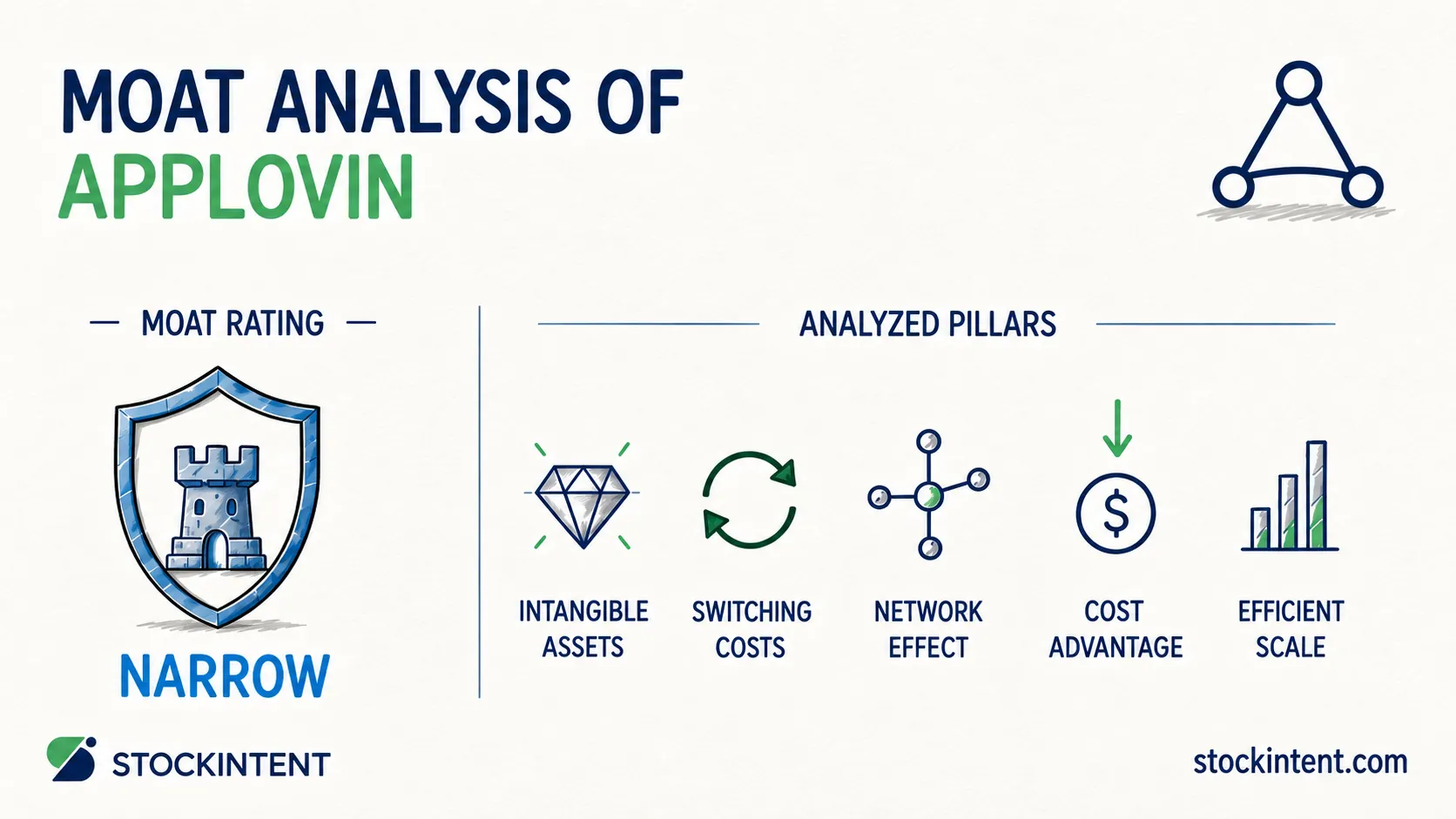
AppLovin carries a Narrow economic moat rating with a Widening trend and Medium uncertainty.
In its Q2 2026 earnings announcement, the company reported revenue of roughly $1.92 billion, up 53% year over year. Yahoo Finance earnings highlights show adjusted EBITDA reached approximately $1.61 billion, sustaining an exceptional margin near 84%. Still, we believe investors should distinguish between blistering near-term performance and structural durability.
Astronomical margins alone do not guarantee a permanent competitive shield. For long-term investors, determining whether AppLovin owns a compounding structural franchise requires looking past recent headlines into its underlying economic architecture.
To evaluate AppLovin through a long-term business lens, we look at economic moats across five classical sources: intangible assets, network effects, switching costs, cost advantages, and efficient scale. Rather than treating all five as equally strong, we rank them from AppLovin's most potent edge down to its weakest link.
Proprietary technology and exclusive data form AppLovin's primary economic engine. The core advantage stems from its AXON machine learning engine combined with billions of daily in-app auction signals. Competitors cannot easily replicate these models without matching both AppLovin's historical conversion dataset and real-time bid stream. Proprietary AXON predictive models and granular first-party pricing datasets deliver superior advertiser return on ad spend (ROAS), creating a durable analytical barrier.
AppLovin benefits from a self-reinforcing flywheel across its MAX mediation and AppDiscovery platforms. Higher ad supply attracts more bidding demand, which yields deeper conversion data that sharpens auction outcomes. However, this dynamic remains concentrated within mobile apps and gaming rather than representing a universal, web-wide advertising network effect. The MAX mediation platform and AXON bidding infrastructure feed each other: deeper publisher volume improves conversion accuracy, which draws higher advertiser budgets.
Integrating AppLovin's software development kit (SDK) into a mobile game requires technical setup, testing, and operational embedding. While tearing out mediation infrastructure creates friction and short-term revenue risk for publishers, advertisers regularly multi-home across networks. As a result, switching costs provide genuine friction, but not true customer lock-in. Deep SDK integration creates operational inertia among mobile publishers, though advertisers remain free to redirect campaign budgets to rival channels.
AppLovin does not operate as a traditional low-cost producer with cheaper compute or structural distribution advantages. Its high profitability reflects monetization efficiency: extracting more revenue per ad impression rather than running an inherently cheaper tech stack than peers. Massive processing scale spreads server expenses across billions of daily requests, but the financial edge reflects premium pricing efficiency rather than low-cost infrastructure.
Efficient scale occurs when a market only supports a limited number of profitable players, discouraging new entrants. AppLovin does not meet this standard. While MAX holds significant mediation share, the broader ad ecosystem features well-funded giants that prevent natural monopoly defenses.
Pro Insight: AppLovin's efficient scale argument is its weakest pillar. Per Deep Research Global's 2026 SWOT analysis, MAX controls an estimated 55% of top-grossing mobile game mediation, outpacing Unity LevelPlay at 25% and Google AdMob at 13.3%. Yet the broader digital advertising market remains heavily contested by Meta and Alphabet. This makes AppLovin's position a formidable niche advantage rather than an unbeatable natural monopoly.
AppLovin's moat assets appear most convincingly in its operating leverage and monetization power. In its Q1 2026 financial report, the company delivered $1.84 billion in revenue, up 59% year over year, while adjusted EBITDA hit roughly $1.56 billion at an 85% margin. The June quarter continued this trend with $1.92 billion in revenue and adjusted EBITDA expanding by about 300 basis points year over year. When an ad-tech company converts incremental top-line expansion directly into mid-80% cash margins, its predictive algorithms are delivering genuine pricing efficiency.
That cash generation translates into tangible shareholder returns. According to The Motley Fool's earnings transcript, AppLovin repurchased approximately $1 billion of its own shares in Q1 2026 alone, highlighting disciplined capital allocation without starving core operations.
Yet the evidence remains asymmetrical. AppLovin does not disclose detailed customer retention rates or contract stickiness metrics. In practice, the moat is visible in financial outcomes rather than direct contractual lock-in, meaning advertisers stay because the platform works, not because they are contractually forced to.
For investors reviewing detailed financial statements and metrics, separating structural advantages from cyclical execution is essential for judging how long this extraordinary cash flow will compound.
We rate AppLovin's moat trend as Widening. The platform continues to capture incremental ad budgets beyond mobile gaming, proving that its auction mechanics translate into new, highly contested ad categories.
Two notable market share shifts support this widening trajectory in 2026:
Still, this trend faces friction. Second-quarter revenue of $1.92 billion landed slightly below management's guidance midpoint. The company attributed this minor shortfall to a lighter cadence of meaningful AI model improvements, showing that revenue trajectory depends directly on rapid iteration. Concurrently, rising compute costs for model training pressured flow-through margins, while Meta, Alphabet, TikTok, and Unity continue to invest heavily in matching these bidding efficiencies.
To determine whether this widening trend holds or stalls, we recommend monitoring these indicators on an ongoing basis:
We assign AppLovin a Medium uncertainty rating. This rating does not signal elevated insolvency risk or balance sheet fragility. Rather, it reflects a moderately wide range of potential business outcomes over the next three to five years, primarily tied to whether current competitive advantages can outlast technological catch-up.
Four key drivers explain this uncertainty level:
From Our Experience: Assessing uncertainty in AI-driven ad-tech requires distinguishing between model performance volatility and business model durability. For AppLovin, the uncertainty is not survival risk; the business generates substantial free cash flow. The real question is whether it can maintain exceptional returns as the competitive landscape evolves and AI capabilities converge across platforms.
AppLovin pairs a Narrow economic moat with a Widening trend and Medium uncertainty. The company's proprietary AXON engine, roughly $1.92 billion in quarterly revenue, and adjusted EBITDA margins near 84% confirm exceptional current execution. Moreover, capturing 44% of iOS ad revenue share and expanding e-commerce ad budget share to 11% prove that its bidding engine translates effectively into non-gaming categories.
Yet long-term business quality depends on durability rather than short-term momentum. Because AppLovin relies on algorithmic prediction rather than contractual customer lock-in, its moat remains sensitive to model upgrade timing and technological catch-up from rivals like Meta and Google.
For quality-minded investors, the priority now is tracking platform durability. Monitoring our four-indicator watchlist will help you spot whether AppLovin is building a multi-year compounding franchise or simply experiencing an extended run of superior execution.
This content is for informational and educational purposes only and is not investment advice.
AppLovin carries a Narrow economic moat rating with a Widening trend and Medium uncertainty.
In its Q2 2026 earnings announcement, the company reported revenue of roughly $1.92 billion, up 53% year over year. Yahoo Finance earnings highlights show adjusted EBITDA reached approximately $1.61 billion, sustaining an exceptional margin near 84%. Still, we believe investors should distinguish between blistering near-term performance and structural durability.
Astronomical margins alone do not guarantee a permanent competitive shield. For long-term investors, determining whether AppLovin owns a compounding structural franchise requires looking past recent headlines into its underlying economic architecture.
To evaluate AppLovin through a long-term business lens, we look at economic moats across five classical sources: intangible assets, network effects, switching costs, cost advantages, and efficient scale. Rather than treating all five as equally strong, we rank them from AppLovin's most potent edge down to its weakest link.
Proprietary technology and exclusive data form AppLovin's primary economic engine. The core advantage stems from its AXON machine learning engine combined with billions of daily in-app auction signals. Competitors cannot easily replicate these models without matching both AppLovin's historical conversion dataset and real-time bid stream. Proprietary AXON predictive models and granular first-party pricing datasets deliver superior advertiser return on ad spend (ROAS), creating a durable analytical barrier.
AppLovin benefits from a self-reinforcing flywheel across its MAX mediation and AppDiscovery platforms. Higher ad supply attracts more bidding demand, which yields deeper conversion data that sharpens auction outcomes. However, this dynamic remains concentrated within mobile apps and gaming rather than representing a universal, web-wide advertising network effect. The MAX mediation platform and AXON bidding infrastructure feed each other: deeper publisher volume improves conversion accuracy, which draws higher advertiser budgets.
Integrating AppLovin's software development kit (SDK) into a mobile game requires technical setup, testing, and operational embedding. While tearing out mediation infrastructure creates friction and short-term revenue risk for publishers, advertisers regularly multi-home across networks. As a result, switching costs provide genuine friction, but not true customer lock-in. Deep SDK integration creates operational inertia among mobile publishers, though advertisers remain free to redirect campaign budgets to rival channels.
AppLovin does not operate as a traditional low-cost producer with cheaper compute or structural distribution advantages. Its high profitability reflects monetization efficiency: extracting more revenue per ad impression rather than running an inherently cheaper tech stack than peers. Massive processing scale spreads server expenses across billions of daily requests, but the financial edge reflects premium pricing efficiency rather than low-cost infrastructure.
Efficient scale occurs when a market only supports a limited number of profitable players, discouraging new entrants. AppLovin does not meet this standard. While MAX holds significant mediation share, the broader ad ecosystem features well-funded giants that prevent natural monopoly defenses.
Pro Insight: AppLovin's efficient scale argument is its weakest pillar. Per Deep Research Global's 2026 SWOT analysis, MAX controls an estimated 55% of top-grossing mobile game mediation, outpacing Unity LevelPlay at 25% and Google AdMob at 13.3%. Yet the broader digital advertising market remains heavily contested by Meta and Alphabet. This makes AppLovin's position a formidable niche advantage rather than an unbeatable natural monopoly.
AppLovin's moat assets appear most convincingly in its operating leverage and monetization power. In its Q1 2026 financial report, the company delivered $1.84 billion in revenue, up 59% year over year, while adjusted EBITDA hit roughly $1.56 billion at an 85% margin. The June quarter continued this trend with $1.92 billion in revenue and adjusted EBITDA expanding by about 300 basis points year over year. When an ad-tech company converts incremental top-line expansion directly into mid-80% cash margins, its predictive algorithms are delivering genuine pricing efficiency.
That cash generation translates into tangible shareholder returns. According to The Motley Fool's earnings transcript, AppLovin repurchased approximately $1 billion of its own shares in Q1 2026 alone, highlighting disciplined capital allocation without starving core operations.
Yet the evidence remains asymmetrical. AppLovin does not disclose detailed customer retention rates or contract stickiness metrics. In practice, the moat is visible in financial outcomes rather than direct contractual lock-in, meaning advertisers stay because the platform works, not because they are contractually forced to.
For investors reviewing detailed financial statements and metrics, separating structural advantages from cyclical execution is essential for judging how long this extraordinary cash flow will compound.
We rate AppLovin's moat trend as Widening. The platform continues to capture incremental ad budgets beyond mobile gaming, proving that its auction mechanics translate into new, highly contested ad categories.
Two notable market share shifts support this widening trajectory in 2026:
Still, this trend faces friction. Second-quarter revenue of $1.92 billion landed slightly below management's guidance midpoint. The company attributed this minor shortfall to a lighter cadence of meaningful AI model improvements, showing that revenue trajectory depends directly on rapid iteration. Concurrently, rising compute costs for model training pressured flow-through margins, while Meta, Alphabet, TikTok, and Unity continue to invest heavily in matching these bidding efficiencies.
To determine whether this widening trend holds or stalls, we recommend monitoring these indicators on an ongoing basis:
We assign AppLovin a Medium uncertainty rating. This rating does not signal elevated insolvency risk or balance sheet fragility. Rather, it reflects a moderately wide range of potential business outcomes over the next three to five years, primarily tied to whether current competitive advantages can outlast technological catch-up.
Four key drivers explain this uncertainty level:
From Our Experience: Assessing uncertainty in AI-driven ad-tech requires distinguishing between model performance volatility and business model durability. For AppLovin, the uncertainty is not survival risk; the business generates substantial free cash flow. The real question is whether it can maintain exceptional returns as the competitive landscape evolves and AI capabilities converge across platforms.
AppLovin pairs a Narrow economic moat with a Widening trend and Medium uncertainty. The company's proprietary AXON engine, roughly $1.92 billion in quarterly revenue, and adjusted EBITDA margins near 84% confirm exceptional current execution. Moreover, capturing 44% of iOS ad revenue share and expanding e-commerce ad budget share to 11% prove that its bidding engine translates effectively into non-gaming categories.
Yet long-term business quality depends on durability rather than short-term momentum. Because AppLovin relies on algorithmic prediction rather than contractual customer lock-in, its moat remains sensitive to model upgrade timing and technological catch-up from rivals like Meta and Google.
For quality-minded investors, the priority now is tracking platform durability. Monitoring our four-indicator watchlist will help you spot whether AppLovin is building a multi-year compounding franchise or simply experiencing an extended run of superior execution.
This content is for informational and educational purposes only and is not investment advice.