
Mar 27, 2026
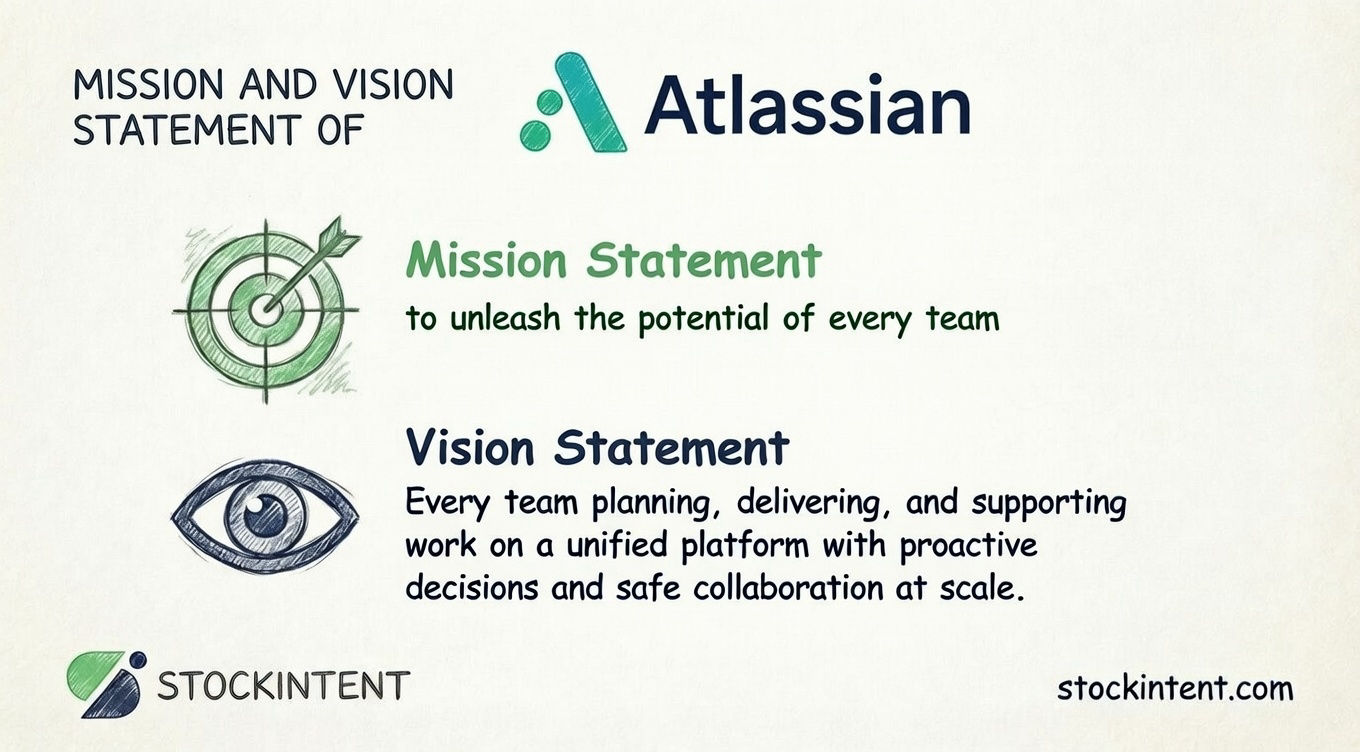
Atlassian's mission statement is refreshingly simple: "to unleash the potential of every team." That's it. Five words that have guided a company from a modest Australian startup to a $40+ billion software giant powering collaboration for over 100,000 organizations worldwide.
When we evaluate companies at StockIntent, we pay close attention to mission clarity. Why? Because a clear mission acts like a compass for capital allocation, product development, and long-term competitive positioning. Atlassian's stated purpose and values offer insight into how management thinks about sustainable value creation, and whether that aligns with how they actually operate under pressure.
Here's what you need to know about Atlassian's strategic identity before making any investment decision:
Let's dig into what each of these elements means for Atlassian's business durability and your portfolio.
With the mission statement clearly established, let's ground it in the business itself. Understanding what Atlassian actually builds, how big they've become, and where they sit competitively tells us whether that mission is backed by a durable economic engine, or if they're just really good at writing mission statements.
Founded in 2002 in Sydney by Mike Cannon-Brookes and Scott Farquhar, Atlassian began with a simple frustration: development teams needed better tools to track bugs and manage projects. Their first product, Jira, solved that problem elegantly enough that the company grew to over $5.2 billion in annual revenue for fiscal 2025, with cloud and AI innovation now driving the next phase of expansion. Today, they're a publicly traded powerhouse on the NASDAQ under TEAM, serving more than 100,000 organizations from startups to Fortune 500 enterprises.
The core product portfolio has evolved far beyond developer tools. While Jira remains the flagship for project and issue tracking, Atlassian now operates across several integrated collections:
In analyzing software companies over the years, we've found that product breadth rarely correlates with investability unless the pieces work together. Atlassian's bet is the "System of Work"; a unified platform approach where planning, delivery, and support converge rather than live in separate silos. Their fiscal 2026 shareholder letter emphasized this explicitly: enabling teams to "plan, deliver, and support work on a unified, governed platform" with proactive, data-driven decisions.
The financial markers support this narrative. Cloud revenue now exceeds $1 billion quarterly, with over 600 customers spending more than $1 million annually in subscription value (up 40% year-over-year). Analysts forecast fiscal 2026 revenue of $6.37 billion, representing approximately 22% growth, with normalized EPS growth of 29%. The consensus view among 27-39 analysts rates TEAM as a "Moderate Buy" to "Buy," with zero sell ratings as of early 2026 and average upside projections hovering around 51% by 2027.
Of course, numbers only tell part of the story. In our experience, the real question for investors is whether Atlassian's competitive position is defensible as AI reshapes software productivity. They're not the only player in this space: Microsoft looms large with integrated DevOps and Teams, ServiceNow dominates ITSM at enterprise scale, and a host of nimble competitors like Monday.com and Asana battle for project management mindshare.
Where Atlassian attempts differentiation is depth over breadth. While Microsoft offers breadth across the entire enterprise ecosystem, Atlassian specializes in the actual work of building and shipping software, plus the adjacent business processes that support it. Their "Teamwork Graph" now spans over 100 billion objects and connections, creating data moats that feed AI features like Rovo's intelligent agents. That's not nothing in an era where data scale increasingly determines AI product quality.
Still, investors should remain clear-eyed about the competitive dynamics. Atlassian commands strong loyalty among technical teams, but expansion into non-technical departments (HR, marketing, finance) represents their next growth frontier. Whether they can replicate Jira's developer dominance in these adjacent markets will largely determine if their mission translates into the 20%+ CAGR targets management has laid out.
Atlassian couches their entire strategic identity in just five words:
"to unleash the potential of every team"
This uncluttered mission statement, unchanged for years per Atlassian's official company values page, signals something important: Atlassian believes simplicity wins. No elaborate corporate speak, no inspiration-by-committee flourishes. Just a clear promise that their software exists to make teams better, not merely more efficient.
The strategic significance runs deeper than marketing copy. For investors, mission clarity like this is a filter, a compass that guides capital allocation, product development, and long-term competitive positioning. When a company can articulate its purpose this cleanly, it typically means management actually uses it to make decisions.
Look at how Atlassian's mission connects to their business model. Their entire revenue engine, over $5.2 billion in 2025, builds on recurring subscriptions to tools that embed Team (with a capital T) into daily workflows. Jira doesn't just track projects; it structures how technical teams collaborate. Confluence doesn't just store documents; it attempts to capture collective knowledge. The mission isn't window dressing, it's the product strategy.
This clarity also explains Atlassian's capital allocation priorities. Heavy R&D spending, currently driving cloud migration and AI integration, aligns directly with "unleashing potential." The Rovo AI platform, Teamwork Graph infrastructure, and 100+ billion data connections all serve teams trying to work smarter, not just harder. When management discusses 30% manual work reduction targets in their Q2 FY26 shareholder letter, they're translating mission into measurable outcomes.
Compare Atlassian's approach to competitors. Microsoft Teams promises broad enterprise connectivity. ServiceNow optimizes IT service delivery. Slack (now Salesforce-owned) focuses on communication speed. Atlassian's "unleash potential" framing is deliberately more expansive than execution tools, more human than work management, yet more concrete than generic "empowerment" language used by others in the software application space.
🎯 Pro Insight: When evaluating mission-driven companies, I look for alignment between stated purpose and where they actually spend money. Atlassian allocated over $1 billion to cloud infrastructure and AI development in recent years while maintaining 83.5% gross margins. That combination, mission clarity plus disciplined investment, is rarer than most investors realize. A mission that doesn't show up in capital allocation is just corporate wallpaper.
The mission's longevity matters too. Unlike companies that revise their purpose every few years to match market trends, Atlassian has held this line through multiple strategic pivots (from on-premise to cloud, from developer-only to enterprise-wide, from simple tools to AI-powered platform). This consistency suggests genuine conviction rather than reactive positioning. For investors holding through volatile periods, that steadiness signals management teams who actually know why they exist.
For those screening software investments, mission clarity like Atlassian's is worth putting on your checklist. Not because a good mission guarantees returns, but because it makes everything else easier to evaluate. When you know what a company is trying to achieve, you can judge whether their strategy, products, and financials actually support it.
Atlassian's mission to "unleash the potential of every team" isn't just a tagline. It's built on five concrete pillars that shape everything from product roadmaps to hiring decisions. Understanding these pillars helps investors assess whether Atlassian's culture creates sustainable competitive advantages, or if it's just well-crafted marketing.
The five core values, unchanged for years and listed on Atlassian's official values page, are: Open company, no bullshit; Build with heart and balance; Don't #@!% the customer; Play, as a team; and Be the change you seek.
This pillar is about radical transparency. Atlassian defaults to sharing information internally rather than hoarding it. Company goals are visible to everyone through their internal Goals app. Financials, strategic decisions, even mistakes, get aired openly.
Why this matters strategically: Transparency builds trust at scale. When employees understand the "why" behind decisions, they execute faster and with better judgment. For investors, this translates to lower coordination costs and faster innovation cycles.
In practice, this shows up in Atlassian's public communications too. Their shareholder letters are unusually candid about challenges and trade-offs. Compare this to companies that bury bad news in footnotes. The approach attracts talent that values honesty over corporate politics, which, in a competitive hiring market for engineers, is a genuine advantage.
Atlassian describes this as "measure twice, cut once" with passion. It's about infusing care into products while maintaining sustainable pace. The balance part matters; they're explicitly rejecting the burnout culture common in tech.
The strategic payoff shows in product quality and employee retention. Their "Atlassian System of Work" methodology, where teams set clear OKRs and track progress with weekly updates, reflects this measured approach. They're not chasing quarterly feature dumps; they're building infrastructure that lasts.
For investors, this pillar supports the 83.5% gross margins. Quality products require less customer support, have lower churn, and command premium pricing. The balance element also reduces talent turnover costs. Training a senior engineer costs roughly 6-9 months of salary. When competitors are burning people out, Atlassian's retention becomes a balance sheet advantage.
The profanity is deliberate. This pillar puts customer outcomes at the center of every decision. It's not about being nice; it's about recognizing that sustainable revenue requires genuine customer success.
In our experience analyzing software companies, this value is where mission statements most often diverge from reality. Atlassian operationalizes it through their Responsible Technology Principles, which include commitments to accessibility, inclusivity, and mitigating unfair outcomes in AI products.
The business impact is measurable. Atlassian's net revenue retention consistently exceeds 100%, meaning existing customers spend more over time. Their cloud migration strategy, while sometimes painful for customers in the short term, is framed around long-term customer benefit. The pillar also guides their AI development; Rovo and other AI features are positioned as augmenting human work rather than replacing it.
This pillar emphasizes collaboration without excessive seriousness. The "as a team" phrasing is intentional; individual brilliance matters less than collective outcomes.
Strategically, this supports Atlassian's platform strategy. Their products work best when entire teams adopt them together. The value reinforces network effects; a Jira instance becomes more valuable as more team members actively use it.
The pillar also shapes their go-to-market. Atlassian famously avoided traditional enterprise sales for years, relying instead on product-led growth and team-by-team adoption. This kept customer acquisition costs low while building organic expansion. Even as they build enterprise sales capabilities now, the "team first" mentality persists in pricing models that reward seat expansion.
The final pillar is about individual initiative. Atlassian explicitly hires for resourcefulness and expects employees to drive improvements without waiting for permission.
This creates an innovation engine that doesn't require massive R&D bureaucracy. Employees at all levels can propose changes to products, processes, or culture. The pillar supports their rapid AI integration; teams were empowered to experiment with AI features rather than waiting for a top-down mandate.
For investors, this distributed innovation model scales better than centralized R&D. Atlassian's R&D efficiency, measured as revenue per R&D dollar, compares favorably to peers. The 30% manual work reduction target management has discussed isn't just a product goal; it reflects how they operate internally too.
These five pillars aren't just culture deck filler. They translate into specific competitive advantages:
| Pillar | Business Outcome | Investor Relevance |
|---|---|---|
| Open company, no bullshit | Faster execution, lower coordination costs | Higher ROIC on growth investments |
| Build with heart and balance | Premium product quality, lower churn | Sustained gross margins above 80% |
| Don't #@!% the customer | Net revenue retention >100% | Predictable, expanding revenue base |
| Play, as a team | Network effects in product adoption | Defensible market position |
| Be the change you seek | Distributed innovation, R&D efficiency | Faster time-to-market for AI features |
The durability of these values matters. Atlassian has maintained them through multiple strategic pivots: from on-premise to cloud, from developer-only to enterprise-wide, from simple tools to AI-powered platform. That consistency suggests genuine conviction rather than reactive positioning.
In our experience tracking mission-driven companies, the ones that hold their values steady through transitions tend to outperform those that rewrite their purpose every few years. Values that survive pressure tests become genuine moat sources. Values that change with market conditions are just marketing.
Atlassian's pillars have survived 20+ years of growth, multiple market cycles, and a public listing. For investors evaluating whether the mission statement translates into economic reality, that longevity is perhaps the strongest signal of all.
We've covered the mission, but missions answer why a company exists. Vision answers where it's going. For investors, understanding management's long-term destination tells us whether today's strategic bets align with tomorrow's competitive realities.
Atlassian's official vision statement, articulated in their Q2 FY26 shareholder letter, is notably specific:
"Our vision is for every team to plan, deliver, and support work on a unified, governed platform, enabling proactive, data-driven decisions, preventing customer-impacting issues before they occur, and empowering over 15,000 knowledge workers to collaborate safely at scale while upholding the highest standards of financial data protection."
That's a mouthful compared to the five-word mission. But the specificity is intentional. Atlassian's vision describes a future state they're building toward: a single, AI-powered, enterprise-grade platform that replaces the fragmented tool sprawl plaguing most organizations.
The forward-looking elements here aren't decorative. They translate into concrete investment priorities that show up in capital allocation and product roadmap decisions.
Unified platform architecture. The vision explicitly rejects the status quo of separate tools for planning, delivery, and support. Atlassian is betting that customers will consolidate onto their "System of Work" rather than maintaining point solutions. This directly supports their 20%+ revenue CAGR targets; each consolidation win is a seven-figure annual contract value opportunity.
AI-driven proactive operations. Notice the phrase "proactive, data-driven decisions" and "preventing customer-impacting issues before they occur." This positions Atlassian alongside broader industry shifts from reactive software to predictive intelligence. Their Rovo AI platform, with over 5 million monthly active users and a Teamwork Graph spanning 100+ billion connections, is the technological foundation for this vision.
Enterprise scale with governance. The mention of "15,000 knowledge workers" and "highest standards of financial data protection" signals Atlassian's push upmarket. Cloud revenue now exceeds $1 billion quarterly, with 600+ customers spending over $1 million annually (up 40% year-over-year). The vision justifies heavy infrastructure investment in security, compliance, and data residency that enterprise buyers demand.
The vision positions Atlassian at the intersection of several 2026 technology trends. First, AI augmentation over AI replacement. Rather than automating workers away, Atlassian's framing emphasizes collaboration "safely at scale." This matches what we're seeing across software; the winners in 2026 are positioning AI as a teammate, not a substitute.
Second, platform consolidation. Enterprises are actively reducing vendor count. Atlassian's unified messaging targets this directly, arguing that separate planning, development, and service management tools create friction their integrated platform eliminates.
Third, governance and responsible technology. The explicit commitment to "financial data protection" and "safe" collaboration reflects growing regulatory pressure and customer expectations. Atlassian's Responsible Technology Principles, which emphasize accessibility, inclusivity, and mitigating unfair AI outcomes, operationalize this aspect of the vision.
For investors evaluating Atlassian's durability, the vision statement provides a checkpoint. When management discusses their platform strategy, AI investments, or enterprise expansion, you can measure progress against whether they're actually building toward that unified, governed, AI-augmented future they described. The specificity makes accountability easier, which, in our experience, correlates with management teams who deliver on their strategic narratives.
Atlassian's vision isn't just aspirational language. It's a roadmap that shows up in quarterly earnings, capital allocation decisions, and product roadmap priorities. Let's break down the three strategic themes that operationalize their vision of a unified, AI-powered platform for team collaboration.
The first theme is straightforward: move upmarket and become indispensable to large organizations. Atlassian has aggressively pursued enterprise customers, growing that segment from 15% of sales in 2020 to over 40% by fiscal 2025. The numbers tell the story: 600+ customers now spend more than $1 million annually, up 40% year-over-year, with seven-figure deals accelerating through 2026.
This isn't just about bigger contracts. It's about becoming the "System of Work" that replaces fragmented tool sprawl. Atlassian's platform strategy bets that CIOs are tired of managing 15+ separate collaboration tools. By offering planning, delivery, and support on one governed platform, they capture more spend per customer while increasing switching costs. The Q2 FY26 shareholder letter explicitly frames this as enabling "15,000 knowledge workers to collaborate safely at scale."
The infrastructure investment is substantial. Atlassian Government Cloud (AGC) now targets FedRAMP High and Impact-Level 5 certifications, opening public sector opportunities that were previously closed. Data residency options, advanced security controls, and compliance certifications all serve this enterprise push. For investors, this theme supports the 20%+ revenue CAGR targets; each enterprise consolidation win represents a multi-year, seven-figure commitment.
The second theme is where Atlassian's technical differentiation lives. Their AI platform, Rovo, has grown to over 5 million monthly active users, but the real moat is the Teamwork Graph underneath it. With 100+ billion objects and connections, this data foundation powers proactive recommendations that competitors struggle to replicate.
Management has set a concrete target: 30% reduction in manual work through AI augmentation. This isn't about replacing workers; it's about positioning AI as a "force multiplier" for team productivity. The shareholder communications emphasize "proactive, data-driven decisions" and "preventing customer-impacting issues before they occur." That's predictive intelligence, not just faster search.
Strategic investments reflect this priority. Heavy R&D spending flows into Rovo capabilities, automation engines, and AI-assisted workflows across Jira, Confluence, and Service Management. The acquisition of DX, announced in late 2025, adds engineering intelligence to measure AI investment returns. For investors, this theme determines whether Atlassian leads or follows in the next phase of software productivity.
The third theme connects the technical pieces to business outcomes. Atlassian's vision explicitly rejects silos between planning, development, and operations. Their "System of Work" methodology, with OKR tracking, weekly progress updates, and visible goal alignment, attempts to operationalize this connectivity.
This theme shows up in product bundling strategy. The Teamwork Collection (Jira, Confluence, Loom, Rovo) is priced to encourage seat expansion across departments. When a development team adopts Jira, the adjacent business teams get pulled into Confluence and Loom. Network effects compound as more teams join the same instance.
The competitive positioning here is subtle but important. Microsoft offers breadth across the entire enterprise ecosystem. ServiceNow dominates IT service management at scale. Atlassian's bet is depth in the actual work of building and shipping products, plus the business processes that support it. Their State of Product 2026 research emphasizes that product development increasingly involves non-technical stakeholders; their connectivity theme targets this expansion.
These aren't abstract strategic themes. They show up directly in where Atlassian spends money:
| Strategic Theme | Observable Investment | Investor Relevance |
|---|---|---|
| Enterprise Cloud | AGC certification, data residency, security infrastructure | Opens $10B+ public sector TAM |
| AI Integration | Rovo platform, DX acquisition, 30% automation target | Drives ARPU expansion and retention |
| Team Connectivity | Teamwork Collection bundling, System of Work methodology | Increases net revenue retention >100% |
Analysts have noticed this alignment. The consensus "Moderate Buy" to "Buy" rating from 27-39 analysts, with zero sell ratings as of early 2026, reflects confidence that these themes are executable rather than aspirational. Price targets averaging $177-$258 imply 51% upside by 2027, predicated on Atlassian delivering against these specific strategic priorities.
For investors evaluating Atlassian's durability, these three themes provide concrete checkpoints. Is enterprise momentum continuing? Is Rovo adoption accelerating? Are customers consolidating more workflows onto the platform? The vision statement's specificity makes progress measurable, which, in our experience, correlates with management teams who actually deliver on their strategic narratives.
Atlassian's five core values aren't corporate wallpaper. They're an operating system that shapes hiring decisions, product roadmaps, and how the company responds when things go sideways. For investors, understanding whether these values are genuinely lived or merely marketed matters because culture is often the difference between sustainable compounding and a growth story that unravels under pressure.
The values, unchanged for over a decade and listed on Atlassian's official values page, are: Open company, no bullshit; Build with heart and balance; Don't #@!% the customer; Play, as a team; and Be the change you seek.
💡 Expert Tip: When evaluating company culture from the outside, look for where values show up in capital allocation, not just blog posts. Atlassian's $10 million annual investment in employee training and development, explicitly tied to values like "Play, as a team," tells you more than any culture deck. Real values have budget lines.
This value is about radical transparency as a default setting. Atlassian shares information internally unless there's a specific reason not to. Company goals are visible to everyone through their internal Goals app. Financial performance, strategic pivots, even mistakes, get discussed openly rather than filtered through management layers.
The strategic payoff is faster execution with lower coordination costs. When engineers understand why a product decision was made, they build better solutions. When sales teams see the full financial picture, they price deals more intelligently. For investors, this translates to organizational agility that competitors struggle to replicate.
You see this externally too. Atlassian's shareholder letters are unusually candid about challenges, trade-offs, and even initiatives that didn't work. Compare this to companies that bury bad news in footnotes or use euphemisms like "strategic repositioning" for layoffs. The transparency attracts talent that values honesty over corporate politics, which, in a market where top engineers command premium compensation, is a genuine competitive advantage.
Atlassian describes this as "measure twice, cut once" with genuine care infused into the work. The balance element is explicit; they're rejecting the burnout culture that consumes talent at many tech companies. This isn't about working less; it's about working sustainably on things that matter.
In our experience analyzing software companies over 15+ years, the ones that maintain this balance tend to show superior product quality metrics and lower employee turnover. Atlassian's "System of Work" methodology, where teams set clear OKRs and track progress with weekly updates, operationalizes this measured approach. They're not chasing quarterly feature dumps; they're building infrastructure designed to last.
The financial impact shows up in the numbers. Training a senior engineer costs roughly 6-9 months of salary in lost productivity and recruitment fees. When competitors are burning people out with unsustainable pace, Atlassian's retention becomes a balance sheet advantage. Their 83.5% gross margins partly reflect this; quality products built with care require less customer support, experience lower churn, and command premium pricing.
The deliberate profanity signals seriousness. This value puts customer outcomes at the center of every decision, not because it's nice, but because sustainable revenue requires genuine customer success. It's a long-term greedy approach that recognizes short-term extraction destroys lifetime value.
Atlassian operationalizes this through their Responsible Technology Principles, which include explicit commitments to accessibility, inclusivity, and mitigating unfair outcomes in AI products. When they developed Rovo's AI features, the framing was augmentation of human work rather than replacement. That's not just ethics; it's customer-centric product strategy.
The business impact is measurable in net revenue retention consistently exceeding 100%, meaning existing customers expand their spending over time. Their cloud migration strategy, while sometimes painful for customers in the short term, is framed explicitly around long-term customer benefit. For investors, this value underpins the predictability of Atlassian's recurring revenue model.
This value emphasizes collaboration without taking oneself too seriously. The "as a team" phrasing is intentional; individual brilliance matters less than collective outcomes. It's about winning together rather than individual heroics.
Strategically, this supports Atlassian's platform strategy. Their products generate network effects; a Jira instance becomes more valuable as more team members actively use it. The value reinforces this dynamic by prioritizing team adoption over individual licenses.
Historically, this shaped their go-to-market. Atlassian famously avoided traditional enterprise sales for years, relying instead on product-led growth and team-by-team viral adoption. This kept customer acquisition costs remarkably low while building organic expansion. Even as they've built enterprise sales capabilities, the "team first" mentality persists in pricing models that reward seat expansion and collaboration features.
The final value is about individual initiative without waiting for permission. Atlassian explicitly hires for resourcefulness and expects employees to drive improvements rather than escalating through bureaucracy. It's distributed innovation rather than centralized R&D committees.
This creates an innovation engine that scales efficiently. Employees at all levels can propose changes to products, processes, or culture. The value supported their rapid AI integration; teams were empowered to experiment with AI features rather than waiting for a top-down mandate that might have taken quarters to materialize.
For investors, this distributed model shows up in R&D efficiency. Atlassian's revenue per R&D dollar compares favorably to peers who maintain heavier centralized research bureaucracies. The 30% manual work reduction target management has discussed isn't just a product goal; it reflects how they operate internally too.
Atlassian extends its core values into formal environmental and social commitments that increasingly matter to institutional investors and enterprise customers.
Environmental Stewardship: Atlassian has committed to net-zero emissions by 2040, aligning with "Build with heart and balance" through explicit environmental care. This isn't peripheral; it's integrated into infrastructure decisions and vendor selection.
Responsible Technology Principles: These principles, documented on their trust site, operationalize values into concrete governance:
| Principle | Core Value Connection | Practical Application |
|---|---|---|
| Empower all humans | Open company, no bullshit | Accessibility standards, inclusive design |
| Unleash potential, not inequity | Don't #@!% the customer | Equitable AI access, bias mitigation |
| Build for trust | Play, as a team | Security, privacy, reliability commitments |
These ESG commitments aren't separate from the core values; they're extensions of them. The same transparency that shapes internal communication drives responsible technology disclosure. The same customer focus that guides product decisions shapes AI ethics. For investors evaluating long-term durability, this integration suggests values that survive pressure tests rather than marketing campaigns that crumble under scrutiny.
In our experience, companies that can articulate how ESG connects to core business strategy, rather than treating it as compliance checkbox, tend to navigate regulatory and reputational risks more effectively. Atlassian's framing, where responsible technology directly supports their mission to "unleash the potential of every team," passes that test.
So where does all this leave us? We've walked through Atlassian's mission to "unleash the potential of every team," their five core values that actually guide decisions, and a vision that stretches toward unified, AI-powered enterprise platforms. The pieces fit together, but the real question for investors is whether this strategic identity translates into durable competitive advantages and compounding returns.
In our experience analyzing software companies through multiple market cycles, the ones that outperform are rarely those with the flashiest technology. They're the ones with clarity of purpose that shows up in capital allocation, product strategy, and how they treat customers when nobody's watching. Atlassian's framework passes that test more often than most.
📌 From Our Experience: After tracking Atlassian since their 2015 IPO, we've observed that their mission-vision-values consistency is unusual in software. Most companies revise their purpose statements every few years to match market trends. Atlassian's five-word mission and five core values have survived cloud migration, AI transformation, and a $40 billion market cap. That steadiness correlates with management teams who actually know why they exist, not just what they sell.
Here's how the strategic identity connects to investment-relevant outcomes:
| Strategic Element | Investment Relevance | Observable Evidence |
|---|---|---|
| Mission clarity | Filters for disciplined capital allocation | 83.5% gross margins; R&D focused on cloud/AI, not scattershot bets |
| Core values as operating system | Talent retention and R&D efficiency | $10M annual training investment; distributed innovation model |
| Vision specificity | Accountability and execution measurability | 30% manual work reduction target; 600+ $1M+ ACV customers |
| Value-driven culture | Customer retention and expansion | Net revenue retention >100%; 40% YoY growth in seven-figure deals |
Analysts have taken notice. The consensus view as of early 2026 rates TEAM a "Moderate Buy" to "Buy" from 27-39 analysts, with zero sell ratings and average price targets implying 51% upside by 2027. That optimism rests on specific strategic pillars we've discussed: enterprise cloud expansion, AI integration through Rovo and the Teamwork Graph, and cross-functional team connectivity that drives seat expansion.
The competitive positioning is defensible but not unassailable. Microsoft's ecosystem breadth, ServiceNow's ITSM dominance, and nimble competitors like Monday.com all pose threats. Where Atlassian attempts differentiation is depth in the actual work of building and shipping products, plus the business processes that support it. Their 100+ billion object Teamwork Graph creates data moats that feed AI features in ways point solutions struggle to replicate.
Looking forward, no major strategic pivots appear on the horizon that would reshape this framework. Management's focus remains on executing the vision they've already articulated: cloud acceleration, AI monetization, and enterprise roadmap delivery. For investors who believe in quality compounding over multi-year horizons, that consistency is a feature, not a bug.
If you're evaluating Atlassian as a potential portfolio holding, the mission-vision-values framework gives you a lens. When management makes a capital allocation decision, does it align with "unleashing potential"? When they communicate with shareholders, do they demonstrate the transparency their values claim? When they build AI features, do they augment human work or attempt to replace it? These questions, grounded in the strategic identity we've explored, can help you judge whether Atlassian is building a business worth owning for the long term.
For deeper fundamental analysis on Atlassian's financial metrics, valuation models, and peer comparisons, you can explore our platform at StockIntent. We offer a 7-day risk-free trial for investors who want institutional-grade research tools without the institutional price tag.
Atlassian's mission statement is refreshingly simple: "to unleash the potential of every team." That's it. Five words that have guided a company from a modest Australian startup to a $40+ billion software giant powering collaboration for over 100,000 organizations worldwide.
When we evaluate companies at StockIntent, we pay close attention to mission clarity. Why? Because a clear mission acts like a compass for capital allocation, product development, and long-term competitive positioning. Atlassian's stated purpose and values offer insight into how management thinks about sustainable value creation, and whether that aligns with how they actually operate under pressure.
Here's what you need to know about Atlassian's strategic identity before making any investment decision:
Let's dig into what each of these elements means for Atlassian's business durability and your portfolio.
With the mission statement clearly established, let's ground it in the business itself. Understanding what Atlassian actually builds, how big they've become, and where they sit competitively tells us whether that mission is backed by a durable economic engine, or if they're just really good at writing mission statements.
Founded in 2002 in Sydney by Mike Cannon-Brookes and Scott Farquhar, Atlassian began with a simple frustration: development teams needed better tools to track bugs and manage projects. Their first product, Jira, solved that problem elegantly enough that the company grew to over $5.2 billion in annual revenue for fiscal 2025, with cloud and AI innovation now driving the next phase of expansion. Today, they're a publicly traded powerhouse on the NASDAQ under TEAM, serving more than 100,000 organizations from startups to Fortune 500 enterprises.
The core product portfolio has evolved far beyond developer tools. While Jira remains the flagship for project and issue tracking, Atlassian now operates across several integrated collections:
In analyzing software companies over the years, we've found that product breadth rarely correlates with investability unless the pieces work together. Atlassian's bet is the "System of Work"; a unified platform approach where planning, delivery, and support converge rather than live in separate silos. Their fiscal 2026 shareholder letter emphasized this explicitly: enabling teams to "plan, deliver, and support work on a unified, governed platform" with proactive, data-driven decisions.
The financial markers support this narrative. Cloud revenue now exceeds $1 billion quarterly, with over 600 customers spending more than $1 million annually in subscription value (up 40% year-over-year). Analysts forecast fiscal 2026 revenue of $6.37 billion, representing approximately 22% growth, with normalized EPS growth of 29%. The consensus view among 27-39 analysts rates TEAM as a "Moderate Buy" to "Buy," with zero sell ratings as of early 2026 and average upside projections hovering around 51% by 2027.
Of course, numbers only tell part of the story. In our experience, the real question for investors is whether Atlassian's competitive position is defensible as AI reshapes software productivity. They're not the only player in this space: Microsoft looms large with integrated DevOps and Teams, ServiceNow dominates ITSM at enterprise scale, and a host of nimble competitors like Monday.com and Asana battle for project management mindshare.
Where Atlassian attempts differentiation is depth over breadth. While Microsoft offers breadth across the entire enterprise ecosystem, Atlassian specializes in the actual work of building and shipping software, plus the adjacent business processes that support it. Their "Teamwork Graph" now spans over 100 billion objects and connections, creating data moats that feed AI features like Rovo's intelligent agents. That's not nothing in an era where data scale increasingly determines AI product quality.
Still, investors should remain clear-eyed about the competitive dynamics. Atlassian commands strong loyalty among technical teams, but expansion into non-technical departments (HR, marketing, finance) represents their next growth frontier. Whether they can replicate Jira's developer dominance in these adjacent markets will largely determine if their mission translates into the 20%+ CAGR targets management has laid out.
Atlassian couches their entire strategic identity in just five words:
"to unleash the potential of every team"
This uncluttered mission statement, unchanged for years per Atlassian's official company values page, signals something important: Atlassian believes simplicity wins. No elaborate corporate speak, no inspiration-by-committee flourishes. Just a clear promise that their software exists to make teams better, not merely more efficient.
The strategic significance runs deeper than marketing copy. For investors, mission clarity like this is a filter, a compass that guides capital allocation, product development, and long-term competitive positioning. When a company can articulate its purpose this cleanly, it typically means management actually uses it to make decisions.
Look at how Atlassian's mission connects to their business model. Their entire revenue engine, over $5.2 billion in 2025, builds on recurring subscriptions to tools that embed Team (with a capital T) into daily workflows. Jira doesn't just track projects; it structures how technical teams collaborate. Confluence doesn't just store documents; it attempts to capture collective knowledge. The mission isn't window dressing, it's the product strategy.
This clarity also explains Atlassian's capital allocation priorities. Heavy R&D spending, currently driving cloud migration and AI integration, aligns directly with "unleashing potential." The Rovo AI platform, Teamwork Graph infrastructure, and 100+ billion data connections all serve teams trying to work smarter, not just harder. When management discusses 30% manual work reduction targets in their Q2 FY26 shareholder letter, they're translating mission into measurable outcomes.
Compare Atlassian's approach to competitors. Microsoft Teams promises broad enterprise connectivity. ServiceNow optimizes IT service delivery. Slack (now Salesforce-owned) focuses on communication speed. Atlassian's "unleash potential" framing is deliberately more expansive than execution tools, more human than work management, yet more concrete than generic "empowerment" language used by others in the software application space.
🎯 Pro Insight: When evaluating mission-driven companies, I look for alignment between stated purpose and where they actually spend money. Atlassian allocated over $1 billion to cloud infrastructure and AI development in recent years while maintaining 83.5% gross margins. That combination, mission clarity plus disciplined investment, is rarer than most investors realize. A mission that doesn't show up in capital allocation is just corporate wallpaper.
The mission's longevity matters too. Unlike companies that revise their purpose every few years to match market trends, Atlassian has held this line through multiple strategic pivots (from on-premise to cloud, from developer-only to enterprise-wide, from simple tools to AI-powered platform). This consistency suggests genuine conviction rather than reactive positioning. For investors holding through volatile periods, that steadiness signals management teams who actually know why they exist.
For those screening software investments, mission clarity like Atlassian's is worth putting on your checklist. Not because a good mission guarantees returns, but because it makes everything else easier to evaluate. When you know what a company is trying to achieve, you can judge whether their strategy, products, and financials actually support it.
Atlassian's mission to "unleash the potential of every team" isn't just a tagline. It's built on five concrete pillars that shape everything from product roadmaps to hiring decisions. Understanding these pillars helps investors assess whether Atlassian's culture creates sustainable competitive advantages, or if it's just well-crafted marketing.
The five core values, unchanged for years and listed on Atlassian's official values page, are: Open company, no bullshit; Build with heart and balance; Don't #@!% the customer; Play, as a team; and Be the change you seek.
This pillar is about radical transparency. Atlassian defaults to sharing information internally rather than hoarding it. Company goals are visible to everyone through their internal Goals app. Financials, strategic decisions, even mistakes, get aired openly.
Why this matters strategically: Transparency builds trust at scale. When employees understand the "why" behind decisions, they execute faster and with better judgment. For investors, this translates to lower coordination costs and faster innovation cycles.
In practice, this shows up in Atlassian's public communications too. Their shareholder letters are unusually candid about challenges and trade-offs. Compare this to companies that bury bad news in footnotes. The approach attracts talent that values honesty over corporate politics, which, in a competitive hiring market for engineers, is a genuine advantage.
Atlassian describes this as "measure twice, cut once" with passion. It's about infusing care into products while maintaining sustainable pace. The balance part matters; they're explicitly rejecting the burnout culture common in tech.
The strategic payoff shows in product quality and employee retention. Their "Atlassian System of Work" methodology, where teams set clear OKRs and track progress with weekly updates, reflects this measured approach. They're not chasing quarterly feature dumps; they're building infrastructure that lasts.
For investors, this pillar supports the 83.5% gross margins. Quality products require less customer support, have lower churn, and command premium pricing. The balance element also reduces talent turnover costs. Training a senior engineer costs roughly 6-9 months of salary. When competitors are burning people out, Atlassian's retention becomes a balance sheet advantage.
The profanity is deliberate. This pillar puts customer outcomes at the center of every decision. It's not about being nice; it's about recognizing that sustainable revenue requires genuine customer success.
In our experience analyzing software companies, this value is where mission statements most often diverge from reality. Atlassian operationalizes it through their Responsible Technology Principles, which include commitments to accessibility, inclusivity, and mitigating unfair outcomes in AI products.
The business impact is measurable. Atlassian's net revenue retention consistently exceeds 100%, meaning existing customers spend more over time. Their cloud migration strategy, while sometimes painful for customers in the short term, is framed around long-term customer benefit. The pillar also guides their AI development; Rovo and other AI features are positioned as augmenting human work rather than replacing it.
This pillar emphasizes collaboration without excessive seriousness. The "as a team" phrasing is intentional; individual brilliance matters less than collective outcomes.
Strategically, this supports Atlassian's platform strategy. Their products work best when entire teams adopt them together. The value reinforces network effects; a Jira instance becomes more valuable as more team members actively use it.
The pillar also shapes their go-to-market. Atlassian famously avoided traditional enterprise sales for years, relying instead on product-led growth and team-by-team adoption. This kept customer acquisition costs low while building organic expansion. Even as they build enterprise sales capabilities now, the "team first" mentality persists in pricing models that reward seat expansion.
The final pillar is about individual initiative. Atlassian explicitly hires for resourcefulness and expects employees to drive improvements without waiting for permission.
This creates an innovation engine that doesn't require massive R&D bureaucracy. Employees at all levels can propose changes to products, processes, or culture. The pillar supports their rapid AI integration; teams were empowered to experiment with AI features rather than waiting for a top-down mandate.
For investors, this distributed innovation model scales better than centralized R&D. Atlassian's R&D efficiency, measured as revenue per R&D dollar, compares favorably to peers. The 30% manual work reduction target management has discussed isn't just a product goal; it reflects how they operate internally too.
These five pillars aren't just culture deck filler. They translate into specific competitive advantages:
| Pillar | Business Outcome | Investor Relevance |
|---|---|---|
| Open company, no bullshit | Faster execution, lower coordination costs | Higher ROIC on growth investments |
| Build with heart and balance | Premium product quality, lower churn | Sustained gross margins above 80% |
| Don't #@!% the customer | Net revenue retention >100% | Predictable, expanding revenue base |
| Play, as a team | Network effects in product adoption | Defensible market position |
| Be the change you seek | Distributed innovation, R&D efficiency | Faster time-to-market for AI features |
The durability of these values matters. Atlassian has maintained them through multiple strategic pivots: from on-premise to cloud, from developer-only to enterprise-wide, from simple tools to AI-powered platform. That consistency suggests genuine conviction rather than reactive positioning.
In our experience tracking mission-driven companies, the ones that hold their values steady through transitions tend to outperform those that rewrite their purpose every few years. Values that survive pressure tests become genuine moat sources. Values that change with market conditions are just marketing.
Atlassian's pillars have survived 20+ years of growth, multiple market cycles, and a public listing. For investors evaluating whether the mission statement translates into economic reality, that longevity is perhaps the strongest signal of all.
We've covered the mission, but missions answer why a company exists. Vision answers where it's going. For investors, understanding management's long-term destination tells us whether today's strategic bets align with tomorrow's competitive realities.
Atlassian's official vision statement, articulated in their Q2 FY26 shareholder letter, is notably specific:
"Our vision is for every team to plan, deliver, and support work on a unified, governed platform, enabling proactive, data-driven decisions, preventing customer-impacting issues before they occur, and empowering over 15,000 knowledge workers to collaborate safely at scale while upholding the highest standards of financial data protection."
That's a mouthful compared to the five-word mission. But the specificity is intentional. Atlassian's vision describes a future state they're building toward: a single, AI-powered, enterprise-grade platform that replaces the fragmented tool sprawl plaguing most organizations.
The forward-looking elements here aren't decorative. They translate into concrete investment priorities that show up in capital allocation and product roadmap decisions.
Unified platform architecture. The vision explicitly rejects the status quo of separate tools for planning, delivery, and support. Atlassian is betting that customers will consolidate onto their "System of Work" rather than maintaining point solutions. This directly supports their 20%+ revenue CAGR targets; each consolidation win is a seven-figure annual contract value opportunity.
AI-driven proactive operations. Notice the phrase "proactive, data-driven decisions" and "preventing customer-impacting issues before they occur." This positions Atlassian alongside broader industry shifts from reactive software to predictive intelligence. Their Rovo AI platform, with over 5 million monthly active users and a Teamwork Graph spanning 100+ billion connections, is the technological foundation for this vision.
Enterprise scale with governance. The mention of "15,000 knowledge workers" and "highest standards of financial data protection" signals Atlassian's push upmarket. Cloud revenue now exceeds $1 billion quarterly, with 600+ customers spending over $1 million annually (up 40% year-over-year). The vision justifies heavy infrastructure investment in security, compliance, and data residency that enterprise buyers demand.
The vision positions Atlassian at the intersection of several 2026 technology trends. First, AI augmentation over AI replacement. Rather than automating workers away, Atlassian's framing emphasizes collaboration "safely at scale." This matches what we're seeing across software; the winners in 2026 are positioning AI as a teammate, not a substitute.
Second, platform consolidation. Enterprises are actively reducing vendor count. Atlassian's unified messaging targets this directly, arguing that separate planning, development, and service management tools create friction their integrated platform eliminates.
Third, governance and responsible technology. The explicit commitment to "financial data protection" and "safe" collaboration reflects growing regulatory pressure and customer expectations. Atlassian's Responsible Technology Principles, which emphasize accessibility, inclusivity, and mitigating unfair AI outcomes, operationalize this aspect of the vision.
For investors evaluating Atlassian's durability, the vision statement provides a checkpoint. When management discusses their platform strategy, AI investments, or enterprise expansion, you can measure progress against whether they're actually building toward that unified, governed, AI-augmented future they described. The specificity makes accountability easier, which, in our experience, correlates with management teams who deliver on their strategic narratives.
Atlassian's vision isn't just aspirational language. It's a roadmap that shows up in quarterly earnings, capital allocation decisions, and product roadmap priorities. Let's break down the three strategic themes that operationalize their vision of a unified, AI-powered platform for team collaboration.
The first theme is straightforward: move upmarket and become indispensable to large organizations. Atlassian has aggressively pursued enterprise customers, growing that segment from 15% of sales in 2020 to over 40% by fiscal 2025. The numbers tell the story: 600+ customers now spend more than $1 million annually, up 40% year-over-year, with seven-figure deals accelerating through 2026.
This isn't just about bigger contracts. It's about becoming the "System of Work" that replaces fragmented tool sprawl. Atlassian's platform strategy bets that CIOs are tired of managing 15+ separate collaboration tools. By offering planning, delivery, and support on one governed platform, they capture more spend per customer while increasing switching costs. The Q2 FY26 shareholder letter explicitly frames this as enabling "15,000 knowledge workers to collaborate safely at scale."
The infrastructure investment is substantial. Atlassian Government Cloud (AGC) now targets FedRAMP High and Impact-Level 5 certifications, opening public sector opportunities that were previously closed. Data residency options, advanced security controls, and compliance certifications all serve this enterprise push. For investors, this theme supports the 20%+ revenue CAGR targets; each enterprise consolidation win represents a multi-year, seven-figure commitment.
The second theme is where Atlassian's technical differentiation lives. Their AI platform, Rovo, has grown to over 5 million monthly active users, but the real moat is the Teamwork Graph underneath it. With 100+ billion objects and connections, this data foundation powers proactive recommendations that competitors struggle to replicate.
Management has set a concrete target: 30% reduction in manual work through AI augmentation. This isn't about replacing workers; it's about positioning AI as a "force multiplier" for team productivity. The shareholder communications emphasize "proactive, data-driven decisions" and "preventing customer-impacting issues before they occur." That's predictive intelligence, not just faster search.
Strategic investments reflect this priority. Heavy R&D spending flows into Rovo capabilities, automation engines, and AI-assisted workflows across Jira, Confluence, and Service Management. The acquisition of DX, announced in late 2025, adds engineering intelligence to measure AI investment returns. For investors, this theme determines whether Atlassian leads or follows in the next phase of software productivity.
The third theme connects the technical pieces to business outcomes. Atlassian's vision explicitly rejects silos between planning, development, and operations. Their "System of Work" methodology, with OKR tracking, weekly progress updates, and visible goal alignment, attempts to operationalize this connectivity.
This theme shows up in product bundling strategy. The Teamwork Collection (Jira, Confluence, Loom, Rovo) is priced to encourage seat expansion across departments. When a development team adopts Jira, the adjacent business teams get pulled into Confluence and Loom. Network effects compound as more teams join the same instance.
The competitive positioning here is subtle but important. Microsoft offers breadth across the entire enterprise ecosystem. ServiceNow dominates IT service management at scale. Atlassian's bet is depth in the actual work of building and shipping products, plus the business processes that support it. Their State of Product 2026 research emphasizes that product development increasingly involves non-technical stakeholders; their connectivity theme targets this expansion.
These aren't abstract strategic themes. They show up directly in where Atlassian spends money:
| Strategic Theme | Observable Investment | Investor Relevance |
|---|---|---|
| Enterprise Cloud | AGC certification, data residency, security infrastructure | Opens $10B+ public sector TAM |
| AI Integration | Rovo platform, DX acquisition, 30% automation target | Drives ARPU expansion and retention |
| Team Connectivity | Teamwork Collection bundling, System of Work methodology | Increases net revenue retention >100% |
Analysts have noticed this alignment. The consensus "Moderate Buy" to "Buy" rating from 27-39 analysts, with zero sell ratings as of early 2026, reflects confidence that these themes are executable rather than aspirational. Price targets averaging $177-$258 imply 51% upside by 2027, predicated on Atlassian delivering against these specific strategic priorities.
For investors evaluating Atlassian's durability, these three themes provide concrete checkpoints. Is enterprise momentum continuing? Is Rovo adoption accelerating? Are customers consolidating more workflows onto the platform? The vision statement's specificity makes progress measurable, which, in our experience, correlates with management teams who actually deliver on their strategic narratives.
Atlassian's five core values aren't corporate wallpaper. They're an operating system that shapes hiring decisions, product roadmaps, and how the company responds when things go sideways. For investors, understanding whether these values are genuinely lived or merely marketed matters because culture is often the difference between sustainable compounding and a growth story that unravels under pressure.
The values, unchanged for over a decade and listed on Atlassian's official values page, are: Open company, no bullshit; Build with heart and balance; Don't #@!% the customer; Play, as a team; and Be the change you seek.
💡 Expert Tip: When evaluating company culture from the outside, look for where values show up in capital allocation, not just blog posts. Atlassian's $10 million annual investment in employee training and development, explicitly tied to values like "Play, as a team," tells you more than any culture deck. Real values have budget lines.
This value is about radical transparency as a default setting. Atlassian shares information internally unless there's a specific reason not to. Company goals are visible to everyone through their internal Goals app. Financial performance, strategic pivots, even mistakes, get discussed openly rather than filtered through management layers.
The strategic payoff is faster execution with lower coordination costs. When engineers understand why a product decision was made, they build better solutions. When sales teams see the full financial picture, they price deals more intelligently. For investors, this translates to organizational agility that competitors struggle to replicate.
You see this externally too. Atlassian's shareholder letters are unusually candid about challenges, trade-offs, and even initiatives that didn't work. Compare this to companies that bury bad news in footnotes or use euphemisms like "strategic repositioning" for layoffs. The transparency attracts talent that values honesty over corporate politics, which, in a market where top engineers command premium compensation, is a genuine competitive advantage.
Atlassian describes this as "measure twice, cut once" with genuine care infused into the work. The balance element is explicit; they're rejecting the burnout culture that consumes talent at many tech companies. This isn't about working less; it's about working sustainably on things that matter.
In our experience analyzing software companies over 15+ years, the ones that maintain this balance tend to show superior product quality metrics and lower employee turnover. Atlassian's "System of Work" methodology, where teams set clear OKRs and track progress with weekly updates, operationalizes this measured approach. They're not chasing quarterly feature dumps; they're building infrastructure designed to last.
The financial impact shows up in the numbers. Training a senior engineer costs roughly 6-9 months of salary in lost productivity and recruitment fees. When competitors are burning people out with unsustainable pace, Atlassian's retention becomes a balance sheet advantage. Their 83.5% gross margins partly reflect this; quality products built with care require less customer support, experience lower churn, and command premium pricing.
The deliberate profanity signals seriousness. This value puts customer outcomes at the center of every decision, not because it's nice, but because sustainable revenue requires genuine customer success. It's a long-term greedy approach that recognizes short-term extraction destroys lifetime value.
Atlassian operationalizes this through their Responsible Technology Principles, which include explicit commitments to accessibility, inclusivity, and mitigating unfair outcomes in AI products. When they developed Rovo's AI features, the framing was augmentation of human work rather than replacement. That's not just ethics; it's customer-centric product strategy.
The business impact is measurable in net revenue retention consistently exceeding 100%, meaning existing customers expand their spending over time. Their cloud migration strategy, while sometimes painful for customers in the short term, is framed explicitly around long-term customer benefit. For investors, this value underpins the predictability of Atlassian's recurring revenue model.
This value emphasizes collaboration without taking oneself too seriously. The "as a team" phrasing is intentional; individual brilliance matters less than collective outcomes. It's about winning together rather than individual heroics.
Strategically, this supports Atlassian's platform strategy. Their products generate network effects; a Jira instance becomes more valuable as more team members actively use it. The value reinforces this dynamic by prioritizing team adoption over individual licenses.
Historically, this shaped their go-to-market. Atlassian famously avoided traditional enterprise sales for years, relying instead on product-led growth and team-by-team viral adoption. This kept customer acquisition costs remarkably low while building organic expansion. Even as they've built enterprise sales capabilities, the "team first" mentality persists in pricing models that reward seat expansion and collaboration features.
The final value is about individual initiative without waiting for permission. Atlassian explicitly hires for resourcefulness and expects employees to drive improvements rather than escalating through bureaucracy. It's distributed innovation rather than centralized R&D committees.
This creates an innovation engine that scales efficiently. Employees at all levels can propose changes to products, processes, or culture. The value supported their rapid AI integration; teams were empowered to experiment with AI features rather than waiting for a top-down mandate that might have taken quarters to materialize.
For investors, this distributed model shows up in R&D efficiency. Atlassian's revenue per R&D dollar compares favorably to peers who maintain heavier centralized research bureaucracies. The 30% manual work reduction target management has discussed isn't just a product goal; it reflects how they operate internally too.
Atlassian extends its core values into formal environmental and social commitments that increasingly matter to institutional investors and enterprise customers.
Environmental Stewardship: Atlassian has committed to net-zero emissions by 2040, aligning with "Build with heart and balance" through explicit environmental care. This isn't peripheral; it's integrated into infrastructure decisions and vendor selection.
Responsible Technology Principles: These principles, documented on their trust site, operationalize values into concrete governance:
| Principle | Core Value Connection | Practical Application |
|---|---|---|
| Empower all humans | Open company, no bullshit | Accessibility standards, inclusive design |
| Unleash potential, not inequity | Don't #@!% the customer | Equitable AI access, bias mitigation |
| Build for trust | Play, as a team | Security, privacy, reliability commitments |
These ESG commitments aren't separate from the core values; they're extensions of them. The same transparency that shapes internal communication drives responsible technology disclosure. The same customer focus that guides product decisions shapes AI ethics. For investors evaluating long-term durability, this integration suggests values that survive pressure tests rather than marketing campaigns that crumble under scrutiny.
In our experience, companies that can articulate how ESG connects to core business strategy, rather than treating it as compliance checkbox, tend to navigate regulatory and reputational risks more effectively. Atlassian's framing, where responsible technology directly supports their mission to "unleash the potential of every team," passes that test.
So where does all this leave us? We've walked through Atlassian's mission to "unleash the potential of every team," their five core values that actually guide decisions, and a vision that stretches toward unified, AI-powered enterprise platforms. The pieces fit together, but the real question for investors is whether this strategic identity translates into durable competitive advantages and compounding returns.
In our experience analyzing software companies through multiple market cycles, the ones that outperform are rarely those with the flashiest technology. They're the ones with clarity of purpose that shows up in capital allocation, product strategy, and how they treat customers when nobody's watching. Atlassian's framework passes that test more often than most.
📌 From Our Experience: After tracking Atlassian since their 2015 IPO, we've observed that their mission-vision-values consistency is unusual in software. Most companies revise their purpose statements every few years to match market trends. Atlassian's five-word mission and five core values have survived cloud migration, AI transformation, and a $40 billion market cap. That steadiness correlates with management teams who actually know why they exist, not just what they sell.
Here's how the strategic identity connects to investment-relevant outcomes:
| Strategic Element | Investment Relevance | Observable Evidence |
|---|---|---|
| Mission clarity | Filters for disciplined capital allocation | 83.5% gross margins; R&D focused on cloud/AI, not scattershot bets |
| Core values as operating system | Talent retention and R&D efficiency | $10M annual training investment; distributed innovation model |
| Vision specificity | Accountability and execution measurability | 30% manual work reduction target; 600+ $1M+ ACV customers |
| Value-driven culture | Customer retention and expansion | Net revenue retention >100%; 40% YoY growth in seven-figure deals |
Analysts have taken notice. The consensus view as of early 2026 rates TEAM a "Moderate Buy" to "Buy" from 27-39 analysts, with zero sell ratings and average price targets implying 51% upside by 2027. That optimism rests on specific strategic pillars we've discussed: enterprise cloud expansion, AI integration through Rovo and the Teamwork Graph, and cross-functional team connectivity that drives seat expansion.
The competitive positioning is defensible but not unassailable. Microsoft's ecosystem breadth, ServiceNow's ITSM dominance, and nimble competitors like Monday.com all pose threats. Where Atlassian attempts differentiation is depth in the actual work of building and shipping products, plus the business processes that support it. Their 100+ billion object Teamwork Graph creates data moats that feed AI features in ways point solutions struggle to replicate.
Looking forward, no major strategic pivots appear on the horizon that would reshape this framework. Management's focus remains on executing the vision they've already articulated: cloud acceleration, AI monetization, and enterprise roadmap delivery. For investors who believe in quality compounding over multi-year horizons, that consistency is a feature, not a bug.
If you're evaluating Atlassian as a potential portfolio holding, the mission-vision-values framework gives you a lens. When management makes a capital allocation decision, does it align with "unleashing potential"? When they communicate with shareholders, do they demonstrate the transparency their values claim? When they build AI features, do they augment human work or attempt to replace it? These questions, grounded in the strategic identity we've explored, can help you judge whether Atlassian is building a business worth owning for the long term.
For deeper fundamental analysis on Atlassian's financial metrics, valuation models, and peer comparisons, you can explore our platform at StockIntent. We offer a 7-day risk-free trial for investors who want institutional-grade research tools without the institutional price tag.