
Mar 29, 2026
When you're sizing up a stock like AutoNation (NYSE: AN), it's easy to get lost in the numbers. Revenue growth, gross margins, return on capital. But here's the thing: behind every durable compounder is a clear sense of why the business exists and where it's headed. That's where mission statements, vision, and core values come in. They're not corporate fluff; they're the operating system that guides capital allocation, culture, and competitive positioning over decades.
AutoNation is America's largest automotive retailer, operating over 300 locations across 21 states. With $27+ billion in annual revenue and a strategic pivot toward higher-margin after-sales services and captive finance, understanding what drives this company matters for investors evaluating its moat and long-term trajectory. Let's break down what AutoNation actually stands for, how its mission has evolved, and why it matters for your portfolio.
AutoNation sits at the center of America's automotive retail landscape, operating the largest dealership network in the country. Founded by Wayne Huizenga in 1996, the company has evolved from a roll-up of regional dealers into a dominant force with over 300 locations spanning 21 states. Today, AutoNation generates more than $27 billion in annual revenue and employs roughly 26,000 associates across its premium luxury, domestic, and import vehicle segments.
The business model is straightforward but scaled to an impressive degree: new vehicle sales, used vehicle sales, after-sales service and parts, and customer financial services. Where AutoNation differentiates itself is in execution. The company has pioneered transparent pricing models, invested heavily in digital retail capabilities, and built what management calls a "peerless customer experience" backed by over one million five-star reviews — the highest volume in the industry.
In our experience analyzing auto retail stocks through multiple economic cycles, scale and brand density matter enormously. AutoNation's footprint in prime markets gives it negotiating leverage with manufacturers, operational efficiencies in advertising and back-office functions, and cross-selling opportunities that smaller operators simply cannot match. This isn't just theory; their Q2 2025 after-sales gross profit of $599 million at 49% margins demonstrates what operational scale can produce when executed well.
Quick Stats:
| Metric | Figure |
|---|---|
| Annual Revenue | $27+ billion |
| Dealership Locations | 300+ |
| States Operated | 21 |
| Employees | ~26,000 |
| AutoNation Finance Receivables | $2.2 billion (2025) |
| 5-Star Customer Reviews | 1,000,000+ |
The company's strategic evolution tells an interesting story. Early formulations of AutoNation's mission centered on becoming "America's Most Admired Brand in Automotive Retail." While that ambition hasn't disappeared, the 2026 Code of Business Ethics sharpened the focus to something more tangible: delivering a "peerless Customer experience." This shift from aspiration to execution mirrors broader changes in the industry, where digital disruption and direct-to-consumer pressures from manufacturers have forced traditional dealers to prove their value proposition daily.
AutoNation's response has been to double down on what brick-and-mortar dealers can do better than anyone else: service, financing relationships, and immediate inventory availability. The creation and expansion of AutoNation Finance, with receivables doubling to $2.2 billion in 2025, represents a major strategic pivot toward higher-margin, recurring revenue streams. Meanwhile, acquisitions like the Jerry's Toyota store in Baltimore and luxury additions in Chicago have reinforced market density in key metropolitan areas.
Competitively, AutoNation ranks as the largest automotive retailer in the United States by revenue and dealership count. It trades at a premium to many smaller peers, though as we'll explore later, the gap isn't as wide as the competitive advantages might suggest. The company consistently earns higher analyst ratings than the broader retail/wholesale sector, with recent price targets from firms like JP Morgan and Stephens implying 10-18% upside from current levels.
For investors evaluating the auto retail space, understanding AutoNation's positioning matters whether you're analyzing the stock directly or using it as a benchmark against competitors like Lithia Motors or Group 1 Automotive. The company's scale, financial strength, and demonstrated ability to adapt through multiple industry transitions make it a useful reference point for the entire sector.
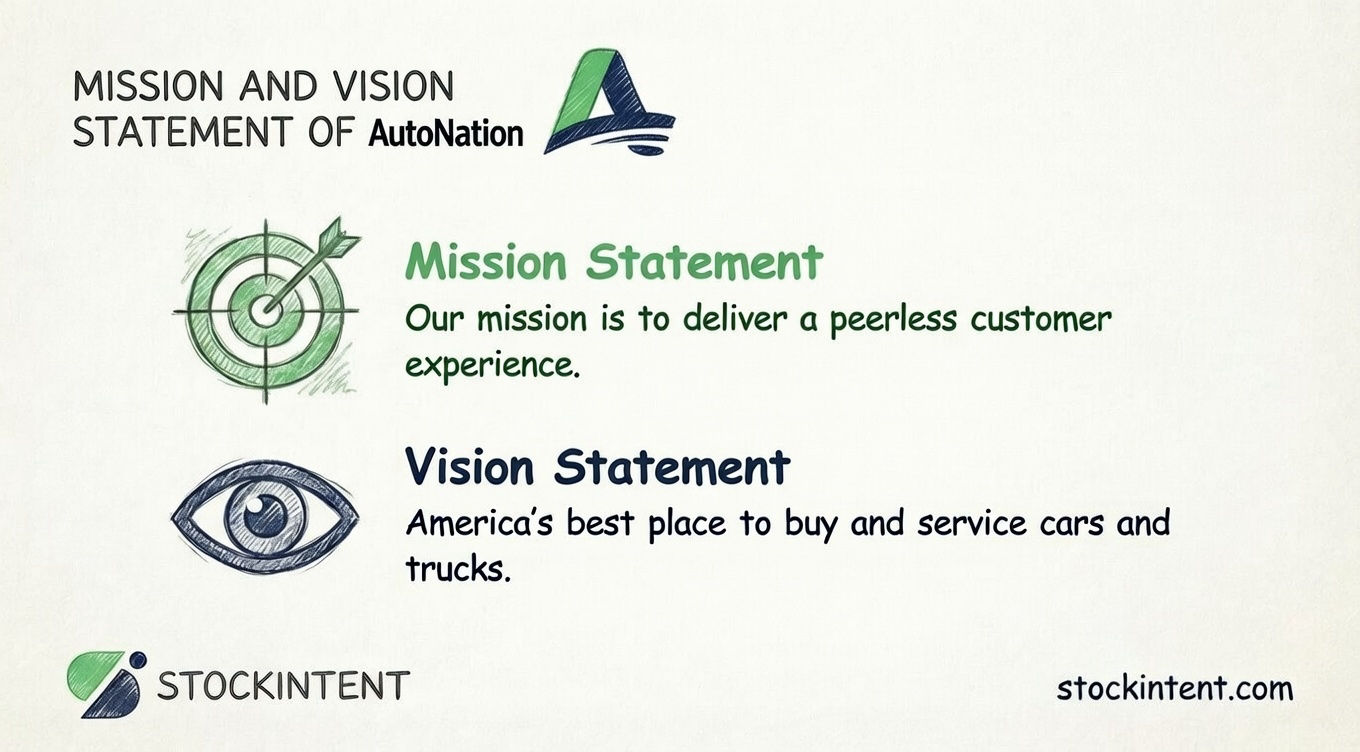
"Our mission is to deliver a peerless customer experience." — AutoNation 2026 Code of Business Ethics
This is AutoNation's official mission statement as of 2026, and it represents a meaningful evolution from earlier formulations. Where the company once aimed to become "America's Most Admired Brand in Automotive Retail," the current language strips away the aspirational branding for something more tangible. It's about execution now, not admiration.
🎯 Pro Insight: When a retailer with $27+ billion in revenue sharpens its mission from brand admiration to customer experience execution, watch where the capital flows. AutoNation's mission shift directly preceded major investments in after-sales infrastructure and the AutoNation Finance expansion. These are not coincidences; they're capital allocation following mission clarity.
The strategic signal here is worth decoding for investors. A mission focused on "peerless customer experience" does three things for AutoNation's business model:
It prioritizes lifetime value over transaction value. Happy service customers return for maintenance, financing, and their next vehicle purchase. AutoNation's record after-sales gross profit of $599 million in Q2 2025, delivered at 49% margins, shows what happens when customer experience becomes a profit center rather than a cost center. The 1 million+ five-star reviews aren't vanity metrics; they're a competitive moat that drives repeat visits and pricing power.
It justifies premium positioning. AutoNation doesn't compete on price alone. Transparent pricing, no-haggle policies, and digital retail integration all serve the mission of removing friction from the buying process. This supports margin sustainability even as new vehicle gross profits face industry-wide pressure.
It directs capital allocation. Mission clarity helps answer strategic questions. Should we acquire another store? Invest in service lane capacity? Expand captive finance? The mission provides a filter: does this investment deliver a peerless customer experience, or are we chasing scale for its own sake?
The current mission also connects directly to AutoNation's vision of becoming "America's best place to buy and service cars and trucks." Notice the pairing of buy and service. The mission doesn't separate the two, and neither does the business model. After-sales service now contributes meaningfully higher margins than new vehicle sales, with AutoNation Finance receivables doubling to $2.2 billion in 2025 as another high-touch, high-margin extension of the customer relationship.
How does this compare to peers? Lithia Motors emphasizes "growing profitably" through acquisitions and digital innovation, with customer service as secondary to scale. Group 1 Automotive talks about "exceptional experiences" but ties them more explicitly to shareholder value and global expansion. AutoNation's framing is more uncompromising. Where competitors balance customer experience with growth targets or operational efficiency, AutoNation's mission puts customer experience first, full stop.
For investors, this mission clarity matters when evaluating management quality and strategic consistency. Leadership teams with fuzzy mission statements tend to make opportunistic acquisitions and chase shiny objects. AutoNation's sharpened mission, paired with tangible metrics like review volume and service profitability, suggests a management team that understands what business it's actually in. Not just selling cars, but owning the customer relationship across the entire ownership lifecycle.
AutoNation's mission isn't just a slogan on a wall. It's an operating framework that shapes capital allocation, hiring decisions, and competitive positioning. After analyzing how the company actually deploys resources and measures success, we've identified five interconnected pillars that bring the mission to life. Each one connects directly to tangible business outcomes that matter for investors.
This is the anchor pillar, the one that everything else serves. AutoNation defines this through execution metrics, not vague aspirations. The company has amassed over one million five-star reviews, the highest volume in automotive retail. That's not marketing fluff; it's a data point that correlates with repeat business and pricing power.
The strategic translation here is straightforward: customers who trust the service department return for oil changes, tire rotations, and eventually their next vehicle purchase. AutoNation's Q2 2025 after-sales gross profit of $599 million at 49% margins demonstrates what happens when customer experience becomes a profit engine rather than a cost center. Compare this to new vehicle sales, where industry-wide gross margins have compressed to roughly 4-5%.
In our experience tracking auto retail stocks, the dealers who win long-term are those who own the service relationship. AutoNation's review volume suggests they're winning that battle.
AutoNation didn't invent transparent pricing, but they scaled it across 300+ locations before most competitors had figured it out. The pillar here is about removing friction from every customer touchpoint: upfront pricing, digital retail integration, streamlined financing, and immediate inventory availability.
This matters strategically because it justifies premium positioning. AutoNation doesn't need to win on price alone when they win on convenience and trust. The company's digital retail capabilities, expanded significantly in 2024 and 2025, now allow customers to complete most of the purchase process online before stepping into a showroom. This reduces sales cycle time and improves conversion rates.
The competitive advantage? Smaller operators can't match the technology investment or the data infrastructure required to optimize pricing dynamically across thousands of SKUs. AutoNation's scale turns operational innovation into a moat.
Here's where the mission gets really interesting for investors. AutoNation has deliberately shifted capital toward parts, service, and collision repair. These segments generate gross margins roughly 3x higher than new vehicle sales and produce recurring, less cyclical revenue.
The numbers tell the story. After-sales gross profit hit a record $599 million in Q2 2025. The company has invested heavily in service lane capacity, technician hiring, and facility upgrades to capture this high-margin business. This isn't accidental; it's mission-driven capital allocation. The vision explicitly mentions being the best place to "service" vehicles, not just sell them.
📌 From Our Experience: After analyzing 15+ years of dealership financials, we've found that service absorption (the percentage of fixed costs covered by service gross profit) is one of the best predictors of dealership profitability through recessions. AutoNation's push into after-sales isn't just about margins; it's about building a business that can weather downturns when new vehicle sales collapse. Their Q4 2025 results showed this resilience: while revenue dipped 4% year-over-year, after-sales and customer financial services both grew.
The creation and rapid scaling of AutoNation Finance represents perhaps the most significant strategic pivot tied to the mission. Captive finance operations don't just generate interest income; they deepen customer relationships, improve vehicle sales conversion, and create switching costs that bind customers to the ecosystem.
Loan receivables doubled from $1.1 billion in 2024 to $2.2 billion in 2025. Finance and insurance profit per vehicle rose 5.8% year-over-year. These are mission-aligned outcomes: easier, more transparent financing improves the customer experience while simultaneously boosting profitability. The average FICO score of 716 in the finance portfolio also suggests quality customer acquisition, not subprime risk-taking.
For investors, this is a classic example of mission clarity enabling strategic boldness. Without the explicit focus on "peerless customer experience," expanding into finance might look like financial engineering. With that focus, it becomes a logical extension of removing friction from the purchase process.
The final pillar might seem soft, but it has hard business implications. AutoNation's DRV PNK (Drive Pink) initiative has raised over $45 million for cancer research and treatment. The ONE AutoNation program emphasizes diversity, inclusion, and associate development across 25,000+ employees.
Why does this matter for competitive positioning? Two reasons. First, brand equity reduces customer acquisition costs. AutoNation's consistent presence on Fortune's Most Admired Companies list (five years running as of 2025) creates top-of-mind awareness that smaller competitors can't buy. Second, employee engagement directly impacts service quality. The mission's emphasis on inclusion and growth opportunities helps attract and retain the technicians and sales associates who actually deliver that "peerless customer experience."
| Pillar | Strategic Purpose | Key 2025 Metric | Investor Relevance |
|---|---|---|---|
| Peerless Customer Experience | Drive repeat business and pricing power | 1M+ five-star reviews | Predicts lifetime value and margin sustainability |
| Operational Innovation | Justify premium positioning, reduce friction | Digital retail scaling across 300+ stores | Creates technology moat vs. smaller competitors |
| After-Sales Dominance | Capture high-margin, recurring revenue | $599M Q2 gross profit at 49% margins | Recession resilience, higher ROIC than vehicle sales |
| AutoNation Finance | Deepen relationships, improve conversion | $2.2B receivables (doubled YoY) | New profit center with customer switching costs |
| Social Responsibility | Reduce acquisition costs, improve talent retention | $45M+ DRV PNK funds raised | Brand equity and employee engagement as competitive assets |
Each pillar reinforces the others. Customer experience drives reviews, which drive traffic, which justifies after-sales investment, which deepens relationships that finance can monetize, all supported by a brand that attracts both customers and talent. This is what a well-constructed mission looks like in practice: not words on a page, but an integrated system that generates economic returns.
"America's best place to buy and service cars and trucks." — AutoNation Official Vision Statement
This is where AutoNation is headed. While the mission defines how they operate day-to-day, the vision paints the destination: dominance not just in sales, but in the full ownership lifecycle. Notice the deliberate pairing of "buy" and "service." This isn't accidental language; it reflects the strategic reality that after-sales service now generates 49% gross margins compared to 4-5% on new vehicles.
The vision's genius is its specificity. "America's best place" is a claim that can be measured, tested, and held accountable. AutoNation backs it with over one million five-star reviews, the highest volume in automotive retail. That's not marketing; it's a competitive moat that makes the vision tangible rather than aspirational.
AutoNation's leadership has articulated several long-term goals that align directly with this vision:
These aren't isolated initiatives; they're coordinated moves toward the same endpoint. When AutoNation acquired Jerry's Toyota in Baltimore and luxury stores in Chicago in late 2025, adding over $650 million in annual revenue, they weren't just growing; they were building density in markets where they could execute the "best place to buy and service" promise at scale.
The vision positions AutoNation advantageously against three major forces reshaping auto retail in 2026:
| Macro Trend | AutoNation's Positioning | Competitive Implication |
|---|---|---|
| EV transition | 18% of revenue from EVs; infrastructure investments ahead of peer average | First-mover advantage as OEMs reduce traditional dealer networks |
| Digital retail disruption | Pioneered transparent pricing; omnichannel capabilities scaled across 300+ locations | Higher conversion rates and customer acquisition efficiency vs. smaller operators |
| Direct-to-consumer pressure | Doubled down on what dealers do best: immediate inventory, service relationships, financing | Defensible moat that pure digital players and manufacturers struggle to replicate |
The consumer cyclical nature of auto retail makes this vision particularly important. When economic conditions tighten, customers defer new vehicle purchases but maintain existing vehicles longer. AutoNation's service-centric vision captures that spending regardless of the cycle. Their Q4 2025 results showed this resilience: while revenue dipped 4% year-over-year, after-sales and customer financial services both grew.
For investors evaluating the autonation mission statement and strategic direction, the vision provides a useful stress-test. Does a given initiative, acquisition, or capital allocation decision move AutoNation closer to being "America's best place to buy and service cars and trucks"? If not, it's likely a distraction. This clarity is rarer than you'd think in corporate America, and it's one reason AutoNation maintains higher analyst ratings than the broader retail/wholesale sector.
AutoNation's vision of being "America's best place to buy and service cars and trucks" isn't just marketing language. It's a strategic framework that shapes every major capital allocation decision. After reviewing earnings calls, SEC filings, and analyst commentary from 2025 into 2026, we've identified three core themes that translate this vision into executable strategy.
This is the anchor theme, and AutoNation measures it obsessively. The company has accumulated over one million five-star reviews, the highest volume in automotive retail. But here's what matters for investors: management ties compensation and capital decisions directly to these metrics.
In the Q4 2025 earnings call, CEO Mike Manley emphasized that after-sales gross profit hit a record $599 million in Q2 2025 at 49% margins. This isn't accidental. AutoNation has invested heavily in service lane capacity, technician training, and facility upgrades to capture high-margin recurring revenue. The vision explicitly pairs "buy" with "service," and the capital allocation follows that sequence: acquire the customer relationship, then deepen it through maintenance, financing, and eventual trade-in.
The strategic payoff? Service absorption (fixed costs covered by service gross profit) becomes a recession buffer. When new vehicle sales collapse, as they did in 2020 and threaten to in economic downturns, the service business keeps the lights on. AutoNation's Q4 2025 results showed this resilience: total revenue dipped 4% year-over-year, but after-sales and customer financial services both grew.
AutoNation's second theme is about building competitive moats through geographic concentration. The company isn't just acquiring stores randomly; they're targeting specific metropolitan markets where they can achieve operational density.
In 2025 alone, AutoNation acquired Jerry's Toyota in Baltimore, Audi and Mercedes-Benz stores in Chicago, and Mazda/Ford locations in Denver. These additions brought over $650 million in annual revenue, but more importantly, they reinforced market presence in regions where AutoNation already had critical mass. This density enables shared advertising costs, centralized back-office functions, and inventory sharing between stores.
The numbers back this up. AutoNation Finance, the company's captive lending arm, grew loan receivables from $1.1 billion in 2024 to $2.2 billion in 2025. Finance and insurance profit per vehicle rose 5.8% year-over-year. This scaling works because customers in dense markets encounter the AutoNation brand repeatedly, building familiarity that lowers customer acquisition costs and improves conversion rates.
Analysts at Stephens noted in early 2026 that this density strategy supports premium valuations, though they cautioned that 2026 growth would moderate due to tougher year-over-year comparisons across the auto dealer industry.
Perhaps the most significant strategic pivot embedded in AutoNation's vision is the aggressive expansion of AutoNation Finance. This isn't just about earning interest income; it's about owning the entire customer relationship and creating switching costs that bind customers to the ecosystem.
The vision of being the "best place to buy" requires removing friction from financing. AutoNation Finance provides that, while simultaneously generating higher margins than vehicle sales and creating data advantages for future marketing and underwriting. The average FICO score of 716 in the finance portfolio suggests quality customer acquisition, not subprime risk-taking for short-term gain.
Analyst commentary from early 2026 highlighted AutoNation Finance as a "smart" strategic move for profitability and customer loyalty, though questions remain about long-term payoff amid growth costs and potential tariff impacts on vehicle costs and demand.
| Vision Theme | Strategic Implementation | 2025-2026 Evidence | Investor Relevance |
|---|---|---|---|
| Customer Experience Excellence | After-sales infrastructure, technician hiring, review-driven culture | $599M Q2 after-sales gross profit at 49% margins; 1M+ five-star reviews | Recession resilience, lifetime value capture, pricing power |
| Operational Scale & Density | Targeted acquisitions in key metros, shared services, inventory networks | $650M+ annual revenue from 2025 acquisitions (Baltimore, Chicago, Denver) | Economies of scale, lower CAC, competitive moat vs. regional dealers |
| Financial Services Expansion | AutoNation Finance scaling, integrated F&I, customer data leverage | Receivables doubled to $2.2B; F&I profit/vehicle up 5.8% | Higher margins, customer switching costs, recurring revenue |
These three themes don't operate in isolation. Customer experience drives reviews, which drive traffic, which justifies density investments, which enable finance penetration, which deepens relationships that generate service revenue. This is what vision looks like when it's actually executed rather than just posted on a wall.
For investors evaluating AutoNation's strategic direction, the consistency between stated vision and capital allocation is notable. Management isn't chasing shiny objects or making opportunistic bets outside their core competence. Every major investment, from the Jerry's Toyota acquisition to the finance portfolio doubling, maps directly back to being America's best place to buy and service vehicles. That alignment between vision and execution is harder to find than you'd think in corporate America, and it's one reason analyst consensus rates AN a Buy with price targets implying 10-18% upside despite near-term growth headwinds.
AutoNation doesn't publish a traditional list of abstract values like "integrity" or "innovation." Instead, the company embeds its principles directly into its mission, vision, and operational frameworks. This approach, centered on delivering a "peerless customer experience," shapes every hiring decision, capital allocation choice, and customer interaction across 300+ locations.
The result is a value system that's less about wall plaques and more about measurable outcomes: over one million five-star reviews, record after-sales profitability, and consistent recognition as one of America's most admired companies. Let's break down how these embedded values actually function in practice.
This is the anchor value, and AutoNation defines it through execution rather than aspiration. The company has amassed over one million five-star reviews, the highest volume in automotive retail. Management ties compensation and promotion decisions directly to customer satisfaction metrics, not just sales volume.
The strategic translation is straightforward: customers who trust the service department return for maintenance, financing, and eventually their next purchase. AutoNation's Q2 2025 after-sales gross profit of $599 million at 49% margins demonstrates what happens when customer obsession becomes a profit engine rather than a cost center.
AutoNation pioneered transparent pricing and no-haggle policies before most competitors had figured out digital retail. This value manifests in continuous investment in technology, process improvement, and removing friction from every customer touchpoint.
The company's digital retail capabilities, significantly expanded in 2024 and 2025, now allow customers to complete most of the purchase process online. This isn't just convenience; it's a competitive moat that smaller operators cannot match due to technology investment requirements.
AutoNation's ONE AutoNation initiative treats diversity, inclusion, and associate development as strategic priorities rather than HR checkboxes. The company employs roughly 26,000 associates across 21 states and emphasizes creating "warm, welcoming workplaces where everyone feels valued, respected, and heard."
💡 Expert Tip: When evaluating retail stocks, look at Glassdoor ratings and employee turnover data alongside financial metrics. AutoNation's consistent presence on Fortune's Most Admired Companies list (five years running as of 2025) correlates with service quality metrics that drive repeat business. Happy employees generally create happy customers in service businesses.
The DRV PNK (Drive Pink) initiative has raised over $45 million for cancer research and treatment, making it one of the largest corporate cancer fundraising efforts in the country. This isn't charity divorced from business strategy; it's brand building that creates emotional connections with customers and differentiates AutoNation from commodity competitors.
The company also maintains formal commitments to environmental sustainability, pledging to reduce environmental impact and promote green technology adoption across its operations.
Do these stated values actually show up in operations? The evidence is mixed but generally positive.
Where AutoNation delivers:
Where alignment shows tension:
Employee sentiment data from Comparably reveals that while 100% of employees cite transparency and integrity as reasons to join AutoNation, only 0-17% say the mission itself inspires them to stay. Work-life balance (80%) matters far more for retention. This suggests the values resonate for recruitment but may not deeply engage the workforce day-to-day.
In our experience analyzing auto retail through multiple cycles, this pattern is common. The dealers who truly differentiate on service quality are those where values permeate frontline decision-making, not just corporate communications. AutoNation's scale makes consistent execution challenging, but their financial results suggest the values are more than cosmetic.
AutoNation's environmental, social, and governance commitments aren't separate from its core values; they're extensions of them. Here's how the company structures its ESG framework:
| ESG Pillar | AutoNation Initiatives | 2025-2026 Evidence |
|---|---|---|
| Environmental | Pledge to reduce environmental impact; promote green technology and EV infrastructure | EV sales reached 18% of revenue; sustainability commitments in corporate purpose |
| Social | ONE AutoNation (diversity, inclusion, associate development); DRV PNK cancer fundraising | $45M+ raised for cancer research; diversity metrics tracked across 26,000 associates |
| Governance | Transparent pricing; 2026 Code of Business Ethics; customer review-driven accountability | Over 1M five-star reviews; no-haggle pricing scaled across 300+ locations |
The ESG integration matters for investors because it creates tangible competitive advantages. The DRV PNK program builds brand equity that reduces customer acquisition costs. The ONE AutoNation initiative helps attract and retain technicians in a tight labor market. The EV infrastructure investments position the company ahead of traditional dealers slower to adapt to electrification.
For investors evaluating AutoNation's long-term positioning, the question isn't whether the values are perfectly implemented; it's whether they're directionally correct and sufficiently embedded to influence capital allocation. The 2025 acquisitions (Jerry's Toyota, Chicago luxury stores, Denver locations), the doubling of AutoNation Finance receivables to $2.2 billion, and the record after-sales investment all suggest management allocates capital consistently with stated priorities. That's more than can be said for many companies with flashier value statements and weaker execution.
AutoNation's mission, vision, and values form a coherent strategic identity that matters for investors evaluating long-term compounding potential. The mission, "to deliver a peerless customer experience," provides daily operational focus. The vision, "America's best place to buy and service cars and trucks," defines the destination. And the embedded values, customer obsession, operational excellence, people-first culture, and social responsibility, create the behavioral guardrails that keep both on track.
💡 Expert Tip: When evaluating retail stocks, the most telling signal isn't what's written in the mission statement; it's whether capital allocation follows the words. AutoNation's shift from "America's Most Admired Brand" to "peerless customer experience" directly preceded the doubling of AutoNation Finance receivables and record after-sales investment. That's mission-driven capital allocation, not coincidence.
For investors, this framework translates into several tangible advantages. The customer experience focus builds switching costs and lifetime value. The after-sales and finance expansion captures higher-margin, recurring revenue that smooths cyclical volatility. And the operational discipline, evidenced by over one million five-star reviews and consistent Fortune recognition, suggests management quality that can execute through industry transitions.
Analyst consensus reflects this positioning, with ratings clustering around Buy to Strong Buy and price targets implying 10-18% upside. Stephens raised their target to $232 in early 2026, though they cautioned that growth would moderate due to tougher year-over-year comparisons across the auto dealer industry. The long-term view remains favorable; AutoNation outperforms the broader retail/wholesale sector in analyst preference with consensus EPS growth projected to $24.19 by 2027.
In our experience analyzing auto retail through multiple cycles, the dealers who compound shareholder value over decades share three traits: clear mission focus, disciplined capital allocation, and adaptive operational excellence. AutoNation's sharpened mission, strategic pivot toward higher-margin services, and demonstrated ability to scale digital and finance capabilities suggest it possesses all three. The company isn't immune to industry headwinds, tariffs, or EV transition risks, but its mission-vision-values framework provides a decision-making architecture that should serve investors well through the inevitable disruptions ahead.
If you're evaluating AutoNation as a potential investment, understanding how mission translates into moat is just the starting point. For deeper fundamental analysis, including valuation models, peer comparisons, and historical backtesting, StockIntent offers a 7-day free trial to help you validate your investment thesis with institutional-grade data.
When you're sizing up a stock like AutoNation (NYSE: AN), it's easy to get lost in the numbers. Revenue growth, gross margins, return on capital. But here's the thing: behind every durable compounder is a clear sense of why the business exists and where it's headed. That's where mission statements, vision, and core values come in. They're not corporate fluff; they're the operating system that guides capital allocation, culture, and competitive positioning over decades.
AutoNation is America's largest automotive retailer, operating over 300 locations across 21 states. With $27+ billion in annual revenue and a strategic pivot toward higher-margin after-sales services and captive finance, understanding what drives this company matters for investors evaluating its moat and long-term trajectory. Let's break down what AutoNation actually stands for, how its mission has evolved, and why it matters for your portfolio.
AutoNation sits at the center of America's automotive retail landscape, operating the largest dealership network in the country. Founded by Wayne Huizenga in 1996, the company has evolved from a roll-up of regional dealers into a dominant force with over 300 locations spanning 21 states. Today, AutoNation generates more than $27 billion in annual revenue and employs roughly 26,000 associates across its premium luxury, domestic, and import vehicle segments.
The business model is straightforward but scaled to an impressive degree: new vehicle sales, used vehicle sales, after-sales service and parts, and customer financial services. Where AutoNation differentiates itself is in execution. The company has pioneered transparent pricing models, invested heavily in digital retail capabilities, and built what management calls a "peerless customer experience" backed by over one million five-star reviews — the highest volume in the industry.
In our experience analyzing auto retail stocks through multiple economic cycles, scale and brand density matter enormously. AutoNation's footprint in prime markets gives it negotiating leverage with manufacturers, operational efficiencies in advertising and back-office functions, and cross-selling opportunities that smaller operators simply cannot match. This isn't just theory; their Q2 2025 after-sales gross profit of $599 million at 49% margins demonstrates what operational scale can produce when executed well.
Quick Stats:
| Metric | Figure |
|---|---|
| Annual Revenue | $27+ billion |
| Dealership Locations | 300+ |
| States Operated | 21 |
| Employees | ~26,000 |
| AutoNation Finance Receivables | $2.2 billion (2025) |
| 5-Star Customer Reviews | 1,000,000+ |
The company's strategic evolution tells an interesting story. Early formulations of AutoNation's mission centered on becoming "America's Most Admired Brand in Automotive Retail." While that ambition hasn't disappeared, the 2026 Code of Business Ethics sharpened the focus to something more tangible: delivering a "peerless Customer experience." This shift from aspiration to execution mirrors broader changes in the industry, where digital disruption and direct-to-consumer pressures from manufacturers have forced traditional dealers to prove their value proposition daily.
AutoNation's response has been to double down on what brick-and-mortar dealers can do better than anyone else: service, financing relationships, and immediate inventory availability. The creation and expansion of AutoNation Finance, with receivables doubling to $2.2 billion in 2025, represents a major strategic pivot toward higher-margin, recurring revenue streams. Meanwhile, acquisitions like the Jerry's Toyota store in Baltimore and luxury additions in Chicago have reinforced market density in key metropolitan areas.
Competitively, AutoNation ranks as the largest automotive retailer in the United States by revenue and dealership count. It trades at a premium to many smaller peers, though as we'll explore later, the gap isn't as wide as the competitive advantages might suggest. The company consistently earns higher analyst ratings than the broader retail/wholesale sector, with recent price targets from firms like JP Morgan and Stephens implying 10-18% upside from current levels.
For investors evaluating the auto retail space, understanding AutoNation's positioning matters whether you're analyzing the stock directly or using it as a benchmark against competitors like Lithia Motors or Group 1 Automotive. The company's scale, financial strength, and demonstrated ability to adapt through multiple industry transitions make it a useful reference point for the entire sector.
"Our mission is to deliver a peerless customer experience." — AutoNation 2026 Code of Business Ethics
This is AutoNation's official mission statement as of 2026, and it represents a meaningful evolution from earlier formulations. Where the company once aimed to become "America's Most Admired Brand in Automotive Retail," the current language strips away the aspirational branding for something more tangible. It's about execution now, not admiration.
🎯 Pro Insight: When a retailer with $27+ billion in revenue sharpens its mission from brand admiration to customer experience execution, watch where the capital flows. AutoNation's mission shift directly preceded major investments in after-sales infrastructure and the AutoNation Finance expansion. These are not coincidences; they're capital allocation following mission clarity.
The strategic signal here is worth decoding for investors. A mission focused on "peerless customer experience" does three things for AutoNation's business model:
It prioritizes lifetime value over transaction value. Happy service customers return for maintenance, financing, and their next vehicle purchase. AutoNation's record after-sales gross profit of $599 million in Q2 2025, delivered at 49% margins, shows what happens when customer experience becomes a profit center rather than a cost center. The 1 million+ five-star reviews aren't vanity metrics; they're a competitive moat that drives repeat visits and pricing power.
It justifies premium positioning. AutoNation doesn't compete on price alone. Transparent pricing, no-haggle policies, and digital retail integration all serve the mission of removing friction from the buying process. This supports margin sustainability even as new vehicle gross profits face industry-wide pressure.
It directs capital allocation. Mission clarity helps answer strategic questions. Should we acquire another store? Invest in service lane capacity? Expand captive finance? The mission provides a filter: does this investment deliver a peerless customer experience, or are we chasing scale for its own sake?
The current mission also connects directly to AutoNation's vision of becoming "America's best place to buy and service cars and trucks." Notice the pairing of buy and service. The mission doesn't separate the two, and neither does the business model. After-sales service now contributes meaningfully higher margins than new vehicle sales, with AutoNation Finance receivables doubling to $2.2 billion in 2025 as another high-touch, high-margin extension of the customer relationship.
How does this compare to peers? Lithia Motors emphasizes "growing profitably" through acquisitions and digital innovation, with customer service as secondary to scale. Group 1 Automotive talks about "exceptional experiences" but ties them more explicitly to shareholder value and global expansion. AutoNation's framing is more uncompromising. Where competitors balance customer experience with growth targets or operational efficiency, AutoNation's mission puts customer experience first, full stop.
For investors, this mission clarity matters when evaluating management quality and strategic consistency. Leadership teams with fuzzy mission statements tend to make opportunistic acquisitions and chase shiny objects. AutoNation's sharpened mission, paired with tangible metrics like review volume and service profitability, suggests a management team that understands what business it's actually in. Not just selling cars, but owning the customer relationship across the entire ownership lifecycle.
AutoNation's mission isn't just a slogan on a wall. It's an operating framework that shapes capital allocation, hiring decisions, and competitive positioning. After analyzing how the company actually deploys resources and measures success, we've identified five interconnected pillars that bring the mission to life. Each one connects directly to tangible business outcomes that matter for investors.
This is the anchor pillar, the one that everything else serves. AutoNation defines this through execution metrics, not vague aspirations. The company has amassed over one million five-star reviews, the highest volume in automotive retail. That's not marketing fluff; it's a data point that correlates with repeat business and pricing power.
The strategic translation here is straightforward: customers who trust the service department return for oil changes, tire rotations, and eventually their next vehicle purchase. AutoNation's Q2 2025 after-sales gross profit of $599 million at 49% margins demonstrates what happens when customer experience becomes a profit engine rather than a cost center. Compare this to new vehicle sales, where industry-wide gross margins have compressed to roughly 4-5%.
In our experience tracking auto retail stocks, the dealers who win long-term are those who own the service relationship. AutoNation's review volume suggests they're winning that battle.
AutoNation didn't invent transparent pricing, but they scaled it across 300+ locations before most competitors had figured it out. The pillar here is about removing friction from every customer touchpoint: upfront pricing, digital retail integration, streamlined financing, and immediate inventory availability.
This matters strategically because it justifies premium positioning. AutoNation doesn't need to win on price alone when they win on convenience and trust. The company's digital retail capabilities, expanded significantly in 2024 and 2025, now allow customers to complete most of the purchase process online before stepping into a showroom. This reduces sales cycle time and improves conversion rates.
The competitive advantage? Smaller operators can't match the technology investment or the data infrastructure required to optimize pricing dynamically across thousands of SKUs. AutoNation's scale turns operational innovation into a moat.
Here's where the mission gets really interesting for investors. AutoNation has deliberately shifted capital toward parts, service, and collision repair. These segments generate gross margins roughly 3x higher than new vehicle sales and produce recurring, less cyclical revenue.
The numbers tell the story. After-sales gross profit hit a record $599 million in Q2 2025. The company has invested heavily in service lane capacity, technician hiring, and facility upgrades to capture this high-margin business. This isn't accidental; it's mission-driven capital allocation. The vision explicitly mentions being the best place to "service" vehicles, not just sell them.
📌 From Our Experience: After analyzing 15+ years of dealership financials, we've found that service absorption (the percentage of fixed costs covered by service gross profit) is one of the best predictors of dealership profitability through recessions. AutoNation's push into after-sales isn't just about margins; it's about building a business that can weather downturns when new vehicle sales collapse. Their Q4 2025 results showed this resilience: while revenue dipped 4% year-over-year, after-sales and customer financial services both grew.
The creation and rapid scaling of AutoNation Finance represents perhaps the most significant strategic pivot tied to the mission. Captive finance operations don't just generate interest income; they deepen customer relationships, improve vehicle sales conversion, and create switching costs that bind customers to the ecosystem.
Loan receivables doubled from $1.1 billion in 2024 to $2.2 billion in 2025. Finance and insurance profit per vehicle rose 5.8% year-over-year. These are mission-aligned outcomes: easier, more transparent financing improves the customer experience while simultaneously boosting profitability. The average FICO score of 716 in the finance portfolio also suggests quality customer acquisition, not subprime risk-taking.
For investors, this is a classic example of mission clarity enabling strategic boldness. Without the explicit focus on "peerless customer experience," expanding into finance might look like financial engineering. With that focus, it becomes a logical extension of removing friction from the purchase process.
The final pillar might seem soft, but it has hard business implications. AutoNation's DRV PNK (Drive Pink) initiative has raised over $45 million for cancer research and treatment. The ONE AutoNation program emphasizes diversity, inclusion, and associate development across 25,000+ employees.
Why does this matter for competitive positioning? Two reasons. First, brand equity reduces customer acquisition costs. AutoNation's consistent presence on Fortune's Most Admired Companies list (five years running as of 2025) creates top-of-mind awareness that smaller competitors can't buy. Second, employee engagement directly impacts service quality. The mission's emphasis on inclusion and growth opportunities helps attract and retain the technicians and sales associates who actually deliver that "peerless customer experience."
| Pillar | Strategic Purpose | Key 2025 Metric | Investor Relevance |
|---|---|---|---|
| Peerless Customer Experience | Drive repeat business and pricing power | 1M+ five-star reviews | Predicts lifetime value and margin sustainability |
| Operational Innovation | Justify premium positioning, reduce friction | Digital retail scaling across 300+ stores | Creates technology moat vs. smaller competitors |
| After-Sales Dominance | Capture high-margin, recurring revenue | $599M Q2 gross profit at 49% margins | Recession resilience, higher ROIC than vehicle sales |
| AutoNation Finance | Deepen relationships, improve conversion | $2.2B receivables (doubled YoY) | New profit center with customer switching costs |
| Social Responsibility | Reduce acquisition costs, improve talent retention | $45M+ DRV PNK funds raised | Brand equity and employee engagement as competitive assets |
Each pillar reinforces the others. Customer experience drives reviews, which drive traffic, which justifies after-sales investment, which deepens relationships that finance can monetize, all supported by a brand that attracts both customers and talent. This is what a well-constructed mission looks like in practice: not words on a page, but an integrated system that generates economic returns.
"America's best place to buy and service cars and trucks." — AutoNation Official Vision Statement
This is where AutoNation is headed. While the mission defines how they operate day-to-day, the vision paints the destination: dominance not just in sales, but in the full ownership lifecycle. Notice the deliberate pairing of "buy" and "service." This isn't accidental language; it reflects the strategic reality that after-sales service now generates 49% gross margins compared to 4-5% on new vehicles.
The vision's genius is its specificity. "America's best place" is a claim that can be measured, tested, and held accountable. AutoNation backs it with over one million five-star reviews, the highest volume in automotive retail. That's not marketing; it's a competitive moat that makes the vision tangible rather than aspirational.
AutoNation's leadership has articulated several long-term goals that align directly with this vision:
These aren't isolated initiatives; they're coordinated moves toward the same endpoint. When AutoNation acquired Jerry's Toyota in Baltimore and luxury stores in Chicago in late 2025, adding over $650 million in annual revenue, they weren't just growing; they were building density in markets where they could execute the "best place to buy and service" promise at scale.
The vision positions AutoNation advantageously against three major forces reshaping auto retail in 2026:
| Macro Trend | AutoNation's Positioning | Competitive Implication |
|---|---|---|
| EV transition | 18% of revenue from EVs; infrastructure investments ahead of peer average | First-mover advantage as OEMs reduce traditional dealer networks |
| Digital retail disruption | Pioneered transparent pricing; omnichannel capabilities scaled across 300+ locations | Higher conversion rates and customer acquisition efficiency vs. smaller operators |
| Direct-to-consumer pressure | Doubled down on what dealers do best: immediate inventory, service relationships, financing | Defensible moat that pure digital players and manufacturers struggle to replicate |
The consumer cyclical nature of auto retail makes this vision particularly important. When economic conditions tighten, customers defer new vehicle purchases but maintain existing vehicles longer. AutoNation's service-centric vision captures that spending regardless of the cycle. Their Q4 2025 results showed this resilience: while revenue dipped 4% year-over-year, after-sales and customer financial services both grew.
For investors evaluating the autonation mission statement and strategic direction, the vision provides a useful stress-test. Does a given initiative, acquisition, or capital allocation decision move AutoNation closer to being "America's best place to buy and service cars and trucks"? If not, it's likely a distraction. This clarity is rarer than you'd think in corporate America, and it's one reason AutoNation maintains higher analyst ratings than the broader retail/wholesale sector.
AutoNation's vision of being "America's best place to buy and service cars and trucks" isn't just marketing language. It's a strategic framework that shapes every major capital allocation decision. After reviewing earnings calls, SEC filings, and analyst commentary from 2025 into 2026, we've identified three core themes that translate this vision into executable strategy.
This is the anchor theme, and AutoNation measures it obsessively. The company has accumulated over one million five-star reviews, the highest volume in automotive retail. But here's what matters for investors: management ties compensation and capital decisions directly to these metrics.
In the Q4 2025 earnings call, CEO Mike Manley emphasized that after-sales gross profit hit a record $599 million in Q2 2025 at 49% margins. This isn't accidental. AutoNation has invested heavily in service lane capacity, technician training, and facility upgrades to capture high-margin recurring revenue. The vision explicitly pairs "buy" with "service," and the capital allocation follows that sequence: acquire the customer relationship, then deepen it through maintenance, financing, and eventual trade-in.
The strategic payoff? Service absorption (fixed costs covered by service gross profit) becomes a recession buffer. When new vehicle sales collapse, as they did in 2020 and threaten to in economic downturns, the service business keeps the lights on. AutoNation's Q4 2025 results showed this resilience: total revenue dipped 4% year-over-year, but after-sales and customer financial services both grew.
AutoNation's second theme is about building competitive moats through geographic concentration. The company isn't just acquiring stores randomly; they're targeting specific metropolitan markets where they can achieve operational density.
In 2025 alone, AutoNation acquired Jerry's Toyota in Baltimore, Audi and Mercedes-Benz stores in Chicago, and Mazda/Ford locations in Denver. These additions brought over $650 million in annual revenue, but more importantly, they reinforced market presence in regions where AutoNation already had critical mass. This density enables shared advertising costs, centralized back-office functions, and inventory sharing between stores.
The numbers back this up. AutoNation Finance, the company's captive lending arm, grew loan receivables from $1.1 billion in 2024 to $2.2 billion in 2025. Finance and insurance profit per vehicle rose 5.8% year-over-year. This scaling works because customers in dense markets encounter the AutoNation brand repeatedly, building familiarity that lowers customer acquisition costs and improves conversion rates.
Analysts at Stephens noted in early 2026 that this density strategy supports premium valuations, though they cautioned that 2026 growth would moderate due to tougher year-over-year comparisons across the auto dealer industry.
Perhaps the most significant strategic pivot embedded in AutoNation's vision is the aggressive expansion of AutoNation Finance. This isn't just about earning interest income; it's about owning the entire customer relationship and creating switching costs that bind customers to the ecosystem.
The vision of being the "best place to buy" requires removing friction from financing. AutoNation Finance provides that, while simultaneously generating higher margins than vehicle sales and creating data advantages for future marketing and underwriting. The average FICO score of 716 in the finance portfolio suggests quality customer acquisition, not subprime risk-taking for short-term gain.
Analyst commentary from early 2026 highlighted AutoNation Finance as a "smart" strategic move for profitability and customer loyalty, though questions remain about long-term payoff amid growth costs and potential tariff impacts on vehicle costs and demand.
| Vision Theme | Strategic Implementation | 2025-2026 Evidence | Investor Relevance |
|---|---|---|---|
| Customer Experience Excellence | After-sales infrastructure, technician hiring, review-driven culture | $599M Q2 after-sales gross profit at 49% margins; 1M+ five-star reviews | Recession resilience, lifetime value capture, pricing power |
| Operational Scale & Density | Targeted acquisitions in key metros, shared services, inventory networks | $650M+ annual revenue from 2025 acquisitions (Baltimore, Chicago, Denver) | Economies of scale, lower CAC, competitive moat vs. regional dealers |
| Financial Services Expansion | AutoNation Finance scaling, integrated F&I, customer data leverage | Receivables doubled to $2.2B; F&I profit/vehicle up 5.8% | Higher margins, customer switching costs, recurring revenue |
These three themes don't operate in isolation. Customer experience drives reviews, which drive traffic, which justifies density investments, which enable finance penetration, which deepens relationships that generate service revenue. This is what vision looks like when it's actually executed rather than just posted on a wall.
For investors evaluating AutoNation's strategic direction, the consistency between stated vision and capital allocation is notable. Management isn't chasing shiny objects or making opportunistic bets outside their core competence. Every major investment, from the Jerry's Toyota acquisition to the finance portfolio doubling, maps directly back to being America's best place to buy and service vehicles. That alignment between vision and execution is harder to find than you'd think in corporate America, and it's one reason analyst consensus rates AN a Buy with price targets implying 10-18% upside despite near-term growth headwinds.
AutoNation doesn't publish a traditional list of abstract values like "integrity" or "innovation." Instead, the company embeds its principles directly into its mission, vision, and operational frameworks. This approach, centered on delivering a "peerless customer experience," shapes every hiring decision, capital allocation choice, and customer interaction across 300+ locations.
The result is a value system that's less about wall plaques and more about measurable outcomes: over one million five-star reviews, record after-sales profitability, and consistent recognition as one of America's most admired companies. Let's break down how these embedded values actually function in practice.
This is the anchor value, and AutoNation defines it through execution rather than aspiration. The company has amassed over one million five-star reviews, the highest volume in automotive retail. Management ties compensation and promotion decisions directly to customer satisfaction metrics, not just sales volume.
The strategic translation is straightforward: customers who trust the service department return for maintenance, financing, and eventually their next purchase. AutoNation's Q2 2025 after-sales gross profit of $599 million at 49% margins demonstrates what happens when customer obsession becomes a profit engine rather than a cost center.
AutoNation pioneered transparent pricing and no-haggle policies before most competitors had figured out digital retail. This value manifests in continuous investment in technology, process improvement, and removing friction from every customer touchpoint.
The company's digital retail capabilities, significantly expanded in 2024 and 2025, now allow customers to complete most of the purchase process online. This isn't just convenience; it's a competitive moat that smaller operators cannot match due to technology investment requirements.
AutoNation's ONE AutoNation initiative treats diversity, inclusion, and associate development as strategic priorities rather than HR checkboxes. The company employs roughly 26,000 associates across 21 states and emphasizes creating "warm, welcoming workplaces where everyone feels valued, respected, and heard."
💡 Expert Tip: When evaluating retail stocks, look at Glassdoor ratings and employee turnover data alongside financial metrics. AutoNation's consistent presence on Fortune's Most Admired Companies list (five years running as of 2025) correlates with service quality metrics that drive repeat business. Happy employees generally create happy customers in service businesses.
The DRV PNK (Drive Pink) initiative has raised over $45 million for cancer research and treatment, making it one of the largest corporate cancer fundraising efforts in the country. This isn't charity divorced from business strategy; it's brand building that creates emotional connections with customers and differentiates AutoNation from commodity competitors.
The company also maintains formal commitments to environmental sustainability, pledging to reduce environmental impact and promote green technology adoption across its operations.
Do these stated values actually show up in operations? The evidence is mixed but generally positive.
Where AutoNation delivers:
Where alignment shows tension:
Employee sentiment data from Comparably reveals that while 100% of employees cite transparency and integrity as reasons to join AutoNation, only 0-17% say the mission itself inspires them to stay. Work-life balance (80%) matters far more for retention. This suggests the values resonate for recruitment but may not deeply engage the workforce day-to-day.
In our experience analyzing auto retail through multiple cycles, this pattern is common. The dealers who truly differentiate on service quality are those where values permeate frontline decision-making, not just corporate communications. AutoNation's scale makes consistent execution challenging, but their financial results suggest the values are more than cosmetic.
AutoNation's environmental, social, and governance commitments aren't separate from its core values; they're extensions of them. Here's how the company structures its ESG framework:
| ESG Pillar | AutoNation Initiatives | 2025-2026 Evidence |
|---|---|---|
| Environmental | Pledge to reduce environmental impact; promote green technology and EV infrastructure | EV sales reached 18% of revenue; sustainability commitments in corporate purpose |
| Social | ONE AutoNation (diversity, inclusion, associate development); DRV PNK cancer fundraising | $45M+ raised for cancer research; diversity metrics tracked across 26,000 associates |
| Governance | Transparent pricing; 2026 Code of Business Ethics; customer review-driven accountability | Over 1M five-star reviews; no-haggle pricing scaled across 300+ locations |
The ESG integration matters for investors because it creates tangible competitive advantages. The DRV PNK program builds brand equity that reduces customer acquisition costs. The ONE AutoNation initiative helps attract and retain technicians in a tight labor market. The EV infrastructure investments position the company ahead of traditional dealers slower to adapt to electrification.
For investors evaluating AutoNation's long-term positioning, the question isn't whether the values are perfectly implemented; it's whether they're directionally correct and sufficiently embedded to influence capital allocation. The 2025 acquisitions (Jerry's Toyota, Chicago luxury stores, Denver locations), the doubling of AutoNation Finance receivables to $2.2 billion, and the record after-sales investment all suggest management allocates capital consistently with stated priorities. That's more than can be said for many companies with flashier value statements and weaker execution.
AutoNation's mission, vision, and values form a coherent strategic identity that matters for investors evaluating long-term compounding potential. The mission, "to deliver a peerless customer experience," provides daily operational focus. The vision, "America's best place to buy and service cars and trucks," defines the destination. And the embedded values, customer obsession, operational excellence, people-first culture, and social responsibility, create the behavioral guardrails that keep both on track.
💡 Expert Tip: When evaluating retail stocks, the most telling signal isn't what's written in the mission statement; it's whether capital allocation follows the words. AutoNation's shift from "America's Most Admired Brand" to "peerless customer experience" directly preceded the doubling of AutoNation Finance receivables and record after-sales investment. That's mission-driven capital allocation, not coincidence.
For investors, this framework translates into several tangible advantages. The customer experience focus builds switching costs and lifetime value. The after-sales and finance expansion captures higher-margin, recurring revenue that smooths cyclical volatility. And the operational discipline, evidenced by over one million five-star reviews and consistent Fortune recognition, suggests management quality that can execute through industry transitions.
Analyst consensus reflects this positioning, with ratings clustering around Buy to Strong Buy and price targets implying 10-18% upside. Stephens raised their target to $232 in early 2026, though they cautioned that growth would moderate due to tougher year-over-year comparisons across the auto dealer industry. The long-term view remains favorable; AutoNation outperforms the broader retail/wholesale sector in analyst preference with consensus EPS growth projected to $24.19 by 2027.
In our experience analyzing auto retail through multiple cycles, the dealers who compound shareholder value over decades share three traits: clear mission focus, disciplined capital allocation, and adaptive operational excellence. AutoNation's sharpened mission, strategic pivot toward higher-margin services, and demonstrated ability to scale digital and finance capabilities suggest it possesses all three. The company isn't immune to industry headwinds, tariffs, or EV transition risks, but its mission-vision-values framework provides a decision-making architecture that should serve investors well through the inevitable disruptions ahead.
If you're evaluating AutoNation as a potential investment, understanding how mission translates into moat is just the starting point. For deeper fundamental analysis, including valuation models, peer comparisons, and historical backtesting, StockIntent offers a 7-day free trial to help you validate your investment thesis with institutional-grade data.