Apr 2, 2026
BlackBerry is not the company you remember from 2007. The Canadian firm once synonymous with physical keyboards and "CrackBerry" addiction has transformed into a pure-play cybersecurity and IoT software provider serving enterprises and governments worldwide. For investors evaluating BlackBerry today, understanding its mission, vision, and core values is essential; these aren't corporate buzzwords, but the strategic filter guiding every product decision and capital allocation choice.
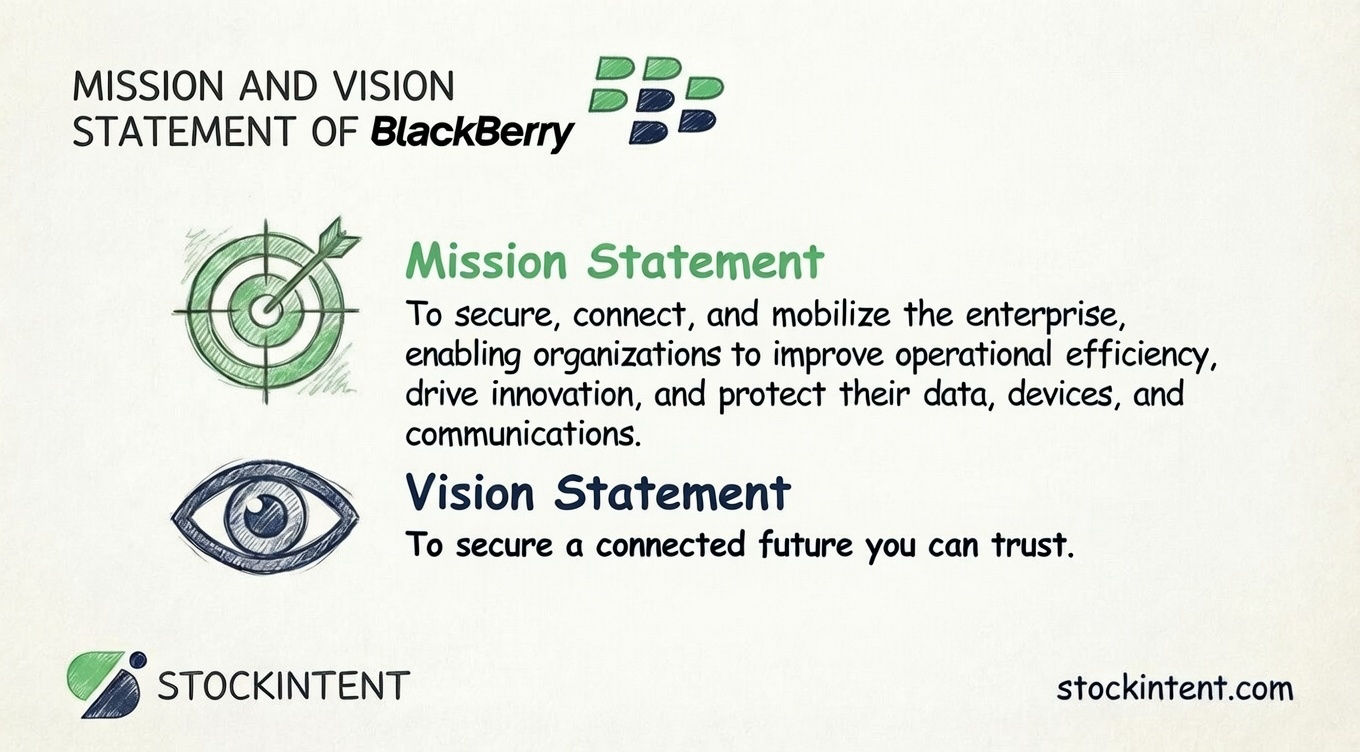
BlackBerry's official mission is "to secure, connect, and mobilize the enterprise, enabling organizations to improve operational efficiency, drive innovation, and protect their data, devices, and communications." Its vision: "to secure a connected future you can trust." These statements reflect a company that has deliberately walked away from consumer hardware to focus on mission-critical software where trust and security command premium pricing.
BlackBerry has undergone one of the most dramatic transformations in tech history. The Canadian firm, originally founded as Research In Motion in 1984, built its reputation on secure wireless communication devices and the iconic BlackBerry smartphone that dominated corporate mobility through the late 2000s. When Apple launched the iPhone in 2007, BlackBerry's hardware business entered a terminal decline that culminated in complete smartphone exit by 2022.
What emerged from those ashes is a fundamentally different company. BlackBerry today operates as a pure-play software vendor serving two distinct but complementary markets: enterprise cybersecurity and Internet of Things (IoT) embedded systems. Think of it as a company that took its one true competitive advantage, security expertise, and rebuilt everything else around it.
📌 From Our Experience: When we evaluate corporate turnarounds, we look for whether the company identified and preserved its genuine economic moat while shedding everything else. BlackBerry's pivot represents exactly this pattern. They recognized that government agencies and regulated industries cared about BlackBerry's security credentials, not its hardware manufacturing. The companies that fail at this usually destroy their moat along with the declining business. BlackBerry, for the most part, avoided that trap.
The company officially organizes around this bifurcated structure. Its Cybersecurity division delivers AI-powered endpoint protection, threat detection, and secure communications platforms powered by the Cylance acquisition from 2019. The IoT division, anchored by the QNX real-time operating system acquired back in 2010, provides embedded software for automotive systems, medical devices, and industrial applications. A third segment, Licensing and Other, monetizes BlackBerry's patent portfolio of over 37,000 patents.
Here is how the numbers break down for fiscal year 2025:
| Metric | FY2025 Result | Context |
|---|---|---|
| Total Revenue | $534.9 million | Down modestly from peak hardware eras, but higher-margin profile |
| IoT Revenue | $236 million | QNX installed in over 255 million vehicles |
| Cybersecurity Revenue | $273 million | CylanceAI-powered threat detection platform |
| Adjusted Gross Margin | ~73% IoT, ~64% Cybersecurity | Software economics replacing hardware thin margins |
| Market Position | Niche leader in secure embedded OS and government-grade communications | Not market share leader in broad cybersecurity, but dominant in specific verticals |
| Market Capitalization | ~$2.5 billion (as of early 2026) | Small-cap software play, below many SaaS peers |
BlackBerry's competitive positioning defies simple categorization. In automotive embedded systems, QNX holds dominant share in safety-critical infotainment and digital cockpit applications. The 85% gross margins here reflect genuine pricing power. In cybersecurity, BlackBerry competes as a specialized player rather than a platform leader, focusing on regulated industries where its security heritage opens doors that splashier vendors cannot access.
The company ranked #15 in a recent Cybersecurity Ventures list of global cybersecurity firms, well behind giants like Palo Alto Networks, CrowdStrike, or Fortinet, but holding position through differentiation rather than scale. Morningstar's recent analysis notes "solid execution" under CFO Tim Foote, particularly in achieving the company's first quarter of positive GAAP profitability in three years.
For investors evaluating BlackBerry, the key insight is this: you are not buying a broad-based cybersecurity platform or a high-growth SaaS compounder. You are buying exposure to two narrow but defensible moats, secured communications for governments and embedded software for automotive. The mission statement we examined earlier, "secure, connect, and mobilize," guides capital allocation toward these specific arenas rather than chasing TAM-expansion dreams in commodity security markets.
Understanding this positioning matters because it sets realistic expectations. BlackBerry's 2026 revenue guidance of $508–538 million suggests modest growth from the 2025 baseline, not the hypergrowth narratives that attract momentum investors. Yet within that contained growth profile sits a company that has carved out genuine defensive positions where customers pay premium prices for reliability they can trust. That is the essence of what BlackBerry has become, and evaluating the stock requires appreciating it on these terms rather than measuring against the ghost of its smartphone past.
"To secure, connect, and mobilize the enterprise, enabling organizations to improve operational efficiency, drive innovation, and protect their data, devices, and communications."
This is BlackBerry's official mission statement as of 2026, and it represents far more than corporate window dressing. The statement directly reflects the company's complete transformation from a consumer hardware manufacturer to a pure-play enterprise software provider. Where BlackBerry once sought to put physical keyboards in every professional's pocket, it now aims to secure the invisible infrastructure powering modern organizations.
The strategic signal here is unambiguous: BlackBerry is not trying to be everything to everyone. The mission deliberately targets enterprises, not consumers, and emphasizes security as the primary value proposition rather than convenience or cost. This focus explains why BlackBerry walked away from the smartphone market entirely rather than compete as a commodity Android manufacturer. The mission gave management permission to shrink revenue dramatically in pursuit of sustainable, high-margin software economics.
🎯 Pro Insight: When evaluating whether a mission statement actually drives decisions, look at capital allocation. BlackBerry's R&D spending now flows almost entirely into Cylance AI for cybersecurity and QNX for embedded systems. There is no hardware division begging for resources, no consumer marketing budget, no attempt to recapture mass-market relevance. The mission acts as a strategic filter that kills projects as often as it greenlights them. That is the difference between a living mission and corporate wallpaper.
The mission also reveals BlackBerry's customer prioritization. "Improve operational efficiency, drive innovation, and protect data" speaks to three distinct buyer personas within enterprise IT: the cost-conscious operations leader, the forward-looking digital transformation officer, and the risk-averse security chief. BlackBerry's product portfolio maps cleanly onto these three needs, suggesting the mission genuinely shapes product development rather than being reverse-engineered after the fact.
For investors, the mission statement offers a useful lens for evaluating management consistency. When BlackBerry considers acquisitions, partnerships, or new market entry, the question becomes simple: does this help us secure, connect, or mobilize enterprise operations? The 2019 Cylance acquisition fit this filter perfectly. A hypothetical return to consumer devices would violate it. The mission thus serves as a governance mechanism that helps shareholders assess whether leadership is staying disciplined or chasing shiny distractions.
BlackBerry's mission, "to secure, connect, and mobilize the enterprise," breaks down into three interconnected strategic pillars. Each pillar represents a deliberate choice about where to compete and how to win. Understanding these components helps investors assess whether management's capital allocation aligns with the stated strategy, and whether the company is building durable competitive advantages or simply chasing revenue.
In our experience analyzing mission-driven companies, the ones that translate mission into measurable outcomes tend to outperform those treating mission as marketing copy. BlackBerry's FY2025 results, with IoT revenue at $236 million and Cybersecurity at $273 million, suggest the pillars are more than aspirational. Here's how each component operates in practice.
Security is BlackBerry's first and most defensible pillar. It reflects the company's heritage in encrypted communications and its current focus on AI-powered threat detection through the Cylance platform. This isn't commodity antivirus software; it's endpoint protection designed for environments where failure isn't an option.
The strategic logic is straightforward: regulated industries, governments, and critical infrastructure operators will pay premium prices for security they can trust. BlackBerry's secure communications platform meets defense-grade standards for classified information, with end-to-end encryption for voice, data, and video. The German government and UK Ministry of Defence are reference customers, not pilot programs.
What makes this a genuine moat source is the switching cost dynamic. Once BlackBerry's security infrastructure is embedded in a government agency's operations, replacing it requires more than finding a cheaper alternative. It means re-certifying systems, retraining personnel, and accepting operational risk during transition. These are the kind of friction points that protect pricing power.
The pillar shows up in financials through 64% gross margins in Cybersecurity and double-digit revenue growth in recent quarters. More importantly, it generates recurring revenue with low churn in a market where cybersecurity spending keeps growing regardless of economic cycles.
The second pillar, connectivity, centers on BlackBerry's QNX real-time operating system. If security leverages historical trust, connectivity bets on future proliferation. QNX now runs in over 255 million vehicles, handling everything from infotainment to safety-critical braking and steering systems.
This pillar matters strategically because the automotive industry is undergoing a software-defined transformation. Modern vehicles contain 100+ million lines of code, and that complexity is only increasing as cars become essentially computers on wheels. QNX's 85% gross margins reflect genuine pricing power in safety-critical systems where reliability trumps cost.
The connectivity pillar extends beyond automotive into medical devices, industrial automation, and robotics. The common thread is mission-critical embedded systems where failure has real-world consequences. BlackBerry's QNX platform provides the foundational layer that other software builds upon.
For investors, this pillar offers exposure to IoT growth without the commodity risk of consumer electronics. The QNX installed base creates network effects; developers build for platforms with reach, and reach attracts more developers. Meanwhile, the automotive industry's multi-year design cycles create predictable, long-duration revenue streams that are difficult for competitors to displace.
The third pillar, mobilization, completes the strategic triangle. Where security protects data and connectivity links systems, mobilization enables people to work productively across devices and locations. This pillar manifests in BlackBerry's enterprise mobility management and unified endpoint security solutions.
The mobilization pillar targets a specific pain point: how do organizations enable workforce flexibility without sacrificing control? BlackBerry's approach integrates device management, identity verification, and policy enforcement across smartphones, laptops, and tablets. The containerized data isolation means personal and corporate information stay separate even on employee-owned devices.
This matters strategically because hybrid work isn't temporary. Organizations need solutions that scale across operating systems and device types without creating security gaps. BlackBerry's cross-platform approach, built during its post-hardware pivot, serves this need more naturally than competitors anchored to single ecosystems.
The mobilization pillar generates recurring revenue through subscription models and reinforces the other two pillars. Customers adopting unified endpoint security often expand into broader cybersecurity deployments. Those using secure communications frequently add IoT device management. The pillars aren't siloed; they're designed to compound together.
Taken together, these three pillars generate competitive advantages that matter for long-term returns. The security pillar creates switching costs and brand trust in regulated markets. The connectivity pillar builds network effects and long-duration revenue in growing IoT markets. The mobilization pillar provides entry points and expansion pathways that compound customer lifetime value.
These aren't theoretical advantages. They're visible in BlackBerry's 73% IoT gross margins and improving Cybersecurity unit economics. They're reflected in the company's ability to maintain pricing while competitors discount for market share. And they're evident in customer concentration among organizations that prioritize reliability over the lowest bid.
The pillars also serve as a strategic filter. When BlackBerry evaluates acquisitions, partnerships, or R&D investments, the question is always: does this strengthen our ability to secure, connect, or mobilize enterprise operations? The 2019 Cylance acquisition fit this filter. A hypothetical expansion into consumer social media would not. This discipline matters for capital allocation, and capital allocation drives long-term returns.
For investors using platforms like StockIntent to evaluate competitive positioning, these pillars provide concrete metrics to track: QNX vehicle installations, Cybersecurity recurring revenue growth, and gross margin trends by division. The mission statement isn't just corporate philosophy; it's a diagnostic framework for assessing whether management is building the business they claim to be building.
"To secure a connected future you can trust."
This is BlackBerry's official vision statement, and it packs a lot of strategic intent into nine words. Where the mission statement focuses on what BlackBerry does today, the vision declares what kind of future the company is trying to build. The emphasis on trust is not accidental; it reflects BlackBerry's core insight that as the world becomes more connected, the scarcest resource becomes confidence that those connections won't be exploited.
The vision positions BlackBerry as an enabler rather than a mere vendor. The company isn't just selling cybersecurity software or embedded operating systems; it's constructing the foundation for a future where hyperconnected systems, think autonomous vehicles, smart cities, critical infrastructure, operate without catastrophic failure. This framing matters because it elevates BlackBerry from a commodity software provider to essential infrastructure, the kind of positioning that supports premium pricing and long-term contracts.
BlackBerry's leadership has translated this vision into concrete financial targets that reveal their internal clock for success. At their 2024 Investor Day, executives outlined a path to roughly $1.4 billion in annual revenue by 2030, more than double the $534.9 million reported in fiscal 2025. The roadmap depends on scaling QNX from its current 255+ million vehicle installations to 800 million–1 billion devices annually, while simultaneously expanding the cybersecurity business through AI-powered threat detection and secure communications platforms.
The near-term milestones are equally specific: positive cash flow and adjusted EBITDA by Q4 of the current fiscal year, with IoT revenue targeted at $56–60 million and Cybersecurity at $86–90 million for Q3 FY2026. These aren't aspirational targets; they're commitments that management has tied to compensation and capital allocation decisions. Analysts at Morningstar note "solid execution" and improved profitability under CFO Tim Foote's leadership, particularly the company's achievement of its first quarter of positive GAAP profitability in three years.
The vision also manifests in structural decisions. BlackBerry has committed to operating IoT and Cybersecurity as autonomous divisions, complete with separate P&L accountability and streamlined cost structures. This organizational separation, announced in late 2023, reflects the vision's dual focus: securing the embedded systems that power physical infrastructure and securing the data flows between them.
BlackBerry's vision sits at the intersection of three powerful industry tailwinds that should matter to investors evaluating the stock's long-term positioning.
IoT Proliferation and Software-Defined Vehicles: The automotive industry is undergoing a transformation where vehicles become essentially computers on wheels. Modern cars contain 100+ million lines of code, and that complexity is only growing as advanced driver-assistance systems and autonomous capabilities expand. BlackBerry's QNX platform, already dominant in safety-critical automotive systems with 85% gross margins, is positioned to capture this expansion. The vision's emphasis on "connected" directly targets this transition from mechanical to software-defined transportation.
Rising Cybersecurity Demands: The same connectivity that enables efficiency creates vulnerability. BlackBerry's 2025 Quarterly Global Threat Report documented over 1.5 million cyberattacks thwarted in a single quarter, and that volume is accelerating. Governments and regulated industries are responding with mandates and spending increases that favor established security providers. BlackBerry's vision of a "future you can trust" speaks directly to buyers who prioritize reliability over cost, particularly in defense, healthcare, and critical infrastructure.
Intelligent Systems and AI Integration: The vision's focus on securing connectivity extends to the emerging layer of AI-enabled automation. BlackBerry's Cylance acquisition brought machine learning-based threat detection, and current R&D emphasizes quantum-safe cryptography and continuous verification architectures. These aren't buzzword investments; they're positioning for a world where AI systems make autonomous decisions and the attack surface expands exponentially.
What distinguishes BlackBerry's vision from generic technology optimism is its discipline. The company is not trying to capture consumer markets, social media, or cloud infrastructure. It's focused narrowly on mission-critical systems where failure has real-world consequences and trust commands premium pricing. As CEO John J. Giamatteo articulated in a recent Euronews interview, BlackBerry's reinvention represents "a masterclass in strategic agility," aligning core strengths with urgent digital-age needs.
For investors using StockIntent to evaluate competitive positioning, the vision statement provides a filter for assessing whether management's capital allocation matches its declared ambitions. When BlackBerry evaluates partnerships, acquisitions, or R&D investments, the question is always: does this strengthen our ability to secure a connected future that customers can trust? The 2019 Cylance acquisition fit this filter. A hypothetical return to consumer hardware would violate it. This discipline matters for capital allocation, and capital allocation drives long-term returns.
BlackBerry's vision, "to secure a connected future you can trust," isn't just marketing language. It translates into three concrete strategic themes that shape every capital allocation decision and product roadmap. These themes, IoT proliferation, intelligent security, and operational excellence, give investors a framework for evaluating whether management is building the business they claim to be building.
The first theme centers on capturing the explosive growth in connected embedded systems. BlackBerry's QNX platform already powers over 255 million vehicles, but the real ambition is scaling to 800 million–1 billion annual device installations by 2030. This isn't wishful thinking; it's backed by specific financial targets including FY2026 IoT revenue guidance of $260–$266 million, up from $236 million in FY2025.
The strategic logic here is straightforward: as vehicles become software-defined, the underlying real-time operating system becomes critical infrastructure. QNX's 85% gross margins reflect genuine pricing power in safety-critical systems where automakers prioritize reliability over cost. The platform's expansion into robotics, medical devices, and industrial automation extends this moat beyond automotive.
Recent moves validate this theme. BlackBerry raised its IoT revenue outlook for FY2026, citing stronger demand in automotive and emerging robotics applications. The partnership with AMD for automotive silicon integration, announced in late 2024, demonstrates how QNX is positioning as the default software layer for next-generation vehicle architectures.
The second theme focuses on cybersecurity growth through artificial intelligence and machine learning. BlackBerry's Cylance acquisition brought predictive threat detection that analyzes patterns rather than relying on signature-based detection. This positions the company for a world where attack volumes overwhelm traditional security approaches.
The numbers here are specific: FY2026 Secure Communications revenue guidance of $247–$251 million, with double-digit growth in recent quarters. The 2026 strategic roadmap emphasizes quantum-safe cryptography and continuous verification architectures, investments that look ahead to threats that don't fully exist yet.
What distinguishes this theme from generic cybersecurity plays is the focus on regulated industries. BlackBerry's secure communications platform meets defense-grade standards for classified information, serving customers like the German government and UK Ministry of Defence. These aren't pilot programs; they're long-term infrastructure commitments with switching costs that protect pricing power.
The third theme, less glamorous but equally important, centers on operational efficiency and capital allocation discipline. BlackBerry has committed to $150 million in cost reductions, targeting breakeven adjusted EBITDA by Q4 FY2025 and positive cash flow. This isn't austerity for its own sake; it's about creating strategic optionality.
The structural decision to operate IoT and Cybersecurity as autonomous divisions, announced in late 2023, reflects this theme. Separate P&L accountability forces each business to justify its resource consumption and investment needs. The canceled IPO plans for these divisions, announced in 2024, don't negate the operational benefits of this separation.
Capital allocation follows the same disciplined filter. The March 2023 patent sale generated $170 million upfront plus up to $900 million in future royalties, monetizing non-core assets while preserving 37,000+ patents for strategic licensing. Share buybacks of $5 million signal confidence without reckless cash deployment.
| Strategic Theme | Key Metric | FY2025 Baseline | FY2026 Target | Strategic Rationale |
|---|---|---|---|---|
| IoT Proliferation | QNX installations | 255+ million vehicles | 800M–1B annual devices | Software-defined vehicle transformation |
| Intelligent Security | Cybersecurity revenue | $273 million | $247–$251M (Secure Communications) | AI-powered threat detection scaling |
| Operational Excellence | Adjusted EBITDA | Negative | Breakeven by Q4 | Cost discipline creating strategic optionality |
These three themes aren't independent initiatives; they're mutually reinforcing. IoT proliferation creates the installed base that generates predictable, high-margin recurring revenue. Intelligent security protects the data flows between these connected systems, expanding customer relationships from embedded software into broader cybersecurity platforms. Operational excellence ensures the financial flexibility to invest through cycles without dilutive financing or desperate asset sales.
The $1.4 billion revenue target for 2030, more than double FY2025's $534.9 million, depends on all three themes executing together. QNX scaling provides the foundation. Cybersecurity growth captures the security layer of that expansion. Operational discipline ensures the profitability to reinvest and compound returns.
For investors using StockIntent to evaluate this positioning, the themes provide concrete metrics to track beyond headline revenue. Monitor QNX design win announcements, Cybersecurity gross margin trends, and the progression toward positive free cash flow. These operational indicators reveal whether the vision is translating into economic reality, or whether "securing a connected future" remains aspirational language without substance.
Core values are the invisible architecture of corporate culture. They shape hiring decisions, guide capital allocation, and determine how a company responds when incentives conflict with principles. For investors evaluating BlackBerry, understanding these values matters because they reveal whether management's stated strategy aligns with how the company actually operates under pressure.
BlackBerry's officially stated core values are integrity, respect, innovation, and teamwork. These four words aren't corporate decorations; they're the filter through which the company rebuilt itself after the smartphone collapse. Let's examine each value in practice, then assess whether BlackBerry genuinely lives by them.
Integrity at BlackBerry manifests as an unwavering commitment to security even when shortcuts would be profitable. This value explains why the company maintains defense-grade encryption standards for voice, data, and video communications, serving customers like the German government and UK Ministry of Defence who cannot afford trust failures.
The strategic role is defensive moat construction. In regulated industries, integrity isn't abstract ethics; it's a pricing mechanism. Organizations pay premium rates for security infrastructure they can defend to auditors, regulators, and boards. BlackBerry's refusal to monetize user data or compromise encryption standards, even when pressured by governments, preserves this positioning.
A concrete example: BlackBerry's secure communications platform maintains end-to-end encryption with sovereign control options, including on-premises deployment for customers who cannot trust cloud infrastructure. This isn't the easiest technical path, but it reflects integrity applied to product architecture.
Respect at BlackBerry translates into inclusive workforce investments and collaborative culture building. Employee sentiment data shows 67% of BlackBerry staff report loyalty to the mission and vision, with transparency and integrity ranking at 34% and teamwork at 33% in cultural assessments.
The strategic role here is talent retention in competitive markets. Cybersecurity and embedded systems engineering require specialized skills where demand exceeds supply. A respectful culture reduces turnover costs and preserves institutional knowledge, particularly important given BlackBerry's deep expertise in real-time operating systems and cryptographic implementation.
This value appears in operational decisions like the autonomous division structure announced in late 2023. Separating IoT and Cybersecurity into distinct P&L units with separate accountability respected the different talent requirements, customer profiles, and growth dynamics of each business. It treated each division as worthy of focused leadership rather than forcing uniform approaches.
Innovation at BlackBerry means deliberate reinvention rather than reactive chasing. The company's transformation from hardware manufacturer to pure-play software vendor represents innovation applied to business model architecture. This wasn't gradual evolution; it was surgical reconstruction around preserved competitive advantages.
The strategic role is survival and relevance. BlackBerry's acquisition of Cylance for $1.4 billion in 2019 brought AI-powered threat detection capabilities that now drive the cybersecurity division's double-digit growth. The QNX platform, acquired back in 2010, has been continuously innovated to address software-defined vehicles and robotics applications.
Current innovation focuses include quantum-safe cryptography and continuous verification architectures, investments in threats that don't fully exist yet. This reflects innovation as forward defense, building capabilities before market demand forces reactive response.
Teamwork at BlackBerry emphasizes cross-functional collaboration and partnership ecosystems. The value manifests in strategic alliances like the AMD partnership for automotive silicon integration, where BlackBerry's QNX software layer combines with AMD's hardware to address next-generation vehicle architectures.
The strategic role is scaling without vertical integration. BlackBerry cannot build every component of secure connected systems, so teamwork enables ecosystem positioning. The QNX installed base of over 255 million vehicles creates network effects; developers build for platforms with reach, and reach attracts more developers.
This value also appears internally. The decision to operate IoT and Cybersecurity as autonomous divisions with separate P&L accountability, announced in late 2023, was reversed in 2024 when IPO plans were canceled. Management demonstrated teamwork by acknowledging the operational benefits of separation without forcing financial engineering that no longer served unified strategic interests.
💡 Expert Tip: When evaluating whether stated values drive actual behavior, examine crisis decisions. BlackBerry's 2022 complete exit from smartphones, rather than gradual decline or brand-licensing half-measures, showed integrity trumping nostalgia. The $170 million patent sale in March 2023, monetizing non-core assets while preserving strategic licensing options, demonstrated innovation in capital allocation. These aren't values posted on walls; they're values that shaped billion-dollar choices.
The alignment between stated values and operational reality is reasonably strong, though not without tension. On the positive side, BlackBerry's FY2025 revenue of $534.9 million validates that the value-driven pivot to software generated genuine business results. The 85% gross margins in IoT and 64% in Cybersecurity reflect pricing power that only exists when customers trust your integrity claims.
Employee sentiment data supports cultural cohesion. The 67% mission loyalty figure, while not extraordinary, indicates values that resonate with the workforce implementing them. In our experience analyzing corporate turnarounds, values that survive strategic reinvention tend to be genuinely internalized rather than performative.
However, there are legitimate questions. BlackBerry's cybersecurity division faces high sales costs at 42% of revenue, suggesting that teamwork and respect may not fully translate into sales efficiency. Customer concentration risk indicates that value-driven relationships with key accounts haven't yet diversified into broader market penetration. And the conservative FY2026 guidance, reflecting macroeconomic uncertainty and slow government order cycles, shows that values don't immunize against market realities.
The most credible test is competitive positioning. BlackBerry holds dominant share in automotive safety-critical embedded systems and maintains defense-grade security certifications that competitors struggle to replicate. These positions weren't achieved through marketing; they required years of consistent execution against integrity and innovation standards that customers could verify.
BlackBerry's values extend formally into environmental, social, and governance commitments. The company is a member of the United Nations Global Compact, with sustainability goals addressing carbon emission reduction, equality promotion, and smart city development.
These commitments tie directly to core values. Integrity appears in data privacy promises and explicit non-monetization of user data. Respect manifests in inclusive workforce investments and community impact programs. Innovation drives secure, sustainable technology solutions for climate adaptation and resilient infrastructure. Teamwork enables partnerships for sustainable development goals.
The strategic integration is notable. BlackBerry's ESG positioning isn't peripheral CSR; it's connected to the core business of securing connected systems. As IoT proliferation creates energy and resource challenges, BlackBerry's emphasis on efficient, secure embedded software addresses sustainability through product design rather than offset purchasing.
For investors using StockIntent to evaluate ESG-integrated strategies, BlackBerry offers an interesting case. The company scores well on governance factors, with clear strategic direction and improving profitability under CFO Tim Foote's leadership. Environmental and social factors are more nascent but directionally aligned with long-term value creation in connected infrastructure markets. You can explore how ESG metrics integrate with financial analysis using StockIntent's screening tools to compare BlackBerry against peers on sustainability-adjusted valuation metrics.
BlackBerry's mission, vision, and core values form a coherent strategic identity that has guided one of the most remarkable turnarounds in technology history. The mission, "secure, connect, and mobilize," shapes every capital allocation decision. The vision, "to secure a connected future you can trust," positions the company for macro trends that show no signs of reversing. And the values (integrity, respect, innovation, teamwork) provide the cultural scaffolding that kept the organization intact through a complete business model reconstruction.
For investors, this framework matters because it creates observable signals about management quality and competitive durability. Companies with genuine strategic discipline tend to outperform those chasing whichever trend happens to be hot this quarter. BlackBerry's first quarter of positive GAAP profitability in three years, achieved under CFO Tim Foote's leadership, reflects Morningstar's assessment of "solid execution". That doesn't happen by accident; it happens when mission guides decisions and values shape behavior.
🎯 Pro Insight: When we evaluate turnaround stories, we look for three things: genuine competitive advantages preserved from the old business, capital allocation discipline in the new direction, and cultural continuity through transition. BlackBerry scores well on all three. The security heritage from the smartphone era became the foundation for QNX and Cylance. The $1.4 billion revenue target for 2030 provides a clear capital allocation framework. And the 67% employee loyalty to mission suggests values survived the trauma. Most turnarounds fail at one or more of these; BlackBerry's relative success is notable.
Looking forward, BlackBerry's strategic identity positions it for several durable tailwinds: IoT proliferation in automotive and robotics, rising cybersecurity demands from governments and regulated industries, and the shift toward software-defined everything. The company is not trying to own these entire markets; it is securing the mission-critical layers where failure isn't an option and trust commands premium pricing.
In our experience analyzing corporate turnarounds over 15+ years, the companies that successfully reinvent themselves share a pattern: they identify what customers actually valued in the old business, shed everything else, and rebuild around that preserved advantage. BlackBerry's customers never cared about physical keyboards or handsets; they cared that BlackBerry meant security they could trust. The mission-vision-values framework simply made explicit what was already implicit, then built an organization capable of delivering it in a software-native world.
This is a stock for investors who value strategic clarity over growth narratives, and defensive moats over TAM-expansion dreams. The valuation, at roughly $2.5 billion market cap against $535 million in revenue and improving profitability, suggests the market hasn't fully priced in what BlackBerry has become. Using platforms like StockIntent to dig deeper into the fundamentals, you can evaluate whether BlackBerry's strategic positioning translates into the kind of compounding returns that quality-focused investors seek.
The company that once put smartphones in every pocket now secures the invisible infrastructure powering every connected device that matters. That's not a decline story; that's a deliberate transformation executed with rare discipline. Understanding BlackBerry means appreciating it on these terms, not measuring against the ghost of its past.
Start your 7-day free trial and find quality compounders faster.
— StockIntent Score ╌ S&P 500