
Sep 20, 2026
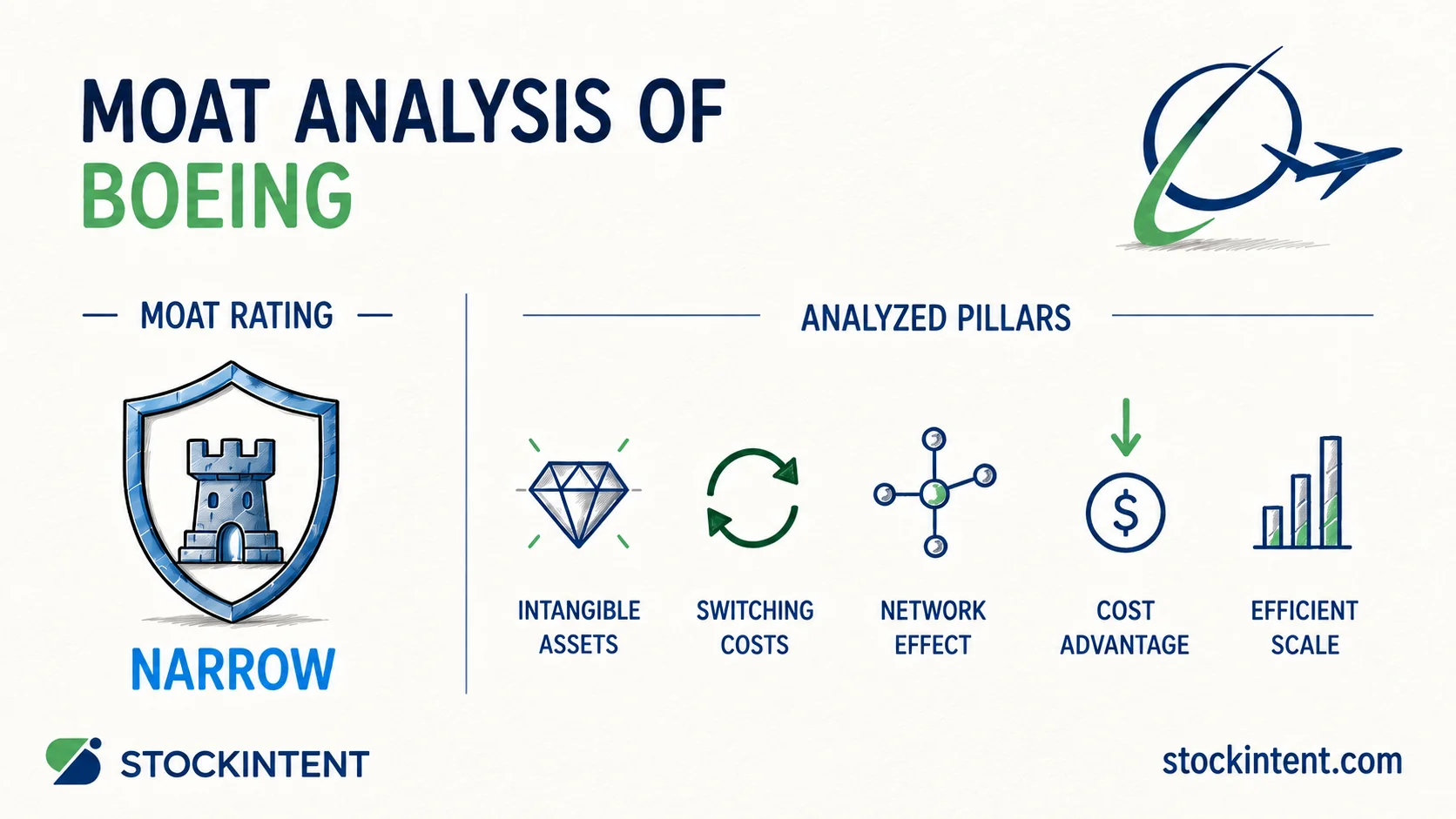
Boeing holds a narrow economic moat with a stable-to-weakening trend and high uncertainty. While its commercial aviation duopoly alongside Airbus ensures long-term relevance, an economic moat should ideally result in durable excess returns on invested capital, not just protected market share.
Boeing’s commercial aircraft backlog stands at more than 6,100 aircraft, supporting a record total backlog of $715.3 billion as of Q2 2026. Yet Boeing’s Q2 2026 earnings release reported an operating margin of just 0.6% on $24.6 billion in revenue, alongside positive free cash flow of $631 million.
The franchise enjoys structural defense, but production instability and thin profitability keep its moat fragile:
A multi-year order book matters little if manufacturing friction erodes unit profitability. To see why this moat remains under pressure, we have to look closely at its five underlying competitive pillars.
When we evaluate business quality, we look for structural characteristics that defend excess economic returns over decades. A genuine economic moat protects profits from competitors, allowing capital to compound without requiring heroic operational effort every quarter.
Boeing benefits from an exceptional market position, but its competitive pillars are uneven. We evaluated all five traditional economic moat sources, ranking them from strongest to weakest.
Switching costs represent a strong competitive pillar that tightly binds commercial airlines to Boeing's airframes. Operating an airline requires standardized operations, and shifting a fleet between airframe manufacturers triggers substantial operational friction.
A 2026 FactorsToday equity research report emphasizes that switching away from Boeing forces carriers to finance extensive pilot and mechanic retraining, retool maintenance facilities, duplicate spare-parts inventories, and rewrite standard flight manuals. Because airlines operate on thin margins, fleet commonality dictates procurement decisions. Replacing Boeing 737 or 787 fleets with competing models causes long transition delays and substantial fleet-planning disruption that most operators actively avoid.
Boeing possesses strong intangible assets formed by decades of engineering institutional knowledge, proprietary intellectual property, and extensive regulatory certifications. Building a commercial transport aircraft requires navigating thousands of global airworthiness standards that take years to clear.
As outlined in FindMyMoat's 2026 competitive analysis, Boeing's standing Federal Aviation Administration (FAA) and international type certificates represent regulatory assets that outside competitors cannot quickly reproduce. Decades of validated flight physics data, specialized avionics integration, and established relationships with global military buyers create high reputational and administrative barriers to entry.
Efficient scale provides Boeing with a strong structural shield against new industry entrants. The global market for large commercial passenger jets is an effective duopoly with Airbus, shaped by multi-billion-dollar development cycles and finite global delivery slots.
A 2026 SWOT analysis by Business Model Analyst notes that the commercial market cannot support more than two dominant producers of widebody and narrowbody aircraft at scale. The astronomical capital expenditure, decade-long payback periods, and complex global supplier webs prevent new aerospace entrants from achieving profitable volume without incurring massive losses.
Boeing's cost advantage is moderate and remains heavily disputed by ongoing manufacturing execution challenges. In theory, immense volume across commercial and defense lines should yield superior purchasing leverage with suppliers and substantial manufacturing scale economies.
However, a 2026 MoatScan AI report highlights how recurring supply-chain friction, factory rework, and paused delivery cadences have substantially offset Boeing's theoretical scale advantages. While Boeing's global installed base delivers dependable, high-margin aftermarket services, current production inefficiencies prevent scale from translating into consistent low-cost leadership.
Network effects are not relevant to Boeing's business model. A product enjoys network effects when every additional user makes the underlying service more valuable to existing customers.
Pro Insights: Commercial aircraft demand is governed entirely by carrier unit economics, route density, and fleet compatibility. An airline does not purchase a Boeing 787 Dreamliner because other airlines fly it; they buy it because the airframe fits their specific stage-length fuel burn requirements. The lack of network effects does not harm Boeing, but it means the franchise must rely entirely on its other competitive pillars to protect its economic profits.
Boeing's economic moat shows up most visibly in customer lock-in rather than pricing power. Airlines cannot easily walk away from years of fleet planning, which is why multi-year demand persists despite acute delivery delays and operational friction.
That customer dependency underpins Boeing's massive commercial backlog of over 6,100 airplanes. Airlines commit billions of dollars years in advance because reserving delivery slots is essential to protecting future flight schedules. Furthermore, Boeing maintains clear competitive strength in long-haul travel. A 2026 Air Insight industry assessment found that Boeing's widebody backlog exceeded Airbus's by a wide margin, reflecting a sturdy franchise in twin-aisle aircraft like the 787 and 777X.
Yet the classic benefits of a wide economic moat remain absent from Boeing's bottom line. In the high-volume single-aisle market, which Aerospace Global News reported made up 81% of total commercial aircraft orders in the first half of 2026, Airbus continues to hold the upper hand in order momentum. More critically, Boeing's thin 0.6% operating margin in Q2 2026 proves that structural duopolies do not automatically grant pricing leverage when factory execution falters.
In our experience analyzing industrial moats, Boeing's economic moat is best understood as regulatory-and-installed-base rather than pricing power. The record backlog demonstrates customer dependence and high switching costs, but thin operating margins reveal that durability of excess returns remains aspirational rather than realized. Investors should distinguish between structural moat sources, such as certification and fleet commonality, and operational execution.
Boeing's overall moat trend is stable to weakening, reflecting a sharp split between expanding government defense franchises and lingering fragility across commercial jet production.
On the defense side, the moat is genuinely widening through mission-critical, long-cycle military programs. Boeing's newsroom announcements confirm major long-duration production awards, including seven-year framework agreements expanding Standard Missile-3 and PAC-3 Seeker hardware output, an initial production contract for the MQ-25 Stingray carrier-based refueler, and the multibillion-dollar F-15 Eagle Crest modernization award. These multi-year contracts entrench military buyer relationships and secure highly predictable, sticky defense revenues that buffer commercial cyclicality.
In contrast, the commercial aerospace moat remains fragile. While the industry duopoly shields Boeing from direct new entrants, Airbus continues to win disproportionate narrowbody gross orders. More critically, Boeing's financial results showed net losses in both Q1 and Q2 2026 despite rising deliveries, underscoring that factory rework and fixed-cost absorption continue to dilute operational advantages.
To determine whether Boeing's moat trajectory is improving or degrading over the next 3 to 5 years, we track four forward-looking operating indicators:
Investors tracking this operational recovery can use StockIntent's watchlist feature to monitor key financial ratios alongside margin progression without manual data gathering.
Boeing's multi-decade franchise remains intact, but the trajectory of its moat will be decided on the factory floor.
We assign Boeing an uncertainty rating of High. When evaluating an economic moat, uncertainty does not refer to stock price volatility alone. Instead, it reflects the plausible range of future operational outcomes, from sustained recovery to persistent balance sheet distress.
Boeing’s reported numbers illustrate this dispersion. In its Q1 2026 earnings call, Boeing posted an operating margin of 2.0% before margins compressed to 0.6% in Q2. As detailed in Investing.com's Q2 2026 earnings transcript, the business produced $631 million in free cash flow, yet reported a loss per share of $0.76. That quarterly loss widened largely due to a $280 million pre-tax charge on the fixed-price VC-25B presidential aircraft program. Liquidity remains sturdy, with approximately $20 billion in cash and marketable securities and an undrawn $10 billion credit facility.
In StockIntent's view, these reported results confirm that sales predictability remains high, but operating predictability is fragile. Demand is firmly anchored by multi-year delivery commitments, yet execution and regulatory friction introduce massive variability.
In a positive scenario, steady assembly lines and fewer factory disruptions convert the massive order book into growing margins and durable cash flow. Conversely, fresh manufacturing bottlenecks, tighter FAA oversight, or further fixed-price defense write-downs would delay cash recovery and cede market share. Because either outcome remains plausible, the operational range stays wide.
Boeing commands a narrow economic moat with a stable-to-weakening trend and high uncertainty. Its competitive foundation remains anchored by high switching costs, regulatory certification barriers, and efficient scale within an entrenched global duopoly.
From here, long-term investors should watch two defining issues. First, Boeing must prove it can convert its massive $715 billion backlog into durable operating profitability instead of absorbing recurring factory rework and fixed-price contract charges. Second, investors need to monitor whether expanding defense awards can counter ongoing single-aisle market share pressure from Airbus.
Structural protections guarantee customer demand, but ongoing operational execution will decide whether Boeing ever earns back a wide economic moat. If factory cadence stabilizes and cash conversion normalizes, the moat will widen; if manufacturing bottlenecks persist, capital compounding will remain impaired.
To track whether this operational turnaround is taking hold, investors can review StockIntent's company reports for updated financial statements, segment margins, and historical cash flow metrics.
Boeing holds a narrow economic moat with a stable-to-weakening trend and high uncertainty. While its commercial aviation duopoly alongside Airbus ensures long-term relevance, an economic moat should ideally result in durable excess returns on invested capital, not just protected market share.
Boeing’s commercial aircraft backlog stands at more than 6,100 aircraft, supporting a record total backlog of $715.3 billion as of Q2 2026. Yet Boeing’s Q2 2026 earnings release reported an operating margin of just 0.6% on $24.6 billion in revenue, alongside positive free cash flow of $631 million.
The franchise enjoys structural defense, but production instability and thin profitability keep its moat fragile:
A multi-year order book matters little if manufacturing friction erodes unit profitability. To see why this moat remains under pressure, we have to look closely at its five underlying competitive pillars.
When we evaluate business quality, we look for structural characteristics that defend excess economic returns over decades. A genuine economic moat protects profits from competitors, allowing capital to compound without requiring heroic operational effort every quarter.
Boeing benefits from an exceptional market position, but its competitive pillars are uneven. We evaluated all five traditional economic moat sources, ranking them from strongest to weakest.
Switching costs represent a strong competitive pillar that tightly binds commercial airlines to Boeing's airframes. Operating an airline requires standardized operations, and shifting a fleet between airframe manufacturers triggers substantial operational friction.
A 2026 FactorsToday equity research report emphasizes that switching away from Boeing forces carriers to finance extensive pilot and mechanic retraining, retool maintenance facilities, duplicate spare-parts inventories, and rewrite standard flight manuals. Because airlines operate on thin margins, fleet commonality dictates procurement decisions. Replacing Boeing 737 or 787 fleets with competing models causes long transition delays and substantial fleet-planning disruption that most operators actively avoid.
Boeing possesses strong intangible assets formed by decades of engineering institutional knowledge, proprietary intellectual property, and extensive regulatory certifications. Building a commercial transport aircraft requires navigating thousands of global airworthiness standards that take years to clear.
As outlined in FindMyMoat's 2026 competitive analysis, Boeing's standing Federal Aviation Administration (FAA) and international type certificates represent regulatory assets that outside competitors cannot quickly reproduce. Decades of validated flight physics data, specialized avionics integration, and established relationships with global military buyers create high reputational and administrative barriers to entry.
Efficient scale provides Boeing with a strong structural shield against new industry entrants. The global market for large commercial passenger jets is an effective duopoly with Airbus, shaped by multi-billion-dollar development cycles and finite global delivery slots.
A 2026 SWOT analysis by Business Model Analyst notes that the commercial market cannot support more than two dominant producers of widebody and narrowbody aircraft at scale. The astronomical capital expenditure, decade-long payback periods, and complex global supplier webs prevent new aerospace entrants from achieving profitable volume without incurring massive losses.
Boeing's cost advantage is moderate and remains heavily disputed by ongoing manufacturing execution challenges. In theory, immense volume across commercial and defense lines should yield superior purchasing leverage with suppliers and substantial manufacturing scale economies.
However, a 2026 MoatScan AI report highlights how recurring supply-chain friction, factory rework, and paused delivery cadences have substantially offset Boeing's theoretical scale advantages. While Boeing's global installed base delivers dependable, high-margin aftermarket services, current production inefficiencies prevent scale from translating into consistent low-cost leadership.
Network effects are not relevant to Boeing's business model. A product enjoys network effects when every additional user makes the underlying service more valuable to existing customers.
Pro Insights: Commercial aircraft demand is governed entirely by carrier unit economics, route density, and fleet compatibility. An airline does not purchase a Boeing 787 Dreamliner because other airlines fly it; they buy it because the airframe fits their specific stage-length fuel burn requirements. The lack of network effects does not harm Boeing, but it means the franchise must rely entirely on its other competitive pillars to protect its economic profits.
Boeing's economic moat shows up most visibly in customer lock-in rather than pricing power. Airlines cannot easily walk away from years of fleet planning, which is why multi-year demand persists despite acute delivery delays and operational friction.
That customer dependency underpins Boeing's massive commercial backlog of over 6,100 airplanes. Airlines commit billions of dollars years in advance because reserving delivery slots is essential to protecting future flight schedules. Furthermore, Boeing maintains clear competitive strength in long-haul travel. A 2026 Air Insight industry assessment found that Boeing's widebody backlog exceeded Airbus's by a wide margin, reflecting a sturdy franchise in twin-aisle aircraft like the 787 and 777X.
Yet the classic benefits of a wide economic moat remain absent from Boeing's bottom line. In the high-volume single-aisle market, which Aerospace Global News reported made up 81% of total commercial aircraft orders in the first half of 2026, Airbus continues to hold the upper hand in order momentum. More critically, Boeing's thin 0.6% operating margin in Q2 2026 proves that structural duopolies do not automatically grant pricing leverage when factory execution falters.
In our experience analyzing industrial moats, Boeing's economic moat is best understood as regulatory-and-installed-base rather than pricing power. The record backlog demonstrates customer dependence and high switching costs, but thin operating margins reveal that durability of excess returns remains aspirational rather than realized. Investors should distinguish between structural moat sources, such as certification and fleet commonality, and operational execution.
Boeing's overall moat trend is stable to weakening, reflecting a sharp split between expanding government defense franchises and lingering fragility across commercial jet production.
On the defense side, the moat is genuinely widening through mission-critical, long-cycle military programs. Boeing's newsroom announcements confirm major long-duration production awards, including seven-year framework agreements expanding Standard Missile-3 and PAC-3 Seeker hardware output, an initial production contract for the MQ-25 Stingray carrier-based refueler, and the multibillion-dollar F-15 Eagle Crest modernization award. These multi-year contracts entrench military buyer relationships and secure highly predictable, sticky defense revenues that buffer commercial cyclicality.
In contrast, the commercial aerospace moat remains fragile. While the industry duopoly shields Boeing from direct new entrants, Airbus continues to win disproportionate narrowbody gross orders. More critically, Boeing's financial results showed net losses in both Q1 and Q2 2026 despite rising deliveries, underscoring that factory rework and fixed-cost absorption continue to dilute operational advantages.
To determine whether Boeing's moat trajectory is improving or degrading over the next 3 to 5 years, we track four forward-looking operating indicators:
Investors tracking this operational recovery can use StockIntent's watchlist feature to monitor key financial ratios alongside margin progression without manual data gathering.
Boeing's multi-decade franchise remains intact, but the trajectory of its moat will be decided on the factory floor.
We assign Boeing an uncertainty rating of High. When evaluating an economic moat, uncertainty does not refer to stock price volatility alone. Instead, it reflects the plausible range of future operational outcomes, from sustained recovery to persistent balance sheet distress.
Boeing’s reported numbers illustrate this dispersion. In its Q1 2026 earnings call, Boeing posted an operating margin of 2.0% before margins compressed to 0.6% in Q2. As detailed in Investing.com's Q2 2026 earnings transcript, the business produced $631 million in free cash flow, yet reported a loss per share of $0.76. That quarterly loss widened largely due to a $280 million pre-tax charge on the fixed-price VC-25B presidential aircraft program. Liquidity remains sturdy, with approximately $20 billion in cash and marketable securities and an undrawn $10 billion credit facility.
In StockIntent's view, these reported results confirm that sales predictability remains high, but operating predictability is fragile. Demand is firmly anchored by multi-year delivery commitments, yet execution and regulatory friction introduce massive variability.
In a positive scenario, steady assembly lines and fewer factory disruptions convert the massive order book into growing margins and durable cash flow. Conversely, fresh manufacturing bottlenecks, tighter FAA oversight, or further fixed-price defense write-downs would delay cash recovery and cede market share. Because either outcome remains plausible, the operational range stays wide.
Boeing commands a narrow economic moat with a stable-to-weakening trend and high uncertainty. Its competitive foundation remains anchored by high switching costs, regulatory certification barriers, and efficient scale within an entrenched global duopoly.
From here, long-term investors should watch two defining issues. First, Boeing must prove it can convert its massive $715 billion backlog into durable operating profitability instead of absorbing recurring factory rework and fixed-price contract charges. Second, investors need to monitor whether expanding defense awards can counter ongoing single-aisle market share pressure from Airbus.
Structural protections guarantee customer demand, but ongoing operational execution will decide whether Boeing ever earns back a wide economic moat. If factory cadence stabilizes and cash conversion normalizes, the moat will widen; if manufacturing bottlenecks persist, capital compounding will remain impaired.
To track whether this operational turnaround is taking hold, investors can review StockIntent's company reports for updated financial statements, segment margins, and historical cash flow metrics.