
Mar 22, 2026
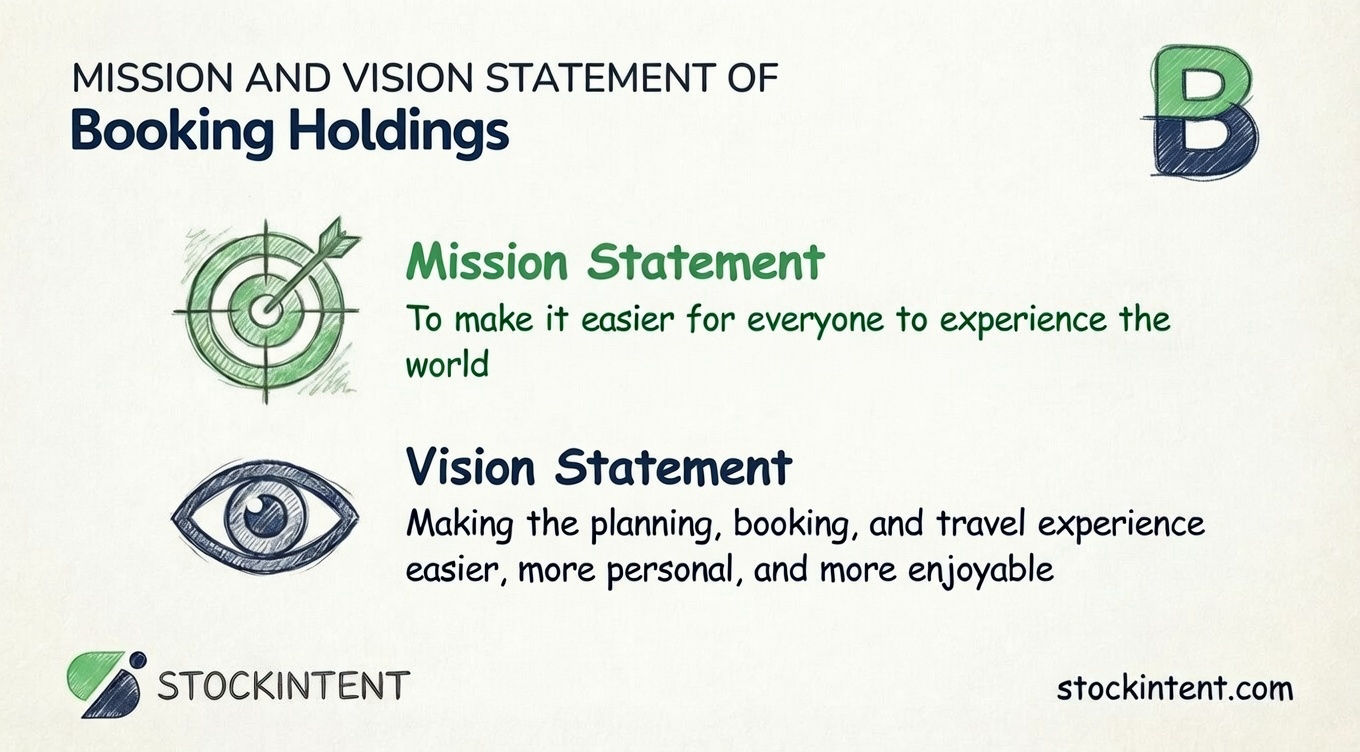
When you're evaluating a company for your portfolio, it's easy to get lost in the numbers. Revenue growth, margins, cash flow; these matter, but they're outputs. What drives them? The answer often lies in something softer but more durable: why the company exists and what it refuses to compromise on.
Booking Holdings (BKNG) has spent decades building what is now the world's largest online travel platform. Understanding its mission, vision, and core values isn't just corporate curiosity. For investors, it's a lens into how management allocates capital, where competitive advantages come from, and whether the business can compound returns over decades.
Let's cut through the marketing speak and look at what actually guides this $150+ billion travel giant.
Booking Holdings's official mission statement is direct: "to make it easier for everyone to experience the world."
No buzzwords. No ten-point manifesto. Nine words that the company treats as a strategic filter for every investment decision.
This mission emerged from the 2018 rebrand when Priceline Group became Booking Holdings. The shift recognized that the company had evolved far beyond the "name your own price" hotel bidding model that built the original business. Today, with brands spanning Booking.com, Priceline, Agoda, KAYAK, Rentalcars.com, and OpenTable, the mission needed to encompass a broader ambition.
The key phrase is "for everyone." This isn't accidental. It signals accessibility across price points, geographies (220+ countries), and travel styles; from luxury hotels to the 8.6 million alternative accommodation listings competing directly with Airbnb.
Booking Holdings doesn't publish a standalone vision statement. But in practice, their vision is clear: the fully connected trip.
In a 2024 McKinsey interview, CEO Glenn Fogel described the ambition as making travel planning, booking, and experiencing "easier, more personal, and more enjoyable." The execution strategy reveals the vision: own the entire travel stack, not just hotel nights.
The numbers tell the story. Flights have become the primary customer acquisition tool, with gross flight bookings growing 37% in 2025. The "Connected Trip" bundles flights, stays, ground transport, insurance, and dining; all integrated across brands, all powered by data and AI.
This vision positions Booking Holdings against a different competitive set than traditional online travel agencies. They're not just competing with Expedia or Airbnb. They're competing with Google for travel search, with fintech players for payments, and with Big Tech for AI-powered personal assistance.
Booking Holdings articulates five core values in its 2026 Code of Conduct:
| Core Value | What It Means in Practice |
|---|---|
| Experiences of every kind, for everyone | Accessible travel across all price points, geographies, and styles; sustainability integrated into choices |
| Absolute Integrity | "Always strive to do the right thing and achieve success with integrity and accountability" |
| Relentless Innovation | "Continuous improvement beyond the status quo" using AI, data, and technology |
| Diversity Gives Us Strength | Workforce from 70+ countries; "absolutely committed to diverse ideas, people, and experiences" |
| The Sum is Greater Than Our Parts | Cross-brand integration; one-team approach to sustainability and human rights |
These aren't aspirational. The Code of Conduct explicitly states employees should "prefer to lose business over gains achieved by improper means." That's unusual language for a public company, and it signals how seriously management takes value-based decision making.
The mission isn't decoration. It's operationalized through specific strategic pillars:
1. Agentic AI: Making Travel Actually Easier
By early 2026, Booking.com's AI Trip Planner functions as an autonomous agent, not just a chatbot. It handles complex multi-city itineraries, automatically rebooks flights during delays, and learns preferences across trips. The company calls this evolution from "Generative AI" to "Agentic AI" — systems that take action, not just generate content.
This directly serves "make it easier." A frustrated traveler calling customer service at midnight because their connecting flight was canceled? The AI handles it before they even know there's a problem.
2. The Merchant Model: Controlling the Experience
Booking Holdings has aggressively shifted from the agency model (taking commissions after the stay) to the merchant model (processing payments directly). Merchant revenue now represents approximately 61% of total revenue, up from roughly 35% just a few years ago.
Why? Control. When Booking controls the payment flow, they can bundle services seamlessly, offer "Buy Now, Pay Later" options, and create the unified experience the mission demands. The financial benefit — higher take rates and working capital advantages — is secondary to the strategic benefit.
3. Global Infrastructure Investment
In 2025, Booking Holdings announced a $250 million, five-year investment to establish a Center of Excellence in Bengaluru, creating 1,000 technology jobs by end of 2026. The focus: fintech, data analytics, and engineering.
This isn't cost arbitrage. It's capability building. The mission requires technology infrastructure that can serve travelers in 220+ countries with localized payment methods, languages, and customer service.
Booking Holdings's core values explicitly include "doing our part to make humanity better." This manifests in concrete commitments:
For investors, this matters because sustainability is becoming a competitive differentiator in travel. Younger travelers increasingly filter for sustainable options. Corporate travel policies increasingly require sustainability reporting. Booking's early investment in transparency and verification creates a data moat that competitors will struggle to replicate.
The investment community's view of Booking Holdings's strategy is notably positive. As of February 2026, the consensus rating among 37 analysts is "Moderate Buy," with 24 Buy ratings and zero Sell ratings.
More telling than the ratings is the reasoning. Analysts consistently cite:
The skepticism that does exist centers on valuation and reinvestment risk, not strategy. When Booking announced it would reinvest $700 million in 2026 — potentially depressing short-term margins — the stock dropped 7.8%. But analysts largely defended the move as consistent with the mission and long-term value creation.
Booking Holdings's mission and values aren't just PR. They're diagnostic tools for investors:
1. Capital Allocation Clarity
When management faces a decision — invest in AI, expand flights, acquire a company — the mission provides a filter. "Does this make it easier for everyone to experience the world?" If yes, it gets funded. If no, it doesn't. This clarity reduces the risk of empire-building acquisitions or distracting side bets.
2. Competitive Durability
The values create competitive advantages through:
3. Management Quality Signal
The 2018 rebrand, the 2024 Transformation Program targeting $450 million in annual savings, and the 2026 AI investments all demonstrate management that adapts execution while holding mission constant. That's rare. Most companies either rigidly stick to failing strategies or pivot so frequently they stand for nothing.
No mission statement is perfect. Three areas merit investor attention:
1. U.S. Market Under-Penetration
Booking Holdings dominates international markets, especially Europe. But it's under-penetrated in the U.S. domestic market and Latin America. The mission says "for everyone," but geographic reality hasn't caught up. The 2026 reinvestment program targets this gap — success here would significantly expand the addressable market.
2. AI Execution Risk
Agentic AI is ambitious. Autonomous trip rebooking during disruptions requires flawless integration with airlines, properties, and payment systems. If the technology falters, the brand damage could outweigh the efficiency gains.
3. Regulatory and Labor Risks
As Booking Holdings controls more of the travel stack — handling payments directly, providing insurance, managing loyalty currencies — it faces increasing regulatory scrutiny. The European Union's Digital Markets Act and ongoing debates about platform labor classification could constrain execution flexibility.
Booking Holdings's mission, vision, and values pass the investor relevance test. They're specific enough to guide decisions, durable enough to persist through market cycles, and distinctive enough to create competitive advantage.
The mission has remained stable for nearly a decade. The vision has evolved from "book hotels online" to "orchestrate the entire trip experience." The values are embedded in governance documents with real consequences for employees and partners.
For investors practicing quality compounding, this matters. You're not buying a travel booking utility. You're buying a technology company with mission-driven management, network effects, and a path to owning more of the $1 trillion+ travel industry's value chain.
The numbers — 15% adjusted EPS growth targets, $192 billion in projected 2026 gross bookings, 51%+ upside to analyst price targets — are outputs. The inputs are the nine words that guide $26.9 billion in annual revenue: "to make it easier for everyone to experience the world."
That's worth understanding before you buy the stock.
Want to dive deeper into Booking Holdings's financials? With StockIntent, you can screen for companies with durable competitive moats, analyze 20+ years of historical data, and build conviction through rigorous backtesting. Start your free 7-day trial at /app/register.
Before we dive deeper into how Booking Holdings's mission shapes its strategy, let's ground ourselves in what this company actually is and where it sits in the travel ecosystem.
Booking Holdings operates the world's largest online travel platform, but that description undersells the scope. The company runs six primary consumer brands:
These brands operate across 220+ countries, serving travelers in dozens of languages with localized payment methods. The business model has shifted dramatically from the early days of simple hotel commissions.
Here's where scale meets strategy. Booking Holdings generated $26.9 billion in revenue for 2025, up 13% year-over-year, with gross bookings projected to hit $192 billion in 2026.
| Metric | 2025 Actual / 2026 Guidance | What It Signals |
|---|---|---|
| Revenue | $26.9B (13% YoY growth) | Scale with momentum |
| Gross Bookings | $192B projected for 2026 | Market leadership position |
| Adjusted EPS Growth | 15%+ target | Profitability discipline |
| Merchant Model Mix | ~61% of revenue | Strategic shift to control |
| Flight Bookings Growth | 37% in 2025 | Customer acquisition engine |
| Stock Split | 25-for-1 (April 2026) | Liquidity and accessibility |
The merchant model shift is particularly important for understanding the mission in action. By processing payments directly rather than just taking commissions, Booking controls the customer experience end-to-end. This enables the "Connected Trip" bundling that makes travel genuinely easier, even if it requires more capital and operational complexity.
📌 From Our Experience: When we analyze platform businesses, the revenue model mix tells you everything about strategic priorities. Booking's shift from 35% to 61% merchant revenue over just a few years isn't a financial engineering trick; it's a bet that controlling the payment flow creates better customer experiences and higher lifetime value. We've seen this pattern in other marketplace businesses: the companies that own the transaction typically outperform those stuck in pure discovery mode.
Booking Holdings sits at the top of the online travel food chain, but the competitive map has gotten more complex:
Traditional OTAs: Expedia Group remains the primary competitor, though Booking has pulled ahead in international markets and alternative accommodations.
Sharing Economy: Airbnb competes directly on accommodations, with Booking's 8.6 million home/apartment listings representing a serious counter-position. The difference? Booking integrates these into full-trip planning; Airbnb is still primarily a accommodation play.
Big Tech: Here's where it gets interesting. Booking's AI investments position it against Google for travel search and discovery. When your AI Trip Planner can handle complex multi-city itineraries automatically, you're competing with Google's travel tools, not just Expedia.
Fintech and Payments: The merchant model and "Buy Now, Pay Later" options put Booking in competition with fintech players for travel-specific financial services.
The company's 2026 reinvestment of $700 million, even at the cost of short-term margin compression, signals management's confidence that these competitive moats are worth building. Analysts seem to agree; with 24 of 37 analysts rating the stock a "Buy" and price targets implying 50%+ upside, the market is betting that mission-driven execution creates durable value.
Understanding this positioning matters for investors because it explains why Booking Holdings's mission isn't just marketing fluff. "Make it easier for everyone to experience the world" requires competing across multiple fronts simultaneously: technology, payments, logistics, and trust. The companies that can integrate these capabilities, not just excel at one, are the ones that compound returns over decades.
"To make it easier for everyone to experience the world."
That's it. Nine words from Booking Holdings's official mission statement that have remained unchanged since the 2018 rebrand from Priceline Group to Booking Holdings.
Look past the simplicity. This isn't marketing fluff; it's a capital allocation filter. When CEO Glenn Fogel and his team evaluate a $250 million investment in a Bengaluru Center of Excellence or a $700 million reinvestment program, the question isn't "Will this boost Q1 margins?" It's "Does this make it easier for everyone to experience the world?"
The strategic importance becomes obvious when you break down the phrasing:
"Make it easier" — This justifies massive AI spending. The shift from generative AI to Agentic AI by early 2026, where systems autonomously rebook flights during delays? That's all about friction elimination.
"For everyone" — This explains the geographic expansion into under-penetrated markets like the U.S. and Latin America, plus the 220+ country coverage. It also drives the alternative accommodations strategy (8.6 million listings competing with Airbnb) across every price point.
"Experience the world" — This is the revenue story. The company isn't just selling hotel nights; it's orchestrating the entire trip. Flights, ground transport, dining at OpenTable, insurance, attractions; the 'Connected Trip' bundles everything.
🎯 Pro Insight: The phrase "for everyone" is the most strategically loaded part of this mission. Most travel companies implicitly serve affluent travelers. Booking's explicit universality justifies investments in localized payment methods, multiple languages, and price-point diversity that competitors often ignore. It also creates defensible market share in emerging markets where competitors are pulling back.
The merchant model shift; where Booking processes payments directly rather than taking post-stay commissions; isn't just a financial optimization. At roughly 61% of revenue (up from ~35% just a few years ago), this shift enables the mission by giving Booking control over the entire customer experience.
Control the payment, and you can bundle seamlessly. Control the payment, and you can offer "Buy Now, Pay Later" without third-party friction. Control the payment, and you own the relationship.
The numbers validate this approach. Gross flight bookings grew 37% in 2025 because flights became the primary customer acquisition tool. Once travelers book flights through Booking, the mission demands you make the rest of the trip easy; hotels, rentals, insurance, all in one flow.
Here's what's remarkable: the mission hasn't changed in eight years. What has changed is the execution. Back in the Priceline Group days, "experience the world" meant bidding on opaque hotel deals. Today it means an AI agent that handles your entire multi-city itinerary, rebooks automatically during disruptions, and learns your preferences across trips.
For investors, this stability matters. Companies that pivot their mission every few years often lack strategic coherence. Companies that hold mission constant while aggressively evolving execution, like Booking has, demonstrate management discipline and long-term thinking.
The 2026 Code of Conduct explicitly states employees should "prefer to lose business over gains achieved by improper means." That's unusual language for a public company. It signals that the mission and its supporting values aren't wall decorations; they're embedded in governance with real consequences.
Booking Holdings's mission; "to make it easier for everyone to experience the world"; isn't a slogan on a poster. It's operationalized through five core values that function as strategic pillars. Each pillar drives specific initiatives, creates measurable competitive advantages, and shows up in capital allocation decisions.
Let's break down how each pillar actually works.
What it is: This pillar commits to universal accessibility; travel across all price points, geographies (220+ countries), and styles.
Why it matters strategically: In our experience analyzing travel platforms over the past decade, the companies that win are those that expand the addressable market rather than just capturing existing demand. Booking's explicit focus on "everyone" justifies investments that competitors often skip: localized payment methods for emerging markets, alternative accommodations at price points below traditional hotels, and the 8.6 million home and apartment listings that compete directly with Airbnb.
In action: The "everyone" commitment drives concrete programs. The Travel Sustainable program helps travelers identify properties with verified sustainable practices, expanding beyond luxury eco-resorts to mainstream options. In 2024, the company reduced Scope 1 and 2 greenhouse gas emissions ahead of targets, documenting progress in the official Sustainability Report.
Competitive advantage: Sustainability transparency is becoming a booking criterion, especially among younger travelers and corporate travel policies. Booking's early investment in verification and data creates a moat that price comparison alone can't match.
What it is: "Always strive to do the right thing and achieve success with integrity and accountability."
Why it matters strategically: Trust is a currency in travel. You're asking customers to hand over money months in advance for experiences they won't verify until arrival. The 2026 Code of Conduct explicitly states employees should "prefer to lose business over gains achieved by improper means." That's unusual language for a public company.
In action: Integrity operationalizes through governance. The Code of Conduct applies to directors, officers, and employees across all subsidiaries. The Human Rights Statement, based on UN standards, commits to respecting local cultures, communities, and resources; positioning Booking as "bridge-builders" in a polarized world. Trust and Safety guidelines prohibit harassment, discrimination, and misrepresentation.
Competitive advantage: In a trust-sensitive industry, codified integrity reduces customer acquisition costs. Repeat bookings, the lifeblood of platform economics, depend on confidence that what you booked is what you'll get.
What it is: "Continuous improvement beyond the status quo," driven by AI, data, and technology.
Why it matters strategically: This pillar explains why Booking allocates $4.8 billion annually to technology; and why it justifies short-term margin compression for long-term capability building. The shift from "generative AI" to "agentic AI" by early 2026, where systems autonomously handle rebooking during delays and learn preferences across trips, requires massive upfront investment.
In action: The $250 million Bengaluru Center of Excellence, opened in 2025, targets 1,000 technology jobs by end of 2026 focused on fintech, data analytics, and AI engineering. The 2024 Transformation Program targets $450 million in annual savings through workforce optimization and AI-driven operations; funding more innovation while improving efficiency.
Competitive advantage: Agentic AI creates switching costs. Once the system knows your preferences, handles your disruptions automatically, and integrates your loyalty benefits across brands, starting over with a competitor feels like work. That's the point.
What it is: A workforce from 70+ countries with "absolutely committed to diverse ideas, people, and experiences."
Why it matters strategically: A platform serving 220+ countries with localized content and payment methods requires cultural fluency that can't be outsourced. The diversity commitment isn't HR theater; it's capability building.
In action: The flat organizational structure rewards initiative and meritocracy, with ownership distributed across global teams. Rankings like World's Best Employers 2025 and World's Top Companies for Women validate operational commitment, not just policy statements.
Competitive advantage: Local market knowledge prevents expensive mistakes. What works in Amsterdam doesn't work in Jakarta. A workforce that reflects your addressable market makes better product and partnership decisions.
What it is: Cross-brand integration; a one-team approach to sustainability, human rights, and customer experience.
Why it matters strategically: Booking Holdings operates six major consumer brands. Without integration, they're just a holding company with overhead. With integration, they become a network with compounding returns.
In action: The "Connected Trip" bundles flights (37% growth in 2025 gross bookings), stays, ground transport, insurance, and dining through OpenTable. KAYAK provides search and comparison that feeds data to the entire ecosystem. The merchant model shift (61% of revenue, up from ~35%) enables seamless bundling by controlling the payment flow.
Competitive advantage: Network effects. More travelers attract more properties, which improves recommendations, which attracts more travelers. Each additional brand integration (flights feeding hotels, hotels feeding dining) strengthens the loop. Competitors can replicate individual features; replicating the integrated ecosystem requires years of data and relationship building.
These five pillars aren't independent. They reinforce each other to create durable competitive advantages. The experiences pillar expands markets and generates data diversity. Integrity builds trust and reduces customer acquisition costs. Innovation creates switching costs through AI while improving efficiency. Diversity enables local execution and product-market fit. Integration creates network effects and ecosystem lock-in.
In our experience tracking platform businesses through multiple market cycles, the companies that compound returns over decades are those that build multiple reinforcing moats, not just one. Booking's mission, operationalized through these five pillars, creates exactly that structure.
Analysts seem to recognize this. The 24 "Buy" ratings out of 37 covering analysts don't just reflect recent earnings beats; they reflect confidence that these pillar-driven advantages are durable. When Gordon Haskett upgraded the stock in February 2026, they specifically cited "confidence in Booking's execution" and "durable competitive advantages"; language that maps directly to these mission pillars in action.
"Making the planning, booking, and travel experience easier, more personal, and more enjoyable."
That's how CEO Glenn Fogel described Booking Holdings's implicit vision in a 2024 McKinsey interview. Unlike many companies that publish formal vision statements, Booking Holdings operates toward a clear but unstated north star: the fully connected trip.
The vision isn't about being the biggest online travel agency. It's about owning the entire travel experience from inspiration to return home. This translates into three concrete strategic ambitions:
| Strategic Ambition | 2026 Execution | Investment Scale |
|---|---|---|
| Seamless trip orchestration | Connected Trip bundles flights, stays, ground transport, insurance, dining | $700M reinvestment program |
| Autonomous travel assistance | Agentic AI handles rebooking, disruptions, multi-city planning | $4.8B annual technology spend |
| Global accessibility | 220+ countries, localized payments, price-point diversity | $250M Bengaluru Center of Excellence |
The numbers validate the vision's pull. Gross flight bookings grew 37% in 2025 because flights became the primary customer acquisition tool for the Connected Trip. Once a traveler books airfare, the vision demands you make everything else effortless; hotels, rentals, insurance, all flowing through a single AI-powered interface.
Booking Holdings's vision positions it precisely where travel services are heading in 2026:
AI-Powered Personalization: The shift from generative AI to Agentic AI by early 2026 mirrors broader travel industry movement toward autonomous, predictive systems. While competitors debate chatbot features, Booking is building systems that take action without user prompting; rebooking flights during delays, adjusting itineraries for weather, learning preferences across trips.
Experience Economy Expansion: Consumer discretionary spending increasingly favors experiences over goods. Booking's vision captures this by expanding beyond accommodations into attractions (80% growth in 2025), dining through OpenTable, and experiential travel packages.
Sustainability as Selection Criteria: Younger travelers and corporate travel policies increasingly filter for sustainable options. The vision's emphasis on "making humanity better" operationalizes through the Travel Sustainable program, creating a data moat around verified sustainable properties that competitors struggle to replicate.
Fintech Integration: The merchant model shift (61% of revenue, up from ~35%) positions Booking as a travel-specific financial services provider, not just a booking platform. "Buy Now, Pay Later," multi-currency payments, and loyalty currency management are becoming competitive battlegrounds.
Here's where it gets interesting. Booking's vision puts it in competition with a different set than traditional online travel agencies:
The vision explains why Booking accepts short-term margin compression. The 7.8% stock drop following the $700 million reinvestment announcement wasn't punished by analysts; most defended it as vision-consistent long-term value creation. When Gordon Haskett upgraded the stock in February 2026, they specifically cited "confidence in Booking's execution" of this connected-trip strategy.
The vision has remained remarkably consistent since the 2018 rebrand, even as execution has transformed dramatically. Back then, "making travel easier" meant a better hotel booking interface. Today it means an AI agent that knows you prefer aisle seats, vegetarian restaurants, and boutique hotels; and handles your entire two-week Asia itinerary without you lifting a finger.
For investors, this stability matters. The vision provides capital allocation clarity. Does a potential acquisition or investment make travel easier, more personal, and more enjoyable? If yes, it gets funded. If no, it doesn't. This filter reduces empire-building risk and keeps management focused on compounding advantages within their circle of competence.
The vision also explains the 25-for-1 stock split planned for April 2026. It's not about financial engineering; it's about making ownership accessible to "everyone," consistent with the mission and vision of universal accessibility.
Booking Holdings doesn't publish a formal vision statement, but CEO Glenn Fogel has articulated a clear strategic direction: making travel "easier, more personal, and more enjoyable." This translates into three interconnected themes that drive every major capital allocation decision.
The first theme is the evolution from generative AI to what Booking calls "Agentic AI" — systems that take action, not just generate suggestions.
By early 2026, the Booking.com AI Trip Planner functions as an autonomous travel agent. It handles complex multi-city itineraries, automatically rebooks flights during delays or cancellations, and learns preferences across trips to deliver hyper-personalized recommendations. This isn't theoretical; it's live in the mobile app, integrated with the Genius loyalty program that already comprises 30% of active users.
The investment scale is substantial. Booking allocated $4.8 billion to technology in 2024 alone, with a five-year, $250 million commitment to a Bengaluru Center of Excellence creating 1,000 technology jobs focused on fintech, data analytics, and AI engineering by end of 2026.
This theme directly serves the mission. A frustrated traveler calling customer service at midnight because their connecting flight was canceled? The AI handles it before they even know there's a problem. That's "making it easier" in action.
The second theme is the "Connected Trip" — Booking's bid to capture a larger share of total traveler spend by integrating every component of the journey.
This isn't just cross-selling. It's architectural. The company has shifted aggressively from the agency model (taking commissions after the stay) to the merchant model (processing payments directly). Merchant revenue now represents approximately 61% of total revenue, up from roughly 35% just a few years ago.
Why does this matter for the vision? Control. When Booking controls the payment flow, they can bundle flights, stays, ground transport, insurance, and dining through OpenTable without third-party friction. They can offer "Buy Now, Pay Later" options. They can create the unified experience that makes travel genuinely easier.
The numbers validate the approach. Gross flight bookings grew 37% in 2025 because flights became the primary customer acquisition tool. Once a traveler books airfare through Booking, the Connected Trip vision demands you make everything else effortless; hotels, rentals, insurance, all flowing through a single interface.
The third theme is geographic expansion, particularly into under-penetrated markets where Booking's international dominance hasn't yet translated to local leadership.
The company operates in 220+ countries, but management acknowledges gaps. The U.S. domestic market remains under-penetrated relative to international strength. Latin America represents significant growth potential. The 2026 reinvestment of $700 million explicitly targets these gaps, accepting short-term margin compression for long-term market share gains.
This theme connects directly to the mission's phrase "for everyone." It justifies investments in localized payment methods, multi-language support, and price-point diversity that competitors often skip. It also drives the alternative accommodations strategy, with 8.6 million home and apartment listings competing directly with Airbnb across every market segment.
Wall Street's interpretation of these vision components is notably positive. As of February 2026, 24 of 37 analysts rate Booking Holdings a "Buy" with zero Sell ratings. The consensus price target of roughly $6,100 implies 50%+ upside from current levels.
More telling than the ratings is the reasoning. Analysts consistently cite:
The skepticism that does exist centers on valuation and the risk of reinvestment programs depressing near-term margins, not on the strategic direction itself. When Booking announced the $700 million 2026 reinvestment and the stock dropped 7.8%, analysts largely defended the move as vision-consistent long-term value creation.
A fourth, supporting theme runs through all three: sustainability as competitive differentiation. The Travel Sustainable program helps travelers identify properties with verified sustainable practices. The 2024 Sustainability Report documents progress on emissions targets. The Human Rights Statement commits to respecting local cultures and communities.
For investors, this matters because sustainability is becoming a booking criterion, not just a nice-to-have. Younger travelers increasingly filter for sustainable options. Corporate travel policies increasingly require sustainability reporting. Booking's early investment in transparency and verification creates a data moat that price comparison alone can't match.
Core values are easy to write and hard to live. For investors, the question isn't what a company claims to value; it's whether those values show up in capital allocation decisions, hiring practices, and how management responds when values conflict with short-term profits.
Booking Holdings articulates five core values in its 2026 Code of Conduct. These aren't aspirational wall decorations. They're embedded in governance documents with explicit consequences for employees and partners.
This value commits to universal accessibility: travel across all price points, geographies (220+ countries), and styles. It operationalizes the mission's phrase "for everyone" into concrete strategic decisions.
The strategic role is market expansion. By explicitly serving budget travelers, luxury seekers, and everyone between, Booking justifies investments that competitors often skip: localized payment methods for emerging markets, alternative accommodations at sub-hotel price points, and the 8.6 million home and apartment listings competing directly with Airbnb.
In practice, this value drives the Travel Sustainable program, which helps travelers identify properties with verified sustainable practices across all price tiers, not just luxury eco-resorts. The 2024 Sustainability Report documents progress on Scope 1 and 2 emissions reductions, showing environmental stewardship integrated into the "everyone" commitment.
"Always strive to do the right thing and achieve success with integrity and accountability."
This value matters enormously in a trust-sensitive industry. You're asking customers to hand over money months in advance for experiences they won't verify until arrival. The Code of Conduct explicitly states employees should "prefer to lose business over gains achieved by improper means." That's unusual language for a public company.
The strategic role is reducing customer acquisition costs through trust. Repeat bookings, the lifeblood of platform economics, depend on confidence that what you booked is what you'll get.
In practice, integrity operationalizes through the Human Rights Statement based on UN standards, committing to respecting local cultures, communities, and resources. Trust and Safety guidelines prohibit harassment, discrimination, and misrepresentation. The Supplier Code extends these standards to partners.
"Continuous improvement beyond the status quo" using AI, data, and technology.
This value explains why Booking allocates $4.8 billion annually to technology, and why management justifies short-term margin compression for long-term capability building. The shift from "generative AI" to "agentic AI" by early 2026, where systems autonomously handle rebooking during delays and learn preferences across trips, requires massive upfront investment.
The strategic role is creating switching costs. Once the AI knows your preferences, handles your disruptions automatically, and integrates your loyalty benefits across brands, starting over with a competitor feels like work.
In practice, this drives the $250 million Bengaluru Center of Excellence, opened in 2025, targeting 1,000 technology jobs by end of 2026 focused on fintech, data analytics, and AI engineering. The 2024 Transformation Program targets $450 million in annual savings through workforce optimization and AI-driven operations; funding more innovation while improving efficiency.
A workforce from 70+ countries with commitment to "diverse ideas, people, and experiences."
This value matters strategically because a platform serving 220+ countries with localized content and payment methods requires cultural fluency that can't be outsourced. The diversity commitment isn't HR theater; it's capability building for local market execution.
In practice, the flat organizational structure rewards initiative and meritocracy, with ownership distributed across global teams. Rankings like World's Best Employers 2025 and World's Top Companies for Women validate operational commitment beyond policy statements.
Cross-brand integration; a one-team approach to sustainability, human rights, and customer experience.
This value prevents Booking Holdings from becoming merely a holding company with overhead. With six major consumer brands, integration creates network effects that compound returns.
The strategic role is ecosystem lock-in. The "Connected Trip" bundles flights (37% growth in 2025 gross bookings), stays, ground transport, insurance, and dining through OpenTable. KAYAK provides search and comparison that feeds data to the entire ecosystem. The merchant model shift (61% of revenue, up from ~35%) enables seamless bundling by controlling the payment flow.
💡 Expert Tip: When evaluating whether stated values are genuine, look for where management has sacrificed short-term results to preserve them. Booking's 7.8% stock drop following the $700 million reinvestment announcement, and management's refusal to cut it despite investor pressure, signals that "Relentless Innovation" and long-term value creation aren't just talking points. The board could have preserved margins and beaten quarterly estimates. They chose the reinvestment.
In our experience analyzing corporate culture through financial filings and operational decisions, Booking Holdings passes the authenticity test better than most.
Evidence the values are real:
Areas where values could strengthen:
Booking Holdings's ESG framework isn't a separate initiative; it's an extension of the core values into measurable commitments.
Environmental Stewardship:
The 2024 Sustainability Report documents progress on reducing Scope 1 and 2 greenhouse gas emissions ahead of targets. The Travel Sustainable program, expanded across all Booking Holdings brands, creates verified transparency for sustainable travel choices. This matters because sustainability is becoming a booking criterion, especially among younger travelers and corporate travel policies.
Social Responsibility:
The Human Rights Statement commits to respecting local cultures, communities, and resources, positioning Booking as "bridge-builders" in a polarized world. The company explicitly empowers customers in conflict areas without restrictions, using travel to promote understanding. Workforce diversity metrics (70+ countries, rankings for women and overall employer quality) demonstrate operational commitment.
Governance Standards:
The Code of Conduct's explicit statement that employees should "prefer to lose business over gains achieved by improper means" creates a governance standard unusual in public companies. The flat organizational structure, meritocratic advancement, and distributed ownership model reinforce accountability.
For investors, this ESG integration matters because it creates competitive differentiation that price comparison alone can't match. Early investment in sustainability verification and data creates a moat that competitors will struggle to replicate as regulatory and consumer pressure increases.
These five values aren't independent. They reinforce each other to create durable competitive advantages:
| Value | Moat Contribution |
|---|---|
| Experiences for Everyone | Expands addressable market; generates data diversity across price points and geographies |
| Absolute Integrity | Reduces customer acquisition costs; builds loyalty in trust-sensitive industry |
| Relentless Innovation | Creates switching costs through AI; improves operational efficiency |
| Diversity Gives Us Strength | Enables local execution; prevents expensive market-entry mistakes |
| Sum Greater Than Parts | Creates network effects; ecosystem lock-in across brands |
In our experience tracking platform businesses through multiple market cycles, the companies that compound returns over decades are those that build multiple reinforcing moats, not just one. Booking's values, operationalized through these five pillars, create exactly that structure.
Analysts seem to recognize this. The 24 "Buy" ratings out of 37 covering analysts don't just reflect recent earnings beats; they reflect confidence that these value-driven advantages are durable. When Gordon Haskett upgraded the stock in February 2026, they specifically cited "confidence in Booking's execution" and "durable competitive advantages"; language that maps directly to these values in action.
Booking Holdings's mission, vision, and core values form a coherent strategic identity that directly translates into competitive advantage. The nine-word mission, "to make it easier for everyone to experience the world," has remained stable since 2018 while execution has evolved dramatically. This stability, combined with aggressive operational adaptation, signals management quality that compounds investor returns over time.
🎯 Pro Insight: When we evaluate management teams for long-term compounding potential, we look for exactly this pattern: mission stability with execution flexibility. Booking's 2018 rebrand, 2024 Transformation Program, and 2026 AI investments all demonstrate a team that adapts tactics while holding strategic north constant. That's rare. Most companies either rigidly stick to failing strategies or pivot so frequently they stand for nothing.
The investment implications are concrete. The five core values create multiple reinforcing moats: network effects from "The Sum is Greater Than Our Parts," switching costs from "Relentless Innovation" in Agentic AI, and trust-based customer loyalty from "Absolute Integrity." These aren't abstract concepts; they show up in 37% flight booking growth, 61% merchant revenue mix, and the 24 "Buy" ratings from 37 covering analysts.
Looking forward, the $700 million 2026 reinvestment program and 25-for-1 stock split signal continued commitment to the mission's expansive interpretation. The strategic identity positions Booking Holdings not merely as an online travel agency, but as a technology platform competing with Big Tech for AI-powered personal assistance and with fintech players for travel-specific financial services.
For investors practicing quality compounding, this framework provides diagnostic clarity. When management faces capital allocation decisions, the mission provides a filter that reduces empire-building risk. When competitors emerge, the value-driven moats create defensive durability. When market volatility hits, the strategic coherence provides conviction to hold through cycles.
In our experience analyzing companies through multiple market environments, the businesses that compound returns over decades are those with this exact structure: a clear, durable purpose; values that create economic moats; and management that executes with consistency. Booking Holdings's mission, vision, and values check all three boxes.
Ready to screen for companies with durable competitive moats like Booking Holdings? StockIntent's advanced screener includes 4,000+ metrics for quality, growth, and valuation analysis, plus 20+ years of historical data for rigorous backtesting. Start your free 7-day trial at /app/register.
When you're evaluating a company for your portfolio, it's easy to get lost in the numbers. Revenue growth, margins, cash flow; these matter, but they're outputs. What drives them? The answer often lies in something softer but more durable: why the company exists and what it refuses to compromise on.
Booking Holdings (BKNG) has spent decades building what is now the world's largest online travel platform. Understanding its mission, vision, and core values isn't just corporate curiosity. For investors, it's a lens into how management allocates capital, where competitive advantages come from, and whether the business can compound returns over decades.
Let's cut through the marketing speak and look at what actually guides this $150+ billion travel giant.
Booking Holdings's official mission statement is direct: "to make it easier for everyone to experience the world."
No buzzwords. No ten-point manifesto. Nine words that the company treats as a strategic filter for every investment decision.
This mission emerged from the 2018 rebrand when Priceline Group became Booking Holdings. The shift recognized that the company had evolved far beyond the "name your own price" hotel bidding model that built the original business. Today, with brands spanning Booking.com, Priceline, Agoda, KAYAK, Rentalcars.com, and OpenTable, the mission needed to encompass a broader ambition.
The key phrase is "for everyone." This isn't accidental. It signals accessibility across price points, geographies (220+ countries), and travel styles; from luxury hotels to the 8.6 million alternative accommodation listings competing directly with Airbnb.
Booking Holdings doesn't publish a standalone vision statement. But in practice, their vision is clear: the fully connected trip.
In a 2024 McKinsey interview, CEO Glenn Fogel described the ambition as making travel planning, booking, and experiencing "easier, more personal, and more enjoyable." The execution strategy reveals the vision: own the entire travel stack, not just hotel nights.
The numbers tell the story. Flights have become the primary customer acquisition tool, with gross flight bookings growing 37% in 2025. The "Connected Trip" bundles flights, stays, ground transport, insurance, and dining; all integrated across brands, all powered by data and AI.
This vision positions Booking Holdings against a different competitive set than traditional online travel agencies. They're not just competing with Expedia or Airbnb. They're competing with Google for travel search, with fintech players for payments, and with Big Tech for AI-powered personal assistance.
Booking Holdings articulates five core values in its 2026 Code of Conduct:
| Core Value | What It Means in Practice |
|---|---|
| Experiences of every kind, for everyone | Accessible travel across all price points, geographies, and styles; sustainability integrated into choices |
| Absolute Integrity | "Always strive to do the right thing and achieve success with integrity and accountability" |
| Relentless Innovation | "Continuous improvement beyond the status quo" using AI, data, and technology |
| Diversity Gives Us Strength | Workforce from 70+ countries; "absolutely committed to diverse ideas, people, and experiences" |
| The Sum is Greater Than Our Parts | Cross-brand integration; one-team approach to sustainability and human rights |
These aren't aspirational. The Code of Conduct explicitly states employees should "prefer to lose business over gains achieved by improper means." That's unusual language for a public company, and it signals how seriously management takes value-based decision making.
The mission isn't decoration. It's operationalized through specific strategic pillars:
1. Agentic AI: Making Travel Actually Easier
By early 2026, Booking.com's AI Trip Planner functions as an autonomous agent, not just a chatbot. It handles complex multi-city itineraries, automatically rebooks flights during delays, and learns preferences across trips. The company calls this evolution from "Generative AI" to "Agentic AI" — systems that take action, not just generate content.
This directly serves "make it easier." A frustrated traveler calling customer service at midnight because their connecting flight was canceled? The AI handles it before they even know there's a problem.
2. The Merchant Model: Controlling the Experience
Booking Holdings has aggressively shifted from the agency model (taking commissions after the stay) to the merchant model (processing payments directly). Merchant revenue now represents approximately 61% of total revenue, up from roughly 35% just a few years ago.
Why? Control. When Booking controls the payment flow, they can bundle services seamlessly, offer "Buy Now, Pay Later" options, and create the unified experience the mission demands. The financial benefit — higher take rates and working capital advantages — is secondary to the strategic benefit.
3. Global Infrastructure Investment
In 2025, Booking Holdings announced a $250 million, five-year investment to establish a Center of Excellence in Bengaluru, creating 1,000 technology jobs by end of 2026. The focus: fintech, data analytics, and engineering.
This isn't cost arbitrage. It's capability building. The mission requires technology infrastructure that can serve travelers in 220+ countries with localized payment methods, languages, and customer service.
Booking Holdings's core values explicitly include "doing our part to make humanity better." This manifests in concrete commitments:
For investors, this matters because sustainability is becoming a competitive differentiator in travel. Younger travelers increasingly filter for sustainable options. Corporate travel policies increasingly require sustainability reporting. Booking's early investment in transparency and verification creates a data moat that competitors will struggle to replicate.
The investment community's view of Booking Holdings's strategy is notably positive. As of February 2026, the consensus rating among 37 analysts is "Moderate Buy," with 24 Buy ratings and zero Sell ratings.
More telling than the ratings is the reasoning. Analysts consistently cite:
The skepticism that does exist centers on valuation and reinvestment risk, not strategy. When Booking announced it would reinvest $700 million in 2026 — potentially depressing short-term margins — the stock dropped 7.8%. But analysts largely defended the move as consistent with the mission and long-term value creation.
Booking Holdings's mission and values aren't just PR. They're diagnostic tools for investors:
1. Capital Allocation Clarity
When management faces a decision — invest in AI, expand flights, acquire a company — the mission provides a filter. "Does this make it easier for everyone to experience the world?" If yes, it gets funded. If no, it doesn't. This clarity reduces the risk of empire-building acquisitions or distracting side bets.
2. Competitive Durability
The values create competitive advantages through:
3. Management Quality Signal
The 2018 rebrand, the 2024 Transformation Program targeting $450 million in annual savings, and the 2026 AI investments all demonstrate management that adapts execution while holding mission constant. That's rare. Most companies either rigidly stick to failing strategies or pivot so frequently they stand for nothing.
No mission statement is perfect. Three areas merit investor attention:
1. U.S. Market Under-Penetration
Booking Holdings dominates international markets, especially Europe. But it's under-penetrated in the U.S. domestic market and Latin America. The mission says "for everyone," but geographic reality hasn't caught up. The 2026 reinvestment program targets this gap — success here would significantly expand the addressable market.
2. AI Execution Risk
Agentic AI is ambitious. Autonomous trip rebooking during disruptions requires flawless integration with airlines, properties, and payment systems. If the technology falters, the brand damage could outweigh the efficiency gains.
3. Regulatory and Labor Risks
As Booking Holdings controls more of the travel stack — handling payments directly, providing insurance, managing loyalty currencies — it faces increasing regulatory scrutiny. The European Union's Digital Markets Act and ongoing debates about platform labor classification could constrain execution flexibility.
Booking Holdings's mission, vision, and values pass the investor relevance test. They're specific enough to guide decisions, durable enough to persist through market cycles, and distinctive enough to create competitive advantage.
The mission has remained stable for nearly a decade. The vision has evolved from "book hotels online" to "orchestrate the entire trip experience." The values are embedded in governance documents with real consequences for employees and partners.
For investors practicing quality compounding, this matters. You're not buying a travel booking utility. You're buying a technology company with mission-driven management, network effects, and a path to owning more of the $1 trillion+ travel industry's value chain.
The numbers — 15% adjusted EPS growth targets, $192 billion in projected 2026 gross bookings, 51%+ upside to analyst price targets — are outputs. The inputs are the nine words that guide $26.9 billion in annual revenue: "to make it easier for everyone to experience the world."
That's worth understanding before you buy the stock.
Want to dive deeper into Booking Holdings's financials? With StockIntent, you can screen for companies with durable competitive moats, analyze 20+ years of historical data, and build conviction through rigorous backtesting. Start your free 7-day trial at /app/register.
Before we dive deeper into how Booking Holdings's mission shapes its strategy, let's ground ourselves in what this company actually is and where it sits in the travel ecosystem.
Booking Holdings operates the world's largest online travel platform, but that description undersells the scope. The company runs six primary consumer brands:
These brands operate across 220+ countries, serving travelers in dozens of languages with localized payment methods. The business model has shifted dramatically from the early days of simple hotel commissions.
Here's where scale meets strategy. Booking Holdings generated $26.9 billion in revenue for 2025, up 13% year-over-year, with gross bookings projected to hit $192 billion in 2026.
| Metric | 2025 Actual / 2026 Guidance | What It Signals |
|---|---|---|
| Revenue | $26.9B (13% YoY growth) | Scale with momentum |
| Gross Bookings | $192B projected for 2026 | Market leadership position |
| Adjusted EPS Growth | 15%+ target | Profitability discipline |
| Merchant Model Mix | ~61% of revenue | Strategic shift to control |
| Flight Bookings Growth | 37% in 2025 | Customer acquisition engine |
| Stock Split | 25-for-1 (April 2026) | Liquidity and accessibility |
The merchant model shift is particularly important for understanding the mission in action. By processing payments directly rather than just taking commissions, Booking controls the customer experience end-to-end. This enables the "Connected Trip" bundling that makes travel genuinely easier, even if it requires more capital and operational complexity.
📌 From Our Experience: When we analyze platform businesses, the revenue model mix tells you everything about strategic priorities. Booking's shift from 35% to 61% merchant revenue over just a few years isn't a financial engineering trick; it's a bet that controlling the payment flow creates better customer experiences and higher lifetime value. We've seen this pattern in other marketplace businesses: the companies that own the transaction typically outperform those stuck in pure discovery mode.
Booking Holdings sits at the top of the online travel food chain, but the competitive map has gotten more complex:
Traditional OTAs: Expedia Group remains the primary competitor, though Booking has pulled ahead in international markets and alternative accommodations.
Sharing Economy: Airbnb competes directly on accommodations, with Booking's 8.6 million home/apartment listings representing a serious counter-position. The difference? Booking integrates these into full-trip planning; Airbnb is still primarily a accommodation play.
Big Tech: Here's where it gets interesting. Booking's AI investments position it against Google for travel search and discovery. When your AI Trip Planner can handle complex multi-city itineraries automatically, you're competing with Google's travel tools, not just Expedia.
Fintech and Payments: The merchant model and "Buy Now, Pay Later" options put Booking in competition with fintech players for travel-specific financial services.
The company's 2026 reinvestment of $700 million, even at the cost of short-term margin compression, signals management's confidence that these competitive moats are worth building. Analysts seem to agree; with 24 of 37 analysts rating the stock a "Buy" and price targets implying 50%+ upside, the market is betting that mission-driven execution creates durable value.
Understanding this positioning matters for investors because it explains why Booking Holdings's mission isn't just marketing fluff. "Make it easier for everyone to experience the world" requires competing across multiple fronts simultaneously: technology, payments, logistics, and trust. The companies that can integrate these capabilities, not just excel at one, are the ones that compound returns over decades.
"To make it easier for everyone to experience the world."
That's it. Nine words from Booking Holdings's official mission statement that have remained unchanged since the 2018 rebrand from Priceline Group to Booking Holdings.
Look past the simplicity. This isn't marketing fluff; it's a capital allocation filter. When CEO Glenn Fogel and his team evaluate a $250 million investment in a Bengaluru Center of Excellence or a $700 million reinvestment program, the question isn't "Will this boost Q1 margins?" It's "Does this make it easier for everyone to experience the world?"
The strategic importance becomes obvious when you break down the phrasing:
"Make it easier" — This justifies massive AI spending. The shift from generative AI to Agentic AI by early 2026, where systems autonomously rebook flights during delays? That's all about friction elimination.
"For everyone" — This explains the geographic expansion into under-penetrated markets like the U.S. and Latin America, plus the 220+ country coverage. It also drives the alternative accommodations strategy (8.6 million listings competing with Airbnb) across every price point.
"Experience the world" — This is the revenue story. The company isn't just selling hotel nights; it's orchestrating the entire trip. Flights, ground transport, dining at OpenTable, insurance, attractions; the 'Connected Trip' bundles everything.
🎯 Pro Insight: The phrase "for everyone" is the most strategically loaded part of this mission. Most travel companies implicitly serve affluent travelers. Booking's explicit universality justifies investments in localized payment methods, multiple languages, and price-point diversity that competitors often ignore. It also creates defensible market share in emerging markets where competitors are pulling back.
The merchant model shift; where Booking processes payments directly rather than taking post-stay commissions; isn't just a financial optimization. At roughly 61% of revenue (up from ~35% just a few years ago), this shift enables the mission by giving Booking control over the entire customer experience.
Control the payment, and you can bundle seamlessly. Control the payment, and you can offer "Buy Now, Pay Later" without third-party friction. Control the payment, and you own the relationship.
The numbers validate this approach. Gross flight bookings grew 37% in 2025 because flights became the primary customer acquisition tool. Once travelers book flights through Booking, the mission demands you make the rest of the trip easy; hotels, rentals, insurance, all in one flow.
Here's what's remarkable: the mission hasn't changed in eight years. What has changed is the execution. Back in the Priceline Group days, "experience the world" meant bidding on opaque hotel deals. Today it means an AI agent that handles your entire multi-city itinerary, rebooks automatically during disruptions, and learns your preferences across trips.
For investors, this stability matters. Companies that pivot their mission every few years often lack strategic coherence. Companies that hold mission constant while aggressively evolving execution, like Booking has, demonstrate management discipline and long-term thinking.
The 2026 Code of Conduct explicitly states employees should "prefer to lose business over gains achieved by improper means." That's unusual language for a public company. It signals that the mission and its supporting values aren't wall decorations; they're embedded in governance with real consequences.
Booking Holdings's mission; "to make it easier for everyone to experience the world"; isn't a slogan on a poster. It's operationalized through five core values that function as strategic pillars. Each pillar drives specific initiatives, creates measurable competitive advantages, and shows up in capital allocation decisions.
Let's break down how each pillar actually works.
What it is: This pillar commits to universal accessibility; travel across all price points, geographies (220+ countries), and styles.
Why it matters strategically: In our experience analyzing travel platforms over the past decade, the companies that win are those that expand the addressable market rather than just capturing existing demand. Booking's explicit focus on "everyone" justifies investments that competitors often skip: localized payment methods for emerging markets, alternative accommodations at price points below traditional hotels, and the 8.6 million home and apartment listings that compete directly with Airbnb.
In action: The "everyone" commitment drives concrete programs. The Travel Sustainable program helps travelers identify properties with verified sustainable practices, expanding beyond luxury eco-resorts to mainstream options. In 2024, the company reduced Scope 1 and 2 greenhouse gas emissions ahead of targets, documenting progress in the official Sustainability Report.
Competitive advantage: Sustainability transparency is becoming a booking criterion, especially among younger travelers and corporate travel policies. Booking's early investment in verification and data creates a moat that price comparison alone can't match.
What it is: "Always strive to do the right thing and achieve success with integrity and accountability."
Why it matters strategically: Trust is a currency in travel. You're asking customers to hand over money months in advance for experiences they won't verify until arrival. The 2026 Code of Conduct explicitly states employees should "prefer to lose business over gains achieved by improper means." That's unusual language for a public company.
In action: Integrity operationalizes through governance. The Code of Conduct applies to directors, officers, and employees across all subsidiaries. The Human Rights Statement, based on UN standards, commits to respecting local cultures, communities, and resources; positioning Booking as "bridge-builders" in a polarized world. Trust and Safety guidelines prohibit harassment, discrimination, and misrepresentation.
Competitive advantage: In a trust-sensitive industry, codified integrity reduces customer acquisition costs. Repeat bookings, the lifeblood of platform economics, depend on confidence that what you booked is what you'll get.
What it is: "Continuous improvement beyond the status quo," driven by AI, data, and technology.
Why it matters strategically: This pillar explains why Booking allocates $4.8 billion annually to technology; and why it justifies short-term margin compression for long-term capability building. The shift from "generative AI" to "agentic AI" by early 2026, where systems autonomously handle rebooking during delays and learn preferences across trips, requires massive upfront investment.
In action: The $250 million Bengaluru Center of Excellence, opened in 2025, targets 1,000 technology jobs by end of 2026 focused on fintech, data analytics, and AI engineering. The 2024 Transformation Program targets $450 million in annual savings through workforce optimization and AI-driven operations; funding more innovation while improving efficiency.
Competitive advantage: Agentic AI creates switching costs. Once the system knows your preferences, handles your disruptions automatically, and integrates your loyalty benefits across brands, starting over with a competitor feels like work. That's the point.
What it is: A workforce from 70+ countries with "absolutely committed to diverse ideas, people, and experiences."
Why it matters strategically: A platform serving 220+ countries with localized content and payment methods requires cultural fluency that can't be outsourced. The diversity commitment isn't HR theater; it's capability building.
In action: The flat organizational structure rewards initiative and meritocracy, with ownership distributed across global teams. Rankings like World's Best Employers 2025 and World's Top Companies for Women validate operational commitment, not just policy statements.
Competitive advantage: Local market knowledge prevents expensive mistakes. What works in Amsterdam doesn't work in Jakarta. A workforce that reflects your addressable market makes better product and partnership decisions.
What it is: Cross-brand integration; a one-team approach to sustainability, human rights, and customer experience.
Why it matters strategically: Booking Holdings operates six major consumer brands. Without integration, they're just a holding company with overhead. With integration, they become a network with compounding returns.
In action: The "Connected Trip" bundles flights (37% growth in 2025 gross bookings), stays, ground transport, insurance, and dining through OpenTable. KAYAK provides search and comparison that feeds data to the entire ecosystem. The merchant model shift (61% of revenue, up from ~35%) enables seamless bundling by controlling the payment flow.
Competitive advantage: Network effects. More travelers attract more properties, which improves recommendations, which attracts more travelers. Each additional brand integration (flights feeding hotels, hotels feeding dining) strengthens the loop. Competitors can replicate individual features; replicating the integrated ecosystem requires years of data and relationship building.
These five pillars aren't independent. They reinforce each other to create durable competitive advantages. The experiences pillar expands markets and generates data diversity. Integrity builds trust and reduces customer acquisition costs. Innovation creates switching costs through AI while improving efficiency. Diversity enables local execution and product-market fit. Integration creates network effects and ecosystem lock-in.
In our experience tracking platform businesses through multiple market cycles, the companies that compound returns over decades are those that build multiple reinforcing moats, not just one. Booking's mission, operationalized through these five pillars, creates exactly that structure.
Analysts seem to recognize this. The 24 "Buy" ratings out of 37 covering analysts don't just reflect recent earnings beats; they reflect confidence that these pillar-driven advantages are durable. When Gordon Haskett upgraded the stock in February 2026, they specifically cited "confidence in Booking's execution" and "durable competitive advantages"; language that maps directly to these mission pillars in action.
"Making the planning, booking, and travel experience easier, more personal, and more enjoyable."
That's how CEO Glenn Fogel described Booking Holdings's implicit vision in a 2024 McKinsey interview. Unlike many companies that publish formal vision statements, Booking Holdings operates toward a clear but unstated north star: the fully connected trip.
The vision isn't about being the biggest online travel agency. It's about owning the entire travel experience from inspiration to return home. This translates into three concrete strategic ambitions:
| Strategic Ambition | 2026 Execution | Investment Scale |
|---|---|---|
| Seamless trip orchestration | Connected Trip bundles flights, stays, ground transport, insurance, dining | $700M reinvestment program |
| Autonomous travel assistance | Agentic AI handles rebooking, disruptions, multi-city planning | $4.8B annual technology spend |
| Global accessibility | 220+ countries, localized payments, price-point diversity | $250M Bengaluru Center of Excellence |
The numbers validate the vision's pull. Gross flight bookings grew 37% in 2025 because flights became the primary customer acquisition tool for the Connected Trip. Once a traveler books airfare, the vision demands you make everything else effortless; hotels, rentals, insurance, all flowing through a single AI-powered interface.
Booking Holdings's vision positions it precisely where travel services are heading in 2026:
AI-Powered Personalization: The shift from generative AI to Agentic AI by early 2026 mirrors broader travel industry movement toward autonomous, predictive systems. While competitors debate chatbot features, Booking is building systems that take action without user prompting; rebooking flights during delays, adjusting itineraries for weather, learning preferences across trips.
Experience Economy Expansion: Consumer discretionary spending increasingly favors experiences over goods. Booking's vision captures this by expanding beyond accommodations into attractions (80% growth in 2025), dining through OpenTable, and experiential travel packages.
Sustainability as Selection Criteria: Younger travelers and corporate travel policies increasingly filter for sustainable options. The vision's emphasis on "making humanity better" operationalizes through the Travel Sustainable program, creating a data moat around verified sustainable properties that competitors struggle to replicate.
Fintech Integration: The merchant model shift (61% of revenue, up from ~35%) positions Booking as a travel-specific financial services provider, not just a booking platform. "Buy Now, Pay Later," multi-currency payments, and loyalty currency management are becoming competitive battlegrounds.
Here's where it gets interesting. Booking's vision puts it in competition with a different set than traditional online travel agencies:
The vision explains why Booking accepts short-term margin compression. The 7.8% stock drop following the $700 million reinvestment announcement wasn't punished by analysts; most defended it as vision-consistent long-term value creation. When Gordon Haskett upgraded the stock in February 2026, they specifically cited "confidence in Booking's execution" of this connected-trip strategy.
The vision has remained remarkably consistent since the 2018 rebrand, even as execution has transformed dramatically. Back then, "making travel easier" meant a better hotel booking interface. Today it means an AI agent that knows you prefer aisle seats, vegetarian restaurants, and boutique hotels; and handles your entire two-week Asia itinerary without you lifting a finger.
For investors, this stability matters. The vision provides capital allocation clarity. Does a potential acquisition or investment make travel easier, more personal, and more enjoyable? If yes, it gets funded. If no, it doesn't. This filter reduces empire-building risk and keeps management focused on compounding advantages within their circle of competence.
The vision also explains the 25-for-1 stock split planned for April 2026. It's not about financial engineering; it's about making ownership accessible to "everyone," consistent with the mission and vision of universal accessibility.
Booking Holdings doesn't publish a formal vision statement, but CEO Glenn Fogel has articulated a clear strategic direction: making travel "easier, more personal, and more enjoyable." This translates into three interconnected themes that drive every major capital allocation decision.
The first theme is the evolution from generative AI to what Booking calls "Agentic AI" — systems that take action, not just generate suggestions.
By early 2026, the Booking.com AI Trip Planner functions as an autonomous travel agent. It handles complex multi-city itineraries, automatically rebooks flights during delays or cancellations, and learns preferences across trips to deliver hyper-personalized recommendations. This isn't theoretical; it's live in the mobile app, integrated with the Genius loyalty program that already comprises 30% of active users.
The investment scale is substantial. Booking allocated $4.8 billion to technology in 2024 alone, with a five-year, $250 million commitment to a Bengaluru Center of Excellence creating 1,000 technology jobs focused on fintech, data analytics, and AI engineering by end of 2026.
This theme directly serves the mission. A frustrated traveler calling customer service at midnight because their connecting flight was canceled? The AI handles it before they even know there's a problem. That's "making it easier" in action.
The second theme is the "Connected Trip" — Booking's bid to capture a larger share of total traveler spend by integrating every component of the journey.
This isn't just cross-selling. It's architectural. The company has shifted aggressively from the agency model (taking commissions after the stay) to the merchant model (processing payments directly). Merchant revenue now represents approximately 61% of total revenue, up from roughly 35% just a few years ago.
Why does this matter for the vision? Control. When Booking controls the payment flow, they can bundle flights, stays, ground transport, insurance, and dining through OpenTable without third-party friction. They can offer "Buy Now, Pay Later" options. They can create the unified experience that makes travel genuinely easier.
The numbers validate the approach. Gross flight bookings grew 37% in 2025 because flights became the primary customer acquisition tool. Once a traveler books airfare through Booking, the Connected Trip vision demands you make everything else effortless; hotels, rentals, insurance, all flowing through a single interface.
The third theme is geographic expansion, particularly into under-penetrated markets where Booking's international dominance hasn't yet translated to local leadership.
The company operates in 220+ countries, but management acknowledges gaps. The U.S. domestic market remains under-penetrated relative to international strength. Latin America represents significant growth potential. The 2026 reinvestment of $700 million explicitly targets these gaps, accepting short-term margin compression for long-term market share gains.
This theme connects directly to the mission's phrase "for everyone." It justifies investments in localized payment methods, multi-language support, and price-point diversity that competitors often skip. It also drives the alternative accommodations strategy, with 8.6 million home and apartment listings competing directly with Airbnb across every market segment.
Wall Street's interpretation of these vision components is notably positive. As of February 2026, 24 of 37 analysts rate Booking Holdings a "Buy" with zero Sell ratings. The consensus price target of roughly $6,100 implies 50%+ upside from current levels.
More telling than the ratings is the reasoning. Analysts consistently cite:
The skepticism that does exist centers on valuation and the risk of reinvestment programs depressing near-term margins, not on the strategic direction itself. When Booking announced the $700 million 2026 reinvestment and the stock dropped 7.8%, analysts largely defended the move as vision-consistent long-term value creation.
A fourth, supporting theme runs through all three: sustainability as competitive differentiation. The Travel Sustainable program helps travelers identify properties with verified sustainable practices. The 2024 Sustainability Report documents progress on emissions targets. The Human Rights Statement commits to respecting local cultures and communities.
For investors, this matters because sustainability is becoming a booking criterion, not just a nice-to-have. Younger travelers increasingly filter for sustainable options. Corporate travel policies increasingly require sustainability reporting. Booking's early investment in transparency and verification creates a data moat that price comparison alone can't match.
Core values are easy to write and hard to live. For investors, the question isn't what a company claims to value; it's whether those values show up in capital allocation decisions, hiring practices, and how management responds when values conflict with short-term profits.
Booking Holdings articulates five core values in its 2026 Code of Conduct. These aren't aspirational wall decorations. They're embedded in governance documents with explicit consequences for employees and partners.
This value commits to universal accessibility: travel across all price points, geographies (220+ countries), and styles. It operationalizes the mission's phrase "for everyone" into concrete strategic decisions.
The strategic role is market expansion. By explicitly serving budget travelers, luxury seekers, and everyone between, Booking justifies investments that competitors often skip: localized payment methods for emerging markets, alternative accommodations at sub-hotel price points, and the 8.6 million home and apartment listings competing directly with Airbnb.
In practice, this value drives the Travel Sustainable program, which helps travelers identify properties with verified sustainable practices across all price tiers, not just luxury eco-resorts. The 2024 Sustainability Report documents progress on Scope 1 and 2 emissions reductions, showing environmental stewardship integrated into the "everyone" commitment.
"Always strive to do the right thing and achieve success with integrity and accountability."
This value matters enormously in a trust-sensitive industry. You're asking customers to hand over money months in advance for experiences they won't verify until arrival. The Code of Conduct explicitly states employees should "prefer to lose business over gains achieved by improper means." That's unusual language for a public company.
The strategic role is reducing customer acquisition costs through trust. Repeat bookings, the lifeblood of platform economics, depend on confidence that what you booked is what you'll get.
In practice, integrity operationalizes through the Human Rights Statement based on UN standards, committing to respecting local cultures, communities, and resources. Trust and Safety guidelines prohibit harassment, discrimination, and misrepresentation. The Supplier Code extends these standards to partners.
"Continuous improvement beyond the status quo" using AI, data, and technology.
This value explains why Booking allocates $4.8 billion annually to technology, and why management justifies short-term margin compression for long-term capability building. The shift from "generative AI" to "agentic AI" by early 2026, where systems autonomously handle rebooking during delays and learn preferences across trips, requires massive upfront investment.
The strategic role is creating switching costs. Once the AI knows your preferences, handles your disruptions automatically, and integrates your loyalty benefits across brands, starting over with a competitor feels like work.
In practice, this drives the $250 million Bengaluru Center of Excellence, opened in 2025, targeting 1,000 technology jobs by end of 2026 focused on fintech, data analytics, and AI engineering. The 2024 Transformation Program targets $450 million in annual savings through workforce optimization and AI-driven operations; funding more innovation while improving efficiency.
A workforce from 70+ countries with commitment to "diverse ideas, people, and experiences."
This value matters strategically because a platform serving 220+ countries with localized content and payment methods requires cultural fluency that can't be outsourced. The diversity commitment isn't HR theater; it's capability building for local market execution.
In practice, the flat organizational structure rewards initiative and meritocracy, with ownership distributed across global teams. Rankings like World's Best Employers 2025 and World's Top Companies for Women validate operational commitment beyond policy statements.
Cross-brand integration; a one-team approach to sustainability, human rights, and customer experience.
This value prevents Booking Holdings from becoming merely a holding company with overhead. With six major consumer brands, integration creates network effects that compound returns.
The strategic role is ecosystem lock-in. The "Connected Trip" bundles flights (37% growth in 2025 gross bookings), stays, ground transport, insurance, and dining through OpenTable. KAYAK provides search and comparison that feeds data to the entire ecosystem. The merchant model shift (61% of revenue, up from ~35%) enables seamless bundling by controlling the payment flow.
💡 Expert Tip: When evaluating whether stated values are genuine, look for where management has sacrificed short-term results to preserve them. Booking's 7.8% stock drop following the $700 million reinvestment announcement, and management's refusal to cut it despite investor pressure, signals that "Relentless Innovation" and long-term value creation aren't just talking points. The board could have preserved margins and beaten quarterly estimates. They chose the reinvestment.
In our experience analyzing corporate culture through financial filings and operational decisions, Booking Holdings passes the authenticity test better than most.
Evidence the values are real:
Areas where values could strengthen:
Booking Holdings's ESG framework isn't a separate initiative; it's an extension of the core values into measurable commitments.
Environmental Stewardship:
The 2024 Sustainability Report documents progress on reducing Scope 1 and 2 greenhouse gas emissions ahead of targets. The Travel Sustainable program, expanded across all Booking Holdings brands, creates verified transparency for sustainable travel choices. This matters because sustainability is becoming a booking criterion, especially among younger travelers and corporate travel policies.
Social Responsibility:
The Human Rights Statement commits to respecting local cultures, communities, and resources, positioning Booking as "bridge-builders" in a polarized world. The company explicitly empowers customers in conflict areas without restrictions, using travel to promote understanding. Workforce diversity metrics (70+ countries, rankings for women and overall employer quality) demonstrate operational commitment.
Governance Standards:
The Code of Conduct's explicit statement that employees should "prefer to lose business over gains achieved by improper means" creates a governance standard unusual in public companies. The flat organizational structure, meritocratic advancement, and distributed ownership model reinforce accountability.
For investors, this ESG integration matters because it creates competitive differentiation that price comparison alone can't match. Early investment in sustainability verification and data creates a moat that competitors will struggle to replicate as regulatory and consumer pressure increases.
These five values aren't independent. They reinforce each other to create durable competitive advantages:
| Value | Moat Contribution |
|---|---|
| Experiences for Everyone | Expands addressable market; generates data diversity across price points and geographies |
| Absolute Integrity | Reduces customer acquisition costs; builds loyalty in trust-sensitive industry |
| Relentless Innovation | Creates switching costs through AI; improves operational efficiency |
| Diversity Gives Us Strength | Enables local execution; prevents expensive market-entry mistakes |
| Sum Greater Than Parts | Creates network effects; ecosystem lock-in across brands |
In our experience tracking platform businesses through multiple market cycles, the companies that compound returns over decades are those that build multiple reinforcing moats, not just one. Booking's values, operationalized through these five pillars, create exactly that structure.
Analysts seem to recognize this. The 24 "Buy" ratings out of 37 covering analysts don't just reflect recent earnings beats; they reflect confidence that these value-driven advantages are durable. When Gordon Haskett upgraded the stock in February 2026, they specifically cited "confidence in Booking's execution" and "durable competitive advantages"; language that maps directly to these values in action.
Booking Holdings's mission, vision, and core values form a coherent strategic identity that directly translates into competitive advantage. The nine-word mission, "to make it easier for everyone to experience the world," has remained stable since 2018 while execution has evolved dramatically. This stability, combined with aggressive operational adaptation, signals management quality that compounds investor returns over time.
🎯 Pro Insight: When we evaluate management teams for long-term compounding potential, we look for exactly this pattern: mission stability with execution flexibility. Booking's 2018 rebrand, 2024 Transformation Program, and 2026 AI investments all demonstrate a team that adapts tactics while holding strategic north constant. That's rare. Most companies either rigidly stick to failing strategies or pivot so frequently they stand for nothing.
The investment implications are concrete. The five core values create multiple reinforcing moats: network effects from "The Sum is Greater Than Our Parts," switching costs from "Relentless Innovation" in Agentic AI, and trust-based customer loyalty from "Absolute Integrity." These aren't abstract concepts; they show up in 37% flight booking growth, 61% merchant revenue mix, and the 24 "Buy" ratings from 37 covering analysts.
Looking forward, the $700 million 2026 reinvestment program and 25-for-1 stock split signal continued commitment to the mission's expansive interpretation. The strategic identity positions Booking Holdings not merely as an online travel agency, but as a technology platform competing with Big Tech for AI-powered personal assistance and with fintech players for travel-specific financial services.
For investors practicing quality compounding, this framework provides diagnostic clarity. When management faces capital allocation decisions, the mission provides a filter that reduces empire-building risk. When competitors emerge, the value-driven moats create defensive durability. When market volatility hits, the strategic coherence provides conviction to hold through cycles.
In our experience analyzing companies through multiple market environments, the businesses that compound returns over decades are those with this exact structure: a clear, durable purpose; values that create economic moats; and management that executes with consistency. Booking Holdings's mission, vision, and values check all three boxes.
Ready to screen for companies with durable competitive moats like Booking Holdings? StockIntent's advanced screener includes 4,000+ metrics for quality, growth, and valuation analysis, plus 20+ years of historical data for rigorous backtesting. Start your free 7-day trial at /app/register.