
Sep 16, 2026
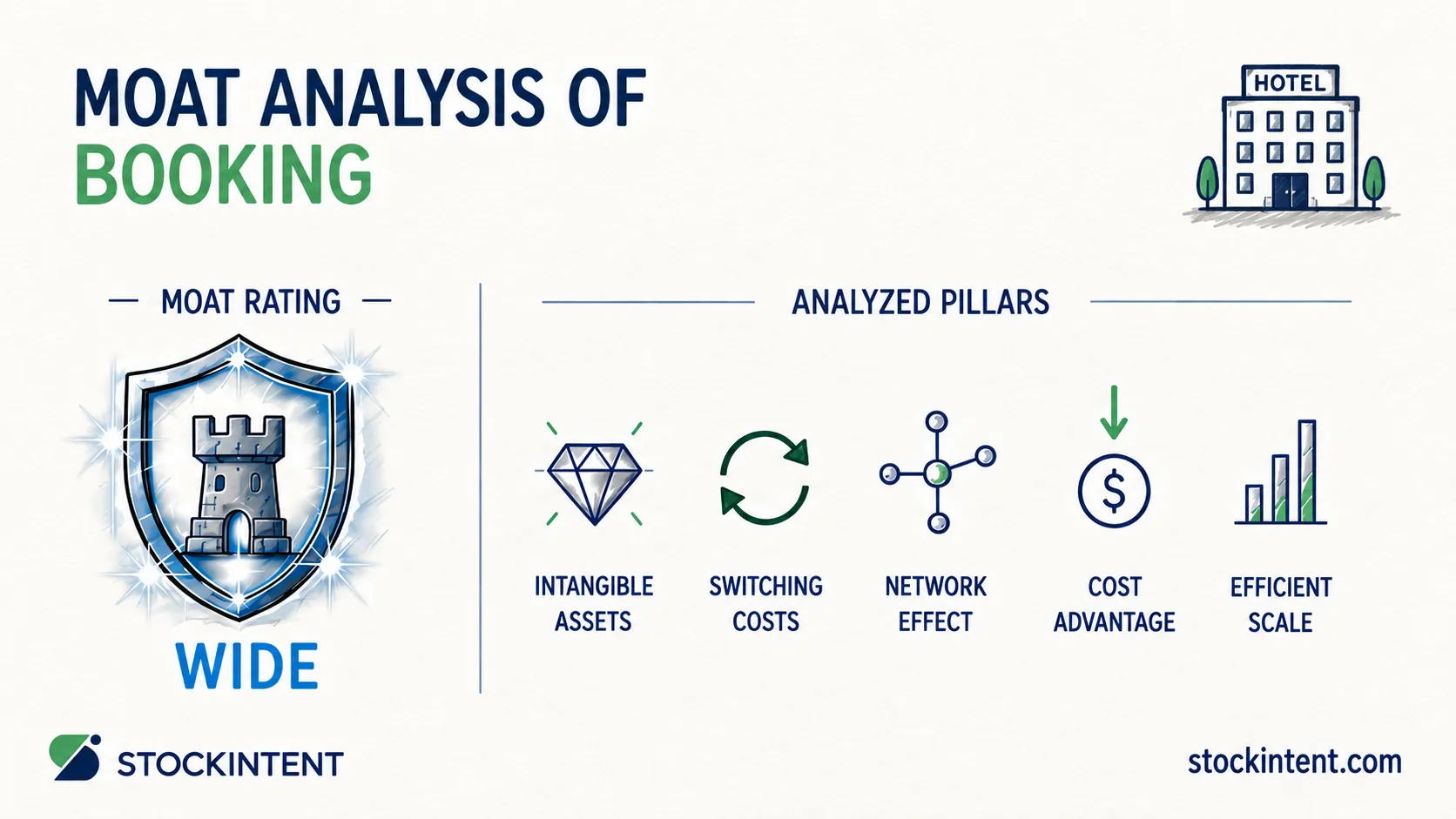
Booking Holdings earns a Wide economic moat rating with a Stable trend and Medium uncertainty. As an online travel marketplace, its competitive position rests on supply-side liquidity and immense operating leverage rather than consumer lock-in.
Here are the four core takeaways on Booking's business quality as of 2026:
Evaluating moat durability is essential for long-term investors because economic profit hinges on whether a company can defend high returns on capital over multiple decades.
To understand business quality, we look through the lens of durable competitive advantages rather than cheap multiples. A wonderful business compounding capital at high rates outperforms a mediocre business bought at a bargain. For Booking Holdings, assessing durability requires walking through the five traditional economic moat sources: network effects, cost advantage, intangible assets, switching costs, and efficient scale.
Booking's core advantage stems from its global accommodation marketplace, which spans 2.5 million properties. This breadth powers a self-reinforcing flywheel: extensive property listings attract global travelers, and concentrated traveler demand compels hotels to list their inventory. According to CSI Market, Booking captured 35.9% market share in Q1 2026, well ahead of Expedia at 19.7% and Airbnb at 14.5%. This scale deepens liquidity, though multi-homing prevents it from becoming a winner-take-all monopoly.
Marketing scale creates Booking's most concrete cost edge. The company processes massive transaction volumes, allowing it to spread performance advertising and technology investments across a huge revenue base. Competitors must outbid Booking on paid search channels just to capture similar inventory. Furthermore, the management's transformation program increased expected annual run-rate savings to approximately $650 million in 2026, reinforcing structural margin advantages.
Recognized global brands like Booking.com, Priceline, and Agoda provide consistent top-of-funnel traffic and trust. Beyond brand equity, Booking leverages decades of proprietary traveler intent data and conversion algorithms. These assets optimize personalized search results and pricing display, supporting direct consumer traffic and directly increasing returns.
Pro Insight: Booking's moat is strongest in network effects and cost advantage, but efficient scale is the weakest pillar. Many investors miss this distinction when assuming market leadership makes a platform unbeatable. The global travel sector remains contestable despite Booking's 35.9% market share, and multi-homing behavior limits genuine consumer lock-in.
Switching costs provide modest friction rather than impenetrable barriers. Saved payment details, loyalty features, and interface familiarity encourage consumers to return. For hoteliers, software integration and revenue reliance make leaving inconvenient. Still, consumers compare multiple platforms within seconds, and hotels list across competing channels, keeping true switching friction moderate to low.
Efficient scale occurs when a limited market size discourages rational entrants. Online travel does not fit this description. The worldwide travel industry represents a multi-trillion-dollar contestable market with continuous entry from independent hotel portals, short-term rentals, and regional aggregators. Scale creates operational leverage for Booking, but it does not prevent new platforms from attempting to enter.
In short, Booking's wide moat relies on two load-bearing pillars: marketplace network effects and scale-driven cost advantages. Brand intangibles and modest switching frictions support the moat, while efficient scale plays virtually no defensive role.
A company's economic moat is only as credible as the financial results it produces. For Booking Holdings, two-sided network liquidity and marketing scale translate directly into exceptional operating cash generation and sustained pricing leverage.
In FY2025, Booking reported $26.9 billion in revenue and $9.9 billion in adjusted EBITDA. That momentum continued into 2026. According to Quartr's Q2 2026 earnings report, gross bookings increased 9% while revenue grew 8% year-over-year. During that quarter, adjusted EBITDA margin expanded by approximately 40 basis points to reach 36.7%. Our interpretation is that this profitability confirms genuine pricing power, supported by third-party research from FactorsToday showing Booking commands a consistent take-rate premium over Expedia.
Immense operating leverage enables substantial shareholder returns. In Q2 2026, Booking executed $4.1 billion in total capital returns, featuring $3.7 billion in share buybacks and $400 million in dividends funded by trailing twelve-month free cash flow of $10.4 billion.
Yet wide moats do not insulate businesses from volatility. Despite top-line expansion, Booking reported an 8% decline in GAAP net income for 2025 due to shifts in tax provisions and investment timing. A great reminder that moats protect excess returns on capital over full economic cycles, but they do not eliminate quarter-to-quarter earnings fluctuations.
Our verdict on Booking Holdings's moat trend is Stable. The business possesses clear reinforcing strengths, but meaningful structural counterweights keep the moat from decisively widening.
Several forces are actively reinforcing Booking's competitive position. Customer loyalty is deepening through the connected-trip initiative, which links stays, flights, and ground transport into a single checkout. According to CX Dive, Level 2 and Level 3 Genius members represented over 30% of active customers and accounted for a high-50% share of room nights in 2026. These higher-tier travelers book earlier and visit directly more often. To protect this lead, Booking announced a planned $700 million reinvestment in 2026 targeting artificial intelligence, connected trips, and loyalty enhancements. Morningstar explicitly highlighted this favorable AI execution when upgrading the company's moat rating.
Opposing forces prevent the moat from widening further. Under the European Union Digital Markets Act, Booking was forced to abandon broad rate-parity clauses, as documented in an analysis by FinancialContent. This change gives European hotels greater pricing flexibility to encourage direct consumer reservations. Simultaneously, large hotel chains are deploying autonomous search tools. For example, PhocusWire reported that IHG is piloting Google agentic AI booking tools to steer travelers straight to hotel websites. Over time, independent AI assistants could bypass traditional travel aggregators altogether.
Investors tracking this tug-of-war should monitor four forward-looking operational indicators:
You can set up a StockIntent watchlist to organize peer comparisons and monitor these quarterly operating metrics as new earnings filings arrive.
We assign Booking Holdings an Uncertainty Rating of Medium. While its two-sided network advantage is structurally durable, the travel industry carries inherent macro cyclicality and emerging technological risks that widen the range of future outcomes.
A common mistake among self-directed investors is equating a Wide moat rating with low risk or immune share prices. An economic moat defends return on invested capital over time, but it does not protect quarterly earnings against consumer discretionary downturns. In April 2026, for instance, management lowered its annual revenue-growth forecast to high single digits from low double digits after regional instability in the Middle East disrupted international travel demand, as reported by Reuters. Geopolitics, foreign exchange fluctuations, and flight cancellations directly influence booking volumes regardless of platform scale.
Three primary drivers explain this Medium uncertainty score:
Booking operates with high margins and an asset-light model, which keeps balance sheet risk low. Still, exposure to macro travel cycles and potential distribution shifts gives it a moderate spread of plausible business outcomes over the next three to five years.
Booking Holdings commands a Wide economic moat with a Stable trend and Medium uncertainty. That verdict reflects the immense cash-generative power of its two-sided network effects and scale-driven marketing advantages, which delivered adjusted EBITDA margins near 36.7% and trailing twelve-month free cash flow of $10.4 billion.
For investors monitoring the durability of this business, valuation multiples take a back seat to competitive mechanics. Two pivotal dynamics will shape the company's trajectory from here:
First, can connected-trip features and Genius loyalty expansion grow direct demand faster than hotel direct initiatives and emerging AI assistants chip away at intermediation? Second, will regulatory scrutiny under Europe's Digital Markets Act steadily compress take rates over the next several years?
Keep an eye on the four operational indicators outlined above: direct booking mix, connected-trip bundling, take-rate spreads, and regional market share. As long as those metrics hold steady, Booking's high-return marketplace model should remain well protected against competitive pressure.
This content is for informational or educational purposes and is not investment advice.
Booking Holdings earns a Wide economic moat rating with a Stable trend and Medium uncertainty. As an online travel marketplace, its competitive position rests on supply-side liquidity and immense operating leverage rather than consumer lock-in.
Here are the four core takeaways on Booking's business quality as of 2026:
Evaluating moat durability is essential for long-term investors because economic profit hinges on whether a company can defend high returns on capital over multiple decades.
To understand business quality, we look through the lens of durable competitive advantages rather than cheap multiples. A wonderful business compounding capital at high rates outperforms a mediocre business bought at a bargain. For Booking Holdings, assessing durability requires walking through the five traditional economic moat sources: network effects, cost advantage, intangible assets, switching costs, and efficient scale.
Booking's core advantage stems from its global accommodation marketplace, which spans 2.5 million properties. This breadth powers a self-reinforcing flywheel: extensive property listings attract global travelers, and concentrated traveler demand compels hotels to list their inventory. According to CSI Market, Booking captured 35.9% market share in Q1 2026, well ahead of Expedia at 19.7% and Airbnb at 14.5%. This scale deepens liquidity, though multi-homing prevents it from becoming a winner-take-all monopoly.
Marketing scale creates Booking's most concrete cost edge. The company processes massive transaction volumes, allowing it to spread performance advertising and technology investments across a huge revenue base. Competitors must outbid Booking on paid search channels just to capture similar inventory. Furthermore, the management's transformation program increased expected annual run-rate savings to approximately $650 million in 2026, reinforcing structural margin advantages.
Recognized global brands like Booking.com, Priceline, and Agoda provide consistent top-of-funnel traffic and trust. Beyond brand equity, Booking leverages decades of proprietary traveler intent data and conversion algorithms. These assets optimize personalized search results and pricing display, supporting direct consumer traffic and directly increasing returns.
Pro Insight: Booking's moat is strongest in network effects and cost advantage, but efficient scale is the weakest pillar. Many investors miss this distinction when assuming market leadership makes a platform unbeatable. The global travel sector remains contestable despite Booking's 35.9% market share, and multi-homing behavior limits genuine consumer lock-in.
Switching costs provide modest friction rather than impenetrable barriers. Saved payment details, loyalty features, and interface familiarity encourage consumers to return. For hoteliers, software integration and revenue reliance make leaving inconvenient. Still, consumers compare multiple platforms within seconds, and hotels list across competing channels, keeping true switching friction moderate to low.
Efficient scale occurs when a limited market size discourages rational entrants. Online travel does not fit this description. The worldwide travel industry represents a multi-trillion-dollar contestable market with continuous entry from independent hotel portals, short-term rentals, and regional aggregators. Scale creates operational leverage for Booking, but it does not prevent new platforms from attempting to enter.
In short, Booking's wide moat relies on two load-bearing pillars: marketplace network effects and scale-driven cost advantages. Brand intangibles and modest switching frictions support the moat, while efficient scale plays virtually no defensive role.
A company's economic moat is only as credible as the financial results it produces. For Booking Holdings, two-sided network liquidity and marketing scale translate directly into exceptional operating cash generation and sustained pricing leverage.
In FY2025, Booking reported $26.9 billion in revenue and $9.9 billion in adjusted EBITDA. That momentum continued into 2026. According to Quartr's Q2 2026 earnings report, gross bookings increased 9% while revenue grew 8% year-over-year. During that quarter, adjusted EBITDA margin expanded by approximately 40 basis points to reach 36.7%. Our interpretation is that this profitability confirms genuine pricing power, supported by third-party research from FactorsToday showing Booking commands a consistent take-rate premium over Expedia.
Immense operating leverage enables substantial shareholder returns. In Q2 2026, Booking executed $4.1 billion in total capital returns, featuring $3.7 billion in share buybacks and $400 million in dividends funded by trailing twelve-month free cash flow of $10.4 billion.
Yet wide moats do not insulate businesses from volatility. Despite top-line expansion, Booking reported an 8% decline in GAAP net income for 2025 due to shifts in tax provisions and investment timing. A great reminder that moats protect excess returns on capital over full economic cycles, but they do not eliminate quarter-to-quarter earnings fluctuations.
Our verdict on Booking Holdings's moat trend is Stable. The business possesses clear reinforcing strengths, but meaningful structural counterweights keep the moat from decisively widening.
Several forces are actively reinforcing Booking's competitive position. Customer loyalty is deepening through the connected-trip initiative, which links stays, flights, and ground transport into a single checkout. According to CX Dive, Level 2 and Level 3 Genius members represented over 30% of active customers and accounted for a high-50% share of room nights in 2026. These higher-tier travelers book earlier and visit directly more often. To protect this lead, Booking announced a planned $700 million reinvestment in 2026 targeting artificial intelligence, connected trips, and loyalty enhancements. Morningstar explicitly highlighted this favorable AI execution when upgrading the company's moat rating.
Opposing forces prevent the moat from widening further. Under the European Union Digital Markets Act, Booking was forced to abandon broad rate-parity clauses, as documented in an analysis by FinancialContent. This change gives European hotels greater pricing flexibility to encourage direct consumer reservations. Simultaneously, large hotel chains are deploying autonomous search tools. For example, PhocusWire reported that IHG is piloting Google agentic AI booking tools to steer travelers straight to hotel websites. Over time, independent AI assistants could bypass traditional travel aggregators altogether.
Investors tracking this tug-of-war should monitor four forward-looking operational indicators:
You can set up a StockIntent watchlist to organize peer comparisons and monitor these quarterly operating metrics as new earnings filings arrive.
We assign Booking Holdings an Uncertainty Rating of Medium. While its two-sided network advantage is structurally durable, the travel industry carries inherent macro cyclicality and emerging technological risks that widen the range of future outcomes.
A common mistake among self-directed investors is equating a Wide moat rating with low risk or immune share prices. An economic moat defends return on invested capital over time, but it does not protect quarterly earnings against consumer discretionary downturns. In April 2026, for instance, management lowered its annual revenue-growth forecast to high single digits from low double digits after regional instability in the Middle East disrupted international travel demand, as reported by Reuters. Geopolitics, foreign exchange fluctuations, and flight cancellations directly influence booking volumes regardless of platform scale.
Three primary drivers explain this Medium uncertainty score:
Booking operates with high margins and an asset-light model, which keeps balance sheet risk low. Still, exposure to macro travel cycles and potential distribution shifts gives it a moderate spread of plausible business outcomes over the next three to five years.
Booking Holdings commands a Wide economic moat with a Stable trend and Medium uncertainty. That verdict reflects the immense cash-generative power of its two-sided network effects and scale-driven marketing advantages, which delivered adjusted EBITDA margins near 36.7% and trailing twelve-month free cash flow of $10.4 billion.
For investors monitoring the durability of this business, valuation multiples take a back seat to competitive mechanics. Two pivotal dynamics will shape the company's trajectory from here:
First, can connected-trip features and Genius loyalty expansion grow direct demand faster than hotel direct initiatives and emerging AI assistants chip away at intermediation? Second, will regulatory scrutiny under Europe's Digital Markets Act steadily compress take rates over the next several years?
Keep an eye on the four operational indicators outlined above: direct booking mix, connected-trip bundling, take-rate spreads, and regional market share. As long as those metrics hold steady, Booking's high-return marketplace model should remain well protected against competitive pressure.
This content is for informational or educational purposes and is not investment advice.