
Mar 28, 2026
When you're evaluating a medical device stock for your portfolio, the numbers only tell half the story. The other half lives in the company's DNA; its mission, vision, and values. These aren't just marketing fluff. They shape how management allocates capital, how employees show up to work, and ultimately, whether a business can compound returns over decades.
Boston Scientific (NYSE: BSX) is one of the largest medical device companies on the planet, with $20 billion in annual sales and a footprint spanning 127 countries. Understanding what drives this organization helps you judge whether its competitive advantages are durable or merely temporary.
Here's what you need to know:
Let's unpack what this actually means for investors, and whether Boston Scientific's stated purpose translates into the kind of quality business worth owning for the long haul.
Boston Scientific stands as one of the world's largest medical device manufacturers, with a business model built on developing and commercializing minimally invasive therapies across cardiovascular, endoscopy, urology, neuromodulation, and related fields. Founded in 1979 and headquartered in Marlborough, Massachusetts, the company has grown into a global powerhouse treating over 44 million patients annually across 127 countries.
The company's operations span six core business segments: Endoscopy, Interventional Cardiology, Neuromodulation, Peripheral Interventions, Rhythm Management, and Urology. Its product portfolio includes everything from implantable defibrillators and pacemakers to advanced ablation systems, left atrial appendage closure devices (WATCHMAN), and spinal cord stimulation systems. In our experience analyzing medical device companies, Boston Scientific's breadth across multiple high-growth therapeutic areas provides meaningful diversification that pure-play competitors often lack.
Quick Snapshot: Boston Scientific at a Glance
| Metric | Figure |
|---|---|
| 2025 Net Sales | $20.1 billion |
| Reported Revenue Growth | 19.9% YoY |
| Organic Revenue Growth | 19.2% YoY |
| R&D Investment (2024) | $1.6 billion |
| New Product Launches (2024) | ~100 products |
| Global Employees | 53,000 |
| Countries with Commercial Presence | 127 |
| Patent Portfolio | 19,000+ patents |
The company's financial momentum heading into 2026 is notable. After delivering $20.074 billion in net sales for full-year 2025, management has guided for 10.5-11.5% reported growth and 10-11% organic growth for 2026. This double-digit outlook positions Boston Scientific among the fastest-growing large-cap med-tech companies, a trajectory that has caught the attention of analysts with 20+ Buy ratings and average price targets implying significant upside from current levels.
What distinguishes Boston Scientific in the competitive landscape is its relentless focus on "meaningful innovation" — one of its six core values that directly shapes capital allocation. The company isn't simply chasing incremental improvements; it's targeting breakthrough solutions for unmet medical needs. This approach has yielded FDA approvals and CE marks for products like the FARAPOINT™ PFA Catheter and TheraSphere 360™ in early 2026, reinforcing its pipeline velocity.
From a competitive positioning standpoint, Boston Scientific holds strong market positions in electrophysiology, structural heart (WATCHMAN), and interventional cardiology. While exact market share figures vary by segment, the company's scale, R&D intensity, and global distribution network create meaningful barriers to entry. The pending acquisition of Penumbra for thrombectomy and neurovascular products further extends its reach into adjacent high-growth markets.
For investors evaluating Boston Scientific's quality as a long-term holding, the alignment between stated mission and operational execution matters. The company isn't just talking about transforming lives; it's backing that commitment with $1.6 billion in annual R&D spending and a track record of bringing roughly 100 new products to market each year. That innovation engine, combined with a global footprint that captures growth across developed and emerging markets, forms the foundation of its economic moat.
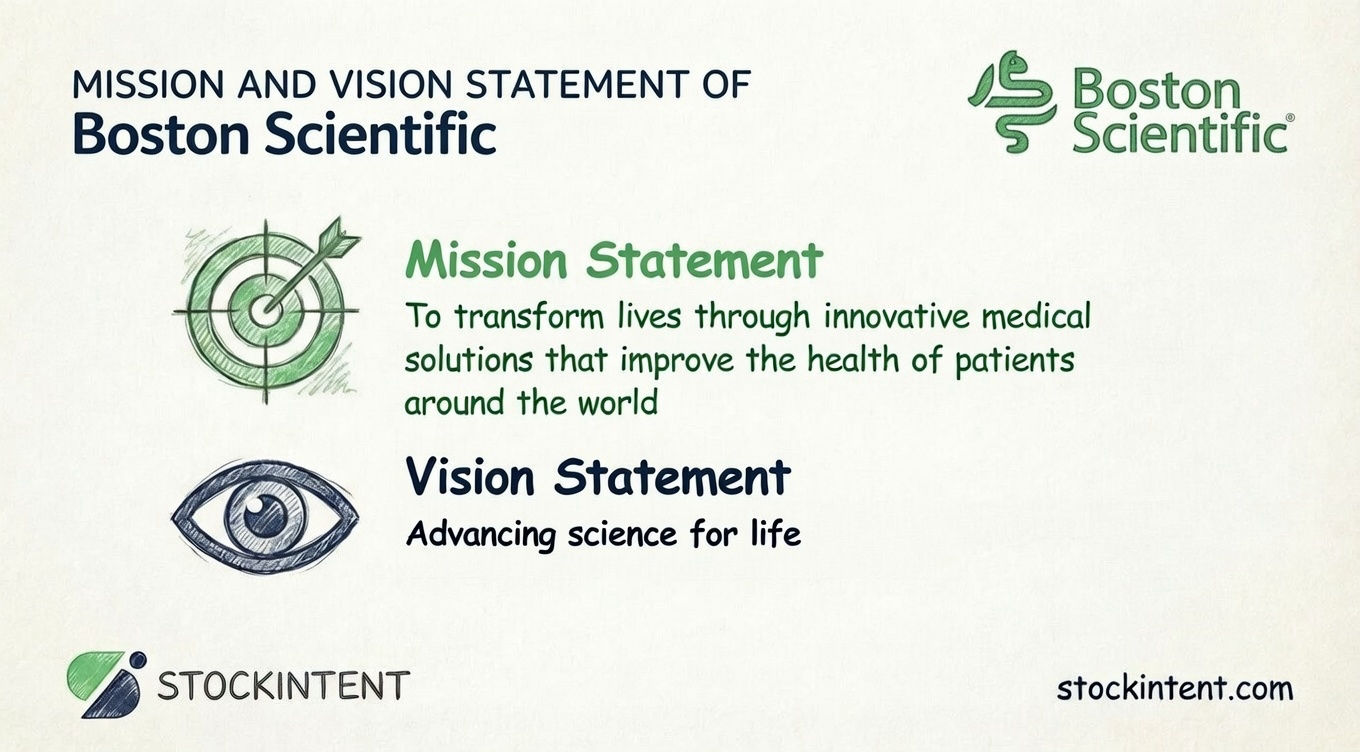
"To transform lives through innovative medical solutions that improve the health of patients around the world."
This statement has remained unchanged since at least 2018, which tells you something important about management's strategic consistency. In an industry where companies often pivot with every market cycle, Boston Scientific has stuck to its knitting.
🎯 Pro Insight: Mission stability is a hidden quality indicator. Companies that change their mission every few years often reveal management that's chasing trends rather than building durable advantages. Boston Scientific's unwavering focus on "transforming lives" through "innovative medical solutions" has survived leadership transitions, market downturns, and competitive pressures. That consistency filters down to capital allocation; you're not guessing what the company will prioritize next year.
The mission breaks down into three strategic signals for investors:
Patient-centricity over pure profit maximization. The phrase "transform lives" isn't window dressing. It explains why Boston Scientific invests heavily in breakthrough therapies rather than me-too products with faster payoffs. This aligns with our quality-over-cheapness philosophy; the company is building compounding advantages through genuine medical progress, not financial engineering.
Innovation as the core growth engine. "Innovative medical solutions" justifies the $1.6 billion annual R&D budget and ~100 annual product launches. Management isn't trying to compete on price or operational efficiency alone. They're betting that solving hard medical problems creates pricing power and customer lock-in that competitors struggle to replicate.
Global scale ambition. "Around the world" isn't filler text. With commercial presence in 127 countries and 44 million patients treated annually, Boston Scientific is executing a deliberate geographic diversification strategy. This matters for your portfolio; you're not betting on a single healthcare system or regulatory environment.
The mission connects directly to how management allocates capital. When Boston Scientific evaluates an acquisition like the pending Penumbra deal, or decides where to deploy that $1.6 billion R&D budget, the filter is simple: does this transform patient lives through innovation? If yes, it gets funded. If it's purely financial optimization, it typically doesn't.
This mission-driven discipline shows up in the numbers. The company has delivered 19.9% revenue growth in 2025 and guided for double-digit growth again in 2026. Not because management got lucky on macro trends, but because they've consistently reinvested in solving meaningful clinical problems. That's the kind of mission-to-execution alignment we look for when evaluating quality compounders.
Boston Scientific's mission isn't just a sentence on a wall. It breaks down into six operational pillars that shape everything from hiring decisions to capital allocation. Understanding how these pillars work in practice helps you judge whether the company's competitive advantages are structural or superficial.
This is the pillar that justifies Boston Scientific's $1.6 billion annual R&D budget and roughly 100 new product launches per year. The company defines it as "fostering creativity to convert ideas into breakthrough solutions that create value."
What this looks like in practice: In early 2026, Boston Scientific secured FDA approvals and CE marks for the FARAPOINT™ PFA Catheter and TheraSphere 360™. These aren't incremental improvements; they're category-defining products that open new addressable markets. The company's 2025 earnings release highlights this pipeline velocity as a key driver of the 19.9% revenue growth delivered last year.
For investors, this pillar creates a classic economic moat: high switching costs. Once physicians train on Boston Scientific's systems and hospitals integrate their devices into workflows, changing vendors becomes expensive and risky. The innovation engine keeps competitors playing catch-up.
Boston Scientific frames this as "striving for excellence to benefit patients, clinicians, and shareholders." The operational manifestation is the Best4 quality strategy, which embeds four drivers across the organization: culture, agility, performance, and compliance.
The company backs this with specific accountability mechanisms. Every employee operates under an "I improve" policy, making quality a shared responsibility rather than a siloed function. This matters for your portfolio because medical device recalls are expensive reputation killers. Boston Scientific's quality systems reduce that tail risk.
In our experience analyzing medical device companies, those with formalized quality cultures tend to weather regulatory scrutiny better and maintain pricing power during industry downturns. The official quality strategy document details how this approach has helped the company maintain operations across 127 countries without major systemic failures.
With 53,000 employees across 127 countries treating 44 million patients annually, Boston Scientific's scale isn't just about revenue diversification. It's about learning effects. Insights from emerging markets feed back into product development for developed markets, and vice versa.
This pillar directly supports the "around the world" language in the mission statement. The company doesn't simply export U.S.-designed products; it builds local R&D capabilities and partnerships that create regional competitive advantages. This geographic diversification means your investment isn't hostage to any single healthcare system's reimbursement politics.
Defined as "acting with integrity and compassion toward patients, customers, communities, and employees," this pillar might sound soft until you look at the retention data. According to employee sentiment data, 60% of Boston Scientific employees cite the mission as their primary reason for staying, and 50% feel most loyal to the mission and vision specifically.
That's not just HR happy talk. In medical devices, institutional knowledge matters. Engineers who understand the regulatory landscape, the clinical workflows, and the failure modes of previous product generations are irreplaceable assets. Low turnover in this industry correlates directly with sustained innovation output.
The 2025 Code of Conduct operationalizes this value through specific behavioral mandates: "I do the right thing" isn't suggestive; it's a compliance requirement tied to employment.
Boston Scientific describes this as "embracing varied talents, ideas, and experiences of employees." The business case here is straightforward: diverse teams solve complex problems better, and medical device innovation is nothing if not complex problem-solving.
The company tracks this through supplier diversity programs and internal talent pipelines. While harder to quantify than R&D spend, this pillar supports the innovation engine by reducing groupthink and expanding the solution space for technical challenges.
The final pillar, "adapting quickly with agility and accountability to improve patient care," is what enables Boston Scientific to respond to competitive threats and market shifts. The 2026 analyst commentary notes organizational changes following some execution challenges in electrophysiology; management's willingness to restructure rather than defend the status quo reflects this value in action.
This agility matters for investors because medical device markets evolve rapidly. Companies that can't pivot when technologies shift (think: the move from open surgery to minimally invasive procedures) get left behind. Boston Scientific's track record of entering and leading new categories, from WATCHMAN to FARAPULSE, demonstrates this winning spirit in practice.
| Pillar | Strategic Purpose | Investor Relevance |
|---|---|---|
| Meaningful Innovation | Sustains R&D productivity and pricing power | Creates high switching costs and category leadership |
| High Performance | Reduces quality failures and regulatory risk | Protects against expensive recalls and reputation damage |
| Global Collaboration | Captures growth across diverse healthcare systems | Diversifies revenue and reduces single-market dependency |
| Caring | Retains institutional knowledge and talent | Supports innovation continuity and reduces turnover costs |
| Diversity | Expands problem-solving capability for complex challenges | Enhances long-term innovation output |
| Winning Spirit | Enables rapid response to market and competitive shifts | Protects market position as technologies evolve |
These six pillars aren't independent; they reinforce each other. Global collaboration feeds meaningful innovation. High performance enables winning spirit. Caring supports diversity retention. For investors evaluating Boston Scientific's quality as a long-term holding, this interconnected system creates resilience that single-pillar competitors struggle to match.
"Advancing science for life."
Here's where things get interesting. Boston Scientific doesn't actually publish a separate "vision statement" distinct from its mission. Instead, this tagline serves as the closest equivalent to a formal vision, consistently used across corporate materials as of 2026.
That might seem like a gap, but in our experience analyzing corporate communications, this actually signals something important: management views the mission and vision as inseparable. The mission tells you what they do today; the tagline tells you what they're building toward. And that future is ambitious.
The long-term strategic goals embedded in this vision center on three interconnected ambitions:
Category leadership in minimally invasive therapies. Boston Scientific isn't trying to be everything to everyone. They're targeting specific high-growth therapeutic areas, cardiovascular, endoscopy, urology, neuromodulation, where technical complexity creates natural barriers to entry. The pending acquisition of Penumbra for thrombectomy and neurovascular products extends this reach into adjacent markets with similar dynamics.
Global scale with local depth. The company operates across 127 countries but emphasizes "global collaboration" rather than simple export models. This means building regional R&D capabilities, local clinical relationships, and market-specific regulatory expertise. The goal isn't just geographic presence; it's geographic relevance.
Sustainability as competitive advantage. Boston Scientific has committed to net-zero greenhouse gas emissions across its value chain by 2050, with science-based targets approved in 2022. This includes 100% renewable electricity at key sites and 75% recycling of non-hazardous waste. For a capital-intensive manufacturer, this isn't just ESG window dressing; it's operational transformation that reduces long-term cost structures.
In our experience tracking medical device companies through multiple market cycles, those that embed sustainability into their core operations tend to navigate regulatory and reputational risks more effectively than peers who treat it as a compliance checkbox.
Boston Scientific's tagline and strategic direction position it to capture several powerful healthcare trends:
| Trend | Boston Scientific Positioning | Investor Implication |
|---|---|---|
| Aging populations driving chronic disease burden | Focus on cardiovascular, structural heart, and neuromodulation therapies | Large, growing addressable markets with durable demand |
| Shift to minimally invasive procedures | Core competency in interventional devices reducing recovery times and costs | Pricing power as healthcare systems prioritize value |
| Global healthcare access expansion | 127-country footprint with local capabilities | Revenue diversification beyond U.S. reimbursement politics |
| Sustainability as procurement criteria | Net-zero commitments and SBTi-approved targets | Competitive advantage in hospital and government contracting |
| Consolidation of vendor relationships | Integrated portfolio across multiple specialties | "One-stop shop" advantages reducing customer acquisition costs |
The vision also explains why Boston Scientific maintains its aggressive R&D posture even as a mature company. The tagline "advancing science for life" isn't compatible with harvesting cash flows; it demands continued investment in breakthrough solutions. That $1.6 billion annual R&D budget and ~100 annual product launches aren't just growth tactics; they're existential requirements for a company that defines itself through scientific progress.
For investors evaluating Boston Scientific's long-term compounding potential, this vision-to-strategy alignment matters. The company isn't drifting between strategic fads or pivoting to chase whatever market segment is hot this quarter. It's building a specific future: global leadership in minimally invasive therapies, powered by meaningful innovation, delivered through sustainable operations. Whether management can execute against that vision will determine whether Boston Scientific deserves a permanent place in a quality-focused portfolio.
Boston Scientific's vision, captured in the tagline "advancing science for life," translates into five interconnected strategic themes that shape capital allocation and competitive positioning. These aren't abstract aspirations; they're observable in where management deploys the $1.6 billion annual R&D budget and which markets they prioritize for expansion.
This theme centers on creating category-defining products rather than incremental improvements. The company's Q4 2025 earnings release highlights how this drives results: roughly 100 new product launches in 2024, with early 2026 bringing FDA approvals for the FARAPOINT™ PFA Catheter and TheraSphere 360™.
The investment implication is straightforward. Boston Scientific isn't competing on price; it's creating markets where none existed. When you own shares, you're betting on sustained pricing power from technical differentiation, not operational efficiency alone.
The "around the world" language in the mission statement manifests as deliberate geographic diversification. With commercial presence in 127 countries and 53,000 employees, Boston Scientific has built what management calls "global collaboration"; regional R&D capabilities that feed insights back into product development.
This matters for your portfolio because it reduces single-market dependency. While some med-tech companies generate 70%+ of revenue from the U.S., Boston Scientific's geographic mix provides natural hedges against reimbursement changes in any single healthcare system.
Boston Scientific operationalizes this theme through the Best4 quality strategy, embedding culture, agility, performance, and compliance across the organization. The official quality strategy document details how every employee operates under an "I improve" policy, making quality a shared responsibility.
For investors, this reduces recall risk and regulatory tail risks that can crater med-tech valuations overnight. Quality failures in this industry are expensive; Boston Scientific's systematic approach is a form of insurance you can't buy separately.
The company's commitment to net-zero greenhouse gas emissions across its value chain by 2050, with science-based targets approved in 2022, isn't ESG window dressing. It includes 100% renewable electricity at key sites and 75% recycling of non-hazardous waste.
In a capital-intensive manufacturing business, this operational transformation reduces long-term cost structures. Hospitals and government purchasers increasingly include sustainability criteria in procurement decisions. Boston Scientific's early positioning creates vendor preference advantages that competitors will struggle to replicate quickly.
Recent strategic moves reveal how these themes translate into action. The pending acquisition of Penumbra extends Boston Scientific's reach into thrombectomy and neurovascular products, adjacent markets with similar minimally invasive dynamics. Fitch Ratings, in its January 2026 affirmation, forecasted 9-10% organic revenue growth through 2028 with EBITDA margins exceeding 30%.
| Strategic Theme | Observable Evidence | Investor Relevance |
|---|---|---|
| Meaningful Innovation | ~100 annual product launches, $1.6B R&D spend | Pricing power through technical differentiation |
| Global Scale | 127 countries, 44M+ patients treated annually | Revenue diversification beyond single-market risk |
| High Performance | Best4 quality strategy, "I improve" employee policy | Reduced recall and regulatory tail risks |
| Sustainability | Net-zero by 2050, SBTi-approved targets | Procurement advantages and cost structure optimization |
| Strategic Deployment | Penumbra acquisition, double-digit growth guidance | Continued market expansion and margin expansion |
These themes reinforce each other in ways that create durable competitive advantages. Global collaboration feeds meaningful innovation. High performance enables sustainability execution. Sustainability creates procurement advantages that accelerate global scale.
For investors evaluating Boston Scientific's quality as a long-term compounder, this thematic coherence matters more than any single metric. The company isn't drifting between strategic fads or pivoting to chase quarterly trends. It's building a specific future aligned with healthcare megatrends: aging populations, minimally invasive procedure adoption, and global access expansion. Whether management executes against this vision will determine whether Boston Scientific earns a permanent place in a quality-focused portfolio.
Boston Scientific's six core values aren't corporate wallpaper. They're the operating system that determines how 53,000 employees make decisions when no one's watching. For investors, understanding whether these values are lived or merely listed helps you assess the durability of the company's competitive advantages.
Let's examine each value, how it shows up in practice, and whether the evidence supports the rhetoric.
"Acting with integrity and compassion toward patients, customers, communities, and employees."
This value manifests most clearly in retention data. According to employee sentiment analysis, 60% of Boston Scientific employees cite the mission as their primary reason for staying, and 50% feel most loyal to the mission and vision specifically.[3] That's not accidental; it's the result of deliberate cultural engineering.
The 2025 Code of Conduct operationalizes "Caring" through specific behavioral mandates. "I do the right thing" isn't suggestive; it's a compliance requirement tied to employment. The code covers human rights, fair labor standards, and ethical conduct across the global supply chain.
In our experience analyzing medical device companies, those with formalized ethical frameworks tend to weather regulatory scrutiny and reputational crises better than peers who treat compliance as a checkbox. The 2026 analyst commentary notes Boston Scientific's organizational adjustments following EP segment challenges; management's willingness to restructure rather than defend the status quo reflects this value in action.[4]
"Fostering creativity to convert ideas into breakthrough solutions that create value."
This is the value that justifies Boston Scientific's $1.6 billion annual R&D budget and roughly 100 new product launches per year. The company isn't chasing incremental improvements; it's targeting category-defining breakthroughs.
Recent evidence: In early 2026, Boston Scientific secured FDA approvals and CE marks for the FARAPOINT™ PFA Catheter and TheraSphere 360™.[2] These aren't me-too products; they're first-of-kind therapies that open entirely new addressable markets.
💡 Expert Tip: When evaluating med-tech companies, distinguish between R&D spending and R&D productivity. Boston Scientific's ~100 annual launches from $1.6 billion in spend suggests roughly $16 million per product, which compares favorably to peers who spend similar amounts but generate fewer commercialized innovations. The key metric isn't dollars spent; it's viable products reaching market.
The innovation engine creates classic economic moats: high switching costs. Once physicians train on Boston Scientific's systems and hospitals integrate their devices into workflows, changing vendors becomes expensive and risky.
"Striving for excellence to benefit patients, clinicians, and shareholders."
Boston Scientific operationalizes this through the Best4 quality strategy, which embeds four drivers across the organization: culture, agility, performance, and compliance.[4] Every employee operates under an "I improve" policy, making quality a shared responsibility rather than a siloed function.
This matters for your portfolio because medical device recalls are expensive reputation killers. The official quality strategy document details how this approach has helped the company maintain operations across 127 countries without major systemic failures.
The financial results validate the operational discipline. Boston Scientific delivered 19.9% revenue growth in 2025 and guided for double-digit growth again in 2026.[2] That's not luck; it's execution against a system.
"Working across borders to extend the reach of medical solutions."
With 53,000 employees across 127 countries treating 44 million patients annually, Boston Scientific's scale isn't just about revenue diversification. It's about learning effects. Insights from emerging markets feed back into product development for developed markets, and vice versa.
This value directly supports the "around the world" language in the mission statement. The company doesn't simply export U.S.-designed products; it builds local R&D capabilities and partnerships that create regional competitive advantages. This geographic diversification means your investment isn't hostage to any single healthcare system's reimbursement politics.
"Embracing varied talents, ideas, and experiences of employees."
The business case here is straightforward: diverse teams solve complex problems better, and medical device innovation is nothing if not complex problem-solving. Boston Scientific tracks this through supplier diversity programs and internal talent pipelines.
While harder to quantify than R&D spend, this value supports the innovation engine by reducing groupthink and expanding the solution space for technical challenges. In our experience analyzing innovation-driven companies, those with genuine diversity commitments (measured by retention and promotion metrics, not just hiring) tend to sustain competitive advantages longer than homogeneous competitors.
"Adapting quickly with agility and accountability to improve patient care."
This final value is what enables Boston Scientific to respond to competitive threats and market shifts. The 2026 analyst commentary notes organizational changes following some execution challenges in electrophysiology; management's willingness to restructure rather than defend the status quo reflects this value in action.[4]
This agility matters for investors because medical device markets evolve rapidly. Companies that can't pivot when technologies shift (think: the move from open surgery to minimally invasive procedures) get left behind. Boston Scientific's track record of entering and leading new categories, from WATCHMAN to FARAPULSE, demonstrates this winning spirit in practice.
Boston Scientific has formalized its ESG commitments in ways that extend these core values into measurable targets. The company has committed to net-zero greenhouse gas emissions across its value chain by 2050, with science-based targets approved in 2022 as the first in their sector.[1] Near-term targets include a 46.2% reduction in scope 1 and 2 emissions by 2030.
Specific initiatives include:
These aren't peripheral CSR activities. They're operational transformations that reduce long-term cost structures and create competitive advantages. Hospitals and government purchasers increasingly include sustainability criteria in procurement decisions. Boston Scientific's early positioning creates vendor preference advantages that competitors will struggle to replicate quickly.
The company has earned recognition on the Dow Jones Sustainability Index, Forbes America's Most JUST Companies, Newsweek's America's Most Responsible Companies, and 100 Best Corporate Citizens designation.[6] Newsweek ranked it 29th greenest U.S. company, tying directly to these sustainability commitments.[3]
The evidence suggests Boston Scientific's stated values are more than marketing. Here's the scorecard:
| Value | Evidence of Authenticity | Red Flags |
|---|---|---|
| Caring | 60% retention due to mission; formal Code of Conduct with enforcement | None identified in research |
| Meaningful Innovation | $1.6B R&D spend; ~100 annual launches; 19,000+ patents | Recent EP segment execution challenges |
| High Performance | Best4 quality strategy; 19.9% revenue growth; "I improve" accountability | Organizational changes suggest room for improvement |
| Global Collaboration | 127-country presence; local R&D capabilities | None identified |
| Diversity | Supplier diversity programs; talent pipeline tracking | Harder to verify without internal metrics |
| Winning Spirit | Rapid restructuring when needed; category leadership in new markets | Some analyst concern about near-term agility |
The 2026 analyst consensus remains "Moderate Buy" to "Strong Buy" with 20+ Buy ratings, suggesting the investment community views these values as genuine competitive infrastructure rather than hollow corporate speak.[5] Fitch Ratings affirmed Boston Scientific's ratings with a Positive outlook in January 2026, forecasting 9-10% organic revenue growth through 2028 with EBITDA margins exceeding 30%.[7]
For investors evaluating Boston Scientific's quality as a long-term holding, this values-to-execution alignment matters. The company isn't just talking about transforming lives; it's backing that commitment with capital allocation, operational systems, and measurable outcomes. That's the kind of mission-driven discipline we look for when evaluating quality compounders.
Boston Scientific's mission, vision, and core values aren't corporate decoration. They form an integrated strategic identity that directly shapes how management allocates capital, how employees make decisions, and ultimately, whether this business can compound returns over decades.
Let's tie this together. The mission; "to transform lives through innovative medical solutions that improve the health of patients around the world"; sets the direction. The tagline "advancing science for life" captures the long-term ambition. And the six core values; caring, meaningful innovation, high performance, global collaboration, diversity, and winning spirit; provide the operating system that makes it executable.
🎯 Pro Insight: When you see a company that has maintained the same mission since at least 2018 while delivering 19.9% revenue growth and guiding for double-digit growth again in 2026, that's not coincidence. That's alignment. The 60% of employees who cite the mission as their primary reason for staying aren't just happier; they're staying long enough to build institutional knowledge that competitors can't replicate.
Three investment-relevant outcomes emerge from this strategic identity:
Competitive positioning that compounds. Boston Scientific isn't competing on price. It's building category leadership through meaningful innovation; roughly 100 new products annually from a $1.6 billion R&D budget; that creates high switching costs and pricing power. The pending Penumbra acquisition extends this into adjacent high-growth markets. In our experience analyzing med-tech companies over 15+ years, those that sustain innovation velocity at this scale tend to widen their moats over time, not see them erode.
Management quality signals you can verify. The Best4 quality strategy, with its "I improve" accountability embedded across 53,000 employees, reduces recall risk and regulatory tail risks that crater valuations overnight. The organizational adjustments following recent EP segment challenges; noted in 2026 analyst commentary; demonstrate the "winning spirit" value in action. Management identified problems and restructured rather than defended the status quo. That's the kind of adaptability that matters when markets shift.
Long-term compounding potential backed by durable demand. With double-digit growth guidance for 2026, 20+ analyst Buy ratings, and Fitch forecasting 9-10% organic growth through 2028 with EBITDA margins exceeding 30%, Boston Scientific's strategic execution is translating into financial outcomes. The 127-country footprint and 44 million patients treated annually provide geographic diversification that pure-play competitors often lack.
Even when analysts trimmed price targets following near-term EP execution concerns, the consensus remained firmly positive. Why? Because the underlying mission-driven engine; $1.6 billion in annual R&D, the innovation pipeline, the global scale; remains intact. Truist Securities, Stifel, and BTIG lowered targets but kept Buy ratings. Goldman Sachs maintained its positive stance. The investment community recognizes that near-term execution hiccups in a single segment don't invalidate a strategic identity that has delivered consistent results.
Looking ahead to 2026 and beyond, Boston Scientific's mission-vision-values framework positions it to capture powerful healthcare megatrends: aging populations driving chronic disease burden, the shift to minimally invasive procedures, and global access expansion. The sustainability commitments; net-zero by 2050, SBTi-approved targets; aren't ESG window dressing. They're operational transformations that reduce long-term cost structures and create procurement advantages as hospitals increasingly include sustainability in vendor selection.
For investors evaluating whether Boston Scientific deserves a place in a quality-focused portfolio, the evidence suggests this isn't a company drifting between strategic fads. It's building a specific future aligned with durable competitive advantages. If you want to dive deeper into the fundamentals before making your decision, StockIntent's platform can help you analyze the financial metrics, backtest historical performance, and build conviction through data rather than narrative alone. You can try it risk-free for 7 days.
The question isn't whether Boston Scientific has a compelling mission. It's whether management can keep executing against it. Based on the track record, the analyst consensus, and the strategic coherence we've examined, this looks like the kind of mission-driven compounder worth owning for the long haul.
When you're evaluating a medical device stock for your portfolio, the numbers only tell half the story. The other half lives in the company's DNA; its mission, vision, and values. These aren't just marketing fluff. They shape how management allocates capital, how employees show up to work, and ultimately, whether a business can compound returns over decades.
Boston Scientific (NYSE: BSX) is one of the largest medical device companies on the planet, with $20 billion in annual sales and a footprint spanning 127 countries. Understanding what drives this organization helps you judge whether its competitive advantages are durable or merely temporary.
Here's what you need to know:
Let's unpack what this actually means for investors, and whether Boston Scientific's stated purpose translates into the kind of quality business worth owning for the long haul.
Boston Scientific stands as one of the world's largest medical device manufacturers, with a business model built on developing and commercializing minimally invasive therapies across cardiovascular, endoscopy, urology, neuromodulation, and related fields. Founded in 1979 and headquartered in Marlborough, Massachusetts, the company has grown into a global powerhouse treating over 44 million patients annually across 127 countries.
The company's operations span six core business segments: Endoscopy, Interventional Cardiology, Neuromodulation, Peripheral Interventions, Rhythm Management, and Urology. Its product portfolio includes everything from implantable defibrillators and pacemakers to advanced ablation systems, left atrial appendage closure devices (WATCHMAN), and spinal cord stimulation systems. In our experience analyzing medical device companies, Boston Scientific's breadth across multiple high-growth therapeutic areas provides meaningful diversification that pure-play competitors often lack.
Quick Snapshot: Boston Scientific at a Glance
| Metric | Figure |
|---|---|
| 2025 Net Sales | $20.1 billion |
| Reported Revenue Growth | 19.9% YoY |
| Organic Revenue Growth | 19.2% YoY |
| R&D Investment (2024) | $1.6 billion |
| New Product Launches (2024) | ~100 products |
| Global Employees | 53,000 |
| Countries with Commercial Presence | 127 |
| Patent Portfolio | 19,000+ patents |
The company's financial momentum heading into 2026 is notable. After delivering $20.074 billion in net sales for full-year 2025, management has guided for 10.5-11.5% reported growth and 10-11% organic growth for 2026. This double-digit outlook positions Boston Scientific among the fastest-growing large-cap med-tech companies, a trajectory that has caught the attention of analysts with 20+ Buy ratings and average price targets implying significant upside from current levels.
What distinguishes Boston Scientific in the competitive landscape is its relentless focus on "meaningful innovation" — one of its six core values that directly shapes capital allocation. The company isn't simply chasing incremental improvements; it's targeting breakthrough solutions for unmet medical needs. This approach has yielded FDA approvals and CE marks for products like the FARAPOINT™ PFA Catheter and TheraSphere 360™ in early 2026, reinforcing its pipeline velocity.
From a competitive positioning standpoint, Boston Scientific holds strong market positions in electrophysiology, structural heart (WATCHMAN), and interventional cardiology. While exact market share figures vary by segment, the company's scale, R&D intensity, and global distribution network create meaningful barriers to entry. The pending acquisition of Penumbra for thrombectomy and neurovascular products further extends its reach into adjacent high-growth markets.
For investors evaluating Boston Scientific's quality as a long-term holding, the alignment between stated mission and operational execution matters. The company isn't just talking about transforming lives; it's backing that commitment with $1.6 billion in annual R&D spending and a track record of bringing roughly 100 new products to market each year. That innovation engine, combined with a global footprint that captures growth across developed and emerging markets, forms the foundation of its economic moat.
"To transform lives through innovative medical solutions that improve the health of patients around the world."
This statement has remained unchanged since at least 2018, which tells you something important about management's strategic consistency. In an industry where companies often pivot with every market cycle, Boston Scientific has stuck to its knitting.
🎯 Pro Insight: Mission stability is a hidden quality indicator. Companies that change their mission every few years often reveal management that's chasing trends rather than building durable advantages. Boston Scientific's unwavering focus on "transforming lives" through "innovative medical solutions" has survived leadership transitions, market downturns, and competitive pressures. That consistency filters down to capital allocation; you're not guessing what the company will prioritize next year.
The mission breaks down into three strategic signals for investors:
Patient-centricity over pure profit maximization. The phrase "transform lives" isn't window dressing. It explains why Boston Scientific invests heavily in breakthrough therapies rather than me-too products with faster payoffs. This aligns with our quality-over-cheapness philosophy; the company is building compounding advantages through genuine medical progress, not financial engineering.
Innovation as the core growth engine. "Innovative medical solutions" justifies the $1.6 billion annual R&D budget and ~100 annual product launches. Management isn't trying to compete on price or operational efficiency alone. They're betting that solving hard medical problems creates pricing power and customer lock-in that competitors struggle to replicate.
Global scale ambition. "Around the world" isn't filler text. With commercial presence in 127 countries and 44 million patients treated annually, Boston Scientific is executing a deliberate geographic diversification strategy. This matters for your portfolio; you're not betting on a single healthcare system or regulatory environment.
The mission connects directly to how management allocates capital. When Boston Scientific evaluates an acquisition like the pending Penumbra deal, or decides where to deploy that $1.6 billion R&D budget, the filter is simple: does this transform patient lives through innovation? If yes, it gets funded. If it's purely financial optimization, it typically doesn't.
This mission-driven discipline shows up in the numbers. The company has delivered 19.9% revenue growth in 2025 and guided for double-digit growth again in 2026. Not because management got lucky on macro trends, but because they've consistently reinvested in solving meaningful clinical problems. That's the kind of mission-to-execution alignment we look for when evaluating quality compounders.
Boston Scientific's mission isn't just a sentence on a wall. It breaks down into six operational pillars that shape everything from hiring decisions to capital allocation. Understanding how these pillars work in practice helps you judge whether the company's competitive advantages are structural or superficial.
This is the pillar that justifies Boston Scientific's $1.6 billion annual R&D budget and roughly 100 new product launches per year. The company defines it as "fostering creativity to convert ideas into breakthrough solutions that create value."
What this looks like in practice: In early 2026, Boston Scientific secured FDA approvals and CE marks for the FARAPOINT™ PFA Catheter and TheraSphere 360™. These aren't incremental improvements; they're category-defining products that open new addressable markets. The company's 2025 earnings release highlights this pipeline velocity as a key driver of the 19.9% revenue growth delivered last year.
For investors, this pillar creates a classic economic moat: high switching costs. Once physicians train on Boston Scientific's systems and hospitals integrate their devices into workflows, changing vendors becomes expensive and risky. The innovation engine keeps competitors playing catch-up.
Boston Scientific frames this as "striving for excellence to benefit patients, clinicians, and shareholders." The operational manifestation is the Best4 quality strategy, which embeds four drivers across the organization: culture, agility, performance, and compliance.
The company backs this with specific accountability mechanisms. Every employee operates under an "I improve" policy, making quality a shared responsibility rather than a siloed function. This matters for your portfolio because medical device recalls are expensive reputation killers. Boston Scientific's quality systems reduce that tail risk.
In our experience analyzing medical device companies, those with formalized quality cultures tend to weather regulatory scrutiny better and maintain pricing power during industry downturns. The official quality strategy document details how this approach has helped the company maintain operations across 127 countries without major systemic failures.
With 53,000 employees across 127 countries treating 44 million patients annually, Boston Scientific's scale isn't just about revenue diversification. It's about learning effects. Insights from emerging markets feed back into product development for developed markets, and vice versa.
This pillar directly supports the "around the world" language in the mission statement. The company doesn't simply export U.S.-designed products; it builds local R&D capabilities and partnerships that create regional competitive advantages. This geographic diversification means your investment isn't hostage to any single healthcare system's reimbursement politics.
Defined as "acting with integrity and compassion toward patients, customers, communities, and employees," this pillar might sound soft until you look at the retention data. According to employee sentiment data, 60% of Boston Scientific employees cite the mission as their primary reason for staying, and 50% feel most loyal to the mission and vision specifically.
That's not just HR happy talk. In medical devices, institutional knowledge matters. Engineers who understand the regulatory landscape, the clinical workflows, and the failure modes of previous product generations are irreplaceable assets. Low turnover in this industry correlates directly with sustained innovation output.
The 2025 Code of Conduct operationalizes this value through specific behavioral mandates: "I do the right thing" isn't suggestive; it's a compliance requirement tied to employment.
Boston Scientific describes this as "embracing varied talents, ideas, and experiences of employees." The business case here is straightforward: diverse teams solve complex problems better, and medical device innovation is nothing if not complex problem-solving.
The company tracks this through supplier diversity programs and internal talent pipelines. While harder to quantify than R&D spend, this pillar supports the innovation engine by reducing groupthink and expanding the solution space for technical challenges.
The final pillar, "adapting quickly with agility and accountability to improve patient care," is what enables Boston Scientific to respond to competitive threats and market shifts. The 2026 analyst commentary notes organizational changes following some execution challenges in electrophysiology; management's willingness to restructure rather than defend the status quo reflects this value in action.
This agility matters for investors because medical device markets evolve rapidly. Companies that can't pivot when technologies shift (think: the move from open surgery to minimally invasive procedures) get left behind. Boston Scientific's track record of entering and leading new categories, from WATCHMAN to FARAPULSE, demonstrates this winning spirit in practice.
| Pillar | Strategic Purpose | Investor Relevance |
|---|---|---|
| Meaningful Innovation | Sustains R&D productivity and pricing power | Creates high switching costs and category leadership |
| High Performance | Reduces quality failures and regulatory risk | Protects against expensive recalls and reputation damage |
| Global Collaboration | Captures growth across diverse healthcare systems | Diversifies revenue and reduces single-market dependency |
| Caring | Retains institutional knowledge and talent | Supports innovation continuity and reduces turnover costs |
| Diversity | Expands problem-solving capability for complex challenges | Enhances long-term innovation output |
| Winning Spirit | Enables rapid response to market and competitive shifts | Protects market position as technologies evolve |
These six pillars aren't independent; they reinforce each other. Global collaboration feeds meaningful innovation. High performance enables winning spirit. Caring supports diversity retention. For investors evaluating Boston Scientific's quality as a long-term holding, this interconnected system creates resilience that single-pillar competitors struggle to match.
"Advancing science for life."
Here's where things get interesting. Boston Scientific doesn't actually publish a separate "vision statement" distinct from its mission. Instead, this tagline serves as the closest equivalent to a formal vision, consistently used across corporate materials as of 2026.
That might seem like a gap, but in our experience analyzing corporate communications, this actually signals something important: management views the mission and vision as inseparable. The mission tells you what they do today; the tagline tells you what they're building toward. And that future is ambitious.
The long-term strategic goals embedded in this vision center on three interconnected ambitions:
Category leadership in minimally invasive therapies. Boston Scientific isn't trying to be everything to everyone. They're targeting specific high-growth therapeutic areas, cardiovascular, endoscopy, urology, neuromodulation, where technical complexity creates natural barriers to entry. The pending acquisition of Penumbra for thrombectomy and neurovascular products extends this reach into adjacent markets with similar dynamics.
Global scale with local depth. The company operates across 127 countries but emphasizes "global collaboration" rather than simple export models. This means building regional R&D capabilities, local clinical relationships, and market-specific regulatory expertise. The goal isn't just geographic presence; it's geographic relevance.
Sustainability as competitive advantage. Boston Scientific has committed to net-zero greenhouse gas emissions across its value chain by 2050, with science-based targets approved in 2022. This includes 100% renewable electricity at key sites and 75% recycling of non-hazardous waste. For a capital-intensive manufacturer, this isn't just ESG window dressing; it's operational transformation that reduces long-term cost structures.
In our experience tracking medical device companies through multiple market cycles, those that embed sustainability into their core operations tend to navigate regulatory and reputational risks more effectively than peers who treat it as a compliance checkbox.
Boston Scientific's tagline and strategic direction position it to capture several powerful healthcare trends:
| Trend | Boston Scientific Positioning | Investor Implication |
|---|---|---|
| Aging populations driving chronic disease burden | Focus on cardiovascular, structural heart, and neuromodulation therapies | Large, growing addressable markets with durable demand |
| Shift to minimally invasive procedures | Core competency in interventional devices reducing recovery times and costs | Pricing power as healthcare systems prioritize value |
| Global healthcare access expansion | 127-country footprint with local capabilities | Revenue diversification beyond U.S. reimbursement politics |
| Sustainability as procurement criteria | Net-zero commitments and SBTi-approved targets | Competitive advantage in hospital and government contracting |
| Consolidation of vendor relationships | Integrated portfolio across multiple specialties | "One-stop shop" advantages reducing customer acquisition costs |
The vision also explains why Boston Scientific maintains its aggressive R&D posture even as a mature company. The tagline "advancing science for life" isn't compatible with harvesting cash flows; it demands continued investment in breakthrough solutions. That $1.6 billion annual R&D budget and ~100 annual product launches aren't just growth tactics; they're existential requirements for a company that defines itself through scientific progress.
For investors evaluating Boston Scientific's long-term compounding potential, this vision-to-strategy alignment matters. The company isn't drifting between strategic fads or pivoting to chase whatever market segment is hot this quarter. It's building a specific future: global leadership in minimally invasive therapies, powered by meaningful innovation, delivered through sustainable operations. Whether management can execute against that vision will determine whether Boston Scientific deserves a permanent place in a quality-focused portfolio.
Boston Scientific's vision, captured in the tagline "advancing science for life," translates into five interconnected strategic themes that shape capital allocation and competitive positioning. These aren't abstract aspirations; they're observable in where management deploys the $1.6 billion annual R&D budget and which markets they prioritize for expansion.
This theme centers on creating category-defining products rather than incremental improvements. The company's Q4 2025 earnings release highlights how this drives results: roughly 100 new product launches in 2024, with early 2026 bringing FDA approvals for the FARAPOINT™ PFA Catheter and TheraSphere 360™.
The investment implication is straightforward. Boston Scientific isn't competing on price; it's creating markets where none existed. When you own shares, you're betting on sustained pricing power from technical differentiation, not operational efficiency alone.
The "around the world" language in the mission statement manifests as deliberate geographic diversification. With commercial presence in 127 countries and 53,000 employees, Boston Scientific has built what management calls "global collaboration"; regional R&D capabilities that feed insights back into product development.
This matters for your portfolio because it reduces single-market dependency. While some med-tech companies generate 70%+ of revenue from the U.S., Boston Scientific's geographic mix provides natural hedges against reimbursement changes in any single healthcare system.
Boston Scientific operationalizes this theme through the Best4 quality strategy, embedding culture, agility, performance, and compliance across the organization. The official quality strategy document details how every employee operates under an "I improve" policy, making quality a shared responsibility.
For investors, this reduces recall risk and regulatory tail risks that can crater med-tech valuations overnight. Quality failures in this industry are expensive; Boston Scientific's systematic approach is a form of insurance you can't buy separately.
The company's commitment to net-zero greenhouse gas emissions across its value chain by 2050, with science-based targets approved in 2022, isn't ESG window dressing. It includes 100% renewable electricity at key sites and 75% recycling of non-hazardous waste.
In a capital-intensive manufacturing business, this operational transformation reduces long-term cost structures. Hospitals and government purchasers increasingly include sustainability criteria in procurement decisions. Boston Scientific's early positioning creates vendor preference advantages that competitors will struggle to replicate quickly.
Recent strategic moves reveal how these themes translate into action. The pending acquisition of Penumbra extends Boston Scientific's reach into thrombectomy and neurovascular products, adjacent markets with similar minimally invasive dynamics. Fitch Ratings, in its January 2026 affirmation, forecasted 9-10% organic revenue growth through 2028 with EBITDA margins exceeding 30%.
| Strategic Theme | Observable Evidence | Investor Relevance |
|---|---|---|
| Meaningful Innovation | ~100 annual product launches, $1.6B R&D spend | Pricing power through technical differentiation |
| Global Scale | 127 countries, 44M+ patients treated annually | Revenue diversification beyond single-market risk |
| High Performance | Best4 quality strategy, "I improve" employee policy | Reduced recall and regulatory tail risks |
| Sustainability | Net-zero by 2050, SBTi-approved targets | Procurement advantages and cost structure optimization |
| Strategic Deployment | Penumbra acquisition, double-digit growth guidance | Continued market expansion and margin expansion |
These themes reinforce each other in ways that create durable competitive advantages. Global collaboration feeds meaningful innovation. High performance enables sustainability execution. Sustainability creates procurement advantages that accelerate global scale.
For investors evaluating Boston Scientific's quality as a long-term compounder, this thematic coherence matters more than any single metric. The company isn't drifting between strategic fads or pivoting to chase quarterly trends. It's building a specific future aligned with healthcare megatrends: aging populations, minimally invasive procedure adoption, and global access expansion. Whether management executes against this vision will determine whether Boston Scientific earns a permanent place in a quality-focused portfolio.
Boston Scientific's six core values aren't corporate wallpaper. They're the operating system that determines how 53,000 employees make decisions when no one's watching. For investors, understanding whether these values are lived or merely listed helps you assess the durability of the company's competitive advantages.
Let's examine each value, how it shows up in practice, and whether the evidence supports the rhetoric.
"Acting with integrity and compassion toward patients, customers, communities, and employees."
This value manifests most clearly in retention data. According to employee sentiment analysis, 60% of Boston Scientific employees cite the mission as their primary reason for staying, and 50% feel most loyal to the mission and vision specifically.[3] That's not accidental; it's the result of deliberate cultural engineering.
The 2025 Code of Conduct operationalizes "Caring" through specific behavioral mandates. "I do the right thing" isn't suggestive; it's a compliance requirement tied to employment. The code covers human rights, fair labor standards, and ethical conduct across the global supply chain.
In our experience analyzing medical device companies, those with formalized ethical frameworks tend to weather regulatory scrutiny and reputational crises better than peers who treat compliance as a checkbox. The 2026 analyst commentary notes Boston Scientific's organizational adjustments following EP segment challenges; management's willingness to restructure rather than defend the status quo reflects this value in action.[4]
"Fostering creativity to convert ideas into breakthrough solutions that create value."
This is the value that justifies Boston Scientific's $1.6 billion annual R&D budget and roughly 100 new product launches per year. The company isn't chasing incremental improvements; it's targeting category-defining breakthroughs.
Recent evidence: In early 2026, Boston Scientific secured FDA approvals and CE marks for the FARAPOINT™ PFA Catheter and TheraSphere 360™.[2] These aren't me-too products; they're first-of-kind therapies that open entirely new addressable markets.
💡 Expert Tip: When evaluating med-tech companies, distinguish between R&D spending and R&D productivity. Boston Scientific's ~100 annual launches from $1.6 billion in spend suggests roughly $16 million per product, which compares favorably to peers who spend similar amounts but generate fewer commercialized innovations. The key metric isn't dollars spent; it's viable products reaching market.
The innovation engine creates classic economic moats: high switching costs. Once physicians train on Boston Scientific's systems and hospitals integrate their devices into workflows, changing vendors becomes expensive and risky.
"Striving for excellence to benefit patients, clinicians, and shareholders."
Boston Scientific operationalizes this through the Best4 quality strategy, which embeds four drivers across the organization: culture, agility, performance, and compliance.[4] Every employee operates under an "I improve" policy, making quality a shared responsibility rather than a siloed function.
This matters for your portfolio because medical device recalls are expensive reputation killers. The official quality strategy document details how this approach has helped the company maintain operations across 127 countries without major systemic failures.
The financial results validate the operational discipline. Boston Scientific delivered 19.9% revenue growth in 2025 and guided for double-digit growth again in 2026.[2] That's not luck; it's execution against a system.
"Working across borders to extend the reach of medical solutions."
With 53,000 employees across 127 countries treating 44 million patients annually, Boston Scientific's scale isn't just about revenue diversification. It's about learning effects. Insights from emerging markets feed back into product development for developed markets, and vice versa.
This value directly supports the "around the world" language in the mission statement. The company doesn't simply export U.S.-designed products; it builds local R&D capabilities and partnerships that create regional competitive advantages. This geographic diversification means your investment isn't hostage to any single healthcare system's reimbursement politics.
"Embracing varied talents, ideas, and experiences of employees."
The business case here is straightforward: diverse teams solve complex problems better, and medical device innovation is nothing if not complex problem-solving. Boston Scientific tracks this through supplier diversity programs and internal talent pipelines.
While harder to quantify than R&D spend, this value supports the innovation engine by reducing groupthink and expanding the solution space for technical challenges. In our experience analyzing innovation-driven companies, those with genuine diversity commitments (measured by retention and promotion metrics, not just hiring) tend to sustain competitive advantages longer than homogeneous competitors.
"Adapting quickly with agility and accountability to improve patient care."
This final value is what enables Boston Scientific to respond to competitive threats and market shifts. The 2026 analyst commentary notes organizational changes following some execution challenges in electrophysiology; management's willingness to restructure rather than defend the status quo reflects this value in action.[4]
This agility matters for investors because medical device markets evolve rapidly. Companies that can't pivot when technologies shift (think: the move from open surgery to minimally invasive procedures) get left behind. Boston Scientific's track record of entering and leading new categories, from WATCHMAN to FARAPULSE, demonstrates this winning spirit in practice.
Boston Scientific has formalized its ESG commitments in ways that extend these core values into measurable targets. The company has committed to net-zero greenhouse gas emissions across its value chain by 2050, with science-based targets approved in 2022 as the first in their sector.[1] Near-term targets include a 46.2% reduction in scope 1 and 2 emissions by 2030.
Specific initiatives include:
These aren't peripheral CSR activities. They're operational transformations that reduce long-term cost structures and create competitive advantages. Hospitals and government purchasers increasingly include sustainability criteria in procurement decisions. Boston Scientific's early positioning creates vendor preference advantages that competitors will struggle to replicate quickly.
The company has earned recognition on the Dow Jones Sustainability Index, Forbes America's Most JUST Companies, Newsweek's America's Most Responsible Companies, and 100 Best Corporate Citizens designation.[6] Newsweek ranked it 29th greenest U.S. company, tying directly to these sustainability commitments.[3]
The evidence suggests Boston Scientific's stated values are more than marketing. Here's the scorecard:
| Value | Evidence of Authenticity | Red Flags |
|---|---|---|
| Caring | 60% retention due to mission; formal Code of Conduct with enforcement | None identified in research |
| Meaningful Innovation | $1.6B R&D spend; ~100 annual launches; 19,000+ patents | Recent EP segment execution challenges |
| High Performance | Best4 quality strategy; 19.9% revenue growth; "I improve" accountability | Organizational changes suggest room for improvement |
| Global Collaboration | 127-country presence; local R&D capabilities | None identified |
| Diversity | Supplier diversity programs; talent pipeline tracking | Harder to verify without internal metrics |
| Winning Spirit | Rapid restructuring when needed; category leadership in new markets | Some analyst concern about near-term agility |
The 2026 analyst consensus remains "Moderate Buy" to "Strong Buy" with 20+ Buy ratings, suggesting the investment community views these values as genuine competitive infrastructure rather than hollow corporate speak.[5] Fitch Ratings affirmed Boston Scientific's ratings with a Positive outlook in January 2026, forecasting 9-10% organic revenue growth through 2028 with EBITDA margins exceeding 30%.[7]
For investors evaluating Boston Scientific's quality as a long-term holding, this values-to-execution alignment matters. The company isn't just talking about transforming lives; it's backing that commitment with capital allocation, operational systems, and measurable outcomes. That's the kind of mission-driven discipline we look for when evaluating quality compounders.
Boston Scientific's mission, vision, and core values aren't corporate decoration. They form an integrated strategic identity that directly shapes how management allocates capital, how employees make decisions, and ultimately, whether this business can compound returns over decades.
Let's tie this together. The mission; "to transform lives through innovative medical solutions that improve the health of patients around the world"; sets the direction. The tagline "advancing science for life" captures the long-term ambition. And the six core values; caring, meaningful innovation, high performance, global collaboration, diversity, and winning spirit; provide the operating system that makes it executable.
🎯 Pro Insight: When you see a company that has maintained the same mission since at least 2018 while delivering 19.9% revenue growth and guiding for double-digit growth again in 2026, that's not coincidence. That's alignment. The 60% of employees who cite the mission as their primary reason for staying aren't just happier; they're staying long enough to build institutional knowledge that competitors can't replicate.
Three investment-relevant outcomes emerge from this strategic identity:
Competitive positioning that compounds. Boston Scientific isn't competing on price. It's building category leadership through meaningful innovation; roughly 100 new products annually from a $1.6 billion R&D budget; that creates high switching costs and pricing power. The pending Penumbra acquisition extends this into adjacent high-growth markets. In our experience analyzing med-tech companies over 15+ years, those that sustain innovation velocity at this scale tend to widen their moats over time, not see them erode.
Management quality signals you can verify. The Best4 quality strategy, with its "I improve" accountability embedded across 53,000 employees, reduces recall risk and regulatory tail risks that crater valuations overnight. The organizational adjustments following recent EP segment challenges; noted in 2026 analyst commentary; demonstrate the "winning spirit" value in action. Management identified problems and restructured rather than defended the status quo. That's the kind of adaptability that matters when markets shift.
Long-term compounding potential backed by durable demand. With double-digit growth guidance for 2026, 20+ analyst Buy ratings, and Fitch forecasting 9-10% organic growth through 2028 with EBITDA margins exceeding 30%, Boston Scientific's strategic execution is translating into financial outcomes. The 127-country footprint and 44 million patients treated annually provide geographic diversification that pure-play competitors often lack.
Even when analysts trimmed price targets following near-term EP execution concerns, the consensus remained firmly positive. Why? Because the underlying mission-driven engine; $1.6 billion in annual R&D, the innovation pipeline, the global scale; remains intact. Truist Securities, Stifel, and BTIG lowered targets but kept Buy ratings. Goldman Sachs maintained its positive stance. The investment community recognizes that near-term execution hiccups in a single segment don't invalidate a strategic identity that has delivered consistent results.
Looking ahead to 2026 and beyond, Boston Scientific's mission-vision-values framework positions it to capture powerful healthcare megatrends: aging populations driving chronic disease burden, the shift to minimally invasive procedures, and global access expansion. The sustainability commitments; net-zero by 2050, SBTi-approved targets; aren't ESG window dressing. They're operational transformations that reduce long-term cost structures and create procurement advantages as hospitals increasingly include sustainability in vendor selection.
For investors evaluating whether Boston Scientific deserves a place in a quality-focused portfolio, the evidence suggests this isn't a company drifting between strategic fads. It's building a specific future aligned with durable competitive advantages. If you want to dive deeper into the fundamentals before making your decision, StockIntent's platform can help you analyze the financial metrics, backtest historical performance, and build conviction through data rather than narrative alone. You can try it risk-free for 7 days.
The question isn't whether Boston Scientific has a compelling mission. It's whether management can keep executing against it. Based on the track record, the analyst consensus, and the strategic coherence we've examined, this looks like the kind of mission-driven compounder worth owning for the long haul.