
Jul 29, 2026
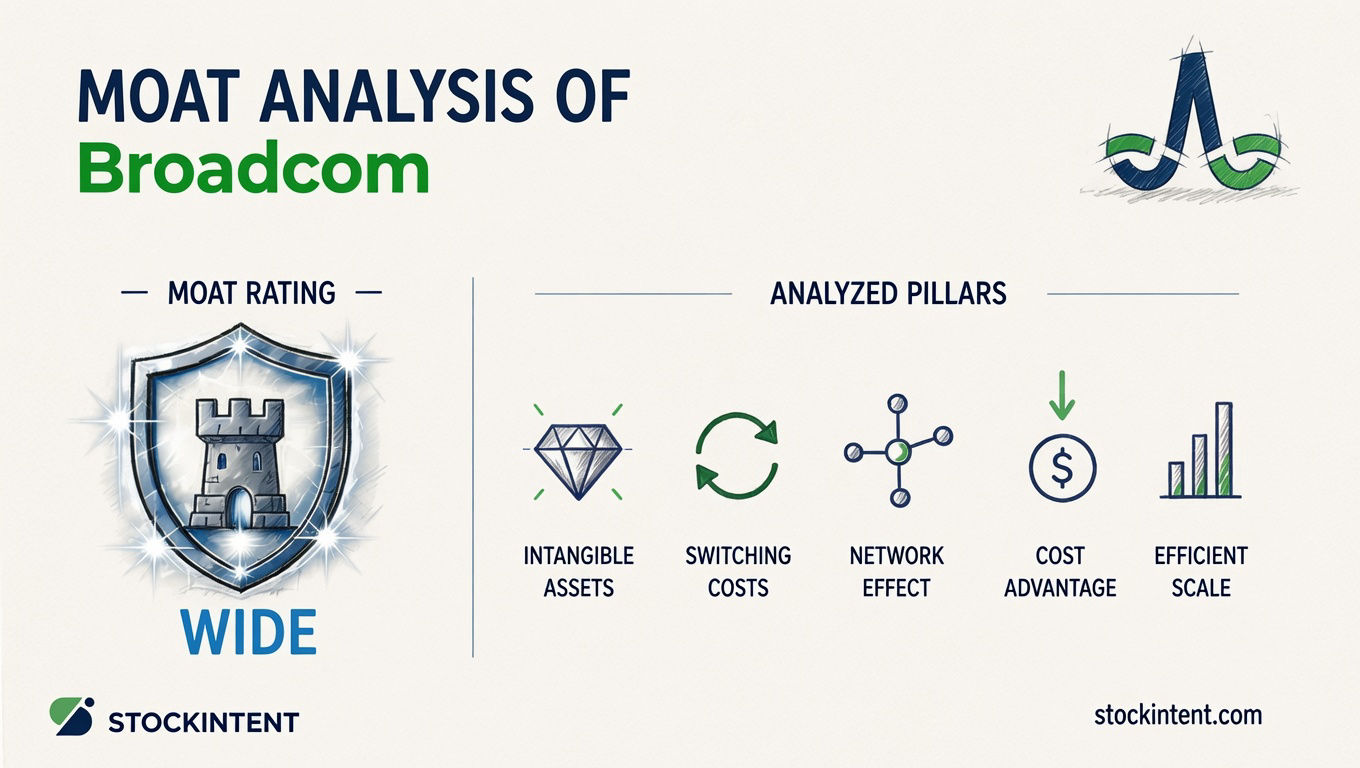
Broadcom earns a Wide moat with a Stable to Widening trend and Medium uncertainty. The company converts technical embedding and proprietary silicon design into pricing power that shows up in roughly 68% adjusted EBITDA margins and $10.3 billion in quarterly free cash flow. Yet that same strength is concentrated among approximately six hyperscaler and AI-lab customers, creating a vulnerability that keeps our confidence level in check.
Here is what matters most:
The following analysis examines each moat pillar in detail, starting with where Broadcom's competitive advantages are genuinely durable and where the narrative risks outrunning the reality.
Broadcom's moat rests on two genuinely strong pillars, two moderate ones, and one that is essentially a distraction. The strongest advantages come from switching costs and intangible assets. Cost advantage and efficient scale matter but are harder to isolate. Network effects, despite what some AI infrastructure narratives suggest, are not a meaningful source of competitive protection.
Switching Costs — Strong
Broadcom's chips and software are embedded deep in customer infrastructure. Replacing them requires redesign, revalidation, and operational risk that most customers will not take unless they have a compelling reason. The AI and custom-ASIC business has made this stickiness even stronger. When Broadcom co-designs silicon with a hyperscaler, it is not selling a commodity component. It is building a system that the customer helped architect, with networking and interconnect pieces layered on top. That kind of technical embedding creates lock-in that goes well beyond a standard supply contract. A Bernstein-backed assessment published on AInvest describes these co-design relationships as deepening customer dependence, while The Teardown's analysis notes that mission-critical software like VMware adds another layer of stickiness on top of the hardware.
Intangible Assets — Strong
Broadcom's proprietary intellectual property is the second pillar that genuinely protects its economics. The company has accumulated specialized know-how in 3D stacking, SerDes technology, and substrate investment that is difficult to replicate at scale. Invetso's 2026 moat analysis emphasizes that these technical capabilities, not brand power, form the core of Broadcom's intangible asset moat. This is engineering depth accumulated over years of working with the most demanding customers in the industry. A competitor could theoretically match individual capabilities, but reproducing the full stack of design complexity, manufacturing relationships, and system integration would take years and billions in R&D with no guarantee of success.
Cost Advantage — Moderate
Broadcom's gross margin of roughly 68% and EBITDA margins near 68% suggest significant pricing power. Greendotstocks' Broadcom analysis links these margins to operational efficiency and scale in manufacturing relationships. But this pillar is more disputed than switching costs or intangible assets. High margins can reflect mix effects, customer lock-in, and pricing power rather than true structural cost leadership. The evidence is supportive but not definitive.
Efficient Scale — Moderate
Broadcom operates in concentrated, capital-intensive niches like custom ASICs and high-end networking where only a handful of firms can support the required R&D investment. AInvest's 2026 thesis notes this efficient-scale dynamic as a supporting factor. Still, it is not the dominant explanation for Broadcom's economics. The moat appears to come more from embedded solutions and co-design relationships than from a classic natural oligopoly structure.
Network Effects — Weak / Not Material
Here is where the narrative often drifts from reality. Broadcom does not benefit from network effects in any meaningful sense. Invetso's analysis is explicit: the evidence does not support a classic network-effects moat where the product becomes more valuable as more users join. Broadcom's advantages come from technical integration and customer lock-in, not from user-to-user value creation. The fact that its chips sit inside large hyperscaler ecosystems does not create network effects. It creates switching costs, which is a fundamentally different and more durable mechanism.
Pro Insight: Broadcom's moat is often misunderstood as benefiting from network effects because it serves large hyperscaler ecosystems. In our experience analyzing infrastructure businesses, the real durability comes from switching costs and technical embedding, not user-to-user network value. This distinction matters for long-term investors: network effects can fade if user growth stalls or platforms shift, while deeply embedded switching costs in co-designed silicon create stickier, more predictable revenue streams that withstand competitive pressure.
If you want to test whether these theoretical advantages hold up in the financial data, StockIntent's company reports let you pull the profitability metrics, returns on capital, and competitive rankings that reveal whether switching costs and intangible assets actually translate into durable excess returns. The moat framework is a starting point. The numbers tell you whether it is working in practice.
Broadcom converts its moat into exceptional financial performance. The approximately 68% adjusted EBITDA margin reported in recent quarters, combined with quarterly free cash flow generation of roughly $10.3 billion, shows that technical embedding and proprietary IP are not just theoretical advantages. They translate directly into pricing power and cash generation.
The mechanism is straightforward. Switching costs in co-designed silicon let Broadcom capture value without constant price competition. Intangible assets in 3D stacking and SerDes technology create technical differentiation that customers cannot easily replicate. The result is a return on equity of 28.45% and ROIC that exceeds WACC by nearly seven percentage points. These are the numbers that matter for assessing whether a moat is real or narrative.
The specific business evidence is concentrated in AI semiconductors. Yahoo Finance / Reuters reported 63% year-over-year AI revenue growth, with the AI semiconductor business driven by approximately six hyperscaler and AI-lab customers. That concentration creates unusual revenue visibility. When your customers are disclosing multi-year capex plans, your demand forecast becomes more readable than in a typical component business.
But here is the critical limitation. The moat's benefits are not evenly distributed. Non-AI semiconductor revenue has been flat, which means the widening trend is driven by a single segment. The same customer concentration that creates visibility also creates vulnerability. If hyperscaler spending slows or if even one major customer moves toward in-house design, the financial performance would shift quickly. The moat is real and currently visible in the numbers, but its durability depends on assumptions about customer behavior that are inherently uncertain.
Broadcom's moat is widening, but fragile.
The AI infrastructure market is shifting toward co-designed, multi-year relationships that play directly into Broadcom's strengths. Customers are moving away from spot purchasing and toward custom design-win partnerships that embed Broadcom deeper into their technology stacks. This structural change raises switching costs and makes procurement stickier. The previously mentioned $10 billion contract win from a new customer, combined with the 63% growth rate previously discussed, shows this is not a theoretical trend. It is already converting into revenue and backlog.
The bull case rests on deepening embedding. Broadcom is not just supplying chips. It is co-architecting silicon with hyperscalers, layering in networking and interconnect technology, and building systems that become harder to replace with each design cycle. A 2026 SWOT analysis notes that this co-design model creates stronger lock-in than traditional component sales, while The Teardown's assessment points to large booked orders suggesting Broadcom's role is becoming more central to hyperscaler infrastructure planning rather than peripheral.
But the bear case is equally real. The biggest existential threat to Broadcom's moat is not Marvell or AMD. It is the vertical integration ambitions of Broadcom's own customers.
From Our Experience: The gravest threat to Broadcom's moat isn't Marvell or AMD—it's the vertical integration ambitions of its own customers. When hyperscalers like Google and Meta talk about in-sourcing chip design, they're not just negotiating tactics; they're genuine attempts to capture the value Broadcom currently extracts. We've seen this pattern before in enterprise software: the most dangerous competitors are often your largest customers once they reach sufficient scale and motivation to build in-house.
Approximately six hyperscaler and AI-lab customers drive the AI semiconductor revenue. That concentration creates a paradox. Near-term revenue visibility is unusually high because these customers disclose multi-year capex plans. But long-term durability is uncertain because the same customers have the resources and incentive to design around Broadcom. The Teardown's analysis flags this as the core tension: structural advantages in sticky infrastructure businesses versus concentration risk that could undermine durability.
Here are four indicators investors should monitor to judge whether the moat trend is improving or weakening:
If you want to test whether monitoring these fundamentals has historically preceded outperformance, StockIntent's backtesting engine lets you run moat-based strategies against more than 20 years of survivorship-free data. You can validate whether tracking customer concentration shifts and margin durability has actually worked as an investment signal in practice.
These trends create a genuinely wide range of outcomes. Broadcom could become a more dominant AI infrastructure compounder, or it could face normalization if AI capex growth slows or hyperscalers successfully in-source. The moat is real and currently widening, but its trajectory is not predetermined.
We rate Broadcom's moat uncertainty as Medium.
The near-term revenue picture is unusually clear. Management's guidance for roughly 67% non-GAAP operating margin in Q3 FY2026 and the visible hyperscaler capex plans behind the AI semiconductor business create a level of predictability most semiconductor companies do not enjoy. When your largest customers announce multi-year infrastructure spending commitments, forecasting becomes easier than selling into fragmented spot markets.
But that same concentration is what widens the range of outcomes. Broadcom's own filings explicitly flag global economic uncertainty, trade restrictions, customer concentration, and demand-estimation risk as factors that could materially affect results. The company does not pretend the path is smooth. Neither should investors.
Three drivers shape our Medium rating. Sales predictability is high today but vulnerable to shifts among approximately six hyperscaler customers. Operating stability looks solid with current margin guidance, yet outsourced manufacturing dependence and TSMC geographic concentration create latent stress points. Strategic range is genuinely wide: Reuters reported that Broadcom missed Q2 revenue expectations and left its 2027 sales forecast unchanged, a reminder that even strong AI cycles can reset quickly.
The core question for moat durability is not stock volatility. It is whether the assumptions embedded in customer relationships hold. If hyperscalers continue outsourcing custom silicon design, Broadcom's position strengthens. If they in-source, the ASIC franchise erodes. The moat is real, but its durability depends on customer behavior that Broadcom does not fully control.
This content is for informational and educational purposes only and is not investment advice. Investors should conduct their own research and consider their individual circumstances before making investment decisions.
Broadcom earns a Wide moat with a Stable to Widening trend and Medium uncertainty.
The core tension is straightforward. Switching costs from co-designed custom silicon and intangible assets in 3D stacking and SerDes IP are translating into exceptional pricing power. The approximately 68% adjusted EBITDA margin and roughly $10.3 billion in quarterly free cash flow are not accidents. They are evidence that technical embedding creates genuine business durability.
But the moat's trajectory is not predetermined. The same hyperscaler concentration that drives near-term visibility creates long-term fragility. If customers like Google and Meta succeed in bringing chip design in-house, Broadcom's ASIC franchise erodes faster than most investors expect. The moat is real, but its durability depends on customer decisions that Broadcom does not control.
What should investors watch? The four indicators identified above: AI backlog growth, customer diversification trends, networking attach rates, and sustained margin expansion. These fundamentals will signal whether the moat is strengthening or beginning to thin before the narrative shifts. The verdict today is favorable. The work is staying alert to what changes it.
Broadcom earns a Wide moat with a Stable to Widening trend and Medium uncertainty. The company converts technical embedding and proprietary silicon design into pricing power that shows up in roughly 68% adjusted EBITDA margins and $10.3 billion in quarterly free cash flow. Yet that same strength is concentrated among approximately six hyperscaler and AI-lab customers, creating a vulnerability that keeps our confidence level in check.
Here is what matters most:
The following analysis examines each moat pillar in detail, starting with where Broadcom's competitive advantages are genuinely durable and where the narrative risks outrunning the reality.
Broadcom's moat rests on two genuinely strong pillars, two moderate ones, and one that is essentially a distraction. The strongest advantages come from switching costs and intangible assets. Cost advantage and efficient scale matter but are harder to isolate. Network effects, despite what some AI infrastructure narratives suggest, are not a meaningful source of competitive protection.
Switching Costs — Strong
Broadcom's chips and software are embedded deep in customer infrastructure. Replacing them requires redesign, revalidation, and operational risk that most customers will not take unless they have a compelling reason. The AI and custom-ASIC business has made this stickiness even stronger. When Broadcom co-designs silicon with a hyperscaler, it is not selling a commodity component. It is building a system that the customer helped architect, with networking and interconnect pieces layered on top. That kind of technical embedding creates lock-in that goes well beyond a standard supply contract. A Bernstein-backed assessment published on AInvest describes these co-design relationships as deepening customer dependence, while The Teardown's analysis notes that mission-critical software like VMware adds another layer of stickiness on top of the hardware.
Intangible Assets — Strong
Broadcom's proprietary intellectual property is the second pillar that genuinely protects its economics. The company has accumulated specialized know-how in 3D stacking, SerDes technology, and substrate investment that is difficult to replicate at scale. Invetso's 2026 moat analysis emphasizes that these technical capabilities, not brand power, form the core of Broadcom's intangible asset moat. This is engineering depth accumulated over years of working with the most demanding customers in the industry. A competitor could theoretically match individual capabilities, but reproducing the full stack of design complexity, manufacturing relationships, and system integration would take years and billions in R&D with no guarantee of success.
Cost Advantage — Moderate
Broadcom's gross margin of roughly 68% and EBITDA margins near 68% suggest significant pricing power. Greendotstocks' Broadcom analysis links these margins to operational efficiency and scale in manufacturing relationships. But this pillar is more disputed than switching costs or intangible assets. High margins can reflect mix effects, customer lock-in, and pricing power rather than true structural cost leadership. The evidence is supportive but not definitive.
Efficient Scale — Moderate
Broadcom operates in concentrated, capital-intensive niches like custom ASICs and high-end networking where only a handful of firms can support the required R&D investment. AInvest's 2026 thesis notes this efficient-scale dynamic as a supporting factor. Still, it is not the dominant explanation for Broadcom's economics. The moat appears to come more from embedded solutions and co-design relationships than from a classic natural oligopoly structure.
Network Effects — Weak / Not Material
Here is where the narrative often drifts from reality. Broadcom does not benefit from network effects in any meaningful sense. Invetso's analysis is explicit: the evidence does not support a classic network-effects moat where the product becomes more valuable as more users join. Broadcom's advantages come from technical integration and customer lock-in, not from user-to-user value creation. The fact that its chips sit inside large hyperscaler ecosystems does not create network effects. It creates switching costs, which is a fundamentally different and more durable mechanism.
Pro Insight: Broadcom's moat is often misunderstood as benefiting from network effects because it serves large hyperscaler ecosystems. In our experience analyzing infrastructure businesses, the real durability comes from switching costs and technical embedding, not user-to-user network value. This distinction matters for long-term investors: network effects can fade if user growth stalls or platforms shift, while deeply embedded switching costs in co-designed silicon create stickier, more predictable revenue streams that withstand competitive pressure.
If you want to test whether these theoretical advantages hold up in the financial data, StockIntent's company reports let you pull the profitability metrics, returns on capital, and competitive rankings that reveal whether switching costs and intangible assets actually translate into durable excess returns. The moat framework is a starting point. The numbers tell you whether it is working in practice.
Broadcom converts its moat into exceptional financial performance. The approximately 68% adjusted EBITDA margin reported in recent quarters, combined with quarterly free cash flow generation of roughly $10.3 billion, shows that technical embedding and proprietary IP are not just theoretical advantages. They translate directly into pricing power and cash generation.
The mechanism is straightforward. Switching costs in co-designed silicon let Broadcom capture value without constant price competition. Intangible assets in 3D stacking and SerDes technology create technical differentiation that customers cannot easily replicate. The result is a return on equity of 28.45% and ROIC that exceeds WACC by nearly seven percentage points. These are the numbers that matter for assessing whether a moat is real or narrative.
The specific business evidence is concentrated in AI semiconductors. Yahoo Finance / Reuters reported 63% year-over-year AI revenue growth, with the AI semiconductor business driven by approximately six hyperscaler and AI-lab customers. That concentration creates unusual revenue visibility. When your customers are disclosing multi-year capex plans, your demand forecast becomes more readable than in a typical component business.
But here is the critical limitation. The moat's benefits are not evenly distributed. Non-AI semiconductor revenue has been flat, which means the widening trend is driven by a single segment. The same customer concentration that creates visibility also creates vulnerability. If hyperscaler spending slows or if even one major customer moves toward in-house design, the financial performance would shift quickly. The moat is real and currently visible in the numbers, but its durability depends on assumptions about customer behavior that are inherently uncertain.
Broadcom's moat is widening, but fragile.
The AI infrastructure market is shifting toward co-designed, multi-year relationships that play directly into Broadcom's strengths. Customers are moving away from spot purchasing and toward custom design-win partnerships that embed Broadcom deeper into their technology stacks. This structural change raises switching costs and makes procurement stickier. The previously mentioned $10 billion contract win from a new customer, combined with the 63% growth rate previously discussed, shows this is not a theoretical trend. It is already converting into revenue and backlog.
The bull case rests on deepening embedding. Broadcom is not just supplying chips. It is co-architecting silicon with hyperscalers, layering in networking and interconnect technology, and building systems that become harder to replace with each design cycle. A 2026 SWOT analysis notes that this co-design model creates stronger lock-in than traditional component sales, while The Teardown's assessment points to large booked orders suggesting Broadcom's role is becoming more central to hyperscaler infrastructure planning rather than peripheral.
But the bear case is equally real. The biggest existential threat to Broadcom's moat is not Marvell or AMD. It is the vertical integration ambitions of Broadcom's own customers.
From Our Experience: The gravest threat to Broadcom's moat isn't Marvell or AMD—it's the vertical integration ambitions of its own customers. When hyperscalers like Google and Meta talk about in-sourcing chip design, they're not just negotiating tactics; they're genuine attempts to capture the value Broadcom currently extracts. We've seen this pattern before in enterprise software: the most dangerous competitors are often your largest customers once they reach sufficient scale and motivation to build in-house.
Approximately six hyperscaler and AI-lab customers drive the AI semiconductor revenue. That concentration creates a paradox. Near-term revenue visibility is unusually high because these customers disclose multi-year capex plans. But long-term durability is uncertain because the same customers have the resources and incentive to design around Broadcom. The Teardown's analysis flags this as the core tension: structural advantages in sticky infrastructure businesses versus concentration risk that could undermine durability.
Here are four indicators investors should monitor to judge whether the moat trend is improving or weakening:
If you want to test whether monitoring these fundamentals has historically preceded outperformance, StockIntent's backtesting engine lets you run moat-based strategies against more than 20 years of survivorship-free data. You can validate whether tracking customer concentration shifts and margin durability has actually worked as an investment signal in practice.
These trends create a genuinely wide range of outcomes. Broadcom could become a more dominant AI infrastructure compounder, or it could face normalization if AI capex growth slows or hyperscalers successfully in-source. The moat is real and currently widening, but its trajectory is not predetermined.
We rate Broadcom's moat uncertainty as Medium.
The near-term revenue picture is unusually clear. Management's guidance for roughly 67% non-GAAP operating margin in Q3 FY2026 and the visible hyperscaler capex plans behind the AI semiconductor business create a level of predictability most semiconductor companies do not enjoy. When your largest customers announce multi-year infrastructure spending commitments, forecasting becomes easier than selling into fragmented spot markets.
But that same concentration is what widens the range of outcomes. Broadcom's own filings explicitly flag global economic uncertainty, trade restrictions, customer concentration, and demand-estimation risk as factors that could materially affect results. The company does not pretend the path is smooth. Neither should investors.
Three drivers shape our Medium rating. Sales predictability is high today but vulnerable to shifts among approximately six hyperscaler customers. Operating stability looks solid with current margin guidance, yet outsourced manufacturing dependence and TSMC geographic concentration create latent stress points. Strategic range is genuinely wide: Reuters reported that Broadcom missed Q2 revenue expectations and left its 2027 sales forecast unchanged, a reminder that even strong AI cycles can reset quickly.
The core question for moat durability is not stock volatility. It is whether the assumptions embedded in customer relationships hold. If hyperscalers continue outsourcing custom silicon design, Broadcom's position strengthens. If they in-source, the ASIC franchise erodes. The moat is real, but its durability depends on customer behavior that Broadcom does not fully control.
This content is for informational and educational purposes only and is not investment advice. Investors should conduct their own research and consider their individual circumstances before making investment decisions.
Broadcom earns a Wide moat with a Stable to Widening trend and Medium uncertainty.
The core tension is straightforward. Switching costs from co-designed custom silicon and intangible assets in 3D stacking and SerDes IP are translating into exceptional pricing power. The approximately 68% adjusted EBITDA margin and roughly $10.3 billion in quarterly free cash flow are not accidents. They are evidence that technical embedding creates genuine business durability.
But the moat's trajectory is not predetermined. The same hyperscaler concentration that drives near-term visibility creates long-term fragility. If customers like Google and Meta succeed in bringing chip design in-house, Broadcom's ASIC franchise erodes faster than most investors expect. The moat is real, but its durability depends on customer decisions that Broadcom does not control.
What should investors watch? The four indicators identified above: AI backlog growth, customer diversification trends, networking attach rates, and sustained margin expansion. These fundamentals will signal whether the moat is strengthening or beginning to thin before the narrative shifts. The verdict today is favorable. The work is staying alert to what changes it.