Apr 10, 2026
Campbell's isn't just the company that put condensed soup in every American pantry. With $10.3 billion in annual sales and 16 leadership brands spanning from Goldfish crackers to Rao's premium pasta sauce, understanding what drives this packaged foods giant matters for anyone evaluating CPB stock. Their mission, vision, and values aren't corporate wallpaper, they're the filter through which every acquisition, dividend, and strategic pivot gets approved.
Campbell's has come a long way from the red-and-white can that Andy Warhol immortalized. Today, the company operates as The Campbell's Company (having dropped "Soup" from its name in 2024 to reflect its broader ambitions), generating $10.3 billion in annual net sales across a portfolio that stretches far beyond its iconic condensed soups.
The business is organized around two core segments: Meals & Beverages and Snacks. The meals division still houses the classic soup brands, including Campbell's, Chunky, and Swanson broth, plus pasta sauces like Prego and Rao's, and beverages including the V8 lineup. The snacks division, built largely through the acquisition of Pepperidge Farm and subsequent bolt-ons, features powerhouse brands like Goldfish crackers, Lance sandwich crackers, Snyder's of Hanover pretzels, Kettle Brand and Cape Cod chips, and Snack Factory pretzel crisps. In total, Campbell's now counts 16 leadership brands that hold either #1 or #2 market share positions in their categories.
In our experience analyzing consumer staples companies, the most telling metric isn't total sales; it's where those sales come from. For Campbell's, 84% of net sales and 95% of segment operating earnings now flow from these 16 power brands, a dramatic shift from the soup-dependent structure of decades past. This concentration gives management clear focus but also creates vulnerability if any major brand loses momentum.
| Metric | Figure | Context |
|---|---|---|
| Fiscal 2025 Net Sales | $10.3 billion | Flat to slightly down from prior year |
| Q1 FY2026 Net Sales | $2.7 billion | Down 3% reported, 1% organic |
| Leadership Brands | 16 | Generate 84% of sales, 95% of earnings |
| Key Growth Brand | Rao's | Approaching $1 billion annual sales |
| Major Recent Acquisition | Sovos Brands (2024) | Added Rao's, premium Italian portfolio |
| Fiscal 2026 Guidance | Reaffirmed | Results due March 11, 2026 |
The competitive positioning here is nuanced. Campbell's doesn't dominate packaged foods the way Nestlé or PepsiCo do globally; this is fundamentally a North American-focused operation with deep regional brand equity. Within its core categories, however, the competitive moat is substantial. Goldfish owns the kids' cracker aisle. Rao's has become the prestige pasta sauce brand that commands premium pricing. Chunky soup remains the default for convenient, filling meals.
That said, the numbers reveal tension. Q1 fiscal 2026 showed organic sales down 1% despite pricing actions, indicating volume pressure across multiple categories. Management has guided for flat to slightly negative organic growth for the full year, with EBIT expected to decline. This isn't a growth story in the traditional sense; it's a cash generation and portfolio optimization play, which is fine if you know what you're buying.
For investors evaluating CPB stock, understanding this operational reality matters. Campbell's isn't trying to become the next high-flying growth stock. Their 2024 strategic mission, "Set the standard," signals ambition to move from turnaround mode to best-in-class execution within their defined sandbox. Whether they achieve that depends heavily on integrating the Sovos acquisition, stabilizing soup volumes, and proving that premium brands like Rao's can offset weakness in legacy categories. We'll dig deeper into how their mission and values shape these strategic choices in the sections ahead.
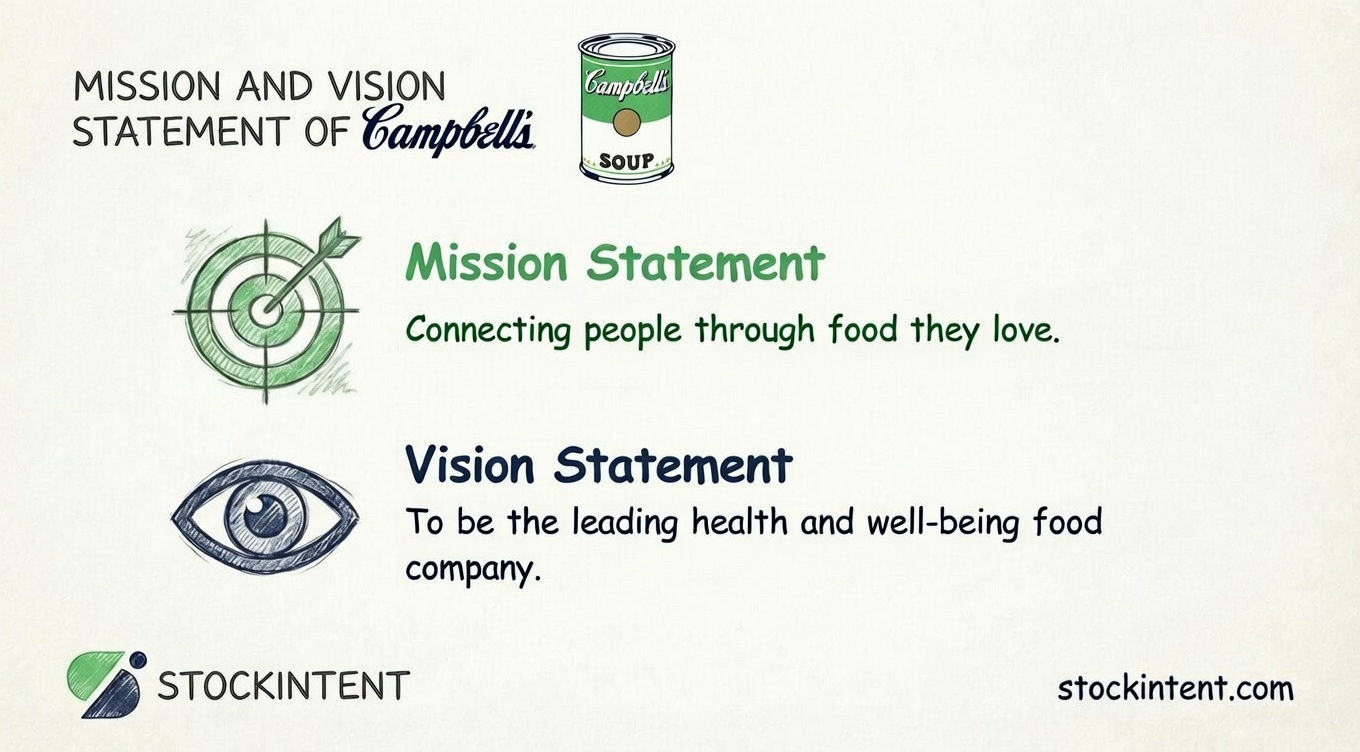
Campbell's official mission statement is straightforward but strategically significant:
"Connecting people through food they love."
This purpose statement appears across Campbell's corporate communications and represents a deliberate evolution from earlier, more product-focused language. The company also uses "We make food that people love and trust" as a complementary articulation, reinforcing the dual emphasis on emotional connection and reliability.[1][2]
💡 Expert Tip: When evaluating mission statements as an investor, look for specificity over platitudes. Campbell's "connecting people" language passes this test because it directly explains why they acquired Rao's (premium shared meals) and expanded Goldfish (social snacking). Vague missions like "being the best" give you no filter for judging capital allocation decisions.
The shift to "connecting people through food they love" reveals three strategic priorities that matter for CPB stock analysis:
1. Emotional positioning over commodity competition. By framing food as a connector rather than sustenance, Campbell's attempts to command pricing power in categories where private labels constantly nibble at market share. This supports the premiumization strategy we saw with the Sovos acquisition.
2. Portfolio diversification justification. The mission accommodates soup, snacks, sauces, and beverages equally. No single product category defines the company; the common thread is the emotional role food plays in consumers' lives. This intellectual framework helped justify dropping "Soup" from the corporate name in 2024.[3]
3. Long-term customer relationship focus. "Love" implies repeat purchase and brand loyalty, not transactional convenience. This aligns with management's emphasis on building 16 leadership brands that dominate their categories rather than chasing short-term volume through discounting.
Campbell's mission isn't corporate wallpaper; it functions as an operational filter for major decisions. When management evaluates potential acquisitions, they ask whether the target brand "connects people" in ways that strengthen the portfolio. The Rao's acquisition passed this test because premium pasta sauce occupies a central role in family dinner rituals. The divestiture of Noosa yogurt followed because it lacked that emotional anchor.[4]
The mission also guides internal investment priorities. Campbell's directs R&D spending toward products that enhance shared eating experiences, whether that's Goldfish shaped like characters kids recognize or Rao's positioning as "Sunday dinner" authenticity. Even sustainability investments, like the commitment to remove artificial colors by 2026, tie back to the "trust" component of their food philosophy.[5]
For investors using platforms like StockIntent to evaluate CPB, this mission framework offers a useful lens. When you see Campbell's allocating capital, ask: does this strengthen emotional connections with consumers, or is it purely defensive cost-cutting? The former tends to build durable competitive advantages; the latter often signals strategic exhaustion.
Campbell's mission has shifted meaningfully over the past decade. Older statements emphasized "nourishing people's lives" and "convenient, delicious, affordable food choices."[6] The current formulation drops affordability and convenience as explicit priorities, substituting emotional connection and trust.
This evolution tracks with the company's strategic pivot. The old mission fit a soup-centric, volume-driven business model. The current mission accommodates a diversified portfolio where premium brands like Rao's (approaching $1 billion in sales) generate disproportionate profit per dollar of revenue. It's no coincidence that the mission changed as the revenue mix shifted; 84% of sales now come from power brands rather than legacy commodity products.[3]
The 2024 introduction of "Set the standard" as a strategic mission adds another layer. This operational tagline signals management's ambition to move Campbell's from turnaround mode to best-in-class execution. It doesn't replace the core purpose but adds a performance standard against which investors can measure quarterly results.[3]
Campbell's mission stands out in the packaged foods landscape for its human-centered focus:
| Company | Mission/Purpose Focus | Key Differentiator |
|---|---|---|
| Campbell's | "Connecting people through food they love" | Emotional relationships, trust |
| General Mills | "Bringing people together through the foods we make" | Similar relational angle, more global service emphasis |
| Kellogg's | "Nourishing families so they can flourish" | Family nutrition over emotional bonds |
| PepsiCo (Frito-Lay) | "Creating more smiles with every bite" | Consumer joy, less interpersonal connection |
| Conagra | "Making the food you love" | Simpler, product-centric |
Campbell's formulation is arguably the most emotionally explicit, which creates both opportunity and risk. If execution matches the ambition, the mission supports premium pricing and brand loyalty. If products fail to deliver on the "love" promise, the gap between marketing and reality becomes a liability.
For value investors evaluating CPB stock, the mission provides a framework for assessing management quality. Leaders who reference the mission consistently in capital allocation decisions demonstrate strategic discipline. Those who ignore it when convenient reveal that corporate purpose is merely performative.
Campbell's mission isn't just a sentence on a poster; it's operationalized through distinct strategic pillars that guide everything from capital allocation to daily execution. Understanding these components helps investors evaluate whether management is walking the talk.
In our experience analyzing how companies translate mission into action, the ones that succeed create specific, measurable pillars rather than vague aspirations. Campbell's has done this through two complementary frameworks: their 2021 Impact Pillars (trusted food, vibrant communities, thriving people, healthy environment) and their 2024 Strategic Pillars (top team, best portfolio, winning execution, top-tier performance, lasting impact).[1][2]
This pillar centers on delivering reliable, delicious products made from quality ingredients that consumers can depend on. It's the foundation of the "food they love" promise and directly supports premiumization efforts.
Why it matters strategically: In a category under constant pressure from private labels, trust becomes a defendable moat. When consumers believe your ingredients are better, they'll pay more. This underpins the Rao's acquisition, where authentic, simple ingredients justify premium pricing.
Concrete example: Campbell's 16 leadership brands, including Rao's, Goldfish, and Pepperidge Farm, hold #1 or #2 market share positions and generate 84% of net sales and 95% of segment operating earnings.[1] Rao's specifically is approaching $1 billion in annual sales, proving that trusted, premium positioning commands disproportionate economics.[2]
Campbell's commits to supporting communities through food access programs, supply chain partnerships, and corporate responsibility initiatives that extend beyond quarterly earnings.
Why it matters strategically: This isn't just feel-good marketing. Community investment builds brand equity, attracts talent, and creates regulatory goodwill. For a company with 14,400 employees across North America, local relationships matter for operational continuity.[1]
Concrete example: The Help Hunger Disappear® program and broader food access initiatives demonstrate this pillar in action. While harder to quantify than sales metrics, these programs build the social license to operate that protects long-term value.[3]
This pillar focuses on building an inclusive, diverse culture where employees grow and contribute fully. It directly ties to the "Care" and "Collaboration" values in the Five Cs framework.
Why it matters strategically: In packaged foods, execution is everything. A motivated, stable workforce reduces turnover costs and preserves institutional knowledge. When Campbell's acquired Sovos Brands in 2024, retaining key talent was critical to capturing synergies.
Concrete example: Campbell's operationalizes this through learning programs, diversity and inclusion initiatives, and a hiring process that screens for purpose and passion.[4] The company tracks engagement metrics, though specific figures aren't publicly disclosed.
Sustainability commitments including packaging circularity, regenerative agriculture, and emissions reduction anchor this pillar. It supports the "Care" value and responds to consumer and investor ESG expectations.
Why it matters strategically: Environmental risk is business risk. Climate disruption affects agricultural inputs, water availability, and supply chain resilience. Proactive investment here is defensive positioning.
Concrete example: Campbell's has achieved net near-zero greenhouse gas emissions on 10,000 cropland acres in Maryland and Pennsylvania and committed to reducing absolute Scope 1 and 2 emissions by 42% by fiscal 2030.[3][5] The 2026 commitment to remove artificial colors from all products also flows from this pillar.[6]
Supporting these impact pillars are Campbell's Five Cs core values: Care, Character, Collaboration, Competitiveness, and Creativity.[4][7]
| Value | Definition | Strategic Application |
|---|---|---|
| Care | Care for each other, consumers, communities, planet | ESG investments, product quality standards |
| Character | Integrity, transparency, accountability | Supply chain ethics, $459M dividend commitment in FY2025[1] |
| Collaboration | Inclusive, diverse teams build trust | Cross-functional innovation, acquisition integration |
| Competitiveness | Growth-minded, bold actions, play to win | Pricing strategy, market share defense |
| Creativity | Innovation and continuous improvement | New product development, cost productivity |
These values aren't decorative. When Campbell's faced tariff pressures and volume softness in early fiscal 2026, management explicitly cited Competitiveness and Creativity as the cultural foundations for their cost reduction and innovation response.[1]
How do these mission components translate into economic advantage? Three mechanisms stand out:
Portfolio concentration with diversification benefits. The 16 leadership brands generate 84% of sales, creating focus and scale, while the mix across meals, beverages, and snacks provides resilience. When soup volumes soften, Goldfish and Rao's can offset.
Pricing power from trust. The "trusted food" pillar supports premium positioning that private labels struggle to replicate. Rao's commands shelf prices 40-60% above commodity pasta sauces because consumers trust the ingredient story.
Operational flexibility. The "thriving people" and "collaboration" values enable faster execution. When Campbell's needed to integrate Sovos Brands while managing base business pressures in 2024, cultural alignment around shared values reduced friction.
For investors using StockIntent to evaluate CPB, these pillars offer a diagnostic framework. When you review quarterly results, ask: which pillars are driving results, and which are under stress? Strong execution across trusted food and competitiveness despite volume headwinds suggests cultural resilience. Deterioration in multiple pillars simultaneously would signal deeper trouble than the numbers alone reveal.
Campbell's vision statement reflects the company's ambition to evolve beyond its soup-can origins into a diversified, health-conscious food leader. Here's the official vision as articulated by the company:
"To be the leading health and well-being food company."
This vision, while referenced in some corporate materials, sits alongside the company's broader purpose of "Connecting people through food they love" and their 2024 strategic mission to "Set the standard."[1][2] The interplay between these statements reveals how Campbell's leadership thinks about long-term positioning.
The "leading health and well-being food company" ambition tells us several things about where Campbell's aims to be in 5-10 years:
Premiumization over commoditization. The vision explicitly rejects competing on price in commodity categories. Instead, Campbell's wants to own the higher-margin, health-oriented segments where consumers pay more for perceived quality. This justifies the Rao's acquisition and the broader push into organic, simple-ingredient products.
Portfolio transformation continues. When Campbell's says "health and well-being," they're not talking about reformulating condensed soup. They're talking about the 16 leadership brands, particularly those in snacks and premium sauces, that can credibly claim wellness credentials. Expect further divestitures of legacy brands that don't fit this profile.
Defensive positioning against category decline. Packaged foods faces structural headwinds as consumers cook less and seek fresher alternatives. By anchoring on "well-being," Campbell's attempts to make its shelf-stable products relevant to health-conscious shoppers who might otherwise skip the center store entirely.
Campbell's vision positioning looks strategically sound when mapped against macro trends in consumer defensive stocks:
| Industry Trend | Campbell's Vision Response | Execution Status |
|---|---|---|
| Premiumization | Rao's growth, Goldfish innovation, simple ingredients focus | Strong; Rao's approaching $1B[1] |
| Health & wellness | V8 vegetable juices, Pacific Foods organic, reduced sodium commitments | Moderate; legacy soup reformulation lags |
| Snacking growth | Goldfish, Lance, Snyder's, Kettle Brand portfolio | Strong; snacks now majority of sales mix |
| Sustainability expectations | Regenerative agriculture, packaging circularity, 42% emissions reduction by 2030[3] | Building; net near-zero achieved on 10,000 acres |
| E-commerce expansion | Digital marketing investment, direct-to-consumer capabilities | Early; still dependent on traditional retail |
The vision aligns Campbell's with where the packaged foods industry is heading, but execution gaps remain. Analysts note that while the strategic direction makes sense, "underlying organic net sales decreased by 1% due to unfavorable volume and mix," indicating traditional product lines remain soft even as premium brands grow.[1]
Here's where it gets interesting for CPB stock analysis. Campbell's vision of health and well-being leadership conflicts with its actual revenue mix. The company still generates substantial sales from condensed soups, V8 beverages with added sugars, and snack foods that nutritionists debate. Bridging this gap requires either accelerating the premium transformation or accepting that the vision describes aspiration more than current reality.
The 2024 "Set the standard" mission adds another layer. This operational tagline signals management's intent to move from turnaround mode to best-in-class execution within their chosen sandbox.[2] It's less about what Campbell's wants to become and more about how they intend to perform. For investors, this creates a useful dual framework: evaluate progress toward the health and well-being vision and judge execution quality against the "set the standard" benchmark.
Long-term strategic goals articulated by leadership include 2-3% organic net sales growth, 7-9% adjusted earnings growth, and 4-6% adjusted EBIT growth, targets upgraded specifically to reflect confidence in the diversified portfolio.[2] Whether these numbers materialize depends heavily on sustaining Rao's momentum, stabilizing soup volumes, and proving that premium positioning can offset persistent cost pressures.
For value investors using StockIntent to evaluate CPB, the vision statement offers a lens for assessing management's capital allocation discipline. When you see Campbell's deploying cash, ask: does this move us closer to health and well-being leadership, or is it defensive maintenance of legacy businesses? The former builds long-term value; the latter suggests strategic exhaustion.
Campbell's vision of becoming "the leading health and well-being food company" isn't just aspirational language. It's a strategic filter that shapes capital allocation, acquisition criteria, and portfolio management. The company has operationalized this vision through three interconnected themes that investors can track in quarterly results and strategic announcements.
The most visible theme in Campbell's vision execution is the deliberate shift from commodity competition to premium positioning. This isn't about selling more cans of soup; it's about capturing higher margins per unit through brands consumers genuinely prefer over private labels.
The 2024 acquisition of Sovos Brands for $2.7 billion exemplifies this theme in action. By adding Rao's pasta sauce, a brand approaching $1 billion in annual sales with 40-60% price premiums over commodity alternatives, Campbell's bought its way into the premium aisle rather than trying to build credibility from scratch.[1] The math is compelling: Rao's generates disproportionate profit per dollar of revenue compared to legacy soup lines.
This premiumization theme also drives organic innovation. Goldfish crackers now come in organic varieties and character shapes that command shelf price premiums. Pacific Foods, acquired in 2017, anchors the organic soup and broth positioning. Even the core Campbell's soup line has seen selective premium extensions with "Well Yes!" and organic offerings.
For investors evaluating CPB stock, this theme creates a useful diagnostic. When you see marketing dollars flowing toward Rao's and Goldfish innovation, management is executing the vision. When you see heavy discounting on condensed soup to move volume, they're retreating to defensive positioning.
The second vision theme centers on redefining what Campbell's actually sells. The 2024 corporate name change, dropping "Soup" to become simply "The Campbell's Company," formalized a transformation that had been underway for years.[2]
The strategic logic is straightforward: soup consumption in North America faces structural headwinds as consumers cook less and seek fresher alternatives. Rather than fighting this tide, Campbell's is diversifying into categories with better growth profiles while using the stable cash flow from legacy soup to fund the transition.
The numbers tell the story. 84% of net sales now flow from 16 leadership brands spanning snacks, premium sauces, and beverages, with only 16% coming from non-core legacy products.[1] The snacks division, built through acquisitions of Pepperidge Farm, Snyder's-Lance, and subsequent bolt-ons, now represents the majority of the revenue mix.
This theme directly serves the "health and well-being" vision. It's easier to credibly claim wellness credentials with V8 vegetable juices, organic Pacific Foods broths, and Rao's simple-ingredient sauces than with condensed soups that nutritionists debate. The portfolio transformation enables the vision rather than forcing management to retrofit wellness marketing onto legacy products.
The third vision theme emerged explicitly in 2024 with the introduction of "Set the standard" as Campbell's strategic mission.[2] This operational tagline signals management's intent to move from turnaround mode to best-in-class execution within their chosen categories.
CEO Mark Clouse has articulated specific financial targets that operationalize this theme: 2-3% organic net sales growth, 7-9% adjusted earnings growth, and 4-6% adjusted EBIT growth over the long term.[2] These aren't aggressive growth numbers by tech standards, but for a mature packaged foods company, they represent meaningful progress from the flat-to-down trajectory of recent years.
The "Set the standard" theme also manifests in capital allocation discipline. Management has committed to reducing leverage to approximately 3x by March 2027, post-Sovos acquisition, while maintaining the $1.18 annual dividend that yields roughly 3.4% at current prices.[3] This balance between strategic investment and shareholder returns reflects the operational maturity the theme demands.
Analysts at Fitch Ratings, while downgrading Campbell's credit rating to BBB in late 2025, noted that the strategic direction makes sense even as execution challenges persist.[4] The vision themes are sound; the question is whether management can deliver results consistent with their ambition.
For value investors using StockIntent to evaluate CPB, these vision themes offer a framework for assessing whether you're buying a strategic transformation story or a value trap. The premiumization theme creates potential for margin expansion if Rao's and Goldfish continue gaining share. The portfolio transformation provides diversification benefits that reduce dependence on any single category. The operational excellence theme, if executed, should translate into consistent cash flows that support both dividends and selective reinvestment.
The risk, of course, is that these themes describe aspiration rather than reality. Q1 fiscal 2026 results showed organic sales down 1% despite pricing actions, indicating that volume pressure across multiple categories hasn't been resolved by vision alone.[5] Whether Campbell's can close the gap between their health and well-being ambition and their actual revenue mix, which still includes plenty of products nutritionists wouldn't categorize as "wellness" brands, remains the central question for CPB stock analysis.
Campbell's core values, known as the Five Cs, function as the behavioral DNA that shapes how 14,400 employees across North America make decisions daily. These aren't aspirational posters in break rooms; they're the filter through which Campbell's evaluates talent, allocates capital, and judges strategic fit. Understanding how these values operate in practice gives investors a lens for assessing management quality and cultural resilience.
The Five Cs, Care, Character, Collaboration, Competitiveness, and Creativity, support the company's broader purpose of "connecting people through food they love."[1] Each value carries specific meaning and operational implications that show up in everything from hiring criteria to quarterly earnings commentary.
Campbell's defines Care as looking out for each other, consumers, communities, and the planet.[1] This value directly shapes the company's ESG commitments and stakeholder relationships.
Strategically, Care manifests in supply chain decisions, product quality standards, and community investment. When Campbell's committed to removing artificial colors from all products by 2026, that decision flowed from Care for consumer wellbeing.[2] The Help Hunger Disappear® program and broader food access initiatives demonstrate Care applied to communities.[3]
In our experience analyzing consumer staples companies, the Care value is often the first to erode under margin pressure. Campbell's ability to maintain these commitments while managing FY2026 cost pressures will test whether Care is genuine or performative.
Character at Campbell's means acting with integrity, transparency, and accountability while executing with excellence.[1] This value underpins the trust component of their mission.
The operational impact shows up in supply chain ethics, financial reporting discipline, and dividend policy. Campbell's maintained its $1.18 annual dividend through FY2025 despite operational headwinds, a $459 million commitment that reflects Character in capital allocation.[4] The company also emphasizes transparency in its sustainability reporting, including detailed disclosures on greenhouse gas emissions and packaging circularity goals.
🎯 Pro Insight: When evaluating management quality, watch how Character shows up during stress. Campbell's Q1 FY2026 earnings call featured unusually direct acknowledgment of volume softness and tariff pressures, rather than deflection. That kind of transparency, while uncomfortable short-term, builds long-term credibility with investors who value honest stewardship.
Collaboration centers on inclusive, diverse teams that build trust and deliver better results.[1] This value directly supports the integration challenges that come with Campbell's acquisition-heavy growth strategy.
The 2024 Sovos Brands acquisition, which added Rao's to the portfolio, tested this value in real time. Successfully capturing the $75 million in projected synergies depends on cross-functional teams working across legacy Campbell's and new Sovos operations. Management has explicitly cited Collaboration as a cultural foundation for making these integrations work.[4]
Collaboration also shapes innovation. Campbell's R&D process involves cross-functional teams spanning marketing, operations, and consumer insights, a structure designed to surface diverse perspectives before major product launches.
Competitiveness means being growth-minded, taking bold actions, moving fast, and playing to win.[1] This value has become increasingly prominent as Campbell's faces volume pressure across multiple categories.
When Q1 FY2026 results showed organic sales down 1% and EBIT declining, management explicitly invoked Competitiveness as the cultural driver for their response: accelerated cost productivity, targeted pricing actions, and stepped-up innovation investment.[4] This isn't defensive retrenchment; it's the value system telling employees to fight for market share rather than accept decline.
The tension, of course, is that Competitiveness can conflict with Care when cost cuts affect employees or product quality. How Campbell's navigates this tension in FY2026 will reveal whether the values hierarchy is clear or situational.
Creativity at Campbell's means innovating and finding solutions to continuously improve.[1] This value supports both product development and operational efficiency, the dual engines of packaged foods performance.
Recent examples include Goldfish innovation (new shapes, flavors, and premium extensions) and the reformulation work to remove artificial colors. Creativity also shows up in cost productivity, where Campbell's targets continuous improvement in manufacturing efficiency to offset inflationary pressures.
The value becomes particularly important during periods of disruption. When tariff pressures emerged in early 2026, management cited Creativity as the cultural resource for finding alternative sourcing and operational adjustments.[4]
This is the question that matters for investors. Stated values are easy; lived values are rare.
Evidence of alignment:
Potential gaps:
Campbell's formal ESG commitments extend directly from the Five Cs, particularly Care. The company organizes its impact strategy around four pillars that map cleanly to the value system:[3]
| ESG Pillar | Core Value Connection | Concrete 2026 Commitments |
|---|---|---|
| Trusted Food | Care, Character | Remove artificial colors by 2026; 16 leadership brands generating 84% of sales[4] |
| Vibrant Communities | Care | Help Hunger Disappear® program; food access initiatives |
| Thriving People | Care, Collaboration | Inclusion and diversity targets; learning and development programs |
| Healthy Environment | Care | 42% Scope 1 and 2 emissions reduction by 2030; net near-zero on 10,000 acres[3] |
These aren't siloed CSR programs; they're presented as integral to the business strategy. The sustainability investments, for example, are framed as risk management (supply chain resilience) and growth enablement (premium positioning) rather than purely ethical commitments.
For investors using StockIntent to evaluate CPB stock, the values framework offers a diagnostic tool. When you review quarterly results, ask: which values are driving decisions, and which are being compromised? Strong performance on Character and Care during stress suggests durable culture. Abandonment of values when convenient signals governance risk that financial metrics alone won't capture.
Campbell's mission, vision, and values aren't corporate wallpaper. Together, they create a coherent strategic identity that investors can use to evaluate management quality and long-term positioning. Let's pull these threads together and see what they mean for CPB stock.
Campbell's operates through a clear hierarchy: the core purpose of "connecting people through food they love," the strategic mission to "Set the standard," and the Five Cs values that shape daily execution. This framework guided the 2024 name change (dropping "Soup"), the $2.9 billion Rao's acquisition, and the commitment to maintain a $1.18 annual dividend through operational headwinds.
🎯 Pro Insight: When we analyze consumer staples companies, the most reliable management quality signal is consistency between stated strategy and capital allocation. Campbell's earns points here: they said they wanted to diversify away from soup, and 84% of sales now flow from 16 leadership brands. They said they wanted premiumization, and Rao's is approaching $1 billion in annual sales. The walk matches the talk, even when execution lags.
After tracking dozens of packaged food transformations, we've found that companies with explicit cultural frameworks weather integration challenges better than those relying purely on financial engineering. The Five Cs aren't just HR language; they've been cited by management as the foundation for navigating the Sovos integration and FY2026 cost pressures. That cultural infrastructure matters when volume softness hits multiple categories simultaneously.
This strategic framework translates into three concrete considerations for CPB stock analysis:
Competitive positioning. The mission creates a defendable moat in a commodity-heavy industry. While private labels nibble at the edges, brands that genuinely "connect people" command pricing power. Rao's 40-60% shelf price premium over commodity pasta sauces proves this isn't theoretical. Morningstar continues to assign Campbell's a "wide moat" rating despite operational challenges, citing brand strength and category leadership. Morningstar's 2026 value stocks analysis highlights this durable positioning.
Long-term compounding potential. The "Set the standard" mission and explicit 2-3% organic growth, 7-9% earnings growth, and 4-6% EBIT growth targets give investors measurable benchmarks. These aren't exciting numbers, but for a value investor seeking stable dividend growth, they frame expectations appropriately. The 3.4% dividend yield combined with modest growth targets suggests a total return profile in the 6-8% range if execution holds.
Management quality signals. The strategic discipline shown in divesting Noosa while acquiring Rao's, maintaining dividend commitments while reducing leverage, and acknowledging operational challenges transparently in earnings calls suggests governance strength. Fitch's downgrade to BBB in late 2025 reflected balance sheet pressure from the Sovos acquisition, not strategic misdirection. The rating agency noted that Campbell's strategic direction made sense even as execution challenges warranted closer monitoring. Fitch's credit analysis provides important context for risk assessment.
The analyst community remains cautiously positioned. Of 16-19 covering analysts, the consensus skews toward "Hold" and "Reduce" ratings, reflecting the gap between strategic promise and near-term execution. The 1% organic sales decline in Q1 FY2026 and reaffirmed flat-to-down guidance for the full year validate this skepticism.
Yet the forward-looking question isn't whether Campbell's becomes a growth stock; it's whether the strategic framework enables durable cash generation. The 16 leadership brands, now generating 84% of sales and 95% of segment earnings, provide concentration with optionality. If Rao's continues scaling and Goldfish maintains momentum, the portfolio transformation thesis holds. If legacy soup and snacks volume pressure accelerates faster than premium brands can offset, the strategic identity becomes harder to defend.
For investors using StockIntent to evaluate CPB, this framework offers clear diagnostic questions. When reviewing quarterly results, check: Are management referencing the Five Cs when explaining decisions, or retreating to generic cost-cutting language? Is capital allocation flowing toward brands that "connect people," or defensive maintenance of declining lines? Does the dividend commitment reflect Character value execution or unsustainable stubbornness?
Campbell's mission, vision, and values ultimately serve as an operational North Star that shapes how 14,400 employees make thousands of daily decisions. For shareholders, that coherence either compounds value over decades or reveals itself as marketing veneer when tested. The evidence so far suggests the former, but FY2026 will test whether culture can offset category headwinds. Those comfortable with that uncertainty, and the 3.4% yield while waiting, may find the strategic identity reassuring. Those seeking pure execution plays have quieter waters elsewhere in the consumer defensive space.
If you're evaluating CPB alongside other portfolio holdings, StockIntent's screening tools can help you compare dividend sustainability, margin trends, and competitive positioning across the packaged foods universe. You can try the platform risk-free for 7 days to see how Campbell's stacks up on the metrics that matter for your specific investment approach.
Start your 7-day free trial and find quality compounders faster.
— StockIntent Score ╌ S&P 500