
Mar 19, 2026
Carvana (NYSE: CVNA) has emerged as one of the most disruptive forces in the auto and truck dealerships industry, transforming how Americans buy and sell used vehicles through its technology-first platform. For investors evaluating this consumer cyclical stock, understanding the company's mission, vision, and core values provides crucial insight into management's strategic priorities and the competitive moats that could drive long-term returns.
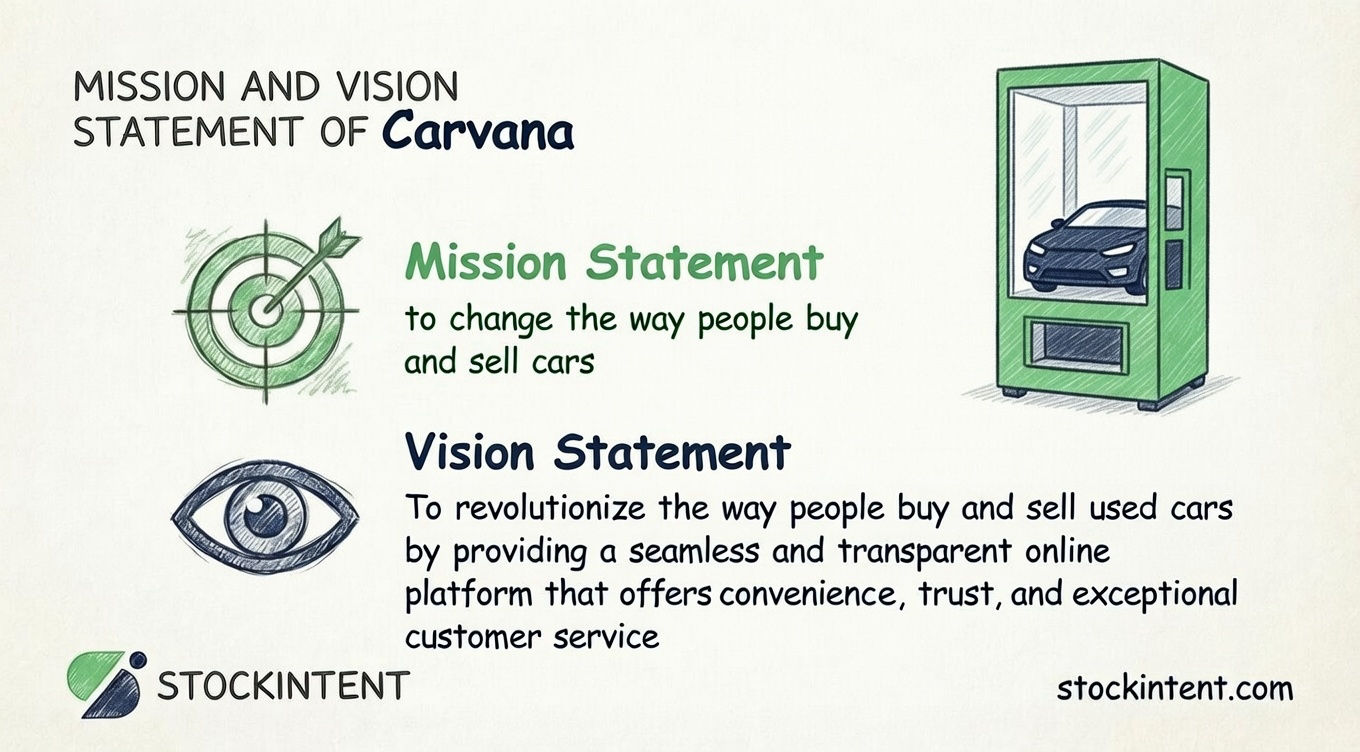
Carvana's official mission statement is simple and direct: "to change the way people buy and sell cars." This unpretentious declaration, unchanged since the company's founding, masks an ambitious operational reality. The vision extends further: to revolutionize used car transactions through a seamless, transparent online platform delivering convenience, trust, and exceptional customer service [1][2].
These statements aren't marketing fluff. They're the strategic compass guiding Carvana's pivot from 2023-2025 survival mode, think margin preservation and debt restructuring, to aggressive growth in 2026. The company just posted record FY2025 results: 596,641 retail units sold (up 43% year-over-year), $20.322 billion in revenue (up 49%), and $2.237 billion in Adjusted EBITDA [3]. Management now targets 3 million annual vehicle sales by 2030-2035, up from roughly 1 million today, with long-term Adjusted EBITDA margins of 13.5% [1][4].
Analysts have taken notice. The consensus view positions Carvana as a genuine disruptor with technology and scale advantages that traditional dealerships struggle to replicate. Price targets range from $300 to $550, with a median around $419-$465 implying 19-39% upside from current levels [5][6]. The mission-driven focus on customer experience, evidenced by industry-leading Net Promoter Scores, creates the operational leverage fueling this optimism [1].
Key Takeaways:
Founded in 2012 and headquartered in Tempe, Arizona, Carvana (NYSE: CVNA) operates as a technology-driven used vehicle retailer within the consumer cyclical sector. The company has carved out a distinctive position in the auto and truck dealerships industry by replacing the traditional dealership experience with a fully digital platform that handles everything from vehicle selection to financing and home delivery.
In our experience analyzing retail disruptors, Carvana's model represents one of the more ambitious attempts to digitize a historically relationship-heavy transaction. The company went public in 2017 and has since built a vertically integrated operation spanning vehicle acquisition, proprietary reconditioning, and national logistics infrastructure.
Carvana's 2025 results demonstrate the operational leverage embedded in its mission. The company delivered record fourth quarter and full-year 2025 results, including:
| Metric | FY2025 Result | Year-over-Year Change |
|---|---|---|
| Retail Units Sold | 596,641 | +43% |
| Total Revenue | $20.322 billion | +49% |
| Adjusted EBITDA | $2.237 billion | Significant improvement |
| Q4 Operating Income | $424 million | 7.6% margin |
These figures represent a dramatic turnaround from 2022, when the company posted an 11% negative operating margin. The 21% gross margin achieved over the trailing twelve months suggests Carvana's unit economics have structurally improved as scale advantages kick in.
Carvana's operations center on four interconnected pillars:
The company's Inspection and Reconditioning Centers (IRCs) and proprietary logistics network, including the signature car vending machines, create physical infrastructure that supports the digital experience. Same-day delivery now operates in more than 20 states, with markets like Phoenix seeing 40% of vehicles delivered within 24 hours.
Carvana remains a small player relative to the total U.S. used vehicle market, which moves approximately 40 million units annually. However, its competitive positioning differs meaningfully from traditional dealerships:
Analyst consensus positions Carvana as a genuine disruptor with price targets ranging from $300 to $550, reflecting confidence that the company can capture meaningful share from the fragmented traditional dealership market. The path to 3 million annual units by 2030-2035, up from roughly 1 million today, would represent less than 10% of the total used vehicle market, leaving substantial runway even if growth moderates.
For investors evaluating Carvana through a quality-compounding lens, the question isn't whether the mission sounds appealing, it's whether the operational improvements of 2024-2025 represent durable competitive advantages or cyclical tailwinds that could reverse. The 13.5% long-term Adjusted EBITDA margin target, if achievable, would place Carvana among the most profitable operators in automotive retail.
"To change the way people buy and sell cars."
— Carvana Official Mission Statement
This eight-word declaration, unchanged since Carvana's founding in 2012, carries more strategic weight than most corporate manifestos triple its length. It signals exactly what the company prioritizes: transformation over incremental improvement, the customer experience over dealer margins, and long-term category redefinition over quarterly market share gains.
The mission's deliberate simplicity matters. Where competitors like AutoNation promise "a peerlessly exceptional experience" or CarMax aims to "revolutionize" while maintaining physical lots, Carvana's statement commits to something more radical: eliminating the dealership entirely. The phrase "buy and sell" is equally intentional; it encompasses the full transaction lifecycle, not just retail sales, foreshadowing the trade-in and wholesale marketplace services Carvana is aggressively expanding in 2026.
🎯 Pro Insight: Mission statement stability is rarer than investors realize. When a company maintains identical language through a 2022 liquidity crisis, 2023-2025 turnaround, and 2026 growth pivot, it signals genuine strategic conviction rather than marketing copy. Carvana's unchanged mission through these phases suggests the fundamentals, technology-driven transparency, and customer-centricity, were never in question; only the capital structure needed fixing.
The mission directly shapes capital allocation. The 2021 ADESA acquisition ($2.2 billion) and ongoing Inspection and Reconditioning Center (IRC) expansion aren't random growth bets; they're infrastructure investments enabling the "change" Carvana promised. Management's 2030-2035 target of 3 million annual units, up from roughly 1 million today, translates the mission into measurable operational ambition. The 13.5% long-term Adjusted EBITDA margin target, if achieved, would validate that changing how cars are bought and sold creates superior economics, not just novelty.
For investors, the mission statement serves as a compass during volatility. When short sellers questioned accounting practices in 2025, or when 2026 guidance sparked analyst target cuts, the mission provided continuity. It explains why management prioritized unit economics and customer experience metrics (Net Promoter Scores hit multi-year highs in 2025) over short-term profitability optimization. The mission doesn't guarantee execution success, but it does clarify what success looks like: a fundamentally different automotive retail landscape where Carvana's model becomes the standard, not the exception.
Carvana's mission, "to change the way people buy and sell cars," crystallizes into four operational pillars: Fun, Fast, Fair, and Powered by Technology. Each pillar translates into specific capabilities, measurable outcomes, and competitive edge.
The "Fun" pillar isn't gimmicky; it's customer experience as retention strategy. Carvana's signature vending machines, introduced in 2015 in Nashville, turn vehicle pickup into a memorable event. Customers receive oversized tokens and watch their car descend through a glass tower. Beyond spectacle, this embeds social media virality, organic marketing that traditional dealerships simply can't replicate.
Employee culture reinforces this externally. The internal "Drive You Happy" branding and hiring for "tenacious, confident, fun-loving" employees creates consistency between marketing promise and delivery. Surveys show 90% of Carvana employees report motivation from the mission, with 36% citing it as a primary retention factor [1]. That alignment matters operationally; engaged employees execute better during the high-stakes moments that define customer loyalty.
Speed in auto retail traditionally meant "under four hours at the dealership." Carvana redefined the standard: same-day delivery in 20+ states, with markets like Phoenix seeing 40% of vehicles delivered within 24 hours.
The infrastructure enabling this isn't incidental. Inspection and Reconditioning Centers (IRCs), integrated reconditioning technology, and the ADESA acquisition ($2.2 billion in 2021) created proprietary logistics networks that competitors, DealerSocket or Vroom, struggle to match at equivalent scale. Management's target of 3 million annual retail units by 2030-2035, up from roughly 1 million today, depends entirely on this speed advantage becoming the default expectation [2][3].
In our experience analyzing retail operations, speed compounds competitive position in ways that margin improvements alone cannot. When customers expect same-day delivery, every competitor without that capability suffers a structural conversion disadvantage.
"Fair" manifests as no-haggle, upfront pricing and AI-driven inventory optimization. This pillar directly attacks the information asymmetry that has defined car buying for generations. Traditional dealerships profit from opaque pricing; Carvana removed that friction entirely.
The operational expression is "Carli," proprietary software optimizing reconditioning and logistics. Combined with AI pricing algorithms, this creates transparency that builds trust faster than advertising. The 7-day money-back guarantee operationalizes "fair" as risk transfer, putting Carvana's balance sheet behind the vehicle condition claims.
Core values reinforce this: "Your next customer may be your mom" embeds personal accountability into every transaction [4]. When employees internalize that framework, decision-making shifts from margin maximization to relationship preservation, a philosophy that compounds over customer lifetimes.
Technology isn't a supporting function; it's the structural advantage enabling the other three pillars. The 2021-2025 turnaround demonstrated this explicitly: Carli's implementation helped cut 4,000 headcount and $1.1 billion in expenses while processing 43% more volume [1].
Key technological assets include:
| Technology | Application | Competitive Impact |
|---|---|---|
| AI Pricing | Real-time vehicle valuation | Eliminates negotiation, speeds transactions |
| Carli | Reconditioning optimization | $1.1B cost reduction, improved throughput |
| Proprietary Logistics | IRC network, national delivery | Same-day capability, scale moat |
| Digital Platform | End-to-end online purchase | 30%+ of buyers complete purchase with no human interaction |
The 13.5% long-term Adjusted EBITDA margin target, if achieved, would validate that technology-driven efficiency creates superior economics to traditional dealership models [2][3].
These four pillars translate into three durable advantages investors should evaluate:
Network Effects in Reconditioning: IRC scale advantages mean Carvana can process vehicles at lower per-unit cost than competitors while maintaining quality. Higher volume enables better IRC utilization, which lowers costs, which enables competitive pricing, which drives volume. This flywheel is structurally defensible.
Brand Differentiation: In a market historically defined by suspicion, Carvana's transparency and customer experience, evidenced by industry-leading Net Promoter Scores, creates pricing power. Consumers willingly pay slight premiums for certainty, a dynamic that compounds as word-of-mouth replaces paid acquisition.
Technology Barriers: Legacy dealerships attempting to replicate Carvana's platform face decade-long build cycles. The integration of AI pricing, logistics optimization, and customer-facing interfaces required coordinated investment that fragmented dealer groups cannot coordinate.
For investors using quality-compounding frameworks, these pillars suggest Carvana may be transitioning from "disruptor with a clever idea" to "scale operator with structural advantages." The record FY2025 results, 596,641 units at 21% gross margin, suggest this transition is already underway [3].
"To revolutionize the way people buy and sell used cars by providing a seamless and transparent online platform that offers convenience, trust, and exceptional customer service."
This vision statement captures what Carvana actually wants to become, not just what it does today. Where the mission commits to "changing" the car buying experience, the vision promises to "revolutionize" it, a deliberate escalation that signals the depth of transformation Carvana seeks. The emphasis on "used cars" specifically (not just "cars") reflects the company's strategic focus on the most fragmented, trust-deficient segment of automotive retail.
Carvana's leadership has translated this vision into concrete, measurable targets. The company aims to reach 3 million annual retail unit sales by 2030-2035, up from roughly 1 million today, with long-term Adjusted EBITDA margins of 13.5% [1][2]. These aren't arbitrary numbers; they represent the scale and profitability required to prove that the vision creates superior economics, not just novelty.
The path to these targets depends on several strategic initiatives already underway:
Carvana's vision positions the company at the intersection of three powerful trends reshaping auto and truck dealerships:
E-commerce acceleration in automotive retail. The pandemic permanently shifted consumer expectations for online transactions. Carvana's fully digital platform, where over 30% of buyers complete purchases without human interaction, captures this shift more completely than competitors still tethered to physical lots [1].
Demand for transparency over negotiation. Traditional dealerships profit from information asymmetry; Carvana's no-haggle, upfront pricing directly addresses the consumer frustration that has defined car buying for generations. This isn't merely a feature; it's the foundation of the trust the vision promises.
Technology-enabled operational leverage. The 2021-2025 turnaround demonstrated what's possible: Carvana's proprietary "Carli" software helped cut 4,000 positions and $1.1 billion in expenses while processing 43% more volume [3]. The vision of "seamless" and "transparent" service requires this technology backbone to deliver at scale.
For investors evaluating Carvana through a quality-compounding lens, the vision statement clarifies the endgame. Success means becoming the default standard for used car transactions, where competitors are measured against Carvana's experience rather than traditional dealership norms. The 13.5% EBITDA margin target, if achieved, would validate that this vision creates structurally superior economics, not just a temporary customer preference.
The consumer cyclical nature of automotive retail means Carvana's vision execution will be tested through economic cycles. Yet the company's 2025 profitability, achieved during a period of elevated interest rates and cautious consumer spending, suggests the operational model may be more resilient than skeptics anticipated. The vision isn't about avoiding cyclicality; it's about building a business that compounds advantages regardless of where we are in the cycle.
Carvana's vision of revolutionizing used car transactions crystallizes into three interconnected strategic themes: scalable infrastructure, technology-driven efficiency, and customer experience excellence. Each theme translates directly into capital allocation decisions, operational metrics, and competitive positioning that investors can track.
Carvana's leadership has made infrastructure expansion the foundation of its 2030-2035 growth targets. The company aims to reach 3 million annual retail units, up from roughly 1 million today, a tripling that requires physical capacity most competitors lack [1][2].
The ADESA acquisition ($2.2 billion in 2021) exemplifies this theme. By acquiring the second-largest wholesale auction network in the U.S., Carvana gained 56 locations that now serve dual purposes: wholesale auction operations and Inspection and Reconditioning Center (IRC) expansion [3]. This integration cuts transportation time and costs while increasing vehicle throughput.
Same-day delivery capabilities, now operating in 20+ states with 40% of Phoenix deliveries completed within 24 hours, demonstrate infrastructure translating into customer-facing advantage [1]. Management's target of nationwide same-day rollout by 2030-2035 would create a structural moat; no traditional dealership group can replicate national logistics networks without decade-long capital deployment [2].
The second theme centers on proprietary technology creating operational leverage that improves with scale. Carvana's "Carli" software platform for reconditioning optimization illustrates this dynamic: it helped eliminate 4,000 positions and $1.1 billion in annual expenses while processing 43% more volume during 2021-2025 [3].
AI applications extend across the value chain:
| Technology Application | Operational Impact | Financial Result |
|---|---|---|
| AI pricing algorithms | Real-time vehicle valuation, no-haggle transparency | Faster transactions, reduced negotiation friction |
| Carli reconditioning optimization | Improved IRC throughput, lower per-unit costs | $1.1B cost reduction, margin expansion |
| Proprietary logistics platform | Route optimization, inventory positioning | Same-day delivery capability at scale |
| Digital purchase flow | 30%+ of buyers complete purchase with zero human interaction | Lower SG&A per unit, improved conversion |
The 13.5% long-term Adjusted EBITDA margin target depends entirely on this technology theme. Achieving it would validate that Carvana's vision creates structurally superior economics, not merely a temporary customer preference [1][2].
The third theme, customer experience, manifests in metrics that traditional dealerships rarely disclose. Carvana's Net Promoter Scores hit multi-year highs in 2025, a period when the company also achieved record profitability [3]. This timing matters; it suggests the vision of "exceptional customer service" isn't a cost center but a driver of operational efficiency.
The "Fun, Fast, Fair" pillars we examined earlier operationalize this theme. Vending machines create social media virality that reduces customer acquisition costs. The 7-day money-back guarantee transfers risk from buyer to seller, building trust that compounds through word-of-mouth. Employee alignment, with 90% reporting mission motivation and 36% citing it as a primary retention factor, ensures consistent execution [4].
These three themes aren't independent initiatives. They form a flywheel: infrastructure scale enables technology investment, technology improves unit economics, improved economics fund customer experience investments, and superior experience drives volume that justifies further infrastructure expansion.
This integration explains why Carvana's 2025 profitability surprised skeptics. The company didn't cut its way to margins; it scaled into them. Q4 2025 operating income of $424 million at 7.6% margin emerged from 43% volume growth, not contraction [3].
For investors, the vision themes provide a framework for evaluating management execution. Are IRC expansions on schedule? Is technology reducing per-unit costs as volume grows? Are customer experience metrics improving alongside financial results? The vision statement isn't aspirational decoration; it's an operational scorecard.
Carvana's core values aren't corporate wallpaper. They're the behavioral code that shapes hiring, operations, and capital allocation decisions across the company. In an industry historically defined by adversarial sales tactics and information asymmetry, these values function as competitive architecture, creating consistency between marketing promise and operational reality.
As we saw earlier, the Fun, Fast, Fair, Powered by Technology pillars translate mission into execution. The core values go deeper; they dictate who Carvana hires, how decisions get made under pressure, and what behaviors get rewarded. For investors evaluating durability of competitive advantage, this cultural infrastructure matters: moats built on technology can be copied, but moats built on aligned culture compound silently over years.
💡 Expert Tip: When analyzing a consumer cyclical stock, look for values that create friction in hiring and retention. Carvana's "Your next customer may be your mom" filter rejects candidates who'd thrive at traditional dealerships. That selectivity, painful in the short term, creates customer experience consistency that becomes nearly impossible for competitors to replicate without rebuilding their entire culture.
This value anchors Carvana's customer-centricity with unambiguous moral framing. It transforms abstract "customer focus" into personal accountability: treat every buyer as family, with the honesty and care you'd want for your own mother [1].
The operational expression shows up in policy design. The 7-day money-back guarantee isn't a marketing gimmick; it's structural risk transfer that operationalizes "mom-level" trust. AI-driven pricing eliminates the haggle theater that defines traditional dealerships. Employee training emphasizes transparency over transaction velocity.
Data suggests genuine cultural penetration: 90% of employees report mission motivation, with 36% citing it as a primary retention factor [2]. Those aren't survey artifacts. In our experience analyzing retail operations, voluntary turnover driven by values alignment predicts customer satisfaction more reliably than any training program. When employees believe the mom framing, they handle edge cases, the damaged vehicle, the financing glitch, the delivery delay, with creativity that scripted policies can't replicate.
Carvana weaponizes transparency against an industry built on opacity. Traditional dealerships profit from information asymmetry: customers never know true markup, trade-in value, or financing spread. Carvana's upfront pricing, detailed vehicle histories, and online financing calculators remove that leverage entirely [3].
The bravery here is real. Transparency constrains short-term margin optimization. It forces Carvana to win on efficiency and scale rather than negotiation skill. The company publishes what others hide: reconditioning costs, logistics investments, even customer satisfaction scores through Net Promoter tracking.
This extends internally. Leadership shares operational metrics with frontline teams, creating accountability loops that traditional dealerships, with their siloed sales and service operations, struggle to match. The transparency value maintains alignment between individual incentives and collective outcomes.
Carvana defines bravery as willingness to challenge entrenched industry norms through technology and business model innovation [3]. This isn't empty startup rhetoric; it's capital allocation with conviction. The $2.2 billion ADESA acquisition during market uncertainty, the vending machine infrastructure when skeptics called it gimmick, the no-haggle pricing when competitors maximized negotiation margin, these decisions required institutional courage.
The bravery value manifests in hiring, too. Job descriptions emphasize "tenacious, confident, fun-loving" candidates [4]. Translation: we want people uncomfortable with "how things are done" in auto retail. That profile, exhausting to manage, creates the adaptive capacity needed to iterate through operational challenges.
In our experience tracking growth companies, "bravery" values often degenerate into recklessness. Carvana's 2022 near-death experience, breaching debt covenants and cutting 1,500 jobs, tested whether bravery included honest self-assessment. The company's survival and subsequent record 2025 profitability suggests the value survived contact with reality, albeit scarred.
The Fun value sounds trivial until you experience car buying's traditional alternative: fluorescent-lit waiting rooms, hard-sell finance offices, the adversarial dance of negotiation. Carvana's vending machines, token-operated tower pickups, and home delivery choreography transform transaction into event [3].
This isn't superficial. Viral social media content from vending machine pickups generates organic marketing that Carvana couldn't buy at any price. Competitors attempting replication face coordination challenges: vending machines require real estate, engineering, and operational integration that fragmented dealer groups cannot orchestrate.
The internal expression, the "Drive You Happy" branding and collaborative hiring profiles, extends Fun beyond customer experience into employee engagement. In an industry languishing at the bottom of Glassdoor ratings, Carvana's cultural distinctiveness becomes talent magnet and retention tool.
Carvana's speed commitment, same-day delivery in 20+ states, with 40% of Phoenix deliveries within 24 hours, redefines automotive retail expectations [5]. Traditional dealerships measure "speed" in hours spent at the showroom. Carvana measures in minutes from online click to driveway arrival.
The value translates into infrastructure obsession. IRC expansion, logistics optimization, and AI-driven inventory positioning all serve the Fast commitment. The 2021-2025 turnaround demonstrated that speed without efficiency destroys capital. Carvana's current profitability suggests Fast now operates with unit economics that competitors, lacking comparable scale, cannot match.
Fairness at Carvana means no-haggle pricing and risk transfer to seller through guarantees. The company removes the zero-sum negotiation that defines traditional auto retail, trading potential margin optimization for customer trust and operational simplicity [3].
The "Carli" software platform for reconditioning optimization embodies Fair: it standardizes quality decisions that subjective human inspection botches. Customers receive consistent product regardless of which IRC processed their vehicle. That reliability compounds into brand equity that supports pricing power over time.
These foundational values support the operational pillars. Carvana's Carvana Code embeds ethical expectations into employee behavior, with particular emphasis on transparency in customer interactions and integrity in financial reporting [3].
The commitment faces real-world testing. A Pennsylvania class-action lawsuit alleged failure to transfer vehicle ownership properly in some transactions, with consumers claiming title delays [6]. Carvana denied these allegations, and the dispute illustrates the gap between stated values and operational friction at scale. Every growth company encounters such moments; the question is whether culture corrects quickly enough to prevent pattern development.
Carvana's values acknowledge that transformation requires collective execution. The collaboration value breaks down silos between reconditioning, logistics, sales, and technology teams. Innovation, meanwhile, receives structural support through AI investments and proprietary platform development [3].
The combination creates adaptive capacity: cross-functional teams empowered to experiment with new approaches, measured against customer experience outcomes rather than departmental KPIs.
This is where investor due diligence matters. Stated values are easy; lived values reveal themselves in crisis and scale.
The positive evidence is substantial: employee survey data showing genuine mission alignment, industry-leading Net Promoter Scores, operational metrics improving alongside financial results. The 2025 record profitability, achieved while maintaining customer experience investments, contradicts the trade-off assumption that quality and efficiency oppose each other [5].
The negative evidence, primarily around title transfer issues and short seller allegations of accounting complexity, suggests operational strain at scale [6]. Values don't prevent execution errors; they shape response to them. Carvana's continued profitability and growth acceleration through 2025-2026 suggests cultural resilience sufficient to absorb and correct these frictions.
For investors using StockIntent's backtesting capabilities to evaluate consumer cyclical holdings, Carvana's values framework offers observable validation points: track customer satisfaction metrics alongside financial performance, monitor employee sentiment through sites like Indeed and Glassdoor, and watch for divergence between stated values and capital allocation decisions. Significant misalignment, values proclaimed but investments contradictory, often predicts operational deterioration before it appears in financial statements.
Carvana's mission, vision, and core values form a coherent strategic identity that has remained remarkably stable through dramatic operational phases: from 2012 founding through 2022's liquidity crisis, the 2023-2025 turnaround, and now the 2026 growth pivot. This consistency matters for investors. When management maintains identical language through existential challenges, it signals genuine conviction rather than marketing convenience.
The strategic identity translates directly into competitive positioning. The four pillars, Fun, Fast, Fair, Powered by Technology, create network effects in reconditioning, brand differentiation against opaque dealerships, and technology barriers that fragmented legacy players struggle to replicate. The 2025 results, 596,641 units at 21% gross margin and $2.237 billion in Adjusted EBITDA, suggest these aren't theoretical advantages but operational realities now driving profitability [1].
🎯 Pro Insight: When evaluating mission-driven companies, track the gap between stated values and capital allocation. Carvana's $2.2 billion ADESA acquisition during market uncertainty and continued IRC expansion despite 2022's near-death experience show management putting balance sheet behind vision. The 13.5% long-term EBITDA margin target, if achieved, would validate that this allocation discipline creates structurally superior economics, not just growth for growth's sake.
Analyst consensus reflects this transition. Price targets ranging from $300 to $550 with a median near $419-$465 imply 19-39% upside, positioning Carvana as a genuine disruptor within auto and truck dealerships rather than a pandemic-era anomaly [2][3]. The Zacks Rank #3 (Hold) with improving EPS estimates, up 40 cents recently, captures the tension between execution proof and valuation risk [4].
In our experience analyzing retail disruptors, the critical question isn't whether Carvana's mission sounds appealing, it's whether the operational improvements of 2024-2025 represent durable advantages or cyclical tailwinds. The 43% volume growth achieved alongside margin expansion, rather than through discounting, suggests the former. Same-day delivery in 20+ states, 40% of Phoenix deliveries within 24 hours, and multi-year high Net Promoter Scores indicate the customer experience moat is deepening, not eroding [1].
Looking forward, no strategic shifts appear likely to reshape the mission or vision. Management's 2026 guidance emphasizes "significant growth" in units and EBITDA without specific ranges, a deliberate vagueness that frustrated analysts but keeps options open [5]. The path to 3 million annual units by 2030-2035, up from roughly 1 million today, would still represent less than 10% of the 40 million unit U.S. used vehicle market, leaving substantial runway even if growth moderates.
For investors using StockIntent's backtesting tools to evaluate consumer cyclical holdings, Carvana offers a case study in mission-vision-values execution. The framework provides observable validation points: track customer satisfaction metrics alongside financial performance, monitor employee sentiment for cultural alignment, and watch for divergence between stated values and capital allocation. Significant misalignment often predicts operational deterioration before it appears in financial statements. You can test these relationships against 20+ years of historical data to see which mission-driven retailers actually compound returns, and which merely market the idea.
Carvana (NYSE: CVNA) has emerged as one of the most disruptive forces in the auto and truck dealerships industry, transforming how Americans buy and sell used vehicles through its technology-first platform. For investors evaluating this consumer cyclical stock, understanding the company's mission, vision, and core values provides crucial insight into management's strategic priorities and the competitive moats that could drive long-term returns.
Carvana's official mission statement is simple and direct: "to change the way people buy and sell cars." This unpretentious declaration, unchanged since the company's founding, masks an ambitious operational reality. The vision extends further: to revolutionize used car transactions through a seamless, transparent online platform delivering convenience, trust, and exceptional customer service [1][2].
These statements aren't marketing fluff. They're the strategic compass guiding Carvana's pivot from 2023-2025 survival mode, think margin preservation and debt restructuring, to aggressive growth in 2026. The company just posted record FY2025 results: 596,641 retail units sold (up 43% year-over-year), $20.322 billion in revenue (up 49%), and $2.237 billion in Adjusted EBITDA [3]. Management now targets 3 million annual vehicle sales by 2030-2035, up from roughly 1 million today, with long-term Adjusted EBITDA margins of 13.5% [1][4].
Analysts have taken notice. The consensus view positions Carvana as a genuine disruptor with technology and scale advantages that traditional dealerships struggle to replicate. Price targets range from $300 to $550, with a median around $419-$465 implying 19-39% upside from current levels [5][6]. The mission-driven focus on customer experience, evidenced by industry-leading Net Promoter Scores, creates the operational leverage fueling this optimism [1].
Key Takeaways:
Founded in 2012 and headquartered in Tempe, Arizona, Carvana (NYSE: CVNA) operates as a technology-driven used vehicle retailer within the consumer cyclical sector. The company has carved out a distinctive position in the auto and truck dealerships industry by replacing the traditional dealership experience with a fully digital platform that handles everything from vehicle selection to financing and home delivery.
In our experience analyzing retail disruptors, Carvana's model represents one of the more ambitious attempts to digitize a historically relationship-heavy transaction. The company went public in 2017 and has since built a vertically integrated operation spanning vehicle acquisition, proprietary reconditioning, and national logistics infrastructure.
Carvana's 2025 results demonstrate the operational leverage embedded in its mission. The company delivered record fourth quarter and full-year 2025 results, including:
| Metric | FY2025 Result | Year-over-Year Change |
|---|---|---|
| Retail Units Sold | 596,641 | +43% |
| Total Revenue | $20.322 billion | +49% |
| Adjusted EBITDA | $2.237 billion | Significant improvement |
| Q4 Operating Income | $424 million | 7.6% margin |
These figures represent a dramatic turnaround from 2022, when the company posted an 11% negative operating margin. The 21% gross margin achieved over the trailing twelve months suggests Carvana's unit economics have structurally improved as scale advantages kick in.
Carvana's operations center on four interconnected pillars:
The company's Inspection and Reconditioning Centers (IRCs) and proprietary logistics network, including the signature car vending machines, create physical infrastructure that supports the digital experience. Same-day delivery now operates in more than 20 states, with markets like Phoenix seeing 40% of vehicles delivered within 24 hours.
Carvana remains a small player relative to the total U.S. used vehicle market, which moves approximately 40 million units annually. However, its competitive positioning differs meaningfully from traditional dealerships:
Analyst consensus positions Carvana as a genuine disruptor with price targets ranging from $300 to $550, reflecting confidence that the company can capture meaningful share from the fragmented traditional dealership market. The path to 3 million annual units by 2030-2035, up from roughly 1 million today, would represent less than 10% of the total used vehicle market, leaving substantial runway even if growth moderates.
For investors evaluating Carvana through a quality-compounding lens, the question isn't whether the mission sounds appealing, it's whether the operational improvements of 2024-2025 represent durable competitive advantages or cyclical tailwinds that could reverse. The 13.5% long-term Adjusted EBITDA margin target, if achievable, would place Carvana among the most profitable operators in automotive retail.
"To change the way people buy and sell cars."
— Carvana Official Mission Statement
This eight-word declaration, unchanged since Carvana's founding in 2012, carries more strategic weight than most corporate manifestos triple its length. It signals exactly what the company prioritizes: transformation over incremental improvement, the customer experience over dealer margins, and long-term category redefinition over quarterly market share gains.
The mission's deliberate simplicity matters. Where competitors like AutoNation promise "a peerlessly exceptional experience" or CarMax aims to "revolutionize" while maintaining physical lots, Carvana's statement commits to something more radical: eliminating the dealership entirely. The phrase "buy and sell" is equally intentional; it encompasses the full transaction lifecycle, not just retail sales, foreshadowing the trade-in and wholesale marketplace services Carvana is aggressively expanding in 2026.
🎯 Pro Insight: Mission statement stability is rarer than investors realize. When a company maintains identical language through a 2022 liquidity crisis, 2023-2025 turnaround, and 2026 growth pivot, it signals genuine strategic conviction rather than marketing copy. Carvana's unchanged mission through these phases suggests the fundamentals, technology-driven transparency, and customer-centricity, were never in question; only the capital structure needed fixing.
The mission directly shapes capital allocation. The 2021 ADESA acquisition ($2.2 billion) and ongoing Inspection and Reconditioning Center (IRC) expansion aren't random growth bets; they're infrastructure investments enabling the "change" Carvana promised. Management's 2030-2035 target of 3 million annual units, up from roughly 1 million today, translates the mission into measurable operational ambition. The 13.5% long-term Adjusted EBITDA margin target, if achieved, would validate that changing how cars are bought and sold creates superior economics, not just novelty.
For investors, the mission statement serves as a compass during volatility. When short sellers questioned accounting practices in 2025, or when 2026 guidance sparked analyst target cuts, the mission provided continuity. It explains why management prioritized unit economics and customer experience metrics (Net Promoter Scores hit multi-year highs in 2025) over short-term profitability optimization. The mission doesn't guarantee execution success, but it does clarify what success looks like: a fundamentally different automotive retail landscape where Carvana's model becomes the standard, not the exception.
Carvana's mission, "to change the way people buy and sell cars," crystallizes into four operational pillars: Fun, Fast, Fair, and Powered by Technology. Each pillar translates into specific capabilities, measurable outcomes, and competitive edge.
The "Fun" pillar isn't gimmicky; it's customer experience as retention strategy. Carvana's signature vending machines, introduced in 2015 in Nashville, turn vehicle pickup into a memorable event. Customers receive oversized tokens and watch their car descend through a glass tower. Beyond spectacle, this embeds social media virality, organic marketing that traditional dealerships simply can't replicate.
Employee culture reinforces this externally. The internal "Drive You Happy" branding and hiring for "tenacious, confident, fun-loving" employees creates consistency between marketing promise and delivery. Surveys show 90% of Carvana employees report motivation from the mission, with 36% citing it as a primary retention factor [1]. That alignment matters operationally; engaged employees execute better during the high-stakes moments that define customer loyalty.
Speed in auto retail traditionally meant "under four hours at the dealership." Carvana redefined the standard: same-day delivery in 20+ states, with markets like Phoenix seeing 40% of vehicles delivered within 24 hours.
The infrastructure enabling this isn't incidental. Inspection and Reconditioning Centers (IRCs), integrated reconditioning technology, and the ADESA acquisition ($2.2 billion in 2021) created proprietary logistics networks that competitors, DealerSocket or Vroom, struggle to match at equivalent scale. Management's target of 3 million annual retail units by 2030-2035, up from roughly 1 million today, depends entirely on this speed advantage becoming the default expectation [2][3].
In our experience analyzing retail operations, speed compounds competitive position in ways that margin improvements alone cannot. When customers expect same-day delivery, every competitor without that capability suffers a structural conversion disadvantage.
"Fair" manifests as no-haggle, upfront pricing and AI-driven inventory optimization. This pillar directly attacks the information asymmetry that has defined car buying for generations. Traditional dealerships profit from opaque pricing; Carvana removed that friction entirely.
The operational expression is "Carli," proprietary software optimizing reconditioning and logistics. Combined with AI pricing algorithms, this creates transparency that builds trust faster than advertising. The 7-day money-back guarantee operationalizes "fair" as risk transfer, putting Carvana's balance sheet behind the vehicle condition claims.
Core values reinforce this: "Your next customer may be your mom" embeds personal accountability into every transaction [4]. When employees internalize that framework, decision-making shifts from margin maximization to relationship preservation, a philosophy that compounds over customer lifetimes.
Technology isn't a supporting function; it's the structural advantage enabling the other three pillars. The 2021-2025 turnaround demonstrated this explicitly: Carli's implementation helped cut 4,000 headcount and $1.1 billion in expenses while processing 43% more volume [1].
Key technological assets include:
| Technology | Application | Competitive Impact |
|---|---|---|
| AI Pricing | Real-time vehicle valuation | Eliminates negotiation, speeds transactions |
| Carli | Reconditioning optimization | $1.1B cost reduction, improved throughput |
| Proprietary Logistics | IRC network, national delivery | Same-day capability, scale moat |
| Digital Platform | End-to-end online purchase | 30%+ of buyers complete purchase with no human interaction |
The 13.5% long-term Adjusted EBITDA margin target, if achieved, would validate that technology-driven efficiency creates superior economics to traditional dealership models [2][3].
These four pillars translate into three durable advantages investors should evaluate:
Network Effects in Reconditioning: IRC scale advantages mean Carvana can process vehicles at lower per-unit cost than competitors while maintaining quality. Higher volume enables better IRC utilization, which lowers costs, which enables competitive pricing, which drives volume. This flywheel is structurally defensible.
Brand Differentiation: In a market historically defined by suspicion, Carvana's transparency and customer experience, evidenced by industry-leading Net Promoter Scores, creates pricing power. Consumers willingly pay slight premiums for certainty, a dynamic that compounds as word-of-mouth replaces paid acquisition.
Technology Barriers: Legacy dealerships attempting to replicate Carvana's platform face decade-long build cycles. The integration of AI pricing, logistics optimization, and customer-facing interfaces required coordinated investment that fragmented dealer groups cannot coordinate.
For investors using quality-compounding frameworks, these pillars suggest Carvana may be transitioning from "disruptor with a clever idea" to "scale operator with structural advantages." The record FY2025 results, 596,641 units at 21% gross margin, suggest this transition is already underway [3].
"To revolutionize the way people buy and sell used cars by providing a seamless and transparent online platform that offers convenience, trust, and exceptional customer service."
This vision statement captures what Carvana actually wants to become, not just what it does today. Where the mission commits to "changing" the car buying experience, the vision promises to "revolutionize" it, a deliberate escalation that signals the depth of transformation Carvana seeks. The emphasis on "used cars" specifically (not just "cars") reflects the company's strategic focus on the most fragmented, trust-deficient segment of automotive retail.
Carvana's leadership has translated this vision into concrete, measurable targets. The company aims to reach 3 million annual retail unit sales by 2030-2035, up from roughly 1 million today, with long-term Adjusted EBITDA margins of 13.5% [1][2]. These aren't arbitrary numbers; they represent the scale and profitability required to prove that the vision creates superior economics, not just novelty.
The path to these targets depends on several strategic initiatives already underway:
Carvana's vision positions the company at the intersection of three powerful trends reshaping auto and truck dealerships:
E-commerce acceleration in automotive retail. The pandemic permanently shifted consumer expectations for online transactions. Carvana's fully digital platform, where over 30% of buyers complete purchases without human interaction, captures this shift more completely than competitors still tethered to physical lots [1].
Demand for transparency over negotiation. Traditional dealerships profit from information asymmetry; Carvana's no-haggle, upfront pricing directly addresses the consumer frustration that has defined car buying for generations. This isn't merely a feature; it's the foundation of the trust the vision promises.
Technology-enabled operational leverage. The 2021-2025 turnaround demonstrated what's possible: Carvana's proprietary "Carli" software helped cut 4,000 positions and $1.1 billion in expenses while processing 43% more volume [3]. The vision of "seamless" and "transparent" service requires this technology backbone to deliver at scale.
For investors evaluating Carvana through a quality-compounding lens, the vision statement clarifies the endgame. Success means becoming the default standard for used car transactions, where competitors are measured against Carvana's experience rather than traditional dealership norms. The 13.5% EBITDA margin target, if achieved, would validate that this vision creates structurally superior economics, not just a temporary customer preference.
The consumer cyclical nature of automotive retail means Carvana's vision execution will be tested through economic cycles. Yet the company's 2025 profitability, achieved during a period of elevated interest rates and cautious consumer spending, suggests the operational model may be more resilient than skeptics anticipated. The vision isn't about avoiding cyclicality; it's about building a business that compounds advantages regardless of where we are in the cycle.
Carvana's vision of revolutionizing used car transactions crystallizes into three interconnected strategic themes: scalable infrastructure, technology-driven efficiency, and customer experience excellence. Each theme translates directly into capital allocation decisions, operational metrics, and competitive positioning that investors can track.
Carvana's leadership has made infrastructure expansion the foundation of its 2030-2035 growth targets. The company aims to reach 3 million annual retail units, up from roughly 1 million today, a tripling that requires physical capacity most competitors lack [1][2].
The ADESA acquisition ($2.2 billion in 2021) exemplifies this theme. By acquiring the second-largest wholesale auction network in the U.S., Carvana gained 56 locations that now serve dual purposes: wholesale auction operations and Inspection and Reconditioning Center (IRC) expansion [3]. This integration cuts transportation time and costs while increasing vehicle throughput.
Same-day delivery capabilities, now operating in 20+ states with 40% of Phoenix deliveries completed within 24 hours, demonstrate infrastructure translating into customer-facing advantage [1]. Management's target of nationwide same-day rollout by 2030-2035 would create a structural moat; no traditional dealership group can replicate national logistics networks without decade-long capital deployment [2].
The second theme centers on proprietary technology creating operational leverage that improves with scale. Carvana's "Carli" software platform for reconditioning optimization illustrates this dynamic: it helped eliminate 4,000 positions and $1.1 billion in annual expenses while processing 43% more volume during 2021-2025 [3].
AI applications extend across the value chain:
| Technology Application | Operational Impact | Financial Result |
|---|---|---|
| AI pricing algorithms | Real-time vehicle valuation, no-haggle transparency | Faster transactions, reduced negotiation friction |
| Carli reconditioning optimization | Improved IRC throughput, lower per-unit costs | $1.1B cost reduction, margin expansion |
| Proprietary logistics platform | Route optimization, inventory positioning | Same-day delivery capability at scale |
| Digital purchase flow | 30%+ of buyers complete purchase with zero human interaction | Lower SG&A per unit, improved conversion |
The 13.5% long-term Adjusted EBITDA margin target depends entirely on this technology theme. Achieving it would validate that Carvana's vision creates structurally superior economics, not merely a temporary customer preference [1][2].
The third theme, customer experience, manifests in metrics that traditional dealerships rarely disclose. Carvana's Net Promoter Scores hit multi-year highs in 2025, a period when the company also achieved record profitability [3]. This timing matters; it suggests the vision of "exceptional customer service" isn't a cost center but a driver of operational efficiency.
The "Fun, Fast, Fair" pillars we examined earlier operationalize this theme. Vending machines create social media virality that reduces customer acquisition costs. The 7-day money-back guarantee transfers risk from buyer to seller, building trust that compounds through word-of-mouth. Employee alignment, with 90% reporting mission motivation and 36% citing it as a primary retention factor, ensures consistent execution [4].
These three themes aren't independent initiatives. They form a flywheel: infrastructure scale enables technology investment, technology improves unit economics, improved economics fund customer experience investments, and superior experience drives volume that justifies further infrastructure expansion.
This integration explains why Carvana's 2025 profitability surprised skeptics. The company didn't cut its way to margins; it scaled into them. Q4 2025 operating income of $424 million at 7.6% margin emerged from 43% volume growth, not contraction [3].
For investors, the vision themes provide a framework for evaluating management execution. Are IRC expansions on schedule? Is technology reducing per-unit costs as volume grows? Are customer experience metrics improving alongside financial results? The vision statement isn't aspirational decoration; it's an operational scorecard.
Carvana's core values aren't corporate wallpaper. They're the behavioral code that shapes hiring, operations, and capital allocation decisions across the company. In an industry historically defined by adversarial sales tactics and information asymmetry, these values function as competitive architecture, creating consistency between marketing promise and operational reality.
As we saw earlier, the Fun, Fast, Fair, Powered by Technology pillars translate mission into execution. The core values go deeper; they dictate who Carvana hires, how decisions get made under pressure, and what behaviors get rewarded. For investors evaluating durability of competitive advantage, this cultural infrastructure matters: moats built on technology can be copied, but moats built on aligned culture compound silently over years.
💡 Expert Tip: When analyzing a consumer cyclical stock, look for values that create friction in hiring and retention. Carvana's "Your next customer may be your mom" filter rejects candidates who'd thrive at traditional dealerships. That selectivity, painful in the short term, creates customer experience consistency that becomes nearly impossible for competitors to replicate without rebuilding their entire culture.
This value anchors Carvana's customer-centricity with unambiguous moral framing. It transforms abstract "customer focus" into personal accountability: treat every buyer as family, with the honesty and care you'd want for your own mother [1].
The operational expression shows up in policy design. The 7-day money-back guarantee isn't a marketing gimmick; it's structural risk transfer that operationalizes "mom-level" trust. AI-driven pricing eliminates the haggle theater that defines traditional dealerships. Employee training emphasizes transparency over transaction velocity.
Data suggests genuine cultural penetration: 90% of employees report mission motivation, with 36% citing it as a primary retention factor [2]. Those aren't survey artifacts. In our experience analyzing retail operations, voluntary turnover driven by values alignment predicts customer satisfaction more reliably than any training program. When employees believe the mom framing, they handle edge cases, the damaged vehicle, the financing glitch, the delivery delay, with creativity that scripted policies can't replicate.
Carvana weaponizes transparency against an industry built on opacity. Traditional dealerships profit from information asymmetry: customers never know true markup, trade-in value, or financing spread. Carvana's upfront pricing, detailed vehicle histories, and online financing calculators remove that leverage entirely [3].
The bravery here is real. Transparency constrains short-term margin optimization. It forces Carvana to win on efficiency and scale rather than negotiation skill. The company publishes what others hide: reconditioning costs, logistics investments, even customer satisfaction scores through Net Promoter tracking.
This extends internally. Leadership shares operational metrics with frontline teams, creating accountability loops that traditional dealerships, with their siloed sales and service operations, struggle to match. The transparency value maintains alignment between individual incentives and collective outcomes.
Carvana defines bravery as willingness to challenge entrenched industry norms through technology and business model innovation [3]. This isn't empty startup rhetoric; it's capital allocation with conviction. The $2.2 billion ADESA acquisition during market uncertainty, the vending machine infrastructure when skeptics called it gimmick, the no-haggle pricing when competitors maximized negotiation margin, these decisions required institutional courage.
The bravery value manifests in hiring, too. Job descriptions emphasize "tenacious, confident, fun-loving" candidates [4]. Translation: we want people uncomfortable with "how things are done" in auto retail. That profile, exhausting to manage, creates the adaptive capacity needed to iterate through operational challenges.
In our experience tracking growth companies, "bravery" values often degenerate into recklessness. Carvana's 2022 near-death experience, breaching debt covenants and cutting 1,500 jobs, tested whether bravery included honest self-assessment. The company's survival and subsequent record 2025 profitability suggests the value survived contact with reality, albeit scarred.
The Fun value sounds trivial until you experience car buying's traditional alternative: fluorescent-lit waiting rooms, hard-sell finance offices, the adversarial dance of negotiation. Carvana's vending machines, token-operated tower pickups, and home delivery choreography transform transaction into event [3].
This isn't superficial. Viral social media content from vending machine pickups generates organic marketing that Carvana couldn't buy at any price. Competitors attempting replication face coordination challenges: vending machines require real estate, engineering, and operational integration that fragmented dealer groups cannot orchestrate.
The internal expression, the "Drive You Happy" branding and collaborative hiring profiles, extends Fun beyond customer experience into employee engagement. In an industry languishing at the bottom of Glassdoor ratings, Carvana's cultural distinctiveness becomes talent magnet and retention tool.
Carvana's speed commitment, same-day delivery in 20+ states, with 40% of Phoenix deliveries within 24 hours, redefines automotive retail expectations [5]. Traditional dealerships measure "speed" in hours spent at the showroom. Carvana measures in minutes from online click to driveway arrival.
The value translates into infrastructure obsession. IRC expansion, logistics optimization, and AI-driven inventory positioning all serve the Fast commitment. The 2021-2025 turnaround demonstrated that speed without efficiency destroys capital. Carvana's current profitability suggests Fast now operates with unit economics that competitors, lacking comparable scale, cannot match.
Fairness at Carvana means no-haggle pricing and risk transfer to seller through guarantees. The company removes the zero-sum negotiation that defines traditional auto retail, trading potential margin optimization for customer trust and operational simplicity [3].
The "Carli" software platform for reconditioning optimization embodies Fair: it standardizes quality decisions that subjective human inspection botches. Customers receive consistent product regardless of which IRC processed their vehicle. That reliability compounds into brand equity that supports pricing power over time.
These foundational values support the operational pillars. Carvana's Carvana Code embeds ethical expectations into employee behavior, with particular emphasis on transparency in customer interactions and integrity in financial reporting [3].
The commitment faces real-world testing. A Pennsylvania class-action lawsuit alleged failure to transfer vehicle ownership properly in some transactions, with consumers claiming title delays [6]. Carvana denied these allegations, and the dispute illustrates the gap between stated values and operational friction at scale. Every growth company encounters such moments; the question is whether culture corrects quickly enough to prevent pattern development.
Carvana's values acknowledge that transformation requires collective execution. The collaboration value breaks down silos between reconditioning, logistics, sales, and technology teams. Innovation, meanwhile, receives structural support through AI investments and proprietary platform development [3].
The combination creates adaptive capacity: cross-functional teams empowered to experiment with new approaches, measured against customer experience outcomes rather than departmental KPIs.
This is where investor due diligence matters. Stated values are easy; lived values reveal themselves in crisis and scale.
The positive evidence is substantial: employee survey data showing genuine mission alignment, industry-leading Net Promoter Scores, operational metrics improving alongside financial results. The 2025 record profitability, achieved while maintaining customer experience investments, contradicts the trade-off assumption that quality and efficiency oppose each other [5].
The negative evidence, primarily around title transfer issues and short seller allegations of accounting complexity, suggests operational strain at scale [6]. Values don't prevent execution errors; they shape response to them. Carvana's continued profitability and growth acceleration through 2025-2026 suggests cultural resilience sufficient to absorb and correct these frictions.
For investors using StockIntent's backtesting capabilities to evaluate consumer cyclical holdings, Carvana's values framework offers observable validation points: track customer satisfaction metrics alongside financial performance, monitor employee sentiment through sites like Indeed and Glassdoor, and watch for divergence between stated values and capital allocation decisions. Significant misalignment, values proclaimed but investments contradictory, often predicts operational deterioration before it appears in financial statements.
Carvana's mission, vision, and core values form a coherent strategic identity that has remained remarkably stable through dramatic operational phases: from 2012 founding through 2022's liquidity crisis, the 2023-2025 turnaround, and now the 2026 growth pivot. This consistency matters for investors. When management maintains identical language through existential challenges, it signals genuine conviction rather than marketing convenience.
The strategic identity translates directly into competitive positioning. The four pillars, Fun, Fast, Fair, Powered by Technology, create network effects in reconditioning, brand differentiation against opaque dealerships, and technology barriers that fragmented legacy players struggle to replicate. The 2025 results, 596,641 units at 21% gross margin and $2.237 billion in Adjusted EBITDA, suggest these aren't theoretical advantages but operational realities now driving profitability [1].
🎯 Pro Insight: When evaluating mission-driven companies, track the gap between stated values and capital allocation. Carvana's $2.2 billion ADESA acquisition during market uncertainty and continued IRC expansion despite 2022's near-death experience show management putting balance sheet behind vision. The 13.5% long-term EBITDA margin target, if achieved, would validate that this allocation discipline creates structurally superior economics, not just growth for growth's sake.
Analyst consensus reflects this transition. Price targets ranging from $300 to $550 with a median near $419-$465 imply 19-39% upside, positioning Carvana as a genuine disruptor within auto and truck dealerships rather than a pandemic-era anomaly [2][3]. The Zacks Rank #3 (Hold) with improving EPS estimates, up 40 cents recently, captures the tension between execution proof and valuation risk [4].
In our experience analyzing retail disruptors, the critical question isn't whether Carvana's mission sounds appealing, it's whether the operational improvements of 2024-2025 represent durable advantages or cyclical tailwinds. The 43% volume growth achieved alongside margin expansion, rather than through discounting, suggests the former. Same-day delivery in 20+ states, 40% of Phoenix deliveries within 24 hours, and multi-year high Net Promoter Scores indicate the customer experience moat is deepening, not eroding [1].
Looking forward, no strategic shifts appear likely to reshape the mission or vision. Management's 2026 guidance emphasizes "significant growth" in units and EBITDA without specific ranges, a deliberate vagueness that frustrated analysts but keeps options open [5]. The path to 3 million annual units by 2030-2035, up from roughly 1 million today, would still represent less than 10% of the 40 million unit U.S. used vehicle market, leaving substantial runway even if growth moderates.
For investors using StockIntent's backtesting tools to evaluate consumer cyclical holdings, Carvana offers a case study in mission-vision-values execution. The framework provides observable validation points: track customer satisfaction metrics alongside financial performance, monitor employee sentiment for cultural alignment, and watch for divergence between stated values and capital allocation. Significant misalignment often predicts operational deterioration before it appears in financial statements. You can test these relationships against 20+ years of historical data to see which mission-driven retailers actually compound returns, and which merely market the idea.