
Aug 18, 2026
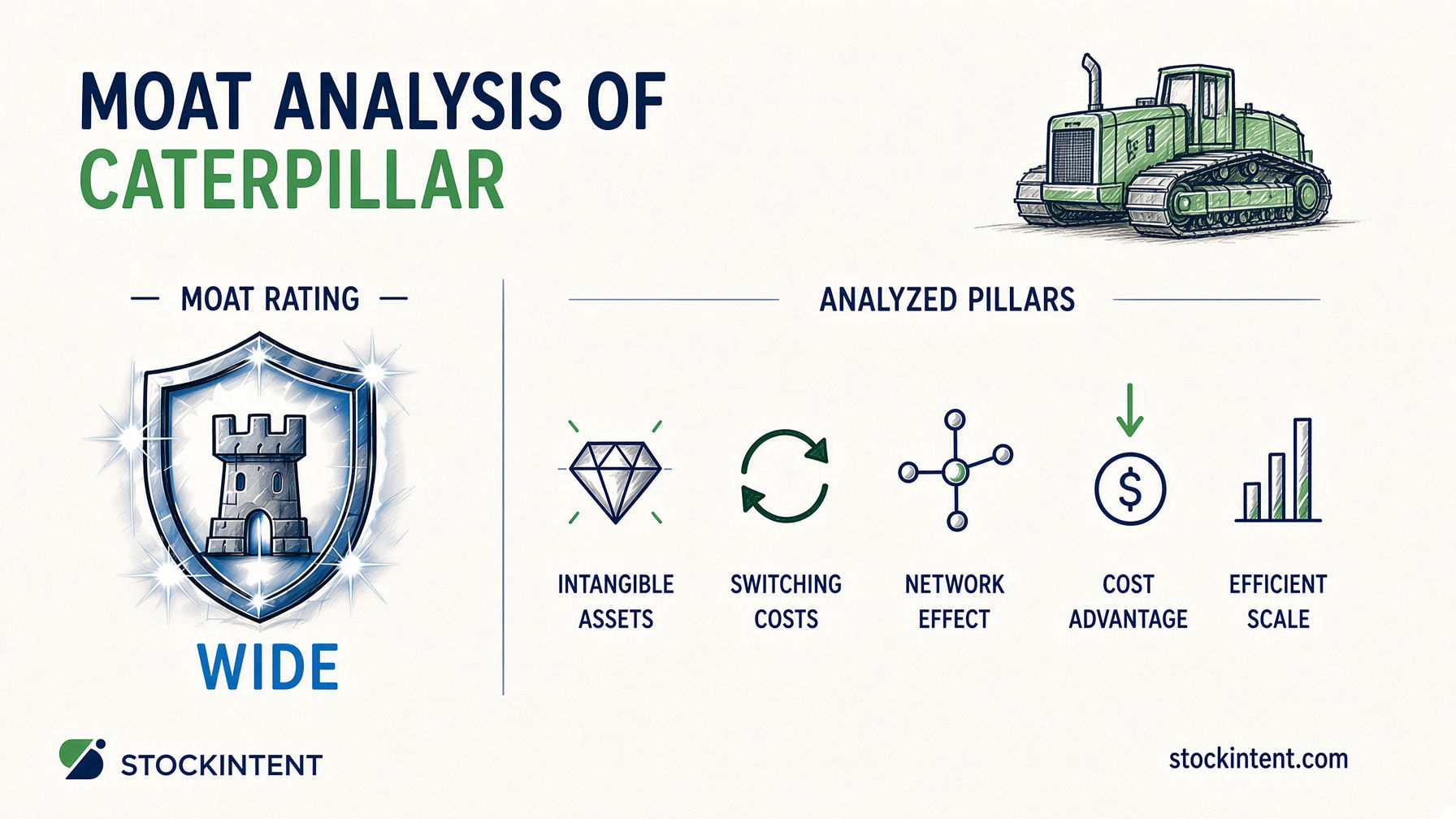
Caterpillar earns a Wide Moat rating with a Stable to Modestly Widening trend and Medium Uncertainty. Its competitive position rests on industrial distribution density and installed base scale rather than brand mystique or platform effects. For long-term investors evaluating business quality, the central question is whether that distribution moat can compound through services growth and new power-generation demand while absorbing tariff and cyclical headwinds.
Here's what matters most:
Pro Insight: Most investors mistake Caterpillar's moat for a brand story or assume network effects exist because of its scale. In practice, CAT's moat is an industrial distribution moat: switching costs rooted in dealer density and parts availability, not platform effects. This distinction matters because industrial moats erode slowly but require consistent capital maintenance.
We evaluate Caterpillar as a durable industrial business with compounding potential through its dealer ecosystem and installed base. The analysis that follows examines whether that durability translates into excess returns through cycles and where the risks lie.
Caterpillar's moat is best understood through five pillars, ordered here by demonstrated strength. The strongest sources are switching costs and efficient scale; network effects, despite the company's scale, are weak or not material for the core business.
This is Caterpillar's most durable moat pillar. The company manages over 1.6 million connected assets, and each machine creates a web of dependencies that make replacement costly and risky. Parts availability, field service relationships, uptime guarantees, and embedded financing all bind customers to the ecosystem. A PSG research report notes that approximately 160 independent dealers operating roughly 2,700 branches provide local service density competitors would need years and substantial capital to replicate.
The installed base compounds this effect. Equipment life cycles run long, and mission-critical applications like mining and power generation reward reliability over upfront cost. Customers who switch risk downtime that can erode any purchase savings quickly.
Caterpillar's global dealer network represents efficient scale in practice. The density of local branches creates a barrier that is expensive to match across geographies and end markets simultaneously. This is not a regulated monopoly; competition remains real in construction, mining, and power systems. But the combination of manufacturing scale, procurement leverage, and distribution reach produces economics that smaller or regional players struggle to equal.
The PSG report frames this as a density flywheel: more machines attract more dealer investment, which improves service reach, which attracts more customers. That is classic efficient-scale logic, even if the business operates in competitive markets.
Brand reputation in heavy equipment carries real weight, but it is secondary to the dealer and installed base moat. Caterpillar's brand signals reliability in harsh, mission-critical applications where failure is expensive. MoatScan analysis cites regulatory and certification barriers in mining and certain energy applications as additional intangible protections.
Still, brand alone does not explain why customers stay. The brand works because it is backed by parts availability and service relationships. Without that infrastructure, the brand would be a weaker moat component.
Scale benefits in manufacturing, procurement, logistics, and R&D are real but supportive rather than central. Caterpillar spreads fixed costs across a large base, and its global footprint provides sourcing advantages. However, sources consistently rank cost advantage below switching costs and efficient scale in explaining the company's competitive position. MoatScan analysis and PSG research both imply that low-cost production is not the primary reason customers choose Caterpillar or remain loyal.
This pillar is the most commonly misunderstood. Caterpillar's scale does not create true network effects where each additional customer directly increases value for all others. What exists is dealer-network density and installed base scaling, which are better described as efficient scale and switching costs. InvestMoat analysis explicitly clarifies that Caterpillar's moat is industrial rather than platform-based. The distinction matters because it sets realistic expectations for growth dynamics and defensive characteristics. Industrial moats erode slowly but require ongoing capital maintenance; they do not produce the exponential returns or sudden collapse risks of platform networks.
Caterpillar's moat is most visible in its pricing power and demand durability, though it is currently being stress-tested by input cost pressures that pricing has not fully offset.
In Q1 2026, favorable price realization contributed $426 million to revenue growth. That is a concrete signal that customers accept premiums rather than moving to competitors. At the same time, backlog surged $12 billion to reach $63 billion, with management citing record order rates. Customers are committing ahead even in an uncertain environment, which suggests the dealer network and installed base create real stickiness.
Cash generation reinforces the picture. Enterprise operating cash flow hit $1.9 billion in Q1 2026, and the company returned $5.7 billion to shareholders through buybacks and dividends in the quarter. The moat is converting into actual cash.
Still, the moat's limits are equally visible. Operating margin compressed to 17.7% in Q1 2026 from 18.1% a year earlier, despite 22% revenue growth. Unfavorable manufacturing costs ran approximately $710 million in the quarter. Pricing power is real, but it is not fully insulating margins from tariff and cost headwinds.
In our experience, the tension between Caterpillar's record backlog and its margin compression is the critical moat test: if pricing power cannot fully offset tariff and manufacturing costs, the moat is narrower than the backlog suggests. The $426 million price realization against $710 million cost headwinds in Q1 2026 suggests the moat is real but not impenetrable.
We rate Caterpillar's moat trend as Stable to Modestly Widening. The company is not experiencing a structural transformation, but demand diversification into AI infrastructure power generation and record backlog growth are genuine tailwinds. Tariff pressure and China competition prevent a stronger widening call.
What's pushing the moat wider: AI and data-center power generation demand has emerged as a material growth driver that extends Caterpillar beyond its traditional construction and mining cycles. Reuters reported in August 2026 that this demand helped lift Q2 sales 24% year-over-year and prompted management to raise full-year guidance to low double-digit growth. That's not a small cyclical bump; it's entry into mission-critical infrastructure with different demand characteristics and potentially higher switching costs. The backlog tells a similar story. At $63 billion in Q1 2026, up $12 billion with record order rates, customers are committing ahead of delivery in ways that suggest confidence in Caterpillar's ecosystem rather than just chasing available capacity.
What's keeping the trend stable rather than strongly widening: The core moat mechanics haven't changed dramatically. Dealer density, parts availability, and installed base scaling still do the heavy lifting. MoatScan analysis notes that Caterpillar's pivot toward autonomous technology and lifecycle solutions aims to deepen switching costs, but execution risk remains. Services scaling must convert that installed base into durable profit, and the transition is ongoing rather than complete.
What's constraining or threatening the moat: Tariff costs, while revised downward from approximately $2.6 billion to $2.2 billion, still represent a material margin headwind. More concerning for the moat's geographic integrity, Finterra research from March 2026 flagged that China domestic competitors are taking market share and compressing prices. That's a localized but real crack in pricing power that could signal broader competitive pressure if similar dynamics spread.
What to watch: Investors can track these indicators using watchlists with custom metric views to stay on top of developments. StockIntent's watchlists help monitor whether these fundamentals are improving or deteriorating quarter by quarter.
| Indicator | Why It Matters | Bull Signal | Bear Signal |
|---|---|---|---|
| Backlog conversion rates | Shows whether record orders become profitable revenue | Rising conversion, stable margins | Slowing conversion, rising cancellations |
| Power generation revenue mix | Tracks AI/data-center demand as % of total | Growing share of infrastructure-led orders | Reversion to pure construction/mining mix |
| Services growth trajectory | Measures recurring revenue deepening customer lock-in | Services outpacing equipment growth | Services stagnating despite installed base growth |
| Price realization vs. tariff impact | Tests whether pricing power fully offsets cost pressures | Price realization exceeding tariff/cost headwinds | Costs outpacing pricing, margin compression |
The modestly widening call depends on that first indicator most of all. If Caterpillar converts its $63 billion backlog at healthy margins while power generation becomes a durable revenue pillar, the moat broadens meaningfully. If backlog converts slowly or AI demand proves cyclical rather than structural, the trend reverts to stable. The watchlist above separates conviction from hope by focusing on measurable outcomes rather than narrative momentum.
We assign Caterpillar a Medium Uncertainty rating. The business is stronger and more predictable than a typical cyclical industrial, but several forces keep the range of future outcomes moderately wide.
Sales predictability has improved, but cyclicality remains. The $63 billion backlog with record order rates gives Caterpillar better near-term visibility than most equipment manufacturers. Management raised 2026 guidance to low double-digit growth after 22% and 24% revenue gains in Q1 and Q2. Still, construction and mining capex cycles can turn quickly, and Reuters noted that 2026 strength partly reflects recovering dealer orders and stabilizing non-residential construction rather than a permanently linear demand profile.
Operating stability is solid but stressed. Enterprise operating cash flow reached $1.9 billion in Q1 2026 and $11.7 billion for full-year 2025, while the balance sheet carries $10.0 billion in enterprise cash. The company returned $5.7 billion to shareholders in Q1 alone. That's real financial resilience. Yet tariff costs estimated at $2.2 billion for 2026, revised down from $2.6 billion earlier, create earnings volatility that even strong cash generation cannot fully neutralize.
Contingent risks are material and growing. AI and data-center power demand is expanding Caterpillar's addressable market, but this driver is unproven across a full economic cycle. Reuters reported that management tied the stronger outlook to this trend, which means execution and sustained customer investment matter. Meanwhile, China domestic competitors are compressing prices and taking share in that region, a crack in geographic pricing power that could widen. Trade policy, emissions regulation, and the capital intensity of scaling power-generation capacity all add variables.
The medium rating reflects this tension: cyclicality could overwhelm switching-cost advantages in a severe downturn, but financial strength and backlog depth provide meaningful resilience. The moat is durable, not invincible.
Caterpillar earns a Wide Moat with a Stable to Modestly Widening trend and Medium Uncertainty. The verdict rests on dealer network density and installed base scale that create genuine switching costs.
Two issues matter most from here. First, can pricing power sustain margins against the estimated $2.2 billion tariff headwind for 2026? Q1 2026 showed $426 million in price realization against $710 million in unfavorable manufacturing costs. The moat is real, but not impenetrable. Second, will AI and data-center power demand prove durable across a full economic cycle, or is it a cyclical spike dressed in secular clothing? Management raised full-year guidance to low double-digit growth on this trend.
We view Caterpillar as a classic test of whether industrial moats can adapt to secular shifts: the dealer network provides defensible local density, but the moat only widens if management successfully converts AI power demand and services growth into durable, high-return reinvestment. The wide moat verdict holds, but the medium uncertainty rating reflects that this transition remains execution-dependent.
For investors evaluating economic moat durability across any company, StockIntent's research platform offers tools to track these fundamentals over time. You can start a 7-day risk-free trial to build your own moat assessments.
This content is for informational or educational purposes and is not investment advice.
Caterpillar earns a Wide Moat rating with a Stable to Modestly Widening trend and Medium Uncertainty. Its competitive position rests on industrial distribution density and installed base scale rather than brand mystique or platform effects. For long-term investors evaluating business quality, the central question is whether that distribution moat can compound through services growth and new power-generation demand while absorbing tariff and cyclical headwinds.
Here's what matters most:
Pro Insight: Most investors mistake Caterpillar's moat for a brand story or assume network effects exist because of its scale. In practice, CAT's moat is an industrial distribution moat: switching costs rooted in dealer density and parts availability, not platform effects. This distinction matters because industrial moats erode slowly but require consistent capital maintenance.
We evaluate Caterpillar as a durable industrial business with compounding potential through its dealer ecosystem and installed base. The analysis that follows examines whether that durability translates into excess returns through cycles and where the risks lie.
Caterpillar's moat is best understood through five pillars, ordered here by demonstrated strength. The strongest sources are switching costs and efficient scale; network effects, despite the company's scale, are weak or not material for the core business.
This is Caterpillar's most durable moat pillar. The company manages over 1.6 million connected assets, and each machine creates a web of dependencies that make replacement costly and risky. Parts availability, field service relationships, uptime guarantees, and embedded financing all bind customers to the ecosystem. A PSG research report notes that approximately 160 independent dealers operating roughly 2,700 branches provide local service density competitors would need years and substantial capital to replicate.
The installed base compounds this effect. Equipment life cycles run long, and mission-critical applications like mining and power generation reward reliability over upfront cost. Customers who switch risk downtime that can erode any purchase savings quickly.
Caterpillar's global dealer network represents efficient scale in practice. The density of local branches creates a barrier that is expensive to match across geographies and end markets simultaneously. This is not a regulated monopoly; competition remains real in construction, mining, and power systems. But the combination of manufacturing scale, procurement leverage, and distribution reach produces economics that smaller or regional players struggle to equal.
The PSG report frames this as a density flywheel: more machines attract more dealer investment, which improves service reach, which attracts more customers. That is classic efficient-scale logic, even if the business operates in competitive markets.
Brand reputation in heavy equipment carries real weight, but it is secondary to the dealer and installed base moat. Caterpillar's brand signals reliability in harsh, mission-critical applications where failure is expensive. MoatScan analysis cites regulatory and certification barriers in mining and certain energy applications as additional intangible protections.
Still, brand alone does not explain why customers stay. The brand works because it is backed by parts availability and service relationships. Without that infrastructure, the brand would be a weaker moat component.
Scale benefits in manufacturing, procurement, logistics, and R&D are real but supportive rather than central. Caterpillar spreads fixed costs across a large base, and its global footprint provides sourcing advantages. However, sources consistently rank cost advantage below switching costs and efficient scale in explaining the company's competitive position. MoatScan analysis and PSG research both imply that low-cost production is not the primary reason customers choose Caterpillar or remain loyal.
This pillar is the most commonly misunderstood. Caterpillar's scale does not create true network effects where each additional customer directly increases value for all others. What exists is dealer-network density and installed base scaling, which are better described as efficient scale and switching costs. InvestMoat analysis explicitly clarifies that Caterpillar's moat is industrial rather than platform-based. The distinction matters because it sets realistic expectations for growth dynamics and defensive characteristics. Industrial moats erode slowly but require ongoing capital maintenance; they do not produce the exponential returns or sudden collapse risks of platform networks.
Caterpillar's moat is most visible in its pricing power and demand durability, though it is currently being stress-tested by input cost pressures that pricing has not fully offset.
In Q1 2026, favorable price realization contributed $426 million to revenue growth. That is a concrete signal that customers accept premiums rather than moving to competitors. At the same time, backlog surged $12 billion to reach $63 billion, with management citing record order rates. Customers are committing ahead even in an uncertain environment, which suggests the dealer network and installed base create real stickiness.
Cash generation reinforces the picture. Enterprise operating cash flow hit $1.9 billion in Q1 2026, and the company returned $5.7 billion to shareholders through buybacks and dividends in the quarter. The moat is converting into actual cash.
Still, the moat's limits are equally visible. Operating margin compressed to 17.7% in Q1 2026 from 18.1% a year earlier, despite 22% revenue growth. Unfavorable manufacturing costs ran approximately $710 million in the quarter. Pricing power is real, but it is not fully insulating margins from tariff and cost headwinds.
In our experience, the tension between Caterpillar's record backlog and its margin compression is the critical moat test: if pricing power cannot fully offset tariff and manufacturing costs, the moat is narrower than the backlog suggests. The $426 million price realization against $710 million cost headwinds in Q1 2026 suggests the moat is real but not impenetrable.
We rate Caterpillar's moat trend as Stable to Modestly Widening. The company is not experiencing a structural transformation, but demand diversification into AI infrastructure power generation and record backlog growth are genuine tailwinds. Tariff pressure and China competition prevent a stronger widening call.
What's pushing the moat wider: AI and data-center power generation demand has emerged as a material growth driver that extends Caterpillar beyond its traditional construction and mining cycles. Reuters reported in August 2026 that this demand helped lift Q2 sales 24% year-over-year and prompted management to raise full-year guidance to low double-digit growth. That's not a small cyclical bump; it's entry into mission-critical infrastructure with different demand characteristics and potentially higher switching costs. The backlog tells a similar story. At $63 billion in Q1 2026, up $12 billion with record order rates, customers are committing ahead of delivery in ways that suggest confidence in Caterpillar's ecosystem rather than just chasing available capacity.
What's keeping the trend stable rather than strongly widening: The core moat mechanics haven't changed dramatically. Dealer density, parts availability, and installed base scaling still do the heavy lifting. MoatScan analysis notes that Caterpillar's pivot toward autonomous technology and lifecycle solutions aims to deepen switching costs, but execution risk remains. Services scaling must convert that installed base into durable profit, and the transition is ongoing rather than complete.
What's constraining or threatening the moat: Tariff costs, while revised downward from approximately $2.6 billion to $2.2 billion, still represent a material margin headwind. More concerning for the moat's geographic integrity, Finterra research from March 2026 flagged that China domestic competitors are taking market share and compressing prices. That's a localized but real crack in pricing power that could signal broader competitive pressure if similar dynamics spread.
What to watch: Investors can track these indicators using watchlists with custom metric views to stay on top of developments. StockIntent's watchlists help monitor whether these fundamentals are improving or deteriorating quarter by quarter.
| Indicator | Why It Matters | Bull Signal | Bear Signal |
|---|---|---|---|
| Backlog conversion rates | Shows whether record orders become profitable revenue | Rising conversion, stable margins | Slowing conversion, rising cancellations |
| Power generation revenue mix | Tracks AI/data-center demand as % of total | Growing share of infrastructure-led orders | Reversion to pure construction/mining mix |
| Services growth trajectory | Measures recurring revenue deepening customer lock-in | Services outpacing equipment growth | Services stagnating despite installed base growth |
| Price realization vs. tariff impact | Tests whether pricing power fully offsets cost pressures | Price realization exceeding tariff/cost headwinds | Costs outpacing pricing, margin compression |
The modestly widening call depends on that first indicator most of all. If Caterpillar converts its $63 billion backlog at healthy margins while power generation becomes a durable revenue pillar, the moat broadens meaningfully. If backlog converts slowly or AI demand proves cyclical rather than structural, the trend reverts to stable. The watchlist above separates conviction from hope by focusing on measurable outcomes rather than narrative momentum.
We assign Caterpillar a Medium Uncertainty rating. The business is stronger and more predictable than a typical cyclical industrial, but several forces keep the range of future outcomes moderately wide.
Sales predictability has improved, but cyclicality remains. The $63 billion backlog with record order rates gives Caterpillar better near-term visibility than most equipment manufacturers. Management raised 2026 guidance to low double-digit growth after 22% and 24% revenue gains in Q1 and Q2. Still, construction and mining capex cycles can turn quickly, and Reuters noted that 2026 strength partly reflects recovering dealer orders and stabilizing non-residential construction rather than a permanently linear demand profile.
Operating stability is solid but stressed. Enterprise operating cash flow reached $1.9 billion in Q1 2026 and $11.7 billion for full-year 2025, while the balance sheet carries $10.0 billion in enterprise cash. The company returned $5.7 billion to shareholders in Q1 alone. That's real financial resilience. Yet tariff costs estimated at $2.2 billion for 2026, revised down from $2.6 billion earlier, create earnings volatility that even strong cash generation cannot fully neutralize.
Contingent risks are material and growing. AI and data-center power demand is expanding Caterpillar's addressable market, but this driver is unproven across a full economic cycle. Reuters reported that management tied the stronger outlook to this trend, which means execution and sustained customer investment matter. Meanwhile, China domestic competitors are compressing prices and taking share in that region, a crack in geographic pricing power that could widen. Trade policy, emissions regulation, and the capital intensity of scaling power-generation capacity all add variables.
The medium rating reflects this tension: cyclicality could overwhelm switching-cost advantages in a severe downturn, but financial strength and backlog depth provide meaningful resilience. The moat is durable, not invincible.
Caterpillar earns a Wide Moat with a Stable to Modestly Widening trend and Medium Uncertainty. The verdict rests on dealer network density and installed base scale that create genuine switching costs.
Two issues matter most from here. First, can pricing power sustain margins against the estimated $2.2 billion tariff headwind for 2026? Q1 2026 showed $426 million in price realization against $710 million in unfavorable manufacturing costs. The moat is real, but not impenetrable. Second, will AI and data-center power demand prove durable across a full economic cycle, or is it a cyclical spike dressed in secular clothing? Management raised full-year guidance to low double-digit growth on this trend.
We view Caterpillar as a classic test of whether industrial moats can adapt to secular shifts: the dealer network provides defensible local density, but the moat only widens if management successfully converts AI power demand and services growth into durable, high-return reinvestment. The wide moat verdict holds, but the medium uncertainty rating reflects that this transition remains execution-dependent.
For investors evaluating economic moat durability across any company, StockIntent's research platform offers tools to track these fundamentals over time. You can start a 7-day risk-free trial to build your own moat assessments.
This content is for informational or educational purposes and is not investment advice.