
Apr 1, 2026
Understanding a company's mission, vision, and core values isn't just corporate homework. For investors, it reveals how leadership thinks about capital allocation, competitive positioning, and long-term value creation. The Cheesecake Factory (NASDAQ: CAKE) offers a fascinating case study in how a simple, guest-centric philosophy can drive decades of expansion and resilience in the notoriously brutal restaurant industry.
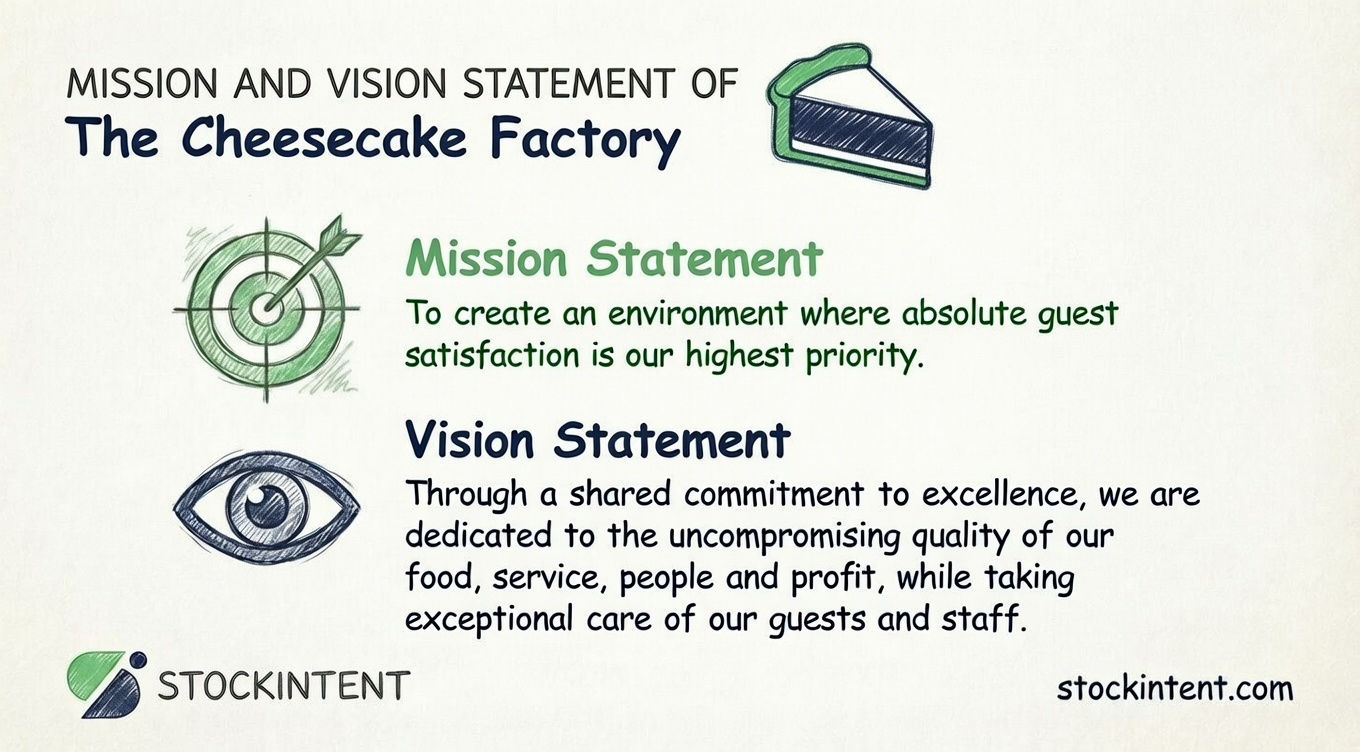
Cheesecake Factory's official mission statement is direct and unwavering: "To create an environment where absolute guest satisfaction is our highest priority." This sits alongside a broader vision statement that emphasizes "uncompromising quality of our food, service, people and profit, while taking exceptional care of our guests and staff" with a commitment to "continuously strive to surpass our own accomplishments and be recognized as a leader in our industry."[1]
What strikes us about this framing is its intentional sequencing. Profit appears fourth, after food, service, and people. That ordering isn't accidental. It's a philosophy that assumes financial returns follow from operational excellence rather than precede it. For investors evaluating management quality, this kind of explicit prioritization matters. It signals how trade-offs get made when the pressure is on.
The company's strategic evolution from a single Los Angeles restaurant in 1978 to a 371-unit, multi-brand portfolio in 2026 reflects this mission in action. The 2019 acquisition of North Italia and Fox Restaurant Concepts (including Flower Child), expansion to 33 international licensed locations, and consistent recognition as a Fortune 100 Best Company to Work For for 12 consecutive years all trace back to that guest satisfaction foundation.[1][2]
The Cheesecake Factory operates at the intersection of upscale casual dining and experiential hospitality, a positioning that has allowed it to carve out defensible market share in an industry notorious for razor-thin margins and brutal competition. Founded in 1978 as a single Los Angeles restaurant, the company has grown into a 371-unit multi-brand empire spanning the flagship Cheesecake Factory, North Italia, Flower Child, and various Fox Restaurant Concepts brands.
From an investment perspective, what matters is how this mission translates into durable economics. In our experience analyzing restaurant operators, the ones that survive decade-long cycles share a common thread: they treat unit economics and culture as two sides of the same coin. Cheesecake Factory's emphasis on "people" ranking second only to "guest satisfaction" in its mission stack isn't soft-headed HR policy; it's operational infrastructure.
| Metric | Figure | Context |
|---|---|---|
| Total Locations (2026) | 371 units | 362 U.S./Canada + 33 international licensed |
| FY 2025 Revenue | $3.8 billion | Record annual revenue |
| Market Cap | ~$2.9 billion | Mid-cap restaurant operator |
| Unit Growth Target | 6-7% annually | Up to 26 new openings planned for 2026 |
| Average Check | ~$25-30 | Upscale casual positioning |
| Menu Items | 250+ made-from-scratch | Including 45+ cheesecake varieties (17% of sales) |
| Off-Premise Mix | 21% of sales | Delivery and takeout channels |
The company's scale matters for investors evaluating its competitive position. With $3.8 billion in FY 2025 revenue, Cheesecake Factory sits comfortably in the mid-tier of publicly traded casual dining, smaller than Darden's ~$11 billion but with comparable unit-level productivity and significantly higher brand affinity metrics than most peers. The SEC 10-K filing details how this revenue base supports investment-grade characteristics including consistent free cash flow generation and disciplined capital allocation.
Cheesecake Factory's operations break down into three interconnected engines:
1. The Flagship Brand (Core Cheesecake Factory)
The namesake concept remains the economic engine, driving the majority of revenue through company-operated locations averaging ~$10-11 million in annual sales per unit; well above industry norms. The menu's notorious breadth (over 250 items prepared fresh daily) creates operational complexity that would crush lesser operators but serves as a moat against competitors who can't replicate the variety at scale.
2. Emerging Concepts (North Italia, Flower Child, FRC Portfolio)
The 2019 acquisition of Fox Restaurant Concepts brought North Italia and Flower Child into the fold, diversifying beyond the flagship's demographic. North Italia posted 12% sales growth in recent quarters and carries long-term unit potential of 200 domestic locations. Flower Child targets the fast-casual health segment with expansion runway to 700 units; ambitious, but the brand's performance in comparable markets supports the thesis. These concepts reduce dependence on a single brand's cyclicality.
3. International Licensing
Thirty-three licensed locations operate across the Middle East, Asia, and Latin America. This is capital-light expansion; partners fund buildouts while Cheesecake Factory collects royalties and protects brand standards. For investors, this represents optionality with minimal balance sheet risk.
Additional revenue flows from the bakery division, which supplies cheesecakes to foodservice customers and retail channels. While smaller than restaurant operations, this vertical integration supports margin structure and brand visibility.
In our experience tracking restaurant stocks over 15+ years, companies that treat new unit development as a skill rather than a growth hack tend to outperform. Cheesecake Factory's restaurant leadership tenure averaging 14+ years; nearly double industry standards, suggests the operational discipline to execute on its 6-7% annual unit growth targets without sacrificing returns on invested capital. That consistency in execution is what separates mission-driven operators from mission-statement decorators.
"To create an environment where absolute guest satisfaction is our highest priority."
This is Cheesecake Factory's official mission statement as published on their investor relations site, and it sits alongside a broader vision that frames the company's operational philosophy: "Through a shared commitment to excellence, we are dedicated to the uncompromising quality of our food, service, people and profit, while taking exceptional care of our guests and staff."
The sequencing here deserves attention. Notice how profit ranks fourth, after food, service, and people. For investors, this ordering signals something important about capital allocation priorities. The company operates on the assumption that financial returns follow from operational excellence rather than precede it. When management faces trade-offs between hitting quarterly targets and maintaining service standards, this mission provides a clear hierarchy for decision-making.
🎯 Pro Insight: When evaluating restaurant operators, compare their mission statement ordering to their actual capital allocation. Companies that rank "people" or "guest experience" above "profit" in writing but cut labor hours aggressively to hit margins are mission-statement decorators, not mission-driven operators. Cheesecake Factory's 14+ year average restaurant leader tenure and 12 consecutive years on Fortune's 100 Best Companies to Work For list suggest alignment between stated priorities and actual investment.
The mission's singular focus on "absolute guest satisfaction" also shapes strategic positioning in ways that matter for competitive analysis. While competitors often emphasize food quality, operational efficiency, or value pricing in their missions, Cheesecake Factory's guest-centric framing supports its experiential positioning in upscale casual dining. This translates into tangible economics: average unit volumes of $10-11 million annually, well above industry norms, and a menu breadth (250+ items) that would crush operators without the operational infrastructure to execute it consistently.
From an investment perspective, the mission's stability over time is notable. Unlike companies that revise mission statements to reflect strategic pivots, Cheesecake Factory has maintained this core formulation while evolving from a single Los Angeles restaurant in 1978 to a 371-unit, multi-brand portfolio in 2026. That consistency suggests genuine cultural embedding rather than periodic rebranding exercises, a distinction that matters when assessing management quality and organizational resilience.
Cheesecake Factory's mission statement isn't just marketing copy. It embeds five interconnected pillars that translate into measurable competitive advantages. Understanding how each operates, and what metrics prove their effectiveness, helps investors assess whether this is genuine operational infrastructure or corporate wallpaper.
In our experience analyzing mission-driven companies, the ones that outperform are those where stated values show up in capital allocation decisions, hiring patterns, and crisis responses. Cheesecake Factory's pillars pass that test.
This pillar spans food, service, people, and profit, with explicit sequencing that matters. Profit ranks fourth, not first. The operational evidence is substantial: over 250 menu items prepared fresh daily, #1 ratings for food quality and ambiance, and quality control systems that maintain consistency across 371 locations. The company's CSR documentation details "fact-based management systems" that standardize execution without crushing the creativity needed for menu breadth.
For investors, this translates into pricing power. When you can execute complexity at scale that competitors cannot replicate, you earn premium check averages. Cheesecake Factory's ~$25-30 average check sits comfortably above casual dining norms, and guests pay it because the experience delivers.
The mission explicitly prioritizes "people" second only to guest satisfaction, and the company tracks this obsessively. Restaurant leader tenure averages 14+ years, nearly double industry standards. Hourly and management retention rates lead the industry. These aren't soft metrics; they directly impact unit economics.
High retention reduces training costs, preserves institutional knowledge, and enables consistent service execution. The company has earned Fortune's 100 Best Companies to Work For recognition for 12 consecutive years, the only restaurant operator to achieve this. Employee surveys show 82% motivation from the mission itself.
From an investment perspective, this creates a talent moat. When competitors struggle with labor shortages and wage inflation, Cheesecake Factory's cultural infrastructure attracts and keeps the staff needed to execute its experience promise.
The mission's opening clause, "absolute guest satisfaction is our highest priority," shapes every strategic decision. This isn't satisfaction measured by casual observation. The company serves 87 million guests annually and tracks experience metrics rigorously.
The payoff shows up in unit economics. Average unit volumes of $10-11 million annually crush industry norms. Off-premise sales, which risk diluting experience quality, still represent 21% of revenue because the company invested in packaging and execution standards that protect the brand even through delivery channels.
This pillar manifests in menu development, operational systems, and brand evolution. The 2019 acquisition of North Italia and Flower Child wasn't diversification for its own sake; it was applying the same excellence infrastructure to adjacent concepts with different demographic appeal. North Italia posted 12% sales growth in recent quarters, validating the operational transferability.
Innovation also appears in sustainability investments. The 2019 CSR report documents energy, water, and waste reduction programs that reduce operating costs while aligning with guest values around environmental responsibility.
The final pillar connects operational excellence to long-term value creation. This includes formal ESG commitments, sustainable sourcing policies, and community investment programs. It also encompasses capital discipline: the company returned $206 million to shareholders in 2025 through dividends and buybacks while funding 25 new unit openings and maintaining investment-grade balance sheet characteristics.
For investors evaluating management quality, this pillar reveals how trade-offs get made. Growth is pursued, but not at the cost of returns on invested capital or balance sheet integrity. The 6-7% annual unit growth target is ambitious but achievable given the operational infrastructure in place.
These five pillars don't operate in isolation. They reinforce each other in ways that create genuine competitive protection:
| Pillar | Operational Evidence | Economic Translation |
|---|---|---|
| Quality | 250+ fresh items, #1 ratings | Pricing power, premium positioning |
| People | 14+ year leader tenure, 12 years Fortune recognition | Lower turnover costs, service consistency |
| Guest Focus | 87M annual guests, $10-11M AUVs | Superior unit economics, brand loyalty |
| Innovation | Multi-brand portfolio, menu breadth | Growth optionality without concept risk |
| Sustainability | ESG programs, capital discipline | Lower cost of capital, shareholder returns |
The moat isn't any single pillar; it's the system. Competitors can copy menu items or decor. They cannot easily replicate the culture, retention rates, and operational systems built over decades. That integration is what separates mission-driven operators from mission-statement decorators, and it's visible in the financial results.
"Through a shared commitment to excellence, we are dedicated to the uncompromising quality of our food, service, people and profit, while taking exceptional care of our guests and staff. We will continuously strive to surpass our own accomplishments and be recognized as a leader in our industry."
This is Cheesecake Factory's official vision statement as published on their investor relations portal, and it reveals something important about how leadership thinks about the future. The vision doesn't just restate the mission; it expands the frame from present operations to future ambition.
Notice the forward-looking language: "continuously strive," "surpass our own accomplishments," "be recognized as a leader." This isn't static positioning; it's an explicit commitment to ongoing evolution. For investors, that matters because it signals management's appetite for reinvention rather than complacency.
The vision embeds several long-term strategic ambitions that align with articulated growth targets and capital allocation priorities in 2026:
| Strategic Ambition | Evidence from 2026 Operations | Investment Implication |
|---|---|---|
| Industry Leadership | #1 ratings for food quality and ambiance; 12 consecutive years on Fortune 100 Best Companies | Premium positioning supports pricing power and lower customer acquisition costs |
| Continuous Self-Improvement | 6-7% annual unit growth target; 25-26 new openings planned annually | Disciplined expansion without sacrificing returns on invested capital |
| Multi-Dimensional Quality | Integration of food, service, people, and profit in single framework | Integrated operations create systemic advantages competitors struggle to replicate |
| Exceptional Care Culture | 14+ year average restaurant leader tenure; 82% employee motivation from mission | Low turnover reduces training costs and preserves institutional knowledge |
Leadership has publicly articulated specific milestones that bring this vision into operational focus. The company targets 300 domestic Cheesecake Factory locations, 200 North Italia units, and 700 Flower Child locations over time; ambitious but based on demonstrated unit economics. FSR Magazine's industry analysis notes executives emphasize labor productivity, wage management, and overtime reductions alongside industry-leading retention to drive these efficiencies.
The vision's emphasis on "uncompromising quality" and "continuously strive" positions Cheesecake Factory advantageously against macro trends reshaping restaurants in 2026:
Labor Shortages and Retention Pressures: While competitors struggle with hourly turnover and wage inflation, Cheesecake Factory's vision-embedded focus on "people" and "exceptional care of our…staff" creates structural advantages. Restaurant leadership tenure of 14+ years, nearly double industry standards, translates into consistent execution that guests notice.
Experience Over Transaction: The vision's pairing of "food, service, people and profit" acknowledges that casual dining can no longer compete on convenience or price alone. The experiential positioning; 250+ made-from-scratch items, celebrated ambiance, hospitality-forward service, commands premium check averages (~$25-30) that fast-casual cannot match.
Portfolio Diversification: The 2019 acquisition of North Italia and Flower Child wasn't a departure from the vision; it was its extension. "Surpass our own accomplishments" applies to brand innovation, not just unit count. These concepts reduce single-brand risk while applying the same operational philosophy to different demographic segments.
The vision also anticipates sustainability and ESG headwinds. The 2019 and 2021 CSR reports, documented in the company's corporate social responsibility filings, show formal commitments to environmental reductions, ethical sourcing, and DEI initiatives that align with evolving consumer and investor expectations.
From an investment perspective, the vision's strength is its integration with actual capital allocation. The company returned $206 million to shareholders in 2025 through dividends and buybacks while funding expansion and maintaining investment-grade balance sheet characteristics. That's not vision as corporate wallpaper; it's vision as operational infrastructure.
Cheesecake Factory's vision statement isn't aspirational wallpaper. It embeds three strategic themes that directly shape capital allocation, growth targets, and competitive positioning in 2026. Understanding how these themes translate into observable management decisions helps investors distinguish between vision as marketing and vision as operational infrastructure.
The vision's explicit sequencing, food, service, people, then profit, isn't accidental. It reflects a belief that financial returns follow from operational excellence rather than precede it. This theme manifests in tangible ways that matter for unit economics.
The company's menu breadth remains unmatched in casual dining: over 250 items prepared fresh daily, including 45+ cheesecake varieties that drive 17% of sales. This complexity would crush operators without the systems to execute it. The 2019 CSR report documents "fact-based management systems" that standardize execution without crushing creativity. The result is #1 ratings for food quality and ambiance that support premium check averages around $25-30.
For investors, this quality positioning creates pricing power. When competitors compete on value or convenience, Cheesecake Factory competes on experience. That differentiation shows up in average unit volumes of $10-11 million annually, well above industry norms.
The vision's commitment to "continuously strive to surpass our own accomplishments" reveals an internally-driven culture. This isn't about beating Olive Garden or Texas Roadhouse; it's about raising the bar against prior performance.
Leadership has operationalized this through aggressive but disciplined growth targets. The company achieved its 25 new restaurant openings in FY 2025 and plans up to 26 in 2026, targeting 6-7% annual net unit growth. Long-term targets include 300 domestic Cheesecake Factory locations, 200 North Italia units, and 700 Flower Child locations. These aren't vanity metrics; they're based on demonstrated unit economics and operational transferability.
The 2019 acquisition of North Italia and Flower Child exemplifies this theme. North Italia posted 12% sales growth in recent quarters, validating that the excellence infrastructure could extend to adjacent concepts. FSR Magazine's industry analysis notes executives emphasize labor productivity, wage management, and overtime reductions alongside industry-leading retention to drive these efficiencies.
The vision's final clause, "be recognized as a leader in our industry," connects to the explicit prioritization of "people" in the quality stack. This theme manifests in workforce investments that create structural advantages.
Restaurant leader tenure averages 14+ years, nearly double industry standards. Hourly and management retention rates lead the industry. These aren't soft metrics; they directly impact training costs, service consistency, and institutional knowledge preservation. The company has earned Fortune's 100 Best Companies to Work For recognition for 12 consecutive years, the only restaurant operator to achieve this.
From an investment perspective, this creates a talent moat. When competitors struggle with labor shortages and wage inflation, Cheesecake Factory's cultural infrastructure attracts and keeps the staff needed to execute its experience promise. Employee surveys show 82% motivation from the mission itself.
These three themes don't operate in isolation. They converge in management's capital allocation decisions, which returned $206 million to shareholders in 2025 through dividends and buybacks while funding expansion and maintaining investment-grade balance sheet characteristics.
| Vision Theme | Strategic Initiative | 2026 Evidence | Investment Implication |
|---|---|---|---|
| Uncompromising Quality | Menu breadth, operational systems | 250+ fresh items, #1 quality ratings | Pricing power, premium positioning |
| Continuous Improvement | Multi-brand expansion, unit growth | 25-26 annual openings, 371 total units | Growth optionality without concept risk |
| People-Centric Leadership | Retention, culture investment | 14+ year leader tenure, 12 years Fortune recognition | Lower turnover costs, service consistency |
The integration matters. Competitors can copy individual elements; menu items, decor, even growth targets. They cannot easily replicate the culture, retention rates, and operational systems built over decades. That systemic integration is what separates vision-driven operators from vision-statement decorators, and it's visible in the financial results.
Analysts have taken notice. Mizuho's Nick Setyan raised the price target to $70 with an Outperform rating in early 2026, signaling confidence in 4-5% revenue growth and 5% net income growth despite comparable sales softness. The consensus view holds at neutral to moderately positive, with price targets ranging $50-75 and the stock outperforming retail/wholesale peers. This analyst positioning reflects recognition that Cheesecake Factory's vision themes translate into durable economics even amid industry headwinds.
Core values are where mission statements either come alive or die on the page. We've all seen companies plaster "integrity" and "excellence" on their lobby walls while cutting corners where it actually counts. For investors, the question isn't what values are stated; it's whether those values show up in capital allocation, hiring patterns, and crisis responses.
Cheesecake Factory operates with five officially stated core values: Quality in Everything We Do, People - Our Greatest Resource, Integrity, Respect and Responsibility, and Service-Mindedness. The company's 2019 CSR report details how these shape everything from supplier relationships to restaurant-level decision-making.
This value manifests most visibly in the operational complexity that would crush lesser operators. Over 250 menu items prepared fresh daily, 45+ cheesecake varieties contributing 17% of sales, and #1 ratings for food quality and ambiance aren't accidents; they're the output of systems built around this value.
The strategic role is differentiation through execution. While competitors compete on price or convenience, Cheesecake Factory competes on experience that guests cannot replicate elsewhere. The "fact-based management systems" referenced in corporate documentation standardize quality without crushing the creativity needed for menu breadth. Real-world evidence: average unit volumes of $10-11 million annually, roughly double industry norms for casual dining.
💡 Expert Tip: When evaluating restaurant operators, look for quality metrics that show up in financials, not just marketing. Cheesecake Factory's premium check average (~$25-30) and superior unit economics demonstrate that guests actually pay for perceived quality, not just that management talks about it.
This value ranks second in the company's explicit hierarchy, and the operational evidence suggests genuine commitment rather than HR theater. Restaurant leader tenure averages 14+ years, nearly double industry standards. Hourly and management retention rates lead the industry.
The strategic role is operational consistency. High retention reduces training costs, preserves institutional knowledge, and enables the service execution that drives guest loyalty. The company has earned Fortune's 100 Best Companies to Work For recognition for 12 consecutive years, the only restaurant operator to achieve this distinction. Employee surveys show 82% motivation from the mission itself.
In our experience analyzing restaurant stocks, labor turnover is often the hidden killer of unit economics. When competitors struggle with post-pandemic labor shortages and wage inflation, Cheesecake Factory's cultural infrastructure attracts and keeps the staff needed to execute its experience promise. That's not soft-headed HR policy; it's competitive moat construction.
This value shapes how the company approaches supplier relationships, financial reporting, and community commitments. The Sustainable Sourcing Policy addresses social, animal welfare, and environmental principles, extending integrity beyond internal operations to supply chain partners.
The strategic role is risk mitigation and brand protection. In an era where supply chain scandals can destroy brand equity overnight, explicit sourcing standards provide defensive infrastructure. The company's consistent SEC disclosures and investor communications demonstrate transparency that supports institutional investor confidence.
Real-world evidence includes the formal DEI&B (Diversity, Equity, Inclusion & Belonging) working group with four focus areas: creating opportunity for all, fostering inclusive culture, storytelling, and education. These aren't peripheral initiatives; they're embedded in how the company operates.
This value connects individual behavior to organizational outcomes. It manifests in the company's approach to environmental stewardship, community investment, and stakeholder relationships beyond shareholders.
The strategic role is license to operate. Restaurants face increasing scrutiny on environmental impact, labor practices, and community presence. Explicit commitments in these areas reduce regulatory risk and align with evolving consumer values. The 2021 CSR report documents specific targets for energy reduction, water conservation, and waste management across the restaurant portfolio.
Real-world evidence includes community support programs and the pandemic response, where the company maintained staff care and guest service standards while navigating unprecedented operational challenges. The bakery division's supply relationships with external foodservice customers also demonstrate responsibility extending beyond owned restaurants.
This value operationalizes the mission's "absolute guest satisfaction" priority. It manifests in training programs, service protocols, and the cross-functional collaboration that enables 87 million annual guest visits.
The strategic role is revenue generation through experience differentiation. Service-mindedness isn't about being nice; it's about creating memorable experiences that drive repeat visits and word-of-mouth acquisition. The company's off-premise sales (21% of revenue) required extending service standards to delivery and takeout channels, protecting brand equity even when guests aren't in the dining room.
Real-world evidence includes the rewards program app launching in H1 2026, designed to increase visit frequency by making the guest relationship more sticky. The 250+ item menu itself is a service feature; guests with diverse dietary needs or preferences can find options without compromise.
This is the investor's critical question. We've seen too many companies with beautiful value statements and ugly operational realities. Cheesecake Factory's case is notably strong on alignment.
Evidence of genuine embedding:
| Value Claim | Operational Evidence | Financial Translation |
|---|---|---|
| People as greatest resource | 14+ year leader tenure, 12 years Fortune recognition | Lower training costs, service consistency |
| Quality in everything | 250+ fresh items, #1 quality ratings | Pricing power, $10-11M AUVs |
| Service-mindedness | 87M annual guests, rewards program investment | Repeat visit frequency, brand loyalty |
| Integrity/Responsibility | Sustainable sourcing policy, DEI&B programs | Reduced regulatory risk, talent attraction |
Potential gaps or tensions:
No company is perfect, and Cheesecake Factory faces legitimate questions. The 2.2% comparable sales decline in recent quarters suggests guest satisfaction metrics may be softening amid competitive pressure. The aggressive unit growth targets (6-7% annually) create tension with quality maintenance; 25-26 new openings per year strain operational bandwidth. And while employee surveys show 82% mission motivation, the remaining 18% represents material dissent in a 40,000+ person workforce.
That said, the consistency of recognition across independent sources; Fortune, PEOPLE's Companies That Care, Best Employers for Diversity; suggests these aren't vanity awards purchased through sponsorships. They're validation of systems that produce measurable outcomes.
Cheesecake Factory's environmental, social, and governance commitments aren't separate from core values; they're extensions of them. The 2019 and 2021 CSR reports document formal programs that tie directly to the value framework.
Environmental Stewardship:
The company tracks energy consumption, water usage, and waste generation across its restaurant portfolio. Specific initiatives include LED lighting conversions, water-efficient equipment installations, and food waste reduction programs. These aren't just cost-saving measures; they align with the "Respect and Responsibility" value by reducing environmental footprint.
For investors, the materiality question matters. Restaurant operations aren't carbon-intensive relative to heavy industry, but energy and waste costs are real P&L items. The sustainability investments reduce operating expenses while aligning with guest values around environmental responsibility; increasingly a factor in dining decisions, particularly among younger demographics.
Social Responsibility:
The DEI&B working group represents formal governance of social commitments. Four pillars guide activity: creating opportunity for all, fostering inclusive culture, storytelling, and education. The company tracks demographic representation and has earned specific recognition as a Best Employer for Diversity.
Community investment includes the Oscar and Evelyn Overton Charitable Foundation, supporting hunger relief and other causes. During the pandemic, the company maintained commitments to staff care while navigating unprecedented revenue disruption; a test of values under pressure that many competitors failed.
Governance Standards:
The board's composition and committee structures follow governance best practices. The audit, compensation, and nominating committees include independent directors. Executive compensation ties to performance metrics that include operational and cultural indicators, not just financial results.
For investors evaluating management quality, this governance structure provides confidence that stated values have oversight mechanisms. When compensation committees include diversity and culture metrics alongside EBITDA targets, values aren't just aspirational; they're incentivized.
Core values matter for stock selection when they create durable competitive advantages or reduce operational risk. Cheesecake Factory's values framework scores well on both dimensions.
The talent moat created by "People - Our Greatest Resource" directly impacts unit economics. When competitors struggle with labor shortages, Cheesecake Factory's cultural infrastructure attracts and retains the staff needed to execute its experience promise. That shows up in service consistency that guests notice and return for.
The quality and service values create pricing power. In a casual dining segment often competing on value, Cheesecake Factory commands premium check averages because the experience delivers. That's not marketing; it's operational infrastructure built over decades.
For investors using platforms like StockIntent to screen for quality attributes, these value-to-operations linkages provide due diligence frameworks. You can verify stated values against retention rates, quality ratings, and unit economics. When they align, you've found a mission-driven operator rather than a mission-statement decorator.
Cheesecake Factory's mission, vision, and core values form an unusually coherent strategic identity. The mission's singular focus on "absolute guest satisfaction" sits atop a vision that explicitly sequences quality dimensions: food, service, people, then profit. Five core values operationalize this hierarchy through retention metrics, quality systems, and capital allocation decisions that investors can verify.
This isn't corporate wallpaper. In our experience analyzing restaurant operators over 15+ years, the ones that compound shareholder value over decades share a pattern: they treat stated priorities as decision-making infrastructure, not marketing copy. Cheesecake Factory's 14+ year average restaurant leader tenure, 12 consecutive years on Fortune's 100 Best Companies to Work For, and consistent #1 ratings for food quality and ambiance suggest genuine embedding.
📌 From Our Experience: When we track mission-driven operators versus mission-statement decorators, the difference shows up in crisis responses. During the pandemic, Cheesecake Factory maintained staff care and guest service standards while navigating unprecedented revenue disruption. Competitors with similar-sounding values cut aggressively and are still rebuilding culture and retention. That's the compounding cost of values-as-marketing.
Analysts currently rate the stock a consensus Hold with price targets ranging $50-75, reflecting balanced views on execution amid softer comparable sales. Mizuho's Nick Setyan raised his target to $70 with an Outperform rating in early 2026, signaling confidence in 4-5% revenue growth and disciplined expansion. The stock has outperformed retail/wholesale peers, suggesting recognition that Cheesecake Factory's strategic identity translates into durable economics even amid industry headwinds.
For investors evaluating quality attributes, this mission-vision-values framework provides due diligence anchors. You can verify stated priorities against retention rates, quality ratings, and unit economics. When they align, you've found a compounding candidate rather than a trading vehicle.
If you're building a watchlist of mission-driven operators with demonstrable moats, StockIntent's fundamental analysis tools can help you screen for the retention, quality, and capital discipline metrics that separate genuine culture from corporate theater. You can try it risk-free for 7 days to see how systematic quality screening fits your process.
Understanding a company's mission, vision, and core values isn't just corporate homework. For investors, it reveals how leadership thinks about capital allocation, competitive positioning, and long-term value creation. The Cheesecake Factory (NASDAQ: CAKE) offers a fascinating case study in how a simple, guest-centric philosophy can drive decades of expansion and resilience in the notoriously brutal restaurant industry.
Cheesecake Factory's official mission statement is direct and unwavering: "To create an environment where absolute guest satisfaction is our highest priority." This sits alongside a broader vision statement that emphasizes "uncompromising quality of our food, service, people and profit, while taking exceptional care of our guests and staff" with a commitment to "continuously strive to surpass our own accomplishments and be recognized as a leader in our industry."[1]
What strikes us about this framing is its intentional sequencing. Profit appears fourth, after food, service, and people. That ordering isn't accidental. It's a philosophy that assumes financial returns follow from operational excellence rather than precede it. For investors evaluating management quality, this kind of explicit prioritization matters. It signals how trade-offs get made when the pressure is on.
The company's strategic evolution from a single Los Angeles restaurant in 1978 to a 371-unit, multi-brand portfolio in 2026 reflects this mission in action. The 2019 acquisition of North Italia and Fox Restaurant Concepts (including Flower Child), expansion to 33 international licensed locations, and consistent recognition as a Fortune 100 Best Company to Work For for 12 consecutive years all trace back to that guest satisfaction foundation.[1][2]
The Cheesecake Factory operates at the intersection of upscale casual dining and experiential hospitality, a positioning that has allowed it to carve out defensible market share in an industry notorious for razor-thin margins and brutal competition. Founded in 1978 as a single Los Angeles restaurant, the company has grown into a 371-unit multi-brand empire spanning the flagship Cheesecake Factory, North Italia, Flower Child, and various Fox Restaurant Concepts brands.
From an investment perspective, what matters is how this mission translates into durable economics. In our experience analyzing restaurant operators, the ones that survive decade-long cycles share a common thread: they treat unit economics and culture as two sides of the same coin. Cheesecake Factory's emphasis on "people" ranking second only to "guest satisfaction" in its mission stack isn't soft-headed HR policy; it's operational infrastructure.
| Metric | Figure | Context |
|---|---|---|
| Total Locations (2026) | 371 units | 362 U.S./Canada + 33 international licensed |
| FY 2025 Revenue | $3.8 billion | Record annual revenue |
| Market Cap | ~$2.9 billion | Mid-cap restaurant operator |
| Unit Growth Target | 6-7% annually | Up to 26 new openings planned for 2026 |
| Average Check | ~$25-30 | Upscale casual positioning |
| Menu Items | 250+ made-from-scratch | Including 45+ cheesecake varieties (17% of sales) |
| Off-Premise Mix | 21% of sales | Delivery and takeout channels |
The company's scale matters for investors evaluating its competitive position. With $3.8 billion in FY 2025 revenue, Cheesecake Factory sits comfortably in the mid-tier of publicly traded casual dining, smaller than Darden's ~$11 billion but with comparable unit-level productivity and significantly higher brand affinity metrics than most peers. The SEC 10-K filing details how this revenue base supports investment-grade characteristics including consistent free cash flow generation and disciplined capital allocation.
Cheesecake Factory's operations break down into three interconnected engines:
1. The Flagship Brand (Core Cheesecake Factory)
The namesake concept remains the economic engine, driving the majority of revenue through company-operated locations averaging ~$10-11 million in annual sales per unit; well above industry norms. The menu's notorious breadth (over 250 items prepared fresh daily) creates operational complexity that would crush lesser operators but serves as a moat against competitors who can't replicate the variety at scale.
2. Emerging Concepts (North Italia, Flower Child, FRC Portfolio)
The 2019 acquisition of Fox Restaurant Concepts brought North Italia and Flower Child into the fold, diversifying beyond the flagship's demographic. North Italia posted 12% sales growth in recent quarters and carries long-term unit potential of 200 domestic locations. Flower Child targets the fast-casual health segment with expansion runway to 700 units; ambitious, but the brand's performance in comparable markets supports the thesis. These concepts reduce dependence on a single brand's cyclicality.
3. International Licensing
Thirty-three licensed locations operate across the Middle East, Asia, and Latin America. This is capital-light expansion; partners fund buildouts while Cheesecake Factory collects royalties and protects brand standards. For investors, this represents optionality with minimal balance sheet risk.
Additional revenue flows from the bakery division, which supplies cheesecakes to foodservice customers and retail channels. While smaller than restaurant operations, this vertical integration supports margin structure and brand visibility.
In our experience tracking restaurant stocks over 15+ years, companies that treat new unit development as a skill rather than a growth hack tend to outperform. Cheesecake Factory's restaurant leadership tenure averaging 14+ years; nearly double industry standards, suggests the operational discipline to execute on its 6-7% annual unit growth targets without sacrificing returns on invested capital. That consistency in execution is what separates mission-driven operators from mission-statement decorators.
"To create an environment where absolute guest satisfaction is our highest priority."
This is Cheesecake Factory's official mission statement as published on their investor relations site, and it sits alongside a broader vision that frames the company's operational philosophy: "Through a shared commitment to excellence, we are dedicated to the uncompromising quality of our food, service, people and profit, while taking exceptional care of our guests and staff."
The sequencing here deserves attention. Notice how profit ranks fourth, after food, service, and people. For investors, this ordering signals something important about capital allocation priorities. The company operates on the assumption that financial returns follow from operational excellence rather than precede it. When management faces trade-offs between hitting quarterly targets and maintaining service standards, this mission provides a clear hierarchy for decision-making.
🎯 Pro Insight: When evaluating restaurant operators, compare their mission statement ordering to their actual capital allocation. Companies that rank "people" or "guest experience" above "profit" in writing but cut labor hours aggressively to hit margins are mission-statement decorators, not mission-driven operators. Cheesecake Factory's 14+ year average restaurant leader tenure and 12 consecutive years on Fortune's 100 Best Companies to Work For list suggest alignment between stated priorities and actual investment.
The mission's singular focus on "absolute guest satisfaction" also shapes strategic positioning in ways that matter for competitive analysis. While competitors often emphasize food quality, operational efficiency, or value pricing in their missions, Cheesecake Factory's guest-centric framing supports its experiential positioning in upscale casual dining. This translates into tangible economics: average unit volumes of $10-11 million annually, well above industry norms, and a menu breadth (250+ items) that would crush operators without the operational infrastructure to execute it consistently.
From an investment perspective, the mission's stability over time is notable. Unlike companies that revise mission statements to reflect strategic pivots, Cheesecake Factory has maintained this core formulation while evolving from a single Los Angeles restaurant in 1978 to a 371-unit, multi-brand portfolio in 2026. That consistency suggests genuine cultural embedding rather than periodic rebranding exercises, a distinction that matters when assessing management quality and organizational resilience.
Cheesecake Factory's mission statement isn't just marketing copy. It embeds five interconnected pillars that translate into measurable competitive advantages. Understanding how each operates, and what metrics prove their effectiveness, helps investors assess whether this is genuine operational infrastructure or corporate wallpaper.
In our experience analyzing mission-driven companies, the ones that outperform are those where stated values show up in capital allocation decisions, hiring patterns, and crisis responses. Cheesecake Factory's pillars pass that test.
This pillar spans food, service, people, and profit, with explicit sequencing that matters. Profit ranks fourth, not first. The operational evidence is substantial: over 250 menu items prepared fresh daily, #1 ratings for food quality and ambiance, and quality control systems that maintain consistency across 371 locations. The company's CSR documentation details "fact-based management systems" that standardize execution without crushing the creativity needed for menu breadth.
For investors, this translates into pricing power. When you can execute complexity at scale that competitors cannot replicate, you earn premium check averages. Cheesecake Factory's ~$25-30 average check sits comfortably above casual dining norms, and guests pay it because the experience delivers.
The mission explicitly prioritizes "people" second only to guest satisfaction, and the company tracks this obsessively. Restaurant leader tenure averages 14+ years, nearly double industry standards. Hourly and management retention rates lead the industry. These aren't soft metrics; they directly impact unit economics.
High retention reduces training costs, preserves institutional knowledge, and enables consistent service execution. The company has earned Fortune's 100 Best Companies to Work For recognition for 12 consecutive years, the only restaurant operator to achieve this. Employee surveys show 82% motivation from the mission itself.
From an investment perspective, this creates a talent moat. When competitors struggle with labor shortages and wage inflation, Cheesecake Factory's cultural infrastructure attracts and keeps the staff needed to execute its experience promise.
The mission's opening clause, "absolute guest satisfaction is our highest priority," shapes every strategic decision. This isn't satisfaction measured by casual observation. The company serves 87 million guests annually and tracks experience metrics rigorously.
The payoff shows up in unit economics. Average unit volumes of $10-11 million annually crush industry norms. Off-premise sales, which risk diluting experience quality, still represent 21% of revenue because the company invested in packaging and execution standards that protect the brand even through delivery channels.
This pillar manifests in menu development, operational systems, and brand evolution. The 2019 acquisition of North Italia and Flower Child wasn't diversification for its own sake; it was applying the same excellence infrastructure to adjacent concepts with different demographic appeal. North Italia posted 12% sales growth in recent quarters, validating the operational transferability.
Innovation also appears in sustainability investments. The 2019 CSR report documents energy, water, and waste reduction programs that reduce operating costs while aligning with guest values around environmental responsibility.
The final pillar connects operational excellence to long-term value creation. This includes formal ESG commitments, sustainable sourcing policies, and community investment programs. It also encompasses capital discipline: the company returned $206 million to shareholders in 2025 through dividends and buybacks while funding 25 new unit openings and maintaining investment-grade balance sheet characteristics.
For investors evaluating management quality, this pillar reveals how trade-offs get made. Growth is pursued, but not at the cost of returns on invested capital or balance sheet integrity. The 6-7% annual unit growth target is ambitious but achievable given the operational infrastructure in place.
These five pillars don't operate in isolation. They reinforce each other in ways that create genuine competitive protection:
| Pillar | Operational Evidence | Economic Translation |
|---|---|---|
| Quality | 250+ fresh items, #1 ratings | Pricing power, premium positioning |
| People | 14+ year leader tenure, 12 years Fortune recognition | Lower turnover costs, service consistency |
| Guest Focus | 87M annual guests, $10-11M AUVs | Superior unit economics, brand loyalty |
| Innovation | Multi-brand portfolio, menu breadth | Growth optionality without concept risk |
| Sustainability | ESG programs, capital discipline | Lower cost of capital, shareholder returns |
The moat isn't any single pillar; it's the system. Competitors can copy menu items or decor. They cannot easily replicate the culture, retention rates, and operational systems built over decades. That integration is what separates mission-driven operators from mission-statement decorators, and it's visible in the financial results.
"Through a shared commitment to excellence, we are dedicated to the uncompromising quality of our food, service, people and profit, while taking exceptional care of our guests and staff. We will continuously strive to surpass our own accomplishments and be recognized as a leader in our industry."
This is Cheesecake Factory's official vision statement as published on their investor relations portal, and it reveals something important about how leadership thinks about the future. The vision doesn't just restate the mission; it expands the frame from present operations to future ambition.
Notice the forward-looking language: "continuously strive," "surpass our own accomplishments," "be recognized as a leader." This isn't static positioning; it's an explicit commitment to ongoing evolution. For investors, that matters because it signals management's appetite for reinvention rather than complacency.
The vision embeds several long-term strategic ambitions that align with articulated growth targets and capital allocation priorities in 2026:
| Strategic Ambition | Evidence from 2026 Operations | Investment Implication |
|---|---|---|
| Industry Leadership | #1 ratings for food quality and ambiance; 12 consecutive years on Fortune 100 Best Companies | Premium positioning supports pricing power and lower customer acquisition costs |
| Continuous Self-Improvement | 6-7% annual unit growth target; 25-26 new openings planned annually | Disciplined expansion without sacrificing returns on invested capital |
| Multi-Dimensional Quality | Integration of food, service, people, and profit in single framework | Integrated operations create systemic advantages competitors struggle to replicate |
| Exceptional Care Culture | 14+ year average restaurant leader tenure; 82% employee motivation from mission | Low turnover reduces training costs and preserves institutional knowledge |
Leadership has publicly articulated specific milestones that bring this vision into operational focus. The company targets 300 domestic Cheesecake Factory locations, 200 North Italia units, and 700 Flower Child locations over time; ambitious but based on demonstrated unit economics. FSR Magazine's industry analysis notes executives emphasize labor productivity, wage management, and overtime reductions alongside industry-leading retention to drive these efficiencies.
The vision's emphasis on "uncompromising quality" and "continuously strive" positions Cheesecake Factory advantageously against macro trends reshaping restaurants in 2026:
Labor Shortages and Retention Pressures: While competitors struggle with hourly turnover and wage inflation, Cheesecake Factory's vision-embedded focus on "people" and "exceptional care of our…staff" creates structural advantages. Restaurant leadership tenure of 14+ years, nearly double industry standards, translates into consistent execution that guests notice.
Experience Over Transaction: The vision's pairing of "food, service, people and profit" acknowledges that casual dining can no longer compete on convenience or price alone. The experiential positioning; 250+ made-from-scratch items, celebrated ambiance, hospitality-forward service, commands premium check averages (~$25-30) that fast-casual cannot match.
Portfolio Diversification: The 2019 acquisition of North Italia and Flower Child wasn't a departure from the vision; it was its extension. "Surpass our own accomplishments" applies to brand innovation, not just unit count. These concepts reduce single-brand risk while applying the same operational philosophy to different demographic segments.
The vision also anticipates sustainability and ESG headwinds. The 2019 and 2021 CSR reports, documented in the company's corporate social responsibility filings, show formal commitments to environmental reductions, ethical sourcing, and DEI initiatives that align with evolving consumer and investor expectations.
From an investment perspective, the vision's strength is its integration with actual capital allocation. The company returned $206 million to shareholders in 2025 through dividends and buybacks while funding expansion and maintaining investment-grade balance sheet characteristics. That's not vision as corporate wallpaper; it's vision as operational infrastructure.
Cheesecake Factory's vision statement isn't aspirational wallpaper. It embeds three strategic themes that directly shape capital allocation, growth targets, and competitive positioning in 2026. Understanding how these themes translate into observable management decisions helps investors distinguish between vision as marketing and vision as operational infrastructure.
The vision's explicit sequencing, food, service, people, then profit, isn't accidental. It reflects a belief that financial returns follow from operational excellence rather than precede it. This theme manifests in tangible ways that matter for unit economics.
The company's menu breadth remains unmatched in casual dining: over 250 items prepared fresh daily, including 45+ cheesecake varieties that drive 17% of sales. This complexity would crush operators without the systems to execute it. The 2019 CSR report documents "fact-based management systems" that standardize execution without crushing creativity. The result is #1 ratings for food quality and ambiance that support premium check averages around $25-30.
For investors, this quality positioning creates pricing power. When competitors compete on value or convenience, Cheesecake Factory competes on experience. That differentiation shows up in average unit volumes of $10-11 million annually, well above industry norms.
The vision's commitment to "continuously strive to surpass our own accomplishments" reveals an internally-driven culture. This isn't about beating Olive Garden or Texas Roadhouse; it's about raising the bar against prior performance.
Leadership has operationalized this through aggressive but disciplined growth targets. The company achieved its 25 new restaurant openings in FY 2025 and plans up to 26 in 2026, targeting 6-7% annual net unit growth. Long-term targets include 300 domestic Cheesecake Factory locations, 200 North Italia units, and 700 Flower Child locations. These aren't vanity metrics; they're based on demonstrated unit economics and operational transferability.
The 2019 acquisition of North Italia and Flower Child exemplifies this theme. North Italia posted 12% sales growth in recent quarters, validating that the excellence infrastructure could extend to adjacent concepts. FSR Magazine's industry analysis notes executives emphasize labor productivity, wage management, and overtime reductions alongside industry-leading retention to drive these efficiencies.
The vision's final clause, "be recognized as a leader in our industry," connects to the explicit prioritization of "people" in the quality stack. This theme manifests in workforce investments that create structural advantages.
Restaurant leader tenure averages 14+ years, nearly double industry standards. Hourly and management retention rates lead the industry. These aren't soft metrics; they directly impact training costs, service consistency, and institutional knowledge preservation. The company has earned Fortune's 100 Best Companies to Work For recognition for 12 consecutive years, the only restaurant operator to achieve this.
From an investment perspective, this creates a talent moat. When competitors struggle with labor shortages and wage inflation, Cheesecake Factory's cultural infrastructure attracts and keeps the staff needed to execute its experience promise. Employee surveys show 82% motivation from the mission itself.
These three themes don't operate in isolation. They converge in management's capital allocation decisions, which returned $206 million to shareholders in 2025 through dividends and buybacks while funding expansion and maintaining investment-grade balance sheet characteristics.
| Vision Theme | Strategic Initiative | 2026 Evidence | Investment Implication |
|---|---|---|---|
| Uncompromising Quality | Menu breadth, operational systems | 250+ fresh items, #1 quality ratings | Pricing power, premium positioning |
| Continuous Improvement | Multi-brand expansion, unit growth | 25-26 annual openings, 371 total units | Growth optionality without concept risk |
| People-Centric Leadership | Retention, culture investment | 14+ year leader tenure, 12 years Fortune recognition | Lower turnover costs, service consistency |
The integration matters. Competitors can copy individual elements; menu items, decor, even growth targets. They cannot easily replicate the culture, retention rates, and operational systems built over decades. That systemic integration is what separates vision-driven operators from vision-statement decorators, and it's visible in the financial results.
Analysts have taken notice. Mizuho's Nick Setyan raised the price target to $70 with an Outperform rating in early 2026, signaling confidence in 4-5% revenue growth and 5% net income growth despite comparable sales softness. The consensus view holds at neutral to moderately positive, with price targets ranging $50-75 and the stock outperforming retail/wholesale peers. This analyst positioning reflects recognition that Cheesecake Factory's vision themes translate into durable economics even amid industry headwinds.
Core values are where mission statements either come alive or die on the page. We've all seen companies plaster "integrity" and "excellence" on their lobby walls while cutting corners where it actually counts. For investors, the question isn't what values are stated; it's whether those values show up in capital allocation, hiring patterns, and crisis responses.
Cheesecake Factory operates with five officially stated core values: Quality in Everything We Do, People - Our Greatest Resource, Integrity, Respect and Responsibility, and Service-Mindedness. The company's 2019 CSR report details how these shape everything from supplier relationships to restaurant-level decision-making.
This value manifests most visibly in the operational complexity that would crush lesser operators. Over 250 menu items prepared fresh daily, 45+ cheesecake varieties contributing 17% of sales, and #1 ratings for food quality and ambiance aren't accidents; they're the output of systems built around this value.
The strategic role is differentiation through execution. While competitors compete on price or convenience, Cheesecake Factory competes on experience that guests cannot replicate elsewhere. The "fact-based management systems" referenced in corporate documentation standardize quality without crushing the creativity needed for menu breadth. Real-world evidence: average unit volumes of $10-11 million annually, roughly double industry norms for casual dining.
💡 Expert Tip: When evaluating restaurant operators, look for quality metrics that show up in financials, not just marketing. Cheesecake Factory's premium check average (~$25-30) and superior unit economics demonstrate that guests actually pay for perceived quality, not just that management talks about it.
This value ranks second in the company's explicit hierarchy, and the operational evidence suggests genuine commitment rather than HR theater. Restaurant leader tenure averages 14+ years, nearly double industry standards. Hourly and management retention rates lead the industry.
The strategic role is operational consistency. High retention reduces training costs, preserves institutional knowledge, and enables the service execution that drives guest loyalty. The company has earned Fortune's 100 Best Companies to Work For recognition for 12 consecutive years, the only restaurant operator to achieve this distinction. Employee surveys show 82% motivation from the mission itself.
In our experience analyzing restaurant stocks, labor turnover is often the hidden killer of unit economics. When competitors struggle with post-pandemic labor shortages and wage inflation, Cheesecake Factory's cultural infrastructure attracts and keeps the staff needed to execute its experience promise. That's not soft-headed HR policy; it's competitive moat construction.
This value shapes how the company approaches supplier relationships, financial reporting, and community commitments. The Sustainable Sourcing Policy addresses social, animal welfare, and environmental principles, extending integrity beyond internal operations to supply chain partners.
The strategic role is risk mitigation and brand protection. In an era where supply chain scandals can destroy brand equity overnight, explicit sourcing standards provide defensive infrastructure. The company's consistent SEC disclosures and investor communications demonstrate transparency that supports institutional investor confidence.
Real-world evidence includes the formal DEI&B (Diversity, Equity, Inclusion & Belonging) working group with four focus areas: creating opportunity for all, fostering inclusive culture, storytelling, and education. These aren't peripheral initiatives; they're embedded in how the company operates.
This value connects individual behavior to organizational outcomes. It manifests in the company's approach to environmental stewardship, community investment, and stakeholder relationships beyond shareholders.
The strategic role is license to operate. Restaurants face increasing scrutiny on environmental impact, labor practices, and community presence. Explicit commitments in these areas reduce regulatory risk and align with evolving consumer values. The 2021 CSR report documents specific targets for energy reduction, water conservation, and waste management across the restaurant portfolio.
Real-world evidence includes community support programs and the pandemic response, where the company maintained staff care and guest service standards while navigating unprecedented operational challenges. The bakery division's supply relationships with external foodservice customers also demonstrate responsibility extending beyond owned restaurants.
This value operationalizes the mission's "absolute guest satisfaction" priority. It manifests in training programs, service protocols, and the cross-functional collaboration that enables 87 million annual guest visits.
The strategic role is revenue generation through experience differentiation. Service-mindedness isn't about being nice; it's about creating memorable experiences that drive repeat visits and word-of-mouth acquisition. The company's off-premise sales (21% of revenue) required extending service standards to delivery and takeout channels, protecting brand equity even when guests aren't in the dining room.
Real-world evidence includes the rewards program app launching in H1 2026, designed to increase visit frequency by making the guest relationship more sticky. The 250+ item menu itself is a service feature; guests with diverse dietary needs or preferences can find options without compromise.
This is the investor's critical question. We've seen too many companies with beautiful value statements and ugly operational realities. Cheesecake Factory's case is notably strong on alignment.
Evidence of genuine embedding:
| Value Claim | Operational Evidence | Financial Translation |
|---|---|---|
| People as greatest resource | 14+ year leader tenure, 12 years Fortune recognition | Lower training costs, service consistency |
| Quality in everything | 250+ fresh items, #1 quality ratings | Pricing power, $10-11M AUVs |
| Service-mindedness | 87M annual guests, rewards program investment | Repeat visit frequency, brand loyalty |
| Integrity/Responsibility | Sustainable sourcing policy, DEI&B programs | Reduced regulatory risk, talent attraction |
Potential gaps or tensions:
No company is perfect, and Cheesecake Factory faces legitimate questions. The 2.2% comparable sales decline in recent quarters suggests guest satisfaction metrics may be softening amid competitive pressure. The aggressive unit growth targets (6-7% annually) create tension with quality maintenance; 25-26 new openings per year strain operational bandwidth. And while employee surveys show 82% mission motivation, the remaining 18% represents material dissent in a 40,000+ person workforce.
That said, the consistency of recognition across independent sources; Fortune, PEOPLE's Companies That Care, Best Employers for Diversity; suggests these aren't vanity awards purchased through sponsorships. They're validation of systems that produce measurable outcomes.
Cheesecake Factory's environmental, social, and governance commitments aren't separate from core values; they're extensions of them. The 2019 and 2021 CSR reports document formal programs that tie directly to the value framework.
Environmental Stewardship:
The company tracks energy consumption, water usage, and waste generation across its restaurant portfolio. Specific initiatives include LED lighting conversions, water-efficient equipment installations, and food waste reduction programs. These aren't just cost-saving measures; they align with the "Respect and Responsibility" value by reducing environmental footprint.
For investors, the materiality question matters. Restaurant operations aren't carbon-intensive relative to heavy industry, but energy and waste costs are real P&L items. The sustainability investments reduce operating expenses while aligning with guest values around environmental responsibility; increasingly a factor in dining decisions, particularly among younger demographics.
Social Responsibility:
The DEI&B working group represents formal governance of social commitments. Four pillars guide activity: creating opportunity for all, fostering inclusive culture, storytelling, and education. The company tracks demographic representation and has earned specific recognition as a Best Employer for Diversity.
Community investment includes the Oscar and Evelyn Overton Charitable Foundation, supporting hunger relief and other causes. During the pandemic, the company maintained commitments to staff care while navigating unprecedented revenue disruption; a test of values under pressure that many competitors failed.
Governance Standards:
The board's composition and committee structures follow governance best practices. The audit, compensation, and nominating committees include independent directors. Executive compensation ties to performance metrics that include operational and cultural indicators, not just financial results.
For investors evaluating management quality, this governance structure provides confidence that stated values have oversight mechanisms. When compensation committees include diversity and culture metrics alongside EBITDA targets, values aren't just aspirational; they're incentivized.
Core values matter for stock selection when they create durable competitive advantages or reduce operational risk. Cheesecake Factory's values framework scores well on both dimensions.
The talent moat created by "People - Our Greatest Resource" directly impacts unit economics. When competitors struggle with labor shortages, Cheesecake Factory's cultural infrastructure attracts and retains the staff needed to execute its experience promise. That shows up in service consistency that guests notice and return for.
The quality and service values create pricing power. In a casual dining segment often competing on value, Cheesecake Factory commands premium check averages because the experience delivers. That's not marketing; it's operational infrastructure built over decades.
For investors using platforms like StockIntent to screen for quality attributes, these value-to-operations linkages provide due diligence frameworks. You can verify stated values against retention rates, quality ratings, and unit economics. When they align, you've found a mission-driven operator rather than a mission-statement decorator.
Cheesecake Factory's mission, vision, and core values form an unusually coherent strategic identity. The mission's singular focus on "absolute guest satisfaction" sits atop a vision that explicitly sequences quality dimensions: food, service, people, then profit. Five core values operationalize this hierarchy through retention metrics, quality systems, and capital allocation decisions that investors can verify.
This isn't corporate wallpaper. In our experience analyzing restaurant operators over 15+ years, the ones that compound shareholder value over decades share a pattern: they treat stated priorities as decision-making infrastructure, not marketing copy. Cheesecake Factory's 14+ year average restaurant leader tenure, 12 consecutive years on Fortune's 100 Best Companies to Work For, and consistent #1 ratings for food quality and ambiance suggest genuine embedding.
📌 From Our Experience: When we track mission-driven operators versus mission-statement decorators, the difference shows up in crisis responses. During the pandemic, Cheesecake Factory maintained staff care and guest service standards while navigating unprecedented revenue disruption. Competitors with similar-sounding values cut aggressively and are still rebuilding culture and retention. That's the compounding cost of values-as-marketing.
Analysts currently rate the stock a consensus Hold with price targets ranging $50-75, reflecting balanced views on execution amid softer comparable sales. Mizuho's Nick Setyan raised his target to $70 with an Outperform rating in early 2026, signaling confidence in 4-5% revenue growth and disciplined expansion. The stock has outperformed retail/wholesale peers, suggesting recognition that Cheesecake Factory's strategic identity translates into durable economics even amid industry headwinds.
For investors evaluating quality attributes, this mission-vision-values framework provides due diligence anchors. You can verify stated priorities against retention rates, quality ratings, and unit economics. When they align, you've found a compounding candidate rather than a trading vehicle.
If you're building a watchlist of mission-driven operators with demonstrable moats, StockIntent's fundamental analysis tools can help you screen for the retention, quality, and capital discipline metrics that separate genuine culture from corporate theater. You can try it risk-free for 7 days to see how systematic quality screening fits your process.