
Mar 15, 2026
Chevron stands as one of the world's largest integrated oil and gas companies, with operations spanning upstream exploration, midstream logistics, and downstream refining. For investors evaluating energy stocks, understanding a company's mission, vision, and core values offers crucial insight into how management allocates capital, navigates industry transitions, and builds sustainable competitive advantages over decades. These statements aren't just corporate fluff; they reveal the strategic DNA that drives billion-dollar decisions.
Chevron's strategic identity centers on what CEO Mike Wirth calls "more secular growth potential than other major oil companies" — a bold claim backed by disciplined capital allocation, cost efficiency targets of $3-4 billion, and a production growth trajectory of 2-3% annually through 2030. For investors, the mission statement signals a company unwilling to abandon profitable hydrocarbons while methodically building lower-carbon options — a stance that has generated $27 billion in shareholder returns in 2024 alone.
Chevron traces its roots back to 1879, when Pacific Coast Oil Company struck oil in California's Kern County. Nearly 150 years later, it stands as one of the world's largest integrated energy companies, with operations spanning six continents and a market capitalization that places it firmly in the top tier of global oil majors.
The company's integrated model combines upstream exploration and production, midstream logistics, downstream refining and marketing, and specialty chemicals through its Chevron Phillips Chemical joint venture. This structure provides natural hedges; when crude prices slump, refining margins often expand, and vice versa.
Chevron at a Glance (2026)
table {
width: 100%;
border-collapse: collapse;
margin: 20px 0;
}
th, td {
border: 1px solid #ddd;
padding: 12px;
text-align: left;
}
th {
border-bottom: 2px solid #ddd;
}
MetricFigure2026 Capital Budget$18–19 billion (up to $21B possible)Upstream Allocation~$17 billionLower-Carbon Investment$1 billion annuallyPermian Basin Target1+ million boe/dayProduction Growth Target2–3% annually through 2030Cost Savings Target$3–4 billionFree Cash Flow Growth (2026)$12.5 billion projected increaseYear-to-Date Stock Return (Feb 2026)21.8%
In our experience analyzing integrated oil majors, Chevron's capital discipline stands out. While peers often chase production growth at any cost, Chevron has consistently prioritized returns on capital employed. CEO Mike Wirth's claim of "more secular growth potential than other major oil companies" isn't empty rhetoric; it's backed by a portfolio weighted toward low-cost, long-duration assets.
The upstream business dominates Chevron's investment profile, with roughly $6 billion directed toward U.S. shale (Permian, DJ Basin, Bakken) and $7 billion toward global offshore developments including Guyana, the Eastern Mediterranean, and Gulf of Mexico projects. The Tengiz expansion in Kazakhstan alone is expected to add 260,000 barrels per day once fully operational.
Downstream, Chevron emphasizes high-margin lubricants and specialty products rather than commodity refining. Its Delo, Havoline, and Cetus product lines serve heavy-duty diesel, industrial equipment, and marine applications where technical performance commands pricing power. This isn't the glamour side of the business, but it generates steady cash flows with lower capital intensity than upstream drilling.
Chevron's competitive positioning rests on three structural advantages: industry-leading unit costs in its core assets, financial flexibility with low leverage relative to peers, and portfolio quality weighted toward low-carbon-intensity barrels. The Hess acquisition, completed in 2024, added premier Guyana assets that should compound value for decades. When we evaluate energy stocks for long-term holding periods, these are precisely the characteristics we prioritize over short-term production growth rates.
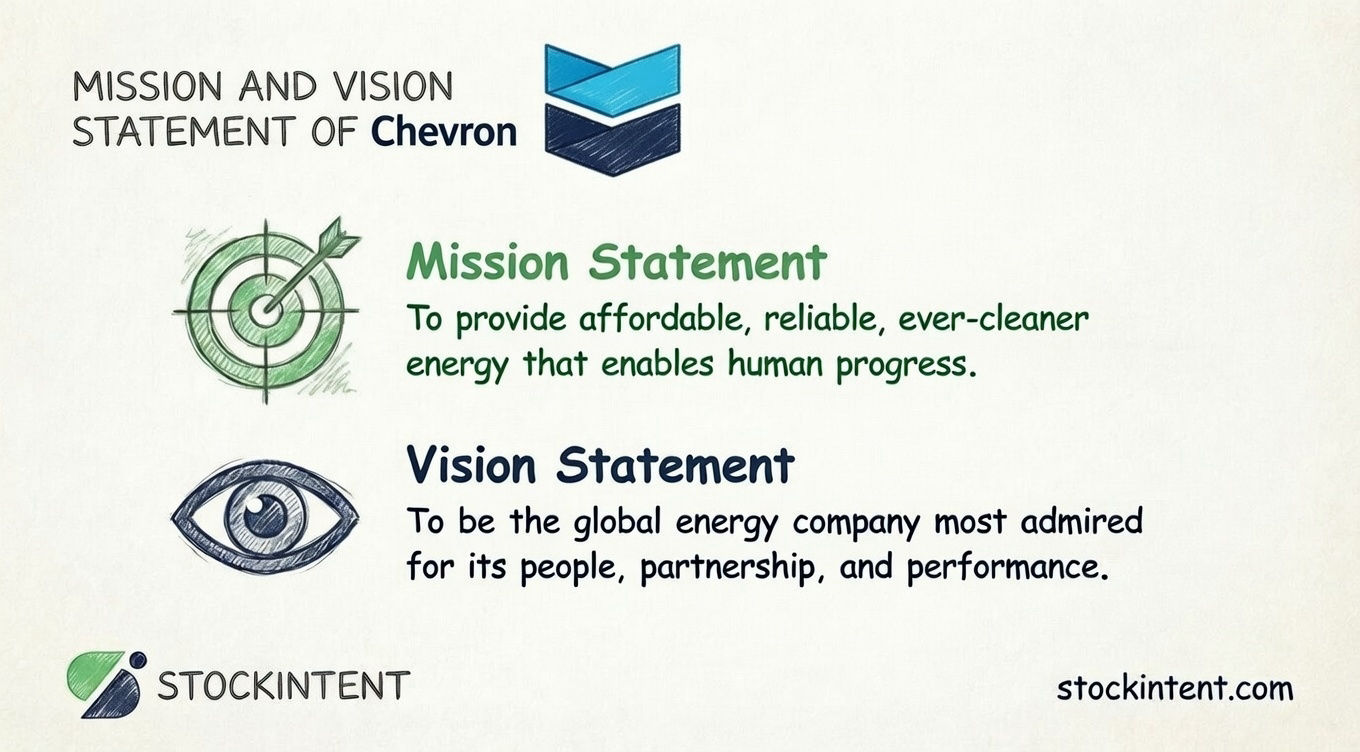
To provide affordable, reliable, ever-cleaner energy that enables human progress.
That 10-word statement packs more strategic insight than most 10-page investor presentations. Let's break down what Chevron's mission actually signals, and why it matters for anyone evaluating this energy giant.
Chevron's mission statement isn't accidental word choice, it's a deliberate balancing act. The company confronted a classic strategic dilemma: how to position itself between fossil fuel dominance and the energy transition without alienating either shareholders or stakeholders. The phrase "ever-cleaner energy" deserves particular attention this term is favored over "renewable" or "sustainable", suggesting incremental improvement rather than wholesale transformation. This aligns with CEO Mike Wirth's capital allocation philosophy: maintain hydrocarbon cash flows while building lower-carbon options at the margin.
The "affordable, reliable" pairing addresses customer and geopolitical realities. In our experience, energy security concerns have resurged as a primary driver of national policy globally. Chevron's mission explicitly acknowledges that price stability and supply consistency remain non-negotiable, even as environmental performance improves.
The "human progress" framing elevates Chevron above commodity producer status. It positions the company as an enabler of broader economic development; a subtle but important distinction from competitors focused purely on shareholder returns or environmental metrics.
🎯 Pro Insight: Compare Chevron's mission language to BP's "reimagine energy for people and our planet" or Shell's "powering progress together." Chevron's statement is more operationally concrete, less aspirational rhetoric. For investors, this suggests management that rewards execution over vision-casting; a mixed blessing depending on your risk tolerance.
Chevron's 2026 capital budget numbers bring the mission to life in dollars: roughly $17 billion directed upstream (the affordable, reliable energy), $1 billion toward lower-carbon initiatives (the ever-cleaner piece), and relentless focus on $3-4 billion in cost reductions (enabling affordability). These figures reflect strategic alignment with mission pillars, not just financial optimization.
The mission also explains Chevron's selective acquisition strategy. The Hess deal added premier, long-duration assets at low breakeven costs, directly supporting "reliable" energy supply. Meanwhile, Chevron's $1 billion annual lower-carbon budget targets biofuels, carbon capture, and hydrogen projects that advance "ever-cleaner" goals without betting the company on unproven technologies.
In short, Chevron's mission statement functions as a capital allocation filter. Projects that don't clearly advance affordability, reliability, or environmental improvement within a hydrocarbon framework struggle to compete for funding. For investors, that's actually useful information; it tells you what management will say no to, which often matters more than what they say yes to.
Chevron's mission, "to provide affordable, reliable, ever-cleaner energy that enables human progress," isn't marketing poetry. It's a capital allocation framework disguised as corporate philosophy. Each pillar directly shapes where the company spends its $18-19 billion annual budget and explains the tradeoffs management makes when projects compete for funding.
The "affordable" pillar translates to Chevron's relentless focus on low breakeven costs and operational efficiency. This isn't charity work; it's about building a business that thrives at $50-60 oil while competitors bleed.
Concrete implementation:
In our experience analyzing upstream operators, these cost targets aren't aspirational; they're survival mechanisms. Chevron's ability to fund both shareholder returns and lower-carbon investments while oil prices fluctuate depends entirely on this cost structure.
Competitive advantage: Industry-leading unit costs create margin expansion that compounds over decades. When peers cut dividends or shelve growth projects during downturns, Chevron maintains flexibility. That financial resilience is worth a valuation premium.
Reliability means delivering energy regardless of geopolitical disruptions, supply chain chaos, or commodity price swings. For customers and national governments, this has become non-negotiable following energy security crises in 2022-2024.
Concrete implementation:
The reliability pillar also explains Chevron's geographic diversification strategy. Rather than concentrating in unstable regions for easy barrels, management prioritizes jurisdictions with stable fiscal terms and predictable regulatory environments. It's slower growth but more durable.
Competitive advantage: Reliability builds customer relationships that transcend commodity pricing. Industrial customers and power utilities pay slight premiums for supply certainty, and governments award preferential access to stable operators. This trust compounds into preferential license rounds and partnership opportunities.
Here's where Chevron diverges most sharply from European competitors. While BP promises to reimagine energy and Shell talks about becoming a net-zero company, Chevron's "ever-cleaner" framing signals incremental improvement within a hydrocarbon framework, not wholesale transformation.
Concrete implementation:
The key word is "ever," implying continuous improvement rather than a 2050 destination. This linguistic choice matters for capital allocation. Chevron funds lower-carbon projects that generate returns today, not moonshots dependent on policy subsidies or technology breakthroughs. The $1 billion annual budget is real money, but against $17 billion upstream spending, it signals priorities without pretension.
Competitive advantage: Chevron's approach builds optionality without destroying hydrocarbon value. If transition technologies mature faster than expected, the company can accelerate spending using proven project execution capabilities. If traditional energy demand persists longer than projected, Chevron isn't stranded with stranded assets. That flexibility is undervalued by markets pricing pure-play narratives.
To be the global energy company most admired for its people, partnership, and performance.
This 11-word vision statement reveals something important about how Chevron sees its future. Notice what's missing: there's no mention of being the biggest, the most profitable, or the greenest. Instead, Chevron aims for admiration built on three specific pillars that, frankly, tell us a lot about management's priorities and how they want the world to view their company.
The "people" pillar signals Chevron's bet that talent retention and workforce quality will differentiate winners from losers in energy. With six senior leadership transitions entering 2026, this focus on people isn't abstract; it's operational. The company needs to attract and keep engineers, geoscientists, and project managers who can execute complex developments like Tengiz and Guyana while competitors face their own talent crunches.
"Partnership" reflects Chevron's structural reality. Unlike ExxonMobil, which often goes it alone, Chevron has built its growth through joint ventures: Tengiz with Kazakhstan and partners, Gorgon and Wheatstone with multiple stakeholders, and now Guyana with Exxon and others. The vision explicitly validates this collaborative model rather than treating it as a necessary evil.
The "performance" pillar ties directly to what CEO Mike Wirth calls Chevron's "more secular growth potential than other major oil companies." This isn't just rhetoric; it's backed by specific targets: 2-3% annual production growth through 2030, $3-4 billion in structural cost savings, and a projected $12.5 billion free cash flow increase in 2026 alone. Performance here means returns on capital, not vanity metrics like reserve replacement ratios.
Chevron's vision positions the company pragmatically relative to macro trends in oil & gas integrated. While European peers like BP and Shell pivoted hard toward renewable electricity and rebranding as "energy companies," Chevron's vision keeps it firmly in the integrated oil & gas lane while elevating execution excellence.
This positioning makes sense given 2026 realities. The energy transition is proving bumpier than 2021 projections suggested. Chevron's vision doesn't require betting the company on technologies that may or may not scale. Instead, it allows continued investment in advantaged hydrocarbons, Guyana barrels at sub-$35 breakevens, while building lower-carbon options like carbon capture and hydrogen through partnerships (the ACES project in Utah, Gulf of Mexico CCS hubs) rather than massive solo bets.
The vision also aligns with what we're seeing in capital markets. Investors have rewarded Chevron's 21.8% year-to-date return in 2026 not because it's the greenest major, but because it's delivering on its promises. Admiration, in this case, follows performance rather than precedes it. For investors evaluating whether Chevron's strategic vision translates to portfolio value, that sequencing matters.
Chevron's vision, "to be the global energy company most admired for its people, partnership, and performance," breaks down into three interconnected strategic themes. Each theme shapes capital allocation, operational priorities, and how management measures success beyond simple production growth.
The "people" pillar reflects Chevron's bet that workforce quality will separate winners from losers in energy. This isn't HR fluff; it's operational reality. Complex developments like Tengiz, Guyana, and the Permian require specialized geoscientists, petroleum engineers, and project managers that competitors also want.
Strategic moves tied to this theme:
The people theme explains Chevron's conservative approach to layoffs during downturns. While peers cut deeply to preserve margins, Chevron tends to retain technical staff, betting that recovery cycles reward companies with execution-ready teams. In our experience analyzing cyclical industries, this retention strategy pays off in project ramp speed and cost control during upswings.
The "partnership" pillar validates Chevron's structural preference for joint ventures over solo bets. Unlike ExxonMobil, which frequently operates alone, Chevron has built its growth through collaboration: Tengiz with Kazakhstan and partners, Gorgon and Wheatstone with multiple stakeholders, and Guyana alongside Exxon and others.
Strategic moves tied to this theme:
Partnerships reduce capital intensity per barrel, diversify geopolitical risk, and provide operational learning from partners with complementary expertise. The downside? Slower decision-making and shared economics. Chevron's vision explicitly embraces this tradeoff, suggesting management believes the risk-sharing benefits outweigh control premiums.
The "performance" pillar anchors Chevron's claim of "more secular growth potential than other major oil companies." CEO Mike Wirth has backed this with specific, measurable targets that separate performance from aspiration.
Strategic moves tied to this theme:
The performance theme also explains what Chevron won't do. No massive renewable electricity buildouts like BP's 50 GW target. No reimagining the company as an "integrated energy" provider. Performance here means returns on capital employed, free cash flow per share, and total shareholder returns; metrics that have generated $27 billion in distributions in 2024 alone.
These three themes aren't independent. Partnerships enable performance by sharing risk and accessing capital-efficient growth. People deliver performance through execution excellence on complex projects. Performance attracts and retains people through compensation and career stability. The vision's genius is recognizing these reinforcing relationships rather than treating them as separate priorities.
For investors evaluating whether Chevron's strategic vision translates to portfolio value, this framework offers clear measurement points: track leadership stability (people), JV execution and expansion (partnership), and free cash flow growth versus targets (performance). The company has set explicit benchmarks for 2026 and 2030 that make accountability straightforward; something we appreciate when analyzing management quality.
Chevron's core values aren't corporate wall art; they're the decision-making framework that determines which projects get funded, who gets promoted, and how the company navigates ethical gray areas. For investors, understanding these values offers insight into management quality and cultural durability; two factors that separate compounders from value traps over decades.
Chevron articulates its values through The Chevron Way, a documented framework guiding daily operations and strategic choices. Here are the five pillars with their practical implications:
Chevron defines integrity as doing the right thing, even when no one is watching. In practice, this translates to transparent financial reporting, strict compliance with host-country regulations, and refusal to engage in bribery or corruption regardless of competitive pressure.
The value manifests in Chevron's approach to sustainability reporting and governance disclosures, which exceed minimum regulatory requirements in many jurisdictions. For investors, this matters because integrity failures in oil and gas, think BP's Deepwater Horizon or Petrobras's corruption scandal, destroy billions in shareholder value overnight. Chevron's track record here isn't perfect, but it's notably cleaner than many peers.
Trust at Chevron operates on multiple levels: employee trust in leadership, partner trust in joint venture execution, and community trust in operational safety. The company measures this through employee engagement surveys and stakeholder feedback mechanisms.
The trust value explains Chevron's conservative approach to leverage and financial commitments. Unlike peers who stretched balance sheets during the 2010-2014 boom years, Chevron maintained investment-grade ratings through the 2020 downturn. That financial discipline built trust with capital providers that now rewards the company with lower borrowing costs.
Chevron's diversity commitment extends beyond HR metrics to supplier diversity, with $1.2 billion spent with diverse suppliers in 2024. The logic is straightforward: diverse teams make better decisions, and diverse suppliers drive competitive procurement outcomes.
For investors, this value signals management's recognition that talent scarcity in energy will intensify. Companies that build inclusive cultures now will attract the geoscientists, petroleum engineers, and project managers needed to execute complex developments like Tengiz and Guyana over the next two decades.
High performance at Chevron means measurable outcomes, not activity metrics. The company tracks return on capital employed, free cash flow per barrel, and total shareholder returns against peer benchmarks. Employee surveys indicate 57% of staff are motivated by the mission and values, suggesting the performance culture resonates beyond compensation incentives.
This value directly shapes capital allocation. Projects that don't meet hurdle rates get killed, regardless of executive sponsorship or sunk costs. That discipline explains why Chevron avoided the massive cost overruns that plagued Shell's Arctic drilling and Exxon's XTO acquisition.
Chevron's safety and environmental commitment operates through layered protocols: engineering controls, operational procedures, and cultural expectations. The company publishes annual sustainability reports detailing emissions, spills, and safety incidents with more granularity than regulatory requirements demand.
The environmental protection value increasingly influences strategic positioning. Chevron's $1 billion annual lower-carbon investment budget and carbon intensity reduction targets reflect genuine operational priority, not just stakeholder management. Whether these investments generate competitive returns remains debated, but the commitment is real.
💡 Expert Tip: When evaluating energy companies, look for how core values show up in capital allocation, not just marketing materials. Chevron's values are credible because they constrain behavior: the company walks away from projects that don't meet integrity or environmental standards, even when competitors proceed. That discipline costs growth in the short term but builds durable franchise value.
The gap between stated values and operational reality is where corporate culture lives or dies. In our experience analyzing oil majors, Chevron's values alignment is above average but not flawless.
Evidence of alignment:
Areas of tension:
The honest assessment: Chevron's values are more than aspirational, but they're not absolute constraints. Management exercises judgment about when values trade off against growth or returns, which is exactly what you'd expect from a pragmatic capital allocator.
Chevron's ESG framework extends its core values into measurable commitments. The company has articulated specific targets that tie directly to the protection of people and environment value:
ESG PillarChevron Commitment2026 StatusEnvironmentalNet-zero Scope 1 and 2 emissions by 2050Progressing; carbon intensity reduction targets in placeEnvironmentalScope 3 emissions reduction >5% by 2028 (from 2016)Tracking; methodology debates ongoingSocial$1.2 billion diverse supplier spendingAchieved in 2024GovernanceBoard independence and sustainability oversight11 independent directors; dedicated safety committeeLower-Carbon$1 billion annual investment through 2026On track; biofuels, CCS, hydrogen pilots
The ESG commitment functions as both values expression and strategic positioning. Chevron's approach differs from European peers in important ways: the targets are less aggressive than BP's or Shell's, but they're backed by more credible capital allocation. The $1 billion annual lower-carbon budget is real money, but against $17 billion upstream spending, it signals priorities without betting the company.
For investors evaluating Chevron's ESG positioning, the key question is whether these commitments create optionality or destroy value. The company's partnerships in Gulf of Mexico carbon capture hubs and the ACES hydrogen storage project in Utah suggest a partnership-based approach that shares risk and capital requirements. That's consistent with the trust and high performance values; Chevron isn't pretending to have all the answers, but it's building capabilities that could scale if policy and technology align.
The bottom line: Chevron's core values provide a useful lens for predicting management behavior. The company will prioritize returns on capital over growth for growth's sake. It will walk away from ethically questionable opportunities that peers might pursue. And it will invest incrementally in lower-carbon options without abandoning the hydrocarbon cash flows that fund shareholder returns. For investors who share that pragmatic philosophy, the values alignment is a feature, not a bug.
Chevron's mission, vision, and core values weave together into something more coherent than corporate boilerplate. The company wants to provide affordable, reliable, ever-cleaner energy (mission), while becoming most admired for people, partnership, and performance (vision), guided by integrity, trust, diversity, high performance, and protection of people and environment (values). That's not accidental alignment; it's a capital allocation philosophy dressed up as corporate philosophy.
🎯 Pro Insight: When we evaluate management quality in oil majors, we look for consistency between what they say and where they spend money. Chevron's 2026 budget, $17 billion upstream versus $1 billion lower-carbon, tells you exactly how management weights its mission pillars. The ratio isn't changing anytime soon, and that's actually valuable information for investors building long-term positions.
Analysts generally rate Chevron's execution as solid but not flawless. Argus maintains a Buy rating with a $203 price target, citing the projected $12.5 billion free cash flow increase in 2026 and $3-4 billion in structural cost savings. Melius Research upgraded to Buy with a $205 target, praising the Permian's shift to cash generation and high-impact exploration in Guyana and the Gulf of Mexico.
But there's nuance here. Zacks currently ranks Chevron a #4 (Sell), not because the strategy is broken, but because the valuation at 20.8x forward earnings may have priced in the good news already. The consensus view: Chevron's competitive positioning within oil & gas integrated is strong, particularly post-Hess, but the stock isn't obviously cheap at current levels.
In our experience tracking integrated majors through multiple cycles, Chevron's management quality signals are above average. The company maintained dividend growth and investment-grade ratings during the 2020 downturn when peers cut payouts and leveraged up. That financial discipline reflects genuine values alignment, not just marketing. Six senior leadership transitions entering 2026 do raise execution continuity questions during the critical Hess integration year, but the underlying portfolio quality, Guyana barrels at sub-$35 breakevens, Tengiz expansion adding 260,000 barrels daily, and Permian scale at 1 million boe/day, provides genuine secular growth optionality.
Looking ahead, Chevron's framework suggests specific management behaviors you can bank on. The company will prioritize returns on capital over production growth for its own sake. It will walk away from ethically questionable opportunities that peers might pursue. And it will invest incrementally in lower-carbon options, think Gulf of Mexico carbon capture hubs and ACES hydrogen storage in Utah, without abandoning the hydrocarbon cash flows that fund shareholder returns.
No major strategic shifts appear likely to reshape this mission or vision. Chevron's 2026 plans emphasize the same priorities: upstream production ramps, cost discipline, and selective lower-carbon initiatives. The Hess integration, Tengiz completion, and potential Venezuela expansion represent execution milestones, not strategic pivots.
For investors who share Chevron's pragmatic philosophy, quality over cheapness, returns over scale, incremental improvement over revolutionary transformation, this strategic identity is a feature, not a bug. The company won't win ESG beauty contests against European peers promising net-zero by 2050. But it might compound capital more reliably through the messy, uneven energy transition that's actually unfolding, not the smooth one in PowerPoint presentations.
If you're evaluating Chevron against your own investment criteria, tools like StockIntent can help you dig deeper into the financial metrics behind these strategic claims. You can screen for energy stocks with similar capital discipline profiles, backtest how integrated majors performed through previous transition periods, and build valuation models that stress-test whether Chevron's premium multiple is justified by its return on capital trajectory. The 7-day free trial lets you test whether the platform fits your analytical workflow before committing.
Chevron stands as one of the world's largest integrated oil and gas companies, with operations spanning upstream exploration, midstream logistics, and downstream refining. For investors evaluating energy stocks, understanding a company's mission, vision, and core values offers crucial insight into how management allocates capital, navigates industry transitions, and builds sustainable competitive advantages over decades. These statements aren't just corporate fluff; they reveal the strategic DNA that drives billion-dollar decisions.
Chevron's strategic identity centers on what CEO Mike Wirth calls "more secular growth potential than other major oil companies" — a bold claim backed by disciplined capital allocation, cost efficiency targets of $3-4 billion, and a production growth trajectory of 2-3% annually through 2030. For investors, the mission statement signals a company unwilling to abandon profitable hydrocarbons while methodically building lower-carbon options — a stance that has generated $27 billion in shareholder returns in 2024 alone.
Chevron traces its roots back to 1879, when Pacific Coast Oil Company struck oil in California's Kern County. Nearly 150 years later, it stands as one of the world's largest integrated energy companies, with operations spanning six continents and a market capitalization that places it firmly in the top tier of global oil majors.
The company's integrated model combines upstream exploration and production, midstream logistics, downstream refining and marketing, and specialty chemicals through its Chevron Phillips Chemical joint venture. This structure provides natural hedges; when crude prices slump, refining margins often expand, and vice versa.
Chevron at a Glance (2026)
table {
width: 100%;
border-collapse: collapse;
margin: 20px 0;
}
th, td {
border: 1px solid #ddd;
padding: 12px;
text-align: left;
}
th {
border-bottom: 2px solid #ddd;
}
MetricFigure2026 Capital Budget$18–19 billion (up to $21B possible)Upstream Allocation~$17 billionLower-Carbon Investment$1 billion annuallyPermian Basin Target1+ million boe/dayProduction Growth Target2–3% annually through 2030Cost Savings Target$3–4 billionFree Cash Flow Growth (2026)$12.5 billion projected increaseYear-to-Date Stock Return (Feb 2026)21.8%
In our experience analyzing integrated oil majors, Chevron's capital discipline stands out. While peers often chase production growth at any cost, Chevron has consistently prioritized returns on capital employed. CEO Mike Wirth's claim of "more secular growth potential than other major oil companies" isn't empty rhetoric; it's backed by a portfolio weighted toward low-cost, long-duration assets.
The upstream business dominates Chevron's investment profile, with roughly $6 billion directed toward U.S. shale (Permian, DJ Basin, Bakken) and $7 billion toward global offshore developments including Guyana, the Eastern Mediterranean, and Gulf of Mexico projects. The Tengiz expansion in Kazakhstan alone is expected to add 260,000 barrels per day once fully operational.
Downstream, Chevron emphasizes high-margin lubricants and specialty products rather than commodity refining. Its Delo, Havoline, and Cetus product lines serve heavy-duty diesel, industrial equipment, and marine applications where technical performance commands pricing power. This isn't the glamour side of the business, but it generates steady cash flows with lower capital intensity than upstream drilling.
Chevron's competitive positioning rests on three structural advantages: industry-leading unit costs in its core assets, financial flexibility with low leverage relative to peers, and portfolio quality weighted toward low-carbon-intensity barrels. The Hess acquisition, completed in 2024, added premier Guyana assets that should compound value for decades. When we evaluate energy stocks for long-term holding periods, these are precisely the characteristics we prioritize over short-term production growth rates.
To provide affordable, reliable, ever-cleaner energy that enables human progress.
That 10-word statement packs more strategic insight than most 10-page investor presentations. Let's break down what Chevron's mission actually signals, and why it matters for anyone evaluating this energy giant.
Chevron's mission statement isn't accidental word choice, it's a deliberate balancing act. The company confronted a classic strategic dilemma: how to position itself between fossil fuel dominance and the energy transition without alienating either shareholders or stakeholders. The phrase "ever-cleaner energy" deserves particular attention this term is favored over "renewable" or "sustainable", suggesting incremental improvement rather than wholesale transformation. This aligns with CEO Mike Wirth's capital allocation philosophy: maintain hydrocarbon cash flows while building lower-carbon options at the margin.
The "affordable, reliable" pairing addresses customer and geopolitical realities. In our experience, energy security concerns have resurged as a primary driver of national policy globally. Chevron's mission explicitly acknowledges that price stability and supply consistency remain non-negotiable, even as environmental performance improves.
The "human progress" framing elevates Chevron above commodity producer status. It positions the company as an enabler of broader economic development; a subtle but important distinction from competitors focused purely on shareholder returns or environmental metrics.
🎯 Pro Insight: Compare Chevron's mission language to BP's "reimagine energy for people and our planet" or Shell's "powering progress together." Chevron's statement is more operationally concrete, less aspirational rhetoric. For investors, this suggests management that rewards execution over vision-casting; a mixed blessing depending on your risk tolerance.
Chevron's 2026 capital budget numbers bring the mission to life in dollars: roughly $17 billion directed upstream (the affordable, reliable energy), $1 billion toward lower-carbon initiatives (the ever-cleaner piece), and relentless focus on $3-4 billion in cost reductions (enabling affordability). These figures reflect strategic alignment with mission pillars, not just financial optimization.
The mission also explains Chevron's selective acquisition strategy. The Hess deal added premier, long-duration assets at low breakeven costs, directly supporting "reliable" energy supply. Meanwhile, Chevron's $1 billion annual lower-carbon budget targets biofuels, carbon capture, and hydrogen projects that advance "ever-cleaner" goals without betting the company on unproven technologies.
In short, Chevron's mission statement functions as a capital allocation filter. Projects that don't clearly advance affordability, reliability, or environmental improvement within a hydrocarbon framework struggle to compete for funding. For investors, that's actually useful information; it tells you what management will say no to, which often matters more than what they say yes to.
Chevron's mission, "to provide affordable, reliable, ever-cleaner energy that enables human progress," isn't marketing poetry. It's a capital allocation framework disguised as corporate philosophy. Each pillar directly shapes where the company spends its $18-19 billion annual budget and explains the tradeoffs management makes when projects compete for funding.
The "affordable" pillar translates to Chevron's relentless focus on low breakeven costs and operational efficiency. This isn't charity work; it's about building a business that thrives at $50-60 oil while competitors bleed.
Concrete implementation:
In our experience analyzing upstream operators, these cost targets aren't aspirational; they're survival mechanisms. Chevron's ability to fund both shareholder returns and lower-carbon investments while oil prices fluctuate depends entirely on this cost structure.
Competitive advantage: Industry-leading unit costs create margin expansion that compounds over decades. When peers cut dividends or shelve growth projects during downturns, Chevron maintains flexibility. That financial resilience is worth a valuation premium.
Reliability means delivering energy regardless of geopolitical disruptions, supply chain chaos, or commodity price swings. For customers and national governments, this has become non-negotiable following energy security crises in 2022-2024.
Concrete implementation:
The reliability pillar also explains Chevron's geographic diversification strategy. Rather than concentrating in unstable regions for easy barrels, management prioritizes jurisdictions with stable fiscal terms and predictable regulatory environments. It's slower growth but more durable.
Competitive advantage: Reliability builds customer relationships that transcend commodity pricing. Industrial customers and power utilities pay slight premiums for supply certainty, and governments award preferential access to stable operators. This trust compounds into preferential license rounds and partnership opportunities.
Here's where Chevron diverges most sharply from European competitors. While BP promises to reimagine energy and Shell talks about becoming a net-zero company, Chevron's "ever-cleaner" framing signals incremental improvement within a hydrocarbon framework, not wholesale transformation.
Concrete implementation:
The key word is "ever," implying continuous improvement rather than a 2050 destination. This linguistic choice matters for capital allocation. Chevron funds lower-carbon projects that generate returns today, not moonshots dependent on policy subsidies or technology breakthroughs. The $1 billion annual budget is real money, but against $17 billion upstream spending, it signals priorities without pretension.
Competitive advantage: Chevron's approach builds optionality without destroying hydrocarbon value. If transition technologies mature faster than expected, the company can accelerate spending using proven project execution capabilities. If traditional energy demand persists longer than projected, Chevron isn't stranded with stranded assets. That flexibility is undervalued by markets pricing pure-play narratives.
To be the global energy company most admired for its people, partnership, and performance.
This 11-word vision statement reveals something important about how Chevron sees its future. Notice what's missing: there's no mention of being the biggest, the most profitable, or the greenest. Instead, Chevron aims for admiration built on three specific pillars that, frankly, tell us a lot about management's priorities and how they want the world to view their company.
The "people" pillar signals Chevron's bet that talent retention and workforce quality will differentiate winners from losers in energy. With six senior leadership transitions entering 2026, this focus on people isn't abstract; it's operational. The company needs to attract and keep engineers, geoscientists, and project managers who can execute complex developments like Tengiz and Guyana while competitors face their own talent crunches.
"Partnership" reflects Chevron's structural reality. Unlike ExxonMobil, which often goes it alone, Chevron has built its growth through joint ventures: Tengiz with Kazakhstan and partners, Gorgon and Wheatstone with multiple stakeholders, and now Guyana with Exxon and others. The vision explicitly validates this collaborative model rather than treating it as a necessary evil.
The "performance" pillar ties directly to what CEO Mike Wirth calls Chevron's "more secular growth potential than other major oil companies." This isn't just rhetoric; it's backed by specific targets: 2-3% annual production growth through 2030, $3-4 billion in structural cost savings, and a projected $12.5 billion free cash flow increase in 2026 alone. Performance here means returns on capital, not vanity metrics like reserve replacement ratios.
Chevron's vision positions the company pragmatically relative to macro trends in oil & gas integrated. While European peers like BP and Shell pivoted hard toward renewable electricity and rebranding as "energy companies," Chevron's vision keeps it firmly in the integrated oil & gas lane while elevating execution excellence.
This positioning makes sense given 2026 realities. The energy transition is proving bumpier than 2021 projections suggested. Chevron's vision doesn't require betting the company on technologies that may or may not scale. Instead, it allows continued investment in advantaged hydrocarbons, Guyana barrels at sub-$35 breakevens, while building lower-carbon options like carbon capture and hydrogen through partnerships (the ACES project in Utah, Gulf of Mexico CCS hubs) rather than massive solo bets.
The vision also aligns with what we're seeing in capital markets. Investors have rewarded Chevron's 21.8% year-to-date return in 2026 not because it's the greenest major, but because it's delivering on its promises. Admiration, in this case, follows performance rather than precedes it. For investors evaluating whether Chevron's strategic vision translates to portfolio value, that sequencing matters.
Chevron's vision, "to be the global energy company most admired for its people, partnership, and performance," breaks down into three interconnected strategic themes. Each theme shapes capital allocation, operational priorities, and how management measures success beyond simple production growth.
The "people" pillar reflects Chevron's bet that workforce quality will separate winners from losers in energy. This isn't HR fluff; it's operational reality. Complex developments like Tengiz, Guyana, and the Permian require specialized geoscientists, petroleum engineers, and project managers that competitors also want.
Strategic moves tied to this theme:
The people theme explains Chevron's conservative approach to layoffs during downturns. While peers cut deeply to preserve margins, Chevron tends to retain technical staff, betting that recovery cycles reward companies with execution-ready teams. In our experience analyzing cyclical industries, this retention strategy pays off in project ramp speed and cost control during upswings.
The "partnership" pillar validates Chevron's structural preference for joint ventures over solo bets. Unlike ExxonMobil, which frequently operates alone, Chevron has built its growth through collaboration: Tengiz with Kazakhstan and partners, Gorgon and Wheatstone with multiple stakeholders, and Guyana alongside Exxon and others.
Strategic moves tied to this theme:
Partnerships reduce capital intensity per barrel, diversify geopolitical risk, and provide operational learning from partners with complementary expertise. The downside? Slower decision-making and shared economics. Chevron's vision explicitly embraces this tradeoff, suggesting management believes the risk-sharing benefits outweigh control premiums.
The "performance" pillar anchors Chevron's claim of "more secular growth potential than other major oil companies." CEO Mike Wirth has backed this with specific, measurable targets that separate performance from aspiration.
Strategic moves tied to this theme:
The performance theme also explains what Chevron won't do. No massive renewable electricity buildouts like BP's 50 GW target. No reimagining the company as an "integrated energy" provider. Performance here means returns on capital employed, free cash flow per share, and total shareholder returns; metrics that have generated $27 billion in distributions in 2024 alone.
These three themes aren't independent. Partnerships enable performance by sharing risk and accessing capital-efficient growth. People deliver performance through execution excellence on complex projects. Performance attracts and retains people through compensation and career stability. The vision's genius is recognizing these reinforcing relationships rather than treating them as separate priorities.
For investors evaluating whether Chevron's strategic vision translates to portfolio value, this framework offers clear measurement points: track leadership stability (people), JV execution and expansion (partnership), and free cash flow growth versus targets (performance). The company has set explicit benchmarks for 2026 and 2030 that make accountability straightforward; something we appreciate when analyzing management quality.
Chevron's core values aren't corporate wall art; they're the decision-making framework that determines which projects get funded, who gets promoted, and how the company navigates ethical gray areas. For investors, understanding these values offers insight into management quality and cultural durability; two factors that separate compounders from value traps over decades.
Chevron articulates its values through The Chevron Way, a documented framework guiding daily operations and strategic choices. Here are the five pillars with their practical implications:
Chevron defines integrity as doing the right thing, even when no one is watching. In practice, this translates to transparent financial reporting, strict compliance with host-country regulations, and refusal to engage in bribery or corruption regardless of competitive pressure.
The value manifests in Chevron's approach to sustainability reporting and governance disclosures, which exceed minimum regulatory requirements in many jurisdictions. For investors, this matters because integrity failures in oil and gas, think BP's Deepwater Horizon or Petrobras's corruption scandal, destroy billions in shareholder value overnight. Chevron's track record here isn't perfect, but it's notably cleaner than many peers.
Trust at Chevron operates on multiple levels: employee trust in leadership, partner trust in joint venture execution, and community trust in operational safety. The company measures this through employee engagement surveys and stakeholder feedback mechanisms.
The trust value explains Chevron's conservative approach to leverage and financial commitments. Unlike peers who stretched balance sheets during the 2010-2014 boom years, Chevron maintained investment-grade ratings through the 2020 downturn. That financial discipline built trust with capital providers that now rewards the company with lower borrowing costs.
Chevron's diversity commitment extends beyond HR metrics to supplier diversity, with $1.2 billion spent with diverse suppliers in 2024. The logic is straightforward: diverse teams make better decisions, and diverse suppliers drive competitive procurement outcomes.
For investors, this value signals management's recognition that talent scarcity in energy will intensify. Companies that build inclusive cultures now will attract the geoscientists, petroleum engineers, and project managers needed to execute complex developments like Tengiz and Guyana over the next two decades.
High performance at Chevron means measurable outcomes, not activity metrics. The company tracks return on capital employed, free cash flow per barrel, and total shareholder returns against peer benchmarks. Employee surveys indicate 57% of staff are motivated by the mission and values, suggesting the performance culture resonates beyond compensation incentives.
This value directly shapes capital allocation. Projects that don't meet hurdle rates get killed, regardless of executive sponsorship or sunk costs. That discipline explains why Chevron avoided the massive cost overruns that plagued Shell's Arctic drilling and Exxon's XTO acquisition.
Chevron's safety and environmental commitment operates through layered protocols: engineering controls, operational procedures, and cultural expectations. The company publishes annual sustainability reports detailing emissions, spills, and safety incidents with more granularity than regulatory requirements demand.
The environmental protection value increasingly influences strategic positioning. Chevron's $1 billion annual lower-carbon investment budget and carbon intensity reduction targets reflect genuine operational priority, not just stakeholder management. Whether these investments generate competitive returns remains debated, but the commitment is real.
💡 Expert Tip: When evaluating energy companies, look for how core values show up in capital allocation, not just marketing materials. Chevron's values are credible because they constrain behavior: the company walks away from projects that don't meet integrity or environmental standards, even when competitors proceed. That discipline costs growth in the short term but builds durable franchise value.
The gap between stated values and operational reality is where corporate culture lives or dies. In our experience analyzing oil majors, Chevron's values alignment is above average but not flawless.
Evidence of alignment:
Areas of tension:
The honest assessment: Chevron's values are more than aspirational, but they're not absolute constraints. Management exercises judgment about when values trade off against growth or returns, which is exactly what you'd expect from a pragmatic capital allocator.
Chevron's ESG framework extends its core values into measurable commitments. The company has articulated specific targets that tie directly to the protection of people and environment value:
ESG PillarChevron Commitment2026 StatusEnvironmentalNet-zero Scope 1 and 2 emissions by 2050Progressing; carbon intensity reduction targets in placeEnvironmentalScope 3 emissions reduction >5% by 2028 (from 2016)Tracking; methodology debates ongoingSocial$1.2 billion diverse supplier spendingAchieved in 2024GovernanceBoard independence and sustainability oversight11 independent directors; dedicated safety committeeLower-Carbon$1 billion annual investment through 2026On track; biofuels, CCS, hydrogen pilots
The ESG commitment functions as both values expression and strategic positioning. Chevron's approach differs from European peers in important ways: the targets are less aggressive than BP's or Shell's, but they're backed by more credible capital allocation. The $1 billion annual lower-carbon budget is real money, but against $17 billion upstream spending, it signals priorities without betting the company.
For investors evaluating Chevron's ESG positioning, the key question is whether these commitments create optionality or destroy value. The company's partnerships in Gulf of Mexico carbon capture hubs and the ACES hydrogen storage project in Utah suggest a partnership-based approach that shares risk and capital requirements. That's consistent with the trust and high performance values; Chevron isn't pretending to have all the answers, but it's building capabilities that could scale if policy and technology align.
The bottom line: Chevron's core values provide a useful lens for predicting management behavior. The company will prioritize returns on capital over growth for growth's sake. It will walk away from ethically questionable opportunities that peers might pursue. And it will invest incrementally in lower-carbon options without abandoning the hydrocarbon cash flows that fund shareholder returns. For investors who share that pragmatic philosophy, the values alignment is a feature, not a bug.
Chevron's mission, vision, and core values weave together into something more coherent than corporate boilerplate. The company wants to provide affordable, reliable, ever-cleaner energy (mission), while becoming most admired for people, partnership, and performance (vision), guided by integrity, trust, diversity, high performance, and protection of people and environment (values). That's not accidental alignment; it's a capital allocation philosophy dressed up as corporate philosophy.
🎯 Pro Insight: When we evaluate management quality in oil majors, we look for consistency between what they say and where they spend money. Chevron's 2026 budget, $17 billion upstream versus $1 billion lower-carbon, tells you exactly how management weights its mission pillars. The ratio isn't changing anytime soon, and that's actually valuable information for investors building long-term positions.
Analysts generally rate Chevron's execution as solid but not flawless. Argus maintains a Buy rating with a $203 price target, citing the projected $12.5 billion free cash flow increase in 2026 and $3-4 billion in structural cost savings. Melius Research upgraded to Buy with a $205 target, praising the Permian's shift to cash generation and high-impact exploration in Guyana and the Gulf of Mexico.
But there's nuance here. Zacks currently ranks Chevron a #4 (Sell), not because the strategy is broken, but because the valuation at 20.8x forward earnings may have priced in the good news already. The consensus view: Chevron's competitive positioning within oil & gas integrated is strong, particularly post-Hess, but the stock isn't obviously cheap at current levels.
In our experience tracking integrated majors through multiple cycles, Chevron's management quality signals are above average. The company maintained dividend growth and investment-grade ratings during the 2020 downturn when peers cut payouts and leveraged up. That financial discipline reflects genuine values alignment, not just marketing. Six senior leadership transitions entering 2026 do raise execution continuity questions during the critical Hess integration year, but the underlying portfolio quality, Guyana barrels at sub-$35 breakevens, Tengiz expansion adding 260,000 barrels daily, and Permian scale at 1 million boe/day, provides genuine secular growth optionality.
Looking ahead, Chevron's framework suggests specific management behaviors you can bank on. The company will prioritize returns on capital over production growth for its own sake. It will walk away from ethically questionable opportunities that peers might pursue. And it will invest incrementally in lower-carbon options, think Gulf of Mexico carbon capture hubs and ACES hydrogen storage in Utah, without abandoning the hydrocarbon cash flows that fund shareholder returns.
No major strategic shifts appear likely to reshape this mission or vision. Chevron's 2026 plans emphasize the same priorities: upstream production ramps, cost discipline, and selective lower-carbon initiatives. The Hess integration, Tengiz completion, and potential Venezuela expansion represent execution milestones, not strategic pivots.
For investors who share Chevron's pragmatic philosophy, quality over cheapness, returns over scale, incremental improvement over revolutionary transformation, this strategic identity is a feature, not a bug. The company won't win ESG beauty contests against European peers promising net-zero by 2050. But it might compound capital more reliably through the messy, uneven energy transition that's actually unfolding, not the smooth one in PowerPoint presentations.
If you're evaluating Chevron against your own investment criteria, tools like StockIntent can help you dig deeper into the financial metrics behind these strategic claims. You can screen for energy stocks with similar capital discipline profiles, backtest how integrated majors performed through previous transition periods, and build valuation models that stress-test whether Chevron's premium multiple is justified by its return on capital trajectory. The 7-day free trial lets you test whether the platform fits your analytical workflow before committing.