
Aug 18, 2026
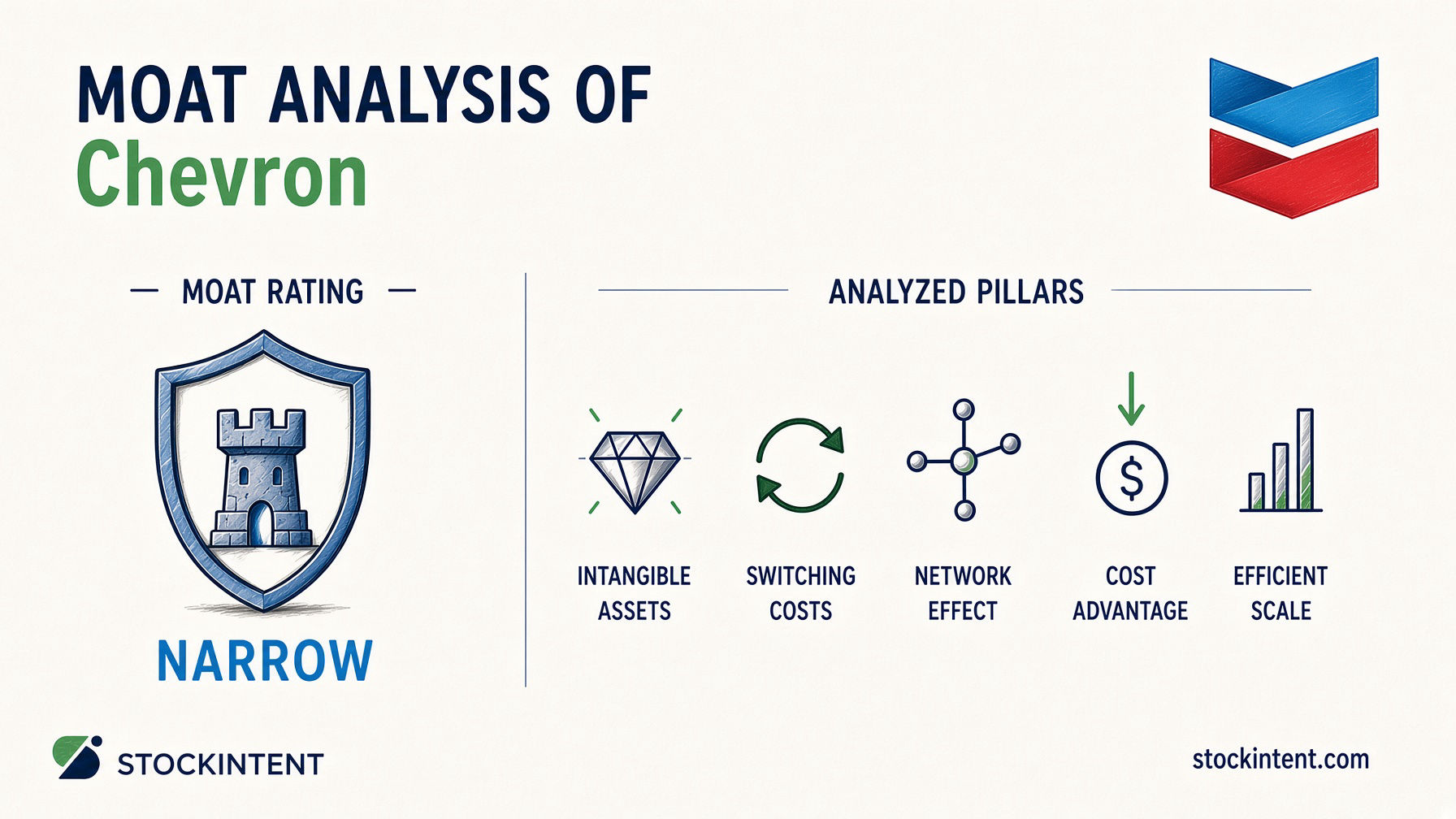
Chevron earns a Narrow economic moat with a Stable trend and Medium uncertainty. Its competitive position rests on low-cost upstream assets and integrated scale, not on pricing power or customer captivity. For investors who think like business owners, this matters because Chevron's quality is cyclical: it generates excess cash when oil prices cooperate, but it cannot command those prices itself.
Here is what the moat assessment boils down to:
Chevron's 2026 investor presentation frames the company around "sustained free cash flow growth" and a "resilient world class portfolio," and management is not wrong about the asset quality. But in commodity businesses, moat strength is measured by survival and cash generation in down cycles, not just peak-cycle profitability. That distinction is why we rate the moat as narrow rather than wide.
Chevron's moat is built on what it owns and operates, not on customer relationships or platform dynamics. The five-pillar framework helps us see which advantages are real and which are illusions in a commodity business.
Cost Advantage: Strong. Chevron's best defense is its low-cost resource base. The company's 2026 capital expenditure budget of $18–19 billion sits at the low end of its long-term range, signaling capital discipline rather than growth at any cost. Its Permian shale operations, Guyana offshore fields, and Australian LNG positions rank among the lower-cost sources of global supply. When oil prices fall, these assets keep generating cash while higher-cost competitors cut back or bleed.
Efficient Scale: Moderate to Strong. Size matters when replacement costs are enormous. Chevron's U.S. production exceeded 2 million barrels of oil equivalent per day for three consecutive quarters, and its Gorgon and Wheatstone LNG facilities ran at full rates in early 2026. U.S. refineries hit record crude throughput. Few competitors can replicate this integrated footprint without years of capital deployment and regulatory navigation. That said, commodity pricing still caps the returns scale can deliver.
Intangible Assets: Moderate, but Different. Chevron's intangible edge is not brand power or patents. It is technical expertise, project execution capability, and resource quality. One 2026 analysis notes these factors support the moat mainly as contributors to cost and scale advantages rather than as standalone pillars.
Switching Costs: Weak. Customers can buy crude, natural gas, or refined products from Exxon, Shell, or a trading house at market prices. Vertical integration improves reliability, but it does not create sticky lock-in.
Network Effects: Not Material. Chevron is not a platform. Each additional barrel produced does not make the next barrel more valuable to buyers. The business runs on reserves and operations, not ecosystem feedback loops.
Pro Insight: Integrated oil moats are often misunderstood. Chevron lacks pricing power like a branded consumer company, but it has "survival power" — low-cost assets that generate cash when higher-cost peers lose money. This creates a narrower but still real moat that is asset-based rather than customer-based.
For investors who want to screen for similar characteristics, StockIntent's screener can filter for companies with similar margin and return on assets characteristics — translating the moat framework into measurable criteria you can track over time.
Chevron's moat is most visible in its cash generation and asset scale, but the picture gets less clear when you look for proof of durable, cycle-beating returns.
The bull case is backed by hard numbers. Chevron returned $27.1 billion to shareholders in 2025 and $6.0 billion in Q1 2026, marking its 16th consecutive quarter above $5 billion. That kind of distribution streak signals a business that converts operations into owner cash, not just accounting earnings. The company also reported a 158% reserve replacement ratio for 2025, meaning it found more oil and gas than it pumped. In Q2 2026, earnings hit $12.1 billion with a 21% return on capital employed. These are genuine competitive fruits: low-cost assets, integrated scale, and capital discipline working in a favorable price environment.
But here's where it gets complicated. One third-party 2026 analysis estimates Chevron's normalized return on invested capital at just 2.42%, below an estimated weighted average cost of capital of 6.56%. That methodology differs from Chevron's own ROCE calculation, and the analysis should be treated as a directional estimate rather than verified fact. Still, it raises a fair question: do Chevron's advantages produce excess returns through the full commodity cycle, or mainly when oil prices are elevated? Our interpretation is that the moat is real but cyclical. It shows up clearly in cash flow and scale, yet remains disputed in normalized profitability. For investors assessing business quality, that distinction is the difference between a structural advantage and a conditional one.
Chevron's moat trend is Stable, with a credible path to widen if the Hess integration and cost targets land as planned. The company is getting bigger and more cash-generative, but it is not getting less dependent on commodity prices.
The clearest widening force is the Hess acquisition. Chevron's Q1 2026 production ran approximately 500 thousand barrels per day higher than Q1 2025, reflecting both Hess volumes and organic growth. U.S. production has now exceeded 2 million barrels of oil equivalent per day for three consecutive quarters. Gorgon and Wheatstone LNG were running at full rates, and U.S. refineries hit record crude throughput. This indicates that the operating leverage is becoming stronger.
Management's $2–3 billion structural cost reduction target by year-end 2026 adds another potential widening channel. If delivered, those savings would improve margins and capital efficiency in a way that outlasts any single oil price cycle. The 2026 capex budget of $18–19 billion sits at the low end of Chevron's long-term range, reinforcing that capital discipline is part of the plan, not just the rhetoric.
Still, the forces pushing back are real. Chevron flagged negative timing effects of $2.7–$3.7 billion in Q1 2026, mainly in Downstream, plus a $350–$400 million legal reserve charge. These are not one-off quirks; they are reminders that accounting volatility and operational complexity travel with scale. More fundamentally, one analysis notes that every $1 move in Brent oil prices shifts Chevron's after-tax earnings by roughly $550 million. That sensitivity is the moat's ceiling. Scale helps, but it does not let Chevron set its own prices.
Looking ahead, four indicators will tell us whether the moat is actually widening or just swelling:
For investors who want to track these metrics systematically, StockIntent's watchlist lets you organize companies with custom metric views and monitor how moat indicators evolve quarter to quarter.
We rate Chevron's moat uncertainty as Medium. The company owns a diversified, integrated portfolio and maintains a fortress balance sheet, but the range of plausible outcomes remains wide because commodity prices, not management skill, ultimately set the ceiling on returns.
Revenue predictability is limited. Chevron's Q1 2026 revenue was $48.6 billion, barely changed from $47.6 billion a year earlier, yet the quarter included $2.7–$3.7 billion in negative timing effects and a $350–$400 million legal reserve charge. These distortions show how reported results can swing for reasons unrelated to underlying demand or competitive position. One 2026 analysis estimates that every $1 move in Brent oil prices shifts after-tax earnings by roughly $550 million.
Operating stability is mixed, not settled. Chevron's worldwide production grew 15% in Q1 2026 and U.S. output rose 24%, with Gorgon and Wheatstone LNG running at full rates. But the same quarter saw downtime at Tengizchevroil and Middle East curtailments. Record throughput and unplanned outages can coexist in the same portfolio, which is exactly the point: scale diversifies risk without eliminating it.
The balance sheet is a genuine stabilizer. Chevron's 2026 capex budget of $18–19 billion sits at the low end of its long-term range, and the company has returned more than $5 billion to shareholders for 16 consecutive quarters. That financial capacity gives Chevron staying power that weaker peers lack.
Still, the uncertainty question is not whether Chevron can survive a downturn; it is whether its competitive position generates durable excess returns through the full cycle. Until normalized returns consistently clear the cost of capital, the moat assessment carries a meaningful range of doubt.
Chevron carries a Narrow economic moat with a Stable trend and Medium uncertainty. Its competitive position is real but conditional: low-cost upstream assets, integrated scale, and disciplined capital allocation generate strong cash flow when oil prices cooperate, yet the company cannot command those prices itself.
The strongest evidence supporting this view is the combination of $27.1 billion in 2025 shareholder returns, 158% reserve replacement, and Q2 2026 ROCE of 21%. These metrics show a business that converts scale and cost advantage into owner cash during favorable cycles.
The main uncertainty that could change this assessment is whether Chevron can achieve sustained normalized returns above its cost of capital. One third-party 2026 analysis estimates normalized ROIC at just 2.42% versus an estimated WACC of 6.56%. If that gap persists through down cycles, the moat is narrower than peak earnings suggest. Prolonged low oil prices or failed execution on the Hess integration and cost targets would also weaken the assessment.
For investors evaluating Chevron as a long-term business holding, the question is not whether the stock is cheap. It is whether the competitive advantages are durable enough to generate excess returns when the commodity cycle turns. Our view is that they are present but not dominant.
This content is for informational or educational purposes and is not investment advice.
Chevron earns a Narrow economic moat with a Stable trend and Medium uncertainty. Its competitive position rests on low-cost upstream assets and integrated scale, not on pricing power or customer captivity. For investors who think like business owners, this matters because Chevron's quality is cyclical: it generates excess cash when oil prices cooperate, but it cannot command those prices itself.
Here is what the moat assessment boils down to:
Chevron's 2026 investor presentation frames the company around "sustained free cash flow growth" and a "resilient world class portfolio," and management is not wrong about the asset quality. But in commodity businesses, moat strength is measured by survival and cash generation in down cycles, not just peak-cycle profitability. That distinction is why we rate the moat as narrow rather than wide.
Chevron's moat is built on what it owns and operates, not on customer relationships or platform dynamics. The five-pillar framework helps us see which advantages are real and which are illusions in a commodity business.
Cost Advantage: Strong. Chevron's best defense is its low-cost resource base. The company's 2026 capital expenditure budget of $18–19 billion sits at the low end of its long-term range, signaling capital discipline rather than growth at any cost. Its Permian shale operations, Guyana offshore fields, and Australian LNG positions rank among the lower-cost sources of global supply. When oil prices fall, these assets keep generating cash while higher-cost competitors cut back or bleed.
Efficient Scale: Moderate to Strong. Size matters when replacement costs are enormous. Chevron's U.S. production exceeded 2 million barrels of oil equivalent per day for three consecutive quarters, and its Gorgon and Wheatstone LNG facilities ran at full rates in early 2026. U.S. refineries hit record crude throughput. Few competitors can replicate this integrated footprint without years of capital deployment and regulatory navigation. That said, commodity pricing still caps the returns scale can deliver.
Intangible Assets: Moderate, but Different. Chevron's intangible edge is not brand power or patents. It is technical expertise, project execution capability, and resource quality. One 2026 analysis notes these factors support the moat mainly as contributors to cost and scale advantages rather than as standalone pillars.
Switching Costs: Weak. Customers can buy crude, natural gas, or refined products from Exxon, Shell, or a trading house at market prices. Vertical integration improves reliability, but it does not create sticky lock-in.
Network Effects: Not Material. Chevron is not a platform. Each additional barrel produced does not make the next barrel more valuable to buyers. The business runs on reserves and operations, not ecosystem feedback loops.
Pro Insight: Integrated oil moats are often misunderstood. Chevron lacks pricing power like a branded consumer company, but it has "survival power" — low-cost assets that generate cash when higher-cost peers lose money. This creates a narrower but still real moat that is asset-based rather than customer-based.
For investors who want to screen for similar characteristics, StockIntent's screener can filter for companies with similar margin and return on assets characteristics — translating the moat framework into measurable criteria you can track over time.
Chevron's moat is most visible in its cash generation and asset scale, but the picture gets less clear when you look for proof of durable, cycle-beating returns.
The bull case is backed by hard numbers. Chevron returned $27.1 billion to shareholders in 2025 and $6.0 billion in Q1 2026, marking its 16th consecutive quarter above $5 billion. That kind of distribution streak signals a business that converts operations into owner cash, not just accounting earnings. The company also reported a 158% reserve replacement ratio for 2025, meaning it found more oil and gas than it pumped. In Q2 2026, earnings hit $12.1 billion with a 21% return on capital employed. These are genuine competitive fruits: low-cost assets, integrated scale, and capital discipline working in a favorable price environment.
But here's where it gets complicated. One third-party 2026 analysis estimates Chevron's normalized return on invested capital at just 2.42%, below an estimated weighted average cost of capital of 6.56%. That methodology differs from Chevron's own ROCE calculation, and the analysis should be treated as a directional estimate rather than verified fact. Still, it raises a fair question: do Chevron's advantages produce excess returns through the full commodity cycle, or mainly when oil prices are elevated? Our interpretation is that the moat is real but cyclical. It shows up clearly in cash flow and scale, yet remains disputed in normalized profitability. For investors assessing business quality, that distinction is the difference between a structural advantage and a conditional one.
Chevron's moat trend is Stable, with a credible path to widen if the Hess integration and cost targets land as planned. The company is getting bigger and more cash-generative, but it is not getting less dependent on commodity prices.
The clearest widening force is the Hess acquisition. Chevron's Q1 2026 production ran approximately 500 thousand barrels per day higher than Q1 2025, reflecting both Hess volumes and organic growth. U.S. production has now exceeded 2 million barrels of oil equivalent per day for three consecutive quarters. Gorgon and Wheatstone LNG were running at full rates, and U.S. refineries hit record crude throughput. This indicates that the operating leverage is becoming stronger.
Management's $2–3 billion structural cost reduction target by year-end 2026 adds another potential widening channel. If delivered, those savings would improve margins and capital efficiency in a way that outlasts any single oil price cycle. The 2026 capex budget of $18–19 billion sits at the low end of Chevron's long-term range, reinforcing that capital discipline is part of the plan, not just the rhetoric.
Still, the forces pushing back are real. Chevron flagged negative timing effects of $2.7–$3.7 billion in Q1 2026, mainly in Downstream, plus a $350–$400 million legal reserve charge. These are not one-off quirks; they are reminders that accounting volatility and operational complexity travel with scale. More fundamentally, one analysis notes that every $1 move in Brent oil prices shifts Chevron's after-tax earnings by roughly $550 million. That sensitivity is the moat's ceiling. Scale helps, but it does not let Chevron set its own prices.
Looking ahead, four indicators will tell us whether the moat is actually widening or just swelling:
For investors who want to track these metrics systematically, StockIntent's watchlist lets you organize companies with custom metric views and monitor how moat indicators evolve quarter to quarter.
We rate Chevron's moat uncertainty as Medium. The company owns a diversified, integrated portfolio and maintains a fortress balance sheet, but the range of plausible outcomes remains wide because commodity prices, not management skill, ultimately set the ceiling on returns.
Revenue predictability is limited. Chevron's Q1 2026 revenue was $48.6 billion, barely changed from $47.6 billion a year earlier, yet the quarter included $2.7–$3.7 billion in negative timing effects and a $350–$400 million legal reserve charge. These distortions show how reported results can swing for reasons unrelated to underlying demand or competitive position. One 2026 analysis estimates that every $1 move in Brent oil prices shifts after-tax earnings by roughly $550 million.
Operating stability is mixed, not settled. Chevron's worldwide production grew 15% in Q1 2026 and U.S. output rose 24%, with Gorgon and Wheatstone LNG running at full rates. But the same quarter saw downtime at Tengizchevroil and Middle East curtailments. Record throughput and unplanned outages can coexist in the same portfolio, which is exactly the point: scale diversifies risk without eliminating it.
The balance sheet is a genuine stabilizer. Chevron's 2026 capex budget of $18–19 billion sits at the low end of its long-term range, and the company has returned more than $5 billion to shareholders for 16 consecutive quarters. That financial capacity gives Chevron staying power that weaker peers lack.
Still, the uncertainty question is not whether Chevron can survive a downturn; it is whether its competitive position generates durable excess returns through the full cycle. Until normalized returns consistently clear the cost of capital, the moat assessment carries a meaningful range of doubt.
Chevron carries a Narrow economic moat with a Stable trend and Medium uncertainty. Its competitive position is real but conditional: low-cost upstream assets, integrated scale, and disciplined capital allocation generate strong cash flow when oil prices cooperate, yet the company cannot command those prices itself.
The strongest evidence supporting this view is the combination of $27.1 billion in 2025 shareholder returns, 158% reserve replacement, and Q2 2026 ROCE of 21%. These metrics show a business that converts scale and cost advantage into owner cash during favorable cycles.
The main uncertainty that could change this assessment is whether Chevron can achieve sustained normalized returns above its cost of capital. One third-party 2026 analysis estimates normalized ROIC at just 2.42% versus an estimated WACC of 6.56%. If that gap persists through down cycles, the moat is narrower than peak earnings suggest. Prolonged low oil prices or failed execution on the Hess integration and cost targets would also weaken the assessment.
For investors evaluating Chevron as a long-term business holding, the question is not whether the stock is cheap. It is whether the competitive advantages are durable enough to generate excess returns when the commodity cycle turns. Our view is that they are present but not dominant.
This content is for informational or educational purposes and is not investment advice.