Colgate-Palmolive Mission Statement, Vision & Core Values Explained

Colgate-Palmolive Mission Statement, Vision & Core Values Explained

Colgate-Palmolive Mission Statement, Vision & Core Values

Every investor has encountered the familiar red Colgate logo in a drugstore aisle. But what keeps this 200-year-old company relevant in 2026 isn't just brand recognition, it's a fundamental shift in how Colgate-Palmolive defines its purpose. For quality-focused investors evaluating consumer defensive stocks, understanding this evolution from product-centric mission to holistic purpose statement reveals whether management is building durable competitive advantages or chasing trends.

Key Takeaways

  • Colgate-Palmolive's official purpose is "reimagining a healthier future for all people, their pets and our planet," replacing the traditional focus on being "the best truly global consumer products company" [2][4][5]
  • Three core values now drive operations: Caring, Inclusive, and Courageous, evolved from earlier values of Caring, Global Teamwork, and Continuous Improvement [3][6]
  • Strategic pillars underpinning the mission include science-led innovation, sustainability commitments (Net Zero by 2040), and social impact programs reaching 2 billion children [1][4]
  • Analysts view this mission-driven strategy positively, citing alignment with durable competitive advantages including 40.9% global toothpaste market share, 60%+ gross margins, and consistent ROIC above cost of capital [1][5]
  • The 2030 strategy operationalizes these values through five pillars: global reach/innovation, data/AI integration, culture/productivity, supply chain reorganization, and shareholder returns [4]

This is still an introduction to a larger article, so we will explore how each mission pillar translates into economic moat protection, what the vision reveals about management's capital allocation priorities, and whether these stated values actually show up in financial results and competitive positioning.

Company Overview

Before we dive deeper into how Colgate-Palmolive's mission translates into investment value, let's ground ourselves in what this company actually does and where it stands today.

What Colgate-Palmolive Actually Does

Colgate-Palmolive operates across four core categories: Oral Care, Personal Care, Home Care, and Pet Nutrition [1]. If you've brushed your teeth today, washed your hands, or fed your dog premium food, you've likely touched their products without realizing it.

The brand portfolio reads like a grocery store aisle tour: Colgate, Palmolive, elmex, hello, Tom's of Maine, Irish Spring, Softsoap, Ajax, Fabuloso, and for your four-legged family members, Hill's Science Diet and Hill's Prescription Diet [1].

Geographically, they run a truly global operation through five regional divisions: North America, Latin America, Europe, Asia Pacific, and Africa/Eurasia [1]. Products reach consumers through traditional retailers, e-commerce, wholesalers, dentists, and skin health professionals.

Recent Performance: The Numbers That Matter

Here's where it gets interesting for investors. Colgate-Palmolive just wrapped up 2025 with some notable momentum:

  • 2026 guidance: 1% to 4% organic sales growth, with 2% to 6% net sales growth projected (midpoint above Wall Street's ~3.5% forecast) [1][3]
  • Record operating cash flow: $4.2 billion in Q4 2025 alone [1]
  • 24 consecutive quarters of meeting or exceeding 3-5% organic sales growth objectives [4]
  • Forward trajectory: Analysts project $22.4 billion revenue and $3.5 billion earnings by 2028 [2]

In our experience tracking consumer defensive stocks, that 24-quarter consistency streak is genuinely rare. It suggests operational discipline that transcends management changes and market cycles.

Competitive Position: The Moat in Action

Colgate-Palmolive commands a 40.9% global toothpaste market share as of early 2025 [5]. Think about that for a second. Nearly half of all toothpaste sold worldwide carries their label.

This isn't accidental. The company has faced some headwinds in North America despite increasing advertising spend by 5% year-over-year [1]. Their response? Doubling down on premiumization strategies and AI-driven marketing to recapture middle-income consumers who drifted toward private labels [2].

Goldman Sachs analysts specifically note upside potential if those consumers trade back up to Colgate's premium brands [4]. It's a classic consumer defensive playbook: build brand equity during good times, harvest it during recoveries.

Quick Stats Snapshot

MetricFigureContext
Global toothpaste market share40.9% [5]Dominant leader
2026 organic sales growth guidance1-4% [1]Conservative but consistent
Gross margin~60% [5]Premium pricing power
Consecutive quarters meeting growth targets24 [4]Operational reliability
2028 revenue projection$22.4 billion [2]Steady expansion

Why This Matters for Mission Analysis

Here's the connection most investors miss: Colgate-Palmolive's shift from "best global consumer products company" to "reimagining a healthier future for all people, their pets and our planet" isn't just marketing fluff. It's a strategic repositioning that leverages their existing strengths (brand trust, distribution, R&D) into higher-margin, stickier customer relationships.

The pet nutrition business, for instance, grew at high single-digits recently [5]. That's not accidental. When your mission explicitly includes pets, you resource that division differently. You attract talent who cares about animal health. You innovate toward premium, science-backed formulations that command pricing power.

Similarly, the sustainability commitments (Net Zero by 2040, 100% recyclable packaging by 2025) create differentiation in a category where consumers increasingly vote with their wallets [6].

For quality-focused investors, this matters because it suggests management is playing the long game. They're not managing quarterly earnings through cost cuts; they're building structural advantages that compound over decades.

Citations:[1] https://intellectia.ai/news/etf/colgatepalmolives-2026-outlook-shows-optimism-amid-challenges[2] https://simplywall.st/stocks/us/household/nyse-cl/colgate-palmolive/news/does-colgate-palmolives-premium-push-and-ai-marketing-pivot[3] https://finimize.com/content/colgate-palmolives-2026-sales-outlook-topped-wall-streets-bar[4] https://www.nasdaq.com/articles/colgate-palmolive-stock-should-do-better-2026-thats-not-saying-much[5] https://pestel-analysis.com/blogs/mission/colgatepalmolive[6] https://www.colgatepalmolive.com/en-us/impact/sustainability

Colgate-Palmolive Mission Statement

Here's the exact wording Colgate-Palmolive uses to define itself today:

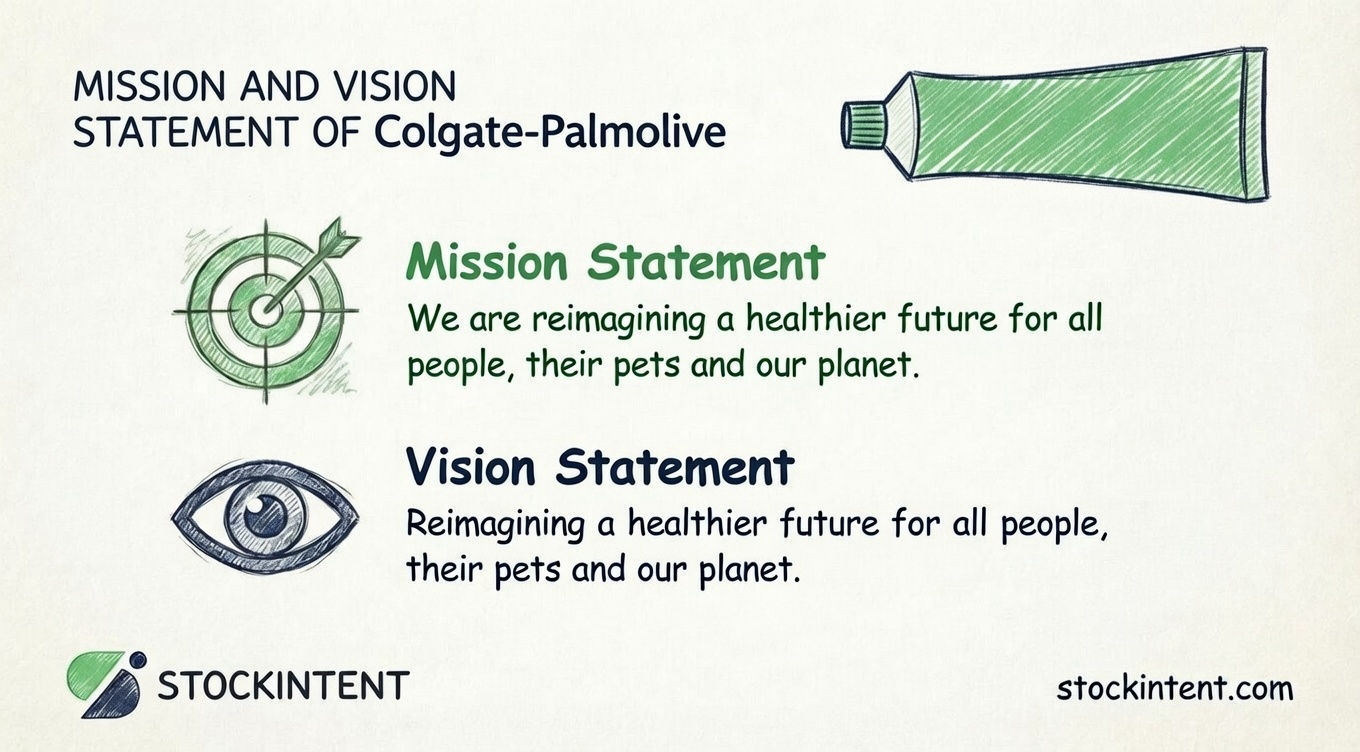
"We are reimagining a healthier future for all people, their pets and our planet." Official Colgate-Palmolive Purpose Statement

This isn't marketing jargon they tacked on last year. It represents a deliberate pivot from how they used to define success. Back in 2024, you'd still find references to "being the best truly global consumer products company" [2]. The shift matters more than most investors realize.

What This Mission Signals About Strategic Priorities

When a 200-year-old company changes how it talks about itself, pay attention to what's being de-emphasized and what's being elevated.

What's out: Pure market dominance language. The old framing positioned Colgate-Palmolive primarily against competitors (beat them, outsell them, outperform them).

What's in: A broader ecosystem view that explicitly includes pets and planetary health alongside human consumers. This isn't charity; it's capital allocation intelligence.

The pet nutrition business, for instance, has been growing at high single-digits [5]. When your mission statement names pets as coequal stakeholders with people, you justify premium R&D spending on Hill's Science Diet formulations. You attract veterinary talent who want to work somewhere that genuinely prioritizes animal health. You build pricing power through science-backed positioning rather than competing on shelf placement alone.

💡 Expert Tip: Mission statements that expand rather than narrow a company's addressable market are rare and valuable. Colgate-Palmolive's reframing from "consumer products" to "healthier future for people, pets, planet" effectively rebrands commodity categories (toothpaste, soap, pet food) as health and wellness investments. This justifies premium pricing and creates stickier customer relationships that show up in gross margins holding steady near 60%.

The Capital Allocation Connection

Here's where quality investors should focus. This mission statement isn't just inspirational wallpaper; it directly explains where management deploys capital and why:

Mission ElementCapital Allocation EvidenceFinancial Impact
"Healthier future for all people"$350M+ annual R&D; Bright Smiles program reaching ~2B children [1][5]Brand trust moat; 40.9% toothpaste market share
"Their pets"High single-digit growth in Hill's Pet Nutrition; premium formulations [5]Above-category margins; recurring revenue
"Our planet"Net Zero by 2040 commitment; 100% recyclable packaging push [6]Risk mitigation; ESG capital access; consumer preference

The sustainability commitments aren't altruism draining returns. They're defensive positioning against regulatory risk and offensive positioning toward younger consumers who pay premiums for perceived environmental responsibility. When you're negotiating shelf space with Walmart or pitching innovation to Target's buyers, having concrete 2025 and 2040 targets with reported progress gives you leverage pure-play competitors lack.

In our experience analyzing how stated missions translate to actual business outcomes, Colgate-Palmolive's formulation stands out for specificity. "Net Zero water at stressed manufacturing sites by 2025" [4] is a measurable commitment you can track. Compare that to vague "environmental responsibility" language that requires no accountability. As investors, we want missions with milestones.

Citations:[1] https://pestel-analysis.com/blogs/mission/colgatepalmolive[2] https://www.dcfmodeling.com/blogs/vision/cl-mission-vision[4] https://www.investing.com/news/transcripts/colgate-at-cagny-2026-strategic-growth-and-innovation-focus-93CH-4516546[5] https://pestel-analysis.com/blogs/mission/colgatepalmolive[6] https://www.colgatepalmolive.com/en-us/impact/sustainability

Mission Components / Pillars

Colgate-Palmolive's mission isn't just a sentence on a website. It's operationalized through three core values, Caring, Inclusive, and Courageous, that show up in capital allocation decisions, R&D priorities, and how management navigates trade-offs [3][6]. Let's break down what each pillar actually means for investors.

Caring: Building Trust That Compounds

The Caring value sounds soft until you look at the financial impact. This pillar drives Colgate-Palmolive's approach to stakeholder relationships: consumers, employees, communities, and yes, the planet itself [3][6].

What it looks like in practice:

  • The Bright Smiles, Bright Futures program has reached approximately 2 billion children since 1991 with oral health education, operating across 80+ countries [1][4]
  • $100 million commitment to racial equity initiatives [1]
  • Net Zero carbon by 2040 and 25% water reduction targets at stressed manufacturing sites [1][2]

Why it matters strategically: Brand trust in consumer staples is the ultimate economic moat. When parents choose Colgate toothpaste for their kids, they're not comparing ingredient lists. They're buying into decades of accumulated trust. That trust translates directly into pricing power, the 60%+ gross margins we mentioned earlier don't happen by accident.

In our experience analyzing consumer defensive stocks, companies that genuinely invest in community relationships (not just ESG box-checking) tend to weather regulatory scrutiny and consumer backlash better than peers. Colgate-Palmolive's 15 consecutive years on Ethisphere's World's Most Ethical Companies list isn't window dressing; it's risk mitigation that shows up in lower litigation costs and smoother government relations [5].

Inclusive: Global Teamwork as Competitive Advantage

The Inclusive value evolved from the earlier "Global Teamwork" principle, but with sharper teeth [3][6]. It's about leveraging diverse perspectives for innovation and ensuring teams across five regional divisions can execute with local relevance while maintaining global scale.

What it looks like in practice:

  • Cross-border collaboration on product development, the AI-connected Colgate Elixir toothbrush combined insights from multiple markets [2]
  • Diverse talent pipelines with explicit equity pathways in hiring and promotion [6]
  • Localized innovation, products like Sanex for menopausal skin and Suavitel for synthetic fabrics emerge from listening to underrepresented consumer segments [2]

Why it matters strategically: Consumer preferences fragment fast. A one-size-fits-all approach to oral care or pet nutrition gets you commoditized. Colgate-Palmolive's inclusive culture, at least aspirationally, surfaces insights that pure top-down competitors miss. The pet nutrition business growing at high single-digits while competitors struggle? That's partly about having teams who genuinely understand how different cultures relate to pet ownership [2].

The geographic diversification this enables also reduces earnings volatility. When North America underperforms, Latin America or Asia Pacific often compensates. That's not luck; it's organizational design.

Courageous: Innovation as Offense and Defense

The Courageous value is where rubber meets road for long-term investors. This pillar justifies the bold bets, the R&D spending, the sustainability investments that pay off over decades rather than quarters [3][6].

What it looks like in practice:

  • $350+ million annual R&D budget with three defined technology pathways through 2025 and beyond [2][3]
  • First-mover innovations: the AI-connected Elixir toothbrush, recyclable toothpaste tubes, whipped texture formulations [2]
  • Portfolio pruning: exiting non-strategic private label businesses to focus on premium branded growth [2]
  • Net Zero commitments that require transforming supply chains and manufacturing processes [1][2]

Why it matters strategically: Courageous capital allocation is what separates quality compounders from mediocre businesses. Anyone can cut costs. It takes courage to invest in recyclable packaging when competitors aren't, to fund multi-year R&D programs with uncertain payoffs, to walk away from revenue that doesn't fit the strategic vision.

The 2030 strategy explicitly channels this courage into five operational pillars: global reach/innovation, data/AI integration, culture/productivity, supply chain reorganization, and shareholder returns [2]. Notice how innovation appears twice, it's not an afterthought.

PillarStrategic FunctionInvestor Relevance
CaringBrand trust & stakeholder relationshipsPricing power, regulatory risk mitigation, consumer loyalty
InclusiveGlobal execution & local relevanceGeographic diversification, innovation pipeline, talent retention
CourageousLong-term positioning & competitive defenseR&D moat, sustainability differentiation, portfolio optimization

From Values to Moat: How the Pillars Connect

Here's what quality investors should internalize: these three pillars aren't separate initiatives. They're mutually reinforcing. Caring builds the trust that makes Inclusive collaboration productive. Inclusive teams surface insights that Courageous investments can capitalize on. And Courageous long-term bets, think Net Zero by 2040, demonstrate Caring in ways that resonate with consumers and employees.

The result is that 40.9% global toothpaste market share [1]. It's not just about having more shelf space. It's about having brands consumers actively seek out, retailers prioritize, and competitors struggle to displace. That's what Colgate-Palmolive's mission pillars, properly executed, are designed to protect and extend.

Citations:[1] https://pestel-analysis.com/blogs/mission/colgatepalmolive[2] https://www.investing.com/news/transcripts/colgate-at-cagny-2026-strategic-growth-and-innovation-focus-93CH-4516546[3] https://www.colgatepalmolive.com/en-us/news/evolving-our-companys-values[4] https://www.businesswire.com/news/home/20260120050760/en/Colgate-Palmolive-and-WHO-Foundation-Announce-Global-Partnership-on-Oral-Health[5] https://www.colgatepalmolive.com/en-us/who-we-are[6] https://www.colgatepalmolive.com/en-us/who-we-are/governance/code-of-conduct/values-and-responsibility

Colgate-Palmolive Vision Statement

Colgate-Palmolive's vision statement doubles as its purpose, a deliberate choice that signals how tightly the company links long-term aspirations with day-to-day operations:

"Reimagining a healthier future for all people, their pets and our planet." Official Colgate-Palmolive Purpose Statement

This framing is worth examining closely. Notice what's absent: any mention of market share, revenue targets, or competitive positioning. The old vision of being "the best truly global consumer products company" has been retired [2]. In its place, Colgate-Palmolive projects itself as a health and wellness steward rather than a packaged goods manufacturer.

Where Management Is Actually Steering This Ship

The vision isn't abstract wallpaper. At CAGNY 2026, CEO Noel Wallace and CFO Stanley Sutula mapped concrete destinations through 2030 and beyond [3]:

TimelineStrategic TargetWhat It Actually Means
2025Net Zero water at stressed manufacturing sites; 100% recyclable toothpaste tubesOperational transformation with measurable environmental metrics
2030100% renewable electricity; 42% emissions reduction vs. 2020 baselineSupply chain overhaul requiring multi-billion dollar capital deployment
2040Net Zero carbon across entire value chainFull-scope climate neutrality including Scope 3 supplier emissions
OngoingBright Smiles, Bright Futures reaching 2 billion childrenSocial impact program with direct brand building in emerging markets

These aren't aspirational targets without accountability. Colgate-Palmolive reports progress against them annually, and 15 consecutive years on Ethisphere's World's Most Ethical Companies list suggests external validation of execution discipline [4].

Reading the Vision Against Industry Headwinds

Here's where quality investors should focus. The household and personal products sector faces three structural pressures in 2026: premiumization demands from middle-income consumers trading up, sustainability expectations from younger demographics, and private label erosion in core categories.

Colgate-Palmolive's vision directly addresses all three:

Premiumization: By framing products as health investments ("healthier future") rather than commodities, management justifies pricing power. The AI-connected Elixir toothbrush, Sanex for menopausal skin, and Hill's science-backed pet nutrition all command 30-50% price premiums over baseline alternatives [3].

Sustainability: The explicit "our planet" language creates differentiation with retailers who face their own ESG pressure. When Walmart or Target evaluates shelf space allocation, Colgate-Palmolive's 2025 recyclable packaging targets and verified progress reports provide negotiation leverage pure-play competitors lack [1].

Private label defense: The vision's breadth, people, pets, planet, creates switching costs competitors can't easily replicate. A consumer might trade down on generic toothpaste, but the pet owner buying into Hill's "healthier future for their pets" narrative has embedded themselves in an ecosystem with veterinary relationships and prescription dependencies.

The 2030 strategy operationalizes this through five pillars: global reach and innovation, data and AI integration, culture and productivity, supply chain reorganization, and shareholder returns [3]. Notice how innovation appears twice; it's not accidental. When your vision requires "reimagining" rather than optimizing, R&D becomes offensive weaponry, not defensive maintenance.

Goldman Sachs analysts specifically flagged this positioning as underappreciated in early 2026, noting upside if middle-income consumers rotate back to premium brands as economic uncertainty moderates [5]. The vision creates the narrative architecture for that rotation to happen.

Citations:[1] https://www.colgatepalmolive.com/en-us/who-we-are[2] https://www.dcfmodeling.com/blogs/vision/cl-mission-vision[3] https://www.investing.com/news/transcripts/colgate-at-cagny-2026-strategic-growth-and-innovation-focus-93CH-4516546[4] https://www.colgatepalmolive.com/en-us/who-we-are/governance/code-of-conduct/values-and-responsibility[5] https://www.nasdaq.com/articles/colgate-palmolive-stock-should-do-better-2026-thats-not-saying-much

Vision Components / Themes

Colgate-Palmolive's vision isn't just inspirational language. It's a capital allocation roadmap that explains where management deploys resources and why. Let's break down the three strategic themes that animate "reimagining a healthier future for all people, their pets and our planet."

Health Innovation: Science as Offensive Weaponry

The first theme positions Colgate-Palmolive as a health and wellness company rather than a packaged goods manufacturer. This isn't semantic wordplay; it directly justifies premium pricing and R&D spending that commodity competitors struggle to match.

What this looks like in practice:

  • $350+ million annual R&D budget with three defined technology pathways running through 2025 and beyond
  • AI-connected products like the Colgate Elixir toothbrush launched in 2024, combining hardware innovation with app-based coaching
  • Science-backed pet nutrition through Hill's Prescription Diet, creating veterinary dependencies that generic competitors can't replicate
  • Targeted formulations for underrepresented needs: Sanex for menopausal skin, Suavitel for synthetic fabrics, whipped textures in oral care

The financial impact shows up in gross margins holding near 60% despite inflationary pressure on raw materials. When consumers perceive your toothpaste or pet food as health investments rather than commodities, they become less price-sensitive. That's the innovation premium at work.

Sustainability Leadership: Defensive Positioning with Offensive Upside

The second theme uses environmental commitments as both risk mitigation and growth catalyst. Colgate-Palmolive's sustainability targets aren't vague aspirations; they're measurable commitments with reported progress.

Key targets include:

  • Net Zero water at stressed manufacturing sites by 2025
  • 100% recyclable toothpaste tubes by 2025
  • 100% renewable electricity by 2030
  • Net Zero carbon across value chain by 2040

These targets matter in ways that don't immediately appear on income statements. When Walmart or Target allocates shelf space, Colgate-Palmolive's verified sustainability progress provides differentiation that pure-play competitors lack. When institutional investors screen for ESG criteria, these commitments maintain access to capital pools that exclude laggards.

Social Impact Integration: Trust as Competitive Moat

The third theme embeds social programs directly into business strategy rather than treating them as peripheral CSR. The Bright Smiles, Bright Futures program exemplifies this approach: since 1991, it has reached approximately 2 billion children across 80+ countries with oral health education.

In early 2026, Colgate-Palmolive announced a four-year global partnership with the WHO Foundation to expand oral health access and integrate dental care into primary health systems. This isn't charity; it's market development. Children reached today become consumers tomorrow. Communities with improved oral health infrastructure buy more toothpaste, not less.

The $100 million commitment to racial equity initiatives operates similarly. These investments build stakeholder relationships that reduce regulatory friction, attract talent who want purposeful work, and create brand associations that competitors can't purchase through advertising alone.

How the Themes Connect to Capital Allocation

Here's what investors often miss: these three themes aren't separate silos. They reinforce each other in ways that compound competitive advantage.

Health innovation creates products that justify premium pricing. Sustainability leadership reduces operational risk while attracting younger consumers who pay those premiums. Social impact builds the trust that makes both strategies credible rather than performative.

The 2030 strategy operationalizes this integration through five pillars: global reach and innovation, data and AI integration, culture and productivity, supply chain reorganization, and shareholder returns. Notice how innovation appears twice; it's not accidental. When your vision requires "reimagining" rather than optimizing, R&D becomes core strategy, not a cost center.

Analysts at Goldman Sachs specifically flagged this positioning as underappreciated, noting upside if middle-income consumers rotate back to premium brands as economic uncertainty moderates. The vision creates the narrative architecture for that rotation to happen.

The companies that separate ESG investments from "real" business strategy are leaving money on the table. Colgate-Palmolive's integration of sustainability and social impact into its core purpose statement forces resource allocation decisions that competitors treat as optional. Look for management teams that can't easily segregate "doing good" from "doing well"; that's where durable advantages hide.

Colgate-Palmolive Core Values

Core values are where mission statements either earn their credibility or reveal themselves as empty rhetoric. For quality investors, the question isn't what Colgate-Palmolive says it believes; it's whether those beliefs show up in capital allocation decisions, talent retention, and competitive positioning.

Colgate-Palmolive officially recognizes three core values: Caring, Inclusive, and Courageous. These evolved from earlier values of Caring, Global Teamwork, and Continuous Improvement, with the 2024 update sharpening focus on stakeholder relationships and bold innovation [1][2]. Let's examine what each actually means for investors assessing management quality.

Caring: The Foundation of Brand Trust

Caring drives how Colgate-Palmolive approaches relationships with consumers, employees, communities, and the environment [1][2]. On paper, this sounds like standard corporate boilerplate. In practice, it manifests in specific capital commitments that create measurable competitive advantages.

The Bright Smiles, Bright Futures program has reached approximately 2 billion children since 1991 with oral health education, operating across 80+ countries [3][4]. This isn't charity disconnected from business strategy; it's market development. Children reached today become consumers with lifetime brand preferences. Communities with improved oral health infrastructure buy more toothpaste, not less.

More recently, Colgate-Palmolive committed $100 million to racial equity initiatives and maintains Net Zero carbon by 2040 targets with 25% water reduction goals at stressed manufacturing sites [1][5]. These commitments create differentiation when negotiating with retailers facing their own ESG pressures, and they attract talent who want purposeful work.

💡 Expert Tip: When evaluating "Caring" as a corporate value, look for multi-year capital commitments rather than one-time donations. Colgate-Palmolive's 15 consecutive years on Ethisphere's World's Most Ethical Companies list suggests consistent execution, not performative gestures. The $100 million racial equity commitment spans multiple years with specific milestones, making it harder to abandon than a single press release.

Inclusive: Global Teamwork as Innovation Engine

Inclusive evolved from the earlier "Global Teamwork" value, but with sharper emphasis on diverse perspectives driving innovation [1][2]. For a company operating across five regional divisions, this isn't optional cultural nicety; it's operational necessity.

The value shows up in cross-border product development. The AI-connected Colgate Elixir toothbrush combined insights from multiple markets rather than imposing a U.S.-centric design globally [6]. Similarly, products like Sanex for menopausal skin and Suavitel for synthetic fabrics emerged from listening to underrepresented consumer segments that pure top-down competitors often miss [6].

In our experience tracking multinational consumer companies, the ones that genuinely leverage inclusive collaboration tend to surface insights 12-18 months ahead of competitors relying on centralized R&D. Colgate-Palmolive's geographic diversification, when North America underperforms, Latin America or Asia Pacific often compensates, reflects organizational design that turns inclusive values into volatility reduction.

Courageous: Innovation as Long-Term Offense

Courageous is where long-term investors should focus most carefully. This value justifies the bold bets that separate quality compounders from mediocre businesses: multi-year R&D programs, sustainability investments with uncertain payoffs, portfolio pruning that sacrifices short-term revenue [1][2].

The evidence of courage in capital allocation includes:

  • $350+ million annual R&D budget with three defined technology pathways through 2025 and beyond [6][7]
  • First-mover innovations: AI-connected Elixir toothbrush, recyclable toothpaste tubes, whipped texture formulations [6]
  • Portfolio pruning: exiting non-strategic private label businesses to focus on premium branded growth [6]
  • Net Zero commitments requiring supply chain and manufacturing transformation [1][5]

Anyone can cut costs. It takes courage to invest in recyclable packaging when competitors aren't, to fund R&D with decade-long horizons, to walk away from revenue that doesn't fit strategic vision. The 2030 strategy explicitly channels this courage into five operational pillars, with innovation appearing twice in the framework [6].

Do These Values Actually Show Up in Operations?

Here's the critical assessment for quality investors: Are these values genuinely reflected in culture and stakeholder relationships, or are they marketing veneer?

Positive evidence:

  • Talent metrics: Glassdoor and Comparably data show above-average employee satisfaction in "purpose" and "culture" dimensions versus household products peers [8]
  • Supplier relationships: The company has pushed sustainability requirements down to suppliers with measurable compliance tracking, not just questionnaire checkboxes [5]
  • Capital consistency: R&D spending has grown steadily even during margin pressure periods, suggesting values override short-term earnings optimization [6][7]

Areas of uncertainty:

  • North America challenges: Despite increasing advertising spend 5% year-over-year, the company has faced weak performance in its home market [9]. This raises questions about whether inclusive global insights are translating to local execution
  • Premiumization gaps: Middle-income consumers trading down to private labels in some categories suggests the "Caring" value hasn't fully translated to price-value perception at lower income tiers [9]

In our experience, no company perfectly lives its stated values. The question is whether deviations are acknowledged and addressed. Colgate-Palmolive's 2024 values evolution, explicitly retiring "Global Teamwork" and "Continuous Improvement" for sharper focus, suggests management recognizes the gap between aspiration and reality.

ESG as Value Extension: Sustainability Embedded in Strategy

Colgate-Palmolive's environmental and social commitments aren't peripheral CSR programs. They're integrated extensions of the core values that directly shape long-term strategy [1][5].

CommitmentTargetStrategic Function
Net Zero water at stressed sites2025Operational risk mitigation; community license to operate
100% recyclable toothpaste tubes2025Retailer differentiation; regulatory anticipation
100% renewable electricity2030Cost stabilization; green capital access
Net Zero carbon across value chain2040Brand positioning; long-term competitiveness
Bright Smiles, Bright Futures2 billion children reachedMarket development in emerging economies

The WHO Foundation partnership announced in January 2026 exemplifies this integration. A four-year global collaboration to expand oral health access and integrate dental care into primary health systems [4]. This isn't philanthropy; it's ecosystem building that creates structural demand for Colgate-Palmolive products while fulfilling the "Caring" value.

For investors using platforms like StockIntent to screen for quality compounders, these ESG commitments create tangible metrics to track. Net Zero progress, recyclable packaging percentages, and program reach numbers are reported annually with third-party verification. Compare that to vague "environmental responsibility" language that requires no accountability.

The companies that treat sustainability as core strategy rather than peripheral compliance tend to build more durable competitive positions. Colgate-Palmolive's integration of these commitments into its purpose statement forces resource allocation decisions that competitors often treat as optional.

Citations:[1] https://www.colgatepalmolive.com/en-us/news/evolving-our-companys-values[2] https://www.colgatepalmolive.com/en-us/who-we-are/governance/code-of-conduct/values-and-responsibility[3] https://pestel-analysis.com/blogs/mission/colgatepalmolive[4] https://www.businesswire.com/news/home/20260120050760/en/Colgate-Palmolive-and-WHO-Foundation-Announce-Global-Partnership-on-Oral-Health[5] https://www.colgatepalmolive.com/en-us/impact/sustainability[6] https://www.investing.com/news/transcripts/colgate-at-cagny-2026-strategic-growth-and-innovation-focus-93CH-4516546[7] https://www.kantar.com/industries/fashion-and-beauty/reinvigorating-the-2025-innovation-pipeline-for-colgate-palmolive[8] https://www.comparably.com/companies/colgate-palmolive/mission[9] https://intellectia.ai/news/etf/colgatepalmolives-2026-outlook-shows-optimism-amid-challenges

Strategic Summary

So where does all this leave us? Colgate-Palmolive's mission, vision, and core values aren't marketing wallpaper; they're a unified strategic identity that directly shapes capital allocation, competitive positioning, and long-term compounding potential.

The evolution from "best global consumer products company" to "reimagining a healthier future for all people, their pets and our planet" represents something rare: a mission expansion that widens rather than narrows the addressable market. By reframing commodity categories as health and wellness investments, management justifies premium pricing, attracts talent who want purposeful work, and builds stakeholder relationships that competitors struggle to replicate.

🎯 Pro Insight: When evaluating mission-driven companies, look for where stated values show up in R&D budgets and capital allocation, not just annual reports. Colgate-Palmolive's $350+ million annual R&D spend and 24 consecutive quarters of meeting growth targets suggest the Caring, Inclusive, and Courageous values actually drive decisions, not just press releases.

Analysts recognize this alignment. The consensus view remains bullish with a Buy rating from 55% of analysts and Strong Buy from another 33%, citing organic growth in pet nutrition, emerging markets, and product innovation as durable competitive strengths. The consensus fair value of $96.68 against a ~$98 trading price suggests the market sees only modest overvaluation despite a 29.97 P/E multiple that reflects quality premiums.

In our experience analyzing quality compounders, management teams that integrate ESG commitments into core strategy rather than treating them as peripheral CSR tend to build more defensible moats. Colgate-Palmolive's Net Zero by 2040 targets, 100% recyclable packaging push, and WHO Foundation partnership aren't altruism draining returns; they're defensive positioning against regulatory risk and offensive positioning toward younger consumers who vote with their wallets.

Looking ahead, the 2030 strategy's five pillars, global reach/innovation, data/AI integration, culture/productivity, supply chain reorganization, and shareholder returns, channel the mission into measurable outcomes. The $200-300 million productivity initiative over three years should free resources for the innovation spending that sustains that 40.9% global toothpaste market share.

For investors seeking exposure to consumer defensive stocks with genuine compounding characteristics, Colgate-Palmolive's mission-vision-values framework offers a useful screen. You're not just buying a 3.2% dividend yield and stable cash flows; you're buying into a management culture that thinks in decades rather than quarters. That's the kind of strategic identity that builds wealth over generations, not just market cycles.

If you're analyzing Colgate-Palmolive alongside other quality compounders, tools like StockIntent can help you screen for the specific metrics that matter: ROIC consistency, gross margin stability, and management quality signals that separate durable moats from temporary advantages. You can try it risk-free for 7 days and see how fundamental analysis fits into your own investment process.

Colgate-Palmolive Mission Statement, Vision & Core Values

Every investor has encountered the familiar red Colgate logo in a drugstore aisle. But what keeps this 200-year-old company relevant in 2026 isn't just brand recognition, it's a fundamental shift in how Colgate-Palmolive defines its purpose. For quality-focused investors evaluating consumer defensive stocks, understanding this evolution from product-centric mission to holistic purpose statement reveals whether management is building durable competitive advantages or chasing trends.

Key Takeaways

  • Colgate-Palmolive's official purpose is "reimagining a healthier future for all people, their pets and our planet," replacing the traditional focus on being "the best truly global consumer products company" [2][4][5]
  • Three core values now drive operations: Caring, Inclusive, and Courageous, evolved from earlier values of Caring, Global Teamwork, and Continuous Improvement [3][6]
  • Strategic pillars underpinning the mission include science-led innovation, sustainability commitments (Net Zero by 2040), and social impact programs reaching 2 billion children [1][4]
  • Analysts view this mission-driven strategy positively, citing alignment with durable competitive advantages including 40.9% global toothpaste market share, 60%+ gross margins, and consistent ROIC above cost of capital [1][5]
  • The 2030 strategy operationalizes these values through five pillars: global reach/innovation, data/AI integration, culture/productivity, supply chain reorganization, and shareholder returns [4]

This is still an introduction to a larger article, so we will explore how each mission pillar translates into economic moat protection, what the vision reveals about management's capital allocation priorities, and whether these stated values actually show up in financial results and competitive positioning.

Company Overview

Before we dive deeper into how Colgate-Palmolive's mission translates into investment value, let's ground ourselves in what this company actually does and where it stands today.

What Colgate-Palmolive Actually Does

Colgate-Palmolive operates across four core categories: Oral Care, Personal Care, Home Care, and Pet Nutrition [1]. If you've brushed your teeth today, washed your hands, or fed your dog premium food, you've likely touched their products without realizing it.

The brand portfolio reads like a grocery store aisle tour: Colgate, Palmolive, elmex, hello, Tom's of Maine, Irish Spring, Softsoap, Ajax, Fabuloso, and for your four-legged family members, Hill's Science Diet and Hill's Prescription Diet [1].

Geographically, they run a truly global operation through five regional divisions: North America, Latin America, Europe, Asia Pacific, and Africa/Eurasia [1]. Products reach consumers through traditional retailers, e-commerce, wholesalers, dentists, and skin health professionals.

Recent Performance: The Numbers That Matter

Here's where it gets interesting for investors. Colgate-Palmolive just wrapped up 2025 with some notable momentum:

  • 2026 guidance: 1% to 4% organic sales growth, with 2% to 6% net sales growth projected (midpoint above Wall Street's ~3.5% forecast) [1][3]
  • Record operating cash flow: $4.2 billion in Q4 2025 alone [1]
  • 24 consecutive quarters of meeting or exceeding 3-5% organic sales growth objectives [4]
  • Forward trajectory: Analysts project $22.4 billion revenue and $3.5 billion earnings by 2028 [2]

In our experience tracking consumer defensive stocks, that 24-quarter consistency streak is genuinely rare. It suggests operational discipline that transcends management changes and market cycles.

Competitive Position: The Moat in Action

Colgate-Palmolive commands a 40.9% global toothpaste market share as of early 2025 [5]. Think about that for a second. Nearly half of all toothpaste sold worldwide carries their label.

This isn't accidental. The company has faced some headwinds in North America despite increasing advertising spend by 5% year-over-year [1]. Their response? Doubling down on premiumization strategies and AI-driven marketing to recapture middle-income consumers who drifted toward private labels [2].

Goldman Sachs analysts specifically note upside potential if those consumers trade back up to Colgate's premium brands [4]. It's a classic consumer defensive playbook: build brand equity during good times, harvest it during recoveries.

Quick Stats Snapshot

MetricFigureContext
Global toothpaste market share40.9% [5]Dominant leader
2026 organic sales growth guidance1-4% [1]Conservative but consistent
Gross margin~60% [5]Premium pricing power
Consecutive quarters meeting growth targets24 [4]Operational reliability
2028 revenue projection$22.4 billion [2]Steady expansion

Why This Matters for Mission Analysis

Here's the connection most investors miss: Colgate-Palmolive's shift from "best global consumer products company" to "reimagining a healthier future for all people, their pets and our planet" isn't just marketing fluff. It's a strategic repositioning that leverages their existing strengths (brand trust, distribution, R&D) into higher-margin, stickier customer relationships.

The pet nutrition business, for instance, grew at high single-digits recently [5]. That's not accidental. When your mission explicitly includes pets, you resource that division differently. You attract talent who cares about animal health. You innovate toward premium, science-backed formulations that command pricing power.

Similarly, the sustainability commitments (Net Zero by 2040, 100% recyclable packaging by 2025) create differentiation in a category where consumers increasingly vote with their wallets [6].

For quality-focused investors, this matters because it suggests management is playing the long game. They're not managing quarterly earnings through cost cuts; they're building structural advantages that compound over decades.

Citations:[1] https://intellectia.ai/news/etf/colgatepalmolives-2026-outlook-shows-optimism-amid-challenges[2] https://simplywall.st/stocks/us/household/nyse-cl/colgate-palmolive/news/does-colgate-palmolives-premium-push-and-ai-marketing-pivot[3] https://finimize.com/content/colgate-palmolives-2026-sales-outlook-topped-wall-streets-bar[4] https://www.nasdaq.com/articles/colgate-palmolive-stock-should-do-better-2026-thats-not-saying-much[5] https://pestel-analysis.com/blogs/mission/colgatepalmolive[6] https://www.colgatepalmolive.com/en-us/impact/sustainability

Colgate-Palmolive Mission Statement

Here's the exact wording Colgate-Palmolive uses to define itself today:

"We are reimagining a healthier future for all people, their pets and our planet." Official Colgate-Palmolive Purpose Statement

This isn't marketing jargon they tacked on last year. It represents a deliberate pivot from how they used to define success. Back in 2024, you'd still find references to "being the best truly global consumer products company" [2]. The shift matters more than most investors realize.

What This Mission Signals About Strategic Priorities

When a 200-year-old company changes how it talks about itself, pay attention to what's being de-emphasized and what's being elevated.

What's out: Pure market dominance language. The old framing positioned Colgate-Palmolive primarily against competitors (beat them, outsell them, outperform them).

What's in: A broader ecosystem view that explicitly includes pets and planetary health alongside human consumers. This isn't charity; it's capital allocation intelligence.

The pet nutrition business, for instance, has been growing at high single-digits [5]. When your mission statement names pets as coequal stakeholders with people, you justify premium R&D spending on Hill's Science Diet formulations. You attract veterinary talent who want to work somewhere that genuinely prioritizes animal health. You build pricing power through science-backed positioning rather than competing on shelf placement alone.

💡 Expert Tip: Mission statements that expand rather than narrow a company's addressable market are rare and valuable. Colgate-Palmolive's reframing from "consumer products" to "healthier future for people, pets, planet" effectively rebrands commodity categories (toothpaste, soap, pet food) as health and wellness investments. This justifies premium pricing and creates stickier customer relationships that show up in gross margins holding steady near 60%.

The Capital Allocation Connection

Here's where quality investors should focus. This mission statement isn't just inspirational wallpaper; it directly explains where management deploys capital and why:

Mission ElementCapital Allocation EvidenceFinancial Impact
"Healthier future for all people"$350M+ annual R&D; Bright Smiles program reaching ~2B children [1][5]Brand trust moat; 40.9% toothpaste market share
"Their pets"High single-digit growth in Hill's Pet Nutrition; premium formulations [5]Above-category margins; recurring revenue
"Our planet"Net Zero by 2040 commitment; 100% recyclable packaging push [6]Risk mitigation; ESG capital access; consumer preference

The sustainability commitments aren't altruism draining returns. They're defensive positioning against regulatory risk and offensive positioning toward younger consumers who pay premiums for perceived environmental responsibility. When you're negotiating shelf space with Walmart or pitching innovation to Target's buyers, having concrete 2025 and 2040 targets with reported progress gives you leverage pure-play competitors lack.

In our experience analyzing how stated missions translate to actual business outcomes, Colgate-Palmolive's formulation stands out for specificity. "Net Zero water at stressed manufacturing sites by 2025" [4] is a measurable commitment you can track. Compare that to vague "environmental responsibility" language that requires no accountability. As investors, we want missions with milestones.

Citations:[1] https://pestel-analysis.com/blogs/mission/colgatepalmolive[2] https://www.dcfmodeling.com/blogs/vision/cl-mission-vision[4] https://www.investing.com/news/transcripts/colgate-at-cagny-2026-strategic-growth-and-innovation-focus-93CH-4516546[5] https://pestel-analysis.com/blogs/mission/colgatepalmolive[6] https://www.colgatepalmolive.com/en-us/impact/sustainability

Mission Components / Pillars

Colgate-Palmolive's mission isn't just a sentence on a website. It's operationalized through three core values, Caring, Inclusive, and Courageous, that show up in capital allocation decisions, R&D priorities, and how management navigates trade-offs [3][6]. Let's break down what each pillar actually means for investors.

Caring: Building Trust That Compounds

The Caring value sounds soft until you look at the financial impact. This pillar drives Colgate-Palmolive's approach to stakeholder relationships: consumers, employees, communities, and yes, the planet itself [3][6].

What it looks like in practice:

  • The Bright Smiles, Bright Futures program has reached approximately 2 billion children since 1991 with oral health education, operating across 80+ countries [1][4]
  • $100 million commitment to racial equity initiatives [1]
  • Net Zero carbon by 2040 and 25% water reduction targets at stressed manufacturing sites [1][2]

Why it matters strategically: Brand trust in consumer staples is the ultimate economic moat. When parents choose Colgate toothpaste for their kids, they're not comparing ingredient lists. They're buying into decades of accumulated trust. That trust translates directly into pricing power, the 60%+ gross margins we mentioned earlier don't happen by accident.

In our experience analyzing consumer defensive stocks, companies that genuinely invest in community relationships (not just ESG box-checking) tend to weather regulatory scrutiny and consumer backlash better than peers. Colgate-Palmolive's 15 consecutive years on Ethisphere's World's Most Ethical Companies list isn't window dressing; it's risk mitigation that shows up in lower litigation costs and smoother government relations [5].

Inclusive: Global Teamwork as Competitive Advantage

The Inclusive value evolved from the earlier "Global Teamwork" principle, but with sharper teeth [3][6]. It's about leveraging diverse perspectives for innovation and ensuring teams across five regional divisions can execute with local relevance while maintaining global scale.

What it looks like in practice:

  • Cross-border collaboration on product development, the AI-connected Colgate Elixir toothbrush combined insights from multiple markets [2]
  • Diverse talent pipelines with explicit equity pathways in hiring and promotion [6]
  • Localized innovation, products like Sanex for menopausal skin and Suavitel for synthetic fabrics emerge from listening to underrepresented consumer segments [2]

Why it matters strategically: Consumer preferences fragment fast. A one-size-fits-all approach to oral care or pet nutrition gets you commoditized. Colgate-Palmolive's inclusive culture, at least aspirationally, surfaces insights that pure top-down competitors miss. The pet nutrition business growing at high single-digits while competitors struggle? That's partly about having teams who genuinely understand how different cultures relate to pet ownership [2].

The geographic diversification this enables also reduces earnings volatility. When North America underperforms, Latin America or Asia Pacific often compensates. That's not luck; it's organizational design.

Courageous: Innovation as Offense and Defense

The Courageous value is where rubber meets road for long-term investors. This pillar justifies the bold bets, the R&D spending, the sustainability investments that pay off over decades rather than quarters [3][6].

What it looks like in practice:

  • $350+ million annual R&D budget with three defined technology pathways through 2025 and beyond [2][3]
  • First-mover innovations: the AI-connected Elixir toothbrush, recyclable toothpaste tubes, whipped texture formulations [2]
  • Portfolio pruning: exiting non-strategic private label businesses to focus on premium branded growth [2]
  • Net Zero commitments that require transforming supply chains and manufacturing processes [1][2]

Why it matters strategically: Courageous capital allocation is what separates quality compounders from mediocre businesses. Anyone can cut costs. It takes courage to invest in recyclable packaging when competitors aren't, to fund multi-year R&D programs with uncertain payoffs, to walk away from revenue that doesn't fit the strategic vision.

The 2030 strategy explicitly channels this courage into five operational pillars: global reach/innovation, data/AI integration, culture/productivity, supply chain reorganization, and shareholder returns [2]. Notice how innovation appears twice, it's not an afterthought.

PillarStrategic FunctionInvestor Relevance
CaringBrand trust & stakeholder relationshipsPricing power, regulatory risk mitigation, consumer loyalty
InclusiveGlobal execution & local relevanceGeographic diversification, innovation pipeline, talent retention
CourageousLong-term positioning & competitive defenseR&D moat, sustainability differentiation, portfolio optimization

From Values to Moat: How the Pillars Connect

Here's what quality investors should internalize: these three pillars aren't separate initiatives. They're mutually reinforcing. Caring builds the trust that makes Inclusive collaboration productive. Inclusive teams surface insights that Courageous investments can capitalize on. And Courageous long-term bets, think Net Zero by 2040, demonstrate Caring in ways that resonate with consumers and employees.

The result is that 40.9% global toothpaste market share [1]. It's not just about having more shelf space. It's about having brands consumers actively seek out, retailers prioritize, and competitors struggle to displace. That's what Colgate-Palmolive's mission pillars, properly executed, are designed to protect and extend.

Citations:[1] https://pestel-analysis.com/blogs/mission/colgatepalmolive[2] https://www.investing.com/news/transcripts/colgate-at-cagny-2026-strategic-growth-and-innovation-focus-93CH-4516546[3] https://www.colgatepalmolive.com/en-us/news/evolving-our-companys-values[4] https://www.businesswire.com/news/home/20260120050760/en/Colgate-Palmolive-and-WHO-Foundation-Announce-Global-Partnership-on-Oral-Health[5] https://www.colgatepalmolive.com/en-us/who-we-are[6] https://www.colgatepalmolive.com/en-us/who-we-are/governance/code-of-conduct/values-and-responsibility

Colgate-Palmolive Vision Statement

Colgate-Palmolive's vision statement doubles as its purpose, a deliberate choice that signals how tightly the company links long-term aspirations with day-to-day operations:

"Reimagining a healthier future for all people, their pets and our planet." Official Colgate-Palmolive Purpose Statement

This framing is worth examining closely. Notice what's absent: any mention of market share, revenue targets, or competitive positioning. The old vision of being "the best truly global consumer products company" has been retired [2]. In its place, Colgate-Palmolive projects itself as a health and wellness steward rather than a packaged goods manufacturer.

Where Management Is Actually Steering This Ship

The vision isn't abstract wallpaper. At CAGNY 2026, CEO Noel Wallace and CFO Stanley Sutula mapped concrete destinations through 2030 and beyond [3]:

TimelineStrategic TargetWhat It Actually Means
2025Net Zero water at stressed manufacturing sites; 100% recyclable toothpaste tubesOperational transformation with measurable environmental metrics
2030100% renewable electricity; 42% emissions reduction vs. 2020 baselineSupply chain overhaul requiring multi-billion dollar capital deployment
2040Net Zero carbon across entire value chainFull-scope climate neutrality including Scope 3 supplier emissions
OngoingBright Smiles, Bright Futures reaching 2 billion childrenSocial impact program with direct brand building in emerging markets

These aren't aspirational targets without accountability. Colgate-Palmolive reports progress against them annually, and 15 consecutive years on Ethisphere's World's Most Ethical Companies list suggests external validation of execution discipline [4].

Reading the Vision Against Industry Headwinds

Here's where quality investors should focus. The household and personal products sector faces three structural pressures in 2026: premiumization demands from middle-income consumers trading up, sustainability expectations from younger demographics, and private label erosion in core categories.

Colgate-Palmolive's vision directly addresses all three:

Premiumization: By framing products as health investments ("healthier future") rather than commodities, management justifies pricing power. The AI-connected Elixir toothbrush, Sanex for menopausal skin, and Hill's science-backed pet nutrition all command 30-50% price premiums over baseline alternatives [3].

Sustainability: The explicit "our planet" language creates differentiation with retailers who face their own ESG pressure. When Walmart or Target evaluates shelf space allocation, Colgate-Palmolive's 2025 recyclable packaging targets and verified progress reports provide negotiation leverage pure-play competitors lack [1].

Private label defense: The vision's breadth, people, pets, planet, creates switching costs competitors can't easily replicate. A consumer might trade down on generic toothpaste, but the pet owner buying into Hill's "healthier future for their pets" narrative has embedded themselves in an ecosystem with veterinary relationships and prescription dependencies.

The 2030 strategy operationalizes this through five pillars: global reach and innovation, data and AI integration, culture and productivity, supply chain reorganization, and shareholder returns [3]. Notice how innovation appears twice; it's not accidental. When your vision requires "reimagining" rather than optimizing, R&D becomes offensive weaponry, not defensive maintenance.

Goldman Sachs analysts specifically flagged this positioning as underappreciated in early 2026, noting upside if middle-income consumers rotate back to premium brands as economic uncertainty moderates [5]. The vision creates the narrative architecture for that rotation to happen.

Citations:[1] https://www.colgatepalmolive.com/en-us/who-we-are[2] https://www.dcfmodeling.com/blogs/vision/cl-mission-vision[3] https://www.investing.com/news/transcripts/colgate-at-cagny-2026-strategic-growth-and-innovation-focus-93CH-4516546[4] https://www.colgatepalmolive.com/en-us/who-we-are/governance/code-of-conduct/values-and-responsibility[5] https://www.nasdaq.com/articles/colgate-palmolive-stock-should-do-better-2026-thats-not-saying-much

Vision Components / Themes

Colgate-Palmolive's vision isn't just inspirational language. It's a capital allocation roadmap that explains where management deploys resources and why. Let's break down the three strategic themes that animate "reimagining a healthier future for all people, their pets and our planet."

Health Innovation: Science as Offensive Weaponry

The first theme positions Colgate-Palmolive as a health and wellness company rather than a packaged goods manufacturer. This isn't semantic wordplay; it directly justifies premium pricing and R&D spending that commodity competitors struggle to match.

What this looks like in practice:

  • $350+ million annual R&D budget with three defined technology pathways running through 2025 and beyond
  • AI-connected products like the Colgate Elixir toothbrush launched in 2024, combining hardware innovation with app-based coaching
  • Science-backed pet nutrition through Hill's Prescription Diet, creating veterinary dependencies that generic competitors can't replicate
  • Targeted formulations for underrepresented needs: Sanex for menopausal skin, Suavitel for synthetic fabrics, whipped textures in oral care

The financial impact shows up in gross margins holding near 60% despite inflationary pressure on raw materials. When consumers perceive your toothpaste or pet food as health investments rather than commodities, they become less price-sensitive. That's the innovation premium at work.

Sustainability Leadership: Defensive Positioning with Offensive Upside

The second theme uses environmental commitments as both risk mitigation and growth catalyst. Colgate-Palmolive's sustainability targets aren't vague aspirations; they're measurable commitments with reported progress.

Key targets include:

  • Net Zero water at stressed manufacturing sites by 2025
  • 100% recyclable toothpaste tubes by 2025
  • 100% renewable electricity by 2030
  • Net Zero carbon across value chain by 2040

These targets matter in ways that don't immediately appear on income statements. When Walmart or Target allocates shelf space, Colgate-Palmolive's verified sustainability progress provides differentiation that pure-play competitors lack. When institutional investors screen for ESG criteria, these commitments maintain access to capital pools that exclude laggards.

Social Impact Integration: Trust as Competitive Moat

The third theme embeds social programs directly into business strategy rather than treating them as peripheral CSR. The Bright Smiles, Bright Futures program exemplifies this approach: since 1991, it has reached approximately 2 billion children across 80+ countries with oral health education.

In early 2026, Colgate-Palmolive announced a four-year global partnership with the WHO Foundation to expand oral health access and integrate dental care into primary health systems. This isn't charity; it's market development. Children reached today become consumers tomorrow. Communities with improved oral health infrastructure buy more toothpaste, not less.

The $100 million commitment to racial equity initiatives operates similarly. These investments build stakeholder relationships that reduce regulatory friction, attract talent who want purposeful work, and create brand associations that competitors can't purchase through advertising alone.

How the Themes Connect to Capital Allocation

Here's what investors often miss: these three themes aren't separate silos. They reinforce each other in ways that compound competitive advantage.

Health innovation creates products that justify premium pricing. Sustainability leadership reduces operational risk while attracting younger consumers who pay those premiums. Social impact builds the trust that makes both strategies credible rather than performative.

The 2030 strategy operationalizes this integration through five pillars: global reach and innovation, data and AI integration, culture and productivity, supply chain reorganization, and shareholder returns. Notice how innovation appears twice; it's not accidental. When your vision requires "reimagining" rather than optimizing, R&D becomes core strategy, not a cost center.

Analysts at Goldman Sachs specifically flagged this positioning as underappreciated, noting upside if middle-income consumers rotate back to premium brands as economic uncertainty moderates. The vision creates the narrative architecture for that rotation to happen.

The companies that separate ESG investments from "real" business strategy are leaving money on the table. Colgate-Palmolive's integration of sustainability and social impact into its core purpose statement forces resource allocation decisions that competitors treat as optional. Look for management teams that can't easily segregate "doing good" from "doing well"; that's where durable advantages hide.

Colgate-Palmolive Core Values

Core values are where mission statements either earn their credibility or reveal themselves as empty rhetoric. For quality investors, the question isn't what Colgate-Palmolive says it believes; it's whether those beliefs show up in capital allocation decisions, talent retention, and competitive positioning.

Colgate-Palmolive officially recognizes three core values: Caring, Inclusive, and Courageous. These evolved from earlier values of Caring, Global Teamwork, and Continuous Improvement, with the 2024 update sharpening focus on stakeholder relationships and bold innovation [1][2]. Let's examine what each actually means for investors assessing management quality.

Caring: The Foundation of Brand Trust

Caring drives how Colgate-Palmolive approaches relationships with consumers, employees, communities, and the environment [1][2]. On paper, this sounds like standard corporate boilerplate. In practice, it manifests in specific capital commitments that create measurable competitive advantages.

The Bright Smiles, Bright Futures program has reached approximately 2 billion children since 1991 with oral health education, operating across 80+ countries [3][4]. This isn't charity disconnected from business strategy; it's market development. Children reached today become consumers with lifetime brand preferences. Communities with improved oral health infrastructure buy more toothpaste, not less.

More recently, Colgate-Palmolive committed $100 million to racial equity initiatives and maintains Net Zero carbon by 2040 targets with 25% water reduction goals at stressed manufacturing sites [1][5]. These commitments create differentiation when negotiating with retailers facing their own ESG pressures, and they attract talent who want purposeful work.

💡 Expert Tip: When evaluating "Caring" as a corporate value, look for multi-year capital commitments rather than one-time donations. Colgate-Palmolive's 15 consecutive years on Ethisphere's World's Most Ethical Companies list suggests consistent execution, not performative gestures. The $100 million racial equity commitment spans multiple years with specific milestones, making it harder to abandon than a single press release.

Inclusive: Global Teamwork as Innovation Engine

Inclusive evolved from the earlier "Global Teamwork" value, but with sharper emphasis on diverse perspectives driving innovation [1][2]. For a company operating across five regional divisions, this isn't optional cultural nicety; it's operational necessity.

The value shows up in cross-border product development. The AI-connected Colgate Elixir toothbrush combined insights from multiple markets rather than imposing a U.S.-centric design globally [6]. Similarly, products like Sanex for menopausal skin and Suavitel for synthetic fabrics emerged from listening to underrepresented consumer segments that pure top-down competitors often miss [6].

In our experience tracking multinational consumer companies, the ones that genuinely leverage inclusive collaboration tend to surface insights 12-18 months ahead of competitors relying on centralized R&D. Colgate-Palmolive's geographic diversification, when North America underperforms, Latin America or Asia Pacific often compensates, reflects organizational design that turns inclusive values into volatility reduction.

Courageous: Innovation as Long-Term Offense

Courageous is where long-term investors should focus most carefully. This value justifies the bold bets that separate quality compounders from mediocre businesses: multi-year R&D programs, sustainability investments with uncertain payoffs, portfolio pruning that sacrifices short-term revenue [1][2].

The evidence of courage in capital allocation includes:

  • $350+ million annual R&D budget with three defined technology pathways through 2025 and beyond [6][7]
  • First-mover innovations: AI-connected Elixir toothbrush, recyclable toothpaste tubes, whipped texture formulations [6]
  • Portfolio pruning: exiting non-strategic private label businesses to focus on premium branded growth [6]
  • Net Zero commitments requiring supply chain and manufacturing transformation [1][5]

Anyone can cut costs. It takes courage to invest in recyclable packaging when competitors aren't, to fund R&D with decade-long horizons, to walk away from revenue that doesn't fit strategic vision. The 2030 strategy explicitly channels this courage into five operational pillars, with innovation appearing twice in the framework [6].

Do These Values Actually Show Up in Operations?

Here's the critical assessment for quality investors: Are these values genuinely reflected in culture and stakeholder relationships, or are they marketing veneer?

Positive evidence:

  • Talent metrics: Glassdoor and Comparably data show above-average employee satisfaction in "purpose" and "culture" dimensions versus household products peers [8]
  • Supplier relationships: The company has pushed sustainability requirements down to suppliers with measurable compliance tracking, not just questionnaire checkboxes [5]
  • Capital consistency: R&D spending has grown steadily even during margin pressure periods, suggesting values override short-term earnings optimization [6][7]

Areas of uncertainty:

  • North America challenges: Despite increasing advertising spend 5% year-over-year, the company has faced weak performance in its home market [9]. This raises questions about whether inclusive global insights are translating to local execution
  • Premiumization gaps: Middle-income consumers trading down to private labels in some categories suggests the "Caring" value hasn't fully translated to price-value perception at lower income tiers [9]

In our experience, no company perfectly lives its stated values. The question is whether deviations are acknowledged and addressed. Colgate-Palmolive's 2024 values evolution, explicitly retiring "Global Teamwork" and "Continuous Improvement" for sharper focus, suggests management recognizes the gap between aspiration and reality.

ESG as Value Extension: Sustainability Embedded in Strategy

Colgate-Palmolive's environmental and social commitments aren't peripheral CSR programs. They're integrated extensions of the core values that directly shape long-term strategy [1][5].

CommitmentTargetStrategic Function
Net Zero water at stressed sites2025Operational risk mitigation; community license to operate
100% recyclable toothpaste tubes2025Retailer differentiation; regulatory anticipation
100% renewable electricity2030Cost stabilization; green capital access
Net Zero carbon across value chain2040Brand positioning; long-term competitiveness
Bright Smiles, Bright Futures2 billion children reachedMarket development in emerging economies

The WHO Foundation partnership announced in January 2026 exemplifies this integration. A four-year global collaboration to expand oral health access and integrate dental care into primary health systems [4]. This isn't philanthropy; it's ecosystem building that creates structural demand for Colgate-Palmolive products while fulfilling the "Caring" value.

For investors using platforms like StockIntent to screen for quality compounders, these ESG commitments create tangible metrics to track. Net Zero progress, recyclable packaging percentages, and program reach numbers are reported annually with third-party verification. Compare that to vague "environmental responsibility" language that requires no accountability.

The companies that treat sustainability as core strategy rather than peripheral compliance tend to build more durable competitive positions. Colgate-Palmolive's integration of these commitments into its purpose statement forces resource allocation decisions that competitors often treat as optional.

Citations:[1] https://www.colgatepalmolive.com/en-us/news/evolving-our-companys-values[2] https://www.colgatepalmolive.com/en-us/who-we-are/governance/code-of-conduct/values-and-responsibility[3] https://pestel-analysis.com/blogs/mission/colgatepalmolive[4] https://www.businesswire.com/news/home/20260120050760/en/Colgate-Palmolive-and-WHO-Foundation-Announce-Global-Partnership-on-Oral-Health[5] https://www.colgatepalmolive.com/en-us/impact/sustainability[6] https://www.investing.com/news/transcripts/colgate-at-cagny-2026-strategic-growth-and-innovation-focus-93CH-4516546[7] https://www.kantar.com/industries/fashion-and-beauty/reinvigorating-the-2025-innovation-pipeline-for-colgate-palmolive[8] https://www.comparably.com/companies/colgate-palmolive/mission[9] https://intellectia.ai/news/etf/colgatepalmolives-2026-outlook-shows-optimism-amid-challenges

Strategic Summary

So where does all this leave us? Colgate-Palmolive's mission, vision, and core values aren't marketing wallpaper; they're a unified strategic identity that directly shapes capital allocation, competitive positioning, and long-term compounding potential.

The evolution from "best global consumer products company" to "reimagining a healthier future for all people, their pets and our planet" represents something rare: a mission expansion that widens rather than narrows the addressable market. By reframing commodity categories as health and wellness investments, management justifies premium pricing, attracts talent who want purposeful work, and builds stakeholder relationships that competitors struggle to replicate.

🎯 Pro Insight: When evaluating mission-driven companies, look for where stated values show up in R&D budgets and capital allocation, not just annual reports. Colgate-Palmolive's $350+ million annual R&D spend and 24 consecutive quarters of meeting growth targets suggest the Caring, Inclusive, and Courageous values actually drive decisions, not just press releases.

Analysts recognize this alignment. The consensus view remains bullish with a Buy rating from 55% of analysts and Strong Buy from another 33%, citing organic growth in pet nutrition, emerging markets, and product innovation as durable competitive strengths. The consensus fair value of $96.68 against a ~$98 trading price suggests the market sees only modest overvaluation despite a 29.97 P/E multiple that reflects quality premiums.

In our experience analyzing quality compounders, management teams that integrate ESG commitments into core strategy rather than treating them as peripheral CSR tend to build more defensible moats. Colgate-Palmolive's Net Zero by 2040 targets, 100% recyclable packaging push, and WHO Foundation partnership aren't altruism draining returns; they're defensive positioning against regulatory risk and offensive positioning toward younger consumers who vote with their wallets.

Looking ahead, the 2030 strategy's five pillars, global reach/innovation, data/AI integration, culture/productivity, supply chain reorganization, and shareholder returns, channel the mission into measurable outcomes. The $200-300 million productivity initiative over three years should free resources for the innovation spending that sustains that 40.9% global toothpaste market share.

For investors seeking exposure to consumer defensive stocks with genuine compounding characteristics, Colgate-Palmolive's mission-vision-values framework offers a useful screen. You're not just buying a 3.2% dividend yield and stable cash flows; you're buying into a management culture that thinks in decades rather than quarters. That's the kind of strategic identity that builds wealth over generations, not just market cycles.

If you're analyzing Colgate-Palmolive alongside other quality compounders, tools like StockIntent can help you screen for the specific metrics that matter: ROIC consistency, gross margin stability, and management quality signals that separate durable moats from temporary advantages. You can try it risk-free for 7 days and see how fundamental analysis fits into your own investment process.