
Mar 30, 2026
ConocoPhillips stands as one of the largest independent exploration and production companies in the oil and gas sector, with operations spanning 15 countries and production reaching 2.375 million barrels of oil equivalent per day in 2025. For investors evaluating energy stocks, understanding a company's mission, vision, and values goes beyond corporate-speak; it reveals how leadership allocates capital, responds to industry disruption, and builds competitive advantages that compound over decades.
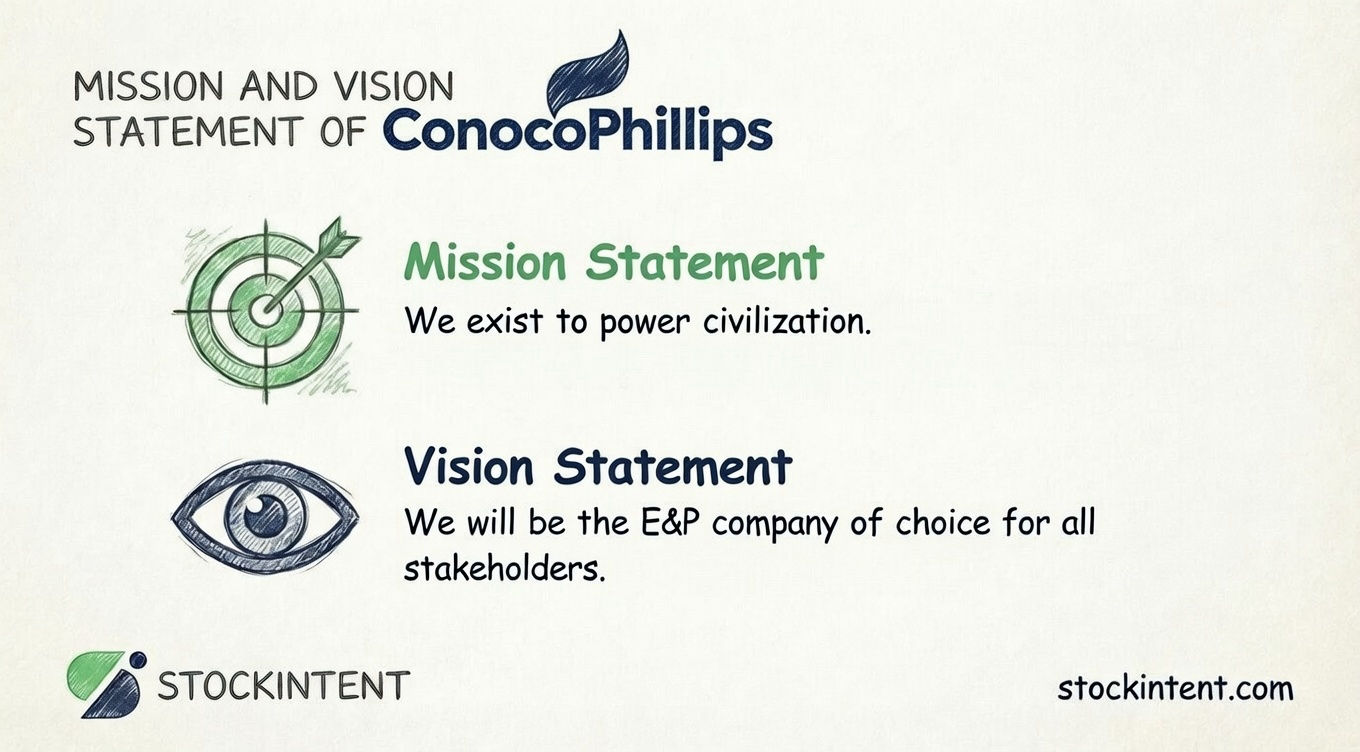
ConocoPhillips's mission is straightforward: "We exist to power civilization." This statement, paired with a vision to become "the E&P company of choice for all stakeholders," reflects a strategy balancing traditional hydrocarbon production with the realities of energy transition. The company's SPIRIT Values (Safety, People, Integrity, Responsibility, Innovation, Teamwork) anchor daily operations, while concrete commitments like net-zero operational emissions by 2050 and $1 billion in planned cost reductions by 2026 demonstrate how mission translates into measurable action.
ConocoPhillips operates as the world's largest independent exploration and production company, with a footprint spanning 15 countries and daily production reaching 2.375 million barrels of oil equivalent as of 2025. Unlike integrated majors that span refining and retail, COP focuses exclusively on finding, developing, and producing hydrocarbons, a strategic choice that shapes everything from capital allocation to how the company measures success.
The business breaks down into six geographic segments: Lower 48 (the largest by production, covering U.S. shale plays), Alaska, Canada, Europe/Middle East/North Africa, Asia Pacific, and Other International. This diversification matters for investors because it reduces single-jurisdiction regulatory risk while providing exposure to different cost structures and commodity pricing dynamics.
In our experience analyzing E&P companies over multiple cycles, pure-play producers like ConocoPhillips often outperform integrated majors during periods of rising commodity prices because they lack the downstream drag, but they require sharper operational discipline to survive the downturns. COP's 2025 revenue of approximately $42.78 billion reflects this focused model, with crude oil contributing $39.07 billion and natural gas liquids adding $3.71 billion.
Critical Stats at a Glance:
| Metric | 2025 Performance | Strategic Context |
|---|---|---|
| Daily Production | 2.375 MMBOED | Up 388 MBOED year-over-year; 2.5% organic growth after adjustments |
| Revenue | ~$42.78 billion | Crude oil dominated at $39.07B; NGLs at $3.71B |
| 2026 Capital Plan | $12 billion | Disciplined allocation with $1B+ targeted cost reductions by year-end |
| Marathon Synergies | $1 billion+ run-rate | Integration completed; doubled from initial expectations |
| Asset Dispositions | $3.2B closed in 2025, targeting $5B by end-2026 | Portfolio high-grading toward lower-cost, lower-carbon assets |
| Lower 48 Efficiency | 15%+ drilling/completion gains | Year-over-year improvement demonstrating operational leverage |
The competitive positioning here is worth understanding. ConocoPhillips ranks among the top independent E&P players by production scale, but more importantly, it claims the "deepest and most capital-efficient Lower 48 inventory" in the industry. This isn't just marketing language; it translates directly into break-even economics that matter when oil prices fluctuate. The company's average cost of supply sits below $35 per barrel of oil equivalent, which provides meaningful margin protection compared to higher-cost operators.
What differentiates COP from peers like Pioneer Natural Resources (now part of Exxon) or EOG Resources comes down to three factors visible in the 2026 guidance: the LNG portfolio expansion through projects like Port Arthur LNG and Qatar partnerships, the Willow project in Alaska providing long-cycle oil exposure, and the explicit commitment to return 45% of cash flow from operations to shareholders through dividends and buybacks.
For investors running their own analysis, these operational details provide the foundation for evaluating whether ConocoPhillips's mission, vision, and values actually translate into durable competitive advantages. The numbers suggest management is executing on the vision of becoming the "E&P company of choice" through measurable capital discipline rather than aspirational statements alone.
"We exist to power civilization."
That's it. Seven words. No elaborate corporate poetry, no buzzword bingo. Just a blunt statement of purpose that tells you exactly what this company believes it's here to do.
But don't mistake brevity for simplicity. This mission packs strategic depth that reveals how ConocoPhillips thinks about its role in the energy landscape, and more importantly, how it allocates the $12 billion in capital it plans to deploy in 2026.
🎯 Pro Insight: When evaluating any energy company's mission, ask: does it create room for disciplined execution, or is it so aspirational that management can justify any decision? ConocoPhillips's stripped-down formulation actually constrains strategic flexibility in healthy ways; it's hard to claim a petrochemical venture or renewable pivot "powers civilization" in the same direct way that producing the oil and gas that literally keep lights on and factories humming does.
The phrasing "we exist to" rather than "we strive to" or "we aim to" matters. It frames energy production as essential infrastructure, not optional economic activity. This positioning shapes how ConocoPhillips approaches everything from regulatory engagement to investor communication.
The mission also sidesteps the trap many peers fall into: trying to be everything to everyone. You won't find explicit climate language here (that's handled separately in the vision and SPIRIT Values), nor will you see references to "energy transition" or "diversification." The mission stays focused on the core economic function, while other corporate documents layer on the responsibility framework.
This separation is intentional. It allows the company to maintain a clear-eyed focus on hydrocarbon production efficiency, the discipline that's driven their cost of supply below $35 per barrel of oil equivalent, while still committing to net-zero operational emissions by 2050 through parallel strategic initiatives.
Here's where mission meets money. ConocoPhillips's 2026 capital plan reflects that "power civilization" mandate in three concrete ways:
| Capital Priority | Mission Alignment | 2026 Commitment |
|---|---|---|
| Reliable base production | Keeping existing supply flowing | $12B total capital program with maintenance of 2.3-2.34 MMBOED guidance |
| Lower-cost supply growth | Expanding affordable energy access | Lower 48 efficiency gains of 15%+ year-over-year |
| LNG infrastructure | Enabling global energy security | Port Arthur LNG startup targeted for 2027 with 10 MTPA offtake secured |
The 2025 proxy statement filed with the SEC explicitly ties capital decisions to this mission framework, noting that the "Triple Mandate" of balance sheet strength, peer-leading distributions, and disciplined investments flows directly from the core purpose of powering civilization responsibly.
ConocoPhillips hasn't always been this concise. Academic research from Baylor University documents that pre-2020s versions of the company's mission emphasized broader "development of energy supply essential to human and economic progress" with explicit references to managing "social and environmental concerns, including climate change."
The shift to the current formulation, which took hold in the early 2020s, coincided with three strategic developments:
By stripping environmental language from the mission itself and relocating it to the vision and values framework, ConocoPhillips created clearer strategic hierarchy. The mission defines what they do. The vision defines how well they aim to do it. And the SPIRIT Values define how they conduct themselves while doing it.
This matters for investors because it reduces the risk of mission drift. When a company embeds too many competing objectives in its core statement, management gains latitude to chase shiny objects. ConocoPhillips's formulation keeps the organization focused on the unglamorous work of finding, developing, and producing hydrocarbons as efficiently as possible.
While direct mission statement comparisons require access to competitor official filings, the strategic positioning is clear. ConocoPhillips's pure-play E&P focus, reflected in this mission, contrasts with integrated majors whose broader operations require more expansive corporate purpose statements.
The "power civilization" framing also differs from growth-oriented missions that emphasize "maximizing shareholder value" or "industry leadership." By anchoring on societal function rather than competitive positioning or financial returns, ConocoPhillips creates a more durable strategic north star; one that remains relevant whether oil trades at $60 or $120 per barrel.
For investors running quality assessments, this mission clarity serves as a useful filter. When management presents strategic initiatives, you can ask: does this directly support powering civilization, or is it a distraction? The answer reveals whether capital is being deployed with discipline or diverted toward management's personal preferences.
The conocophillips mission statement "We exist to power civilization" isn't just marketing copy. It translates into three operational pillars that drive capital allocation, shape competitive positioning, and ultimately determine whether this E&P pure-play delivers the durable returns quality-focused investors seek.
In our experience analyzing how mission statements actually influence corporate behavior (versus sitting ignored on investor relations pages), the companies that win are those where mission components show up in quarterly earnings calls, capital budget line items, and executive compensation metrics. ConocoPhillips passes this test.
What it is: The Responsibility pillar, anchored in the SPIRIT Values, means accountability for actions, care for neighbors, and treating sustainability as core to value creation rather than a compliance checkbox.
Why it matters strategically: In an industry where single incidents can destroy billions in enterprise value, operational responsibility isn't just ethics; it's risk management with a balance sheet impact. ConocoPhillips has achieved the OGMP 2.0 Gold Standard Pathway for methane management, and safety metrics run below industry averages through systems that empower employees to halt unsafe operations.
Concrete example: The company's $10 billion lower-carbon investment plan through 2030 directly ties Responsibility to capital allocation. This isn't greenwashing; it's a marginal abatement cost curve approach that identifies emissions reductions delivering positive returns. The target of 50-60% GHG intensity reduction by 2030 (strengthened from prior 40-50% targets in 2022) and net-zero operational emissions by 2050 provide measurable milestones investors can track.
Competitive advantage: This pillar builds the stakeholder trust that enables peer-leading shareholder distributions through commodity cycles. When regulators, communities, and employees trust your operational discipline, you maintain access to the best acreage and talent regardless of oil price volatility.
What it is: Anticipating change and responding with creative solutions; embracing learning and new approaches to maximize recovery while minimizing footprint and cost.
Why it matters strategically: In E&P, innovation directly translates into cost of supply, the metric that separates survivors from casualties during downturns. ConocoPhillips's average cost of supply below $35 per barrel of oil equivalent provides meaningful margin protection compared to higher-cost operators.
Concrete example: The 15%+ year-over-year drilling and completion efficiency gains in the Lower 48 demonstrate innovation in action. This isn't abstract R&D; it's pad optimization, longer laterals, and multi-zone phasing that extract more barrels per dollar invested. The 2025 earnings release highlights these efficiency gains as a primary driver of the $1 billion+ cost reduction target by year-end 2026.
The Low Carbon Technologies organization, established in 2021, represents innovation applied to emissions reduction, while multilateral drilling programs maximize reservoir contact with minimized surface footprint.
Competitive advantage: Innovation creates the "deepest and most capital-efficient Lower 48 inventory" that management claims. For investors, this translates into superior returns on capital employed (ROCE) exceeding 20% through the cycle, and the operational leverage that compounds shareholder returns when execution improves year after year.
What it is: Meeting the world's energy needs while managing climate and nature risks; positioning natural gas as a bridge fuel and investing in the infrastructure to displace higher-emission alternatives.
Why it matters strategically: The energy transition isn't binary. ConocoPhillips's sustainability pillar acknowledges that oil and gas will comprise significant portions of the energy mix for decades, while embedding the discipline to produce those hydrocarbons with progressively lower emissions intensity. This positions the company to compete across multiple demand scenarios without betting the farm on either "drill baby drill" or premature renewable pivot.
Concrete example: The LNG portfolio expansion demonstrates sustainability as competitive strategy. The Port Arthur LNG project, targeting first production in 2027 with 10 million tonnes per annum of commercial offtake secured, directly displaces coal-fired power generation in Asian markets. This isn't just volume growth; it's 50-60% lower lifecycle emissions compared to coal for equivalent energy output.
The Qatar partnerships (North Field East and South) add low-cost, low-carbon LNG supply with startup targeted for second half 2026, while the Willow project in Alaska provides long-cycle oil exposure with first oil around 2029 and peak production of approximately 180,000 barrels per day.
| Pillar | Key Metric | 2026 Target/Status | Investor Relevance |
|---|---|---|---|
| Responsibility | GHG Intensity Reduction | 50-60% by 2030 | Regulatory risk mitigation; access to capital |
| Innovation | Lower 48 Efficiency Gains | 15%+ year-over-year | Cost of supply advantage; margin expansion |
| Sustainability | LNG Offtake Secured | 10 MTPA | Energy transition positioning; premium pricing |
Competitive advantage: The sustainability pillar creates optionality. If aggressive decarbonization scenarios materialize, ConocoPhillips's LNG assets and low-GHG intensity operations command premium valuations. If transition timelines extend, the core E&P excellence generates superior cash flows. The $12 billion 2026 capital plan reflects this balanced approach: maintaining 2.3-2.34 MMBOED production while advancing lower-carbon growth projects.
These aren't siloed initiatives. The Marathon Oil integration, completed in 2025, shows all three pillars working together:
The result? Accretive production growth with lower carbon intensity per barrel, funded by cost savings that flow directly to shareholder returns.
For investors evaluating whether conocophillips mission and vision actually translate into durable competitive advantages, these pillars provide the framework. Each has measurable targets, capital allocation alignment, and direct connection to the economic moat sources that matter in E&P: cost leadership, operational excellence, and portfolio quality.
"We will be the E&P company of choice for all stakeholders."
This is the vision that sits atop ConocoPhillips's strategic hierarchy. Where the mission defines what the company does, the vision defines how well it aims to do it, and more importantly, who it aims to serve.
The phrase "company of choice" signals competitive ambition across multiple stakeholder groups simultaneously: investors evaluating capital allocation discipline, employees choosing where to build careers, communities hosting operations, regulators setting policy, and partners selecting joint venture participants. It's a broader definition of success than shareholder value maximization alone.
ConocoPhillips leadership has translated this vision into concrete, measurable goals that investors can track:
| Strategic Goal | 2026 Status | Vision Alignment |
|---|---|---|
| Net-zero operational emissions | Target: 2050 | Positions COP as responsible choice for ESG-conscious capital |
| GHG intensity reduction | 50-60% by 2030 (strengthened from 40-50% in 2022) | Demonstrates measurable progress on climate accountability |
| Peer-leading shareholder returns | 45% of CFO to shareholders in 2026 | Makes COP the choice for income-focused investors |
| Cost leadership | $1B+ cost reductions by year-end 2026 | Creates competitive moat for sustained distributions |
| LNG portfolio expansion | 10 MTPA offtake secured; Port Arthur LNG 2027 startup | Positions for energy security demand across scenarios |
The 2025 proxy statement filed with the SEC explicitly frames these goals as flowing from the vision, noting that the "Triple Mandate" of balance sheet strength, peer-leading distributions, and disciplined investments serves the broader objective of stakeholder preference.
The vision positions ConocoPhillips distinctively relative to macro trends reshaping oil and gas E&P:
The pure-play E&P vs. integrated major divergence: While integrated majors like Exxon and Chevron diversify into renewables, chemicals, and retail, ConocoPhillips doubles down on E&P excellence. The vision of being the E&P company of choice, not the energy company of choice, reflects this strategic bet. It assumes that specialization wins over diversification in a capital-intensive commodity business.
Energy transition positioning: The vision accommodates multiple demand scenarios without requiring ConocoPhillips to predict which one materializes. If aggressive decarbonization occurs, the company's low-GHG intensity operations and LNG assets (displacing coal) command premium valuations. If transition timelines extend, the core E&P discipline generates superior cash flows. The vision creates strategic optionality.
Capital discipline as competitive advantage: The 2026 guidance reflects this in numbers: $12 billion capital program, $5 billion asset disposition target by year-end 2026, and explicit prioritization of "high-quality, lower-cost assets." This isn't growth for growth's sake; it's portfolio construction designed to make ConocoPhillips the preferred partner across commodity cycles.
Stakeholder capitalism integration: The "all stakeholders" language predates but aligns with broader shifts in corporate governance expectations. For investors, this translates into practices like the OGMP 2.0 Gold Standard Pathway for methane management and the explicit SPIRIT Values integration into supplier relationships and human capital management.
The vision also shapes how ConocoPhillips measures success internally. The 2025 earnings release highlights that management evaluates performance against "peer-leading returns" and "responsible and reliable ESG performance" as dual objectives, not trade-offs. This matters for investors because it reduces the risk of short-term optimization at the expense of license to operate.
For quality-focused investors running their own analysis, the vision provides a useful filter: when ConocoPhillips announces strategic moves, ask whether they enhance its position as the E&P company of choice for all stakeholders, or just one group at the expense of others. The answer reveals whether management is building durable competitive advantages or harvesting temporary gains.
The ConocoPhillips vision statement "We will be the E&P company of choice for all stakeholders" isn't empty corporate aspiration. It translates into three concrete strategic themes that shape capital allocation, competitive positioning, and how management measures success. These themes show up in quarterly earnings calls, board-level decisions, and the $12 billion capital plan for 2026.
What it means: ConocoPhillips prioritizes shareholder returns over production growth for growth's sake. The company targets returning 45% of cash flow from operations to shareholders in 2026 through dividends and buybacks, while maintaining what it calls "peer-leading distributions" through commodity cycles.
Why it matters: This theme directly addresses the historical E&P industry failure; value destruction through overinvestment at cycle peaks. By anchoring capital decisions to cash flow returns rather than production targets, ConocoPhillips protects investor capital when competitors chase volume.
Observable execution: The 2025 earnings release confirms this discipline with a $12 billion capital program that maintains production at 2.30-2.34 MMBOED while still funding growth projects. The $5 billion asset disposition target by year-end 2026 reflects portfolio high-grading; selling higher-cost, higher-carbon assets to concentrate capital on the most efficient inventory.
The Marathon Oil integration, completed in 2025, exemplifies this theme. Synergy capture doubled to more than $1 billion on a run-rate basis, with approximately $1 billion in additional one-time benefits. Management didn't acquire Marathon for production scale alone; they identified pad-level synergies in Eagle Ford, Bakken, and Permian that improved capital efficiency per barrel.
What it means: The "company of choice" vision requires being the most efficient producer, not just the biggest. ConocoPhillips targets more than $1 billion in incremental cost reductions and margin enhancements by year-end 2026, with Lower 48 drilling and completion efficiency improvements exceeding 15% year-over-year.
Why it matters: In commodity businesses, cost structure determines who survives downturns and who compounds returns during recoveries. ConocoPhillips's average cost of supply below $35 per barrel of oil equivalent provides meaningful margin protection compared to higher-cost operators.
Observable execution: The efficiency gains aren't abstract. They come from specific operational innovations: pad optimization, longer laterals, multi-zone phasing in Permian and Eagle Ford developments. These techniques extract more barrels per dollar invested, directly improving returns on capital employed.
The 2025 proxy statement filed with the SEC explicitly ties executive compensation to this operational excellence theme, with metrics including returns on capital employed exceeding 20% through the cycle and progress toward the $1 billion cost reduction target.
What it means: Rather than diversifying into renewables like integrated majors, ConocoPhillips bets on natural gas as a bridge fuel and invests in the infrastructure to displace higher-emission coal generation globally. This positions the company for energy transition scenarios without abandoning core E&P competence.
Why it matters: LNG offers two strategic advantages: geographic price arbitrage opportunities and 50-60% lower lifecycle emissions compared to coal for equivalent energy output. As Asian economies electrify, LNG demand growth provides a demand hedge against peak oil concerns.
Observable execution: The Port Arthur LNG project received Final Investment Decision in 2023 with first LNG targeted for 2027. The company has secured 10 million tonnes per annum of commercial offtake, with initial 5 MTPA placements and an additional 5 MTPA secured through partnerships with QatarEnergy, Sempra Energy, and Asian entities like Guangdong Pearl River Investment Management Group.
The Qatar partnerships (North Field East and South) add low-cost, low-carbon LNG supply with NFE startup expected in the second half of 2026. These aren't speculative exploration bets; they're equity positions in some of the world's lowest-cost gas resources.
| Strategic Theme | 2026 Commitment | Vision Alignment | Investor Relevance |
|---|---|---|---|
| Returns-First Discipline | 45% of CFO to shareholders; $5B dispositions | Being the choice for capital providers | Income stability through cycles |
| Operational Excellence | $1B+ cost reductions; 15%+ efficiency gains | Being the choice for operational partners | Margin expansion, ROCE >20% |
| LNG/Lower-Carbon Positioning | 10 MTPA offtake secured; Port Arthur 2027 startup | Being the choice for ESG-conscious stakeholders | Energy transition optionality |
These three themes reinforce each other in ways that build durable competitive advantages. The cost leadership from operational excellence funds the returns-first distributions that attract quality-focused investors. The LNG positioning provides growth optionality without requiring the company to bet on specific energy transition timelines. And the disciplined capital allocation prevents the empire-building that destroyed value across the E&P sector in previous cycles.
For investors running their own analysis, these themes provide a framework for evaluating management decisions. When ConocoPhillips announces a new project or acquisition, ask: does it improve cost structure, enhance returns capacity, or strengthen the LNG position? If the answer is no, that's a signal worth noting.
The ConocoPhillips strategic vision ultimately succeeds or fails based on execution against these themes. The 2026 guidance suggests management understands the assignment; now it's about delivering the numbers quarter after quarter.
Corporate values either shape daily decisions or collect dust on lobby walls. For investors, the test is simple: do these values show up in capital allocation, hiring practices, and how management responds when things go wrong? ConocoPhillips's SPIRIT Values (Safety, People, Integrity, Responsibility, Innovation, Teamwork) provide a framework worth examining through that lens.
No task is so important that we can't take the time to do it safely. This isn't just feel-good language; it translates into systems that empower employees and contractors to halt operations when they spot unsafe conditions. The company maintains injury rates below industry averages, and the OGMP 2.0 Gold Standard Pathway for methane management, achieved in 2023, extends this safety culture to environmental operations.
In practical terms, this means ConocoPhillips spends money on training, equipment, and process redundancy that might not show up in quarterly earnings but protects against the catastrophic incidents that destroy enterprise value overnight. For investors, this is risk management with a balance sheet impact.
We respect one another, recognizing that our success depends upon the capabilities and inclusion of our employees. The value here centers on attracting and retaining talent in a cyclical industry where the best engineers and geoscientists have options.
The 2025 proxy statement details human capital management pillars built on SPIRIT: compelling culture, world-class workforce attraction, and talent development. This isn't just HR jargon; it directly affects operational execution. The 15%+ drilling efficiency gains in the Lower 48 don't happen without experienced crews who stick around through commodity downturns.
That said, employee sentiment data from platforms like Comparably suggests only 20% of employees report being motivated by mission and values, with just 9% citing them as a reason to stay. This gap between stated values and employee perception is worth monitoring; culture is ultimately what people experience, not what's printed on posters.
We are ethical and trustworthy in our relationships with internal and external stakeholders. We keep our promises. In an industry where joint ventures, royalty agreements, and regulatory relationships span decades, reputation for fair dealing matters.
ConocoPhillips operationalizes this through its Code of Business Ethics and Conduct, which extends to supplier relationships. Partners must adhere to human rights standards, including prohibitions on child and forced labor. This creates alignment across the value chain, reducing reputational and legal risks that can surface years after a contract is signed.
💡 Expert Tip: When evaluating any energy company's integrity claims, check how they handle royalty disputes and regulatory compliance in jurisdictions with weaker rule of law. Companies that maintain consistent standards globally, rather than cutting corners where enforcement is lax, demonstrate genuine cultural commitment rather than compliance theater.
We are accountable for our actions. We care about our neighbors. Sustainability is core to our company and creates shared value for our stakeholders. This is where ConocoPhillips's values most visibly connect to capital allocation.
The $10 billion lower-carbon investment plan through 2030 directly ties Responsibility to financial decisions. The 50-60% GHG intensity reduction target by 2030 (strengthened from prior 40-50% ranges in 2022) and net-zero operational emissions by 2050 provide measurable milestones. These aren't aspirational; they're embedded in executive compensation metrics and reported quarterly.
The Responsibility value also drives community investment programs detailed on the company's shared value page, where local economic development and transparency initiatives aim to maintain the social license to operate in regions from Alaska to Qatar.
We anticipate change and respond with creative solutions. We embrace learning and are not afraid to try new things. In E&P, innovation directly translates into cost of supply, the metric that separates survivors from casualties during downturns.
The 15%+ year-over-year drilling and completion efficiency gains in the Lower 48 demonstrate this value in action. Specific techniques include pad optimization, longer laterals, and multi-zone phasing that extract more barrels per dollar invested. The Low Carbon Technologies organization, established in 2021, applies this same innovative mindset to emissions reduction.
For investors, this innovation culture creates the "deepest and most capital-efficient Lower 48 inventory" that management claims. It shows up in returns on capital employed exceeding 20% through the cycle.
We have a "can do" attitude that inspires top performance from everyone. We encourage collaboration. We celebrate success. We win together. This value manifests in how ConocoPhillips structures its joint ventures and integration processes.
The Marathon Oil integration, completed in 2025, doubled synergy capture to $1 billion+ on a run-rate basis. This wasn't just financial engineering; it required collaboration across Eagle Ford, Bakken, and Permian operations to identify pad-level efficiencies. The teamwork value, in this case, translated directly into shareholder returns.
Here's where we get practical. ConocoPhillips's SPIRIT Values are comprehensive and well-documented, but do they actually influence behavior?
Evidence of alignment:
Areas of friction:
In our experience analyzing corporate values across the energy sector, the companies that genuinely live their values share three characteristics: values appear in earnings call language (not just sustainability reports), values shape decisions that cost money in the short term, and values survive leadership transitions. ConocoPhillips passes the first two tests; the third requires longer observation.
ConocoPhillips doesn't treat ESG as a standalone initiative; it's framed as an extension of the SPIRIT Values, particularly Responsibility. The sustainability strategy explicitly ties environmental stewardship to core value creation.
Environmental commitments:
Social and governance integration:
The strategic logic here matters for investors. Rather than diversifying into renewables like integrated majors, ConocoPhillips bets that responsible hydrocarbon production will command premium valuations as energy transition pressures intensify. The LNG portfolio expansion, with 10 MTPA offtake secured and Port Arthur LNG startup targeted for 2027, positions natural gas as a bridge fuel displacing higher-emission coal generation.
This approach carries risks. If decarbonization accelerates faster than anticipated, pure-play E&P assets could face stranded value concerns. But it also offers clarity: ConocoPhillips knows what it is and invests accordingly, rather than spreading capital across incompatible strategies.
For investors running their own analysis, the values framework provides a useful lens. When management announces strategic moves, ask: does this align with SPIRIT? When controversies emerge, check whether the response reflects stated values or damage control. The answers reveal whether ConocoPhillips is building durable competitive advantages on a foundation of genuine culture, or merely marketing itself effectively.
ConocoPhillips's mission, vision, and SPIRIT Values form a coherent strategic identity that separates it from both integrated majors chasing diversification and smaller E&Ps lacking operational scale. The simplicity of "We exist to power civilization" focuses capital allocation; the ambition of becoming "the E&P company of choice for all stakeholders" expands competitive arena beyond shareholders alone; and the six SPIRIT Values provide guardrails for execution.
📌 From Our Experience: After tracking how energy companies perform through commodity cycles, we've noticed that firms with mission clarity like ConocoPhillips's tend to make better capital allocation decisions when oil prices spike. It's harder to justify speculative growth projects when your mission statement doesn't leave room for "and whatever else looks shiny." The discipline shows in COP's $12 billion 2026 capital plan, which maintains production while returning 45% of cash flow to shareholders; a balance that mission-drift companies rarely achieve.
This framework translates into investment-relevant outcomes. Analysts currently rate ConocoPhillips a consensus "Moderate Buy" with 58-93% buy recommendations across major firms, reflecting confidence in management's execution against stated objectives. The company's competitive positioning rests on three pillars visible in 2026 guidance: cost leadership with supply costs below $35 per barrel, operational efficiency driving 15%+ Lower 48 drilling gains, and LNG optionality through 10 MTPA of secured offtake.
Looking forward, no strategic pivots appear on the horizon that would reshape this mission-vision-values architecture. The Marathon integration doubled to $1 billion+ in synergies, the Willow project advances toward 2029 first oil, and Port Arthur LNG targets 2027 startup; all consistent with the existing framework. For investors running quality assessments, this stability matters. ConocoPhillips knows what it is, invests accordingly, and measures success against criteria it actually controls.
If you're evaluating whether this strategic identity translates into durable competitive advantages for your own portfolio, tools that track fundamental execution against stated objectives can help separate mission-driven discipline from marketing copy. StockIntent's platform lets you screen for companies where capital allocation aligns with corporate purpose, backtest how similar E&P strategies performed through previous cycles, and monitor whether metrics like ROCE and cost of supply trends support the narrative. You can try it risk-free for 7 days at /app/register to see how ConocoPhillips stacks up on the fundamentals that matter.
ConocoPhillips stands as one of the largest independent exploration and production companies in the oil and gas sector, with operations spanning 15 countries and production reaching 2.375 million barrels of oil equivalent per day in 2025. For investors evaluating energy stocks, understanding a company's mission, vision, and values goes beyond corporate-speak; it reveals how leadership allocates capital, responds to industry disruption, and builds competitive advantages that compound over decades.
ConocoPhillips's mission is straightforward: "We exist to power civilization." This statement, paired with a vision to become "the E&P company of choice for all stakeholders," reflects a strategy balancing traditional hydrocarbon production with the realities of energy transition. The company's SPIRIT Values (Safety, People, Integrity, Responsibility, Innovation, Teamwork) anchor daily operations, while concrete commitments like net-zero operational emissions by 2050 and $1 billion in planned cost reductions by 2026 demonstrate how mission translates into measurable action.
ConocoPhillips operates as the world's largest independent exploration and production company, with a footprint spanning 15 countries and daily production reaching 2.375 million barrels of oil equivalent as of 2025. Unlike integrated majors that span refining and retail, COP focuses exclusively on finding, developing, and producing hydrocarbons, a strategic choice that shapes everything from capital allocation to how the company measures success.
The business breaks down into six geographic segments: Lower 48 (the largest by production, covering U.S. shale plays), Alaska, Canada, Europe/Middle East/North Africa, Asia Pacific, and Other International. This diversification matters for investors because it reduces single-jurisdiction regulatory risk while providing exposure to different cost structures and commodity pricing dynamics.
In our experience analyzing E&P companies over multiple cycles, pure-play producers like ConocoPhillips often outperform integrated majors during periods of rising commodity prices because they lack the downstream drag, but they require sharper operational discipline to survive the downturns. COP's 2025 revenue of approximately $42.78 billion reflects this focused model, with crude oil contributing $39.07 billion and natural gas liquids adding $3.71 billion.
Critical Stats at a Glance:
| Metric | 2025 Performance | Strategic Context |
|---|---|---|
| Daily Production | 2.375 MMBOED | Up 388 MBOED year-over-year; 2.5% organic growth after adjustments |
| Revenue | ~$42.78 billion | Crude oil dominated at $39.07B; NGLs at $3.71B |
| 2026 Capital Plan | $12 billion | Disciplined allocation with $1B+ targeted cost reductions by year-end |
| Marathon Synergies | $1 billion+ run-rate | Integration completed; doubled from initial expectations |
| Asset Dispositions | $3.2B closed in 2025, targeting $5B by end-2026 | Portfolio high-grading toward lower-cost, lower-carbon assets |
| Lower 48 Efficiency | 15%+ drilling/completion gains | Year-over-year improvement demonstrating operational leverage |
The competitive positioning here is worth understanding. ConocoPhillips ranks among the top independent E&P players by production scale, but more importantly, it claims the "deepest and most capital-efficient Lower 48 inventory" in the industry. This isn't just marketing language; it translates directly into break-even economics that matter when oil prices fluctuate. The company's average cost of supply sits below $35 per barrel of oil equivalent, which provides meaningful margin protection compared to higher-cost operators.
What differentiates COP from peers like Pioneer Natural Resources (now part of Exxon) or EOG Resources comes down to three factors visible in the 2026 guidance: the LNG portfolio expansion through projects like Port Arthur LNG and Qatar partnerships, the Willow project in Alaska providing long-cycle oil exposure, and the explicit commitment to return 45% of cash flow from operations to shareholders through dividends and buybacks.
For investors running their own analysis, these operational details provide the foundation for evaluating whether ConocoPhillips's mission, vision, and values actually translate into durable competitive advantages. The numbers suggest management is executing on the vision of becoming the "E&P company of choice" through measurable capital discipline rather than aspirational statements alone.
"We exist to power civilization."
That's it. Seven words. No elaborate corporate poetry, no buzzword bingo. Just a blunt statement of purpose that tells you exactly what this company believes it's here to do.
But don't mistake brevity for simplicity. This mission packs strategic depth that reveals how ConocoPhillips thinks about its role in the energy landscape, and more importantly, how it allocates the $12 billion in capital it plans to deploy in 2026.
🎯 Pro Insight: When evaluating any energy company's mission, ask: does it create room for disciplined execution, or is it so aspirational that management can justify any decision? ConocoPhillips's stripped-down formulation actually constrains strategic flexibility in healthy ways; it's hard to claim a petrochemical venture or renewable pivot "powers civilization" in the same direct way that producing the oil and gas that literally keep lights on and factories humming does.
The phrasing "we exist to" rather than "we strive to" or "we aim to" matters. It frames energy production as essential infrastructure, not optional economic activity. This positioning shapes how ConocoPhillips approaches everything from regulatory engagement to investor communication.
The mission also sidesteps the trap many peers fall into: trying to be everything to everyone. You won't find explicit climate language here (that's handled separately in the vision and SPIRIT Values), nor will you see references to "energy transition" or "diversification." The mission stays focused on the core economic function, while other corporate documents layer on the responsibility framework.
This separation is intentional. It allows the company to maintain a clear-eyed focus on hydrocarbon production efficiency, the discipline that's driven their cost of supply below $35 per barrel of oil equivalent, while still committing to net-zero operational emissions by 2050 through parallel strategic initiatives.
Here's where mission meets money. ConocoPhillips's 2026 capital plan reflects that "power civilization" mandate in three concrete ways:
| Capital Priority | Mission Alignment | 2026 Commitment |
|---|---|---|
| Reliable base production | Keeping existing supply flowing | $12B total capital program with maintenance of 2.3-2.34 MMBOED guidance |
| Lower-cost supply growth | Expanding affordable energy access | Lower 48 efficiency gains of 15%+ year-over-year |
| LNG infrastructure | Enabling global energy security | Port Arthur LNG startup targeted for 2027 with 10 MTPA offtake secured |
The 2025 proxy statement filed with the SEC explicitly ties capital decisions to this mission framework, noting that the "Triple Mandate" of balance sheet strength, peer-leading distributions, and disciplined investments flows directly from the core purpose of powering civilization responsibly.
ConocoPhillips hasn't always been this concise. Academic research from Baylor University documents that pre-2020s versions of the company's mission emphasized broader "development of energy supply essential to human and economic progress" with explicit references to managing "social and environmental concerns, including climate change."
The shift to the current formulation, which took hold in the early 2020s, coincided with three strategic developments:
By stripping environmental language from the mission itself and relocating it to the vision and values framework, ConocoPhillips created clearer strategic hierarchy. The mission defines what they do. The vision defines how well they aim to do it. And the SPIRIT Values define how they conduct themselves while doing it.
This matters for investors because it reduces the risk of mission drift. When a company embeds too many competing objectives in its core statement, management gains latitude to chase shiny objects. ConocoPhillips's formulation keeps the organization focused on the unglamorous work of finding, developing, and producing hydrocarbons as efficiently as possible.
While direct mission statement comparisons require access to competitor official filings, the strategic positioning is clear. ConocoPhillips's pure-play E&P focus, reflected in this mission, contrasts with integrated majors whose broader operations require more expansive corporate purpose statements.
The "power civilization" framing also differs from growth-oriented missions that emphasize "maximizing shareholder value" or "industry leadership." By anchoring on societal function rather than competitive positioning or financial returns, ConocoPhillips creates a more durable strategic north star; one that remains relevant whether oil trades at $60 or $120 per barrel.
For investors running quality assessments, this mission clarity serves as a useful filter. When management presents strategic initiatives, you can ask: does this directly support powering civilization, or is it a distraction? The answer reveals whether capital is being deployed with discipline or diverted toward management's personal preferences.
The conocophillips mission statement "We exist to power civilization" isn't just marketing copy. It translates into three operational pillars that drive capital allocation, shape competitive positioning, and ultimately determine whether this E&P pure-play delivers the durable returns quality-focused investors seek.
In our experience analyzing how mission statements actually influence corporate behavior (versus sitting ignored on investor relations pages), the companies that win are those where mission components show up in quarterly earnings calls, capital budget line items, and executive compensation metrics. ConocoPhillips passes this test.
What it is: The Responsibility pillar, anchored in the SPIRIT Values, means accountability for actions, care for neighbors, and treating sustainability as core to value creation rather than a compliance checkbox.
Why it matters strategically: In an industry where single incidents can destroy billions in enterprise value, operational responsibility isn't just ethics; it's risk management with a balance sheet impact. ConocoPhillips has achieved the OGMP 2.0 Gold Standard Pathway for methane management, and safety metrics run below industry averages through systems that empower employees to halt unsafe operations.
Concrete example: The company's $10 billion lower-carbon investment plan through 2030 directly ties Responsibility to capital allocation. This isn't greenwashing; it's a marginal abatement cost curve approach that identifies emissions reductions delivering positive returns. The target of 50-60% GHG intensity reduction by 2030 (strengthened from prior 40-50% targets in 2022) and net-zero operational emissions by 2050 provide measurable milestones investors can track.
Competitive advantage: This pillar builds the stakeholder trust that enables peer-leading shareholder distributions through commodity cycles. When regulators, communities, and employees trust your operational discipline, you maintain access to the best acreage and talent regardless of oil price volatility.
What it is: Anticipating change and responding with creative solutions; embracing learning and new approaches to maximize recovery while minimizing footprint and cost.
Why it matters strategically: In E&P, innovation directly translates into cost of supply, the metric that separates survivors from casualties during downturns. ConocoPhillips's average cost of supply below $35 per barrel of oil equivalent provides meaningful margin protection compared to higher-cost operators.
Concrete example: The 15%+ year-over-year drilling and completion efficiency gains in the Lower 48 demonstrate innovation in action. This isn't abstract R&D; it's pad optimization, longer laterals, and multi-zone phasing that extract more barrels per dollar invested. The 2025 earnings release highlights these efficiency gains as a primary driver of the $1 billion+ cost reduction target by year-end 2026.
The Low Carbon Technologies organization, established in 2021, represents innovation applied to emissions reduction, while multilateral drilling programs maximize reservoir contact with minimized surface footprint.
Competitive advantage: Innovation creates the "deepest and most capital-efficient Lower 48 inventory" that management claims. For investors, this translates into superior returns on capital employed (ROCE) exceeding 20% through the cycle, and the operational leverage that compounds shareholder returns when execution improves year after year.
What it is: Meeting the world's energy needs while managing climate and nature risks; positioning natural gas as a bridge fuel and investing in the infrastructure to displace higher-emission alternatives.
Why it matters strategically: The energy transition isn't binary. ConocoPhillips's sustainability pillar acknowledges that oil and gas will comprise significant portions of the energy mix for decades, while embedding the discipline to produce those hydrocarbons with progressively lower emissions intensity. This positions the company to compete across multiple demand scenarios without betting the farm on either "drill baby drill" or premature renewable pivot.
Concrete example: The LNG portfolio expansion demonstrates sustainability as competitive strategy. The Port Arthur LNG project, targeting first production in 2027 with 10 million tonnes per annum of commercial offtake secured, directly displaces coal-fired power generation in Asian markets. This isn't just volume growth; it's 50-60% lower lifecycle emissions compared to coal for equivalent energy output.
The Qatar partnerships (North Field East and South) add low-cost, low-carbon LNG supply with startup targeted for second half 2026, while the Willow project in Alaska provides long-cycle oil exposure with first oil around 2029 and peak production of approximately 180,000 barrels per day.
| Pillar | Key Metric | 2026 Target/Status | Investor Relevance |
|---|---|---|---|
| Responsibility | GHG Intensity Reduction | 50-60% by 2030 | Regulatory risk mitigation; access to capital |
| Innovation | Lower 48 Efficiency Gains | 15%+ year-over-year | Cost of supply advantage; margin expansion |
| Sustainability | LNG Offtake Secured | 10 MTPA | Energy transition positioning; premium pricing |
Competitive advantage: The sustainability pillar creates optionality. If aggressive decarbonization scenarios materialize, ConocoPhillips's LNG assets and low-GHG intensity operations command premium valuations. If transition timelines extend, the core E&P excellence generates superior cash flows. The $12 billion 2026 capital plan reflects this balanced approach: maintaining 2.3-2.34 MMBOED production while advancing lower-carbon growth projects.
These aren't siloed initiatives. The Marathon Oil integration, completed in 2025, shows all three pillars working together:
The result? Accretive production growth with lower carbon intensity per barrel, funded by cost savings that flow directly to shareholder returns.
For investors evaluating whether conocophillips mission and vision actually translate into durable competitive advantages, these pillars provide the framework. Each has measurable targets, capital allocation alignment, and direct connection to the economic moat sources that matter in E&P: cost leadership, operational excellence, and portfolio quality.
"We will be the E&P company of choice for all stakeholders."
This is the vision that sits atop ConocoPhillips's strategic hierarchy. Where the mission defines what the company does, the vision defines how well it aims to do it, and more importantly, who it aims to serve.
The phrase "company of choice" signals competitive ambition across multiple stakeholder groups simultaneously: investors evaluating capital allocation discipline, employees choosing where to build careers, communities hosting operations, regulators setting policy, and partners selecting joint venture participants. It's a broader definition of success than shareholder value maximization alone.
ConocoPhillips leadership has translated this vision into concrete, measurable goals that investors can track:
| Strategic Goal | 2026 Status | Vision Alignment |
|---|---|---|
| Net-zero operational emissions | Target: 2050 | Positions COP as responsible choice for ESG-conscious capital |
| GHG intensity reduction | 50-60% by 2030 (strengthened from 40-50% in 2022) | Demonstrates measurable progress on climate accountability |
| Peer-leading shareholder returns | 45% of CFO to shareholders in 2026 | Makes COP the choice for income-focused investors |
| Cost leadership | $1B+ cost reductions by year-end 2026 | Creates competitive moat for sustained distributions |
| LNG portfolio expansion | 10 MTPA offtake secured; Port Arthur LNG 2027 startup | Positions for energy security demand across scenarios |
The 2025 proxy statement filed with the SEC explicitly frames these goals as flowing from the vision, noting that the "Triple Mandate" of balance sheet strength, peer-leading distributions, and disciplined investments serves the broader objective of stakeholder preference.
The vision positions ConocoPhillips distinctively relative to macro trends reshaping oil and gas E&P:
The pure-play E&P vs. integrated major divergence: While integrated majors like Exxon and Chevron diversify into renewables, chemicals, and retail, ConocoPhillips doubles down on E&P excellence. The vision of being the E&P company of choice, not the energy company of choice, reflects this strategic bet. It assumes that specialization wins over diversification in a capital-intensive commodity business.
Energy transition positioning: The vision accommodates multiple demand scenarios without requiring ConocoPhillips to predict which one materializes. If aggressive decarbonization occurs, the company's low-GHG intensity operations and LNG assets (displacing coal) command premium valuations. If transition timelines extend, the core E&P discipline generates superior cash flows. The vision creates strategic optionality.
Capital discipline as competitive advantage: The 2026 guidance reflects this in numbers: $12 billion capital program, $5 billion asset disposition target by year-end 2026, and explicit prioritization of "high-quality, lower-cost assets." This isn't growth for growth's sake; it's portfolio construction designed to make ConocoPhillips the preferred partner across commodity cycles.
Stakeholder capitalism integration: The "all stakeholders" language predates but aligns with broader shifts in corporate governance expectations. For investors, this translates into practices like the OGMP 2.0 Gold Standard Pathway for methane management and the explicit SPIRIT Values integration into supplier relationships and human capital management.
The vision also shapes how ConocoPhillips measures success internally. The 2025 earnings release highlights that management evaluates performance against "peer-leading returns" and "responsible and reliable ESG performance" as dual objectives, not trade-offs. This matters for investors because it reduces the risk of short-term optimization at the expense of license to operate.
For quality-focused investors running their own analysis, the vision provides a useful filter: when ConocoPhillips announces strategic moves, ask whether they enhance its position as the E&P company of choice for all stakeholders, or just one group at the expense of others. The answer reveals whether management is building durable competitive advantages or harvesting temporary gains.
The ConocoPhillips vision statement "We will be the E&P company of choice for all stakeholders" isn't empty corporate aspiration. It translates into three concrete strategic themes that shape capital allocation, competitive positioning, and how management measures success. These themes show up in quarterly earnings calls, board-level decisions, and the $12 billion capital plan for 2026.
What it means: ConocoPhillips prioritizes shareholder returns over production growth for growth's sake. The company targets returning 45% of cash flow from operations to shareholders in 2026 through dividends and buybacks, while maintaining what it calls "peer-leading distributions" through commodity cycles.
Why it matters: This theme directly addresses the historical E&P industry failure; value destruction through overinvestment at cycle peaks. By anchoring capital decisions to cash flow returns rather than production targets, ConocoPhillips protects investor capital when competitors chase volume.
Observable execution: The 2025 earnings release confirms this discipline with a $12 billion capital program that maintains production at 2.30-2.34 MMBOED while still funding growth projects. The $5 billion asset disposition target by year-end 2026 reflects portfolio high-grading; selling higher-cost, higher-carbon assets to concentrate capital on the most efficient inventory.
The Marathon Oil integration, completed in 2025, exemplifies this theme. Synergy capture doubled to more than $1 billion on a run-rate basis, with approximately $1 billion in additional one-time benefits. Management didn't acquire Marathon for production scale alone; they identified pad-level synergies in Eagle Ford, Bakken, and Permian that improved capital efficiency per barrel.
What it means: The "company of choice" vision requires being the most efficient producer, not just the biggest. ConocoPhillips targets more than $1 billion in incremental cost reductions and margin enhancements by year-end 2026, with Lower 48 drilling and completion efficiency improvements exceeding 15% year-over-year.
Why it matters: In commodity businesses, cost structure determines who survives downturns and who compounds returns during recoveries. ConocoPhillips's average cost of supply below $35 per barrel of oil equivalent provides meaningful margin protection compared to higher-cost operators.
Observable execution: The efficiency gains aren't abstract. They come from specific operational innovations: pad optimization, longer laterals, multi-zone phasing in Permian and Eagle Ford developments. These techniques extract more barrels per dollar invested, directly improving returns on capital employed.
The 2025 proxy statement filed with the SEC explicitly ties executive compensation to this operational excellence theme, with metrics including returns on capital employed exceeding 20% through the cycle and progress toward the $1 billion cost reduction target.
What it means: Rather than diversifying into renewables like integrated majors, ConocoPhillips bets on natural gas as a bridge fuel and invests in the infrastructure to displace higher-emission coal generation globally. This positions the company for energy transition scenarios without abandoning core E&P competence.
Why it matters: LNG offers two strategic advantages: geographic price arbitrage opportunities and 50-60% lower lifecycle emissions compared to coal for equivalent energy output. As Asian economies electrify, LNG demand growth provides a demand hedge against peak oil concerns.
Observable execution: The Port Arthur LNG project received Final Investment Decision in 2023 with first LNG targeted for 2027. The company has secured 10 million tonnes per annum of commercial offtake, with initial 5 MTPA placements and an additional 5 MTPA secured through partnerships with QatarEnergy, Sempra Energy, and Asian entities like Guangdong Pearl River Investment Management Group.
The Qatar partnerships (North Field East and South) add low-cost, low-carbon LNG supply with NFE startup expected in the second half of 2026. These aren't speculative exploration bets; they're equity positions in some of the world's lowest-cost gas resources.
| Strategic Theme | 2026 Commitment | Vision Alignment | Investor Relevance |
|---|---|---|---|
| Returns-First Discipline | 45% of CFO to shareholders; $5B dispositions | Being the choice for capital providers | Income stability through cycles |
| Operational Excellence | $1B+ cost reductions; 15%+ efficiency gains | Being the choice for operational partners | Margin expansion, ROCE >20% |
| LNG/Lower-Carbon Positioning | 10 MTPA offtake secured; Port Arthur 2027 startup | Being the choice for ESG-conscious stakeholders | Energy transition optionality |
These three themes reinforce each other in ways that build durable competitive advantages. The cost leadership from operational excellence funds the returns-first distributions that attract quality-focused investors. The LNG positioning provides growth optionality without requiring the company to bet on specific energy transition timelines. And the disciplined capital allocation prevents the empire-building that destroyed value across the E&P sector in previous cycles.
For investors running their own analysis, these themes provide a framework for evaluating management decisions. When ConocoPhillips announces a new project or acquisition, ask: does it improve cost structure, enhance returns capacity, or strengthen the LNG position? If the answer is no, that's a signal worth noting.
The ConocoPhillips strategic vision ultimately succeeds or fails based on execution against these themes. The 2026 guidance suggests management understands the assignment; now it's about delivering the numbers quarter after quarter.
Corporate values either shape daily decisions or collect dust on lobby walls. For investors, the test is simple: do these values show up in capital allocation, hiring practices, and how management responds when things go wrong? ConocoPhillips's SPIRIT Values (Safety, People, Integrity, Responsibility, Innovation, Teamwork) provide a framework worth examining through that lens.
No task is so important that we can't take the time to do it safely. This isn't just feel-good language; it translates into systems that empower employees and contractors to halt operations when they spot unsafe conditions. The company maintains injury rates below industry averages, and the OGMP 2.0 Gold Standard Pathway for methane management, achieved in 2023, extends this safety culture to environmental operations.
In practical terms, this means ConocoPhillips spends money on training, equipment, and process redundancy that might not show up in quarterly earnings but protects against the catastrophic incidents that destroy enterprise value overnight. For investors, this is risk management with a balance sheet impact.
We respect one another, recognizing that our success depends upon the capabilities and inclusion of our employees. The value here centers on attracting and retaining talent in a cyclical industry where the best engineers and geoscientists have options.
The 2025 proxy statement details human capital management pillars built on SPIRIT: compelling culture, world-class workforce attraction, and talent development. This isn't just HR jargon; it directly affects operational execution. The 15%+ drilling efficiency gains in the Lower 48 don't happen without experienced crews who stick around through commodity downturns.
That said, employee sentiment data from platforms like Comparably suggests only 20% of employees report being motivated by mission and values, with just 9% citing them as a reason to stay. This gap between stated values and employee perception is worth monitoring; culture is ultimately what people experience, not what's printed on posters.
We are ethical and trustworthy in our relationships with internal and external stakeholders. We keep our promises. In an industry where joint ventures, royalty agreements, and regulatory relationships span decades, reputation for fair dealing matters.
ConocoPhillips operationalizes this through its Code of Business Ethics and Conduct, which extends to supplier relationships. Partners must adhere to human rights standards, including prohibitions on child and forced labor. This creates alignment across the value chain, reducing reputational and legal risks that can surface years after a contract is signed.
💡 Expert Tip: When evaluating any energy company's integrity claims, check how they handle royalty disputes and regulatory compliance in jurisdictions with weaker rule of law. Companies that maintain consistent standards globally, rather than cutting corners where enforcement is lax, demonstrate genuine cultural commitment rather than compliance theater.
We are accountable for our actions. We care about our neighbors. Sustainability is core to our company and creates shared value for our stakeholders. This is where ConocoPhillips's values most visibly connect to capital allocation.
The $10 billion lower-carbon investment plan through 2030 directly ties Responsibility to financial decisions. The 50-60% GHG intensity reduction target by 2030 (strengthened from prior 40-50% ranges in 2022) and net-zero operational emissions by 2050 provide measurable milestones. These aren't aspirational; they're embedded in executive compensation metrics and reported quarterly.
The Responsibility value also drives community investment programs detailed on the company's shared value page, where local economic development and transparency initiatives aim to maintain the social license to operate in regions from Alaska to Qatar.
We anticipate change and respond with creative solutions. We embrace learning and are not afraid to try new things. In E&P, innovation directly translates into cost of supply, the metric that separates survivors from casualties during downturns.
The 15%+ year-over-year drilling and completion efficiency gains in the Lower 48 demonstrate this value in action. Specific techniques include pad optimization, longer laterals, and multi-zone phasing that extract more barrels per dollar invested. The Low Carbon Technologies organization, established in 2021, applies this same innovative mindset to emissions reduction.
For investors, this innovation culture creates the "deepest and most capital-efficient Lower 48 inventory" that management claims. It shows up in returns on capital employed exceeding 20% through the cycle.
We have a "can do" attitude that inspires top performance from everyone. We encourage collaboration. We celebrate success. We win together. This value manifests in how ConocoPhillips structures its joint ventures and integration processes.
The Marathon Oil integration, completed in 2025, doubled synergy capture to $1 billion+ on a run-rate basis. This wasn't just financial engineering; it required collaboration across Eagle Ford, Bakken, and Permian operations to identify pad-level efficiencies. The teamwork value, in this case, translated directly into shareholder returns.
Here's where we get practical. ConocoPhillips's SPIRIT Values are comprehensive and well-documented, but do they actually influence behavior?
Evidence of alignment:
Areas of friction:
In our experience analyzing corporate values across the energy sector, the companies that genuinely live their values share three characteristics: values appear in earnings call language (not just sustainability reports), values shape decisions that cost money in the short term, and values survive leadership transitions. ConocoPhillips passes the first two tests; the third requires longer observation.
ConocoPhillips doesn't treat ESG as a standalone initiative; it's framed as an extension of the SPIRIT Values, particularly Responsibility. The sustainability strategy explicitly ties environmental stewardship to core value creation.
Environmental commitments:
Social and governance integration:
The strategic logic here matters for investors. Rather than diversifying into renewables like integrated majors, ConocoPhillips bets that responsible hydrocarbon production will command premium valuations as energy transition pressures intensify. The LNG portfolio expansion, with 10 MTPA offtake secured and Port Arthur LNG startup targeted for 2027, positions natural gas as a bridge fuel displacing higher-emission coal generation.
This approach carries risks. If decarbonization accelerates faster than anticipated, pure-play E&P assets could face stranded value concerns. But it also offers clarity: ConocoPhillips knows what it is and invests accordingly, rather than spreading capital across incompatible strategies.
For investors running their own analysis, the values framework provides a useful lens. When management announces strategic moves, ask: does this align with SPIRIT? When controversies emerge, check whether the response reflects stated values or damage control. The answers reveal whether ConocoPhillips is building durable competitive advantages on a foundation of genuine culture, or merely marketing itself effectively.
ConocoPhillips's mission, vision, and SPIRIT Values form a coherent strategic identity that separates it from both integrated majors chasing diversification and smaller E&Ps lacking operational scale. The simplicity of "We exist to power civilization" focuses capital allocation; the ambition of becoming "the E&P company of choice for all stakeholders" expands competitive arena beyond shareholders alone; and the six SPIRIT Values provide guardrails for execution.
📌 From Our Experience: After tracking how energy companies perform through commodity cycles, we've noticed that firms with mission clarity like ConocoPhillips's tend to make better capital allocation decisions when oil prices spike. It's harder to justify speculative growth projects when your mission statement doesn't leave room for "and whatever else looks shiny." The discipline shows in COP's $12 billion 2026 capital plan, which maintains production while returning 45% of cash flow to shareholders; a balance that mission-drift companies rarely achieve.
This framework translates into investment-relevant outcomes. Analysts currently rate ConocoPhillips a consensus "Moderate Buy" with 58-93% buy recommendations across major firms, reflecting confidence in management's execution against stated objectives. The company's competitive positioning rests on three pillars visible in 2026 guidance: cost leadership with supply costs below $35 per barrel, operational efficiency driving 15%+ Lower 48 drilling gains, and LNG optionality through 10 MTPA of secured offtake.
Looking forward, no strategic pivots appear on the horizon that would reshape this mission-vision-values architecture. The Marathon integration doubled to $1 billion+ in synergies, the Willow project advances toward 2029 first oil, and Port Arthur LNG targets 2027 startup; all consistent with the existing framework. For investors running quality assessments, this stability matters. ConocoPhillips knows what it is, invests accordingly, and measures success against criteria it actually controls.
If you're evaluating whether this strategic identity translates into durable competitive advantages for your own portfolio, tools that track fundamental execution against stated objectives can help separate mission-driven discipline from marketing copy. StockIntent's platform lets you screen for companies where capital allocation aligns with corporate purpose, backtest how similar E&P strategies performed through previous cycles, and monitor whether metrics like ROCE and cost of supply trends support the narrative. You can try it risk-free for 7 days at /app/register to see how ConocoPhillips stacks up on the fundamentals that matter.