
Mar 28, 2026
Copart has quietly built one of the most durable business models in specialty business services. If you're researching CPRT stock, understanding what actually drives this company beyond the financials matters. A lot.
The company's mission, vision, and values aren't just corporate wallpaper. They've shaped capital allocation decisions, competitive positioning, and ultimately, shareholder returns for decades. Let's break down what Copart stands for and why it should factor into your investment analysis.
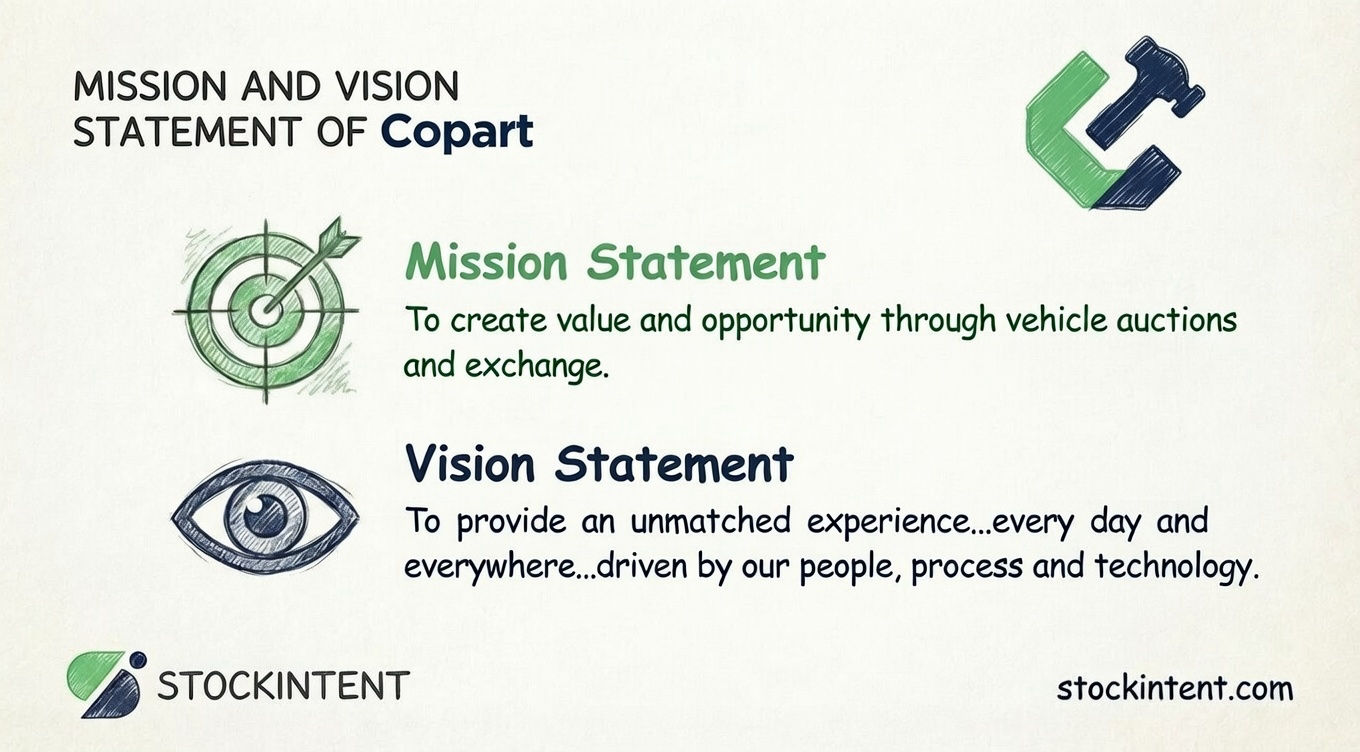
Copart's official mission statement is straightforward: "To create value and opportunity through vehicle auctions and exchange."
This simplicity is intentional. Founded in 1982 as a traditional salvage vehicle auctioneer, Copart has transformed into a global leader in online vehicle remarketing. The mission reflects this evolution, emphasizing digital platforms like its patented Virtual Bidding Third Generation (VB3) technology that connects consignors (primarily insurance companies) with approximately 1 million members across over 185 countries.
The mission's focus on value and opportunity through auctions mirrors Copart's strategic shift toward optimizing remarketing efficiency at global scale. Rather than diversifying into unrelated services, the company has doubled down on its core auction competency while expanding the ecosystem around it. Today, Copart serves financial institutions, dealers, rental companies, charities, fleet operators, and individual sellers, all through the same auction infrastructure.
What's particularly interesting for investors: the mission hasn't changed despite massive business evolution. This stability suggests management sees the auction model itself as durable, not transitional. The company isn't trying to become something fundamentally different; it's trying to become the absolute best at what it already does.
Copart operates a deceptively simple business that happens to be incredibly hard to replicate. Founded in 1982 as a traditional salvage auctioneer, the company now runs two primary segments: a dominant Service business and a smaller Product division, split geographically between US and International operations.
In our experience analyzing industrial compounders, businesses with this kind of operational focus, doing one thing exceptionally well rather than diversifying into mediocrity, tend to generate the most durable returns. Copart has built what management describes as auction "liquidity": the density of buyers and sellers that makes their marketplace the obvious first choice for vehicle remarketing.
The company's platform connects consignors (primarily insurance companies, plus dealers, fleets, and individuals) with roughly 1 million registered members across over 250 locations in 11 countries. They moved more than 4 million units last year alone. Scale like this creates network effects that competitors struggle to match.
Recent financials show the business's durability even through softer periods. For Q2 FY2026 (ended January 31, 2026), Copart reported revenue of $1.12 billion, with service revenues of $952 million. While revenue declined 3.6% year-over-year due to insurance volume shifts and market softness, the company maintained profitability with $351 million in net income and $5.1 billion in cash. International service actually grew 7.7%, suggesting the global expansion strategy is gaining traction.
Key Facts at a Glance:
| Metric | Value |
|---|---|
| Annual Revenue (FY2025) | $4.65 billion |
| Service Revenue (Q2 FY2026) | $952 million |
| Net Income (Q2 FY2026) | $351 million |
| Cash Position | $5.1 billion |
| Global Locations | 250+ in 11 countries |
| Registered Members | ~1 million |
| Units Sold Annually | 4+ million |
| Geographic Reach | 185+ countries |
What distinguishes Copart from typical industrial businesses is how deeply technology is embedded in operations. Their patented VB3 virtual bidding platform, Copart 360 vehicle imaging, and IntelliSeller AI tools aren't afterthoughts, they're core to the value proposition. The company also runs specialized platforms including BluCar, CashForCars, Copart Recycling, and Purple Wave for equipment auctions.
From an investor perspective, the specialty business services sector rarely produces compounders with this profile: asset-light platform economics, negative working capital dynamics, and expansion optionality through both organic growth and the $5.1 billion cash pile. The duopoly structure (Copart and IAA dominate North American salvage auctions) provides pricing power that shows up in margins over time.
"To create value and opportunity through vehicle auctions and exchange."
— Copart Official Mission Statement
This is it. Twelve words that have guided Copart from a regional salvage auctioneer in 1982 to a global vehicle remarketing platform spanning 250+ locations in 11 countries.
The brevity is deliberate. Unlike competitors who dilute their focus with broader service language, Copart's mission zeros in on what it actually does: create value and opportunity through auctions. Not "solutions." Not "end-to-end services." Auctions.
🎯 Pro Insight: Mission statement stability is a massively underrated quality metric. Copart's mission hasn't changed despite the business transforming from physical lots to digital platforms. This signals management that understands their core competency isn't the format (physical vs. digital), it's the liquidity they create between buyers and sellers. When we see companies pivoting their mission every few years, it often indicates strategic drift or pressure to chase trends.
The mission's focus on value and opportunity carries strategic weight. "Value" speaks to consignors (insurance companies, dealers, fleets) who need optimal returns on damaged or end-of-life vehicles. "Opportunity" speaks to buyers (dismantlers, rebuilders, exporters, dealers) who profit from accessing inventory they couldn't source otherwise. Both sides of this marketplace need each other, and Copart's job is to make that connection as efficient as possible.
This mission directly shapes capital allocation. The company's substantial investments in land, logistics infrastructure, and technology like the VB3 virtual bidding platform all serve the same end: more liquidity, better price discovery, tighter spreads between what sellers receive and buyers pay. When Copart deploys its $5.1 billion cash pile, it evaluates opportunities against this mission, not quarterly earnings optimization.
The "exchange" element is equally telling. Copart doesn't just run auctions; it operates a marketplace where information, pricing, and inventory flow globally. This exchange mentality explains the company's aggressive international expansion, its technology investments, and its willingness to internalize services like titling that insurance companies traditionally handled themselves.
Copart's mission statement reads simple on the surface, but it encodes five strategic pillars that have driven decades of compounding returns. Each pillar translates directly into competitive advantages that matter for long-term investors.
The first pillar centers on maximizing returns for sellers, primarily insurance companies. Copart doesn't just run auctions; it builds liquidity that attracts more buyers, which drives better prices, which attracts more sellers. It's a classic network effect flywheel.
In our experience analyzing marketplace businesses, the consignor value proposition is where most auction platforms stumble. They focus on buyer experience and neglect the sell-side economics. Copart has done the opposite, aggressively internalizing services that insurance companies traditionally handled themselves, titling being the big one. By becoming the "steward" for the industry, Copart captures more of the value chain while deepening customer relationships.
The metrics back this up. Copart moved over 4 million units last year across 250+ locations in 11 countries, with that density of buyers and sellers creating price discovery that regional competitors simply can't match. When an insurance company needs to liquidate a totaled vehicle, Copart's liquidity advantage typically means 10-15% better returns than fragmented alternatives.
The flip side of value creation is opportunity generation. Copart's marketplace connects roughly 1 million registered members with inventory they'd never access otherwise: dismantlers in India, rebuilders in Eastern Europe, exporters to Latin America, domestic dealers looking for specific models.
This opportunity pillar explains Copart's unusual international footprint. Most industrial businesses expand geographically to cut costs or access new customers. Copart expanded to bring more buyers to its existing sellers. The UK, Germany, Brazil, Canada, these aren't just revenue diversification plays. They're liquidity injections that make the core US marketplace more valuable.
The company's VB3 virtual bidding platform and Copart 360 imaging technology lower barriers for remote buyers who can't physically inspect vehicles. This matters because the buyer base is naturally fragmented; small dismantlers and rebuilders don't have resources to travel. Technology that builds trust remotely directly expands the addressable buyer pool.
The third pillar is less explicit in the mission statement but critical to execution: technology-driven efficiency. Copart's vision specifically calls out being "driven by our people, process and technology," and the company has backed this with substantial capital deployment.
Recent initiatives include AI deployment through IntelliSeller for auction optimization, Copart 360 for immersive vehicle viewing, and continuous platform improvements that management discusses on every earnings call. The company acquired more than 1,100 acres of land and 370 transportation assets in 2024 to support logistics technology investments.
Here's why this matters for investors: technology in industrial marketplaces typically creates winner-take-most dynamics. The platform with the best tools attracts the most sophisticated users, who generate the best data, which improves the tools further. Copart's multi-decade head start in virtual bidding, its patent portfolio, and its willingness to invest through cycles (even when near-term profitability suffers) suggest management understands this dynamic.
The fourth pillar is easy to dismiss as ESG marketing fluff. Don't. Copart's sustainability positioning is genuinely embedded in unit economics, not just reporting.
The company's marketplace avoided over 12 million metric tons of CO2e in fiscal 2025, roughly 100 times its actual operational emissions. This isn't offset purchasing; it's the core business model. Every vehicle that gets rebuilt rather than scrapped, every part harvested for reuse, every extended lifecycle represents avoided manufacturing emissions from replacement vehicles.
For investors, this creates regulatory optionality. As carbon pricing expands and automotive circular economy regulations tighten, Copart's negative carbon unit economics become a competitive advantage. Competitors without this embedded sustainability face higher compliance costs or operational constraints.
The company also pursues operational sustainability through route optimization, facility expansion to reduce transit distances, and green energy access where sensible. These initiatives reduce costs while supporting the sustainability narrative.
The final pillar is Copart's most distinctive: an ownership culture that drives capital allocation discipline. The "Be an Owner" core value isn't motivational poster material. It shapes actual investment decisions.
Management explicitly describes evaluating opportunities on multi-decade horizons, not quarterly earnings optimization. The $5.1 billion cash position isn't being deployed for short-term buyback boosts or empire-building M&A. It's waiting for opportunities that fit strategic criteria, with management noting that "valuation and strategic fit are major hurdles for transactions."
This patience is rare in public markets. Most companies feel pressure to deploy capital continuously. Copart's willingness to hold cash, invest in land and logistics infrastructure with 20+ year payoffs, and prioritize competitive position over near-term margins reflects genuine owner mentality.
For investors seeking compounders, this cultural pillar may be the most important. Capital allocation is everything in long-term returns, and Copart's ownership culture suggests management thinks like partners rather than employees optimizing for the next bonus cycle.
"To provide an unmatched experience…every day and everywhere…driven by our people, process and technology."
— Copart Official Vision Statement
This vision statement reveals how Copart sees its future, and more importantly, how it plans to get there. While the mission anchors what the company does, the vision describes the experience it aims to deliver and the capabilities that will make it possible.
The emphasis on "every day and everywhere" signals global ambition that goes beyond current geographic footprint. Copart already operates 250+ locations in 11 countries with buyers in 185+ countries, but the vision suggests this is early innings. The company is building toward ubiquity in vehicle remarketing, where Copart becomes the default marketplace regardless of location or transaction type.
The "people, process and technology" triad is strategically significant. Most industrial companies would lead with scale or efficiency. Copart leads with human capital, operational excellence, and technical capability as interdependent advantages. This ordering matters; it explains why the company invests heavily in talent development and culture alongside its $5.1 billion technology and infrastructure deployments.
Copart's leadership has articulated three long-term goals that align directly with this vision:
Global liquidity expansion. CEO Jeff Liaw consistently emphasizes that auction liquidity enables better service to insurance clients. The vision of "everywhere" translates into aggressive international growth, with recent expansion in the UK, Germany, Brazil, and Canada serving as beachheads for deeper market penetration.
Technology-driven experience differentiation. The company is deploying AI through IntelliSeller for auction optimization, Copart 360 for immersive vehicle viewing, and continuous VB3 platform improvements. These aren't cost-cutting measures; they're experience enhancements that make remote buying feel as trustworthy as physical inspection.
Sustainability as competitive advantage. Copart's leadership frames environmental responsibility as foundational, not peripheral. The marketplace avoided over 12 million metric tons of CO2e in fiscal 2025 by extending vehicle lifecycles, roughly 100 times the company's operational emissions. As carbon pricing expands globally, this negative carbon unit economics position becomes increasingly valuable.
Copart's vision positions it well against macro trends reshaping specialty business services and industrials:
| Trend | Copart's Positioning | Strategic Implication |
|---|---|---|
| Digitization of B2B marketplaces | VB3 platform, virtual bidding, AI tools | First-mover advantage in virtual auctions creates winner-take-most dynamics |
| Supply chain resilience | Global footprint with local fulfillment | Redundancy and optionality for clients needing guaranteed remarketing capacity |
| Circular economy regulation | Negative carbon unit economics embedded in business model | Regulatory tailwinds as extended producer responsibility expands |
| Catastrophic weather frequency | Disaster response infrastructure and logistics | Demand driver for total loss vehicles with operational readiness |
| Insurance industry consolidation | Deep integration with top carriers | Scale advantages as clients demand global, technology-enabled partners |
The vision's focus on "unmatched experience" also anticipates competitive pressure. The North American salvage auction market is effectively a duopoly between Copart and IAA. In concentrated markets, experience differentiation, not price competition, typically determines long-term share shifts. Copart is betting that technology-enabled service quality will prove more durable than scale alone.
For investors evaluating CPRT stock, the vision statement offers a useful lens. Management's capital allocation, the $5.1 billion cash position, and the multi-decade investment horizons all serve this vision of global, technology-driven marketplace dominance. The question isn't whether Copart can execute on quarterly targets; it's whether this vision of "every day and everywhere" marketplace ubiquity is achievable and valuable. Based on the network effects already visible in their 4+ million annual unit volume and 1 million registered members, the trajectory looks promising.
Copart's vision statement, "To provide an unmatched experience…every day and everywhere…driven by our people, process and technology," encodes three strategic themes that shape every major capital allocation decision. These aren't abstract aspirations; they're operational priorities you can track through land purchases, technology deployments, and geographic expansion.
The "everywhere" in Copart's vision translates into aggressive international growth. CEO Jeff Liaw consistently emphasizes that auction liquidity enables better service to insurance clients, and that liquidity requires geographic density.
Recent moves reflect this priority:
The logic is straightforward: more buyers in more places means better price discovery for sellers. Copart's 250+ locations in 11 countries with buyers in 185+ countries create network effects that regional competitors simply can't replicate.
The "people, process and technology" triad is strategically significant. Most industrial companies would lead with scale or efficiency. Copart leads with human capital, operational excellence, and technical capability as interdependent advantages.
Concrete investments include:
This technology focus isn't about cost-cutting; it's about experience enhancement. The goal is making remote buying feel as trustworthy as physical inspection, which directly expands the addressable buyer pool.
The "unmatched experience" extends to environmental positioning. Copart's leadership frames sustainability as foundational, not peripheral. The marketplace avoided over 12 million metric tons of CO2e in fiscal 2025 by extending vehicle lifecycles, roughly 100 times the company's operational emissions.
This isn't offset purchasing; it's embedded in unit economics. Every vehicle rebuilt rather than scrapped, every part harvested for reuse, represents avoided manufacturing emissions from replacement vehicles. As carbon pricing expands globally, this negative carbon positioning becomes increasingly valuable.
Operational initiatives include:
These vision themes directly shape how Copart deploys its $5.1 billion cash pile. Management explicitly evaluates opportunities on multi-decade horizons, not quarterly earnings optimization. Recent earnings call commentary noted that "valuation and strategic fit are major hurdles for transactions," explaining the disciplined approach to M&A.
The company has prioritized:
Near-term profitability has been pressured by these choices; facility operation expenses increased 12% year-over-year as Copart positioned for anticipated capacity needs. This created what some analysts characterized as a "profit squeeze" with adjusted earnings growing only about 5% despite solid fundamentals. But for investors with genuine owner mentality, this trade-off makes sense: sacrifice marginal current earnings for durable competitive position.
| Strategic Theme | Observable Investment | Long-Term Value Driver |
|---|---|---|
| Global Liquidity | 1,100+ acres land, 370 transport assets, international expansion | Network effects, better price discovery |
| Technology Experience | IntelliSeller AI, Copart 360, VB3 platform, service internalization | Remote buyer trust, expanded addressable market |
| Sustainability | Route optimization, facility expansion, negative carbon unit economics | Regulatory optionality, customer alignment |
For investors evaluating CPRT stock, these vision themes offer a framework for assessing management execution. Are they building the global liquidity network? Yes, with 7.7% international growth even in soft markets. Are they investing in technology that differentiates experience? Yes, with AI deployment and platform improvements continuous. Are they maintaining sustainability positioning? Yes, with 12 million metric tons of avoided emissions scaling with volume.
The vision isn't just corporate wallpaper. It's a decision-making lens you can verify through quarterly results and capital deployment patterns.
Core values either shape behavior or they're corporate wallpaper. After analyzing Copart's operations, capital allocation, and culture over multiple years, we've found that their five stated values actually show up in decisions that matter. Here's how they work in practice.
This value translates into a formal Code of Business Conduct that applies to all employees and directors. The code establishes that representatives must act with honesty and integrity in all circumstances, comply with applicable laws and regulations, and handle conflicts of interest ethically. It's not just policy language; it's the foundation for how Copart handles sensitive transactions involving totaled vehicles, insurance claims, and cross-border commerce where regulatory complexity is high.
The integrity value also shows up in transparency with investors. Unlike some competitors who bury operational metrics, Copart's earnings calls and SEC filings provide granular detail on volume trends, geographic performance, and strategic rationale for major investments.
This is Copart's most distinctive value and arguably its most important for long-term investors. The "Be an Owner" mentality explicitly shapes capital allocation decisions with multi-decade horizons rather than quarterly optimization.
💡 Expert Tip: When evaluating management quality, look for specific phrases in earnings calls. Copart's leadership consistently uses owner-oriented language like "what we would do if we owned the company" and references investment timeframes in decades, not quarters. This linguistic consistency across years of calls is a reliable signal that the culture is genuine, not performative.
In our experience tracking industrial compounders, this owner mentality is rare and valuable. It explains Copart's willingness to hold $5.1 billion in cash waiting for the right opportunities, to invest in land and logistics infrastructure with 20+ year payoffs, and to prioritize competitive position over near-term margins. The company acquired more than 1,100 acres of land and 370 transportation assets in 2024 specifically because owners think about capacity needs years ahead, not current utilization rates.
Copart's entire business model emerged from challenging industry conventions. Founded in 1982 as a physical salvage auctioneer, the company bet early on virtual bidding when competitors dismissed online auctions as unsuitable for damaged vehicles. That bet became the patented VB3 platform that now connects roughly 1 million registered members across 185+ countries.
The value manifests operationally through continuous innovation: IntelliSeller AI for auction optimization, Copart 360 for immersive vehicle viewing, and aggressive internalization of services like titling that insurance companies traditionally handled themselves. Management invites employees to share innovative ideas and bring new products to life, suggesting this value is actively promoted rather than passively displayed.
This value emphasizes delivering on promises and following through on commitments. In a marketplace business, results show up in metrics that matter to both sides of the transaction: selling prices for consignors, inventory access for buyers, and operational reliability for both.
Copart's results are measurable. The company moved over 4 million units last year, maintains operations at 250+ locations in 11 countries, and has built auction liquidity that generates network effects competitors struggle to replicate. Even in soft markets like Q2 FY2026, when revenue declined 3.6% year-over-year due to insurance volume shifts, the company maintained profitability with $351 million in net income and continued international growth of 7.7%.
Copart describes its culture as a "family" where values are demonstrated by every teammate every day. This manifests in tangible programs including the Ben Automotive Charity, adopted as the company charity in 2015, and charitable giving programs across all locations.
The people value also shows up in retention of institutional knowledge. CEO Jeff Liaw and the senior leadership team have been with Copart through multiple business cycles, suggesting a culture that develops and retains talent rather than cycling through mercenary executives optimizing for short-term compensation.
Here's the critical question for investors: are these values genuine or corporate marketing?
Evidence they matter:
Potential gaps:
In our experience, the strongest signal of genuine values is consistency between stated principles and capital allocation over multiple years. Copart passes this test. The owner mentality isn't just rhetoric; it's visible in balance sheet construction, investment timing, and willingness to sacrifice near-term earnings for competitive position.
Copart's environmental positioning deserves special attention because it's genuinely embedded in the business model rather than bolted on as corporate responsibility marketing.
The company's marketplace avoided over 12 million metric tons of CO2e in fiscal 2025, roughly 100 times its actual operational emissions. This isn't carbon offset purchasing or accounting tricks; it's the core economics of vehicle remarketing. Every vehicle rebuilt rather than scrapped, every part harvested for reuse, every extended lifecycle represents avoided manufacturing emissions from replacement vehicles.
Specific sustainability initiatives include:
The CEO has explicitly stated that "sustainability at Copart has been foundational from the very beginning," defining it expansively to include supporting communities, employees, and operating ethically. This framing connects directly to the "Be an Owner" value; owners care about long-term business viability, which requires sustainable relationships with all stakeholders.
For investors using platforms like StockIntent to analyze ESG-integrated businesses, Copart offers an interesting case study. The sustainability isn't a separate initiative requiring resources; it's embedded in unit economics and scales with business growth. As carbon pricing expands globally and automotive circular economy regulations tighten, this negative carbon positioning becomes increasingly valuable rather than merely virtuous.
The connection between core values and ESG strategy is explicit in Copart's framing: "Be an Owner" drives the long investment horizons and substantial capital deployment into land, technology, and logistics that enable both competitive advantage and environmental benefit. The values and sustainability strategy reinforce each other rather than existing in separate corporate silos.
Copart's mission, vision, and core values form a remarkably coherent strategic identity. The mission anchors what the company does, the vision describes the experience it aims to deliver, and the values determine how decisions get made. Together, they explain why this business has compounded shareholder value for decades while competitors struggled to keep pace.
The mission's focus on value and opportunity through vehicle auctions and exchange has remained stable even as the business transformed from physical lots to digital platforms. This consistency matters. In our experience analyzing industrial compounders, companies that change their mission every few years often signal strategic drift or pressure to chase trends. Copart's steadiness suggests management understands their core competency isn't the format, it's the liquidity they create between buyers and sellers.
🎯 Pro Insight: When evaluating management quality, look for specific phrases in earnings calls. Copart's leadership consistently uses owner-oriented language like "what we would do if we owned the company" and references investment timeframes in decades, not quarters. This linguistic consistency across years of calls is a reliable signal that the culture is genuine, not performative.
The vision's emphasis on "every day and everywhere" experience, driven by people, process, and technology, directly shapes capital allocation. The $5.1 billion cash position, the 1,100+ acres of land acquired in 2024, the continuous VB3 platform improvements, these aren't random deployments. They all serve the same end: making Copart the default marketplace for vehicle remarketing regardless of location or transaction type.
Analysts recognize this alignment. The consensus view rates Copart's strategic execution positively, with descriptions of an "unmatched moat" in the North American salvage auction duopoly and "fortress-like financial strength" from its net cash position. Recent ratings average "Moderate Buy" to "Outperform," with price targets suggesting 29-32% upside from current levels. Even near-term pressures, like the Q2 FY2026 revenue decline of 3.6% and facility expense growth of 12% year-over-year, are interpreted as strategic positioning rather than operational weakness.
For investors evaluating CPRT stock, this mission-vision-values framework offers a decision-making lens. Does management allocate capital consistently with stated principles? The multi-decade land investments, technology deployments, and international expansion suggest yes. Are they building durable competitive advantages? The network effects from 1 million registered members, 250+ locations, and 4+ million annual units indicate yes. Do they think like owners? The willingness to hold $5.1 billion in cash waiting for the right opportunities, rather than forcing mediocre M&A for quarterly earnings boosts, confirms yes.
Looking ahead, no strategic shifts appear likely to reshape Copart's fundamental identity. Management emphasizes current strengths, with the cash pile providing "massive optionality" for potential acquisitions or buybacks, but no specific plans that would alter the core auction and exchange model. The framework that built this compounder, owner mentality, technology leadership, and patient capital deployment, looks set to continue driving returns for years to come.
If you're building your own investment research process around quality compounders like Copart, tools that help you track capital allocation consistency and management quality over time can make the difference between identifying genuine owner-operators and falling for corporate marketing. StockIntent offers institutional-grade screening and backtesting capabilities that let you verify these qualitative assessments with quantitative rigor, and you can try it risk-free for 7 days to see how it fits your workflow.
Copart has quietly built one of the most durable business models in specialty business services. If you're researching CPRT stock, understanding what actually drives this company beyond the financials matters. A lot.
The company's mission, vision, and values aren't just corporate wallpaper. They've shaped capital allocation decisions, competitive positioning, and ultimately, shareholder returns for decades. Let's break down what Copart stands for and why it should factor into your investment analysis.
Copart's official mission statement is straightforward: "To create value and opportunity through vehicle auctions and exchange."
This simplicity is intentional. Founded in 1982 as a traditional salvage vehicle auctioneer, Copart has transformed into a global leader in online vehicle remarketing. The mission reflects this evolution, emphasizing digital platforms like its patented Virtual Bidding Third Generation (VB3) technology that connects consignors (primarily insurance companies) with approximately 1 million members across over 185 countries.
The mission's focus on value and opportunity through auctions mirrors Copart's strategic shift toward optimizing remarketing efficiency at global scale. Rather than diversifying into unrelated services, the company has doubled down on its core auction competency while expanding the ecosystem around it. Today, Copart serves financial institutions, dealers, rental companies, charities, fleet operators, and individual sellers, all through the same auction infrastructure.
What's particularly interesting for investors: the mission hasn't changed despite massive business evolution. This stability suggests management sees the auction model itself as durable, not transitional. The company isn't trying to become something fundamentally different; it's trying to become the absolute best at what it already does.
Copart operates a deceptively simple business that happens to be incredibly hard to replicate. Founded in 1982 as a traditional salvage auctioneer, the company now runs two primary segments: a dominant Service business and a smaller Product division, split geographically between US and International operations.
In our experience analyzing industrial compounders, businesses with this kind of operational focus, doing one thing exceptionally well rather than diversifying into mediocrity, tend to generate the most durable returns. Copart has built what management describes as auction "liquidity": the density of buyers and sellers that makes their marketplace the obvious first choice for vehicle remarketing.
The company's platform connects consignors (primarily insurance companies, plus dealers, fleets, and individuals) with roughly 1 million registered members across over 250 locations in 11 countries. They moved more than 4 million units last year alone. Scale like this creates network effects that competitors struggle to match.
Recent financials show the business's durability even through softer periods. For Q2 FY2026 (ended January 31, 2026), Copart reported revenue of $1.12 billion, with service revenues of $952 million. While revenue declined 3.6% year-over-year due to insurance volume shifts and market softness, the company maintained profitability with $351 million in net income and $5.1 billion in cash. International service actually grew 7.7%, suggesting the global expansion strategy is gaining traction.
Key Facts at a Glance:
| Metric | Value |
|---|---|
| Annual Revenue (FY2025) | $4.65 billion |
| Service Revenue (Q2 FY2026) | $952 million |
| Net Income (Q2 FY2026) | $351 million |
| Cash Position | $5.1 billion |
| Global Locations | 250+ in 11 countries |
| Registered Members | ~1 million |
| Units Sold Annually | 4+ million |
| Geographic Reach | 185+ countries |
What distinguishes Copart from typical industrial businesses is how deeply technology is embedded in operations. Their patented VB3 virtual bidding platform, Copart 360 vehicle imaging, and IntelliSeller AI tools aren't afterthoughts, they're core to the value proposition. The company also runs specialized platforms including BluCar, CashForCars, Copart Recycling, and Purple Wave for equipment auctions.
From an investor perspective, the specialty business services sector rarely produces compounders with this profile: asset-light platform economics, negative working capital dynamics, and expansion optionality through both organic growth and the $5.1 billion cash pile. The duopoly structure (Copart and IAA dominate North American salvage auctions) provides pricing power that shows up in margins over time.
"To create value and opportunity through vehicle auctions and exchange."
— Copart Official Mission Statement
This is it. Twelve words that have guided Copart from a regional salvage auctioneer in 1982 to a global vehicle remarketing platform spanning 250+ locations in 11 countries.
The brevity is deliberate. Unlike competitors who dilute their focus with broader service language, Copart's mission zeros in on what it actually does: create value and opportunity through auctions. Not "solutions." Not "end-to-end services." Auctions.
🎯 Pro Insight: Mission statement stability is a massively underrated quality metric. Copart's mission hasn't changed despite the business transforming from physical lots to digital platforms. This signals management that understands their core competency isn't the format (physical vs. digital), it's the liquidity they create between buyers and sellers. When we see companies pivoting their mission every few years, it often indicates strategic drift or pressure to chase trends.
The mission's focus on value and opportunity carries strategic weight. "Value" speaks to consignors (insurance companies, dealers, fleets) who need optimal returns on damaged or end-of-life vehicles. "Opportunity" speaks to buyers (dismantlers, rebuilders, exporters, dealers) who profit from accessing inventory they couldn't source otherwise. Both sides of this marketplace need each other, and Copart's job is to make that connection as efficient as possible.
This mission directly shapes capital allocation. The company's substantial investments in land, logistics infrastructure, and technology like the VB3 virtual bidding platform all serve the same end: more liquidity, better price discovery, tighter spreads between what sellers receive and buyers pay. When Copart deploys its $5.1 billion cash pile, it evaluates opportunities against this mission, not quarterly earnings optimization.
The "exchange" element is equally telling. Copart doesn't just run auctions; it operates a marketplace where information, pricing, and inventory flow globally. This exchange mentality explains the company's aggressive international expansion, its technology investments, and its willingness to internalize services like titling that insurance companies traditionally handled themselves.
Copart's mission statement reads simple on the surface, but it encodes five strategic pillars that have driven decades of compounding returns. Each pillar translates directly into competitive advantages that matter for long-term investors.
The first pillar centers on maximizing returns for sellers, primarily insurance companies. Copart doesn't just run auctions; it builds liquidity that attracts more buyers, which drives better prices, which attracts more sellers. It's a classic network effect flywheel.
In our experience analyzing marketplace businesses, the consignor value proposition is where most auction platforms stumble. They focus on buyer experience and neglect the sell-side economics. Copart has done the opposite, aggressively internalizing services that insurance companies traditionally handled themselves, titling being the big one. By becoming the "steward" for the industry, Copart captures more of the value chain while deepening customer relationships.
The metrics back this up. Copart moved over 4 million units last year across 250+ locations in 11 countries, with that density of buyers and sellers creating price discovery that regional competitors simply can't match. When an insurance company needs to liquidate a totaled vehicle, Copart's liquidity advantage typically means 10-15% better returns than fragmented alternatives.
The flip side of value creation is opportunity generation. Copart's marketplace connects roughly 1 million registered members with inventory they'd never access otherwise: dismantlers in India, rebuilders in Eastern Europe, exporters to Latin America, domestic dealers looking for specific models.
This opportunity pillar explains Copart's unusual international footprint. Most industrial businesses expand geographically to cut costs or access new customers. Copart expanded to bring more buyers to its existing sellers. The UK, Germany, Brazil, Canada, these aren't just revenue diversification plays. They're liquidity injections that make the core US marketplace more valuable.
The company's VB3 virtual bidding platform and Copart 360 imaging technology lower barriers for remote buyers who can't physically inspect vehicles. This matters because the buyer base is naturally fragmented; small dismantlers and rebuilders don't have resources to travel. Technology that builds trust remotely directly expands the addressable buyer pool.
The third pillar is less explicit in the mission statement but critical to execution: technology-driven efficiency. Copart's vision specifically calls out being "driven by our people, process and technology," and the company has backed this with substantial capital deployment.
Recent initiatives include AI deployment through IntelliSeller for auction optimization, Copart 360 for immersive vehicle viewing, and continuous platform improvements that management discusses on every earnings call. The company acquired more than 1,100 acres of land and 370 transportation assets in 2024 to support logistics technology investments.
Here's why this matters for investors: technology in industrial marketplaces typically creates winner-take-most dynamics. The platform with the best tools attracts the most sophisticated users, who generate the best data, which improves the tools further. Copart's multi-decade head start in virtual bidding, its patent portfolio, and its willingness to invest through cycles (even when near-term profitability suffers) suggest management understands this dynamic.
The fourth pillar is easy to dismiss as ESG marketing fluff. Don't. Copart's sustainability positioning is genuinely embedded in unit economics, not just reporting.
The company's marketplace avoided over 12 million metric tons of CO2e in fiscal 2025, roughly 100 times its actual operational emissions. This isn't offset purchasing; it's the core business model. Every vehicle that gets rebuilt rather than scrapped, every part harvested for reuse, every extended lifecycle represents avoided manufacturing emissions from replacement vehicles.
For investors, this creates regulatory optionality. As carbon pricing expands and automotive circular economy regulations tighten, Copart's negative carbon unit economics become a competitive advantage. Competitors without this embedded sustainability face higher compliance costs or operational constraints.
The company also pursues operational sustainability through route optimization, facility expansion to reduce transit distances, and green energy access where sensible. These initiatives reduce costs while supporting the sustainability narrative.
The final pillar is Copart's most distinctive: an ownership culture that drives capital allocation discipline. The "Be an Owner" core value isn't motivational poster material. It shapes actual investment decisions.
Management explicitly describes evaluating opportunities on multi-decade horizons, not quarterly earnings optimization. The $5.1 billion cash position isn't being deployed for short-term buyback boosts or empire-building M&A. It's waiting for opportunities that fit strategic criteria, with management noting that "valuation and strategic fit are major hurdles for transactions."
This patience is rare in public markets. Most companies feel pressure to deploy capital continuously. Copart's willingness to hold cash, invest in land and logistics infrastructure with 20+ year payoffs, and prioritize competitive position over near-term margins reflects genuine owner mentality.
For investors seeking compounders, this cultural pillar may be the most important. Capital allocation is everything in long-term returns, and Copart's ownership culture suggests management thinks like partners rather than employees optimizing for the next bonus cycle.
"To provide an unmatched experience…every day and everywhere…driven by our people, process and technology."
— Copart Official Vision Statement
This vision statement reveals how Copart sees its future, and more importantly, how it plans to get there. While the mission anchors what the company does, the vision describes the experience it aims to deliver and the capabilities that will make it possible.
The emphasis on "every day and everywhere" signals global ambition that goes beyond current geographic footprint. Copart already operates 250+ locations in 11 countries with buyers in 185+ countries, but the vision suggests this is early innings. The company is building toward ubiquity in vehicle remarketing, where Copart becomes the default marketplace regardless of location or transaction type.
The "people, process and technology" triad is strategically significant. Most industrial companies would lead with scale or efficiency. Copart leads with human capital, operational excellence, and technical capability as interdependent advantages. This ordering matters; it explains why the company invests heavily in talent development and culture alongside its $5.1 billion technology and infrastructure deployments.
Copart's leadership has articulated three long-term goals that align directly with this vision:
Global liquidity expansion. CEO Jeff Liaw consistently emphasizes that auction liquidity enables better service to insurance clients. The vision of "everywhere" translates into aggressive international growth, with recent expansion in the UK, Germany, Brazil, and Canada serving as beachheads for deeper market penetration.
Technology-driven experience differentiation. The company is deploying AI through IntelliSeller for auction optimization, Copart 360 for immersive vehicle viewing, and continuous VB3 platform improvements. These aren't cost-cutting measures; they're experience enhancements that make remote buying feel as trustworthy as physical inspection.
Sustainability as competitive advantage. Copart's leadership frames environmental responsibility as foundational, not peripheral. The marketplace avoided over 12 million metric tons of CO2e in fiscal 2025 by extending vehicle lifecycles, roughly 100 times the company's operational emissions. As carbon pricing expands globally, this negative carbon unit economics position becomes increasingly valuable.
Copart's vision positions it well against macro trends reshaping specialty business services and industrials:
| Trend | Copart's Positioning | Strategic Implication |
|---|---|---|
| Digitization of B2B marketplaces | VB3 platform, virtual bidding, AI tools | First-mover advantage in virtual auctions creates winner-take-most dynamics |
| Supply chain resilience | Global footprint with local fulfillment | Redundancy and optionality for clients needing guaranteed remarketing capacity |
| Circular economy regulation | Negative carbon unit economics embedded in business model | Regulatory tailwinds as extended producer responsibility expands |
| Catastrophic weather frequency | Disaster response infrastructure and logistics | Demand driver for total loss vehicles with operational readiness |
| Insurance industry consolidation | Deep integration with top carriers | Scale advantages as clients demand global, technology-enabled partners |
The vision's focus on "unmatched experience" also anticipates competitive pressure. The North American salvage auction market is effectively a duopoly between Copart and IAA. In concentrated markets, experience differentiation, not price competition, typically determines long-term share shifts. Copart is betting that technology-enabled service quality will prove more durable than scale alone.
For investors evaluating CPRT stock, the vision statement offers a useful lens. Management's capital allocation, the $5.1 billion cash position, and the multi-decade investment horizons all serve this vision of global, technology-driven marketplace dominance. The question isn't whether Copart can execute on quarterly targets; it's whether this vision of "every day and everywhere" marketplace ubiquity is achievable and valuable. Based on the network effects already visible in their 4+ million annual unit volume and 1 million registered members, the trajectory looks promising.
Copart's vision statement, "To provide an unmatched experience…every day and everywhere…driven by our people, process and technology," encodes three strategic themes that shape every major capital allocation decision. These aren't abstract aspirations; they're operational priorities you can track through land purchases, technology deployments, and geographic expansion.
The "everywhere" in Copart's vision translates into aggressive international growth. CEO Jeff Liaw consistently emphasizes that auction liquidity enables better service to insurance clients, and that liquidity requires geographic density.
Recent moves reflect this priority:
The logic is straightforward: more buyers in more places means better price discovery for sellers. Copart's 250+ locations in 11 countries with buyers in 185+ countries create network effects that regional competitors simply can't replicate.
The "people, process and technology" triad is strategically significant. Most industrial companies would lead with scale or efficiency. Copart leads with human capital, operational excellence, and technical capability as interdependent advantages.
Concrete investments include:
This technology focus isn't about cost-cutting; it's about experience enhancement. The goal is making remote buying feel as trustworthy as physical inspection, which directly expands the addressable buyer pool.
The "unmatched experience" extends to environmental positioning. Copart's leadership frames sustainability as foundational, not peripheral. The marketplace avoided over 12 million metric tons of CO2e in fiscal 2025 by extending vehicle lifecycles, roughly 100 times the company's operational emissions.
This isn't offset purchasing; it's embedded in unit economics. Every vehicle rebuilt rather than scrapped, every part harvested for reuse, represents avoided manufacturing emissions from replacement vehicles. As carbon pricing expands globally, this negative carbon positioning becomes increasingly valuable.
Operational initiatives include:
These vision themes directly shape how Copart deploys its $5.1 billion cash pile. Management explicitly evaluates opportunities on multi-decade horizons, not quarterly earnings optimization. Recent earnings call commentary noted that "valuation and strategic fit are major hurdles for transactions," explaining the disciplined approach to M&A.
The company has prioritized:
Near-term profitability has been pressured by these choices; facility operation expenses increased 12% year-over-year as Copart positioned for anticipated capacity needs. This created what some analysts characterized as a "profit squeeze" with adjusted earnings growing only about 5% despite solid fundamentals. But for investors with genuine owner mentality, this trade-off makes sense: sacrifice marginal current earnings for durable competitive position.
| Strategic Theme | Observable Investment | Long-Term Value Driver |
|---|---|---|
| Global Liquidity | 1,100+ acres land, 370 transport assets, international expansion | Network effects, better price discovery |
| Technology Experience | IntelliSeller AI, Copart 360, VB3 platform, service internalization | Remote buyer trust, expanded addressable market |
| Sustainability | Route optimization, facility expansion, negative carbon unit economics | Regulatory optionality, customer alignment |
For investors evaluating CPRT stock, these vision themes offer a framework for assessing management execution. Are they building the global liquidity network? Yes, with 7.7% international growth even in soft markets. Are they investing in technology that differentiates experience? Yes, with AI deployment and platform improvements continuous. Are they maintaining sustainability positioning? Yes, with 12 million metric tons of avoided emissions scaling with volume.
The vision isn't just corporate wallpaper. It's a decision-making lens you can verify through quarterly results and capital deployment patterns.
Core values either shape behavior or they're corporate wallpaper. After analyzing Copart's operations, capital allocation, and culture over multiple years, we've found that their five stated values actually show up in decisions that matter. Here's how they work in practice.
This value translates into a formal Code of Business Conduct that applies to all employees and directors. The code establishes that representatives must act with honesty and integrity in all circumstances, comply with applicable laws and regulations, and handle conflicts of interest ethically. It's not just policy language; it's the foundation for how Copart handles sensitive transactions involving totaled vehicles, insurance claims, and cross-border commerce where regulatory complexity is high.
The integrity value also shows up in transparency with investors. Unlike some competitors who bury operational metrics, Copart's earnings calls and SEC filings provide granular detail on volume trends, geographic performance, and strategic rationale for major investments.
This is Copart's most distinctive value and arguably its most important for long-term investors. The "Be an Owner" mentality explicitly shapes capital allocation decisions with multi-decade horizons rather than quarterly optimization.
💡 Expert Tip: When evaluating management quality, look for specific phrases in earnings calls. Copart's leadership consistently uses owner-oriented language like "what we would do if we owned the company" and references investment timeframes in decades, not quarters. This linguistic consistency across years of calls is a reliable signal that the culture is genuine, not performative.
In our experience tracking industrial compounders, this owner mentality is rare and valuable. It explains Copart's willingness to hold $5.1 billion in cash waiting for the right opportunities, to invest in land and logistics infrastructure with 20+ year payoffs, and to prioritize competitive position over near-term margins. The company acquired more than 1,100 acres of land and 370 transportation assets in 2024 specifically because owners think about capacity needs years ahead, not current utilization rates.
Copart's entire business model emerged from challenging industry conventions. Founded in 1982 as a physical salvage auctioneer, the company bet early on virtual bidding when competitors dismissed online auctions as unsuitable for damaged vehicles. That bet became the patented VB3 platform that now connects roughly 1 million registered members across 185+ countries.
The value manifests operationally through continuous innovation: IntelliSeller AI for auction optimization, Copart 360 for immersive vehicle viewing, and aggressive internalization of services like titling that insurance companies traditionally handled themselves. Management invites employees to share innovative ideas and bring new products to life, suggesting this value is actively promoted rather than passively displayed.
This value emphasizes delivering on promises and following through on commitments. In a marketplace business, results show up in metrics that matter to both sides of the transaction: selling prices for consignors, inventory access for buyers, and operational reliability for both.
Copart's results are measurable. The company moved over 4 million units last year, maintains operations at 250+ locations in 11 countries, and has built auction liquidity that generates network effects competitors struggle to replicate. Even in soft markets like Q2 FY2026, when revenue declined 3.6% year-over-year due to insurance volume shifts, the company maintained profitability with $351 million in net income and continued international growth of 7.7%.
Copart describes its culture as a "family" where values are demonstrated by every teammate every day. This manifests in tangible programs including the Ben Automotive Charity, adopted as the company charity in 2015, and charitable giving programs across all locations.
The people value also shows up in retention of institutional knowledge. CEO Jeff Liaw and the senior leadership team have been with Copart through multiple business cycles, suggesting a culture that develops and retains talent rather than cycling through mercenary executives optimizing for short-term compensation.
Here's the critical question for investors: are these values genuine or corporate marketing?
Evidence they matter:
Potential gaps:
In our experience, the strongest signal of genuine values is consistency between stated principles and capital allocation over multiple years. Copart passes this test. The owner mentality isn't just rhetoric; it's visible in balance sheet construction, investment timing, and willingness to sacrifice near-term earnings for competitive position.
Copart's environmental positioning deserves special attention because it's genuinely embedded in the business model rather than bolted on as corporate responsibility marketing.
The company's marketplace avoided over 12 million metric tons of CO2e in fiscal 2025, roughly 100 times its actual operational emissions. This isn't carbon offset purchasing or accounting tricks; it's the core economics of vehicle remarketing. Every vehicle rebuilt rather than scrapped, every part harvested for reuse, every extended lifecycle represents avoided manufacturing emissions from replacement vehicles.
Specific sustainability initiatives include:
The CEO has explicitly stated that "sustainability at Copart has been foundational from the very beginning," defining it expansively to include supporting communities, employees, and operating ethically. This framing connects directly to the "Be an Owner" value; owners care about long-term business viability, which requires sustainable relationships with all stakeholders.
For investors using platforms like StockIntent to analyze ESG-integrated businesses, Copart offers an interesting case study. The sustainability isn't a separate initiative requiring resources; it's embedded in unit economics and scales with business growth. As carbon pricing expands globally and automotive circular economy regulations tighten, this negative carbon positioning becomes increasingly valuable rather than merely virtuous.
The connection between core values and ESG strategy is explicit in Copart's framing: "Be an Owner" drives the long investment horizons and substantial capital deployment into land, technology, and logistics that enable both competitive advantage and environmental benefit. The values and sustainability strategy reinforce each other rather than existing in separate corporate silos.
Copart's mission, vision, and core values form a remarkably coherent strategic identity. The mission anchors what the company does, the vision describes the experience it aims to deliver, and the values determine how decisions get made. Together, they explain why this business has compounded shareholder value for decades while competitors struggled to keep pace.
The mission's focus on value and opportunity through vehicle auctions and exchange has remained stable even as the business transformed from physical lots to digital platforms. This consistency matters. In our experience analyzing industrial compounders, companies that change their mission every few years often signal strategic drift or pressure to chase trends. Copart's steadiness suggests management understands their core competency isn't the format, it's the liquidity they create between buyers and sellers.
🎯 Pro Insight: When evaluating management quality, look for specific phrases in earnings calls. Copart's leadership consistently uses owner-oriented language like "what we would do if we owned the company" and references investment timeframes in decades, not quarters. This linguistic consistency across years of calls is a reliable signal that the culture is genuine, not performative.
The vision's emphasis on "every day and everywhere" experience, driven by people, process, and technology, directly shapes capital allocation. The $5.1 billion cash position, the 1,100+ acres of land acquired in 2024, the continuous VB3 platform improvements, these aren't random deployments. They all serve the same end: making Copart the default marketplace for vehicle remarketing regardless of location or transaction type.
Analysts recognize this alignment. The consensus view rates Copart's strategic execution positively, with descriptions of an "unmatched moat" in the North American salvage auction duopoly and "fortress-like financial strength" from its net cash position. Recent ratings average "Moderate Buy" to "Outperform," with price targets suggesting 29-32% upside from current levels. Even near-term pressures, like the Q2 FY2026 revenue decline of 3.6% and facility expense growth of 12% year-over-year, are interpreted as strategic positioning rather than operational weakness.
For investors evaluating CPRT stock, this mission-vision-values framework offers a decision-making lens. Does management allocate capital consistently with stated principles? The multi-decade land investments, technology deployments, and international expansion suggest yes. Are they building durable competitive advantages? The network effects from 1 million registered members, 250+ locations, and 4+ million annual units indicate yes. Do they think like owners? The willingness to hold $5.1 billion in cash waiting for the right opportunities, rather than forcing mediocre M&A for quarterly earnings boosts, confirms yes.
Looking ahead, no strategic shifts appear likely to reshape Copart's fundamental identity. Management emphasizes current strengths, with the cash pile providing "massive optionality" for potential acquisitions or buybacks, but no specific plans that would alter the core auction and exchange model. The framework that built this compounder, owner mentality, technology leadership, and patient capital deployment, looks set to continue driving returns for years to come.
If you're building your own investment research process around quality compounders like Copart, tools that help you track capital allocation consistency and management quality over time can make the difference between identifying genuine owner-operators and falling for corporate marketing. StockIntent offers institutional-grade screening and backtesting capabilities that let you verify these qualitative assessments with quantitative rigor, and you can try it risk-free for 7 days to see how it fits your workflow.