
Aug 12, 2026
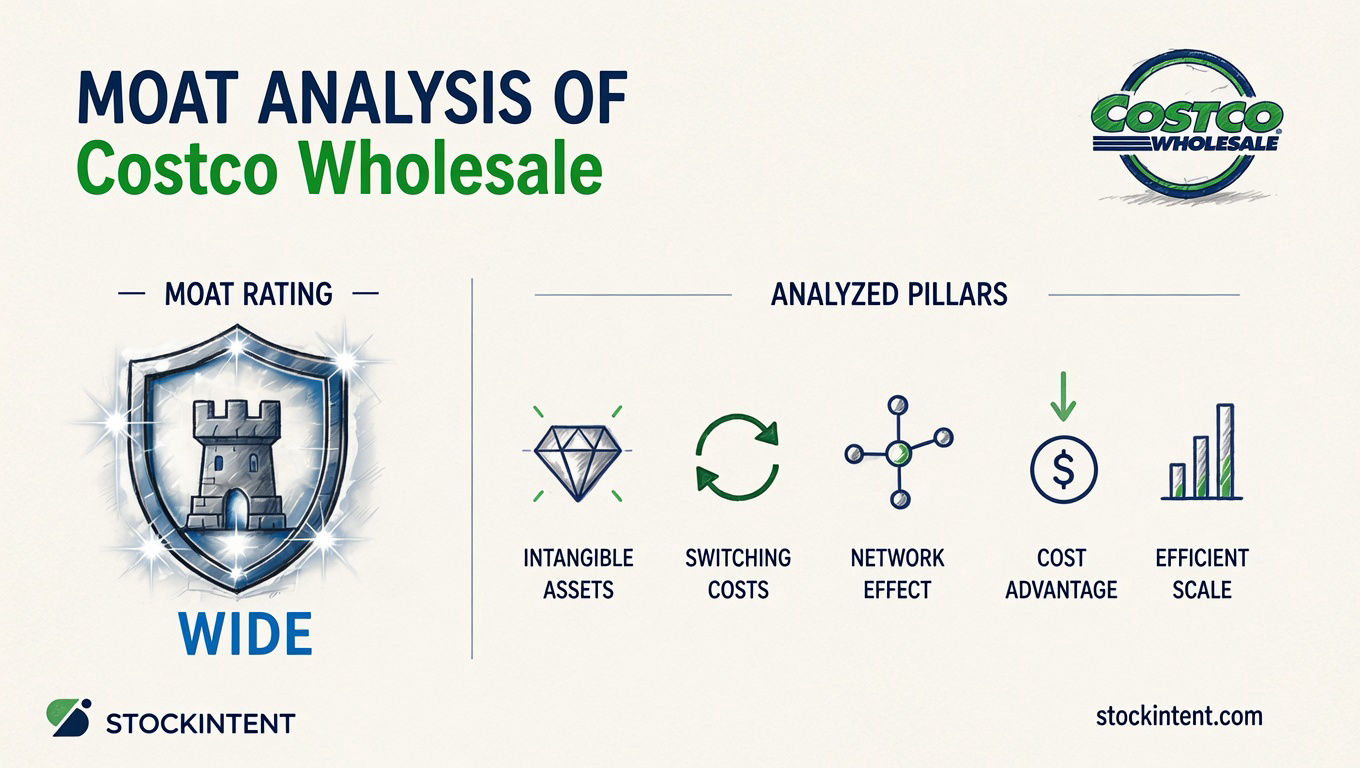
Costco Wholesale carries a Wide Moat with a Stable to Modestly Widening trend and Low-Medium Uncertainty. The warehouse club's competitive position is unusually durable, built on a membership flywheel that competitors struggle to replicate at scale. That durability matters for long-term investors because it supports predictable cash flows and reinvestment economics even when retail cycles turn rough.
The evidence is in the numbers. Net sales growth accelerated through the first three quarters of fiscal 2026: 8.2% in Q1, 9.1% in Q2, and 11.6% in Q3. That progression is not typical for a retailer at this scale, and it signals that the moat is doing more than holding steady.
Here is what investors need to know at a glance:
The detailed pillar-by-pillar analysis that follows shows exactly where Costco's advantages are deepest, where they are thinner than commonly assumed, and which forward indicators to watch for early signs of change.
Costco's moat rests on two genuinely powerful pillars: efficient scale and cost advantage. The other three pillars matter to varying degrees, but some are weaker than the bull case often assumes. Let's walk through each one in order of strength.
Efficient Scale: Very Strong
This is Costco's deepest defense. The company operates roughly 4,000 SKUs per warehouse versus 30,000+ at a typical supermarket. That limited assortment is not a constraint; it's a weapon. Fewer SKUs mean faster inventory turns, stronger purchasing leverage with suppliers, and operating density that smaller rivals cannot replicate without destroying their own economics. The scale is self-reinforcing: more members justify more warehouses, which deepens the cost structure that sustains low prices.
Cost Advantage: Strong
Costco's merchandise margins are intentionally thin. Profitability comes primarily from membership fees, which lets the company pass savings through to members and maintain price leadership. This is the classic "scale-economies-shared" model. Competitors can match individual prices on select items, but they cannot sustainably replicate the full-system cost structure without a comparable membership base and warehouse network. In our experience reviewing detailed company reports, this fee-subsidized model is what separates Costco's economics from conventional retailers that depend on merchandise spread alone.
Intangible Assets: Moderate-to-Strong
The Kirkland Signature private label is the clearest intangible here. It accounts for nearly 30% of total sales and functions as a quality signal that builds trust and reduces dependence on third-party brands. The Costco brand itself carries weight, too. Members associate it with reliable value and the "treasure hunt" experience. Still, this is brand equity and private-label strength, not hard intellectual property or regulatory protection. It supports the moat without being the moat's foundation.
Network Effects: Disputed
You'll sometimes hear Costco's membership model described as having network effects. We think that's a stretch. There is a self-reinforcing flywheel: high renewal rates fund low prices, which attract more members, which deepens scale. But customers do not directly create value for each other in the way they do on a marketplace or social platform. Analysts at Ecomoat characterize this more precisely as behavioral loyalty rather than true network effects. The distinction matters because behavioral loyalty can erode if value delivery slips, whereas platform network effects tend to be stickier.
Switching Costs: Weak
This is the least material pillar for Costco. Yes, the annual membership fee creates some friction, and the shopping habit builds stickiness over time. But research from Koala Gains makes the point clearly: customers face low barriers to shopping at rival clubs, supermarkets, or e-commerce sellers. There is no technical lock-in, no proprietary data ecosystem, and no contractual penalty for leaving. Retention depends on continuous value delivery, not structural switching costs. That makes renewal rate monitoring critical, because it is a real-time read on whether the value proposition still compels.
What Actually Matters for the Investment Case
If you are evaluating Costco's business quality, focus on efficient scale and cost advantage. These two pillars explain the durable excess returns. Intangible assets, mainly through Kirkland, provide meaningful support. Network effects and switching costs? Relevant to the narrative, but not load-bearing. The moat does not depend on them.
Costco's moat is not an abstract concept. It shows up in the numbers as recurring membership economics and stable profitability despite intentionally thin merchandise margins. The clearest evidence is the quarterly net income progression: $2.0 billion in Q1 FY2026, $2.0 billion in Q2, and $2.19 billion in Q3. That consistency is rare in retail, where earnings often swing with seasonal demand and promotional cycles.
The membership model is what makes this possible. Fee income subsidizes low merchandise prices, which drives traffic and basket size, which deepens scale, which funds still-low prices. It is a self-reinforcing loop. Comparable sales growth of 6.4% in the latest quarter confirms that members are not just renewing; they are shopping more frequently and spending more per trip.
Kirkland Signature strengthens the economics further. The private label accounts for nearly 30% of total sales, which supports margins and reduces dependence on national brands that might squeeze terms. This is not pricing power in the traditional sense. Costco does not charge more; it delivers more value at the same or lower prices.
Here is where some investors get confused. Low gross margins are not a weakness. They are the intentional output of a high-turn, scale-purchasing model that competitors cannot replicate without destroying their own economics. Walmart and Target operate at massive scale too, but neither has the same fee-subsidized, membership-tied profit engine. BJ's Wholesale runs a similar club concept, yet lacks Costco's purchasing density and brand trust.
The moat's weakest visible point is not in the warehouse at all. It is in proving that digital expansion does not dilute the treasure-hunt experience that members pay to access. Online sales are growing, but the core competitive advantage remains rooted in the physical visit.
Costco's moat trend is stable to modestly widening. That call rests on accelerating sales, expanding digital engagement, and continued warehouse growth, offset only by minor renewal-rate pressure in North America that bears watching but does not yet signal structural deterioration.
Several forces are actively widening the competitive advantage. Digitally enabled sales grew 22.6% in fiscal 2026, and the company is proving it can build online convenience without killing the treasure-hunt experience that members value. Morningstar's assessment that the moat is "stable to modestly widening" aligns with this evidence. At the same time, Costco plans to open 28 new warehouses in fiscal 2026, reinforcing the efficient-scale pillar that rivals struggle to match. Each new location deepens purchasing leverage and geographic density.
Still, the trend is not uniformly positive everywhere. Renewal rates in the U.S. and Canada dipped roughly 20 basis points over the last two quarters. That is not a crack in the foundation, but it is a reminder that Costco's customer captivity depends on continuous value delivery rather than structural lock-in. International markets may be offsetting this softness, yet North America remains the profit core.
In our experience analyzing retail business models, investors often mistake Costco's structurally low merchandise margins for a lack of pricing power. The true moat manifestation is not margin expansion but volume acceleration and membership retention that competitors cannot replicate at scale without destroying their own economics.
What to monitor:
These four indicators form an early warning system. Renewal erosion or digital growth that stalls without engagement gains would be the first signals that the stable-to-widening trend is shifting. For now, the balance of evidence favors modest widening.
We rate Costco's uncertainty as Low to Medium, leaning toward Medium. The membership model provides unusually predictable revenue for a retailer, but external cost pressures and policy risks prevent us from calling the range narrow.
The anchor for the lower end of that range is membership stickiness. Morningstar reports renewal rates at 92.3% in North America, which creates a floor under revenue visibility. Members pay annually, shop repeatedly, and renew habitually. That recurrence is why analysts cluster their growth forecasts tightly around 7% to 8% annually, with no consensus for extreme outcomes.
Still, several factors push uncertainty toward Medium. Analyst commentary flags tariff uncertainty, elevated labor costs, and supply-chain pressures as primary risks that could compress margins in Costco's intentionally low-markup model. The company is also spending roughly $6.5 billion per year on new facilities and digital enhancements. That capital commitment is disciplined, but it raises the stakes if demand softens or expansion productivity disappoints.
Here is how we think about the plausible range. On the downside, a sustained renewal decline beyond the recent 20 basis point dip, combined with tariff shocks or wage inflation, could pressure earnings without destroying the business. On the upside, continued digital traction and international expansion could widen the moat faster than expected. The range is not wide because the structural advantages are deep, but it is not razor-thin because policy and cost risks are real.
One practical note: the stock's premium valuation assumes near-perfect execution. That creates investment risk even if the underlying business uncertainty stays bounded. We use our watchlist to track the four indicators from the prior section - renewal rates, digital growth, warehouse productivity, and Kirkland penetration - so we can spot early shifts before they show up in the headline numbers.
Costco Wholesale earns a Wide Moat, a Stable to Modestly Widening trend, and Low-Medium Uncertainty. The structural advantages are real, deep, and currently strengthening.
The strongest evidence remains the membership economics. Renewal rates near 92.3% in North America, accelerating sales growth through Q3 FY2026, and the Kirkland Signature private label at roughly 30% penetration all point to a business that competitors cannot easily replicate. Efficient scale and cost advantage are the load-bearing pillars; everything else is supporting structure.
Two issues matter most from here. First, watch renewal rates for any sustained deterioration beyond the recent 20 basis point dip. That is the earliest signal that value delivery is slipping. Second, monitor how tariff policy and labor costs interact with Costco's thin-margin model. The business can absorb pressure, but not indefinitely without passing costs to members or compressing returns.
The moat is durable. The trend is favorable. The uncertainty is bounded but real. For investors focused on business quality rather than timing, that combination is what separates a compounder from a trade.
This content is for informational and educational purposes only and is not investment advice. Investors should conduct their own research before making investment decisions.
Costco Wholesale carries a Wide Moat with a Stable to Modestly Widening trend and Low-Medium Uncertainty. The warehouse club's competitive position is unusually durable, built on a membership flywheel that competitors struggle to replicate at scale. That durability matters for long-term investors because it supports predictable cash flows and reinvestment economics even when retail cycles turn rough.
The evidence is in the numbers. Net sales growth accelerated through the first three quarters of fiscal 2026: 8.2% in Q1, 9.1% in Q2, and 11.6% in Q3. That progression is not typical for a retailer at this scale, and it signals that the moat is doing more than holding steady.
Here is what investors need to know at a glance:
The detailed pillar-by-pillar analysis that follows shows exactly where Costco's advantages are deepest, where they are thinner than commonly assumed, and which forward indicators to watch for early signs of change.
Costco's moat rests on two genuinely powerful pillars: efficient scale and cost advantage. The other three pillars matter to varying degrees, but some are weaker than the bull case often assumes. Let's walk through each one in order of strength.
Efficient Scale: Very Strong
This is Costco's deepest defense. The company operates roughly 4,000 SKUs per warehouse versus 30,000+ at a typical supermarket. That limited assortment is not a constraint; it's a weapon. Fewer SKUs mean faster inventory turns, stronger purchasing leverage with suppliers, and operating density that smaller rivals cannot replicate without destroying their own economics. The scale is self-reinforcing: more members justify more warehouses, which deepens the cost structure that sustains low prices.
Cost Advantage: Strong
Costco's merchandise margins are intentionally thin. Profitability comes primarily from membership fees, which lets the company pass savings through to members and maintain price leadership. This is the classic "scale-economies-shared" model. Competitors can match individual prices on select items, but they cannot sustainably replicate the full-system cost structure without a comparable membership base and warehouse network. In our experience reviewing detailed company reports, this fee-subsidized model is what separates Costco's economics from conventional retailers that depend on merchandise spread alone.
Intangible Assets: Moderate-to-Strong
The Kirkland Signature private label is the clearest intangible here. It accounts for nearly 30% of total sales and functions as a quality signal that builds trust and reduces dependence on third-party brands. The Costco brand itself carries weight, too. Members associate it with reliable value and the "treasure hunt" experience. Still, this is brand equity and private-label strength, not hard intellectual property or regulatory protection. It supports the moat without being the moat's foundation.
Network Effects: Disputed
You'll sometimes hear Costco's membership model described as having network effects. We think that's a stretch. There is a self-reinforcing flywheel: high renewal rates fund low prices, which attract more members, which deepens scale. But customers do not directly create value for each other in the way they do on a marketplace or social platform. Analysts at Ecomoat characterize this more precisely as behavioral loyalty rather than true network effects. The distinction matters because behavioral loyalty can erode if value delivery slips, whereas platform network effects tend to be stickier.
Switching Costs: Weak
This is the least material pillar for Costco. Yes, the annual membership fee creates some friction, and the shopping habit builds stickiness over time. But research from Koala Gains makes the point clearly: customers face low barriers to shopping at rival clubs, supermarkets, or e-commerce sellers. There is no technical lock-in, no proprietary data ecosystem, and no contractual penalty for leaving. Retention depends on continuous value delivery, not structural switching costs. That makes renewal rate monitoring critical, because it is a real-time read on whether the value proposition still compels.
What Actually Matters for the Investment Case
If you are evaluating Costco's business quality, focus on efficient scale and cost advantage. These two pillars explain the durable excess returns. Intangible assets, mainly through Kirkland, provide meaningful support. Network effects and switching costs? Relevant to the narrative, but not load-bearing. The moat does not depend on them.
Costco's moat is not an abstract concept. It shows up in the numbers as recurring membership economics and stable profitability despite intentionally thin merchandise margins. The clearest evidence is the quarterly net income progression: $2.0 billion in Q1 FY2026, $2.0 billion in Q2, and $2.19 billion in Q3. That consistency is rare in retail, where earnings often swing with seasonal demand and promotional cycles.
The membership model is what makes this possible. Fee income subsidizes low merchandise prices, which drives traffic and basket size, which deepens scale, which funds still-low prices. It is a self-reinforcing loop. Comparable sales growth of 6.4% in the latest quarter confirms that members are not just renewing; they are shopping more frequently and spending more per trip.
Kirkland Signature strengthens the economics further. The private label accounts for nearly 30% of total sales, which supports margins and reduces dependence on national brands that might squeeze terms. This is not pricing power in the traditional sense. Costco does not charge more; it delivers more value at the same or lower prices.
Here is where some investors get confused. Low gross margins are not a weakness. They are the intentional output of a high-turn, scale-purchasing model that competitors cannot replicate without destroying their own economics. Walmart and Target operate at massive scale too, but neither has the same fee-subsidized, membership-tied profit engine. BJ's Wholesale runs a similar club concept, yet lacks Costco's purchasing density and brand trust.
The moat's weakest visible point is not in the warehouse at all. It is in proving that digital expansion does not dilute the treasure-hunt experience that members pay to access. Online sales are growing, but the core competitive advantage remains rooted in the physical visit.
Costco's moat trend is stable to modestly widening. That call rests on accelerating sales, expanding digital engagement, and continued warehouse growth, offset only by minor renewal-rate pressure in North America that bears watching but does not yet signal structural deterioration.
Several forces are actively widening the competitive advantage. Digitally enabled sales grew 22.6% in fiscal 2026, and the company is proving it can build online convenience without killing the treasure-hunt experience that members value. Morningstar's assessment that the moat is "stable to modestly widening" aligns with this evidence. At the same time, Costco plans to open 28 new warehouses in fiscal 2026, reinforcing the efficient-scale pillar that rivals struggle to match. Each new location deepens purchasing leverage and geographic density.
Still, the trend is not uniformly positive everywhere. Renewal rates in the U.S. and Canada dipped roughly 20 basis points over the last two quarters. That is not a crack in the foundation, but it is a reminder that Costco's customer captivity depends on continuous value delivery rather than structural lock-in. International markets may be offsetting this softness, yet North America remains the profit core.
In our experience analyzing retail business models, investors often mistake Costco's structurally low merchandise margins for a lack of pricing power. The true moat manifestation is not margin expansion but volume acceleration and membership retention that competitors cannot replicate at scale without destroying their own economics.
What to monitor:
These four indicators form an early warning system. Renewal erosion or digital growth that stalls without engagement gains would be the first signals that the stable-to-widening trend is shifting. For now, the balance of evidence favors modest widening.
We rate Costco's uncertainty as Low to Medium, leaning toward Medium. The membership model provides unusually predictable revenue for a retailer, but external cost pressures and policy risks prevent us from calling the range narrow.
The anchor for the lower end of that range is membership stickiness. Morningstar reports renewal rates at 92.3% in North America, which creates a floor under revenue visibility. Members pay annually, shop repeatedly, and renew habitually. That recurrence is why analysts cluster their growth forecasts tightly around 7% to 8% annually, with no consensus for extreme outcomes.
Still, several factors push uncertainty toward Medium. Analyst commentary flags tariff uncertainty, elevated labor costs, and supply-chain pressures as primary risks that could compress margins in Costco's intentionally low-markup model. The company is also spending roughly $6.5 billion per year on new facilities and digital enhancements. That capital commitment is disciplined, but it raises the stakes if demand softens or expansion productivity disappoints.
Here is how we think about the plausible range. On the downside, a sustained renewal decline beyond the recent 20 basis point dip, combined with tariff shocks or wage inflation, could pressure earnings without destroying the business. On the upside, continued digital traction and international expansion could widen the moat faster than expected. The range is not wide because the structural advantages are deep, but it is not razor-thin because policy and cost risks are real.
One practical note: the stock's premium valuation assumes near-perfect execution. That creates investment risk even if the underlying business uncertainty stays bounded. We use our watchlist to track the four indicators from the prior section - renewal rates, digital growth, warehouse productivity, and Kirkland penetration - so we can spot early shifts before they show up in the headline numbers.
Costco Wholesale earns a Wide Moat, a Stable to Modestly Widening trend, and Low-Medium Uncertainty. The structural advantages are real, deep, and currently strengthening.
The strongest evidence remains the membership economics. Renewal rates near 92.3% in North America, accelerating sales growth through Q3 FY2026, and the Kirkland Signature private label at roughly 30% penetration all point to a business that competitors cannot easily replicate. Efficient scale and cost advantage are the load-bearing pillars; everything else is supporting structure.
Two issues matter most from here. First, watch renewal rates for any sustained deterioration beyond the recent 20 basis point dip. That is the earliest signal that value delivery is slipping. Second, monitor how tariff policy and labor costs interact with Costco's thin-margin model. The business can absorb pressure, but not indefinitely without passing costs to members or compressing returns.
The moat is durable. The trend is favorable. The uncertainty is bounded but real. For investors focused on business quality rather than timing, that combination is what separates a compounder from a trade.
This content is for informational and educational purposes only and is not investment advice. Investors should conduct their own research before making investment decisions.