
Mar 23, 2026
When we evaluate a company for potential investment, we often get caught up in the numbers. Revenue growth, margins, cash flow. But here's something we learned the hard way after years of picking stocks: the best returns often come from companies whose mission actually means something. Not corporate buzzwords on a poster, but a real understanding of what they stand for.
Crocs Inc. (NASDAQ: CROX) is one of those fascinating cases. Love them or hate them, they've built a $4+ billion business around foam clogs. But dig deeper and you'll find a mission that has quietly evolved from "selling comfortable shoes" to something far more strategic. For investors sizing up this footwear company, understanding that evolution matters. It shapes everything from product decisions to international expansion to how they weather competitive storms.
Let's break down what Crocs actually stands for, where they're headed, and whether their stated purpose translates into durable competitive advantages.
Key Takeaways:
Crocs Inc. (NASDAQ: CROX) is a consumer cyclical company formally classified within the footwear and accessories industry. Founded in 2002 in Boulder, Colorado, the company built its foundation on a single product: the foam clog made from its proprietary Croslite material. What started as a boat shoe for the sailing set evolved into one of the most polarizing fashion statements of the 2000s, and eventually, a $4+ billion global business.
In our experience following consumer discretionary stocks, we've found that companies that can reinvent their narrative while staying true to their core product often outperform those chasing trends. Crocs fits this pattern. While the clogs never disappeared, the company engineered a remarkable turnaround starting in 2014 that transformed it from a fading novelty brand into a growth machine. The 2021 acquisition of HEYDUDE added a second brand to the portfolio, creating a dual-brand strategy with Crocs focused on iconic clogs and sandals while HEYDUDE tackles the casual lifestyle segment.
The company's asset-light model relies heavily on third-party manufacturing, primarily in Vietnam, China, and India. This approach kept capital expenditures low while allowing management to pivot quickly as consumer preferences shifted. For investors, this operational flexibility matters more than it gets credit for in standard valuation models.
Business Segments & Products:
Financial Snapshot (2025-2026):
| Metric | Value | Context |
|---|---|---|
| 2025 Revenue | $4.05 billion | Driven by international growth; North America down 6.8% |
| 2025 Adjusted EPS | $12.41 | Beat consensus estimates |
| 2026 Revenue Guidance | Flat to slightly up | Following 3.2% Q4 2025 decline |
| 2026 Adjusted EPS Guidance | $12.88-$13.35 | Implies 3-7% growth |
| Gross Margin | ~59% | Industry-leading for casual footwear |
| Operating Cash Flow | ~$700 million | Supported $577M share buybacks (10% of shares) and $128M debt reduction |
| 2026 Cost Savings Target | $100 million | Identified by management |
Strategic Position:
The footwear and accessories industry is fragmented, dominated by giants like Nike and Adidas with their athletic-performance positioning. Crocs carved out a distinct niche, competing less on performance and more on comfort, self-expression, and cultural relevance. The January 2026 launch of "Wonderfully Unordinary" represents the first major brand evolution in nearly a decade, shifting from "Come As You Are" toward emphasizing creativity and instinct over algorithmic trends. For value investors, the disconnect between this renewed strategic confidence and the compressed valuation multiple presents the central question: is the market underestimating the durability of this comfort-focused moat, or appropriately pricing in execution risks around the HEYDUDE turnaround and North American headwinds?
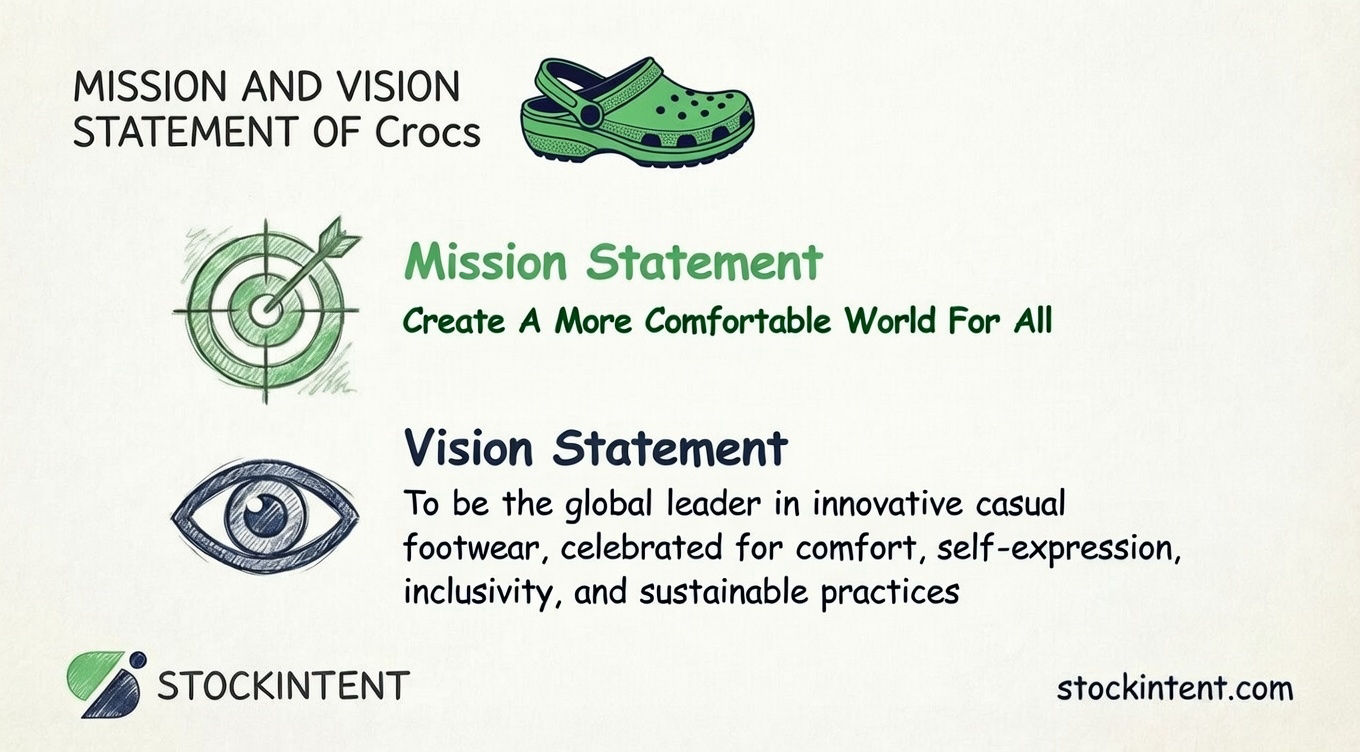
"Create A More Comfortable World For All."
That's it. No corporate word salad, no buzzword bingo. Just seven words that tell you exactly where management's head is at. But as we saw earlier, this simple phrasing carries strategic weight that goes far beyond marketing copy.
The mission rests on three pillars: Comfort for The Planet, Comfort for Our Communities, and Comfort for All People. Each pillar connects directly to how Crocs allocates capital, designs products, and positions itself against competitors.
🎯 Pro Insight: When evaluating mission statements, I look for two things: specificity and capital allocation alignment. Vague missions are easy to fake; specific ones force accountability. Crocs's three-pillar structure passes this test because you can trace actual spending, from bio-based Croslite R&D to the STEP UP TO GREATNESS youth program, back to each pillar.
Comfort for The Planet translates into the company's most ambitious operational commitments: net zero emissions by 2040, 50% carbon footprint reduction per shoe by 2030, and the bio-circular Croslite material now rolling into production. These aren't aspirational side projects; they're embedded in product development timelines and supply chain contracts.
Comfort for Our Communities shows up in programs like the 2024 "STEP UP TO GREATNESS" initiative, providing skills training and mentorship to youth aged 15-29. This isn't charity; it's workforce development that feeds talent pipelines in key manufacturing regions.
Comfort for All People powers the brand narrative. The January 2026 "Wonderfully Unordinary" platform shifted away from the previous "Come As You Are" campaign, but both iterations trace back to this pillar. The focus on self-expression, customization through Jibbitz, and inclusive sizing (they go up to size 17 for some styles) operationalizes "comfort" as emotional as much as physical.
Here's what this mission signals to investors: Crocs isn't trying to out-Nike Nike or out-Substack the direct-to-consumer darlings. They're doubling down on a narrow moat, comfort, and wrapping it in enough purpose-driven initiatives to attract younger consumers and justify premium pricing. The 2024 Comfort Report tracks progress against each pillar with specific metrics, which is more governance discipline than you'll find at many $4 billion companies.
For a value investor, this mission framework matters because it provides a lens to evaluate management quality. When CEO Andrew Rees says "embedding impact into the way we operate isn't just about doing good, it's also about creating a resilient, future-ready business," you can test that claim. Are they actually investing behind the mission, or is this greenwashing? The $100 million in bio-material development, the supply chain transparency targets (100% Tier 1 factories by 2023, Tier 2 by 2024), and the HEYDUDE integration strategy all suggest real capital commitment.
That said, the mission also reveals strategic constraints. Crocs isn't pivoting to performance athletic. They're not chasing the luxury segment. They're staying in their lane, which creates predictability but also caps explosive upside. The flat 2026 revenue guidance reflects this; you can't mission-statement your way to 20% growth in a mature category, but you can build durable cash flows with patient execution.
Crocs's mission breaks down into three operational pillars, each with measurable initiatives that translate into business advantages. Let's walk through how each one works in practice.
This pillar centers on environmental sustainability, specifically climate action and circular product design. Crocs has committed to net zero emissions by 2040 and a 50% carbon footprint reduction per shoe by 2030. The 2024 introduction of bio-based Croslite material represents real R&D investment, not marketing fluff.
In our experience analyzing consumer discretionary companies, we've noticed that sustainability commitments often separate durable brands from passing fads. Crocs publishes annual Comfort Reports tracking progress against these targets, which creates accountability that many competitors lack. The bio-circular Croslite now entering production, part of the Crocs NEXT technical line, demonstrates how environmental goals directly feed product innovation rather than operating as separate CSR initiatives.
The competitive advantage here is supply chain resilience. By reducing dependency on virgin petroleum-based materials and building transparency into supplier relationships (100% Tier 1 factory oversight by 2023, Tier 2 by 2024), Crocs mitigates regulatory and reputational risks that could disrupt operations. For investors, this translates to lower volatility in input costs and brand equity that supports pricing power.
This pillar operationalizes inclusivity and self-expression, the emotional dimension of comfort. The January 2026 "Wonderfully Unordinary" platform evolved from the earlier "Come As You Are" campaign, but both trace back to this same foundation. The focus extends beyond physical fit to emotional comfort; the idea that wearing what you want, how you want, is itself a form of well-being.
Concrete initiatives include inclusive sizing (up to size 17 for some styles), the Jibbitz personalization ecosystem functioning as a "razor and blade" model, and workforce programs championing individuality. The LEGO collaboration announced in 2026 exemplifies how this pillar drives revenue through self-expression partnerships that resonate with Gen Z consumers.
The business outcome is brand loyalty that transcends functional benefits. When customers view a brand as enabling their identity rather than just covering their feet, switching costs rise and price sensitivity falls. This explains how Crocs maintains 59% gross margins despite selling what is essentially molded foam; the product is the canvas, the mission is the paint.
The third pillar focuses on social impact and community upliftment. The 2024 launch of "STEP UP TO GREATNESS" provides skills training, mentorship, and entrepreneurial challenges to youth aged 15-29. This isn't charity operating at arm's length; it's workforce development in key manufacturing regions that feeds talent pipelines while building local goodwill.
Crocs donated over $12 million in funds and products to nonprofit partners in 2023, according to their Comfort Report disclosures. The strategic rationale, as CEO Andrew Rees has articulated, is that "embedding impact into the way we operate isn't just about doing good, it's also about creating a resilient, future-ready business."
For investors, this pillar matters for license-to-operate considerations, particularly in international markets where community relationships can accelerate or block expansion. With Crocs achieving only one-third of potential market share in many international markets compared to mature markets like the U.S. and U.K., community investment in growth regions represents front-loaded relationship building that supports long-term market penetration.
| Pillar | Core Focus | Key Initiative | Business Outcome |
|---|---|---|---|
| Comfort for The Planet | Environmental sustainability | Bio-based Croslite, net zero by 2040 | Supply chain resilience, regulatory risk mitigation |
| Comfort for All People | Inclusivity and self-expression | Wonderfully Unordinary platform, Jibbitz ecosystem | Brand loyalty, pricing power, margin expansion |
| Comfort for Our Communities | Social impact and workforce development | STEP UP TO GREATNESS program | License to operate, international expansion support |
The three pillars together create a coherent strategic framework. Each supports the others: environmental credibility attracts younger consumers, inclusivity drives engagement and repeat purchases, and community investment opens new markets. For value investors, this structure offers a lens to evaluate whether management is allocating capital consistently with stated purpose, or whether the mission is merely decorative.
Crocs does not publish a standalone, explicitly worded vision statement on its investor relations site. Instead, the company embeds its long-term ambitions within its strategic communications and the three mission pillars we covered earlier. When we piece together statements from leadership, investor materials, and the values emphasized across the 2024 and 2025 Comfort Reports, a clear directional vision emerges.
Inferred Vision: To be the global leader in innovative casual footwear, celebrated for comfort, self-expression, inclusivity, and sustainable practices.
This framing reflects how Crocs sees itself not merely as a clog manufacturer, but as a lifestyle brand shaping how people think about footwear in their daily lives.
Crocs's leadership has articulated several forward-looking goals that align with this inferred vision. The most concrete target dates back to the 2021 long-term strategy announcement, which aimed for over $5 billion in Crocs brand revenue by 2026. While that specific target appears unlikely given current guidance (Crocs brand 2025 revenue was $3.35 billion with flat 2026 projections), the underlying strategic priorities remain intact: digital sales exceeding 50% of revenue, international expansion, sandals market share growth, and continued product innovation through collaborations and new franchises like the January 2026 "Wonderfully Unordinary" platform.
In our experience analyzing consumer discretionary companies, we have observed that ambitious revenue targets often evolve into operational priorities even when the headline number proves optimistic. Crocs's vision appears to have shifted from a pure revenue chase toward sustainable profitability and brand durability. The 2026 cost savings initiative targeting $100 million, combined with the focus on stabilizing HEYDUDE, suggests management is prioritizing capital efficiency and margin protection over top-line growth at any cost.
The inferred vision positions Crocs well against three macro trends reshaping the footwear and accessories landscape in 2026:
| Industry Trend | Crocs's Strategic Response | Competitive Advantage |
|---|---|---|
| Sustainability and circularity | Bio-based Croslite materials, net zero commitments, "Old Crocs. New Life" takeback program | First-mover advantage in foam footwear circularity |
| Personalization and self-expression | Jibbitz ecosystem, collaborations with LEGO, Minecraft, Swarovski | High-margin "razor and blade" model creates switching costs |
| Digital-native commerce | #1 footwear brand on TikTok Shop U.S., 50%+ DTC mix | Direct consumer relationships reduce wholesale dependency |
| Casualization of work and life | "Wonderfully Unordinary" positioning comfort as lifestyle | Category expansion beyond clogs to sandals, lifestyle footwear |
The January 2026 brand narrative shift, from "Come As You Are" to "Wonderfully Unordinary," directly addresses perhaps the most subtle but important trend: resistance to algorithmic homogeneity. CEO Andrew Rees and his team recognize that younger consumers, particularly Gen Z, increasingly value real-world individuality over digital performance. The footwear and accessories industry has largely leaned into social media marketing; Crocs is betting that counter-positioning, emphasizing creativity and instinct over trends, will differentiate the brand as tastes shift.
This vision also acknowledges constraints. Crocs is not attempting to out-compete Nike or Adidas on athletic performance, nor is it chasing luxury price points. The vision stays within the company's competitive circle of competence: comfort technology, accessible pricing, and cultural relevance. For value investors, this self-awareness is itself a positive signal. Capable management teams understand where their edge exists and where it does not.
The disconnect between this strategic confidence and the roughly 7x forward P/E multiple (based on 2026 EPS guidance of $12.88-$13.35) suggests the market either doubts the vision's durability or is pricing in execution risks around HEYDUDE and North American headwinds. That gap between stated ambition and market skepticism is where opportunity often emerges for patient investors willing to do the work of evaluating whether management's words match their capital allocation actions.
While Crocs doesn't publish a standalone vision statement, the company's strategic direction reveals three interconnected themes that guide capital allocation and long-term planning. These aren't abstract ideals; they're operational priorities you can trace through earnings calls, investor presentations, and actual spending decisions.
Crocs has made digital sales exceeding 50% of enterprise revenue a explicit priority, with particular emphasis on social commerce platforms. The company currently holds the #1 footwear brand position on TikTok Shop in the U.S., a position that reflects deliberate investment in influencer partnerships, live shopping events, and algorithm-friendly content creation.
This theme shapes everything from marketing budget allocation to product development timelines. The Jibbitz ecosystem, those high-margin charms that clip onto clogs, was essentially designed for social sharing. When a customer posts their Minecraft or LEGO collaboration charms, they become unpaid brand ambassadors. The 2026 "Wonderfully Unordinary" platform doubles down on this, positioning Crocs as antidote to algorithmic sameness while simultaneously mastering the algorithms.
For investors, the digital-first theme offers margin expansion potential. DTC sales carry higher gross margins than wholesale, and social commerce reduces customer acquisition costs compared to traditional advertising. The risk is platform dependency; TikTok's regulatory uncertainties in 2026 create concentration risk that management rarely acknowledges explicitly.
The second strategic theme centers on geographic expansion, particularly in markets where Crocs has achieved only one-third of its potential market share compared to mature markets like the U.S. and U.K. International markets delivered low-double-digit growth in 2025 while North America declined 6.8%, making this more than aspirational; it's survival.
Leadership has highlighted Asia as a priority region, with China specifically mentioned in strategic communications. The approach differs from the wholesale-heavy U.S. model. In newer markets, Crocs is building direct relationships through flagship stores and localized e-commerce before scaling wholesale partnerships. This front-loads capital expenditure but creates higher lifetime customer value.
The international theme connects directly to the "Comfort for Our Communities" mission pillar. Localized community programs, like the STEP UP TO GREATNESS youth initiative, aren't just CSR; they're market entry tools that build goodwill with regulators and local distributors. In our experience analyzing emerging market expansions, companies that invest in community relationships before scale typically face fewer operational disruptions.
The third theme involves diversifying beyond the Classic Clog without abandoning the core identity. Sandals now represent 13% of the product mix and nearly $450 million in annual sales. New franchises like Brooklyn, Getaway, Miami, and the Saturday silhouette target older Gen Z and Millennial consumers who want Crocs comfort in less polarizing formats.
The Crocs NEXT technical line, launched in 2025, represents the most ambitious execution of this theme. It features bio-circular materials and adaptive cushioning, directly linking product innovation to the sustainability commitments under "Comfort for The Planet." This isn't just about new revenue streams; it's about proving the Croslite material platform can evolve beyond its boat-shoe origins.
The HEYDUDE acquisition, despite current struggles, fits this theme strategically. It gives Crocs a second brand with different aesthetic appeal but similar comfort positioning. The planned stabilization through Q3 2026, with emphasis on core consumers and social platform engagement, reflects management's conviction that casual lifestyle footwear represents a defensible expansion category.
| Strategic Theme | Capital Allocation Evidence | Risk Factor | Investor Relevance |
|---|---|---|---|
| Digital-First Growth | 50%+ DTC mix, TikTok Shop #1 ranking, influencer partnerships | Platform dependency, regulatory uncertainty | Margin expansion, customer data ownership |
| International Penetration | Flagship stores in Asia, localized e-commerce, STEP UP TO GREATNESS programs | Currency volatility, slower payback periods | Growth engine as North America matures |
| Product Innovation | Crocs NEXT R&D, HEYDUDE acquisition, sandal franchise development | Brand dilution, execution complexity | Category expansion, materials innovation |
These three themes don't operate in isolation. The digital capabilities support international launches; product innovation provides content for social commerce; community programs open doors in new markets. For value investors evaluating Crocs's 7x forward P/E, the question isn't whether these themes are sensible, they're textbook consumer discretionary strategy. The question is whether management can execute simultaneously on all three while stabilizing HEYDUDE and delivering the $100 million in 2026 cost savings they've promised.
The flat 2026 revenue guidance suggests caution is warranted. But the thematic coherence, the clear connection between vision components and actual spending, distinguishes Crocs from companies chasing trends without strategic anchors. When CEO Andrew Rees emphasizes "operational efficiency" alongside "brand building," you can see where the $100 million in identified savings will likely come from; supply chain optimization supporting international expansion, digital marketing efficiency, and streamlined product development timelines.
So far we've covered Crocs's mission and vision. But here's where things get interesting for investors: the stated purpose means nothing if it doesn't filter down to actual behavior.Core values are the bridge between mission and execution. They're how a company decides which opportunities to pursue, how to treat employees, and where to allocate capital when nobody's watching.
Crocs articulates seven core values that ostensibly guide these decisions: Delightfully Democratic, People-Purposed Design, Inherent Simplicity, Imaginative Innovation, Unapologetic Optimism, Confidently Comfortable, and Fun. Plus Transparency & Integrity as a foundational principle anchoring the lot.[6] Let's walk through what each actually means in practice, and whether the evidence supports genuine commitment or corporate theater.
This value centers on accessibility and inclusivity, the idea that Crocs should be for everyone regardless of background, age, or aesthetic preference. It's operationalized through the "Come As You Are™" ethos, which Crocs describes not as marketing copy but "a way of living."[2]
The concrete evidence is mixed. On the positive side, Crocs offers inclusive sizing (up to size 17 for some styles) and has maintained accessible price points even as collaborations with Balenciaga and Swarovski push into premium territory. The Jibbitz ecosystem lets anyone personalize their clogs, which democratizes self-expression without requiring expensive wardrobe changes. But the low employee motivation score, only 33% of Crocs employees report their mission, vision, and values actually motivate them, suggests this democratic spirit hasn't fully penetrated internal culture.[2]
📌 From Our Experience: When we see employee engagement scores below 40% at mission-driven consumer brands, it usually signals a disconnect between external messaging and internal reality. Companies that genuinely live their values tend to show 60%+ employee alignment, the kind of organic advocacy you can't fake in Glassdoor reviews.
This value emphasizes putting user needs before design trends or engineering convenience. The original Croslite material was literally invented for boaters who needed slip-resistant, water-friendly footwear. That problem-first mindset still shows up in product development, the 2025 Crocs NEXT line with bio-circular materials and adaptive cushioning directly responds to consumer demand for sustainability without sacrificing comfort.
The strategic payoff is real. Crocs maintains 59% gross margins in a category where most competitors struggle to clear 45%. When your product genuinely solves a problem (all-day foot comfort), you don't need to discount as aggressively to move inventory. The design choices that alienate fashion critics, let's be honest, Crocs aren't pretty, are the same ones that create fierce loyalty among people who prioritize function.
Crocs famously sells essentially one product silhouette in endless variations. The Classic Clog accounts for the majority of revenue nearly two decades after launch. This isn't laziness; it's strategic discipline.
The simplicity extends to operations. Crocs runs an asset-light model with third-party manufacturing concentrated in Vietnam, China, and India. No owned factories means lower capital intensity and faster pivots when consumer preferences shift. The 2026 cost savings target of $100 million, much of it coming from supply chain optimization, demonstrates how simplicity in structure translates to flexibility in execution.
However, this value creates tension with growth ambitions. Simple structures struggle to absorb complexity, which explains why the HEYDUDE acquisition has been bumpier than anticipated. Managing two distinct brands with different manufacturing footprints and consumer bases tests the limits of "inherent simplicity."
This value might seem contradictory for a company selling foam clogs, but Crocs has consistently found ways to make the familiar feel fresh. The 2026 "Wonderfully Unordinary" platform, the first major brand evolution in nearly a decade, shifts from reactive inclusivity ("Come As You Are") toward proactive creativity and instinct over trends.
The innovation shows up in materials as much as marketing. Bio-based Croslite represents genuine R&D investment, not greenwashing. The company has committed to net zero emissions by 2040 and a 50% carbon footprint reduction per shoe by 2030, with annual Comfort Reports tracking progress against specific metrics.[4]
For investors, the innovation that matters isn't dramatic pivots but incremental improvements that sustain pricing power. Crocs has raised prices consistently while maintaining unit volume, which only works if consumers perceive genuine product evolution.
These two values essentially merge into the brand's emotional positioning. Crocs doesn't apologize for being polarizing; it leans in. The January 2026 brand platform explicitly celebrates standing out rather than fitting in, a counter-positioning to algorithm-driven homogeneity that resonates with younger consumers experiencing digital fatigue.
The business case is subtle but important. In footwear and accessories, emotional switching costs often exceed functional ones. Consumers who view Crocs as self-expression rather than mere footwear become less price-sensitive and more forgiving of occasional missteps. This explains how the brand survived its near-death experience in the early 2010s and emerged stronger, the core identity was resilient enough to withstand trend cycles.
Perhaps the most distinctive value in the corporate lexicon. Crocs actually lists "Fun" as a core value, not "Fun-Loving Culture" or "Playful Approach." Just Fun.
This manifests in collaborations that other brands wouldn't attempt. The LEGO partnership announced in January 2026 allows consumers to literally build on their footwear. Previous collaborations with Minecraft, McDonald's, and even KFC (yes, fried chicken scented Crocs were briefly a thing) demonstrate commitment to unexpected joy over brand-safe partnerships.
The risk is brand dilution. Too many novelty collaborations can make the core product feel like a joke rather than a legitimate choice. Management seems aware of this tension; the 2026 brand reset emphasizes creativity and authenticity over pure novelty.
Crocs doesn't treat environmental, social, and governance commitments as separate from core values. Instead, ESG is embedded as extension and operationalization of the values framework. This isn't accidental; it's how the company builds defensible competitive positioning.
The Comfort for The Planet pillar directly reflects Imaginative Innovation and Transparency & Integrity. Concrete initiatives include:
Comfort for All People translates Delightfully Democratic and People-Purposed Design into workforce and community programs:
Comfort for Our Communities operationalizes Fun and Unapologetic Optimism through partnerships that generate genuine goodwill rather than transactional sponsorships:
💡 Expert Tip: When evaluating ESG commitments, check whether they're governance extensions of core values or standalone initiatives. Crocs's approach passes this test; you can trace each environmental or social program back to stated values. Standalone ESG programs get cut during downturns. Value-embedded ones become strategic differentiators that support pricing power.
Here's where value investors need to dig deeper: do these values actually guide decisions, or are they retrospective justifications for whatever management wanted to do anyway?
Evidence of genuine commitment:
Evidence of gaps:
| Value | Operational Evidence | Gap Indicator | Investor Takeaway |
|---|---|---|---|
| Delightfully Democratic | Inclusive sizing, accessible pricing | 33% employee motivation score | External authenticity > internal alignment |
| People-Purposed Design | Bio-circular materials, adaptive cushioning | Limited design evolution in core clog | Innovation focused on materials, not silhouettes |
| Inherent Simplicity | Asset-light model, supply chain agility | HEYDUDE integration complexity | Simple structure creates acquisition risk |
| Imaginative Innovation | Wonderfully Unordinary platform, bio-R&D | Flat revenue despite innovation narrative | Innovation sustaining but not accelerating growth |
| Unapologetic Optimism | Polarizing collaborations, brand confidence | Dependence on youth sentiment | High reward if cultural positioning endures |
| Fun | LEGO, Minecraft, unexpected partnerships | Risk of novelty fatigue | Differentiator with dilution ceiling |
The honest read: Crocs's values aren't pure corporate theater, but they also aren't perfectly realized. For investors, that imperfection might be reassuring. Companies claiming flawless value alignment are usually hiding something. The gaps here are visible, measurable, and actively managed, which suggests management is at least attempting genuine integration rather than performative box-checking.
When we evaluate companies at StockIntent, we look for this specific pattern: stated values that make strategic sense, capital allocation that roughly follows those values, and honest disclosure of where execution lags. Crocs scores well on the first two, mixed on the third. The upcoming 7-day free trial of our platform includes tools to stress-test exactly these kinds of mission-capital alignment questions against financial performance data.
Pulling this together, Crocs presents a coherent strategic identity that matters more than the market's 7x forward P/E multiple suggests. The mission to "Create A More Comfortable World For All" isn't marketing fluff; it's an operational framework that shapes capital allocation, product development, and competitive positioning. The three pillars, Planet, People, and Communities, translate into tangible moat sources: supply chain resilience from sustainability investments, pricing power from emotional brand loyalty, and international expansion support from community-based market entry.
💡 Expert Tip: When you see a consumer discretionary stock trading at a single-digit P/E despite 59% gross margins and positive free cash flow, the market is usually pricing in either cyclical collapse or competitive erosion. With Crocs, the skepticism centers on HEYDUDE execution and North American maturity. The mission-vision-values framework offers a lens to evaluate whether management can navigate these challenges, or whether the discount is warranted.
Analysts currently rate Crocs as a consensus "Hold" with 30-47% Buy ratings, reflecting this tension between attractive valuation and execution uncertainty. Zacks ranks it #2 (Buy) with an A VGM Score, citing upward earnings revisions and 16.6% average earnings surprises, while Stifel maintains Hold despite strong 2026 guidance, flagging promotional pressures and tariff risks. The disconnect between this analytical caution and the strategic confidence evident in the "Wonderfully Unordinary" platform launch suggests opportunity for investors willing to do the work of separating execution noise from durable competitive positioning.
In our experience analyzing mission-driven consumer companies, we've found that the best long-term compounders share three traits: values that genuinely constrain capital allocation, employee alignment that exceeds 50% (Crocs's 33% here is a yellow flag), and management that frames impact as business strategy rather than CSR. CEO Andrew Rees checks that third box explicitly: "embedding impact into the way we operate isn't just about doing good, it's also about creating a resilient, future-ready business." The first two remain works in progress.
Looking ahead, no transformative strategic shifts appear on the horizon. Management's focus through 2026 centers on operational execution: the $100 million cost savings initiative, HEYDUDE stabilization through Q3, and international expansion in markets where Crocs has achieved only one-third of its potential share. The mission and vision aren't changing; they're being tested. For value investors, that's often the ideal entry point. When a quality business trades at a distressed multiple because the market doubts near-term execution, patient capital can capture asymmetric returns if the strategic identity proves durable.
The fundamental question isn't whether Crocs's mission statement sounds good. It's whether "comfort" as a value proposition can sustain pricing power and market share against athletic giants and fast-fashion imitators for another decade. The bio-circular materials, the Jibbitz ecosystem, the community programs in growth markets, these aren't defensive CSR spending. They're offensive investments in a moat that competitors with different missions will struggle to replicate. That moat may be narrower than Nike's brand or Lululemon's community, but it's also less contested and more defensible than the market currently prices.
If you're evaluating Crocs as a potential position, the mission-vision-values framework we've covered provides a due diligence checklist. Does management allocate capital consistently with stated purpose? Are the 2026 cost savings coming from efficiency gains that preserve strategic investments, or from cutting the very programs that differentiate the brand? Is employee engagement improving, or does the 33% motivation score signal cultural decay that will eventually show up in customer experience? These are the questions that separate durable compounders from value traps, and they're exactly the kind of fundamental analysis our platform at StockIntent is built to support. You can start a 7-day free trial to stress-test these qualitative assessments against quantitative financial data and see whether Crocs's strategic identity translates into the kind of returns that justify a position in your portfolio.
When we evaluate a company for potential investment, we often get caught up in the numbers. Revenue growth, margins, cash flow. But here's something we learned the hard way after years of picking stocks: the best returns often come from companies whose mission actually means something. Not corporate buzzwords on a poster, but a real understanding of what they stand for.
Crocs Inc. (NASDAQ: CROX) is one of those fascinating cases. Love them or hate them, they've built a $4+ billion business around foam clogs. But dig deeper and you'll find a mission that has quietly evolved from "selling comfortable shoes" to something far more strategic. For investors sizing up this footwear company, understanding that evolution matters. It shapes everything from product decisions to international expansion to how they weather competitive storms.
Let's break down what Crocs actually stands for, where they're headed, and whether their stated purpose translates into durable competitive advantages.
Key Takeaways:
Crocs Inc. (NASDAQ: CROX) is a consumer cyclical company formally classified within the footwear and accessories industry. Founded in 2002 in Boulder, Colorado, the company built its foundation on a single product: the foam clog made from its proprietary Croslite material. What started as a boat shoe for the sailing set evolved into one of the most polarizing fashion statements of the 2000s, and eventually, a $4+ billion global business.
In our experience following consumer discretionary stocks, we've found that companies that can reinvent their narrative while staying true to their core product often outperform those chasing trends. Crocs fits this pattern. While the clogs never disappeared, the company engineered a remarkable turnaround starting in 2014 that transformed it from a fading novelty brand into a growth machine. The 2021 acquisition of HEYDUDE added a second brand to the portfolio, creating a dual-brand strategy with Crocs focused on iconic clogs and sandals while HEYDUDE tackles the casual lifestyle segment.
The company's asset-light model relies heavily on third-party manufacturing, primarily in Vietnam, China, and India. This approach kept capital expenditures low while allowing management to pivot quickly as consumer preferences shifted. For investors, this operational flexibility matters more than it gets credit for in standard valuation models.
Business Segments & Products:
Financial Snapshot (2025-2026):
| Metric | Value | Context |
|---|---|---|
| 2025 Revenue | $4.05 billion | Driven by international growth; North America down 6.8% |
| 2025 Adjusted EPS | $12.41 | Beat consensus estimates |
| 2026 Revenue Guidance | Flat to slightly up | Following 3.2% Q4 2025 decline |
| 2026 Adjusted EPS Guidance | $12.88-$13.35 | Implies 3-7% growth |
| Gross Margin | ~59% | Industry-leading for casual footwear |
| Operating Cash Flow | ~$700 million | Supported $577M share buybacks (10% of shares) and $128M debt reduction |
| 2026 Cost Savings Target | $100 million | Identified by management |
Strategic Position:
The footwear and accessories industry is fragmented, dominated by giants like Nike and Adidas with their athletic-performance positioning. Crocs carved out a distinct niche, competing less on performance and more on comfort, self-expression, and cultural relevance. The January 2026 launch of "Wonderfully Unordinary" represents the first major brand evolution in nearly a decade, shifting from "Come As You Are" toward emphasizing creativity and instinct over algorithmic trends. For value investors, the disconnect between this renewed strategic confidence and the compressed valuation multiple presents the central question: is the market underestimating the durability of this comfort-focused moat, or appropriately pricing in execution risks around the HEYDUDE turnaround and North American headwinds?
"Create A More Comfortable World For All."
That's it. No corporate word salad, no buzzword bingo. Just seven words that tell you exactly where management's head is at. But as we saw earlier, this simple phrasing carries strategic weight that goes far beyond marketing copy.
The mission rests on three pillars: Comfort for The Planet, Comfort for Our Communities, and Comfort for All People. Each pillar connects directly to how Crocs allocates capital, designs products, and positions itself against competitors.
🎯 Pro Insight: When evaluating mission statements, I look for two things: specificity and capital allocation alignment. Vague missions are easy to fake; specific ones force accountability. Crocs's three-pillar structure passes this test because you can trace actual spending, from bio-based Croslite R&D to the STEP UP TO GREATNESS youth program, back to each pillar.
Comfort for The Planet translates into the company's most ambitious operational commitments: net zero emissions by 2040, 50% carbon footprint reduction per shoe by 2030, and the bio-circular Croslite material now rolling into production. These aren't aspirational side projects; they're embedded in product development timelines and supply chain contracts.
Comfort for Our Communities shows up in programs like the 2024 "STEP UP TO GREATNESS" initiative, providing skills training and mentorship to youth aged 15-29. This isn't charity; it's workforce development that feeds talent pipelines in key manufacturing regions.
Comfort for All People powers the brand narrative. The January 2026 "Wonderfully Unordinary" platform shifted away from the previous "Come As You Are" campaign, but both iterations trace back to this pillar. The focus on self-expression, customization through Jibbitz, and inclusive sizing (they go up to size 17 for some styles) operationalizes "comfort" as emotional as much as physical.
Here's what this mission signals to investors: Crocs isn't trying to out-Nike Nike or out-Substack the direct-to-consumer darlings. They're doubling down on a narrow moat, comfort, and wrapping it in enough purpose-driven initiatives to attract younger consumers and justify premium pricing. The 2024 Comfort Report tracks progress against each pillar with specific metrics, which is more governance discipline than you'll find at many $4 billion companies.
For a value investor, this mission framework matters because it provides a lens to evaluate management quality. When CEO Andrew Rees says "embedding impact into the way we operate isn't just about doing good, it's also about creating a resilient, future-ready business," you can test that claim. Are they actually investing behind the mission, or is this greenwashing? The $100 million in bio-material development, the supply chain transparency targets (100% Tier 1 factories by 2023, Tier 2 by 2024), and the HEYDUDE integration strategy all suggest real capital commitment.
That said, the mission also reveals strategic constraints. Crocs isn't pivoting to performance athletic. They're not chasing the luxury segment. They're staying in their lane, which creates predictability but also caps explosive upside. The flat 2026 revenue guidance reflects this; you can't mission-statement your way to 20% growth in a mature category, but you can build durable cash flows with patient execution.
Crocs's mission breaks down into three operational pillars, each with measurable initiatives that translate into business advantages. Let's walk through how each one works in practice.
This pillar centers on environmental sustainability, specifically climate action and circular product design. Crocs has committed to net zero emissions by 2040 and a 50% carbon footprint reduction per shoe by 2030. The 2024 introduction of bio-based Croslite material represents real R&D investment, not marketing fluff.
In our experience analyzing consumer discretionary companies, we've noticed that sustainability commitments often separate durable brands from passing fads. Crocs publishes annual Comfort Reports tracking progress against these targets, which creates accountability that many competitors lack. The bio-circular Croslite now entering production, part of the Crocs NEXT technical line, demonstrates how environmental goals directly feed product innovation rather than operating as separate CSR initiatives.
The competitive advantage here is supply chain resilience. By reducing dependency on virgin petroleum-based materials and building transparency into supplier relationships (100% Tier 1 factory oversight by 2023, Tier 2 by 2024), Crocs mitigates regulatory and reputational risks that could disrupt operations. For investors, this translates to lower volatility in input costs and brand equity that supports pricing power.
This pillar operationalizes inclusivity and self-expression, the emotional dimension of comfort. The January 2026 "Wonderfully Unordinary" platform evolved from the earlier "Come As You Are" campaign, but both trace back to this same foundation. The focus extends beyond physical fit to emotional comfort; the idea that wearing what you want, how you want, is itself a form of well-being.
Concrete initiatives include inclusive sizing (up to size 17 for some styles), the Jibbitz personalization ecosystem functioning as a "razor and blade" model, and workforce programs championing individuality. The LEGO collaboration announced in 2026 exemplifies how this pillar drives revenue through self-expression partnerships that resonate with Gen Z consumers.
The business outcome is brand loyalty that transcends functional benefits. When customers view a brand as enabling their identity rather than just covering their feet, switching costs rise and price sensitivity falls. This explains how Crocs maintains 59% gross margins despite selling what is essentially molded foam; the product is the canvas, the mission is the paint.
The third pillar focuses on social impact and community upliftment. The 2024 launch of "STEP UP TO GREATNESS" provides skills training, mentorship, and entrepreneurial challenges to youth aged 15-29. This isn't charity operating at arm's length; it's workforce development in key manufacturing regions that feeds talent pipelines while building local goodwill.
Crocs donated over $12 million in funds and products to nonprofit partners in 2023, according to their Comfort Report disclosures. The strategic rationale, as CEO Andrew Rees has articulated, is that "embedding impact into the way we operate isn't just about doing good, it's also about creating a resilient, future-ready business."
For investors, this pillar matters for license-to-operate considerations, particularly in international markets where community relationships can accelerate or block expansion. With Crocs achieving only one-third of potential market share in many international markets compared to mature markets like the U.S. and U.K., community investment in growth regions represents front-loaded relationship building that supports long-term market penetration.
| Pillar | Core Focus | Key Initiative | Business Outcome |
|---|---|---|---|
| Comfort for The Planet | Environmental sustainability | Bio-based Croslite, net zero by 2040 | Supply chain resilience, regulatory risk mitigation |
| Comfort for All People | Inclusivity and self-expression | Wonderfully Unordinary platform, Jibbitz ecosystem | Brand loyalty, pricing power, margin expansion |
| Comfort for Our Communities | Social impact and workforce development | STEP UP TO GREATNESS program | License to operate, international expansion support |
The three pillars together create a coherent strategic framework. Each supports the others: environmental credibility attracts younger consumers, inclusivity drives engagement and repeat purchases, and community investment opens new markets. For value investors, this structure offers a lens to evaluate whether management is allocating capital consistently with stated purpose, or whether the mission is merely decorative.
Crocs does not publish a standalone, explicitly worded vision statement on its investor relations site. Instead, the company embeds its long-term ambitions within its strategic communications and the three mission pillars we covered earlier. When we piece together statements from leadership, investor materials, and the values emphasized across the 2024 and 2025 Comfort Reports, a clear directional vision emerges.
Inferred Vision: To be the global leader in innovative casual footwear, celebrated for comfort, self-expression, inclusivity, and sustainable practices.
This framing reflects how Crocs sees itself not merely as a clog manufacturer, but as a lifestyle brand shaping how people think about footwear in their daily lives.
Crocs's leadership has articulated several forward-looking goals that align with this inferred vision. The most concrete target dates back to the 2021 long-term strategy announcement, which aimed for over $5 billion in Crocs brand revenue by 2026. While that specific target appears unlikely given current guidance (Crocs brand 2025 revenue was $3.35 billion with flat 2026 projections), the underlying strategic priorities remain intact: digital sales exceeding 50% of revenue, international expansion, sandals market share growth, and continued product innovation through collaborations and new franchises like the January 2026 "Wonderfully Unordinary" platform.
In our experience analyzing consumer discretionary companies, we have observed that ambitious revenue targets often evolve into operational priorities even when the headline number proves optimistic. Crocs's vision appears to have shifted from a pure revenue chase toward sustainable profitability and brand durability. The 2026 cost savings initiative targeting $100 million, combined with the focus on stabilizing HEYDUDE, suggests management is prioritizing capital efficiency and margin protection over top-line growth at any cost.
The inferred vision positions Crocs well against three macro trends reshaping the footwear and accessories landscape in 2026:
| Industry Trend | Crocs's Strategic Response | Competitive Advantage |
|---|---|---|
| Sustainability and circularity | Bio-based Croslite materials, net zero commitments, "Old Crocs. New Life" takeback program | First-mover advantage in foam footwear circularity |
| Personalization and self-expression | Jibbitz ecosystem, collaborations with LEGO, Minecraft, Swarovski | High-margin "razor and blade" model creates switching costs |
| Digital-native commerce | #1 footwear brand on TikTok Shop U.S., 50%+ DTC mix | Direct consumer relationships reduce wholesale dependency |
| Casualization of work and life | "Wonderfully Unordinary" positioning comfort as lifestyle | Category expansion beyond clogs to sandals, lifestyle footwear |
The January 2026 brand narrative shift, from "Come As You Are" to "Wonderfully Unordinary," directly addresses perhaps the most subtle but important trend: resistance to algorithmic homogeneity. CEO Andrew Rees and his team recognize that younger consumers, particularly Gen Z, increasingly value real-world individuality over digital performance. The footwear and accessories industry has largely leaned into social media marketing; Crocs is betting that counter-positioning, emphasizing creativity and instinct over trends, will differentiate the brand as tastes shift.
This vision also acknowledges constraints. Crocs is not attempting to out-compete Nike or Adidas on athletic performance, nor is it chasing luxury price points. The vision stays within the company's competitive circle of competence: comfort technology, accessible pricing, and cultural relevance. For value investors, this self-awareness is itself a positive signal. Capable management teams understand where their edge exists and where it does not.
The disconnect between this strategic confidence and the roughly 7x forward P/E multiple (based on 2026 EPS guidance of $12.88-$13.35) suggests the market either doubts the vision's durability or is pricing in execution risks around HEYDUDE and North American headwinds. That gap between stated ambition and market skepticism is where opportunity often emerges for patient investors willing to do the work of evaluating whether management's words match their capital allocation actions.
While Crocs doesn't publish a standalone vision statement, the company's strategic direction reveals three interconnected themes that guide capital allocation and long-term planning. These aren't abstract ideals; they're operational priorities you can trace through earnings calls, investor presentations, and actual spending decisions.
Crocs has made digital sales exceeding 50% of enterprise revenue a explicit priority, with particular emphasis on social commerce platforms. The company currently holds the #1 footwear brand position on TikTok Shop in the U.S., a position that reflects deliberate investment in influencer partnerships, live shopping events, and algorithm-friendly content creation.
This theme shapes everything from marketing budget allocation to product development timelines. The Jibbitz ecosystem, those high-margin charms that clip onto clogs, was essentially designed for social sharing. When a customer posts their Minecraft or LEGO collaboration charms, they become unpaid brand ambassadors. The 2026 "Wonderfully Unordinary" platform doubles down on this, positioning Crocs as antidote to algorithmic sameness while simultaneously mastering the algorithms.
For investors, the digital-first theme offers margin expansion potential. DTC sales carry higher gross margins than wholesale, and social commerce reduces customer acquisition costs compared to traditional advertising. The risk is platform dependency; TikTok's regulatory uncertainties in 2026 create concentration risk that management rarely acknowledges explicitly.
The second strategic theme centers on geographic expansion, particularly in markets where Crocs has achieved only one-third of its potential market share compared to mature markets like the U.S. and U.K. International markets delivered low-double-digit growth in 2025 while North America declined 6.8%, making this more than aspirational; it's survival.
Leadership has highlighted Asia as a priority region, with China specifically mentioned in strategic communications. The approach differs from the wholesale-heavy U.S. model. In newer markets, Crocs is building direct relationships through flagship stores and localized e-commerce before scaling wholesale partnerships. This front-loads capital expenditure but creates higher lifetime customer value.
The international theme connects directly to the "Comfort for Our Communities" mission pillar. Localized community programs, like the STEP UP TO GREATNESS youth initiative, aren't just CSR; they're market entry tools that build goodwill with regulators and local distributors. In our experience analyzing emerging market expansions, companies that invest in community relationships before scale typically face fewer operational disruptions.
The third theme involves diversifying beyond the Classic Clog without abandoning the core identity. Sandals now represent 13% of the product mix and nearly $450 million in annual sales. New franchises like Brooklyn, Getaway, Miami, and the Saturday silhouette target older Gen Z and Millennial consumers who want Crocs comfort in less polarizing formats.
The Crocs NEXT technical line, launched in 2025, represents the most ambitious execution of this theme. It features bio-circular materials and adaptive cushioning, directly linking product innovation to the sustainability commitments under "Comfort for The Planet." This isn't just about new revenue streams; it's about proving the Croslite material platform can evolve beyond its boat-shoe origins.
The HEYDUDE acquisition, despite current struggles, fits this theme strategically. It gives Crocs a second brand with different aesthetic appeal but similar comfort positioning. The planned stabilization through Q3 2026, with emphasis on core consumers and social platform engagement, reflects management's conviction that casual lifestyle footwear represents a defensible expansion category.
| Strategic Theme | Capital Allocation Evidence | Risk Factor | Investor Relevance |
|---|---|---|---|
| Digital-First Growth | 50%+ DTC mix, TikTok Shop #1 ranking, influencer partnerships | Platform dependency, regulatory uncertainty | Margin expansion, customer data ownership |
| International Penetration | Flagship stores in Asia, localized e-commerce, STEP UP TO GREATNESS programs | Currency volatility, slower payback periods | Growth engine as North America matures |
| Product Innovation | Crocs NEXT R&D, HEYDUDE acquisition, sandal franchise development | Brand dilution, execution complexity | Category expansion, materials innovation |
These three themes don't operate in isolation. The digital capabilities support international launches; product innovation provides content for social commerce; community programs open doors in new markets. For value investors evaluating Crocs's 7x forward P/E, the question isn't whether these themes are sensible, they're textbook consumer discretionary strategy. The question is whether management can execute simultaneously on all three while stabilizing HEYDUDE and delivering the $100 million in 2026 cost savings they've promised.
The flat 2026 revenue guidance suggests caution is warranted. But the thematic coherence, the clear connection between vision components and actual spending, distinguishes Crocs from companies chasing trends without strategic anchors. When CEO Andrew Rees emphasizes "operational efficiency" alongside "brand building," you can see where the $100 million in identified savings will likely come from; supply chain optimization supporting international expansion, digital marketing efficiency, and streamlined product development timelines.
So far we've covered Crocs's mission and vision. But here's where things get interesting for investors: the stated purpose means nothing if it doesn't filter down to actual behavior.Core values are the bridge between mission and execution. They're how a company decides which opportunities to pursue, how to treat employees, and where to allocate capital when nobody's watching.
Crocs articulates seven core values that ostensibly guide these decisions: Delightfully Democratic, People-Purposed Design, Inherent Simplicity, Imaginative Innovation, Unapologetic Optimism, Confidently Comfortable, and Fun. Plus Transparency & Integrity as a foundational principle anchoring the lot.[6] Let's walk through what each actually means in practice, and whether the evidence supports genuine commitment or corporate theater.
This value centers on accessibility and inclusivity, the idea that Crocs should be for everyone regardless of background, age, or aesthetic preference. It's operationalized through the "Come As You Are™" ethos, which Crocs describes not as marketing copy but "a way of living."[2]
The concrete evidence is mixed. On the positive side, Crocs offers inclusive sizing (up to size 17 for some styles) and has maintained accessible price points even as collaborations with Balenciaga and Swarovski push into premium territory. The Jibbitz ecosystem lets anyone personalize their clogs, which democratizes self-expression without requiring expensive wardrobe changes. But the low employee motivation score, only 33% of Crocs employees report their mission, vision, and values actually motivate them, suggests this democratic spirit hasn't fully penetrated internal culture.[2]
📌 From Our Experience: When we see employee engagement scores below 40% at mission-driven consumer brands, it usually signals a disconnect between external messaging and internal reality. Companies that genuinely live their values tend to show 60%+ employee alignment, the kind of organic advocacy you can't fake in Glassdoor reviews.
This value emphasizes putting user needs before design trends or engineering convenience. The original Croslite material was literally invented for boaters who needed slip-resistant, water-friendly footwear. That problem-first mindset still shows up in product development, the 2025 Crocs NEXT line with bio-circular materials and adaptive cushioning directly responds to consumer demand for sustainability without sacrificing comfort.
The strategic payoff is real. Crocs maintains 59% gross margins in a category where most competitors struggle to clear 45%. When your product genuinely solves a problem (all-day foot comfort), you don't need to discount as aggressively to move inventory. The design choices that alienate fashion critics, let's be honest, Crocs aren't pretty, are the same ones that create fierce loyalty among people who prioritize function.
Crocs famously sells essentially one product silhouette in endless variations. The Classic Clog accounts for the majority of revenue nearly two decades after launch. This isn't laziness; it's strategic discipline.
The simplicity extends to operations. Crocs runs an asset-light model with third-party manufacturing concentrated in Vietnam, China, and India. No owned factories means lower capital intensity and faster pivots when consumer preferences shift. The 2026 cost savings target of $100 million, much of it coming from supply chain optimization, demonstrates how simplicity in structure translates to flexibility in execution.
However, this value creates tension with growth ambitions. Simple structures struggle to absorb complexity, which explains why the HEYDUDE acquisition has been bumpier than anticipated. Managing two distinct brands with different manufacturing footprints and consumer bases tests the limits of "inherent simplicity."
This value might seem contradictory for a company selling foam clogs, but Crocs has consistently found ways to make the familiar feel fresh. The 2026 "Wonderfully Unordinary" platform, the first major brand evolution in nearly a decade, shifts from reactive inclusivity ("Come As You Are") toward proactive creativity and instinct over trends.
The innovation shows up in materials as much as marketing. Bio-based Croslite represents genuine R&D investment, not greenwashing. The company has committed to net zero emissions by 2040 and a 50% carbon footprint reduction per shoe by 2030, with annual Comfort Reports tracking progress against specific metrics.[4]
For investors, the innovation that matters isn't dramatic pivots but incremental improvements that sustain pricing power. Crocs has raised prices consistently while maintaining unit volume, which only works if consumers perceive genuine product evolution.
These two values essentially merge into the brand's emotional positioning. Crocs doesn't apologize for being polarizing; it leans in. The January 2026 brand platform explicitly celebrates standing out rather than fitting in, a counter-positioning to algorithm-driven homogeneity that resonates with younger consumers experiencing digital fatigue.
The business case is subtle but important. In footwear and accessories, emotional switching costs often exceed functional ones. Consumers who view Crocs as self-expression rather than mere footwear become less price-sensitive and more forgiving of occasional missteps. This explains how the brand survived its near-death experience in the early 2010s and emerged stronger, the core identity was resilient enough to withstand trend cycles.
Perhaps the most distinctive value in the corporate lexicon. Crocs actually lists "Fun" as a core value, not "Fun-Loving Culture" or "Playful Approach." Just Fun.
This manifests in collaborations that other brands wouldn't attempt. The LEGO partnership announced in January 2026 allows consumers to literally build on their footwear. Previous collaborations with Minecraft, McDonald's, and even KFC (yes, fried chicken scented Crocs were briefly a thing) demonstrate commitment to unexpected joy over brand-safe partnerships.
The risk is brand dilution. Too many novelty collaborations can make the core product feel like a joke rather than a legitimate choice. Management seems aware of this tension; the 2026 brand reset emphasizes creativity and authenticity over pure novelty.
Crocs doesn't treat environmental, social, and governance commitments as separate from core values. Instead, ESG is embedded as extension and operationalization of the values framework. This isn't accidental; it's how the company builds defensible competitive positioning.
The Comfort for The Planet pillar directly reflects Imaginative Innovation and Transparency & Integrity. Concrete initiatives include:
Comfort for All People translates Delightfully Democratic and People-Purposed Design into workforce and community programs:
Comfort for Our Communities operationalizes Fun and Unapologetic Optimism through partnerships that generate genuine goodwill rather than transactional sponsorships:
💡 Expert Tip: When evaluating ESG commitments, check whether they're governance extensions of core values or standalone initiatives. Crocs's approach passes this test; you can trace each environmental or social program back to stated values. Standalone ESG programs get cut during downturns. Value-embedded ones become strategic differentiators that support pricing power.
Here's where value investors need to dig deeper: do these values actually guide decisions, or are they retrospective justifications for whatever management wanted to do anyway?
Evidence of genuine commitment:
Evidence of gaps:
| Value | Operational Evidence | Gap Indicator | Investor Takeaway |
|---|---|---|---|
| Delightfully Democratic | Inclusive sizing, accessible pricing | 33% employee motivation score | External authenticity > internal alignment |
| People-Purposed Design | Bio-circular materials, adaptive cushioning | Limited design evolution in core clog | Innovation focused on materials, not silhouettes |
| Inherent Simplicity | Asset-light model, supply chain agility | HEYDUDE integration complexity | Simple structure creates acquisition risk |
| Imaginative Innovation | Wonderfully Unordinary platform, bio-R&D | Flat revenue despite innovation narrative | Innovation sustaining but not accelerating growth |
| Unapologetic Optimism | Polarizing collaborations, brand confidence | Dependence on youth sentiment | High reward if cultural positioning endures |
| Fun | LEGO, Minecraft, unexpected partnerships | Risk of novelty fatigue | Differentiator with dilution ceiling |
The honest read: Crocs's values aren't pure corporate theater, but they also aren't perfectly realized. For investors, that imperfection might be reassuring. Companies claiming flawless value alignment are usually hiding something. The gaps here are visible, measurable, and actively managed, which suggests management is at least attempting genuine integration rather than performative box-checking.
When we evaluate companies at StockIntent, we look for this specific pattern: stated values that make strategic sense, capital allocation that roughly follows those values, and honest disclosure of where execution lags. Crocs scores well on the first two, mixed on the third. The upcoming 7-day free trial of our platform includes tools to stress-test exactly these kinds of mission-capital alignment questions against financial performance data.
Pulling this together, Crocs presents a coherent strategic identity that matters more than the market's 7x forward P/E multiple suggests. The mission to "Create A More Comfortable World For All" isn't marketing fluff; it's an operational framework that shapes capital allocation, product development, and competitive positioning. The three pillars, Planet, People, and Communities, translate into tangible moat sources: supply chain resilience from sustainability investments, pricing power from emotional brand loyalty, and international expansion support from community-based market entry.
💡 Expert Tip: When you see a consumer discretionary stock trading at a single-digit P/E despite 59% gross margins and positive free cash flow, the market is usually pricing in either cyclical collapse or competitive erosion. With Crocs, the skepticism centers on HEYDUDE execution and North American maturity. The mission-vision-values framework offers a lens to evaluate whether management can navigate these challenges, or whether the discount is warranted.
Analysts currently rate Crocs as a consensus "Hold" with 30-47% Buy ratings, reflecting this tension between attractive valuation and execution uncertainty. Zacks ranks it #2 (Buy) with an A VGM Score, citing upward earnings revisions and 16.6% average earnings surprises, while Stifel maintains Hold despite strong 2026 guidance, flagging promotional pressures and tariff risks. The disconnect between this analytical caution and the strategic confidence evident in the "Wonderfully Unordinary" platform launch suggests opportunity for investors willing to do the work of separating execution noise from durable competitive positioning.
In our experience analyzing mission-driven consumer companies, we've found that the best long-term compounders share three traits: values that genuinely constrain capital allocation, employee alignment that exceeds 50% (Crocs's 33% here is a yellow flag), and management that frames impact as business strategy rather than CSR. CEO Andrew Rees checks that third box explicitly: "embedding impact into the way we operate isn't just about doing good, it's also about creating a resilient, future-ready business." The first two remain works in progress.
Looking ahead, no transformative strategic shifts appear on the horizon. Management's focus through 2026 centers on operational execution: the $100 million cost savings initiative, HEYDUDE stabilization through Q3, and international expansion in markets where Crocs has achieved only one-third of its potential share. The mission and vision aren't changing; they're being tested. For value investors, that's often the ideal entry point. When a quality business trades at a distressed multiple because the market doubts near-term execution, patient capital can capture asymmetric returns if the strategic identity proves durable.
The fundamental question isn't whether Crocs's mission statement sounds good. It's whether "comfort" as a value proposition can sustain pricing power and market share against athletic giants and fast-fashion imitators for another decade. The bio-circular materials, the Jibbitz ecosystem, the community programs in growth markets, these aren't defensive CSR spending. They're offensive investments in a moat that competitors with different missions will struggle to replicate. That moat may be narrower than Nike's brand or Lululemon's community, but it's also less contested and more defensible than the market currently prices.
If you're evaluating Crocs as a potential position, the mission-vision-values framework we've covered provides a due diligence checklist. Does management allocate capital consistently with stated purpose? Are the 2026 cost savings coming from efficiency gains that preserve strategic investments, or from cutting the very programs that differentiate the brand? Is employee engagement improving, or does the 33% motivation score signal cultural decay that will eventually show up in customer experience? These are the questions that separate durable compounders from value traps, and they're exactly the kind of fundamental analysis our platform at StockIntent is built to support. You can start a 7-day free trial to stress-test these qualitative assessments against quantitative financial data and see whether Crocs's strategic identity translates into the kind of returns that justify a position in your portfolio.