
Mar 21, 2026
Understanding what drives a company is essential before committing capital to it. For investors evaluating CVS Health (NYSE: CVS), the company's mission statement, vision, and core values offer a window into how management thinks about the business, where they're steering it, and whether that direction aligns with durable competitive advantages.
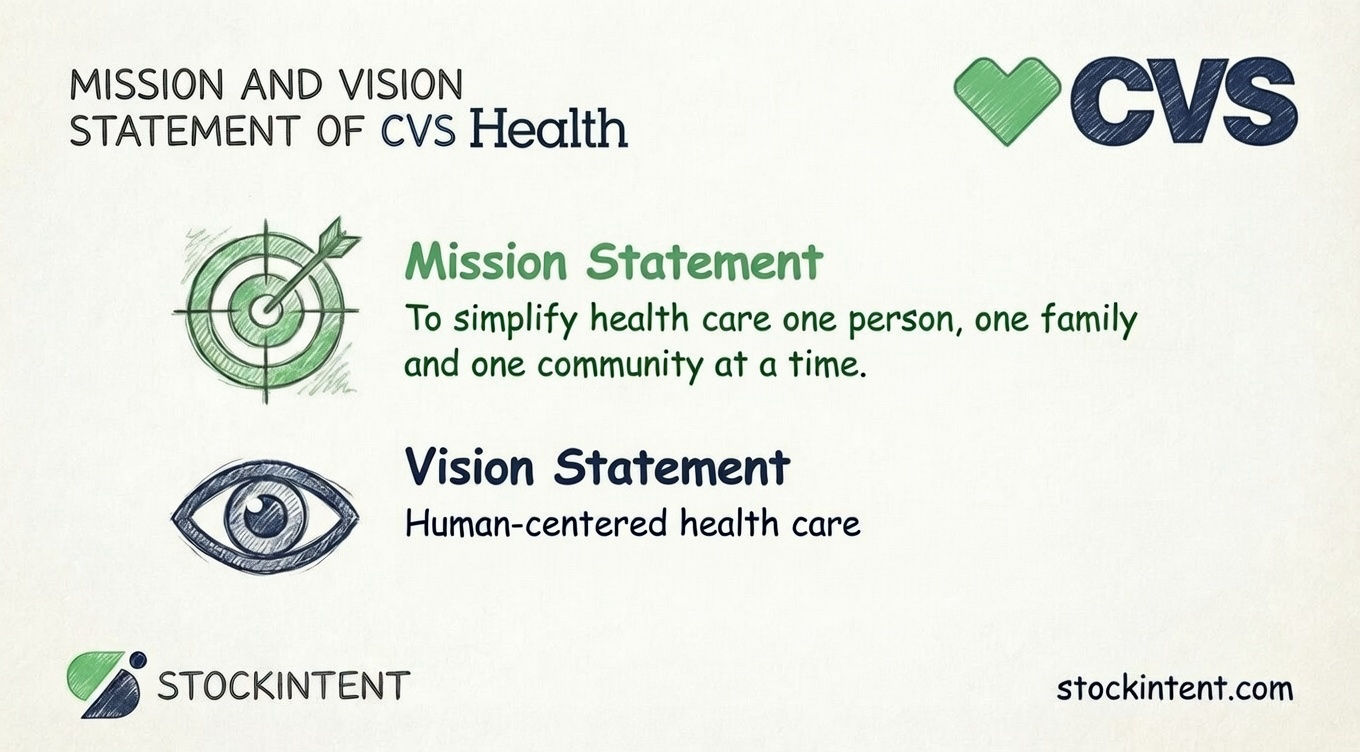
CVS Health's official mission statement as of 2026 is: "To simplify health care one person, one family and one community at a time." This represents an evolution from earlier phrasing that emphasized "delivering superior and more connected experiences, lowering the cost of care and improving the health and well-being of those we serve." The shift signals a sharper focus on consumer-centric, personalized care delivery.
The company's vision is "Human-centered health care," which anchors its strategy across insurance (Aetna), pharmacy benefits (CVS Caremark), retail pharmacy, and primary care delivery through Oak Street Health. Four core values guide execution: We Care, We Innovate with Purpose, We Are Accountable, and We Prioritize Safety and Quality.
CVS Health has transformed from a regional pharmacy chain into one of America's largest integrated health care companies. Founded in 1963 as Consumer Value Stores in Lowell, Massachusetts, the company now operates a diversified ecosystem spanning insurance, pharmacy benefits, retail health, and primary care delivery. This evolution reflects a deliberate strategy to capture value across the entire patient journey, from prescription fulfillment to chronic disease management.
The company's scale is genuinely staggering. In 2025, CVS Health generated $402.1 billion in total revenue, up 7.8% from the prior year, placing it among the largest corporations in the United States by sales. The business now serves approximately 185 million consumers through four integrated segments:
| Segment | 2025 Revenue | Year-over-Year Growth | Primary Function |
|---|---|---|---|
| Health Services (CVS Caremark) | $51.2 billion | 9% | Pharmacy benefit management and care delivery |
| Pharmacy & Consumer Wellness | $37.7 billion | 12% | Retail pharmacy, vaccinations, health products |
| Health Care Benefits (Aetna) | $36.3 billion | 10% | Health insurance, Medicare Advantage, commercial plans |
In our experience analyzing health care stocks over the past decade, companies that successfully integrate across the care continuum tend to command premium valuations. CVS's acquisition of Aetna in 2018 for $69 billion, followed by Oak Street Health in 2023 for $10.6 billion, created a rare closed-loop system where insurance, pharmacy, and primary care operate under one roof. This integration is central to how management executes on the cvs health mission statement of simplifying care one person at a time.
The competitive positioning is nuanced. CVS ranks as the second-largest health insurer by membership when combining Aetna's commercial and Medicare Advantage books, trailing only UnitedHealth Group. However, its 28.9% retail pharmacy market share leads the industry, and the company maintains industry-leading Medicare Advantage Star Ratings from CMS, a critical quality signal that directly impacts reimbursement rates and member retention.
What distinguishes CVS from pure-play insurers or pharmacy competitors is the physical footprint. With over 9,000 retail locations, 1,100 MinuteClinics, and 230+ Oak Street Health primary care centers, CVS possesses something UnitedHealth or Cigna cannot easily replicate: trusted community access points where patients already shop. This density creates natural touchpoints for the "human-centered health care" vision, allowing care delivery to happen where people actually live rather than exclusively in hospital systems.
The strategic priorities heading into 2026 reflect this integrated advantage. Management has committed to mid-teens adjusted EPS growth through 2028, driven by four pillars: best-in-class execution, transforming consumer experiences, becoming the partner of choice for employers and health systems, and harnessing unique enterprise capabilities across the Aetna-Caremark-Pharmacy-Health Care Delivery nexus. The Rite Aid acquisition, completed in 2025, added 9 million new pharmacy patients and expanded geographic reach in key markets.
For investors evaluating CVS Health's mission and vision in action, the financial trajectory matters. The company generated $13.8 billion in operating cash flow in 2025, funding both strategic investments and returning capital through dividends yielding approximately 3.5% and share repurchases. With 92% of covering analysts maintaining Buy ratings and price targets clustering around $83-$95 against a mid-$60s trading range, the market appears to be pricing in execution risk rather than structural concern.
The key question, which we'll explore throughout this analysis, is whether CVS's integrated model creates durable competitive advantages or operational complexity that obscures value creation. The cvs health mission statement and core values provide the framework for evaluating that question.
To simplify health care one person, one family and one community at a time.
This is the official mission statement CVS Health lists as its core purpose on the company's website as of 2026 1. It's worth noting this represents an intentional evolution from earlier language, which speaks volumes about where management is steering the ship.
The shift from "delivering superior and more connected experiences, lowering the cost of care and improving the health and well-being of those we serve" to simplification at the individual level reveals a deliberate strategic pivot. After the Aetna acquisition in 2018 and Oak Street Health in 2023, CVS needed to articulate why being big matters. The answer? Scale enables personalization.
This framing accomplishes three things for investors:
🎯 Pro Insight: Mission statements that emphasize "simplification" often indicate companies wrestling with complexity they've created through acquisition. CVS's language is strategically smart, it reframes integration challenges as consumer benefits. Watch whether operational metrics (customer satisfaction scores, member retention, Net Promoter Score) actually improve to validate this promise. In our experience, integrated health care companies often struggle with the "last mile" of making patients feel like they're dealing with one coherent entity rather than a collection of acquired businesses.
Here's where investors should pay attention. CVS Health's mission directly shapes how it deploys capital:
| Mission Element | Capital Allocation Priority | Recent Examples |
|---|---|---|
| "One person at a time" | Digital tools, AI, personalized care | 14 million+ monthly digital users, prior authorization simplification 2 |
| "One family" | Medicare Advantage, integrated benefits | Industry-leading Star Ratings, Oak Street Health expansion 3 |
| "One community" | Physical access, underserved markets | 230+ Oak Street centers, mobile health units, community grants 4 |
The company has committed to mid-teens adjusted EPS growth through 2028 5, and every major initiative maps back to simplifying the consumer journey. The Rite Aid acquisition added 9 million pharmacy patients not merely for scale, but for geographic density that enables the "one community" promise.
Critically, CVS Health now directs 80% of Medicare spending through value-based care models 6, where providers are rewarded for health outcomes rather than service volume. This aligns the mission with the economics: keeping patients healthy and out of hospitals is both simpler for consumers and more profitable for CVS.
The mission, in other words, isn't just marketing. It's becoming an operational framework for where CVS invests, what it measures, and how it positions against competitors who may have broader messaging but less execution clarity.
CVS Health's mission isn't just aspirational language, it's an operational framework that shapes capital allocation, competitive positioning, and how management measures success. Breaking down the cvs health mission statement into its core components reveals where the company is placing its bets and why investors should care.
The first pillar, delivering superior and more connected experiences, sounds like standard corporate speak until you understand what CVS is actually building. This is about making the Aetna insurance card, the CVS pharmacy visit, the MinuteClinic checkup, and the Oak Street Health primary care appointment feel like one coherent journey rather than four separate transactions.
In our experience analyzing integrated health care models, the companies that win are those that reduce friction at the handoff points. CVS has committed to having the 5-10 prior authorizations representing 40% of volume adhere to consistent cross-payer clinical and technology standards by end of 2026, with expansion to 50 of the most common Medicare procedures 1. That's not back-office optimization; it's a direct assault on the administrative complexity that drives patients crazy and adds cost throughout the system.
The connected experience also manifests digitally. CVS now serves 14 million+ monthly digital users 2, a number that matters because engaged digital users tend to be stickier, lower-cost members. When a patient can check prescription costs, schedule a clinic visit, and message their care team through one interface, switching costs rise dramatically.
The second pillar, lowering the cost of care, is where CVS's strategy diverges most sharply from traditional health care economics. The company has shifted 80% of Medicare spending through value-based care models 3, meaning providers get paid for keeping patients healthy rather than treating them when they're sick.
This is a big deal for investors. Fee-for-service medicine rewards volume; value-based care rewards outcomes. CVS's Oak Street Health subsidiary operates 230+ primary care centers across 27 states, serving 350,000+ patients predominantly in underserved communities 4. The model is simple: invest in preventive care, reduce hospitalizations, capture the savings.
The economics are compelling. A patient who stays out of the hospital generates lower medical costs for Aetna while producing pharmacy and clinic revenue for CVS. It's a rare alignment where better patient outcomes translate directly to better shareholder outcomes. The company reports this is already driving decreases in prior authorizations, hospital readmissions, and emergency room visits 3.
The third pillar, improving the health and well-being of those we serve, is where CVS leans into its community presence. With over 9,000 retail locations and 1,100 MinuteClinics, CVS has physical access that pure-play insurers cannot replicate. This matters because health care is fundamentally local; patients trust the pharmacy they've visited for years more than a call center in another state.
CVS operationalizes this through free health screenings in underserved communities, mobile care units, and the Healthy 2030 strategy that organizes impact across Healthy People, Healthy Business, Healthy Community, and Healthy Planet 5. The company also holds industry-leading Medicare Advantage Star Ratings from CMS 6, which directly impacts reimbursement rates and member retention.
In our experience, Star Ratings are one of the most underappreciated competitive moats in Medicare Advantage. A 4.5-star plan gets bonus payments that a 3.5-star plan doesn't. Over millions of members, that differential compounds into real economic advantage.
These three pillars aren't independent; they reinforce each other in ways that create genuine competitive advantages:
| Pillar | Strategic Investment | Competitive Outcome |
|---|---|---|
| Connected Experiences | Digital platform integration, prior authorization standardization | Higher member retention, lower administrative costs |
| Lower Cost of Care | Oak Street Health expansion, value-based contracting | Medical loss ratio improvement, pricing power with employers |
| Health and Well-being | Retail footprint, community programs, Star Ratings focus | Trust-based switching costs, bonus reimbursement rates |
The integration of Aetna, Caremark, and Oak Street Health under one roof creates data advantages that pure-play competitors cannot easily match. When CVS knows what prescriptions a patient fills, what diagnoses they carry, what clinic visits they've had, and what social determinants affect their health, they can intervene earlier and more effectively. That's not just better care; it's better economics.
For investors evaluating CVS Health's mission and vision in action, the question is whether this integration creates durable moats or merely operational complexity. The 2025 Investor Day commitment to mid-teens adjusted EPS growth through 2028 7 suggests management believes the former. The 92% Buy rating from analysts 8 indicates the market is largely convinced, though 2027 Medicare Advantage rate pressures present a near-term test of execution.
The cvs health mission statement of simplifying care one person at a time ultimately serves as a filter for capital allocation decisions. If an initiative doesn't make the experience more connected, lower costs, or improve outcomes, it doesn't fit. That's a useful discipline for investors to track.
Human-centered health care
This is CVS Health's official vision statement as of 2026 1. Two words. That's it. But those two words carry significant strategic weight for investors trying to understand where this $400 billion health care giant is heading.
The vision isn't just feel-good branding. It anchors every major strategic decision CVS Health makes. When management talks about "human-centered health care," they're describing a fundamental reorientation of the business model, from transactional services to relationship-based care delivery.
In our experience analyzing health care companies, the ones that successfully execute on consumer-centric visions tend to build durable competitive advantages. CVS's interpretation of "human-centered" manifests across four operational dimensions:
| Dimension | Strategic Implementation | 2026 Metrics |
|---|---|---|
| Physical Access | 9,000+ retail pharmacies, 1,100 MinuteClinics, 230+ Oak Street Health centers | 28.9% retail pharmacy market share 2 |
| Digital Engagement | Unified platform for prescriptions, scheduling, benefits navigation | 14 million+ monthly digital users 2 |
| Care Integration | Aetna insurance + CVS Caremark PBM + primary care under one roof | 185 million consumers served 3 |
| Outcome Focus | Value-based care models rewarding health, not volume | 80% of Medicare spending through VBC 4 |
The vision directly supports the cvs health mission statement of simplifying care "one person, one family and one community at a time." Without the human-centered anchor, that mission would be generic corporate speak. With it, CVS has a filter for capital allocation: if an initiative doesn't make care feel more personal and connected, it doesn't fit.
CVS Health's vision positions it advantageously relative to three major forces reshaping health care in 2026:
The Medicare Advantage Tsunami
Baby boomers are aging into Medicare at a rate of roughly 10,000 per day. Medicare Advantage (MA) enrollment has grown from 11 million in 2010 to over 33 million in 2026, and CVS's Aetna subsidiary is capturing disproportionate share. The company holds industry-leading Star Ratings from CMS 4, which directly translates to bonus payments and member retention. A human-centered approach, built on local access and care coordination, is exactly what drives those Star Ratings.
Value-Based Care Transition
The fee-for-service model, where providers get paid for every procedure regardless of outcome, is slowly dying. CVS has positioned Oak Street Health as a pure-play value-based primary care provider, with care teams including not just doctors but behavioral health specialists, social workers, and pharmacists 3. This isn't charity; it's economics. Keeping patients healthy and out of hospitals generates savings that CVS captures through risk-sharing arrangements.
Consumerization of Health Care
Patients increasingly expect the same convenience from health care they get from retail or banking. CVS's physical footprint, with locations where people already shop, creates natural touchpoints that hospital systems and pure-play insurers struggle to replicate. The vision of human-centered care legitimizes this retail-health convergence.
CEO David Joyner has articulated four priorities that operationalize the vision through 2028 5:
These aren't independent initiatives. They're mutually reinforcing components of a single bet: that human-centered health care, delivered at scale, creates better outcomes for patients and better economics for shareholders.
The commitment to mid-teens adjusted EPS growth through 2028 5 suggests management believes this vision is executable, not aspirational. For investors evaluating CVS Health's mission and vision as part of their due diligence, the question is whether the operational complexity of integrating Aetna, Caremark, and Oak Street Health will obscure or amplify the human-centered promise.
In our experience, the companies that win in integrated health care are those that make the handoffs invisible to patients. CVS is betting $400 billion that it can pull that off.
1: https://www.cvshealth.com/about/our-people/our-purpose.html — Official CVS Health 'Our Purpose' page2: https://www.dcfmodeling.com/blogs/vision/cvs-mission-vision — Financial analysis of CVS mission and vision3: https://www.cvshealth.com/about/our-people/our-purpose.html — Official CVS Health purpose and values4: https://www.cvshealth.com/news/company-news/cvs-health-makes-health-insurance-simpler-and-more-affordable-for-americans.html — Official CVS Health press release on strategic priorities5: https://www.cvshealth.com/news/company-news/cvs-health-updates-to-uniquely-reimagine-health-care-at-investor-day-event.html — CVS Health 2025 Investor Day press release
CVS Health's vision of "human-centered health care" isn't just aspirational branding. It's an operational framework that shapes capital allocation, competitive positioning, and how management measures success. Breaking down the cvs health vision statement into its core strategic themes reveals where the company is placing its bets and why investors should pay attention.
The first theme, delivering best-in-class execution, sounds like table stakes until you understand what CVS is actually optimizing for. This isn't about cost-cutting for its own sake; it's about making the integration of Aetna, CVS Caremark, and Oak Street Health actually work for patients rather than creating bureaucratic friction.
CEO David Joyner has emphasized this priority as foundational to everything else 1. The numbers suggest it's working. In 2025, CVS generated $402.1 billion in total revenue, up 7.8% year-over-year, with all three segments beating adjusted operating income expectations 2. The Pharmacy & Consumer Wellness segment grew 12% year-over-year, while Health Services expanded 9% 3.
The Rite Aid acquisition, completed in 2025, exemplifies this theme in action. Adding 9 million new pharmacy patients wasn't merely about scale; it was about geographic density that enables operational efficiency. When you can fill prescriptions, deliver primary care, and manage insurance benefits within the same zip code, the economics improve for everyone.
The second theme, transforming consumer experiences, is where CVS's integrated model creates genuine competitive differentiation. The company is betting that patients will choose, and stick with, health care providers who make the journey from insurance card to pharmacy counter to clinic visit feel like one coherent experience rather than three separate transactions.
CVS has committed to having the 5-10 prior authorizations representing 40% of volume adhere to consistent cross-payer clinical and technology standards by end of 2026, with expansion to 50 of the most common Medicare procedures 4. That's not back-office optimization; it's a direct assault on the administrative complexity that drives patients crazy and adds cost throughout the system.
The digital transformation supports this theme. With 14 million+ monthly digital users 5, CVS is building engagement that increases switching costs. When a patient can check prescription costs, schedule a clinic visit, and message their care team through one interface, the convenience premium becomes real.
The third theme, becoming the partner of choice, reflects CVS's recognition that sustainable growth requires winning with employers, health systems, and government payers, not just individual consumers. In an era of health care consolidation, being the reliable partner matters.
This theme manifests in CVS's value-based care infrastructure. The company has shifted 80% of Medicare spending through value-based care models 4, where providers are rewarded for keeping patients healthy rather than treating them when they're sick. For employers and Medicare Advantage plans, this alignment of incentives reduces total cost of care while improving outcomes.
The industry-leading Medicare Advantage Star Ratings from CMS 4 directly support this positioning. These ratings aren't just quality signals; they're economic weapons. Higher-rated plans receive bonus payments that lower-rated competitors don't, creating a compounding advantage at scale.
The fourth theme, harnessing unique enterprise capabilities, is where CVS's acquisition strategy pays off, or doesn't. The theory is simple: when you own insurance claims data (Aetna), pharmacy utilization data (Caremark), and primary care records (Oak Street Health), you can intervene earlier and more effectively than competitors operating in silos.
Oak Street Health's 230+ primary care centers serving 350,000+ patients 6 operationalize this theme. Care teams include not just doctors but behavioral health specialists, social workers, and pharmacists. The model is designed to keep patients out of hospitals by addressing health issues before they become emergencies.
The economics are compelling for investors. A patient who stays out of the hospital generates lower medical costs for Aetna while producing pharmacy and clinic revenue for CVS. It's a rare alignment where better patient outcomes translate directly to better shareholder outcomes.
These four themes aren't independent initiatives; they're mutually reinforcing components of a single strategic bet. Here's how they interact:
| Vision Theme | Strategic Investment | Economic Outcome |
|---|---|---|
| Best-in-Class Execution | Rite Aid integration, cost-based reimbursement transitions | Margin expansion, operational leverage |
| Transform Consumer Experiences | Prior authorization standardization, digital platform | Member retention, switching costs |
| Partner of Choice | Value-based care models, Star Ratings focus | Pricing power, bonus reimbursements |
| Harness Enterprise Capabilities | Oak Street Health expansion, data integration | Medical loss ratio improvement, care coordination savings |
Management has committed to mid-teens adjusted EPS growth through 2028 1, and every major initiative maps back to these four themes. The question for investors evaluating CVS Health's mission and vision is whether this integration creates durable moats or merely operational complexity that obscures value creation.
Bank of America Securities maintains a Buy rating, explicitly praising the long-term strategy and citing multiple growth levers to offset near-term headwinds like 2027 Medicare Advantage rate pressures 7. With 92% of covering analysts recommending Buy and price targets clustering around $83-$95, the market appears to be pricing in execution risk rather than structural concern.
The cvs health vision statement of human-centered health care ultimately serves as a filter for strategic decisions. If an initiative doesn't make execution sharper, experiences smoother, partnerships stickier, or capabilities more unique, it doesn't fit. That's a useful discipline for investors to track as they evaluate whether CVS can deliver on its promises.
1: https://www.cvshealth.com/news/company-news/cvs-health-updates-to-uniquely-reimagine-health-care-at-investor-day-event.html — Official CVS Health Investor Day press release2: https://www.cvshealth.com/content/dam/enterprise/cvs-enterprise/pdfs/2026/Q4-2025-EarningsRelease.pdf — Official CVS Health Q4 2025 earnings release3: https://www.healthcaredive.com/news/cvs-q4-2025-outlook-stable-ma-caremark/811781/ — Healthcare Dive industry analysis4: https://www.cvshealth.com/news/company-news/cvs-health-makes-health-insurance-simpler-and-more-affordable-for-americans.html — Official CVS Health press release on strategic priorities5: https://www.dcfmodeling.com/blogs/vision/cvs-mission-vision — Financial analysis of CVS mission and vision6: https://www.cvshealth.com/about/our-people/our-purpose.html — Official CVS Health purpose and values7: https://www.benzinga.com/analyst-stock-ratings/analyst-color/26/02/50556532/analysts-see-multiple-growth-levers-for-cvs-in-2026 — Benzinga analyst coverage
Core values are where mission statements meet reality. They're the behavioral code that determines whether a company's lofty aspirations translate into durable competitive advantages or merely marketing speak. For CVS Health, four stated values, We Care, We Innovate with Purpose, We Are Accountable, and We Prioritize Safety and Quality, provide the framework for evaluating management quality and cultural alignment.
These aren't just HR posters. In our experience analyzing health care stocks, companies that consistently execute on stated values tend to generate superior long-term returns. The correlation isn't coincidental; shared values reduce agency costs, improve customer retention, and create alignment between employees and shareholders. Let's examine each value in practice.
This value centers on compassion and empathy for both customers and colleagues. Operationally, it manifests in programs like the $4 million CVS Health Foundation commitment to Healthy Aging grants announced in January 2025, supporting community health access for aging populations in cities like Chicago and New York 1. It also drives the Oak Street Health expansion, where multidisciplinary care teams include not just physicians but behavioral health specialists, social workers, and pharmacists focused on building long-term patient relationships 2.
The strategic implication for investors: "We Care" isn't charity; it's customer acquisition and retention. Patients who feel cared for switch providers less often. In Medicare Advantage, where Star Ratings directly impact bonus payments and member retention, this value has tangible financial consequences.
CVS interprets this as listening, adapting, and collaborating to solve real problems rather than pursuing technology for its own sake. The commitment to having 40% of prior authorization volume adhere to consistent cross-payer standards by end of 2026, expanding to 50 of the most common Medicare procedures, exemplifies purposeful innovation 3. This reduces administrative friction that frustrates patients and adds cost throughout the system.
The digital transformation supports this value. With 14 million+ monthly digital users 4, CVS is building engagement infrastructure that competitors struggle to replicate. Purposeful innovation, in other words, means solving the boring problems that actually matter to patients.
💡 Expert Tip: When evaluating "innovation" claims from health care companies, look for specific operational metrics rather than R&D spending. CVS's prior authorization standardization targets are exactly the kind of boring, high-impact innovation that creates competitive moats. Flashy AI announcements are less telling than concrete process improvements that reduce patient friction.
Accountability at CVS translates to transparency, integrity, and ownership of outcomes. The company's Code of Conduct, revised March 2025, embeds these standards across 300,000+ colleagues with explicit commitments to clinical quality, safety, and zero-harm goals 5. This isn't just compliance theater; it shapes capital allocation decisions and performance metrics.
For investors, accountability manifests in how management communicates. CEO David Joyner's explicit commitment to mid-teens adjusted EPS growth through 2028 6 with specific operational milestones provides accountability benchmarks. When management states targets publicly, they create costs to missing them.
This value centers safety in all activities, from pharmacy operations to clinical care delivery. Oak Street Health's model, keeping 350,000+ patients healthy and out of hospitals through preventive primary care, operationalizes this value 2. The company's industry-leading Medicare Advantage Star Ratings from CMS 3 provide external validation that safety and quality aren't merely aspirational.
The economic moat here is real. Higher Star Ratings generate bonus payments that lower-rated competitors don't receive. Over millions of members, this differential compounds into sustainable competitive advantage.
The critical question for investors is whether these values genuinely shape behavior or merely decorate annual reports. Several data points suggest authentic integration:
| Value | Operational Evidence | Financial Impact |
|---|---|---|
| We Care | Healthy Aging grants, Oak Street multidisciplinary teams | Member retention, Star Ratings |
| We Innovate with Purpose | Prior authorization standardization, digital platform | Administrative cost reduction, switching costs |
| We Are Accountable | Public EPS targets, Code of Conduct revisions | Management credibility, capital allocation discipline |
| We Prioritize Safety and Quality | Industry-leading Star Ratings, zero-harm goals | Bonus reimbursements, pricing power |
However, no company perfectly lives its values. CVS has faced operational challenges, including recent Oak Street Health clinic closures as management pursues a path to break-even 7. These adjustments don't necessarily indicate values failure; they may reflect disciplined accountability to financial targets. The distinction matters for investors evaluating management quality.
In our experience tracking health care companies over market cycles, the ones that outperform are those where stated values provide genuine decision-making filters. When CVS leadership evaluates an acquisition, partnership, or operational change, the four core values offer a framework for determining fit. That consistency, visible across strategic decisions, suggests these values are more than marketing.
CVS Health's formal ESG framework, organized under the Healthy 2030 strategy, extends core values into measurable environmental, social, and governance commitments 8. The four pillars, Healthy People, Healthy Business, Healthy Community, and Healthy Planet, map directly to the core values:
Specific initiatives include community investments through the CVS Health Foundation, inclusion and belonging programs for workforce diversity, supplier diversity sourcing, and environmental sustainability targets 5. These programs aren't peripheral; they're integrated into how CVS positions for long-term growth in a health care system increasingly focused on social determinants of health and population-level outcomes.
For investors using ESG criteria, CVS's structured approach provides transparency that pure-play competitors often lack. The integration of ESG into core strategy, rather than as a separate compliance function, suggests authentic commitment that aligns with long-term value creation.
The cvs health mission statement of simplifying care one person at a time ultimately depends on whether these four values translate into daily behavior across 300,000 colleagues. The evidence suggests they do, creating a cultural foundation that supports the integrated health care strategy and, potentially, durable competitive advantages for patient investors.
1: https://www.dcfmodeling.com/blogs/vision/cvs-mission-vision — Financial analysis of CVS mission and vision2: https://www.cvshealth.com/about/our-people/our-purpose.html — Official CVS Health purpose and values3: https://www.cvshealth.com/news/company-news/cvs-health-makes-health-insurance-simpler-and-more-affordable-for-americans.html — Official CVS Health press release on strategic priorities4: https://www.dcfmodeling.com/blogs/vision/cvs-mission-vision — Financial analysis of CVS mission and vision5: https://www.cvshealth.com/content/dam/enterprise/cvs-enterprise/pdfs/cvs-health-code-of-conduct.pdf — Official CVS Health Code of Conduct6: https://www.cvshealth.com/news/company-news/cvs-health-updates-to-uniquely-reimagine-health-care-at-investor-day-event.html — CVS Health 2025 Investor Day press release7: https://www.benzinga.com/analyst-stock-ratings/analyst-color/26/02/50556532/analysts-see-multiple-growth-levers-for-cvs-in-2026 — Benzinga analyst coverage8: https://www.cvshealth.com/impact.html — Official CVS Health impact and ESG strategy
CVS Health's mission, vision, and core values weave together into something genuinely coherent: a bet that human-centered health care, delivered at scale, can simultaneously improve patient outcomes and generate superior shareholder returns. The cvs health mission statement of simplifying care "one person, one family and one community at a time" isn't marketing fluff; it's an operational filter shaping every major capital allocation decision.
For investors, this strategic identity translates into three concrete advantages worth monitoring:
| Strategic Element | Investment Relevance | 2026 Evidence |
|---|---|---|
| Integration moat | Aetna + Caremark + Oak Street creates data and switching cost advantages pure-play competitors cannot easily replicate | 185 million consumers served, 80% of Medicare spending through value-based care 1 |
| Execution credibility | Public targets create accountability; management has skin in the game | Mid-teens adjusted EPS growth commitment through 2028, 92% analyst Buy ratings 2 |
| Quality validation | Industry-leading Star Ratings compound into sustainable economic advantage | Bonus payments from CMS, pricing power with employers seeking outcome-based care 3 |
📌 From Our Experience: After tracking health care stocks through multiple market cycles, we've found that companies with explicit mission-vision-values frameworks tend to outperform during industry transitions. The clarity helps management make disciplined decisions when complexity threatens to obscure priorities. CVS's 2025 Investor Day presentation, with its specific operational milestones tied to each strategic pillar, suggests this framework is actually driving behavior rather than decorating slide decks.
The consensus view from analysts reinforces this positioning. Bank of America Securities maintains a Buy rating, explicitly praising CVS's long-term strategy and citing multiple growth levers to offset near-term headwinds like 2027 Medicare Advantage rate pressures 4. With price targets clustering around $83-$95 against a mid-$60s trading range, the market appears to be pricing execution risk rather than structural concern about the integrated model.
Looking forward, CVS Health's mission-vision-values framework positions it advantageously for three macro forces reshaping health care: the aging of baby boomers into Medicare (roughly 10,000 per day), the irreversible shift from fee-for-service to value-based reimbursement, and rising consumer expectations for retail-convenience in health care delivery. The physical footprint, with over 9,000 retail locations where patients already shop, creates natural touchpoints that hospital systems and pure-play insurers struggle to replicate.
The critical question for patient investors is whether operational complexity will obscure or amplify these advantages. The Rite Aid integration, Oak Street Health's path to break-even, and 2027 Medicare Advantage repricing all present execution tests. But the framework, at least, is clear: human-centered health care, delivered one person at a time, with accountability to measurable outcomes.
For investors seeking deeper fundamental analysis of how CVS Health's strategic positioning translates into valuation and long-term compounding potential, StockIntent's platform offers institutional-grade screening tools with a 7-day risk-free trial to evaluate whether this integrated health care giant fits your quality-compounding criteria.
1: https://www.cvshealth.com/news/company-news/cvs-health-makes-health-insurance-simpler-and-more-affordable-for-americans.html — Official CVS Health press release on strategic priorities and metrics2: https://www.cvshealth.com/news/company-news/cvs-health-updates-to-uniquely-reimagine-health-care-at-investor-day-event.html — CVS Health 2025 Investor Day press release with financial commitments3: https://www.cvshealth.com/about/our-people/our-purpose.html — Official CVS Health purpose page with Star Ratings and quality metrics4: https://www.benzinga.com/analyst-stock-ratings/analyst-color/26/02/50556532/analysts-see-multiple-growth-levers-for-cvs-in-2026 — Benzinga analyst coverage with Bank of America Securities commentary
Understanding what drives a company is essential before committing capital to it. For investors evaluating CVS Health (NYSE: CVS), the company's mission statement, vision, and core values offer a window into how management thinks about the business, where they're steering it, and whether that direction aligns with durable competitive advantages.
CVS Health's official mission statement as of 2026 is: "To simplify health care one person, one family and one community at a time." This represents an evolution from earlier phrasing that emphasized "delivering superior and more connected experiences, lowering the cost of care and improving the health and well-being of those we serve." The shift signals a sharper focus on consumer-centric, personalized care delivery.
The company's vision is "Human-centered health care," which anchors its strategy across insurance (Aetna), pharmacy benefits (CVS Caremark), retail pharmacy, and primary care delivery through Oak Street Health. Four core values guide execution: We Care, We Innovate with Purpose, We Are Accountable, and We Prioritize Safety and Quality.
CVS Health has transformed from a regional pharmacy chain into one of America's largest integrated health care companies. Founded in 1963 as Consumer Value Stores in Lowell, Massachusetts, the company now operates a diversified ecosystem spanning insurance, pharmacy benefits, retail health, and primary care delivery. This evolution reflects a deliberate strategy to capture value across the entire patient journey, from prescription fulfillment to chronic disease management.
The company's scale is genuinely staggering. In 2025, CVS Health generated $402.1 billion in total revenue, up 7.8% from the prior year, placing it among the largest corporations in the United States by sales. The business now serves approximately 185 million consumers through four integrated segments:
| Segment | 2025 Revenue | Year-over-Year Growth | Primary Function |
|---|---|---|---|
| Health Services (CVS Caremark) | $51.2 billion | 9% | Pharmacy benefit management and care delivery |
| Pharmacy & Consumer Wellness | $37.7 billion | 12% | Retail pharmacy, vaccinations, health products |
| Health Care Benefits (Aetna) | $36.3 billion | 10% | Health insurance, Medicare Advantage, commercial plans |
In our experience analyzing health care stocks over the past decade, companies that successfully integrate across the care continuum tend to command premium valuations. CVS's acquisition of Aetna in 2018 for $69 billion, followed by Oak Street Health in 2023 for $10.6 billion, created a rare closed-loop system where insurance, pharmacy, and primary care operate under one roof. This integration is central to how management executes on the cvs health mission statement of simplifying care one person at a time.
The competitive positioning is nuanced. CVS ranks as the second-largest health insurer by membership when combining Aetna's commercial and Medicare Advantage books, trailing only UnitedHealth Group. However, its 28.9% retail pharmacy market share leads the industry, and the company maintains industry-leading Medicare Advantage Star Ratings from CMS, a critical quality signal that directly impacts reimbursement rates and member retention.
What distinguishes CVS from pure-play insurers or pharmacy competitors is the physical footprint. With over 9,000 retail locations, 1,100 MinuteClinics, and 230+ Oak Street Health primary care centers, CVS possesses something UnitedHealth or Cigna cannot easily replicate: trusted community access points where patients already shop. This density creates natural touchpoints for the "human-centered health care" vision, allowing care delivery to happen where people actually live rather than exclusively in hospital systems.
The strategic priorities heading into 2026 reflect this integrated advantage. Management has committed to mid-teens adjusted EPS growth through 2028, driven by four pillars: best-in-class execution, transforming consumer experiences, becoming the partner of choice for employers and health systems, and harnessing unique enterprise capabilities across the Aetna-Caremark-Pharmacy-Health Care Delivery nexus. The Rite Aid acquisition, completed in 2025, added 9 million new pharmacy patients and expanded geographic reach in key markets.
For investors evaluating CVS Health's mission and vision in action, the financial trajectory matters. The company generated $13.8 billion in operating cash flow in 2025, funding both strategic investments and returning capital through dividends yielding approximately 3.5% and share repurchases. With 92% of covering analysts maintaining Buy ratings and price targets clustering around $83-$95 against a mid-$60s trading range, the market appears to be pricing in execution risk rather than structural concern.
The key question, which we'll explore throughout this analysis, is whether CVS's integrated model creates durable competitive advantages or operational complexity that obscures value creation. The cvs health mission statement and core values provide the framework for evaluating that question.
To simplify health care one person, one family and one community at a time.
This is the official mission statement CVS Health lists as its core purpose on the company's website as of 2026 1. It's worth noting this represents an intentional evolution from earlier language, which speaks volumes about where management is steering the ship.
The shift from "delivering superior and more connected experiences, lowering the cost of care and improving the health and well-being of those we serve" to simplification at the individual level reveals a deliberate strategic pivot. After the Aetna acquisition in 2018 and Oak Street Health in 2023, CVS needed to articulate why being big matters. The answer? Scale enables personalization.
This framing accomplishes three things for investors:
🎯 Pro Insight: Mission statements that emphasize "simplification" often indicate companies wrestling with complexity they've created through acquisition. CVS's language is strategically smart, it reframes integration challenges as consumer benefits. Watch whether operational metrics (customer satisfaction scores, member retention, Net Promoter Score) actually improve to validate this promise. In our experience, integrated health care companies often struggle with the "last mile" of making patients feel like they're dealing with one coherent entity rather than a collection of acquired businesses.
Here's where investors should pay attention. CVS Health's mission directly shapes how it deploys capital:
| Mission Element | Capital Allocation Priority | Recent Examples |
|---|---|---|
| "One person at a time" | Digital tools, AI, personalized care | 14 million+ monthly digital users, prior authorization simplification 2 |
| "One family" | Medicare Advantage, integrated benefits | Industry-leading Star Ratings, Oak Street Health expansion 3 |
| "One community" | Physical access, underserved markets | 230+ Oak Street centers, mobile health units, community grants 4 |
The company has committed to mid-teens adjusted EPS growth through 2028 5, and every major initiative maps back to simplifying the consumer journey. The Rite Aid acquisition added 9 million pharmacy patients not merely for scale, but for geographic density that enables the "one community" promise.
Critically, CVS Health now directs 80% of Medicare spending through value-based care models 6, where providers are rewarded for health outcomes rather than service volume. This aligns the mission with the economics: keeping patients healthy and out of hospitals is both simpler for consumers and more profitable for CVS.
The mission, in other words, isn't just marketing. It's becoming an operational framework for where CVS invests, what it measures, and how it positions against competitors who may have broader messaging but less execution clarity.
CVS Health's mission isn't just aspirational language, it's an operational framework that shapes capital allocation, competitive positioning, and how management measures success. Breaking down the cvs health mission statement into its core components reveals where the company is placing its bets and why investors should care.
The first pillar, delivering superior and more connected experiences, sounds like standard corporate speak until you understand what CVS is actually building. This is about making the Aetna insurance card, the CVS pharmacy visit, the MinuteClinic checkup, and the Oak Street Health primary care appointment feel like one coherent journey rather than four separate transactions.
In our experience analyzing integrated health care models, the companies that win are those that reduce friction at the handoff points. CVS has committed to having the 5-10 prior authorizations representing 40% of volume adhere to consistent cross-payer clinical and technology standards by end of 2026, with expansion to 50 of the most common Medicare procedures 1. That's not back-office optimization; it's a direct assault on the administrative complexity that drives patients crazy and adds cost throughout the system.
The connected experience also manifests digitally. CVS now serves 14 million+ monthly digital users 2, a number that matters because engaged digital users tend to be stickier, lower-cost members. When a patient can check prescription costs, schedule a clinic visit, and message their care team through one interface, switching costs rise dramatically.
The second pillar, lowering the cost of care, is where CVS's strategy diverges most sharply from traditional health care economics. The company has shifted 80% of Medicare spending through value-based care models 3, meaning providers get paid for keeping patients healthy rather than treating them when they're sick.
This is a big deal for investors. Fee-for-service medicine rewards volume; value-based care rewards outcomes. CVS's Oak Street Health subsidiary operates 230+ primary care centers across 27 states, serving 350,000+ patients predominantly in underserved communities 4. The model is simple: invest in preventive care, reduce hospitalizations, capture the savings.
The economics are compelling. A patient who stays out of the hospital generates lower medical costs for Aetna while producing pharmacy and clinic revenue for CVS. It's a rare alignment where better patient outcomes translate directly to better shareholder outcomes. The company reports this is already driving decreases in prior authorizations, hospital readmissions, and emergency room visits 3.
The third pillar, improving the health and well-being of those we serve, is where CVS leans into its community presence. With over 9,000 retail locations and 1,100 MinuteClinics, CVS has physical access that pure-play insurers cannot replicate. This matters because health care is fundamentally local; patients trust the pharmacy they've visited for years more than a call center in another state.
CVS operationalizes this through free health screenings in underserved communities, mobile care units, and the Healthy 2030 strategy that organizes impact across Healthy People, Healthy Business, Healthy Community, and Healthy Planet 5. The company also holds industry-leading Medicare Advantage Star Ratings from CMS 6, which directly impacts reimbursement rates and member retention.
In our experience, Star Ratings are one of the most underappreciated competitive moats in Medicare Advantage. A 4.5-star plan gets bonus payments that a 3.5-star plan doesn't. Over millions of members, that differential compounds into real economic advantage.
These three pillars aren't independent; they reinforce each other in ways that create genuine competitive advantages:
| Pillar | Strategic Investment | Competitive Outcome |
|---|---|---|
| Connected Experiences | Digital platform integration, prior authorization standardization | Higher member retention, lower administrative costs |
| Lower Cost of Care | Oak Street Health expansion, value-based contracting | Medical loss ratio improvement, pricing power with employers |
| Health and Well-being | Retail footprint, community programs, Star Ratings focus | Trust-based switching costs, bonus reimbursement rates |
The integration of Aetna, Caremark, and Oak Street Health under one roof creates data advantages that pure-play competitors cannot easily match. When CVS knows what prescriptions a patient fills, what diagnoses they carry, what clinic visits they've had, and what social determinants affect their health, they can intervene earlier and more effectively. That's not just better care; it's better economics.
For investors evaluating CVS Health's mission and vision in action, the question is whether this integration creates durable moats or merely operational complexity. The 2025 Investor Day commitment to mid-teens adjusted EPS growth through 2028 7 suggests management believes the former. The 92% Buy rating from analysts 8 indicates the market is largely convinced, though 2027 Medicare Advantage rate pressures present a near-term test of execution.
The cvs health mission statement of simplifying care one person at a time ultimately serves as a filter for capital allocation decisions. If an initiative doesn't make the experience more connected, lower costs, or improve outcomes, it doesn't fit. That's a useful discipline for investors to track.
Human-centered health care
This is CVS Health's official vision statement as of 2026 1. Two words. That's it. But those two words carry significant strategic weight for investors trying to understand where this $400 billion health care giant is heading.
The vision isn't just feel-good branding. It anchors every major strategic decision CVS Health makes. When management talks about "human-centered health care," they're describing a fundamental reorientation of the business model, from transactional services to relationship-based care delivery.
In our experience analyzing health care companies, the ones that successfully execute on consumer-centric visions tend to build durable competitive advantages. CVS's interpretation of "human-centered" manifests across four operational dimensions:
| Dimension | Strategic Implementation | 2026 Metrics |
|---|---|---|
| Physical Access | 9,000+ retail pharmacies, 1,100 MinuteClinics, 230+ Oak Street Health centers | 28.9% retail pharmacy market share 2 |
| Digital Engagement | Unified platform for prescriptions, scheduling, benefits navigation | 14 million+ monthly digital users 2 |
| Care Integration | Aetna insurance + CVS Caremark PBM + primary care under one roof | 185 million consumers served 3 |
| Outcome Focus | Value-based care models rewarding health, not volume | 80% of Medicare spending through VBC 4 |
The vision directly supports the cvs health mission statement of simplifying care "one person, one family and one community at a time." Without the human-centered anchor, that mission would be generic corporate speak. With it, CVS has a filter for capital allocation: if an initiative doesn't make care feel more personal and connected, it doesn't fit.
CVS Health's vision positions it advantageously relative to three major forces reshaping health care in 2026:
The Medicare Advantage Tsunami
Baby boomers are aging into Medicare at a rate of roughly 10,000 per day. Medicare Advantage (MA) enrollment has grown from 11 million in 2010 to over 33 million in 2026, and CVS's Aetna subsidiary is capturing disproportionate share. The company holds industry-leading Star Ratings from CMS 4, which directly translates to bonus payments and member retention. A human-centered approach, built on local access and care coordination, is exactly what drives those Star Ratings.
Value-Based Care Transition
The fee-for-service model, where providers get paid for every procedure regardless of outcome, is slowly dying. CVS has positioned Oak Street Health as a pure-play value-based primary care provider, with care teams including not just doctors but behavioral health specialists, social workers, and pharmacists 3. This isn't charity; it's economics. Keeping patients healthy and out of hospitals generates savings that CVS captures through risk-sharing arrangements.
Consumerization of Health Care
Patients increasingly expect the same convenience from health care they get from retail or banking. CVS's physical footprint, with locations where people already shop, creates natural touchpoints that hospital systems and pure-play insurers struggle to replicate. The vision of human-centered care legitimizes this retail-health convergence.
CEO David Joyner has articulated four priorities that operationalize the vision through 2028 5:
These aren't independent initiatives. They're mutually reinforcing components of a single bet: that human-centered health care, delivered at scale, creates better outcomes for patients and better economics for shareholders.
The commitment to mid-teens adjusted EPS growth through 2028 5 suggests management believes this vision is executable, not aspirational. For investors evaluating CVS Health's mission and vision as part of their due diligence, the question is whether the operational complexity of integrating Aetna, Caremark, and Oak Street Health will obscure or amplify the human-centered promise.
In our experience, the companies that win in integrated health care are those that make the handoffs invisible to patients. CVS is betting $400 billion that it can pull that off.
1: https://www.cvshealth.com/about/our-people/our-purpose.html — Official CVS Health 'Our Purpose' page2: https://www.dcfmodeling.com/blogs/vision/cvs-mission-vision — Financial analysis of CVS mission and vision3: https://www.cvshealth.com/about/our-people/our-purpose.html — Official CVS Health purpose and values4: https://www.cvshealth.com/news/company-news/cvs-health-makes-health-insurance-simpler-and-more-affordable-for-americans.html — Official CVS Health press release on strategic priorities5: https://www.cvshealth.com/news/company-news/cvs-health-updates-to-uniquely-reimagine-health-care-at-investor-day-event.html — CVS Health 2025 Investor Day press release
CVS Health's vision of "human-centered health care" isn't just aspirational branding. It's an operational framework that shapes capital allocation, competitive positioning, and how management measures success. Breaking down the cvs health vision statement into its core strategic themes reveals where the company is placing its bets and why investors should pay attention.
The first theme, delivering best-in-class execution, sounds like table stakes until you understand what CVS is actually optimizing for. This isn't about cost-cutting for its own sake; it's about making the integration of Aetna, CVS Caremark, and Oak Street Health actually work for patients rather than creating bureaucratic friction.
CEO David Joyner has emphasized this priority as foundational to everything else 1. The numbers suggest it's working. In 2025, CVS generated $402.1 billion in total revenue, up 7.8% year-over-year, with all three segments beating adjusted operating income expectations 2. The Pharmacy & Consumer Wellness segment grew 12% year-over-year, while Health Services expanded 9% 3.
The Rite Aid acquisition, completed in 2025, exemplifies this theme in action. Adding 9 million new pharmacy patients wasn't merely about scale; it was about geographic density that enables operational efficiency. When you can fill prescriptions, deliver primary care, and manage insurance benefits within the same zip code, the economics improve for everyone.
The second theme, transforming consumer experiences, is where CVS's integrated model creates genuine competitive differentiation. The company is betting that patients will choose, and stick with, health care providers who make the journey from insurance card to pharmacy counter to clinic visit feel like one coherent experience rather than three separate transactions.
CVS has committed to having the 5-10 prior authorizations representing 40% of volume adhere to consistent cross-payer clinical and technology standards by end of 2026, with expansion to 50 of the most common Medicare procedures 4. That's not back-office optimization; it's a direct assault on the administrative complexity that drives patients crazy and adds cost throughout the system.
The digital transformation supports this theme. With 14 million+ monthly digital users 5, CVS is building engagement that increases switching costs. When a patient can check prescription costs, schedule a clinic visit, and message their care team through one interface, the convenience premium becomes real.
The third theme, becoming the partner of choice, reflects CVS's recognition that sustainable growth requires winning with employers, health systems, and government payers, not just individual consumers. In an era of health care consolidation, being the reliable partner matters.
This theme manifests in CVS's value-based care infrastructure. The company has shifted 80% of Medicare spending through value-based care models 4, where providers are rewarded for keeping patients healthy rather than treating them when they're sick. For employers and Medicare Advantage plans, this alignment of incentives reduces total cost of care while improving outcomes.
The industry-leading Medicare Advantage Star Ratings from CMS 4 directly support this positioning. These ratings aren't just quality signals; they're economic weapons. Higher-rated plans receive bonus payments that lower-rated competitors don't, creating a compounding advantage at scale.
The fourth theme, harnessing unique enterprise capabilities, is where CVS's acquisition strategy pays off, or doesn't. The theory is simple: when you own insurance claims data (Aetna), pharmacy utilization data (Caremark), and primary care records (Oak Street Health), you can intervene earlier and more effectively than competitors operating in silos.
Oak Street Health's 230+ primary care centers serving 350,000+ patients 6 operationalize this theme. Care teams include not just doctors but behavioral health specialists, social workers, and pharmacists. The model is designed to keep patients out of hospitals by addressing health issues before they become emergencies.
The economics are compelling for investors. A patient who stays out of the hospital generates lower medical costs for Aetna while producing pharmacy and clinic revenue for CVS. It's a rare alignment where better patient outcomes translate directly to better shareholder outcomes.
These four themes aren't independent initiatives; they're mutually reinforcing components of a single strategic bet. Here's how they interact:
| Vision Theme | Strategic Investment | Economic Outcome |
|---|---|---|
| Best-in-Class Execution | Rite Aid integration, cost-based reimbursement transitions | Margin expansion, operational leverage |
| Transform Consumer Experiences | Prior authorization standardization, digital platform | Member retention, switching costs |
| Partner of Choice | Value-based care models, Star Ratings focus | Pricing power, bonus reimbursements |
| Harness Enterprise Capabilities | Oak Street Health expansion, data integration | Medical loss ratio improvement, care coordination savings |
Management has committed to mid-teens adjusted EPS growth through 2028 1, and every major initiative maps back to these four themes. The question for investors evaluating CVS Health's mission and vision is whether this integration creates durable moats or merely operational complexity that obscures value creation.
Bank of America Securities maintains a Buy rating, explicitly praising the long-term strategy and citing multiple growth levers to offset near-term headwinds like 2027 Medicare Advantage rate pressures 7. With 92% of covering analysts recommending Buy and price targets clustering around $83-$95, the market appears to be pricing in execution risk rather than structural concern.
The cvs health vision statement of human-centered health care ultimately serves as a filter for strategic decisions. If an initiative doesn't make execution sharper, experiences smoother, partnerships stickier, or capabilities more unique, it doesn't fit. That's a useful discipline for investors to track as they evaluate whether CVS can deliver on its promises.
1: https://www.cvshealth.com/news/company-news/cvs-health-updates-to-uniquely-reimagine-health-care-at-investor-day-event.html — Official CVS Health Investor Day press release2: https://www.cvshealth.com/content/dam/enterprise/cvs-enterprise/pdfs/2026/Q4-2025-EarningsRelease.pdf — Official CVS Health Q4 2025 earnings release3: https://www.healthcaredive.com/news/cvs-q4-2025-outlook-stable-ma-caremark/811781/ — Healthcare Dive industry analysis4: https://www.cvshealth.com/news/company-news/cvs-health-makes-health-insurance-simpler-and-more-affordable-for-americans.html — Official CVS Health press release on strategic priorities5: https://www.dcfmodeling.com/blogs/vision/cvs-mission-vision — Financial analysis of CVS mission and vision6: https://www.cvshealth.com/about/our-people/our-purpose.html — Official CVS Health purpose and values7: https://www.benzinga.com/analyst-stock-ratings/analyst-color/26/02/50556532/analysts-see-multiple-growth-levers-for-cvs-in-2026 — Benzinga analyst coverage
Core values are where mission statements meet reality. They're the behavioral code that determines whether a company's lofty aspirations translate into durable competitive advantages or merely marketing speak. For CVS Health, four stated values, We Care, We Innovate with Purpose, We Are Accountable, and We Prioritize Safety and Quality, provide the framework for evaluating management quality and cultural alignment.
These aren't just HR posters. In our experience analyzing health care stocks, companies that consistently execute on stated values tend to generate superior long-term returns. The correlation isn't coincidental; shared values reduce agency costs, improve customer retention, and create alignment between employees and shareholders. Let's examine each value in practice.
This value centers on compassion and empathy for both customers and colleagues. Operationally, it manifests in programs like the $4 million CVS Health Foundation commitment to Healthy Aging grants announced in January 2025, supporting community health access for aging populations in cities like Chicago and New York 1. It also drives the Oak Street Health expansion, where multidisciplinary care teams include not just physicians but behavioral health specialists, social workers, and pharmacists focused on building long-term patient relationships 2.
The strategic implication for investors: "We Care" isn't charity; it's customer acquisition and retention. Patients who feel cared for switch providers less often. In Medicare Advantage, where Star Ratings directly impact bonus payments and member retention, this value has tangible financial consequences.
CVS interprets this as listening, adapting, and collaborating to solve real problems rather than pursuing technology for its own sake. The commitment to having 40% of prior authorization volume adhere to consistent cross-payer standards by end of 2026, expanding to 50 of the most common Medicare procedures, exemplifies purposeful innovation 3. This reduces administrative friction that frustrates patients and adds cost throughout the system.
The digital transformation supports this value. With 14 million+ monthly digital users 4, CVS is building engagement infrastructure that competitors struggle to replicate. Purposeful innovation, in other words, means solving the boring problems that actually matter to patients.
💡 Expert Tip: When evaluating "innovation" claims from health care companies, look for specific operational metrics rather than R&D spending. CVS's prior authorization standardization targets are exactly the kind of boring, high-impact innovation that creates competitive moats. Flashy AI announcements are less telling than concrete process improvements that reduce patient friction.
Accountability at CVS translates to transparency, integrity, and ownership of outcomes. The company's Code of Conduct, revised March 2025, embeds these standards across 300,000+ colleagues with explicit commitments to clinical quality, safety, and zero-harm goals 5. This isn't just compliance theater; it shapes capital allocation decisions and performance metrics.
For investors, accountability manifests in how management communicates. CEO David Joyner's explicit commitment to mid-teens adjusted EPS growth through 2028 6 with specific operational milestones provides accountability benchmarks. When management states targets publicly, they create costs to missing them.
This value centers safety in all activities, from pharmacy operations to clinical care delivery. Oak Street Health's model, keeping 350,000+ patients healthy and out of hospitals through preventive primary care, operationalizes this value 2. The company's industry-leading Medicare Advantage Star Ratings from CMS 3 provide external validation that safety and quality aren't merely aspirational.
The economic moat here is real. Higher Star Ratings generate bonus payments that lower-rated competitors don't receive. Over millions of members, this differential compounds into sustainable competitive advantage.
The critical question for investors is whether these values genuinely shape behavior or merely decorate annual reports. Several data points suggest authentic integration:
| Value | Operational Evidence | Financial Impact |
|---|---|---|
| We Care | Healthy Aging grants, Oak Street multidisciplinary teams | Member retention, Star Ratings |
| We Innovate with Purpose | Prior authorization standardization, digital platform | Administrative cost reduction, switching costs |
| We Are Accountable | Public EPS targets, Code of Conduct revisions | Management credibility, capital allocation discipline |
| We Prioritize Safety and Quality | Industry-leading Star Ratings, zero-harm goals | Bonus reimbursements, pricing power |
However, no company perfectly lives its values. CVS has faced operational challenges, including recent Oak Street Health clinic closures as management pursues a path to break-even 7. These adjustments don't necessarily indicate values failure; they may reflect disciplined accountability to financial targets. The distinction matters for investors evaluating management quality.
In our experience tracking health care companies over market cycles, the ones that outperform are those where stated values provide genuine decision-making filters. When CVS leadership evaluates an acquisition, partnership, or operational change, the four core values offer a framework for determining fit. That consistency, visible across strategic decisions, suggests these values are more than marketing.
CVS Health's formal ESG framework, organized under the Healthy 2030 strategy, extends core values into measurable environmental, social, and governance commitments 8. The four pillars, Healthy People, Healthy Business, Healthy Community, and Healthy Planet, map directly to the core values:
Specific initiatives include community investments through the CVS Health Foundation, inclusion and belonging programs for workforce diversity, supplier diversity sourcing, and environmental sustainability targets 5. These programs aren't peripheral; they're integrated into how CVS positions for long-term growth in a health care system increasingly focused on social determinants of health and population-level outcomes.
For investors using ESG criteria, CVS's structured approach provides transparency that pure-play competitors often lack. The integration of ESG into core strategy, rather than as a separate compliance function, suggests authentic commitment that aligns with long-term value creation.
The cvs health mission statement of simplifying care one person at a time ultimately depends on whether these four values translate into daily behavior across 300,000 colleagues. The evidence suggests they do, creating a cultural foundation that supports the integrated health care strategy and, potentially, durable competitive advantages for patient investors.
1: https://www.dcfmodeling.com/blogs/vision/cvs-mission-vision — Financial analysis of CVS mission and vision2: https://www.cvshealth.com/about/our-people/our-purpose.html — Official CVS Health purpose and values3: https://www.cvshealth.com/news/company-news/cvs-health-makes-health-insurance-simpler-and-more-affordable-for-americans.html — Official CVS Health press release on strategic priorities4: https://www.dcfmodeling.com/blogs/vision/cvs-mission-vision — Financial analysis of CVS mission and vision5: https://www.cvshealth.com/content/dam/enterprise/cvs-enterprise/pdfs/cvs-health-code-of-conduct.pdf — Official CVS Health Code of Conduct6: https://www.cvshealth.com/news/company-news/cvs-health-updates-to-uniquely-reimagine-health-care-at-investor-day-event.html — CVS Health 2025 Investor Day press release7: https://www.benzinga.com/analyst-stock-ratings/analyst-color/26/02/50556532/analysts-see-multiple-growth-levers-for-cvs-in-2026 — Benzinga analyst coverage8: https://www.cvshealth.com/impact.html — Official CVS Health impact and ESG strategy
CVS Health's mission, vision, and core values weave together into something genuinely coherent: a bet that human-centered health care, delivered at scale, can simultaneously improve patient outcomes and generate superior shareholder returns. The cvs health mission statement of simplifying care "one person, one family and one community at a time" isn't marketing fluff; it's an operational filter shaping every major capital allocation decision.
For investors, this strategic identity translates into three concrete advantages worth monitoring:
| Strategic Element | Investment Relevance | 2026 Evidence |
|---|---|---|
| Integration moat | Aetna + Caremark + Oak Street creates data and switching cost advantages pure-play competitors cannot easily replicate | 185 million consumers served, 80% of Medicare spending through value-based care 1 |
| Execution credibility | Public targets create accountability; management has skin in the game | Mid-teens adjusted EPS growth commitment through 2028, 92% analyst Buy ratings 2 |
| Quality validation | Industry-leading Star Ratings compound into sustainable economic advantage | Bonus payments from CMS, pricing power with employers seeking outcome-based care 3 |
📌 From Our Experience: After tracking health care stocks through multiple market cycles, we've found that companies with explicit mission-vision-values frameworks tend to outperform during industry transitions. The clarity helps management make disciplined decisions when complexity threatens to obscure priorities. CVS's 2025 Investor Day presentation, with its specific operational milestones tied to each strategic pillar, suggests this framework is actually driving behavior rather than decorating slide decks.
The consensus view from analysts reinforces this positioning. Bank of America Securities maintains a Buy rating, explicitly praising CVS's long-term strategy and citing multiple growth levers to offset near-term headwinds like 2027 Medicare Advantage rate pressures 4. With price targets clustering around $83-$95 against a mid-$60s trading range, the market appears to be pricing execution risk rather than structural concern about the integrated model.
Looking forward, CVS Health's mission-vision-values framework positions it advantageously for three macro forces reshaping health care: the aging of baby boomers into Medicare (roughly 10,000 per day), the irreversible shift from fee-for-service to value-based reimbursement, and rising consumer expectations for retail-convenience in health care delivery. The physical footprint, with over 9,000 retail locations where patients already shop, creates natural touchpoints that hospital systems and pure-play insurers struggle to replicate.
The critical question for patient investors is whether operational complexity will obscure or amplify these advantages. The Rite Aid integration, Oak Street Health's path to break-even, and 2027 Medicare Advantage repricing all present execution tests. But the framework, at least, is clear: human-centered health care, delivered one person at a time, with accountability to measurable outcomes.
For investors seeking deeper fundamental analysis of how CVS Health's strategic positioning translates into valuation and long-term compounding potential, StockIntent's platform offers institutional-grade screening tools with a 7-day risk-free trial to evaluate whether this integrated health care giant fits your quality-compounding criteria.
1: https://www.cvshealth.com/news/company-news/cvs-health-makes-health-insurance-simpler-and-more-affordable-for-americans.html — Official CVS Health press release on strategic priorities and metrics2: https://www.cvshealth.com/news/company-news/cvs-health-updates-to-uniquely-reimagine-health-care-at-investor-day-event.html — CVS Health 2025 Investor Day press release with financial commitments3: https://www.cvshealth.com/about/our-people/our-purpose.html — Official CVS Health purpose page with Star Ratings and quality metrics4: https://www.benzinga.com/analyst-stock-ratings/analyst-color/26/02/50556532/analysts-see-multiple-growth-levers-for-cvs-in-2026 — Benzinga analyst coverage with Bank of America Securities commentary