
Sep 19, 2026
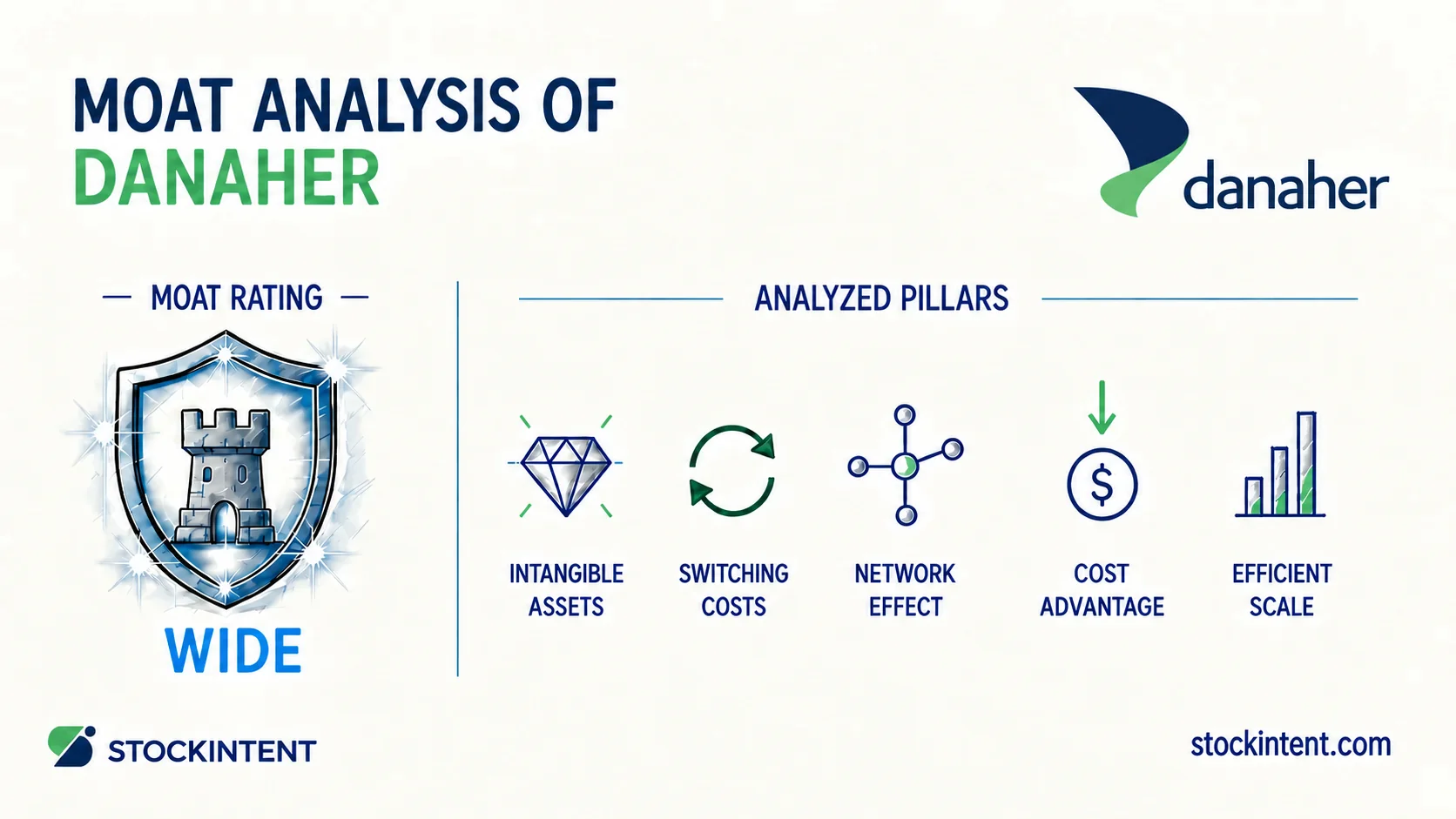
We assess Danaher as possessing a Wide economic moat with a Stable trend and a Medium uncertainty rating.
Late in 2024, Morningstar raised Danaher's moat rating to Wide, citing switching costs comparable to leading medical technology franchises. The foundation of this advantage is clear in the numbers: Danaher generated $24.6 billion in revenue in 2025, supported by an installed base where approximately 80% of revenue is recurring. In the second quarter of 2026, core revenue grew 3.0% overall and 4.5% excluding respiratory testing headwinds, proving the core engine remains steady.
Here are the central takeaways for investors:
For business-focused investors, understanding the durability of these competitive barriers matters far more than obsessing over near-term valuation multiples.
Danaher's economic moat is built on regulatory barriers and process integration. In a 2026 assessment of competitive moats, Beanvest rated Danaher's switching costs and intangible assets at 4 out of 4, while scoring efficient scale and cost advantage at 2.5 and network effects at just 1.
Switching costs represent Danaher's most formidable barrier to competition. In bioprocessing and clinical diagnostics, the company's instruments and consumables integrate directly into validated manufacturing recipes and clinical workflows. Once a drug sponsor specifies Cytiva filtration equipment or chromatography resin in its regulatory filings with the FDA, changing suppliers requires costly revalidation trials, regulatory filings, and production line downtime. That dynamic locks in customer demand across multi-decade commercial drug lifecycles.
Proprietary technology, deep patent portfolios, and specialized brands provide durable pricing power. Danaher's Biotechnology and Life Sciences divisions house premier industry names, including Cytiva, Pall, and Beckman Coulter. These units maintain thousands of active patents covering filtration media, chromatography matrices, and automated diagnostic testing protocols. Replicating this proprietary science requires massive clinical trial investments and decades of specialized biochemical expertise, preventing generic competitors from making easy incursions.
Pro Insight: The moat is about the durability of excess returns from regulatory embedding, not just brand recognition. In our experience analyzing healthcare franchises, investors often underestimate Danaher's switching costs because they focus on the Cytiva or Pall logos rather than the validation documents that make switching economically irrational for drug manufacturers.
Danaher benefits from efficient scale in niche life-science markets, though it is not the primary anchor of its moat. Supplying biopharma production sites requires global cold-chain distribution, strict cleanroom manufacturing, and around-the-clock technical service. Because individual submarkets like specific filtration chemistries have limited total addressable volume, new entrants face uneconomic unit economics if they try to build duplicate global service footprints.
Operational discipline through the Danaher Business System (DBS) drives cost efficiencies, but it does not constitute a low-cost commodity advantage. DBS relies on lean manufacturing, continuous improvement, and processes to reduce waste and raise factory output across acquired units. However, Danaher does not compete on rock-bottom pricing; instead, it leverages these operational gains to protect premium gross margins while investing aggressively in research.
Network effects do not play a meaningful role in Danaher's competitive positioning. Diagnostic analyzers and chromatography columns do not gain value simply because other hospitals or pharmaceutical labs purchase them. While standardizing on common testing consumables creates minor operational convenience across multi-site hospital networks, this dynamic does not produce true platform lock-in.
Danaher's economic moat shows up directly in strong cash conversion and high margins. In 2025, the company generated $5.3 billion in free cash flow. In the first quarter of 2026, Danaher reported a gross margin of 60.3% and an adjusted operating margin of 30.2%. The high-margin Biotechnology division delivered 7% core sales growth alongside a 29.7% operating margin in the same period, illustrating how regulatory embedding protects profitability.
Still, business performance highlights real friction points. In the second quarter of 2026, gross margin dropped to 57.6% and operating margin dropped 310 basis points to 27.1%, driven by product-mix swings and respiratory testing headwinds. A third-party analysis by Factors Today calculated Danaher's ten-year ROIC at roughly 6.5%, and 5.7% in 2025, showing that goodwill from historical acquisitions keeps consolidated returns on capital subdued.
Investors reviewing detailed company reports can separate this structural goodwill drag from segment profitability. While bioprocessing remains highly lucrative, overall performance remains vulnerable to periodic diagnostics swings.
We rate Danaher's moat trend as Stable. In the first quarter of 2026, the Biotechnology unit expanded its operating margin to 29.7% on 7% core sales growth, reinforced by double-digit bioprocessing gains in China. Operational execution remained solid enough for management to raise full-year 2026 EPS guidance following second-quarter earnings. These figures confirm that demand for core bioprocessing consumables remains resilient across commercial biopharma programs.
Yet several counterweights keep the overall competitive trajectory from widening. In the second quarter of 2026, large biopharma customers deferred $50 million to $60 million in chromatography resin shipments into 2027. Combined with lingering respiratory diagnostic declines, these delays demonstrate that customer purchasing timelines can introduce real friction. At the same time, integrating the recent Masimo transaction brings near-term margin dilution and execution risks that balance out bioprocessing gains.
From Our Experience: We view Danaher's moat as stable rather than widening despite the strong bioprocessing results. The real test is whether Danaher can sustain bioprocessing momentum while digesting Masimo and stabilizing diagnostics, a juggling act that favors stability over expansion until proven otherwise.
Investors tracking the durability of Danaher's competitive positioning over the next three to five years should watch four measurable signals:
We assign Danaher a Medium uncertainty rating. This rating is not an indictment of Danaher's operational discipline, but rather a realistic reflection of the range of potential business outcomes.
At the annual level, sales remain broadly forecastable. Management initially guided 2026 core revenue growth at 3% to 6%, later tightening the top end to 4% as respiratory testing demand softened. However, quarterly profitability can fluctuate based on product mix and acquisition dilution, swinging adjusted operating margin from 30.2% in the first quarter of 2026 down to 27.1% in the second quarter.
Several external variables widen this outcome dispersion. Danaher faces cyclical sensitivity to biotech funding environments, unpredictable hospital procurement timing in China, and constant regulatory oversight across clinical healthcare markets. In our view, customer concentration among top biopharma developers also creates lumpy purchasing patterns, while integrating Masimo adds near-term execution risk. Danaher's 80% recurring revenue base provides a sturdy downside buffer, but these variables prevent us from designating uncertainty as low. A durable economic moat protects market position over time, yet near-term execution and market timing keep future returns within a moderately wide band.
Our assessment concludes that Danaher possesses a Wide economic moat with a Stable trend and a Medium uncertainty rating.
This defensible position rests on high switching costs embedded in validated bioprocessing workflows, an 80% recurring revenue mix, and dependable cash generation. While these competitive advantages insulate core operations from direct commoditization, the moat's commercial expression is tempered by near-term customer order adjustments and lingering diagnostics headwinds.
Moving forward, two central issues will dictate whether Danaher strengthens its competitive lead. First, management must demonstrate that sustained bioprocessing cash flows can lift consolidated returns on invested capital above its historical 6.5% average, proving that heavy acquisition outlays create lasting per-share value. Second, Danaher must integrate Masimo without diluting operating margins or distracting from core life-science operations.
Rather than seeking immediate resolution, long-term investors should track the four forward-looking indicators established above to gauge whether Danaher's operational compounding remains on track.
We assess Danaher as possessing a Wide economic moat with a Stable trend and a Medium uncertainty rating.
Late in 2024, Morningstar raised Danaher's moat rating to Wide, citing switching costs comparable to leading medical technology franchises. The foundation of this advantage is clear in the numbers: Danaher generated $24.6 billion in revenue in 2025, supported by an installed base where approximately 80% of revenue is recurring. In the second quarter of 2026, core revenue grew 3.0% overall and 4.5% excluding respiratory testing headwinds, proving the core engine remains steady.
Here are the central takeaways for investors:
For business-focused investors, understanding the durability of these competitive barriers matters far more than obsessing over near-term valuation multiples.
Danaher's economic moat is built on regulatory barriers and process integration. In a 2026 assessment of competitive moats, Beanvest rated Danaher's switching costs and intangible assets at 4 out of 4, while scoring efficient scale and cost advantage at 2.5 and network effects at just 1.
Switching costs represent Danaher's most formidable barrier to competition. In bioprocessing and clinical diagnostics, the company's instruments and consumables integrate directly into validated manufacturing recipes and clinical workflows. Once a drug sponsor specifies Cytiva filtration equipment or chromatography resin in its regulatory filings with the FDA, changing suppliers requires costly revalidation trials, regulatory filings, and production line downtime. That dynamic locks in customer demand across multi-decade commercial drug lifecycles.
Proprietary technology, deep patent portfolios, and specialized brands provide durable pricing power. Danaher's Biotechnology and Life Sciences divisions house premier industry names, including Cytiva, Pall, and Beckman Coulter. These units maintain thousands of active patents covering filtration media, chromatography matrices, and automated diagnostic testing protocols. Replicating this proprietary science requires massive clinical trial investments and decades of specialized biochemical expertise, preventing generic competitors from making easy incursions.
Pro Insight: The moat is about the durability of excess returns from regulatory embedding, not just brand recognition. In our experience analyzing healthcare franchises, investors often underestimate Danaher's switching costs because they focus on the Cytiva or Pall logos rather than the validation documents that make switching economically irrational for drug manufacturers.
Danaher benefits from efficient scale in niche life-science markets, though it is not the primary anchor of its moat. Supplying biopharma production sites requires global cold-chain distribution, strict cleanroom manufacturing, and around-the-clock technical service. Because individual submarkets like specific filtration chemistries have limited total addressable volume, new entrants face uneconomic unit economics if they try to build duplicate global service footprints.
Operational discipline through the Danaher Business System (DBS) drives cost efficiencies, but it does not constitute a low-cost commodity advantage. DBS relies on lean manufacturing, continuous improvement, and processes to reduce waste and raise factory output across acquired units. However, Danaher does not compete on rock-bottom pricing; instead, it leverages these operational gains to protect premium gross margins while investing aggressively in research.
Network effects do not play a meaningful role in Danaher's competitive positioning. Diagnostic analyzers and chromatography columns do not gain value simply because other hospitals or pharmaceutical labs purchase them. While standardizing on common testing consumables creates minor operational convenience across multi-site hospital networks, this dynamic does not produce true platform lock-in.
Danaher's economic moat shows up directly in strong cash conversion and high margins. In 2025, the company generated $5.3 billion in free cash flow. In the first quarter of 2026, Danaher reported a gross margin of 60.3% and an adjusted operating margin of 30.2%. The high-margin Biotechnology division delivered 7% core sales growth alongside a 29.7% operating margin in the same period, illustrating how regulatory embedding protects profitability.
Still, business performance highlights real friction points. In the second quarter of 2026, gross margin dropped to 57.6% and operating margin dropped 310 basis points to 27.1%, driven by product-mix swings and respiratory testing headwinds. A third-party analysis by Factors Today calculated Danaher's ten-year ROIC at roughly 6.5%, and 5.7% in 2025, showing that goodwill from historical acquisitions keeps consolidated returns on capital subdued.
Investors reviewing detailed company reports can separate this structural goodwill drag from segment profitability. While bioprocessing remains highly lucrative, overall performance remains vulnerable to periodic diagnostics swings.
We rate Danaher's moat trend as Stable. In the first quarter of 2026, the Biotechnology unit expanded its operating margin to 29.7% on 7% core sales growth, reinforced by double-digit bioprocessing gains in China. Operational execution remained solid enough for management to raise full-year 2026 EPS guidance following second-quarter earnings. These figures confirm that demand for core bioprocessing consumables remains resilient across commercial biopharma programs.
Yet several counterweights keep the overall competitive trajectory from widening. In the second quarter of 2026, large biopharma customers deferred $50 million to $60 million in chromatography resin shipments into 2027. Combined with lingering respiratory diagnostic declines, these delays demonstrate that customer purchasing timelines can introduce real friction. At the same time, integrating the recent Masimo transaction brings near-term margin dilution and execution risks that balance out bioprocessing gains.
From Our Experience: We view Danaher's moat as stable rather than widening despite the strong bioprocessing results. The real test is whether Danaher can sustain bioprocessing momentum while digesting Masimo and stabilizing diagnostics, a juggling act that favors stability over expansion until proven otherwise.
Investors tracking the durability of Danaher's competitive positioning over the next three to five years should watch four measurable signals:
We assign Danaher a Medium uncertainty rating. This rating is not an indictment of Danaher's operational discipline, but rather a realistic reflection of the range of potential business outcomes.
At the annual level, sales remain broadly forecastable. Management initially guided 2026 core revenue growth at 3% to 6%, later tightening the top end to 4% as respiratory testing demand softened. However, quarterly profitability can fluctuate based on product mix and acquisition dilution, swinging adjusted operating margin from 30.2% in the first quarter of 2026 down to 27.1% in the second quarter.
Several external variables widen this outcome dispersion. Danaher faces cyclical sensitivity to biotech funding environments, unpredictable hospital procurement timing in China, and constant regulatory oversight across clinical healthcare markets. In our view, customer concentration among top biopharma developers also creates lumpy purchasing patterns, while integrating Masimo adds near-term execution risk. Danaher's 80% recurring revenue base provides a sturdy downside buffer, but these variables prevent us from designating uncertainty as low. A durable economic moat protects market position over time, yet near-term execution and market timing keep future returns within a moderately wide band.
Our assessment concludes that Danaher possesses a Wide economic moat with a Stable trend and a Medium uncertainty rating.
This defensible position rests on high switching costs embedded in validated bioprocessing workflows, an 80% recurring revenue mix, and dependable cash generation. While these competitive advantages insulate core operations from direct commoditization, the moat's commercial expression is tempered by near-term customer order adjustments and lingering diagnostics headwinds.
Moving forward, two central issues will dictate whether Danaher strengthens its competitive lead. First, management must demonstrate that sustained bioprocessing cash flows can lift consolidated returns on invested capital above its historical 6.5% average, proving that heavy acquisition outlays create lasting per-share value. Second, Danaher must integrate Masimo without diluting operating margins or distracting from core life-science operations.
Rather than seeking immediate resolution, long-term investors should track the four forward-looking indicators established above to gauge whether Danaher's operational compounding remains on track.