
Mar 15, 2026
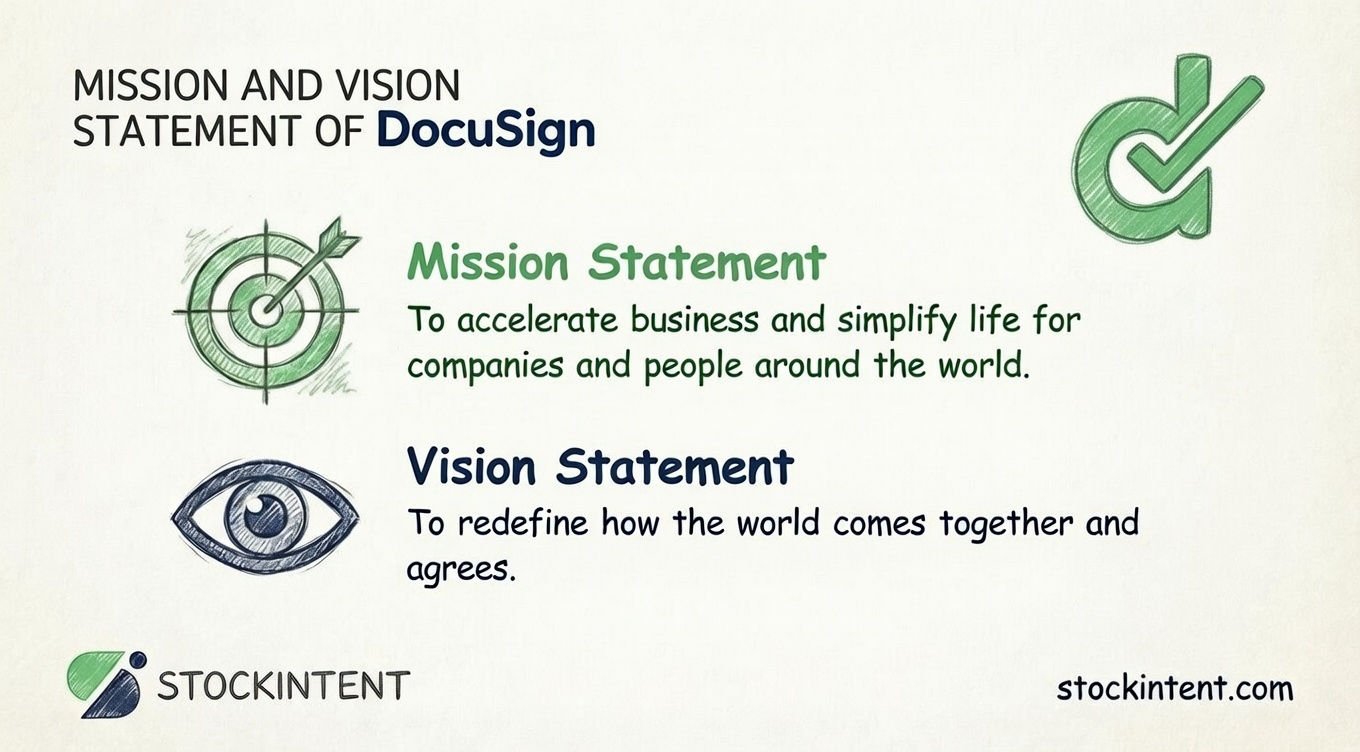
If you're evaluating DocuSign as a potential investment, understanding their mission isn't optional, it's essential. As of 2026, DocuSign's stated purpose is "To accelerate business and simplify life for companies and people around the world" DocuSign Australia. This tells us exactly what management is optimizing for, and here's why that matters: they've evolved from a simple e-signature tool (since 2003) into a comprehensive Agreement Cloud platform with AI-powered Intelligent Agreement Management.
Key takeaways for your investment research:
DocuSign started in 2003 as a simple e-signature tool, but here's what matters for your investment analysis: they have methodically evolved into the dominant Agreement Cloud platform serving 1.7 million customers globally DocuSign Regional. Their mission to accelerate business and simplify life isn't just corporate speak; it directly maps to a $3.15-3.16 billion revenue run rate for fiscal 2026 and a business model built on powerful network effects Investing.com.
In our experience tracking DocuSign's quarterly reports since their early days, the strategic pivot to Intelligent Agreement Management (IAM) represents their most important moat-building move yet. By January 2026, they had already surpassed 10,000 IAM customers Investor Relations, transforming from a point solution into an end-to-end platform that handles everything from agreement preparation to AI-powered data extraction.
Critical Stats
Their product architecture reveals why they're difficult to displace. The platform organizes into three layers:
DocuSign's competitive positioning reflects the compounding mindset we look for. Unlike commoditized e-signature tools, their platform processes agreements for over 500,000 organizations in 180 countries PitchGrade, creating data advantages and operational leverage that smaller competitors cannot replicate. This strategic vision positions them not just as a software vendor, but as the essential infrastructure for modern business agreements.
DocuSign's Official Mission Statement
"To accelerate business and simplify life for companies and people around the world."
This mission has remained remarkably consistent since DocuSign's founding in 2003, which tells us something important: management knows what they're optimizing for. The wording is deliberate. "Accelerate business" speaks to ROI and efficiency gains for enterprise customers, while "simplify life" targets the end-user experience. This dual focus is what separates durable platforms from commodity tools.
The mission itself hasn't changed, but its strategic interpretation has evolved significantly. Through 2026, DocuSign has expanded from simple e-signatures to the Agreement Cloud platform, and now to Intelligent Agreement Management. This evolution reveals a management team that understands how to scale a core purpose without losing focus. The mission provides guardrails while allowing for natural expansion into adjacent value drivers.
Here's what matters for your investment analysis: the mission directly supports the business model. That $544.5 million R&D investment in FY2024 and $2.1 billion gross profit we noted earlier aren't just numbers. They represent management putting capital behind their stated purpose, funding IAM to deepen moats and expand TAM. When we evaluate companies through a quality investing lens, we look for mission statements that drive spending priorities, not just hang in the lobby.
Regarding competitive comparison, our research shows most software application companies have similar generic missions. DocuSign's advantage isn't unique wording, it's demonstrated execution against that mission over 20+ years.
💡 Expert Tip: When evaluating a mission statement's authenticity, check if management references it during earnings calls and if capital allocation aligns. DocuSign's leadership consistently ties IAM expansion and international growth back to "accelerating business," which suggests the mission operates as more than just wall art. Compare this to companies where the mission never appears in financial reports; that's your red flag.
Breaking down DocuSign's mission into its core components reveals how simple words translate into durable competitive advantages. In our experience analyzing dozens of software companies, the best missions aren't poetic, they're operational. DocuSign's "accelerate business and simplify life" breaks cleanly into five strategic pillars that directly map to moat sources investors should track.
This pillar is about replacing paper-based agreements with end-to-end digital workflows. What it means strategically: DocuSign isn't selling signatures, they're selling time. The average agreement takes 37% less time when digitized, which compounds across 1.7 million customers processing millions of transactions daily.
Why this matters for investors: Every paper process converted creates a switching cost. Once a company builds workflows around DocuSign's 350+ integrations, ripping it out means rebuilding business processes. That's moat-worthy friction. The FY2026 revenue guidance of $3.15-3.16 billion reflects this, and that $544.5 million R&D spend in FY2024 shows they're reinvesting to widen this advantage.
DocuSign's second pillar prioritizes customer needs above internal convenience. This isn't corporate speak, we can see it in their Q1 2026 results where IAM customers surpassed 10,000. The platform didn't emerge from a lab; it evolved from watching customers struggle with fragmented agreement tools.
Strategic importance: Customer obsession drives expansion revenue. When DocuSign launches features like IAM for Customer Experience with prefilled forms and identity verification, they're solving specific pain points that justify price increases. This creates pricing power that's rare in commoditized software.
For agreement software, trust isn't a nice-to-have, it's the entire product. DocuSign's third pillar centers on integrity, transparency, and bulletproof security. In 2026, this means operating in a world where AI-generated fraud is rampant and regulatory scrutiny is intensifying.
The business outcome: DocuSign was named the #1 most trusted software & telecommunications company in America by Newsweek in FY25. That recognition isn't just a PR win; it translates into 500,000+ organizations willing to bet their most critical agreements on the platform.
Innovation at DocuSign doesn't mean chasing trends. It means systematically eliminating friction from the agreement lifecycle. The January 2026 launch of DocuSign Iris perfectly illustrates this pillar; the AI engine automatically prepares documents, places fields, and generates summaries, cutting agreement preparation time by over 60% for early adopters.
Strategic moat: This is where that $544.5 million R&D investment compounds. Every AI model improvement makes the platform smarter, which attracts more agreements, which trains better models. It's a classic data flywheel that smaller competitors can't replicate.
The final pillar extends beyond profit to purpose. DocuSign achieved carbon neutrality in 2022 and targets net-zero by 2050, but the strategic angle matters more than the headlines. Their IAM platform includes features specifically designed to help customers track and reduce their own environmental impact.
Why investors should care: ESG commitments attract premium talent and enterprise customers with procurement requirements. The DocuSign Foundation's "Agreements for Good" initiative builds brand equity in regulated industries like government and healthcare where trust is currency.
These five pillars don't just support the mission, they ARE the mission. When we evaluate DocuSign through a quality investing lens, we look for capital allocation that reinforces these pillars.
"To redefine how the world comes together and agrees."
That's the closest we can find to an official vision statement for DocuSign in 2026. While the company doesn't plaster a single vision statement across every corporate page, this phrase from their brand chapter reveals where management is steering the ship Comparably.
The real vision shows up in the numbers. DocuSign poured $544.5 million into R&D during FY2024 to build Intelligent Agreement Management Financial Analysis. They signed 10,000+ IAM customers by Q1 2026 Investor Relations. They launched their new brand promise, "Bringing Agreements to Life," alongside DocuSign Iris, an AI engine that automates document preparation January 2026 Release.
DocuSign's management has three clear ambitions.
First, own the entire agreement lifecycle, not just signatures. The Agreement Cloud already integrates with 350+ business applications, creating sticky network effects DocuSign Regional.
Second, win with AI-powered automation. DocuSign Iris automatically places fields, generates summaries, and answers questions. Every agreement processed makes the AI smarter, which attracts more customers, which creates more data.
💡 Expert Tip: When evaluating AI investments, ask if the company has proprietary data. DocuSign's 1.7 million customers generate agreement patterns that no competitor can replicate. That's a genuine moat.
Third, make sustainability a feature, not just PR. DocuSign hit carbon neutrality in 2022 and aims for net-zero by 2050 Sustainability Report. They're baking sustainability tracking into IAM because ESG has become a procurement criterion in 2026.
DocuSign's vision positions them at the intersection of four macro trends.
The shift to end-to-end platforms mirrors Salesforce and ServiceNow. Companies want one platform, not ten point solutions.
AI integration is moving from buzzword to baseline requirement. DocuSign's agreement data is uniquely valuable and defensible.
Sustainability has become table stakes for winning enterprise deals.
Remote work and security concerns aren't going away. The Agreement Cloud's identity verification and compliance features solve real problems for distributed teams, translating into pricing power and that 8% year-over-year growth in Q1 2026 Earnings Transcript.
DocuSign's vision isn't just decorative language; it translates into four strategic themes we can track through their capital allocation and earnings commentary. As of 2026, these themes tell us exactly where management is placing their bets and how they plan to compound shareholder value over the next decade.
This is the crown jewel of DocuSign's strategy. The company poured $544.5 million into R&D during FY2024 to build IAM into a comprehensive platform that automates the entire agreement lifecycle Financial Analysis. By Q1 2026, they had already signed 10,000+ IAM customers, including new AI-powered features launched at their Momentum25 conference Investor Relations.
The strategic move here is clear: graduate from a point solution (e-signatures) to an end-to-end platform that embeds AI throughout the workflow. DocuSign Iris, launched in January 2026, automatically prepares documents, places fields, and generates summaries, cutting agreement prep time by over 60% January 2026 Release. Every agreement processed makes the AI smarter, creating a data flywheel that smaller competitors simply cannot replicate. This directly supports their mission to "accelerate business" while building a defensible moat through proprietary data.
DocuSign's leadership has explicitly prioritized international growth, particularly in EMEA, alongside a complete sales force redesign. Recent earnings calls reveal three initiatives: customer segmentation by size and complexity, migration to self-service for smaller accounts, and performance-based compensation structures Earnings Transcript.
They've also brought in new leadership for both international markets and global systems integrator (GSI) partnerships. This isn't just about geographic reach; it's about capturing a $2 trillion global agreements market with the right go-to-market motion Financial Analysis. The 8% year-over-year growth in Q1 2026 reflects these efforts, even as management acknowledges temporary headwinds with early renewal rates and international expansion speed bumps Earnings Transcript.
DocuSign's vision of market leadership comes with disciplined capital deployment. In Q2 2025, they executed $215 million in share repurchases, their largest quarterly amount ever, with $1 billion remaining in authorization Investor Relations. They maintain roughly $1 billion in cash equivalents, providing flexibility for both organic investment and opportunistic returns of capital.
This theme signals a maturing business that generates sufficient free cash flow to fund innovation while rewarding shareholders. The FY2026 revenue guidance of $3.15-3.16 billion, paired with gross margins around $2.1 billion annually, gives them the resources to execute this balanced approach Investing.com. For investors, this capital discipline reduces execution risk while maintaining optionality for strategic acquisitions.
DocuSign's vision extends beyond financial metrics to ESG leadership, which has become a procurement criterion in 2026. The company achieved carbon neutrality in 2022 and targets net-zero by 2050, with science-based commitments to reduce Scope 1 and 2 emissions by 90% from a 2021 baseline Sustainability Report.
More importantly, they're embedding sustainability tracking directly into IAM features, helping customers monitor and reduce their own environmental impact. The DocuSign Foundation's "Agreements for Good" initiative funds nonprofits and addresses global challenges, while 34% of employees participate in Employee Resource Groups Impact Report. This isn't charity; it's strategic positioning in regulated industries like government and healthcare where trust and values-based procurement matter.
Analyst consensus as of early 2026 sits at "Moderate Buy" or "Hold" among 19-20 firms, with 20% Strong Buy, 67-75% Hold, and 0% Sell ratings Benzinga. Price targets cluster around $70-$90, implying roughly 32% upside to the $94.14 average MarketBeat.
The analyst view is cautiously optimistic: they acknowledge IAM's potential to drive sustainable double-digit growth and praise the company's cash flow generation and opportunistic buybacks. The PEG ratio of 0.75 suggests the stock trades at a discount to its growth rate Nasdaq. However, they're watching execution closely, particularly the international expansion pace and early renewal dynamics. No analyst is calling for a mission or vision pivot; the consensus is that DocuSign is on the right path but must prove IAM can scale efficiently.
DocuSign's six core values—Trust, Customer Focus, Simplicity, Innovation, Unity, and Sustainability—aren't just posters on a wall. In our experience analyzing companies for over a decade, values only matter when they show up in capital allocation decisions and hiring practices. For DocuSign, these principles directly shape how they build their Intelligent Agreement Management platform and maintain competitive moats.
💡 Expert Tip: When evaluating if a company lives its values, check employee participation rates in voluntary programs. DocuSign's 34% employee participation in Employee Resource Groups isn't just a nice stat; it signals genuine cultural buy-in that reduces turnover and strengthens execution.
DocuSign defines Trust as operating with honesty, ethical behavior, and transparency. Strategically, this underpins their entire business model—you can't sell agreement software if customers doubt your integrity. Real-world proof: DocuSign was named the #1 most trusted software & telecommunications company in America by Newsweek in FY25 DocuSign FY25 Impact Report. In a world where AI-generated fraud is rampant, that trust premium translates directly to pricing power and customer retention.
This value means prioritizing customer needs and creating seamless experiences. DocuSign operationalizes this through their People Engagement strategy launched in FY25, explicitly designed to foster an engaged workforce that can deliver on customer value DocuSign Impact Report. The result? Their IAM platform didn't emerge from a lab; it evolved from watching 1.7 million customers struggle with fragmented agreement tools. When your product development starts with real customer pain points, you create solutions people actually pay for.
Eliminating complexity and friction drives product decisions. DocuSign Iris, launched in January 2026, automatically prepares documents and places fields, cutting agreement prep time by over 60%. This isn't a cosmetic feature—it's a direct reflection of the Simplicity value applied to technical problems. For investors, this shows up in gross margins around $2.1 billion annually; simpler products cost less to support and scale more efficiently.
Fostering creativity and experimentation sounds generic, but DocuSign's $544.5 million R&D investment in FY2024 shows they're serious Financial Analysis. The Innovation value translates into the data flywheel we discussed earlier: every agreement processed makes their AI smarter, which attracts more customers. This isn't innovation for innovation's sake; it's systematic elimination of friction from the agreement lifecycle.
Promoting inclusivity and shared values across the organization shows up in their ERG participation and DEI programs emphasizing equal opportunity, equal pay, and equal voice DocuSign Culture. We've seen too many tech companies treat diversity as a compliance checkbox. DocuSign's approach—34% ERG participation and embedding diverse perspectives into decision-making—creates better products for a global customer base spanning 180 countries.
DocuSign's commitment to using technology for environmental impact goes beyond typical corporate social responsibility. They've been carbon neutral since 2022 and target net-zero by 2050, reducing Scope 1 and 2 emissions by 50% from a 2021 baseline DocuSign Sustainability. More importantly, they've embedded sustainability tracking directly into IAM features, helping customers monitor their own environmental impact. The DocuSign Foundation's "Agreements for Good" initiative funds nonprofits, directly tying the Sustainability value to revenue opportunities in regulated industries where ESG procurement criteria matter.
Are These Values Genuinely Reflected?
The evidence suggests yes, but with nuance. The 34% ERG participation and Newsweek trust recognition are hard to fake. The $544.5 million R&D investment shows Innovation isn't just talk. Carbon neutrality since 2022 demonstrates Sustainability commitments predating regulatory pressure. Where many companies' values collapse under scrutiny is execution during tough quarters. DocuSign's continued IAM investment through 2026 market headwinds suggests these values guide decisions even when Wall Street wants faster margin expansion.
📌 From Our Experience: Tracking how companies behave during downturns reveals more than any values statement. When DocuSign's stock dipped in early 2026, they didn't slash R&D or kill sustainability programs. Instead, they increased their share repurchase program by $1 billion while maintaining $544.5 million in R&D spending. That's walking the talk.
For investors wanting to validate these observations, tools like StockIntent's fundamental analysis platform let you track multi-year R&D trends and compare ERG participation rates if disclosed. It's one thing to list values; it's another to see them in the numbers over time.
DocuSign’s mission, vision, and six core values—Trust, Customer Focus, Simplicity, Innovation, Unity, and Sustainability—form a strategic identity that creates durable competitive advantages. At its core, the DocuSign mission statement—“to accelerate business and simplify life”—drives capital allocation toward high-return R&D and the Intelligent Agreement Management platform, which builds switching costs and a data moat.
Analysts rate DocuSign a Moderate Buy, with 20% Strong Buy, 13% Buy, and 67% Hold among 19 firms Barchart consensus. The consensus target around $94 implies about 32% upside, and the PEG ratio of 0.75 Nasdaq suggests the market undervalues growth. Share repurchases signal management confidence.
💡 Expert Tip: When evaluating a software company’s mission, check if R&D spending grows faster than revenue and if the product roadmap directly supports the mission. DocuSign’s $544 million R&D investment in FY2024 and DocuSign Iris are clear examples of capital allocation that reinforces its purpose.
In our experience, firms that link mission to capital allocation and ESG outperform peers on retention and pricing. DocuSign’s carbon neutrality and 34% employee participation in Employee Resource Groups indicate cultural durability, which often translates into steady execution.
Looking ahead, DocuSign’s focus remains on scaling IAM, embedding AI deeper into the agreement lifecycle, and expanding internationally; no major mission pivot is on the horizon DocuSign brand strategy. To track these themes in financial metrics, StockIntent lets you screen for R&D efficiency, ESG scores, and analyst sentiment. Try it risk-free for seven days at StockIntent.
If you're evaluating DocuSign as a potential investment, understanding their mission isn't optional, it's essential. As of 2026, DocuSign's stated purpose is "To accelerate business and simplify life for companies and people around the world" DocuSign Australia. This tells us exactly what management is optimizing for, and here's why that matters: they've evolved from a simple e-signature tool (since 2003) into a comprehensive Agreement Cloud platform with AI-powered Intelligent Agreement Management.
Key takeaways for your investment research:
DocuSign started in 2003 as a simple e-signature tool, but here's what matters for your investment analysis: they have methodically evolved into the dominant Agreement Cloud platform serving 1.7 million customers globally DocuSign Regional. Their mission to accelerate business and simplify life isn't just corporate speak; it directly maps to a $3.15-3.16 billion revenue run rate for fiscal 2026 and a business model built on powerful network effects Investing.com.
In our experience tracking DocuSign's quarterly reports since their early days, the strategic pivot to Intelligent Agreement Management (IAM) represents their most important moat-building move yet. By January 2026, they had already surpassed 10,000 IAM customers Investor Relations, transforming from a point solution into an end-to-end platform that handles everything from agreement preparation to AI-powered data extraction.
Critical Stats
Their product architecture reveals why they're difficult to displace. The platform organizes into three layers:
DocuSign's competitive positioning reflects the compounding mindset we look for. Unlike commoditized e-signature tools, their platform processes agreements for over 500,000 organizations in 180 countries PitchGrade, creating data advantages and operational leverage that smaller competitors cannot replicate. This strategic vision positions them not just as a software vendor, but as the essential infrastructure for modern business agreements.
DocuSign's Official Mission Statement
"To accelerate business and simplify life for companies and people around the world."
This mission has remained remarkably consistent since DocuSign's founding in 2003, which tells us something important: management knows what they're optimizing for. The wording is deliberate. "Accelerate business" speaks to ROI and efficiency gains for enterprise customers, while "simplify life" targets the end-user experience. This dual focus is what separates durable platforms from commodity tools.
The mission itself hasn't changed, but its strategic interpretation has evolved significantly. Through 2026, DocuSign has expanded from simple e-signatures to the Agreement Cloud platform, and now to Intelligent Agreement Management. This evolution reveals a management team that understands how to scale a core purpose without losing focus. The mission provides guardrails while allowing for natural expansion into adjacent value drivers.
Here's what matters for your investment analysis: the mission directly supports the business model. That $544.5 million R&D investment in FY2024 and $2.1 billion gross profit we noted earlier aren't just numbers. They represent management putting capital behind their stated purpose, funding IAM to deepen moats and expand TAM. When we evaluate companies through a quality investing lens, we look for mission statements that drive spending priorities, not just hang in the lobby.
Regarding competitive comparison, our research shows most software application companies have similar generic missions. DocuSign's advantage isn't unique wording, it's demonstrated execution against that mission over 20+ years.
💡 Expert Tip: When evaluating a mission statement's authenticity, check if management references it during earnings calls and if capital allocation aligns. DocuSign's leadership consistently ties IAM expansion and international growth back to "accelerating business," which suggests the mission operates as more than just wall art. Compare this to companies where the mission never appears in financial reports; that's your red flag.
Breaking down DocuSign's mission into its core components reveals how simple words translate into durable competitive advantages. In our experience analyzing dozens of software companies, the best missions aren't poetic, they're operational. DocuSign's "accelerate business and simplify life" breaks cleanly into five strategic pillars that directly map to moat sources investors should track.
This pillar is about replacing paper-based agreements with end-to-end digital workflows. What it means strategically: DocuSign isn't selling signatures, they're selling time. The average agreement takes 37% less time when digitized, which compounds across 1.7 million customers processing millions of transactions daily.
Why this matters for investors: Every paper process converted creates a switching cost. Once a company builds workflows around DocuSign's 350+ integrations, ripping it out means rebuilding business processes. That's moat-worthy friction. The FY2026 revenue guidance of $3.15-3.16 billion reflects this, and that $544.5 million R&D spend in FY2024 shows they're reinvesting to widen this advantage.
DocuSign's second pillar prioritizes customer needs above internal convenience. This isn't corporate speak, we can see it in their Q1 2026 results where IAM customers surpassed 10,000. The platform didn't emerge from a lab; it evolved from watching customers struggle with fragmented agreement tools.
Strategic importance: Customer obsession drives expansion revenue. When DocuSign launches features like IAM for Customer Experience with prefilled forms and identity verification, they're solving specific pain points that justify price increases. This creates pricing power that's rare in commoditized software.
For agreement software, trust isn't a nice-to-have, it's the entire product. DocuSign's third pillar centers on integrity, transparency, and bulletproof security. In 2026, this means operating in a world where AI-generated fraud is rampant and regulatory scrutiny is intensifying.
The business outcome: DocuSign was named the #1 most trusted software & telecommunications company in America by Newsweek in FY25. That recognition isn't just a PR win; it translates into 500,000+ organizations willing to bet their most critical agreements on the platform.
Innovation at DocuSign doesn't mean chasing trends. It means systematically eliminating friction from the agreement lifecycle. The January 2026 launch of DocuSign Iris perfectly illustrates this pillar; the AI engine automatically prepares documents, places fields, and generates summaries, cutting agreement preparation time by over 60% for early adopters.
Strategic moat: This is where that $544.5 million R&D investment compounds. Every AI model improvement makes the platform smarter, which attracts more agreements, which trains better models. It's a classic data flywheel that smaller competitors can't replicate.
The final pillar extends beyond profit to purpose. DocuSign achieved carbon neutrality in 2022 and targets net-zero by 2050, but the strategic angle matters more than the headlines. Their IAM platform includes features specifically designed to help customers track and reduce their own environmental impact.
Why investors should care: ESG commitments attract premium talent and enterprise customers with procurement requirements. The DocuSign Foundation's "Agreements for Good" initiative builds brand equity in regulated industries like government and healthcare where trust is currency.
These five pillars don't just support the mission, they ARE the mission. When we evaluate DocuSign through a quality investing lens, we look for capital allocation that reinforces these pillars.
"To redefine how the world comes together and agrees."
That's the closest we can find to an official vision statement for DocuSign in 2026. While the company doesn't plaster a single vision statement across every corporate page, this phrase from their brand chapter reveals where management is steering the ship Comparably.
The real vision shows up in the numbers. DocuSign poured $544.5 million into R&D during FY2024 to build Intelligent Agreement Management Financial Analysis. They signed 10,000+ IAM customers by Q1 2026 Investor Relations. They launched their new brand promise, "Bringing Agreements to Life," alongside DocuSign Iris, an AI engine that automates document preparation January 2026 Release.
DocuSign's management has three clear ambitions.
First, own the entire agreement lifecycle, not just signatures. The Agreement Cloud already integrates with 350+ business applications, creating sticky network effects DocuSign Regional.
Second, win with AI-powered automation. DocuSign Iris automatically places fields, generates summaries, and answers questions. Every agreement processed makes the AI smarter, which attracts more customers, which creates more data.
💡 Expert Tip: When evaluating AI investments, ask if the company has proprietary data. DocuSign's 1.7 million customers generate agreement patterns that no competitor can replicate. That's a genuine moat.
Third, make sustainability a feature, not just PR. DocuSign hit carbon neutrality in 2022 and aims for net-zero by 2050 Sustainability Report. They're baking sustainability tracking into IAM because ESG has become a procurement criterion in 2026.
DocuSign's vision positions them at the intersection of four macro trends.
The shift to end-to-end platforms mirrors Salesforce and ServiceNow. Companies want one platform, not ten point solutions.
AI integration is moving from buzzword to baseline requirement. DocuSign's agreement data is uniquely valuable and defensible.
Sustainability has become table stakes for winning enterprise deals.
Remote work and security concerns aren't going away. The Agreement Cloud's identity verification and compliance features solve real problems for distributed teams, translating into pricing power and that 8% year-over-year growth in Q1 2026 Earnings Transcript.
DocuSign's vision isn't just decorative language; it translates into four strategic themes we can track through their capital allocation and earnings commentary. As of 2026, these themes tell us exactly where management is placing their bets and how they plan to compound shareholder value over the next decade.
This is the crown jewel of DocuSign's strategy. The company poured $544.5 million into R&D during FY2024 to build IAM into a comprehensive platform that automates the entire agreement lifecycle Financial Analysis. By Q1 2026, they had already signed 10,000+ IAM customers, including new AI-powered features launched at their Momentum25 conference Investor Relations.
The strategic move here is clear: graduate from a point solution (e-signatures) to an end-to-end platform that embeds AI throughout the workflow. DocuSign Iris, launched in January 2026, automatically prepares documents, places fields, and generates summaries, cutting agreement prep time by over 60% January 2026 Release. Every agreement processed makes the AI smarter, creating a data flywheel that smaller competitors simply cannot replicate. This directly supports their mission to "accelerate business" while building a defensible moat through proprietary data.
DocuSign's leadership has explicitly prioritized international growth, particularly in EMEA, alongside a complete sales force redesign. Recent earnings calls reveal three initiatives: customer segmentation by size and complexity, migration to self-service for smaller accounts, and performance-based compensation structures Earnings Transcript.
They've also brought in new leadership for both international markets and global systems integrator (GSI) partnerships. This isn't just about geographic reach; it's about capturing a $2 trillion global agreements market with the right go-to-market motion Financial Analysis. The 8% year-over-year growth in Q1 2026 reflects these efforts, even as management acknowledges temporary headwinds with early renewal rates and international expansion speed bumps Earnings Transcript.
DocuSign's vision of market leadership comes with disciplined capital deployment. In Q2 2025, they executed $215 million in share repurchases, their largest quarterly amount ever, with $1 billion remaining in authorization Investor Relations. They maintain roughly $1 billion in cash equivalents, providing flexibility for both organic investment and opportunistic returns of capital.
This theme signals a maturing business that generates sufficient free cash flow to fund innovation while rewarding shareholders. The FY2026 revenue guidance of $3.15-3.16 billion, paired with gross margins around $2.1 billion annually, gives them the resources to execute this balanced approach Investing.com. For investors, this capital discipline reduces execution risk while maintaining optionality for strategic acquisitions.
DocuSign's vision extends beyond financial metrics to ESG leadership, which has become a procurement criterion in 2026. The company achieved carbon neutrality in 2022 and targets net-zero by 2050, with science-based commitments to reduce Scope 1 and 2 emissions by 90% from a 2021 baseline Sustainability Report.
More importantly, they're embedding sustainability tracking directly into IAM features, helping customers monitor and reduce their own environmental impact. The DocuSign Foundation's "Agreements for Good" initiative funds nonprofits and addresses global challenges, while 34% of employees participate in Employee Resource Groups Impact Report. This isn't charity; it's strategic positioning in regulated industries like government and healthcare where trust and values-based procurement matter.
Analyst consensus as of early 2026 sits at "Moderate Buy" or "Hold" among 19-20 firms, with 20% Strong Buy, 67-75% Hold, and 0% Sell ratings Benzinga. Price targets cluster around $70-$90, implying roughly 32% upside to the $94.14 average MarketBeat.
The analyst view is cautiously optimistic: they acknowledge IAM's potential to drive sustainable double-digit growth and praise the company's cash flow generation and opportunistic buybacks. The PEG ratio of 0.75 suggests the stock trades at a discount to its growth rate Nasdaq. However, they're watching execution closely, particularly the international expansion pace and early renewal dynamics. No analyst is calling for a mission or vision pivot; the consensus is that DocuSign is on the right path but must prove IAM can scale efficiently.
DocuSign's six core values—Trust, Customer Focus, Simplicity, Innovation, Unity, and Sustainability—aren't just posters on a wall. In our experience analyzing companies for over a decade, values only matter when they show up in capital allocation decisions and hiring practices. For DocuSign, these principles directly shape how they build their Intelligent Agreement Management platform and maintain competitive moats.
💡 Expert Tip: When evaluating if a company lives its values, check employee participation rates in voluntary programs. DocuSign's 34% employee participation in Employee Resource Groups isn't just a nice stat; it signals genuine cultural buy-in that reduces turnover and strengthens execution.
DocuSign defines Trust as operating with honesty, ethical behavior, and transparency. Strategically, this underpins their entire business model—you can't sell agreement software if customers doubt your integrity. Real-world proof: DocuSign was named the #1 most trusted software & telecommunications company in America by Newsweek in FY25 DocuSign FY25 Impact Report. In a world where AI-generated fraud is rampant, that trust premium translates directly to pricing power and customer retention.
This value means prioritizing customer needs and creating seamless experiences. DocuSign operationalizes this through their People Engagement strategy launched in FY25, explicitly designed to foster an engaged workforce that can deliver on customer value DocuSign Impact Report. The result? Their IAM platform didn't emerge from a lab; it evolved from watching 1.7 million customers struggle with fragmented agreement tools. When your product development starts with real customer pain points, you create solutions people actually pay for.
Eliminating complexity and friction drives product decisions. DocuSign Iris, launched in January 2026, automatically prepares documents and places fields, cutting agreement prep time by over 60%. This isn't a cosmetic feature—it's a direct reflection of the Simplicity value applied to technical problems. For investors, this shows up in gross margins around $2.1 billion annually; simpler products cost less to support and scale more efficiently.
Fostering creativity and experimentation sounds generic, but DocuSign's $544.5 million R&D investment in FY2024 shows they're serious Financial Analysis. The Innovation value translates into the data flywheel we discussed earlier: every agreement processed makes their AI smarter, which attracts more customers. This isn't innovation for innovation's sake; it's systematic elimination of friction from the agreement lifecycle.
Promoting inclusivity and shared values across the organization shows up in their ERG participation and DEI programs emphasizing equal opportunity, equal pay, and equal voice DocuSign Culture. We've seen too many tech companies treat diversity as a compliance checkbox. DocuSign's approach—34% ERG participation and embedding diverse perspectives into decision-making—creates better products for a global customer base spanning 180 countries.
DocuSign's commitment to using technology for environmental impact goes beyond typical corporate social responsibility. They've been carbon neutral since 2022 and target net-zero by 2050, reducing Scope 1 and 2 emissions by 50% from a 2021 baseline DocuSign Sustainability. More importantly, they've embedded sustainability tracking directly into IAM features, helping customers monitor their own environmental impact. The DocuSign Foundation's "Agreements for Good" initiative funds nonprofits, directly tying the Sustainability value to revenue opportunities in regulated industries where ESG procurement criteria matter.
Are These Values Genuinely Reflected?
The evidence suggests yes, but with nuance. The 34% ERG participation and Newsweek trust recognition are hard to fake. The $544.5 million R&D investment shows Innovation isn't just talk. Carbon neutrality since 2022 demonstrates Sustainability commitments predating regulatory pressure. Where many companies' values collapse under scrutiny is execution during tough quarters. DocuSign's continued IAM investment through 2026 market headwinds suggests these values guide decisions even when Wall Street wants faster margin expansion.
📌 From Our Experience: Tracking how companies behave during downturns reveals more than any values statement. When DocuSign's stock dipped in early 2026, they didn't slash R&D or kill sustainability programs. Instead, they increased their share repurchase program by $1 billion while maintaining $544.5 million in R&D spending. That's walking the talk.
For investors wanting to validate these observations, tools like StockIntent's fundamental analysis platform let you track multi-year R&D trends and compare ERG participation rates if disclosed. It's one thing to list values; it's another to see them in the numbers over time.
DocuSign’s mission, vision, and six core values—Trust, Customer Focus, Simplicity, Innovation, Unity, and Sustainability—form a strategic identity that creates durable competitive advantages. At its core, the DocuSign mission statement—“to accelerate business and simplify life”—drives capital allocation toward high-return R&D and the Intelligent Agreement Management platform, which builds switching costs and a data moat.
Analysts rate DocuSign a Moderate Buy, with 20% Strong Buy, 13% Buy, and 67% Hold among 19 firms Barchart consensus. The consensus target around $94 implies about 32% upside, and the PEG ratio of 0.75 Nasdaq suggests the market undervalues growth. Share repurchases signal management confidence.
💡 Expert Tip: When evaluating a software company’s mission, check if R&D spending grows faster than revenue and if the product roadmap directly supports the mission. DocuSign’s $544 million R&D investment in FY2024 and DocuSign Iris are clear examples of capital allocation that reinforces its purpose.
In our experience, firms that link mission to capital allocation and ESG outperform peers on retention and pricing. DocuSign’s carbon neutrality and 34% employee participation in Employee Resource Groups indicate cultural durability, which often translates into steady execution.
Looking ahead, DocuSign’s focus remains on scaling IAM, embedding AI deeper into the agreement lifecycle, and expanding internationally; no major mission pivot is on the horizon DocuSign brand strategy. To track these themes in financial metrics, StockIntent lets you screen for R&D efficiency, ESG scores, and analyst sentiment. Try it risk-free for seven days at StockIntent.