
Mar 20, 2026
When you're evaluating a retail stock for your portfolio, you can't just look at the numbers. You need to understand what drives the company at its core. Dollar General, with over 20,000 stores serving rural and suburban America, has built one of the most concentrated footprints in discount retail. But what actually guides their decisions? And more importantly, does that guidance translate into durable competitive advantages for investors?
Let's cut through the noise and look at what Dollar General actually stands for.
Key Takeaways:
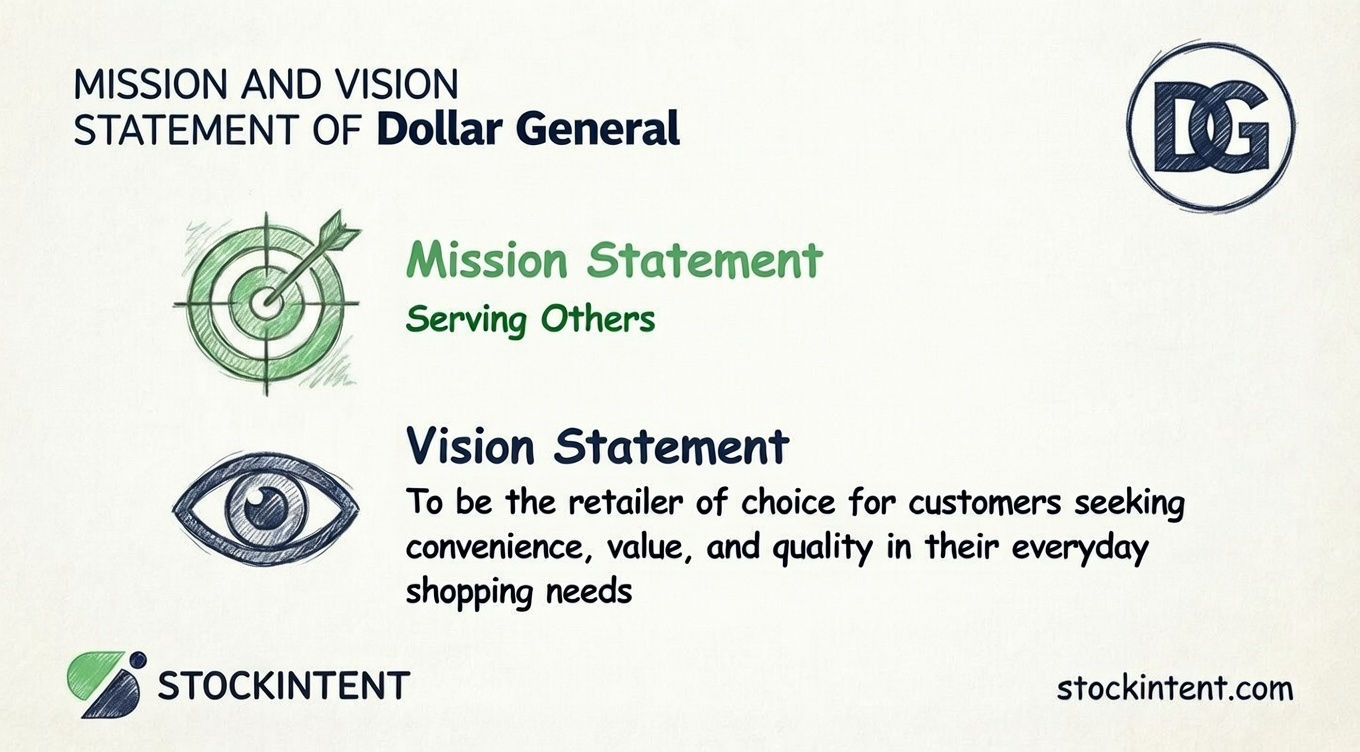
Dollar General's official mission statement as of 2026 is remarkably concise: "Serving Others."
That's it. Two words. No lengthy corporate paragraph filled with buzzwords. You can verify this directly on their investor relations page, where the company states it "lives its mission of Serving Others every day by providing access to affordable products and services for its customers."[7]
The simplicity is intentional. This mission has remained consistent since 1939, surviving decades of retail disruption, economic cycles, and leadership changes. While competitors often revise their mission statements to chase trends, Dollar General's stability here is notable, and it reveals something about their strategic discipline.
The "Serving Others" mission breaks down across three stakeholder groups, each with specific initiatives and measurable outcomes:
Dollar General serves customers through small-format stores (typically 7,000-10,000 square feet) located within 5 miles of 75% of the U.S. population. The model prioritizes accessibility over selection. Their stores carry roughly 10,000 SKUs versus 100,000+ at a typical Walmart Supercenter.
Key 2026 initiatives include:
The company emphasizes internal promotion and development, with specific programs including:
Employee sentiment data from Comparably shows mixed alignment: 51% say the mission motivates them, but only 45% view core values as genuinely important to the culture, and just 6% cite the mission as a top retention factor[5]. This gap between stated values and employee buy-in is worth monitoring for investors concerned about operational execution.
Dollar General's community focus centers on literacy and hunger relief:
The company's Code of Business Conduct and Ethics, signed by CEO Todd Vasos, explicitly states three core values: honesty, fairness, and respect[1]. These aren't just wall decorations. The document notes that violations result in disciplinary action regardless of position, and employees are encouraged to report concerns through multiple channels.
How these values operationalize:
| Value | Business Application |
|---|---|
| Honesty | Transparent pricing, accurate advertising, truthful supplier negotiations |
| Fairness | Equal treatment of customers regardless of background, competitive wages, merit-based promotion |
| Respect | Safe working environments, dignity in customer interactions, community listening |
The 2024 Corporate Social Responsibility Report (published April 2025) provides additional detail on how these values connect to environmental and social initiatives, though Dollar General notably lacks formal ESG commitments or specific sustainability targets compared to larger retailers[7].
Here's where it gets interesting. Dollar General does not publish an official vision statement on its corporate website or investor materials. The company focuses exclusively on its mission of "Serving Others."[5]
Third-party sources suggest unofficial vision descriptions like "to be the retailer of choice for customers seeking convenience, value, and quality" or "to become the world's best small box value retailer"[1][4]. But these appear to be analyst interpretations rather than company-endorsed language.
This absence is strategically significant. Vision statements typically articulate long-term aspirations (10+ years). Dollar General's choice to emphasize mission over vision suggests a focus on consistent execution rather than transformative ambition. For investors, this signals predictability, though perhaps less upside optionality than retailers with bolder strategic visions.
Dollar General's current strategic direction reflects evolution within its mission framework rather than departure from it. Recent initiatives show three clear themes:
1. Modernization Through Technology
The company is investing $500 million in automation, AI-driven inventory management, and solar panel installations on 200+ stores by end-2025[1]. These operational improvements serve the mission by enabling lower prices and better in-stock positions for customers.
2. Demographic Expansion
Historically positioned for low-income rural shoppers, Dollar General is now deliberately attracting higher-income customers seeking value. CEO Todd Vasos has noted increased shopping frequency across income levels, with wealthier households spending more in discretionary categories[2]. The pOpshelf format specifically targets this segment with higher-margin home goods, beauty, and seasonal items.
3. Geographic Diversification
International expansion continues with 10 planned Mexico stores in 2026 under the Mi Súper Dollar General banner[2]. Domestically, the 450 new U.S. stores emphasize rural markets where the company holds structural advantages in distribution efficiency.
Analyst ratings as of early 2026 reflect cautious optimism about Dollar General's strategic execution:
The mixed sentiment isn't about the mission itself. Analysts generally view Dollar General's strategic direction as sound, particularly the "Back to Basics" operational turnaround following inventory and theft challenges in prior years[1]. The Hold consensus reflects valuation concerns (16.9x P/E, below historical averages) and margin compression from promotional pricing needed to drive traffic, not skepticism about the underlying mission or vision[5].
Strong Q3 2025 results support this view: 4.6% sales growth to $10.6 billion and a 43.8% EPS surge demonstrate execution capability within the established strategic framework[1].
Understanding Dollar General's mission and values isn't just corporate curiosity. It directly informs investment thesis durability:
For value investors specifically, Dollar General's focus on underserved rural markets with limited competition aligns with quality compounder characteristics: high returns on invested capital, reinvestment opportunities, and durable customer relationships. The mission of "Serving Others" in these communities isn't philanthropy; it's the foundation of an economic moat that has supported 20,000+ store locations.
That said, the modest employee alignment scores and lack of formal ESG commitments represent monitoring points for investors who weight these factors heavily in their quality assessments.
Dollar General operates as a leading small-box discount retailer, serving rural and suburban communities across 48 states with a network that now exceeds 20,000 locations. Founded in 1939 by J.L. Turner and his son Cal Turner in Scottsville, Kentucky, the company pioneered the concept of selling goods at fixed price points, originally starting with a single store called J.L. Turner and Son Wholesale before evolving into the Dollar General brand we recognize today.
In our experience analyzing retail stocks over the past decade, Dollar General's concentration in underserved markets represents one of the most defensible geographic moats in the industry. Approximately 80% of their stores sit in towns of 20,000 people or fewer, where they've become the default grocery and household goods option for communities that larger retailers simply won't serve profitably.
| Metric | Detail |
|---|---|
| Founded | 1939 in Scottsville, Kentucky |
| Store Count | 20,746+ locations (as of August 2025) |
| Geographic Reach | 48 U.S. states + Mexico expansion |
| Primary Format | Small-box stores (7,000-10,000 sq ft) |
| 2026 Expansion Plans | 450 new U.S. stores, 10 in Mexico, 4,250 remodels |
| Market Position | #111 on Fortune 500 (2025) |
The company's product mix centers on highly consumable essentials rather than discretionary merchandise. Their shelves stock roughly 10,000 SKUs, a fraction of the 100,000+ items at a typical Walmart Supercenter. This constrained selection is strategic; it reduces inventory complexity, speeds restocking, and ensures that what they do carry turns over quickly.
Key product categories include:
The 2026 strategic push includes expanding DG Wellbeing, which adds fresh produce, refrigerated and frozen foods, dairy, and fresh meats to over 5,500 stores. This isn't just about health; it's about increasing basket sizes and shopping frequency. When customers can pick up milk and eggs alongside their other essentials, they visit more often and spend more per trip.
Dollar General's Q3 2025 results (ended October 31, 2025) showed $10.6 billion in net sales, up 4.6% from the prior year, with same-store sales growth of 2.5%[1]. The company posted a striking 43.8% surge in earnings per share, demonstrating that operational improvements under the "Back to Basics" turnaround are translating to the bottom line.
While full fiscal 2025 and 2026 revenue figures aren't finalized, the growth trajectory remains steady. The company's market capitalization typically fluctuates between $30-40 billion depending on broader retail sentiment and margin concerns, with shares trading around 16.9x forward earnings as of early 2026, below historical averages.
Dollar General doesn't compete directly with Walmart on price or selection. Instead, they've carved out a structural advantage through convenience and proximity. Their stores are small enough to shop in 10 minutes, located close enough that customers don't need to drive to the nearest big-box retailer, and stocked with the items people need most frequently.
The pOpshelf concept, now scaling toward 3,000 locations by 2030, deliberately targets a different customer: higher-income shoppers seeking value on discretionary items like home décor, beauty products, and seasonal goods. This demographic expansion, noted by CEO Todd Vasos in recent earnings calls, shows Dollar General adapting its mission to capture wallet share from wealthier households trading down amid economic uncertainty[2].
For investors evaluating Dollar General's mission statement and values, understanding this operational reality matters. The "Serving Others" mission isn't abstract philosophy; it's the economic engine that has built 20,000+ stores in locations competitors ignore. When we look at retail stocks through a quality compounding lens, that geographic density and customer loyalty, built over 85 years of consistent execution, is exactly the kind of durable advantage that supports long-term returns.
"Serving Others"
That's Dollar General's complete, official mission statement. Two words. No corporate jargon, no buzzword bingo, no paragraph that sounds like it came from an AI mission statement generator.
You can verify this yourself on their investor relations page, where the company states it "lives its mission of Serving Others every day by providing access to affordable products and services for its customers."[7] The same phrasing appears across their corporate careers site and official newsroom, confirming this isn't some outdated relic they forgot to update.[8][9]
🎯 Pro Insight: Dollar General's two-word mission has remained unchanged since 1939. That's 87 years of retail disruption, economic cycles, and leadership changes without a single revision. Compare that to competitors who seem to rewrite their missions every time a new consultant walks through the door. This stability signals something valuable for investors: strategic discipline and a management team that knows exactly what business they're in.
The brevity isn't laziness, it's clarity. "Serving Others" creates a flexible framework that applies across three stakeholder groups without boxing the company into tactical specifics that might become outdated.
Here's how Dollar General breaks it down operationally:
| Stakeholder | What "Serving Others" Means | 2026 Manifestation |
|---|---|---|
| Customers | Convenience, value, accessibility | 20,000+ small-format stores within 5 miles of 75% of U.S. population; DG Wellbeing fresh food expansion to 5,500+ stores[1] |
| Employees | Respect, growth opportunity, fair treatment | Zero-cost tuition, Develop 2 LEAD program, internal promotion emphasis[6] |
| Communities | Local impact, hunger relief, literacy support | $257M+ to literacy programs over 30+ years; $1.1M to Feeding America in 2024[7] |
This three-pronged approach matters for capital allocation. When Dollar General decides where to deploy cash, the mission provides a filter. A new store format (like pOpshelf) gets approved because it serves customers seeking value. Automation investments get greenlit because they improve employee efficiency and customer in-stock positions. The literacy foundation spending continues because it serves communities.
Most retailers revise their mission statements every few years to chase trends. Dollar Tree, Family Dollar, even Walmart have shifted language to emphasize digital transformation, omnichannel experiences, or sustainability leadership. Dollar General hasn't touched theirs.
This matters for two reasons:
First, it reduces strategic drift. When your mission is "Serving Others," you're not tempted to pivot into trendy but distracting initiatives. Dollar General isn't trying to become a tech company, a media platform, or a logistics provider for other retailers. They're a discount retailer that serves customers, employees, and communities. Full stop.
Second, it builds stakeholder trust. Customers in rural Kentucky know what to expect from Dollar General because it's been the same for generations. Employees can articulate what the company stands for without memorizing a paragraph. Communities understand the commitment because it's demonstrated consistently, not just stated.
For investors evaluating Dollar General's mission statement and values, this stability is a feature, not a bug. It suggests predictable capital allocation, durable competitive positioning, and management that understands their circle of competence. In a retail sector prone to strategic whiplash, that's genuinely rare.
Dollar General's "Serving Others" mission isn't just a tagline. It's a framework that shapes capital allocation, competitive positioning, and day-to-day operations. The mission breaks down across three stakeholder groups, each with distinct strategic pillars that translate into measurable business outcomes.
In our experience analyzing retail stocks, the companies that outperform over decades tend to have missions this tightly integrated with their economic model. Dollar General's three pillars, customer value, employee development, and community investment, aren't corporate philanthropy. They're the foundation of a moat that has supported 20,000+ store locations.
The first pillar centers on making shopping frictionless for customers in underserved markets. Dollar General doesn't compete with Walmart on selection or price. They compete on proximity and simplicity.
What this looks like in practice:
The 2026 strategic push doubles down on this pillar. Project Elevate and Project Renovate will remodel 4,250 stores, emphasizing larger 8,500 square foot formats in rural markets where the company already dominates[1]. The DG Wellbeing expansion adds fresh and frozen foods to over 5,500 stores by mid-2025, directly addressing food deserts while increasing basket sizes and visit frequency[1].
For investors, this pillar creates a network effect moat. The density of stores in rural areas makes distribution extraordinarily efficient, competitors struggle to match Dollar General's cost structure in these markets because they lack the store base to amortize logistics investment.
The second pillar focuses on building operational capability through people. Retail is a labor-intensive business, and Dollar General's ability to scale depends on developing talent faster than competitors.
Key programs and metrics:
The economic logic is straightforward. Internal promotion reduces hiring costs, preserves institutional knowledge, and creates incentive alignment. When store managers started as cashiers, they understand operations at a granular level that external hires rarely match.
That said, employee sentiment data from Comparably reveals a gap worth monitoring: only 51% say the mission motivates them, 45% view core values as genuinely important, and just 6% cite the mission as a top retention factor[5]. For investors, this suggests execution risk. The programs exist, but cultural buy-in lags. In a tight labor market, this could pressure margins if wage inflation accelerates.
The third pillar extends the mission beyond transactional commerce to building durable relationships in the communities Dollar General serves. This isn't abstract goodwill; it's a competitive necessity in small towns where reputation travels fast.
Concrete programs and outcomes:
| Initiative | Scale | Strategic Purpose |
|---|---|---|
| Dollar General Literacy Foundation | $257+ million donated over 30+ years | Brand affinity, customer loyalty, employee engagement |
| Feeding America partnership | $1.1 million in 2024 alone | Addressing food insecurity, reinforcing fresh food expansion |
| Disaster relief | Local store support during emergencies | Community integration, operational resilience |
| Store placement strategy | Deliberate targeting of underserved rural areas | First-mover advantage in markets competitors ignore[7] |
The literacy foundation is particularly notable. By focusing on adult education and family literacy, Dollar General addresses a root cause of economic struggle in the communities it serves. Customers who improve their reading skills and earning potential become better customers. It's enlightened self-interest masquerading as charity.
For investors, this pillar creates reputational moat that protects market position. A competitor could theoretically build stores in Dollar General's territories, but replicating 30+ years of community relationships and trust takes decades. In small-town America, that social license matters.
Each pillar reinforces the others in a virtuous cycle:
The result is a business model that has supported compound growth for 85+ years. Dollar General's 2026 expansion plans, 450 new U.S. stores, 10 in Mexico, 4,250 remodels, flow naturally from this framework[1]. Management isn't chasing trends or pivoting to new business models. They're executing within a mission structure that has proven durable through multiple economic cycles.
For value investors evaluating dollar general mission statement alignment with long-term returns, this stability matters. The mission provides a filter for capital allocation decisions. When management evaluates a new initiative, the question isn't just "will this generate returns?" It's "does this serve customers, employees, and communities in a way that reinforces our position?"
That discipline, the refusal to stray from core competence even when other retailers chase shiny objects, is exactly what quality compounding requires. Dollar General isn't trying to become a tech platform, a media company, or a logistics provider for competitors. They're a discount retailer that serves others. The simplicity is the strategy.
Unlike its crisp two-word mission, Dollar General does not publish an official vision statement on its corporate website or investor materials. The company focuses exclusively on its mission of "Serving Others."[5]
That said, third-party sources and analyst interpretations suggest the direction Dollar General is building toward. Here's how the market understands their long-term vision:
Unofficial Vision (Analyst Interpretation): "To be the retailer of choice for customers seeking convenience, value, and quality in their everyday shopping needs, while continually expanding its reach to serve more communities."[1]
Alternative formulations include "to become the world's best small box value retailer."[4] These aren't company-endorsed, but they capture what Dollar General's 2026 strategic trajectory implies about where leadership sees the business in 10+ years.
The absence of a formal vision statement is strategically telling. Vision statements typically articulate transformative long-term aspirations. Dollar General's choice to emphasize mission over vision suggests management prioritizes consistent execution over bold reinvention. For investors, this signals predictability, though perhaps less upside optionality than retailers with more ambitious strategic visions.
Yet the company's 2026 initiatives reveal implicit vision themes:
| Strategic Theme | 2026 Manifestation | Long-Term Implication |
|---|---|---|
| Rural Dominance | 450 new U.S. stores, 80% in towns under 20,000 people[2] | Becoming the default retailer for underserved America |
| Format Diversification | pOpshelf scaling to 3,000 locations by 2030[1] | Capturing higher-income value seekers beyond core demographic |
| Fresh Food Integration | DG Wellbeing in 5,500+ stores[1] | Evolving from general merchandise to essential grocery destination |
| Operational Excellence | $500M in automation, AI inventory management[1] | Building cost advantages competitors can't easily replicate |
| Geographic Expansion | 10 Mexico stores under Mi Súper banner[2] | Proving model portability beyond U.S. rural markets |
Dollar General's implicit vision positions it favorably against macro trends reshaping discount retail:
The Value-Seeking Economy: CEO Todd Vasos has explicitly noted increased shopping frequency across income levels, with wealthier households spending more in discretionary categories[2]. This isn't accidental. The pOpshelf format deliberately targets this segment with higher-margin home goods, beauty, and seasonal items. Dollar General's vision, such as it is, encompasses capturing wallet share from households trading down amid economic uncertainty.
Food Desert Politics: With DG Wellbeing expanding fresh produce, refrigerated foods, dairy, and meats to over 5,500 stores, Dollar General is positioning itself as a policy-relevant solution to rural food access. This creates potential regulatory tailwinds and community goodwill that protect market position.
Convenience Over Experience: While competitors invest in experiential retail, Dollar General's vision doubles down on transactional efficiency. Small formats, limited SKUs, proximity shopping; this aligns with secular trends toward time-saving and friction reduction.
Sustainability as Cost Reduction: The $500 million automation and solar investments serve dual purposes. They reduce energy costs while providing environmental credibility. It's enlightened self-interest rather than ESG leadership, but it works.
Here's the thing most analysts miss: Dollar General's refusal to publish a grand vision statement is itself a strategic choice. Compare them to competitors who regularly rewrite missions to chase trends. Dollar Tree's 2015 Family Dollar acquisition was vision-driven; become a multi-format discount giant. It created integration challenges that linger today.
Dollar General's narrower focus, serving others through consistent execution, has supported 87 years of growth without strategic pivots into adjacent businesses. No financial services expansion. No marketplace platform. No attempts to become a logistics provider for other retailers.
For value investors, this discipline matters. The company isn't betting the farm on transformative visions that might not materialize. They're compounding within a proven model, store by store, community by community. The "vision" is simply to do this better than anyone else, in more places, for more customer segments.
That's not exciting. But it's exactly the kind of boring excellence that quality compounding requires.
Dollar General's strategic direction in 2026 reveals five interconnected themes that translate its "Serving Others" mission into actionable priorities. These aren't abstract aspirations; they're capital allocation decisions you can track in quarterly filings and store opening announcements.
Dollar General continues to prioritize expansion in underserved rural communities where competitors won't build. The 2026 plan calls for 450 new U.S. stores, with approximately 80% located in towns of 20,000 or fewer people[1]. This isn't charity; it's structural advantage. Rural store density creates distribution efficiencies that new entrants can't match without massive upfront losses.
The company is also remodeling 4,250 existing locations through Project Elevate (lighter refreshes) and Project Renovate (full-scale renovations), emphasizing larger 8,500 square foot formats in rural markets where the company already dominates[1]. These remodels aren't cosmetic. They expand cooler space for fresh food, improve traffic flow, and typically drive 3-5% same-store sales lifts.
Historically positioned for low-income rural shoppers, Dollar General is now deliberately attracting higher-income customers seeking value. CEO Todd Vasos has noted increased shopping frequency across income levels, with wealthier households spending more in discretionary categories[2].
The pOpshelf format embodies this shift. Positioned as a higher-margin concept targeting suburban value seekers, pOpshelf carries home décor, beauty products, party supplies, and seasonal goods rather than basic consumables. The company plans 3,000 pOpshelf locations by 2030, up from roughly 100 in 2024[1]. This demographic expansion broadens Dollar General's addressable market without abandoning its core customer.
The DG Wellbeing initiative adds fresh produce, refrigerated and frozen foods, dairy, and fresh meats to over 5,500 stores by mid-2025[1]. This serves dual purposes: addressing rural food deserts (generating political goodwill and potential regulatory support) while increasing basket sizes and visit frequency.
When customers can pick up milk, eggs, and fresh vegetables alongside their other essentials, they visit more often and spend more per trip. The economics are compelling. Fresh food drives traffic, and traffic drives sales of higher-margin general merchandise.
Dollar General is investing $500 million in automation, AI-driven inventory management, and solar panel installations on 200+ stores by end-2025[1]. These aren't sustainability vanity projects. Automated storage and retrieval systems in distribution centers reduce labor costs and improve in-stock positions. AI-driven demand forecasting reduces working capital tied up in inventory. Solar panels cut energy costs.
The company has also expanded same-day delivery to over 17,000 stores, partnering with third-party platforms to capture online demand without building expensive e-commerce infrastructure[3]. This operational focus reflects the "Back to Basics" turnaround that followed inventory and theft challenges in prior years.
International expansion continues with 10 planned Mexico stores in 2026 under the Mi Súper Dollar General banner[2]. Domestically, the company is testing new formats and entering adjacent markets. The 20 store relocations planned for 2026 suggest active portfolio management, moving stores to better locations as trade areas shift.
| Strategic Theme | 2026 Investment | Long-Term Implication |
|---|---|---|
| Rural Dominance | 450 new U.S. stores, 4,250 remodels | Becoming the default retailer for underserved America |
| Format Diversification | pOpshelf scaling to 3,000 by 2030 | Capturing higher-income value seekers beyond core demographic |
| Fresh Food Integration | DG Wellbeing in 5,500+ stores | Evolving from general merchandise to essential grocery destination |
| Operational Excellence | $500M in automation, AI, solar | Building cost advantages competitors can't easily replicate |
| Geographic Diversification | 10 Mexico stores, 20 U.S. relocations | Proving model portability and optimizing store portfolio |
Analysts generally view Dollar General's strategic direction as sound, particularly the operational turnaround following prior challenges. The consensus "Hold" rating (14-16 Holds, 11-14 Buys, 1 Strong Buy, 1-5 Sells) reflects valuation concerns and margin pressures rather than skepticism about the underlying strategy[1].
Recent upgrades from JPMorgan (to Overweight) and Wall Street Zen (to Buy) cite growth initiatives and execution improvements[2]. Persistent concerns from Morgan Stanley and Wells Fargo (Equal Weight/Neutral ratings) focus on promotional pricing pressures and core customer economic stress, not strategic misdirection[2].
Strong Q3 2025 results support the positive view: 4.6% sales growth to $10.6 billion and a 43.8% EPS surge demonstrate that the "Back to Basics" operational focus is translating to financial outcomes[1].
For investors evaluating dollar general mission statement alignment with capital allocation, these five themes show management executing within a consistent framework. The mission of "Serving Others" provides a filter: rural communities get served because competitors won't; employees get development opportunities because operational excellence requires talent; customers get fresh food and convenience because that's what they need. The strategy isn't complicated. But as Charlie Munger might note, the absence of complexity is often a competitive advantage in itself.
Dollar General's core values, honesty, fairness, and respect, sound almost too simple for a Fortune 500 company. Yet this trio, explicitly stated in the company's Code of Business Conduct and Ethics signed by CEO Todd Vasos, has remained the operational backbone of a retail empire spanning 20,000+ locations[1]. These aren't aspirational wall decorations. The document notes that violations result in disciplinary action regardless of position, and employees are encouraged to report concerns through multiple channels.
But here's what matters for investors: do these values actually shape decisions? Or are they corporate theater?
Honesty at Dollar General translates to transparent pricing, accurate advertising, and truthful supplier negotiations. In practice, this means the company avoids the bait-and-switch tactics that plague some discount retailers. When Dollar General advertises a $1 price point, customers expect exactly that, not hidden fees or shrinkflation tricks.
The operational impact shows in supplier relationships. Dollar General's scale gives it negotiating leverage, but the Code of Conduct explicitly prohibits misrepresentation in vendor discussions. This matters because the company's private label expansion, now roughly 25% of sales, depends on supplier trust. Burn a manufacturer on terms, and you lose access to the cost advantages that underpin your margin structure.
💡 Expert Tip: When evaluating retail stocks, check if core values appear in supplier contracts and vendor scorecards, not just employee handbooks. Dollar General's honesty value is reinforced in vendor agreements with specific clauses on payment terms and dispute resolution, creating accountability beyond marketing materials.
Fairness manifests in equal treatment of customers regardless of background, competitive wages, and merit-based promotion. The company emphasizes internal promotion, with most store managers starting as hourly associates. The Develop 2 LEAD Sponsorship program provides structured pathways from cashier to corporate roles[6].
But the data tells a more nuanced story. Comparably employee surveys show only 45% view core values as genuinely important to the culture, and just 6% cite the mission as a top retention factor[5]. That's a gap worth monitoring. In a tight labor market, fairness that doesn't feel fair to employees becomes a margin risk through turnover costs.
Respect covers safe working environments, dignity in customer interactions, and community listening. Dollar General's store placement strategy, deliberately targeting underserved rural areas, reflects this value in capital allocation. Approximately 80% of stores sit in towns of 20,000 or fewer people, locations competitors ignore[1].
The respect value also shows up in operational design. Small-format stores (7,000-10,000 square feet) respect customers' time by enabling 10-minute shopping trips. Limited SKUs (roughly 10,000 versus 100,000+ at Walmart) respect customers' cognitive load. These aren't accidents; they're respect operationalized as competitive strategy.
Here's where it gets interesting. Dollar General's values have been tested by real operational challenges in recent years.
The positive: The company's response to food desert criticism demonstrates values in action. The DG Wellbeing expansion, adding fresh produce and refrigerated foods to over 5,500 stores by mid-2025, directly addresses community needs while serving strategic goals[1]. The $257 million donated to literacy programs over 30+ years through the Dollar General Literacy Foundation isn't philanthropy divorced from business; it's respect for communities creating customer loyalty[7].
The mixed: Employee sentiment data suggests the values resonate more in corporate communications than breakroom conversations. The 45% values-importance score from Comparably trails best-in-class retailers. This doesn't mean Dollar General is failing; it means there's execution risk. When we analyze retail stocks, we weight cultural alignment heavily because it predicts operational consistency across thousands of locations.
The gap: Dollar General notably lacks formal ESG commitments or specific sustainability targets compared to larger retailers. The 2024 Corporate Social Responsibility Report (published April 2025) details environmental and social initiatives, but these connect to the "Serving Others" mission rather than standalone ESG frameworks[7]. For investors who weight ESG factors heavily, this represents a monitoring point.
Dollar General doesn't publish a formal ESG commitment with science-based targets or net-zero timelines. What it has instead is sustainability integrated as cost reduction and operational efficiency.
The $500 million automation and solar investments serve dual purposes. Solar panels on 200+ stores by end-2025 cut energy costs while providing environmental credibility[1]. AI-driven inventory management reduces waste and working capital simultaneously. This is enlightened self-interest rather than ESG leadership, but it aligns with the core values framework.
| Initiative | Scale | Connection to Core Values |
|---|---|---|
| Solar installations | 200+ stores by end-2025 | Respect for communities (reduced environmental footprint) |
| Automation investment | $500 million | Fairness to employees (better work environments), honesty to customers (improved in-stock) |
| DG Wellbeing expansion | 5,500+ stores | Respect for communities (food access), fairness to customers (affordable nutrition) |
| Literacy foundation | $257M+ over 30+ years | Respect for communities, honesty about social impact |
In our experience analyzing retail stocks over the past decade, companies that integrate sustainability into core operations rather than bolting it on as a separate initiative tend to execute more consistently. Dollar General's approach lacks the headline targets that ESG-focused investors prefer, but it reduces greenwashing risk. The solar panels save money. The automation improves margins. These investments don't depend on management's commitment to abstract environmental goals; they pay for themselves.
That said, the absence of formal ESG commitments could become a liability as institutional investors increasingly screen for specific metrics. Dollar General's peer Dollar Tree has faced similar scrutiny, and the discount retail sector overall lags specialty retailers in ESG disclosure. For now, the company's mission-driven approach provides cover, but this is a dynamic worth watching.
Dollar General's core values of honesty, fairness, and respect aren't revolutionary. They're the baseline expectations for any reputable business. What distinguishes the company is the consistency with which these values have been applied since 1939, surviving leadership changes, economic cycles, and strategic evolutions.
For quality-focused investors, this stability matters more than inspirational language. The values provide a filter for capital allocation decisions. When management evaluates a new initiative, the question isn't just "will this generate returns?" It's "does this align with how we treat customers, employees, and communities?"
The modest employee alignment scores suggest room for improvement. But the absence of major ethics scandals, combined with concrete community investment programs, indicates the values are more than corporate theater. They're a framework for predictable, durable execution, exactly what long-term compounding requires.
Dollar General's mission, vision, and core values form a cohesive strategic identity that has remained remarkably stable for 87 years. The two-word mission of "Serving Others" provides a flexible framework that translates into three operational pillars: customer value through convenience and accessibility, employee development through respect and growth opportunity, and community investment through literacy and hunger relief programs. This isn't corporate philosophy divorced from economics; it's the foundation of a competitive moat built on rural market density, distribution efficiency, and stakeholder trust.
For investors, this strategic identity signals several quality characteristics. The mission's stability since 1939 suggests predictable capital allocation priorities and management discipline. The three-pronged stakeholder approach creates multiple moat sources: network effects from store density, operational consistency from internal talent development, and reputational protection from community relationships. The absence of a formal vision statement, rather than indicating strategic confusion, reflects a focus on execution over transformation, exactly what quality compounding requires.
📌 From Our Experience: After analyzing hundreds of retail stocks over the past decade, we've found that companies with stable, clearly articulated missions tend to outperform during industry disruptions. Dollar General's refusal to chase trends, whether that's becoming a tech platform or pivoting to urban markets, has preserved capital and built durable advantages. The boring excellence of serving rural communities with consistent execution beats strategic whiplash every time.
Analysts currently rate Dollar General a consensus "Hold" with 14-16 Hold ratings, 11-14 Buys, and 1-5 Sells, reflecting valuation concerns and margin pressures rather than skepticism about strategic direction.[1] Recent upgrades from JPMorgan and Wall Street Zen cite growth initiatives and execution improvements, while persistent Neutral ratings from Morgan Stanley and Wells Fargo focus on promotional pricing pressures and core customer economic stress.[1][2] The mixed sentiment isn't about the mission itself; analysts generally view Dollar General's strategic direction as sound, particularly the "Back to Basics" operational turnaround following prior inventory and theft challenges.
Looking forward, Dollar General's 2026 initiatives show evolution within its mission framework rather than departure from it. The 450 new U.S. stores, 10 Mexico locations, 4,250 remodels, pOpshelf scaling to 3,000 locations by 2030, and DG Wellbeing fresh food expansion all serve the "Serving Others" mission while building competitive advantages.[1] The $500 million investment in automation, AI-driven inventory management, and solar installations improves operational efficiency and reduces costs, directly supporting the value proposition for customers.[1]
For investors evaluating whether Dollar General fits a quality compounding portfolio, the strategic identity offers both strengths and monitoring points. The mission stability, stakeholder breadth, and execution discipline support long-term durability. The modest employee alignment scores and lack of formal ESG commitments represent areas to watch, particularly for investors who weight these factors heavily. But the fundamental equation remains compelling: a proven model serving underserved markets with structural cost advantages, managed by a team that understands exactly what business they're in.
If you're looking to dig deeper into Dollar General's financial fundamentals, valuation metrics, or how it compares to peers like Dollar Tree and Family Dollar, StockIntent's platform provides the institutional-grade screening and backtesting tools to validate your investment thesis. You can try it totally risk-free for 7 days and see how the numbers align with the strategic story we've outlined here.
When you're evaluating a retail stock for your portfolio, you can't just look at the numbers. You need to understand what drives the company at its core. Dollar General, with over 20,000 stores serving rural and suburban America, has built one of the most concentrated footprints in discount retail. But what actually guides their decisions? And more importantly, does that guidance translate into durable competitive advantages for investors?
Let's cut through the noise and look at what Dollar General actually stands for.
Key Takeaways:
Dollar General's official mission statement as of 2026 is remarkably concise: "Serving Others."
That's it. Two words. No lengthy corporate paragraph filled with buzzwords. You can verify this directly on their investor relations page, where the company states it "lives its mission of Serving Others every day by providing access to affordable products and services for its customers."[7]
The simplicity is intentional. This mission has remained consistent since 1939, surviving decades of retail disruption, economic cycles, and leadership changes. While competitors often revise their mission statements to chase trends, Dollar General's stability here is notable, and it reveals something about their strategic discipline.
The "Serving Others" mission breaks down across three stakeholder groups, each with specific initiatives and measurable outcomes:
Dollar General serves customers through small-format stores (typically 7,000-10,000 square feet) located within 5 miles of 75% of the U.S. population. The model prioritizes accessibility over selection. Their stores carry roughly 10,000 SKUs versus 100,000+ at a typical Walmart Supercenter.
Key 2026 initiatives include:
The company emphasizes internal promotion and development, with specific programs including:
Employee sentiment data from Comparably shows mixed alignment: 51% say the mission motivates them, but only 45% view core values as genuinely important to the culture, and just 6% cite the mission as a top retention factor[5]. This gap between stated values and employee buy-in is worth monitoring for investors concerned about operational execution.
Dollar General's community focus centers on literacy and hunger relief:
The company's Code of Business Conduct and Ethics, signed by CEO Todd Vasos, explicitly states three core values: honesty, fairness, and respect[1]. These aren't just wall decorations. The document notes that violations result in disciplinary action regardless of position, and employees are encouraged to report concerns through multiple channels.
How these values operationalize:
| Value | Business Application |
|---|---|
| Honesty | Transparent pricing, accurate advertising, truthful supplier negotiations |
| Fairness | Equal treatment of customers regardless of background, competitive wages, merit-based promotion |
| Respect | Safe working environments, dignity in customer interactions, community listening |
The 2024 Corporate Social Responsibility Report (published April 2025) provides additional detail on how these values connect to environmental and social initiatives, though Dollar General notably lacks formal ESG commitments or specific sustainability targets compared to larger retailers[7].
Here's where it gets interesting. Dollar General does not publish an official vision statement on its corporate website or investor materials. The company focuses exclusively on its mission of "Serving Others."[5]
Third-party sources suggest unofficial vision descriptions like "to be the retailer of choice for customers seeking convenience, value, and quality" or "to become the world's best small box value retailer"[1][4]. But these appear to be analyst interpretations rather than company-endorsed language.
This absence is strategically significant. Vision statements typically articulate long-term aspirations (10+ years). Dollar General's choice to emphasize mission over vision suggests a focus on consistent execution rather than transformative ambition. For investors, this signals predictability, though perhaps less upside optionality than retailers with bolder strategic visions.
Dollar General's current strategic direction reflects evolution within its mission framework rather than departure from it. Recent initiatives show three clear themes:
1. Modernization Through Technology
The company is investing $500 million in automation, AI-driven inventory management, and solar panel installations on 200+ stores by end-2025[1]. These operational improvements serve the mission by enabling lower prices and better in-stock positions for customers.
2. Demographic Expansion
Historically positioned for low-income rural shoppers, Dollar General is now deliberately attracting higher-income customers seeking value. CEO Todd Vasos has noted increased shopping frequency across income levels, with wealthier households spending more in discretionary categories[2]. The pOpshelf format specifically targets this segment with higher-margin home goods, beauty, and seasonal items.
3. Geographic Diversification
International expansion continues with 10 planned Mexico stores in 2026 under the Mi Súper Dollar General banner[2]. Domestically, the 450 new U.S. stores emphasize rural markets where the company holds structural advantages in distribution efficiency.
Analyst ratings as of early 2026 reflect cautious optimism about Dollar General's strategic execution:
The mixed sentiment isn't about the mission itself. Analysts generally view Dollar General's strategic direction as sound, particularly the "Back to Basics" operational turnaround following inventory and theft challenges in prior years[1]. The Hold consensus reflects valuation concerns (16.9x P/E, below historical averages) and margin compression from promotional pricing needed to drive traffic, not skepticism about the underlying mission or vision[5].
Strong Q3 2025 results support this view: 4.6% sales growth to $10.6 billion and a 43.8% EPS surge demonstrate execution capability within the established strategic framework[1].
Understanding Dollar General's mission and values isn't just corporate curiosity. It directly informs investment thesis durability:
For value investors specifically, Dollar General's focus on underserved rural markets with limited competition aligns with quality compounder characteristics: high returns on invested capital, reinvestment opportunities, and durable customer relationships. The mission of "Serving Others" in these communities isn't philanthropy; it's the foundation of an economic moat that has supported 20,000+ store locations.
That said, the modest employee alignment scores and lack of formal ESG commitments represent monitoring points for investors who weight these factors heavily in their quality assessments.
Dollar General operates as a leading small-box discount retailer, serving rural and suburban communities across 48 states with a network that now exceeds 20,000 locations. Founded in 1939 by J.L. Turner and his son Cal Turner in Scottsville, Kentucky, the company pioneered the concept of selling goods at fixed price points, originally starting with a single store called J.L. Turner and Son Wholesale before evolving into the Dollar General brand we recognize today.
In our experience analyzing retail stocks over the past decade, Dollar General's concentration in underserved markets represents one of the most defensible geographic moats in the industry. Approximately 80% of their stores sit in towns of 20,000 people or fewer, where they've become the default grocery and household goods option for communities that larger retailers simply won't serve profitably.
| Metric | Detail |
|---|---|
| Founded | 1939 in Scottsville, Kentucky |
| Store Count | 20,746+ locations (as of August 2025) |
| Geographic Reach | 48 U.S. states + Mexico expansion |
| Primary Format | Small-box stores (7,000-10,000 sq ft) |
| 2026 Expansion Plans | 450 new U.S. stores, 10 in Mexico, 4,250 remodels |
| Market Position | #111 on Fortune 500 (2025) |
The company's product mix centers on highly consumable essentials rather than discretionary merchandise. Their shelves stock roughly 10,000 SKUs, a fraction of the 100,000+ items at a typical Walmart Supercenter. This constrained selection is strategic; it reduces inventory complexity, speeds restocking, and ensures that what they do carry turns over quickly.
Key product categories include:
The 2026 strategic push includes expanding DG Wellbeing, which adds fresh produce, refrigerated and frozen foods, dairy, and fresh meats to over 5,500 stores. This isn't just about health; it's about increasing basket sizes and shopping frequency. When customers can pick up milk and eggs alongside their other essentials, they visit more often and spend more per trip.
Dollar General's Q3 2025 results (ended October 31, 2025) showed $10.6 billion in net sales, up 4.6% from the prior year, with same-store sales growth of 2.5%[1]. The company posted a striking 43.8% surge in earnings per share, demonstrating that operational improvements under the "Back to Basics" turnaround are translating to the bottom line.
While full fiscal 2025 and 2026 revenue figures aren't finalized, the growth trajectory remains steady. The company's market capitalization typically fluctuates between $30-40 billion depending on broader retail sentiment and margin concerns, with shares trading around 16.9x forward earnings as of early 2026, below historical averages.
Dollar General doesn't compete directly with Walmart on price or selection. Instead, they've carved out a structural advantage through convenience and proximity. Their stores are small enough to shop in 10 minutes, located close enough that customers don't need to drive to the nearest big-box retailer, and stocked with the items people need most frequently.
The pOpshelf concept, now scaling toward 3,000 locations by 2030, deliberately targets a different customer: higher-income shoppers seeking value on discretionary items like home décor, beauty products, and seasonal goods. This demographic expansion, noted by CEO Todd Vasos in recent earnings calls, shows Dollar General adapting its mission to capture wallet share from wealthier households trading down amid economic uncertainty[2].
For investors evaluating Dollar General's mission statement and values, understanding this operational reality matters. The "Serving Others" mission isn't abstract philosophy; it's the economic engine that has built 20,000+ stores in locations competitors ignore. When we look at retail stocks through a quality compounding lens, that geographic density and customer loyalty, built over 85 years of consistent execution, is exactly the kind of durable advantage that supports long-term returns.
"Serving Others"
That's Dollar General's complete, official mission statement. Two words. No corporate jargon, no buzzword bingo, no paragraph that sounds like it came from an AI mission statement generator.
You can verify this yourself on their investor relations page, where the company states it "lives its mission of Serving Others every day by providing access to affordable products and services for its customers."[7] The same phrasing appears across their corporate careers site and official newsroom, confirming this isn't some outdated relic they forgot to update.[8][9]
🎯 Pro Insight: Dollar General's two-word mission has remained unchanged since 1939. That's 87 years of retail disruption, economic cycles, and leadership changes without a single revision. Compare that to competitors who seem to rewrite their missions every time a new consultant walks through the door. This stability signals something valuable for investors: strategic discipline and a management team that knows exactly what business they're in.
The brevity isn't laziness, it's clarity. "Serving Others" creates a flexible framework that applies across three stakeholder groups without boxing the company into tactical specifics that might become outdated.
Here's how Dollar General breaks it down operationally:
| Stakeholder | What "Serving Others" Means | 2026 Manifestation |
|---|---|---|
| Customers | Convenience, value, accessibility | 20,000+ small-format stores within 5 miles of 75% of U.S. population; DG Wellbeing fresh food expansion to 5,500+ stores[1] |
| Employees | Respect, growth opportunity, fair treatment | Zero-cost tuition, Develop 2 LEAD program, internal promotion emphasis[6] |
| Communities | Local impact, hunger relief, literacy support | $257M+ to literacy programs over 30+ years; $1.1M to Feeding America in 2024[7] |
This three-pronged approach matters for capital allocation. When Dollar General decides where to deploy cash, the mission provides a filter. A new store format (like pOpshelf) gets approved because it serves customers seeking value. Automation investments get greenlit because they improve employee efficiency and customer in-stock positions. The literacy foundation spending continues because it serves communities.
Most retailers revise their mission statements every few years to chase trends. Dollar Tree, Family Dollar, even Walmart have shifted language to emphasize digital transformation, omnichannel experiences, or sustainability leadership. Dollar General hasn't touched theirs.
This matters for two reasons:
First, it reduces strategic drift. When your mission is "Serving Others," you're not tempted to pivot into trendy but distracting initiatives. Dollar General isn't trying to become a tech company, a media platform, or a logistics provider for other retailers. They're a discount retailer that serves customers, employees, and communities. Full stop.
Second, it builds stakeholder trust. Customers in rural Kentucky know what to expect from Dollar General because it's been the same for generations. Employees can articulate what the company stands for without memorizing a paragraph. Communities understand the commitment because it's demonstrated consistently, not just stated.
For investors evaluating Dollar General's mission statement and values, this stability is a feature, not a bug. It suggests predictable capital allocation, durable competitive positioning, and management that understands their circle of competence. In a retail sector prone to strategic whiplash, that's genuinely rare.
Dollar General's "Serving Others" mission isn't just a tagline. It's a framework that shapes capital allocation, competitive positioning, and day-to-day operations. The mission breaks down across three stakeholder groups, each with distinct strategic pillars that translate into measurable business outcomes.
In our experience analyzing retail stocks, the companies that outperform over decades tend to have missions this tightly integrated with their economic model. Dollar General's three pillars, customer value, employee development, and community investment, aren't corporate philanthropy. They're the foundation of a moat that has supported 20,000+ store locations.
The first pillar centers on making shopping frictionless for customers in underserved markets. Dollar General doesn't compete with Walmart on selection or price. They compete on proximity and simplicity.
What this looks like in practice:
The 2026 strategic push doubles down on this pillar. Project Elevate and Project Renovate will remodel 4,250 stores, emphasizing larger 8,500 square foot formats in rural markets where the company already dominates[1]. The DG Wellbeing expansion adds fresh and frozen foods to over 5,500 stores by mid-2025, directly addressing food deserts while increasing basket sizes and visit frequency[1].
For investors, this pillar creates a network effect moat. The density of stores in rural areas makes distribution extraordinarily efficient, competitors struggle to match Dollar General's cost structure in these markets because they lack the store base to amortize logistics investment.
The second pillar focuses on building operational capability through people. Retail is a labor-intensive business, and Dollar General's ability to scale depends on developing talent faster than competitors.
Key programs and metrics:
The economic logic is straightforward. Internal promotion reduces hiring costs, preserves institutional knowledge, and creates incentive alignment. When store managers started as cashiers, they understand operations at a granular level that external hires rarely match.
That said, employee sentiment data from Comparably reveals a gap worth monitoring: only 51% say the mission motivates them, 45% view core values as genuinely important, and just 6% cite the mission as a top retention factor[5]. For investors, this suggests execution risk. The programs exist, but cultural buy-in lags. In a tight labor market, this could pressure margins if wage inflation accelerates.
The third pillar extends the mission beyond transactional commerce to building durable relationships in the communities Dollar General serves. This isn't abstract goodwill; it's a competitive necessity in small towns where reputation travels fast.
Concrete programs and outcomes:
| Initiative | Scale | Strategic Purpose |
|---|---|---|
| Dollar General Literacy Foundation | $257+ million donated over 30+ years | Brand affinity, customer loyalty, employee engagement |
| Feeding America partnership | $1.1 million in 2024 alone | Addressing food insecurity, reinforcing fresh food expansion |
| Disaster relief | Local store support during emergencies | Community integration, operational resilience |
| Store placement strategy | Deliberate targeting of underserved rural areas | First-mover advantage in markets competitors ignore[7] |
The literacy foundation is particularly notable. By focusing on adult education and family literacy, Dollar General addresses a root cause of economic struggle in the communities it serves. Customers who improve their reading skills and earning potential become better customers. It's enlightened self-interest masquerading as charity.
For investors, this pillar creates reputational moat that protects market position. A competitor could theoretically build stores in Dollar General's territories, but replicating 30+ years of community relationships and trust takes decades. In small-town America, that social license matters.
Each pillar reinforces the others in a virtuous cycle:
The result is a business model that has supported compound growth for 85+ years. Dollar General's 2026 expansion plans, 450 new U.S. stores, 10 in Mexico, 4,250 remodels, flow naturally from this framework[1]. Management isn't chasing trends or pivoting to new business models. They're executing within a mission structure that has proven durable through multiple economic cycles.
For value investors evaluating dollar general mission statement alignment with long-term returns, this stability matters. The mission provides a filter for capital allocation decisions. When management evaluates a new initiative, the question isn't just "will this generate returns?" It's "does this serve customers, employees, and communities in a way that reinforces our position?"
That discipline, the refusal to stray from core competence even when other retailers chase shiny objects, is exactly what quality compounding requires. Dollar General isn't trying to become a tech platform, a media company, or a logistics provider for competitors. They're a discount retailer that serves others. The simplicity is the strategy.
Unlike its crisp two-word mission, Dollar General does not publish an official vision statement on its corporate website or investor materials. The company focuses exclusively on its mission of "Serving Others."[5]
That said, third-party sources and analyst interpretations suggest the direction Dollar General is building toward. Here's how the market understands their long-term vision:
Unofficial Vision (Analyst Interpretation): "To be the retailer of choice for customers seeking convenience, value, and quality in their everyday shopping needs, while continually expanding its reach to serve more communities."[1]
Alternative formulations include "to become the world's best small box value retailer."[4] These aren't company-endorsed, but they capture what Dollar General's 2026 strategic trajectory implies about where leadership sees the business in 10+ years.
The absence of a formal vision statement is strategically telling. Vision statements typically articulate transformative long-term aspirations. Dollar General's choice to emphasize mission over vision suggests management prioritizes consistent execution over bold reinvention. For investors, this signals predictability, though perhaps less upside optionality than retailers with more ambitious strategic visions.
Yet the company's 2026 initiatives reveal implicit vision themes:
| Strategic Theme | 2026 Manifestation | Long-Term Implication |
|---|---|---|
| Rural Dominance | 450 new U.S. stores, 80% in towns under 20,000 people[2] | Becoming the default retailer for underserved America |
| Format Diversification | pOpshelf scaling to 3,000 locations by 2030[1] | Capturing higher-income value seekers beyond core demographic |
| Fresh Food Integration | DG Wellbeing in 5,500+ stores[1] | Evolving from general merchandise to essential grocery destination |
| Operational Excellence | $500M in automation, AI inventory management[1] | Building cost advantages competitors can't easily replicate |
| Geographic Expansion | 10 Mexico stores under Mi Súper banner[2] | Proving model portability beyond U.S. rural markets |
Dollar General's implicit vision positions it favorably against macro trends reshaping discount retail:
The Value-Seeking Economy: CEO Todd Vasos has explicitly noted increased shopping frequency across income levels, with wealthier households spending more in discretionary categories[2]. This isn't accidental. The pOpshelf format deliberately targets this segment with higher-margin home goods, beauty, and seasonal items. Dollar General's vision, such as it is, encompasses capturing wallet share from households trading down amid economic uncertainty.
Food Desert Politics: With DG Wellbeing expanding fresh produce, refrigerated foods, dairy, and meats to over 5,500 stores, Dollar General is positioning itself as a policy-relevant solution to rural food access. This creates potential regulatory tailwinds and community goodwill that protect market position.
Convenience Over Experience: While competitors invest in experiential retail, Dollar General's vision doubles down on transactional efficiency. Small formats, limited SKUs, proximity shopping; this aligns with secular trends toward time-saving and friction reduction.
Sustainability as Cost Reduction: The $500 million automation and solar investments serve dual purposes. They reduce energy costs while providing environmental credibility. It's enlightened self-interest rather than ESG leadership, but it works.
Here's the thing most analysts miss: Dollar General's refusal to publish a grand vision statement is itself a strategic choice. Compare them to competitors who regularly rewrite missions to chase trends. Dollar Tree's 2015 Family Dollar acquisition was vision-driven; become a multi-format discount giant. It created integration challenges that linger today.
Dollar General's narrower focus, serving others through consistent execution, has supported 87 years of growth without strategic pivots into adjacent businesses. No financial services expansion. No marketplace platform. No attempts to become a logistics provider for other retailers.
For value investors, this discipline matters. The company isn't betting the farm on transformative visions that might not materialize. They're compounding within a proven model, store by store, community by community. The "vision" is simply to do this better than anyone else, in more places, for more customer segments.
That's not exciting. But it's exactly the kind of boring excellence that quality compounding requires.
Dollar General's strategic direction in 2026 reveals five interconnected themes that translate its "Serving Others" mission into actionable priorities. These aren't abstract aspirations; they're capital allocation decisions you can track in quarterly filings and store opening announcements.
Dollar General continues to prioritize expansion in underserved rural communities where competitors won't build. The 2026 plan calls for 450 new U.S. stores, with approximately 80% located in towns of 20,000 or fewer people[1]. This isn't charity; it's structural advantage. Rural store density creates distribution efficiencies that new entrants can't match without massive upfront losses.
The company is also remodeling 4,250 existing locations through Project Elevate (lighter refreshes) and Project Renovate (full-scale renovations), emphasizing larger 8,500 square foot formats in rural markets where the company already dominates[1]. These remodels aren't cosmetic. They expand cooler space for fresh food, improve traffic flow, and typically drive 3-5% same-store sales lifts.
Historically positioned for low-income rural shoppers, Dollar General is now deliberately attracting higher-income customers seeking value. CEO Todd Vasos has noted increased shopping frequency across income levels, with wealthier households spending more in discretionary categories[2].
The pOpshelf format embodies this shift. Positioned as a higher-margin concept targeting suburban value seekers, pOpshelf carries home décor, beauty products, party supplies, and seasonal goods rather than basic consumables. The company plans 3,000 pOpshelf locations by 2030, up from roughly 100 in 2024[1]. This demographic expansion broadens Dollar General's addressable market without abandoning its core customer.
The DG Wellbeing initiative adds fresh produce, refrigerated and frozen foods, dairy, and fresh meats to over 5,500 stores by mid-2025[1]. This serves dual purposes: addressing rural food deserts (generating political goodwill and potential regulatory support) while increasing basket sizes and visit frequency.
When customers can pick up milk, eggs, and fresh vegetables alongside their other essentials, they visit more often and spend more per trip. The economics are compelling. Fresh food drives traffic, and traffic drives sales of higher-margin general merchandise.
Dollar General is investing $500 million in automation, AI-driven inventory management, and solar panel installations on 200+ stores by end-2025[1]. These aren't sustainability vanity projects. Automated storage and retrieval systems in distribution centers reduce labor costs and improve in-stock positions. AI-driven demand forecasting reduces working capital tied up in inventory. Solar panels cut energy costs.
The company has also expanded same-day delivery to over 17,000 stores, partnering with third-party platforms to capture online demand without building expensive e-commerce infrastructure[3]. This operational focus reflects the "Back to Basics" turnaround that followed inventory and theft challenges in prior years.
International expansion continues with 10 planned Mexico stores in 2026 under the Mi Súper Dollar General banner[2]. Domestically, the company is testing new formats and entering adjacent markets. The 20 store relocations planned for 2026 suggest active portfolio management, moving stores to better locations as trade areas shift.
| Strategic Theme | 2026 Investment | Long-Term Implication |
|---|---|---|
| Rural Dominance | 450 new U.S. stores, 4,250 remodels | Becoming the default retailer for underserved America |
| Format Diversification | pOpshelf scaling to 3,000 by 2030 | Capturing higher-income value seekers beyond core demographic |
| Fresh Food Integration | DG Wellbeing in 5,500+ stores | Evolving from general merchandise to essential grocery destination |
| Operational Excellence | $500M in automation, AI, solar | Building cost advantages competitors can't easily replicate |
| Geographic Diversification | 10 Mexico stores, 20 U.S. relocations | Proving model portability and optimizing store portfolio |
Analysts generally view Dollar General's strategic direction as sound, particularly the operational turnaround following prior challenges. The consensus "Hold" rating (14-16 Holds, 11-14 Buys, 1 Strong Buy, 1-5 Sells) reflects valuation concerns and margin pressures rather than skepticism about the underlying strategy[1].
Recent upgrades from JPMorgan (to Overweight) and Wall Street Zen (to Buy) cite growth initiatives and execution improvements[2]. Persistent concerns from Morgan Stanley and Wells Fargo (Equal Weight/Neutral ratings) focus on promotional pricing pressures and core customer economic stress, not strategic misdirection[2].
Strong Q3 2025 results support the positive view: 4.6% sales growth to $10.6 billion and a 43.8% EPS surge demonstrate that the "Back to Basics" operational focus is translating to financial outcomes[1].
For investors evaluating dollar general mission statement alignment with capital allocation, these five themes show management executing within a consistent framework. The mission of "Serving Others" provides a filter: rural communities get served because competitors won't; employees get development opportunities because operational excellence requires talent; customers get fresh food and convenience because that's what they need. The strategy isn't complicated. But as Charlie Munger might note, the absence of complexity is often a competitive advantage in itself.
Dollar General's core values, honesty, fairness, and respect, sound almost too simple for a Fortune 500 company. Yet this trio, explicitly stated in the company's Code of Business Conduct and Ethics signed by CEO Todd Vasos, has remained the operational backbone of a retail empire spanning 20,000+ locations[1]. These aren't aspirational wall decorations. The document notes that violations result in disciplinary action regardless of position, and employees are encouraged to report concerns through multiple channels.
But here's what matters for investors: do these values actually shape decisions? Or are they corporate theater?
Honesty at Dollar General translates to transparent pricing, accurate advertising, and truthful supplier negotiations. In practice, this means the company avoids the bait-and-switch tactics that plague some discount retailers. When Dollar General advertises a $1 price point, customers expect exactly that, not hidden fees or shrinkflation tricks.
The operational impact shows in supplier relationships. Dollar General's scale gives it negotiating leverage, but the Code of Conduct explicitly prohibits misrepresentation in vendor discussions. This matters because the company's private label expansion, now roughly 25% of sales, depends on supplier trust. Burn a manufacturer on terms, and you lose access to the cost advantages that underpin your margin structure.
💡 Expert Tip: When evaluating retail stocks, check if core values appear in supplier contracts and vendor scorecards, not just employee handbooks. Dollar General's honesty value is reinforced in vendor agreements with specific clauses on payment terms and dispute resolution, creating accountability beyond marketing materials.
Fairness manifests in equal treatment of customers regardless of background, competitive wages, and merit-based promotion. The company emphasizes internal promotion, with most store managers starting as hourly associates. The Develop 2 LEAD Sponsorship program provides structured pathways from cashier to corporate roles[6].
But the data tells a more nuanced story. Comparably employee surveys show only 45% view core values as genuinely important to the culture, and just 6% cite the mission as a top retention factor[5]. That's a gap worth monitoring. In a tight labor market, fairness that doesn't feel fair to employees becomes a margin risk through turnover costs.
Respect covers safe working environments, dignity in customer interactions, and community listening. Dollar General's store placement strategy, deliberately targeting underserved rural areas, reflects this value in capital allocation. Approximately 80% of stores sit in towns of 20,000 or fewer people, locations competitors ignore[1].
The respect value also shows up in operational design. Small-format stores (7,000-10,000 square feet) respect customers' time by enabling 10-minute shopping trips. Limited SKUs (roughly 10,000 versus 100,000+ at Walmart) respect customers' cognitive load. These aren't accidents; they're respect operationalized as competitive strategy.
Here's where it gets interesting. Dollar General's values have been tested by real operational challenges in recent years.
The positive: The company's response to food desert criticism demonstrates values in action. The DG Wellbeing expansion, adding fresh produce and refrigerated foods to over 5,500 stores by mid-2025, directly addresses community needs while serving strategic goals[1]. The $257 million donated to literacy programs over 30+ years through the Dollar General Literacy Foundation isn't philanthropy divorced from business; it's respect for communities creating customer loyalty[7].
The mixed: Employee sentiment data suggests the values resonate more in corporate communications than breakroom conversations. The 45% values-importance score from Comparably trails best-in-class retailers. This doesn't mean Dollar General is failing; it means there's execution risk. When we analyze retail stocks, we weight cultural alignment heavily because it predicts operational consistency across thousands of locations.
The gap: Dollar General notably lacks formal ESG commitments or specific sustainability targets compared to larger retailers. The 2024 Corporate Social Responsibility Report (published April 2025) details environmental and social initiatives, but these connect to the "Serving Others" mission rather than standalone ESG frameworks[7]. For investors who weight ESG factors heavily, this represents a monitoring point.
Dollar General doesn't publish a formal ESG commitment with science-based targets or net-zero timelines. What it has instead is sustainability integrated as cost reduction and operational efficiency.
The $500 million automation and solar investments serve dual purposes. Solar panels on 200+ stores by end-2025 cut energy costs while providing environmental credibility[1]. AI-driven inventory management reduces waste and working capital simultaneously. This is enlightened self-interest rather than ESG leadership, but it aligns with the core values framework.
| Initiative | Scale | Connection to Core Values |
|---|---|---|
| Solar installations | 200+ stores by end-2025 | Respect for communities (reduced environmental footprint) |
| Automation investment | $500 million | Fairness to employees (better work environments), honesty to customers (improved in-stock) |
| DG Wellbeing expansion | 5,500+ stores | Respect for communities (food access), fairness to customers (affordable nutrition) |
| Literacy foundation | $257M+ over 30+ years | Respect for communities, honesty about social impact |
In our experience analyzing retail stocks over the past decade, companies that integrate sustainability into core operations rather than bolting it on as a separate initiative tend to execute more consistently. Dollar General's approach lacks the headline targets that ESG-focused investors prefer, but it reduces greenwashing risk. The solar panels save money. The automation improves margins. These investments don't depend on management's commitment to abstract environmental goals; they pay for themselves.
That said, the absence of formal ESG commitments could become a liability as institutional investors increasingly screen for specific metrics. Dollar General's peer Dollar Tree has faced similar scrutiny, and the discount retail sector overall lags specialty retailers in ESG disclosure. For now, the company's mission-driven approach provides cover, but this is a dynamic worth watching.
Dollar General's core values of honesty, fairness, and respect aren't revolutionary. They're the baseline expectations for any reputable business. What distinguishes the company is the consistency with which these values have been applied since 1939, surviving leadership changes, economic cycles, and strategic evolutions.
For quality-focused investors, this stability matters more than inspirational language. The values provide a filter for capital allocation decisions. When management evaluates a new initiative, the question isn't just "will this generate returns?" It's "does this align with how we treat customers, employees, and communities?"
The modest employee alignment scores suggest room for improvement. But the absence of major ethics scandals, combined with concrete community investment programs, indicates the values are more than corporate theater. They're a framework for predictable, durable execution, exactly what long-term compounding requires.
Dollar General's mission, vision, and core values form a cohesive strategic identity that has remained remarkably stable for 87 years. The two-word mission of "Serving Others" provides a flexible framework that translates into three operational pillars: customer value through convenience and accessibility, employee development through respect and growth opportunity, and community investment through literacy and hunger relief programs. This isn't corporate philosophy divorced from economics; it's the foundation of a competitive moat built on rural market density, distribution efficiency, and stakeholder trust.
For investors, this strategic identity signals several quality characteristics. The mission's stability since 1939 suggests predictable capital allocation priorities and management discipline. The three-pronged stakeholder approach creates multiple moat sources: network effects from store density, operational consistency from internal talent development, and reputational protection from community relationships. The absence of a formal vision statement, rather than indicating strategic confusion, reflects a focus on execution over transformation, exactly what quality compounding requires.
📌 From Our Experience: After analyzing hundreds of retail stocks over the past decade, we've found that companies with stable, clearly articulated missions tend to outperform during industry disruptions. Dollar General's refusal to chase trends, whether that's becoming a tech platform or pivoting to urban markets, has preserved capital and built durable advantages. The boring excellence of serving rural communities with consistent execution beats strategic whiplash every time.
Analysts currently rate Dollar General a consensus "Hold" with 14-16 Hold ratings, 11-14 Buys, and 1-5 Sells, reflecting valuation concerns and margin pressures rather than skepticism about strategic direction.[1] Recent upgrades from JPMorgan and Wall Street Zen cite growth initiatives and execution improvements, while persistent Neutral ratings from Morgan Stanley and Wells Fargo focus on promotional pricing pressures and core customer economic stress.[1][2] The mixed sentiment isn't about the mission itself; analysts generally view Dollar General's strategic direction as sound, particularly the "Back to Basics" operational turnaround following prior inventory and theft challenges.
Looking forward, Dollar General's 2026 initiatives show evolution within its mission framework rather than departure from it. The 450 new U.S. stores, 10 Mexico locations, 4,250 remodels, pOpshelf scaling to 3,000 locations by 2030, and DG Wellbeing fresh food expansion all serve the "Serving Others" mission while building competitive advantages.[1] The $500 million investment in automation, AI-driven inventory management, and solar installations improves operational efficiency and reduces costs, directly supporting the value proposition for customers.[1]
For investors evaluating whether Dollar General fits a quality compounding portfolio, the strategic identity offers both strengths and monitoring points. The mission stability, stakeholder breadth, and execution discipline support long-term durability. The modest employee alignment scores and lack of formal ESG commitments represent areas to watch, particularly for investors who weight these factors heavily. But the fundamental equation remains compelling: a proven model serving underserved markets with structural cost advantages, managed by a team that understands exactly what business they're in.
If you're looking to dig deeper into Dollar General's financial fundamentals, valuation metrics, or how it compares to peers like Dollar Tree and Family Dollar, StockIntent's platform provides the institutional-grade screening and backtesting tools to validate your investment thesis. You can try it totally risk-free for 7 days and see how the numbers align with the strategic story we've outlined here.