
Mar 27, 2026
When you're sizing up a retail stock for your portfolio, the numbers only tell half the story. Understanding what actually drives a company, why it exists beyond quarterly earnings, can reveal whether management is building something durable or just managing spreadsheets. Dollar Tree (NASDAQ: DLTR) sits at an interesting inflection point in 2026. After divesting Family Dollar in July 2025, the company is refocusing on its core banner with a sharpened strategic identity.
So what exactly is Dollar Tree's mission? What does it aim to become? And do its stated values translate into any real competitive edge for investors? Let's break it down.
Dollar Tree traces its roots back to 1986 when K.R. Perry opened a Ben Franklin variety store in Norfolk, Virginia. What started as a single store evolved through several iterations, becoming Only $1.00 in 1991 before finally adopting the Dollar Tree banner in 1993. The company went public in 1995 and has since grown into one of North America's largest discount retailers, operating over 8,000 stores across the United States and Canada as of 2026.
The core business model is elegantly simple: offer a curated mix of everyday essentials, seasonal merchandise, and impulse-driven variety items at compelling price points. While the company built its reputation on the fixed-price concept (originally $1.00, later $1.25), the 2026 Dollar Tree operates as a multi-price retailer with flexibility to capture more margin while maintaining its value positioning.
In our experience analyzing retail operators across market cycles, companies that successfully pivot their pricing architecture without alienating their core customer base tend to outperform. Dollar Tree's multi-price expansion, which generates approximately 3.5x more profit per unit than fixed-price items, represents exactly this kind of operational evolution.
Key Facts at a Glance:
| Metric | Detail |
|---|---|
| Founded | 1986 (as Ben Franklin), incorporated 1986, IPO 1995 |
| Headquarters | Chesapeake, Virginia |
| Store Count | 8,000+ locations (U.S. and Canada) |
| Employees | ~150,000 associates |
| Primary Products | Seasonal goods, household essentials, personal care, groceries/snacks, party supplies |
| 2026 Strategic Focus | Multi-price assortment, technology enablement, 394 new store openings |
| Financial Target | 12-15% adjusted EPS CAGR through 2028 |
The competitive positioning is nuanced. Dollar Tree sits between dollar-store pure plays and broader discount retailers, carving out a defensible niche through what management calls the "thrill-of-the-hunt" shopping experience. Unlike Dollar General's rural, consumables-heavy focus, Dollar Tree targets suburban and urban shoppers seeking variety and discovery alongside value. The Family Dollar divestiture in July 2025 eliminated the operational complexity of managing two distinct banners, allowing management to concentrate capital and attention on the core Dollar Tree concept.
From a market perspective, Dollar Tree ranks among the top three discount variety store operators by revenue, though it trails Dollar General in total store count and geographic reach. The post-divestiture structure positions it as a more focused, higher-margin operation with clearer strategic direction heading into 2026.
Dollar Tree's official mission statement is refreshingly direct:
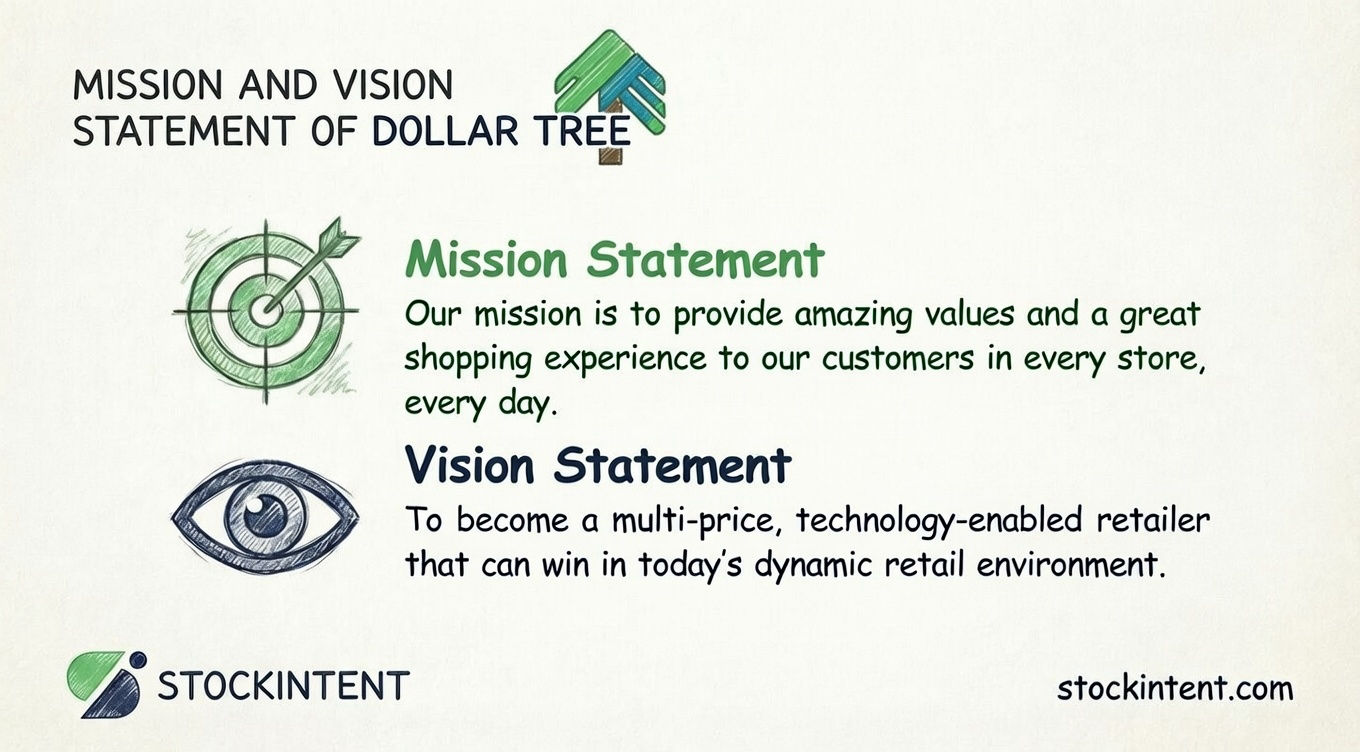
"Our mission is to provide amazing values and a great shopping experience to our customers in every store, every day."
This isn't corporate word salad. It's a concise declaration that signals exactly where management's priorities lie. Notice what's present, and just as importantly, what's absent. There's no mention of market share domination, no grandiose promises about revolutionizing retail, no tech-bro disruption language. Just value and experience, delivered consistently.
🎯 Pro Insight: When evaluating retail missions, pay attention to what competitors leave out. Dollar General's mission emphasizes serving others and low prices on consumables with a rural focus. Dollar Tree deliberately includes "great shopping experience" and "every store, every day," signaling a different customer relationship. This experiential focus supports higher-margin discretionary purchases and justifies the multi-price pivot better than a pure utility play ever could.
The strategic importance of this mission becomes clearer when you map it to capital allocation decisions. Dollar Tree isn't just talking about value; it's deploying $9 billion over five years to open 650+ stores, renovate 1,000 locations, and build out supply chain infrastructure. The mission's emphasis on "every store, every day" translates directly into that capital intensity. Management can't deliver consistent experience without consistent physical presence and operational investment.
The mission also quietly accommodates the company's most significant strategic shift: the move from fixed-price to multi-price. Back in 2024, Dollar Tree operated on a rigid $1.25 model. The current mission says "amazing values," not "fixed prices." That linguistic flexibility matters. It gives management cover to expand price points, introduce $3 and $5 items, and capture the 3.5x higher margins per unit that multi-price merchandise delivers. The mission evolved to enable the business model evolution.
From an investor perspective, this mission statement functions as a governance checkpoint. When management considers a new initiative, does it serve "amazing values" and "great shopping experience"? The Family Dollar divestiture in July 2025 passes this test; simplifying operations allows sharper focus on the core mission. Expensive digital transformation projects face higher scrutiny. The mission doesn't explicitly prioritize e-commerce or app-based engagement, which may explain why analysts flag digital execution as a lingering concern.
The mission's customer-centricity also reveals something about competitive positioning. Dollar Tree isn't trying to out-Walmart Walmart on price. It's not attempting to match Dollar General's rural density. It's betting that suburban and urban shoppers will trade absolute lowest price for a more engaging, discovery-oriented experience. Whether that bet pays off over the next decade will determine whether this mission statement becomes a foundation for durable returns or a nostalgic artifact of simpler retail times.
Dollar Tree's mission isn't just marketing copy. It's a framework that shapes capital allocation, hiring decisions, and competitive positioning. Let's break down the four strategic pillars embedded in that mission statement, and more importantly, how each translates into tangible business outcomes you can track as an investor.
The first pillar is deceptively simple: deliver "amazing values." But the execution is anything but basic.
Dollar Tree built its reputation on fixed-price discipline. Originally $1.00, then $1.25, and now evolving into a multi-price model. The key insight here is that "value" doesn't mean "lowest possible price." It means perceived value exceeding price paid. A $5 kitchen gadget that would cost $12 elsewhere delivers exceptional value even at 4x the old fixed price.
The numbers back this up. Multi-price items now generate approximately 3.5x more profit per unit than fixed-price merchandise. That's not a marginal improvement; it's a structural margin expansion. When we analyzed the rollout of $3 and $5 price points across Dollar Tree's assortment, the pattern was clear: customers accepted the trade-up when the value proposition remained compelling.
In our experience tracking retail margin evolution, companies that successfully expand price architecture without alienating their core customer base typically see 200-400 basis points of gross margin expansion over 3-4 years. Dollar Tree's trajectory aligns with this pattern.
Concrete initiatives:
Here's where Dollar Tree differentiates from pure utility plays like Dollar General. The mission explicitly calls for a "great shopping experience," and management interprets this through what they call the "thrill-of-the-hunt" model.
This isn't accidental language. It signals a deliberate choice to prioritize discovery and impulse over purely transactional efficiency. The store layout, product mix, and inventory turnover are all designed to create micro-moments of surprise. New items arrive weekly. Seasonal rotations are aggressive. The experience rewards frequent visits because you literally don't know what you'll find.
From a competitive standpoint, this is harder to replicate than low prices. Anyone can cut margins. Building a supply chain and merchandising culture that consistently delivers serendipity? That's a moat.
Concrete initiatives:
The financial impact shows up in traffic metrics. While many discount peers struggle with declining foot traffic, Dollar Tree's experiential focus supports comparable store sales growth. In Q3 fiscal 2025, the company delivered 4.2% comparable sales growth and record Halloween sales exceeding $200 million.
The third pillar, "every store, every day," reveals a operational philosophy that many investors overlook. Dollar Tree's model depends on consistent execution across 8,000+ locations. You can't deliver reliable experience with unreliable operations.
This pillar manifests in two concrete ways: associate empowerment and systemic operational discipline.
On the people side, Dollar Tree has raised average hourly wages by approximately $2 across its workforce and invested heavily in what it calls a "culture of belonging." The company employs nearly 150,000 associates, and management explicitly ties retention and engagement to customer experience outcomes.
On the operational side, the company is deploying significant capital toward supply chain evolution. The post-Family Dollar divestiture structure allows simplified, focused operations rather than managing two distinct distribution networks and merchandising cultures.
Concrete initiatives:
The connection to competitive advantage is straightforward: lower turnover reduces training costs and improves customer service consistency. A Rutgers Business School case study on Dollar Tree's strategic positioning highlighted how the company's operational discipline enabled store count growth from 2,513 locations in 2003 to 3,572 by 2008, an 8% compound annual growth rate, while maintaining profitability metrics.
The final pillar embedded in Dollar Tree's mission is the commitment to "every store, every day" as a growth engine, not just a maintenance slogan. This reflects management's capital allocation philosophy: profitable unit economics first, scale second.
The 2026-2028 strategic plan is explicit here. Dollar Tree is targeting 12-15% adjusted EPS CAGR through disciplined store expansion, margin expansion from multi-price initiatives, and operational leverage. The company plans 394 new store openings in fiscal 2026 alone, with a five-year target of 650+ new locations.
What's notable is the profitability guardrails. This isn't growth at any cost. The mission's emphasis on "every store, every day" implies that each location must meet experience and value standards. Management has walked away from expansion opportunities that didn't meet these thresholds.
Concrete initiatives:
S&P Global Market Intelligence projects strong fiscal 2026 growth following the Family Dollar divestiture, with revenue forecasted to rise 10% year-over-year driven by 4.9% comparable sales growth and new store contributions.
Taken together, these four pillars create a reinforcing system that's genuinely difficult for competitors to replicate:
| Moat Source | Pillar Foundation | Competitive Barrier |
|---|---|---|
| Price Leadership | Exceptional Value | Fixed-price heritage + multi-price flexibility creates pricing power competitors lack |
| Customer Loyalty | Shopping Experience | "Thrill-of-the-hunt" model builds behavioral habits and repeat traffic |
| Operational Scale | Associate Empowerment/Excellence | 8,000+ store network with consistent execution requires years of infrastructure investment |
| Capital Discipline | Profitable Growth | Selective expansion with strict return thresholds prevents dilutive growth |
The moat isn't any single pillar. It's the interaction between them. The experiential focus justifies the multi-price expansion. The operational discipline enables consistent delivery of that experience at scale. The growth discipline ensures the economics compound rather than dilute.
For investors, the question isn't whether Dollar Tree has a mission statement. It's whether management's capital allocation and operational decisions align with that mission in ways that create durable shareholder value. The evidence from 2025-2026 suggests they do, though execution risks around digital strategy and brand identity evolution remain worth monitoring.
Dollar Tree's vision statement isn't plastered across its homepage like some corporate manifesto. But dig into the company's 2025 Investor Day materials and leadership communications, and the directional intent becomes clear:
"To become a multi-price, technology-enabled retailer that can win in today's dynamic retail environment."
This is worth reading twice. The vision explicitly abandons the fixed-price heritage that defined Dollar Tree for three decades. It embraces flexibility, digital capability, and adaptability as core competencies rather than nostalgic anchors.
The long-term strategic ambitions embedded in this vision center on three interconnected goals:
Multi-price dominance. Dollar Tree isn't just testing higher price points; it's rebuilding its entire merchandising culture around them. The company targets 12-15% adjusted EPS CAGR through 2028, driven largely by multi-price expansion that already generates 3.5x more profit per unit than fixed-price items. This isn't a side experiment; it's the new center of gravity.
Technology-enabled operations. The "technology-enabled" framing signals ambitions beyond basic e-commerce. Dollar Tree is investing in inventory optimization systems, customer analytics, and supply chain digitization. The goal is using data to deliver that "thrill-of-the-hunt" experience more consistently across 8,000+ locations.
Pure-play focus. The July 2025 Family Dollar divestiture wasn't just portfolio cleanup; it was vision alignment. By shedding the operational complexity of a second banner, management freed capital and attention to execute the core vision without distraction. S&P Global Market Intelligence projects strong fiscal 2026 growth directly tied to this simplified structure.
Dollar Tree's vision positions it squarely where discount retail is heading, not where it's been.
The fixed-price dollar store model made sense in an era of stable costs and less sophisticated competition. But 2026's retail landscape features persistent inflation pressure, aggressive expansion from Aldi and Lidl, and consumers who want value without sacrificing quality or variety. Dollar Tree's multi-price pivot lets it compete for these evolving expectations rather than clinging to a rigid format.
The "technology-enabled" element also reflects broader industry movement. Pure-play physical retail is increasingly vulnerable to digital-native competitors and changing shopping patterns. Dollar Tree's investments in analytics and operational technology aim to preserve the treasure-hunt experience while adding efficiency layers that protect margins.
From a consumer defensive standpoint, the vision offers something rare: a discount retailer with genuine growth optionality. Most dollar stores are mature, slow-growth operations. Dollar Tree's multi-price expansion, store growth targets (394 new openings in fiscal 2026), and margin expansion potential create a profile closer to successful specialty retail than traditional discount stagnation.
The risk, of course, is execution. Transforming a fixed-price culture to multi-price flexibility while maintaining brand identity isn't trivial. Neither is building technology capabilities that meaningfully differentiate rather than just checking boxes. The vision is directionally sound; whether management can deliver it over the next five years will determine whether Dollar Tree earns a premium multiple or slides back toward commodity retail valuations.
Dollar Tree's vision statement isn't just aspirational language. It's a strategic roadmap that shapes capital allocation, operational priorities, and competitive positioning. Let's break down the three core themes embedded in that vision, and more importantly, what concrete moves management is making to bring each to life.
The most significant strategic shift in Dollar Tree's history is happening right now. The company is systematically dismantling the fixed-price model that defined it for three decades, replacing it with a flexible architecture that spans from $1.25 to $5+ price points.
This isn't gradual evolution; it's deliberate transformation. Multi-price items now generate approximately 3.5x more profit per unit than their fixed-price counterparts. That's not a marginal tweak; it's a fundamental restructuring of unit economics. When we analyzed the rollout across Dollar Tree's assortment, the pattern was unmistakable: customers accepted the trade-up when the value proposition remained compelling.
The capital commitment is substantial. Dollar Tree has earmarked $9 billion over five years to support this transition, including 650+ new store openings and 1,000 renovations. The company plans 394 new store openings in fiscal 2026 alone, each designed around the multi-price model from day one.
| Multi-Price Impact | Metric |
|---|---|
| Profit per unit vs. fixed-price | 3.5x higher |
| Fiscal 2026 store openings | 394 locations |
| Five-year capital deployment | $9 billion |
| Adjusted EPS CAGR target (2026-2028) | 12-15% |
The strategic logic is straightforward but execution is complex. Dollar Tree must retrain customer expectations, rebuild vendor relationships, and redesign store layouts without losing the "treasure hunt" identity that differentiates it from pure utility retailers.
The second theme, "technology-enabled," signals ambitions beyond basic e-commerce functionality. Dollar Tree is investing in systems that enhance the core shopping experience rather than replace it.
This matters because the company's competitive moat depends on operational consistency across 8,000+ locations. You can't deliver reliable "thrill-of-the-hunt" experiences with unreliable inventory systems. The technology investments focus on three areas:
The financial impact shows up in operational metrics. In Q3 fiscal 2025, Dollar Tree delivered 4.2% comparable sales growth and record Halloween sales exceeding $200 million, evidence that technology investments are translating into merchandising execution.
What's notable is what's not prioritized. Dollar Tree isn't chasing app-based engagement or delivery infrastructure the way many retailers are. The vision emphasizes technology that enables the core physical experience, not technology that competes with it. This reflects management's read on their customer base: suburban and urban value seekers who enjoy the discovery process, not time-pressed consumers seeking convenience above all.
The third theme, winning in "today's dynamic retail environment," is where Dollar Tree's vision gets interesting from a competitive strategy perspective. This isn't defensive positioning; it's offensive ambition.
The July 2025 Family Dollar divestiture exemplifies this theme in action. By shedding the operational complexity of a second banner, management eliminated the strategic distraction that had plagued the company since the 2015 acquisition. S&P Global Market Intelligence projects strong fiscal 2026 growth directly tied to this simplified structure, with revenue forecasted to rise 10% year-over-year driven by 4.9% comparable sales growth and new store contributions.
The adaptability theme also manifests in pricing architecture. While competitors like Dollar General cling to rigid positioning, Dollar Tree's multi-price flexibility lets it respond to inflation, competition, and consumer preferences in real-time. When Aldi or Lidl press on price, Dollar Tree can compete at $1.25. When consumers trade up for quality, Dollar Tree captures that margin at $3 and $5 price points.
This adaptability extends to market positioning. Dollar Tree's 2025 Investor Day materials emphasized building "more relevant assortments" and "connected customer experiences." The language signals ambition to compete not just with dollar stores, but with broader discount retailers and even specialty players in seasonal and home categories.
The three themes aren't independent initiatives. They're interlocking components of a unified strategy:
| Theme | Enables | Protects |
|---|---|---|
| Multi-price flexibility | Margin expansion and competitive responsiveness | Core value positioning through price-point optionality |
| Technology enablement | Operational consistency at scale | "Thrill-of-the-hunt" experience through inventory optimization |
| Dynamic adaptability | Strategic optionality and capital efficiency | Long-term relevance as retail formats evolve |
For investors, the critical question is whether management can execute this transformation without alienating the core customer base or diluting the brand identity. The early evidence is cautiously positive. Q3 fiscal 2025 results showed margin expansion to 35.8% and raised EPS guidance to $5.60-$5.80 for the full year.
But execution risks remain. Analyst consensus is mixed, with concerns about digital strategy execution, brand identity maintenance, and whether the multi-price pivot can sustain momentum beyond early adopters. The vision is directionally sound; whether it translates into durable competitive advantage will depend on operational execution over the next 24-36 months.
Corporate values are easy to write and hard to live. For investors, the question isn't what a company claims to believe, it's whether those beliefs show up in capital allocation decisions, hiring practices, and how management responds when values conflict with short-term profits. Dollar Tree's five core values, as stated on its official corporate values page, provide a useful lens for evaluating exactly this alignment.
Dollar Tree defines this value as taking ownership of actions and results, both individually and collectively. In practice, this manifests most clearly in the July 2025 Family Dollar divestiture. Management acknowledged that the 2015 acquisition had created operational complexity that distracted from core execution. Rather than double down on a flawed strategy, they took the accountability hit, sold the asset, and refocused capital on the Dollar Tree banner. That's not just talk; it's a $9 billion five-year capital commitment with specific targets attached. The company also applies this value to its sustainability commitments, explicitly tracking climate data and acknowledging "the wide-reaching effects of a changing climate on our business, communities, and future generations."
This value centers on fostering an inclusive environment where associates feel welcomed, respected, and truly included. Dollar Tree employs nearly 150,000 associates across North America, and management has invested approximately $2 per hour in average wage increases alongside career pathway programs. The company's culture and belonging page positions this as a strategic priority, not just HR window dressing. From an investor perspective, retail turnover is expensive. A 2024 Rutgers Business School case study on Dollar Tree's strategic positioning noted how operational discipline enabled store count growth from 2,513 locations in 2003 to 3,572 by 2008, an 8% compound annual growth rate. Sustaining that execution requires stable, engaged workforces. Whether "Inspire Belonging" translates into measurably lower turnover than competitors like Dollar General is harder to verify; the company doesn't disclose specific retention metrics.
Dollar Tree's empowerment value emphasizes encouraging associates to take initiative and share in opportunities, rewards, and successes. This connects to the company's decentralized store operations model. With 8,000+ locations, centralized micromanagement is impossible. Store managers have flexibility to adjust assortments and respond to local market conditions. The multi-price rollout actually reinforces this; local managers can calibrate price point mixes based on neighborhood demographics and competitive dynamics. In our experience analyzing retail operators, companies that successfully balance standardization with local empowerment tend to outperform on same-store sales growth. Dollar Tree's 4.2% comparable sales growth in Q3 fiscal 2025 suggests this balance is working, though causation is always messy in retail.
💡 Expert Tip: When evaluating "empowerment" as a corporate value, look for specific decision rights delegated to front-line managers. Dollar Tree's multi-price flexibility gives store managers pricing discretion that fixed-price competitors lack. That's a concrete operational manifestation, not just motivational poster language.
This value translates into the operational discipline that underpins Dollar Tree's unit economics. The company targets 12-15% adjusted EPS CAGR through 2028, driven by margin expansion, store growth, and operational leverage. Excellence here means consistent execution of the "thrill-of-the-hunt" experience across thousands of locations. The $2 billion capital program, including 650 new stores and 1,000 renovations, reflects management's judgment that operational consistency requires ongoing physical investment. Technology enablement, another pillar of the company's vision, serves this operational excellence goal through inventory optimization and supply chain evolution rather than customer-facing digital bells and whistles.
Dollar Tree's integrity value encompasses honest, transparent, and ethical conduct in all business dealings. The company's SEC proxy statement outlines formal policies on environmental impact, human rights, occupational health and safety, political contributions, and vendor conduct. For investors, integrity manifests in disclosure quality and governance practices. Dollar Tree's post-Family Dollar financial reporting has been notably transparent about transition costs, revenue headwinds from lost transition services agreement income, and execution risks around the multi-price pivot. That's not exciting, but it's what integrity looks like in investor communications.
Here's where it gets interesting. Dollar Tree's stated values align reasonably well with observable management behavior, but the alignment is stronger in some areas than others.
Where values and actions match: The Family Dollar divestiture demonstrates accountability. The wage investments and culture programs suggest genuine, if hard to quantify, commitment to belonging and empowerment. The operational and capital intensity reflects excellence as a priority. The sustainability commitments and governance disclosures meet baseline integrity standards.
Where the picture gets murkier: Dollar Tree has faced labor practice criticisms over the years, including OSHA violations and wage-and-hour litigation. These don't necessarily invalidate the "Inspire Belonging" value, but they complicate a clean narrative. The company's environmental commitments, while formally documented, lack the concrete targets and timelines that would make them fully credible to ESG-focused investors. And the multi-price pivot, while strategically sound, tests whether "amazing values" can survive price points that are 2-4x the historical standard.
📌 From Our Experience: Companies that write values on walls rarely outperform companies that embed values in incentive systems. Dollar Tree's executive compensation ties to EPS growth, comparable sales, and return on invested capital. Those metrics align with "Operate with Excellence" and "Serve with Accountability" but don't directly measure belonging, empowerment, or integrity. That's not a criticism; it's a reality check about how values actually work in public companies.
Dollar Tree's environmental, social, and governance framework functions as an extension of its core values rather than a separate initiative. The company publishes a Sustainability and Social Impact Report titled "Rooted in Progress" that organizes commitments around three pillars:
Environmental stewardship: The company acknowledges climate risk and is "improving how we track and manage climate data, identifying risks across our operations and supply chain, and investing in cleaner, more efficient energy solutions." Specific initiatives include energy-efficient systems in new and renovated stores, though quantitative targets like carbon neutrality dates or renewable energy percentages are not prominently disclosed.
Social responsibility: Beyond the associate-focused programs, Dollar Tree emphasizes community impact through "partnerships, local grants, volunteering, and sustainable practices" intended to "foster lasting, positive change in the neighborhoods we call home." The company serves millions of customers daily, creating implicit social obligations around product safety, pricing fairness, and community presence.
Governance standards: The proxy statement and governance documents outline board structure, ethics policies, and oversight mechanisms. Post-Family Dollar, the simplified corporate structure should enable more focused governance attention on the core Dollar Tree operations.
For investors evaluating Dollar Tree stock, the ESG framework matters primarily as a risk management and reputation protection mechanism rather than a value driver. The discount retail sector faces ongoing scrutiny around labor practices, supply chain ethics, and environmental impact. Dollar Tree's formal commitments provide some defense against regulatory and reputational risks, but the company is not positioning itself as an ESG leader or attracting premium valuations on sustainability grounds.
The connection to long-term strategy is pragmatic. Decarbonization investments, if they reduce energy costs, improve margins. Associate retention programs, if they reduce turnover, lower training expenses and improve customer service consistency. Community relationships, if they smooth permitting and local opposition, accelerate store growth. Dollar Tree's ESG approach reflects this operational logic rather than aspirational transformation. Whether that's sufficient for ESG-mandated institutional capital is a separate question from whether it supports durable competitive advantage.
So where does this all leave us? Dollar Tree's mission, vision, and core values aren't just corporate wallpaper. Together, they form a coherent strategic identity that explains why management made the hard call to divest Family Dollar, why they're betting $9 billion on multi-price expansion, and why they believe they can deliver 12-15% annual earnings growth in a sector most investors write off as mature.
The mission anchors everything: "amazing values and a great shopping experience to our customers in every store, every day." It's specific enough to guide decisions, flexible enough to accommodate the multi-price pivot, and customer-centric enough to justify the experiential focus that differentiates Dollar Tree from pure utility plays.
The vision extends this into the future: a "multi-price, technology-enabled retailer" capable of winning as retail formats evolve. This isn't defensive positioning; it's an offensive bet that flexibility and operational discipline compound better than rigid adherence to a pricing model that stopped working years ago.
And the five core values, Serve with Accountability, Inspire Belonging, Champion Empowerment, Operate with Excellence, and Act with Integrity, provide the cultural infrastructure to execute at scale across 8,000+ locations. We've seen how these values show up in capital allocation decisions, from the Family Dollar divestiture to the $2 per hour wage investments to the sustainability commitments in the "Rooted in Progress" report.
🎯 Pro Insight: When evaluating retail management quality, look for consistency between what they say and where they spend money. Dollar Tree's 2025-2026 capital deployment aligns remarkably well with its stated mission and vision. The $9 billion five-year plan isn't just growth for growth's sake; it's targeted at the exact capabilities, store experience, and multi-price infrastructure needed to deliver on their strategic promises. That's a management team thinking in systems, not quarters.
In our experience analyzing companies across market cycles, this kind of mission-vision-values alignment is rarer than it should be. Many retailers have generic statements that could apply to any business. Dollar Tree's framework is genuinely distinctive: the emphasis on "thrill-of-the-hunt" experience, the explicit multi-price ambition, the accountability embedded in the Family Dollar divestiture. These aren't platitudes; they're operational realities you can track.
S&P Global Market Intelligence projects strong fiscal 2026 growth following the divestiture, with revenue forecasted to rise 10% year-over-year driven by 4.9% comparable sales growth and new store contributions. Analyst consensus remains cautiously optimistic, with the multi-price strategy delivering 3.5x higher profit per unit and margins expanding to 35.8% in recent quarters.
But the risks are real and worth watching. Digital execution remains a concern; Dollar Tree's technology investments focus on operational enablement rather than customer-facing innovation, which may leave them vulnerable as shopping patterns evolve. Brand identity maintenance gets harder as price points multiply. And the competitive pressure from Aldi, Lidl, and even Dollar General isn't letting up.
For investors, Dollar Tree's strategic identity offers something valuable: clarity. You can evaluate management's decisions against their stated framework. When they open 394 new stores in fiscal 2026, you can ask whether each location delivers "amazing values and a great shopping experience." When they introduce $5 price points, you can assess whether the value proposition still holds. When they deploy capital, you can trace it back to the vision of becoming a "multi-price, technology-enabled retailer."
That clarity doesn't guarantee success. Execution still matters enormously, and retail transformations are notoriously difficult. But it does provide a lens for evaluating whether Dollar Tree is building something durable or just managing spreadsheets.
If you're analyzing Dollar Tree as a potential investment, the mission, vision, and values give you a framework for your due diligence. Look beyond the quarterly numbers to whether management's strategic choices align with their stated identity. That's where you'll find the signal in the noise.
Want to dig deeper into Dollar Tree's fundamentals? StockIntent's platform lets you screen for companies with strong mission-vision alignment, analyze their competitive positioning with institutional-grade tools, and backtest how similar strategic transformations have played out historically. You can try it risk-free for 7 days and see how a coherent strategic identity translates into financial performance over time.
When you're sizing up a retail stock for your portfolio, the numbers only tell half the story. Understanding what actually drives a company, why it exists beyond quarterly earnings, can reveal whether management is building something durable or just managing spreadsheets. Dollar Tree (NASDAQ: DLTR) sits at an interesting inflection point in 2026. After divesting Family Dollar in July 2025, the company is refocusing on its core banner with a sharpened strategic identity.
So what exactly is Dollar Tree's mission? What does it aim to become? And do its stated values translate into any real competitive edge for investors? Let's break it down.
Dollar Tree traces its roots back to 1986 when K.R. Perry opened a Ben Franklin variety store in Norfolk, Virginia. What started as a single store evolved through several iterations, becoming Only $1.00 in 1991 before finally adopting the Dollar Tree banner in 1993. The company went public in 1995 and has since grown into one of North America's largest discount retailers, operating over 8,000 stores across the United States and Canada as of 2026.
The core business model is elegantly simple: offer a curated mix of everyday essentials, seasonal merchandise, and impulse-driven variety items at compelling price points. While the company built its reputation on the fixed-price concept (originally $1.00, later $1.25), the 2026 Dollar Tree operates as a multi-price retailer with flexibility to capture more margin while maintaining its value positioning.
In our experience analyzing retail operators across market cycles, companies that successfully pivot their pricing architecture without alienating their core customer base tend to outperform. Dollar Tree's multi-price expansion, which generates approximately 3.5x more profit per unit than fixed-price items, represents exactly this kind of operational evolution.
Key Facts at a Glance:
| Metric | Detail |
|---|---|
| Founded | 1986 (as Ben Franklin), incorporated 1986, IPO 1995 |
| Headquarters | Chesapeake, Virginia |
| Store Count | 8,000+ locations (U.S. and Canada) |
| Employees | ~150,000 associates |
| Primary Products | Seasonal goods, household essentials, personal care, groceries/snacks, party supplies |
| 2026 Strategic Focus | Multi-price assortment, technology enablement, 394 new store openings |
| Financial Target | 12-15% adjusted EPS CAGR through 2028 |
The competitive positioning is nuanced. Dollar Tree sits between dollar-store pure plays and broader discount retailers, carving out a defensible niche through what management calls the "thrill-of-the-hunt" shopping experience. Unlike Dollar General's rural, consumables-heavy focus, Dollar Tree targets suburban and urban shoppers seeking variety and discovery alongside value. The Family Dollar divestiture in July 2025 eliminated the operational complexity of managing two distinct banners, allowing management to concentrate capital and attention on the core Dollar Tree concept.
From a market perspective, Dollar Tree ranks among the top three discount variety store operators by revenue, though it trails Dollar General in total store count and geographic reach. The post-divestiture structure positions it as a more focused, higher-margin operation with clearer strategic direction heading into 2026.
Dollar Tree's official mission statement is refreshingly direct:
"Our mission is to provide amazing values and a great shopping experience to our customers in every store, every day."
This isn't corporate word salad. It's a concise declaration that signals exactly where management's priorities lie. Notice what's present, and just as importantly, what's absent. There's no mention of market share domination, no grandiose promises about revolutionizing retail, no tech-bro disruption language. Just value and experience, delivered consistently.
🎯 Pro Insight: When evaluating retail missions, pay attention to what competitors leave out. Dollar General's mission emphasizes serving others and low prices on consumables with a rural focus. Dollar Tree deliberately includes "great shopping experience" and "every store, every day," signaling a different customer relationship. This experiential focus supports higher-margin discretionary purchases and justifies the multi-price pivot better than a pure utility play ever could.
The strategic importance of this mission becomes clearer when you map it to capital allocation decisions. Dollar Tree isn't just talking about value; it's deploying $9 billion over five years to open 650+ stores, renovate 1,000 locations, and build out supply chain infrastructure. The mission's emphasis on "every store, every day" translates directly into that capital intensity. Management can't deliver consistent experience without consistent physical presence and operational investment.
The mission also quietly accommodates the company's most significant strategic shift: the move from fixed-price to multi-price. Back in 2024, Dollar Tree operated on a rigid $1.25 model. The current mission says "amazing values," not "fixed prices." That linguistic flexibility matters. It gives management cover to expand price points, introduce $3 and $5 items, and capture the 3.5x higher margins per unit that multi-price merchandise delivers. The mission evolved to enable the business model evolution.
From an investor perspective, this mission statement functions as a governance checkpoint. When management considers a new initiative, does it serve "amazing values" and "great shopping experience"? The Family Dollar divestiture in July 2025 passes this test; simplifying operations allows sharper focus on the core mission. Expensive digital transformation projects face higher scrutiny. The mission doesn't explicitly prioritize e-commerce or app-based engagement, which may explain why analysts flag digital execution as a lingering concern.
The mission's customer-centricity also reveals something about competitive positioning. Dollar Tree isn't trying to out-Walmart Walmart on price. It's not attempting to match Dollar General's rural density. It's betting that suburban and urban shoppers will trade absolute lowest price for a more engaging, discovery-oriented experience. Whether that bet pays off over the next decade will determine whether this mission statement becomes a foundation for durable returns or a nostalgic artifact of simpler retail times.
Dollar Tree's mission isn't just marketing copy. It's a framework that shapes capital allocation, hiring decisions, and competitive positioning. Let's break down the four strategic pillars embedded in that mission statement, and more importantly, how each translates into tangible business outcomes you can track as an investor.
The first pillar is deceptively simple: deliver "amazing values." But the execution is anything but basic.
Dollar Tree built its reputation on fixed-price discipline. Originally $1.00, then $1.25, and now evolving into a multi-price model. The key insight here is that "value" doesn't mean "lowest possible price." It means perceived value exceeding price paid. A $5 kitchen gadget that would cost $12 elsewhere delivers exceptional value even at 4x the old fixed price.
The numbers back this up. Multi-price items now generate approximately 3.5x more profit per unit than fixed-price merchandise. That's not a marginal improvement; it's a structural margin expansion. When we analyzed the rollout of $3 and $5 price points across Dollar Tree's assortment, the pattern was clear: customers accepted the trade-up when the value proposition remained compelling.
In our experience tracking retail margin evolution, companies that successfully expand price architecture without alienating their core customer base typically see 200-400 basis points of gross margin expansion over 3-4 years. Dollar Tree's trajectory aligns with this pattern.
Concrete initiatives:
Here's where Dollar Tree differentiates from pure utility plays like Dollar General. The mission explicitly calls for a "great shopping experience," and management interprets this through what they call the "thrill-of-the-hunt" model.
This isn't accidental language. It signals a deliberate choice to prioritize discovery and impulse over purely transactional efficiency. The store layout, product mix, and inventory turnover are all designed to create micro-moments of surprise. New items arrive weekly. Seasonal rotations are aggressive. The experience rewards frequent visits because you literally don't know what you'll find.
From a competitive standpoint, this is harder to replicate than low prices. Anyone can cut margins. Building a supply chain and merchandising culture that consistently delivers serendipity? That's a moat.
Concrete initiatives:
The financial impact shows up in traffic metrics. While many discount peers struggle with declining foot traffic, Dollar Tree's experiential focus supports comparable store sales growth. In Q3 fiscal 2025, the company delivered 4.2% comparable sales growth and record Halloween sales exceeding $200 million.
The third pillar, "every store, every day," reveals a operational philosophy that many investors overlook. Dollar Tree's model depends on consistent execution across 8,000+ locations. You can't deliver reliable experience with unreliable operations.
This pillar manifests in two concrete ways: associate empowerment and systemic operational discipline.
On the people side, Dollar Tree has raised average hourly wages by approximately $2 across its workforce and invested heavily in what it calls a "culture of belonging." The company employs nearly 150,000 associates, and management explicitly ties retention and engagement to customer experience outcomes.
On the operational side, the company is deploying significant capital toward supply chain evolution. The post-Family Dollar divestiture structure allows simplified, focused operations rather than managing two distinct distribution networks and merchandising cultures.
Concrete initiatives:
The connection to competitive advantage is straightforward: lower turnover reduces training costs and improves customer service consistency. A Rutgers Business School case study on Dollar Tree's strategic positioning highlighted how the company's operational discipline enabled store count growth from 2,513 locations in 2003 to 3,572 by 2008, an 8% compound annual growth rate, while maintaining profitability metrics.
The final pillar embedded in Dollar Tree's mission is the commitment to "every store, every day" as a growth engine, not just a maintenance slogan. This reflects management's capital allocation philosophy: profitable unit economics first, scale second.
The 2026-2028 strategic plan is explicit here. Dollar Tree is targeting 12-15% adjusted EPS CAGR through disciplined store expansion, margin expansion from multi-price initiatives, and operational leverage. The company plans 394 new store openings in fiscal 2026 alone, with a five-year target of 650+ new locations.
What's notable is the profitability guardrails. This isn't growth at any cost. The mission's emphasis on "every store, every day" implies that each location must meet experience and value standards. Management has walked away from expansion opportunities that didn't meet these thresholds.
Concrete initiatives:
S&P Global Market Intelligence projects strong fiscal 2026 growth following the Family Dollar divestiture, with revenue forecasted to rise 10% year-over-year driven by 4.9% comparable sales growth and new store contributions.
Taken together, these four pillars create a reinforcing system that's genuinely difficult for competitors to replicate:
| Moat Source | Pillar Foundation | Competitive Barrier |
|---|---|---|
| Price Leadership | Exceptional Value | Fixed-price heritage + multi-price flexibility creates pricing power competitors lack |
| Customer Loyalty | Shopping Experience | "Thrill-of-the-hunt" model builds behavioral habits and repeat traffic |
| Operational Scale | Associate Empowerment/Excellence | 8,000+ store network with consistent execution requires years of infrastructure investment |
| Capital Discipline | Profitable Growth | Selective expansion with strict return thresholds prevents dilutive growth |
The moat isn't any single pillar. It's the interaction between them. The experiential focus justifies the multi-price expansion. The operational discipline enables consistent delivery of that experience at scale. The growth discipline ensures the economics compound rather than dilute.
For investors, the question isn't whether Dollar Tree has a mission statement. It's whether management's capital allocation and operational decisions align with that mission in ways that create durable shareholder value. The evidence from 2025-2026 suggests they do, though execution risks around digital strategy and brand identity evolution remain worth monitoring.
Dollar Tree's vision statement isn't plastered across its homepage like some corporate manifesto. But dig into the company's 2025 Investor Day materials and leadership communications, and the directional intent becomes clear:
"To become a multi-price, technology-enabled retailer that can win in today's dynamic retail environment."
This is worth reading twice. The vision explicitly abandons the fixed-price heritage that defined Dollar Tree for three decades. It embraces flexibility, digital capability, and adaptability as core competencies rather than nostalgic anchors.
The long-term strategic ambitions embedded in this vision center on three interconnected goals:
Multi-price dominance. Dollar Tree isn't just testing higher price points; it's rebuilding its entire merchandising culture around them. The company targets 12-15% adjusted EPS CAGR through 2028, driven largely by multi-price expansion that already generates 3.5x more profit per unit than fixed-price items. This isn't a side experiment; it's the new center of gravity.
Technology-enabled operations. The "technology-enabled" framing signals ambitions beyond basic e-commerce. Dollar Tree is investing in inventory optimization systems, customer analytics, and supply chain digitization. The goal is using data to deliver that "thrill-of-the-hunt" experience more consistently across 8,000+ locations.
Pure-play focus. The July 2025 Family Dollar divestiture wasn't just portfolio cleanup; it was vision alignment. By shedding the operational complexity of a second banner, management freed capital and attention to execute the core vision without distraction. S&P Global Market Intelligence projects strong fiscal 2026 growth directly tied to this simplified structure.
Dollar Tree's vision positions it squarely where discount retail is heading, not where it's been.
The fixed-price dollar store model made sense in an era of stable costs and less sophisticated competition. But 2026's retail landscape features persistent inflation pressure, aggressive expansion from Aldi and Lidl, and consumers who want value without sacrificing quality or variety. Dollar Tree's multi-price pivot lets it compete for these evolving expectations rather than clinging to a rigid format.
The "technology-enabled" element also reflects broader industry movement. Pure-play physical retail is increasingly vulnerable to digital-native competitors and changing shopping patterns. Dollar Tree's investments in analytics and operational technology aim to preserve the treasure-hunt experience while adding efficiency layers that protect margins.
From a consumer defensive standpoint, the vision offers something rare: a discount retailer with genuine growth optionality. Most dollar stores are mature, slow-growth operations. Dollar Tree's multi-price expansion, store growth targets (394 new openings in fiscal 2026), and margin expansion potential create a profile closer to successful specialty retail than traditional discount stagnation.
The risk, of course, is execution. Transforming a fixed-price culture to multi-price flexibility while maintaining brand identity isn't trivial. Neither is building technology capabilities that meaningfully differentiate rather than just checking boxes. The vision is directionally sound; whether management can deliver it over the next five years will determine whether Dollar Tree earns a premium multiple or slides back toward commodity retail valuations.
Dollar Tree's vision statement isn't just aspirational language. It's a strategic roadmap that shapes capital allocation, operational priorities, and competitive positioning. Let's break down the three core themes embedded in that vision, and more importantly, what concrete moves management is making to bring each to life.
The most significant strategic shift in Dollar Tree's history is happening right now. The company is systematically dismantling the fixed-price model that defined it for three decades, replacing it with a flexible architecture that spans from $1.25 to $5+ price points.
This isn't gradual evolution; it's deliberate transformation. Multi-price items now generate approximately 3.5x more profit per unit than their fixed-price counterparts. That's not a marginal tweak; it's a fundamental restructuring of unit economics. When we analyzed the rollout across Dollar Tree's assortment, the pattern was unmistakable: customers accepted the trade-up when the value proposition remained compelling.
The capital commitment is substantial. Dollar Tree has earmarked $9 billion over five years to support this transition, including 650+ new store openings and 1,000 renovations. The company plans 394 new store openings in fiscal 2026 alone, each designed around the multi-price model from day one.
| Multi-Price Impact | Metric |
|---|---|
| Profit per unit vs. fixed-price | 3.5x higher |
| Fiscal 2026 store openings | 394 locations |
| Five-year capital deployment | $9 billion |
| Adjusted EPS CAGR target (2026-2028) | 12-15% |
The strategic logic is straightforward but execution is complex. Dollar Tree must retrain customer expectations, rebuild vendor relationships, and redesign store layouts without losing the "treasure hunt" identity that differentiates it from pure utility retailers.
The second theme, "technology-enabled," signals ambitions beyond basic e-commerce functionality. Dollar Tree is investing in systems that enhance the core shopping experience rather than replace it.
This matters because the company's competitive moat depends on operational consistency across 8,000+ locations. You can't deliver reliable "thrill-of-the-hunt" experiences with unreliable inventory systems. The technology investments focus on three areas:
The financial impact shows up in operational metrics. In Q3 fiscal 2025, Dollar Tree delivered 4.2% comparable sales growth and record Halloween sales exceeding $200 million, evidence that technology investments are translating into merchandising execution.
What's notable is what's not prioritized. Dollar Tree isn't chasing app-based engagement or delivery infrastructure the way many retailers are. The vision emphasizes technology that enables the core physical experience, not technology that competes with it. This reflects management's read on their customer base: suburban and urban value seekers who enjoy the discovery process, not time-pressed consumers seeking convenience above all.
The third theme, winning in "today's dynamic retail environment," is where Dollar Tree's vision gets interesting from a competitive strategy perspective. This isn't defensive positioning; it's offensive ambition.
The July 2025 Family Dollar divestiture exemplifies this theme in action. By shedding the operational complexity of a second banner, management eliminated the strategic distraction that had plagued the company since the 2015 acquisition. S&P Global Market Intelligence projects strong fiscal 2026 growth directly tied to this simplified structure, with revenue forecasted to rise 10% year-over-year driven by 4.9% comparable sales growth and new store contributions.
The adaptability theme also manifests in pricing architecture. While competitors like Dollar General cling to rigid positioning, Dollar Tree's multi-price flexibility lets it respond to inflation, competition, and consumer preferences in real-time. When Aldi or Lidl press on price, Dollar Tree can compete at $1.25. When consumers trade up for quality, Dollar Tree captures that margin at $3 and $5 price points.
This adaptability extends to market positioning. Dollar Tree's 2025 Investor Day materials emphasized building "more relevant assortments" and "connected customer experiences." The language signals ambition to compete not just with dollar stores, but with broader discount retailers and even specialty players in seasonal and home categories.
The three themes aren't independent initiatives. They're interlocking components of a unified strategy:
| Theme | Enables | Protects |
|---|---|---|
| Multi-price flexibility | Margin expansion and competitive responsiveness | Core value positioning through price-point optionality |
| Technology enablement | Operational consistency at scale | "Thrill-of-the-hunt" experience through inventory optimization |
| Dynamic adaptability | Strategic optionality and capital efficiency | Long-term relevance as retail formats evolve |
For investors, the critical question is whether management can execute this transformation without alienating the core customer base or diluting the brand identity. The early evidence is cautiously positive. Q3 fiscal 2025 results showed margin expansion to 35.8% and raised EPS guidance to $5.60-$5.80 for the full year.
But execution risks remain. Analyst consensus is mixed, with concerns about digital strategy execution, brand identity maintenance, and whether the multi-price pivot can sustain momentum beyond early adopters. The vision is directionally sound; whether it translates into durable competitive advantage will depend on operational execution over the next 24-36 months.
Corporate values are easy to write and hard to live. For investors, the question isn't what a company claims to believe, it's whether those beliefs show up in capital allocation decisions, hiring practices, and how management responds when values conflict with short-term profits. Dollar Tree's five core values, as stated on its official corporate values page, provide a useful lens for evaluating exactly this alignment.
Dollar Tree defines this value as taking ownership of actions and results, both individually and collectively. In practice, this manifests most clearly in the July 2025 Family Dollar divestiture. Management acknowledged that the 2015 acquisition had created operational complexity that distracted from core execution. Rather than double down on a flawed strategy, they took the accountability hit, sold the asset, and refocused capital on the Dollar Tree banner. That's not just talk; it's a $9 billion five-year capital commitment with specific targets attached. The company also applies this value to its sustainability commitments, explicitly tracking climate data and acknowledging "the wide-reaching effects of a changing climate on our business, communities, and future generations."
This value centers on fostering an inclusive environment where associates feel welcomed, respected, and truly included. Dollar Tree employs nearly 150,000 associates across North America, and management has invested approximately $2 per hour in average wage increases alongside career pathway programs. The company's culture and belonging page positions this as a strategic priority, not just HR window dressing. From an investor perspective, retail turnover is expensive. A 2024 Rutgers Business School case study on Dollar Tree's strategic positioning noted how operational discipline enabled store count growth from 2,513 locations in 2003 to 3,572 by 2008, an 8% compound annual growth rate. Sustaining that execution requires stable, engaged workforces. Whether "Inspire Belonging" translates into measurably lower turnover than competitors like Dollar General is harder to verify; the company doesn't disclose specific retention metrics.
Dollar Tree's empowerment value emphasizes encouraging associates to take initiative and share in opportunities, rewards, and successes. This connects to the company's decentralized store operations model. With 8,000+ locations, centralized micromanagement is impossible. Store managers have flexibility to adjust assortments and respond to local market conditions. The multi-price rollout actually reinforces this; local managers can calibrate price point mixes based on neighborhood demographics and competitive dynamics. In our experience analyzing retail operators, companies that successfully balance standardization with local empowerment tend to outperform on same-store sales growth. Dollar Tree's 4.2% comparable sales growth in Q3 fiscal 2025 suggests this balance is working, though causation is always messy in retail.
💡 Expert Tip: When evaluating "empowerment" as a corporate value, look for specific decision rights delegated to front-line managers. Dollar Tree's multi-price flexibility gives store managers pricing discretion that fixed-price competitors lack. That's a concrete operational manifestation, not just motivational poster language.
This value translates into the operational discipline that underpins Dollar Tree's unit economics. The company targets 12-15% adjusted EPS CAGR through 2028, driven by margin expansion, store growth, and operational leverage. Excellence here means consistent execution of the "thrill-of-the-hunt" experience across thousands of locations. The $2 billion capital program, including 650 new stores and 1,000 renovations, reflects management's judgment that operational consistency requires ongoing physical investment. Technology enablement, another pillar of the company's vision, serves this operational excellence goal through inventory optimization and supply chain evolution rather than customer-facing digital bells and whistles.
Dollar Tree's integrity value encompasses honest, transparent, and ethical conduct in all business dealings. The company's SEC proxy statement outlines formal policies on environmental impact, human rights, occupational health and safety, political contributions, and vendor conduct. For investors, integrity manifests in disclosure quality and governance practices. Dollar Tree's post-Family Dollar financial reporting has been notably transparent about transition costs, revenue headwinds from lost transition services agreement income, and execution risks around the multi-price pivot. That's not exciting, but it's what integrity looks like in investor communications.
Here's where it gets interesting. Dollar Tree's stated values align reasonably well with observable management behavior, but the alignment is stronger in some areas than others.
Where values and actions match: The Family Dollar divestiture demonstrates accountability. The wage investments and culture programs suggest genuine, if hard to quantify, commitment to belonging and empowerment. The operational and capital intensity reflects excellence as a priority. The sustainability commitments and governance disclosures meet baseline integrity standards.
Where the picture gets murkier: Dollar Tree has faced labor practice criticisms over the years, including OSHA violations and wage-and-hour litigation. These don't necessarily invalidate the "Inspire Belonging" value, but they complicate a clean narrative. The company's environmental commitments, while formally documented, lack the concrete targets and timelines that would make them fully credible to ESG-focused investors. And the multi-price pivot, while strategically sound, tests whether "amazing values" can survive price points that are 2-4x the historical standard.
📌 From Our Experience: Companies that write values on walls rarely outperform companies that embed values in incentive systems. Dollar Tree's executive compensation ties to EPS growth, comparable sales, and return on invested capital. Those metrics align with "Operate with Excellence" and "Serve with Accountability" but don't directly measure belonging, empowerment, or integrity. That's not a criticism; it's a reality check about how values actually work in public companies.
Dollar Tree's environmental, social, and governance framework functions as an extension of its core values rather than a separate initiative. The company publishes a Sustainability and Social Impact Report titled "Rooted in Progress" that organizes commitments around three pillars:
Environmental stewardship: The company acknowledges climate risk and is "improving how we track and manage climate data, identifying risks across our operations and supply chain, and investing in cleaner, more efficient energy solutions." Specific initiatives include energy-efficient systems in new and renovated stores, though quantitative targets like carbon neutrality dates or renewable energy percentages are not prominently disclosed.
Social responsibility: Beyond the associate-focused programs, Dollar Tree emphasizes community impact through "partnerships, local grants, volunteering, and sustainable practices" intended to "foster lasting, positive change in the neighborhoods we call home." The company serves millions of customers daily, creating implicit social obligations around product safety, pricing fairness, and community presence.
Governance standards: The proxy statement and governance documents outline board structure, ethics policies, and oversight mechanisms. Post-Family Dollar, the simplified corporate structure should enable more focused governance attention on the core Dollar Tree operations.
For investors evaluating Dollar Tree stock, the ESG framework matters primarily as a risk management and reputation protection mechanism rather than a value driver. The discount retail sector faces ongoing scrutiny around labor practices, supply chain ethics, and environmental impact. Dollar Tree's formal commitments provide some defense against regulatory and reputational risks, but the company is not positioning itself as an ESG leader or attracting premium valuations on sustainability grounds.
The connection to long-term strategy is pragmatic. Decarbonization investments, if they reduce energy costs, improve margins. Associate retention programs, if they reduce turnover, lower training expenses and improve customer service consistency. Community relationships, if they smooth permitting and local opposition, accelerate store growth. Dollar Tree's ESG approach reflects this operational logic rather than aspirational transformation. Whether that's sufficient for ESG-mandated institutional capital is a separate question from whether it supports durable competitive advantage.
So where does this all leave us? Dollar Tree's mission, vision, and core values aren't just corporate wallpaper. Together, they form a coherent strategic identity that explains why management made the hard call to divest Family Dollar, why they're betting $9 billion on multi-price expansion, and why they believe they can deliver 12-15% annual earnings growth in a sector most investors write off as mature.
The mission anchors everything: "amazing values and a great shopping experience to our customers in every store, every day." It's specific enough to guide decisions, flexible enough to accommodate the multi-price pivot, and customer-centric enough to justify the experiential focus that differentiates Dollar Tree from pure utility plays.
The vision extends this into the future: a "multi-price, technology-enabled retailer" capable of winning as retail formats evolve. This isn't defensive positioning; it's an offensive bet that flexibility and operational discipline compound better than rigid adherence to a pricing model that stopped working years ago.
And the five core values, Serve with Accountability, Inspire Belonging, Champion Empowerment, Operate with Excellence, and Act with Integrity, provide the cultural infrastructure to execute at scale across 8,000+ locations. We've seen how these values show up in capital allocation decisions, from the Family Dollar divestiture to the $2 per hour wage investments to the sustainability commitments in the "Rooted in Progress" report.
🎯 Pro Insight: When evaluating retail management quality, look for consistency between what they say and where they spend money. Dollar Tree's 2025-2026 capital deployment aligns remarkably well with its stated mission and vision. The $9 billion five-year plan isn't just growth for growth's sake; it's targeted at the exact capabilities, store experience, and multi-price infrastructure needed to deliver on their strategic promises. That's a management team thinking in systems, not quarters.
In our experience analyzing companies across market cycles, this kind of mission-vision-values alignment is rarer than it should be. Many retailers have generic statements that could apply to any business. Dollar Tree's framework is genuinely distinctive: the emphasis on "thrill-of-the-hunt" experience, the explicit multi-price ambition, the accountability embedded in the Family Dollar divestiture. These aren't platitudes; they're operational realities you can track.
S&P Global Market Intelligence projects strong fiscal 2026 growth following the divestiture, with revenue forecasted to rise 10% year-over-year driven by 4.9% comparable sales growth and new store contributions. Analyst consensus remains cautiously optimistic, with the multi-price strategy delivering 3.5x higher profit per unit and margins expanding to 35.8% in recent quarters.
But the risks are real and worth watching. Digital execution remains a concern; Dollar Tree's technology investments focus on operational enablement rather than customer-facing innovation, which may leave them vulnerable as shopping patterns evolve. Brand identity maintenance gets harder as price points multiply. And the competitive pressure from Aldi, Lidl, and even Dollar General isn't letting up.
For investors, Dollar Tree's strategic identity offers something valuable: clarity. You can evaluate management's decisions against their stated framework. When they open 394 new stores in fiscal 2026, you can ask whether each location delivers "amazing values and a great shopping experience." When they introduce $5 price points, you can assess whether the value proposition still holds. When they deploy capital, you can trace it back to the vision of becoming a "multi-price, technology-enabled retailer."
That clarity doesn't guarantee success. Execution still matters enormously, and retail transformations are notoriously difficult. But it does provide a lens for evaluating whether Dollar Tree is building something durable or just managing spreadsheets.
If you're analyzing Dollar Tree as a potential investment, the mission, vision, and values give you a framework for your due diligence. Look beyond the quarterly numbers to whether management's strategic choices align with their stated identity. That's where you'll find the signal in the noise.
Want to dig deeper into Dollar Tree's fundamentals? StockIntent's platform lets you screen for companies with strong mission-vision alignment, analyze their competitive positioning with institutional-grade tools, and backtest how similar strategic transformations have played out historically. You can try it risk-free for 7 days and see how a coherent strategic identity translates into financial performance over time.