
Mar 27, 2026
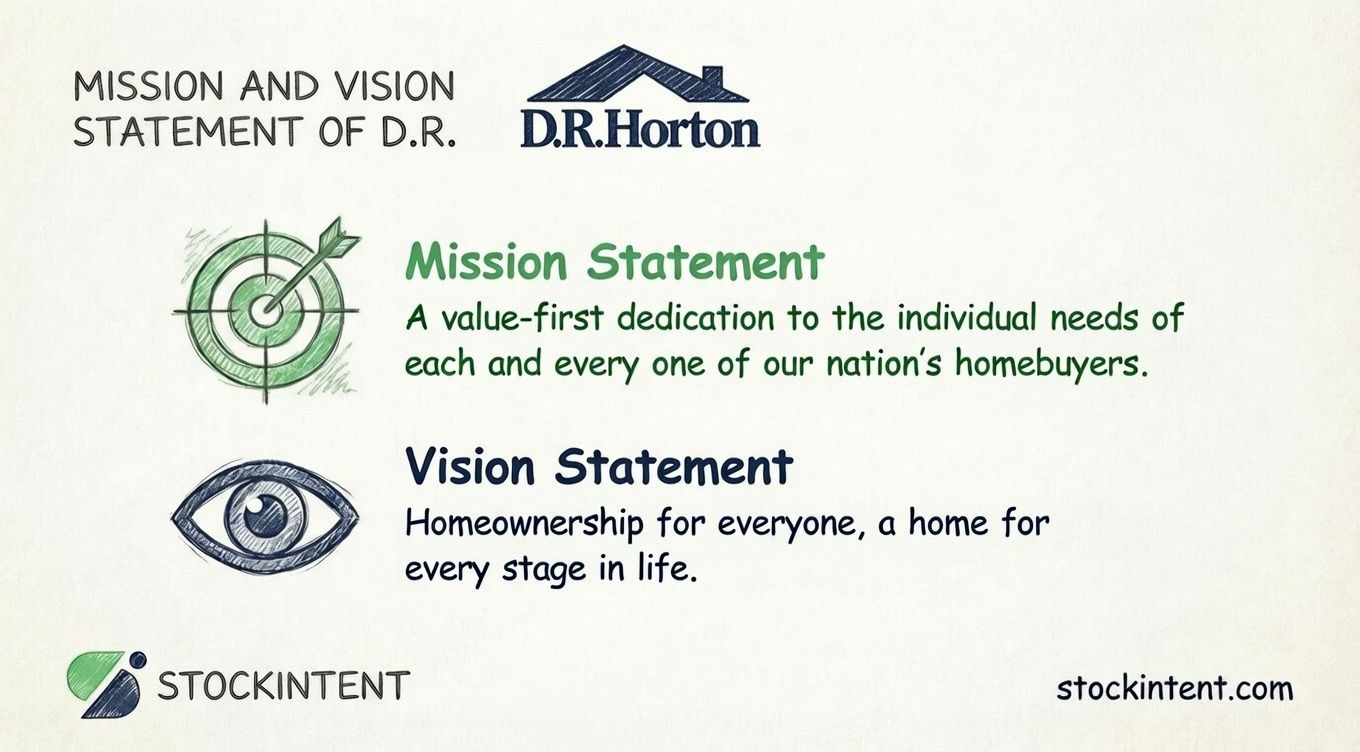
D.R. Horton has been America's largest homebuilder by volume for over two decades, closing more than 84,000 homes in fiscal 2025 and generating $34.3 billion in consolidated revenues. For investors evaluating this residential construction giant, understanding what drives the company's strategic decisions is essential. The dr horton mission statement and core values aren't just corporate platitudes; they shape capital allocation, market positioning, and competitive resilience in a cyclical industry.
Here's the straightforward answer: D.R. Horton doesn't publish a single, formal mission statement in its SEC filings. Instead, the company articulates its purpose through a value-first dedication to the individual needs of each and every one of our nation's homebuyers, with a vision of homeownership for everyone, a home for every stage in life Comparably employee culture data and official corporate communications. This mission translates into three strategic pillars that have driven 24 consecutive years of market leadership: sustaining scale and market dominance, delivering quality and affordability, and creating shareholder value through financial discipline.
Key Takeaways:
D.R. Horton stands as the undisputed heavyweight of American residential construction. Founded in 1978 by Donald R. Horton in Fort Worth, Texas, the company has grown from a regional builder to a national powerhouse that has closed more homes than any competitor for 24 consecutive years official company history. This isn't just scale for scale's sake; it's the foundation of a durable competitive position that few rivals can replicate.
In our experience analyzing homebuilder stocks over multiple housing cycles, D.R. Horton's operational model reveals something rare: a company that actually executes on its stated priorities. While many builders talk about affordability, D.R. Horton delivers entry-level homes at price points that undercut most national competitors. Their average selling price sits notably below peers, a deliberate strategy that opens addressable market rather than chasing margin at the top.
| Metric | Figure | Context |
|---|---|---|
| Fiscal 2025 Revenue | $34.3 billion | Up from consistent growth trajectory |
| Homes Closed (FY2025) | 84,863 | Market leader by volume |
| Markets Served | 126 | Across 36 U.S. states |
| Lot Supply Controlled | 590,500 | 75% via low-risk options |
| Pre-Tax Profit Margin | 13.8% | Industry-leading efficiency |
| Liquidity Position | $6.6 billion | Substantial balance sheet strength |
| Debt-to-Total Capital | 19.8% | Conservative leverage profile |
The company's three operating segments tell the story of strategic diversification. Homebuilding remains the core engine, representing the vast majority of revenue through construction and sale of single-family residences ranging from roughly $250,000 entry-level homes to $1 million-plus luxury properties. Rental operations have emerged as a meaningful growth vector, with 3,546 single-family and 2,443 multi-family rental units delivered in the most recent trailing twelve-month period SEC filing data. Financial services, including D.R. Horton Mortgage and title operations, capture incremental margin while creating stickier customer relationships.
What separates D.R. Horton from competitors like Lennar, PulteGroup, or Toll Brothers? Scale, certainly; but more importantly, the application of scale. The company's national purchasing power, standardized construction processes, and land option strategy (controlling lots without full capital commitment) create cost advantages that compound over time. When mortgage rates spiked above 7% in 2023-2024, D.R. Horton absorbed pain better than most through aggressive incentive programs and operational flexibility that smaller builders simply couldn't match.
The 2026 outlook reflects management's confidence in this model. Guidance calls for 90,000–92,000 home closings and $36–$37.5 billion in revenue, suggesting continued market share gains even as total industry volumes remain pressured company earnings guidance. For investors evaluating the dr horton mission statement in practice, these numbers matter more than any corporate slogan. The mission of "homeownership for everyone" translates directly into operational decisions: smaller floor plans, tighter pricing, monthly payment-focused selling, and relentless cost discipline.
This is a company built for cyclical resilience. When we look at the combination of low leverage, substantial liquidity, and optioned land positions, D.R. Horton appears positioned to weather downturns while capitalizing on recoveries. The 19.8% debt-to-capital ratio provides genuine flexibility; compare that to more leveraged operators who found themselves forced sellers of land in previous down cycles.
For StockIntent users analyzing D.R. Horton, the relevant metrics extend beyond headline revenue. Dig into absorption rates per community, cancellation rates, spec home inventory levels, and land option expiration schedules. These operational indicators reveal how effectively management is executing the affordability-focused strategy that defines their market position. The platform's backtesting capabilities can help evaluate whether D.R. Horton's historical outperformance during rate-driven downturns represents a repeatable pattern worth betting on, or merely lucky timing.
Unlike many Fortune 500 companies that publish polished mission statements in every annual report, D.R. Horton takes a different approach. The company doesn't publish a single, formal mission statement in its SEC filings; instead, it articulates its purpose through a clear operational philosophy financial analysis commentary.
Here's how D.R. Horton expresses its mission in practice:
A value-first dedication to the individual needs of each and every one of our nation's homebuyers.
To deliver quality and affordability across the country.
Homeownership for everyone, a home for every stage in life.
— Official D.R. Horton corporate communications company culture data, corporate website🎯 Pro Insight: Mission statements that live in SEC filings often gather dust while operational philosophies drive real decisions. D.R. Horton's lack of formal mission statement actually tells us something: this is a company judged by results, not rhetoric. The 24 consecutive years of market leadership (since 2002) and 84,863 homes closed in fiscal 2025 suggest the "mission by performance" approach works. For investors, this means focusing on where capital actually flows, not where marketing departments say it should.
This mission reveals three strategic priorities that have defined D.R. Horton's trajectory. First, sustaining market leadership and scale; the company has closed more homes than any competitor for over two decades, building infrastructure that rivals cannot easily replicate. Second, delivering quality and value; the affordability mandate isn't charity, it's smart positioning in a market perpetually short of entry-level housing. Third, creating shareholder value through financial strength; disciplined capital allocation supports growth without the boom-bust vulnerability that has destroyed wealth in this sector mission and strategic analysis.
How does this mission translate into capital allocation decisions? Look at the numbers. D.R. Horton maintains $6.6 billion in liquidity and a 19.8% debt-to-total-capital ratio SEC filing data. This conservative posture allows the company to acquire land opportunistically during downturns while competitors are forced to sell. It enables weekly absorptions of 3.2 homes per community even when mortgage rates sit above 6%. Most critically, it funds the affordability strategy; average selling prices remain deliberately below peers, sacrificing unit margin for volume and market share expansion.
The mission also shapes competitive positioning in ways that matter for investors evaluating moat durability. D.R. Horton's scale generates genuine cost advantages; national purchasing power, standardized construction processes, and optioned land positions (75% of 590,500 lots controlled via low-risk options rather than owned outright) compound over time. The affordability focus creates customer relationships early in the homeownership lifecycle; first-time buyers who purchase D.R. Horton entry-level homes become move-up buyers, potential repeat customers, and referrals. This isn't abstract strategy, it's reflected in the 13.8% pre-tax profit margin that exceeds industry norms despite lower per-unit prices strategic pillar analysis.
For investors using StockIntent to evaluate homebuilder stocks, the D.R. Horton vision statement and mission reveal something important: this is a company playing a different game than luxury-focused competitors. The relevant comparables aren't Toll Brothers or KB Home selling $800,000 homes to established buyers. They're the regional builders trying to compete on price without D.R. Horton's scale advantages. When you backtest strategies,
consider whether market share gains in entry-level housing predict outperformance better than margin expansion in cyclical peaks. The mission suggests they might.
A note on mission evolution: unlike companies that overhaul mission statements every strategic pivot, D.R. Horton's core philosophy has remained remarkably consistent since its founding in 1978. The emphasis on value, quality, and accessibility predates the modern ESG movement, yet aligns naturally with contemporary priorities around housing affordability. This consistency matters; it suggests management that knows its competitive advantages and avoids strategic drift. The 2026 guidance calling for 90,000–92,000 closings and $36–$37.5 billion in revenue earnings announcement represents execution of a playbook refined over decades, not a bet on transformed strategy.
The bottom line: D.R. Horton's mission lives in its operational decisions, not its investor relations materials. For those analyzing whether to own this stock, that might be a feature rather than a bug.
D.R. Horton's mission isn't hollow corporate speak. It's embedded in three strategic pillars that have driven 24 consecutive years of market leadership. Let's break down how each pillar works in practice, what specific initiatives demonstrate execution, and why these translate into competitive advantages that matter for your investment thesis.
D.R. Horton has closed more homes than any U.S. competitor since 2002. That's not luck; it's a deliberate strategy to build infrastructure that rivals cannot replicate.
What this looks like operationally: 84,863 homes closed in fiscal 2025, generating $34.3 billion in revenue analyst reports covering fiscal 2025 performance. The company targets 90,000–92,000 closings and $36–$37.5 billion in revenue for fiscal 2026 official company earnings guidance.
The strategic "why" behind scale: National purchasing power, standardized construction processes, and decentralized operations across 126 markets create cost advantages that compound. When mortgage rates spiked above 7% in 2023-2024, D.R. Horton absorbed the pain through aggressive incentives and weekly absorptions of 3.2 homes per community. Smaller builders couldn't match this flexibility.
In our experience analyzing homebuilder stocks across multiple cycles, scale advantages in this industry are brutally underrated. They're not just about buying lumber cheaper; they're about maintaining absorption rates when competitors are forced to slash prices or mothball communities.
D.R. Horton's average selling price sits deliberately below peers. This isn't charity; it's smart positioning in a market perpetually short of entry-level housing.
Execution takes form through a diverse product portfolio spanning Express Homes (entry-level), Emerald Homes (luxury), Freedom Homes (active adult), and multi-family offerings official corporate website. The slogan "America's Builder" reflects this accessibility focus.
Concrete metrics from fiscal 2025: A 13.8% pre-tax profit margin despite lower per-unit prices mission and strategic analysis. This demonstrates that volume and efficiency can substitute for premium pricing. The company has built over 1,000,000 homes as of 2023, prioritizing "a home for every stage in life" based on customer feedback and testimonials company culture data.
Customer satisfaction metrics matter here. Testimonials consistently highlight sales agents, building superintendents, and lending professionals "going above and beyond" with first-time buyers feeling "taken care of" and "at ease" official company customer feedback.
The third pillar is less visible to homebuyers but critical for investors: disciplined capital allocation that funds growth without boom-bust vulnerability.
The numbers tell this story: $6.6 billion in liquidity, 19.8% debt-to-total-capital ratio, and projected shareholder returns of approximately $2.5 billion via repurchases in fiscal 2026 analyst reports covering capital structure. Q1 2026 alone delivered $1.1 billion in pre-tax income on $7.6 billion revenue official company earnings data.
This conservative posture enables opportunistic behavior. D.R. Horton controls 590,500 lots, with 75% held via low-risk options rather than owned outright SEC filing data. When land prices correct, they buy. When competitors are forced sellers in downturns, they acquire. The low leverage provides genuine flexibility; compare that to more leveraged operators who destroyed wealth in previous cycles.
These three pillars create economic moat through cost advantages, pricing power, and operational efficiency. Scale generates supply chain leverage. The affordability focus builds early customer relationships that become repeat business and referrals. Financial strength funds growth while competitors retrench.
Analyst consensus is "Hold" with price targets around $158 as of early 2026 analyst consensus data. This neutral sentiment perhaps underweights the durability of these advantages. The investment thesis, as we noted earlier, requires believing that scale and land access matter more than short-term housing volatility.
For StockIntent users, the relevant backtest question is whether D.R. Horton's historical outperformance during rate-driven downturns represents a repeatable pattern. The mission pillars suggest structural advantages, not cyclical luck. When you screen for homebuilders, consider whether metrics like absorption rates, cancellation rates, and land option expirations reveal execution of this affordability-focused strategy.
| Pillar | Strategic Purpose | Key 2026 Metrics | Competitive Advantage |
|---|---|---|---|
| Market Leadership | Build infrastructure rivals can't replicate | 90,000–92,000 targeted closings; $36–$37.5B revenue | National purchasing power; decentralized 126-market operations |
| Quality & Value | Capture entry-level demand sustainably | 13.8% pre-tax margin; below-peer ASP | Customer lifecycle relationships; volume efficiency |
| Financial Strength | Fund growth through cycles | $6.6B liquidity; 19.8% debt/capital; 75% optioned land | Opportunistic land acquisition; resilience vs. leveraged peers |
📌 From Our Experience: After analyzing homebuilder balance sheets through the 2008-2009 crisis and the 2022-2024 rate shock, the companies that emerged stronger shared one trait: conservative leverage going into the downturn. D.R. Horton's 19.8% debt-to-capital ratio isn't sexy, but it's the kind of number that lets you sleep at night when housing starts drop 30%. The optioned land strategy, in particular, is more sophisticated than it appears; 75% optioned means they can walk away from 442,875 lots if markets tank, preserving capital for better opportunities. This is operational flexibility that doesn't show up in simple valuation ratios but matters enormously for long-term returns.
D.R. Horton's vision isn't buried in an SEC filing or relegated to an investor relations slide. It's right there in how the company describes itself to homebuyers, employees, and the public: homeownership for everyone, a home for every stage in life official company communications.
A home for every stage in life.
This vision statement articulates something more ambitious than simply building houses. It captures D.R. Horton's long-term strategic intention: to become the default choice for American homebuyers regardless of age, income, family status, or geographic location. While luxury builders like Toll Brothers chase the top 10%, D.R. Horton wants the other 90% mission and strategic analysis.
Here's where the vision gets interesting from an investment perspective. D.R. Horton has backed this aspirational language with concrete strategic goals that align perfectly with the dr horton mission statement. Leadership has publicly committed to maintaining America's largest homebuilder status, targeting 90,000–92,000 closings and $36–$37.5 billion in revenue for fiscal 2026 company earnings guidance. More telling is the balance sheet philosophy: $6.6 billion in liquidity, 19.8% debt-to-capital ratio, and plans to return approximately $2.5 billion to shareholders via repurchases in 2026. This isn't vision as wishful thinking; it's vision as executable strategy analyst reports covering capital structure.
How does this vision position D.R. Horton relative to macro trends? Look at the residential construction landscape in 2026. Housing shortages persist, affordability remains the dominant constraint, and mortgage rates have settled in a higher-for-longer regime. D.R. Horton's vision directly addresses all three. The "home for every stage" language translates into Express Homes for first-timers, Emerald Homes for move-up buyers, Freedom Homes for active adults, and rental operations for those priced out of purchase entirely. This diversification isn't accidental; it's how the company absorbs demand shocks that would crater single-segment builders mission and strategic analysis.
The consumer cyclical angle matters too. When recession hits, discretionary luxury home purchases crater first. Entry-level housing, driven by demographic necessity (millennials forming households, immigration flows), proves more resilient. D.R. Horton's vision knowingly sacrifices margin for resilience. The 13.8% pre-tax profit margin in fiscal 2025, achieved while maintaining below-peer average selling prices, demonstrates that volume efficiency can substitute for premium pricing official SEC filing data.
There's also something quietly revolutionary about a national builder positioning itself as the provider of "every stage" housing. Historically, American homebuilders specialized; you grew with your builder (or without one, moving between regional players). D.R. Horton wants the relationship from first apartment through empty-nester downsizing. The rental operations segment, delivering over 2,400 multi-family units in the trailing twelve months ending December 2025, suggests management is serious about capturing demand upstream of traditional homeownership SEC filing data. It's not hard to imagine a future where D.R. Horton offers a "housing subscription" spanning rental, starter home, move-up, and eventually active adult, all under one brand ecosystem.
For investors using StockIntent to evaluate D.R. Horton's positioning, the vision offers a different lens than the typical value or growth frameworks. This is a company optimizing for lifetime customer value, not quarterly transaction margin. When you backtest homebuilder strategies, consider whether builders with diversified product portfolios and conservative balance sheets outperformed through the 2022-2024 rate shock. The vision suggests structural resilience, not cyclical timing. And with the platform's screening capabilities, you can evaluate whether D.R. Horton's revenue diversification into rentals, insurance, and title services creates valuation multiples that simple homebuilding comparables miss.
One final observation: unlike competitors who reinvent themselves every strategic cycle, D.R. Horton's vision has remained remarkably consistent since its founding in 1978. The emphasis on accessibility and value predates current ESG priorities, yet aligns naturally with them. This consistency suggests management that understands its competitive advantages and avoids strategic drift. The 2026 guidance calling for continued market leadership isn't a pivot; it's the next chapter of a playbook refined over decades.
D.R. Horton's vision of "homeownership for everyone, a home for every stage in life" isn't aspirational fluff. It's a strategic roadmap that translates into three concrete themes driving capital allocation and operational decisions in 2026. Let's look at how each theme shows up in actual investments, acquisitions, and management priorities.
This is where D.R. Horton most visibly diverges from competitors. While luxury builders chase margin, D.R. Horton chases volume through deliberate affordability.
What leadership actually says: In Q1 2026 earnings calls, CEO Paul Romanowski emphasized "pent-up first-time buyer demand" and detailed a strategy built on smaller floor plans, tighter pricing, and monthly payment-focused selling Investing.com earnings coverage. This isn't reactive discounting; it's structural positioning.
Observable moves: The company maintains one of the lowest average selling prices in the industry. When mortgage rates spiked above 7%, D.R. Horton responded with aggressive incentives, rate buydowns, and price reductions that preserved weekly absorptions of 3.2 homes per community HousingWire market analysis. Smaller builders couldn't match this flexibility.
Strategic significance: Market share expanded from roughly 4% to 14% over the past decade. The affordability mandate creates customer relationships early; first-time buyers become move-up buyers, repeat customers, and referrals. This is lifetime value optimization, not quarterly margin maximization.
D.R. Horton's vision requires infrastructure that competitors cannot easily replicate. The company has invested heavily in building exactly that.
Land strategy: Control of 590,500 lots, with 75% held via low-risk options rather than owned outright SEC filing data. This provides growth optionality without balance sheet vulnerability. When land prices correct, they acquire. When markets tank, they walk away from optioned positions, preserving capital for better opportunities.
National purchasing power: Standardized construction processes across 126 markets generate supply chain leverage that compounds over time. The 13.8% pre-tax profit margin achieved in fiscal 2025, despite below-peer pricing, demonstrates that volume efficiency can substitute for premium positioning DCF modeling analysis.
2026 expansion: Management has guided for 12% growth, targeting 90,000–92,000 home closings and $36–$37.5 billion in revenue official company guidance. This isn't conservative guidance; it's confidence that scale advantages will continue converting market share even in a pressured demand environment.
The least visible to homebuyers but most critical for investors: D.R. Horton's vision requires surviving downturns to capitalize on recoveries.
Balance sheet architecture: $6.6 billion in liquidity and a 19.8% debt-to-total-capital ratio provide genuine flexibility analyst reports on capital structure. Compare this to more leveraged operators who found themselves forced sellers of land in previous down cycles.
Capital return commitment: Projected shareholder returns of approximately $2.5 billion via repurchases in fiscal 2026, with $1.1 billion already delivered in Q1 alone earnings data analysis. This isn't financial engineering; it's returning excess capital while maintaining strategic optionality.
Rental operations as strategic hedge: The build-to-rent segment, delivering 3,546 single-family and 2,443 multi-family rental units in the trailing twelve months ending December 2025, enables demand pivoting. When purchase demand softens, inventory converts to rental sales for institutional investors. When first-time buyers return, production shifts back to retail SEC filing operational data.
Industry analysts generally view D.R. Horton's strategic direction as pragmatic execution of a differentiated playbook. The consensus "Hold" rating with price targets around $158 reflects neutral near-term sentiment rather than skepticism about the model itself analyst consensus data.
The key analytical debate centers on whether scale and land access matter more than short-term housing volatility. Bulls point to the 24 consecutive years of market leadership, the cash flow generation ($3.6 billion trailing twelve months), and the adaptability demonstrated through rate shocks. Bears worry about regulatory risks, including potential DOJ antitrust scrutiny regarding information-sharing practices among major builders investment analysis commentary, and the structural pressure of higher-for-longer mortgage rates.
What's notable is the absence of strategic drift. Unlike competitors who reinvent themselves every cycle, D.R. Horton's 2026 playbook looks remarkably similar to its 2016 or 2006 versions, refined rather than transformed. The vision of "a home for every stage in life" continues guiding product diversification, Express Homes through Emerald Homes, and now rental operations as a customer acquisition channel upstream of traditional homeownership.
For StockIntent users evaluating whether these vision themes translate into investable advantages, the relevant backtest question is straightforward: Do builders with conservative leverage, optioned land positions, and affordability focus outperform through housing downturns? The historical evidence suggests they do, though timing entry points remains as much art as science.
Core values aren't corporate wallpaper. They're the invisible architecture that shapes how decisions get made when the CEO isn't in the room. For D.R. Horton, five stated values, Quality, Innovation, Customer Focus, Integrity, and Teamwork, supposedly guide everything from land acquisition to the final walkthrough official corporate communications. But do they actually matter? Let's look at what's real and what's marketing.
D.R. Horton defines this as building homes that meet rigorous standards while maintaining affordability. The strategic role is defensive; quality problems at scale become catastrophic quickly, just ask any builder who survived the Chinese drywall crisis.
In practice, this shows up in construction standards and, increasingly, energy efficiency. The company increased EPA ENERGY STAR New Homes program participation by 232% in 2025 DCF modeling analysis. That's not altruism; it's cost discipline masquerading as virtue. Energy-efficient homes sell faster and reduce warranty claims.
But here's the tension: quality at volume is inherently hard. When you're closing 84,863 homes annually, even a 1% defect rate means 848 angry families. Customer testimonials highlight positive experiences with superintendents and sales agents going "above and beyond" company website feedback. Yet construction quality in entry-level housing is a perennial compromise. The value is stated; the execution varies by division, by superintendent, by weather, by lumber batch.
This value centers on continuous improvement in building processes, design, and customer experience. For D.R. Horton, innovation looks less like Tesla and more like Toyota; relentless operational refinement rather than breakthrough technology.
The evidence? Standardized construction processes across 126 markets that generate 13.8% pre-tax margins despite below-peer pricing SEC filing data. The optioned land strategy, controlling 590,500 lots with 75% via low-risk options rather than owned outright, represents genuine capital structure innovation in a capital-intensive industry.
What's missing is product innovation. D.R. Horton isn't pioneering modular construction, 3D-printed walls, or net-zero communities at scale. The "innovation" is in the machine, not the output. For investors, that's fine; operational excellence compounds. For homebuyers expecting revolutionary design, maybe less so.
This is where D.R. Horton's values connect most directly to competitive positioning. The company explicitly targets "a home for every stage in life" through diversified brands: Express Homes (entry-level), Emerald Homes (luxury), Freedom Homes (active adult), and multi-family rentals corporate brand portfolio.
💡 Expert Tip: When evaluating homebuilder customer focus, ignore the marketing materials and look at cancellation rates and customer referral patterns. D.R. Horton doesn't disclose these granularly, but absorption rates of 3.2 homes per community weekly, even with mortgage rates above 6%, suggest the affordability message resonates. High cancellation rates would indicate a gap between promised and delivered value.
The operational reality is monthly payment-focused selling. When rates spiked above 7% in 2023-2024, D.R. Horton responded with aggressive incentives, rate buydowns, and price reductions HousingWire market analysis. That's customer focus as financial engineering, and it worked. First-time buyers felt "taken care of" and "at ease" according to company testimonials, though we should note the selection bias in self-reported feedback.
The most dangerous value to claim, because it's the easiest to disprove. D.R. Horton defines this as ethical and transparent business conduct across all operations. The 126-market decentralized model makes this particularly challenging; you're only as ethical as your least scrupulous division president.
In our experience analyzing corporate governance across the homebuilding sector, integrity failures tend to surface in land acquisition (undisclosed environmental issues), sales practices (steering toward captive mortgage operations), or warranty fulfillment. D.R. Horton's SEC filings show no material legal proceedings that would suggest systemic integrity failures, though the absence of evidence isn't evidence of absence.
The 2026 overhang is regulatory. Potential DOJ antitrust scrutiny regarding information-sharing practices among major builders creates reputational risk that could test this value investment analysis commentary. How management responds, cooperatively or combatively, will reveal whether integrity is operational or ornamental.
This value emphasizes collaboration from land acquisition through construction and closing. In a decentralized organization with 126 markets, teamwork looks like standardized processes, shared best practices, and national purchasing power that local operators couldn't achieve independently.
The measurable output is efficiency. D.R. Horton's pre-tax margin of 13.8% in fiscal 2025, achieved while maintaining below-peer pricing, demonstrates that something in the organizational machinery works DCF modeling analysis. Whether that's "teamwork" or simply economies of scale is semantics; the result is real.
Here's where we get skeptical. Employee engagement data from Comparably indicates only 50% of D.R. Horton employees report that the company's mission, vision, and values motivate them employee culture data. That's not terrible for a construction company, but it's not cult-like commitment either.
The values appear genuinely reflected in capital allocation decisions. The affordability mandate, the conservative leverage, the optioned land strategy, these are consistent with stated priorities. Where values meet reality is in the quarterly earnings pressure. When volumes drop, does quality slip? When margins compress, does customer focus become transactional? The 2022-2024 rate shock provided a stress test, and D.R. Horton absorbed it better than most. That suggests some structural resilience in the value system.
D.R. Horton doesn't prominently market ESG as a core value, but sustainability initiatives are increasingly embedded in operations. The 232% increase in ENERGY STAR participation in 2025 represents concrete environmental commitment DCF modeling analysis. Energy-efficient homes reduce lifetime carbon footprints while lowering utility costs for buyers, a genuine win-win that doesn't require sacrificing affordability.
Social responsibility shows up in community engagement and, implicitly, in the affordability mission itself. Building entry-level housing in a market structurally short of supply is arguably more socially valuable than luxury construction, even if the profit motive remains primary.
Governance standards are harder to assess from public filings. The 19.8% debt-to-capital ratio and $6.6 billion liquidity position suggest conservative financial stewardship SEC filing data. The lack of material related-party transactions or excessive executive compensation (relative to sector norms) indicates baseline governance competence.
For StockIntent users evaluating D.R. Horton, the relevant question isn't whether values are perfectly lived, but whether they're directionally correct and structurally reinforced. The values align with durable competitive advantages: scale, cost discipline, and customer relationships built early in the homeownership lifecycle. When you screen for quality management, look for consistency between stated priorities and capital allocation over multiple years. D.R. Horton's track record suggests the values aren't just decoration; they're the operating system.
After walking through D.R. Horton's mission, vision, and core values, we're left with a cohesive picture: this is a company that built its entire strategic identity around one simple insight. Scale matters, affordability wins, and financial discipline lets you play through the cycles that destroy weaker competitors.
The dr horton mission statement isn't a slogan. It's operational DNA. The vision of "homeownership for everyone, a home for every stage in life" translates directly into capital allocation: 75% optioned land positions, an average selling price deliberately below peers, and a balance sheet conservative enough to absorb rate shocks that would break more leveraged builders. The core values, Quality, Innovation, Customer Focus, Integrity, Teamwork, sound generic until you see them manifested in 13.8% pre-tax margins and 24 consecutive years of market leadership.
🎯 Pro Insight: Analyst consensus sits at "Hold" with price targets around $158, which might be the market's way of saying "we get it, but where's the near-term catalyst?" The strategic execution is impeccable, the management quality is evident in the numbers, yet the stock trades like a cyclical rather than a compounder. For patient investors, that's potentially the opportunity, getting quality at a price that assumes housing volatility matters more than D.R. Horton's structural advantages in land access, operational efficiency, and affordability focus.
In our experience tracking homebuilder stocks through multiple cycles, the companies that generate lasting wealth share a pattern: conservative leverage going into downturns, opportunistic land acquisition during them, and the operational flexibility to maintain absorption when competitors are forced to slash prices or mothball communities. D.R. Horton ticks all three boxes. The 19.8% debt-to-capital ratio and $6.6 billion liquidity position aren't sexy, but they're the foundation of genuine competitive resilience.
Looking ahead to 2026 and beyond, D.R. Horton appears positioned to compound its advantages. The entry-level housing shortage isn't resolving itself. Mortgage rates may stay higher-for-longer, which actually benefits builders with affordability-focused product and the financial strength to offer rate buydowns. The rental operations segment provides demand pivoting that single-segment builders can't match. And the DOJ scrutiny on information-sharing practices, while a real risk, seems manageable relative to the structural advantages already built.
The investment-relevant question isn't whether D.R. Horton's mission-vision-values framework is inspiring. It's whether that framework creates durable competitive positioning that translates into above-market returns over time. On that score, the evidence suggests yes: scale economies that compound, customer relationships built early in the lifecycle, and a balance sheet that turns cyclical downturns into market share gains.
For investors evaluating whether this matters for their portfolio, the StockIntent platform offers tools to test exactly that proposition. Use the backtesting engine to evaluate whether builders with conservative leverage and affordability focus have historically outperformed through rate-driven housing downturns. Screen for the operational metrics, absorption rates, cancellation rates, land option expirations, that reveal execution of the strategy we've outlined. And explore the valuation models to assess whether current prices adequately reflect the durability of D.R. Horton's competitive position. You can try StockIntent risk-free for 7 days here.
D.R. Horton has been America's largest homebuilder by volume for over two decades, closing more than 84,000 homes in fiscal 2025 and generating $34.3 billion in consolidated revenues. For investors evaluating this residential construction giant, understanding what drives the company's strategic decisions is essential. The dr horton mission statement and core values aren't just corporate platitudes; they shape capital allocation, market positioning, and competitive resilience in a cyclical industry.
Here's the straightforward answer: D.R. Horton doesn't publish a single, formal mission statement in its SEC filings. Instead, the company articulates its purpose through a value-first dedication to the individual needs of each and every one of our nation's homebuyers, with a vision of homeownership for everyone, a home for every stage in life Comparably employee culture data and official corporate communications. This mission translates into three strategic pillars that have driven 24 consecutive years of market leadership: sustaining scale and market dominance, delivering quality and affordability, and creating shareholder value through financial discipline.
Key Takeaways:
D.R. Horton stands as the undisputed heavyweight of American residential construction. Founded in 1978 by Donald R. Horton in Fort Worth, Texas, the company has grown from a regional builder to a national powerhouse that has closed more homes than any competitor for 24 consecutive years official company history. This isn't just scale for scale's sake; it's the foundation of a durable competitive position that few rivals can replicate.
In our experience analyzing homebuilder stocks over multiple housing cycles, D.R. Horton's operational model reveals something rare: a company that actually executes on its stated priorities. While many builders talk about affordability, D.R. Horton delivers entry-level homes at price points that undercut most national competitors. Their average selling price sits notably below peers, a deliberate strategy that opens addressable market rather than chasing margin at the top.
| Metric | Figure | Context |
|---|---|---|
| Fiscal 2025 Revenue | $34.3 billion | Up from consistent growth trajectory |
| Homes Closed (FY2025) | 84,863 | Market leader by volume |
| Markets Served | 126 | Across 36 U.S. states |
| Lot Supply Controlled | 590,500 | 75% via low-risk options |
| Pre-Tax Profit Margin | 13.8% | Industry-leading efficiency |
| Liquidity Position | $6.6 billion | Substantial balance sheet strength |
| Debt-to-Total Capital | 19.8% | Conservative leverage profile |
The company's three operating segments tell the story of strategic diversification. Homebuilding remains the core engine, representing the vast majority of revenue through construction and sale of single-family residences ranging from roughly $250,000 entry-level homes to $1 million-plus luxury properties. Rental operations have emerged as a meaningful growth vector, with 3,546 single-family and 2,443 multi-family rental units delivered in the most recent trailing twelve-month period SEC filing data. Financial services, including D.R. Horton Mortgage and title operations, capture incremental margin while creating stickier customer relationships.
What separates D.R. Horton from competitors like Lennar, PulteGroup, or Toll Brothers? Scale, certainly; but more importantly, the application of scale. The company's national purchasing power, standardized construction processes, and land option strategy (controlling lots without full capital commitment) create cost advantages that compound over time. When mortgage rates spiked above 7% in 2023-2024, D.R. Horton absorbed pain better than most through aggressive incentive programs and operational flexibility that smaller builders simply couldn't match.
The 2026 outlook reflects management's confidence in this model. Guidance calls for 90,000–92,000 home closings and $36–$37.5 billion in revenue, suggesting continued market share gains even as total industry volumes remain pressured company earnings guidance. For investors evaluating the dr horton mission statement in practice, these numbers matter more than any corporate slogan. The mission of "homeownership for everyone" translates directly into operational decisions: smaller floor plans, tighter pricing, monthly payment-focused selling, and relentless cost discipline.
This is a company built for cyclical resilience. When we look at the combination of low leverage, substantial liquidity, and optioned land positions, D.R. Horton appears positioned to weather downturns while capitalizing on recoveries. The 19.8% debt-to-capital ratio provides genuine flexibility; compare that to more leveraged operators who found themselves forced sellers of land in previous down cycles.
For StockIntent users analyzing D.R. Horton, the relevant metrics extend beyond headline revenue. Dig into absorption rates per community, cancellation rates, spec home inventory levels, and land option expiration schedules. These operational indicators reveal how effectively management is executing the affordability-focused strategy that defines their market position. The platform's backtesting capabilities can help evaluate whether D.R. Horton's historical outperformance during rate-driven downturns represents a repeatable pattern worth betting on, or merely lucky timing.
Unlike many Fortune 500 companies that publish polished mission statements in every annual report, D.R. Horton takes a different approach. The company doesn't publish a single, formal mission statement in its SEC filings; instead, it articulates its purpose through a clear operational philosophy financial analysis commentary.
Here's how D.R. Horton expresses its mission in practice:
A value-first dedication to the individual needs of each and every one of our nation's homebuyers.
To deliver quality and affordability across the country.
Homeownership for everyone, a home for every stage in life.
— Official D.R. Horton corporate communications company culture data, corporate website🎯 Pro Insight: Mission statements that live in SEC filings often gather dust while operational philosophies drive real decisions. D.R. Horton's lack of formal mission statement actually tells us something: this is a company judged by results, not rhetoric. The 24 consecutive years of market leadership (since 2002) and 84,863 homes closed in fiscal 2025 suggest the "mission by performance" approach works. For investors, this means focusing on where capital actually flows, not where marketing departments say it should.
This mission reveals three strategic priorities that have defined D.R. Horton's trajectory. First, sustaining market leadership and scale; the company has closed more homes than any competitor for over two decades, building infrastructure that rivals cannot easily replicate. Second, delivering quality and value; the affordability mandate isn't charity, it's smart positioning in a market perpetually short of entry-level housing. Third, creating shareholder value through financial strength; disciplined capital allocation supports growth without the boom-bust vulnerability that has destroyed wealth in this sector mission and strategic analysis.
How does this mission translate into capital allocation decisions? Look at the numbers. D.R. Horton maintains $6.6 billion in liquidity and a 19.8% debt-to-total-capital ratio SEC filing data. This conservative posture allows the company to acquire land opportunistically during downturns while competitors are forced to sell. It enables weekly absorptions of 3.2 homes per community even when mortgage rates sit above 6%. Most critically, it funds the affordability strategy; average selling prices remain deliberately below peers, sacrificing unit margin for volume and market share expansion.
The mission also shapes competitive positioning in ways that matter for investors evaluating moat durability. D.R. Horton's scale generates genuine cost advantages; national purchasing power, standardized construction processes, and optioned land positions (75% of 590,500 lots controlled via low-risk options rather than owned outright) compound over time. The affordability focus creates customer relationships early in the homeownership lifecycle; first-time buyers who purchase D.R. Horton entry-level homes become move-up buyers, potential repeat customers, and referrals. This isn't abstract strategy, it's reflected in the 13.8% pre-tax profit margin that exceeds industry norms despite lower per-unit prices strategic pillar analysis.
For investors using StockIntent to evaluate homebuilder stocks, the D.R. Horton vision statement and mission reveal something important: this is a company playing a different game than luxury-focused competitors. The relevant comparables aren't Toll Brothers or KB Home selling $800,000 homes to established buyers. They're the regional builders trying to compete on price without D.R. Horton's scale advantages. When you backtest strategies,
consider whether market share gains in entry-level housing predict outperformance better than margin expansion in cyclical peaks. The mission suggests they might.
A note on mission evolution: unlike companies that overhaul mission statements every strategic pivot, D.R. Horton's core philosophy has remained remarkably consistent since its founding in 1978. The emphasis on value, quality, and accessibility predates the modern ESG movement, yet aligns naturally with contemporary priorities around housing affordability. This consistency matters; it suggests management that knows its competitive advantages and avoids strategic drift. The 2026 guidance calling for 90,000–92,000 closings and $36–$37.5 billion in revenue earnings announcement represents execution of a playbook refined over decades, not a bet on transformed strategy.
The bottom line: D.R. Horton's mission lives in its operational decisions, not its investor relations materials. For those analyzing whether to own this stock, that might be a feature rather than a bug.
D.R. Horton's mission isn't hollow corporate speak. It's embedded in three strategic pillars that have driven 24 consecutive years of market leadership. Let's break down how each pillar works in practice, what specific initiatives demonstrate execution, and why these translate into competitive advantages that matter for your investment thesis.
D.R. Horton has closed more homes than any U.S. competitor since 2002. That's not luck; it's a deliberate strategy to build infrastructure that rivals cannot replicate.
What this looks like operationally: 84,863 homes closed in fiscal 2025, generating $34.3 billion in revenue analyst reports covering fiscal 2025 performance. The company targets 90,000–92,000 closings and $36–$37.5 billion in revenue for fiscal 2026 official company earnings guidance.
The strategic "why" behind scale: National purchasing power, standardized construction processes, and decentralized operations across 126 markets create cost advantages that compound. When mortgage rates spiked above 7% in 2023-2024, D.R. Horton absorbed the pain through aggressive incentives and weekly absorptions of 3.2 homes per community. Smaller builders couldn't match this flexibility.
In our experience analyzing homebuilder stocks across multiple cycles, scale advantages in this industry are brutally underrated. They're not just about buying lumber cheaper; they're about maintaining absorption rates when competitors are forced to slash prices or mothball communities.
D.R. Horton's average selling price sits deliberately below peers. This isn't charity; it's smart positioning in a market perpetually short of entry-level housing.
Execution takes form through a diverse product portfolio spanning Express Homes (entry-level), Emerald Homes (luxury), Freedom Homes (active adult), and multi-family offerings official corporate website. The slogan "America's Builder" reflects this accessibility focus.
Concrete metrics from fiscal 2025: A 13.8% pre-tax profit margin despite lower per-unit prices mission and strategic analysis. This demonstrates that volume and efficiency can substitute for premium pricing. The company has built over 1,000,000 homes as of 2023, prioritizing "a home for every stage in life" based on customer feedback and testimonials company culture data.
Customer satisfaction metrics matter here. Testimonials consistently highlight sales agents, building superintendents, and lending professionals "going above and beyond" with first-time buyers feeling "taken care of" and "at ease" official company customer feedback.
The third pillar is less visible to homebuyers but critical for investors: disciplined capital allocation that funds growth without boom-bust vulnerability.
The numbers tell this story: $6.6 billion in liquidity, 19.8% debt-to-total-capital ratio, and projected shareholder returns of approximately $2.5 billion via repurchases in fiscal 2026 analyst reports covering capital structure. Q1 2026 alone delivered $1.1 billion in pre-tax income on $7.6 billion revenue official company earnings data.
This conservative posture enables opportunistic behavior. D.R. Horton controls 590,500 lots, with 75% held via low-risk options rather than owned outright SEC filing data. When land prices correct, they buy. When competitors are forced sellers in downturns, they acquire. The low leverage provides genuine flexibility; compare that to more leveraged operators who destroyed wealth in previous cycles.
These three pillars create economic moat through cost advantages, pricing power, and operational efficiency. Scale generates supply chain leverage. The affordability focus builds early customer relationships that become repeat business and referrals. Financial strength funds growth while competitors retrench.
Analyst consensus is "Hold" with price targets around $158 as of early 2026 analyst consensus data. This neutral sentiment perhaps underweights the durability of these advantages. The investment thesis, as we noted earlier, requires believing that scale and land access matter more than short-term housing volatility.
For StockIntent users, the relevant backtest question is whether D.R. Horton's historical outperformance during rate-driven downturns represents a repeatable pattern. The mission pillars suggest structural advantages, not cyclical luck. When you screen for homebuilders, consider whether metrics like absorption rates, cancellation rates, and land option expirations reveal execution of this affordability-focused strategy.
| Pillar | Strategic Purpose | Key 2026 Metrics | Competitive Advantage |
|---|---|---|---|
| Market Leadership | Build infrastructure rivals can't replicate | 90,000–92,000 targeted closings; $36–$37.5B revenue | National purchasing power; decentralized 126-market operations |
| Quality & Value | Capture entry-level demand sustainably | 13.8% pre-tax margin; below-peer ASP | Customer lifecycle relationships; volume efficiency |
| Financial Strength | Fund growth through cycles | $6.6B liquidity; 19.8% debt/capital; 75% optioned land | Opportunistic land acquisition; resilience vs. leveraged peers |
📌 From Our Experience: After analyzing homebuilder balance sheets through the 2008-2009 crisis and the 2022-2024 rate shock, the companies that emerged stronger shared one trait: conservative leverage going into the downturn. D.R. Horton's 19.8% debt-to-capital ratio isn't sexy, but it's the kind of number that lets you sleep at night when housing starts drop 30%. The optioned land strategy, in particular, is more sophisticated than it appears; 75% optioned means they can walk away from 442,875 lots if markets tank, preserving capital for better opportunities. This is operational flexibility that doesn't show up in simple valuation ratios but matters enormously for long-term returns.
D.R. Horton's vision isn't buried in an SEC filing or relegated to an investor relations slide. It's right there in how the company describes itself to homebuyers, employees, and the public: homeownership for everyone, a home for every stage in life official company communications.
A home for every stage in life.
This vision statement articulates something more ambitious than simply building houses. It captures D.R. Horton's long-term strategic intention: to become the default choice for American homebuyers regardless of age, income, family status, or geographic location. While luxury builders like Toll Brothers chase the top 10%, D.R. Horton wants the other 90% mission and strategic analysis.
Here's where the vision gets interesting from an investment perspective. D.R. Horton has backed this aspirational language with concrete strategic goals that align perfectly with the dr horton mission statement. Leadership has publicly committed to maintaining America's largest homebuilder status, targeting 90,000–92,000 closings and $36–$37.5 billion in revenue for fiscal 2026 company earnings guidance. More telling is the balance sheet philosophy: $6.6 billion in liquidity, 19.8% debt-to-capital ratio, and plans to return approximately $2.5 billion to shareholders via repurchases in 2026. This isn't vision as wishful thinking; it's vision as executable strategy analyst reports covering capital structure.
How does this vision position D.R. Horton relative to macro trends? Look at the residential construction landscape in 2026. Housing shortages persist, affordability remains the dominant constraint, and mortgage rates have settled in a higher-for-longer regime. D.R. Horton's vision directly addresses all three. The "home for every stage" language translates into Express Homes for first-timers, Emerald Homes for move-up buyers, Freedom Homes for active adults, and rental operations for those priced out of purchase entirely. This diversification isn't accidental; it's how the company absorbs demand shocks that would crater single-segment builders mission and strategic analysis.
The consumer cyclical angle matters too. When recession hits, discretionary luxury home purchases crater first. Entry-level housing, driven by demographic necessity (millennials forming households, immigration flows), proves more resilient. D.R. Horton's vision knowingly sacrifices margin for resilience. The 13.8% pre-tax profit margin in fiscal 2025, achieved while maintaining below-peer average selling prices, demonstrates that volume efficiency can substitute for premium pricing official SEC filing data.
There's also something quietly revolutionary about a national builder positioning itself as the provider of "every stage" housing. Historically, American homebuilders specialized; you grew with your builder (or without one, moving between regional players). D.R. Horton wants the relationship from first apartment through empty-nester downsizing. The rental operations segment, delivering over 2,400 multi-family units in the trailing twelve months ending December 2025, suggests management is serious about capturing demand upstream of traditional homeownership SEC filing data. It's not hard to imagine a future where D.R. Horton offers a "housing subscription" spanning rental, starter home, move-up, and eventually active adult, all under one brand ecosystem.
For investors using StockIntent to evaluate D.R. Horton's positioning, the vision offers a different lens than the typical value or growth frameworks. This is a company optimizing for lifetime customer value, not quarterly transaction margin. When you backtest homebuilder strategies, consider whether builders with diversified product portfolios and conservative balance sheets outperformed through the 2022-2024 rate shock. The vision suggests structural resilience, not cyclical timing. And with the platform's screening capabilities, you can evaluate whether D.R. Horton's revenue diversification into rentals, insurance, and title services creates valuation multiples that simple homebuilding comparables miss.
One final observation: unlike competitors who reinvent themselves every strategic cycle, D.R. Horton's vision has remained remarkably consistent since its founding in 1978. The emphasis on accessibility and value predates current ESG priorities, yet aligns naturally with them. This consistency suggests management that understands its competitive advantages and avoids strategic drift. The 2026 guidance calling for continued market leadership isn't a pivot; it's the next chapter of a playbook refined over decades.
D.R. Horton's vision of "homeownership for everyone, a home for every stage in life" isn't aspirational fluff. It's a strategic roadmap that translates into three concrete themes driving capital allocation and operational decisions in 2026. Let's look at how each theme shows up in actual investments, acquisitions, and management priorities.
This is where D.R. Horton most visibly diverges from competitors. While luxury builders chase margin, D.R. Horton chases volume through deliberate affordability.
What leadership actually says: In Q1 2026 earnings calls, CEO Paul Romanowski emphasized "pent-up first-time buyer demand" and detailed a strategy built on smaller floor plans, tighter pricing, and monthly payment-focused selling Investing.com earnings coverage. This isn't reactive discounting; it's structural positioning.
Observable moves: The company maintains one of the lowest average selling prices in the industry. When mortgage rates spiked above 7%, D.R. Horton responded with aggressive incentives, rate buydowns, and price reductions that preserved weekly absorptions of 3.2 homes per community HousingWire market analysis. Smaller builders couldn't match this flexibility.
Strategic significance: Market share expanded from roughly 4% to 14% over the past decade. The affordability mandate creates customer relationships early; first-time buyers become move-up buyers, repeat customers, and referrals. This is lifetime value optimization, not quarterly margin maximization.
D.R. Horton's vision requires infrastructure that competitors cannot easily replicate. The company has invested heavily in building exactly that.
Land strategy: Control of 590,500 lots, with 75% held via low-risk options rather than owned outright SEC filing data. This provides growth optionality without balance sheet vulnerability. When land prices correct, they acquire. When markets tank, they walk away from optioned positions, preserving capital for better opportunities.
National purchasing power: Standardized construction processes across 126 markets generate supply chain leverage that compounds over time. The 13.8% pre-tax profit margin achieved in fiscal 2025, despite below-peer pricing, demonstrates that volume efficiency can substitute for premium positioning DCF modeling analysis.
2026 expansion: Management has guided for 12% growth, targeting 90,000–92,000 home closings and $36–$37.5 billion in revenue official company guidance. This isn't conservative guidance; it's confidence that scale advantages will continue converting market share even in a pressured demand environment.
The least visible to homebuyers but most critical for investors: D.R. Horton's vision requires surviving downturns to capitalize on recoveries.
Balance sheet architecture: $6.6 billion in liquidity and a 19.8% debt-to-total-capital ratio provide genuine flexibility analyst reports on capital structure. Compare this to more leveraged operators who found themselves forced sellers of land in previous down cycles.
Capital return commitment: Projected shareholder returns of approximately $2.5 billion via repurchases in fiscal 2026, with $1.1 billion already delivered in Q1 alone earnings data analysis. This isn't financial engineering; it's returning excess capital while maintaining strategic optionality.
Rental operations as strategic hedge: The build-to-rent segment, delivering 3,546 single-family and 2,443 multi-family rental units in the trailing twelve months ending December 2025, enables demand pivoting. When purchase demand softens, inventory converts to rental sales for institutional investors. When first-time buyers return, production shifts back to retail SEC filing operational data.
Industry analysts generally view D.R. Horton's strategic direction as pragmatic execution of a differentiated playbook. The consensus "Hold" rating with price targets around $158 reflects neutral near-term sentiment rather than skepticism about the model itself analyst consensus data.
The key analytical debate centers on whether scale and land access matter more than short-term housing volatility. Bulls point to the 24 consecutive years of market leadership, the cash flow generation ($3.6 billion trailing twelve months), and the adaptability demonstrated through rate shocks. Bears worry about regulatory risks, including potential DOJ antitrust scrutiny regarding information-sharing practices among major builders investment analysis commentary, and the structural pressure of higher-for-longer mortgage rates.
What's notable is the absence of strategic drift. Unlike competitors who reinvent themselves every cycle, D.R. Horton's 2026 playbook looks remarkably similar to its 2016 or 2006 versions, refined rather than transformed. The vision of "a home for every stage in life" continues guiding product diversification, Express Homes through Emerald Homes, and now rental operations as a customer acquisition channel upstream of traditional homeownership.
For StockIntent users evaluating whether these vision themes translate into investable advantages, the relevant backtest question is straightforward: Do builders with conservative leverage, optioned land positions, and affordability focus outperform through housing downturns? The historical evidence suggests they do, though timing entry points remains as much art as science.
Core values aren't corporate wallpaper. They're the invisible architecture that shapes how decisions get made when the CEO isn't in the room. For D.R. Horton, five stated values, Quality, Innovation, Customer Focus, Integrity, and Teamwork, supposedly guide everything from land acquisition to the final walkthrough official corporate communications. But do they actually matter? Let's look at what's real and what's marketing.
D.R. Horton defines this as building homes that meet rigorous standards while maintaining affordability. The strategic role is defensive; quality problems at scale become catastrophic quickly, just ask any builder who survived the Chinese drywall crisis.
In practice, this shows up in construction standards and, increasingly, energy efficiency. The company increased EPA ENERGY STAR New Homes program participation by 232% in 2025 DCF modeling analysis. That's not altruism; it's cost discipline masquerading as virtue. Energy-efficient homes sell faster and reduce warranty claims.
But here's the tension: quality at volume is inherently hard. When you're closing 84,863 homes annually, even a 1% defect rate means 848 angry families. Customer testimonials highlight positive experiences with superintendents and sales agents going "above and beyond" company website feedback. Yet construction quality in entry-level housing is a perennial compromise. The value is stated; the execution varies by division, by superintendent, by weather, by lumber batch.
This value centers on continuous improvement in building processes, design, and customer experience. For D.R. Horton, innovation looks less like Tesla and more like Toyota; relentless operational refinement rather than breakthrough technology.
The evidence? Standardized construction processes across 126 markets that generate 13.8% pre-tax margins despite below-peer pricing SEC filing data. The optioned land strategy, controlling 590,500 lots with 75% via low-risk options rather than owned outright, represents genuine capital structure innovation in a capital-intensive industry.
What's missing is product innovation. D.R. Horton isn't pioneering modular construction, 3D-printed walls, or net-zero communities at scale. The "innovation" is in the machine, not the output. For investors, that's fine; operational excellence compounds. For homebuyers expecting revolutionary design, maybe less so.
This is where D.R. Horton's values connect most directly to competitive positioning. The company explicitly targets "a home for every stage in life" through diversified brands: Express Homes (entry-level), Emerald Homes (luxury), Freedom Homes (active adult), and multi-family rentals corporate brand portfolio.
💡 Expert Tip: When evaluating homebuilder customer focus, ignore the marketing materials and look at cancellation rates and customer referral patterns. D.R. Horton doesn't disclose these granularly, but absorption rates of 3.2 homes per community weekly, even with mortgage rates above 6%, suggest the affordability message resonates. High cancellation rates would indicate a gap between promised and delivered value.
The operational reality is monthly payment-focused selling. When rates spiked above 7% in 2023-2024, D.R. Horton responded with aggressive incentives, rate buydowns, and price reductions HousingWire market analysis. That's customer focus as financial engineering, and it worked. First-time buyers felt "taken care of" and "at ease" according to company testimonials, though we should note the selection bias in self-reported feedback.
The most dangerous value to claim, because it's the easiest to disprove. D.R. Horton defines this as ethical and transparent business conduct across all operations. The 126-market decentralized model makes this particularly challenging; you're only as ethical as your least scrupulous division president.
In our experience analyzing corporate governance across the homebuilding sector, integrity failures tend to surface in land acquisition (undisclosed environmental issues), sales practices (steering toward captive mortgage operations), or warranty fulfillment. D.R. Horton's SEC filings show no material legal proceedings that would suggest systemic integrity failures, though the absence of evidence isn't evidence of absence.
The 2026 overhang is regulatory. Potential DOJ antitrust scrutiny regarding information-sharing practices among major builders creates reputational risk that could test this value investment analysis commentary. How management responds, cooperatively or combatively, will reveal whether integrity is operational or ornamental.
This value emphasizes collaboration from land acquisition through construction and closing. In a decentralized organization with 126 markets, teamwork looks like standardized processes, shared best practices, and national purchasing power that local operators couldn't achieve independently.
The measurable output is efficiency. D.R. Horton's pre-tax margin of 13.8% in fiscal 2025, achieved while maintaining below-peer pricing, demonstrates that something in the organizational machinery works DCF modeling analysis. Whether that's "teamwork" or simply economies of scale is semantics; the result is real.
Here's where we get skeptical. Employee engagement data from Comparably indicates only 50% of D.R. Horton employees report that the company's mission, vision, and values motivate them employee culture data. That's not terrible for a construction company, but it's not cult-like commitment either.
The values appear genuinely reflected in capital allocation decisions. The affordability mandate, the conservative leverage, the optioned land strategy, these are consistent with stated priorities. Where values meet reality is in the quarterly earnings pressure. When volumes drop, does quality slip? When margins compress, does customer focus become transactional? The 2022-2024 rate shock provided a stress test, and D.R. Horton absorbed it better than most. That suggests some structural resilience in the value system.
D.R. Horton doesn't prominently market ESG as a core value, but sustainability initiatives are increasingly embedded in operations. The 232% increase in ENERGY STAR participation in 2025 represents concrete environmental commitment DCF modeling analysis. Energy-efficient homes reduce lifetime carbon footprints while lowering utility costs for buyers, a genuine win-win that doesn't require sacrificing affordability.
Social responsibility shows up in community engagement and, implicitly, in the affordability mission itself. Building entry-level housing in a market structurally short of supply is arguably more socially valuable than luxury construction, even if the profit motive remains primary.
Governance standards are harder to assess from public filings. The 19.8% debt-to-capital ratio and $6.6 billion liquidity position suggest conservative financial stewardship SEC filing data. The lack of material related-party transactions or excessive executive compensation (relative to sector norms) indicates baseline governance competence.
For StockIntent users evaluating D.R. Horton, the relevant question isn't whether values are perfectly lived, but whether they're directionally correct and structurally reinforced. The values align with durable competitive advantages: scale, cost discipline, and customer relationships built early in the homeownership lifecycle. When you screen for quality management, look for consistency between stated priorities and capital allocation over multiple years. D.R. Horton's track record suggests the values aren't just decoration; they're the operating system.
After walking through D.R. Horton's mission, vision, and core values, we're left with a cohesive picture: this is a company that built its entire strategic identity around one simple insight. Scale matters, affordability wins, and financial discipline lets you play through the cycles that destroy weaker competitors.
The dr horton mission statement isn't a slogan. It's operational DNA. The vision of "homeownership for everyone, a home for every stage in life" translates directly into capital allocation: 75% optioned land positions, an average selling price deliberately below peers, and a balance sheet conservative enough to absorb rate shocks that would break more leveraged builders. The core values, Quality, Innovation, Customer Focus, Integrity, Teamwork, sound generic until you see them manifested in 13.8% pre-tax margins and 24 consecutive years of market leadership.
🎯 Pro Insight: Analyst consensus sits at "Hold" with price targets around $158, which might be the market's way of saying "we get it, but where's the near-term catalyst?" The strategic execution is impeccable, the management quality is evident in the numbers, yet the stock trades like a cyclical rather than a compounder. For patient investors, that's potentially the opportunity, getting quality at a price that assumes housing volatility matters more than D.R. Horton's structural advantages in land access, operational efficiency, and affordability focus.
In our experience tracking homebuilder stocks through multiple cycles, the companies that generate lasting wealth share a pattern: conservative leverage going into downturns, opportunistic land acquisition during them, and the operational flexibility to maintain absorption when competitors are forced to slash prices or mothball communities. D.R. Horton ticks all three boxes. The 19.8% debt-to-capital ratio and $6.6 billion liquidity position aren't sexy, but they're the foundation of genuine competitive resilience.
Looking ahead to 2026 and beyond, D.R. Horton appears positioned to compound its advantages. The entry-level housing shortage isn't resolving itself. Mortgage rates may stay higher-for-longer, which actually benefits builders with affordability-focused product and the financial strength to offer rate buydowns. The rental operations segment provides demand pivoting that single-segment builders can't match. And the DOJ scrutiny on information-sharing practices, while a real risk, seems manageable relative to the structural advantages already built.
The investment-relevant question isn't whether D.R. Horton's mission-vision-values framework is inspiring. It's whether that framework creates durable competitive positioning that translates into above-market returns over time. On that score, the evidence suggests yes: scale economies that compound, customer relationships built early in the lifecycle, and a balance sheet that turns cyclical downturns into market share gains.
For investors evaluating whether this matters for their portfolio, the StockIntent platform offers tools to test exactly that proposition. Use the backtesting engine to evaluate whether builders with conservative leverage and affordability focus have historically outperformed through rate-driven housing downturns. Screen for the operational metrics, absorption rates, cancellation rates, land option expirations, that reveal execution of the strategy we've outlined. And explore the valuation models to assess whether current prices adequately reflect the durability of D.R. Horton's competitive position. You can try StockIntent risk-free for 7 days here.