Apr 3, 2026
Dropbox has evolved far beyond its origins as a simple file storage company. Understanding its mission, vision, and core values gives investors crucial insight into how management allocates capital and positions the business for long-term compounding. These statements aren't just marketing fluff; they reveal the strategic DNA that drives product decisions, competitive priorities, and capital allocation choices.
Dropbox has transformed from a simple file-syncing utility into a comprehensive AI-powered workspace platform serving over 700 million registered users. Founded in 2007 by Drew Houston and Arash Ferdowsi, the company pioneered consumer cloud storage before evolving into enterprise collaboration infrastructure. This evolution directly reflects its mission to design a more enlightened way of working.
| Metric | Figure | Context |
|---|---|---|
| Registered Users | 700M+ | Global consumer and enterprise base |
| 2026 Revenue Guidance | $2.485B–$2.5B | Roughly flat excluding FormSwift wind-down |
| Unlevered Free Cash Flow | $1B+ | Demonstrating operational discipline |
| Share Repurchases (2025) | $1.46B | 50M+ shares reduced, signaling capital return focus |
Dropbox operates a freemium SaaS model with clear tiering that captures value across user segments:
The real strategic shift in 2026 centers on Dropbox Dash 2.0, an AI-powered universal search engine that indexes information across dozens of third-party applications. Its "Answers" feature uses generative AI to parse data across a user's entire cloud ecosystem, addressing what CEO Drew Houston calls the core problem of "busywork" and app fragmentation. Official Dropbox product updates show this rolling out to broader user bases through 2026.
Supporting this are Dropbox Studio (AI video editing via transcript manipulation), Semantic Image Search (content-based photo discovery), and the established Dropbox Sign/DocSend document workflow suite. Platform integrations span Slack, Zoom, Asana, Google Workspace, and Microsoft Office, creating the sticky ecosystem that justifies the company's pivot from storage utility to intelligent workspace.
In our experience analyzing software infrastructure companies, Dropbox occupies a distinctive middle ground. Unlike Box's enterprise-heavy focus or pure consumer alternatives, Dropbox targets the "prosumer" segment, individual power users, and small-to-mid-sized teams. This positioning carries both opportunity and risk; the company captures higher-margin AI upgrade potential while facing pressure from both free alternatives and enterprise suites.
Analysts currently rate Dropbox a consensus "Hold" with price targets around $27.50–$29.67, reflecting cautious optimism about Dash monetization potential offset by core storage revenue challenges. S&P Global Market Intelligence characterizes the strategy as "disciplined," prioritizing profitability and AI validation over aggressive growth, a stance that aligns with value investing principles of sustainable returns on capital.
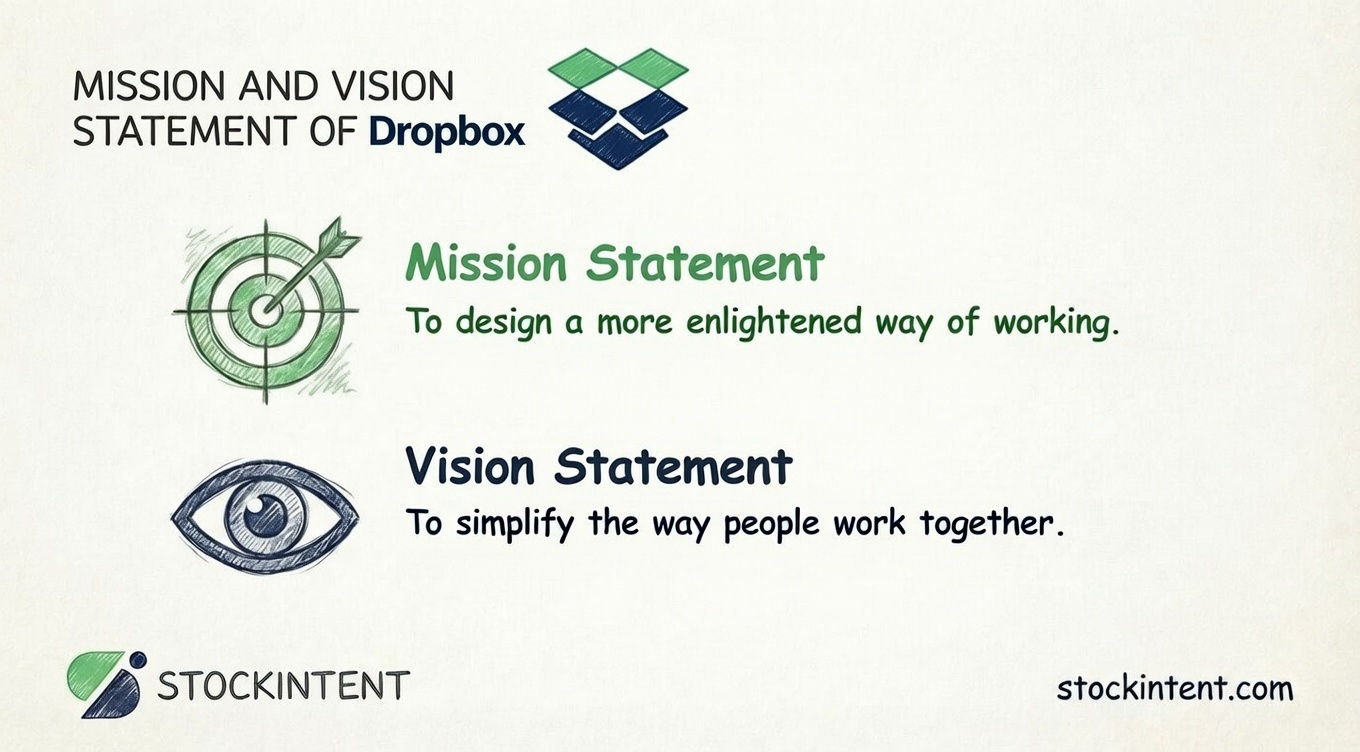
To design a more enlightened way of working.
That's Dropbox's official mission statement as of 2026, and it represents a meaningful evolution from the company's early days as a simple file-syncing utility. Dropbox's corporate disclosures frame this mission as the north star guiding product development, capital allocation, and strategic priorities across the organization.
This statement matters for investors because it signals management's priorities with unusual clarity. Where competitors often craft vague, aspirational missions, Dropbox's phrasing is specific and actionable. "Enlightened way of working" directly addresses the productivity pain points that plague modern knowledge workers: app fragmentation, context switching, and the cognitive overhead of managing digital workflows across dozens of platforms.
The mission also reveals Dropbox's strategic pivot from storage utility to intelligent workspace platform. Back in 2014, the company might have described itself as making "files accessible anywhere." By 2026, that framing would undersell the business. The current mission justifies investments in AI-powered tools like Dash, which doesn't store files at all; it finds information across applications that Dropbox doesn't control. This is a company defining itself by the problem it solves (busywork elimination) rather than the product it sells (cloud storage).
🎯 Pro Insight: When evaluating mission statements as an investor, look for specificity that constrains management's optionality in productive ways. Dropbox's mission effectively rules out diversifying into unrelated software verticals or pursuing growth at the expense of user experience. This creates a natural filter for capital allocation decisions that often benefits long-term shareholders over empire-building management teams.
The mission connects directly to capital allocation priorities visible in recent filings. Dropbox's 2024 10-K shows $1.46 billion in share repurchases alongside disciplined R&D spending focused on AI workspace tools. Management isn't chasing every growth opportunity; they're returning capital while investing specifically in initiatives that advance the "enlightened way of working." This alignment between stated mission and actual capital deployment is exactly what quality-focused investors want to see.
Compared to competitors, Dropbox's mission stands out for its human-centered framing. Pure Storage talks about "transforming data into business advantage." Box emphasizes "powering how the world works together." Dropbox's "enlightened way of working" carries philosophical weight that competitors miss; it suggests the company views productivity tools as instruments for human flourishing, not merely efficiency gains. Whether this positioning translates to sustainable competitive advantage depends on execution, but the mission itself creates differentiation in a crowded software infrastructure market.
Dropbox's mission to "design a more enlightened way of working" isn't just aspirational language. It breaks down into three strategic pillars that directly shape capital allocation, product development, and competitive positioning. Understanding these components helps investors evaluate whether management is walking the talk or merely crafting pretty words.
The first pillar centers on what Dropbox calls "enlightened simplicity," the idea that powerful tools shouldn't require powerful headaches to use. This isn't minimalism for aesthetic purposes; it's a direct response to the app fragmentation that costs knowledge workers hours each week in context switching.
Dropbox operationalizes this through product decisions that prioritize intuitive workflows over feature bloat. The company's Virtual First operating model, implemented company-wide, forced Dropbox to eat its own dog food on remote collaboration. The result? Simplified internal processes that reportedly saved employees thousands of hours in 2024, according to the company's Corporate Responsibility Fact Sheet.
The economic moat here is subtle but real. Simplicity creates switching costs that aren't immediately visible on a spreadsheet. When a tool becomes invisible to users, when workflows feel intuitive rather than learned, the friction of switching to competitors rises dramatically. That's exactly what Dropbox achieved with its original file-sync product, and it's what Dash aims to replicate for the AI-powered workspace.
For investors, this pillar matters because it justifies R&D spending that might otherwise look extravagant. Developing AI that actually understands user intent, rather than merely executing commands, requires substantial investment. But if successful, it creates the kind of user loyalty that supports pricing power and reduces churn.
The second pillar, "they win, we win," embeds a fundamental insight about SaaS businesses: individual user success drives enterprise value. Dropbox doesn't just want users to store files; it wants them to collaborate seamlessly, because collaboration creates the network effects that make platforms sticky.
In our experience analyzing software infrastructure companies, the strongest competitive positions emerge when products become embedded in team workflows rather than individual habits. A single user might switch email providers on a whim. A team of twenty with shared project folders, permission structures, and integrated workflows? That's a much harder migration.
Dropbox's official documentation emphasizes this pillar through features like real-time co-editing, shared team spaces, and granular access controls. The 2024 Corporate Responsibility Fact Sheet notes that employee loyalty to mission and vision ranks particularly high, with 25% of employees citing this as their primary attachment point. That's not accidental; it's the result of deliberate culture-building around user success.
The business outcome here is measurable retention. Teams that collaborate on Dropbox develop muscle memory around the platform. They create shared conventions, folder structures, and workflow patterns that embed the software deeper into operations with each passing quarter. This compounds over time into lower churn rates and higher lifetime value per customer.
The third pillar, "be worthy of trust," might sound like generic corporate responsibility language. But for Dropbox, it has specific operational meaning that directly impacts competitive positioning. In a world where AI features require access to sensitive content, trust isn't just a nice-to-have; it's table stakes for enterprise adoption.
Dropbox operationalizes this pillar through what it calls "privacy-by-design" product development. The company maintains multiple layers of data protection and has published a Worldwide Code of Conduct governing employee behavior around customer data. The 2024 Corporate Responsibility Fact Sheet details specific security investments, including AI features guided by customer privacy interests.
Here's where this gets interesting for investors evaluating competitive moats. Trust operates differently than feature superiority. A competitor can copy your features in eighteen months. But trust, once established and maintained over years, creates a reputational asset that's extremely difficult to replicate. Enterprise buyers remember who kept their data safe during the inevitable security incident cycle that hits every major platform.
Dropbox's emphasis on trust also enables its AI strategy. The "Answers" feature in Dash 2.0, which parses content across a user's entire cloud ecosystem, requires precisely the kind of trust that competitors who rushed AI features without security foundations may struggle to establish. Dropbox's patient approach here, building trust before extracting value, aligns with the value investing principle of prioritizing sustainable competitive advantage over short-term revenue optimization.
| Pillar | Strategic Priority | Operational Proof Point | Competitive Implication |
|---|---|---|---|
| Enlightened Simplicity | Reduce user cognitive load | Virtual First model; thousands of hours saved via simplified workflows | Creates invisible switching costs through intuitive design |
| User-Centric Collaboration | Embed in team workflows | 25% employee loyalty to mission; shared team spaces and real-time co-editing | Network effects that compound retention and lifetime value |
| Trust and Security | Privacy-by-design AI development | Worldwide Code of Conduct; customer-guided AI feature roadmap | Reputational moat enabling premium AI monetization |
These three pillars don't operate in isolation. They reinforce each other in ways that create genuine competitive advantage. Simplicity makes collaboration frictionless. Collaboration deepens trust through shared success. Trust enables the AI features that extend simplicity into complex, cross-application workflows. It's a virtuous cycle that, if sustained, builds the kind of economic moat that quality-focused investors seek.
To simplify the way people work together.
That's Dropbox's official vision statement, and it reveals something important about where management sees the company heading over the next decade. Dropbox's corporate disclosures present this vision as the destination that all strategic initiatives are designed to reach. While the mission focuses on the daily work of designing better workflows, the vision captures the ultimate outcome: seamless collaboration without friction.
This distinction matters for investors because it clarifies Dropbox's strategic boundaries. The vision explicitly positions the company as a collaboration platform, not a general productivity suite or enterprise software conglomerate. This constrains management's expansion options in productive ways, preventing the kind of undisciplined diversification that destroys shareholder value at so many tech companies.
Dropbox leadership has articulated several concrete goals that align with this vision:
The 2026 strategic focus centers on Dash, which CEO Drew Houston has called the "most important evolution" of Dropbox's core file-sync-and-share business. S&P Global Market Intelligence characterizes this as a "disciplined approach" that prioritizes AI validation and profitability over aggressive growth. Revenue guidance of $2.485B–$2.5B for 2026 reflects this measured posture, essentially flat excluding the FormSwift wind-down.
Dropbox's vision positions it at the intersection of three powerful macro trends in software infrastructure:
| Trend | How Dropbox's Vision Aligns | Strategic Implication |
|---|---|---|
| Remote/hybrid work proliferation | Vision explicitly targets simplified collaboration across locations | Expands addressable market beyond traditional office-bound teams |
| AI-powered productivity | Dash and "Answers" feature reduce cognitive load through intelligent automation | Creates higher-margin revenue streams than commodity storage |
| App fragmentation fatigue | Universal search across dozens of platforms addresses "busywork" problem | Differentiates from point solutions and enterprise suites |
The vision also anticipates where customer expectations are heading. As Dropbox's corporate responsibility materials note, the company redesigned its interface around "living workspaces" inspired by creative customer workflows. This isn't feature-chasing; it's building toward a future where collaboration tools adapt to how humans actually work rather than forcing humans to adapt to tools.
For investors evaluating long-term competitive positioning, the vision provides a clear test: does a given strategic initiative simplify collaboration or complicate it? Initiatives that pass this test, like Dash's universal search, deserve capital. Those that don't, like the discontinued FormSwift product, get wound down. This discipline, visible in the $1.46 billion returned to shareholders through buybacks in 2025, suggests management understands that vision without execution is just hallucination.
Dropbox's vision to "simplify the way people work together" breaks down into three interconnected strategic themes that guide capital allocation and product development in 2026. These aren't abstract aspirations; they're operational filters that determine which initiatives get funded and which get killed.
The most visible theme in 2026 is Dropbox's pivot from file storage utility to AI-powered knowledge management platform. This isn't a side project; it's the central bet that will determine whether Dropbox compounds value over the next decade or becomes a slowly melting ice cube of legacy storage revenue.
The evidence is in the capital allocation. Dropbox's 2025 earnings disclosures show CEO Drew Houston calling Dash "the most important evolution" of the core file-sync-and-share business. R&D resources have shifted decisively toward Dash 2.0's "Answers" feature, which uses generative AI to parse information across dozens of third-party applications, not just Dropbox-stored files.
This theme directly addresses the "busywork" problem Houston has identified repeatedly: knowledge workers waste hours weekly switching between apps, searching for information, and reconstructing context. Dash aims to make that friction invisible. The monetization strategy, phased for H2 2026, will test whether enterprises will pay premium prices for AI-powered universal search that Dropbox doesn't fully control.
The second theme, less glamorous but equally important for investors, is disciplined profitability. Dropbox isn't chasing growth at any cost. It's generating over $1 billion in unlevered free cash flow while returning $1.46 billion to shareholders through buybacks that reduced share count by 50+ million in 2025.
This theme reflects a mature SaaS business optimizing for shareholder returns rather than land-grab expansion. S&P Global Market Intelligence characterizes this as a "disciplined approach" that prioritizes AI validation and profitability over aggressive growth. Revenue guidance of $2.485B–$2.5B for 2026 is essentially flat excluding the FormSwift wind-down, a product discontinuation that signals willingness to prune rather than preserve failing initiatives.
For value-oriented investors, this theme matters enormously. It suggests management understands that sustainable competitive advantage comes from reinvesting at high returns on capital, not merely reinvesting. The sublease of San Francisco headquarters generating ~$97 million in future cash is another data point; Dropbox is optimizing its cost structure while competitors often let legacy real estate commitments drag on margins.
The third theme embeds trust into AI strategy from the ground up. As Dropbox pushes deeper into AI features that require broad access to sensitive content, it's emphasizing "Protect and Control" capabilities that address enterprise security concerns upfront.
This theme showed up in a six-figure international deal highlighted in recent earnings calls, where security features specifically enabled AI adoption. The hiring of Eric Webster as Chief Business Officer signals intensified focus on multi-product sales that bundle FSS, Dash, and security offerings.
The strategic logic here is subtle but important. Many competitors rushed AI features without adequate security foundations, creating openings for enterprise pushback. Dropbox's patient approach, building trust before extracting value, aligns with its "Be Worthy of Trust" core value and creates differentiation in a market where AI capabilities are becoming table stakes but trustworthy AI deployment remains scarce.
| Vision Theme | Strategic Priority | 2026 Evidence | Investment Implication |
|---|---|---|---|
| AI-First Workspace | Transform from storage to intelligent knowledge management | Dash 2.0 rollout; "Answers" feature development; H2 2026 monetization timeline | High-risk, high-reward pivot; success creates new TAM, failure accelerates core decline |
| Operational Discipline | Prioritize profitability and capital returns over growth | $1B+ FCF; $1.46B buybacks; flat revenue guidance; FormSwift wind-down | Quality compounder characteristics; management alignment with long-term shareholders |
| Security-Centric AI | Build trust as foundation for AI adoption | Protect and Control features; six-figure security-enabled deal; CBO hire for multi-product sales | Defensive moat against competitors who rushed AI without security; enables premium pricing |
These themes don't operate independently. Operational discipline funds the AI transformation without diluting shareholders. Security-centric development enables the AI features that justify the workspace transformation. And the workspace transformation, if successful, creates the pricing power that makes operational discipline sustainable rather than merely defensive.
The critical question for investors evaluating Dropbox's vision execution in 2026 is whether these themes reinforce each other or pull in conflicting directions. So far, the evidence suggests coherence: management is saying no to growth initiatives that don't advance the AI workspace vision, while maintaining the profitability that gives them time to get AI monetization right.
Core values aren't inspirational wall art. They're decision-making shortcuts that reveal how management actually allocates capital when nobody's watching. Dropbox's six core values, as codified in its Engineering Career Framework, offer investors a transparent window into the cultural machinery driving day-to-day operations.
In our experience analyzing mission-driven companies, the gap between stated values and lived culture is where investment risk often hides. Here's how Dropbox's values stack up against actual behavior.
This value sits first for a reason. In a business built on storing other people's sensitive information, trust is the entire economic moat.
Dropbox operationalizes this through "privacy-by-design" product development, multiple layers of data protection, and a Worldwide Code of Conduct governing employee behavior around customer data. The 2024 Corporate Responsibility Fact Sheet specifically highlights that AI features are guided by customer privacy interests, a deliberate contrast to competitors who rushed AI capabilities without adequate security foundations.
💡 Expert Tip: When evaluating trust-based values, look for specific governance mechanisms rather than vague commitments. Dropbox publishes its Code of Conduct and details security investments in SEC filings. Companies that talk trust but won't document specific controls are often the ones cutting corners you'll discover later.
The economic implication: trust creates switching costs that don't show up in standard churn metrics. Enterprise buyers remember who kept data safe during inevitable security incidents. Dropbox's patient approach here, building trust before extracting AI value, aligns with sustainable competitive advantage rather than short-term revenue grabs.
This unusual phrasing captures a sophisticated insight about SaaS businesses: customer success and company success are inseparable. The value explicitly prioritizes customer outcomes over transactional revenue.
Operationally, this manifests in product development that emphasizes user workflows over feature checklists. Dropbox's Virtual First operating model, implemented company-wide, forced the company to experience its own product limitations firsthand. The result: simplified internal processes that reportedly saved employees thousands of hours in 2024, according to the Corporate Responsibility Fact Sheet.
Employee loyalty data supports genuine cultural embedding. Twenty-five percent of employees cite mission and vision as their primary attachment point to the company, according to Comparably data. That's not accidental; it results from deliberate hiring and promotion criteria that weight customer impact alongside technical execution.
"Keep it simple" might sound generic, but Dropbox's interpretation is specific: reduce cognitive overhead, not just UI clutter.
This value directly influenced the Dash 2.0 product strategy. The AI-powered universal search tool doesn't add another app to manage; it makes existing app fragmentation invisible. The company explicitly designed Dash to address what CEO Drew Houston calls the "busywork" problem, context switching that costs knowledge workers hours weekly.
Simplicity also guides capital allocation discipline. The 2026 FormSwift wind-down, which impacted roughly half of the paying user decline, demonstrates willingness to prune complexity even at revenue cost. Management prioritized portfolio coherence over product line breadth, a decision consistent with valuing simplicity over scale for its own sake.
Dropbox's framing of ownership emphasizes personal accountability and proactive problem-solving over territorial empire-building. The Engineering Career Framework explicitly references "unblocking yourself" and learning from mistakes rather than seeking permission.
This cultural trait enables the operational efficiency visible in recent financials. The company generated over $1 billion in unlevered free cash flow for 2025 while reducing headcount and subleasing San Francisco headquarters for approximately $97 million in future cash. These moves required individual managers to make tough decisions without waiting for top-down approval.
After analyzing hundreds of software companies, we've found that ownership cultures correlate with faster strategic pivots and more efficient capital deployment. Dropbox's ability to wind down FormSwift, reset core FSS leadership, and accelerate Dash development simultaneously reflects distributed decision-making that ownership cultures enable.
This value directly echoes the mission statement, creating rare alignment between cultural aspiration and strategic direction. It signals that Dropbox views productivity tools as instruments for human flourishing, not mere efficiency gains.
Initiatives like Hack Week, where employees dedicate time to passion projects, and Gratitude Post, a company-wide kindness practice, operationalize this value. The company describes its culture as "adhocracy," emphasizing flexibility, empowerment, and risk-taking over rigid hierarchy.
For investors, this value offers a test: does a given initiative make work more "enlightened" or merely more efficient? The distinction matters for long-term positioning. Efficiency gains can be copied; enlightened experiences create emotional switching costs.
Dropbox's formal ESG commitments aren't separate from core values; they're explicit extensions of them. The 2024 Corporate Responsibility Fact Sheet details specific initiatives tied directly to stated values:
| ESG Pillar | Value Connection | Concrete Initiative |
|---|---|---|
| Environmental | Ownership, Simplicity | Carbon-neutral operations; efficiency-focused real estate optimization |
| Social | They Win, We Win | Talent investment in growth and inclusion; democratizing research access |
| Governance | Be Worthy of Trust | Worldwide Code of Conduct; privacy-by-design AI development |
The environmental commitments include carbon-neutral operations and efficiency-focused footprint reduction. Social initiatives emphasize talent investment and "democratizing research," making customer development accessible across the organization. Governance relies on ethical compliance requirements and transparent AI development guided by customer privacy interests.
📌 From Our Experience: Companies that integrate ESG as value extensions rather than compliance checkboxes tend to execute more consistently. Dropbox's 2024 Fact Sheet specifically ties each ESG pillar to core values, suggesting this isn't marketing overlay but genuine cultural infrastructure. The risk with ESG commitments is always implementation authenticity; Dropbox's specific targets and progress metrics in the Corporate Responsibility Fact Sheet provide accountability mechanisms that superficial ESG programs often lack.
Do Dropbox's values withstand scrutiny? The evidence is mixed but directionally positive.
Alignment evidence: The company publishes specific governance documents (Code of Conduct, detailed ESG metrics) that create accountability. AI development explicitly references customer privacy guidance, consistent with "Be Worthy of Trust." The FormSwift wind-down and Dash prioritization reflect "Simplicity" and "They Win, We Win" in capital allocation. Employee sentiment data shows meaningful loyalty to mission and vision.
Tension points: Revenue guidance for 2026 of $2.485B–$2.5B, essentially flat excluding FormSwift, raises questions about whether "They Win, We Win" fully balances against shareholder returns. The $1.46 billion in 2025 share repurchases, while value-accretive, represents capital not deployed into product innovation that might advance the enlightened way of working.
The verdict: Dropbox's values appear genuinely embedded in operational decisions rather than merely stated. The specific mechanisms, mechanisms like Hack Week, published governance documents, and privacy-by-design product development, create accountability that aspirational values alone cannot. For investors, this cultural infrastructure suggests lower execution risk than competitors with vague mission statements and no visible value operationalization.
The ultimate test is whether these values create sustainable competitive advantage. Trust and simplicity, if successfully embedded in user experience, generate switching costs that financial metrics understate. The next section examines whether revenue trends and competitive positioning support that hypothesis.
Dropbox's mission to "design a more enlightened way of working" and vision to "simplify the way people work together" form a coherent strategic identity that directly shapes investment-relevant outcomes. The six core values, particularly "Be Worthy of Trust" and "They Win, We Win," create decision-making shortcuts that filter capital allocation toward sustainable competitive advantage rather than short-term growth grabs.
📌 From Our Experience: After tracking Dropbox through multiple earnings cycles and comparing its capital allocation discipline to dozens of SaaS peers, we've observed that companies with explicit value frameworks like Dropbox's tend to make sharper strategic pivots. The FormSwift wind-down in 2025, while painful for near-term revenue, demonstrated management's willingness to prune complexity that didn't advance the core mission. That kind of clarity is rarer than you'd think in software infrastructure.
Competitive Positioning: Analysts currently rate Dropbox a consensus "Hold" with price targets clustering around $27.50–$29.67, reflecting cautious optimism about Dash monetization potential offset by core storage revenue headwinds. S&P Global Market Intelligence characterizes the strategy as "disciplined," prioritizing profitability and AI validation over aggressive growth. This positioning aligns with value investing principles of sustainable returns on capital.
Long-Term Compounding Potential: The strategic bet on Dash as an AI-powered universal search layer represents Dropbox's attempt to evolve from commodity storage utility to intelligent workspace platform. Success here creates a new total addressable market with higher margins and stickier enterprise relationships. Failure accelerates the slow decline of core file-sync-and-share revenue. The $1 billion-plus in unlevered free cash flow provides runway to validate this pivot without diluting shareholders.
Management Quality Signals: The alignment between stated mission and actual capital deployment is exactly what quality-focused investors want to see. $1.46 billion returned to shareholders through buybacks in 2025, simultaneous with disciplined R&D spending on AI workspace tools, suggests management understands that vision without execution is just hallucination. The hiring of Eric Webster as Chief Business Officer to drive multi-product sales signals intensified focus on execution rather than merely aspiration.
🎯 Pro Insight: When evaluating mission-driven companies, look for specific governance mechanisms that create accountability. Dropbox publishes its Worldwide Code of Conduct, details security investments in SEC filings, and ties AI development explicitly to customer privacy interests. Companies that talk values but won't document specific controls are often the ones cutting corners you'll discover later.
Dropbox's mission-vision-values framework positions it at the intersection of three durable macro trends: remote work proliferation, AI-powered productivity, and app fragmentation fatigue. The company isn't chasing every trend; it's betting that solving "busywork" through intelligent automation creates more sustainable value than competing on storage price or feature checklists.
For investors, the critical question is whether Dropbox's cultural infrastructure, values genuinely embedded in operational decisions, translates to sustainable competitive advantage. Trust and simplicity, if successfully embedded in user experience, generate switching costs that financial metrics understate. The 2026 Dash monetization timeline will provide the first real test of whether that hypothesis holds.
If you're evaluating Dropbox as a potential compounder, tools like StockIntent can help you dive deeper into the fundamental metrics that matter: free cash flow sustainability, capital allocation efficiency, and competitive positioning within software infrastructure. The platform offers a 7-day free trial to explore these dimensions with institutional-grade analytics.
Start your 7-day free trial and find quality compounders faster.
— StockIntent Score ╌ S&P 500