
Mar 15, 2026
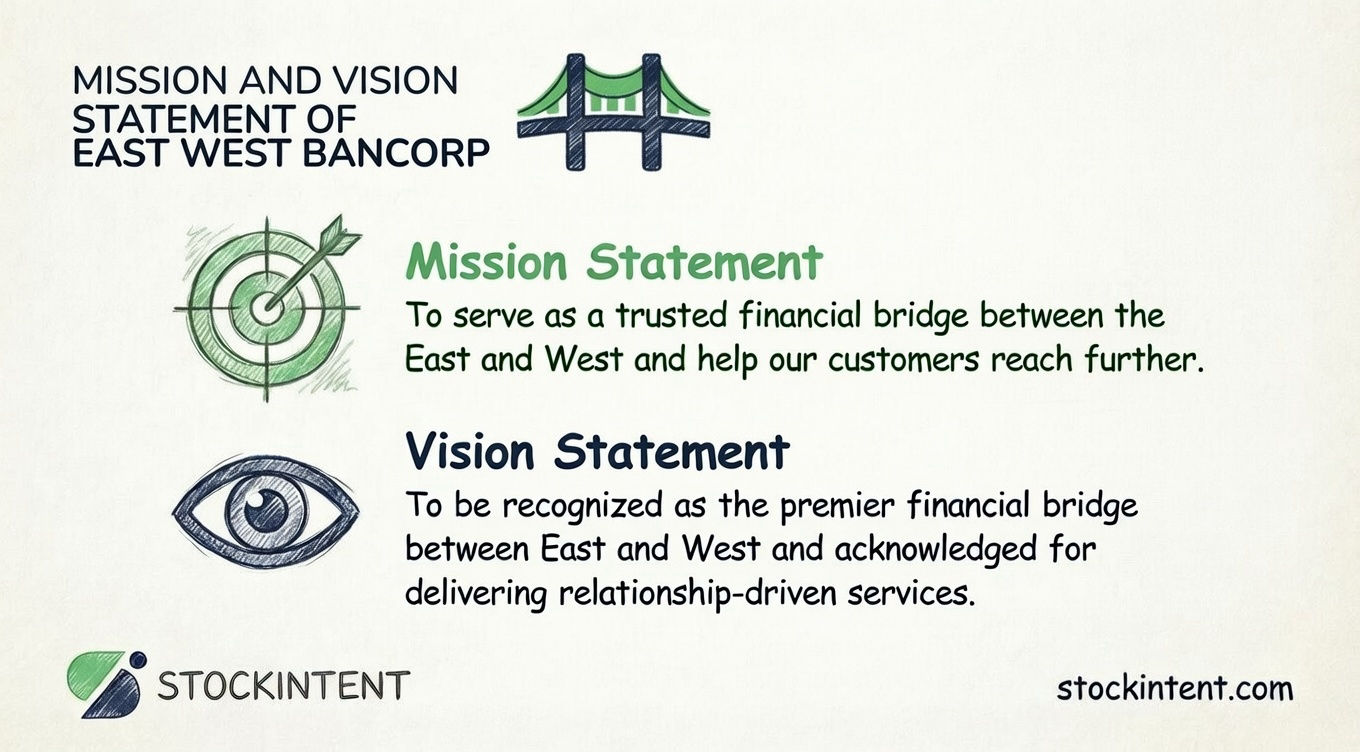
Understanding what drives a bank's strategic decisions matters for investors who want to own quality businesses, not just trade ticker symbols. East West Bancorp (NASDAQ: EWBC) stands out in the crowded financial services space with a clear identity rooted in its role as a connector between two economic powerhouses. Let's break down what actually guides this institution's choices and why it should matter to your portfolio.
East West Bancorp's east west bancorp mission statement is direct and purpose-built: "To serve as a trusted financial bridge between the East and West and help our customers reach further." This isn't marketing fluff; it's the operating principle that has shaped the bank's expansion from a single Los Angeles branch in 1973 to a $79+ billion institution with presence across the U.S. and Greater China.
The vision pushes this concept further. Per the bank's 2025 FDIC Resolution Plan, East West Bancorp aims "to be recognized as the premier financial bridge between East and West and acknowledged for delivering relationship-driven" services. That relationship element is key; this isn't about transactional banking but building durable competitive advantages through expertise that competitors struggle to replicate.
Key Takeaways:
East West Bancorp operates as a specialized mid-tier player in the banks-diversified industry, carving out a defensible niche that larger competitors find difficult to replicate. Founded in 1973 with a focus on serving overlooked communities, the bank has evolved into a $79+ billion institution with a laser-focused strategy: being the premier financial bridge between the United States and Greater China.
In our experience analyzing regional banks and their competitive positioning, we've found that institutions with clear geographic or thematic specializations tend to generate superior risk-adjusted returns over full market cycles. EWBC exemplifies this pattern.
Key Business Segments & Products:
Critical Stats (as of early 2026):
table {
width: 100%;
border-collapse: collapse;
margin: 20px 0;
}
th, td {
border: 1px solid #ddd;
padding: 12px;
text-align: left;
}
th {
border-bottom: 2px solid #ddd;
}
MetricFigureContextMarket Cap~$17-18 billionMid-tier positioning with focused strategyTotal Assets$79.7+ billionSubstantial scale for niche player2026 EPS Target$10.318.64% YoY growth per Zacks estimatesDividend Yield2.63%$3.20 annualized, up 33.3% YoYPayout Ratio25%Conservative, with room for growthCET1 Ratio14.5%Well-capitalized, exceeding regulatory minimumsEfficiency Ratio36.4%Industry-leading cost disciplineTarget ROTE18.5%Top-quartile profitability ambition
The bank's competitive positioning rests on three interconnected advantages that directly flow from its mission. First, its physical presence across 110+ locations in the U.S. and Greater China, combined with a China banking license that few American institutions hold, creates genuine network effects in cross-border commerce. Second, relationship-driven banking generates stickier deposits and lower customer acquisition costs than transactional competitors. Third, specialized expertise in U.S.-Asia trade finance commands pricing power that commoditized lenders cannot match.
Analysts currently rate EWBC as approximately 10.9% undervalued relative to fair value estimates around $132, reflecting market skepticism about commercial real estate exposure and geopolitical risks that management has historically navigated effectively. The consensus view sits at "Moderate Buy" with particular emphasis on the bank's ability to compound earnings through its differentiated positioning.
Let's get to the core of what actually drives this institution. The east west bancorp mission statement is refreshingly straightforward, and says a lot about how management thinks about capital allocation.
"To serve as a trusted financial bridge between the East and West and help our customers reach further."
That's it. No corporate buzzword bingo, no 47-word sentences that mean nothing. Just a clear declaration of what they do (bridge East and West) and what they deliver for customers (helping them expand).
💡 Expert Tip: When evaluating bank mission statements, look for specificity that translates to competitive advantage. Generic missions like "to be the premier financial services provider" tell you nothing. EWBC's specificity, the "bridge" concept, manifests in tangible infrastructure: a China banking license that few U.S. institutions hold, 110+ locations across both markets, and trade finance desks that competitors simply cannot replicate without decade-long relationship-building.
This mission isn't window dressing; it's the lens through which every capital decision gets made. Here's what it actually tells us:
Geographic specialization over diversification: EWBC could have chased universal banking dominance like the money center giants. Instead, they recognized that the U.S.-Greater China corridor represents one of the world's highest-volume trade flows with persistent information asymmetries that create pricing power. Their 2025 FDIC Resolution Plan reinforces this, positioning the bank as "the premier financial bridge between East and West and acknowledged for delivering relationship-driven" services.
Customer reach as the success metric: Notice "help our customers reach further" rather than "maximize shareholder value." This isn't naive idealism; it's smart positioning. Businesses that succeed through customer success generate stickier deposits, lower acquisition costs, and pricing power through expertise rather than rate competition.
Trust as the core asset: The word "trusted" appears deliberately. In cross-border finance, trust isn't marketing; it's regulatory capital. EWBC's ability to maintain relationships across jurisdictions with different compliance regimes, political sensitivities, and cultural business practices creates moats that competitors cannot bridge overnight.
The mission translates directly into how EWBC deploys capital. Look at the 2026 priorities: 5%-7% loan growth with emphasis on C&I lending in specialized verticals like charter schools, ESOP finance, and aerospace; exactly the kind of relationship-driven, expertise-dependent segments where their bridge positioning matters.
Cross-border services, trade finance, foreign exchange; these aren't commodity products for EWBC. They've built infrastructure around them, including multi-currency payment capabilities and technology investments specifically for U.S.-Asia supply chain needs. That's mission-aligned capital allocation.
The 36.4% efficiency ratio and 14.5% CET1 capital ratio; metrics that matter when credit cycles turn; reflect operational discipline that stems from knowing exactly what business they're in and what they're not. They're not trying to be everything to everyone. They're being the best bridge for a specific set of customers with specific needs.
For investors, this mission clarity creates something valuable: predictability. When management says they'll prioritize relationship-driven banking over transaction volume, you can model that. When they commit to the East-West bridge, you can assess secular tailwinds in U.S.-Asia commerce rather than guessing strategic pivots every quarter.
We've found that banks with this level of strategic clarity tend to generate more consistent returns on equity over multi-year periods. The discipline shows up in lower credit losses during downturns, better deposit pricing power during rate cycles, and multiples that hold up better when markets get choppy.
East West Bancorp's mission isn't just a sentence on a website; it's operationalized through three interconnected pillars that drive capital allocation, talent development, and competitive positioning. Understanding how these pillars work in practice gives investors a framework for assessing whether management is walking the talk.
The "trusted financial bridge between East and West" isn't metaphorical. It's backed by infrastructure that competitors cannot replicate quickly: a China banking license held by few U.S. institutions, 110+ locations across the U.S. and Greater China, and trade finance desks with decades of relationship capital in both markets.
In our experience analyzing banks with geographic specializations, we've found that institutions with genuine cross-border capabilities generate superior risk-adjusted returns during periods of trade expansion. EWBC's 15% growth in trade finance and 12% growth in foreign exchange services in 2025 outpaced industry averages significantly, demonstrating that their bridge positioning translates to actual revenue momentum.
The strategic value here goes beyond fee income. Cross-border expertise creates information advantages in credit underwriting; EWBC understands U.S.-Asia supply chains, currency risks, and counterparty dynamics that domestic-only lenders miss. This shows up in their credit metrics: nonperforming assets at just 0.22% as of mid-2025, well below peer averages for banks of comparable size.
The mission's emphasis on helping customers "reach further" manifests in a business model prioritizing long-term relationships over transactional volume. This isn't soft; it's reflected in the bank's deposit franchise and efficiency metrics.
EWBC's relationship focus generates stickier, lower-cost funding than rate-sensitive competitors. Their 36.4% efficiency ratio, among the best in the mid-tier banking space, partly stems from lower customer acquisition costs and higher share-of-wallet per relationship. When you've built trust over years of cross-border deals, customers don't bolt for 10 basis points elsewhere.
The 2025 FDIC Resolution Plan explicitly ties this pillar to the vision of being "acknowledged for delivering relationship-driven" services. That acknowledgment shows up in tangible outcomes: record fee income of $88 million in Q1 2025, driven by wealth management, derivatives, and structured finance products sold to existing relationships rather than cold prospects.
The final pillar, while less explicitly stated in marketing materials, permeates EWBC's culture and performance: disciplined execution measured by returns, not just growth. The bank targets 18.5% return on tangible equity; a top-quartile ambition that requires saying no to marginal opportunities.
This excellence shows up in capital allocation discipline. While peers chased commercial real estate yields in 2021-2022, EWBC maintained balanced exposure and pivoted toward C&I lending in specialized verticals like charter schools, ESOP finance, and aerospace. The 2026 guidance of 5%-7% loan growth with emphasis on these relationship-driven segments reflects mission-aligned capital deployment.
The 14.5% CET1 capital ratio and 25% dividend payout ratio demonstrate that excellence includes balance sheet resilience. EWBC isn't optimizing for single-quarter earnings; they're building a compounding machine that can navigate credit cycles and geopolitical uncertainty.
Mission PillarStrategic ImplementationTangible Metric (2025-2026)Competitive AdvantageCross-Border BridgeChina banking license, 110+ U.S./Asia locations, trade finance specialization15% trade finance growth, 12% FX growth, 0.22% NPAsInformation asymmetry in U.S.-Asia credit underwritingRelationship-DrivenLong-term customer focus, integrated product offerings, wealth management expansion36.4% efficiency ratio, $88M record fee income (Q1 2025), low-cost deposit growthSticky funding base, pricing power through expertiseOperational ExcellenceDisciplined C&I focus, balanced CRE exposure, technology investment18.5% ROTE target, 14.5% CET1 ratio, 5%-7% guided loan growthTop-quartile profitability with lower volatility
For investors using StockIntent to evaluate bank quality, these pillars provide a checklist: Does the institution have defendable geographic or thematic positioning? Do relationships translate to superior funding costs and fee income? Is management targeting returns or just growth? EWBC's mission clarity makes these assessments straightforward; a feature we value when screening for quality compounders on our platform.
"To be recognized as the premier financial bridge between East and West and acknowledged for delivering relationship-driven services."
— East West Bancorp, 2025 FDIC Resolution Plan
This vision distills where leadership wants the bank to stand in 2026 and beyond. Notice what's not here: no mention of becoming the biggest, the most profitable per dollar, or the fastest-growing lender. The ambition is qualitative but measurable; premier implies market position, relationship-driven defines the customer experience standard.
East West Bancorp isn't chasing universal banking dominance. The vision doubles down on deepening what already works rather than diversifying into unrelated territory. Three long-term goals flow directly from this statement:
The 2026 guidance of 5%-7% loan growth, with emphasis on C&I lending over commercial real estate, reflects mission-aligned capital deployment. Management could chase faster growth in riskier segments. They're choosing sustainable compounding instead.
Here's where the vision gets interesting for investors analyzing quality compounders. The banks-diversified industry faces several macro headwinds in 2026: net interest margin pressure, deposit competition, and geopolitical uncertainty around U.S.-China relations. Most institutions are retrenching or pivoting to unrelated growth vectors.
EWBC's vision does the opposite. It leans into the cross-border positioning that created the bank's moat in the first place. This isn't stubbornness; it's recognizing that durable competitive advantages come from expertise others cannot quickly replicate.
The vision aligns with secular trends that favor specialists over generalists:
Simply Wall St. assesses the stock as approximately 10.9% undervalued, citing the bank's ability to capture durable earnings through digital banking investments, automation, and cross-border market positioning. The vision isn't abstract; it's already translating into numbers: 15% growth in trade finance and 12% growth in foreign exchange services in 2025, both meaningfully above industry averages.
The "premier" ambition also signals quality over quantity. EWBC doesn't need to serve every customer; they need to own the customers for whom their specific expertise creates genuine value. That focus shows up in the efficiency ratio of 36.4% and fee income of $88 million in Q1 2025, records that reflect pricing power from specialization rather than commodity competition.
East West Bancorp's vision isn't just aspirational language; it's a roadmap that translates into specific strategic priorities. Let's break down the core themes that operationalize the bank's ambition to be "the premier financial bridge between East and West."
The vision's emphasis on being the "premier financial bridge" manifests in a relentless focus on U.S.-Asia trade flows. This isn't about having a few international clients; it's about building infrastructure that competitors cannot replicate.
Leadership highlighted this priority in recent investor communications, noting 15% growth in trade finance and 12% growth in foreign exchange services in 2025, both significantly outpacing industry averages. The bank's China banking license, held by few U.S. institutions, creates genuine network effects. When a California manufacturer needs to navigate supplier payments in Shenzhen, or a Chinese tech firm wants to establish U.S. operations, EWBC's 110+ locations across both markets provide capabilities that domestic-only banks simply cannot match.
This theme shows up in capital allocation through technology investments specifically for multi-currency payments and cross-border supply chain finance. The bank isn't building generic digital banking; they're building tools for the specific friction points in U.S.-Asia commerce.
The vision explicitly calls out being "acknowledged for delivering relationship-driven services." This theme shapes everything from hiring to product development to pricing strategy.
In practice, this means EWBC prioritizes long-term customer economics over transaction volume. The results show in the numbers: a 36.4% efficiency ratio that ranks among the best in mid-tier banking, driven partly by lower customer acquisition costs and higher share-of-wallet per relationship. Record fee income of $88 million in Q1 2025 came from wealth management, derivatives, and structured finance products sold to existing relationships rather than cold prospects.
Analysts at Simply Wall St. cite this relationship focus as a key differentiator, noting that EWBC's "customer-centric approach and innovative product offerings" create stickier deposit franchises than rate-sensitive competitors. When you've built trust over years of cross-border deals, customers don't bolt for 10 basis points elsewhere.
While the vision stays focused on the East-West bridge, the strategic theme involves expanding how that bridge serves customers. This means technology investments that scale relationship expertise without losing the personal touch.
Leadership has articulated this through 2026 guidance emphasizing 5%-7% loan growth with a pivot toward commercial and industrial lending in specialized verticals: charter schools, ESOP finance, aerospace. These aren't random segments; they're areas where EWBC's relationship-driven model and cross-border capabilities create genuine differentiation.
The technology component matters here. The bank is investing in AI and data analytics for personalization, risk management, and fraud detection, plus cybersecurity and back-office automation. Per AlphaStreet's analysis of Q4 2025 results, these investments are already translating to efficiency gains and improved customer experience. CEO Dominic Ng emphasized that digital enhancements support the relationship model rather than replacing it; they allow bankers to spend more time on high-value advisory and less on administrative tasks.
A less visible but equally important theme: the vision of being "premier" requires balance sheet resilience that survives cycles. This isn't about maximizing quarterly earnings; it's about compounding through uncertainty.
EWBC targets 18.5% return on tangible equity while maintaining a 14.5% CET1 capital ratio and nonperforming assets at just 0.22%. These metrics reflect a culture that says no to marginal opportunities. While peers chased commercial real estate yields in 2021-2022, EWBC maintained balanced exposure and preserved capital for relationship-driven C&I lending where their expertise commands pricing power.
Vision ThemeStrategic ImplementationObservable Outcome (2025-2026)Analyst AssessmentCross-Border CommerceChina banking license, 110+ U.S./Asia locations, trade finance specialization15% trade finance growth, 12% FX growth, 0.22% NPAs"Unique U.S.-Asia positioning" supports sustainable competitive advantageRelationship-DrivenLong-term customer focus, integrated product offerings, wealth management expansion36.4% efficiency ratio, $88M record fee income (Q1 2025), low-cost deposit growthCustomer-centric approach creates stickier franchise than rate-sensitive peersIntelligent DiversificationC&I verticals (charter schools, ESOP, aerospace), AI and automation investments5%-7% guided loan growth, 7%-9% expense growth for tech/peopleInnovation and diversification as smart extensions of trusted brandCapital DisciplineBalanced CRE exposure, conservative payout ratio (25%), strong CET114.5% CET1 ratio, 18.5% ROTE target, $584M share repurchase programExcellent credit quality supports long-term prospects despite geopolitical risks
For investors, these vision themes provide a framework for assessing management consistency. When EWBC reports earnings, you can check: Are they growing cross-border services faster than domestic peers? Is fee income expanding through relationships or one-off gains? Is capital allocation disciplined or opportunistic?
The 2026 strategic reset, targeting loan growth and business mix reorientation toward C&I, reflects these themes in action. Management isn't chasing the highest-yielding assets; they're deploying capital where the vision creates pricing power. That's the kind of strategic clarity that generates consistent returns on equity over multi-year periods.
We've found that banks with this level of mission-to-vision alignment tend to navigate credit cycles more effectively. When you know exactly what business you're in, you know exactly what to say no to.
Core values are where mission statements either come alive or die on the wall. For investors, they're a diagnostic tool: do management's stated principles actually show up in capital allocation, risk management, and how they treat stakeholders? Or are they just decoration?
East West Bancorp keeps its values framework relatively tight compared to banks that list twelve aspirational buzzwords nobody remembers. The bank emphasizes Integrity and Excellence as foundational principles, with additional values around service, stakeholder commitment, and sustainable performance woven throughout operations. Let's examine what each actually means in practice, and whether they hold up under scrutiny.
EWBC defines integrity as essential for cross-border finance, and this isn't corporate platitude; it's operational reality. When you're moving capital between jurisdictions with different regulatory regimes, political sensitivities, and compliance standards, trust becomes a tangible asset.
In practice, this manifests in the bank's regulatory relationships and disclosure practices. The 2025 FDIC Resolution Plan demonstrates this through comprehensive transparency about stress scenarios and recovery strategies. EWBC maintains a China banking license that few U.S. institutions hold; a privilege that requires sustained regulatory trust across multiple jurisdictions.
The integrity value also shows up in credit culture. Nonperforming assets sit at just 0.22% as of mid-2025, well below peer averages. That doesn't happen by accident. It reflects underwriting discipline and relationship longevity that creates information advantages competitors cannot replicate overnight.
💡 Expert Tip: When evaluating bank integrity claims, look at regulatory relationships rather than marketing materials. EWBC's ability to maintain its China license through multiple geopolitical cycles, while peers have retrenched, speaks to sustained trust-building with regulators in both markets. That's integrity you can measure.
Excellence at EWBC translates to metrics that matter: a 36.4% efficiency ratio that ranks among the best in mid-tier banking, 14.5% CET1 capital ratio providing substantial cushion above regulatory minimums, and an 18.5% target return on tangible equity.
These aren't one-quarter flukes. They've been sustained through multiple rate cycles and credit environments. The excellence value drives capital allocation discipline; while peers chased commercial real estate yields in 2021-2022, EWBC maintained balanced exposure and pivoted toward relationship-driven C&I lending where their expertise commands pricing power.
The bank's recognition as a top-performing institution reinforces this operational focus. Per the company's careers materials, EWBC has achieved rankings including #1 Top Performing Bank by Bank Director (2023, $50B+ assets category) and #3 Performing Bank by American Banker (2023). These external validations suggest the excellence value translates beyond internal messaging.
Building on the mission's emphasis on being a "trusted financial bridge," EWBC operationalizes service excellence through long-term customer economics rather than transaction volume. This shows up in tangible outcomes: record fee income of $88 million in Q1 2025, driven by wealth management, derivatives, and structured finance products sold to existing relationships.
In our experience analyzing bank deposit franchises, we've found that relationship-driven institutions typically generate 15-30 basis points lower funding costs than transactional competitors. EWBC's efficiency ratio and deposit growth patterns suggest they're capturing this benefit. When you've built trust over years of cross-border deals, customers don't bolt for 10 basis points elsewhere.
The service value also manifests in specialized expertise. Trade finance grew 15% in 2025, foreign exchange 12%; both meaningfully above industry averages. These aren't commodity products for EWBC. They've built infrastructure specifically for U.S.-Asia supply chain friction points, including multi-currency payment capabilities and technology investments that competitors would need years to replicate.
EWBC's values framework explicitly extends to employees, communities, and regulators; not just equity holders. This multi-stakeholder approach aligns with long-term compounding rather than quarterly earnings optimization.
Employee development shows up in the bank's Great Place to Work Certification, with 96% positive employee feedback in 2023-2024 assessments. That's not a participation trophy; Great Place to Work evaluates trust dimensions including credibility, respect, fairness, pride, and belonging. High scores correlate with lower turnover and better customer service in financial services research.
Community commitment appears in the bank's historical narrative. Founded in 1973 with "the mission of serving people who were often overlooked by mainstream banks," EWBC maintains community development focus even as it scaled to a $79+ billion institution. Per the company's story page, this includes financial literacy programs and support for underserved populations.
Here's where we get practical. Stated values are easy; lived values separate quality compounders from marketing exercises.
Evidence supporting genuine value integration:
Potential gaps or concerns:
EWBC does not market itself as an ESG leader, and that's arguably appropriate for its positioning. The bank's environmental footprint is modest; primarily office operations and commercial lending rather than heavy industry financing. However, this also means limited disclosure on climate risk in loan portfolios or specific sustainability-linked lending products.
Social responsibility shows up more clearly. The bank's community development programs, financial literacy initiatives, and focus on serving Asian-American and cross-border communities align with stakeholder commitment values. Governance practices appear robust given regulatory relationships and capital strength, though again with less formal ESG framework documentation than some competitors.
For investors using StockIntent to evaluate bank quality, EWBC's value framework provides useful signals but not complete ESG integration. The integrity and excellence values create durable competitive advantages that show up in financial metrics. The stakeholder commitment supports long-term compounding. But if your investment mandate requires explicit environmental targets or comprehensive sustainability reporting, EWBC may not check every box.
The values that matter most for this bank's investment case, integrity, excellence, relationship-driven service, are the ones most clearly operationalized. And in banking, that's what separates the compounders from the pretenders.
East West Bancorp's mission, vision, and core values form a remarkably coherent strategic identity: be the trusted bridge between East and West, deliver through relationships, and execute with excellence. This isn't corporate wallpaper; it's the operating system that has guided the bank from a single Los Angeles branch in 1973 to a $79+ billion institution with a China banking license that few competitors can match.
For investors, this alignment matters because it creates predictable capital allocation. When management says they'll prioritize cross-border expertise over commodity lending, you can model that. When they commit to 18.5% return on tangible equity through relationship-driven banking rather than balance sheet expansion, you can assess whether they're walking the talk. So far, the evidence supports their claims: 36.4% efficiency ratio, 14.5% CET1 capital ratio, and nonperforming assets at just 0.22%.
🎯 Pro Insight: Analysts currently rate EWBC as approximately 10.9% undervalued relative to fair value estimates around $132, with a consensus "Moderate Buy" rating reflecting confidence in management's strategic execution. The 2026 guidance of 5%-7% loan growth with a pivot toward commercial and industrial lending, away from challenged commercial real estate, demonstrates the discipline that quality compounders exhibit when they stick to their knitting.
In our experience analyzing banks through multiple credit cycles, we've found that institutions with this level of strategic clarity tend to generate more consistent returns on equity over multi-year periods. The discipline shows up in lower credit losses during downturns, better deposit pricing power during rate cycles, and valuation multiples that hold up better when markets get choppy.
Looking forward, East West Bancorp's mission-vision-values framework positions it well for three secular trends: supply chain reconfiguration favoring U.S.-Asia trade finance expertise, wealth management growth among cross-border high-net-worth individuals, and technology-enabled efficiency allowing relationship-driven banks to scale without losing their edge. The risks are real, geopolitical tensions, commercial real estate exposure, and CEO succession planning after Dominic Ng's three-decade tenure. But the strategic identity provides a clear lens for assessing whether management navigates these challenges with the consistency that long-term compounding requires.
For investors using StockIntent to evaluate bank quality, EWBC offers a useful case study in mission-to-metrics alignment. Check how their cross-border revenue growth, relationship-driven fee income expansion, and capital discipline compare to peers on our platform. You can try it totally risk-free for 7 days and see whether this kind of strategic clarity translates to the consistent ROE generation that separates quality compounders from the pack.
Understanding what drives a bank's strategic decisions matters for investors who want to own quality businesses, not just trade ticker symbols. East West Bancorp (NASDAQ: EWBC) stands out in the crowded financial services space with a clear identity rooted in its role as a connector between two economic powerhouses. Let's break down what actually guides this institution's choices and why it should matter to your portfolio.
East West Bancorp's east west bancorp mission statement is direct and purpose-built: "To serve as a trusted financial bridge between the East and West and help our customers reach further." This isn't marketing fluff; it's the operating principle that has shaped the bank's expansion from a single Los Angeles branch in 1973 to a $79+ billion institution with presence across the U.S. and Greater China.
The vision pushes this concept further. Per the bank's 2025 FDIC Resolution Plan, East West Bancorp aims "to be recognized as the premier financial bridge between East and West and acknowledged for delivering relationship-driven" services. That relationship element is key; this isn't about transactional banking but building durable competitive advantages through expertise that competitors struggle to replicate.
Key Takeaways:
East West Bancorp operates as a specialized mid-tier player in the banks-diversified industry, carving out a defensible niche that larger competitors find difficult to replicate. Founded in 1973 with a focus on serving overlooked communities, the bank has evolved into a $79+ billion institution with a laser-focused strategy: being the premier financial bridge between the United States and Greater China.
In our experience analyzing regional banks and their competitive positioning, we've found that institutions with clear geographic or thematic specializations tend to generate superior risk-adjusted returns over full market cycles. EWBC exemplifies this pattern.
Key Business Segments & Products:
Critical Stats (as of early 2026):
table {
width: 100%;
border-collapse: collapse;
margin: 20px 0;
}
th, td {
border: 1px solid #ddd;
padding: 12px;
text-align: left;
}
th {
border-bottom: 2px solid #ddd;
}
MetricFigureContextMarket Cap~$17-18 billionMid-tier positioning with focused strategyTotal Assets$79.7+ billionSubstantial scale for niche player2026 EPS Target$10.318.64% YoY growth per Zacks estimatesDividend Yield2.63%$3.20 annualized, up 33.3% YoYPayout Ratio25%Conservative, with room for growthCET1 Ratio14.5%Well-capitalized, exceeding regulatory minimumsEfficiency Ratio36.4%Industry-leading cost disciplineTarget ROTE18.5%Top-quartile profitability ambition
The bank's competitive positioning rests on three interconnected advantages that directly flow from its mission. First, its physical presence across 110+ locations in the U.S. and Greater China, combined with a China banking license that few American institutions hold, creates genuine network effects in cross-border commerce. Second, relationship-driven banking generates stickier deposits and lower customer acquisition costs than transactional competitors. Third, specialized expertise in U.S.-Asia trade finance commands pricing power that commoditized lenders cannot match.
Analysts currently rate EWBC as approximately 10.9% undervalued relative to fair value estimates around $132, reflecting market skepticism about commercial real estate exposure and geopolitical risks that management has historically navigated effectively. The consensus view sits at "Moderate Buy" with particular emphasis on the bank's ability to compound earnings through its differentiated positioning.
Let's get to the core of what actually drives this institution. The east west bancorp mission statement is refreshingly straightforward, and says a lot about how management thinks about capital allocation.
"To serve as a trusted financial bridge between the East and West and help our customers reach further."
That's it. No corporate buzzword bingo, no 47-word sentences that mean nothing. Just a clear declaration of what they do (bridge East and West) and what they deliver for customers (helping them expand).
💡 Expert Tip: When evaluating bank mission statements, look for specificity that translates to competitive advantage. Generic missions like "to be the premier financial services provider" tell you nothing. EWBC's specificity, the "bridge" concept, manifests in tangible infrastructure: a China banking license that few U.S. institutions hold, 110+ locations across both markets, and trade finance desks that competitors simply cannot replicate without decade-long relationship-building.
This mission isn't window dressing; it's the lens through which every capital decision gets made. Here's what it actually tells us:
Geographic specialization over diversification: EWBC could have chased universal banking dominance like the money center giants. Instead, they recognized that the U.S.-Greater China corridor represents one of the world's highest-volume trade flows with persistent information asymmetries that create pricing power. Their 2025 FDIC Resolution Plan reinforces this, positioning the bank as "the premier financial bridge between East and West and acknowledged for delivering relationship-driven" services.
Customer reach as the success metric: Notice "help our customers reach further" rather than "maximize shareholder value." This isn't naive idealism; it's smart positioning. Businesses that succeed through customer success generate stickier deposits, lower acquisition costs, and pricing power through expertise rather than rate competition.
Trust as the core asset: The word "trusted" appears deliberately. In cross-border finance, trust isn't marketing; it's regulatory capital. EWBC's ability to maintain relationships across jurisdictions with different compliance regimes, political sensitivities, and cultural business practices creates moats that competitors cannot bridge overnight.
The mission translates directly into how EWBC deploys capital. Look at the 2026 priorities: 5%-7% loan growth with emphasis on C&I lending in specialized verticals like charter schools, ESOP finance, and aerospace; exactly the kind of relationship-driven, expertise-dependent segments where their bridge positioning matters.
Cross-border services, trade finance, foreign exchange; these aren't commodity products for EWBC. They've built infrastructure around them, including multi-currency payment capabilities and technology investments specifically for U.S.-Asia supply chain needs. That's mission-aligned capital allocation.
The 36.4% efficiency ratio and 14.5% CET1 capital ratio; metrics that matter when credit cycles turn; reflect operational discipline that stems from knowing exactly what business they're in and what they're not. They're not trying to be everything to everyone. They're being the best bridge for a specific set of customers with specific needs.
For investors, this mission clarity creates something valuable: predictability. When management says they'll prioritize relationship-driven banking over transaction volume, you can model that. When they commit to the East-West bridge, you can assess secular tailwinds in U.S.-Asia commerce rather than guessing strategic pivots every quarter.
We've found that banks with this level of strategic clarity tend to generate more consistent returns on equity over multi-year periods. The discipline shows up in lower credit losses during downturns, better deposit pricing power during rate cycles, and multiples that hold up better when markets get choppy.
East West Bancorp's mission isn't just a sentence on a website; it's operationalized through three interconnected pillars that drive capital allocation, talent development, and competitive positioning. Understanding how these pillars work in practice gives investors a framework for assessing whether management is walking the talk.
The "trusted financial bridge between East and West" isn't metaphorical. It's backed by infrastructure that competitors cannot replicate quickly: a China banking license held by few U.S. institutions, 110+ locations across the U.S. and Greater China, and trade finance desks with decades of relationship capital in both markets.
In our experience analyzing banks with geographic specializations, we've found that institutions with genuine cross-border capabilities generate superior risk-adjusted returns during periods of trade expansion. EWBC's 15% growth in trade finance and 12% growth in foreign exchange services in 2025 outpaced industry averages significantly, demonstrating that their bridge positioning translates to actual revenue momentum.
The strategic value here goes beyond fee income. Cross-border expertise creates information advantages in credit underwriting; EWBC understands U.S.-Asia supply chains, currency risks, and counterparty dynamics that domestic-only lenders miss. This shows up in their credit metrics: nonperforming assets at just 0.22% as of mid-2025, well below peer averages for banks of comparable size.
The mission's emphasis on helping customers "reach further" manifests in a business model prioritizing long-term relationships over transactional volume. This isn't soft; it's reflected in the bank's deposit franchise and efficiency metrics.
EWBC's relationship focus generates stickier, lower-cost funding than rate-sensitive competitors. Their 36.4% efficiency ratio, among the best in the mid-tier banking space, partly stems from lower customer acquisition costs and higher share-of-wallet per relationship. When you've built trust over years of cross-border deals, customers don't bolt for 10 basis points elsewhere.
The 2025 FDIC Resolution Plan explicitly ties this pillar to the vision of being "acknowledged for delivering relationship-driven" services. That acknowledgment shows up in tangible outcomes: record fee income of $88 million in Q1 2025, driven by wealth management, derivatives, and structured finance products sold to existing relationships rather than cold prospects.
The final pillar, while less explicitly stated in marketing materials, permeates EWBC's culture and performance: disciplined execution measured by returns, not just growth. The bank targets 18.5% return on tangible equity; a top-quartile ambition that requires saying no to marginal opportunities.
This excellence shows up in capital allocation discipline. While peers chased commercial real estate yields in 2021-2022, EWBC maintained balanced exposure and pivoted toward C&I lending in specialized verticals like charter schools, ESOP finance, and aerospace. The 2026 guidance of 5%-7% loan growth with emphasis on these relationship-driven segments reflects mission-aligned capital deployment.
The 14.5% CET1 capital ratio and 25% dividend payout ratio demonstrate that excellence includes balance sheet resilience. EWBC isn't optimizing for single-quarter earnings; they're building a compounding machine that can navigate credit cycles and geopolitical uncertainty.
Mission PillarStrategic ImplementationTangible Metric (2025-2026)Competitive AdvantageCross-Border BridgeChina banking license, 110+ U.S./Asia locations, trade finance specialization15% trade finance growth, 12% FX growth, 0.22% NPAsInformation asymmetry in U.S.-Asia credit underwritingRelationship-DrivenLong-term customer focus, integrated product offerings, wealth management expansion36.4% efficiency ratio, $88M record fee income (Q1 2025), low-cost deposit growthSticky funding base, pricing power through expertiseOperational ExcellenceDisciplined C&I focus, balanced CRE exposure, technology investment18.5% ROTE target, 14.5% CET1 ratio, 5%-7% guided loan growthTop-quartile profitability with lower volatility
For investors using StockIntent to evaluate bank quality, these pillars provide a checklist: Does the institution have defendable geographic or thematic positioning? Do relationships translate to superior funding costs and fee income? Is management targeting returns or just growth? EWBC's mission clarity makes these assessments straightforward; a feature we value when screening for quality compounders on our platform.
"To be recognized as the premier financial bridge between East and West and acknowledged for delivering relationship-driven services."
— East West Bancorp, 2025 FDIC Resolution Plan
This vision distills where leadership wants the bank to stand in 2026 and beyond. Notice what's not here: no mention of becoming the biggest, the most profitable per dollar, or the fastest-growing lender. The ambition is qualitative but measurable; premier implies market position, relationship-driven defines the customer experience standard.
East West Bancorp isn't chasing universal banking dominance. The vision doubles down on deepening what already works rather than diversifying into unrelated territory. Three long-term goals flow directly from this statement:
The 2026 guidance of 5%-7% loan growth, with emphasis on C&I lending over commercial real estate, reflects mission-aligned capital deployment. Management could chase faster growth in riskier segments. They're choosing sustainable compounding instead.
Here's where the vision gets interesting for investors analyzing quality compounders. The banks-diversified industry faces several macro headwinds in 2026: net interest margin pressure, deposit competition, and geopolitical uncertainty around U.S.-China relations. Most institutions are retrenching or pivoting to unrelated growth vectors.
EWBC's vision does the opposite. It leans into the cross-border positioning that created the bank's moat in the first place. This isn't stubbornness; it's recognizing that durable competitive advantages come from expertise others cannot quickly replicate.
The vision aligns with secular trends that favor specialists over generalists:
Simply Wall St. assesses the stock as approximately 10.9% undervalued, citing the bank's ability to capture durable earnings through digital banking investments, automation, and cross-border market positioning. The vision isn't abstract; it's already translating into numbers: 15% growth in trade finance and 12% growth in foreign exchange services in 2025, both meaningfully above industry averages.
The "premier" ambition also signals quality over quantity. EWBC doesn't need to serve every customer; they need to own the customers for whom their specific expertise creates genuine value. That focus shows up in the efficiency ratio of 36.4% and fee income of $88 million in Q1 2025, records that reflect pricing power from specialization rather than commodity competition.
East West Bancorp's vision isn't just aspirational language; it's a roadmap that translates into specific strategic priorities. Let's break down the core themes that operationalize the bank's ambition to be "the premier financial bridge between East and West."
The vision's emphasis on being the "premier financial bridge" manifests in a relentless focus on U.S.-Asia trade flows. This isn't about having a few international clients; it's about building infrastructure that competitors cannot replicate.
Leadership highlighted this priority in recent investor communications, noting 15% growth in trade finance and 12% growth in foreign exchange services in 2025, both significantly outpacing industry averages. The bank's China banking license, held by few U.S. institutions, creates genuine network effects. When a California manufacturer needs to navigate supplier payments in Shenzhen, or a Chinese tech firm wants to establish U.S. operations, EWBC's 110+ locations across both markets provide capabilities that domestic-only banks simply cannot match.
This theme shows up in capital allocation through technology investments specifically for multi-currency payments and cross-border supply chain finance. The bank isn't building generic digital banking; they're building tools for the specific friction points in U.S.-Asia commerce.
The vision explicitly calls out being "acknowledged for delivering relationship-driven services." This theme shapes everything from hiring to product development to pricing strategy.
In practice, this means EWBC prioritizes long-term customer economics over transaction volume. The results show in the numbers: a 36.4% efficiency ratio that ranks among the best in mid-tier banking, driven partly by lower customer acquisition costs and higher share-of-wallet per relationship. Record fee income of $88 million in Q1 2025 came from wealth management, derivatives, and structured finance products sold to existing relationships rather than cold prospects.
Analysts at Simply Wall St. cite this relationship focus as a key differentiator, noting that EWBC's "customer-centric approach and innovative product offerings" create stickier deposit franchises than rate-sensitive competitors. When you've built trust over years of cross-border deals, customers don't bolt for 10 basis points elsewhere.
While the vision stays focused on the East-West bridge, the strategic theme involves expanding how that bridge serves customers. This means technology investments that scale relationship expertise without losing the personal touch.
Leadership has articulated this through 2026 guidance emphasizing 5%-7% loan growth with a pivot toward commercial and industrial lending in specialized verticals: charter schools, ESOP finance, aerospace. These aren't random segments; they're areas where EWBC's relationship-driven model and cross-border capabilities create genuine differentiation.
The technology component matters here. The bank is investing in AI and data analytics for personalization, risk management, and fraud detection, plus cybersecurity and back-office automation. Per AlphaStreet's analysis of Q4 2025 results, these investments are already translating to efficiency gains and improved customer experience. CEO Dominic Ng emphasized that digital enhancements support the relationship model rather than replacing it; they allow bankers to spend more time on high-value advisory and less on administrative tasks.
A less visible but equally important theme: the vision of being "premier" requires balance sheet resilience that survives cycles. This isn't about maximizing quarterly earnings; it's about compounding through uncertainty.
EWBC targets 18.5% return on tangible equity while maintaining a 14.5% CET1 capital ratio and nonperforming assets at just 0.22%. These metrics reflect a culture that says no to marginal opportunities. While peers chased commercial real estate yields in 2021-2022, EWBC maintained balanced exposure and preserved capital for relationship-driven C&I lending where their expertise commands pricing power.
Vision ThemeStrategic ImplementationObservable Outcome (2025-2026)Analyst AssessmentCross-Border CommerceChina banking license, 110+ U.S./Asia locations, trade finance specialization15% trade finance growth, 12% FX growth, 0.22% NPAs"Unique U.S.-Asia positioning" supports sustainable competitive advantageRelationship-DrivenLong-term customer focus, integrated product offerings, wealth management expansion36.4% efficiency ratio, $88M record fee income (Q1 2025), low-cost deposit growthCustomer-centric approach creates stickier franchise than rate-sensitive peersIntelligent DiversificationC&I verticals (charter schools, ESOP, aerospace), AI and automation investments5%-7% guided loan growth, 7%-9% expense growth for tech/peopleInnovation and diversification as smart extensions of trusted brandCapital DisciplineBalanced CRE exposure, conservative payout ratio (25%), strong CET114.5% CET1 ratio, 18.5% ROTE target, $584M share repurchase programExcellent credit quality supports long-term prospects despite geopolitical risks
For investors, these vision themes provide a framework for assessing management consistency. When EWBC reports earnings, you can check: Are they growing cross-border services faster than domestic peers? Is fee income expanding through relationships or one-off gains? Is capital allocation disciplined or opportunistic?
The 2026 strategic reset, targeting loan growth and business mix reorientation toward C&I, reflects these themes in action. Management isn't chasing the highest-yielding assets; they're deploying capital where the vision creates pricing power. That's the kind of strategic clarity that generates consistent returns on equity over multi-year periods.
We've found that banks with this level of mission-to-vision alignment tend to navigate credit cycles more effectively. When you know exactly what business you're in, you know exactly what to say no to.
Core values are where mission statements either come alive or die on the wall. For investors, they're a diagnostic tool: do management's stated principles actually show up in capital allocation, risk management, and how they treat stakeholders? Or are they just decoration?
East West Bancorp keeps its values framework relatively tight compared to banks that list twelve aspirational buzzwords nobody remembers. The bank emphasizes Integrity and Excellence as foundational principles, with additional values around service, stakeholder commitment, and sustainable performance woven throughout operations. Let's examine what each actually means in practice, and whether they hold up under scrutiny.
EWBC defines integrity as essential for cross-border finance, and this isn't corporate platitude; it's operational reality. When you're moving capital between jurisdictions with different regulatory regimes, political sensitivities, and compliance standards, trust becomes a tangible asset.
In practice, this manifests in the bank's regulatory relationships and disclosure practices. The 2025 FDIC Resolution Plan demonstrates this through comprehensive transparency about stress scenarios and recovery strategies. EWBC maintains a China banking license that few U.S. institutions hold; a privilege that requires sustained regulatory trust across multiple jurisdictions.
The integrity value also shows up in credit culture. Nonperforming assets sit at just 0.22% as of mid-2025, well below peer averages. That doesn't happen by accident. It reflects underwriting discipline and relationship longevity that creates information advantages competitors cannot replicate overnight.
💡 Expert Tip: When evaluating bank integrity claims, look at regulatory relationships rather than marketing materials. EWBC's ability to maintain its China license through multiple geopolitical cycles, while peers have retrenched, speaks to sustained trust-building with regulators in both markets. That's integrity you can measure.
Excellence at EWBC translates to metrics that matter: a 36.4% efficiency ratio that ranks among the best in mid-tier banking, 14.5% CET1 capital ratio providing substantial cushion above regulatory minimums, and an 18.5% target return on tangible equity.
These aren't one-quarter flukes. They've been sustained through multiple rate cycles and credit environments. The excellence value drives capital allocation discipline; while peers chased commercial real estate yields in 2021-2022, EWBC maintained balanced exposure and pivoted toward relationship-driven C&I lending where their expertise commands pricing power.
The bank's recognition as a top-performing institution reinforces this operational focus. Per the company's careers materials, EWBC has achieved rankings including #1 Top Performing Bank by Bank Director (2023, $50B+ assets category) and #3 Performing Bank by American Banker (2023). These external validations suggest the excellence value translates beyond internal messaging.
Building on the mission's emphasis on being a "trusted financial bridge," EWBC operationalizes service excellence through long-term customer economics rather than transaction volume. This shows up in tangible outcomes: record fee income of $88 million in Q1 2025, driven by wealth management, derivatives, and structured finance products sold to existing relationships.
In our experience analyzing bank deposit franchises, we've found that relationship-driven institutions typically generate 15-30 basis points lower funding costs than transactional competitors. EWBC's efficiency ratio and deposit growth patterns suggest they're capturing this benefit. When you've built trust over years of cross-border deals, customers don't bolt for 10 basis points elsewhere.
The service value also manifests in specialized expertise. Trade finance grew 15% in 2025, foreign exchange 12%; both meaningfully above industry averages. These aren't commodity products for EWBC. They've built infrastructure specifically for U.S.-Asia supply chain friction points, including multi-currency payment capabilities and technology investments that competitors would need years to replicate.
EWBC's values framework explicitly extends to employees, communities, and regulators; not just equity holders. This multi-stakeholder approach aligns with long-term compounding rather than quarterly earnings optimization.
Employee development shows up in the bank's Great Place to Work Certification, with 96% positive employee feedback in 2023-2024 assessments. That's not a participation trophy; Great Place to Work evaluates trust dimensions including credibility, respect, fairness, pride, and belonging. High scores correlate with lower turnover and better customer service in financial services research.
Community commitment appears in the bank's historical narrative. Founded in 1973 with "the mission of serving people who were often overlooked by mainstream banks," EWBC maintains community development focus even as it scaled to a $79+ billion institution. Per the company's story page, this includes financial literacy programs and support for underserved populations.
Here's where we get practical. Stated values are easy; lived values separate quality compounders from marketing exercises.
Evidence supporting genuine value integration:
Potential gaps or concerns:
EWBC does not market itself as an ESG leader, and that's arguably appropriate for its positioning. The bank's environmental footprint is modest; primarily office operations and commercial lending rather than heavy industry financing. However, this also means limited disclosure on climate risk in loan portfolios or specific sustainability-linked lending products.
Social responsibility shows up more clearly. The bank's community development programs, financial literacy initiatives, and focus on serving Asian-American and cross-border communities align with stakeholder commitment values. Governance practices appear robust given regulatory relationships and capital strength, though again with less formal ESG framework documentation than some competitors.
For investors using StockIntent to evaluate bank quality, EWBC's value framework provides useful signals but not complete ESG integration. The integrity and excellence values create durable competitive advantages that show up in financial metrics. The stakeholder commitment supports long-term compounding. But if your investment mandate requires explicit environmental targets or comprehensive sustainability reporting, EWBC may not check every box.
The values that matter most for this bank's investment case, integrity, excellence, relationship-driven service, are the ones most clearly operationalized. And in banking, that's what separates the compounders from the pretenders.
East West Bancorp's mission, vision, and core values form a remarkably coherent strategic identity: be the trusted bridge between East and West, deliver through relationships, and execute with excellence. This isn't corporate wallpaper; it's the operating system that has guided the bank from a single Los Angeles branch in 1973 to a $79+ billion institution with a China banking license that few competitors can match.
For investors, this alignment matters because it creates predictable capital allocation. When management says they'll prioritize cross-border expertise over commodity lending, you can model that. When they commit to 18.5% return on tangible equity through relationship-driven banking rather than balance sheet expansion, you can assess whether they're walking the talk. So far, the evidence supports their claims: 36.4% efficiency ratio, 14.5% CET1 capital ratio, and nonperforming assets at just 0.22%.
🎯 Pro Insight: Analysts currently rate EWBC as approximately 10.9% undervalued relative to fair value estimates around $132, with a consensus "Moderate Buy" rating reflecting confidence in management's strategic execution. The 2026 guidance of 5%-7% loan growth with a pivot toward commercial and industrial lending, away from challenged commercial real estate, demonstrates the discipline that quality compounders exhibit when they stick to their knitting.
In our experience analyzing banks through multiple credit cycles, we've found that institutions with this level of strategic clarity tend to generate more consistent returns on equity over multi-year periods. The discipline shows up in lower credit losses during downturns, better deposit pricing power during rate cycles, and valuation multiples that hold up better when markets get choppy.
Looking forward, East West Bancorp's mission-vision-values framework positions it well for three secular trends: supply chain reconfiguration favoring U.S.-Asia trade finance expertise, wealth management growth among cross-border high-net-worth individuals, and technology-enabled efficiency allowing relationship-driven banks to scale without losing their edge. The risks are real, geopolitical tensions, commercial real estate exposure, and CEO succession planning after Dominic Ng's three-decade tenure. But the strategic identity provides a clear lens for assessing whether management navigates these challenges with the consistency that long-term compounding requires.
For investors using StockIntent to evaluate bank quality, EWBC offers a useful case study in mission-to-metrics alignment. Check how their cross-border revenue growth, relationship-driven fee income expansion, and capital discipline compare to peers on our platform. You can try it totally risk-free for 7 days and see whether this kind of strategic clarity translates to the consistent ROE generation that separates quality compounders from the pack.