
Sep 20, 2026
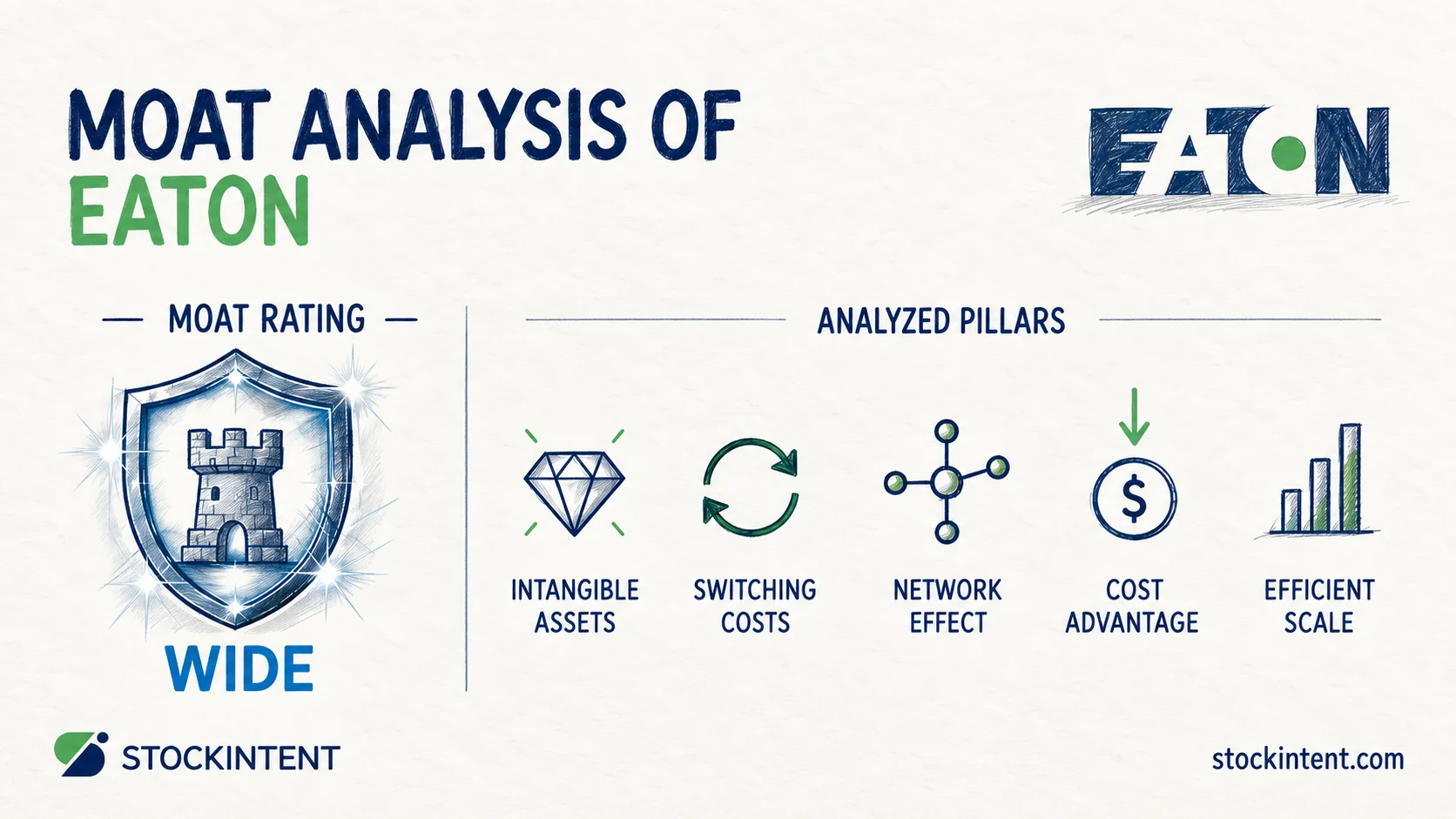
Eaton commands a wide economic moat anchored by high switching costs and mission-critical intangible assets, supported by a widening trend fueled by data-center electrification and grid modernization. We assess Eaton's uncertainty rating as medium, reflecting operational ramp-up risks alongside strong demand visibility.
Eaton delivered record revenue and segment profit in both Q1 2026 and Q2 2026, generating segment margins of 22.7% and 23.1%. Still, those margins contracted year over year by 120 and 80 basis points as the company absorbed capacity expansion costs, illustrating that rapid growth requires real operational execution.
Here is how we evaluate Eaton's competitive position:
For long-term business owners, evaluating moat durability matters far more than chasing quarterly order spikes. Understanding whether Eaton's competitive edge protects long-term compounding requires examining the five structural moat pillars behind its hardware.
To understand whether Eaton's profitability will endure over a decade, we evaluate the business across five classic competitive advantage pillars: switching costs, intangible assets, cost advantage, efficient scale, and network effects.
Switching costs represent Eaton's most durable economic barrier. Electrical architectures, switchgear, and power management equipment are heavily engineered and specified at the initial project design stage. Once an engineering team designs an electrical room or utility substation around Eaton's proprietary configurations, replacing them with a competitor's gear triggers expensive blueprint redesigns, system requalification, and new safety testing.
Customer inertia compounds this lock-in over time. Decades of installed base equipment across utilities, industrial plants, and mission-critical facilities mean maintenance teams already know Eaton components. A competitor analysis from Mohammed Sumon emphasizes that retrofitting competing equipment introduces unnecessary facility downtime risks. Long-term service agreements solidify this friction across electrical distribution and aerospace systems.
Eaton's intangible assets stem from rigorous regulatory certifications, code-compliant specifications, and proven engineering credibility. Mission-critical facilities cannot afford catastrophic electrical failures. Specifiers and facility engineers routinely rely on Eaton's pre-certified equipment to meet stringent local building codes and National Electrical Code standards, making it default gear on engineer-of-record approval lists.
This barrier is particularly steep in aerospace and defense, as highlighted in an in-depth value investment analysis of Eaton. Here, Federal Aviation Administration approvals and qualified supplier lists require years of rigorous flight testing. Once an aircraft platform integrates Eaton's hydraulic or fuel components, that design authority typically lasts throughout the multi-decade life cycle of the airframe.
Eaton's scale yields measurable cost benefits, but they do not create an insurmountable structural moat. A moat evaluation by MoatScan AI notes that while Eaton achieves solid operating leverage through disciplined price/cost management, this operates as an edge within an oligopoly rather than an absolute low-cost position. Global heavyweights like Schneider Electric, ABB, and Siemens possess comparable purchasing power and research budgets, allowing them to match pricing across major enterprise bids.
Efficient scale protects Eaton only within localized, specialized industrial niches. In select custom medium-voltage installations and bespoke aerospace assemblies, market demand remains too narrow to justify capital investment by new entrants. Across its broader enterprise markets, however, multiple well-funded competitors comfortably share capacity, preventing efficient scale from acting as a company-wide barrier.
Network effects do not play a material role in Eaton's economic defense. Eaton's extensive distributor network and electrical contractor relationships provide strong channel access, but having more electrical contractors install Eaton panelboards does not make each panelboard inherently more valuable to other users. The business depends on superior mechanical engineering and channel distribution, not demand-side network loops.
These structural advantages look compelling on paper, but long-term investors need to examine how they translate into actual financial performance.
Eaton's economic moat shows up most visibly in multi-year demand visibility, disciplined pricing actions, and steady margin recovery. In Q2 2026 news releases, Eaton reported that total backlog grew 33% year over year, following a 44% surge at the end of Q1 2026. That extended pipeline includes a massive 307 GW U.S. data-center backlog cited during the Q2 2026 earnings call. Because customers must commit to complex engineering specifications years ahead of project delivery, roughly 80% of this capacity converts in 2028 and beyond. That early lock-in validates the real-world durability of Eaton's switching costs.
This captive positioning also translates into tangible pricing power. Rather than competing on volume or discounting switchgear, management drove revenue by pushing selective backlog repricing and disciplined commercial actions to offset stubborn input inflation. These measures helped Eaton expand its segment margin sequentially from 22.7% in Q1 to 23.1% in Q2, beating internal quarterly guidance and illustrating that customers accept price revisions once their facilities are designed around Eaton components.
Yet the financial evidence is not completely one-sided. Even with sequential improvement, Q2 segment margins remained down 80 basis points year over year as factory tooling and workforce expansions absorbed capital. Headline backlog figures also outpace immediate cash generation, meaning near-term earnings reflect operational ramp costs rather than instant gains. Pricing power remains an active defense mechanism rather than an automatic lever, requiring managerial effort to keep pace with volatile input expenses.
Still, when comparing business quality against global peers like ABB, Schneider Electric, Siemens, and Rockwell Automation, Eaton demonstrates noticeably clearer forward visibility in North American electrification. That operational momentum sets up the next critical question: is this competitive edge widening over the cycle?
Eaton's economic moat trend is widening in 2026. This dynamic shift is visible in incoming demand: orders are significantly outpacing factory shipments. In its Q2 2026 earnings release, Eaton reported 41% organic order growth alongside 43% backlog growth in its Electrical segment. Furthermore, during its appearance at the Morgan Stanley Laguna Conference, management noted that data-center orders surged 85% year over year while segment revenue grew 65%. When orders consistently outpace revenue, the underlying pipeline is expanding. Reflecting this sustained demand, management raised its full-year 2026 organic revenue guidance from 9%–11% to 11%–13%.
Behind these figures lies a structural evolution in customer procurement. Power management is transitioning from piecemeal product purchasing to integrated project solutions. As highlighted by ElectricalTrends analysis, Eaton's end-to-end "grid-to-chip" architecture combines switchgear, power distribution, thermal management, and monitoring software. Customers building multi-gigawatt artificial intelligence clusters or complex utility interconnections cannot easily stitch together disparate components from separate vendors. Eaton captures greater project value by serving the entire electrical chain, steadily outgrowing narrower peers.
Over the next three to five years, specific developments will dictate whether this competitive edge expands further:
To track whether Eaton sustains this structural advantage, investors can configure a customized StockIntent watchlist to monitor quarterly order intake, key financial ratios, backlog burn, and margins against key peers.
But while Eaton's competitive trajectory is expanding, how predictable is the actual range of future business outcomes?
We assign Eaton a Medium uncertainty rating. When assessing uncertainty, our focus is not on short-term stock price volatility, but on the plausible dispersion of fundamental business outcomes over the next three to five years.
Eaton benefits from above-average top-line predictability compared to traditional industrial peers. Secular demand across data centers, electrical grid upgrades, and aerospace reduces reliance on short-cycle manufacturing trends. With raised 2026 organic revenue guidance of 11% to 13% and multi-year backlog commitments, near-term revenue visibility is exceptionally strong.
However, operational execution keeps Eaton firmly out of the Low uncertainty category. On the earnings call, management attributed the bulk of recent Electrical Americas margin compression to temporary negative price/cost dynamics. Second-half margin recovery depends on factory productivity gains as newly hired operators gain experience across manufacturing lines. Furthermore, management outlined approximately $1.5 billion in targeted capacity expansions alongside acquisitions in an earnings call transcript. While this capital expenditure meets demand already locked in backlog, rapid scaling inherently introduces factory bottlenecks and cost-absorption risks.
Eaton's investor presentations also warn that unrecovered material inflation, competing technologies, and broader cyclical downturns could weigh on results. In our assessment, the distribution of future outcomes remains skewed toward durable strength rather than catastrophic share loss. Downside risk centers on post-2027 demand normalization and compressed price/cost spreads, justifying a balanced Medium rating.
Eaton earns a wide economic moat, a widening moat trend, and a medium uncertainty rating. That positioning reflects powerful engineering switching costs and deep regulatory certifications, validated by record 2026 earnings and pricing power across massive multi-year backlogs.
For long-term business owners, two operational dynamics matter most from here. First, investors must track how efficiently Eaton converts its multi-year backlog into cash without sustained margin dilution. Second, watch whether margin pressure in Electrical Americas proves temporary as new factory capacity matures. While broader valuation multiples warrant disciplined entry points, Eaton's underlying business quality remains structurally sound.
Tracking order momentum, book-to-bill metrics, and peer execution offers the clearest way to verify whether this widening competitive moat endures through the next cycle.
This moat assessment is provided solely for informational and educational purposes and does not constitute investment advice.
Eaton commands a wide economic moat anchored by high switching costs and mission-critical intangible assets, supported by a widening trend fueled by data-center electrification and grid modernization. We assess Eaton's uncertainty rating as medium, reflecting operational ramp-up risks alongside strong demand visibility.
Eaton delivered record revenue and segment profit in both Q1 2026 and Q2 2026, generating segment margins of 22.7% and 23.1%. Still, those margins contracted year over year by 120 and 80 basis points as the company absorbed capacity expansion costs, illustrating that rapid growth requires real operational execution.
Here is how we evaluate Eaton's competitive position:
For long-term business owners, evaluating moat durability matters far more than chasing quarterly order spikes. Understanding whether Eaton's competitive edge protects long-term compounding requires examining the five structural moat pillars behind its hardware.
To understand whether Eaton's profitability will endure over a decade, we evaluate the business across five classic competitive advantage pillars: switching costs, intangible assets, cost advantage, efficient scale, and network effects.
Switching costs represent Eaton's most durable economic barrier. Electrical architectures, switchgear, and power management equipment are heavily engineered and specified at the initial project design stage. Once an engineering team designs an electrical room or utility substation around Eaton's proprietary configurations, replacing them with a competitor's gear triggers expensive blueprint redesigns, system requalification, and new safety testing.
Customer inertia compounds this lock-in over time. Decades of installed base equipment across utilities, industrial plants, and mission-critical facilities mean maintenance teams already know Eaton components. A competitor analysis from Mohammed Sumon emphasizes that retrofitting competing equipment introduces unnecessary facility downtime risks. Long-term service agreements solidify this friction across electrical distribution and aerospace systems.
Eaton's intangible assets stem from rigorous regulatory certifications, code-compliant specifications, and proven engineering credibility. Mission-critical facilities cannot afford catastrophic electrical failures. Specifiers and facility engineers routinely rely on Eaton's pre-certified equipment to meet stringent local building codes and National Electrical Code standards, making it default gear on engineer-of-record approval lists.
This barrier is particularly steep in aerospace and defense, as highlighted in an in-depth value investment analysis of Eaton. Here, Federal Aviation Administration approvals and qualified supplier lists require years of rigorous flight testing. Once an aircraft platform integrates Eaton's hydraulic or fuel components, that design authority typically lasts throughout the multi-decade life cycle of the airframe.
Eaton's scale yields measurable cost benefits, but they do not create an insurmountable structural moat. A moat evaluation by MoatScan AI notes that while Eaton achieves solid operating leverage through disciplined price/cost management, this operates as an edge within an oligopoly rather than an absolute low-cost position. Global heavyweights like Schneider Electric, ABB, and Siemens possess comparable purchasing power and research budgets, allowing them to match pricing across major enterprise bids.
Efficient scale protects Eaton only within localized, specialized industrial niches. In select custom medium-voltage installations and bespoke aerospace assemblies, market demand remains too narrow to justify capital investment by new entrants. Across its broader enterprise markets, however, multiple well-funded competitors comfortably share capacity, preventing efficient scale from acting as a company-wide barrier.
Network effects do not play a material role in Eaton's economic defense. Eaton's extensive distributor network and electrical contractor relationships provide strong channel access, but having more electrical contractors install Eaton panelboards does not make each panelboard inherently more valuable to other users. The business depends on superior mechanical engineering and channel distribution, not demand-side network loops.
These structural advantages look compelling on paper, but long-term investors need to examine how they translate into actual financial performance.
Eaton's economic moat shows up most visibly in multi-year demand visibility, disciplined pricing actions, and steady margin recovery. In Q2 2026 news releases, Eaton reported that total backlog grew 33% year over year, following a 44% surge at the end of Q1 2026. That extended pipeline includes a massive 307 GW U.S. data-center backlog cited during the Q2 2026 earnings call. Because customers must commit to complex engineering specifications years ahead of project delivery, roughly 80% of this capacity converts in 2028 and beyond. That early lock-in validates the real-world durability of Eaton's switching costs.
This captive positioning also translates into tangible pricing power. Rather than competing on volume or discounting switchgear, management drove revenue by pushing selective backlog repricing and disciplined commercial actions to offset stubborn input inflation. These measures helped Eaton expand its segment margin sequentially from 22.7% in Q1 to 23.1% in Q2, beating internal quarterly guidance and illustrating that customers accept price revisions once their facilities are designed around Eaton components.
Yet the financial evidence is not completely one-sided. Even with sequential improvement, Q2 segment margins remained down 80 basis points year over year as factory tooling and workforce expansions absorbed capital. Headline backlog figures also outpace immediate cash generation, meaning near-term earnings reflect operational ramp costs rather than instant gains. Pricing power remains an active defense mechanism rather than an automatic lever, requiring managerial effort to keep pace with volatile input expenses.
Still, when comparing business quality against global peers like ABB, Schneider Electric, Siemens, and Rockwell Automation, Eaton demonstrates noticeably clearer forward visibility in North American electrification. That operational momentum sets up the next critical question: is this competitive edge widening over the cycle?
Eaton's economic moat trend is widening in 2026. This dynamic shift is visible in incoming demand: orders are significantly outpacing factory shipments. In its Q2 2026 earnings release, Eaton reported 41% organic order growth alongside 43% backlog growth in its Electrical segment. Furthermore, during its appearance at the Morgan Stanley Laguna Conference, management noted that data-center orders surged 85% year over year while segment revenue grew 65%. When orders consistently outpace revenue, the underlying pipeline is expanding. Reflecting this sustained demand, management raised its full-year 2026 organic revenue guidance from 9%–11% to 11%–13%.
Behind these figures lies a structural evolution in customer procurement. Power management is transitioning from piecemeal product purchasing to integrated project solutions. As highlighted by ElectricalTrends analysis, Eaton's end-to-end "grid-to-chip" architecture combines switchgear, power distribution, thermal management, and monitoring software. Customers building multi-gigawatt artificial intelligence clusters or complex utility interconnections cannot easily stitch together disparate components from separate vendors. Eaton captures greater project value by serving the entire electrical chain, steadily outgrowing narrower peers.
Over the next three to five years, specific developments will dictate whether this competitive edge expands further:
To track whether Eaton sustains this structural advantage, investors can configure a customized StockIntent watchlist to monitor quarterly order intake, key financial ratios, backlog burn, and margins against key peers.
But while Eaton's competitive trajectory is expanding, how predictable is the actual range of future business outcomes?
We assign Eaton a Medium uncertainty rating. When assessing uncertainty, our focus is not on short-term stock price volatility, but on the plausible dispersion of fundamental business outcomes over the next three to five years.
Eaton benefits from above-average top-line predictability compared to traditional industrial peers. Secular demand across data centers, electrical grid upgrades, and aerospace reduces reliance on short-cycle manufacturing trends. With raised 2026 organic revenue guidance of 11% to 13% and multi-year backlog commitments, near-term revenue visibility is exceptionally strong.
However, operational execution keeps Eaton firmly out of the Low uncertainty category. On the earnings call, management attributed the bulk of recent Electrical Americas margin compression to temporary negative price/cost dynamics. Second-half margin recovery depends on factory productivity gains as newly hired operators gain experience across manufacturing lines. Furthermore, management outlined approximately $1.5 billion in targeted capacity expansions alongside acquisitions in an earnings call transcript. While this capital expenditure meets demand already locked in backlog, rapid scaling inherently introduces factory bottlenecks and cost-absorption risks.
Eaton's investor presentations also warn that unrecovered material inflation, competing technologies, and broader cyclical downturns could weigh on results. In our assessment, the distribution of future outcomes remains skewed toward durable strength rather than catastrophic share loss. Downside risk centers on post-2027 demand normalization and compressed price/cost spreads, justifying a balanced Medium rating.
Eaton earns a wide economic moat, a widening moat trend, and a medium uncertainty rating. That positioning reflects powerful engineering switching costs and deep regulatory certifications, validated by record 2026 earnings and pricing power across massive multi-year backlogs.
For long-term business owners, two operational dynamics matter most from here. First, investors must track how efficiently Eaton converts its multi-year backlog into cash without sustained margin dilution. Second, watch whether margin pressure in Electrical Americas proves temporary as new factory capacity matures. While broader valuation multiples warrant disciplined entry points, Eaton's underlying business quality remains structurally sound.
Tracking order momentum, book-to-bill metrics, and peer execution offers the clearest way to verify whether this widening competitive moat endures through the next cycle.
This moat assessment is provided solely for informational and educational purposes and does not constitute investment advice.