
Oct 20, 2026
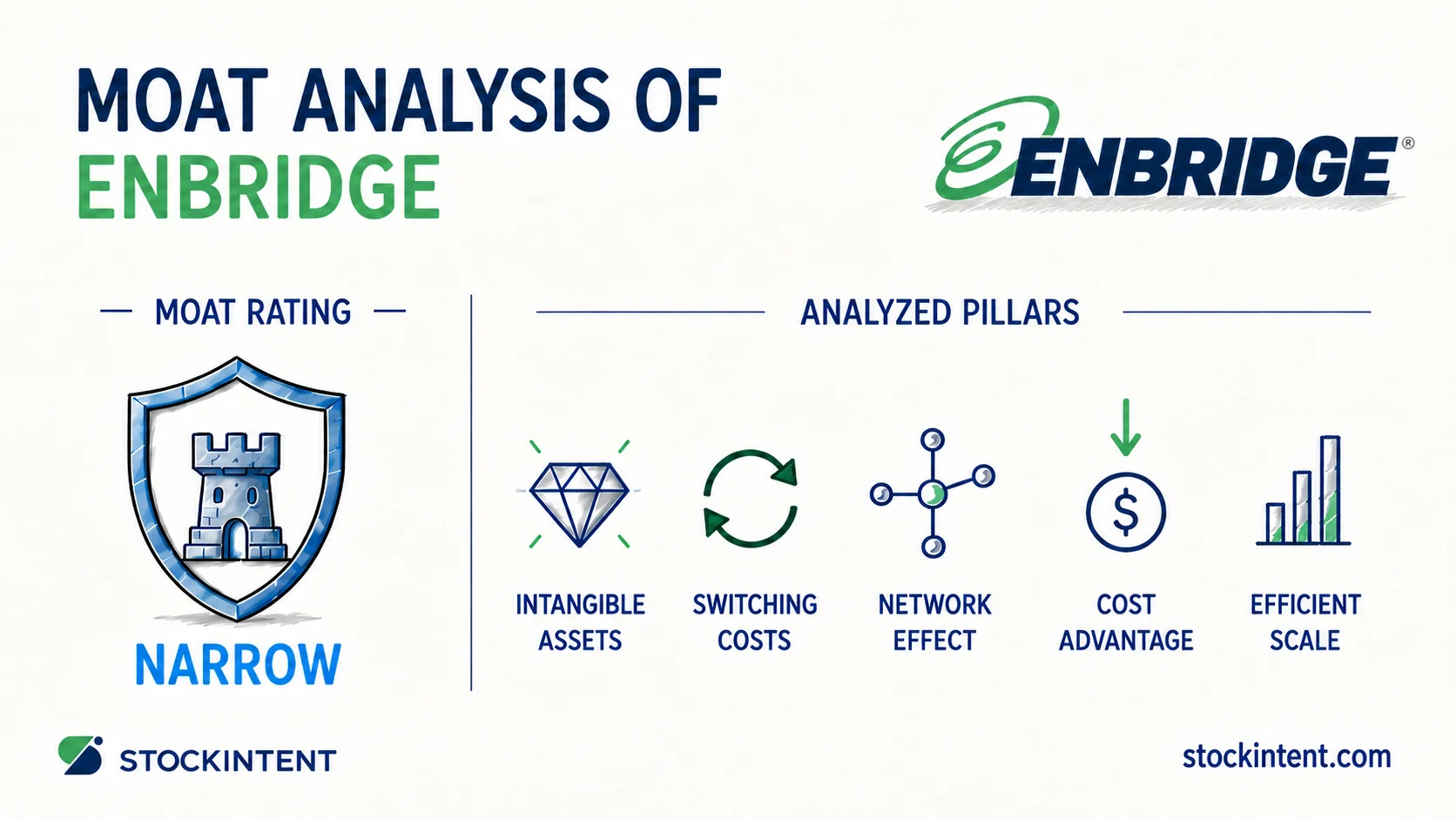
We rate Enbridge with a narrow economic moat, a stable to modestly widening trend, and medium uncertainty. The moat comes from efficient scale, regulated and take-or-pay cash flows, and high switching costs.
The numbers back this up clearly. Enbridge expanded its secured capital backlog to about $41 billion by Q2 2026. Management also reaffirmed 2026 guidance of C$20.2 to C$20.8 billion in adjusted EBITDA and C$5.70 to C$6.10 in DCF per share (Enbridge Q2 2026 news release). According to its Q1 2026 investor presentation, the company supplies over 75% of North American refineries, transports roughly 20% of the continent's natural gas, and serves more than 7 million utility customers.
Here are our main takeaways:
Moat durability matters because it dictates whether Enbridge can compound cash flows over time without rivals eating into returns. Let's look at each competitive pillar, review the performance numbers, and examine the trend.
We rank the five classic moat pillars from strongest to weakest. Two carry real weight, two are partial, and one barely applies.
Enbridge built an asset base that rivals cannot copy at any reasonable cost. In its SEC filings, the company highlights an "unmatched incumbent footprint" spanning pipelines tied to most continental refineries, gas utilities serving millions, and a secured backlog that keeps pipes full. Building an identical corridor takes years of permitting and billions in capital, making full network replication practically impossible. A fully utilized pipeline system generates far better returns per asset dollar than a half-empty competitor.
Customers stay locked into Enbridge's pipelines and gas utilities because of contractual design. In its Q3 2025 earnings presentation, the company noted that about 98% of EBITDA comes from regulated assets or take-or-pay contracts. Customers pay for committed capacity whether they pump product or not.
Once a refinery, utility, or LNG facility connects directly to a specific pipe, switching suppliers costs far more than staying put. These steady, contracted cash flows provide the reliable base Enbridge needs to keep compounding.
Pro Insight: Here is our take: the moat looks wide on a map, but the financial returns tell a narrower story. Market data shows a trailing ROE near 11.17% alongside a net margin around 7.20% (MarketBeat), while Morningstar maintains a narrow moat rating. Entrenched infrastructure protects top-line revenues, but heavy capital demands and elevated debt dilute returns for equity holders.
Regulatory franchises, permits, and established rights-of-way represent Enbridge's real intangible value. The 2026 shareholder letter highlights its status as an established partner, though customers choose the service for convenience rather than brand affection. Securing rights-of-way and environmental approvals takes years, creating a real hurdle that keeps potential competitors off its turf.
Enbridge points to $200–300 million of cost savings in its 2026 guidance supplemental, driven by system optimization and strong capacity utilization. These operational gains reflect solid management execution, but they do not prove a structural cost edge over every peer. We view this as a helpful supporting element rather than a core competitive advantage.
Pipeline infrastructure does not generate network effects since extra shippers do not inherently make the network more valuable to existing customers. We view connectivity value as a feature of efficient scale and switching costs, leaving this pillar immaterial to the overall moat.
The moat shines brightest where utility regulation, essential demand, and long-life assets intersect. Enbridge delivers natural gas to roughly 7 million utility customers across four operating units, including about 4 million at Enbridge Gas (Q1 2026 presentation). Meanwhile, its fee-based gas transmission operations run on firm capacity reservations instead of volatile spot commodity prices.
Management links 2026 strength directly to high utilization and asset optimization. Guidance remains firm at C$20.2 to C$20.8 billion in adjusted EBITDA and C$5.70 to C$6.10 in DCF per share (Q2 2026 news release). These contracted commitments produce the dependable cash flow we see reported each quarter.
Independent credit assessments confirm this profile. In its June 2026 affirmation, Fitch ranked Enbridge as the largest midstream issuer under its coverage by enterprise value and EBITDA. Fitch pointed to a proven record with regulators, placing Enbridge alongside TC Energy and Kinder Morgan while emphasizing Enbridge's larger footprint and integrated utility mix.
There is still a soft spot in the business. During the Q1 2026 call, management acknowledged lower Line 9 tolls and softer contributions from market-access pipelines. This drop shows that toll adjustments on merchant liquids pipelines can soften returns. Across the broader portfolio, recent results point to operational durability rather than unmatched pricing power.
We see Enbridge's moat trend as stable, with clear potential for gradual expansion. Project development and commercial momentum support this view.
The expansion case relies heavily on capital deployment. Enbridge sanctioned around $9 billion in capital year-to-date in 2026 and expects $10 to $20 billion in total project approvals across 2026 and 2027 (Q2 2026 news release). In addition to its secured backlog, the firm is pursuing about $50 billion in unsanctioned commercial projects (2026 news release).
Project composition matters just as much as capital scale. Recent work includes the Vector Pipeline expansion, Tres Palacios and Dawn Hub storage projects, a wind installation serving Meta data centers, the Line 5 replacement, and the Bay Runner Twin LNG project. Commercial customers are locking in multi-year transport capacity to support LNG export facilities, utility demand, and data centers. Enbridge also acquired positions in the Matterhorn Express Pipeline and Salt Creek Midstream to expand its reach.
Several factors keep the moat narrow despite this expansion. Morningstar still classifies the moat as narrow, reflecting ongoing regulatory exposure, project execution risks, and heavy capital requirements.
Here is what we track on our watchlist over the next three to five years:
Following Enbridge through a StockIntent watchlist helps monitor how operational metrics evolve over time.
We rate Enbridge's uncertainty as medium. High contract coverage stabilizes cash flow, while debt levels and regulatory scrutiny keep risk from falling lower.
Cash flow stability stems from regulated tariffs, firm reservation contracts, high pipeline utilization, and transparent backlog visibility. On its Q1 2026 earnings call, leadership reiterated an average 5% growth outlook through the end of the decade. Utility rates and firm shipping contracts anchor earnings, buffering results from short-term commodity price swings.
Financial leverage introduces real downside. Enbridge closed Q2 2026 with a debt-to-EBITDA ratio around 5.1x, exceeding its internal target range of 4.5x to 5.0x (Q2 2026 earnings call). Total long-term obligations topped $100 billion (Zacks). Management also cited commodity, macroeconomic, trade, and regulatory crosswinds. Investors should note that non-cash derivative marks tied to foreign exchange and interest rates make reported GAAP net income far more volatile than distributable cash flow.
We believe Enbridge faces a narrow range of likely business outcomes over the next three to five years. Project delays or expensive refinancings could dampen equity returns. As market commentary observes, the investment thesis "leans on tight execution", making project delivery the main operational variable.
Enbridge earns a narrow economic moat rating, a stable to slightly widening trend, and a medium uncertainty assessment. These ratings reflect deep scale, regulated and contracted cash flows, and customer switching costs documented across 2026 operational filings.
Two variables will guide performance moving forward. Enbridge must deliver its capital backlog on budget to secure projected cash yields. At the same time, the company needs to trim leverage back toward its 4.5x to 5.0x target corridor.
Executing well on both fronts will safeguard the dividend and support steady compounding. Slipping on project timing or debt reduction will squeeze investor returns before the physical assets ever lose relevance.
This content is for informational and educational purposes only and is not investment advice.
Start your 7-day free trial and find quality compounders faster.
— StockIntent Score ╌ S&P 500


