
Aug 9, 2026
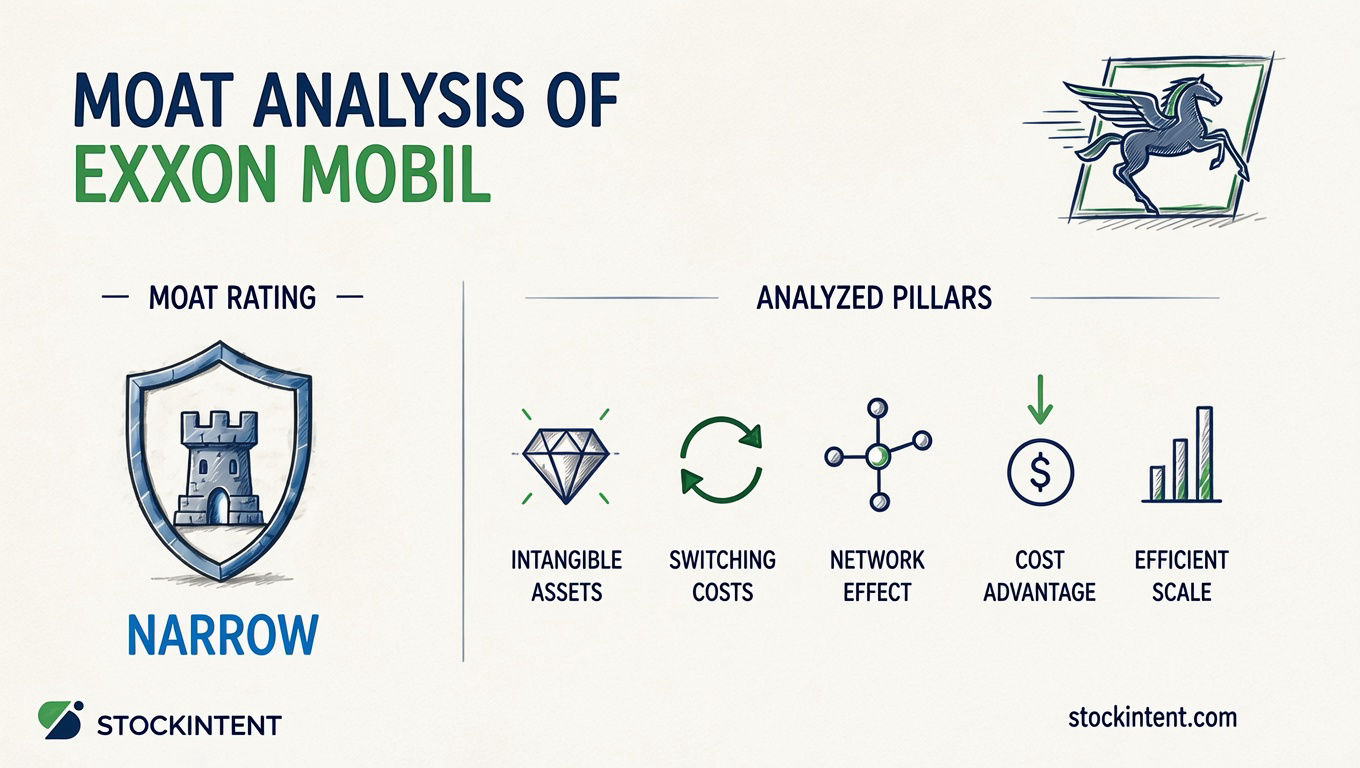
Exxon Mobil carries a narrow economic moat with a stable to modestly widening trend and medium uncertainty. That's the verdict after weighing its industry-leading cost discipline against the reality that oil and gas remains a commodity business where pricing power is essentially nonexistent.
Here's what matters most for investors evaluating business durability:
The tension in Exxon's moat story shows up clearly in the numbers. The company has built genuine cost leadership, yet Q1 2026 gross margin fell to 25%, trailing Chevron's 41%. This gap illustrates a key truth about commodity moats: operational excellence shows up in cycle resilience and asset quality, not in quarterly margin superiority.
For long-term investors, the question isn't whether Exxon can outprice competitors on any given day, but whether its cost structure and advantaged assets let it generate strong returns through the full commodity cycle.
Exxon Mobil's moat rests on a single dominant pillar: cost advantage. Everything else either supports that edge or barely shows up. In commodity businesses, the lowest-cost producer wins through cycles. Exxon has spent years building that position, and the evidence is concrete.
Cost Advantage (Strong)
The company had achieved $15.6 billion in cumulative structural cost savings since 2019 as of Q1 2026, exceeding all other major integrated oil companies combined. Management targets $20 billion by 2030. They're permanent changes to how Exxon operates, from supply chain redesign to digital field automation.
The asset base reinforces this. Exxon's positions in the Permian Basin and Guyana sit at the low end of the global cost curve. Guyana production hit records in Q1 2026. Yellowtail, the third major development there, is scheduled to start up and add higher-margin barrels. When your incremental production costs less than competitors' average costs, you survive price crashes they cannot.
Pro Insight: In commodity businesses, the only durable moat is being the lowest-cost producer. Exxon's $15.6 billion in structural savings isn't just cost-cutting, it's insurance that compounds through oil price cycles while higher-cost peers breakeven. This cost discipline has potential to transform a commodity exposure into a quality compounding story.
We track these cost and margin claims against sector data using detailed company reports. StockIntent's company reports let you pull full financial statements, segment margins, and peer comparisons to test whether Exxon's cost advantage holds up against Chevron, Shell, or BP on the metrics that matter.
Efficient Scale (Moderate)
Exxon operates a world-scale supply chain serving customers in more than 180 countries. Its integrated refining and chemicals footprint spreads fixed costs across enormous volumes. Large project execution capability, think Golden Pass LNG or Bacalhau in Brazil, benefits from repeated execution experience that smaller competitors cannot easily replicate.
Still, scale in oil and gas doesn't create monopoly-like protection. It improves unit economics. That's useful, but it doesn't block entry or guarantee pricing power.
Intangible Assets (Limited)
Exxon possesses genuine technical expertise: subsurface imaging, proprietary recovery methods, and decades of project engineering know-how. MCH Advisory Research and Factors Today both treat these as supportive advantages that enable cost leadership rather than standalone moat pillars. The technology matters because it lowers finding and development costs, not because it locks in customers or commands premium prices.
Network Effects and Switching Costs (Very Weak / Not Material)
These pillars essentially don't exist for Exxon's core business. Crude oil buyers switch suppliers based on price and logistics, not platform lock-in. Refined product customers chase availability and cost. As MCH Advisory Research puts it, Exxon has "no demand captivity" and "no network effects across the bulk of its business."
This isn't a flaw in Exxon's strategy. It's the nature of commodity markets. The company competes on unit economics, not customer stickiness. For investors, that means the moat thesis lives or dies on cost advantage and capital allocation discipline, not on anything resembling a software platform's lock-in dynamics.
Exxon's moat creates a real paradox for investors. The company has delivered $15.6 billion in cumulative structural cost savings since 2019, more than all other major integrated oil companies combined. Yet Q1 2026 gross margin fell to 25%, trailing Chevron's 41% in the same quarter. This gap captures the essence of commodity moats: operational excellence shows up in cycle resilience and asset quality, not in quarterly margin superiority.
The evidence of moat strength appears most clearly in cash generation and production execution. Exxon delivered $52.0 billion in operating cash flow and $26.1 billion in free cash flow in 2025, demonstrating that its cost structure and advantaged assets translate into durable financial capacity even when oil prices soften. Record Guyana production in Q1 2026 reinforced this pattern; the company kept earnings resilient despite lower commodity prices and Middle East shipment disruptions.
| Signal | Exxon Mobil | Peer Comparison | Moat Reading |
|---|---|---|---|
| Q1 2026 Gross Margin | 25% | Chevron: 41% | Near-term weakness |
| Structural Cost Savings (cumulative since 2019) | $15.6 billion | Exceeds all other IOCs combined | Long-term strength |
| Asset Focus | Permian Basin, Guyana | Low-cost, high-margin positions | Core advantage |
The table tells a clear story. Exxon's moat benefits are most visible in multi-year cost discipline and asset quality, not in current-quarter profitability. For long-term investors, this is actually the expected pattern. A genuine cost advantage compounds through cycles; it doesn't guarantee winning every quarter. The risk is that sustained margin underperformance could signal deeper competitive pressure, or that cost savings are being reinvested into growth rather than flowing to the bottom line. Either way, the moat thesis lives or dies on whether Exxon's unit economics hold when prices fall, not on whether it beats Chevron on gross margin in any single period.
Exxon Mobil's moat is stable to modestly widening in 2026. That's the assessment from Finterra Market Analysis, and it reflects a straightforward reality: the company is executing on projects that lower its cost curve and expand its advantaged asset base, while external pressures keep the improvement bounded.
What's pushing the moat wider
The clearest driver is project execution. Yellowtail in Guyana, Bacalhau in Brazil, and Golden Pass LNG reaching mechanical completion are all expected to add high-margin production that competitors will struggle to replicate at comparable unit costs. ExxonMobil's raised 2030 plan now targets $25 billion in earnings growth and $35 billion in cash flow growth from 2024 to 2030, with no increase in capital spending. That's operating leverage in its purest form: more output from the same capital base.
The Pioneer acquisition is also starting to pay off. Exxon anticipates $3 billion or more in synergies from that deal, which tightens its grip on the Permian Basin and reinforces the low-cost barrel profile that underpins the entire moat thesis.
What's holding it back
Commodity dependence hasn't gone anywhere. Oil and gas prices still set the ceiling on profitability, and Exxon cannot outrun that physics. Geopolitical risk is equally stubborn. StockTitan's analysis of Q1 2026 SEC filings notes that Middle East disruptions directly affected shipments and production during the quarter, reminding investors that even the best cost structure can face external shocks.
Regulatory and litigation pressure adds another layer of uncertainty. Climate-related legal exposure and methane compliance costs can compress margins.
What to watch
For investors tracking whether the moat trend improves or deteriorates, four indicators matter most:
The moat isn't widening automatically. It's widening because management is executing specific projects with specific cost and timing targets. Miss those, and the trend stalls or reverses.
We rate Exxon Mobil's moat uncertainty as Medium. The company's integrated scale and visible growth pillars narrow the range of outcomes compared with pure exploration and production companies. Still, commodity exposure, geopolitical shocks, and mega-project execution risk prevent us from calling the path predictable.
Three drivers create this medium rating. First, commodity price volatility remains the elephant in the room. Oil, gas, and refining spreads still drive the bulk of Exxon's earnings. No amount of cost discipline eliminates that sensitivity. Second, geopolitical risk is tangible and recent. StockTitan's analysis of Q1 2026 filings documents how Middle East disruptions caused shipment delays and reduced production during the quarter, delivering an estimated $3.5 to $4.9 billion timing hit. These aren't theoretical risks; they showed up in reported results within the last few months. Third, mega-project execution risk looms large. Exxon is betting heavily on Guyana, LNG, and emerging low-carbon businesses. Strategy Analysis research notes that carbon capture, hydrogen, and lithium ventures face "immense execution risk" and are "heavily contingent on government policy," with markets that "do not yet exist at scale." Success here could widen the moat meaningfully; failure would strand capital and compress returns.
The range of plausible outcomes over the next three to five years is moderately wide. It's narrower than a pure commodity producer because Exxon has scale, integration, and advantaged assets. It's wider than a regulated utility because no regulator guarantees its returns. For investors, this means the central case is favorable, but the confidence interval around that case is real. We use watchlists to track the measurable developments that would shift our view, project milestones, cost savings progress, production growth rates, and early commercial traction in new energy segments.
Exxon Mobil earns a narrow economic moat with a stable to modestly widening trend and medium uncertainty. The investment case rests on one durable advantage: cost leadership backed by $15.6 billion in cumulative structural cost savings since 2019, advantaged Permian and Guyana assets, and disciplined capital allocation that raised 2030 earnings targets without increasing spending. These are real, observable strengths that compound through commodity cycles.
Still, this moat is conditional, not guaranteed. Project delays at Yellowtail or Golden Pass LNG, a sustained collapse in oil prices, or regulatory shocks that impair cost structure could weaken the thesis quickly. The moat lives on execution. Investors should watch delivery discipline, progress toward the $20 billion savings target, Permian and Guyana production growth, and early commercial traction in carbon capture and hydrogen. Past cost achievements don't automatically repeat.
Exxon Mobil carries a narrow economic moat with a stable to modestly widening trend and medium uncertainty. That's the verdict after weighing its industry-leading cost discipline against the reality that oil and gas remains a commodity business where pricing power is essentially nonexistent.
Here's what matters most for investors evaluating business durability:
The tension in Exxon's moat story shows up clearly in the numbers. The company has built genuine cost leadership, yet Q1 2026 gross margin fell to 25%, trailing Chevron's 41%. This gap illustrates a key truth about commodity moats: operational excellence shows up in cycle resilience and asset quality, not in quarterly margin superiority.
For long-term investors, the question isn't whether Exxon can outprice competitors on any given day, but whether its cost structure and advantaged assets let it generate strong returns through the full commodity cycle.
Exxon Mobil's moat rests on a single dominant pillar: cost advantage. Everything else either supports that edge or barely shows up. In commodity businesses, the lowest-cost producer wins through cycles. Exxon has spent years building that position, and the evidence is concrete.
Cost Advantage (Strong)
The company had achieved $15.6 billion in cumulative structural cost savings since 2019 as of Q1 2026, exceeding all other major integrated oil companies combined. Management targets $20 billion by 2030. They're permanent changes to how Exxon operates, from supply chain redesign to digital field automation.
The asset base reinforces this. Exxon's positions in the Permian Basin and Guyana sit at the low end of the global cost curve. Guyana production hit records in Q1 2026. Yellowtail, the third major development there, is scheduled to start up and add higher-margin barrels. When your incremental production costs less than competitors' average costs, you survive price crashes they cannot.
Pro Insight: In commodity businesses, the only durable moat is being the lowest-cost producer. Exxon's $15.6 billion in structural savings isn't just cost-cutting, it's insurance that compounds through oil price cycles while higher-cost peers breakeven. This cost discipline has potential to transform a commodity exposure into a quality compounding story.
We track these cost and margin claims against sector data using detailed company reports. StockIntent's company reports let you pull full financial statements, segment margins, and peer comparisons to test whether Exxon's cost advantage holds up against Chevron, Shell, or BP on the metrics that matter.
Efficient Scale (Moderate)
Exxon operates a world-scale supply chain serving customers in more than 180 countries. Its integrated refining and chemicals footprint spreads fixed costs across enormous volumes. Large project execution capability, think Golden Pass LNG or Bacalhau in Brazil, benefits from repeated execution experience that smaller competitors cannot easily replicate.
Still, scale in oil and gas doesn't create monopoly-like protection. It improves unit economics. That's useful, but it doesn't block entry or guarantee pricing power.
Intangible Assets (Limited)
Exxon possesses genuine technical expertise: subsurface imaging, proprietary recovery methods, and decades of project engineering know-how. MCH Advisory Research and Factors Today both treat these as supportive advantages that enable cost leadership rather than standalone moat pillars. The technology matters because it lowers finding and development costs, not because it locks in customers or commands premium prices.
Network Effects and Switching Costs (Very Weak / Not Material)
These pillars essentially don't exist for Exxon's core business. Crude oil buyers switch suppliers based on price and logistics, not platform lock-in. Refined product customers chase availability and cost. As MCH Advisory Research puts it, Exxon has "no demand captivity" and "no network effects across the bulk of its business."
This isn't a flaw in Exxon's strategy. It's the nature of commodity markets. The company competes on unit economics, not customer stickiness. For investors, that means the moat thesis lives or dies on cost advantage and capital allocation discipline, not on anything resembling a software platform's lock-in dynamics.
Exxon's moat creates a real paradox for investors. The company has delivered $15.6 billion in cumulative structural cost savings since 2019, more than all other major integrated oil companies combined. Yet Q1 2026 gross margin fell to 25%, trailing Chevron's 41% in the same quarter. This gap captures the essence of commodity moats: operational excellence shows up in cycle resilience and asset quality, not in quarterly margin superiority.
The evidence of moat strength appears most clearly in cash generation and production execution. Exxon delivered $52.0 billion in operating cash flow and $26.1 billion in free cash flow in 2025, demonstrating that its cost structure and advantaged assets translate into durable financial capacity even when oil prices soften. Record Guyana production in Q1 2026 reinforced this pattern; the company kept earnings resilient despite lower commodity prices and Middle East shipment disruptions.
| Signal | Exxon Mobil | Peer Comparison | Moat Reading |
|---|---|---|---|
| Q1 2026 Gross Margin | 25% | Chevron: 41% | Near-term weakness |
| Structural Cost Savings (cumulative since 2019) | $15.6 billion | Exceeds all other IOCs combined | Long-term strength |
| Asset Focus | Permian Basin, Guyana | Low-cost, high-margin positions | Core advantage |
The table tells a clear story. Exxon's moat benefits are most visible in multi-year cost discipline and asset quality, not in current-quarter profitability. For long-term investors, this is actually the expected pattern. A genuine cost advantage compounds through cycles; it doesn't guarantee winning every quarter. The risk is that sustained margin underperformance could signal deeper competitive pressure, or that cost savings are being reinvested into growth rather than flowing to the bottom line. Either way, the moat thesis lives or dies on whether Exxon's unit economics hold when prices fall, not on whether it beats Chevron on gross margin in any single period.
Exxon Mobil's moat is stable to modestly widening in 2026. That's the assessment from Finterra Market Analysis, and it reflects a straightforward reality: the company is executing on projects that lower its cost curve and expand its advantaged asset base, while external pressures keep the improvement bounded.
What's pushing the moat wider
The clearest driver is project execution. Yellowtail in Guyana, Bacalhau in Brazil, and Golden Pass LNG reaching mechanical completion are all expected to add high-margin production that competitors will struggle to replicate at comparable unit costs. ExxonMobil's raised 2030 plan now targets $25 billion in earnings growth and $35 billion in cash flow growth from 2024 to 2030, with no increase in capital spending. That's operating leverage in its purest form: more output from the same capital base.
The Pioneer acquisition is also starting to pay off. Exxon anticipates $3 billion or more in synergies from that deal, which tightens its grip on the Permian Basin and reinforces the low-cost barrel profile that underpins the entire moat thesis.
What's holding it back
Commodity dependence hasn't gone anywhere. Oil and gas prices still set the ceiling on profitability, and Exxon cannot outrun that physics. Geopolitical risk is equally stubborn. StockTitan's analysis of Q1 2026 SEC filings notes that Middle East disruptions directly affected shipments and production during the quarter, reminding investors that even the best cost structure can face external shocks.
Regulatory and litigation pressure adds another layer of uncertainty. Climate-related legal exposure and methane compliance costs can compress margins.
What to watch
For investors tracking whether the moat trend improves or deteriorates, four indicators matter most:
The moat isn't widening automatically. It's widening because management is executing specific projects with specific cost and timing targets. Miss those, and the trend stalls or reverses.
We rate Exxon Mobil's moat uncertainty as Medium. The company's integrated scale and visible growth pillars narrow the range of outcomes compared with pure exploration and production companies. Still, commodity exposure, geopolitical shocks, and mega-project execution risk prevent us from calling the path predictable.
Three drivers create this medium rating. First, commodity price volatility remains the elephant in the room. Oil, gas, and refining spreads still drive the bulk of Exxon's earnings. No amount of cost discipline eliminates that sensitivity. Second, geopolitical risk is tangible and recent. StockTitan's analysis of Q1 2026 filings documents how Middle East disruptions caused shipment delays and reduced production during the quarter, delivering an estimated $3.5 to $4.9 billion timing hit. These aren't theoretical risks; they showed up in reported results within the last few months. Third, mega-project execution risk looms large. Exxon is betting heavily on Guyana, LNG, and emerging low-carbon businesses. Strategy Analysis research notes that carbon capture, hydrogen, and lithium ventures face "immense execution risk" and are "heavily contingent on government policy," with markets that "do not yet exist at scale." Success here could widen the moat meaningfully; failure would strand capital and compress returns.
The range of plausible outcomes over the next three to five years is moderately wide. It's narrower than a pure commodity producer because Exxon has scale, integration, and advantaged assets. It's wider than a regulated utility because no regulator guarantees its returns. For investors, this means the central case is favorable, but the confidence interval around that case is real. We use watchlists to track the measurable developments that would shift our view, project milestones, cost savings progress, production growth rates, and early commercial traction in new energy segments.
Exxon Mobil earns a narrow economic moat with a stable to modestly widening trend and medium uncertainty. The investment case rests on one durable advantage: cost leadership backed by $15.6 billion in cumulative structural cost savings since 2019, advantaged Permian and Guyana assets, and disciplined capital allocation that raised 2030 earnings targets without increasing spending. These are real, observable strengths that compound through commodity cycles.
Still, this moat is conditional, not guaranteed. Project delays at Yellowtail or Golden Pass LNG, a sustained collapse in oil prices, or regulatory shocks that impair cost structure could weaken the thesis quickly. The moat lives on execution. Investors should watch delivery discipline, progress toward the $20 billion savings target, Permian and Guyana production growth, and early commercial traction in carbon capture and hydrogen. Past cost achievements don't automatically repeat.