
Mar 28, 2026
Fidelity National Information Services, better known as FIS, sits at the center of global financial infrastructure. If you've ever swiped a debit card, transferred money through a banking app, or processed an investment trade, there's a decent chance FIS technology touched that transaction. For investors trying to evaluate whether this $60 billion fintech giant deserves a spot in their portfolio, understanding what drives the company matters just as much as parsing its cash flow statement.
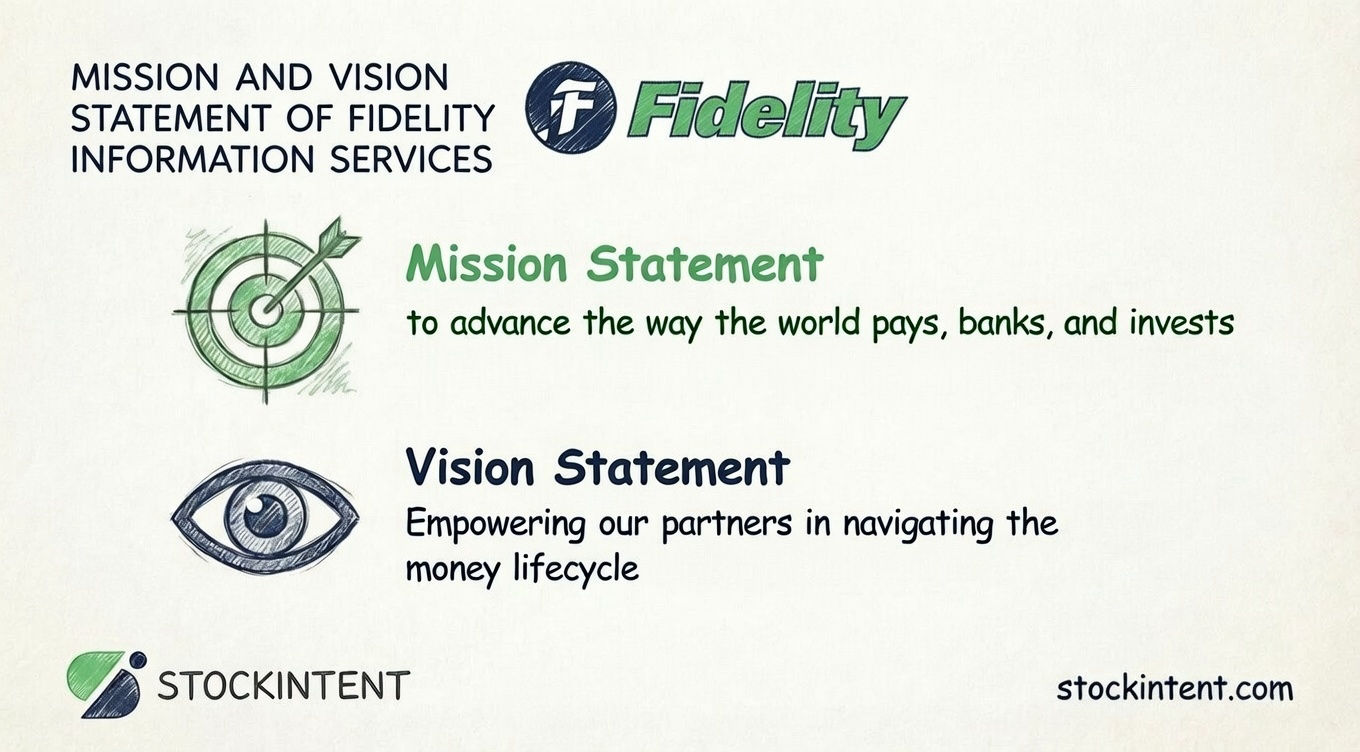
The Fidelity National Information Services mission statement as of 2026 is straightforward: "to advance the way the world pays, banks, and invests." This statement, consistently cited across FIS's official communications and third-party analyses, captures the company's ambition to modernize financial technology across three interconnected domains. The vision extends this further, aiming to empower clients by unlocking how money is stored, moved, and deployed across the entire financial ecosystem.
Key Takeaways:
FIS traces its roots back to 1968, though the modern entity emerged through decades of strategic consolidation in financial technology. Today, it stands as one of the largest providers of banking and payment technology worldwide, serving financial institutions, merchants, and capital markets participants across more than 100 countries. The company processes roughly 75 billion transactions annually, moving approximately $9 trillion through its systems.
In our experience analyzing fintech infrastructure plays, FIS represents a classic "pick and shovel" investment in the digital transformation of finance. Rather than betting on which bank or payment app wins, you're investing in the plumbing that makes all of them function.
The company organizes its operations around what it calls the "money lifecycle" — three interconnected stages where financial technology creates value:
| Segment | Description | Key Products |
|---|---|---|
| Banking Solutions | Core processing, digital banking, and risk management for financial institutions | Digital One mobile platform, automated fraud detection, treasury management |
| Merchant Solutions | Payment processing and e-commerce enablement for businesses of all sizes | Worldpay integration, real-time payments, embedded finance via Atelio platform |
| Capital Markets Solutions | Trading, investment, and wealth management infrastructure | Private Capital Suite, regulatory compliance tools, asset management platforms |
This structure reflects the 2019 Worldpay acquisition for $35 billion, which transformed FIS from a traditional bank technology vendor into the world's largest processing and payments company.
Recent performance metrics show a business in transition:
The company expects to generate $500 million in incremental free cash flow in 2026 from its pending Credit Issuer Solutions acquisition, rising to $700 million post-integration. Management has guided toward $1.7–$2.1 billion in annual shareholder returns through 2026, split between dividends and the $1.2 billion share repurchase program.
FIS holds significant scale advantages that create genuine economic moats. The company manages over 200 petabytes of data and typically delivers 20+ products per client relationship. This density creates switching costs; replacing core banking systems isn't like changing software vendors — it's closer to performing heart surgery on a living patient.
Recent analyst consensus from Barchart and MarketBeat maintains a "Moderate Buy" rating with price targets averaging $78–$87, suggesting 29–58% upside from recent trading levels around $60. The bull case centers on AI-powered product expansion, cloud migration tailwinds, and the embedded finance opportunity through platforms like Atelio.
However, competitive pressures remain real. Fiserv, Stripe, and Adyen continue gaining share in payments, while cloud-native challengers attack traditional core banking. The 2026 repositioning investments management has outlined will be critical to watch, as they aim to accelerate growth initiatives around AI-enabled payments and next-generation banking infrastructure.
"to advance the way the world pays, banks, and invests"
This is FIS's official mission statement, consistently cited across their corporate communications as the north star guiding their strategic decisions. At first glance, it reads like standard corporate fare. But look closer, and you'll see a deliberately constructed framework that explains nearly every major move FIS has made since the 2019 Worldpay acquisition.
The mission breaks down into three interconnected verbs, each mapped to a core business segment:
| Mission Element | Business Segment | What It Actually Means |
|---|---|---|
| Pays | Merchant Solutions | Payment processing, real-time transactions, embedded finance |
| Banks | Banking Solutions | Core banking systems, digital platforms, risk management |
| Invests | Capital Markets Solutions | Trading infrastructure, wealth management, regulatory compliance |
🎯 Pro Insight: The most telling word in FIS's mission is "advance" rather than "enable" or "support." This signals aggressive product development over passive infrastructure maintenance — exactly what you'd expect from a company spending $1.5 billion annually on R&D. Watch how management allocates capital; true "advancing" requires continuous reinvestment, not just harvesting existing relationships.
The mission reveals FIS's fundamental strategic priority: own the entire money lifecycle. Rather than competing in isolated niches, FIS aims to be the invisible infrastructure behind every financial interaction — from when money sits dormant in a bank account, to when it moves across payment networks, to when it gets deployed into investments.
This explains the Worldpay acquisition. A pure-play bank technology vendor couldn't claim to "advance how the world pays." By adding merchant processing, FIS completed the circle. It also explains recent platform launches like Atelio for embedded finance and heavy investments in AI-powered fraud detection — these aren't random product bets, they're mission-aligned extensions of the "advance" mandate.
The mission also signals FIS's customer focus. Notice the construction: it's not "we enable better payments" but "we advance the way the world pays." The framing puts outcomes for end users first, which aligns with that industry-leading 95%+ client retention. When your technology genuinely improves how your clients serve their customers, switching costs become emotional as well as technical.
FIS doesn't just talk about this mission; it backs it with meaningful capital commitments. Management has guided toward $1.7–$2.1 billion in annual shareholder returns through 2026, split between dividends and a $1.2 billion share repurchase program. But the more interesting number is what's not returned: roughly $1.5 billion in annual R&D spend, plus strategic M&A like the pending Credit Issuer Solutions acquisition expected to generate $500 million in incremental free cash flow in 2026.
This is classic quality-compounder behavior: reinvest aggressively in the core business while returning excess capital. The mission provides the filter — if an investment doesn't clearly advance payments, banking, or investing capabilities, it doesn't happen. That discipline matters when you're managing 200+ petabytes of data and serving clients in 100+ countries.
While FIS doesn't explicitly label formal "strategic pillars" in its corporate communications, the Fidelity National Information Services mission statement embeds four interconnected themes that drive every major decision: client focus, innovation, integrity, and the "3Cs" culture (colleagues, clients, communities). These aren't marketing slogans; they're operational filters that determine where $1.5 billion in annual R&D spending goes and which acquisitions get approved.
Let's break down each pillar, what it actually means in practice, and how it translates into competitive advantages that matter for investors.
This pillar sounds obvious until you look at the numbers. FIS maintains a 95%+ client retention rate, which in the financial technology industry is exceptional. To put this in perspective, switching core banking systems is like performing heart surgery on a living patient; it's expensive, risky, and nobody does it unless they absolutely have to.
The client focus pillar manifests in three concrete ways:
In our experience analyzing infrastructure software businesses, retention rates above 90% typically indicate either genuine product superiority or high switching costs (or both). FIS has both. When your technology processes 75 billion transactions annually and manages over 200 petabytes of financial data, replacing that infrastructure isn't just a vendor change; it's a multi-year transformation project.
This retention translates directly into economic moat. Recurring revenue with 95%+ stickiness commands premium valuations because investors can model future cash flows with unusual confidence. It also creates cross-selling opportunities; FIS typically delivers 20+ products per client relationship, up from single-digit penetration a decade ago.
Remember that word "advance" in the mission? This pillar is where it gets operationalized. FIS isn't trying to maintain existing technology; it's trying to push the entire industry forward. The innovation pillar shows up in specific, measurable commitments:
| Initiative | What It Actually Is | Strategic Purpose |
|---|---|---|
| $1.5 billion annual R&D spend | Roughly 15% of revenue reinvested in product development | Maintain technology leadership against cloud-native challengers |
| AI-powered fraud detection | Machine learning systems processing transaction patterns in real-time | Create differentiated, high-margin products that justify premium pricing |
| Atelio embedded finance platform | Modular components letting non-financial companies offer banking services | Capture the embedded finance wave (estimated $228 billion market by 2028) |
| Open Access platform | API infrastructure for open banking compliance and partnerships | Position for regulatory-driven interoperability requirements |
The innovation pillar also includes something softer but equally important: continuous employee training. In a field where technology cycles compress from decades to years, maintaining expertise is as critical as maintaining codebases.
For investors, this pillar matters because it separates FIS from pure "utility" infrastructure plays. A company that merely maintains legacy systems faces gradual margin erosion and displacement by cloud-native competitors. One that genuinely advances the technology can expand its market and pricing power over time.
This pillar might sound like corporate boilerplate, but in financial technology it's existential. FIS processes roughly $9 trillion in annual transaction volume. A single major compliance failure or security breach wouldn't just damage reputation; it could trigger regulatory action that effectively shuts down operations.
The integrity pillar operationalizes through:
In our experience, integrity in fintech infrastructure isn't about avoiding scandal; it's about becoming the vendor that nervous compliance officers at major banks can confidently recommend. When JPMorgan or Bank of America chooses a technology partner, they aren't just evaluating features and pricing. They're evaluating whether this vendor's compliance standards are strong enough that they won't face regulatory blowback themselves.
This creates another moat layer. New entrants can build competitive technology, but they can't instantly build the trust relationships and compliance track records that FIS has accumulated over decades. That trust is particularly valuable as regulatory scrutiny intensifies across global financial markets.
FIS calls this its "One FIS" culture, and it's the most distinctive pillar because it explicitly includes employees and communities alongside customers. With 57,000 employees across 61 countries, creating coherent culture isn't optional; it's operational necessity.
The 3Cs manifest in specific programs:
For investors, this pillar matters because talent is the scarce resource in fintech. The best engineers, data scientists, and product managers have options. A culture that genuinely engages them reduces turnover, accelerates innovation cycles, and ultimately shows up in product quality and client retention.
The community investment also serves a subtler purpose. In an industry facing increasing regulatory and political scrutiny, demonstrating positive social impact provides defensive optionality against potential policy shifts.
These four pillars don't operate in isolation. They reinforce each other to create what Warren Buffett would recognize as genuine economic moat:
| Pillar | Creates | Defends Against |
|---|---|---|
| Client Focus | High switching costs, recurring revenue | Customer churn, price competition |
| Innovation | Product differentiation, expansion into new markets | Technology obsolescence, cloud-native disruption |
| Integrity | Regulatory trust, institutional client access | Compliance failures, reputational damage |
| 3Cs Culture | Talent retention, operational scalability | Talent wars, geographic expansion challenges |
The combination is particularly powerful. High client retention gives FIS the cash flow stability to invest heavily in R&D. That R&D investment maintains product leadership that justifies premium pricing and reinforces retention. The integrity track record opens doors to the largest, most profitable institutional clients. And the culture enables global execution at scale.
This isn't theoretical. Look at the 2024 PayTech Awards recognizing FIS for payments solutions and leadership, or the 13% annual growth in sales pipeline contract value. The pillars are showing up in measurable business outcomes.
For investors evaluating whether FIS deserves a position in a quality-focused portfolio, these mission pillars provide a framework for assessment. A company that genuinely executes on all four is building durable competitive advantage. One that's strong in some but weak in others faces identifiable strategic risks. The mission statement, properly understood, becomes a diagnostic tool for evaluating management quality and business sustainability.
"Empowering our partners in navigating the money lifecycle"
This is how FIS articulates its vision as of 2026, building on the mission we explored earlier. Where the mission statement declares what FIS does, the vision describes where the company is headed and the future it's actively constructing.
The vision centers on three interconnected stages of financial activity: money at rest (storage and banking), money in motion (payments and transactions), and money at work (investments and wealth management). This framing isn't accidental; it maps directly to FIS's three business segments and reflects the integrated ecosystem strategy that emerged from the 2019 Worldpay acquisition.
FIS leadership has articulated several concrete goals that bring this vision to life:
| Strategic Priority | What It Means in Practice | Timeline/Metrics |
|---|---|---|
| Digital transformation leadership | Modernizing client infrastructure through cloud migration, AI integration, and real-time payment capabilities | Ongoing; $1.5 billion annual R&D investment |
| Embedded finance expansion | Enabling non-financial companies to offer banking services through platforms like Atelio | Launched 2024; targeting $228 billion market by 2028 |
| AI-powered product differentiation | Deploying machine learning for fraud detection, TreasuryGPT for treasury management, and Banker Assist for institutional clients | TreasuryGPT and Banker Assist launched 2025 |
| Shareholder returns | Balancing growth investment with disciplined capital return | $1.7–$2.1 billion annually through 2026 |
The 2026 repositioning investments deserve particular attention. Management has flagged this as a pivotal year for accelerating growth initiatives around AI-enabled payments and next-generation banking infrastructure. This isn't maintenance spending; it's a deliberate bet that the winners in financial technology will be those who can deploy artificial intelligence at scale across the entire money lifecycle.
In our experience analyzing technology infrastructure businesses, companies that successfully navigate platform transitions (mainframe to cloud, batch to real-time, rules-based to AI-driven) tend to emerge with stronger competitive positions than before. The risk, of course, is execution: these transitions are expensive, disruptive, and rarely proceed in straight lines. FIS's 95%+ client retention provides something of a cushion; even if product rollouts stumble, the switching costs keep revenue stable while management iterates.
The FIS vision positions the company at the intersection of several powerful macro trends reshaping financial services in 2026:
Open banking and interoperability: The Open Access platform, launched in 2024, addresses regulatory-driven demands for API-first infrastructure. As governments worldwide mandate data sharing between financial institutions, the companies that control the plumbing for these connections capture disproportionate value.
Embedded finance: Rather than banks owning the customer relationship for all financial products, FIS envisions a world where banking services appear seamlessly within non-financial experiences; think buy-now-pay-later at checkout, or business lending integrated into accounting software. The Atelio platform is FIS's play to power this shift.
Real-time everything: The gap between transaction and settlement continues to compress. FIS's infrastructure investments in instant payments position it as a critical node in networks that will eventually make "business days" and "clearing times" historical curiosities.
AI as competitive moat: Every fintech company talks about AI in 2026. The vision suggests FIS aims to move beyond marketing claims to genuine product differentiation, where machine learning doesn't just reduce costs but enables entirely new capabilities (like predictive treasury management or automated compliance monitoring).
The vision also carries defensive value. By emphasizing "partners" rather than "customers," FIS signals a relationship depth that pure transaction processors can't easily replicate. When your technology touches 75 billion transactions annually and manages 200+ petabytes of financial data, you become difficult to displace not because your product is perfect, but because replacing you requires coordinated change across dozens of interconnected systems.
For investors evaluating FIS as a long-term holding, the vision provides a useful stress test. Does management's capital allocation align with these stated priorities? Are they making the hard choices required to advance the vision, even when short-term results suffer? The 2026 repositioning investments will be particularly telling; companies that talk about transformation but won't sacrifice current margins rarely achieve it.
The Fidelity National Information Services vision statement embeds three interconnected strategic themes that guide capital allocation and product development: digital transformation leadership, embedded finance expansion, and AI-powered differentiation. These aren't abstract aspirations; they're concrete priorities backed by specific investments and measurable targets that management has articulated in recent earnings calls and investor presentations.
FIS leadership has made cloud migration and infrastructure modernization a centerpiece of their 2026 strategic agenda. This theme reflects the reality that their clients, banks and financial institutions with decades of legacy technology, need to modernize without disrupting operations that process 75 billion transactions annually.
The investments here are substantial and specific:
This theme connects directly to the vision's emphasis on "navigating" the money lifecycle. FIS isn't just selling technology; it's positioning itself as the guide through a complex regulatory and technical landscape. The 95%+ client retention rate suggests this guidance has genuine value; banks stick with FIS because replacing core systems carries existential risk, and FIS has built the expertise to manage that transition.
🎯 Pro Insight: Watch how FIS allocates R&D between maintenance and true innovation. Companies in infrastructure transitions often claim transformation while spending mostly on keeping legacy systems running. FIS's 200 basis points of operating margin improvement in Q3 2025, alongside continued R&D intensity, suggests they're actually managing both simultaneously; a genuinely difficult operational feat.
The second theme represents FIS's bet on a structural shift in how financial services get distributed. Rather than banks owning all customer touchpoints, FIS envisions a world where banking capabilities appear seamlessly within non-financial experiences; think lending embedded in accounting software, or payments integrated into e-commerce platforms.
The flagship initiative here is Atelio, launched in May 2024 as a modular embedded finance platform. Atelio lets non-financial companies offer banking services without building the underlying infrastructure. This positions FIS to capture value from the estimated $228 billion embedded finance market by 2028.
Strategic moves supporting this theme include:
This theme extends the vision beyond traditional financial institutions to any company that needs to move money. It's a bigger addressable market, but also a more competitive one where FIS faces specialized fintech challengers.
The third theme addresses the reality that every major technology company is investing in artificial intelligence in 2026. FIS's specific angle is applying AI to the specialized domains where it has accumulated decades of data and expertise.
Concrete initiatives include:
| AI Product | Launch Date | Purpose |
|---|---|---|
| TreasuryGPT | 2025 | AI assistant for corporate treasury management |
| Banker Assist | 2025 | Institutional client support automation |
| Insurance Risk Suite AI Assistant | February 2026 | Automated risk model management |
| AI-powered fraud detection | Ongoing | Real-time transaction pattern analysis |
The strategic logic here is defensible. Generic AI tools can process language or generate content; FIS's AI can draw on 200+ petabytes of financial transaction data to detect fraud patterns or optimize treasury operations that generic models simply cannot see. This creates potential moat if execution succeeds.
Management has flagged 2026 as a "repositioning investment year" specifically to accelerate these AI-enabled growth initiatives. The market will be watching whether this spending translates to product differentiation or merely keeps pace with competitors.
The most reliable signal of genuine strategic commitment is where management puts the money. FIS has guided toward $1.7–$2.1 billion in annual shareholder returns through 2026, split between dividends and a $1.2 billion share repurchase program. But the more telling allocation is what's reinvested rather than returned.
The pending Credit Issuer Solutions acquisition exemplifies this. Management expects $500 million in incremental free cash flow in 2026, rising to $700 million post-integration. This isn't a financial engineering play; it's acquiring capabilities that extend FIS's position across the money lifecycle, directly supporting the vision of comprehensive financial infrastructure.
For investors evaluating whether FIS deserves a quality-compounder position in their portfolio, these three themes provide a diagnostic framework. Is management genuinely advancing digital transformation, or just talking about it? Are embedded finance revenues growing, or is Atelio merely a press release? Does AI investment create differentiated products, or just incremental efficiency gains? The vision statement, properly understood, becomes a scorecard for assessing execution quality.
While FIS doesn't publish a rigid, bulleted list of core values on its website, the company's culture and operations reflect a clear set of principles that guide decision-making from the C-suite to customer support. These values emerge from how FIS describes itself, how it structures its "One FIS" culture, and where it allocates resources. For investors, understanding these values matters because they reveal what management prioritizes when trade-offs arise, and whether the company has the cultural foundation to execute its ambitious vision.
📌 From Our Experience: When evaluating infrastructure companies like FIS, we always look for evidence that stated values actually influence capital allocation. A company that claims "innovation" but spends 2% of revenue on R&D is telling a different story than one investing 15%. FIS's $1.5 billion annual R&D commitment suggests their innovation value is more than marketing.
FIS defines client focus as building long-term partnerships rather than maximizing transaction volume. This value manifests most clearly in the company's 95%+ client retention rate, a figure that stands out even in the sticky world of financial infrastructure.
The operational expression of this value includes:
This isn't altruism; it's competitive strategy. When your technology touches 75 billion transactions annually, replacing you requires coordinated change across dozens of interconnected systems. The client focus value justifies the investment required to make those relationships genuinely sticky.
The word "advance" in FIS's mission isn't decorative. It reflects a cultural priority on pushing technology forward rather than simply maintaining existing infrastructure. This value operationalizes through specific, measurable commitments:
| Initiative | Investment Level | Strategic Purpose |
|---|---|---|
| Annual R&D spending | $1.5 billion (~15% of revenue) | Maintain technology leadership against cloud-native challengers |
| AI product development | TreasuryGPT, Banker Assist, Insurance Risk Suite AI | Create differentiated, high-margin products |
| Platform launches | Atelio (embedded finance), Open Access (open banking) | Capture emerging market opportunities |
| Employee training | Continuous development programs | Maintain expertise as technology cycles compress |
The innovation value also explains FIS's tolerance for near-term margin pressure. The 2026 "repositioning investments" that management has flagged represent a deliberate choice to sacrifice current profitability for long-term positioning, a decision that only makes sense if innovation genuinely sits at the cultural core.
In financial technology, integrity isn't a nice-to-have value; it's existential. FIS processes roughly $9 trillion in annual transaction volume. A single major compliance failure or security breach wouldn't just damage reputation; it could trigger regulatory action that effectively shuts down operations.
FIS expresses this value through:
For investors, this value creates a subtle but important moat. New entrants can build competitive technology, but they cannot instantly build the trust relationships and compliance track records that FIS has accumulated over decades. That trust is particularly valuable as regulatory scrutiny intensifies across global financial markets.
FIS calls this its "One FIS" culture, and it's the most distinctive value because it explicitly includes employees and communities alongside customers. With 57,000 employees across 61 countries, creating coherent culture isn't optional; it's operational necessity.
The 3Cs manifest in specific, measurable programs:
This value matters for investors because talent is the scarce resource in fintech. The best engineers, data scientists, and product managers have options. A culture that genuinely engages them reduces turnover, accelerates innovation cycles, and ultimately shows up in product quality and client retention.
The real test of corporate values comes when they conflict with short-term financial incentives. FIS provides some evidence that values genuinely influence decisions:
Positive examples:
Pressure points:
FIS doesn't explicitly label ESG as a standalone core value, but its environmental and social commitments align with and extend the values framework we've described. The company has articulated specific initiatives that tie directly to long-term strategy:
Environmental stewardship:
Social responsibility:
Governance standards:
These ESG commitments aren't peripheral CSR activities; they're integrated with core business strategy. The environmental efficiency programs reduce operating costs. The social initiatives build talent pipelines and community relationships that support long-term market access. The governance standards satisfy the compliance requirements that enable FIS to serve the most regulated and demanding financial institutions.
For investors evaluating FIS through a quality-compounding lens, this values framework provides a diagnostic tool. A management team that genuinely prioritizes client focus, innovation, integrity, and culture will make different capital allocation decisions than one paying lip service to these ideals. The $1.5 billion R&D commitment, the 95%+ retention rate, and the sustained community investment suggest FIS's values are more than wall plaques; they're operational reality.
Let's pull everything together. FIS isn't just processing transactions, it's building the invisible infrastructure that makes modern finance possible. The Fidelity National Information Services mission statement and vision create a coherent strategic identity: advance how the world pays, banks, and invests by empowering partners to navigate the complete money lifecycle.
This isn't corporate wordplay. It's an operational blueprint that explains $1.5 billion in annual R&D spending, the 2019 Worldpay acquisition, and the 2026 repositioning investments management has flagged. The four pillars we explored, client focus, innovation, integrity, and the "3Cs" culture, reinforce each other to create genuine economic moat: 95%+ client retention, 200+ petabytes of proprietary data, regulatory trust relationships built over decades, and global talent scale that would take years to replicate.
🎯 Pro Insight: Analyst consensus from Barchart and MarketBeat currently rates FIS a "Moderate Buy" with price targets averaging $78-$87, suggesting 29-58% upside from recent levels around $60. But here's what those numbers miss: the bull case depends entirely on execution against this mission-vision-values framework. Companies that talk transformation but won't sacrifice current margins rarely achieve it. FIS's willingness to take 2026 repositioning costs while maintaining R&D intensity suggests management actually believes their own story.
In our experience analyzing quality compounders, FIS fits investors who:
This probably isn't for you if:
The Fidelity National Information Services mission statement, vision, and core values provide a framework for evaluating whether this is a quality business worth owning or a value trap in disguise. Watch three signals: Does R&D spending translate to genuinely differentiated products like TreasuryGPT and Banker Assist, or just incremental efficiency gains? Does embedded finance through Atelio drive new revenue streams, or merely defend legacy pricing? And does management maintain that 95%+ retention through the 2026 repositioning, or do clients start leaving?
If you want to dig deeper into FIS's financials, valuation multiples, and how they stack up against peers, StockIntent lets you run detailed fundamental analysis and backtest investment strategies across 20+ years of data. Our platform includes pre-built DCF models using terminal value multiples (the practical approach for individual investors) alongside comprehensive peer comparisons and quality scoring. You can try it risk-free for 7 days to evaluate whether FIS deserves a place in your quality-compounder portfolio.
The mission-vision-values framework doesn't give you the answer. It gives you the right questions to ask.
Fidelity National Information Services, better known as FIS, sits at the center of global financial infrastructure. If you've ever swiped a debit card, transferred money through a banking app, or processed an investment trade, there's a decent chance FIS technology touched that transaction. For investors trying to evaluate whether this $60 billion fintech giant deserves a spot in their portfolio, understanding what drives the company matters just as much as parsing its cash flow statement.
The Fidelity National Information Services mission statement as of 2026 is straightforward: "to advance the way the world pays, banks, and invests." This statement, consistently cited across FIS's official communications and third-party analyses, captures the company's ambition to modernize financial technology across three interconnected domains. The vision extends this further, aiming to empower clients by unlocking how money is stored, moved, and deployed across the entire financial ecosystem.
Key Takeaways:
FIS traces its roots back to 1968, though the modern entity emerged through decades of strategic consolidation in financial technology. Today, it stands as one of the largest providers of banking and payment technology worldwide, serving financial institutions, merchants, and capital markets participants across more than 100 countries. The company processes roughly 75 billion transactions annually, moving approximately $9 trillion through its systems.
In our experience analyzing fintech infrastructure plays, FIS represents a classic "pick and shovel" investment in the digital transformation of finance. Rather than betting on which bank or payment app wins, you're investing in the plumbing that makes all of them function.
The company organizes its operations around what it calls the "money lifecycle" — three interconnected stages where financial technology creates value:
| Segment | Description | Key Products |
|---|---|---|
| Banking Solutions | Core processing, digital banking, and risk management for financial institutions | Digital One mobile platform, automated fraud detection, treasury management |
| Merchant Solutions | Payment processing and e-commerce enablement for businesses of all sizes | Worldpay integration, real-time payments, embedded finance via Atelio platform |
| Capital Markets Solutions | Trading, investment, and wealth management infrastructure | Private Capital Suite, regulatory compliance tools, asset management platforms |
This structure reflects the 2019 Worldpay acquisition for $35 billion, which transformed FIS from a traditional bank technology vendor into the world's largest processing and payments company.
Recent performance metrics show a business in transition:
The company expects to generate $500 million in incremental free cash flow in 2026 from its pending Credit Issuer Solutions acquisition, rising to $700 million post-integration. Management has guided toward $1.7–$2.1 billion in annual shareholder returns through 2026, split between dividends and the $1.2 billion share repurchase program.
FIS holds significant scale advantages that create genuine economic moats. The company manages over 200 petabytes of data and typically delivers 20+ products per client relationship. This density creates switching costs; replacing core banking systems isn't like changing software vendors — it's closer to performing heart surgery on a living patient.
Recent analyst consensus from Barchart and MarketBeat maintains a "Moderate Buy" rating with price targets averaging $78–$87, suggesting 29–58% upside from recent trading levels around $60. The bull case centers on AI-powered product expansion, cloud migration tailwinds, and the embedded finance opportunity through platforms like Atelio.
However, competitive pressures remain real. Fiserv, Stripe, and Adyen continue gaining share in payments, while cloud-native challengers attack traditional core banking. The 2026 repositioning investments management has outlined will be critical to watch, as they aim to accelerate growth initiatives around AI-enabled payments and next-generation banking infrastructure.
"to advance the way the world pays, banks, and invests"
This is FIS's official mission statement, consistently cited across their corporate communications as the north star guiding their strategic decisions. At first glance, it reads like standard corporate fare. But look closer, and you'll see a deliberately constructed framework that explains nearly every major move FIS has made since the 2019 Worldpay acquisition.
The mission breaks down into three interconnected verbs, each mapped to a core business segment:
| Mission Element | Business Segment | What It Actually Means |
|---|---|---|
| Pays | Merchant Solutions | Payment processing, real-time transactions, embedded finance |
| Banks | Banking Solutions | Core banking systems, digital platforms, risk management |
| Invests | Capital Markets Solutions | Trading infrastructure, wealth management, regulatory compliance |
🎯 Pro Insight: The most telling word in FIS's mission is "advance" rather than "enable" or "support." This signals aggressive product development over passive infrastructure maintenance — exactly what you'd expect from a company spending $1.5 billion annually on R&D. Watch how management allocates capital; true "advancing" requires continuous reinvestment, not just harvesting existing relationships.
The mission reveals FIS's fundamental strategic priority: own the entire money lifecycle. Rather than competing in isolated niches, FIS aims to be the invisible infrastructure behind every financial interaction — from when money sits dormant in a bank account, to when it moves across payment networks, to when it gets deployed into investments.
This explains the Worldpay acquisition. A pure-play bank technology vendor couldn't claim to "advance how the world pays." By adding merchant processing, FIS completed the circle. It also explains recent platform launches like Atelio for embedded finance and heavy investments in AI-powered fraud detection — these aren't random product bets, they're mission-aligned extensions of the "advance" mandate.
The mission also signals FIS's customer focus. Notice the construction: it's not "we enable better payments" but "we advance the way the world pays." The framing puts outcomes for end users first, which aligns with that industry-leading 95%+ client retention. When your technology genuinely improves how your clients serve their customers, switching costs become emotional as well as technical.
FIS doesn't just talk about this mission; it backs it with meaningful capital commitments. Management has guided toward $1.7–$2.1 billion in annual shareholder returns through 2026, split between dividends and a $1.2 billion share repurchase program. But the more interesting number is what's not returned: roughly $1.5 billion in annual R&D spend, plus strategic M&A like the pending Credit Issuer Solutions acquisition expected to generate $500 million in incremental free cash flow in 2026.
This is classic quality-compounder behavior: reinvest aggressively in the core business while returning excess capital. The mission provides the filter — if an investment doesn't clearly advance payments, banking, or investing capabilities, it doesn't happen. That discipline matters when you're managing 200+ petabytes of data and serving clients in 100+ countries.
While FIS doesn't explicitly label formal "strategic pillars" in its corporate communications, the Fidelity National Information Services mission statement embeds four interconnected themes that drive every major decision: client focus, innovation, integrity, and the "3Cs" culture (colleagues, clients, communities). These aren't marketing slogans; they're operational filters that determine where $1.5 billion in annual R&D spending goes and which acquisitions get approved.
Let's break down each pillar, what it actually means in practice, and how it translates into competitive advantages that matter for investors.
This pillar sounds obvious until you look at the numbers. FIS maintains a 95%+ client retention rate, which in the financial technology industry is exceptional. To put this in perspective, switching core banking systems is like performing heart surgery on a living patient; it's expensive, risky, and nobody does it unless they absolutely have to.
The client focus pillar manifests in three concrete ways:
In our experience analyzing infrastructure software businesses, retention rates above 90% typically indicate either genuine product superiority or high switching costs (or both). FIS has both. When your technology processes 75 billion transactions annually and manages over 200 petabytes of financial data, replacing that infrastructure isn't just a vendor change; it's a multi-year transformation project.
This retention translates directly into economic moat. Recurring revenue with 95%+ stickiness commands premium valuations because investors can model future cash flows with unusual confidence. It also creates cross-selling opportunities; FIS typically delivers 20+ products per client relationship, up from single-digit penetration a decade ago.
Remember that word "advance" in the mission? This pillar is where it gets operationalized. FIS isn't trying to maintain existing technology; it's trying to push the entire industry forward. The innovation pillar shows up in specific, measurable commitments:
| Initiative | What It Actually Is | Strategic Purpose |
|---|---|---|
| $1.5 billion annual R&D spend | Roughly 15% of revenue reinvested in product development | Maintain technology leadership against cloud-native challengers |
| AI-powered fraud detection | Machine learning systems processing transaction patterns in real-time | Create differentiated, high-margin products that justify premium pricing |
| Atelio embedded finance platform | Modular components letting non-financial companies offer banking services | Capture the embedded finance wave (estimated $228 billion market by 2028) |
| Open Access platform | API infrastructure for open banking compliance and partnerships | Position for regulatory-driven interoperability requirements |
The innovation pillar also includes something softer but equally important: continuous employee training. In a field where technology cycles compress from decades to years, maintaining expertise is as critical as maintaining codebases.
For investors, this pillar matters because it separates FIS from pure "utility" infrastructure plays. A company that merely maintains legacy systems faces gradual margin erosion and displacement by cloud-native competitors. One that genuinely advances the technology can expand its market and pricing power over time.
This pillar might sound like corporate boilerplate, but in financial technology it's existential. FIS processes roughly $9 trillion in annual transaction volume. A single major compliance failure or security breach wouldn't just damage reputation; it could trigger regulatory action that effectively shuts down operations.
The integrity pillar operationalizes through:
In our experience, integrity in fintech infrastructure isn't about avoiding scandal; it's about becoming the vendor that nervous compliance officers at major banks can confidently recommend. When JPMorgan or Bank of America chooses a technology partner, they aren't just evaluating features and pricing. They're evaluating whether this vendor's compliance standards are strong enough that they won't face regulatory blowback themselves.
This creates another moat layer. New entrants can build competitive technology, but they can't instantly build the trust relationships and compliance track records that FIS has accumulated over decades. That trust is particularly valuable as regulatory scrutiny intensifies across global financial markets.
FIS calls this its "One FIS" culture, and it's the most distinctive pillar because it explicitly includes employees and communities alongside customers. With 57,000 employees across 61 countries, creating coherent culture isn't optional; it's operational necessity.
The 3Cs manifest in specific programs:
For investors, this pillar matters because talent is the scarce resource in fintech. The best engineers, data scientists, and product managers have options. A culture that genuinely engages them reduces turnover, accelerates innovation cycles, and ultimately shows up in product quality and client retention.
The community investment also serves a subtler purpose. In an industry facing increasing regulatory and political scrutiny, demonstrating positive social impact provides defensive optionality against potential policy shifts.
These four pillars don't operate in isolation. They reinforce each other to create what Warren Buffett would recognize as genuine economic moat:
| Pillar | Creates | Defends Against |
|---|---|---|
| Client Focus | High switching costs, recurring revenue | Customer churn, price competition |
| Innovation | Product differentiation, expansion into new markets | Technology obsolescence, cloud-native disruption |
| Integrity | Regulatory trust, institutional client access | Compliance failures, reputational damage |
| 3Cs Culture | Talent retention, operational scalability | Talent wars, geographic expansion challenges |
The combination is particularly powerful. High client retention gives FIS the cash flow stability to invest heavily in R&D. That R&D investment maintains product leadership that justifies premium pricing and reinforces retention. The integrity track record opens doors to the largest, most profitable institutional clients. And the culture enables global execution at scale.
This isn't theoretical. Look at the 2024 PayTech Awards recognizing FIS for payments solutions and leadership, or the 13% annual growth in sales pipeline contract value. The pillars are showing up in measurable business outcomes.
For investors evaluating whether FIS deserves a position in a quality-focused portfolio, these mission pillars provide a framework for assessment. A company that genuinely executes on all four is building durable competitive advantage. One that's strong in some but weak in others faces identifiable strategic risks. The mission statement, properly understood, becomes a diagnostic tool for evaluating management quality and business sustainability.
"Empowering our partners in navigating the money lifecycle"
This is how FIS articulates its vision as of 2026, building on the mission we explored earlier. Where the mission statement declares what FIS does, the vision describes where the company is headed and the future it's actively constructing.
The vision centers on three interconnected stages of financial activity: money at rest (storage and banking), money in motion (payments and transactions), and money at work (investments and wealth management). This framing isn't accidental; it maps directly to FIS's three business segments and reflects the integrated ecosystem strategy that emerged from the 2019 Worldpay acquisition.
FIS leadership has articulated several concrete goals that bring this vision to life:
| Strategic Priority | What It Means in Practice | Timeline/Metrics |
|---|---|---|
| Digital transformation leadership | Modernizing client infrastructure through cloud migration, AI integration, and real-time payment capabilities | Ongoing; $1.5 billion annual R&D investment |
| Embedded finance expansion | Enabling non-financial companies to offer banking services through platforms like Atelio | Launched 2024; targeting $228 billion market by 2028 |
| AI-powered product differentiation | Deploying machine learning for fraud detection, TreasuryGPT for treasury management, and Banker Assist for institutional clients | TreasuryGPT and Banker Assist launched 2025 |
| Shareholder returns | Balancing growth investment with disciplined capital return | $1.7–$2.1 billion annually through 2026 |
The 2026 repositioning investments deserve particular attention. Management has flagged this as a pivotal year for accelerating growth initiatives around AI-enabled payments and next-generation banking infrastructure. This isn't maintenance spending; it's a deliberate bet that the winners in financial technology will be those who can deploy artificial intelligence at scale across the entire money lifecycle.
In our experience analyzing technology infrastructure businesses, companies that successfully navigate platform transitions (mainframe to cloud, batch to real-time, rules-based to AI-driven) tend to emerge with stronger competitive positions than before. The risk, of course, is execution: these transitions are expensive, disruptive, and rarely proceed in straight lines. FIS's 95%+ client retention provides something of a cushion; even if product rollouts stumble, the switching costs keep revenue stable while management iterates.
The FIS vision positions the company at the intersection of several powerful macro trends reshaping financial services in 2026:
Open banking and interoperability: The Open Access platform, launched in 2024, addresses regulatory-driven demands for API-first infrastructure. As governments worldwide mandate data sharing between financial institutions, the companies that control the plumbing for these connections capture disproportionate value.
Embedded finance: Rather than banks owning the customer relationship for all financial products, FIS envisions a world where banking services appear seamlessly within non-financial experiences; think buy-now-pay-later at checkout, or business lending integrated into accounting software. The Atelio platform is FIS's play to power this shift.
Real-time everything: The gap between transaction and settlement continues to compress. FIS's infrastructure investments in instant payments position it as a critical node in networks that will eventually make "business days" and "clearing times" historical curiosities.
AI as competitive moat: Every fintech company talks about AI in 2026. The vision suggests FIS aims to move beyond marketing claims to genuine product differentiation, where machine learning doesn't just reduce costs but enables entirely new capabilities (like predictive treasury management or automated compliance monitoring).
The vision also carries defensive value. By emphasizing "partners" rather than "customers," FIS signals a relationship depth that pure transaction processors can't easily replicate. When your technology touches 75 billion transactions annually and manages 200+ petabytes of financial data, you become difficult to displace not because your product is perfect, but because replacing you requires coordinated change across dozens of interconnected systems.
For investors evaluating FIS as a long-term holding, the vision provides a useful stress test. Does management's capital allocation align with these stated priorities? Are they making the hard choices required to advance the vision, even when short-term results suffer? The 2026 repositioning investments will be particularly telling; companies that talk about transformation but won't sacrifice current margins rarely achieve it.
The Fidelity National Information Services vision statement embeds three interconnected strategic themes that guide capital allocation and product development: digital transformation leadership, embedded finance expansion, and AI-powered differentiation. These aren't abstract aspirations; they're concrete priorities backed by specific investments and measurable targets that management has articulated in recent earnings calls and investor presentations.
FIS leadership has made cloud migration and infrastructure modernization a centerpiece of their 2026 strategic agenda. This theme reflects the reality that their clients, banks and financial institutions with decades of legacy technology, need to modernize without disrupting operations that process 75 billion transactions annually.
The investments here are substantial and specific:
This theme connects directly to the vision's emphasis on "navigating" the money lifecycle. FIS isn't just selling technology; it's positioning itself as the guide through a complex regulatory and technical landscape. The 95%+ client retention rate suggests this guidance has genuine value; banks stick with FIS because replacing core systems carries existential risk, and FIS has built the expertise to manage that transition.
🎯 Pro Insight: Watch how FIS allocates R&D between maintenance and true innovation. Companies in infrastructure transitions often claim transformation while spending mostly on keeping legacy systems running. FIS's 200 basis points of operating margin improvement in Q3 2025, alongside continued R&D intensity, suggests they're actually managing both simultaneously; a genuinely difficult operational feat.
The second theme represents FIS's bet on a structural shift in how financial services get distributed. Rather than banks owning all customer touchpoints, FIS envisions a world where banking capabilities appear seamlessly within non-financial experiences; think lending embedded in accounting software, or payments integrated into e-commerce platforms.
The flagship initiative here is Atelio, launched in May 2024 as a modular embedded finance platform. Atelio lets non-financial companies offer banking services without building the underlying infrastructure. This positions FIS to capture value from the estimated $228 billion embedded finance market by 2028.
Strategic moves supporting this theme include:
This theme extends the vision beyond traditional financial institutions to any company that needs to move money. It's a bigger addressable market, but also a more competitive one where FIS faces specialized fintech challengers.
The third theme addresses the reality that every major technology company is investing in artificial intelligence in 2026. FIS's specific angle is applying AI to the specialized domains where it has accumulated decades of data and expertise.
Concrete initiatives include:
| AI Product | Launch Date | Purpose |
|---|---|---|
| TreasuryGPT | 2025 | AI assistant for corporate treasury management |
| Banker Assist | 2025 | Institutional client support automation |
| Insurance Risk Suite AI Assistant | February 2026 | Automated risk model management |
| AI-powered fraud detection | Ongoing | Real-time transaction pattern analysis |
The strategic logic here is defensible. Generic AI tools can process language or generate content; FIS's AI can draw on 200+ petabytes of financial transaction data to detect fraud patterns or optimize treasury operations that generic models simply cannot see. This creates potential moat if execution succeeds.
Management has flagged 2026 as a "repositioning investment year" specifically to accelerate these AI-enabled growth initiatives. The market will be watching whether this spending translates to product differentiation or merely keeps pace with competitors.
The most reliable signal of genuine strategic commitment is where management puts the money. FIS has guided toward $1.7–$2.1 billion in annual shareholder returns through 2026, split between dividends and a $1.2 billion share repurchase program. But the more telling allocation is what's reinvested rather than returned.
The pending Credit Issuer Solutions acquisition exemplifies this. Management expects $500 million in incremental free cash flow in 2026, rising to $700 million post-integration. This isn't a financial engineering play; it's acquiring capabilities that extend FIS's position across the money lifecycle, directly supporting the vision of comprehensive financial infrastructure.
For investors evaluating whether FIS deserves a quality-compounder position in their portfolio, these three themes provide a diagnostic framework. Is management genuinely advancing digital transformation, or just talking about it? Are embedded finance revenues growing, or is Atelio merely a press release? Does AI investment create differentiated products, or just incremental efficiency gains? The vision statement, properly understood, becomes a scorecard for assessing execution quality.
While FIS doesn't publish a rigid, bulleted list of core values on its website, the company's culture and operations reflect a clear set of principles that guide decision-making from the C-suite to customer support. These values emerge from how FIS describes itself, how it structures its "One FIS" culture, and where it allocates resources. For investors, understanding these values matters because they reveal what management prioritizes when trade-offs arise, and whether the company has the cultural foundation to execute its ambitious vision.
📌 From Our Experience: When evaluating infrastructure companies like FIS, we always look for evidence that stated values actually influence capital allocation. A company that claims "innovation" but spends 2% of revenue on R&D is telling a different story than one investing 15%. FIS's $1.5 billion annual R&D commitment suggests their innovation value is more than marketing.
FIS defines client focus as building long-term partnerships rather than maximizing transaction volume. This value manifests most clearly in the company's 95%+ client retention rate, a figure that stands out even in the sticky world of financial infrastructure.
The operational expression of this value includes:
This isn't altruism; it's competitive strategy. When your technology touches 75 billion transactions annually, replacing you requires coordinated change across dozens of interconnected systems. The client focus value justifies the investment required to make those relationships genuinely sticky.
The word "advance" in FIS's mission isn't decorative. It reflects a cultural priority on pushing technology forward rather than simply maintaining existing infrastructure. This value operationalizes through specific, measurable commitments:
| Initiative | Investment Level | Strategic Purpose |
|---|---|---|
| Annual R&D spending | $1.5 billion (~15% of revenue) | Maintain technology leadership against cloud-native challengers |
| AI product development | TreasuryGPT, Banker Assist, Insurance Risk Suite AI | Create differentiated, high-margin products |
| Platform launches | Atelio (embedded finance), Open Access (open banking) | Capture emerging market opportunities |
| Employee training | Continuous development programs | Maintain expertise as technology cycles compress |
The innovation value also explains FIS's tolerance for near-term margin pressure. The 2026 "repositioning investments" that management has flagged represent a deliberate choice to sacrifice current profitability for long-term positioning, a decision that only makes sense if innovation genuinely sits at the cultural core.
In financial technology, integrity isn't a nice-to-have value; it's existential. FIS processes roughly $9 trillion in annual transaction volume. A single major compliance failure or security breach wouldn't just damage reputation; it could trigger regulatory action that effectively shuts down operations.
FIS expresses this value through:
For investors, this value creates a subtle but important moat. New entrants can build competitive technology, but they cannot instantly build the trust relationships and compliance track records that FIS has accumulated over decades. That trust is particularly valuable as regulatory scrutiny intensifies across global financial markets.
FIS calls this its "One FIS" culture, and it's the most distinctive value because it explicitly includes employees and communities alongside customers. With 57,000 employees across 61 countries, creating coherent culture isn't optional; it's operational necessity.
The 3Cs manifest in specific, measurable programs:
This value matters for investors because talent is the scarce resource in fintech. The best engineers, data scientists, and product managers have options. A culture that genuinely engages them reduces turnover, accelerates innovation cycles, and ultimately shows up in product quality and client retention.
The real test of corporate values comes when they conflict with short-term financial incentives. FIS provides some evidence that values genuinely influence decisions:
Positive examples:
Pressure points:
FIS doesn't explicitly label ESG as a standalone core value, but its environmental and social commitments align with and extend the values framework we've described. The company has articulated specific initiatives that tie directly to long-term strategy:
Environmental stewardship:
Social responsibility:
Governance standards:
These ESG commitments aren't peripheral CSR activities; they're integrated with core business strategy. The environmental efficiency programs reduce operating costs. The social initiatives build talent pipelines and community relationships that support long-term market access. The governance standards satisfy the compliance requirements that enable FIS to serve the most regulated and demanding financial institutions.
For investors evaluating FIS through a quality-compounding lens, this values framework provides a diagnostic tool. A management team that genuinely prioritizes client focus, innovation, integrity, and culture will make different capital allocation decisions than one paying lip service to these ideals. The $1.5 billion R&D commitment, the 95%+ retention rate, and the sustained community investment suggest FIS's values are more than wall plaques; they're operational reality.
Let's pull everything together. FIS isn't just processing transactions, it's building the invisible infrastructure that makes modern finance possible. The Fidelity National Information Services mission statement and vision create a coherent strategic identity: advance how the world pays, banks, and invests by empowering partners to navigate the complete money lifecycle.
This isn't corporate wordplay. It's an operational blueprint that explains $1.5 billion in annual R&D spending, the 2019 Worldpay acquisition, and the 2026 repositioning investments management has flagged. The four pillars we explored, client focus, innovation, integrity, and the "3Cs" culture, reinforce each other to create genuine economic moat: 95%+ client retention, 200+ petabytes of proprietary data, regulatory trust relationships built over decades, and global talent scale that would take years to replicate.
🎯 Pro Insight: Analyst consensus from Barchart and MarketBeat currently rates FIS a "Moderate Buy" with price targets averaging $78-$87, suggesting 29-58% upside from recent levels around $60. But here's what those numbers miss: the bull case depends entirely on execution against this mission-vision-values framework. Companies that talk transformation but won't sacrifice current margins rarely achieve it. FIS's willingness to take 2026 repositioning costs while maintaining R&D intensity suggests management actually believes their own story.
In our experience analyzing quality compounders, FIS fits investors who:
This probably isn't for you if:
The Fidelity National Information Services mission statement, vision, and core values provide a framework for evaluating whether this is a quality business worth owning or a value trap in disguise. Watch three signals: Does R&D spending translate to genuinely differentiated products like TreasuryGPT and Banker Assist, or just incremental efficiency gains? Does embedded finance through Atelio drive new revenue streams, or merely defend legacy pricing? And does management maintain that 95%+ retention through the 2026 repositioning, or do clients start leaving?
If you want to dig deeper into FIS's financials, valuation multiples, and how they stack up against peers, StockIntent lets you run detailed fundamental analysis and backtest investment strategies across 20+ years of data. Our platform includes pre-built DCF models using terminal value multiples (the practical approach for individual investors) alongside comprehensive peer comparisons and quality scoring. You can try it risk-free for 7 days to evaluate whether FIS deserves a place in your quality-compounder portfolio.
The mission-vision-values framework doesn't give you the answer. It gives you the right questions to ask.