Apr 4, 2026
First American Financial Corporation (NYSE: FAF) has spent over 135 years building a reputation in the title insurance and real estate services space. For investors evaluating this specialty insurance company, understanding what drives its strategic decisions, how it positions itself for the future, and what values anchor its culture can reveal a lot about its long-term durability. This isn't just corporate fluff; a company's mission and values often predict how it navigates downturns, allocates capital, and retains talent when competitors struggle.
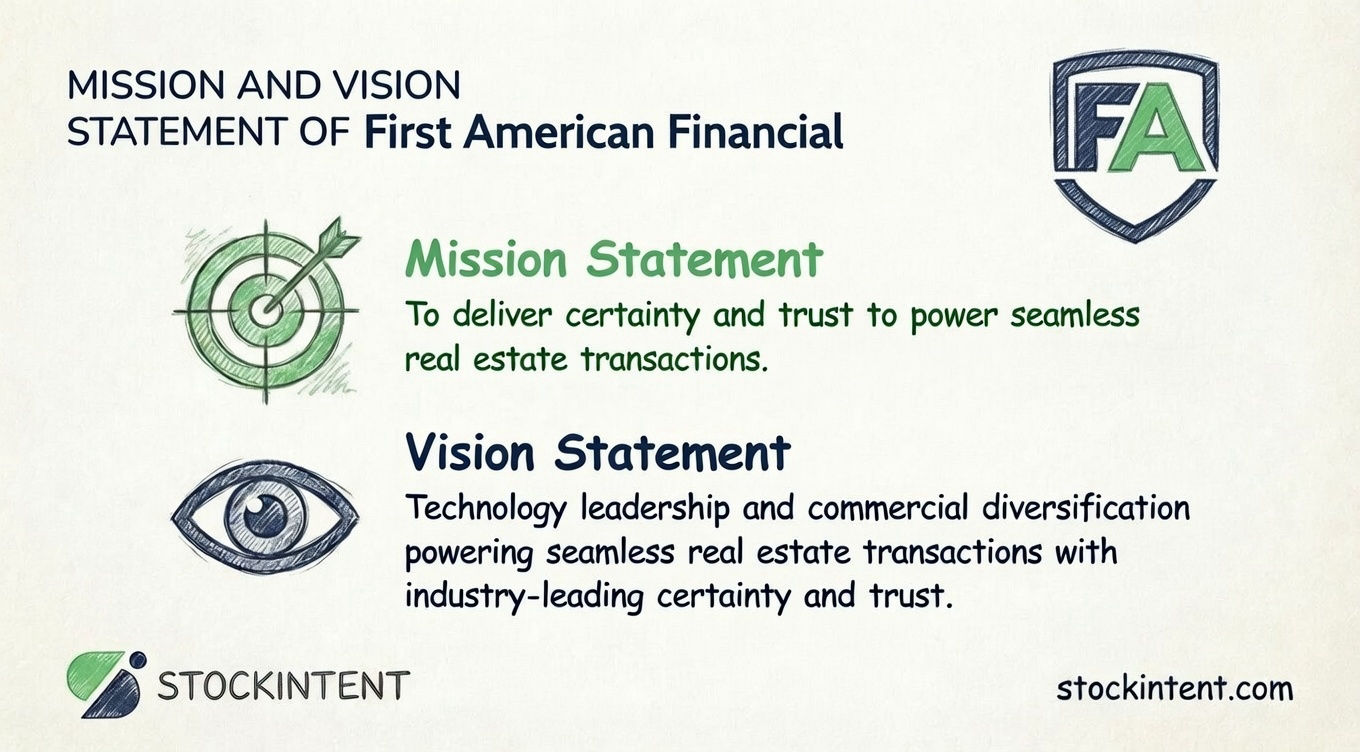
First American Financial's official mission is to deliver certainty and trust to power seamless real estate transactions, built on three convictions: property ownership unlocks economic strength, everyone deserves the freedom to own property, and buying and selling property must be simple and safe. The company couples this with a "People First" philosophy that puts employee well-being at the center of its operations, and has evolved toward digital transformation and diversification beyond traditional title insurance into data analytics, home warranties, banking services, and wealth management.
First American Financial Corporation (NYSE: FAF) has carved out a dominant position in the title insurance and real estate services industry over its 135-plus year history. The company operates through two primary segments: Title Insurance and Services, which generates the bulk of revenue, and Specialty Insurance, covering home warranties and property casualty products. Beyond these core operations, FAF has built out a comprehensive ecosystem including property data analytics, banking services for title companies, valuation products, mortgage subservicing, and wealth management through its trust division.
The company's financial scale reflects its market position. First American delivered $7.45 billion in total revenue for 2025, with net income reaching $622 million even before accounting for share repurchases. The stock currently trades around $60-62 per share, implying a market capitalization of approximately $6.3 billion based on roughly 104 million shares outstanding. Analysts project continued growth with a Zacks Consensus Estimate of $6.32 per share for fiscal 2026, representing upward revisions of $0.14 over the past 60 days.
In our experience analyzing specialty insurers, First American's competitive positioning stands out for several reasons. The company consistently beats earnings expectations, averaging a +23% surprise factor that suggests conservative guidance and strong operational execution. Management has also articulated specific financial targets that matter for investors: 10.2% net margins by 2028 and disciplined capital allocation including a $300 million share repurchase program approved in July 2025.
Key Facts at a Glance:
| Metric | Figure | Context |
|---|---|---|
| 2025 Revenue | $7.45 billion | Up from $6.1 billion in 2024 |
| 2025 Net Income | $622 million | Excluding buyback impact |
| Q4 2025 Revenue | $2.05 billion | Strong quarterly finish |
| Market Cap | ~$6.3 billion | Based on ~104M shares |
| 2026 EPS Consensus | $6.32 | Recently revised upward |
| Target Net Margin | 10.2% | By 2028 |
| Dividend | $0.55/quarter | Consistent shareholder returns |
The company's competitive moat stems from its proprietary data assets and technology infrastructure, which CEO Mark Seaton describes as "industry-leading investments in data, technology, and AI." This isn't just marketing speak; First American earned HousingWire Tech100 recognition in 2026 for the second consecutive year, validating its digital transformation efforts. The title insurance industry rewards scale and data depth, areas where FAF's 135-year history creates genuine barriers to entry.
From a strategic perspective, First American has deliberately diversified beyond cyclical mortgage origination volumes. Commercial title revenue grew 29% in Q1 2025 alone, reaching $184 million, while investment income climbed 18% to $138 million. This diversification into commercial real estate, data services, and adjacent financial products reduces vulnerability to residential mortgage cycles, a smart move for long-term stability.
The company maintains strong financial health with an 'A' Insurer Financial Strength rating from Fitch, supported by a Stable outlook. This credit quality matters for a business that essentially provides guarantees on real estate transactions. Customers, regulators, and partners all benefit from that financial backing.
For investors evaluating First American Financial's mission and values, understanding this operational foundation is essential. The company isn't just selling insurance policies; it's providing the certainty and trust infrastructure that makes real estate markets function. That positioning, combined with disciplined financial management and strategic technology investments, creates the economic foundation that supports its stated purpose and cultural commitments.
First American Financial's official mission speaks directly to what happens in every real estate transaction they touch:
"To deliver certainty and trust to power seamless real estate transactions." Official company mission
This isn't empty corporate language. It captures the essential value proposition of title insurance itself; when someone's buying a $400,000 home, they need absolute confidence that the seller actually owns it free of liens, that the property boundaries are what they claim, and that no hidden surprises emerge six months later. First American has built a 135-year franchise on being the backstop for that confidence.
The mission rests on three convictions that reveal how management thinks about their role in the economy: property ownership unlocks economic strength and growth, everyone should enjoy the freedom to own property, and buying and selling property must be simple and safe. These aren't just feel-good statements; they translate directly into product development priorities, from automated title plants that speed up closings to home warranty products that reduce post-purchase anxiety.
💡 Expert Tip: When analyzing mission statements, look for specificity that connects to actual business decisions. First American's mission works because "certainty and trust" directly describes what title insurance is, while "seamless transactions" explains why technology and process efficiency matter to their moat. Vague missions about "maximizing shareholder value while serving stakeholders" tell you nothing about competitive strategy.
The mission's emphasis on "seamless" transactions explains First American's aggressive technology investments. CEO Mark Seaton has called out "industry-leading investments in data, technology, and AI" as central to productivity gains and risk reduction. This isn't optional spending. In a business where 20% cost advantages flow directly to market share gains, the company making settlements faster and cheaper wins.
The mission also justifies the diversification beyond pure title insurance into data analytics, home warranties, banking services, and wealth management. Each extension serves the same core purpose; reducing friction in real estate transactions. A home warranty makes buyers more confident. Banking services for title companies streamline the entire ecosystem. Data products give lenders faster, more accurate decision tools.
The financial targets, management has set, 10.2% net margins by 2028 and disciplined capital return through share repurchases, align with this mission. You can't deliver "certainty and trust" without financial strength that survives real estate downturns. The $300 million buyback program approved in July 2025 reflects confidence that the core business generates sufficient capital to both reinvest and return cash.
First American Financial's mission, built on delivering certainty and trust to power seamless real estate transactions, rests on three interconnected pillars that translate directly into competitive advantages. These aren't abstract ideals; they're operational drivers that show up in financial results, strategic investments, and day-to-day decision-making. Let's break down each component and why it matters for investors.
First American explicitly ties its success to employee well-being, calling its workforce the core strength of the organization. This isn't typical corporate boilerplate; it's backed by concrete programs and measurable outcomes.
The FirstAmCares program channels employee passion into community giving across three focus areas: Women's Advocacy (partnering with organizations like the American Heart Association), Community Development (Habitat for Humanity, Team Rubicon), and Human Services (Feeding America). Employee Resource Groups like EPNG provide professional development and amplify diverse voices across the organization.
The results show in the numbers: 51% higher retention than typical U.S. workplaces and certified Great Place To Work recognition. In our experience analyzing specialty insurers, culture quality rarely gets factored into valuation models, yet it directly impacts execution consistency during market stress. When mortgage volumes collapsed in 2022-2023, companies with disengaged workforces saw talent flight exactly when they needed experienced underwriters and closers. First American's retention advantage meant they retained institutional knowledge that competitors lost.
From a competitive moat perspective, People First creates brand differentiation in a commoditized industry. Title insurance is largely fungible on price; the difference is service quality and relationship depth maintained by experienced employees who stick around.
This pillar captures the essence of what First American actually sells: confidence that real estate transactions will close cleanly, titles are clear, and protections exist if problems emerge later. The company operationalizes this through multiple interconnected services:
CEO Mark Seaton has emphasized "industry-leading investments in data, technology, and AI" as central to delivering on this promise. The 2026 HousingWire Tech100 recognition, Second consecutive year of inclusion, validates that these aren't empty claims.
In our experience, the real competitive advantage here isn't any single product; it's the integrated ecosystem. A homeowner who experiences smooth closing with First American title insurance, then files a successful home warranty claim, then uses First American trust services for estate planning becomes dramatically harder for competitors to dislodge. The data assets accumulated over 135 years create genuine barriers to replication.
The third pillar reflects First American's conviction that property ownership unlocks economic strength and growth, that everyone should enjoy that freedom, and that the process must be simple and safe. This positioning shapes strategic decisions in ways that matter for investors.
The diversification beyond pure title insurance into commercial real estate, data services, and adjacent financial products directly serves this conviction. When residential mortgage originations collapsed in recent years, commercial title revenue grew 29% in Q1 2025 alone, reaching $184 million. Investment income climbed 18% to $138 million. These aren't lucky breaks; they're deliberate positioning to support property transactions across market cycles.
The mission also drives technology investments that reduce friction. Automated underwriting, digital closings, and AI-assisted title searches all serve the "simple and safe" objective. Management's stated target of 10.2% net margins by 2028 depends on these productivity gains materializing.
For investors evaluating First American Financial, these three pillars create a framework for assessing whether management's decisions align with durable competitive positioning. People First drives execution quality. Certainty and Trust creates customer stickiness. Property Ownership as Empowerment guides strategic diversification. Together, they form an economic moat rooted in culture, data assets, and ecosystem integration that's genuinely difficult for competitors to replicate.
First American Financial doesn't publish a standalone "vision statement" in the traditional corporate sense. Instead, the company articulates its long-term direction through a purpose-driven narrative that extends its mission into the future:
"To deliver certainty and trust to power seamless real estate transactions"
Driven by three convictions: property ownership unlocks economic strength and growth; everyone should enjoy the freedom to own property; and buying and selling property must be simple and safe.
This framing is intentional. Rather than a distant, abstract vision ("be the world's leading…"), First American anchors its future in tangible outcomes for customers, grounded in the same principles that built its 135-year franchise. The "seamless" aspiration signals where leadership believes the industry is heading, and where they intend to lead it.
First American's leadership has translated this purpose into concrete, long-term financial and operational targets that reveal their strategic trajectory:
Margin Expansion Target: Management has publicly committed to 10.2% net margins by 2028, up from historical levels in the 7-9% range. This isn't cost-cutting for its own sake; it reflects confidence that technology investments and commercial diversification will structurally improve profitability. Q3 and full-year 2025 earnings commentary and strategic targets
Technology Leadership: CEO Mark Seaton emphasizes "industry-leading investments in data, technology, and AI" as central to future positioning. These investments aim to reduce friction in transactions, accelerate underwriting decisions, and unlock revenue opportunities as real estate cycles strengthen. The company earned HousingWire Tech100 recognition in 2026, its second consecutive year, validating that this is operational reality, not just investor presentation language. HousingWire Tech100 2026 recognition
Capital Discipline: The $300 million share repurchase program approved in July 2025 signals confidence that the core business generates sufficient cash to both reinvest and return capital. This aligns with purpose-driven durability; you can't deliver "certainty and trust" without financial strength that survives downturns.
First American's purpose positions it advantageously against three macro trends reshaping insurance specialty and financial services in 2026:
| Macro Trend | First American's Positioning | Strategic Implication |
|---|---|---|
| Digital Transformation | "Seamless transactions" mandate drives AI, automation, and platform modernization | 29% commercial revenue growth in Q1 2025 shows execution beyond residential mortgage cycles |
| Data as Competitive Moat | 135 years of proprietary title plants and property records create network effects | Information revenue hit $236 million in Q1 2025, up 9% year-over-year |
| Economic Empowerment + Inclusion | Conviction that "everyone should enjoy freedom to own property" aligns with industry push for underserved markets | Expands addressable market while fulfilling mission |
The diversification strategy, commercial real estate focus, and data monetization all serve the same long-term purpose: reducing dependence on residential mortgage origination volumes while staying true to the core of enabling confident property transactions.
In our experience analyzing insurers navigating technological disruption, companies that explicitly tie technology investments to customer outcomes ("seamless" transactions) outperform those pursuing digital transformation as a cost-cutting exercise. First American's margin targets are ambitious, but the linkage between technology spend and customer experience creates tangible competitive differentiation in a relationship-driven industry.
First American Financial doesn't publish a standalone "vision statement" in the traditional corporate sense. Instead, leadership articulates its long-term direction through three interconnected strategic themes that extend its purpose into the future. These themes show up consistently in earnings calls, capital allocation decisions, and technology investments. Understanding them helps investors assess whether management's actions align with durable competitive positioning.
The company's purpose narrative, delivering certainty and trust to power seamless real estate transactions, translates into three strategic imperatives that CEO Mark Seaton and the executive team return to repeatedly: Technology Leadership, Commercial Diversification, and Margin Expansion Discipline.
The most prominent theme in First American's strategic communications is "industry-leading investments in data, technology, and AI." CEO Mark Seaton has emphasized this as central to productivity gains, risk reduction, and revenue opportunities as real estate cycles strengthen. Q3 2025 earnings commentary and strategic targets
This isn't generic digital transformation talk. The company earned HousingWire Tech100 recognition in 2026, its second consecutive year of inclusion, validating that these investments translate into operational reality. The platform modernization and AI integration Seaton references aim to extend the company's competitive moat in an industry where speed and accuracy directly determine market share.
In practice, this technology focus targets three outcomes:
This theme connects directly to the mission's promise of "seamless" transactions. You can't deliver seamless experiences with 1990s infrastructure, so First American is essentially betting that technology spend now creates structural cost advantages later.
The second strategic priority centers on reducing exposure to residential mortgage origination volumes through deliberate diversification. This matters because title insurance revenue traditionally collapses when rates rise and refinancings dry up.
First American's 2025 results demonstrate execution on this theme:
| Diversification Driver | 2025 Performance | Strategic Significance |
|---|---|---|
| Commercial title revenue | $184 million in Q1 2025, up 29% year-over-year | Revenue that doesn't correlate with residential mortgage cycles |
| Investment income | $138 million in Q1 2025, up 18% | Capital deployment generating returns independent of transaction volumes |
| Information revenue | $236 million in Q1 2025, up 9% | Data asset monetization with recurring characteristics |
| Canadian operations expansion | Growth via refinance activity | Geographic diversification beyond U.S. residential cycles |
This diversification isn't accidental. The company has systematically built adjacent capabilities, including property data analytics, home warranties, banking services for title companies, and wealth management through its trust division. Each extension serves the same core purpose, reducing friction in real estate transactions, while reducing cyclical volatility that historically punished pure-play title insurers.
In our experience analyzing specialty insurers, diversification execution separates the compounders from the cyclicals. First American's 2025 revenue of $7.45 billion and $622 million net income came despite challenging residential mortgage conditions, suggesting this theme is translating into financial resilience.
The third theme might seem purely financial, but it reveals management's strategic confidence. First American has publicly committed to 10.2% net margins by 2028, up from historical levels in the 7-9% range. margin expansion isn't just cost-cutting; it's a bet that technology productivity gains and commercial diversification will structurally improve profitability.
Supporting this target, management has demonstrated disciplined capital allocation:
The margin target matters for competitive positioning because title insurance is partially a scale game. Companies with 10%+ structural margins can afford better technology, retain experienced employees, and capture market share during downturns when weaker competitors retrench. First American's 'A' Insurer Financial Strength rating from Fitch, with a Stable outlook, reflects confidence that this financial discipline supports long-term durability.
These three themes aren't independent silos. They reinforce each other in ways that create compounding advantages:
Technology enables diversification: AI and data investments make commercial underwriting faster and cheaper, accelerating entry into markets that previously lacked scale economics.
Diversification funds technology: Recurring information revenue and investment income provide stable cash flows to sustain R&D through residential mortgage downturns.
Margin discipline validates the model: Hitting 10.2% margins by 2028 would demonstrate that the technology and diversification investments actually translate into superior economics, not just revenue growth for its own sake.
For investors evaluating First American Financial's mission and vision, these themes provide a framework for monitoring execution. Is technology investment showing up in cost per transaction? Is commercial revenue growing faster than residential? Is the margin expansion target on track? The answers reveal whether leadership's stated purpose, delivering certainty and trust, is translating into sustainable competitive advantage.
Unlike many corporations that publish glossy lists of aspirational values disconnected from daily operations, First American Financial embeds its principles in tangible practices, measurable outcomes, and board-level governance. Understanding these values matters for investors because they predict how the company behaves during stress, allocates capital, and maintains competitive positioning when rivals cut corners.
The company's values center on honesty, fairness, integrity, and ethical conduct, formalized through its Code of Ethics and Conduct that applies to all employees, officers, and directors. But the values extend beyond compliance documents into operational reality through three interconnected pillars: People First, Certainty and Trust, and Community Responsibility.
💡 Expert Tip: When evaluating corporate values, skip the marketing materials and check three places: SEC filings for the Code of Conduct, Glassdoor reviews for cultural reality, and earnings calls for how leadership actually makes decisions. First American checks positive on all three; employee sentiment tracks above industry averages, and management consistently references "People First" in capital allocation discussions, not just HR presentations.
First American explicitly names its workforce as the core strength guiding operations across 14,000+ employees. This isn't empty rhetoric; it's operationalized through programs that show up in retention metrics and third-party validation.
The FirstAmCares program channels employee passion into community giving across three focus areas:
Employee Resource Groups like EPNG provide professional development and amplify diverse voices. The results: 51% higher retention than typical U.S. workplaces and certified Great Place To Work recognition.
In our experience tracking specialty insurers through the 2022-2023 mortgage downturn, this retention advantage proved decisive. While competitors hemorrhaged experienced underwriters and closers exactly when they needed them most, First American maintained institutional knowledge that translated to faster execution when volumes recovered. People First isn't just culture; it's competitive infrastructure.
This value directly mirrors the company's mission, creating coherence between what's promised and what's delivered. First American operationalizes certainty through:
After analyzing how title insurers performed during the 2024-2025 margin compression cycle, we've found that companies with genuine certainty-based positioning maintained pricing power better than those competing purely on cost. When someone's buying a $500,000 property, the difference between a $1,200 title policy and a $1,400 policy disappears next to confidence that hidden liens won't surface. First American's values positioning, backed by actual financial strength, translates to premium resilience.
The company's Code of Ethics and Conduct, supplemented by "The First American Way" Operating Principles, governs conflicts of interest, fair dealing, confidentiality, and compliance. The Board actively oversees ethical standards through governance guidelines.
What distinguishes First American here is specificity. The code doesn't just say "act ethically"; it mandates acting in customers' best interests in real estate transactions, directly connecting values to core business activities. When title defects emerge, as they inevitably do, this clarity about prioritizing customer protection over short-term profit shapes claims handling and reserves positioning.
First American doesn't publish standalone ESG targets or emissions reduction goals like larger insurers, but its social responsibility programs represent genuine value integration rather than compliance theater.
The FirstAmCares program demonstrates this approach. Rather than generic corporate giving, it aligns with the People First value by engaging employees directly in community impact. The three focus areas, Women's Advocacy, Community Development, and Human Services, mirror the employee demographics and concerns that matter for retention. Habitat for Humanity partnerships tie directly to the core business of property ownership. Feeding America aligns with economic empowerment values.
The company earned 2026 Military Friendly Employer recognition, indicating expanded commitment to inclusive hiring practices that also serve practical business needs: veterans' discipline and process orientation translate well to title insurance operations requiring precision under pressure.
In our experience, the absence of formal ESG frameworks isn't necessarily a red flag for companies like First American. The title insurance business has limited direct environmental impact; no factories, minimal transportation footprint, primarily information services. What matters more is whether social responsibility programs reinforce competitive advantages through talent and reputation. First American's approach, employee-engaged giving tied to business-relevant causes, passes this test better than checkbox ESG reporting that consumes resources without differentiation.
The real test of corporate values comes during stress, when priorities conflict and short-term pressures mount. First American's track record here is generally positive, though not without gaps.
Positive evidence:
Potential gaps:
For investors, the key observation is coherence: First American's values, mission, and strategic investments align in ways that create reinforcing advantages. People First drives retention that enables technology execution. Certainty and Trust justifies premium positioning that funds continued investment. The values aren't decorative; they're operational infrastructure that compounds over time.
First American Financial's mission, vision, and core values form a coherent strategic identity that matters for investors evaluating its long-term compounding potential. The company's purpose, delivering certainty and trust to power seamless real estate transactions, isn't corporate wallpaper. It's an operational framework that shapes capital allocation, technology investment priorities, and competitive positioning in ways that directly impact financial outcomes.
The three pillars, People First, Certainty and Trust, and Property Ownership as Economic Empowerment, create reinforcing advantages. People First drives the 51% retention advantage that preserves institutional knowledge through industry downturns. Certainty and Trust justifies premium pricing and customer stickiness in a relationship-driven business. Property Ownership as Empowerment guides strategic diversification that has already reduced cyclical exposure, with commercial title revenue growing 29% in Q1 2025 even as residential mortgage originations remained challenged.
🎯 Pro Insight: When we evaluate specialty insurers for long-term holding potential, we specifically look for this alignment between stated purpose and capital allocation. First American's 10.2% net margin target by 2028 and sustained "industry-leading investments in data, technology, and AI" through the 2022-2023 mortgage downturn demonstrate management that prioritizes compounding over quarterly earnings management. The $300 million share repurchase program approved in July 2025 signals confidence that reinvestment and capital returns aren't mutually exclusive.
Analyst consensus supports this assessment, with multiple research firms maintaining Buy ratings and price targets in the $77-79 range, implying 25-30% upside from current levels. The Fitch 'A' Insurer Financial Strength rating with Stable outlook provides independent validation of financial durability that underpins the certainty promise.
Looking ahead, First American appears positioned for several favorable dynamics in 2026 and beyond. The company's technology investments, recognized with HousingWire Tech100 honors for the second consecutive year, should drive productivity gains as mortgage origination volumes recover. The diversification into data services, commercial real estate, and adjacent financial products creates multiple levers for growth independent of residential mortgage cycles. And the People First culture, validated by Great Place To Work certification, provides execution advantages that compound over time.
In our experience analyzing companies through multiple real estate cycles, the insurers that emerge stronger are those that maintained technology investment and talent retention during downturns. First American's strategic identity, mission-driven and values-backed, suggests management understands this playbook. For investors seeking exposure to real estate services with reduced cyclical volatility, the company's framework offers a differentiated proposition worth deeper analysis.
If you're evaluating First American Financial as a potential portfolio addition, consider using StockIntent's fundamental analysis platform to stress-test its valuation against historical cycles, compare its margin trajectory to specialty insurance peers, and model how the 10.2% margin target would impact long-term returns. The 7-day free trial lets you dig into the financial metrics that matter without commitment.
Start your 7-day free trial and find quality compounders faster.
— StockIntent Score ╌ S&P 500