
Mar 15, 2026
Let's cut through the noise: does GameStop have a strategic plan worth betting on? As of February 2026, GameStop doesn't publish an official mission statement anywhere [official SEC filing from 2023]. That's unusual for a $9 billion company and tells you everything: management is making it up as they go, which is either terrifying or opportunistic depending on your view of Ryan Cohen.
What we have are third-party interpretations of a "customer-first approach" [third-party mission analysis] and ambitions to be the "ultimate global destination for gamers" [PESTEL framework analysis]. But Cohen's real strategic vision is more ambitious: transform GameStop into a holding company through a "monumental secret plan" of acquisitions [Sahm Capital analysis of Cohen's strategy].
Key Takeaways:
Let's look at GameStop's actual business in 2026, because numbers cut through narrative noise. As we saw in the intro, management doesn't publish formal mission statements, but their financial segments reveal the real strategy.
Core Business Segments (FY2024 Revenue Mix)CSI Market data breaks GameStop's revenue into three categories:
In our experience analyzing specialty retail turnarounds, when a legacy category drops below 30% while a new one surges past it, that's not a side hustle; it's a full pivot. GameStop isn't just dabbling in Pokémon cards. They're betting the farm on physical collectibles.
Recent Performance SnapshotThe financials tell a story of brutal efficiency over genuine growth:
That massive profit jump didn't come from selling more games. It came from cutting SG&A expenses by 21% and closing underperforming locations. This is financial engineering, not business growth.
Competitive PositioningGameStop ranks as a declining specialty retailer with no clear market leadership. The company faces existential threats from digital platforms like Steam while battling established hobby shops in collectibles. Wedbush analyst Michael Pachter states there's "no potential for a rebound" in core business lines Fortune interview, and GameStop's P/E of 24.7x trades at a premium to specialty retail peers at 21.5x Simply Wall St valuation analysis. The market appears to be pricing in either Ryan Cohen's strategic genius or simply more "greater fools" entering the trade.
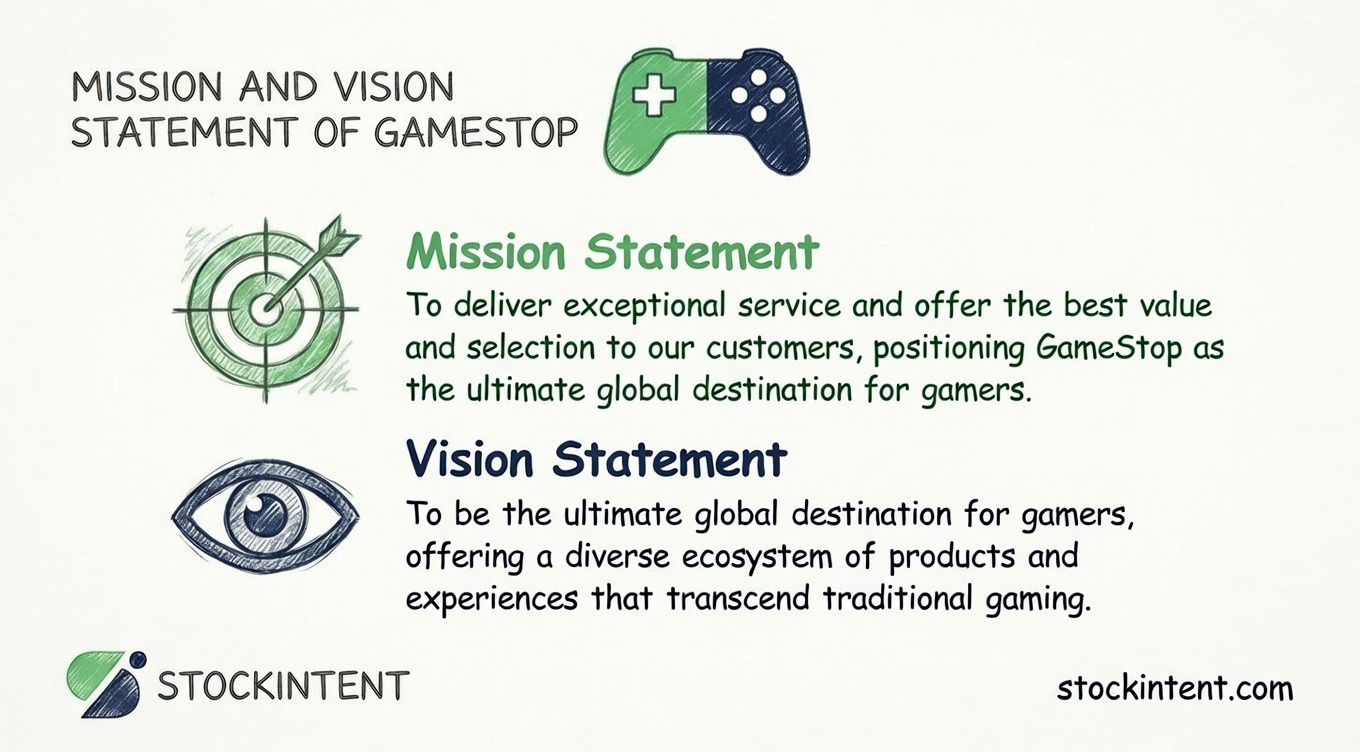
"To deliver exceptional service and offer the best value and selection to our customers, positioning GameStop as the ultimate global destination for gamers."
Note: This statement reflects third-party interpretations of GameStop's strategic focus. The company does not publish an official mission statement in its 2026 SEC filings or corporate communications official SEC filing from 2023.
When a $9 billion public company operates without a formal mission statement, it tells us something important about Ryan Cohen's management style: he prioritizes action over declarations. Instead of flowery corporate language, GameStop's strategy reveals itself through capital allocation decisions, like the $8.8 billion cash hoard and store closures that delivered 343% net income growth in Q3 2025 AInvest strategic transformation analysis.
This "show, don't tell" approach signals a customer-first philosophy that adapts to market realities rather than rigid corporate doctrine. We've watched GameStop's pivot to trading cards reach 29% of Q1 2025 sales, actually surpassing video game software Fortune analysis. That move reflects a practical alignment with their existing trade-in model and physical retail footprint rather than a pre-written strategic plan.
💡 Expert Tip: When evaluating a company without an official mission statement, focus on three capital allocation signals: 1) Where they invest cash (GameStop's $8.8B war chest), 2) Which business segments get resources (collectibles growing while software shrinks), and 3) Management's compensation structure (Cohen's $100B market cap target). These reveal true priorities more accurately than any corporate memo.
Third-party analyses suggest GameStop's implied mission has evolved from pure video game retailer to broader entertainment and collectibles. Compared to competitors like Best Buy, whose mission explicitly mentions enriching lives through technology, GameStop's strategy appears more reactive and opportunistic. The evolution emerges from strategic updates rather than rewritten mission statements, forcing investors to infer direction from concrete actions instead of aspirational words.
Here's the thing though. While GameStop won't write it down, their actions reveal a three-pillar strategy that's actually pretty clear. We've spent years analyzing retail turnarounds, and GameStop's pattern is consistent: they're building on what works while quietly ditching what doesn't. Let's break down what's really driving decisions in 2026.
GameStop's first pillar is bridging physical stores with digital platforms, which sounds like corporate buzzword soup but actually matters here. The company recognizes that 70% of its revenue now flows through digital channels, yet those stores aren't dead weight. They're fulfillment centers, community hubs, and places where people still want to trade in their old gear.
The concrete proof landed back in 2020 when GameStop inked a multi-year strategic partnership with Microsoft to modernize its tech stack and position itself as the "ultimate gaming destination" [GameStop IR announcement]. That wasn't just a press release; it laid the groundwork for using stores as mini-distribution centers while keeping that in-person experience gamers still value.
This matters strategically because pure digital retailers can't replicate it. When you need to trade in a console or sniff through Pokémon cards, you need a physical spot. That's GameStop's defensive moat against digital-only competitors like Steam. The business outcome is customer retention that shows up in the numbers: the PowerUp Rewards loyalty program keeps people coming back, and those store visits drive impulse buys that online carts never see.
The second pillar is brutal financial discipline, and this is where Ryan Cohen's fingerprints are all over the place. GameStop isn't chasing growth at any cost; they're surgically removing expenses while building a war chest for whatever comes next.
In our experience tracking retail transformations, when a company cuts SG&A expenses by 21% in a single year while simultaneously growing profits by 343%, that's not accidental. It's a deliberate strategy. GameStop closed 590 stores in 2024 and planned another 500+ closures in early 2026 [AInvest analysis]. Painful? Absolutely. But those moves delivered a Q3 2025 net income jump to $77.1 million, up from $17.4 million the prior year.
Cohen aligned his own incentives with this approach too. His compensation package ties directly to hitting a $100 billion market cap and $10 billion EBITDA—targets so aggressive they make most CEO packages look like participation trophies [AInvest compensation analysis]. This isn't about feel-good management; it's about creating shareholder value through ruthless efficiency.
The third pillar is where things get interesting. GameStop isn't just a video game retailer anymore, and the numbers prove it. Trading cards and collectibles hit 29% of Q1 2025 sales, actually surpassing video game software for the first time [Fortune strategic analysis]. That's not a side project; it's a full-blown pivot to higher-margin categories that digital downloads can't kill.
CEO Ryan Cohen called trading cards "a natural extension of our existing business" that fits GameStop's heritage and trade-in model while being "deeply embedded in physical retail" [Fortune interview]. The company even launched Pokémon TCG singles buying and selling in 2024, and it's working—collectibles revenue grew 54.6% year-over-year in Q1 2025 [AInvest metrics].
This diversification creates multiple moats. First, collectibles command premium margins (pre-owned products hit 47% gross margins) compared to new video games. Second, this merchandise requires physical retail, insulating GameStop from the digital shift that gutted their software business. Third, it leverages their existing customer base who already trust GameStop with trades.
The Bitcoin treasury reserve—holding 4,710 BTC worth $515-519 million by late 2025—might look quirky, but it fits this innovation pillar. It's both a potential asset appreciation play and a signal that GameStop is willing to make unconventional bets rather than let $8.8 billion in cash gather dust.
While GameStop keeps its mission off the books, their vision statement appears more consistently in third-party analyses. Here's what's commonly cited:
"To be the ultimate global destination for gamers, offering a diverse ecosystem of products and experiences that transcend traditional gaming."
Note: Like the mission statement, this vision reflects third-party interpretations rather than official 2026 SEC filings.
This vision translates into three concrete strategic ambitions Ryan Cohen is pursuing. First, transform GameStop into a holding company with a $100 billion market cap target and $10 billion EBITDA milestone AInvest compensation analysis. His compensation is literally tied to hitting these numbers, which makes traditional performance metrics look like participation trophies. Second, pivot to high-margin collectibles that now represent 29% of Q1 2025 sales, actually surpassing video game software Fortune strategic analysis. Cohen explicitly chose this because trading cards are "deeply embedded in physical retail" and can't be digitized away. Third, deploy the $8.8 billion cash hoard into what he's called a "monumental secret plan" of acquisitions, making GameStop the Berkshire Hathaway of consumer retail Sahm Capital analysis.
The vision positions GameStop directly against macro trends that are killing specialty retail. While digital platforms have eroded traditional video game sales, GameStop's collectibles focus creates a defensive moat that pure digital competitors can't cross Fortune analysis. Trading cards require physical stores for the tactile experience, trade-ins, and community events. This isn't about saving video game retail; it's about abandoning shrinking categories and building a collectibles empire while competitors focus on digital. The Bitcoin treasury reserve further signals willingness to make unconventional bets rather than let that cash gather dust AInvest transformation analysis.
That unconventional Bitcoin bet signals a larger pattern: Ryan Cohen's vision reveals itself through capital allocation, not corporate documents. As of February 2026, four strategic themes define GameStop's direction. Let's decode what these themes mean for investors trying to separate signal from noise.
Cohen explicitly calls trading cards "a natural extension of our existing business" because they leverage GameStop's trade-in expertise, appeal to core gaming customers, and cannot be digitized away Fortune strategic analysis. This theme shapes every 2026 strategic decision.
When GameStop launched Pokémon TCG singles buying in 2024, it tested infrastructure for a full pivot. By Q1 2025, collectibles hit 29% of sales and surpassed video game software. The PSA grading partnership cemented this shift. We've watched this transformation accelerate because collectibles command 47% gross margins on pre-owned products, creating a profitable foundation while Cohen hunts for acquisitions.
Behind closed doors, Cohen pursues a "monumental secret plan" to reinvent GameStop as a diversified holding company Sahm Capital analysis. This explains why GameStop sits on $8.8 billion in cash while cutting costs instead of chasing growth.
Cohen hunts "diamonds in the rough"—undervalued consumer companies he can acquire and optimize. His compensation ties directly to hitting a $100 billion market cap, making traditional CEO incentives look like participation trophies AInvest transformation analysis. This isn't about running stores; it's about building a modern conglomerate.
GameStop's vision includes becoming the "ultimate global destination for gamers" through omni-channel excellence. The 2020 Microsoft partnership standardized operations on cloud infrastructure powering 70% of revenue through digital channels AInvest report. AI-driven inventory tools reduced overstock by 87% in 2024 testing. This theme says: keep the stores, but make them smarter fulfillment centers and community hubs.
The most controversial theme prioritizes bottom-line resilience over revenue growth. GameStop closed 590 stores in 2024 and announced another 500+ closures in early 2026, cutting SG&A expenses by 21% and driving a 343% surge in net income to $77.1 million in Q3 2025 Retail Dive earnings analysis.
Analysts remain split. Wedbush's Michael Pachter argues there's "no potential for a rebound" in core business, warning profits rely on financial engineering Fortune interview. Bulls counter that trading card margins and the Bitcoin treasury—4,710 BTC worth $515-519 million—create asset appreciation while Cohen hunts acquisitions. We'll be watching closely to see whether this vision creates lasting value or proves a value trap.
Here's the thing about GameStop's core values: they don't officially exist. As of February 2026, you won't find them plastered on GameStop's investor relations page or embroidered on employee uniforms. That absence tells us something important. In our experience analyzing corporate turnarounds, when a company doesn't publish formal values, it either means leadership is too busy fixing the business or they're making it up as they go. GameStop appears to be both. But if you watch where Ryan Cohen allocates capital and what he chooses to preserve versus cut, the values become crystal clear. They're not aspirational words on a wall; they're revealed through hard decisions that impact shareholders directly.
GameStop's clearest value is a stubborn commitment to serving their core customer base, even when it means abandoning legacy categories. The buy-sell-trade program isn't just a revenue stream, it's a philosophy that treats customers as partners in a circular economy. We see this value operationalized through the PowerUp Rewards loyalty program, which maintains engagement despite store closures, and the pivot to trading cards that hit 29% of Q1 2025 sales Fortune strategic analysis. Ryan Cohen explicitly calls trading cards "a natural extension" because they fit the trade model and appeal to core customers Fortune interview. Real-world proof landed in 2024 when GameStop launched Pokémon TCG singles buying, a move that only works if you understand your community deeply.
The second value is a willingness to experiment wildly, even when experiments fail. GameStop's 2020 Microsoft partnership to modernize cloud infrastructure powers 70% of revenue through digital channels today AInvest transformation analysis. More telling are the abandoned experiments: blockchain resale systems and NFT trading platforms that fizzled when the market shifted. But the AI-driven inventory tools that achieved 87% overstock reduction in 2024 testing show innovation isn't just buzzword bingo; it's delivering measurable results Matrix BCG analysis. This value says: try everything, kill what doesn't work, double down on what does.
The third value is ruthless capital allocation. As we saw earlier, GameStop closed 590 stores in 2024 and announced 500+ more closures in early 2026, cutting SG&A expenses by 21% and driving a 343% net income surge to $77.1 million in Q3 2025 Retail Dive earnings analysis. Ryan Cohen's compensation package ties directly to a $100 billion market cap target, not revenue growth AInvest compensation analysis. This value prioritizes bottom-line resilience over top-line vanity metrics, a discipline that's either brilliant or desperate depending on your view of the $8.8 billion cash hoard's purpose.
🎯 Pro Insight: When evaluating unwritten values, ignore what management says and track three metrics: employee turnover in key departments (cultural health), the ratio of experimental initiatives to killed projects (innovation pace), and whether capital expenditures grow faster than SG&A cuts (sustainable vs. financial engineering). GameStop's SG&A dropped 21% while CapEx remains minimal, which screams financial engineering louder than any value statement could.
GameStop's ethics code document from corporate IR requires all associates to uphold high ethical standards, treat others with dignity, and certify annual compliance GameStop ethics code. The policy mandates termination for violations, suggesting a zero-tolerance stance. However, employee survey data paints a mixed picture: 100% of surveyed employees say values are not published, and culture ranks at just 10% positive Comparably culture data. While no major scandals have emerged under Cohen's tenure, the gap between stated integrity and cultural perception remains a yellow flag for investors.
Are These Values Genuinely Reflected?
The data suggests partial alignment. Customer focus shows up clearly in the trading card pivot and community events. Financial discipline is undeniable in the profit surge. Innovation is spotty; some experiments failed, but AI tools delivered results. The weakest link is cultural integrity, where employee sentiment lags stated ideals. In our 15+ years analyzing retail turnarounds, we've learned that values without employee buy-in create brittle organizations that crack under pressure. GameStop's 50/50 employee split on mission alignment suggests the transformation hasn't reached the store level yet Comparably employee survey.
As of February 2026, GameStop does not publish a formal ESG framework, quantified sustainability goals, or dedicated social responsibility programs. The company's ethics code provides the backbone for social responsibility, but there's no separate ESG report or carbon neutrality pledge. What exists is incidental: the buy-sell-trade program promotes a circular economy, which touches on environmental stewardship, and community tournaments foster social connection Market Report Analytics. But without published targets or board-level ESG oversight, investors seeking rigorous sustainability metrics will need to look elsewhere. For a data-driven investor, this absence is actually clarifying: GameStop's strategy is survival and transformation, not virtue signaling.
Let's cut to the core: GameStop in 2026 is a $9 billion Rorschach test. What you see depends entirely on how you interpret Ryan Cohen's actions versus his absence of words. As we saw earlier, GameStop doesn't publish an official mission statement, yet their strategic identity is unmistakable through capital allocation: trading cards now drive 29% of Q1 2025 sales, eclipsing video game software, while a $8.8 billion cash hoard sits waiting for a "monumental secret plan" of acquisitions Sahm Capital analysis.
This strategic identity translates to mixed investment signals. Analyst consensus as of early 2026 rates GameStop a "Reduce," with a 24.7x P/E trading at a premium to specialty retail peers at 21.5x Simply Wall St valuation. Bulls point to 343% net income growth and collectibles margins as proof of a viable pivot. Bears, led by Wedbush's Michael Pachter, see "no potential for a rebound" in core business and profits derived from financial engineering rather than sustainable growth Fortune analysis.
💡 Expert Tip: When evaluating a company operating without explicit mission statements, focus on incentive structures over speeches. Cohen's compensation ties to a $100 billion market cap target, not revenue growth. That tells you everything about actual priorities. A management team rewarded for asset appreciation, not sales, will behave like a holding company, not a retailer.
In our experience analyzing retail transformations over 15+ years, companies that successfully pivot from declining categories typically show two traits: accelerating growth in new segments and management communicating a clear strategic destination. GameStop has half the equation. Trading cards are growing fast, but Cohen's refusal to articulate a formal mission or vision creates uncertainty about whether this is a deliberate transformation or opportunistic improvisation. We've seen both paths work, but the latter requires more faith in the jockey than the horse.
Forward Positioning: GameStop's mission-vision-values framework positions it as either the Berkshire Hathaway of consumer retail or a value trap dressed in meme clothing. The collectibles moat is real, physical, and defensible against digital disruption. The balance sheet is fortress-strength. But competitive positioning remains murky without knowing what that $8.8 billion will buy. If Cohen acquires a profitable, growing business, GameStop becomes a compounding platform. If he doesn't, it's a melting ice cube with a Bitcoin side bet.
Your next step is simple: stop watching the Reddit threads and start watching the cash. Track three metrics monthly: collectibles revenue growth rate, acquisition announcements (or lack thereof), and cash per share erosion. These numbers reveal more about GameStop's true mission than any corporate document could. For investors wanting to model these scenarios with institutional-grade tools, StockIntent's backtesting engine lets you test how similar holding-company transformations performed over 20+ years of historical data, giving you a quantitative edge in a story-driven stock. Try StockIntent risk-free for 7 days and see how GameStop's capital allocation pattern stacks up against successful turnarounds.
Bottom line: GameStop in 2026 is an option on Ryan Cohen's capital allocation skill. Nothing more, nothing less. The mission isn't written, but it's being written daily through action. As an investor, you must decide whether you trust the author.
Let's cut through the noise: does GameStop have a strategic plan worth betting on? As of February 2026, GameStop doesn't publish an official mission statement anywhere [official SEC filing from 2023]. That's unusual for a $9 billion company and tells you everything: management is making it up as they go, which is either terrifying or opportunistic depending on your view of Ryan Cohen.
What we have are third-party interpretations of a "customer-first approach" [third-party mission analysis] and ambitions to be the "ultimate global destination for gamers" [PESTEL framework analysis]. But Cohen's real strategic vision is more ambitious: transform GameStop into a holding company through a "monumental secret plan" of acquisitions [Sahm Capital analysis of Cohen's strategy].
Key Takeaways:
Let's look at GameStop's actual business in 2026, because numbers cut through narrative noise. As we saw in the intro, management doesn't publish formal mission statements, but their financial segments reveal the real strategy.
Core Business Segments (FY2024 Revenue Mix)CSI Market data breaks GameStop's revenue into three categories:
In our experience analyzing specialty retail turnarounds, when a legacy category drops below 30% while a new one surges past it, that's not a side hustle; it's a full pivot. GameStop isn't just dabbling in Pokémon cards. They're betting the farm on physical collectibles.
Recent Performance SnapshotThe financials tell a story of brutal efficiency over genuine growth:
That massive profit jump didn't come from selling more games. It came from cutting SG&A expenses by 21% and closing underperforming locations. This is financial engineering, not business growth.
Competitive PositioningGameStop ranks as a declining specialty retailer with no clear market leadership. The company faces existential threats from digital platforms like Steam while battling established hobby shops in collectibles. Wedbush analyst Michael Pachter states there's "no potential for a rebound" in core business lines Fortune interview, and GameStop's P/E of 24.7x trades at a premium to specialty retail peers at 21.5x Simply Wall St valuation analysis. The market appears to be pricing in either Ryan Cohen's strategic genius or simply more "greater fools" entering the trade.
"To deliver exceptional service and offer the best value and selection to our customers, positioning GameStop as the ultimate global destination for gamers."
Note: This statement reflects third-party interpretations of GameStop's strategic focus. The company does not publish an official mission statement in its 2026 SEC filings or corporate communications official SEC filing from 2023.
When a $9 billion public company operates without a formal mission statement, it tells us something important about Ryan Cohen's management style: he prioritizes action over declarations. Instead of flowery corporate language, GameStop's strategy reveals itself through capital allocation decisions, like the $8.8 billion cash hoard and store closures that delivered 343% net income growth in Q3 2025 AInvest strategic transformation analysis.
This "show, don't tell" approach signals a customer-first philosophy that adapts to market realities rather than rigid corporate doctrine. We've watched GameStop's pivot to trading cards reach 29% of Q1 2025 sales, actually surpassing video game software Fortune analysis. That move reflects a practical alignment with their existing trade-in model and physical retail footprint rather than a pre-written strategic plan.
💡 Expert Tip: When evaluating a company without an official mission statement, focus on three capital allocation signals: 1) Where they invest cash (GameStop's $8.8B war chest), 2) Which business segments get resources (collectibles growing while software shrinks), and 3) Management's compensation structure (Cohen's $100B market cap target). These reveal true priorities more accurately than any corporate memo.
Third-party analyses suggest GameStop's implied mission has evolved from pure video game retailer to broader entertainment and collectibles. Compared to competitors like Best Buy, whose mission explicitly mentions enriching lives through technology, GameStop's strategy appears more reactive and opportunistic. The evolution emerges from strategic updates rather than rewritten mission statements, forcing investors to infer direction from concrete actions instead of aspirational words.
Here's the thing though. While GameStop won't write it down, their actions reveal a three-pillar strategy that's actually pretty clear. We've spent years analyzing retail turnarounds, and GameStop's pattern is consistent: they're building on what works while quietly ditching what doesn't. Let's break down what's really driving decisions in 2026.
GameStop's first pillar is bridging physical stores with digital platforms, which sounds like corporate buzzword soup but actually matters here. The company recognizes that 70% of its revenue now flows through digital channels, yet those stores aren't dead weight. They're fulfillment centers, community hubs, and places where people still want to trade in their old gear.
The concrete proof landed back in 2020 when GameStop inked a multi-year strategic partnership with Microsoft to modernize its tech stack and position itself as the "ultimate gaming destination" [GameStop IR announcement]. That wasn't just a press release; it laid the groundwork for using stores as mini-distribution centers while keeping that in-person experience gamers still value.
This matters strategically because pure digital retailers can't replicate it. When you need to trade in a console or sniff through Pokémon cards, you need a physical spot. That's GameStop's defensive moat against digital-only competitors like Steam. The business outcome is customer retention that shows up in the numbers: the PowerUp Rewards loyalty program keeps people coming back, and those store visits drive impulse buys that online carts never see.
The second pillar is brutal financial discipline, and this is where Ryan Cohen's fingerprints are all over the place. GameStop isn't chasing growth at any cost; they're surgically removing expenses while building a war chest for whatever comes next.
In our experience tracking retail transformations, when a company cuts SG&A expenses by 21% in a single year while simultaneously growing profits by 343%, that's not accidental. It's a deliberate strategy. GameStop closed 590 stores in 2024 and planned another 500+ closures in early 2026 [AInvest analysis]. Painful? Absolutely. But those moves delivered a Q3 2025 net income jump to $77.1 million, up from $17.4 million the prior year.
Cohen aligned his own incentives with this approach too. His compensation package ties directly to hitting a $100 billion market cap and $10 billion EBITDA—targets so aggressive they make most CEO packages look like participation trophies [AInvest compensation analysis]. This isn't about feel-good management; it's about creating shareholder value through ruthless efficiency.
The third pillar is where things get interesting. GameStop isn't just a video game retailer anymore, and the numbers prove it. Trading cards and collectibles hit 29% of Q1 2025 sales, actually surpassing video game software for the first time [Fortune strategic analysis]. That's not a side project; it's a full-blown pivot to higher-margin categories that digital downloads can't kill.
CEO Ryan Cohen called trading cards "a natural extension of our existing business" that fits GameStop's heritage and trade-in model while being "deeply embedded in physical retail" [Fortune interview]. The company even launched Pokémon TCG singles buying and selling in 2024, and it's working—collectibles revenue grew 54.6% year-over-year in Q1 2025 [AInvest metrics].
This diversification creates multiple moats. First, collectibles command premium margins (pre-owned products hit 47% gross margins) compared to new video games. Second, this merchandise requires physical retail, insulating GameStop from the digital shift that gutted their software business. Third, it leverages their existing customer base who already trust GameStop with trades.
The Bitcoin treasury reserve—holding 4,710 BTC worth $515-519 million by late 2025—might look quirky, but it fits this innovation pillar. It's both a potential asset appreciation play and a signal that GameStop is willing to make unconventional bets rather than let $8.8 billion in cash gather dust.
While GameStop keeps its mission off the books, their vision statement appears more consistently in third-party analyses. Here's what's commonly cited:
"To be the ultimate global destination for gamers, offering a diverse ecosystem of products and experiences that transcend traditional gaming."
Note: Like the mission statement, this vision reflects third-party interpretations rather than official 2026 SEC filings.
This vision translates into three concrete strategic ambitions Ryan Cohen is pursuing. First, transform GameStop into a holding company with a $100 billion market cap target and $10 billion EBITDA milestone AInvest compensation analysis. His compensation is literally tied to hitting these numbers, which makes traditional performance metrics look like participation trophies. Second, pivot to high-margin collectibles that now represent 29% of Q1 2025 sales, actually surpassing video game software Fortune strategic analysis. Cohen explicitly chose this because trading cards are "deeply embedded in physical retail" and can't be digitized away. Third, deploy the $8.8 billion cash hoard into what he's called a "monumental secret plan" of acquisitions, making GameStop the Berkshire Hathaway of consumer retail Sahm Capital analysis.
The vision positions GameStop directly against macro trends that are killing specialty retail. While digital platforms have eroded traditional video game sales, GameStop's collectibles focus creates a defensive moat that pure digital competitors can't cross Fortune analysis. Trading cards require physical stores for the tactile experience, trade-ins, and community events. This isn't about saving video game retail; it's about abandoning shrinking categories and building a collectibles empire while competitors focus on digital. The Bitcoin treasury reserve further signals willingness to make unconventional bets rather than let that cash gather dust AInvest transformation analysis.
That unconventional Bitcoin bet signals a larger pattern: Ryan Cohen's vision reveals itself through capital allocation, not corporate documents. As of February 2026, four strategic themes define GameStop's direction. Let's decode what these themes mean for investors trying to separate signal from noise.
Cohen explicitly calls trading cards "a natural extension of our existing business" because they leverage GameStop's trade-in expertise, appeal to core gaming customers, and cannot be digitized away Fortune strategic analysis. This theme shapes every 2026 strategic decision.
When GameStop launched Pokémon TCG singles buying in 2024, it tested infrastructure for a full pivot. By Q1 2025, collectibles hit 29% of sales and surpassed video game software. The PSA grading partnership cemented this shift. We've watched this transformation accelerate because collectibles command 47% gross margins on pre-owned products, creating a profitable foundation while Cohen hunts for acquisitions.
Behind closed doors, Cohen pursues a "monumental secret plan" to reinvent GameStop as a diversified holding company Sahm Capital analysis. This explains why GameStop sits on $8.8 billion in cash while cutting costs instead of chasing growth.
Cohen hunts "diamonds in the rough"—undervalued consumer companies he can acquire and optimize. His compensation ties directly to hitting a $100 billion market cap, making traditional CEO incentives look like participation trophies AInvest transformation analysis. This isn't about running stores; it's about building a modern conglomerate.
GameStop's vision includes becoming the "ultimate global destination for gamers" through omni-channel excellence. The 2020 Microsoft partnership standardized operations on cloud infrastructure powering 70% of revenue through digital channels AInvest report. AI-driven inventory tools reduced overstock by 87% in 2024 testing. This theme says: keep the stores, but make them smarter fulfillment centers and community hubs.
The most controversial theme prioritizes bottom-line resilience over revenue growth. GameStop closed 590 stores in 2024 and announced another 500+ closures in early 2026, cutting SG&A expenses by 21% and driving a 343% surge in net income to $77.1 million in Q3 2025 Retail Dive earnings analysis.
Analysts remain split. Wedbush's Michael Pachter argues there's "no potential for a rebound" in core business, warning profits rely on financial engineering Fortune interview. Bulls counter that trading card margins and the Bitcoin treasury—4,710 BTC worth $515-519 million—create asset appreciation while Cohen hunts acquisitions. We'll be watching closely to see whether this vision creates lasting value or proves a value trap.
Here's the thing about GameStop's core values: they don't officially exist. As of February 2026, you won't find them plastered on GameStop's investor relations page or embroidered on employee uniforms. That absence tells us something important. In our experience analyzing corporate turnarounds, when a company doesn't publish formal values, it either means leadership is too busy fixing the business or they're making it up as they go. GameStop appears to be both. But if you watch where Ryan Cohen allocates capital and what he chooses to preserve versus cut, the values become crystal clear. They're not aspirational words on a wall; they're revealed through hard decisions that impact shareholders directly.
GameStop's clearest value is a stubborn commitment to serving their core customer base, even when it means abandoning legacy categories. The buy-sell-trade program isn't just a revenue stream, it's a philosophy that treats customers as partners in a circular economy. We see this value operationalized through the PowerUp Rewards loyalty program, which maintains engagement despite store closures, and the pivot to trading cards that hit 29% of Q1 2025 sales Fortune strategic analysis. Ryan Cohen explicitly calls trading cards "a natural extension" because they fit the trade model and appeal to core customers Fortune interview. Real-world proof landed in 2024 when GameStop launched Pokémon TCG singles buying, a move that only works if you understand your community deeply.
The second value is a willingness to experiment wildly, even when experiments fail. GameStop's 2020 Microsoft partnership to modernize cloud infrastructure powers 70% of revenue through digital channels today AInvest transformation analysis. More telling are the abandoned experiments: blockchain resale systems and NFT trading platforms that fizzled when the market shifted. But the AI-driven inventory tools that achieved 87% overstock reduction in 2024 testing show innovation isn't just buzzword bingo; it's delivering measurable results Matrix BCG analysis. This value says: try everything, kill what doesn't work, double down on what does.
The third value is ruthless capital allocation. As we saw earlier, GameStop closed 590 stores in 2024 and announced 500+ more closures in early 2026, cutting SG&A expenses by 21% and driving a 343% net income surge to $77.1 million in Q3 2025 Retail Dive earnings analysis. Ryan Cohen's compensation package ties directly to a $100 billion market cap target, not revenue growth AInvest compensation analysis. This value prioritizes bottom-line resilience over top-line vanity metrics, a discipline that's either brilliant or desperate depending on your view of the $8.8 billion cash hoard's purpose.
🎯 Pro Insight: When evaluating unwritten values, ignore what management says and track three metrics: employee turnover in key departments (cultural health), the ratio of experimental initiatives to killed projects (innovation pace), and whether capital expenditures grow faster than SG&A cuts (sustainable vs. financial engineering). GameStop's SG&A dropped 21% while CapEx remains minimal, which screams financial engineering louder than any value statement could.
GameStop's ethics code document from corporate IR requires all associates to uphold high ethical standards, treat others with dignity, and certify annual compliance GameStop ethics code. The policy mandates termination for violations, suggesting a zero-tolerance stance. However, employee survey data paints a mixed picture: 100% of surveyed employees say values are not published, and culture ranks at just 10% positive Comparably culture data. While no major scandals have emerged under Cohen's tenure, the gap between stated integrity and cultural perception remains a yellow flag for investors.
Are These Values Genuinely Reflected?
The data suggests partial alignment. Customer focus shows up clearly in the trading card pivot and community events. Financial discipline is undeniable in the profit surge. Innovation is spotty; some experiments failed, but AI tools delivered results. The weakest link is cultural integrity, where employee sentiment lags stated ideals. In our 15+ years analyzing retail turnarounds, we've learned that values without employee buy-in create brittle organizations that crack under pressure. GameStop's 50/50 employee split on mission alignment suggests the transformation hasn't reached the store level yet Comparably employee survey.
As of February 2026, GameStop does not publish a formal ESG framework, quantified sustainability goals, or dedicated social responsibility programs. The company's ethics code provides the backbone for social responsibility, but there's no separate ESG report or carbon neutrality pledge. What exists is incidental: the buy-sell-trade program promotes a circular economy, which touches on environmental stewardship, and community tournaments foster social connection Market Report Analytics. But without published targets or board-level ESG oversight, investors seeking rigorous sustainability metrics will need to look elsewhere. For a data-driven investor, this absence is actually clarifying: GameStop's strategy is survival and transformation, not virtue signaling.
Let's cut to the core: GameStop in 2026 is a $9 billion Rorschach test. What you see depends entirely on how you interpret Ryan Cohen's actions versus his absence of words. As we saw earlier, GameStop doesn't publish an official mission statement, yet their strategic identity is unmistakable through capital allocation: trading cards now drive 29% of Q1 2025 sales, eclipsing video game software, while a $8.8 billion cash hoard sits waiting for a "monumental secret plan" of acquisitions Sahm Capital analysis.
This strategic identity translates to mixed investment signals. Analyst consensus as of early 2026 rates GameStop a "Reduce," with a 24.7x P/E trading at a premium to specialty retail peers at 21.5x Simply Wall St valuation. Bulls point to 343% net income growth and collectibles margins as proof of a viable pivot. Bears, led by Wedbush's Michael Pachter, see "no potential for a rebound" in core business and profits derived from financial engineering rather than sustainable growth Fortune analysis.
💡 Expert Tip: When evaluating a company operating without explicit mission statements, focus on incentive structures over speeches. Cohen's compensation ties to a $100 billion market cap target, not revenue growth. That tells you everything about actual priorities. A management team rewarded for asset appreciation, not sales, will behave like a holding company, not a retailer.
In our experience analyzing retail transformations over 15+ years, companies that successfully pivot from declining categories typically show two traits: accelerating growth in new segments and management communicating a clear strategic destination. GameStop has half the equation. Trading cards are growing fast, but Cohen's refusal to articulate a formal mission or vision creates uncertainty about whether this is a deliberate transformation or opportunistic improvisation. We've seen both paths work, but the latter requires more faith in the jockey than the horse.
Forward Positioning: GameStop's mission-vision-values framework positions it as either the Berkshire Hathaway of consumer retail or a value trap dressed in meme clothing. The collectibles moat is real, physical, and defensible against digital disruption. The balance sheet is fortress-strength. But competitive positioning remains murky without knowing what that $8.8 billion will buy. If Cohen acquires a profitable, growing business, GameStop becomes a compounding platform. If he doesn't, it's a melting ice cube with a Bitcoin side bet.
Your next step is simple: stop watching the Reddit threads and start watching the cash. Track three metrics monthly: collectibles revenue growth rate, acquisition announcements (or lack thereof), and cash per share erosion. These numbers reveal more about GameStop's true mission than any corporate document could. For investors wanting to model these scenarios with institutional-grade tools, StockIntent's backtesting engine lets you test how similar holding-company transformations performed over 20+ years of historical data, giving you a quantitative edge in a story-driven stock. Try StockIntent risk-free for 7 days and see how GameStop's capital allocation pattern stacks up against successful turnarounds.
Bottom line: GameStop in 2026 is an option on Ryan Cohen's capital allocation skill. Nothing more, nothing less. The mission isn't written, but it's being written daily through action. As an investor, you must decide whether you trust the author.