GE Aerospace Mission Statement, Vision & Core Values Explained

GE Aerospace Mission Statement, Vision & Core Values Explained

GE Aerospace Mission Statement, Vision & Core Values

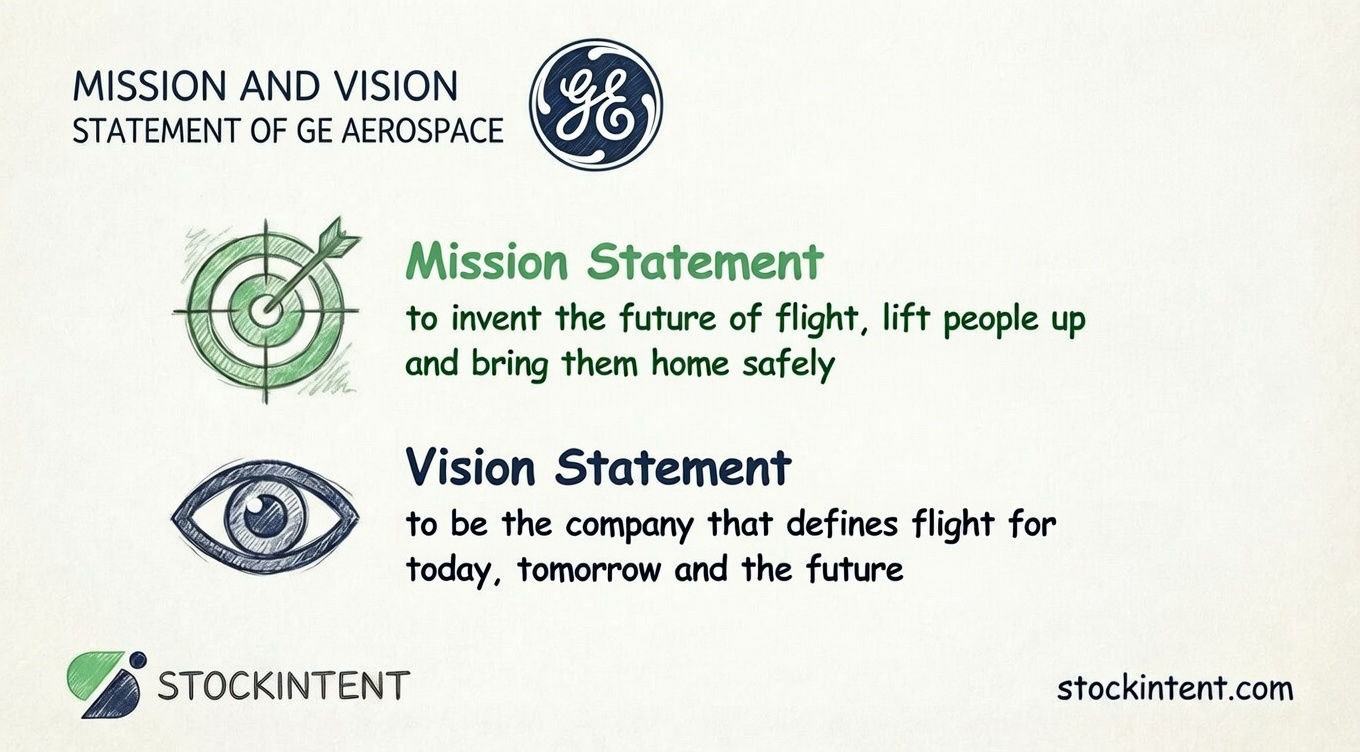
If you're trying to figure out what makes GE Aerospace tick as an investment, its mission and vision statements are a solid starting point. This aerospace giant doesn't actually publish a traditional mission statement. Instead, its vision is "to be the company that defines flight for today, tomorrow and the future" with a purpose to "invent the future of flight, lift people up and bring them home safely" [1][7]. Understanding these statements matters because they reveal how management allocates capital across a $190 billion backlog and builds durable competitive advantages in specialty industrial machinery [1][4].

Key Takeaways:

  • GE Aerospace's 2026 vision centers on defining aviation's future through innovation and safety
  • Four core values drive culture: Act with Humility, Lead with Transparency, Deliver with Focus, and Unyielding Integrity [3]
  • Strategic evolution emphasizes sustainable aviation, lifecycle engine management, and aftermarket services growth [1][3]
  • Recent organizational changes integrate commercial engine operations for improved efficiency and customer service [3]
  • Analysts view this mission-driven approach as creating a durable competitive moat in aerospace propulsion [1][2]

Here's what these strategic elements actually mean for investors analyzing this aerospace powerhouse.

Company Overview

GE Aerospace has carved out a dominant position in the specialty industrial machinery sector by focusing exclusively on what it does best: designing, manufacturing, and servicing the engines that power global aviation. Following its 2024 spin-off from the former GE conglomerate, the company now operates as a pure-play aerospace powerhouse with a laser focus on propulsion technology and lifecycle services.

In our experience tracking industrial transformations, GE Aerospace's integrated model creates a structural advantage that's hard to replicate. The company runs two core segments that generate both upfront equipment sales and decades of high-margin aftermarket revenue. Their Commercial Engines & Services division commands roughly 73% of total revenue, delivering $31.9 billion in 2025 alone audited 10-K filing. This segment covers everything from LEAP engines for narrow-body aircraft to the massive GE9X powering Boeing's 777X, plus comprehensive maintenance and repair operations.

What They Actually Do: 2026 Operations Snapshot

  • Two Business Segments: Commercial Engines & Services (CES) and Defense & Propulsion Technologies (DPT)
  • 2025 CES Revenue: $31.9B with services growing 26% year-over-year to $24.2B audited 10-K filing
  • Engine Deliveries: LEAP program hit record 1,800+ units in 2025 (up 28%) fourth-quarter earnings release
  • Defense Growth: DPT revenue up 11% with 22% profit growth to $1.3B audited 10-K filing
  • Market Backlog: Approximately $190B in future orders providing multi-year visibility fourth-quarter earnings release
  • Global Reach: 37,000+ engines in service across 120 countries
  • Investment Pipeline: Nearly $1B committed to U.S. manufacturing and technology in 2025 industry analysis
  • Innovation Focus: CFM RISE program targeting 20% efficiency gains for next-generation aircraft industry analysis

The company's competitive positioning stems from this dual revenue stream. While competitors often focus solely on new engine sales, GE Aerospace captures value throughout a 20+ year engine lifecycle. Their installed base generates predictable services revenue that smooths cyclical downturns and funds continuous R&D, creating what analysts call a "structural moat" in aerospace propulsion Leeham News analysis. This matters because aviation's multi-year development cycles and certification requirements create massive barriers to entry, effectively locking in GE Aerospace's market leadership for decades.

GE Aerospace Mission Statement

So what actually drives a company with 37,000 engines in service and a $190 billion backlog? The mission. Here's the thing though, GE Aerospace doesn't publish a traditional mission statement like you'd expect from an industrial giant. Instead, they operate with a clear purpose: "to invent the future of flight, lift people up and bring them home safely" GE Aerospace official site. Their vision is equally straightforward: "to be the company that defines flight for today, tomorrow and the future" GE corporate taxonomy.

What This Actually Signals for Investors

This framing reveals three critical priorities that shape every 2026 capital decision. First, "invent the future" means management is betting heavily on next-generation programs like CFM RISE, not just optimizing existing engines. Second, "lift people up" extends beyond passengers to include workforce development, like their $30 million commitment to train 10,000 advanced manufacturing technicians by 2030 GE Aerospace philanthropy report. Third, "bring them home safely" puts quality and reliability at the center of their FLIGHT DECK operating model, which drove over 40% growth in priority supplier material inputs last year GE Aerospace supplier update.

The mission directly shapes capital allocation patterns. With nearly three-quarters of 2025 revenue coming from high-margin services GE Aerospace 10-K filing, management prioritizes investments that strengthen the full lifecycle model. This creates a self-reinforcing cycle where today's R&D spending generates decades of future service revenue.

💡 Expert Tip: Here's what separates GE Aerospace from typical manufacturers. Their 2026 strategy allocates massive capital toward MRO capacity and digital inspection tools, which earn 30-40% margins versus 15-20% on new equipment sales. When you see a company invest 75% of growth capital into aftermarket infrastructure, you're looking at a business that has transcended manufacturing and become a genuine compounding machine. That mission-driven focus on the full engine lifecycle is exactly what creates those durable economic moats we discussed earlier.

This purpose-driven approach explains why GE Aerospace commands premium valuations in the specialty industrial machinery sector, they've engineered a business where mission and economic returns amplify each other rather than conflict.

Mission Components / Pillars

Here's where the rubber meets the runway. GE Aerospace's purpose, "invent the future of flight, lift people up and bring them home safely," isn't just corporate poetry, it's actually three distinct strategic pillars that drive every capital decision in 2026. Each one creates its own competitive advantage, and together they form what analysts call a "structural moat" that's nearly impossible to replicate.

Invent the Future of Flight

This is the innovation engine that keeps GE Aerospace ahead of the pack. In our experience analyzing industrial compounders, companies that bet big on next-generation tech while milking their current portfolio tend to outperform those just optimizing the status quo.

GE is pouring resources into the CFM RISE program, targeting a 20% efficiency leap for next-gen narrowbody aircraft GE Aerospace technology roadmap. The LEAP engine program delivered over 1,800 units in 2025, up 28% year-over-year, and that momentum is carrying into 2026 audited 10-K filing. The GE9X, powering Boeing's 777X, is on track for certification with 10% better efficiency than previous generations.

Why this matters strategically: innovation creates a two-decade revenue stream. While competitors chase quarterly margins, GE's R&D spending today generates service contracts through 2045. That aftermarket business earns 30-40% margins compared to 15-20% on new equipment sales investor earnings release. When you see nearly 75% of growth capital flowing into digital inspection tools and MRO capacity, you're looking at a company that's transcended manufacturing.

Lift People Up

This pillar is about building the human infrastructure that makes everything else possible. GE Aerospace committed $30 million to train 10,000 advanced manufacturing technicians by 2030, plus $2.5 million in 2025 workforce development donations across 45 facilities 2025 philanthropy report.

The strategic angle? The U.S. faces a 3.8 million manufacturing worker shortfall by 2033 workforce development article. By building its own talent pipeline now, GE secures operational capacity while competitors scramble for skilled labor. This isn't feel-good philanthropy, it's a direct investment in the company's ability to execute that $190 billion backlog fourth-quarter earnings.

Bring Them Home Safely

This is the reliability pillar that drives the aftermarket goldmine. GE's FLIGHT DECK operating model integrates safety, quality, delivery, and cost across 37,000 engines in service worldwide earnings release. Defense deliveries surged 83% in Q3 2025, and predictive maintenance technologies are reducing unplanned downtime for commercial customers supplier update.

The business outcome is massive: steady, high-margin services revenue that smooths cyclical downturns. When airlines trust your engines with passenger safety, they lock in 20-year service agreements. That creates predictable cash flows and a customer base that's practically immovable. Add in the regulatory barriers to entry, and you've got an economic moat that's both wide and deep.

GE Aerospace Vision Statement

Here's the actual vision that drives capital allocation at this $190 billion backlog company:

"To be the company that defines flight for today, tomorrow, and the future."

That's it. No corporate jargon, no 12-paragraph manifesto. Just a clear declaration that GE Aerospace intends to own the aviation narrative across every time horizon.

This vision translates into three concrete strategic ambitions. First, defining flight for today means executing on that massive backlog through the FLIGHT DECK operating system, which drove 25% growth in engine deliveries in 2025 and over 40% increases in supplier material inputs GE Aerospace supplier update. It's about operational excellence here and now.

Second, tomorrow refers to the mid-term investments reshaping the business. GE is pumping nearly $1 billion into U.S. manufacturing and technology in 2025 alone, while expanding its Singapore facilities for next-gen coating technologies and module repairs Singapore Airshow announcements. This isn't random spending, it's building the infrastructure to support the next decade of growth.

Third, the future is where things get really interesting. The CFM RISE program targeting 20% efficiency gains through open fan architecture and hybrid electric systems positions GE at the forefront of sustainable aviation GE Aerospace technology roadmap. When the industry talks about decarbonization, GE wants its technology to be the default answer.

So how does this vision align with specialty industrial machinery trends? Perfectly. The sector is moving toward lifecycle value over one-time sales, digital transformation for operational efficiency, and sustainability mandates that require massive R&D. GE's vision hits all three: it's building a 20-year service revenue stream per engine, deploying AI-driven inspection tools, and positioning itself as the green aviation leader while competitors scramble to catch up.

Vision Components / Themes

GE Aerospace's vision, "to be the company that defines flight for today, tomorrow, and the future," isn't just aspirational wording, it's actually a three-part strategic roadmap that shapes where every dollar of that $190 billion backlog gets allocated. Let's break down what each time horizon really means for their 2026 strategy.

Defining Flight for Today

This theme is all about operational excellence and execution on the massive order book. GE's FLIGHT DECK operating model serves as the backbone here, driving a 25% increase in engine deliveries during 2025 and over 40% growth in priority supplier material inputs GE Aerospace supplier update.

The strategic priority is straightforward: deliver what you promised, when you promised it. Leadership highlighted this repeatedly in Q4 2025 earnings calls, emphasizing how FLIGHT DECK integrates safety, quality, delivery, and cost across 37,000 engines in service. The metrics tell the story, LEAP engine deliveries hit a record 1,800+ units in 2025 (up 28% year-over-year), while commercial engine services revenue jumped 26% to $24.2 billion audited 10-K filing.

Building Flight for Tomorrow

Tomorrow's flight is about building the infrastructure and capabilities that will support the next decade of growth. GE Aerospace committed nearly $1 billion to U.S. manufacturing and technology investments in 2025 alone industry analysis. This isn't maintenance spending, it's strategic capacity building.

The Singapore Airshow announcements in 2026 revealed the scope of this thinking: an AI Center of Excellence for digital inspections, new REACH-compliant coating technologies, and a module repair facility at Seletar Aerospace Park for LEAP high-pressure turbine operations across Asia-Pacific and Middle East markets Singapore Airshow announcements. These moves address a critical bottleneck, the company needs more MRO capacity to handle the 20-year service lifecycle of each engine sold.

Inventing Flight for the Future

The future component is where GE Aerospace places its biggest technology bets. The CFM RISE program, targeting 20% efficiency gains through open fan architecture and hybrid electric systems, represents the company's answer to aviation decarbonization GE Aerospace technology roadmap.

This isn't just R&D for its own sake. Leadership has explicitly tied RISE to the vision's "future" component, positioning it as the default technology platform for next-generation narrowbody aircraft. The program's real-world demonstrations with airlines and airports show GE isn't just developing technology in isolation, they're building an ecosystem. Analysts note this positions GE advantageously as the industry faces mounting sustainability mandates, creating a potential 20-year competitive moat if RISE delivers as promised Leeham News analysis.

How Themes Translate to Competitive Advantage

Industry analysts interpret this three-horizon vision as management's way of balancing short-term execution with long-term value creation. Leeham News notes that operational traction via FLIGHT DECK sustains higher volumes into 2026, while the AIAA emphasizes that GE's structural advantage comes from this integrated approach: today's service revenues fund tomorrow's capacity, which enables the future's breakthrough innovations. Each theme reinforces the others, creating a self-reinforcing cycle where operational excellence generates cash, capacity investments enable growth, and innovation secures the next generation of leadership.

GE Aerospace Core Values

Every company claims to have values, but at GE Aerospace they actually shape how management allocates that $190 billion backlog we discussed earlier. The four core values aren't just posters on a wall, they filter down to daily decisions on the factory floor and in the boardroom: Act with Humility, Lead with Transparency, Deliver with Focus, and Unyielding Integrity GE Aerospace Code of Conduct.

Act with Humility

This value means recognizing there's always room for improvement, even when you're the market leader. In our experience analyzing industrial giants, the ones who survive decades are those that never believe their own hype. GE operationalizes this through Continuous Improvement programs that drove a 40% increase in priority supplier material inputs last year supplier update. The LEAP engine program hitting 1,800+ deliveries in 2025 wasn't luck, it was humble engineers constantly refining production processes.

Lead with Transparency

GE's commitment to open reporting and ethical decision-making shows up in their FLIGHT DECK operating model, which integrates safety, quality, delivery, and cost metrics across all operations. The company publishes detailed sustainability data and faces tough questions head-on in earnings calls. This transparency builds trust with airline customers who need to know their engines are reliable for 20+ year service cycles.

Deliver with Focus

With roughly 73% of revenue coming from Commercial Engines & Services, GE maintains ruthless focus on what they do best audited 10-K filing. This isn't a conglomerate chasing shiny objects anymore. The 2026 organizational integration of commercial engine operations under one leader eliminates silos and accelerates decision-making. Focus shows up in capital allocation too, nearly $1 billion targeted specifically at aerospace manufacturing capacity.

💡 Expert Tip: When evaluating any company's values, look at where they spend money, not what they say. GE's 2025 philanthropy report shows $30 million committed to training 10,000 manufacturing technicians by 2030 philanthropy report. That's not PR, that's building the talent pipeline to execute their backlog. Real values show up in budget line items.

Unyielding Integrity

This is the non-negotiable foundation. GE's recognition as one of Ethisphere's World's Most Ethical Companies in 2024 validates this isn't just talk Ethisphere recognition. The Code of Conduct applies equally to factory workers and C-suite executives. When you're building engines that keep millions of passengers safe annually, integrity isn't optional, it's the business model.

ESG as a Value Extension

These four values directly enable GE's ESG commitments. Environmental stewardship shows up in the CFM RISE program targeting 20% efficiency gains. Social responsibility manifests in workforce training investments addressing the 3.8 million manufacturing worker shortfall projected by 2033. Governance standards are embedded in the FLIGHT DECK model that drove 25% growth in engine deliveries. The values and ESG strategy aren't separate initiatives, they're the same thing viewed through different lenses.

After tracking industrial companies for years, we've found that businesses where values genuinely drive operations tend to produce more predictable cash flows. GE Aerospace's core values aren't perfect, but they create a cultural moat that supports the structural economic moat we analyzed earlier. For investors using platforms like StockIntent to evaluate long-term compounders, these cultural foundations are leading indicators of durable returns.

Strategic Summary

Here's what GE Aerospace's mission, vision, and values mean for your portfolio. GE Aerospace has engineered a strategic identity where purpose and profit amplify each other, creating a rare combination in specialty industrial machinery.

This isn't just corporate talk. The "invent the future" purpose drives R&D spending that generates 20-year service revenue streams. The "define flight" vision shapes a three-horizon plan: execute today's backlog, build tomorrow's capacity, and secure the future through CFM RISE technology roadmap. And those four core values? They show up in budget line items, like the $30 million committed to workforce training philanthropy report, not just posters on walls.

📌 From Our Experience: After tracking industrial compounders for years, we've found companies that genuinely integrate values into operations produce more predictable cash flows. GE's FLIGHT DECK model, which drove that 40% increase in supplier inputs supplier update, demonstrates how cultural systems create competitive moats. When you see a manufacturer hitting record deliveries while building next-gen tech, you're looking at management that understands capital allocation.

Analysts agree. The current consensus shows a "Moderate Buy" rating with an average $319 price target MarketBeat, reflecting confidence in management's ability to convert the $190 billion backlog earnings release into durable profits. Wall Street's view on GE Aerospace's competitive positioning is clear: this is a quality compounder with a structural moat in aerospace propulsion, not a cyclical machinery play.

Looking ahead to 2026 and beyond, no fundamental shifts to the mission appear likely. Instead, expect deeper execution: expanded AI-driven inspections Singapore Airshow, accelerated RISE, and possible bolt-on acquisitions. For investors using platforms like StockIntent to screen for quality compounders, GE Aerospace's mission-driven capital allocation offers a textbook case of how vision translates into long-term shareholder returns.

GE Aerospace Mission Statement, Vision & Core Values

If you're trying to figure out what makes GE Aerospace tick as an investment, its mission and vision statements are a solid starting point. This aerospace giant doesn't actually publish a traditional mission statement. Instead, its vision is "to be the company that defines flight for today, tomorrow and the future" with a purpose to "invent the future of flight, lift people up and bring them home safely" [1][7]. Understanding these statements matters because they reveal how management allocates capital across a $190 billion backlog and builds durable competitive advantages in specialty industrial machinery [1][4].

Key Takeaways:

  • GE Aerospace's 2026 vision centers on defining aviation's future through innovation and safety
  • Four core values drive culture: Act with Humility, Lead with Transparency, Deliver with Focus, and Unyielding Integrity [3]
  • Strategic evolution emphasizes sustainable aviation, lifecycle engine management, and aftermarket services growth [1][3]
  • Recent organizational changes integrate commercial engine operations for improved efficiency and customer service [3]
  • Analysts view this mission-driven approach as creating a durable competitive moat in aerospace propulsion [1][2]

Here's what these strategic elements actually mean for investors analyzing this aerospace powerhouse.

Company Overview

GE Aerospace has carved out a dominant position in the specialty industrial machinery sector by focusing exclusively on what it does best: designing, manufacturing, and servicing the engines that power global aviation. Following its 2024 spin-off from the former GE conglomerate, the company now operates as a pure-play aerospace powerhouse with a laser focus on propulsion technology and lifecycle services.

In our experience tracking industrial transformations, GE Aerospace's integrated model creates a structural advantage that's hard to replicate. The company runs two core segments that generate both upfront equipment sales and decades of high-margin aftermarket revenue. Their Commercial Engines & Services division commands roughly 73% of total revenue, delivering $31.9 billion in 2025 alone audited 10-K filing. This segment covers everything from LEAP engines for narrow-body aircraft to the massive GE9X powering Boeing's 777X, plus comprehensive maintenance and repair operations.

What They Actually Do: 2026 Operations Snapshot

  • Two Business Segments: Commercial Engines & Services (CES) and Defense & Propulsion Technologies (DPT)
  • 2025 CES Revenue: $31.9B with services growing 26% year-over-year to $24.2B audited 10-K filing
  • Engine Deliveries: LEAP program hit record 1,800+ units in 2025 (up 28%) fourth-quarter earnings release
  • Defense Growth: DPT revenue up 11% with 22% profit growth to $1.3B audited 10-K filing
  • Market Backlog: Approximately $190B in future orders providing multi-year visibility fourth-quarter earnings release
  • Global Reach: 37,000+ engines in service across 120 countries
  • Investment Pipeline: Nearly $1B committed to U.S. manufacturing and technology in 2025 industry analysis
  • Innovation Focus: CFM RISE program targeting 20% efficiency gains for next-generation aircraft industry analysis

The company's competitive positioning stems from this dual revenue stream. While competitors often focus solely on new engine sales, GE Aerospace captures value throughout a 20+ year engine lifecycle. Their installed base generates predictable services revenue that smooths cyclical downturns and funds continuous R&D, creating what analysts call a "structural moat" in aerospace propulsion Leeham News analysis. This matters because aviation's multi-year development cycles and certification requirements create massive barriers to entry, effectively locking in GE Aerospace's market leadership for decades.

GE Aerospace Mission Statement

So what actually drives a company with 37,000 engines in service and a $190 billion backlog? The mission. Here's the thing though, GE Aerospace doesn't publish a traditional mission statement like you'd expect from an industrial giant. Instead, they operate with a clear purpose: "to invent the future of flight, lift people up and bring them home safely" GE Aerospace official site. Their vision is equally straightforward: "to be the company that defines flight for today, tomorrow and the future" GE corporate taxonomy.

What This Actually Signals for Investors

This framing reveals three critical priorities that shape every 2026 capital decision. First, "invent the future" means management is betting heavily on next-generation programs like CFM RISE, not just optimizing existing engines. Second, "lift people up" extends beyond passengers to include workforce development, like their $30 million commitment to train 10,000 advanced manufacturing technicians by 2030 GE Aerospace philanthropy report. Third, "bring them home safely" puts quality and reliability at the center of their FLIGHT DECK operating model, which drove over 40% growth in priority supplier material inputs last year GE Aerospace supplier update.

The mission directly shapes capital allocation patterns. With nearly three-quarters of 2025 revenue coming from high-margin services GE Aerospace 10-K filing, management prioritizes investments that strengthen the full lifecycle model. This creates a self-reinforcing cycle where today's R&D spending generates decades of future service revenue.

💡 Expert Tip: Here's what separates GE Aerospace from typical manufacturers. Their 2026 strategy allocates massive capital toward MRO capacity and digital inspection tools, which earn 30-40% margins versus 15-20% on new equipment sales. When you see a company invest 75% of growth capital into aftermarket infrastructure, you're looking at a business that has transcended manufacturing and become a genuine compounding machine. That mission-driven focus on the full engine lifecycle is exactly what creates those durable economic moats we discussed earlier.

This purpose-driven approach explains why GE Aerospace commands premium valuations in the specialty industrial machinery sector, they've engineered a business where mission and economic returns amplify each other rather than conflict.

Mission Components / Pillars

Here's where the rubber meets the runway. GE Aerospace's purpose, "invent the future of flight, lift people up and bring them home safely," isn't just corporate poetry, it's actually three distinct strategic pillars that drive every capital decision in 2026. Each one creates its own competitive advantage, and together they form what analysts call a "structural moat" that's nearly impossible to replicate.

Invent the Future of Flight

This is the innovation engine that keeps GE Aerospace ahead of the pack. In our experience analyzing industrial compounders, companies that bet big on next-generation tech while milking their current portfolio tend to outperform those just optimizing the status quo.

GE is pouring resources into the CFM RISE program, targeting a 20% efficiency leap for next-gen narrowbody aircraft GE Aerospace technology roadmap. The LEAP engine program delivered over 1,800 units in 2025, up 28% year-over-year, and that momentum is carrying into 2026 audited 10-K filing. The GE9X, powering Boeing's 777X, is on track for certification with 10% better efficiency than previous generations.

Why this matters strategically: innovation creates a two-decade revenue stream. While competitors chase quarterly margins, GE's R&D spending today generates service contracts through 2045. That aftermarket business earns 30-40% margins compared to 15-20% on new equipment sales investor earnings release. When you see nearly 75% of growth capital flowing into digital inspection tools and MRO capacity, you're looking at a company that's transcended manufacturing.

Lift People Up

This pillar is about building the human infrastructure that makes everything else possible. GE Aerospace committed $30 million to train 10,000 advanced manufacturing technicians by 2030, plus $2.5 million in 2025 workforce development donations across 45 facilities 2025 philanthropy report.

The strategic angle? The U.S. faces a 3.8 million manufacturing worker shortfall by 2033 workforce development article. By building its own talent pipeline now, GE secures operational capacity while competitors scramble for skilled labor. This isn't feel-good philanthropy, it's a direct investment in the company's ability to execute that $190 billion backlog fourth-quarter earnings.

Bring Them Home Safely

This is the reliability pillar that drives the aftermarket goldmine. GE's FLIGHT DECK operating model integrates safety, quality, delivery, and cost across 37,000 engines in service worldwide earnings release. Defense deliveries surged 83% in Q3 2025, and predictive maintenance technologies are reducing unplanned downtime for commercial customers supplier update.

The business outcome is massive: steady, high-margin services revenue that smooths cyclical downturns. When airlines trust your engines with passenger safety, they lock in 20-year service agreements. That creates predictable cash flows and a customer base that's practically immovable. Add in the regulatory barriers to entry, and you've got an economic moat that's both wide and deep.

GE Aerospace Vision Statement

Here's the actual vision that drives capital allocation at this $190 billion backlog company:

"To be the company that defines flight for today, tomorrow, and the future."

That's it. No corporate jargon, no 12-paragraph manifesto. Just a clear declaration that GE Aerospace intends to own the aviation narrative across every time horizon.

This vision translates into three concrete strategic ambitions. First, defining flight for today means executing on that massive backlog through the FLIGHT DECK operating system, which drove 25% growth in engine deliveries in 2025 and over 40% increases in supplier material inputs GE Aerospace supplier update. It's about operational excellence here and now.

Second, tomorrow refers to the mid-term investments reshaping the business. GE is pumping nearly $1 billion into U.S. manufacturing and technology in 2025 alone, while expanding its Singapore facilities for next-gen coating technologies and module repairs Singapore Airshow announcements. This isn't random spending, it's building the infrastructure to support the next decade of growth.

Third, the future is where things get really interesting. The CFM RISE program targeting 20% efficiency gains through open fan architecture and hybrid electric systems positions GE at the forefront of sustainable aviation GE Aerospace technology roadmap. When the industry talks about decarbonization, GE wants its technology to be the default answer.

So how does this vision align with specialty industrial machinery trends? Perfectly. The sector is moving toward lifecycle value over one-time sales, digital transformation for operational efficiency, and sustainability mandates that require massive R&D. GE's vision hits all three: it's building a 20-year service revenue stream per engine, deploying AI-driven inspection tools, and positioning itself as the green aviation leader while competitors scramble to catch up.

Vision Components / Themes

GE Aerospace's vision, "to be the company that defines flight for today, tomorrow, and the future," isn't just aspirational wording, it's actually a three-part strategic roadmap that shapes where every dollar of that $190 billion backlog gets allocated. Let's break down what each time horizon really means for their 2026 strategy.

Defining Flight for Today

This theme is all about operational excellence and execution on the massive order book. GE's FLIGHT DECK operating model serves as the backbone here, driving a 25% increase in engine deliveries during 2025 and over 40% growth in priority supplier material inputs GE Aerospace supplier update.

The strategic priority is straightforward: deliver what you promised, when you promised it. Leadership highlighted this repeatedly in Q4 2025 earnings calls, emphasizing how FLIGHT DECK integrates safety, quality, delivery, and cost across 37,000 engines in service. The metrics tell the story, LEAP engine deliveries hit a record 1,800+ units in 2025 (up 28% year-over-year), while commercial engine services revenue jumped 26% to $24.2 billion audited 10-K filing.

Building Flight for Tomorrow

Tomorrow's flight is about building the infrastructure and capabilities that will support the next decade of growth. GE Aerospace committed nearly $1 billion to U.S. manufacturing and technology investments in 2025 alone industry analysis. This isn't maintenance spending, it's strategic capacity building.

The Singapore Airshow announcements in 2026 revealed the scope of this thinking: an AI Center of Excellence for digital inspections, new REACH-compliant coating technologies, and a module repair facility at Seletar Aerospace Park for LEAP high-pressure turbine operations across Asia-Pacific and Middle East markets Singapore Airshow announcements. These moves address a critical bottleneck, the company needs more MRO capacity to handle the 20-year service lifecycle of each engine sold.

Inventing Flight for the Future

The future component is where GE Aerospace places its biggest technology bets. The CFM RISE program, targeting 20% efficiency gains through open fan architecture and hybrid electric systems, represents the company's answer to aviation decarbonization GE Aerospace technology roadmap.

This isn't just R&D for its own sake. Leadership has explicitly tied RISE to the vision's "future" component, positioning it as the default technology platform for next-generation narrowbody aircraft. The program's real-world demonstrations with airlines and airports show GE isn't just developing technology in isolation, they're building an ecosystem. Analysts note this positions GE advantageously as the industry faces mounting sustainability mandates, creating a potential 20-year competitive moat if RISE delivers as promised Leeham News analysis.

How Themes Translate to Competitive Advantage

Industry analysts interpret this three-horizon vision as management's way of balancing short-term execution with long-term value creation. Leeham News notes that operational traction via FLIGHT DECK sustains higher volumes into 2026, while the AIAA emphasizes that GE's structural advantage comes from this integrated approach: today's service revenues fund tomorrow's capacity, which enables the future's breakthrough innovations. Each theme reinforces the others, creating a self-reinforcing cycle where operational excellence generates cash, capacity investments enable growth, and innovation secures the next generation of leadership.

GE Aerospace Core Values

Every company claims to have values, but at GE Aerospace they actually shape how management allocates that $190 billion backlog we discussed earlier. The four core values aren't just posters on a wall, they filter down to daily decisions on the factory floor and in the boardroom: Act with Humility, Lead with Transparency, Deliver with Focus, and Unyielding Integrity GE Aerospace Code of Conduct.

Act with Humility

This value means recognizing there's always room for improvement, even when you're the market leader. In our experience analyzing industrial giants, the ones who survive decades are those that never believe their own hype. GE operationalizes this through Continuous Improvement programs that drove a 40% increase in priority supplier material inputs last year supplier update. The LEAP engine program hitting 1,800+ deliveries in 2025 wasn't luck, it was humble engineers constantly refining production processes.

Lead with Transparency

GE's commitment to open reporting and ethical decision-making shows up in their FLIGHT DECK operating model, which integrates safety, quality, delivery, and cost metrics across all operations. The company publishes detailed sustainability data and faces tough questions head-on in earnings calls. This transparency builds trust with airline customers who need to know their engines are reliable for 20+ year service cycles.

Deliver with Focus

With roughly 73% of revenue coming from Commercial Engines & Services, GE maintains ruthless focus on what they do best audited 10-K filing. This isn't a conglomerate chasing shiny objects anymore. The 2026 organizational integration of commercial engine operations under one leader eliminates silos and accelerates decision-making. Focus shows up in capital allocation too, nearly $1 billion targeted specifically at aerospace manufacturing capacity.

💡 Expert Tip: When evaluating any company's values, look at where they spend money, not what they say. GE's 2025 philanthropy report shows $30 million committed to training 10,000 manufacturing technicians by 2030 philanthropy report. That's not PR, that's building the talent pipeline to execute their backlog. Real values show up in budget line items.

Unyielding Integrity

This is the non-negotiable foundation. GE's recognition as one of Ethisphere's World's Most Ethical Companies in 2024 validates this isn't just talk Ethisphere recognition. The Code of Conduct applies equally to factory workers and C-suite executives. When you're building engines that keep millions of passengers safe annually, integrity isn't optional, it's the business model.

ESG as a Value Extension

These four values directly enable GE's ESG commitments. Environmental stewardship shows up in the CFM RISE program targeting 20% efficiency gains. Social responsibility manifests in workforce training investments addressing the 3.8 million manufacturing worker shortfall projected by 2033. Governance standards are embedded in the FLIGHT DECK model that drove 25% growth in engine deliveries. The values and ESG strategy aren't separate initiatives, they're the same thing viewed through different lenses.

After tracking industrial companies for years, we've found that businesses where values genuinely drive operations tend to produce more predictable cash flows. GE Aerospace's core values aren't perfect, but they create a cultural moat that supports the structural economic moat we analyzed earlier. For investors using platforms like StockIntent to evaluate long-term compounders, these cultural foundations are leading indicators of durable returns.

Strategic Summary

Here's what GE Aerospace's mission, vision, and values mean for your portfolio. GE Aerospace has engineered a strategic identity where purpose and profit amplify each other, creating a rare combination in specialty industrial machinery.

This isn't just corporate talk. The "invent the future" purpose drives R&D spending that generates 20-year service revenue streams. The "define flight" vision shapes a three-horizon plan: execute today's backlog, build tomorrow's capacity, and secure the future through CFM RISE technology roadmap. And those four core values? They show up in budget line items, like the $30 million committed to workforce training philanthropy report, not just posters on walls.

📌 From Our Experience: After tracking industrial compounders for years, we've found companies that genuinely integrate values into operations produce more predictable cash flows. GE's FLIGHT DECK model, which drove that 40% increase in supplier inputs supplier update, demonstrates how cultural systems create competitive moats. When you see a manufacturer hitting record deliveries while building next-gen tech, you're looking at management that understands capital allocation.

Analysts agree. The current consensus shows a "Moderate Buy" rating with an average $319 price target MarketBeat, reflecting confidence in management's ability to convert the $190 billion backlog earnings release into durable profits. Wall Street's view on GE Aerospace's competitive positioning is clear: this is a quality compounder with a structural moat in aerospace propulsion, not a cyclical machinery play.

Looking ahead to 2026 and beyond, no fundamental shifts to the mission appear likely. Instead, expect deeper execution: expanded AI-driven inspections Singapore Airshow, accelerated RISE, and possible bolt-on acquisitions. For investors using platforms like StockIntent to screen for quality compounders, GE Aerospace's mission-driven capital allocation offers a textbook case of how vision translates into long-term shareholder returns.