
Aug 17, 2026
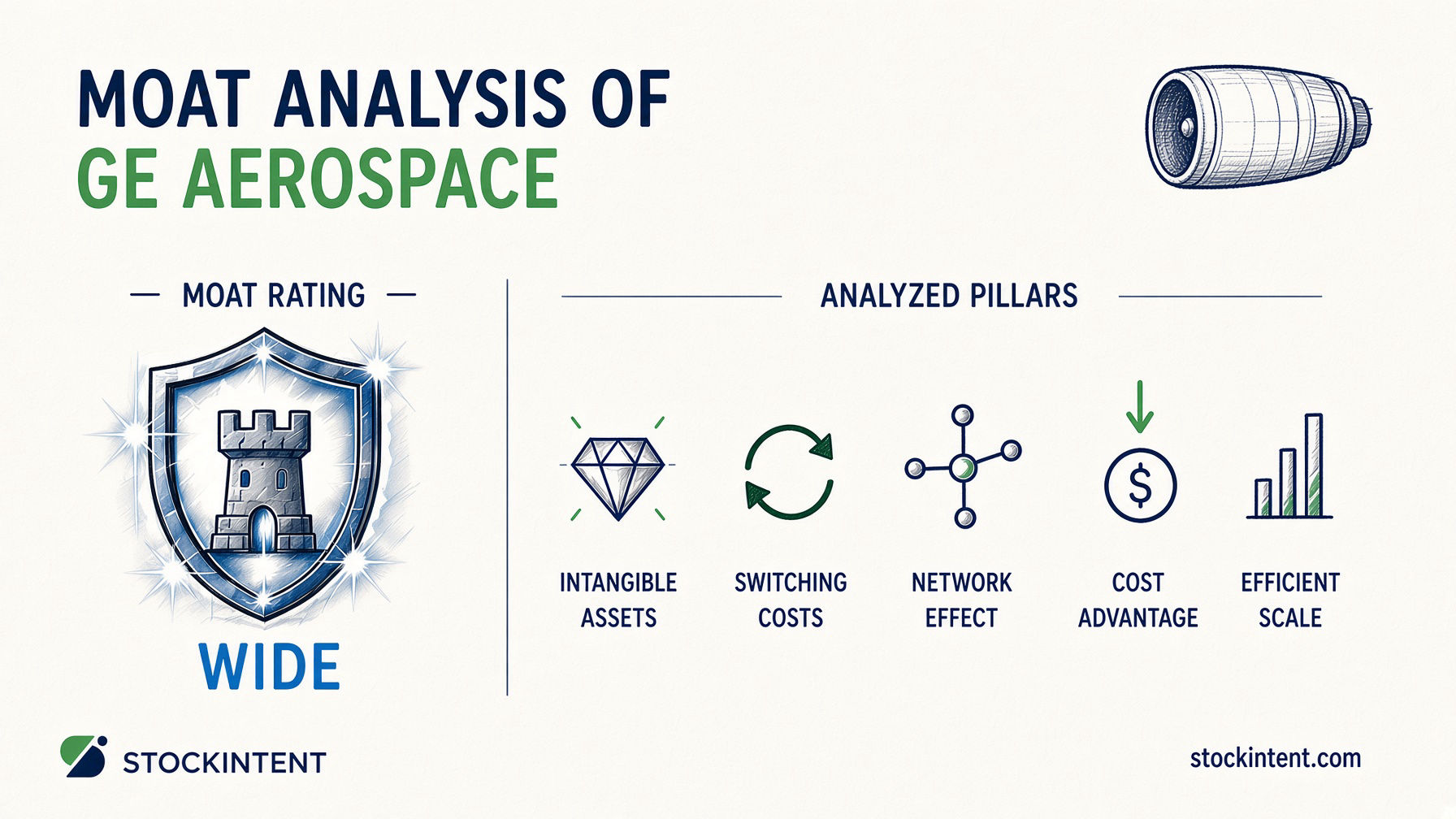
GE Aerospace earns a Wide economic moat rating with a Stable to Widening trend and Medium uncertainty. That verdict rests on a simple reality: once an airline commits to GE engines, it is essentially locked into decades of high-margin maintenance, parts, and overhaul work that competitors cannot easily replicate.
The evidence behind this assessment is substantial. In Q1 2026, GE Aerospace reported 25% revenue growth and 87% order growth year-over-year, while Morningstar assigns the company a Wide moat rating based on durable competitive advantages in commercial aerospace engines and aftermarket services
The five-pillar breakdown that follows explains exactly which competitive advantages are genuine, which are overstated, and how they show up in the financials.
GE Aerospace's moat rests on three genuinely strong pillars and two that are weak or mischaracterized. We'll walk through each of the five standard moat sources in order of strength, from the mechanisms that truly protect its economics to the ones that sound good in conference presentations but do not hold up to scrutiny.
Switching costs: strong. Once an airline installs GE engines, walking away becomes practically impossible. Engines are tightly coupled to long-term maintenance programs, spare parts inventories, shop visit schedules, pilot and mechanic certification, and fleet economics that play out over decades. AInvest's 2026 analysis makes this explicit: the combination of operational disruption, retraining costs, and supply chain reconfiguration creates lock-in that rivals cannot easily overcome. This is the classic razor-and-blades model in aerospace. The initial engine sale is the razor; the decades of aftermarket services, parts, and overhauls are the blades that generate the bulk of lifetime value.
Intangible assets: strong. GE's technical know-how, proprietary engine design capability, and certification history form barriers that new entrants cannot replicate quickly. The LEAP and CFM franchises are not merely product lines; they represent decades of accumulated engineering judgment, regulatory relationships, and brand trust with airlines and regulators. Morningstar's Wide moat assessment specifically cites these intangible assets as foundational to durable competitive advantages in commercial aerospace engines. The certification process alone, which can span years and require exhaustive testing, acts as a regulatory moat that protects incumbents from disruptive newcomers.
Efficient scale: strong. The commercial engine market functions as an oligopoly, effectively a duopoly in narrowbody propulsion, because the economics support only a few large incumbents. SWOTPal's 2026 analysis notes that long development cycles, certification hurdles, and enormous capital requirements discourage new entrants. The market is large enough for GE and its established rivals to earn attractive returns, but not large or accessible enough to attract meaningful competition. This is efficient scale in its textbook form: incumbents prosper, but the structure itself deters challengers.
Pro Insight: Some third-party analyses loosely describe GE's installed-base scale as "network effects." That is imprecise. The mechanism is not platform dynamics where value increases per additional user. It is captive maintenance economics (switching costs) and oligopolistic industry structure (efficient scale). Calling it network effects conflates two genuinely strong pillars with a weaker concept and muddies the analytical picture.
Network effects: weak to not material. A larger installed base does create more aftermarket parts and service opportunities, but that is not a true network effect. More GE engines in operation do not make each individual engine more valuable to its operator in the way that more users on a social network or more merchants on a payments platform make the service more valuable to each participant. The installed base drives revenue through switching costs and efficient scale, not through network dynamics. SWOTPal's analysis correctly identifies network effects as indirect at best, and we would characterize them as simply not material to the moat assessment.
Cost advantage: weak. There is little evidence that GE Aerospace maintains a sustainable structural cost edge versus peers. In fact, near-term dynamics point the other direction. The low-margin LEAP ramp, ongoing supply chain constraints, and margin compression during production scaling all argue against cost leadership. SWOTPal's 2026 assessment explicitly flags cost advantage as weak, and the financial evidence supports that view. GE's profitability comes from aftermarket pricing power and installed-base lock-in, not from manufacturing its engines more cheaply than competitors. The margins are in the services, not the factory floor.
For investors applying a quality-over-cheapness lens, the implication is straightforward. GE Aerospace's durable excess returns depend on reinvestment in research, development, and certification that sustains the intangible assets and switching costs pillars. Capital allocation toward these activities, rather than toward manufacturing cost reduction, is what protects the moat. The efficient scale pillar is largely structural and self-sustaining, but it depends on management not making strategic errors that would fragment the oligopoly or invite regulatory intervention.
The wide moat assessment is visible in the numbers. GE Aerospace's commercial engines operating margin improved from 26.4% in Q1 2026 to 27.3% in Q2 2026, a sequential expansion that signals genuine pricing power in aftermarket services. That margin strength is not a fluke. It reflects the installed-base economics at work: long maintenance contracts, proprietary parts, and shop visits that airlines cannot easily switch away from.
Cash generation tells the same story. In Q2 2026, free cash flow surged 43% year-over-year, well ahead of the 24% adjusted revenue growth. When cash grows faster than sales, it usually means a business is converting its competitive advantages into actual dollars rather than just accounting earnings. The $170 billion commercial services backlog provides the visibility behind that conversion.
Not every segment flashes the same signal. Commercial Engines & Services revenue jumped 39% in Q1 2026, confirming the core franchise is firing on all cylinders. Defense & Propulsion Technologies, by contrast, grows steadily but more modestly. That divergence matters. The moat is strongest where the installed base is largest and switching costs are highest.
These metrics are snapshots, not guarantees. A full cycle test, especially through a sustained downturn in departures, would tell us more about durability than any single year of strong results. Still, the direction is clear. For investors who want to dig into the underlying financial statements and historical trends that validate these signals, StockIntent's company reports let you review the detailed data behind the headlines.
GE Aerospace's moat is Stable to Widening in 2026. The installed base keeps compounding, services demand is holding up through macro pressure, and the competitive battle remains about execution rather than price erosion.
The clearest widening signal is the $170 billion commercial services backlog GE reported in Q1 2026. That figure is not static inventory; it is a forward-revenue reservoir that grows as more LEAP engines enter service and existing fleets age into higher-margin shop visits. When a company converts installed base into recurring, high-margin contracts faster than competitors can replicate the capability, its competitive position is typically expanding.
Sector structure reinforces this. The commercial engine market remains an oligopoly where long development cycles, certification hurdles, and capital requirements keep new entrants at bay. Reuters noted in July 2026 that demand for repairs and spare parts held up even as airlines faced high fuel prices and schedule cuts, with supply constraints rather than demand weakness posing the primary challenge into 2027.
Customer buying patterns are also shifting toward GE's strength. Airlines are prioritizing recurring maintenance and service contracts over discretionary upgrades, which increases the value of GE's captive installed base. The 87% order growth in Q1 2026 and 17% in Q2 2026 show sustained demand, but the real test is delivery conversion. Orders are promises; deliveries are proof.
Here is what investors should watch to judge whether the moat widens or merely holds over the next three to five years:
The main risk to a widening trend is not competitive displacement but self-inflicted execution failures. LEAP durability problems, persistent supply-chain bottlenecks, or slower-than-expected shop visit growth could delay monetization without eroding the underlying advantages. A worsening geopolitical or fuel-cost environment that cuts airline utilization would also pressure parts consumption, though 2026 demand has proven resilient so far.
In short, the moat's direction depends less on what competitors do and more on how effectively GE converts its structural advantages into delivered results.
We assign GE Aerospace a Medium uncertainty rating. The moat itself is durable, but the range of possible outcomes over the next three to five years is wider than the current headline numbers suggest.
Four drivers shape this rating. Sales predictability is unusually high for an industrial company thanks to the $170 billion commercial services backlog and long-term maintenance contracts. Yet macro cyclicality still intrudes. Management reduced its 2026 global departures outlook from mid-single-digit growth to flat to low-single-digit, citing high oil prices, fuel availability constraints, and slower global economic growth. The Middle East alone, roughly 5% of GE's departure exposure, faces a low double-digit decline.
Operating stability is similarly two-sided. Margins are expanding, with commercial engines operating profit up 18% in both Q1 and Q2 2026. But that progress is sensitive to fuel price spikes and geopolitical shocks that pressure airline economics and service timing. Reuters reported in April 2026 that elevated Brent crude through much of 2026 is already testing airlines and constraining flight growth.
Financial leverage is currently stable. The balance sheet shows no acute stress, and free cash flow growth of 43% in Q2 2026 supports reinvestment capacity without strain. Contingent risks are where the uncertainty concentrates: geopolitical instability, regulatory and certification hurdles, export controls, and the ever-present possibility of a major product issue or service-interval change that would reshape the aftermarket economics.
From Our Experience: In aerospace, medium uncertainty is structural rather than operational. Even wide-moat franchises face fuel price and geopolitical volatility that temporarily depress departures. Investors should distinguish between cyclical headwinds (recoverable when fuel prices stabilize) and permanent impairment (technological obsolescence or loss of certification leadership). The moat provides a floor, but the ceiling depends on variables GE does not control.
The question is not how volatile the stock might be, but how wide the range of future business outcomes could prove. GE's installed base and recurring service revenue narrow the downside. Macro and geopolitical forces widen the upside variance. That combination lands squarely in Medium territory.
GE Aerospace earns a Wide moat, Stable to Widening trend, and Medium uncertainty rating. The $170 billion commercial services backlog, the razor-and-blades lock-in of airline maintenance economics, and sequential margin expansion to 27.3% in Q2 2026 give this verdict a solid foundation.
The main issues to watch are potential execution risk. Can GE convert its order surge into deliveries and cash? Will LEAP shop visits mature on schedule to monetize the installed base? Supply chain constraints and geopolitical fuel volatility could delay the payoff without impairing the underlying advantages.
For investors tracking these signals over the next three to five years, a StockIntent watchlist lets you monitor backlog trends, service margins, and shop visit volumes alongside peers like Rolls-Royce and Pratt & Whitney. The moat is durable, but its trajectory depends on what happens next, not just what has already been built.
This content is for informational and educational purposes only and is not investment advice.
GE Aerospace earns a Wide economic moat rating with a Stable to Widening trend and Medium uncertainty. That verdict rests on a simple reality: once an airline commits to GE engines, it is essentially locked into decades of high-margin maintenance, parts, and overhaul work that competitors cannot easily replicate.
The evidence behind this assessment is substantial. In Q1 2026, GE Aerospace reported 25% revenue growth and 87% order growth year-over-year, while Morningstar assigns the company a Wide moat rating based on durable competitive advantages in commercial aerospace engines and aftermarket services
The five-pillar breakdown that follows explains exactly which competitive advantages are genuine, which are overstated, and how they show up in the financials.
GE Aerospace's moat rests on three genuinely strong pillars and two that are weak or mischaracterized. We'll walk through each of the five standard moat sources in order of strength, from the mechanisms that truly protect its economics to the ones that sound good in conference presentations but do not hold up to scrutiny.
Switching costs: strong. Once an airline installs GE engines, walking away becomes practically impossible. Engines are tightly coupled to long-term maintenance programs, spare parts inventories, shop visit schedules, pilot and mechanic certification, and fleet economics that play out over decades. AInvest's 2026 analysis makes this explicit: the combination of operational disruption, retraining costs, and supply chain reconfiguration creates lock-in that rivals cannot easily overcome. This is the classic razor-and-blades model in aerospace. The initial engine sale is the razor; the decades of aftermarket services, parts, and overhauls are the blades that generate the bulk of lifetime value.
Intangible assets: strong. GE's technical know-how, proprietary engine design capability, and certification history form barriers that new entrants cannot replicate quickly. The LEAP and CFM franchises are not merely product lines; they represent decades of accumulated engineering judgment, regulatory relationships, and brand trust with airlines and regulators. Morningstar's Wide moat assessment specifically cites these intangible assets as foundational to durable competitive advantages in commercial aerospace engines. The certification process alone, which can span years and require exhaustive testing, acts as a regulatory moat that protects incumbents from disruptive newcomers.
Efficient scale: strong. The commercial engine market functions as an oligopoly, effectively a duopoly in narrowbody propulsion, because the economics support only a few large incumbents. SWOTPal's 2026 analysis notes that long development cycles, certification hurdles, and enormous capital requirements discourage new entrants. The market is large enough for GE and its established rivals to earn attractive returns, but not large or accessible enough to attract meaningful competition. This is efficient scale in its textbook form: incumbents prosper, but the structure itself deters challengers.
Pro Insight: Some third-party analyses loosely describe GE's installed-base scale as "network effects." That is imprecise. The mechanism is not platform dynamics where value increases per additional user. It is captive maintenance economics (switching costs) and oligopolistic industry structure (efficient scale). Calling it network effects conflates two genuinely strong pillars with a weaker concept and muddies the analytical picture.
Network effects: weak to not material. A larger installed base does create more aftermarket parts and service opportunities, but that is not a true network effect. More GE engines in operation do not make each individual engine more valuable to its operator in the way that more users on a social network or more merchants on a payments platform make the service more valuable to each participant. The installed base drives revenue through switching costs and efficient scale, not through network dynamics. SWOTPal's analysis correctly identifies network effects as indirect at best, and we would characterize them as simply not material to the moat assessment.
Cost advantage: weak. There is little evidence that GE Aerospace maintains a sustainable structural cost edge versus peers. In fact, near-term dynamics point the other direction. The low-margin LEAP ramp, ongoing supply chain constraints, and margin compression during production scaling all argue against cost leadership. SWOTPal's 2026 assessment explicitly flags cost advantage as weak, and the financial evidence supports that view. GE's profitability comes from aftermarket pricing power and installed-base lock-in, not from manufacturing its engines more cheaply than competitors. The margins are in the services, not the factory floor.
For investors applying a quality-over-cheapness lens, the implication is straightforward. GE Aerospace's durable excess returns depend on reinvestment in research, development, and certification that sustains the intangible assets and switching costs pillars. Capital allocation toward these activities, rather than toward manufacturing cost reduction, is what protects the moat. The efficient scale pillar is largely structural and self-sustaining, but it depends on management not making strategic errors that would fragment the oligopoly or invite regulatory intervention.
The wide moat assessment is visible in the numbers. GE Aerospace's commercial engines operating margin improved from 26.4% in Q1 2026 to 27.3% in Q2 2026, a sequential expansion that signals genuine pricing power in aftermarket services. That margin strength is not a fluke. It reflects the installed-base economics at work: long maintenance contracts, proprietary parts, and shop visits that airlines cannot easily switch away from.
Cash generation tells the same story. In Q2 2026, free cash flow surged 43% year-over-year, well ahead of the 24% adjusted revenue growth. When cash grows faster than sales, it usually means a business is converting its competitive advantages into actual dollars rather than just accounting earnings. The $170 billion commercial services backlog provides the visibility behind that conversion.
Not every segment flashes the same signal. Commercial Engines & Services revenue jumped 39% in Q1 2026, confirming the core franchise is firing on all cylinders. Defense & Propulsion Technologies, by contrast, grows steadily but more modestly. That divergence matters. The moat is strongest where the installed base is largest and switching costs are highest.
These metrics are snapshots, not guarantees. A full cycle test, especially through a sustained downturn in departures, would tell us more about durability than any single year of strong results. Still, the direction is clear. For investors who want to dig into the underlying financial statements and historical trends that validate these signals, StockIntent's company reports let you review the detailed data behind the headlines.
GE Aerospace's moat is Stable to Widening in 2026. The installed base keeps compounding, services demand is holding up through macro pressure, and the competitive battle remains about execution rather than price erosion.
The clearest widening signal is the $170 billion commercial services backlog GE reported in Q1 2026. That figure is not static inventory; it is a forward-revenue reservoir that grows as more LEAP engines enter service and existing fleets age into higher-margin shop visits. When a company converts installed base into recurring, high-margin contracts faster than competitors can replicate the capability, its competitive position is typically expanding.
Sector structure reinforces this. The commercial engine market remains an oligopoly where long development cycles, certification hurdles, and capital requirements keep new entrants at bay. Reuters noted in July 2026 that demand for repairs and spare parts held up even as airlines faced high fuel prices and schedule cuts, with supply constraints rather than demand weakness posing the primary challenge into 2027.
Customer buying patterns are also shifting toward GE's strength. Airlines are prioritizing recurring maintenance and service contracts over discretionary upgrades, which increases the value of GE's captive installed base. The 87% order growth in Q1 2026 and 17% in Q2 2026 show sustained demand, but the real test is delivery conversion. Orders are promises; deliveries are proof.
Here is what investors should watch to judge whether the moat widens or merely holds over the next three to five years:
The main risk to a widening trend is not competitive displacement but self-inflicted execution failures. LEAP durability problems, persistent supply-chain bottlenecks, or slower-than-expected shop visit growth could delay monetization without eroding the underlying advantages. A worsening geopolitical or fuel-cost environment that cuts airline utilization would also pressure parts consumption, though 2026 demand has proven resilient so far.
In short, the moat's direction depends less on what competitors do and more on how effectively GE converts its structural advantages into delivered results.
We assign GE Aerospace a Medium uncertainty rating. The moat itself is durable, but the range of possible outcomes over the next three to five years is wider than the current headline numbers suggest.
Four drivers shape this rating. Sales predictability is unusually high for an industrial company thanks to the $170 billion commercial services backlog and long-term maintenance contracts. Yet macro cyclicality still intrudes. Management reduced its 2026 global departures outlook from mid-single-digit growth to flat to low-single-digit, citing high oil prices, fuel availability constraints, and slower global economic growth. The Middle East alone, roughly 5% of GE's departure exposure, faces a low double-digit decline.
Operating stability is similarly two-sided. Margins are expanding, with commercial engines operating profit up 18% in both Q1 and Q2 2026. But that progress is sensitive to fuel price spikes and geopolitical shocks that pressure airline economics and service timing. Reuters reported in April 2026 that elevated Brent crude through much of 2026 is already testing airlines and constraining flight growth.
Financial leverage is currently stable. The balance sheet shows no acute stress, and free cash flow growth of 43% in Q2 2026 supports reinvestment capacity without strain. Contingent risks are where the uncertainty concentrates: geopolitical instability, regulatory and certification hurdles, export controls, and the ever-present possibility of a major product issue or service-interval change that would reshape the aftermarket economics.
From Our Experience: In aerospace, medium uncertainty is structural rather than operational. Even wide-moat franchises face fuel price and geopolitical volatility that temporarily depress departures. Investors should distinguish between cyclical headwinds (recoverable when fuel prices stabilize) and permanent impairment (technological obsolescence or loss of certification leadership). The moat provides a floor, but the ceiling depends on variables GE does not control.
The question is not how volatile the stock might be, but how wide the range of future business outcomes could prove. GE's installed base and recurring service revenue narrow the downside. Macro and geopolitical forces widen the upside variance. That combination lands squarely in Medium territory.
GE Aerospace earns a Wide moat, Stable to Widening trend, and Medium uncertainty rating. The $170 billion commercial services backlog, the razor-and-blades lock-in of airline maintenance economics, and sequential margin expansion to 27.3% in Q2 2026 give this verdict a solid foundation.
The main issues to watch are potential execution risk. Can GE convert its order surge into deliveries and cash? Will LEAP shop visits mature on schedule to monetize the installed base? Supply chain constraints and geopolitical fuel volatility could delay the payoff without impairing the underlying advantages.
For investors tracking these signals over the next three to five years, a StockIntent watchlist lets you monitor backlog trends, service margins, and shop visit volumes alongside peers like Rolls-Royce and Pratt & Whitney. The moat is durable, but its trajectory depends on what happens next, not just what has already been built.
This content is for informational and educational purposes only and is not investment advice.