
Mar 20, 2026
Understanding what drives a company at its core can tell you a lot about where it's headed, and whether that journey aligns with your investment thesis. General Motors, one of America's most iconic automakers, has spent the last few years executing what industry watchers call a "once-in-a-century pivot" away from its combustion engine legacy toward an all-electric, software-defined future.
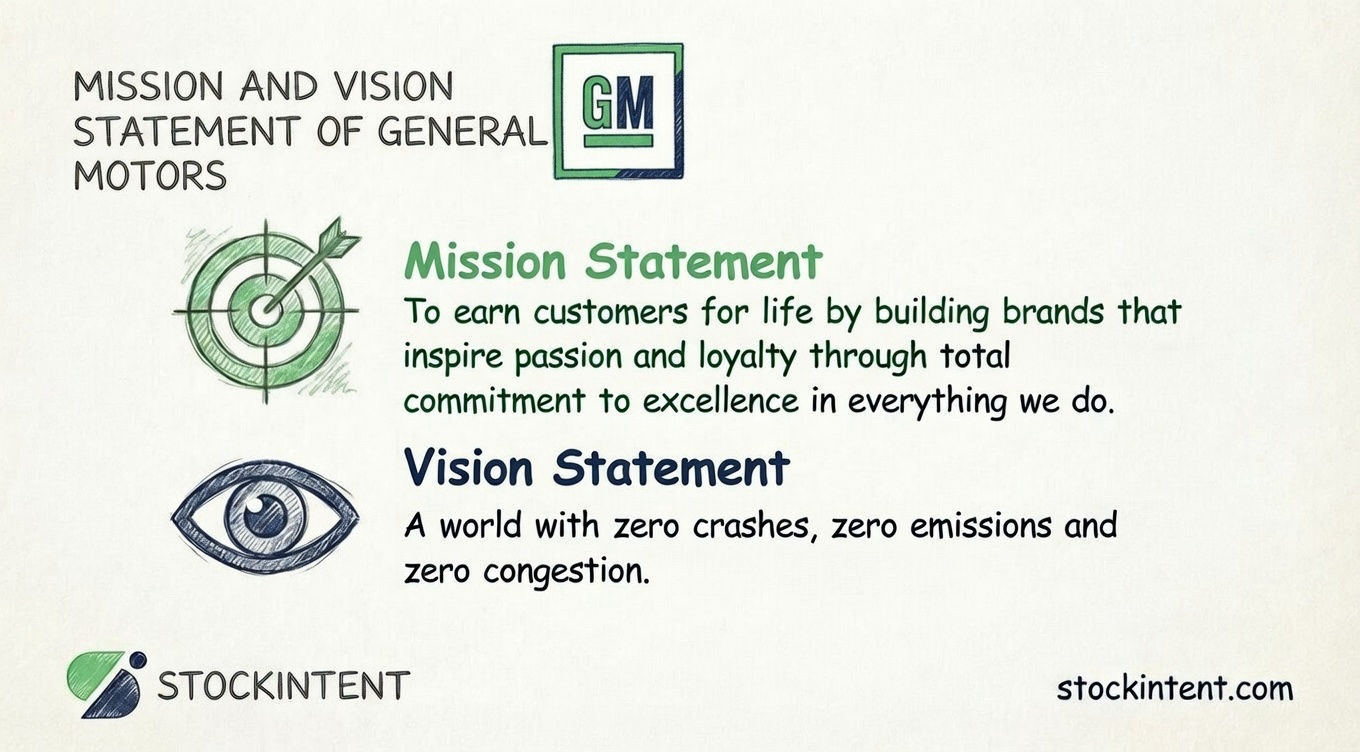
But what exactly is GM trying to achieve? The company's official mission is "to earn customers for life by building brands that inspire passion and loyalty through total commitment to excellence in everything we do." This mission is anchored by a bold vision: a world with zero crashes, zero emissions, and zero congestion. Together, these statements frame how GM allocates capital, develops products, and positions itself against competitors in 2026 and beyond.
Key Takeaways:
General Motors stands as one of America's most enduring industrial giants, tracing its roots back to 1908 when William C. Durant consolidated several automotive companies into what would become the world's largest automaker for much of the 20th century. Today, GM operates as a leading player in the consumer cyclical sector, specifically within auto manufacturers, with a market position that reflects both its heritage and its aggressive pivot toward electrification and software-defined vehicles.
In our experience analyzing automotive companies through multiple market cycles, GM's current structure reveals a business deliberately engineered for resilience. The company organizes around four primary segments: GM North America (GMNA), which serves as the profit engine driven by full-size pickups and SUVs; GM International (GMI), anchored by joint ventures in China with SAIC and Wuling plus operations in South America; GM Financial, the captive financing arm contributing $2-3 billion in annual earnings; and the rapidly expanding Software and Services division, which generated nearly $2 billion in revenue with approximately 70% gross margins as of late 2025.
Key Facts at a Glance:
| Metric | Detail |
|---|---|
| 2025 Net Income | $2.7 billion |
| 2026 Net Income Guidance | $10.3-11.7 billion |
| 2026 Adjusted EBIT Target | $13-15 billion |
| U.S. Market Position | #1 in total sales volume (2025) |
| EV Market Position | #2 in U.S. EV sales |
| Full-Size Pickup Leadership | 6 consecutive years |
| Full-Size SUV Leadership | 51 consecutive years |
| Super Cruise Subscribers | 620,000 (late 2025) |
GM's product portfolio in 2026 spans both traditional internal combustion vehicles and an expanding electric lineup built on the Ultium platform. The company continues to dominate profitable segments with the Chevrolet Silverado and GMC Sierra pickups, while simultaneously rolling out EVs including the Equinox EV, Blazer EV, Silverado EV (with up to 492 miles of range), GMC Hummer EV, and Cadillac Lyriq. This dual-track approach, what management calls a "balanced powertrain portfolio," reflects pragmatic capital allocation: maintaining cash flow from high-margin trucks and SUVs while building capability in electrification.
The competitive positioning here matters for investors. GM's scale advantages show up in manufacturing efficiency, supplier leverage, and the ability to fund $35 billion in EV and autonomous vehicle investments through 2025. While pure-play EV competitors burn cash and legacy peers struggle with transition costs, GM generates sufficient profits from its traditional business to fund the future without jeopardizing present returns. This financial flexibility, combined with its #1 position in the most profitable vehicle segments, creates a moat that narrower competitors will find difficult to cross.
General Motors's official mission statement is straightforward but deliberately chosen:
"To earn customers for life by building brands that inspire passion and loyalty through total commitment to excellence in everything we do."
This statement, documented in GM's corporate communications, serves as the operational backbone for how the company approaches product development, customer service, and capital allocation decisions. It's worth noting that GM's official website increasingly emphasizes purpose over a distinct mission statement, framing the company as "working toward a future with zero crashes, zero emissions, and zero congestion"[5][9].
🎯 Pro Insight: When evaluating automotive companies, pay attention to whether their mission emphasizes transactional sales or lifetime customer value. GM's "customers for life" language signals a strategic priority on recurring revenue streams, which helps explain their aggressive push into software subscriptions like Super Cruise and OnStar. These services now generate nearly $2 billion annually with ~70% gross margins, transforming a traditional manufacturer into something closer to a recurring-revenue business model.
The strategic importance of this mission becomes clear when you connect it to GM's actual business decisions. The phrase "earn customers for life" directly justifies investments in high-touch services, loyalty programs, and the software ecosystem that keeps owners connected to GM long after the initial purchase. Meanwhile, "building brands that inspire passion and loyalty" explains why GM has chosen to electrify existing nameplates like the Silverado, Hummer, and Cadillac rather than launching standalone EV brands like some competitors.
This mission also frames GM's capital allocation priorities. The $35 billion committed to electrification and autonomy through 2025 isn't just about following industry trends; it's about positioning GM's brands to remain relevant and desirable as transportation evolves. When GM invests in the Ultium platform or expands Super Cruise to more models, management is executing against the "total commitment to excellence" pillar with the expectation that superior technology will translate into the passion and loyalty the mission demands.
Compared to competitors, GM's mission sits at an interesting intersection. Ford's mission emphasizes "building a better world" through mobility solutions, while Tesla's is famously product-centric around accelerating sustainable transport. GM's focus on customer lifetime value and brand excellence feels more commercially grounded, which aligns with their recent strategic flexibility: maintaining strong ICE truck and SUV profitability while building EV capability, rather than betting everything on electrification immediately.
GM's mission isn't just marketing copy; it's a framework that directly shapes how capital gets allocated and where management places its bets. Let's break down the three interconnected pillars that translate "earn customers for life" into actionable strategy.
The first pillar of GM's Triple Zero Vision focuses on eliminating vehicle accidents through advanced driver-assistance systems and autonomous technology. This isn't abstract R&D spending; it's already generating measurable returns.
GM's Ultra Cruise and Super Cruise systems represent the core execution here. Super Cruise alone had reached 620,000 subscribers by late 2025, contributing to a software and services segment generating nearly $2 billion annually with approximately 70% gross margins. That's the kind of high-margin, recurring revenue that transforms a traditional manufacturer into a business with SaaS-like characteristics.
In our experience analyzing automotive companies, the safety pillar creates two distinct competitive advantages. First, it builds switching costs; once customers experience hands-free highway driving, going back feels like a downgrade. Second, it establishes pricing power for subscription services that pure hardware competitors can't easily replicate.
The second pillar commits GM to environmental transformation through electrification. The numbers here are substantial: $35 billion invested through 2025, targeting 30 new global EV models and 1 million North American EV sales by 2025, with 50% of manufacturing capacity converted to EV production by 2030.
What's strategically clever is how GM executes this pillar. Rather than launching standalone EV brands like some competitors, GM is electrifying its existing iconic nameplates: Chevrolet Silverado EV, GMC Hummer EV, Cadillac Lyriq. This leverages decades of brand equity and customer loyalty rather than starting from zero.
The infrastructure play matters too. GM's commitment to 40,000 public charging points in North America creates network effects that strengthen customer lock-in. When your vehicle, your charging network, and your digital services all come from one ecosystem, the switching costs increase meaningfully.
The third pillar addresses traffic efficiency through connected vehicle technology and smart infrastructure partnerships. While less mature than the safety and emissions pillars, this represents GM's bet on the future of transportation beyond personal vehicle ownership.
This pillar connects to GM's autonomous vehicle development and its broader software-defined vehicle strategy. The company is positioning itself not just as a car manufacturer, but as a mobility platform provider. The deferred revenue target of $7.5 billion from software and services by 2028, including Super Cruise, OnStar, and autonomy features, shows how this pillar translates into financial outcomes.
Underlying all three pillars is the core mission principle of earning customers for life. This isn't fluffy language; it directly explains GM's capital allocation decisions. The $35 billion EV investment, the push into high-margin subscriptions, the retention of profitable ICE trucks and SUVs while building EV capability; all of it serves the goal of maintaining customer relationships across multiple vehicle lifecycles.
From an investor perspective, this pillar framework creates several economic moat sources: brand equity that reduces customer acquisition costs, technological leadership that creates switching costs, infrastructure investments that build network effects, and scale advantages that fund R&D investments smaller competitors cannot match.
The 2026 financial guidance reflects this execution: adjusted EBIT of $13-15 billion and net income of $10.3-11.7 billion, supported by strong truck and SUV demand alongside growing software revenue. The mission isn't just inspiring; it's translating into shareholder returns.
GM's official vision statement is ambitious and deliberately future-focused:
"A world with zero crashes, zero emissions and zero congestion."
This is the Triple Zero Vision that serves as GM's strategic North Star, guiding every major capital allocation decision and product development priority. It's not merely aspirational language; it's a framework that directly shapes where GM places its $35 billion investment bet through 2025.
The Triple Zero Vision translates into concrete, measurable goals that GM leadership has publicly committed to:
| Vision Pillar | 2025-2030 Targets | Investment Scale |
|---|---|---|
| Zero Crashes | Advanced Driver-Assistance Systems in most vehicles; Ultra Cruise deployment | Embedded in $35B EV/autonomy commitment |
| Zero Emissions | 30 new global EVs by 2025; 1 million North American EV sales; 50% manufacturing converted to EV by 2030 | $35 billion through 2025 |
| Zero Congestion | 40,000 public charging points; autonomous mobility platform development | Infrastructure + R&D integrated |
These aren't distant dreams. GM's 2026 financial guidance reflects this execution: adjusted EBIT of $13-15 billion and net income of $10.3-11.7 billion, supported by strong truck demand alongside growing software revenue from Super Cruise and OnStar.
GM's vision positions it at the intersection of three macro forces reshaping auto manufacturers in 2026:
Electrification Acceleration — The industry-wide shift from internal combustion to electric powertrains is now undeniable. GM's $35 billion commitment and explicit 2025/2030 targets reflect a bet that electrification isn't a niche trend but the fundamental future of transportation. Yet GM maintains strategic flexibility; while pursuing aggressive EV goals, the company continues investing in next-generation truck platforms with updated V-8 engines alongside electrified options, acknowledging that consumer demand for traditional powertrains persists in profitable segments.
Software-Defined Vehicles — The auto industry is transforming from hardware-centric to software-centric business models. GM's vision explicitly captures this through its safety and congestion pillars, which require advanced software, connectivity, and autonomous capabilities. The nearly $2 billion in software and services revenue with ~70% gross margins demonstrates how this vision translates into high-margin, recurring revenue streams that traditional manufacturers struggle to replicate.
Sustainability as Competitive Advantage — Consumer preferences increasingly favor environmentally responsible vehicles and advanced safety features. By framing strategy around zero emissions and zero crashes, GM aligns with growing ESG consciousness while positioning itself to capture value from regulatory tailwinds and consumer willingness to pay for cleaner, safer transportation.
What distinguishes GM's vision from competitors is its pragmatic balance. Ford's mission emphasizes "building a better world" through mobility solutions; Tesla's remains product-centric around accelerating sustainable transport. GM's Triple Zero Vision feels more operationally concrete, which aligns with their recent strategic flexibility: generating sufficient profits from traditional trucks and SUVs to fund the electric future without jeopardizing present returns. This financial discipline, what management calls a "balanced powertrain portfolio," may prove more sustainable than competitors betting everything on immediate electrification.
GM's Triple Zero Vision isn't just aspirational language on a corporate poster. It's a framework that directly shapes capital allocation, R&D priorities, and competitive positioning. Let's look at how each theme translates into observable strategic moves and measurable outcomes.
The safety pillar has evolved from a regulatory compliance exercise into one of GM's highest-margin business segments. Advanced Driver-Assistance Systems, particularly Super Cruise and the next-generation Ultra Cruise, are generating recurring revenue that looks more like software than traditional auto manufacturing.
By late 2025, Super Cruise had reached 620,000 subscribers, contributing to a software and services segment generating nearly $2 billion annually with approximately 70% gross margins. That's SaaS-level profitability from a feature that didn't exist in mass-market vehicles a decade ago. GM's official innovation strategy positions these systems as stepping stones toward full autonomy, with the "zero crashes" goal justifying continued investment even as competitors cut back on autonomous vehicle spending.
The strategic insight here: safety technology creates switching costs. Once customers experience hands-free highway driving, going back feels like a downgrade. This builds the "customers for life" framework directly into the product experience.
The emissions pillar represents GM's largest capital commitment: $35 billion invested through 2025 in electric and autonomous vehicle programs. But what's strategically notable is how GM executes this transition compared to competitors.
Rather than launching standalone EV brands, GM is electrifying existing iconic nameplates. The Chevrolet Silverado EV, GMC Hummer EV, and Cadillac Lyriq leverage decades of brand equity rather than starting from zero. This approach, documented in GM's corporate communications, reflects the mission's emphasis on "building brands that inspire passion and loyalty."
The infrastructure play matters too. GM's commitment to 40,000 public charging points in North America creates network effects that strengthen customer lock-in. When your vehicle, charging network, and digital services all flow through one ecosystem, switching costs increase meaningfully.
| Zero Emissions Target | Timeline | Investment Scale |
|---|---|---|
| 30 new global EV models | By 2025 | Part of $35B commitment |
| 1 million North American EV sales | By 2025 | Manufacturing conversion |
| 50% manufacturing capacity EV | By 2030 | Ongoing capital deployment |
The congestion pillar is GM's bet on transportation evolving beyond personal vehicle ownership. This connects to autonomous vehicle development, smart infrastructure partnerships, and the broader software-defined vehicle strategy.
While less mature than safety and emissions, this pillar positions GM as a mobility platform provider, not merely a car manufacturer. The deferred revenue target of $7.5 billion from software and services by 2028, including Super Cruise, OnStar, and autonomy features, shows how this theme translates into financial outcomes.
What distinguishes GM's vision execution is pragmatic flexibility. While pursuing aggressive electrification goals, management maintains what they call a "balanced powertrain portfolio." The company continues investing in next-generation truck platforms with updated V-8 engines alongside electrified options, acknowledging that consumer demand for traditional powertrains persists in profitable segments.
This isn't vision drift; it's disciplined capital allocation. GM generates sufficient profits from high-margin trucks and SUVs to fund the electric future without jeopardizing present returns. The 2026 financial guidance, adjusted EBIT of $13-15 billion, reflects this execution: strong traditional business performance alongside growing software revenue.
Industry analysts view GM's strategic direction as operationally grounded and financially sound. The consensus emphasizes onshoring production, prioritizing high-margin ICE trucks and SUVs amid slower EV demand, cost reductions for profitable EVs, and continued software/services growth. As noted in recent earnings analysis, GM's balanced portfolio is seen as a "winning formula" that leverages the Ultium platform while maintaining strategic flexibility that pure-EV competitors lack.
The vision themes aren't competing priorities; they're reinforcing elements of a coherent strategy. Safety technology builds customer loyalty. Electrification positions GM for regulatory and consumer trends. Congestion solutions open new revenue streams. Together, they support the core mission of earning customers for life across multiple vehicle lifecycles and transportation modes.
GM's core values aren't just wall decorations at headquarters. They're the operating system that determines who gets hired, which suppliers win contracts, and how capital gets allocated across a $35 billion transformation. Understanding these values helps investors assess whether management's decisions align with stated principles, or whether we're looking at mission-statement theater.
According to GM's official Code of Conduct, Winning with Integrity, the company is committed to three core values: Customers, Relationships, and Excellence, with integrity serving as the foundational commitment that must guide all actions.
This value puts the customer at the center of every decision, aiming to earn loyalty for life rather than optimize for single transactions. In practice, this explains GM's aggressive push into software and services; Super Cruise, OnStar, and connected vehicle features generate nearly $2 billion annually with approximately 70% gross margins, transforming one-time buyers into recurring revenue relationships.
The customer value also drives product strategy. Rather than launching standalone EV brands like some competitors, GM electrifies iconic nameplates (Silverado EV, Hummer EV, Lyriq) that already carry decades of customer trust. It's cheaper to convert a loyal truck owner to an electric Silverado than to acquire a completely new customer for an unfamiliar brand.
GM defines this value around collaboration, both internally and with external partners. The company emphasizes building relationships "through collaboration, ingenuity, and accountability" across its global operations.
This manifests in concrete business decisions. GM's joint ventures in China with SAIC and Wuling represent relationship-based market access that pure exporters cannot replicate. The Ultium battery platform was developed through partnerships with LG Energy Solution, spreading R&D costs while securing supply chain advantages. Even supplier requirements reflect this value; GM mandates EcoVadis sustainability scores above 50 for key suppliers, embedding relationship standards into procurement decisions.
The excellence value commits GM to innovation, accountability, and continuous improvement "in everything we do." This isn't vague aspiration; it's measured against specific targets.
The $35 billion investment in electrification and autonomy through 2025 represents excellence in capital deployment. GM's manufacturing scale, six consecutive years as full-size pickup leader, and 51 consecutive years dominating full-size SUVs demonstrate operational excellence in profitable segments. The 2026 financial guidance, adjusted EBIT of $13-15 billion, reflects management's accountability to delivering measurable outcomes.
💡 Expert Tip: When evaluating whether a company's stated values are genuine, look for where they spend unglamorous money. GM's $30 million workforce upskilling investment at the Fairfax plant, retraining employees for both EV and ICE production flexibility, says more about valuing relationships than any corporate video. Real values show up in capital allocation trade-offs, not marketing materials.
Beyond the three core values, GM's Code of Conduct emphasizes acting with integrity and "seeking truth" through fact-based candor. This includes encouraging employees to speak up, maintaining safety and quality standards without compromise, and transparent reporting on progress toward goals.
In our experience analyzing corporate governance across industrial companies, the "seek truth" language is relatively unusual and suggests a culture that theoretically rewards problem-spotting over problem-hiding. Whether this operates effectively at scale is harder to verify from outside, but the explicit commitment matters for investors assessing organizational health.
GM's environmental, social, and governance commitments function as a direct extension of its core values rather than a separate initiative. The company frames sustainability as "core to our vision," with specific targets that tie to long-term strategy:
| ESG Pillar | Commitment | Strategic Connection |
|---|---|---|
| Environmental | Carbon neutrality by 2040; 50% EV manufacturing capacity by 2030 | Excellence in innovation; Customer demand for cleaner vehicles |
| Social | $50 million Climate Equity Fund; workforce transition support | Relationships with communities and employees |
| Governance | Supplier sustainability mandates; transparent progress reporting | Integrity in operations and accountability |
The Climate Equity Fund specifically addresses inclusive transition to clean energy, supporting STEM education and workforce development in underserved communities. This connects the relationships value to long-term talent pipeline development.
Do GM's stated values hold up under scrutiny? There are genuine examples of alignment and notable historical failures.
Positive execution: The $35 billion electrification bet reflects excellence and customer focus. The decision to maintain ICE truck and SUV profitability while building EV capability, what management calls a "balanced powertrain portfolio," demonstrates pragmatic customer-centricity rather than ideological purity. The supplier sustainability requirements show relationships valued beyond pure cost minimization.
Historical shortfalls: The ignition switch scandal of 2014 represented a catastrophic failure of the customer and integrity values, with delayed recalls linked to fatalities. While this predates current leadership, it remains relevant for assessing how deeply safety culture has genuinely changed versus how much is compliance theater.
Employee sentiment data from Comparably shows 57% alignment with mission and values, with integrity and teamwork scoring highest but diversity and inclusion at only 5% emphasis. This suggests values penetration is partial rather than universal.
For investors, the key question isn't whether GM perfectly lives its values; no large organization does. It's whether the values framework genuinely shapes capital allocation and risk decisions in ways that create sustainable competitive advantage. The evidence suggests GM's values are more than decorative, but execution remains uneven across the organization.
GM's mission, vision, and core values form a coherent strategic identity that directly shapes how the company allocates capital, develops products, and positions itself for long-term compounding. The mission of earning "customers for life" through brand excellence anchors the Triple Zero Vision of zero crashes, emissions, and congestion. Core values of Customers, Relationships, and Excellence, plus the foundational commitment to integrity, provide the operating system for daily decisions.
This framework isn't corporate theater; it's driving measurable outcomes. The $35 billion electrification bet, the $2 billion software revenue stream with 70% gross margins, and the disciplined balance between ICE profitability and EV investment all trace back to these stated principles.
📌 From Our Experience: After analyzing how automotive companies translate mission into capital allocation, we've found that GM's approach of electrifying existing nameplates rather than launching standalone EV brands is a textbook example of mission-driven strategy. The "customers for life" principle directly explains why GM leverages decades of Silverado and Cadillac loyalty rather than starting from zero with unfamiliar brands. This reduces customer acquisition costs and accelerates EV adoption curves in ways pure-play competitors struggle to replicate.
For investors evaluating GM's long-term compounding potential, this strategic identity creates several durable advantages:
| Strategic Element | Competitive Outcome | Financial Evidence |
|---|---|---|
| Customer lifetime focus | Recurring revenue from subscriptions, higher retention rates | $2B software revenue, 620K Super Cruise subscribers |
| Triple Zero Vision | First-mover positioning in EVs, autonomy, safety tech | $35B investment, 30 new EVs by 2025, #2 U.S. EV sales |
| Core values execution | Operational discipline, stakeholder trust | 2026 guidance: $13-15B adjusted EBIT, raised dividend |
| Balanced portfolio | Flexibility amid demand uncertainty | Maintained ICE leadership while building EV capability |
Analysts reflect this quality in their ratings. GM carries consensus Buy ratings from multiple coverage groups, with price targets averaging around $91 implying 13-20% upside from recent levels. The strategic execution scores particularly well on capital allocation discipline and management's willingness to adjust EV timelines based on demand realities rather than ideological commitment.
Looking ahead, GM's mission-vision-values framework positions the company to capture value from several structural trends: the multi-decade shift to electrification, the software-defined vehicle transformation, and the growing premium consumers place on safety and sustainability. The $7.5 billion deferred revenue target for software and services by 2028, including Super Cruise, OnStar, and autonomy features, represents a material expansion of addressable market beyond traditional vehicle sales.
Yet the framework also provides strategic flexibility. Management's "balanced powertrain portfolio" approach, maintaining ICE truck and SUV profitability while building EV capability, reflects the Excellence value in action: pragmatic adaptation rather than rigid adherence to plans that market conditions have rendered suboptimal. This adaptability, combined with the financial strength to fund multiple futures simultaneously, distinguishes GM from competitors forced to bet everything on a single outcome.
For investors seeking exposure to the automotive transformation with management quality signals that suggest durable competitive positioning, GM's mission-driven strategy offers a compelling case. The company isn't just building electric vehicles; it's engineering an ecosystem designed to earn customer loyalty across multiple transportation modes and technology generations.
If you're evaluating GM alongside other auto manufacturers for your portfolio, tools that enable deep fundamental comparison can help clarify how strategic positioning translates into financial outcomes. StockIntent's platform offers institutional-grade screening and backtesting capabilities to stress-test these qualitative assessments against historical data, with a 7-day free trial to explore whether GM's strategic identity aligns with your investment criteria.
Understanding what drives a company at its core can tell you a lot about where it's headed, and whether that journey aligns with your investment thesis. General Motors, one of America's most iconic automakers, has spent the last few years executing what industry watchers call a "once-in-a-century pivot" away from its combustion engine legacy toward an all-electric, software-defined future.
But what exactly is GM trying to achieve? The company's official mission is "to earn customers for life by building brands that inspire passion and loyalty through total commitment to excellence in everything we do." This mission is anchored by a bold vision: a world with zero crashes, zero emissions, and zero congestion. Together, these statements frame how GM allocates capital, develops products, and positions itself against competitors in 2026 and beyond.
Key Takeaways:
General Motors stands as one of America's most enduring industrial giants, tracing its roots back to 1908 when William C. Durant consolidated several automotive companies into what would become the world's largest automaker for much of the 20th century. Today, GM operates as a leading player in the consumer cyclical sector, specifically within auto manufacturers, with a market position that reflects both its heritage and its aggressive pivot toward electrification and software-defined vehicles.
In our experience analyzing automotive companies through multiple market cycles, GM's current structure reveals a business deliberately engineered for resilience. The company organizes around four primary segments: GM North America (GMNA), which serves as the profit engine driven by full-size pickups and SUVs; GM International (GMI), anchored by joint ventures in China with SAIC and Wuling plus operations in South America; GM Financial, the captive financing arm contributing $2-3 billion in annual earnings; and the rapidly expanding Software and Services division, which generated nearly $2 billion in revenue with approximately 70% gross margins as of late 2025.
Key Facts at a Glance:
| Metric | Detail |
|---|---|
| 2025 Net Income | $2.7 billion |
| 2026 Net Income Guidance | $10.3-11.7 billion |
| 2026 Adjusted EBIT Target | $13-15 billion |
| U.S. Market Position | #1 in total sales volume (2025) |
| EV Market Position | #2 in U.S. EV sales |
| Full-Size Pickup Leadership | 6 consecutive years |
| Full-Size SUV Leadership | 51 consecutive years |
| Super Cruise Subscribers | 620,000 (late 2025) |
GM's product portfolio in 2026 spans both traditional internal combustion vehicles and an expanding electric lineup built on the Ultium platform. The company continues to dominate profitable segments with the Chevrolet Silverado and GMC Sierra pickups, while simultaneously rolling out EVs including the Equinox EV, Blazer EV, Silverado EV (with up to 492 miles of range), GMC Hummer EV, and Cadillac Lyriq. This dual-track approach, what management calls a "balanced powertrain portfolio," reflects pragmatic capital allocation: maintaining cash flow from high-margin trucks and SUVs while building capability in electrification.
The competitive positioning here matters for investors. GM's scale advantages show up in manufacturing efficiency, supplier leverage, and the ability to fund $35 billion in EV and autonomous vehicle investments through 2025. While pure-play EV competitors burn cash and legacy peers struggle with transition costs, GM generates sufficient profits from its traditional business to fund the future without jeopardizing present returns. This financial flexibility, combined with its #1 position in the most profitable vehicle segments, creates a moat that narrower competitors will find difficult to cross.
General Motors's official mission statement is straightforward but deliberately chosen:
"To earn customers for life by building brands that inspire passion and loyalty through total commitment to excellence in everything we do."
This statement, documented in GM's corporate communications, serves as the operational backbone for how the company approaches product development, customer service, and capital allocation decisions. It's worth noting that GM's official website increasingly emphasizes purpose over a distinct mission statement, framing the company as "working toward a future with zero crashes, zero emissions, and zero congestion"[5][9].
🎯 Pro Insight: When evaluating automotive companies, pay attention to whether their mission emphasizes transactional sales or lifetime customer value. GM's "customers for life" language signals a strategic priority on recurring revenue streams, which helps explain their aggressive push into software subscriptions like Super Cruise and OnStar. These services now generate nearly $2 billion annually with ~70% gross margins, transforming a traditional manufacturer into something closer to a recurring-revenue business model.
The strategic importance of this mission becomes clear when you connect it to GM's actual business decisions. The phrase "earn customers for life" directly justifies investments in high-touch services, loyalty programs, and the software ecosystem that keeps owners connected to GM long after the initial purchase. Meanwhile, "building brands that inspire passion and loyalty" explains why GM has chosen to electrify existing nameplates like the Silverado, Hummer, and Cadillac rather than launching standalone EV brands like some competitors.
This mission also frames GM's capital allocation priorities. The $35 billion committed to electrification and autonomy through 2025 isn't just about following industry trends; it's about positioning GM's brands to remain relevant and desirable as transportation evolves. When GM invests in the Ultium platform or expands Super Cruise to more models, management is executing against the "total commitment to excellence" pillar with the expectation that superior technology will translate into the passion and loyalty the mission demands.
Compared to competitors, GM's mission sits at an interesting intersection. Ford's mission emphasizes "building a better world" through mobility solutions, while Tesla's is famously product-centric around accelerating sustainable transport. GM's focus on customer lifetime value and brand excellence feels more commercially grounded, which aligns with their recent strategic flexibility: maintaining strong ICE truck and SUV profitability while building EV capability, rather than betting everything on electrification immediately.
GM's mission isn't just marketing copy; it's a framework that directly shapes how capital gets allocated and where management places its bets. Let's break down the three interconnected pillars that translate "earn customers for life" into actionable strategy.
The first pillar of GM's Triple Zero Vision focuses on eliminating vehicle accidents through advanced driver-assistance systems and autonomous technology. This isn't abstract R&D spending; it's already generating measurable returns.
GM's Ultra Cruise and Super Cruise systems represent the core execution here. Super Cruise alone had reached 620,000 subscribers by late 2025, contributing to a software and services segment generating nearly $2 billion annually with approximately 70% gross margins. That's the kind of high-margin, recurring revenue that transforms a traditional manufacturer into a business with SaaS-like characteristics.
In our experience analyzing automotive companies, the safety pillar creates two distinct competitive advantages. First, it builds switching costs; once customers experience hands-free highway driving, going back feels like a downgrade. Second, it establishes pricing power for subscription services that pure hardware competitors can't easily replicate.
The second pillar commits GM to environmental transformation through electrification. The numbers here are substantial: $35 billion invested through 2025, targeting 30 new global EV models and 1 million North American EV sales by 2025, with 50% of manufacturing capacity converted to EV production by 2030.
What's strategically clever is how GM executes this pillar. Rather than launching standalone EV brands like some competitors, GM is electrifying its existing iconic nameplates: Chevrolet Silverado EV, GMC Hummer EV, Cadillac Lyriq. This leverages decades of brand equity and customer loyalty rather than starting from zero.
The infrastructure play matters too. GM's commitment to 40,000 public charging points in North America creates network effects that strengthen customer lock-in. When your vehicle, your charging network, and your digital services all come from one ecosystem, the switching costs increase meaningfully.
The third pillar addresses traffic efficiency through connected vehicle technology and smart infrastructure partnerships. While less mature than the safety and emissions pillars, this represents GM's bet on the future of transportation beyond personal vehicle ownership.
This pillar connects to GM's autonomous vehicle development and its broader software-defined vehicle strategy. The company is positioning itself not just as a car manufacturer, but as a mobility platform provider. The deferred revenue target of $7.5 billion from software and services by 2028, including Super Cruise, OnStar, and autonomy features, shows how this pillar translates into financial outcomes.
Underlying all three pillars is the core mission principle of earning customers for life. This isn't fluffy language; it directly explains GM's capital allocation decisions. The $35 billion EV investment, the push into high-margin subscriptions, the retention of profitable ICE trucks and SUVs while building EV capability; all of it serves the goal of maintaining customer relationships across multiple vehicle lifecycles.
From an investor perspective, this pillar framework creates several economic moat sources: brand equity that reduces customer acquisition costs, technological leadership that creates switching costs, infrastructure investments that build network effects, and scale advantages that fund R&D investments smaller competitors cannot match.
The 2026 financial guidance reflects this execution: adjusted EBIT of $13-15 billion and net income of $10.3-11.7 billion, supported by strong truck and SUV demand alongside growing software revenue. The mission isn't just inspiring; it's translating into shareholder returns.
GM's official vision statement is ambitious and deliberately future-focused:
"A world with zero crashes, zero emissions and zero congestion."
This is the Triple Zero Vision that serves as GM's strategic North Star, guiding every major capital allocation decision and product development priority. It's not merely aspirational language; it's a framework that directly shapes where GM places its $35 billion investment bet through 2025.
The Triple Zero Vision translates into concrete, measurable goals that GM leadership has publicly committed to:
| Vision Pillar | 2025-2030 Targets | Investment Scale |
|---|---|---|
| Zero Crashes | Advanced Driver-Assistance Systems in most vehicles; Ultra Cruise deployment | Embedded in $35B EV/autonomy commitment |
| Zero Emissions | 30 new global EVs by 2025; 1 million North American EV sales; 50% manufacturing converted to EV by 2030 | $35 billion through 2025 |
| Zero Congestion | 40,000 public charging points; autonomous mobility platform development | Infrastructure + R&D integrated |
These aren't distant dreams. GM's 2026 financial guidance reflects this execution: adjusted EBIT of $13-15 billion and net income of $10.3-11.7 billion, supported by strong truck demand alongside growing software revenue from Super Cruise and OnStar.
GM's vision positions it at the intersection of three macro forces reshaping auto manufacturers in 2026:
Electrification Acceleration — The industry-wide shift from internal combustion to electric powertrains is now undeniable. GM's $35 billion commitment and explicit 2025/2030 targets reflect a bet that electrification isn't a niche trend but the fundamental future of transportation. Yet GM maintains strategic flexibility; while pursuing aggressive EV goals, the company continues investing in next-generation truck platforms with updated V-8 engines alongside electrified options, acknowledging that consumer demand for traditional powertrains persists in profitable segments.
Software-Defined Vehicles — The auto industry is transforming from hardware-centric to software-centric business models. GM's vision explicitly captures this through its safety and congestion pillars, which require advanced software, connectivity, and autonomous capabilities. The nearly $2 billion in software and services revenue with ~70% gross margins demonstrates how this vision translates into high-margin, recurring revenue streams that traditional manufacturers struggle to replicate.
Sustainability as Competitive Advantage — Consumer preferences increasingly favor environmentally responsible vehicles and advanced safety features. By framing strategy around zero emissions and zero crashes, GM aligns with growing ESG consciousness while positioning itself to capture value from regulatory tailwinds and consumer willingness to pay for cleaner, safer transportation.
What distinguishes GM's vision from competitors is its pragmatic balance. Ford's mission emphasizes "building a better world" through mobility solutions; Tesla's remains product-centric around accelerating sustainable transport. GM's Triple Zero Vision feels more operationally concrete, which aligns with their recent strategic flexibility: generating sufficient profits from traditional trucks and SUVs to fund the electric future without jeopardizing present returns. This financial discipline, what management calls a "balanced powertrain portfolio," may prove more sustainable than competitors betting everything on immediate electrification.
GM's Triple Zero Vision isn't just aspirational language on a corporate poster. It's a framework that directly shapes capital allocation, R&D priorities, and competitive positioning. Let's look at how each theme translates into observable strategic moves and measurable outcomes.
The safety pillar has evolved from a regulatory compliance exercise into one of GM's highest-margin business segments. Advanced Driver-Assistance Systems, particularly Super Cruise and the next-generation Ultra Cruise, are generating recurring revenue that looks more like software than traditional auto manufacturing.
By late 2025, Super Cruise had reached 620,000 subscribers, contributing to a software and services segment generating nearly $2 billion annually with approximately 70% gross margins. That's SaaS-level profitability from a feature that didn't exist in mass-market vehicles a decade ago. GM's official innovation strategy positions these systems as stepping stones toward full autonomy, with the "zero crashes" goal justifying continued investment even as competitors cut back on autonomous vehicle spending.
The strategic insight here: safety technology creates switching costs. Once customers experience hands-free highway driving, going back feels like a downgrade. This builds the "customers for life" framework directly into the product experience.
The emissions pillar represents GM's largest capital commitment: $35 billion invested through 2025 in electric and autonomous vehicle programs. But what's strategically notable is how GM executes this transition compared to competitors.
Rather than launching standalone EV brands, GM is electrifying existing iconic nameplates. The Chevrolet Silverado EV, GMC Hummer EV, and Cadillac Lyriq leverage decades of brand equity rather than starting from zero. This approach, documented in GM's corporate communications, reflects the mission's emphasis on "building brands that inspire passion and loyalty."
The infrastructure play matters too. GM's commitment to 40,000 public charging points in North America creates network effects that strengthen customer lock-in. When your vehicle, charging network, and digital services all flow through one ecosystem, switching costs increase meaningfully.
| Zero Emissions Target | Timeline | Investment Scale |
|---|---|---|
| 30 new global EV models | By 2025 | Part of $35B commitment |
| 1 million North American EV sales | By 2025 | Manufacturing conversion |
| 50% manufacturing capacity EV | By 2030 | Ongoing capital deployment |
The congestion pillar is GM's bet on transportation evolving beyond personal vehicle ownership. This connects to autonomous vehicle development, smart infrastructure partnerships, and the broader software-defined vehicle strategy.
While less mature than safety and emissions, this pillar positions GM as a mobility platform provider, not merely a car manufacturer. The deferred revenue target of $7.5 billion from software and services by 2028, including Super Cruise, OnStar, and autonomy features, shows how this theme translates into financial outcomes.
What distinguishes GM's vision execution is pragmatic flexibility. While pursuing aggressive electrification goals, management maintains what they call a "balanced powertrain portfolio." The company continues investing in next-generation truck platforms with updated V-8 engines alongside electrified options, acknowledging that consumer demand for traditional powertrains persists in profitable segments.
This isn't vision drift; it's disciplined capital allocation. GM generates sufficient profits from high-margin trucks and SUVs to fund the electric future without jeopardizing present returns. The 2026 financial guidance, adjusted EBIT of $13-15 billion, reflects this execution: strong traditional business performance alongside growing software revenue.
Industry analysts view GM's strategic direction as operationally grounded and financially sound. The consensus emphasizes onshoring production, prioritizing high-margin ICE trucks and SUVs amid slower EV demand, cost reductions for profitable EVs, and continued software/services growth. As noted in recent earnings analysis, GM's balanced portfolio is seen as a "winning formula" that leverages the Ultium platform while maintaining strategic flexibility that pure-EV competitors lack.
The vision themes aren't competing priorities; they're reinforcing elements of a coherent strategy. Safety technology builds customer loyalty. Electrification positions GM for regulatory and consumer trends. Congestion solutions open new revenue streams. Together, they support the core mission of earning customers for life across multiple vehicle lifecycles and transportation modes.
GM's core values aren't just wall decorations at headquarters. They're the operating system that determines who gets hired, which suppliers win contracts, and how capital gets allocated across a $35 billion transformation. Understanding these values helps investors assess whether management's decisions align with stated principles, or whether we're looking at mission-statement theater.
According to GM's official Code of Conduct, Winning with Integrity, the company is committed to three core values: Customers, Relationships, and Excellence, with integrity serving as the foundational commitment that must guide all actions.
This value puts the customer at the center of every decision, aiming to earn loyalty for life rather than optimize for single transactions. In practice, this explains GM's aggressive push into software and services; Super Cruise, OnStar, and connected vehicle features generate nearly $2 billion annually with approximately 70% gross margins, transforming one-time buyers into recurring revenue relationships.
The customer value also drives product strategy. Rather than launching standalone EV brands like some competitors, GM electrifies iconic nameplates (Silverado EV, Hummer EV, Lyriq) that already carry decades of customer trust. It's cheaper to convert a loyal truck owner to an electric Silverado than to acquire a completely new customer for an unfamiliar brand.
GM defines this value around collaboration, both internally and with external partners. The company emphasizes building relationships "through collaboration, ingenuity, and accountability" across its global operations.
This manifests in concrete business decisions. GM's joint ventures in China with SAIC and Wuling represent relationship-based market access that pure exporters cannot replicate. The Ultium battery platform was developed through partnerships with LG Energy Solution, spreading R&D costs while securing supply chain advantages. Even supplier requirements reflect this value; GM mandates EcoVadis sustainability scores above 50 for key suppliers, embedding relationship standards into procurement decisions.
The excellence value commits GM to innovation, accountability, and continuous improvement "in everything we do." This isn't vague aspiration; it's measured against specific targets.
The $35 billion investment in electrification and autonomy through 2025 represents excellence in capital deployment. GM's manufacturing scale, six consecutive years as full-size pickup leader, and 51 consecutive years dominating full-size SUVs demonstrate operational excellence in profitable segments. The 2026 financial guidance, adjusted EBIT of $13-15 billion, reflects management's accountability to delivering measurable outcomes.
💡 Expert Tip: When evaluating whether a company's stated values are genuine, look for where they spend unglamorous money. GM's $30 million workforce upskilling investment at the Fairfax plant, retraining employees for both EV and ICE production flexibility, says more about valuing relationships than any corporate video. Real values show up in capital allocation trade-offs, not marketing materials.
Beyond the three core values, GM's Code of Conduct emphasizes acting with integrity and "seeking truth" through fact-based candor. This includes encouraging employees to speak up, maintaining safety and quality standards without compromise, and transparent reporting on progress toward goals.
In our experience analyzing corporate governance across industrial companies, the "seek truth" language is relatively unusual and suggests a culture that theoretically rewards problem-spotting over problem-hiding. Whether this operates effectively at scale is harder to verify from outside, but the explicit commitment matters for investors assessing organizational health.
GM's environmental, social, and governance commitments function as a direct extension of its core values rather than a separate initiative. The company frames sustainability as "core to our vision," with specific targets that tie to long-term strategy:
| ESG Pillar | Commitment | Strategic Connection |
|---|---|---|
| Environmental | Carbon neutrality by 2040; 50% EV manufacturing capacity by 2030 | Excellence in innovation; Customer demand for cleaner vehicles |
| Social | $50 million Climate Equity Fund; workforce transition support | Relationships with communities and employees |
| Governance | Supplier sustainability mandates; transparent progress reporting | Integrity in operations and accountability |
The Climate Equity Fund specifically addresses inclusive transition to clean energy, supporting STEM education and workforce development in underserved communities. This connects the relationships value to long-term talent pipeline development.
Do GM's stated values hold up under scrutiny? There are genuine examples of alignment and notable historical failures.
Positive execution: The $35 billion electrification bet reflects excellence and customer focus. The decision to maintain ICE truck and SUV profitability while building EV capability, what management calls a "balanced powertrain portfolio," demonstrates pragmatic customer-centricity rather than ideological purity. The supplier sustainability requirements show relationships valued beyond pure cost minimization.
Historical shortfalls: The ignition switch scandal of 2014 represented a catastrophic failure of the customer and integrity values, with delayed recalls linked to fatalities. While this predates current leadership, it remains relevant for assessing how deeply safety culture has genuinely changed versus how much is compliance theater.
Employee sentiment data from Comparably shows 57% alignment with mission and values, with integrity and teamwork scoring highest but diversity and inclusion at only 5% emphasis. This suggests values penetration is partial rather than universal.
For investors, the key question isn't whether GM perfectly lives its values; no large organization does. It's whether the values framework genuinely shapes capital allocation and risk decisions in ways that create sustainable competitive advantage. The evidence suggests GM's values are more than decorative, but execution remains uneven across the organization.
GM's mission, vision, and core values form a coherent strategic identity that directly shapes how the company allocates capital, develops products, and positions itself for long-term compounding. The mission of earning "customers for life" through brand excellence anchors the Triple Zero Vision of zero crashes, emissions, and congestion. Core values of Customers, Relationships, and Excellence, plus the foundational commitment to integrity, provide the operating system for daily decisions.
This framework isn't corporate theater; it's driving measurable outcomes. The $35 billion electrification bet, the $2 billion software revenue stream with 70% gross margins, and the disciplined balance between ICE profitability and EV investment all trace back to these stated principles.
📌 From Our Experience: After analyzing how automotive companies translate mission into capital allocation, we've found that GM's approach of electrifying existing nameplates rather than launching standalone EV brands is a textbook example of mission-driven strategy. The "customers for life" principle directly explains why GM leverages decades of Silverado and Cadillac loyalty rather than starting from zero with unfamiliar brands. This reduces customer acquisition costs and accelerates EV adoption curves in ways pure-play competitors struggle to replicate.
For investors evaluating GM's long-term compounding potential, this strategic identity creates several durable advantages:
| Strategic Element | Competitive Outcome | Financial Evidence |
|---|---|---|
| Customer lifetime focus | Recurring revenue from subscriptions, higher retention rates | $2B software revenue, 620K Super Cruise subscribers |
| Triple Zero Vision | First-mover positioning in EVs, autonomy, safety tech | $35B investment, 30 new EVs by 2025, #2 U.S. EV sales |
| Core values execution | Operational discipline, stakeholder trust | 2026 guidance: $13-15B adjusted EBIT, raised dividend |
| Balanced portfolio | Flexibility amid demand uncertainty | Maintained ICE leadership while building EV capability |
Analysts reflect this quality in their ratings. GM carries consensus Buy ratings from multiple coverage groups, with price targets averaging around $91 implying 13-20% upside from recent levels. The strategic execution scores particularly well on capital allocation discipline and management's willingness to adjust EV timelines based on demand realities rather than ideological commitment.
Looking ahead, GM's mission-vision-values framework positions the company to capture value from several structural trends: the multi-decade shift to electrification, the software-defined vehicle transformation, and the growing premium consumers place on safety and sustainability. The $7.5 billion deferred revenue target for software and services by 2028, including Super Cruise, OnStar, and autonomy features, represents a material expansion of addressable market beyond traditional vehicle sales.
Yet the framework also provides strategic flexibility. Management's "balanced powertrain portfolio" approach, maintaining ICE truck and SUV profitability while building EV capability, reflects the Excellence value in action: pragmatic adaptation rather than rigid adherence to plans that market conditions have rendered suboptimal. This adaptability, combined with the financial strength to fund multiple futures simultaneously, distinguishes GM from competitors forced to bet everything on a single outcome.
For investors seeking exposure to the automotive transformation with management quality signals that suggest durable competitive positioning, GM's mission-driven strategy offers a compelling case. The company isn't just building electric vehicles; it's engineering an ecosystem designed to earn customer loyalty across multiple transportation modes and technology generations.
If you're evaluating GM alongside other auto manufacturers for your portfolio, tools that enable deep fundamental comparison can help clarify how strategic positioning translates into financial outcomes. StockIntent's platform offers institutional-grade screening and backtesting capabilities to stress-test these qualitative assessments against historical data, with a 7-day free trial to explore whether GM's strategic identity aligns with your investment criteria.