
Sep 20, 2026
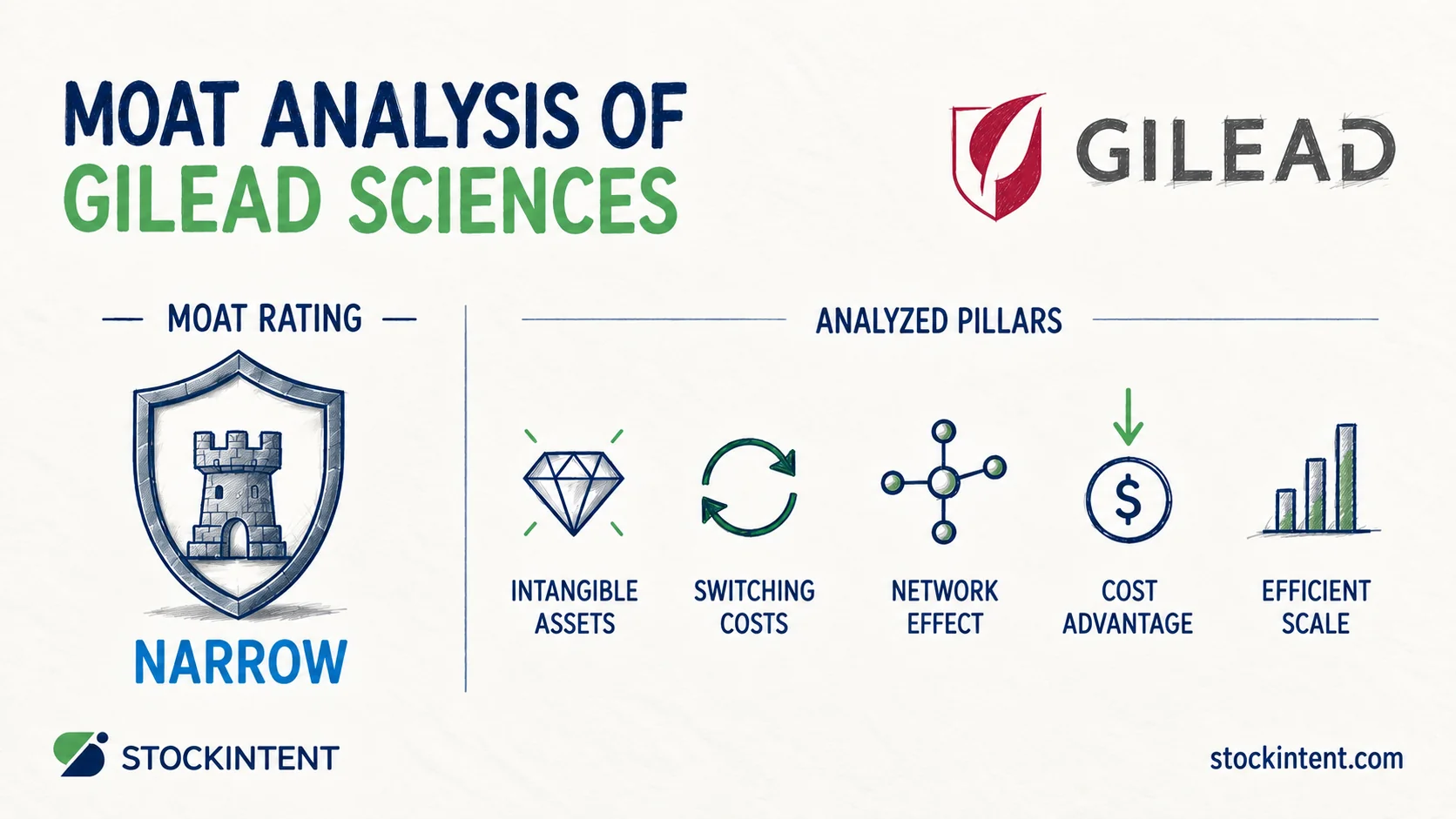
We assess Gilead Sciences as carrying a narrow-to-moderate economic moat with a stable-to-widening trend and medium uncertainty. Its core competitive engine remains an intellectual-property powerhouse anchored in HIV care, where high patient retention, clinician habit, and protected formulations defend attractive economics.
In the second quarter of 2026, Gilead reported that HIV product sales reached approximately $5.7 billion, up 12% year over year, while management raised full-year HIV revenue growth guidance to 9% to 10%.
Here is how we see the business today:
For long-term investors, evaluating Gilead means looking past headline yield to see whether its clinical pipeline can compound capital once older protections expire.
Many investors assume every large pharmaceutical firm possesses a broad, multi-layered economic moat. In our experience analyzing drug manufacturers, Gilead's competitive moat is narrower and far more specialized than peer reputations suggest. The business relies primarily on patent-backed intellectual property rather than platform mechanics or scale advantages. Evaluating Gilead means ranking the five classic competitive moat pillars to see where genuine business durability lives.
Intangible assets are Gilead's strongest moat pillar by a wide margin. The company's competitive protection rests on patents, regulatory market exclusivities, and branded treatment guidelines across HIV, oncology, and liver diseases. According to Gilead's Q2 2026 earnings filing, intellectual property shields dominant therapies such as Biktarvy from direct generic entry, preserving robust pricing power. Furthermore, a NASDAQ research report highlights that Gilead's clinical development pipeline is viewed as difficult to replicate, which helps offset the eventual 2033 patent expiration on core HIV assets. In our view, while reported patent filings establish current market exclusivity, long-term moat durability depends entirely on pipeline execution before those legal protections expire.
Switching costs provide moderate competitive protection, primarily inside Gilead's chronic care franchises. In HIV treatment and prevention, buying behavior is heavily prescription-led and resistant to casual disruption. As investing coverage of Q2 2026 results indicates, Gilead demonstrates strong patient retention in prevention regimens like Yeztugo, reflecting high customer stickiness once a stable therapy is established. Clinicians also develop prescribing habits around proven efficacy and safety profiles, creating real procedural inertia. But this friction is not absolute. When patents lapse, commercial payers routinely shift formularies toward generic alternatives.
Network effects are weak and immaterial to Gilead's business model. A pharmaceutical product does not become intrinsically more effective or valuable simply because additional patients take it. Value comes from biochemical efficacy and clinical trials, not network density. Payer access and clinical familiarity expand market reach, but these dynamics lack the self-reinforcing loops seen in genuine platform networks.
Cost advantage is weak and does not drive Gilead's economic profits. The company does not compete as a low-cost contract manufacturer with structural production efficiencies. Drug development requires heavy selling, general, and administrative expenses alongside substantial research and development outlays. Pricing strength stems from patented therapeutic exclusivity, not an ability to undercut competitors on unit production costs.
Efficient scale is weak because Gilead's target therapeutic markets are expansive and attract well-capitalized global biopharma rivals. Markets for chronic viral infections, solid tumors, and inflammatory conditions are large enough to support multiple competing multi-billion-dollar therapies simultaneously. Gilead does not operate in restricted, natural-monopoly niches where market size discourages outside entry.
Gilead's economic moat shows up most clearly in its financial margins, cash flow generation, and durable HIV market share. When an intellectual-property moat functions properly, it yields pricing power and insulated gross profits. In Q1 2026, Gilead achieved an adjusted gross margin of 87.5%, followed by a non-GAAP product gross margin of 86.9% in Q2 2026.
Those margins translate directly into cash. In FY2025, the HIV franchise alone generated approximately $9.5 billion in free cash flow, giving management substantial capital to reinvest into research and pipeline development. Base business product sales excluding Veklury grew 10% year over year in Q2 2026, powered by $5.7 billion in quarterly HIV sales and Biktarvy's commanding domestic market share above 52%.
Yet the business evidence also reveals a clear weakness: heavy concentration. HIV products contributed about 72% of Q1 2026 revenue. Beyond this core engine, the moat looks uneven. Sales in legacy hepatitis C (HCV), Veklury, and cell therapy have faced declines, meaning non-HIV revenue streams are not yet producing identical defensive economics.
Pro Insight: Pharmaceutical moats often look widest right before they narrow. The 2033 patent cliff is visible, but investors frequently underestimate how quickly oncology and liver disease pipelines must mature to replace HIV economics. The question isn't whether Gilead has a moat today; it's whether that moat can be rebuilt in real-time as the foundation erodes.
We assess Gilead Sciences's moat trend as stable-to-widening, powered by near-term HIV momentum that offsets drag across older treatment areas. Competitive strength is not static, and Gilead's recent performance shows clear expansion in its primary market even as structural headwinds remain on the horizon.
In the near term, several developments point toward a widening moat:
Still, serious cross-currents prevent an unconditional widening verdict across the entire enterprise. Gilead faces an approximate 2% policy-related growth headwind in 2026 from federal drug pricing provisions and Affordable Care Act adjustments, according to Fortune's Q1 2026 earnings transcript. In addition, secular volume declines across legacy hepatitis C treatments, Veklury, and cell therapies keep top-line expansion dependent on one therapeutic silo, while the 2033 HIV patent cliff ticks in the background.
To gauge whether Gilead's competitive moat is genuinely expanding or quietly deteriorating, investors should monitor four specific indicators:
We assign Gilead Sciences a Medium uncertainty rating. This rating reflects the contrast between exceptional near-term operational stability and a wide distribution of long-term business outcomes.
On one side, top-line predictability is solid. Base business sales continue to grow at high single digits, and non-GAAP product gross margins remain rock-solid near 86% to 87%. But portfolio concentration injects substantial risk. HIV therapies generated about 72% of Gilead's first-quarter 2026 revenue. When three-quarters of a business hinges on a single therapeutic category, unexpected clinical developments, payer resistance, or regulatory pushback can quickly distort cash generation. In 2026, management already cited an approximate 2% growth headwind from federal drug pricing agreements and Affordable Care Act adjustments.
From StockIntent's perspective, long-term investors need patience because this moat assessment spans multiple product cycles. The core question is not about next quarter's earnings beat. Instead, it is about whether Gilead can transition from a single-franchise cash cow into a diversified biopharma powerhouse before its scheduled 2033 patent expiration.
That execution dynamic creates two divergent paths. If Yeztugo, Trodelvy, and Livdelzi scale successfully, Gilead will compound capital from a diversified foundation. But if those assets falter while HIV growth normalizes, Gilead faces a sharp deceleration into a mature, low-growth business. Because both paths remain plausible, uncertainty stays firmly in the middle.
Gilead Sciences holds a narrow-to-moderate economic moat with a stable-to-widening trend and medium uncertainty. Its competitive strength rests firmly on strong intangible assets within HIV care. Flagship Biktarvy retains over 52% domestic market share, while adjusted gross margins near 87% provide exceptional free cash flow.
From here, the critical issue for investors is timing. Can emerging treatments like Yeztugo, Trodelvy, and Livdelzi scale fast enough to build a secondary growth engine before the 2033 HIV patent expiration arrives? In the near term, raised 2026 HIV growth guidance of 9% to 10% and 10% base business growth buy valuable breathing room. But with HIV driving over 70% of revenue, any unexpected regulatory pricing squeeze or clinical setback would quickly compress Gilead's compounding potential. For long-term investors, the priority is tracking pipeline commercialization rather than relying solely on today's dividend.
This content is for informational and educational purposes and is not investment advice. Investors should conduct their own research and consider their individual circumstances before making investment decisions.
We assess Gilead Sciences as carrying a narrow-to-moderate economic moat with a stable-to-widening trend and medium uncertainty. Its core competitive engine remains an intellectual-property powerhouse anchored in HIV care, where high patient retention, clinician habit, and protected formulations defend attractive economics.
In the second quarter of 2026, Gilead reported that HIV product sales reached approximately $5.7 billion, up 12% year over year, while management raised full-year HIV revenue growth guidance to 9% to 10%.
Here is how we see the business today:
For long-term investors, evaluating Gilead means looking past headline yield to see whether its clinical pipeline can compound capital once older protections expire.
Many investors assume every large pharmaceutical firm possesses a broad, multi-layered economic moat. In our experience analyzing drug manufacturers, Gilead's competitive moat is narrower and far more specialized than peer reputations suggest. The business relies primarily on patent-backed intellectual property rather than platform mechanics or scale advantages. Evaluating Gilead means ranking the five classic competitive moat pillars to see where genuine business durability lives.
Intangible assets are Gilead's strongest moat pillar by a wide margin. The company's competitive protection rests on patents, regulatory market exclusivities, and branded treatment guidelines across HIV, oncology, and liver diseases. According to Gilead's Q2 2026 earnings filing, intellectual property shields dominant therapies such as Biktarvy from direct generic entry, preserving robust pricing power. Furthermore, a NASDAQ research report highlights that Gilead's clinical development pipeline is viewed as difficult to replicate, which helps offset the eventual 2033 patent expiration on core HIV assets. In our view, while reported patent filings establish current market exclusivity, long-term moat durability depends entirely on pipeline execution before those legal protections expire.
Switching costs provide moderate competitive protection, primarily inside Gilead's chronic care franchises. In HIV treatment and prevention, buying behavior is heavily prescription-led and resistant to casual disruption. As investing coverage of Q2 2026 results indicates, Gilead demonstrates strong patient retention in prevention regimens like Yeztugo, reflecting high customer stickiness once a stable therapy is established. Clinicians also develop prescribing habits around proven efficacy and safety profiles, creating real procedural inertia. But this friction is not absolute. When patents lapse, commercial payers routinely shift formularies toward generic alternatives.
Network effects are weak and immaterial to Gilead's business model. A pharmaceutical product does not become intrinsically more effective or valuable simply because additional patients take it. Value comes from biochemical efficacy and clinical trials, not network density. Payer access and clinical familiarity expand market reach, but these dynamics lack the self-reinforcing loops seen in genuine platform networks.
Cost advantage is weak and does not drive Gilead's economic profits. The company does not compete as a low-cost contract manufacturer with structural production efficiencies. Drug development requires heavy selling, general, and administrative expenses alongside substantial research and development outlays. Pricing strength stems from patented therapeutic exclusivity, not an ability to undercut competitors on unit production costs.
Efficient scale is weak because Gilead's target therapeutic markets are expansive and attract well-capitalized global biopharma rivals. Markets for chronic viral infections, solid tumors, and inflammatory conditions are large enough to support multiple competing multi-billion-dollar therapies simultaneously. Gilead does not operate in restricted, natural-monopoly niches where market size discourages outside entry.
Gilead's economic moat shows up most clearly in its financial margins, cash flow generation, and durable HIV market share. When an intellectual-property moat functions properly, it yields pricing power and insulated gross profits. In Q1 2026, Gilead achieved an adjusted gross margin of 87.5%, followed by a non-GAAP product gross margin of 86.9% in Q2 2026.
Those margins translate directly into cash. In FY2025, the HIV franchise alone generated approximately $9.5 billion in free cash flow, giving management substantial capital to reinvest into research and pipeline development. Base business product sales excluding Veklury grew 10% year over year in Q2 2026, powered by $5.7 billion in quarterly HIV sales and Biktarvy's commanding domestic market share above 52%.
Yet the business evidence also reveals a clear weakness: heavy concentration. HIV products contributed about 72% of Q1 2026 revenue. Beyond this core engine, the moat looks uneven. Sales in legacy hepatitis C (HCV), Veklury, and cell therapy have faced declines, meaning non-HIV revenue streams are not yet producing identical defensive economics.
Pro Insight: Pharmaceutical moats often look widest right before they narrow. The 2033 patent cliff is visible, but investors frequently underestimate how quickly oncology and liver disease pipelines must mature to replace HIV economics. The question isn't whether Gilead has a moat today; it's whether that moat can be rebuilt in real-time as the foundation erodes.
We assess Gilead Sciences's moat trend as stable-to-widening, powered by near-term HIV momentum that offsets drag across older treatment areas. Competitive strength is not static, and Gilead's recent performance shows clear expansion in its primary market even as structural headwinds remain on the horizon.
In the near term, several developments point toward a widening moat:
Still, serious cross-currents prevent an unconditional widening verdict across the entire enterprise. Gilead faces an approximate 2% policy-related growth headwind in 2026 from federal drug pricing provisions and Affordable Care Act adjustments, according to Fortune's Q1 2026 earnings transcript. In addition, secular volume declines across legacy hepatitis C treatments, Veklury, and cell therapies keep top-line expansion dependent on one therapeutic silo, while the 2033 HIV patent cliff ticks in the background.
To gauge whether Gilead's competitive moat is genuinely expanding or quietly deteriorating, investors should monitor four specific indicators:
We assign Gilead Sciences a Medium uncertainty rating. This rating reflects the contrast between exceptional near-term operational stability and a wide distribution of long-term business outcomes.
On one side, top-line predictability is solid. Base business sales continue to grow at high single digits, and non-GAAP product gross margins remain rock-solid near 86% to 87%. But portfolio concentration injects substantial risk. HIV therapies generated about 72% of Gilead's first-quarter 2026 revenue. When three-quarters of a business hinges on a single therapeutic category, unexpected clinical developments, payer resistance, or regulatory pushback can quickly distort cash generation. In 2026, management already cited an approximate 2% growth headwind from federal drug pricing agreements and Affordable Care Act adjustments.
From StockIntent's perspective, long-term investors need patience because this moat assessment spans multiple product cycles. The core question is not about next quarter's earnings beat. Instead, it is about whether Gilead can transition from a single-franchise cash cow into a diversified biopharma powerhouse before its scheduled 2033 patent expiration.
That execution dynamic creates two divergent paths. If Yeztugo, Trodelvy, and Livdelzi scale successfully, Gilead will compound capital from a diversified foundation. But if those assets falter while HIV growth normalizes, Gilead faces a sharp deceleration into a mature, low-growth business. Because both paths remain plausible, uncertainty stays firmly in the middle.
Gilead Sciences holds a narrow-to-moderate economic moat with a stable-to-widening trend and medium uncertainty. Its competitive strength rests firmly on strong intangible assets within HIV care. Flagship Biktarvy retains over 52% domestic market share, while adjusted gross margins near 87% provide exceptional free cash flow.
From here, the critical issue for investors is timing. Can emerging treatments like Yeztugo, Trodelvy, and Livdelzi scale fast enough to build a secondary growth engine before the 2033 HIV patent expiration arrives? In the near term, raised 2026 HIV growth guidance of 9% to 10% and 10% base business growth buy valuable breathing room. But with HIV driving over 70% of revenue, any unexpected regulatory pricing squeeze or clinical setback would quickly compress Gilead's compounding potential. For long-term investors, the priority is tracking pipeline commercialization rather than relying solely on today's dividend.
This content is for informational and educational purposes and is not investment advice. Investors should conduct their own research and consider their individual circumstances before making investment decisions.