Apr 3, 2026
Understanding a company's mission, vision, and values isn't just corporate fluff; it's how you judge whether management actually knows where they're steering the ship. For investors in Goodyear (NASDAQ: GT), these statements reveal how leadership thinks about competitive positioning, capital allocation, and long-term value creation in a cyclical, capital-intensive industry.
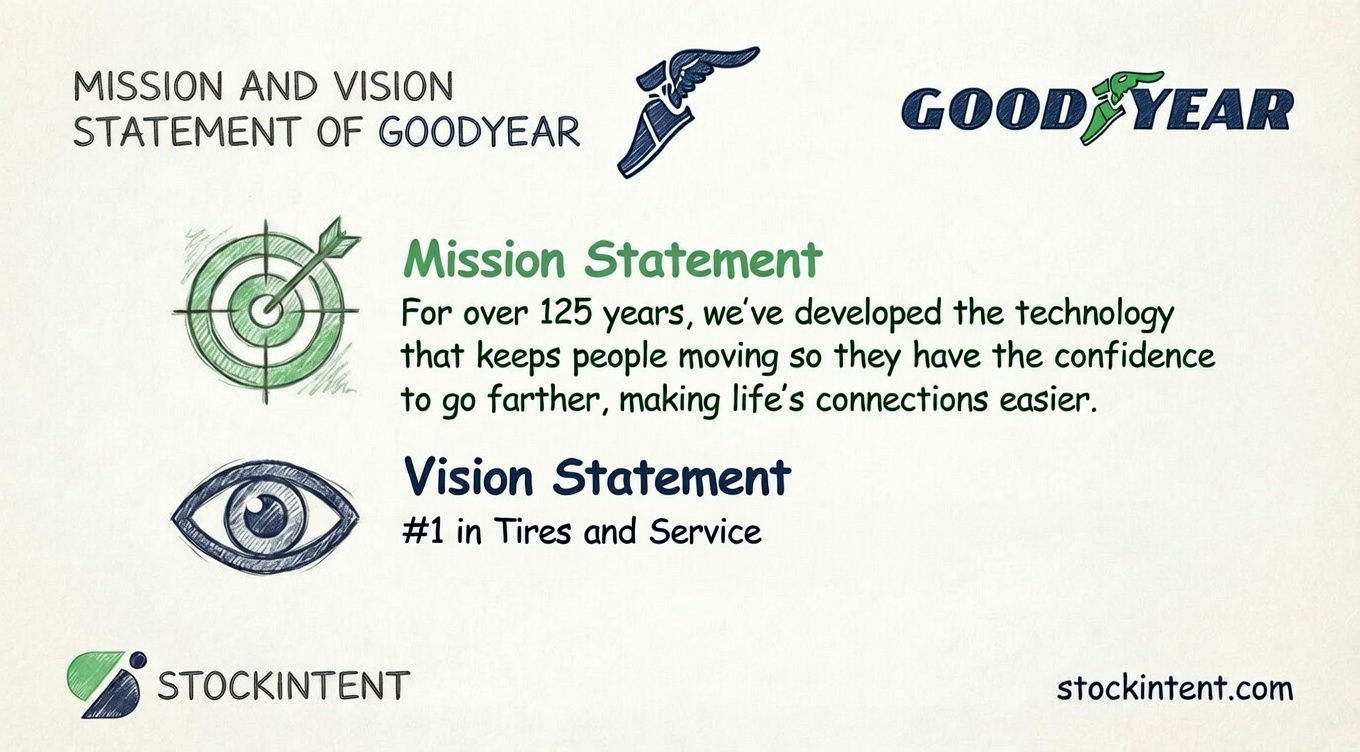
Goodyear's mission statement captures 125 years of innovation: "For more than 125 years, we've developed the technology that keeps people moving so they have the confidence to go faster, farther and to more places, making all of life's connections easier every day."[1] This isn't just marketing language; it reflects a strategic pivot from pure manufacturing toward technology-enabled mobility solutions. The company now describes itself as fueling "the science of motion" from current vehicles to future driverless fleets.[1]
The vision of being "#1 in Tires and Service" provides a clear, measurable North Star. It's ambitious but specific enough to guide operational decisions, from the $2.3 billion in divestitures completed in 2025 to the premium product lineup expansion.[2] This clarity matters for investors trying to assess whether management's capital allocation decisions align with stated priorities.
Goodyear's core values aren't wall decorations; they're operationalized through the "Goodyear Forward" transformation. The company achieved 8.5% segment operating margin in Q4 2025 (the highest in seven years) by applying these principles: agility in restructuring, collaboration across global teams, and relentless focus on delivering measurable results.[2] The values also underpin ESG commitments that have earned external validation, including designation as one of Ethisphere's 2025 World's Most Ethical Companies.[3]
For investors evaluating Goodyear stock, the mission, vision, and values framework offers a lens to assess management quality and strategic coherence. The 2026 investment case hinges on whether this mission-driven discipline can sustain margin expansion amid industry headwinds.
Sources:
[1] Goodyear Corporate Strategy — Official Goodyear corporate strategy page, primary source for mission statement and vision
[2] Goodyear Q4 2025 Earnings Presentation — Official investor relations document with verified financial results and transformation progress
[3] Goodyear Corporate Responsibility Report 2024 — Official ESG report documenting ethical recognition and sustainability commitments
Goodyear Tire & Rubber Company (NASDAQ: GT) stands as one of the most recognizable names in the auto parts industry, with a heritage stretching back to 1898 when Frank Seiberling founded the company in Akron, Ohio. Named after Charles Goodyear, the inventor of vulcanized rubber, the company has evolved from a bicycle tire manufacturer into a global mobility technology leader with operations spanning three geographic segments: Americas, EMEA (Europe, Middle East and Africa), and Asia Pacific.
In our experience analyzing cyclical industrial companies, Goodyear's current positioning reflects a deliberate strategic pivot. The company completed $2.3 billion in divestitures during 2025, shedding its Off-the-Road tire and Chemical businesses to streamline operations around core tire manufacturing and aviation products. This portfolio reshaping aligns with the "Goodyear Forward" transformation plan that has already delivered $1.25 billion in cumulative benefits, $150 million ahead of original targets.
| Metric | Figure | Context |
|---|---|---|
| Q4 2025 Revenue | $4.9 billion | Flat YoY; +4% organic basis |
| Segment Operating Margin | 8.5% | Highest in 7+ years |
| Q4 Segment Operating Income | $416 million | Up 9% YoY; 18% organic growth |
| Full-Year Tire Units | 158.7 million | Down from prior year levels |
| Goodyear Forward Benefits | $1.25 billion cumulative | $150M above original target |
| Operating Cash Flow (Q4) | $1.5 billion | Strong liquidity generation |
Goodyear's operations center on three pillars that define its competitive footprint:
Consumer Tires: The largest revenue driver, spanning replacement and original equipment (OE) markets. The company gained OE market share for seven consecutive quarters in the U.S. and EMEA as of Q4 2025, a notable achievement in a competitive landscape dominated by Michelin and Bridgestone.
Commercial Tires: Serving fleet operators and trucking companies, this segment remains sensitive to freight volumes. Analysts note recovery to 12-13 million annual commercial units would significantly boost performance.
Aviation: A century-old business dating to the world's first pneumatic aircraft tire in 1909. Goodyear unified its global aviation operations in late 2025 to accelerate innovation, serving commercial airlines, military fleets, and private aircraft with specialized tire technology.
The company's product strategy increasingly emphasizes premium positioning, with nearly 1,000 new SKUs launched in 2025 targeting higher-margin segments. This shift toward value over volume mirrors strategies we've seen work at other industrial compounders, though execution remains tested by soft consumer demand and competitive pricing pressure.
Goodyear's market position sits solidly among the "big three" global tire manufacturers, trailing Michelin and Bridgestone in overall scale but maintaining strong regional presence, particularly in North America. The 2026 investment thesis hinges on whether management can sustain margin expansion, the 8.5% segment operating margin achieved in Q4 2025, while navigating industry headwinds including raw material costs, tariff uncertainty, and the ongoing EV transition requiring specialized tire technologies.
"For more than 125 years, we've developed the technology that keeps people moving so they have the confidence to go faster, farther and to more places, making all of life's connections easier every day."
Goodyear's official mission statement captures something essential about how the company sees itself in 2026. It's not just about rubber and steel belts; it's about enabling human mobility and connection. The phrase "making all of life's connections easier every day" signals a strategic pivot from pure manufacturing toward technology-enabled mobility solutions.
This mission matters for investors because it frames how management allocates capital. When Goodyear describes itself as fueling "the science of motion" from current vehicles to future driverless fleets, that isn't marketing fluff. It justifies R&D spending on smart tires, EV-specific products, and sustainable materials. The company's official strategy page makes this explicit: innovation in sustainable and smart tire technologies sits at the core of the mission.
🎯 Pro Insight: Watch how mission language translates into actual capital allocation. Goodyear's $2.3 billion in 2025 divestitures, shedding non-core businesses like Off-the-Road tires and Chemicals, directly reflects this mobility-focused mission. Management is pruning everything that doesn't advance the core technology platform. The 8.5% segment operating margin achieved in Q4 2025, the highest in seven years, suggests this discipline is paying off.
The mission also embeds sustainability as a strategic priority, not just a compliance exercise. Goodyear's net-zero emissions target by 2050 and its 35.5% reduction in rolling resistance since 2005 aren't separate CSR initiatives; they're woven into how the company defines "superior products." For investors using platforms like StockIntent to screen for ESG-aligned industrials, this mission-to-metrics linkage is worth tracking. The company's designation as one of Ethisphere's 2025 World's Most Ethical Companies provides external validation that the mission isn't just words on a page.
Compared to competitors, Goodyear's mission stands out for its explicit technology positioning. While Michelin and Bridgestone also emphasize innovation, Goodyear's framing as a "technology company that happens to make tires" (as one analysis puts it) creates a narrative that can support premium pricing and customer stickiness. The mission's focus on "confidence" also speaks to brand positioning in a market where safety and reliability drive purchase decisions.
Goodyear's mission isn't just a feel-good statement; it's a framework that guides capital allocation, product development, and competitive positioning. When we analyze how companies actually execute on their stated missions, we look for three things: clarity of strategic pillars, measurable initiatives that demonstrate each pillar, and tangible competitive advantages that emerge from consistent execution. Goodyear checks these boxes through four interconnected pillars that define its 2026 strategy.
The first pillar centers on Goodyear's self-positioning as a technology company that happens to make tires. This isn't semantic gymnastics. The company has invested heavily in smart tire technologies, EV-specific products, and data-enabled fleet solutions that extend beyond traditional rubber manufacturing.
In our experience tracking industrial companies through multiple technology cycles, the ones that successfully reposition as technology providers often capture pricing power that pure manufacturers can't match. Goodyear's ElectricDrive 2 and ElectricDrive Sustainable-material Tire lines demonstrate this shift; they're not just tires for electric vehicles, but integrated solutions addressing range optimization (low rolling resistance) and noise reduction that EV manufacturers specifically demand.
The concrete metric here: Goodyear achieved a 35.5% reduction in rolling resistance and 9.9% reduction in tire weight from its 2005 baseline. These aren't vanity metrics; they translate directly into fuel efficiency for ICE vehicles and range extension for EVs, creating genuine customer value that supports premium pricing.
The second pillar focuses on product excellence and operational execution. Goodyear's "Goodyear Forward" transformation provides the clearest evidence of mission-driven execution here. The plan has delivered $1.25 billion in cumulative benefits, already $150 million ahead of original targets, with $192 million in Q4 2025 benefits alone.
This pillar manifests in specific operational choices: nearly 1,000 new SKUs launched in 2025, a unified global aviation business (accelerating innovation in a century-old segment), and seven consecutive quarters of OE market share gains in the U.S. and EMEA. The 8.5% segment operating margin achieved in Q4 2025, the highest in over seven years, validates that superior product execution can translate into superior economics.
For investors using screening tools to identify operational turnarounds, these metrics matter more than mission statement language. The margin expansion demonstrates that "superior products" isn't just marketing; it's a defendable market position.
The third pillar embeds environmental and social responsibility into the core business strategy, not as a separate CSR initiative. Goodyear's net-zero greenhouse gas emissions target by 2050 and its "Better Future" framework align with this commitment.
What distinguishes Goodyear's approach is how sustainability connects to product performance. The same innovations that reduce environmental impact (sustainable materials, lower rolling resistance) also improve the customer value proposition. This creates a virtuous cycle where ESG progress reinforces competitive positioning rather than competing with it.
External validation provides credibility here: Goodyear's designation as one of Ethisphere's 2025 World's Most Ethical Companies and recognition as a Top 25 Most Socially Innovative Company suggest independent observers view these commitments as substantive rather than performative.
The fourth pillar, Goodyear's stated vision, provides the unifying strategic goal. This isn't subtle; it's a clear market share and positioning ambition that guides portfolio decisions. The $2.3 billion in divestitures completed in 2025, shedding Off-the-Road tire and Chemical businesses, directly reflects this focus. Management pruned everything that didn't advance the core tire and service platform.
The strategic logic is straightforward: in a consolidated industry where Michelin and Bridgestone hold scale advantages, Goodyear needs operational focus to compete effectively. The vision provides a filter for capital allocation decisions, from the Lawton EV investment to the global aviation unification.
| Mission Pillar | Strategic Initiative | Measurable Outcome | Competitive Advantage |
|---|---|---|---|
| Technology/Mobility | EV-specific tire development (ElectricDrive lines) | 35.5% rolling resistance reduction since 2005 | Premium positioning in fastest-growing vehicle segment |
| Superior Products | Goodyear Forward transformation | $1.25B cumulative benefits; 8.5% segment operating margin | Highest margin in 7+ years; pricing power validation |
| Sustainable Value | Net-zero by 2050 commitment; sustainable materials integration | Ethisphere 2025 World's Most Ethical Companies | Brand differentiation; regulatory risk mitigation |
| #1 in Tires and Service | Portfolio optimization ($2.3B divestitures) | $1.5B Q4 operating cash flow; debt reduced by $1.6B | Focused competitive footprint; balance sheet strength |
The critical question for investors: do these mission pillars translate into durable competitive advantages? In our view, the evidence is mixed but trending positive. The technology positioning creates differentiation in EV tires, a growth segment where customer requirements (range, noise, load-bearing for battery weight) favor specialized solutions over commodity offerings. The operational improvements from Goodyear Forward demonstrate execution capability that can persist even as the specific transformation program concludes.
However, the tire industry remains structurally challenging: capital-intensive, exposed to raw material volatility, and subject to pricing pressure from both premium competitors and low-cost imports. Goodyear's mission-driven focus provides a framework for navigating these challenges, but it doesn't eliminate them. The 2026 investment case depends on whether management can sustain the margin discipline and innovation cadence that the mission pillars demand.
"#1 in Tires and Service"
Goodyear's vision statement is refreshingly direct. No corporate poetry, no buzzword bingo; just a clear, measurable ambition that everyone from the factory floor to the C-suite can understand. This isn't a mission statement dressed up as vision. It's a market position goal with teeth.
The strategic logic behind this vision becomes clear when you look at how management has reshaped the portfolio. The $2.3 billion in divestitures completed in 2025, shedding the Off-the-Road tire and Chemical businesses, wasn't just balance sheet housekeeping. It was surgical focus on the core tire and service platform that can actually win market leadership. When you're competing against Michelin and Bridgestone, two companies with deeper balance sheets and broader global footprints, you can't afford strategic drift.
Goodyear leadership has articulated specific targets through the "Goodyear Forward" transformation plan that directly serve the "#1" ambition:
These aren't aspirational targets floating in strategic documents. The 8.5% segment operating margin achieved in Q4 2025, the highest in over seven years, demonstrates tangible progress toward the margin goal that underpins market leadership.
Goodyear's vision positions the company to capture value from three macro trends reshaping auto parts and consumer cyclicals in 2026:
| Macro Trend | Goodyear's Vision-Aligned Response | Competitive Implication |
|---|---|---|
| EV Transition | ElectricDrive tire lines with low rolling resistance for range optimization | Premium positioning in fastest-growing vehicle segment; supports "#1" through technology differentiation |
| Sustainability Mandates | Net-zero by 2050 commitment; 35.5% rolling resistance reduction since 2005 | Regulatory risk mitigation; brand differentiation with ESG-focused fleet customers |
| Fleet Digitization | Smart tire technologies and data-enabled fleet solutions | Expands "Service" component of vision beyond commodity tire sales |
The vision's dual emphasis on "Tires" and "Service" is strategically significant. Pure manufacturing scale is increasingly difficult to defend against low-cost competitors and private label pressure. But service relationships, fleet data partnerships, and integrated mobility solutions create stickier customer economics that support sustainable market leadership.
For investors evaluating Goodyear stock, the vision provides a clear benchmark for management accountability. Either the company gains share and margin trajectory toward "#1" positioning, or it doesn't. The 2026 investment case hinges on whether the operational discipline demonstrated in Q4 2025 can persist as the transformation program concludes and the company enters what management calls the "post-Goodyear Forward" phase.
Goodyear's vision of being "#1 in Tires and Service" isn't just aspirational branding; it's a strategic filter that shapes every major decision. When management talks about this vision, they're really talking about three interlocking themes that determine how capital gets allocated, where talent gets deployed, and which markets get prioritized. Let's break down what these themes actually mean in practice.
The first vision theme is execution discipline. CEO Mark Stewart has been crystal clear that this isn't about waiting for market tailwinds; it's about controlling what the company can control. The numbers suggest this approach works.
The "Goodyear Forward" transformation delivered $1.25 billion in cumulative benefits through the end of 2025, already $150 million ahead of original targets. In Q4 alone, the plan generated $192 million in benefits, contributing to the 8.5% segment operating margin; the highest achieved in over seven years. Official Q4 2025 earnings results demonstrate how vision translates into measurable performance.
This theme manifests in specific operational choices: $1.5 billion in annual run-rate savings achieved (up from the original $1.3 billion target), workforce reductions totaling 1,750 positions in 2025 with 450 more planned for 2026, and facility consolidations like the Findlay mold facility closure by March 31, 2026. The Q4 2025 earnings presentation shows management treating cost discipline not as a one-time fix but as a permanent operating philosophy.
The second theme is ruthless prioritization. Goodyear's leadership has made the hard call to prune everything that doesn't advance the "#1" ambition. The $2.3 billion in divestitures completed in 2025, exceeding the $2.0 billion target by $300 million, demonstrates this theme in action.
Specific moves include:
These weren't distress sales; they were strategic choices to concentrate resources where Goodyear can actually win. The result: $1.6 billion in debt reduction and a cleaner competitive footprint focused on consumer tires, commercial tires, and aviation; the segments where scale and technology create defendable positions.
As Manufacturing Dive reported, this portfolio discipline positions Goodyear "stronger despite flat 2025 sales," though ongoing workforce cuts signal continued restructuring for durability amid industry challenges.
The third vision theme is about where Goodyear competes, not just how. Being "#1" can't mean being biggest in a race to the bottom on price. It means dominating the segments where technology, brand, and service create sustainable pricing power.
Goodyear launched nearly 1,000 new premium SKUs in 2025, targeting higher-margin segments. The company gained original equipment (OE) market share for seven consecutive quarters in both the U.S. and EMEA as of Q4 2025; a notable achievement in markets typically dominated by Michelin and Bridgestone.
The sustainability angle is integral here, not peripheral. Goodyear's net-zero greenhouse gas emissions target by 2050 and its 35.5% rolling resistance reduction since 2005 (which improves fuel efficiency and EV range) create product differentiation that supports premium positioning. The Official corporate responsibility report documents how sustainability investments like EV-specific tire development align with long-term value creation.
| Vision Theme | Strategic Initiative | Financial Outcome | Competitive Implication |
|---|---|---|---|
| Operational Excellence | Goodyear Forward transformation | $1.25B cumulative benefits; 8.5% segment margin | Highest margin in 7+ years validates execution capability |
| Portfolio Optimization | $2.3B in divestitures (OTR, Chemicals, Dunlop) | Debt reduced by $1.6B; $1.5B Q4 operating cash flow | Focused competitive footprint on winnable segments |
| Premium Positioning | 1,000 new premium SKUs; OE share gains | 7 consecutive quarters of OE share growth | Pricing power in fastest-growing mobility segments |
For investors using platforms like StockIntent to analyze industrial turnarounds, these themes provide a framework for assessing management quality. The question isn't whether Goodyear can hit any single metric; it's whether the three themes reinforce each other to create durable competitive positioning.
The evidence is mixed but directionally positive. Operational excellence generates cash for portfolio optimization. Portfolio optimization creates focus for premium positioning. Premium positioning funds further operational investment. This flywheel effect, if sustained, is what separates cyclical recoveries from genuine structural improvements.
What remains to be proven is whether these vision themes can persist once the "Goodyear Forward" program officially concludes. Management has already signaled a "post-Goodyear Forward" phase focused on sustaining margin discipline and demand recovery. The 8.5% segment operating margin achieved in Q4 2025 suggests the foundation is there. But as any experienced investor knows, maintaining execution discipline during industry downturns is where visions get tested.
Goodyear's core values aren't aspirational wall art; they're operational directives that shape how the company hires, makes decisions, and executes strategy. In our experience analyzing industrial turnarounds, the companies that actually transform are those where stated values show up in capital allocation and personnel choices, not just annual reports. Goodyear's five core values, articulated as "How We Work," provide that framework: Act with Integrity, Energize the Team, Promote Collaboration, Be Agile, and Deliver Results.[1]
These values matter for investors because they explain how management intends to achieve the "#1 in Tires and Service" vision. When CEO Mark Stewart talks about "execution discipline" and "controlling what we can control," he's speaking the language of these values.[2] Let's break down what each actually means in practice.
This value centers on ethical conduct, transparency, and doing business the right way even when it's harder. Goodyear's 2024 Corporate Responsibility Report documents how integrity translates into supply chain practices, human rights commitments, and governance standards. The company's designation as one of Ethisphere's 2025 World's Most Ethical Companies provides external validation that this isn't just talk.[3]
In practice, integrity shows up in product safety commitments and honest communication with stakeholders. When Goodyear reports financial results, the detailed segment disclosures and candid discussion of headwinds (like the Q4 2025 volume declines) reflect this value in action. For investors using screening tools to assess management quality, this kind of transparency matters; it's how you build trust that reported numbers are real.
Goodyear describes this as creating an environment where associates bring their full selves to work, fostering growth and community engagement. The company employs approximately 68,000 people globally, and this value emphasizes that human capital is a competitive weapon, not just a cost center.[1]
The operational evidence is mixed but directionally clear. Goodyear reduced headcount by 1,750 positions in 2025 with 450 more planned for 2026, including the closure of the Findlay mold facility by March 31, 2026.[2] These are painful but necessary moves to achieve the $1.5 billion run-rate cost savings target. The "energize" value doesn't mean avoiding hard decisions; it means making them transparently while investing in the remaining team. Employee survey data from Comparably shows 67% of associates are motivated by the mission and values, with particular strength in teamwork (25%) and transparency/integrity (50%).[4]
This value breaks down silos and emphasizes "One Team" behavior across functions and geographies. For a company operating in Americas, EMEA, and Asia Pacific segments, collaboration isn't optional; it's how you leverage global scale without becoming bureaucratic.
The unification of Goodyear's global aviation business in late 2025 demonstrates this value in action. By consolidating what had been regional operations, the company aims to accelerate innovation in a century-old segment.[5] Similarly, the "Goodyear Forward" transformation required cross-functional coordination to achieve $192 million in benefits during Q4 2025 alone.[2] These aren't initiatives that succeed without genuine collaboration; they fail when fiefdoms protect turf.
In a cyclical, capital-intensive industry, agility means responding to market shifts faster than competitors. Goodyear's 35.5% reduction in rolling resistance and 9.9% reduction in tire weight since 2005 reflect agility in product development; adapting to regulatory and customer demands for efficiency.[1]
More recently, agility showed up in portfolio decisions. When the OTR tire and Chemical businesses no longer fit the strategic focus, management moved decisively to divest them, generating $2.3 billion in proceeds (exceeding the $2.0 billion target by $300 million).[2] This willingness to change course, to admit that yesterday's assets are tomorrow's distractions, is what separates adaptive companies from those that slowly atrophy.
💡 Expert Tip: When evaluating management quality, look for agility in capital allocation, not just product development. Goodyear's willingness to divest $2.3 billion in non-core assets, even at potentially discounted prices, demonstrates the kind of strategic flexibility that creates long-term value. The best industrial companies prune aggressively; the mediocre ones cling to legacy businesses until markets force their hand.
This is the value that ties the others together. Integrity, energized teams, collaboration, and agility are means to an end: measurable performance. Goodyear's 8.5% segment operating margin in Q4 2025, the highest in over seven years, is the scoreboard.[2]
The results orientation extends to specific financial targets: 10% segment operating income margin, net leverage of 2.0x–2.5x, and $1.5 billion in annual run-rate savings. These aren't vague aspirations; they're commitments against which management can be judged. For investors using platforms like StockIntent to track operational progress, this clarity is valuable; you know what success looks like.
The question for investors is whether these values are genuinely reflected in operations or merely corporate communications. The evidence is broadly positive but not without nuance.
Positive indicators:
Areas of tension:
In our experience, no company perfectly lives its values; the question is whether the values provide a useful framework for decision-making and accountability. Goodyear's core values pass this test. They're specific enough to guide behavior, measurable enough to track progress, and aligned with the strategic priorities that will determine whether the "#1 in Tires and Service" vision becomes reality.
Goodyear's environmental, social, and governance commitments aren't separate from its core values; they're an extension of them. The net-zero greenhouse gas emissions target by 2050, the "Better Future" framework, and the integration of sustainable materials into product lines all flow from the same strategic logic that produced the values.[1]
The connection is explicit in the company's Corporate Responsibility Report: integrity drives responsible supply chain practices; collaboration extends to community partnerships; agility enables rapid adaptation to regulatory and customer sustainability demands; delivering results includes ESG metrics alongside financial performance.
For investors evaluating Goodyear stock, this integration matters. ESG isn't a compliance cost or marketing exercise; it's embedded in how the company defines superior products and services. The 35.5% rolling resistance reduction since 2005 creates customer value (better fuel efficiency, longer EV range) while advancing environmental goals. This alignment, where sustainability investments reinforce competitive positioning rather than competing with it, is what distinguishes substantive ESG commitment from performative gestures.
Sources:
[1] Goodyear Corporate Strategy — Official Goodyear corporate strategy page, primary source for core values and strategic framework
[2] Goodyear Q4 2025 Earnings Presentation — Official investor relations document with verified financial results and transformation progress
[3] Goodyear Corporate Responsibility Report 2024 — Official ESG report documenting ethical recognition and sustainability commitments
[4] Comparably Company Culture Data — Aggregated employee survey data on mission and values alignment
[5] Goodyear Unifies Global Aviation Business — Official press release on aviation business consolidation
[6] Goodyear Q4 2025 Earnings Results — Official earnings release with volume and segment data
[7] MarketBeat Analyst Coverage — Financial news aggregator with analyst consensus and ratings
Goodyear's mission, vision, and core values form a coherent strategic identity that matters for investors evaluating management quality and long-term compounding potential. The mission of advancing mobility through technology, the vision of being "#1 in Tires and Service," and the five core values (Act with Integrity, Energize the Team, Promote Collaboration, Be Agile, Deliver Results) aren't corporate decorations; they're operational filters that have guided $2.3 billion in divestitures, $1.25 billion in transformation benefits, and the 8.5% segment operating margin achieved in Q4 2025.
📌 From Our Experience: When we analyze industrial turnarounds, the companies that sustain margin improvements are those where stated values actually constrain capital allocation decisions. Goodyear's willingness to divest non-core assets, even at potentially discounted prices, demonstrates that "Deliver Results" and "Be Agile" aren't just posters in the break room. The 450 additional layoffs planned for 2026, painful as they are, show management's willingness to make hard choices that align with the strategic vision.
Analysts currently rate Goodyear's strategic execution as mixed but directionally positive. S&P specifically highlights effective risk management practices, while the consensus "Hold" rating with a ~$10.85 price target reflects caution about near-term profitability headwinds despite operational improvements. The critical investment question isn't whether Goodyear Forward worked; the $150 million outperformance versus original targets settles that. It's whether the mission-driven discipline can persist into the "post-Goodyear Forward" phase, where management must sustain margins without the tailwind of a formal transformation program.
Looking ahead, the Lawton EV investment and continued portfolio refinement suggest Goodyear's strategic identity will evolve rather than pivot. The mission's emphasis on "the science of motion" positions the company to capture value from electrification and fleet digitization without requiring a fundamental restatement of purpose. For investors using StockIntent to screen for quality industrials, Goodyear offers a case study in how clear strategic identity can guide execution through cyclical headwinds; though the 2.29 debt-to-equity ratio and soft consumer demand remind us that mission alone doesn't eliminate balance sheet risk.
The bottom line: Goodyear's mission-vision-values framework passes the test of operational relevance. It explains past capital allocation decisions, provides a filter for future ones, and offers investors a lens to assess whether management's actions align with stated priorities. That's more than most industrial companies can claim.
Start your 7-day free trial and find quality compounders faster.
— StockIntent Score ╌ S&P 500