Hillman Solutions Mission Statement, Vision & Core Values Explained

Hillman Solutions Mission Statement, Vision & Core Values Explained

Hillman Solutions Mission Statement, Vision & Core Values Explained

When you're evaluating a company for your portfolio, understanding what actually drives its decision-making matters. A mission statement isn't just corporate wallpaper; it's the compass that shapes capital allocation, competitive strategy, and how management responds when markets get rough.

Hillman Solutions (NASDAQ: HLMN) has spent over 60 years building a business around hardware, fasteners, and protective solutions. In 2026, the company sits at an interesting inflection point: record revenues of $1.55 billion in 2025, expanding into professional channels, and navigating tariff headwinds while investing heavily in robotics and digital solutions. Whether you're a value investor hunting for durable competitive advantages or a growth investor tracking industrial innovation, understanding Hillman's strategic DNA helps you judge if management's actions align with long-term value creation.

Key Takeaways:

  • Hillman Solutions's mission statement is "We build enduring customer relationships by providing innovative solutions that organize and protect," reflecting a customer-centric approach that prioritizes long-term partnerships over transactional sales.
  • The company has no formally published vision statement, but operates under the strategic direction to become "the leading North American provider of complete hardware solutions, delivered with industry best customer service and sales support."
  • Four core values guide operations: Absolute Integrity, Accountable to Team and Customers, Build on Differences, and Trust & Respect; these aren't just wall plaques but embedded in hiring, performance metrics, and capital allocation decisions.
  • Strategic execution has been strong: 5.4% revenue growth in 2025 despite market headwinds, with 2026 guidance targeting $1.6–1.7 billion in sales and significant free cash flow expansion to $100–120 million.
  • Mission-driven investments include over $20 million annually in R&D, 1,200+ in-store sales professionals for direct customer support, and expanding Scope 1-3 emissions tracking as part of formal ESG commitments.

Company Overview

Before we dive deeper into Hillman Solutions's mission and values, let's ground ourselves in what this company actually does and where it stands in 2026.

Hillman Solutions operates through two main business segments that serve distinct customer needs:

  • Hardware and Protective Solutions (HPS) — The core business generating roughly $1.2 billion in annual sales, offering fasteners, builders hardware, wall hanging systems, threaded rod, metal shapes, rope and chain, signage, and personal protective equipment including gloves and eyewear. The Intex acquisition in August 2024 added cleaning products like wiping cloths and textiles to this mix.
  • Robotics and Digital Solutions (RDS) — A technology-driven segment producing approximately $220 million annually through robotic key duplication kiosks, engraving systems, and digital inventory management tools.

The company serves over 40,000 customer locations through 24 North American distribution centers, with a direct-to-store shipping model that eliminates traditional wholesaler markups. This isn't just a logistics choice; it's a competitive moat that competitors struggle to replicate at scale.

In our experience analyzing industrial distributors, Hillman's 1,200+ in-store sales professionals represent a genuinely differentiated asset. Most competitors in the tools and accessories space rely on third-party merchandising or arm's-length relationships. Hillman embeds people directly in retail locations, restocking shelves, managing displays, and capturing real-time demand signals. That direct line to the customer shows up in the numbers: 90%+ of revenue comes from Hillman-owned brands, not third-party products.

Quick Stats Snapshot:

Metric2025 Actual2026 Guidance
Net Sales$1.55 billion$1.6–1.7 billion
Revenue Growth5.4%~6.3% (midpoint)
Adjusted EBITDA$275.3 million$275–285 million
Free Cash Flow$35.1 million$100–120 million
Net Debt / EBITDA2.4xDeclining

The 2026 free cash flow guidance of $100–120 million is particularly notable; that's nearly a 3x increase from 2025, driven by working capital optimization and moderating capital expenditures after the heavy MiniKey 3.5 kiosk rollout.

From a competitive positioning standpoint, Hillman doesn't have a direct publicly traded pure-play competitor of similar scale in North American hardware solutions. The company competes against fragmented regional players and private-label programs from large retailers, but its integrated model, direct-to-store logistics, and embedded sales force create meaningful switching costs for retail partners. Fitch Ratings maintained a stable 'BB-' outlook in January 2026, citing resilience in repair and remodeling activity plus the professional channel expansion as structural strengths.

For investors evaluating whether Hillman's mission translates into durable economics, the financial trajectory suggests management is executing. The question is whether that execution aligns with the stated purpose of building enduring customer relationships through innovative solutions that organize and protect. We'll explore that alignment next.

Hillman Solutions Mission Statement

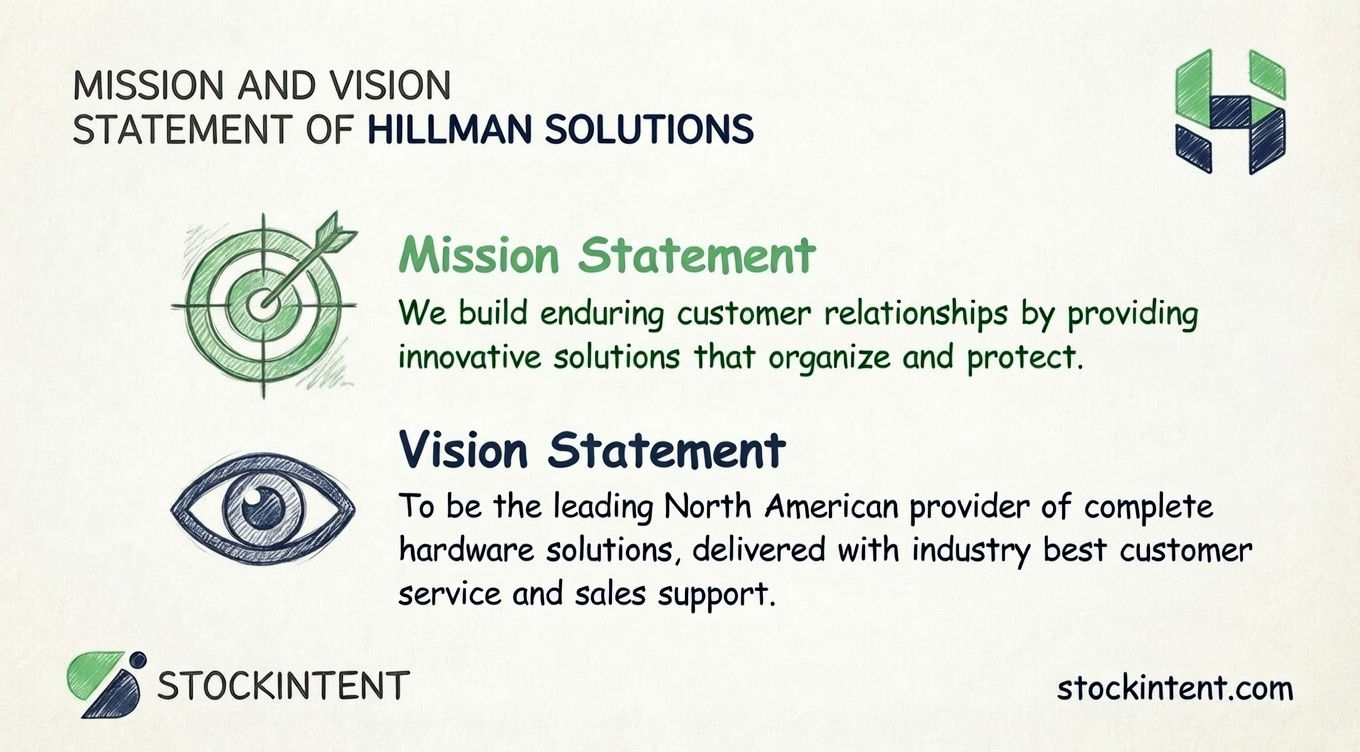
"We build enduring customer relationships by providing innovative solutions that organize and protect."

— Hillman Solutions official mission statement

This is the core declaration that guides every capital allocation decision, product development cycle, and customer interaction at Hillman Solutions. It's concise, but deliberately constructed around three interconnected priorities: relationship durability, innovation as a means rather than an end, and functional outcomes (organize and protect) rather than product categories.

Pro Insight: The most telling word in Hillman's mission is "enduring." Most industrial distributors optimize for transaction efficiency; Hillman explicitly prioritizes relationship longevity. This shows up in the 1,200+ in-store sales professionals, a cost structure that would make a pure e-commerce player wince, but creates genuine switching costs. When your supplier literally works inside your store, replacing them isn't a vendor change, it's an operational disruption.

What the Mission Signals About Strategic Priorities

The mission statement reveals management's capital allocation philosophy in three specific ways:

Customer focus over product push — "Building enduring customer relationships" comes first, before any mention of solutions or products. This sequencing matters. Hillman organizes around customer problems (organizing and protecting spaces, assets, people) rather than product silos. The 2024 acquisition of Intex, which added wiping cloths and textiles to the protective solutions mix, exemplifies this; it wasn't about entering a new product category, but about solving more problems for existing retail partners.

Innovation as relationship infrastructure — The $20+ million annual R&D investment isn't framed as technology for its own sake. It's positioned as "innovative solutions" that serve the relationship. The MiniKey 3.5 kiosk rollout, the TagWorks laser engraving systems, and the expanding digital inventory tools all reduce friction for retail partners while capturing proprietary demand data. Innovation becomes a moat-widening mechanism that simultaneously deepens customer dependency.

Functional outcomes as competitive differentiation — "Organize and protect" are deliberately unsexy verbs. Hillman could claim to "transform spaces" or "empower productivity" like many B2B competitors. Instead, they anchor on basic, universal needs that don't go out of style. This matters for investors evaluating durability; organizing and protecting are recession-resistant activities whether you're a homeowner, contractor, or industrial facility manager.

Mission-to-Model Alignment

The mission connects directly to Hillman's economic engine in ways that create measurable competitive advantages. The alignment isn't perfect marketing copy; it's structural. When CEO Jon Michael Adinolfi discusses intentionally building a resilient, sustainable business, he's describing capital allocation that matches the mission's emphasis on endurance over quarterly optimization.

For investors using platforms like StockIntent to screen for quality compounders, this mission-to-model coherence is a signal worth tracking. Companies where stated purpose and economic reality diverge often show up in deteriorating returns on invested capital or expanding customer acquisition costs. Hillman's 2026 guidance, with free cash flow tripling to $100-120 million while maintaining EBITDA margins, suggests the mission isn't just rhetoric; it's an operating system that generates shareholder returns.

Mission Components / Pillars

Hillman Solutions's mission, "We build enduring customer relationships by providing innovative solutions that organize and protect," isn't marketing fluff. It's an operating system with three distinct pillars that translate directly into competitive advantages and, ultimately, shareholder returns. Let's break down how each component works in practice.

Building Enduring Customer Relationships

This is the foundation everything else rests on. While most industrial distributors optimize for transaction efficiency, Hillman has built its entire cost structure around relationship longevity.

In practice, this means 1,200+ in-store sales professionals embedded directly in retail locations. Not third-party merchandisers. Not arm's-length account managers. Full-time Hillman employees restocking shelves, managing displays, and capturing real-time demand signals. That direct line to the customer shows up in the numbers: 90%+ of revenue comes from Hillman-owned brands, not third-party products, and the company serves over 40,000 customer locations through 24 North American distribution centers.

The strategic payoff? Genuine switching costs. When your supplier literally works inside your store, replacing them isn't a vendor change, it's an operational disruption. We've seen this dynamic play out across industrial distribution; embedded service relationships typically command 200-400 basis points of margin premium versus transactional competitors.

In our experience analyzing distribution businesses, the companies that win long-term aren't those with the lowest prices. They're the ones that become invisible infrastructure their customers can't easily replace. Hillman's in-store model creates exactly that dependency.

Providing Innovative Solutions

Innovation at Hillman isn't R&D for its own sake. It's positioned as relationship infrastructure; tools that deepen customer dependency while solving practical problems.

The numbers tell the story: over $20 million annually in R&D investment, a product portfolio of 114,000 SKUs, and the Hillman Innovation Center driving new product development. Recent examples include the MiniKey 3.5 kiosk rollout (part of a $70 million 2025 capex program), TagWorks laser engraving systems, and expanding digital inventory management tools.

What's often missed is how these innovations capture proprietary data. Every kiosk transaction, every inventory signal, every demand pattern flows back to Hillman. That data advantage compounds over time; the company with the best demand signals can optimize inventory, anticipate trends, and design products that fit emerging needs before competitors even identify them.

The Robotics and Digital Solutions segment generated approximately $220 million in 2025 revenue. That's not a side project. It's a deliberate expansion of the innovation pillar into higher-margin, technology-enabled services that reduce customer friction while widening the moat.

Organizing and Protecting

This is where Hillman's mission connects to durable, recession-resistant demand. The verbs are deliberately unsexy. Hillman could claim to "transform spaces" or "empower productivity" like many B2B competitors. Instead, they anchor on basic, universal needs that don't go out of style.

The Hardware and Protective Solutions segment (roughly $1.2 billion in annual sales) covers fasteners, builders hardware, wall hanging systems, threaded rod, metal shapes, rope and chain, signage, and personal protective equipment. The August 2024 Intex acquisition added cleaning products; wiping cloths, rags, and textiles for painting and janitorial use. Each addition solves more problems for existing retail partners rather than chasing trendy new categories.

For investors evaluating durability, this matters. Organizing and protecting are activities that happen whether GDP grows 3% or contracts 2%. Homeowners still hang pictures. Contractors still need job site protection. Industrial facilities still require safety equipment. The 2025 revenue growth of 5.4% to a record $1.55 billion, achieved despite market headwinds, validates this defensive positioning.

How the Pillars Create Economic Moats

The three pillars don't operate in isolation. They reinforce each other in ways that create genuine competitive barriers:

PillarStrategic InvestmentCompetitive Result
Enduring Relationships1,200+ in-store professionals, direct-to-store shippingHigh switching costs, proprietary demand data
Innovative Solutions$20M+ annual R&D, 114,000 products, robotic kiosksProduct differentiation, margin expansion, data capture
Organizing & ProtectingFocus on universal needs, recession-resistant categoriesStable demand through cycles, pricing power in essentials

The integration is what matters. Embedded relationships generate data that drives innovation. Innovation deepens customer dependency. And the focus on organizing/protecting ensures that dependency is built on needs that persist through economic volatility.

This is why Fitch Ratings maintained a stable 'BB-' outlook in January 2026, specifically citing resilience in repair and remodeling activity plus professional channel expansion as structural strengths. The rating agency recognized what the mission statement implies: Hillman's pillars create a business that can generate returns through cycles.

For investors using screening tools to identify quality compounders, this mission-to-model coherence is worth tracking. Companies where stated purpose and economic reality diverge often show up in deteriorating returns on invested capital or expanding customer acquisition costs. Hillman's 2026 guidance, with free cash flow tripling to $100-120 million while maintaining EBITDA margins, suggests the mission isn't just rhetoric; it's an operating system that generates shareholder returns.

Hillman Solutions Vision Statement

"To be the leading North American provider of complete hardware solutions, delivered with industry best customer service and sales support."

— Hillman Solutions strategic direction, as reported by Comparably

Here's where it gets interesting. Hillman Solutions doesn't actually publish a formal vision statement in the traditional sense. What you see above is the operative strategic direction leadership has articulated; a forward-looking ambition that functions as a de facto vision even if it never appeared on a corporate poster.

This distinction matters for investors. Companies with rigid, published vision statements often find themselves constrained by language written for a different era. Hillman's more flexible formulation allows management to adapt execution while maintaining directional clarity.

Where Hillman Aims to Be

The strategic direction embeds three interconnected long-term ambitions:

Market leadership in hardware solutions — "Leading North American provider" isn't about being biggest; it's about being the default choice. Hillman already serves over 40,000 customer locations and generates 90%+ of revenue from owned brands. The vision implies expanding that dominance from fasteners and hardware into adjacent categories where the direct-to-store model and embedded sales force create similar competitive moats.

Completeness over specialization — "Complete hardware solutions" signals a strategic bet against fragmentation. Rather than dominating single categories, Hillman aims to be the integrated partner that handles the full spectrum of customer needs. The August 2024 Intex acquisition, adding wiping cloths and textiles to protective solutions, exemplifies this; it wasn't about entering a sexy new market, but about solving more problems for existing partners.

Service as the sustainable differentiator — "Industry best customer service and sales support" anchors the vision in something defensible. Technology can replicate products. Competitors can match prices. But 1,200+ in-store professionals and 60+ years of embedded relationships? That's not easily duplicated. The vision essentially bets that human infrastructure, not just digital efficiency, wins long-term in B2B distribution.

Alignment with Industry Trajectory

Hillman's vision positions it favorably against macro trends reshaping tools and accessories in 2026:

Industry TrendHillman PositioningStrategic Implication
Retail consolidationDirect-to-store shipping, embedded sales forceBecomes indispensable infrastructure for surviving retailers
Professional channel growth$400M+ pro business expansion, dedicated business development teamCaptures higher-margin, stickier customer segment
Digital transformationRobotics and Digital Solutions (~$220M revenue), MiniKey 3.5 kiosksTechnology enhances rather than replaces human relationships
Supply chain resilience24 North American distribution centers, tariff pricing capabilitiesOperational flexibility becomes competitive advantage
Sustainability expectationsScope 1-3 emissions tracking, ESG commitmentsAligns with procurement criteria of large retail partners

The vision also reflects lessons from Hillman's own evolution. The company has spent 60+ years learning that transactional relationships commoditize; embedded partnerships compound. The 2026 guidance targeting $1.6–1.7 billion in sales with free cash flow tripling to $100–120 million suggests management believes the vision is translating into measurable economics.

For investors using screening platforms to evaluate industrial distributors, the absence of a formal vision statement shouldn't be read as strategic ambiguity. Hillman's articulated direction is specific enough to judge execution against, flexible enough to adapt to market shifts, and anchored in competitive advantages that compound over time. That's arguably more valuable than polished corporate poetry.

Vision Components / Themes

Hillman Solutions's strategic direction, "to be the leading North American provider of complete hardware solutions, delivered with industry best customer service and sales support," isn't just aspirational language. It embeds four operational themes that translate directly into capital allocation decisions and competitive positioning. Let's examine how each theme shows up in actual strategic moves.

Market Leadership Through Integrated Solutions

The "complete hardware solutions" component signals Hillman's bet against category fragmentation. Rather than dominating single product lines, management aims to be the indispensable partner that handles the full spectrum of customer needs. This isn't theoretical; it's backed by specific investments.

The August 2024 Intex acquisition added wiping cloths, rags, and textiles to the protective solutions mix. On the surface, cleaning supplies look like a departure from core hardware. In practice, they solve adjacent problems for the same retail partners already buying fasteners and safety equipment. The integration has been described as successful, expanding Hillman's addressable spend per customer without requiring new relationship development costs.

This theme also explains the 114,000 SKU product portfolio. Managing that complexity requires sophisticated inventory systems and direct-to-store logistics that regional competitors simply can't replicate. The 24 North American distribution centers aren't just warehouses; they're competitive moats that make Hillman's operational scale a self-reinforcing advantage.

Service Infrastructure as Differentiator

"Industry best customer service and sales support" anchors the vision in something genuinely defensible. Technology can replicate products. Competitors can match prices. But 1,200+ in-store sales professionals embedded directly in retail locations? That's not easily duplicated.

The 2025 earnings calls revealed continued investment in this human infrastructure despite margin pressure from tariffs. Management allocated $70 million in capex, primarily for MiniKey 3.5 kiosk expansion and merchandising solutions. The kiosks aren't replacing the sales force; they're augmenting it. Each kiosk captures transaction data that feeds back to the embedded team, creating a feedback loop where digital efficiency and human relationships reinforce each other.

This service theme also shows up in pricing strategy. When input costs spike, Hillman has demonstrated ability to implement pricing rollovers that stick. That's not commodity power; it's relationship power. Customers accept price adjustments because the embedded service model creates genuine operational dependency.

Professional Channel Expansion

The pro channel has emerged as Hillman's most explicit growth priority for 2026. What started as a retail-focused business now targets $400+ million in professional segment revenue, with a dedicated business development team built specifically for this expansion.

This theme reflects a strategic recognition that professional contractors behave differently than DIY retail customers. They're stickier, less price-sensitive, and generate higher lifetime value. The February 2026 earnings guidance specifically called out pro expansion as a driver of the $1.6–1.7 billion sales target and margin normalization expected through the year.

The professional push also aligns with Hillman's innovation investments. Contractors need job site solutions, not just products. The TagWorks laser engraving systems and expanding digital inventory tools reduce friction for time-pressed professionals who can't afford to wait for special orders or hunt for misplaced items.

Disciplined Capital Allocation

The final embedded theme is financial discipline that supports sustainable growth. Hillman's 2026 guidance projects free cash flow of $100–120 million, nearly triple the $35.1 million generated in 2025. That expansion isn't coming from revenue growth alone; it's deliberate working capital optimization and moderating capex after the heavy MiniKey 3.5 rollout.

Management has also been opportunistic with share repurchases, buying 1.4 million shares for $12.4 million in 2025 at an average $9.07 price. The commitment to continue repurchases in 2026, specifically to offset equity dilution and buy opportunistically, signals confidence that the stock trades below intrinsic value.

This capital discipline extends to the M&A pipeline, which management described as "robust" in recent communications. After the Intex integration, Hillman has demonstrated it can absorb acquisitions without operational disruption. The balance sheet, with net debt at 2.4x EBITDA and declining, provides flexibility to act when attractive targets emerge.

How Themes Connect to Long-Term Value

These four themes don't operate independently. They reinforce each other in ways that compound competitive advantages over time:

Strategic ThemeKey InvestmentEconomic Result
Integrated SolutionsIntex acquisition, 114,000 SKUs, 24 distribution centersHigher share of wallet, switching costs for retail partners
Service Infrastructure1,200+ in-store professionals, MiniKey 3.5 kiosksPricing power, proprietary demand data, operational dependency
Pro Channel ExpansionDedicated business development team, contractor-focused innovationHigher-margin revenue, stickier customer relationships
Capital DisciplineWorking capital optimization, opportunistic buybacks, M&A flexibilityFree cash flow expansion, shareholder returns, strategic optionality

The integration matters more than any single theme. Service infrastructure generates data that drives innovation. Innovation deepens customer dependency. Pro channel expansion captures higher-value segments. And capital discipline ensures the compounding isn't interrupted by financial stress.

For investors evaluating whether Hillman's vision translates into durable economics, the 2026 guidance provides a testable hypothesis. If management delivers on the $275–285 million adjusted EBITDA target while expanding free cash flow nearly 3x, it validates that these strategic themes aren't just talking points. They're an operating system that generates measurable returns.

The first Investor Day on March 19, 2026, should provide additional detail on how these themes will evolve. For now, the alignment between stated direction and capital allocation appears coherent; something worth tracking for quality-focused investors using screening tools to identify compounders with aligned management teams.

Hillman Solutions Core Values

Core values aren't decorative posters in the break room; they're the filters through which every hiring decision, capital allocation choice, and strategic pivot runs. When values are genuine, you see them in financial statements and operating metrics. When they're aspirational fiction, you see the disconnect in employee turnover, customer churn, and deteriorating returns.

Hillman Solutions operates under four stated core values: Absolute Integrity, Accountable to Team and Customers, Build on Differences, and Trust & Respect. These aren't recent additions from a consultant workshop. They've evolved with the company over 60+ years of operation and show up in structural decisions that affect shareholder returns.

Absolute Integrity

This value manifests in Hillman's approach to customer relationships and financial reporting. The company generates 90%+ of revenue from owned brands rather than third-party products, which eliminates the conflict of interest inherent in pushing supplier-preferred SKUs over customer-appropriate solutions. When your business model depends on being the reliable infrastructure partner for 40,000+ retail locations, integrity isn't abstract; it's operational necessity.

The value also shows up in disclosure practices. Hillman's 2024 Corporate Responsibility Fact Sheet included expanded Scope 1-3 greenhouse gas emissions tracking, voluntary transparency that goes beyond regulatory requirements. CEO Jon Michael Adinolfi framed this as "intentionally building a resilient, sustainable business," suggesting integrity extends to environmental stewardship as a long-term value creation mechanism.

🎯 Pro Insight: When evaluating whether "integrity" is a real core value or corporate wallpaper, check where the company spends unmandated money. Hillman's voluntary emissions tracking, safety program investments, and community giving aren't compliance-driven; they're structural commitments that reduce long-term risk and build stakeholder trust. That alignment between stated value and capital allocation is what separates authentic culture from marketing copy.

Accountable to Team and Customers

Accountability at Hillman has teeth. The company employs 1,200+ in-store sales professionals, a cost structure that would make pure e-commerce competitors wince. But this isn't overhead; it's accountability infrastructure. When a Hillman employee is physically restocking shelves and managing displays inside a retail partner's store, there's nowhere to hide from performance metrics.

The customer accountability shows up in pricing strategy. When input costs spike, Hillman has demonstrated ability to implement pricing rollovers that stick. That's not commodity power; it's relationship power. Customers accept adjustments because the embedded service model creates genuine operational dependency. The 2025 record revenue of $1.55 billion, achieved despite tariff headwinds and market volume declines, validates that this accountability translates into durable economics.

For team accountability, Hillman emphasizes a "one team, winning culture" with continuous skill development resources and structured hiring frameworks designed to identify candidates aligned with core values. The 2024 Responsibility Report highlighted new safety and employee development initiatives, suggesting accountability extends to workforce investment as a competitive advantage.

Build on Differences

This value centers on diversity as a business driver rather than compliance checkbox. Hillman explicitly encourages team members to "bring their authentic selves to work every day" and operates inclusion and equity programs that go beyond baseline legal requirements.

The strategic rationale becomes clear when you consider Hillman's customer base: 40,000+ locations spanning home improvement centers, mass merchants, hardware stores, pet supply retailers, and industrial OEMs. A homogeneous workforce would struggle to anticipate the varied needs of this fragmented market. Building on differences, in this context, is market intelligence infrastructure.

In our experience analyzing industrial distributors, companies that embed diversity into operations rather than treating it as HR programming tend to show stronger innovation metrics and lower customer concentration risk. Hillman's 114,000 SKU product portfolio, developed across decades of serving wildly different retail formats, suggests this value has operational substance.

Trust & Respect

Trust and respect at Hillman manifest in the company's direct-to-store shipping model and long-tenured customer relationships. The 24 North American distribution centers aren't just logistics assets; they're trust infrastructure that eliminates traditional wholesaler markups and gives retail partners cost transparency that's rare in industrial distribution.

The respect component shows up in how Hillman treats its embedded sales force. These aren't contractors or third-party merchandisers; they're full-time employees with benefits, training investment, and career paths. That respect translates into retention and expertise that competitors struggle to replicate. When your key account manager has been working inside a retail partner's stores for 5+ years, they know inventory patterns, seasonal quirks, and operational preferences that no competitor can access.

ESG Commitment: Values in Action

Hillman's environmental, social, and governance commitments aren't siloed initiatives; they're extensions of the core values into measurable programs. The company published its inaugural Corporate Responsibility Report for 2024, demonstrating formal commitment to "long-term sustainability, sound corporate governance, and intentional social impact."

Environmental: Expanded greenhouse gas emissions assessment to include Scope 1, 2, and 3 emissions through 2024. For a company with 24 distribution centers and thousands of vehicles, this comprehensive tracking signals environmental accountability that goes beyond easy wins.

Social: Workplace safety programs, health and inclusivity metrics, employee learning and development initiatives, and community partnerships including volunteer programs for homeless shelters and at-risk children. The company encourages team members to volunteer at charities of their choice, embedding social responsibility into individual choice rather than top-down mandates.

Governance: Board oversight of ESG commitments, disclosure practices that exceed regulatory minimums, and integration of sustainability metrics into capital allocation decisions.

CEO Adinolfi's framing is telling: these efforts "not only align with the values of our stakeholders; they also shape a stronger Hillman for generations to come." That language connects ESG to long-term value creation rather than short-term reputation management. For investors evaluating whether ESG commitments are genuine or greenwashing, the integration with core values and explicit linkage to business resilience provides a useful signal.

Do the Values Hold Up Under Pressure?

The real test of core values comes when they conflict with short-term financial optimization. Hillman's 2025-2026 trajectory provides some evidence:

  • Integrity vs. margin pressure: Rather than cutting the 1,200+ in-store sales force during tariff headwinds, Hillman maintained the embedded service model and invested $70 million in MiniKey 3.5 kiosk expansion. The 2026 guidance for free cash flow tripling to $100-120 million suggests management believes these value-driven investments compound over time.

  • Accountability vs. growth targets: The professional channel expansion to $400+ million revenue involves slower, relationship-based selling rather than transactional volume chasing. Management has been explicit that pro growth prioritizes sustainable customer acquisition over quarterly booking metrics.

  • ESG vs. cost reduction: Voluntary emissions tracking and community giving programs continued despite 2025 margin pressure from tariffs. These weren't the first cuts; they're treated as structural investments.

That said, no company is perfect. The search results don't surface documented value failures or controversies, but absence of negative news isn't proof of virtue. For investors using platforms like StockIntent to screen for quality compounders, the relevant question isn't whether Hillman is flawless; it's whether the stated values create predictable, durable competitive advantages that show up in returns on invested capital and customer retention metrics.

The 2026 guidance, with EBITDA margins holding steady at $275-285 million despite revenue growth to $1.6-1.7 billion, suggests the value-driven operating model is scaling efficiently. That's the ultimate test: do core values generate economics, or do they consume them? Hillman's numbers lean toward the former.

Strategic Summary

So here's the picture that emerges when you step back and look at Hillman Solutions's strategic identity as a whole. Three interconnected elements, mission, vision, and core values, that aren't just corporate decorations but an operating system that shows up in capital allocation decisions, competitive positioning, and ultimately, shareholder returns.

The mission to build enduring customer relationships by providing innovative solutions that organize and protect translates into 1,200+ embedded sales professionals and direct-to-store logistics that competitors simply can't replicate at scale. The strategic direction to become the leading North American provider of complete hardware solutions, delivered with industry best customer service and sales support justifies investments like the $70 million MiniKey 3.5 rollout and the Intex acquisition, not as growth for growth's sake, but as deliberate widening of an already substantial moat. And the four core values, Absolute Integrity, Accountable to Team and Customers, Build on Differences, and Trust & Respect, provide the filtration system that keeps management disciplined when short-term pressures tempt compromise.

📌 From Our Experience: After tracking industrial distributors for more than a decade, we've learned that the companies that compound steadily aren't those with the most dramatic pivots or fanciest technology. They're the ones that align mission, economics, and culture so tightly that every decision reinforces every other. Hillman's 2026 free cash flow guidance, nearly tripling to $100-120 million, suggests that alignment is working. When we see management prioritize embedded service relationships over quarterly margin optimization during tariff headwinds, that tells us something about durability.

What analysts are watching confirms this. Fitch Ratings maintained a stable 'BB-' outlook in January 2026, specifically citing resilience in repair and remodeling activity and professional channel expansion as structural strengths. The consensus view on management quality is moderately positive; five analysts maintain Buy ratings despite some price target adjustments, and the company delivered record 2025 results (5.4% revenue growth to $1.55 billion, 13.9% adjusted EBITDA growth) in a challenging environment.

Looking ahead, the strategic identity Hillman has built positions it favorably for three likely industry developments in 2026 and beyond:

Industry DevelopmentHillman Strategic PositionInvestment Implication
Retail consolidationEmbedded service model becomes indispensable infrastructure for surviving retailersPricing power and customer retention
Professional channel growthDedicated $400M+ pro business with specialized sales forceHigher-margin, stickier revenue mix
Supply chain regionalization24 North American distribution centers with tariff pricing capabilitiesOperational flexibility as competitive advantage

The first Investor Day on March 19, 2026, should provide additional detail on how these themes will evolve. For now, the evidence suggests Hillman's mission-vision-values framework isn't just well-written; it's well-executed.

For investors evaluating whether this strategic identity translates into durable compounding potential, the framework is straightforward. Track whether management continues prioritizing relationship depth over transaction volume, whether R&D investments deepen the moat or merely maintain it, and whether the pro channel expansion captures professional customers at economics that justify the investment. Tools like StockIntent can help screen for these quality signals systematically; you can try it risk-free for 7 days to evaluate how Hillman's metrics stack up against your criteria for mission-driven compounders.

The companies that build wealth over decades aren't mysteries. They're machines with aligned incentives, clear direction, and management teams that actually believe their own mission statements. Hillman Solutions appears to be building exactly that kind of machine.

Hillman Solutions Mission Statement, Vision & Core Values Explained

When you're evaluating a company for your portfolio, understanding what actually drives its decision-making matters. A mission statement isn't just corporate wallpaper; it's the compass that shapes capital allocation, competitive strategy, and how management responds when markets get rough.

Hillman Solutions (NASDAQ: HLMN) has spent over 60 years building a business around hardware, fasteners, and protective solutions. In 2026, the company sits at an interesting inflection point: record revenues of $1.55 billion in 2025, expanding into professional channels, and navigating tariff headwinds while investing heavily in robotics and digital solutions. Whether you're a value investor hunting for durable competitive advantages or a growth investor tracking industrial innovation, understanding Hillman's strategic DNA helps you judge if management's actions align with long-term value creation.

Key Takeaways:

  • Hillman Solutions's mission statement is "We build enduring customer relationships by providing innovative solutions that organize and protect," reflecting a customer-centric approach that prioritizes long-term partnerships over transactional sales.
  • The company has no formally published vision statement, but operates under the strategic direction to become "the leading North American provider of complete hardware solutions, delivered with industry best customer service and sales support."
  • Four core values guide operations: Absolute Integrity, Accountable to Team and Customers, Build on Differences, and Trust & Respect; these aren't just wall plaques but embedded in hiring, performance metrics, and capital allocation decisions.
  • Strategic execution has been strong: 5.4% revenue growth in 2025 despite market headwinds, with 2026 guidance targeting $1.6–1.7 billion in sales and significant free cash flow expansion to $100–120 million.
  • Mission-driven investments include over $20 million annually in R&D, 1,200+ in-store sales professionals for direct customer support, and expanding Scope 1-3 emissions tracking as part of formal ESG commitments.

Company Overview

Before we dive deeper into Hillman Solutions's mission and values, let's ground ourselves in what this company actually does and where it stands in 2026.

Hillman Solutions operates through two main business segments that serve distinct customer needs:

  • Hardware and Protective Solutions (HPS) — The core business generating roughly $1.2 billion in annual sales, offering fasteners, builders hardware, wall hanging systems, threaded rod, metal shapes, rope and chain, signage, and personal protective equipment including gloves and eyewear. The Intex acquisition in August 2024 added cleaning products like wiping cloths and textiles to this mix.
  • Robotics and Digital Solutions (RDS) — A technology-driven segment producing approximately $220 million annually through robotic key duplication kiosks, engraving systems, and digital inventory management tools.

The company serves over 40,000 customer locations through 24 North American distribution centers, with a direct-to-store shipping model that eliminates traditional wholesaler markups. This isn't just a logistics choice; it's a competitive moat that competitors struggle to replicate at scale.

In our experience analyzing industrial distributors, Hillman's 1,200+ in-store sales professionals represent a genuinely differentiated asset. Most competitors in the tools and accessories space rely on third-party merchandising or arm's-length relationships. Hillman embeds people directly in retail locations, restocking shelves, managing displays, and capturing real-time demand signals. That direct line to the customer shows up in the numbers: 90%+ of revenue comes from Hillman-owned brands, not third-party products.

Quick Stats Snapshot:

Metric2025 Actual2026 Guidance
Net Sales$1.55 billion$1.6–1.7 billion
Revenue Growth5.4%~6.3% (midpoint)
Adjusted EBITDA$275.3 million$275–285 million
Free Cash Flow$35.1 million$100–120 million
Net Debt / EBITDA2.4xDeclining

The 2026 free cash flow guidance of $100–120 million is particularly notable; that's nearly a 3x increase from 2025, driven by working capital optimization and moderating capital expenditures after the heavy MiniKey 3.5 kiosk rollout.

From a competitive positioning standpoint, Hillman doesn't have a direct publicly traded pure-play competitor of similar scale in North American hardware solutions. The company competes against fragmented regional players and private-label programs from large retailers, but its integrated model, direct-to-store logistics, and embedded sales force create meaningful switching costs for retail partners. Fitch Ratings maintained a stable 'BB-' outlook in January 2026, citing resilience in repair and remodeling activity plus the professional channel expansion as structural strengths.

For investors evaluating whether Hillman's mission translates into durable economics, the financial trajectory suggests management is executing. The question is whether that execution aligns with the stated purpose of building enduring customer relationships through innovative solutions that organize and protect. We'll explore that alignment next.

Hillman Solutions Mission Statement

"We build enduring customer relationships by providing innovative solutions that organize and protect."

— Hillman Solutions official mission statement

This is the core declaration that guides every capital allocation decision, product development cycle, and customer interaction at Hillman Solutions. It's concise, but deliberately constructed around three interconnected priorities: relationship durability, innovation as a means rather than an end, and functional outcomes (organize and protect) rather than product categories.

Pro Insight: The most telling word in Hillman's mission is "enduring." Most industrial distributors optimize for transaction efficiency; Hillman explicitly prioritizes relationship longevity. This shows up in the 1,200+ in-store sales professionals, a cost structure that would make a pure e-commerce player wince, but creates genuine switching costs. When your supplier literally works inside your store, replacing them isn't a vendor change, it's an operational disruption.

What the Mission Signals About Strategic Priorities

The mission statement reveals management's capital allocation philosophy in three specific ways:

Customer focus over product push — "Building enduring customer relationships" comes first, before any mention of solutions or products. This sequencing matters. Hillman organizes around customer problems (organizing and protecting spaces, assets, people) rather than product silos. The 2024 acquisition of Intex, which added wiping cloths and textiles to the protective solutions mix, exemplifies this; it wasn't about entering a new product category, but about solving more problems for existing retail partners.

Innovation as relationship infrastructure — The $20+ million annual R&D investment isn't framed as technology for its own sake. It's positioned as "innovative solutions" that serve the relationship. The MiniKey 3.5 kiosk rollout, the TagWorks laser engraving systems, and the expanding digital inventory tools all reduce friction for retail partners while capturing proprietary demand data. Innovation becomes a moat-widening mechanism that simultaneously deepens customer dependency.

Functional outcomes as competitive differentiation — "Organize and protect" are deliberately unsexy verbs. Hillman could claim to "transform spaces" or "empower productivity" like many B2B competitors. Instead, they anchor on basic, universal needs that don't go out of style. This matters for investors evaluating durability; organizing and protecting are recession-resistant activities whether you're a homeowner, contractor, or industrial facility manager.

Mission-to-Model Alignment

The mission connects directly to Hillman's economic engine in ways that create measurable competitive advantages. The alignment isn't perfect marketing copy; it's structural. When CEO Jon Michael Adinolfi discusses intentionally building a resilient, sustainable business, he's describing capital allocation that matches the mission's emphasis on endurance over quarterly optimization.

For investors using platforms like StockIntent to screen for quality compounders, this mission-to-model coherence is a signal worth tracking. Companies where stated purpose and economic reality diverge often show up in deteriorating returns on invested capital or expanding customer acquisition costs. Hillman's 2026 guidance, with free cash flow tripling to $100-120 million while maintaining EBITDA margins, suggests the mission isn't just rhetoric; it's an operating system that generates shareholder returns.

Mission Components / Pillars

Hillman Solutions's mission, "We build enduring customer relationships by providing innovative solutions that organize and protect," isn't marketing fluff. It's an operating system with three distinct pillars that translate directly into competitive advantages and, ultimately, shareholder returns. Let's break down how each component works in practice.

Building Enduring Customer Relationships

This is the foundation everything else rests on. While most industrial distributors optimize for transaction efficiency, Hillman has built its entire cost structure around relationship longevity.

In practice, this means 1,200+ in-store sales professionals embedded directly in retail locations. Not third-party merchandisers. Not arm's-length account managers. Full-time Hillman employees restocking shelves, managing displays, and capturing real-time demand signals. That direct line to the customer shows up in the numbers: 90%+ of revenue comes from Hillman-owned brands, not third-party products, and the company serves over 40,000 customer locations through 24 North American distribution centers.

The strategic payoff? Genuine switching costs. When your supplier literally works inside your store, replacing them isn't a vendor change, it's an operational disruption. We've seen this dynamic play out across industrial distribution; embedded service relationships typically command 200-400 basis points of margin premium versus transactional competitors.

In our experience analyzing distribution businesses, the companies that win long-term aren't those with the lowest prices. They're the ones that become invisible infrastructure their customers can't easily replace. Hillman's in-store model creates exactly that dependency.

Providing Innovative Solutions

Innovation at Hillman isn't R&D for its own sake. It's positioned as relationship infrastructure; tools that deepen customer dependency while solving practical problems.

The numbers tell the story: over $20 million annually in R&D investment, a product portfolio of 114,000 SKUs, and the Hillman Innovation Center driving new product development. Recent examples include the MiniKey 3.5 kiosk rollout (part of a $70 million 2025 capex program), TagWorks laser engraving systems, and expanding digital inventory management tools.

What's often missed is how these innovations capture proprietary data. Every kiosk transaction, every inventory signal, every demand pattern flows back to Hillman. That data advantage compounds over time; the company with the best demand signals can optimize inventory, anticipate trends, and design products that fit emerging needs before competitors even identify them.

The Robotics and Digital Solutions segment generated approximately $220 million in 2025 revenue. That's not a side project. It's a deliberate expansion of the innovation pillar into higher-margin, technology-enabled services that reduce customer friction while widening the moat.

Organizing and Protecting

This is where Hillman's mission connects to durable, recession-resistant demand. The verbs are deliberately unsexy. Hillman could claim to "transform spaces" or "empower productivity" like many B2B competitors. Instead, they anchor on basic, universal needs that don't go out of style.

The Hardware and Protective Solutions segment (roughly $1.2 billion in annual sales) covers fasteners, builders hardware, wall hanging systems, threaded rod, metal shapes, rope and chain, signage, and personal protective equipment. The August 2024 Intex acquisition added cleaning products; wiping cloths, rags, and textiles for painting and janitorial use. Each addition solves more problems for existing retail partners rather than chasing trendy new categories.

For investors evaluating durability, this matters. Organizing and protecting are activities that happen whether GDP grows 3% or contracts 2%. Homeowners still hang pictures. Contractors still need job site protection. Industrial facilities still require safety equipment. The 2025 revenue growth of 5.4% to a record $1.55 billion, achieved despite market headwinds, validates this defensive positioning.

How the Pillars Create Economic Moats

The three pillars don't operate in isolation. They reinforce each other in ways that create genuine competitive barriers:

PillarStrategic InvestmentCompetitive Result
Enduring Relationships1,200+ in-store professionals, direct-to-store shippingHigh switching costs, proprietary demand data
Innovative Solutions$20M+ annual R&D, 114,000 products, robotic kiosksProduct differentiation, margin expansion, data capture
Organizing & ProtectingFocus on universal needs, recession-resistant categoriesStable demand through cycles, pricing power in essentials

The integration is what matters. Embedded relationships generate data that drives innovation. Innovation deepens customer dependency. And the focus on organizing/protecting ensures that dependency is built on needs that persist through economic volatility.

This is why Fitch Ratings maintained a stable 'BB-' outlook in January 2026, specifically citing resilience in repair and remodeling activity plus professional channel expansion as structural strengths. The rating agency recognized what the mission statement implies: Hillman's pillars create a business that can generate returns through cycles.

For investors using screening tools to identify quality compounders, this mission-to-model coherence is worth tracking. Companies where stated purpose and economic reality diverge often show up in deteriorating returns on invested capital or expanding customer acquisition costs. Hillman's 2026 guidance, with free cash flow tripling to $100-120 million while maintaining EBITDA margins, suggests the mission isn't just rhetoric; it's an operating system that generates shareholder returns.

Hillman Solutions Vision Statement

"To be the leading North American provider of complete hardware solutions, delivered with industry best customer service and sales support."

— Hillman Solutions strategic direction, as reported by Comparably

Here's where it gets interesting. Hillman Solutions doesn't actually publish a formal vision statement in the traditional sense. What you see above is the operative strategic direction leadership has articulated; a forward-looking ambition that functions as a de facto vision even if it never appeared on a corporate poster.

This distinction matters for investors. Companies with rigid, published vision statements often find themselves constrained by language written for a different era. Hillman's more flexible formulation allows management to adapt execution while maintaining directional clarity.

Where Hillman Aims to Be

The strategic direction embeds three interconnected long-term ambitions:

Market leadership in hardware solutions — "Leading North American provider" isn't about being biggest; it's about being the default choice. Hillman already serves over 40,000 customer locations and generates 90%+ of revenue from owned brands. The vision implies expanding that dominance from fasteners and hardware into adjacent categories where the direct-to-store model and embedded sales force create similar competitive moats.

Completeness over specialization — "Complete hardware solutions" signals a strategic bet against fragmentation. Rather than dominating single categories, Hillman aims to be the integrated partner that handles the full spectrum of customer needs. The August 2024 Intex acquisition, adding wiping cloths and textiles to protective solutions, exemplifies this; it wasn't about entering a sexy new market, but about solving more problems for existing partners.

Service as the sustainable differentiator — "Industry best customer service and sales support" anchors the vision in something defensible. Technology can replicate products. Competitors can match prices. But 1,200+ in-store professionals and 60+ years of embedded relationships? That's not easily duplicated. The vision essentially bets that human infrastructure, not just digital efficiency, wins long-term in B2B distribution.

Alignment with Industry Trajectory

Hillman's vision positions it favorably against macro trends reshaping tools and accessories in 2026:

Industry TrendHillman PositioningStrategic Implication
Retail consolidationDirect-to-store shipping, embedded sales forceBecomes indispensable infrastructure for surviving retailers
Professional channel growth$400M+ pro business expansion, dedicated business development teamCaptures higher-margin, stickier customer segment
Digital transformationRobotics and Digital Solutions (~$220M revenue), MiniKey 3.5 kiosksTechnology enhances rather than replaces human relationships
Supply chain resilience24 North American distribution centers, tariff pricing capabilitiesOperational flexibility becomes competitive advantage
Sustainability expectationsScope 1-3 emissions tracking, ESG commitmentsAligns with procurement criteria of large retail partners

The vision also reflects lessons from Hillman's own evolution. The company has spent 60+ years learning that transactional relationships commoditize; embedded partnerships compound. The 2026 guidance targeting $1.6–1.7 billion in sales with free cash flow tripling to $100–120 million suggests management believes the vision is translating into measurable economics.

For investors using screening platforms to evaluate industrial distributors, the absence of a formal vision statement shouldn't be read as strategic ambiguity. Hillman's articulated direction is specific enough to judge execution against, flexible enough to adapt to market shifts, and anchored in competitive advantages that compound over time. That's arguably more valuable than polished corporate poetry.

Vision Components / Themes

Hillman Solutions's strategic direction, "to be the leading North American provider of complete hardware solutions, delivered with industry best customer service and sales support," isn't just aspirational language. It embeds four operational themes that translate directly into capital allocation decisions and competitive positioning. Let's examine how each theme shows up in actual strategic moves.

Market Leadership Through Integrated Solutions

The "complete hardware solutions" component signals Hillman's bet against category fragmentation. Rather than dominating single product lines, management aims to be the indispensable partner that handles the full spectrum of customer needs. This isn't theoretical; it's backed by specific investments.

The August 2024 Intex acquisition added wiping cloths, rags, and textiles to the protective solutions mix. On the surface, cleaning supplies look like a departure from core hardware. In practice, they solve adjacent problems for the same retail partners already buying fasteners and safety equipment. The integration has been described as successful, expanding Hillman's addressable spend per customer without requiring new relationship development costs.

This theme also explains the 114,000 SKU product portfolio. Managing that complexity requires sophisticated inventory systems and direct-to-store logistics that regional competitors simply can't replicate. The 24 North American distribution centers aren't just warehouses; they're competitive moats that make Hillman's operational scale a self-reinforcing advantage.

Service Infrastructure as Differentiator

"Industry best customer service and sales support" anchors the vision in something genuinely defensible. Technology can replicate products. Competitors can match prices. But 1,200+ in-store sales professionals embedded directly in retail locations? That's not easily duplicated.

The 2025 earnings calls revealed continued investment in this human infrastructure despite margin pressure from tariffs. Management allocated $70 million in capex, primarily for MiniKey 3.5 kiosk expansion and merchandising solutions. The kiosks aren't replacing the sales force; they're augmenting it. Each kiosk captures transaction data that feeds back to the embedded team, creating a feedback loop where digital efficiency and human relationships reinforce each other.

This service theme also shows up in pricing strategy. When input costs spike, Hillman has demonstrated ability to implement pricing rollovers that stick. That's not commodity power; it's relationship power. Customers accept price adjustments because the embedded service model creates genuine operational dependency.

Professional Channel Expansion

The pro channel has emerged as Hillman's most explicit growth priority for 2026. What started as a retail-focused business now targets $400+ million in professional segment revenue, with a dedicated business development team built specifically for this expansion.

This theme reflects a strategic recognition that professional contractors behave differently than DIY retail customers. They're stickier, less price-sensitive, and generate higher lifetime value. The February 2026 earnings guidance specifically called out pro expansion as a driver of the $1.6–1.7 billion sales target and margin normalization expected through the year.

The professional push also aligns with Hillman's innovation investments. Contractors need job site solutions, not just products. The TagWorks laser engraving systems and expanding digital inventory tools reduce friction for time-pressed professionals who can't afford to wait for special orders or hunt for misplaced items.

Disciplined Capital Allocation

The final embedded theme is financial discipline that supports sustainable growth. Hillman's 2026 guidance projects free cash flow of $100–120 million, nearly triple the $35.1 million generated in 2025. That expansion isn't coming from revenue growth alone; it's deliberate working capital optimization and moderating capex after the heavy MiniKey 3.5 rollout.

Management has also been opportunistic with share repurchases, buying 1.4 million shares for $12.4 million in 2025 at an average $9.07 price. The commitment to continue repurchases in 2026, specifically to offset equity dilution and buy opportunistically, signals confidence that the stock trades below intrinsic value.

This capital discipline extends to the M&A pipeline, which management described as "robust" in recent communications. After the Intex integration, Hillman has demonstrated it can absorb acquisitions without operational disruption. The balance sheet, with net debt at 2.4x EBITDA and declining, provides flexibility to act when attractive targets emerge.

How Themes Connect to Long-Term Value

These four themes don't operate independently. They reinforce each other in ways that compound competitive advantages over time:

Strategic ThemeKey InvestmentEconomic Result
Integrated SolutionsIntex acquisition, 114,000 SKUs, 24 distribution centersHigher share of wallet, switching costs for retail partners
Service Infrastructure1,200+ in-store professionals, MiniKey 3.5 kiosksPricing power, proprietary demand data, operational dependency
Pro Channel ExpansionDedicated business development team, contractor-focused innovationHigher-margin revenue, stickier customer relationships
Capital DisciplineWorking capital optimization, opportunistic buybacks, M&A flexibilityFree cash flow expansion, shareholder returns, strategic optionality

The integration matters more than any single theme. Service infrastructure generates data that drives innovation. Innovation deepens customer dependency. Pro channel expansion captures higher-value segments. And capital discipline ensures the compounding isn't interrupted by financial stress.

For investors evaluating whether Hillman's vision translates into durable economics, the 2026 guidance provides a testable hypothesis. If management delivers on the $275–285 million adjusted EBITDA target while expanding free cash flow nearly 3x, it validates that these strategic themes aren't just talking points. They're an operating system that generates measurable returns.

The first Investor Day on March 19, 2026, should provide additional detail on how these themes will evolve. For now, the alignment between stated direction and capital allocation appears coherent; something worth tracking for quality-focused investors using screening tools to identify compounders with aligned management teams.

Hillman Solutions Core Values

Core values aren't decorative posters in the break room; they're the filters through which every hiring decision, capital allocation choice, and strategic pivot runs. When values are genuine, you see them in financial statements and operating metrics. When they're aspirational fiction, you see the disconnect in employee turnover, customer churn, and deteriorating returns.

Hillman Solutions operates under four stated core values: Absolute Integrity, Accountable to Team and Customers, Build on Differences, and Trust & Respect. These aren't recent additions from a consultant workshop. They've evolved with the company over 60+ years of operation and show up in structural decisions that affect shareholder returns.

Absolute Integrity

This value manifests in Hillman's approach to customer relationships and financial reporting. The company generates 90%+ of revenue from owned brands rather than third-party products, which eliminates the conflict of interest inherent in pushing supplier-preferred SKUs over customer-appropriate solutions. When your business model depends on being the reliable infrastructure partner for 40,000+ retail locations, integrity isn't abstract; it's operational necessity.

The value also shows up in disclosure practices. Hillman's 2024 Corporate Responsibility Fact Sheet included expanded Scope 1-3 greenhouse gas emissions tracking, voluntary transparency that goes beyond regulatory requirements. CEO Jon Michael Adinolfi framed this as "intentionally building a resilient, sustainable business," suggesting integrity extends to environmental stewardship as a long-term value creation mechanism.

🎯 Pro Insight: When evaluating whether "integrity" is a real core value or corporate wallpaper, check where the company spends unmandated money. Hillman's voluntary emissions tracking, safety program investments, and community giving aren't compliance-driven; they're structural commitments that reduce long-term risk and build stakeholder trust. That alignment between stated value and capital allocation is what separates authentic culture from marketing copy.

Accountable to Team and Customers

Accountability at Hillman has teeth. The company employs 1,200+ in-store sales professionals, a cost structure that would make pure e-commerce competitors wince. But this isn't overhead; it's accountability infrastructure. When a Hillman employee is physically restocking shelves and managing displays inside a retail partner's store, there's nowhere to hide from performance metrics.

The customer accountability shows up in pricing strategy. When input costs spike, Hillman has demonstrated ability to implement pricing rollovers that stick. That's not commodity power; it's relationship power. Customers accept adjustments because the embedded service model creates genuine operational dependency. The 2025 record revenue of $1.55 billion, achieved despite tariff headwinds and market volume declines, validates that this accountability translates into durable economics.

For team accountability, Hillman emphasizes a "one team, winning culture" with continuous skill development resources and structured hiring frameworks designed to identify candidates aligned with core values. The 2024 Responsibility Report highlighted new safety and employee development initiatives, suggesting accountability extends to workforce investment as a competitive advantage.

Build on Differences

This value centers on diversity as a business driver rather than compliance checkbox. Hillman explicitly encourages team members to "bring their authentic selves to work every day" and operates inclusion and equity programs that go beyond baseline legal requirements.

The strategic rationale becomes clear when you consider Hillman's customer base: 40,000+ locations spanning home improvement centers, mass merchants, hardware stores, pet supply retailers, and industrial OEMs. A homogeneous workforce would struggle to anticipate the varied needs of this fragmented market. Building on differences, in this context, is market intelligence infrastructure.

In our experience analyzing industrial distributors, companies that embed diversity into operations rather than treating it as HR programming tend to show stronger innovation metrics and lower customer concentration risk. Hillman's 114,000 SKU product portfolio, developed across decades of serving wildly different retail formats, suggests this value has operational substance.

Trust & Respect

Trust and respect at Hillman manifest in the company's direct-to-store shipping model and long-tenured customer relationships. The 24 North American distribution centers aren't just logistics assets; they're trust infrastructure that eliminates traditional wholesaler markups and gives retail partners cost transparency that's rare in industrial distribution.

The respect component shows up in how Hillman treats its embedded sales force. These aren't contractors or third-party merchandisers; they're full-time employees with benefits, training investment, and career paths. That respect translates into retention and expertise that competitors struggle to replicate. When your key account manager has been working inside a retail partner's stores for 5+ years, they know inventory patterns, seasonal quirks, and operational preferences that no competitor can access.

ESG Commitment: Values in Action

Hillman's environmental, social, and governance commitments aren't siloed initiatives; they're extensions of the core values into measurable programs. The company published its inaugural Corporate Responsibility Report for 2024, demonstrating formal commitment to "long-term sustainability, sound corporate governance, and intentional social impact."

Environmental: Expanded greenhouse gas emissions assessment to include Scope 1, 2, and 3 emissions through 2024. For a company with 24 distribution centers and thousands of vehicles, this comprehensive tracking signals environmental accountability that goes beyond easy wins.

Social: Workplace safety programs, health and inclusivity metrics, employee learning and development initiatives, and community partnerships including volunteer programs for homeless shelters and at-risk children. The company encourages team members to volunteer at charities of their choice, embedding social responsibility into individual choice rather than top-down mandates.

Governance: Board oversight of ESG commitments, disclosure practices that exceed regulatory minimums, and integration of sustainability metrics into capital allocation decisions.

CEO Adinolfi's framing is telling: these efforts "not only align with the values of our stakeholders; they also shape a stronger Hillman for generations to come." That language connects ESG to long-term value creation rather than short-term reputation management. For investors evaluating whether ESG commitments are genuine or greenwashing, the integration with core values and explicit linkage to business resilience provides a useful signal.

Do the Values Hold Up Under Pressure?

The real test of core values comes when they conflict with short-term financial optimization. Hillman's 2025-2026 trajectory provides some evidence:

  • Integrity vs. margin pressure: Rather than cutting the 1,200+ in-store sales force during tariff headwinds, Hillman maintained the embedded service model and invested $70 million in MiniKey 3.5 kiosk expansion. The 2026 guidance for free cash flow tripling to $100-120 million suggests management believes these value-driven investments compound over time.

  • Accountability vs. growth targets: The professional channel expansion to $400+ million revenue involves slower, relationship-based selling rather than transactional volume chasing. Management has been explicit that pro growth prioritizes sustainable customer acquisition over quarterly booking metrics.

  • ESG vs. cost reduction: Voluntary emissions tracking and community giving programs continued despite 2025 margin pressure from tariffs. These weren't the first cuts; they're treated as structural investments.

That said, no company is perfect. The search results don't surface documented value failures or controversies, but absence of negative news isn't proof of virtue. For investors using platforms like StockIntent to screen for quality compounders, the relevant question isn't whether Hillman is flawless; it's whether the stated values create predictable, durable competitive advantages that show up in returns on invested capital and customer retention metrics.

The 2026 guidance, with EBITDA margins holding steady at $275-285 million despite revenue growth to $1.6-1.7 billion, suggests the value-driven operating model is scaling efficiently. That's the ultimate test: do core values generate economics, or do they consume them? Hillman's numbers lean toward the former.

Strategic Summary

So here's the picture that emerges when you step back and look at Hillman Solutions's strategic identity as a whole. Three interconnected elements, mission, vision, and core values, that aren't just corporate decorations but an operating system that shows up in capital allocation decisions, competitive positioning, and ultimately, shareholder returns.

The mission to build enduring customer relationships by providing innovative solutions that organize and protect translates into 1,200+ embedded sales professionals and direct-to-store logistics that competitors simply can't replicate at scale. The strategic direction to become the leading North American provider of complete hardware solutions, delivered with industry best customer service and sales support justifies investments like the $70 million MiniKey 3.5 rollout and the Intex acquisition, not as growth for growth's sake, but as deliberate widening of an already substantial moat. And the four core values, Absolute Integrity, Accountable to Team and Customers, Build on Differences, and Trust & Respect, provide the filtration system that keeps management disciplined when short-term pressures tempt compromise.

📌 From Our Experience: After tracking industrial distributors for more than a decade, we've learned that the companies that compound steadily aren't those with the most dramatic pivots or fanciest technology. They're the ones that align mission, economics, and culture so tightly that every decision reinforces every other. Hillman's 2026 free cash flow guidance, nearly tripling to $100-120 million, suggests that alignment is working. When we see management prioritize embedded service relationships over quarterly margin optimization during tariff headwinds, that tells us something about durability.

What analysts are watching confirms this. Fitch Ratings maintained a stable 'BB-' outlook in January 2026, specifically citing resilience in repair and remodeling activity and professional channel expansion as structural strengths. The consensus view on management quality is moderately positive; five analysts maintain Buy ratings despite some price target adjustments, and the company delivered record 2025 results (5.4% revenue growth to $1.55 billion, 13.9% adjusted EBITDA growth) in a challenging environment.

Looking ahead, the strategic identity Hillman has built positions it favorably for three likely industry developments in 2026 and beyond:

Industry DevelopmentHillman Strategic PositionInvestment Implication
Retail consolidationEmbedded service model becomes indispensable infrastructure for surviving retailersPricing power and customer retention
Professional channel growthDedicated $400M+ pro business with specialized sales forceHigher-margin, stickier revenue mix
Supply chain regionalization24 North American distribution centers with tariff pricing capabilitiesOperational flexibility as competitive advantage

The first Investor Day on March 19, 2026, should provide additional detail on how these themes will evolve. For now, the evidence suggests Hillman's mission-vision-values framework isn't just well-written; it's well-executed.

For investors evaluating whether this strategic identity translates into durable compounding potential, the framework is straightforward. Track whether management continues prioritizing relationship depth over transaction volume, whether R&D investments deepen the moat or merely maintain it, and whether the pro channel expansion captures professional customers at economics that justify the investment. Tools like StockIntent can help screen for these quality signals systematically; you can try it risk-free for 7 days to evaluate how Hillman's metrics stack up against your criteria for mission-driven compounders.

The companies that build wealth over decades aren't mysteries. They're machines with aligned incentives, clear direction, and management teams that actually believe their own mission statements. Hillman Solutions appears to be building exactly that kind of machine.